ISSN Online: 2327-4379 ISSN Print: 2327-4352
DOI: 10.4236/jamp.2019.711197 Nov. 27, 2019 2883 Journal of Applied Mathematics and Physics
Forest-Fire Recognition by Sparse and
Collaborative Subspace Clustering
Zhen Ye
1*, Yifu Jiang
2, Shihao Shi
1, Jiefei Yan
1, Lin Bai
11School of Electronics and Control Engineering, Chang’an University, Xi’an, China
2School of Electronics and Information Engineering, Beijing Jiaotong University, Beijing, China
Abstract
Traditional forest-fire recognition based on the characteristics of smoke, temperature and light fails to accurately detect and respond to early fires. By analyzing the characteristics of flame, the methods based on aerial image recognition have been widely used, such as RGB-based and HIS-based me-thods. However, these methods are susceptible to background factors causing interference and false detection. To alleviate these problems, we investigate two subspace clustering methods based on sparse and collaborative represen-tation, respectively, to detect and locate forest fires. Firstly, subspace cluster-ing segments flame from the whole image. Afterwards, sparse or collaborative representation is employed to represent most of the flame information in a dictionary with l1-regularization or l2-regularization term, which results in fewer reconstruction errors. Experimental results show that the proposed SSC and CSC substantially outperform the state-of-the art methods.
Keywords
Forest Fires, Flame Recognition, Sparse Subspace Clustering (SSC), Collaborative Subspace Clustering (CSC)
1. Introduction
Forest fires destroy forests and undergrowth plants, endanger human beings and wildlife, pollute soil and air, affect water cycle, and so on. In order to protect the ecological environment and human security, early fire detection is a necessary step for forest fire warning. Conventional detection methods use the characteris-tics of smoke, temperature and light to monitor fires. However, these methods can’t respond quickly to early fire when the forest environment is bad, and the fires may not be detected immediately if it is far away from the sensors [1]. The
How to cite this paper: Ye, Z., Jiang, Y.F., Shi, S.H., Yan, J.F. and Bai, L. (2019) For-est-Fire Recognition by Sparse and
Colla-borative Subspace Clustering. Journal of
Applied Mathematics and Physics, 7, 2883-2890.
https://doi.org/10.4236/jamp.2019.711197
DOI: 10.4236/jamp.2019.711197 2884 Journal of Applied Mathematics and Physics methods based upon aerial image recognition avoid the adverse effects (e.g. space, height and airflow), by analyzing the characteristics of flame (e.g. color, area and location), to detect and locate forest fires accurately. Arguably, flame recognition has been the key to the success of early fire detection [2].
RGB (red, green, and blue) and HIS (hue, intensity and saturation)-based methods mainly make use of color information in flame recognition recent years [3] [4]. RGB-based methods employ color features to recognize fire areas by segmenting objects in a specified color range in RGB images [5]. In these me-thods, RGB vector m is used to represent the average color estimation. If the color of some pixels is within a certain range of the vector m, these pixels will be recognized and classified. The following comparation method RGB employs the Euclidean distance [6] as the classification range. On the other hand, HIS-based methods employ hue, light intensity and saturation as features for flame recog-nition. In general, the flame colors are usually yellow, red and orange, and the flame hue is distributed in 0 - 60 degrees. Due to the light intensity of back-ground, the flame saturation may be affected, causing interference and false de-tection [7].
Since the sparse coefficients can result in fewer reconstruction errors and can represent most of the important information in a dictionary, we investigate sparse subspace clustering (SSC) for flame recognition to improve the recogni-tion accuracy. Given a set of pixels drawn from a union of linear or affine sub-spaces, the task is to find segmentation of forest-fire images. Because each pixel in a union of subspaces can always be written as a linear or affine combination of all other pixels, the representation of pixels in the same subspace can be obtained by searching for the sparsest combination. Thus, a similarity matrix will be es-tablished for flame segmentation by sparse subspace clustering. Since the com-binatorial l0-norm minimization is NP-hard, SSC estimates similarity matrix by imposing l1-norm optimization [8]. We also studied collaborative representa-tion clustering (CSC) [9] whose similarity matrix is employed by imposing l2 -norm optimization instead of l1-norm optimization, which means that the “collaborative” nature is instead of “competitive” nature of forest-fire images.
The main contributions of this paper are summarized as follows. 1) The pro-posed approaches are unsupervised methods requiring no initialization. 2) Our work is the first one to employ the spare or collaborative representation of vec-tors in subspace clustering for forest-fire recognition. 3) The proposed ap-proaches, whose objective function is optimized by l1-norm optimization or l2 -norm optimization fully exploiting the internal relationship among pixels, pro-duces stronger ability of discrimination compared with traditional methods (i.e., RGB and HIS) by conducting experiments on three forest-fire images.
DOI: 10.4236/jamp.2019.711197 2885 Journal of Applied Mathematics and Physics
2. Approach
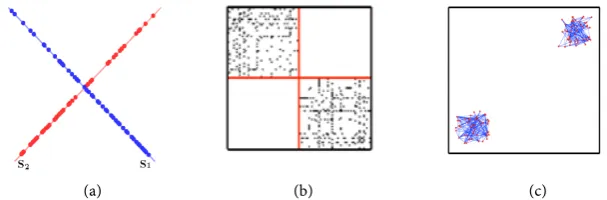
The basic idea of subspace clustering is to extract a set of points from linear or affine subspace and to find the segments of data. Since each data point in the union set of a subspace can always be written as a linear or affine combination of other points, the sparse or collaborative expression-based subspace clustering me-thod uses the low-dimensional representation of the data in the high-dimensional space by searching the most sparse or collaborative combination. This enables us to establish a similarity matrix and segment flame by spectral clustering. Since the combinatorial l0-norm minimization is NP-hard, the l1-norm minimiza-tion and l2-norm minimization employed in sparse subspace clustering and collaborative subspace clustering, respectively. Thus, spectral clustering method is applied to the similarity graph formed by sparse coefficient or collaborative coefficient to realize the detection and recognition of forest-fire images. Figure 1 shows an example of data drawn from two subspaces, the corresponding adja-cency matrix and similarity graph. For each data point, the l1-minimization or
2
l -minimization gives subspace-preserving representation, hence the adjacency matrix has a block-diagonal structure and the similarity graph has two con-nected components. Using spectral clustering methods, we can recover the components of the similarity graph, obtaining the segmentation of forest-fire data.
The proposed sparse subspace clustering (SSC) algorithm will be discussed in the following. Let X=
{
X1,,XN}
be N subspaces of dimensions { , , }d1 dNembedded in D dimensional space. Consider a given collection of M points 1
{ , , M}
=
ψ ψ ψ drawn from the N subspaces. Wherein, Y can be
represented by sparse representation if Y is a linear combination of at most K (K<<N) basis vectors in ψ. In practice, the signal is K-sparse when it has at most K large nonzero coefficients and the remaining coefficients are very small [10]. We can write Y as
1
M j j j= =
∑
Y X ψ
(1)
Y and X belong to the space domain and the subspace domain, respectively. The idea is based on the observation that each data point can be described as a linear combination of all the other data points in subspace domain.
[image:3.595.221.525.593.693.2]
(a) (b) (c)
DOI: 10.4236/jamp.2019.711197 2886 Journal of Applied Mathematics and Physics For separating X into different class-specific representations, we need to calculate
i= i
x Xw (2)
W is the similarity matrix whose ith column corresponds to the sparse repre-sentation of xi. For each pixel xi in the dictionary X, the sparse
representa-tion vector is calculated by solving the l1-norm optimization problem
2 1
min . .
i i s t i i− i ≤ε
w w X w x (3)
where Xi does not include xi itself, wi=[ ,w wi1 i2, , wiN] is the sparse
re-presentation vector corresponding to xi of size N×1, and ε >0 is a small
tolerance. Thus, the similarity (or affinity) matrix W is described as
' ' ' ' ' , , ' , 1 0, ( ) , , s i i i i
i i i i i i i i − =
= >
< W w w (4)
The generalized eigenvalue problem can be expressed as
{
2}
2 1
min
i i− i i +λ i
w x X w w (5)
where λ is a Lagrange multiplier balancing the minimization between regula-rization term and residual part [11]. The procedure of SSC is outlined in Algo-rithm 1.
Algorithm 1 SSC for Segmentation
Input: A set of points { }1
N i i= = ∈
Y y lying in a union of N subspaces { }1
N i i= =
X x . Normalize the columns of X.
Obtain a similarity graph (matrix) via solving (5). Apply spectral clustering to the similarity graph. Output: Segmentation of the data.
In the next, collaborative subspace clustering (CSC) is also proposed to inves-tigate the collaborative nature of forest-fire images. Collaborative representation is studied to estimate the similarity matrix by replacing the l1-norm minimiza-tion in solving the weight matrix with an l2-norm minimization. The segmen-tation of forest-fire images is found by applying spectral clustering to a similarity graph formed by the collaborative coefficients. The collaborative representation vector for xi is calculated by solving the l2-norm optimization problem
2
min . .
i i s t i i= i
w w X w x (6)
where Xi does not include xi itself, and wi =[w wi1, i2, , wiN] is the
col-laborative representation vector corresponding to xi of size (N− ×1) 1. The
objective function can be reformulated as
{
2 2}
2 2
min
i i− i i +λ i
DOI: 10.4236/jamp.2019.711197 2887 Journal of Applied Mathematics and Physics The regularization parameter λ does two things: it makes the least square solution stable; and it introduces a weaker “sparsity” than that by l1-norm mi-nimization to the solution depicted as Equation (6). The collaborative represen-tation vector can be calculated as
1
( T ) T . i = i i +λ − i i
w X X I X x (8)
Similarity matrix W=[ ,w w1 2, , wN] represents the graph weight matrix of
size N N× and diag( )W is a zero vector. The graph weight matrix can be calculated by within-class samples to generate class-specific collaborative coeffi-cients. The procedure of the proposed CSC is outlined in Algorithm 2.
Algorithm 2 CSC for Segmentation
Input: A set of points { }1
N i i= = ∈
Y y lying in a union of N subspaces { }1
N i i= =
X x . Solve the sparse optimization problem by Equation (7).
Normalize the columns of X.
Obtain a similarity graph (matrix) with N nodes representing the data points by Equation (8). Apply spectral clustering to the similarity graph.
Output: Segmentation of the data.
3. Experimental Results
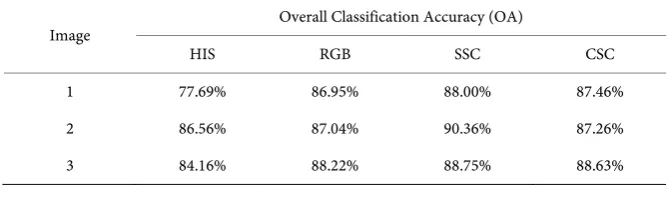
Experiments are conducted using three forest-fire images, which are represent a forest-fire scenario with 55 × 59 pixels, 79 × 63 pixels, and 58 × 51 pixels. To quantify the efficacy of the proposed two approaches, we study the classification performance of them and two state-of-the-art methods (HIS and RGB) for clas-sifying forest-fire data. Table 1 shows the classification results with the overall classification accuracy (OA). From this table, we can see that the proposed me-thods are superior to HIS and RGB. In particular, the proposed SSC has more significant advantage in classification accuracy. For example, the OA of SSC has improvements of 10.31% and 1.05% for image 1 compared with HIS and RGB, respectively; the OA of SSC has improvements of 3.8% and 3.32% for image 2 compared with HIS and RGB, respectively.
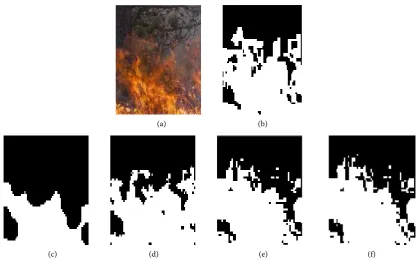
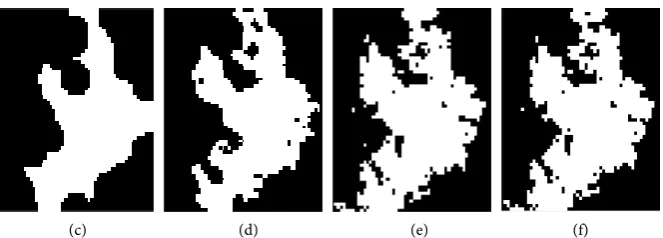
[image:5.595.205.540.629.729.2]Figures 2-4 provide the classification maps of the aforementioned methods for the forest-fire images. From the classification maps, it can be seen that the proposed SSC and CSC have better classification performance of details, which can play a positive role in the assessment of fire severity and areas.
Table 1. Classification results for the four methods.
Image Overall Classification Accuracy (OA)
HIS RGB SSC CSC
1 77.69% 86.95% 88.00% 87.46%
2 86.56% 87.04% 90.36% 87.26%
DOI: 10.4236/jamp.2019.711197 2888 Journal of Applied Mathematics and Physics
(a) (b)
[image:6.595.122.542.66.326.2]
(c) (d) (e) (f)
Figure 2. Classification maps of four approaches for image 1. (a) Image 1; (b) Ground-truth; (c) HIS; (d) RGB; (e) SSC; (f) CSC.
(a) (b)
[image:6.595.125.539.366.564.2](c) (d) (e) (f)
Figure 3. Classification maps of four approaches for image 3. (a) Image 3; (b) Ground-truth; (c) HIS; (d) RGB; (e) SSC; (f) CSC.
DOI: 10.4236/jamp.2019.711197 2889 Journal of Applied Mathematics and Physics
[image:7.595.208.540.67.186.2](c) (d) (e) (f)
Figure 4. Classification maps of four approaches for image 2. (a) Image 2; (b) Ground-truth; (c) HIS; (d) RGB; (e) SSC; (f) CSC.
4. Conclusion
In this paper, we propose two unsupervised classification methods based on sparse or collaborative representation of vectors in subspace clustering for for-est-fire recognition. These strategies employing l1-norm or l2-norm optimiza-tion exploits the internal relaoptimiza-tionship among pixels and produces stronger ability of discrimination. Experimental results show that the proposed methods sub-stantially outperform the state-of-the-art methods. We hence conclude that the proposed SSC and CSC approach are two effective approaches for forest-fire recognition.
Acknowledgements
This research was supported by the National Natural Science Foundation of China (41601344, 61803042).
Conflicts of Interest
The authors declare no conflicts of interest regarding the publication of this pa-per.
References
[1] Wang, Y.B. and Ma, X.M. (2014) Early Fire Detection for High Space Based on Video-Image Processing. 2014 International Symposium on Computer, Consumer and Control, Taichung, 10-12 June 2014.
[2] Qiu, T., Yan, Y. and Lu, G. (2012) An Autoadaptive Edge-Detection Algorithm for Flame and Fire Image Processing. IEEE Transactions on Instrumentation and Mea-surement, 61, 1486-1493. https://doi.org/10.1109/TIM.2011.2175833
[3] Wang, L. and Li, A.G. (2017) Early fire recognition based on Multi-Feature Fusion of Video Smoke. The 36th Chinese Control Conference, Dalian, 26-28 July 2017. https://doi.org/10.23919/ChiCC.2017.8028197
[4] Chen, T.-H., Wu, P.-H. and Chiou, Y.-C. (2004) An Early Fire-Detection Method Based on Image Processing. 2004 International Conference on Image Processing, Singapore, 24-27 October 2004.
[5] Gonzalez, R.C. and Woods, R.E. (2017) Digital Image Processing. Publishing House of Electronics Industry, Beijing.
DOI: 10.4236/jamp.2019.711197 2890 Journal of Applied Mathematics and Physics Fuzzy Color Spaces: A Conceptual Approach to Color Vision. IEEE Transaction on Fuzzy Systems, 25, 1264-1280. https://doi.org/10.1109/TFUZZ.2016.2612259 [7] Celik, T. and Demirel, H. (2009) Fire Safety in Video Sequence Using a Generic
Color Model. Fire Safety, 44, 951-61. https://doi.org/10.1016/j.firesaf.2008.05.005 [8] Elhamifar, E. and Vidal, R. (2013) Sparse Subspace Clustering: Algorithm, Theory,
and Applications. IEEE Transactions on Pattern Analysis and Machine Intelligence, 35, 2765-2781. https://doi.org/10.1109/TPAMI.2013.57
[9] Zhang, Y.B., Zhang, Y.L., Zhang, J. and Dai, Q.H. (2016) CCR: Clustering and Col-laborative Representation for Fast Single Image Super-Resolution. IEEE Transac-tions on Multimedia, 18, 405-417. https://doi.org/10.1109/TMM.2015.2512046 [10]Elhamifar, E. and Vidal, R. (2009) Sparse Subspace Clustering. IEEE Computer
So-ciety Conference on Computer Vision and Pattern Recognition, Miami, 20-25 June 2009. https://doi.org/10.1109/CVPR.2009.5206547