ORIGINAL RESEARCH
INTERVENTIONAL
e-ASPECTS Correlates with and Is Predictive of Outcome after
Mechanical Thrombectomy
XJ. Pfaff,XC. Herweh,XS. Schieber,XS. Scho¨nenberger,XJ. Bo¨sel,XP.A. Ringleb,XM. Mo¨hlenbruch, XM. Bendszus, andXS. Nagel
ABSTRACT
BACKGROUND AND PURPOSE: The e-ASPECTS software is a tool for the automated use of ASPECTS. Our aim was to analyze whether baseline e-ASPECT scores correlate with outcome after mechanical thrombectomy.
MATERIALS AND METHODS: Patients with ischemic strokes in the anterior circulation who were admitted between 2010 and 2015, diagnosed by CT, and received mechanical thrombectomy were included. The ASPECTS on baseline CT was scored by e-ASPECTS and 3 expert raters, and interclass correlation coefficients were calculated. The e-ASPECTS was correlated with functional outcome (modified Rankin Scale) at 3 months by using the Spearman rank correlation coefficient. Unfavorable outcome was defined as mRS 4 – 6 at 3 months, and a poor scan was defined as e-ASPECTS 0 –5.
RESULTS:Two hundred twenty patients were included, and 147 (67%) were treated with bridging protocols. The median e-ASPECTS was 9 (interquartile range, 8 –10). Intraclass correlation coefficients between e-ASPECTS and raters were 0.72, 0.74, and 0.76 (all,P⬍.001). e-ASPECTS (Spearman rank correlation coefficient⫽ ⫺0.15,P⫽.027) correlated with mRS at 3 months. Patients with unfavorable outcome had lower e-ASPECTS (median, 8; interquartile range, 7–10 versus median, 9; interquartile range, 8 –10;P⫽.014). Sixteen patients (7.4%) had a poor scan, which was associated with unfavorable outcome (OR, 13.6; 95% CI, 1.8 –104). Independent predictors of unfavorable outcome were e-ASPECTS (OR, 0.79; 95% CI, 0.63– 0.99), blood sugar (OR, 1.01; 95% CI, 1.004 –1.02), atrial fibrillation (OR, 2.64; 95% CI, 1.22–5.69), premorbid mRS (OR, 1.77; 95% CI, 1.21–2.58), NIHSS (OR, 1.11; 95% CI, 1.04 –1.19), general anesthesia (OR, 0.24; 95% CI, 0.07– 0.84), failed recanalization (OR, 8.47; 95% CI, 3.5–20.2), and symptomatic intracerebral hemorrhage (OR, 25.8; 95% CI, 2.5–268).
CONCLUSIONS: The e-ASPECTS correlated with mRS at 3 months and was predictive of unfavorable outcome after mechanical throm-bectomy, but further studies in patients with poor scan are needed.
ABBREVIATIONS:AIS⫽acute ischemic stroke; MT⫽mechanical thrombectomy; sICH⫽symptomatic intracranial hemorrhage
M
echanical thrombectomy (MT) in acute ischemic stroke (AIS) due to a large intracranial vessel occlusion in the an-terior circulation has been proven to be an effective therapy.1-5With the success of the recent trials, an increasing number of patients with AIS will be evaluated for eligibility for this therapy. However, because there are no strict ex-/inclusion guidelines,6
patient selection for MT remains a challenging process. In the
end, this evaluation process should not withhold therapy from patients who might benefit from MT but should preclude patients who will not benefit. During the evaluation process, multiple fac-tors need to be cautiously reviewed. Noncontrast CT is still the most available imaging tool worldwide. Early signs of infarction on NCCT scans are a potent predictor of clinical outcome in pa-tients with AIS.7In 2000, Barber et al8introduced the Alberta
Stroke Program Early CT Score. ASPECTS divides the middle cerebral artery territory into 10 predefined anatomic areas and grades the presence of early infarct signs by parenchymal hy-podensity on NCCT. This increasingly used score has already proved a reliable predictor of clinical outcome in patients with AIS treated with intravenous rtPA and/or MT.8-10
Unfortunately, the determination of early signs of ischemia and their translation into the ASPECTS have a considerable inter-rater variability, which is, among other factors, influenced by inter-rater experience.11-13However, during the evaluation process for
per-Received January 12, 2017; accepted after revision March 22.
From the Departments of Neuroradiology (J.P., C.H., M.M., M.B.) and Neurology (S. Shieber, S. Scho¨nenberger, J.B., P.A.R., S.N.), University of Heidelberg, Heidelberg, Germany.
Please address correspondence to Simon Nagel, MD, Universita¨t Heidelberg, Abteilung fu¨r Neurologie, Im Neuenheimer Feld 400, 69120 Heidelberg, Germany; e-mail: [email protected]
Indicates open access to non-subscribers at www.ajnr.org Indicates article with supplemental on-line table.
forming MT or before transfer of a patient to a comprehensive stroke center performing MT, scoring variability could negatively influence the decision-making process and lead to false patient in-/exclusion. The e-ASPECTS software (Brainomix, Oxford, UK; www.brainomix.com) is a standardized, fully automated, CE mark–approved ASPECTS scoring tool for NCCT, which has pre-viously demonstrated scoring on an expert level.14,15We analyzed
whether e-ASPECT scores correlate with outcome after mechan-ical thrombectomy and whether low scores are predictors of un-favorable outcome. In particular, we were interested in whether patients with low e-ASPECTS (0 –5, poor scans) were very likely to have a bad outcome.
MATERIALS AND METHODS
From a prospectively collected stroke data base, we identified 430 patients with AIS in the anterior circulation who underwent MT between May 2010 and May 2015. All patients were treated with endovascular revascularization therapy and, in case of eligibility, with intravenous thrombolysis after an interdisciplinary decision by the neurologist and neurointerventionalist on call. Histori-cally, during MT, patients were treated under general anesthesia; and since 2009, we have been following a strict standardized op-erating procedure. In September 2013, an additional standardized operating procedure for conscious sedation was introduced, and selected patients were treated following this procedure with MT. Since April 2014, eligible patients were included in our single-center randomized sedation trial, Sedation vs. Intubation for En-dovascular Stroke TreAtment (SIESTA).16After the procedure,
all patients were treated according to in-house standardized op-erating procedures in our neurointensive care unit and/or our stroke unit. In our data base, clinical data at baseline and during the hospital stay as well as radiologic and laboratory information are prospectively entered and used for analysis when appropriate. Recanalization was assessed with the Thrombolysis in Cere-bral Infarction Score by a blinded investigator (J.P.). TICI 0 –2a was scored as failed, and TICI 2b–3 was scored as successful re-canalization. The outcome was measured with the modified Rankin Scale after 3 months and was obtained through rehabilitation reports, outpatient assessments, or a standardized interview by an unblinded investigator. Unfavorable outcome was defined as a mod-ified Rankin Scale score between 4 and 6; favorable outcome, as mRS 0 –3; and good outcome, as mRS 0 –2. Symptomatic intracranial hemorrhage (sICH) was defined according to the European Cooper-ative Acute Stroke Study II (blood at any site in the brain and clinical deterioration with an increase in the NIHSS score of at least 4 points compared with the lowest value within the first 7 days or any intra-cranial hemorrhage leading to death).
NCCT scans of the included patients were obtained from the same multisection CT scanners. Between May 2010 and January 2014, images were acquired from a Somatom Volume Zoom (Sie-mens, Erlangen, Germany,n⫽150). Incremental sections had a thickness of 6 mm with an in-plane resolution of 512⫻512 mm. Between February 2014 and May 2015, NCCTs were acquired from a Somatom Definition AS (Siemens,n⫽70) with a section thickness of 4 mm and an in-plane resolution of 512⫻512 mm. NCCT scans were retrospectively scored by e-ASPECTS (Version 5.0), as well as by 3 stroke experts, and software and experts were
blinded to any patient data and clinical information except for the side of the unilateral ischemic stroke. The experts had 6 –12 years of extensive experience in neurovascular imaging interpretation (J.P. and C.H., certified neuroradiologists; S.N., board-certified neurologist). e-ASPECTS is based on a combination of advanced image-processing and machine-learning algorithms. Several image-enhancement filters are applied to the input DICOM CT image to deal with noise, differences between scan-ners, and image artifacts. A 3D registration module corrects for any tilt, rotation, and other transformations. The ASPECTS re-gions are then segmented; this segmentation provides a standard-ized reference for the cortical regions. The scoring module oper-ates on the standardized 3D images, classifying signs of ischemic damage and assigning them to ASPECTS regions. It applies sta-tistical learning methods to image features to determine whether a region is likely to be damaged.14,15An e-ASPECTS score between
0 and 5 was considered a poor scan.
Statistical Analysis
Our primary end point was defined as unfavorable outcome as opposed to good outcome because we wanted to test the hypoth-esis that patients with low e-ASPECTS are indeed under a higher risk of futile treatment. Nominal data are presented as frequen-cies; ordinal data, as median with interquartile range; and metric data, as mean⫾SD. To show univariate differences in outcome groups, we used the Fisher exact test, the2test, the
Mann-Whit-neyU, or unpairedttest when appropriate according to data category. For multivariate analysis to show predictors of unfavor-able and good outcome, we used a stepwise forward binary logistic regression model with correction for all significant variables (Pⱕ
.05) in univariate analyses. Odds ratios are presented as values with 95% confident intervals. For the agreement between e-ASPECTS with each expert we used the intraclass correlation co-efficient. For correlation of the e-ASPECTS and the mRS at 3 months, we used the Spearman rank correlation coefficient.
Ethics Approval
Our local ethics committee approved the prospective data base and retrospective analysis herein. Due to its monocentric and ret-rospective character, the requirement for subsequent written pa-tient informed consent was waived.
RESULTS
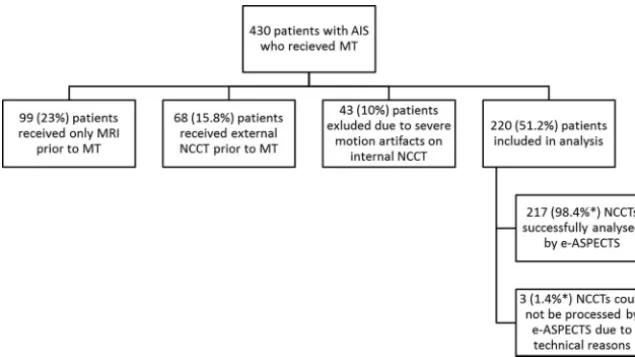
human rater impossible, an additional 3 (1.4%) scans could not be processed by e-ASPECTS due to technical reasons (upload or processing of the DICOM data). The median e-ASPECTS was 9 (interquartile range, 8 –10) The distribution of e-ASPECTS and human raters’ scores are shown inFig 2. Only 16 patients (7.4%) had a poor scan, which was strongly associated with unfavorable out-come (OR, 13.6; 95% CI, 1.8 –104;P⫽.012). Overall, after 3 months, the primary end point of unfavorable outcome was met by 123 (55.9%) patients, and 61 (27.7%) patients reached the secondary end point of good outcome.
The intraclass correlation coefficients between e-ASPECTS and each rater were 0.72, 0.74, and 0.76, respectively (all,P⬍
.001). The agreement within the human raters was very robust as well (intraclass correlation coefficients, 0.7, 0.77, and 0.75; all,P⬍
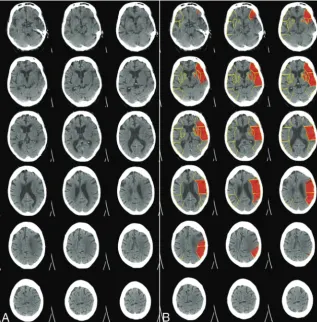
.001). Although the overall agreement of raters and e-ASPECTS was good, in some cases, considerably different scoring results occurred and an example with a low e-ASPECTS (4) is presented in Fig 3. Only e-ASPECTS (Spearman rank correlation coeffi-cient⫽ ⫺0.15,P⫽.027) and the expert’s scoring with the highest agreement with e-ASPECTS (Spearman rank correlation coeffi-cient⫽ ⫺0.19,P⫽.004) correlated inversely but significantly with mRS at 3 months, indicating that a lower ASPECTS is asso-ciated with a higher mRS after 3 months. ASPECTS scoring of the other 2 readers differed from the e-ASPECTS scores to the extent that a significant statistical correlation between their ASPECTS scores and clinical outcome could not be detected. Spearman rank correlation coefficient for e-ASPECTS and mRS in our analysis differed from the Spearman rank correlation coefficient in the study of Barber et al (⫺0.69)8because Barber et al used only 3
categories of the mRS for correlation and their cohort consisted of consecutive patients with suspected stroke in the anterior circu-lation, whereas our patients all had proved large-vessel occlusion. One hundred ninety-eight (90%) patients were treated with modern stent retrievers (mostly Solitaire; Covidien, Irvine, Cali-fornia), and 195 (88.6%) patients underwent thrombectomy un-der general anesthesia. In the univariate analysis for the primary end point, among other significant differences, patients with un-favorable outcome had lower e-ASPECTS (median, 8;
interquar-tile range, 7–10 versus median, 9; inter-quartile range, 8 –10;P⫽.014; On-line Table). Bridging therapy or treatment and procedural times, however, were not significantly different in patients with unfavorable outcome versus pa-tients with favorable outcome (mRS, 0 –3). For multivariate analysis, we in-cluded the variables age, premorbid mRS, atrial fibrillation, previous stroke, baseline blood sugar, and hemoglobin A1c, as well as NIHSS, hyperdense vessel sign, e-ASPECTS, general anesthesia, re-canalization, and sICH (allP⬍.05 in univariate analysis). Independent prdictors of unfavorable outcome were e-ASPECTS (OR, 0.79; 95% CI, 0.63– 0.99;
P ⫽ .049) but also blood sugar (OR, 1.01; 95% CI, 1.004 –1.02;P ⫽ .005), atrial fibrillation (OR, 2.64; 95% CI, 1.22–5.69;P⫽.013), premorbid mRS (OR, 1.77; 95% CI, 1.21– 2.58;P⫽.003), NIHSS (OR, 1.11; 95% CI, 1.04 –1.19;P⫽.003), general anesthesia (OR, 0.24; 95% CI, 0.07– 0.84;P⫽.007), failed recanalization (OR, 8.47; 95% CI, 3.5–20.2;P⬍.001), and sICH (OR, 25.8; 95% CI, 2.5–268;P⫽.007).
In the analysis of the secondary end point, factors associated with good outcome were mean age (66⫾12 versus 74⫾11 years;
P⬍.001), premorbid mRS (median, 0; interquartile range, 0 –1 versus median, 1; interquartile range, 0 –2;P⫽.002), atrial fibril-lation (34.4% versus 52.2%;P⫽.023), blood sugar (118⫾33 versus 139⫾57 mg/dL;P⫽.015), creatinine (0.89⫾0.25 versus 1.1⫾0.78 mg/dL;P⫽.03), general anesthesia (80.3% versus 91.8%;P⫽.03), NIHSS (median, 16; interquartile range, 11–19 versus median, 19; interquartile range, 15–22;P⬍.001), success-ful recanalization (88.5% versus 58.9%,P⬍.001) and sICH (0% versus 8.8%,P⫽.012). The e-ASPECTS, however, was not asso-ciated with good outcome (median, 9; interquartile range, 8 –10 versus median, 9; interquartile range, 7–10;P⫽.249). After mul-tivariate analysis (sICH was not included in the model because no patient with good outcome had sICH), only age (OR, 0.96; 95% CI, 0.93– 0.98), blood sugar levels (OR, 0.99; 95% CI, 0.99 –1.0), NIHSS (OR, 0.91; 95% CI, 0.86 – 0.97), and successful recanaliza-tion (OR, 5.45; 95% CI, 2.18 –13.61) remained independent pre-dictors of good outcome.
DISCUSSION
Our study confirmed that the e-ASPECTS software performs in a manner similar to that of stroke experts in detecting early isch-emic damage in the MCA territory. Furthermore, we could dem-onstrate for the first time that fully automatically derived e-ASPECT scores correlated inversely with patient outcome 3 months after MT (Spearman rank correlation coefficient⫽ ⫺0.15,P⫽
.027). Patients with poor scans (ASPECTS 0 –5) at baseline had a significantly high probability of unfavorable outcome (OR, 13.6; 95% CI, 1.8 –104). On the basis of the multivariate regression analysis, a 1-point decrease in the e-ASPECTS increases the risk for an unfavorable clinical outcome by 20%. Most important, indicating the robustness of our results, we could also confirm FIG 1. Exclusion criteria for patients with AIS who received MT entering this analysis. Severe
[image:3.594.55.373.46.224.2]other known predictors of outcome after acute ischemic stroke, such as recanalization, sICH, atrial fibrillation, NIHSS, pre-morbid functionality, and blood sugar levels.
The ASPECTS is a validated, reliable, and reproducible grad-ing system to assess early ischemic changes on noncontrast CT studies in patients with acute ischemic stroke of the anterior cir-culation.8The Highly Effective Reperfusion evaluated in Multiple
Endovascular Stroke trials (HERMES) collaboration has recently shown a clear association between favorable clinical outcome af-ter MT and ASPECTS ofⱖ6.17Additionally, a subgroup analysis
of the Multicenter Randomized Clinical trial of Endovascular treatment for Acute ischemic stroke in the Netherlands (MR CLEAN) also demonstrated that patients with moderate early ischemic changes (ASPECTS 5–7) benefit from mechanical thrombectomy.18On the other hand, there are other studies that
could not show a correlation between ASPECTS 5–7 and clinical outcome after 3 months,19and the HERMES data revealed that
there is no clear benefit for patients with an ASPECTS of 0 –5. Another study found that patients with ASPECTS 0 – 4 before me-chanical thrombectomy had higher rates of serious adverse events and hemicraniectomy. Furthermore, death within 1 week and 30 days after treatment was more frequent.18Therefore, the effect of
endovascular treatment for patients with a poor scan (ASPECTS 0 –5) is unclear, with perhaps only a slim margin for benefit.
Ad-ditionally, multivariate regression analysis to show the indepen-dent prognostic effects of the ASPECTS has not been performed in these previous trials.
Because the probability of achieving functional independence declines and the risk of severe disability and death rises with lower ASPECTS, this scoring system appears important for patient eval-uation for endovascular stroke treatment. Our data indicate that e-ASPECTS can provide important technical support in estimat-ing a patient’s prognosis. Furthermore, in the present analysis, 2 of 3 expert raters’ scores did not correlate with the clinical out-come, whereas e-ASPECT scores did. This nicely illustrates 2 fea-tures: First, as already shown by others, the ASPECTS has consid-erable variability even among experts. This may be even more pronounced in the acute treatment decision for understandable reasons, such as emotional issues and stress. Second, an auto-mated scoring tool can be advantageous here due to its “objectiv-ity.” Hence, e-ASPECTS could contribute to decision-making for patient selection in the community hospital or telemedicine ser-vices and/or patient transfer into a comprehensive stroke center for MT. Other important imaging variables derived from CT an-giography and CT perfusion have also been shown to carry prog-nostic information that can inform treatment decision-making,20
but NCCT is still the most commonly used imaging tool in acute stroke.
[image:4.594.54.533.44.411.2]Our analysis focused on the prognostic value of ASPECTS, specifically e-ASPECTS for unfavorable outcome, as opposed to good outcome. According to current guidelines considering endovascular stroke therapy, a favorable ASPECTS is not an un-conditional prerequisite, especially within 6 hours from onset (American Heart Association guidelines/European Stroke Or-ganisation–European Foundation of Minimally Invasive Neu-rological Therapy guidelines).21,22The question does not seem
to be whom to treat but for whom treatment could be disad-vantageous due to missing success or the increased likelihood of complications because patients with ASPECTSⱕ5 have a lower chance of independent living or even survival. The e-ASPECTS was not a predictor of good outcome in this analysis, which indicates that patients with low scores still have a con-siderable probability of achieving clinical improvement through therapy; therefore, this analysis reinforces the need for a prospective controlled trial to investigate the potential benefit of thrombectomy in patients with a low initial ASPECTS.
Our study has several limitations: 1) Because we treated pa-tients with broad inclusion criteria (ie, higher premorbid mRS and so forth), one cannot expect outcome results similar to those in the recent seminal MT trials, but rather similar to real-life data. 2) This analysis was based on a prospective single-center cohort data base, and data were analyzed retrospectively; therefore, cau-tion should be exercised when generalizing the results. Our data
regarding the mode of sedation need to be interpreted with caution. Most (88.6%) patients were treated under general anesthesia; and only a minority, with conscious sedation. We only intro-duced this mode of sedation in Septem-ber 2013, and until April 2014, a selec-tion bias in our cohort was present. The results of the SIESTA trial, however, in-dicated that in our center, general anes-thesia is not associated with impaired outcome.16 3) The performance of
e-ASPECTs might have been compro-mised due to the available section nesses of 4 and 6 mm; the optimal thick-ness for analysis is 1 mm. Moreover, there was no ground truth (ie, diffusion-weighted imaging or CT perfusion) de-fined for ASPECTS scoring for this analy-sis. However, the e-ASPECTS software has previously shown similar and noninferior performance to that of stroke experts,14,15
and most centers do not have sophisti-cated imaging tools and rely on NCCT, which makes this an important analysis. 4) Additionally, the number of patients with a poor scan of ⱕ5 ASPECTS points was low, and our results need to be confirmed by analysis of large reg-istries of patients undergoing MT, at best by randomized controlled trials including those patients in whom con-siderable uncertainty still exists with respect to the efficacy and safety of MT (ie, patients with ex-tensive ischemic brain damage at baseline). The e-ASPECTS software could be a suitable tool for patient stratification in such trials.
The strengths of this study were that our cohort was very typ-ical for patients undergoing MT and that we included numerous clinical, laboratory, and radiologic data in our analysis. The mul-tivariate model confirmed many previously described prognostic factors, while the predictive value of e-ASPECTS prevailed, thereby indicating the robustness of our results.
CONCLUSIONS
The e-ASPECTS correlated with outcome overall and was pre-dictive of unfavorable outcome after mechanical thrombec-tomy. e-ASPECTS might facilitate treatment decision-making, especially in centers without modern imaging tools for tissue perfusion and collateral status. It is easy to use, has a robust and reliable performance, and removes intra- and interrater variability. Because there are few patients with poor initial CT scans who improve after treatment, further prospective studies in those patients are needed and individual decision-making remains necessary.
Disclosures: Johannes Pfaff—UNRELATED:Payment for Lectures Including Service
on Speakers Bureaus: Siemens;Travel/Accommodations/Meeting Expenses
[image:5.594.57.375.48.370.2]lated to Activities Listed: Stryker. Christian Herweh—UNRELATED:Consultancy: Brainomix,Comments: temporary consultancy related to a project different from the one from which the current article originated;Payment for Lectures Including
Service on Speakers Bureaus: Bristol-Myers Squibb, Brainomix: once in 2016;Travel/
Accommodations/Meeting Expenses Unrelated to Activities Listed: Stryker,
Braino-mix: travel expenses for attending a national meeting in 2016. Julian Bo¨sel—
UNRELATED:Grants/Grants Pending: Patient-Centered Outcomes Research
Insti-tute, Brainomix Ltd: award pending for SETPOINT2 Trial;Travel/Accommodations/
Meeting Expenses Unrelated to Activities Listed: Zoll, Bard Medical, Sedana Medical,
Seiratherm, Boehringer Ingelheim, Brainomix Ltd: speaker’s honoraria and travel sup-port. Peter A. Ringleb—UNRELATED:Consultancy: advisory board member for Boehringer Ingelheim, Covidien;Payment for Lectures Including Service on Speakers
Bureaus: lecture fee from Boehringer Ingelheim, Bayer, Pfizer, Daichii Sanyo. Markus
Mo¨hlenbruch—UNRELATED:Payment for Lectures Including Service on Speakers
Bureaus: Codman, MicroVention, phenox, Stryker. Martin Bendszus—UNRELATED:
Board Membership:Data and Safety Monitoring Board for Vascular Dynamics;
Con-sultancy: Codman, Roche, Guerbet, Boehringer Ingelheim;Grants/Grants Pending:
Deutsche Forschungsgemeinschaft, Hopp Foundation, Novartis, Siemens, Guerbet, Stryker, Covidien*;Payment for Lectures Including Service on Speakers Bureaus: Novartis, Roche, Guerbet, Teva Pharmaceutical Industries, Bayer, Codman. Simon Nagel—UNRELATED:Consultancy: Brainomix; S.N. has had an ongoing consultancy appointment with Brainomix since 2015 independent from the current study;
Grants/Grants Pending: Brainomix; The University Hospital Heidelberg received
grants from Brainomix for prior studies*;Payment for Lectures Including Service on
Speakers Bureaus: Bayer, Medtronic, Pfizer;Travel/Accommodations/Meeting
Ex-penses Unrelated to Activities Listed: Boehringer Ingelheim, Brainomix. *Money paid
to the institution.
REFERENCES
1. Berkhemer OA, Fransen PSS, Beumer D, et al.A randomized trial of intraarterial treatment for acute ischemic stroke.N Engl J Med2015; 372:11–20CrossRef Medline
2. Campbell BC, Mitchell PJ, Kleinig TJ, et al; EXTEND-IA Investiga-tors.Endovascular therapy for ischemic stroke with perfusion-im-aging selection.N Engl J Med2015;372:1009 –18CrossRef Medline
3. Goyal M, Fargen KM, Turk AS, et al.2C or not 2C: defining an im-proved revascularization grading scale and the need for standard-ization of angiography outcomes in stroke trials.J Neurointerv Surg 2014;6:83– 86CrossRef Medline
4. Jovin TG, Chamorro A, Cobo E, et al; REVASCAT Trial Investigators. Thrombectomy within 8 hours after symptom onset in ischemic stroke.N Engl J Med2015;372:2296 –306CrossRef Medline
5. Saver JL, Goyal M, Bonafe A, et al; SWIFT PRIME Investigators. Stent-retriever thrombectomy after intravenous t-PA vs. t-PA alone in stroke.N Engl J Med2015;372:2285–95CrossRef Medline
6. A collaboration of the European Stroke Organisation–Karolinska Stroke Update, European Society for Minimally Invasive Neurologi-cal Therapy, and European Society of Neuroradiology.Consensus statement on mechanical thrombectomy in acute ischemic stroke. In:Proceedings of the European Stroke Organisation–Karolinska Stroke Update, Stockholm, Sweden. November 16 –18, 2014
7. Wardlaw JM, Mielke O.Early signs of brain infarction at CT: ob-server reliability and outcome after thrombolytic treatment– systematic review.Radiology2005;235:444 –53CrossRef Medline
8. Barber PA, Demchuk AM, Zhang J, et al.Validity and reliability of a quantitative computed tomography score in predicting outcome of hyperacute stroke before thrombolytic therapy: ASPECTS Study Group—Alberta Stroke Programme Early CT Score.Lancet2000; 355:1670 –74CrossRef Medline
9. Menon BK, Puetz V, Kochar P, et al.ASPECTS and other neuroim-aging scores in the triage and prediction of outcome in acute stroke patients. Neuroimaging Clin N Am2011;21:407–23, xiiCrossRef Medline
10. Liebeskind DS, Jahan R, Nogueira RG, et al; SWIFT Investigators. Serial Alberta Stroke Program Early CT score from baseline to 24 hours in Solitaire Flow Restoration with the Intention for Throm-bectomy study: a novel surrogate end point for revascularization in acute stroke.Stroke2014;45:723–27CrossRef Medline
11. Demaerschalk BM, Silver B, Wong E, et al.ASPECT scoring to esti-mate>1/3 middle cerebral artery territory infarction.Can J Neurol Sci2006;33:200 – 04CrossRef Medline
12. Mak HK, Yau KK, Khong PL, et al; Alberta Stroke Programme Early CT Score.Hypodensity of>1/3 middle cerebral artery territory ver-sus Alberta Stroke Programme Early CT Score (ASPECTS): com-parison of two methods of quantitative evaluation of early CT changes in hyperacute ischemic stroke in the community setting.
Stroke2003;34:1194 –96CrossRef Medline
13. Finlayson O, John V, Yeung R, et al.Interobserver agreement of ASPECT score distribution for noncontrast CT, CT angiography, and CT perfusion in acute stroke.Stroke2013;44:234 –36CrossRef Medline
14. Herweh C, Ringleb PA, Rauch G, et al.Performance of e-ASPECTS software in comparison to that of stroke physicians on assessing CT scans of acute ischemic stroke patients.Int J Stroke2016;11:438 – 45
CrossRef Medline
15. Nagel S, Sinha D, Day D, et al.e-ASPECTS software is non-inferior to neuroradiologists in applying the ASPECTS score to CT scans of acute ischemic stroke patients.In:Proceedings of the 2nd European Stroke Organisation Conference,Barcelona, Spain. May 10 –12, 2016 16. Schonenberger S, Uhlmann L, Hacke W, et al.Effect of conscious
sedation vs general anesthesia on early neurological improvement among patients with ischemic stroke undergoing endovascular thrombectomy: a randomized clinical trial. JAMA 2016;316: 1986 –96CrossRef Medline
17. Goyal M, Menon BK, van Zwam WH, et al; HERMES collaborators. Endovascular thrombectomy after large-vessel ischaemic stroke: a meta-analysis of individual patient data from five randomised tri-als.Lancet2016;387:1723–31CrossRef Medline
18. Yoo AJ, Berkhemer OA, Fransen PS, et al; MR CLEAN investigators. Effect of baseline Alberta Stroke Program Early CT Score on safety and efficacy of intra-arterial treatment: a subgroup analysis of a randomised phase 3 trial (MR CLEAN).Lancet Neurol 2016;15: 685–94CrossRef Medline
19. Costalat V, Lobotesis K, Machi P, et al.Prognostic factors related to clinical outcome following thrombectomy in ischemic stroke (RECOST study): 50 patients prospective study.Eur J Radiol2012; 81:4075– 82CrossRef Medline
20. Turk AS, Magarick JA, Frei D, et al.CT perfusion-guided patient selection for endovascular recanalization in acute ischemic stroke: a multicenter study. J Neurointerv Surg2013;5:523–27 CrossRef Medline
21. Powers WJ, Derdeyn CP, Biller J, et al; American Heart Association Stroke Council.2015 American Heart Association/American Stroke Association Focused Update of the 2013 Guidelines for the Early Management of Patients with Acute Ischemic Stroke Regarding En-dovascular Treatment: A Guideline for Healthcare Professionals from the American Heart Association/American Stroke Associa-tion. Stroke2015;46:3020 –35CrossRef Medline