http://www.scirp.org/journal/ce ISSN Online: 2151-4771
ISSN Print: 2151-4755
DOI: 10.4236/ce.2017.815165 Dec. 11, 2017 2412 Creative Education
Learning High School Biology in a
Social Context
Amitabha Basu
1,2, Deborah Aglira
1, James R. Spotila
31G. W. Carver High School of Engineering and Science, Philadelphia, PA, USA
2Department of Biology, Drexel University, Philadelphia, PA, USA
3Department of Biodiversity, Earth and Environmental Science, Philadelphia, PA, USA
Abstract
In this research, we developed a process that helped students connect cell and molecular biology concepts with problems in context of their lives. Spe-cifically, we supplemented traditional teaching with problem, project and inquiry based laboratories, without changing the structure of the mandated biology curriculum. We ran the process twice, following the classroom based action research model. Our initial foray exhibited better stu-dent-developed projects and a modest improvement of test grades. Second time we compared changes in problem solving skills, attitude toward read-ing, writing and problem solving and improvement of traditional test grades from the beginning and end of the school year. This process made the bio-logical concepts so interesting that by the end of the year nearly all students significantly (t(55) = −8.95, p ≤ 0.05) improved problem-solving skills and some students went further to develop and solve independent inquiries. They also exhibited improved attitude towards reading, writing and prob-lem solving. However, we didn’t observe any causal relationship between improvement of problem solving skills and test grade, since its trend showed little difference between first and second trial.
Keywords
Biology Learning, Cell and Molecular Biology, Standardized Curriculum, Problem, Project and Inquiry Based Laboratories,
Learning and Problem-Solving Skills, Test Grades
1. Introduction
This paper describes our investigation on the effect of a teacher designed
sup-How to cite this paper: Basu, A., Aglira, D., & Spotila, J. R. (2017). Learning High School Biology in a Social Context. Creative Education, 8, 2412-2429.
https://doi.org/10.4236/ce.2017.815165
Received: October 11, 2017 Accepted: December 8, 2017 Published: December 11, 2017
Copyright © 2017 by authors and Scientific Research Publishing Inc. This work is licensed under the Creative Commons Attribution International License (CC BY 4.0).
http://creativecommons.org/licenses/by/4.0/
DOI: 10.4236/ce.2017.815165 2413 Creative Education plemental interactive learning process supporting introductory biology courses at a high school in the City of Philadelphia. The primary aim of this research was to examine whether application of interactive hands on learning of the biological facts and concepts in the context of appropriate socioeconomic scenarios can improve inquiry type problem solving skills and content knowledge to make bi-ology interesting and meaningful to all students. The secondary aim was to measure the conventional test performance of the same students.
The authors recognized that our students not only disliked Life-Science lite-rature, but they also lacked the study skills to follow the scientific terms, lan-guage, facts, and to analyze and understand the data (inductive and deductive reasoning), and conclusions. They were unable to correlate scientific facts with most facets of their lives. It made the biology a boring, dull and useless subject that they were forced to learn. Most were happy if they could pass and forget it, which we believed resulted in poor test performance by 25% - 30% of the stu-dents.
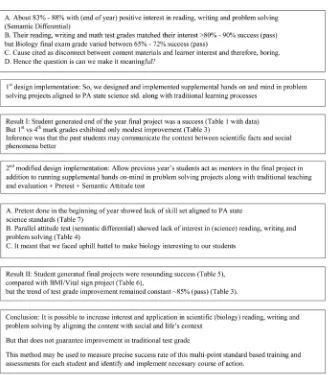
So we developed and implemented an idea in two iterations to supplement our traditionally time paced core instructions with strategically placed problems, projects and inquires. We believed this strategy helped the students develop their own deductive (research) questions and investigations, and thereby helped them to apply biology concepts to solve social problems instead of standard laborato-ries (Figure 1). The process supported traditional teaching processes and tests throughout the school year. The students were required to complete a final project developed individually or in small groups based on the topics taught in the class, in addition to a final exam. The students exhibited substantial im-provement in skills and ability to solve biological problems. The combined measure identified each student’s progress and necessary interventions without any major curricular modification and cost overruns.
2. Literature Review
The emphasis on cellular and molecular sciences in high school biology curricula raised awareness of cutting-edge advances in molecular sciences, technology and medicine. Molecular genetics connected evolution with multiple aspects of our lives and society with irrefutable facts (Nishinakamura & Takasato, 2017; Wang
et al., 2014). However, the cross-disciplinary and multi-dimensional nature of
cell-molecular biology is challenging for most high school students (Koba & Tweed, 2016; Cimer, 2012; Tibell & Rundgren, 2010; Sahdra & Thagard, 2003;
Stewart, 1982). Learning these topics requires a paradigm shift in conceptual
DOI: 10.4236/ce.2017.815165 2414 Creative Education
Figure 1. Model for implementing hands-on and mind-in projects supplementing
tradi-tional high school biology course. The design was implemented twice with necessary modifications as described below.
Grant, Fisher, & Lapp, 2015). It required the first author to teach high school
bi-ology with lectures, presentations, videos and simulations, reading, writing, model building, small group tutoring and, sadly, rote memorization of facts(Lu,
Cowie, & Jones, 2010; Bell, 2001; Wood, 2001; Lock, 1998). Technical complexity
DOI: 10.4236/ce.2017.815165 2415 Creative Education with traditional approach and asked for more interesting, effective and hands-on learning practices in line with the inquiry method suggested by the National
Re-search Council (2000). The state and district mandated biology standards and
curricula also advocated hands-on learning (PA SAS, 2010) supplementing learning of content knowledge. However, effective learning advocated by the science standards (NRC, 1996) was found to be quite elusive even with watered down college style laboratories or dry simulations with little or no connection to our students’ social lives. These techniques lacked the transformative experience assisting students to apply disparate and ordinarily intangible molecular and logical concepts to the tangible living world.
We combined three independent ideas to enable students to read, compre-hend, and express the scientific concepts in written format (Grant & Diana,
2011), learn biological concepts with “Inquiry learning” due to its close
similari-ty with the “scientific method” (NRC, 2000, 1996; Kaufmann, 1959; Dewey,
1938) and organize them insocial context (Penuel, 2016). The problem with
in-quiry is acquiring conceptual knowledge from direct observations by using de-ductive questions (Oguz-Unver & Arabacioglu, 2014) and appropriate
hypothe-sis (NRC, 2000). However, most biology problems, especially at the high school
level often do not have any tangible hypothesis. Therefore the end results cannot be used to prove or disprove the hypothesis. With a little accommodation, bio-logical topics can be learned through identifying and solving socially and scien-tifically relevant multi-disciplinary but ill-defined problems (PBL) (Savery,
2006). Or they can be learned through an extended hands-on inquiry process
structured around complex, authentic questions and carefully designed complex but authentic projects and tasks (PjBL) (Regassa & Morrison-Shetlar, 2009;
Wright & Boggs, 2002). However, all three methods entail a similar but
inhe-rently different learning experience (Oguz-Unver & Arabacioglu, 2014). So, we used multiple problem, projects and inquiries to support high school biology topics.
Our next challenge was time; we had to be pragmatic and adhere to the state’s and district’s biology standards (PA SAS, 2010) which emphasized learning of specific contents and their evaluation in precise sequence and pacing (School District of Philadelphia: Scope and Sequence). The students were also required to go through traditional assessments stressing factual recall and solving pen and paper based problems (Lock, 1997). But making students learn science content hands-on and in the context of their lives (Koba & Tweed, 2016) takes time, tends to be confusing and requires multiple mid-course corrections during the learning process (NRC, 2000, 1996).
DOI: 10.4236/ce.2017.815165 2416 Creative Education
Tweed, 2016; Lenz & Willcox, 2012; Domingos-Grilo, 2011; Reiss, 2005). The
results were discussed, analyzed and critiqued in class within and among the groups to support the development of reports and presentations, which typi-cally measured progress towards the goals of PBL (Savery, 2006). Final projects were evaluated by both internal and external examiners as an extended form of assessment to reflect a broad range of learning and cognitive outcomes
(Car-tier & Stewart, 2000) and genuine understanding (Gardiner & Farragher,
1999).
The last piece of the puzzle was evaluation of student performance in tradi-tional tests, since a loss of test grades is sometime a problem in investigative classrooms (Domingos-Grilo et al., 2011). We emphasized the importance of test grades to the students involved in this research. One author provided after school tutoring sessions two-three times a week throughout school year, and left all classroom and district mandated benchmark tests in place without any modification. We analyzed the student performance in fourth versus first quarter class (test and quiz) grades for every school year during this research work.
3. Research Questions
In this research, we answered the following questions:
• How does the practice of supplemental hands-on projects strengthen stu-dents’ problem-solving skills and interest in connecting scientific concepts to social problems?
• How does our process affect student performance in traditional tests? Are the skills translational between hands-on projects and traditional tests?
4. Methods
In practice, we adopted a student centric and constructivist process as opposed to traditional fact and concept centered approach to cater to all individuals in the biology class, including the teacher. In order to develop an appropriate me-thod, we implemented our strategy twice on two different groups of 9th grade
bi-ology students at the Carver High School of Engineering and Science (HSES) in Philadelphia. First, we implemented our strategy with a group of 33 students for a year and analyzed the outcome. We then tweaked the process following the suggestion from our students and colleagues. The modified strategies were reimplemented with two different groups with a total of 55 students (overview in
Figure 1).
DOI: 10.4236/ce.2017.815165 2417 Creative Education requires teachers to teach the biology basics following a pacing guide (SDP Scope and Sequence) with clearly designated concepts, chapters and resources aligned to the State of Pennsylvania Standards Aligned System (PA-SAS). Both PA-SAS and SDP allowed the curricular units to be supported with hands-on laboratories at the discretion of the teacher and the availability of resources. We made small modifications in the syllabus to integrate the projects seam-lessly (Supplement A).
The first author lectured on the topic from assigned texts with intermittent dialogue and discussion with the students (didactic), and promoted memoriza-tion and rote learning as productive learning approaches (Lock, 1998). The lec-tures were scientifically correct and seamlessly followed traditional biology teaching practices and the students’ learning was evaluated with traditional con-tent assessments and SDP benchmark tests common to all biology students in the school.
Design of supplemental hands-on problem-solving projects: The students worked on the projects in two stages. The first stage consisted of small demon-strations or hands-on laboratory experiments in which the students learned to align the results with corresponding biology content learned in the class, some of which were inspired by Serendip© studio projects
(http://serendip.brynmawr.edu/biology/). But the problem identification, solving and interpretation were categorically facilitated by the teacher. These formative projects were done more than once during the school year following the out-come of a syllabus unit. The formative projects were followed by short discus-sions on the design and selection of final summative projects (DeHaan, 2009). The students completed the summative projects toward the end of the school year. They worked as independent operators with little guidance or direct inter-vention from the teacher, who acted as a resource and facility manager in these projects (Krajick, 2015).
With few exceptions, most of the students perceived science as a miracle that could be performed only by well-trained scientists, engineers or doctors. For most of these students scientific concepts were beyond their social realms and something that they were forced to learn against their primary beliefs. Based on social constructivist approach, we strongly encouraged the students to develop their scientific and technical thinking in context with relevant social problems
(Lenz & Wllcox, 2012) rather than simple knowledge transmission (Saverym &
Thomas, 1995). This process, in turn, helped them to take more responsibility
for their own learning. We encouraged both student-teacher and stu-dent-student interactions as ways for students to explore and evaluate ideas, re-solve scientific misunderstanding and identify differences (Prawat, 1989), as opposed to transmitting information without contributions from students
(Yang, 2002). The students were strongly encouraged to discuss their problems
DOI: 10.4236/ce.2017.815165 2418 Creative Education
Fisher, & Lapp, 2015).
The formative projects were socially relevant problems aligned to specific parts of the curriculum. The students learned scientific method by measuring and analyzing Body Metabolic Index (BMI); cell structure and function by writ-ing stories and poems, and Mendelian genetics and probability by playwrit-ing cards. Cell division and sexual reproduction and pedigree analyses were taught with live Zebrafish (Danio rario) spawning, and molecular biology was taught by constructing cDNA and mRNA of human insulin gene with K’nex kits and demonstration of green fluorescent protein (GFP) gene cloning in E. coli bacte-ria (Supplement A).
The first year’s final challenge was to identify and solve multiple social prob-lems with relevant biological concepts. We looked at the resultant data and add-ed the senior students to mentor the freshmen with the idea that the seniors would inspire and guide younger students to solve problems efficiently. In the second year the final challenge problem was designed to increase awareness of organ and tissue and blood donation, since organ donation in Philadelphia lags surrounding counties. Learning and understanding the complex technicalities of organ donation easily supported cell biology, genetics, molecular biology and evolution. It also supported anatomy sections of the curriculum and facilitated the development of final independent projects. From the social point, organ do-nation was a worthy cause for the students to understand because organ dona-tions give second chances to the recipients and organ donors are real heroes. We emphasized that the organ donation organizations are not organ harvesters and that the donation process is actually designed to reduce any procedural risk, contrary to the common belief (unpublished data).
Evaluation of student performance: The success of our strategy and its appli-cability in teaching high school biology was identified by successful completion of final student crafted projects and analysis and interpretation of results, and students’ performance in friendly competitions. The students were made aware that they need to take and pass all tests including district mandated benchmarks, and we recorded the first versus fourth quarter grade averages.
Outcomes of all projects were evaluated by multiple measures independent of the test grades. In-class projects were evaluated by the peers, mentors, stu-dent teachers and authors. This practice led to the development of final projects either by pairs or individual students. The final project reports and presentations were evaluated by a combination of internal and external evalu-ators. We discussed the rough copies of the results and analyses in class to aid the development of final reports and presentations. They were then evaluated by external examiners following pre-determined rubrics to measure the progress of students’ understanding of the problem (Supplement C). We de-veloped the evaluation rubrics following Intel International Science and Engi-neering Fair (ISEF) evaluation rules (IRPSR, 2017), and relevant PA-SAS
(Table 7) and NRC inquiry (NRC, 2000) standards (Table 7). In our rubric,
DOI: 10.4236/ce.2017.815165 2419 Creative Education technical problems of the project, and development of solution based on per-tinent biological concepts (Supplement C).
We also applied a few specially designed assessments, which were pre- and midterm (and external SDP benchmark II) tests developed in house with items aligned to the above-mentioned standards to measure the relevancy of our process (Table 7). Pre- and midterm tests contained both multiple choice and short answer items and the benchmark contained all but one multiple choice item.
Semantic differential test of student attitude: Students’ interest in science sub-jects was estimated with a semantic differential analysis with seven paired adjec-tives (like the Likart scale) applied to three different questions about their atti-tudes toward reading, writing, and problem solving (Osgood, Suci, &
Tannen-baum, 1957) (Supplement B).
5. Results
First year: Evaluation of final summative projects grades showed that among 33 students, 26 (78.8%) received 80% (B) or above, 5 (15.2%) received below 80% (B) and 2 (6.06%) were unsuccessful (Table 1). The percent of these stu-dents with positive attitudes (using semantic pair of adjectives) towards reading, writing and problem solving were 85.7, 88.6 and 68.6, respectively (Table 2). Average class grades composed mostly of traditional test and quizzes in the 1st
and 4th marking periods changed from 76.2 to 82 (Table 3).
Second year: In this iteration, we compared of the project, test and attitude grades from introduction and completion of the trial. Evaluation of the project
Table 1. 1st Final project presentation grade. The data showed number and percent of
students either received 80% or above and below grades. The 80% grade cut-off was used to keep parity with average traditional final test grade in Table 3.
No. of Students (Std. deviation of grade) 80% or above (Std. deviation of grade) Below 80%
[image:8.595.208.538.488.537.2]33 (one section) 26% or 78.8% (3.02) 7% or 21% (13.4)
Table 2. 1st Attitude Test was done in parallel with final project (33 students 2005). The
data showed percent of students with positive attitude towards either reading, writing or problem solving in biology. The students were made aware more than once that the test was about their attitude towards science.
Seven pairs of semantics (adjectives) with three positive trends (range value max. 3 → 1 min. = (+21 to +7)/7), three negative trends (range value max. −3 → −1 = (−21 to −7)/7) and one neutral trend (range value = 0/7)
for problem solving, reading and writing in science were used, where all pairs weighted equal. We identified any value <1 as either neutral
or negative attitude of a student towards that specific attribute.
No. of Students Reading (%) Writing (%) Problem Solving (%)
DOI: 10.4236/ce.2017.815165 2420 Creative Education
Table 3. Student performance in the traditional 1st Mark (pre) and 4th Mark (post)
life-science content assessments following the implementation of the model stated in the
Figure 1. The sample size for this assessment was small and the standard deviation values
showed large variations in the assessment data.
School (year of study)
Average 1st Mark Grade
(Std. deviation)
Average 4th Mark Grade
(Std. deviation)
No. of students
HSES (1st) 76.2 (11.3) 82 (9.7) 33
HSES (2nd) 73.8 (21.5) 87.8 (11.3) 55
grades showed that 12 out of 63 students (19%)in the introductory(BMI) project and 47 (71.2%) out of 55 students in the final project received 80% or above
(Table 5). The 26 students out of 63 (41.3%) were unsuccessful in the
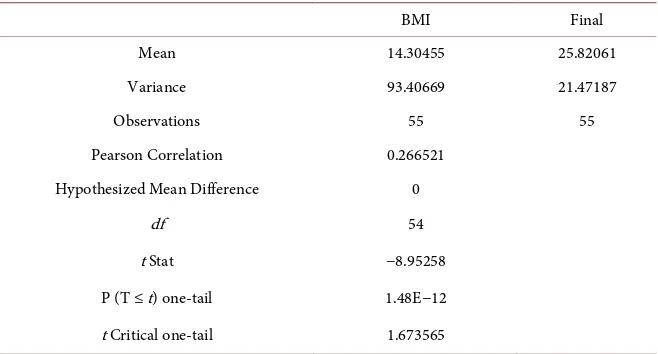
introduc-tory project but none in the final project. A match paired t-test of introducintroduc-tory and final project grades from the same55 students gave t(55) = −8.95, p ≤ 0.05 with a Pearson correlation of 0.26 (Table 6).
The grades from the specially made tests with items aligned to PA-SAS and NRC inquiry standards relevant to ISEF rules, showed that 6.06 and 45.5 percent students solved problems in pretest and midterm test (posttest), respectively and 50% students exhibited success in content knowledge in both (Table 7). In the SDP benchmark 2 test taken after three weeks of midterm examination 25.4% students solved problems, 93.1% showed content knowledge and 75.4% showed predictive skills (63.6% in pretest) (not shown).
This year the 1st and 4th marking periods average class grades mainly from
tests were 73.8 and 87.8, respectively (Table 3), and the percent of students with positive attitude towards reading, writing and problem solving were 16.7 and 83.2, 15.2 and 88.6, and 15.2 and 70.5, respectively (Table 4).
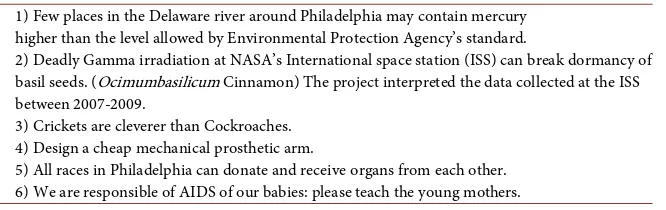
Development of independent scientific inquiries: Multiple students indepen-dently and in groups of three students continued their investigations one year after and presented their results at the (Regional) G. W. Carver Science Fair at the Temple University, Philadelphia, Delaware Valley Science Fair (DVSF), AIDS conference at the Children’s Hospital of Philadelphia and National Math, Science and Engineering Achievement Competition (MESA). Some of the win-ning projects aligned to biology were listed in Table 8.
6. Discussion and Conclusion
This study was meant to evaluate the effectiveness of small hands-on inquiry style projects supplementing traditional high school biology coursework. The results showed that it successfully improved problem solving skills (Table 5 and
Table 6) without compromising test grades (Table 3), which was a major
DOI: 10.4236/ce.2017.815165 2421 Creative Education
Table 4. Beginning and year end (pre- and post-) attitude Tests were done in parallel
with 1st vital-sign (basic metabolic index or BMI) and final biology projects, respectively (66 and 55 students in two sections 2010). The data showed percent of students with posi-tive attitude towards either reading, writing or problem solving in biology. The students were made aware more than once that the test was about their attitude towards science.
Seven pairs of semantics (adjectives) with three positive trends (range value max. 3 → 1 min. = (+21 to +7)/7), three negative trends (range value max. −3 → −1 min. = (−21 to −7)/7) and one neutral trend (range value = 0/7) for problem solving, reading and writing in science were used, where all pairs weighted equal. We identified any value < 1 as either
neutral or negative attitude of a student towards that specific attribute. Total no. of Students
(Two sections) Reading (%) Writing (%) Problem Solving (%)
63 (beginning of yr.) 16.7 15.2 15.2
[image:10.595.209.541.334.401.2]55 (end of yr.) 83.2 88.6 70.5
Table 5. Number and percent of students received 80% or above in 1st vital-sign (basic
metabolic index or BMI) and final biology projects. The 80% grade cut-off was used to keep parity with average traditional final test grade in Table 3.
Total no. of Students Introductory BMI project Final project
Grade (Percent) ≥80 <65 ≥80 <65
63 (beginning of yr.) 27 (42.9%) 26 (41.3)
55 (end of yr.) 47 (71.2%) 0
Table 6. Matched pair t-test (two sample for means) of 1st BMI vs final project grades of
55 students showing significant (~95% percentile) improved performance (Interpretation needs a Statistician).
BMI Final
Mean 14.30455 25.82061
Variance 93.40669 21.47187
Observations 55 55
Pearson Correlation 0.266521
Hypothesized Mean Difference 0
df 54
t Stat −8.95258
P (T ≤ t) one-tail 1.48E−12
t Critical one-tail 1.673565
[image:10.595.210.539.457.634.2]DOI: 10.4236/ce.2017.815165 2422 Creative Education
Table 7. PA standards relevant to ISEF project evaluation rules were used in SDP
Benchmark tests and grade interpretation of the following in house tests. These tests dif-fered from the traditional 1st versus 4th marking period in class tests and their grades were never reflected in actual class grades in any form. The measured success was percent of students answered ≥ 50% test items correctly. The pretest result was compared with that of midterm test as posttest. The standards were separated in three groups for the ease of explaining the data.
Problem solving skills:
A.2.1.1: Experimental design, hypothesis, management & interpretation of data. A.2.1.3: Use data to draw inference & conclusion.
A.3.3.1: Describe or interpret recurring patterns that form the basis of biological classification, chemical periodicity, geological order, or astronomical order.
Predictive skills:
A.3.1.2: Analyze and predict the effect of making a change in one part of a system on the system as a whole.
A.3.2.1: Compare the accuracy of predictions represented in a model to actual observations and behavior.
Content knowledge:
B.1.1.1: Explain how structure determines function at multiple levels of organization (e.g., chemical, cellular, anatomical).
B.1.1.2: Compare and contrast the structural and functional similarities and differences among living things (e.g., classify organisms into classification groups, compare systems).
B.1.1.3: Compare and contrast cellular processes
(e.g., photosynthesis and respiration, meiosis and mitosis, protein synthesis and DNA replication).
Problem solving skills Predictive skills Content knowledge
A.2.1.1 B.1.1.1
A.2.1.3 A.3.1.2 B.1.1.2
PA Standards A.3.3.1 A.3.2.1 B.1.1.3
Pretest 6.06 63.64 48.48
Midterm test 45.45 50
Table 8. Sparks of real scientific investigations and discoveries.
1) Few places in the Delaware river around Philadelphia may contain mercury higher than the level allowed by Environmental Protection Agency’s standard.
2) Deadly Gamma irradiation at NASA’s International space station (ISS) can break dormancy of basil seeds. (Ocimumbasilicum Cinnamon) The project interpreted the data collected at the ISS between 2007-2009.
3) Crickets are cleverer than Cockroaches. 4) Design a cheap mechanical prosthetic arm.
5) All races in Philadelphia can donate and receive organs from each other. 6) We are responsible of AIDS of our babies: please teach the young mothers.
The improvement of students’ attitudes towards reading, writing and solving problems (Table 4) was in line with improvement in content knowledge, since increasingly complex traditional tests did not depress the average class grade
(Table 3). But their confidence level in problems solving differed with actual
[image:11.595.212.545.505.610.2]DOI: 10.4236/ce.2017.815165 2423 Creative Education 2 versus 50% in midterm). Our data didn’t show relationship between improve-ment in problem-solving skills and performance in traditional tests, since some students remained unsuccessful irrespective of their performance in the final project. Following midterm and Benchmark 2 no more standard aligned tests were added with final project and traditional tests, since the students grew wary of all tests.
It appears, the concomitant use of common learning skills such as reading, writing, recalling the scientific facts, identifying connections between a problem (test question) and its answer from the knowledgebase, developing a solution by combining disparate information (from knowledgebase) helped most students succeed both in projects and tests. Our evaluation process measured multiple parameters of biology learning akin to 21st century skills (21st Century Skills
As-sessment, 2007).
In the future, we shall investigate the relationship between the skill to interp-ret and express project data with proper scientific concepts and the ability to answer problem solving questions in traditional tests.
Acknowledgements
Authors gratefully acknowledge support received from the Gift of Life Founda-tion and Donor are Heroes, L. Drew Betz Chair Professorship, and Department of Biology, Drexel University and Nutter Center for Community Partnership, University of Pennsylvania, and Wister Institute, Philadelphia. The AIDS project was supported by grant from Center for Disease Control, USA through the School District of Philadelphia. We had to request necessary supplies and in-struments from Drexel University Biology and Chemistry departments and Science in Motion (http://phillysim.org/staff.html part of the State of
Pennsylvania Science in Motion), respectively. The University of Pennsylvania outreach donated the zebrafish, and allowed students to use laboratory facilities.
References
21st Century Skills Assessment: A Partnership for 21st Century Skills e-paper (2007) http://www.p21.org/storage/documents/21st_Century_Skills_Assessment_e-paper.pdf Bell, E. (2001). The Future of Education in Molecular Life Sciences. Nature Reviews:
Mo-lecular Cell Biology, 2, 221-225. https://doi.org/10.1038/35056610
Cartier, J. L., & Stewart, J. (2000). Teaching the Nature of Inquiry: Further Developments in a High School Genetics Curriculum. Science and Education, 9, 247-267.
https://doi.org/10.1023/A:1008779126718
Cimer, A. (2012). What Makes Biology Learning Difficult and Effective: Students’ Views. Educational Research and Reviews, 7, 61-71.
DeHaan, R. L. (2009). Teaching Creativity and Inventive Problem Solving in Science. CBE—Life Sciences Education, 8, 172-181.https://doi.org/10.1187/cbe.08-12-0081 Dewey, J. (1938). Experience and Education. Kappa Delta Pi, USA.
DOI: 10.4236/ce.2017.815165 2424 Creative Education Gardiner, P. G., & Farragher, P. (1999). The Quantity and Quality of Biology Laboratory
Work in British Columbia High Schools. School Science and Mathematics, 99, 197-204. https://doi.org/10.1111/j.1949-8594.1999.tb17474.x
Grant, M., & Lapp, D. (2011) Teaching Science Literacy, Educational Leadership, 68. http://www.ascd.org/publications/educational-leadership/mar11/vol68/num06/Teachin g-Science-Literacy.aspx
Grant, M., Fisher, D., & Lapp, D. (2015) Reading and Writing in Science. Corwin, A SAGE Co. Thousand Oaks, California, USA.
International Rules for Pre-College Science Research, IRPSR International Science and Engineering Fair (2017)
https://student.societyforscience.org/international-rules-pre-college-science-research Kaufmann, F. (1959) John Dewey’s Theory of Inquiry. The Journal of Philosophy, 56,
826-836. https://doi.org/10.2307/2022592
Koba, S., & Tweed, A. (2016) Hard to Teach Biology Concepts: A Framework to Deepen Student Understanding. National Science Teachers Association Press, Arlington, Vir-ginia, USA.
Krajick, J. (2015). Project-Based Science. Science Teacher, 82, 25-27.
Lenz, L., & Willcox, M. K. (2012). Issue-Oriented Science: Using Socioscientific Issues to Engage Biology Students. The American Biology Teacher, 74, 551-556.
https://doi.org/10.1525/abt.2012.74.8.4
Leonard, W. H., & Chandler, P. M. (2003). Where Is the Inquiry in Biology Textbooks? The American Biology Teacher, 65, 485-487.https://doi.org/10.2307/4451546
Lock, R. (1997). Is There Life in Science 2000? Journal of Biological Education, 31, 83-85. https://doi.org/10.1080/00219266.1997.9655537
Lock, R. (1998). Advanced-Level Biology—Is There A Problem? The School Science Re-view, 80, 25–29.
Lu, T., Cowie, B, & Jones, A. (2010). Senior High School Student Biology Learning in In-teractive Teaching. Research in Science Education, 40, 267-289.
https://doi.org/10.1007/s11165-008-9107-8
Nishinakamura, R., & Takasato, M. (2017) Human Development, Heredity and Evolu-tion. Development, 144, 2099-2103.https://doi.org/10.1242/dev.150565
NRC (National Research Council) (1996). National Science Education Standards. Wash-ington, DC: The National Academies Press.
NRC (National Research Council) (2000). Inquiry and the National Science Standards. Washington DC: The National Academy Press.
Oguz-Unver, A., & Arabacioglu, S. (2014). A Comparison of Inquiry-Based Learning (IBL), Problem-Based Learning (PBL) and Project-Based Learning (PJBL) in Science Education. Academia Journal Educational Research, 2, 120-128.
Osgood, C. E., Suci, G., & Tannenbaum, P. (1957). The Measurement of Meaning. Urba-na IL: University of Illinois Press.
PA SAS (2010) Academic Standards for Science and Technology and Engineering Educa-tion (Secondary). Pennsylvania Department of EducaEduca-tion.
http://www.pdesas.org/Standard/Views
Penuel, W. R. (2016). Studying Science and Engineering Learning in Practice. Cultural Studies of Science Education, 11, 89-104.https://doi.org/10.1007/s11422-014-9632-x Prawat, R. S. (1989). Teaching for Understanding: Three Key Attributes. Teaching and
DOI: 10.4236/ce.2017.815165 2425 Creative Education Regassa, L. B., & Morrison-Shetlar, A. (2009). Student Learning in a Project-Based
Mole-cular Biology Course. Journal of College Science Teaching, 38, 58-67.
Reiss, M. J. (2005). SNAB: A New Advanced Level Biology Course. Journal of Biological Education, 39, 56-59.https://doi.org/10.1080/00219266.2005.9655961
Sahdra, B., & Thagard, P. (2003). Procedural Knowledge in Molecular Biology. Philo-sophical Psychology, 16, 477-498. https://doi.org/10.1080/0951508032000121788 Savery, J. R. (2006). Overview of Problem-based Learning: Definitions and Distinctions.
Interdisciplinary Journal of Problem-Based Learning, 1, 9-20.
Savery, J. R., & Thomas, M. D. (1995). Problem Based Learning: An Instructional Model and Its Constructivist Framework. Educational Technology, 35, 31-38.
Stewart, J. H. (1982). Difficulties Experienced by High School Students When Learning Basic Mendelian Genetics. The American Biology Teacher, 44, 80-82 + 84 + 89. Tibell, L. A. E., & Rundgren, C.-J. (2010). Educational Challenges of Molecular Life
Science: Characteristics and Implications for Education and Research. CBE-Life Science Education, 9, 25-33.https://doi.org/10.1187/cbe.08-09-0055
Wang, G. D., Xie, H. B., Peng, M. S., Irwin, D., & Zhang, Y. P. (2014). Domestication Genomics: Evidence from Animals. Annual Review of Animal Bioscience, 2, 65-84. https://doi.org/10.1146/annurev-animal-022513-114129
Wood, E. J. (2001). Molecular Biology and Biochemistry Teaching over Past 50 Years. Nature Reviews: Molecular Cell Biology, 2, 217-221. https://doi.org/10.1038/35056600 Wright, R., & Boggs, J. (2002). Learning Cell Biology as a Team: A Project-Based
Ap-proach to Upper-Division Cell Biology. Cell Biology Education, 1, 145-153. https://doi.org/10.1187/cbe.02-03-0006
DOI: 10.4236/ce.2017.815165 2426 Creative Education
Supplement A
1) Eighteen-week plan (Semester I) Date: September-2009; Department: Science Course: BIO-I; Grade(s)/Level(s): 9th-Grade
Week 1 (Sep 8-11) Week 10 (Nov 9-13)
Introduction to Courses
UNIT I: Scientific Method & Inquiry
Scientific Method: notes, journals and Lab. book (4) Intro to projects and research (Lab) (1) BMI project Intro
Test 02 (1)
Student design Inquiry Lab (2) Introduction to UNIT V: Cellular Respiration Gift of Life (GoL) the breakdown of food (1) Project
Week 2 (Sep 14-18) Week 11 (Nov 16-20) (Benchmark 1)
Prediction/ Inferring & Scientific Lingo (1) & (Lab) (1) UNIT II: Introduction to Chemistry
Review of Chemistry (1) Develop BMI report
The breakdown of food (lab) (1) Issue (GoL) Project The structure & function of ATP (2)outline The steps of Aerobic Cellular Respiration (2)
Week 3 (Sep 21-25) Week 12 (Nov 23-25)
Rev. of Chemistry (3) Complete BMI report Chemistry of Water (1)
Properties of Water and pH (Lab) (1)
Anaerobic Cellular Respiration (2) Intro to content UNIT VI: Photosynthesis Research (GoL) Introduction to Photosynthesis (1) or Resp. Lab (1)
Week 4 (Sep 29-Oct 2) (Test Rev. Oct 2) Week 13 (Nov 30-Dec 4)
Chemistry of Water (1) Organic Chemistry (2) Macromolecule (Lab) (1) Test Review (1)
Introduction to Photosynthesis (1) Intro to online Photosynthetic Pigments (1) Research (GoL) Steps of Photosynthesis (2)
Pigments lab (1)
Week 5 (Oct 05-09) (Test 1-Oct 8) Week 14 (Dec 07-11) (Test Rev: Dec 10-11)
Test 01 (1)
UNIT III: Cell Structure and Function
Cell Theory (2) (Biogenesis and spontaneous generation) Techniques of using Microscope (1) & Lab (1)
UNIT VI: Molecular Basis of Inheritance Nucleotides & DNA replication (2) GoL online res. Transcription from DNA to RNA (1) or model Lab (1) Test Review (1)
Week 6 (Oct 13-16) Week 15 (Dec 14-18) (Test 3-Dec 16)
Cell Size (2)
Molecular Transport Lab (Osmosis) (1)
Test 03 (1) Res. Info to
Transcription from DNA to RNA (1) rough draft (GoL) Translation from mRNA to Proteins (1) & model Lab (1)
Week 7 (Oct 19-23) Week 16 (Dec 21-23) (Holiday Dec 24-Jan 03)
Molecular Transport (2)Intro to cell story project
Cell Organelle (2) & Lab (1) DNA technology (3) GoL topic selection Discussion on Molc. Basis of inheritance (1)
Week 8 (Oct 26-30) Week 17 (Jan 04-08)
Types of Cells (2) Cell Story project Correlation between cells and organisms (1) UNIT IV: Enzymes
Overview of Enzyme Action (2)
UNIT VIII: Mitosis & Meiosis GoL outline due Understanding cell division (Worksheet) (1) Understanding Mitosis I (1) & II (1) (Worksheets) Understanding Meiosis (1) (Worksheet) Introduction to Cell cycle (1)
Week 9 (Nov 02-06) (Test Rev: Nov 5-6) Week 18 (Jan 11-15) (Test Rev. Jan 14-15)
Enzyme Lab (1) Complete cell stories Substrate & Receptor mimics (2) Regulation of Enzyme (1) Test Review (1)
DOI: 10.4236/ce.2017.815165 2427 Creative Education 2) Eighteen-Week Plan (Semester II)
Date: January 2010; Department: Science Course: BIO-I; Grade(s)/Level(s): 9th-Grade
Week 1 (Jan 18-22) Week 10 (Mar 22-26) (Benchmark 3)
Introduction to Courses
UNIT IX: Cell Division & Mendelian Genetics Project Zebra Fish fertilization & development Inquiry Projects and Lab. (1)
Student design Inquiry Lab (2) UNIT: Intro to Human Anatomy Human body structure
Design Final (GoL) independent projects
Week 2 Jan 25-29) (Test Genetics 01-Jan 27) Week 11 (Apr 5-9) (Final Project: report book)
UNIT IX: Cell Division &Medelian Genetics (Contd.) Develop Zebra fish project report (Rough Copy)
Intro to Human Anatomy (Digestive & Excretory systems): Research on your project at IMC Issue individual or group specific project guide lines
Week 3 (Feb 1-5) (Test Genetics 02-Feb 01) Week 12 (Apr 12-16) (Final Project: report book)
Rev. of Mendel & Post Mendelian Genetics Intro to Population Biology (Hardy & Weinberg Complete project report (Final Copy)
Develop Interview Questions for UG & G students Questions should be about organs & organ donations Continue studying Human Digest. & Excre. systems
Week 4 (Feb 08-12) (Benchmark 2) Week 13 (Apr 19-23) (Final Project: report book)
UNIT X: Intro to Molecular Genetics
DNA Modeling with K’nex, extraction and RFLP lab Develop project report (Rough Copy)
Finalize & test run the Interview questions Questions should be about organs & organ donation Continue studying Human Digest. & Excre. systems
Week 5 (Feb 15-19) Week 14 (Apr 26-30) (Final Project: report book)
UNIT X: Intro to Molecular Genetics (Contd.) DNA replication & Cell Cycle (Review) Complete project report (Final Copy) Intro to PSSA (PA State Exam)
Interview the students from Drexel University Process Data following Interview
Intro to Heart & Circulatory system
Week 6 (Feb 22-26) (Test 01 Molec. Genetics) Week 15 (May 3-7) (Final Project) (PSSA Exam)
UNIT X: Intro to Molecular Genetics (Contd.) Transcription from DNA to RNA
Translation from mRNA to Proteins & Lab
Interview the students from Temple University Process Data following Interview
Continue studying Heart & Circulatory system
Week 7 (Mar 1-5) (Intro to Final Project) Week 16 (May 10-14) (Final Project: report book)
UNIT X: Intro to Molecular Genetics (Contd.)
Control of Gene Expression Compile DATA from Interview & from Organ Transplant websites and develop conclusion for each organ
Week 8 (Mar 8-12) (Final Project Groups) Week 17 (May 17-21) (Final Project)
UNIT X(A): Intro to Biotechnology
Development of cloning process &artificial organs Intro to molecular cloning and organism cloning
Complete DATA Compilation Develop the Presentation for the Board Develop Research Question & Hypothesis
Week 9 (Mar 15-19) (Test 02 Molec. Genetics) Week 18 (May 24-28) (Final Project)
Test 02
Continue with molecular cloning and organism cloning
Rough Copy of the Report corrected & returned Develop Title
Each Group or individual make your board Make 3 × 6 Cards for Practice run
Week 19-20 (May 31-June 11) (Presentations)
NOTE: PSSA practice will continue every week from week 5 to 14. PSSA exam will be on week 15.
We will Make & Display our Final Board & present our findings to the Examiners.
DOI: 10.4236/ce.2017.815165 2428 Creative Education
Supplement B
Attitude Tests [Note: Each test containing the statement and adjectives were printed on a separate sheet of paper]
Attitude Test (Semantic Differential) Date:
o The list of adjectives measure how you feel toward the IDEA listed at the top of the page
o Place ONE X on the space that shows how closely the objectives reflect how you feel toward the subject heading above the adjectives
o Place only ONE X for each pair of adjectives IDEA: I AS A READER
very closely related quite closely related only closely related neutral
only closely related quite closely related very closely related
Strong - - - Weak
Nice - - - Awful
Fast - - - Slow
Distasteful - - - Tasteful
Successful - - - Unsuccessful
Active - - - Passive
Pleasant - - - Unpleasant
IDEA: I AS A WRITER
very closely related quite closely related only closely related neutral
only closely related quite closely related very closely related
Strong - - - Weak
Nice - - - Awful
Fast - - - Slow
Tense - - - Relaxed
Successful - - - Unsuccessful
Active - - - Passive
Pleasant - - - Unpleasant
IDEA: I AS A PROBLEM SOLVER
very closely related quite closely related only closely related neutral
only closely related quite closely related very closely related
Dishonest - - - Honest
Dull - - - Sharp
Fast - - - Slow
Tense - - - Relaxed
Successful - - - Unsuccessful
Active - - - Passive
DOI: 10.4236/ce.2017.815165 2429 Creative Education
Supplement C
The rubric for in school science presentations was adopted from Intel Interna-tional Science and Engineering Fair (ISEF) and G. W. Carver Science Fair (Tem-ple University), Philadelphia. The Rubric is divided into two parts, which are as follows:
Strengths of the Project Suggested Improvements and Modifications
Appropriate use of scientific principle Requires additional research on scientific principle
Technical details are appropriate Requires additional technical details
Appropriate use of scientific method Follow scientific method
Topic is original and scientifically interesting research on topic selection Requires additional
Problem statement/hypothesis appropriate Clarify problem statement/hypothesis
Appropriate sample size/no. of trials Use appropriate sample size/no. of trials/controls
Appropriate data analyses Requires appropriate data analyses
Data/Graphs/Tables presented clearly Use appropriate data/graphs/tables
Appropriate use of Math/Statistical procedures Use appropriate Math/Statistical procedures
Conclusions followed data analyses Inadequate data analyses/support for conclusion
Appropriate log book/notes supplied Requires appropriate data logging process/notes
Appropriate procedures followed Rethink procedures
Appropriate citation of Scientific Literature Update/expand Bibliography
Appropriate use of resources Requires additional support/resources
Appropriate layout of display board Improved layout/preparation of display board
(For Engineering Projects only)
Workable solution of research statement Unacceptable solution of research statement (For Engineering Projects only) (For Team projects only)
Contributions of EACH team member evident