PRIMITIVE PERMUTATION GROUPS WITH A SOLVABLE SUBCONSTITUENT OF DEGREE 7
Zhengfei Wu∗, Shangjin Xu∗∗and Jiangtao Shi∗∗∗
∗Xingjian College of Science and Liberal Arts, Guangxi University,
Nanning 530004, P. R. China and
School of Mathematics, South China University of Technology, Guangzhou 510641, P. R. China
∗∗School of Mathematics and Information Science, Guangxi University,
Nanning 530004, P. R. China
∗∗∗School of Mathematics and Information Science,Yantai University,
Yantai 264005, P. R. China e-mail: [email protected]
(Received 15 May 2017; after final revision 28 December 2017;
accepted 15 March 2018)
In this paper all primitive permutation groups which have a solvable subconstituent of degree 7 are determined.
Key words : Primitive group; subconstituent; irreducible character; Galois conjugacy class.
1. INTRODUCTION
LetG be a primitive permutation group acting on the finite set Ω. Denote by Gα the stabilizer of
α ∈ Ωand∆(α) an orbit of Gα on Ωwhich is often called a suborbit of G. Consider the action
induced byGα on∆(α).Its transitive constituentG∆(α α) is a homomorphic image ofGα which is
called a subconstituent ofG. The subconstituent ofGis said to be faithful if the kernel ofGα on ∆(α)is trivial.
Lots of work has been done for primitive permutation groups whose subconstituents satisfy certain
Wang [2, 3] classified primitive groups with a sharply 2-transitive and solvable 2-transitive
subcon-stituent, respectively. Here we mainly focus on the primitive permutation groups with a suborbit of
small length. It is well known that the primitive group with a suborbit of length 2 is a Frobenius group
of prime degree [4, Theorem 18.7]. However, the structure ofGwould be more complicated when Gα has an orbit of length more than 2. The primitive permutation groups with a suborbit of length
3 were determined by Wong in [5]. The classification of primitive groups with a suborbit of length
4 were given by Quirin, Sims and Wang in [6, 7, 8]. Furthermore, Quirin, Wang, Fawcett, Giudici,
et al., researched the primitive groups with a suborbit of length5 in [6, 9-12]. Their results have completed the classification of all finite primitive permutation groups having a suborbit of length5.
So it is natural to consider the problem of classifying the primitive groups which have a suborbit
of length7. Then the transitive constituentG∆(α α) ofGα acts on the suborbit∆(α)of length 7 is
either solvable, or isomorphism toP SL(2,7), A7, S7. If the situation comes to the latter one, it is
difficult to determineGα whenG∆(α α) is unfaithful, and it is more difficult to determineGby Gα.
Therefore, in this paper, our main goal is to study the case that the subconstituentG∆(α α)is solvable
and we have the following result.
Theorem 1.1 — LetGbe a primitive permutation group acting on a finite setΩwith a suborbit ∆(α)of length 7. Assume that the subconstituentG∆(α α)is solvable. Then one of the following holds:
(1) IfG∆(α α)∼=Z7, thenGis solvable andG∼=G(7, p)which is listed in subsection 3.1;
(2) If G∆(α α) ∼= D14 is faithful, then either Gis solvable and G ∼= G(14, p) which is listed in
subsection 3.2, orG∼= PSL(2,8),PSL(2,13)or2B2(8);
(3) IfG∆(α α)∼= D14is unfaithful, thenG∼= PSL(2,27),PSL(2,29),PGL(2,27)orPGL(2,29);
(4) If G∆(α α) ∼= Z7 o Z3, then either G ∼= G(21, p) which is listed in subsection 3.3, orG ∼=
PSL(3,2),PGL(3,4)orPGU(3,5);
(5) IfG∆(α α) ∼=Z7 o Z6, then eitherG ∼=G(42, p)which is listed in subsection 3.4, orG ∼= S7,
J1,PΣL(2,27),PSL(3,4).Z6,PGL(3,4)or2B2(8).Z3.
The notation and terminology used in this paper are standard (see [4, 13-17]). For two groupsK
andH,K.H is an arbitrary extension ofKbyH, whileK oH stands for a split one. We useZm
andD2mto denote the cyclic group of ordermand the dihedral group of order2m, respectively. For
over the fieldGF(p). The definition of the groupG(i, p)fori= 7,14,21,42appeared in Theorem
1.1 will be given in Section3.
The organization of the paper is as follows. In Section2, we give some preliminary results. In
Section3, we determine the faithful irreducible representations ofZ7, D14, Z7o Z3 andZ7 o Z6 over the fieldF :=GF(p)for primep6= 7. For each case, using the computer algebra systemGAP
[18] we construct primitive groupsGwith a suborbit of length7. In the last section, we complete the
proof of Theorem 1.1.
2. PRELIMINARIES
We first give some lemmas about the structure ofGα,G∆(α α)andG.
Lemma 2.1 — LetGbe a primitive permutation group with a suborbit∆(α)of prime lengthp.
(1) [6, Proposition 3.2]. IfG∆(α α)∼=Zp, thenGα∼=ZpandGis solvable;
(2) [6, Theorem 3.5]. IfG∆(α α) ∼= D2pis not faithful, thenGis isomorphic toPSL(2,4p±1)or PGL(2,2p±1).
Lemma 2.2 — [9, Theorem 1.2]. LetGbe a primitive permutation group of degreen. Suppose thatGhas a suborbit∆(α)of lengthp(p≥5)and a faithful subconstituentG∆(α α)∼= D2p.Then one
of the following holds:
(1) Gis solvable,nis a prime power andp-n;
(2) G= A5, p= 5, n= 6;
(3) G= PSL(2, q), p= (2, qq−−²1), ²=±1,(², q)6= (1,11)and(−1,9),n= 12q(q+²);
(4) G=2B2(q), p=q−1, n= 12q2(q2+ 1).
Lemma 2.3 — [6, Theorem 2.2]. SupposeGis a primitive permutation group with an suborbit
∆(α)of lengthpa, wherepis a prime. If
(1) G∆(α α)is primitive and
(2) |G∆(α α)| = |G∆ 0(α)
α | = parb, where∆0 is an orbital ofGpaired with∆, a 6= 0, b 6= 0,and
r6=pis a prime such that
(ii) a≤2ifp= 2andr = 3.
Then(a)pa+1does not divide|Gα|,
(b)Gα∪∆(α)=Gα∪∆0(α)=Oq(Gα),
(c)Op(Gα)is a Sylowp-subgroup ofGαand
(d)|Gα| |par2b.
Lemma 2.4 — [7, Lemma 9]. LetGbe a primitive permutation group on the finite setΩ. Suppose thatG contains a regular normal subgroup. Then every non-trivial transitive constituent ofGα is
faithful.
The following two lemmas will be used to determine the faithful irreducible representations of
the subconstituentG∆(α α). We denotedegY be degree of an irreducible representationY andF(χ)
be the field generated overF by the value ofχ.
Lemma 2.5 — [15, Corollary 9.23]. LetF ⊆E be fields of prime characteristic,X be an irre-ducibleE-representation ofHwhich affords the characterχandY be an irreducibleF-representation
such thatXis a constituent of YE. ThendegY =|F(χ) : F|degX. In particular,X is similar to YE ifF(χ)=F.
Lemma 2.6 — [13, Theorem 26.2]. LetV be an irreducibleF G-module,E be a finite extension ofF andΓ =Gal(E/F). Then
(1)VE =La∈AWafor some irreducibleEG-moduleW and any setAof coset representatives
forNΓ(W)inΓ, whereNΓ(W) ={γ ∈Γ :Wγ∼=W}.
(2)LetU be an irreducibleEG-module. ThenV is anF G-submodule ofU precisely whenU is EG-isomorphic toWσ for someσ∈Γ.
Lemma 2.7 — [13, Theorem 5.15.1]. LetH be a finite group of exponentmandF be a finite field withchar(F) =psuch thatp-|H|. LetEbe a splitting field ofH, whereE =F(ζ)andζ is a primitivem-th root of unit. If(ϕ, U)is an irreducibleF-representation ofH, then there exists an
irreducibleE-representation(χ, W)ofHsuch that
UE ∼=`
³ M
Wσ∈Orb(W)
Wσ
´
, ϕE ∼=`
³ M
χσ∈Orb(χ)
χσ
´
whereOrb(W) denotes an orbit containing W whichGal(E/F)acts on all of the irreducible
E-modules ofH andOrb(χ) denotes an orbit containingχ whichGal(E/F) acts on all of the
3. FAITHFULIRREDUCIBLEREPRESENTATIONS OFZ7,D14,Z7o Z3 ANDZ7o Z6
In this section, suppose thatH is an affine primitive group of degree7. ThenH is isomorphic to one
of the following groups:Z7,D14∼=Z7o Z2,Z7o Z3orAGL(1,7)∼=Z7o Z6. We will determine the faithful irreducible representations ofHand all primitive groupsGwithHas the subconstituent
in four subsections. In the following we denote byεa primitive7-th root of unity andω a primitive
6-th root of unity.
3.1 Faithful irreducible representations ofZ7
LetH = Z7. ThenH has a faithful irreducible representation overGF(p)for primep 6= 7. This representation is unique up to an automorphism of H. The representation has degree1 if p ≡ 1 (mod 7), degree2ifp≡ −1 (mod 7), degree3ifp≡2 (mod 7)orp≡ −3 (mod 7), and degree
6ifp≡ −2 (mod 7)orp≡3 (mod 7). So we can define the semidirect product:
G(7, p) =
Zpo Z7 if p ≡1 (mod 7),
Z2
po Z7 if p ≡ −1 (mod 7),
Z3
po Z7 if p ≡2 (mod 7) or p≡ −3 (mod 7),
Z6
po Z7 if p ≡ −2 (mod 7) or p≡3 (mod 7).
ThusG =G(7, p)is a primitive group of degreep,p2,p3 orp6, respectively. The stabilizerGα
has an orbit of length7onΩ\ {α}.
3.2 Faithful irreducible representations ofD14
LetH = ha, b|a7 = b2 = 1, bab = a−1i ∼= D14. SinceH has five conjugacy classes, namely {1},{a, a−1},{a2, a−2},{a3, a−3}and{b, ab,· · ·, a6b}, one has thatH has five irreducible
char-acters over the complex fieldC. The irreducible character table ofH overCis listed in Table 1. It
Table 1: The character table ofD14
1 a a2 a3 b
χ1 1 1 1 1 1
χ2 1 1 1 1 −1
follows from [15, Theorem 9.10] that the splitting fieldEforHis
E=
GF(p) ifp ≡1 (mod 7), GF(p2) ifp ≡ −1 (mod 7), GF(p3) ifp ≡2 (mod 7),
GF(p6) ifp ≡ −2 (mod 7)orp≡ ±3 (mod 7).
Assumep ≡ 1(mod 7). ThenF is a splitting field for H. HenceH has exactly three faithful
irreducible representationsXi which affords the irreducible characterχioverF wherei= 3, 4 and
5, all of which have degree2.ThenXican be represented by
X3(a) =
Ã
ε 0
0 ε−1
!
, X3(b) =
à 0 1 1 0
! ;
X4(a) = Ã
ε2 0
0 ε−2
!
, X4(b) = Ã
0 1 1 0
! ;
X5(a) =
Ã
ε3 0
0 ε−3
!
, X5(b) =
à 0 1 1 0
!
.
From the factshXi(a), Xi(b)i∼=D14(i=3,4,5)andX3(H) = X4(H) = X5(H)we know that
there exists a unique split extension ofZ2
pbyH. Define
G(14, p) =Z2poD14 if p≡1 (mod 7).
ThenG =G(14, p)is a primitive group of degreep2 withΩ = V(2, p) ∼=Z2
p. Letα=(0,0) ∈ Ω.
ThenGα∼=Hhas an orbit∆={(1,1),(ε, ε−1),(ε2, ε−2),(ε3, ε−3),(ε−3, ε3),(ε−2, ε2),(ε−1, ε)}of
length7.
Ifp ≡ −1(mod 7). ThenH has exactly three faithful irreducible E-representationsXi where
i= 3,4,5, all of which have degree2. Letσ :x7→xpbe a Frobenius automorphism ofE. It follows
thatσ ∈Gal(E/F)andσ fixesε+ε−1, ε2+ε−2andε3+ε−3. It implies thatε+ε−1,ε2+ε−2
andε3+ε−3 are all in F. HenceF(χi) = F for each irreducible characterχi, where1 ≤ i ≤ 5
andF(χi) is the field overF generated by the values ofχi. LetY be an irreducible representation
ofH overF andX be an irreducible constituent ofYE. ThenYE is similar toX by Lemma 2.5.
has matrix representation:
Y3(a) =
Ã
ε+ε−1 −1
1 0
!
, Y3(b) =
à 0 1 1 0
! ;
Y4(a) = Ã
ε2+ε−2+ 1 −(ε+ε−1) ε+ε−1 −1
!
, Y4(b) = Ã
0 1 1 0
! ;
Y5(a) =
Ã
−(1 +ε2+ε−2) −(1 +ε2+ε−2)
1 +ε2+ε−2 −(ε+ε−1)
!
, Y5(b) =
à 0 1 1 0
!
.
AshYi(a), Yi(b)i ∼=D14(i= 3,4,5)andY3(H) =Y4(H) = Y5(H)we have that there exists a
unique split extension ofZ2pbyH. Define G(14, p) =Z2
poD14 ifp≡ −1 (mod 7).
HenceG=G(14, p)is a primitive permutation group of degreep2 withΩ =V(2, p) ∼=Z2
p. Let
α=(0,0) ∈ Ω.ThenGα=∼H has an orbit∆={(1,1),(1 +ε+ε−1,−1),(−ε3 −ε−3,−1−ε−
ε−1),(0, ε3+ε−3),(ε3+ε−3,0),(−1−ε−ε−1,−ε3−ε−3), (−1,1 +ε+ε−1)}of length7.
Assumep ≡ d (mod 7) whered ∈ {±2,±3} andp 6= 2. ThenH has exactly three faithful
irreducibleE-representations which all have degree2. Letσ :x7→xpbe a Frobenius automorphism
ofE. Thenσ belongs toGal(E/F)and it cyclicly permutesε+ε−1, ε2+ε−2 andε3+ε−3. It
follows that χ3, χ4 and χ5 comprise a Galois conjugacy class over the field F (see [15, Chapter
9]). Furthermore, there is an irreducible representationY ofHoverF,which affords an irreducible
characterµby Lemma 2.6 such thatYEis similar toX3⊕X4⊕X5andµ=χ3+χ4+χ5. ThusY
is an irreducible representation of degree6.
Ifp = 2. ThenE = GF(8) is a splitting field forH. Let K = Q(ω) whereω is a primitive
7th complex root of1andQis a rational number field. ThenK is also a splitting field forH. Let R = Z[ω](where Zis a complex number field) andP = 2R be a maximal ideal inR. Choose a
nonarchimedeanP−adic valuation onK. It is well known that the valuation ringRP has a unique
maximal ideal P ·RP andRP/P ·RP ∼= R/P = Z[ω] ∼= E. Then (K, R, E) is a2−modular
system(cf.[16],§4and§16). By the corollary of Fong-Swan-Rukolaine Theorem([16],22.5), the
degree of each irreducible E−representation of H coincides with the degree of some irreducible K−representation, becauseHis2−solvable. It follows that a faithful irreducibleE−representation
ofHmust have degree2. By using the results in([17],§86), we get the conclusion thatHhas exactly
affords the Brauer charactersψi(1≤i≤4). It is easy to determine the Brauer character table ofH
[image:8.612.123.539.472.594.2]overEwhich is given in Table 2.
Table 2: Brauer character table ofD14forp= 2
1 a a2 a3
ψ1 1 1 1 1
ψ2 2 ε+ε−1 ε2+ε−2 ε3+ε−3 ψ3 2 ε2+ε−2 ε3+ε−3 ε+ε−1 ψ4 2 ε3+ε−3 ε+ε−1 ε2+ε−2
Letσ:x7→x2be a Frobenius automorphism ofE. Thenσbelongs toGal(E/F)and it cyclicly
permutesε+ε−1,ε2+ε−2andε3+ε−3. Henceψ2,ψ3andψ4comprise a Galois conjugacy class
over the fieldF. Furthermore, there is an irreducible representationY ofHoverF which affords an
irreducible characterµby Lemma 2.6 such thatYE is similar toX2⊕X3⊕X4andµ=ψ2+ψ3+ψ4.
ThereforeY is an irreducible representation of degree6.
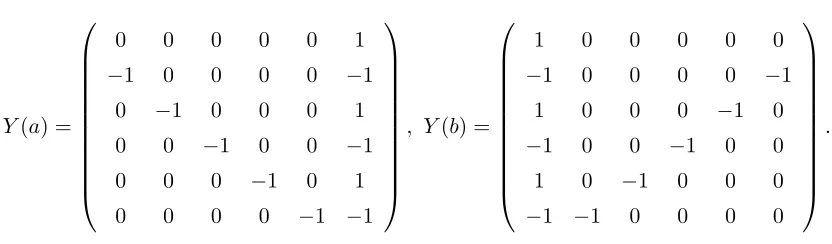
For these two cases,Y can be represented by
Y(a) =
0 0 0 0 0 1
−1 0 0 0 0 −1
0 −1 0 0 0 1
0 0 −1 0 0 −1
0 0 0 −1 0 1
0 0 0 0 −1 −1
, Y(b) =
1 0 0 0 0 0
−1 0 0 0 0 −1
1 0 0 0 −1 0
−1 0 0 −1 0 0
1 0 −1 0 0 0
−1 −1 0 0 0 0 .
It is easy to see thathY(a), Y(b)i ∼= D14. Therefore, there is a unique split extension ofZ6p by H. Define
G(14, p) =Z6
poD14 ifp≡d (mod 7), d∈ {±2,±3}.
Then G = G(14, p) is a primitive group of degree p6 with Ω = V(6, p) ∼= Z6
p. Let
α= (0,0,0,0,0,0)∈Ω. ThenHhas an orbit∆ ={(1,1,0,0,0,0),(−1,0,0,0,0,0),(0,0,0,0,0,−1),
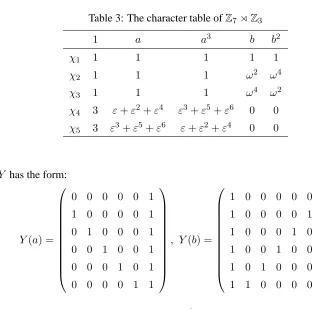
Table 3: The character table ofZ7o Z3
1 a a3 b b2
χ1 1 1 1 1 1
χ2 1 1 1 ω2 ω4
χ3 1 1 1 ω4 ω2
χ4 3 ε+ε2+ε4 ε3+ε5+ε6 0 0 χ5 3 ε3+ε5+ε6 ε+ε2+ε4 0 0
ThenY has the form:
Y(a) =
0 0 0 0 0 1 1 0 0 0 0 1 0 1 0 0 0 1 0 0 1 0 0 1 0 0 0 1 0 1 0 0 0 0 1 1
, Y(b) =
1 0 0 0 0 0 1 0 0 0 0 1 1 0 0 0 1 0 1 0 0 1 0 0 1 0 1 0 0 0 1 1 0 0 0 0
.
Therefore, there is a unique split extension ofZ62 by H. Define G(14,2) = Z62oD14. Then G=G(14,2)is a primitive group of degreep6withΩ =V(6,2)∼=Z6
2. Letα = (0,0,0,0,0,0)∈
Ω, then Gα∼=H has an orbit ∆={(1,1,0,0,0,0), (1,0,0,0,0,0), (0,0,0,0,0,1), (0,0,0,0,1,1), (0,0,0,1,1,0),(0,0,1,1,0,0),(0,1,1,0,0,0)}of length7.
3.3 Faithful irreducible representations ofZ7o Z3
LetH =ha, b|a7 =b3 = 1, b−1ab=a2i ∼=Z7o Z3. SinceH has five conjugacy classes, namely {1}, {a, a2, a4}, {a3, a5, a6}, {aib|0 ≤ i ≤ 6}, {aib2|0 ≤ i ≤ 6}, it follows thatH has five
irreducible characters overC. By [19] the irreducible character table ofHoverCis listed in Table 3.
It is clear that the splitting fieldEforHis as follows:
E=
GF(36) if p= 3,
GF(p) if p≡1 (mod 21),
GF(p2) if p≡d (mod 21), d∈ {−1,±8}, GF(p3) if p≡4 (mod 21),
Assume p ≡ 1 (mod 21). Then F is a splitting field forH. Hence H has only two faithful
irreducible representationsXi which affords the irreducible characterχi overF fori = 4,5, all of
which have degree3. ThenXican be given by the following matrices:
X4(a) =
ε 0 0
0 ε2 0
0 0 ε4
, X4(b) =
0 0 1 1 0 0 0 1 0
;
X5(a) =
ε3 0 0 0 ε6 0
0 0 ε5
, X5(b) =
0 0 1 1 0 0 0 1 0
.
It is easy to verify thatX4(H) = X5(H). Therefore, there is a unique split extension ofZ3p by
H. DefineG(21, p) = Z3
p o(Z7o Z3)whenp ≡ 1 (mod 21). ThenG =G(21, p)is a primitive group of degreep3 withΩ = V(3, p) ∼= Z3
p. Letα = (0,0,0) ∈ Ω. ThenGα ∼= H has an orbit ∆ ={(1,1,1),(ε, ε2, ε4),(ε2, ε4, ε),(ε3, ε6, ε5),(ε4, ε, ε2),(ε5, ε3, ε6),(ε6, ε5, ε3)}of length7.
If p ≡ d (mod 21) for d ∈ {2,4,8,−5,−10}. ThenH has only two faithful irreducible
E-representations. Letσ :x 7→ xp be a Frobenius automorphism ofE. Thenσ ∈ Gal(E/F)and it
fixesε+ε2+ε4andε3+ε5+ε6. It implies that bothε+ε2+ε4andε3+ε5+ε6are inF. Hence F(χi) =F for each irreducible characterχi(1≤i≤5). LetY be an irreducible representation of
H overF andX be an irreducible constituent ofYE. ThenYE is similar toX. ThereforeH has
exactly two irreducibleF-representationsY4andY5 of degree 3 which are listed as follows:
Assume thatG∼=Z3
po(Z7o Z3).Since the average value of the characterχ4on a subgroupZ3 ofZ7o Z3is1,so thatZ3fixes a non-trivial element ofV(3, p), thenZ7o Z3has an orbit of length
7onV(3, p), namelyGα = (∼ Z7o Z3)has an orbit of length7onΩ.
Y4(a) =
ε+ε2+ε4 0 1
1 0 0
−ε3−ε5−ε6 1 0
, Y4(b) =
1 0 ε3+ε5+ε6
0 0 −1
0 1 −1
;
Y5(a) =
ε3+ε5+ε6 ε+ε2+ε4 −1 −1 1 ε+ε2+ε4 −1 −ε3−ε5−ε6 −1
, Y5(b) =
1 0 ε3+ε5+ε6
0 0 −1
0 1 −1
.
G(21, p) =Z3
po(Z7o Z3)ifp≡d (mod 21)andd∈ {2,4,8,−5,−10}.
ThenG=G(21, p)is a primitive group of degreep3 onΩ = V(3, p)∼=Z3p. Letα = (0,0,0)∈ Ω. ThenGα ∼= H has an orbit∆ = {(ε+ε2+ε4, ε3+ε5 +ε6,3),(ε+ε2+ε4,3, ε+ε2 +
ε4),(ε3+ε5+ε6, ε+ε2+ε4, ε+ε2+ε4),(ε+ε2+ε4, ε+ε2+ε4, ε3+ε5+ε6),(ε3+ε5+ε6, ε+ ε2+ε4, ε3+ε5+ε6),(ε3+ε5+ε6, ε3+ε5+ε6, ε+ε2+ε4),(3, ε3+ε5+ε6, ε3+ε5+ε6)}
of length7.
Ifp ≡ d (mod 21)ford∈ {−1,−2,−4,5,−8,10}. ThenHhas only two faithful irreducible E-representations. Letσ : x 7→ xp be a Frobenius automorphism ofE. Thenσ ∈ Gal(E/F)and
it interchangesε+ε2+ε4 andε3+ε5+ε6. Soχ
4 andχ5comprise a Galois conjugacy class over F. Furthermore, there is an irreducible representationY ofGoverF which affords an irreducible
characterµby Lemma 2.6 such thatYE is similar toX4⊕X5andµ=χ4+χ5. ThereforeY is an
irreducibleF-representation of degree6.
Ifp = 3. ThenH has three irreducible Brauer charactersψi(1 ≤ i ≤ 3)overE sinceH has
three3-regular classes. LetYi(1≤ i ≤3)be irreducible representations overE which affords the
Brauer charactersψi(1 ≤ i ≤ 3). It is easy to determine the Brauer character table of H overE,
see Table 4 below. Letσ :x 7→ x3 be a Frobenius automorphism ofE. Thenσ ∈ Gal(E/F)and
it interchangesε+ε2+ε4 andε3+ε5+ε6. Soψ2andψ3 comprise a Galois conjugacy class over F.Furthermore, there is an irreducible representationY ofH overF which affords an irreducible
characterµby Lemma 2.6 such thatYE is similar toY2⊕Y3andµ=ψ2+ψ3. We also have thatY
is an irreducibleF-representation of degree6.
Table 4: Brauer character table ofZ7o Z3forp= 3
1 a a3
ψ1 1 1 1
ψ2 3 ε+ε2+ε4 ε3+ε5+ε6 ψ3 3 ε3+ε5+ε6 ε+ε2+ε4
For these two cases,Y can be represented by
Y(a) =
0 0 0 0 0 1
−1 0 0 0 0 −1
0 −1 0 0 0 1
0 0 −1 0 0 −1
0 0 0 −1 0 1
0 0 0 0 −1 −1
, Y(b) =
1 0 0 0 0 0
−1 −1 −1 0 0 0
1 1 1 1 1 0
−1 −1 −1 −1 −1 −1
0 0 1 1 1 1
0 0 0 0 −1 −1
It is easy to verify thathY(a), Y(b)i ∼=Z7o Z3. Therefore, there is a unique split extension of
Z6
p byH. Define
G(21, p) =Z6
po(Z7o Z3)ifp= 3orp≡d (mod 21)ford∈ {−1,−2,−4,5,−8,10}.
Then G = G(21, p) is a primitive group of degree p6 on Ω = V(6, p) ∼= Z6
p. Let α = (0,0,0,0,0,0)∈ Ω. Then Gα∼=H has an orbit ∆ = {(1,1,0,0,0,0), (−1,0,0,0,0,0), (0, 0, 0, 0,0,−1),(0,0,0,0,1,1),(0,0,0,−1,−1,0),(0,0,1,1,0,0),(0,−1,−1,0,0,0)}of length7.
3.4 Faithful irreducible representations ofZ7o Z6
LetH = ha, b|a7 = b6 = 1, b−1ab = a5i ∼= Z7 o Z6. SinceH has seven conjugacy classes, namely{1},{ai|1≤i≤6},{aibj|0≤i≤6,1≤j ≤5}, it follows thatHhas seven irreducible
[image:12.612.122.537.592.702.2]characters overCwhich are listed in Table 5 (also see [19]).
Table 5: The character table ofZ7o Z6
1 b b2 b3 b4 b5 a
χ1 1 1 1 1 1 1 1
χ2 1 ω ω2 ω3 ω4 ω5 1 χ3 1 ω2 ω4 1 ω2 ω4 1
χ4 1 ω3 1 ω3 1 ω3 1
χ5 1 ω4 ω2 1 ω4 ω2 1 χ6 1 ω5 ω4 ω3 ω2 ω 1
χ7 6 0 0 0 0 0 −1
SinceHhas only one nonlinear character, one gets thatH has only one faithful irreducible
rep-resentations X7 which affords the irreducible character χ7 overF of degree 6. Then X7 has the
form:
Y(a) =
0 0 0 0 0 1
−1 0 0 0 0 −1
0 −1 0 0 0 1
0 0 −1 0 0 −1
0 0 0 −1 0 1
0 0 0 0 −1 −1
, Y(b) =
1 0 0 0 0 0
−1 0 0 0 1 1
1 0 −1 −1 −1 −1
0 1 1 1 1 1
0 −1 −1 −1 −1 0
0 1 1 0 0 0
.
Z6
p by H. Define G(42, p) = Z6p o(Z7 o Z6). Then G = G(42, p) is a primitive group of degree p6 on Ω = V(6, p) ∼= Z6
p. Let α = (0,0,0,0,0,0) ∈ Ω. Thus Gα ∼= H has an orbit ∆={(1,1,0,0,0,0),(−1,0,0,0,0,0),(0,0,0,0,0,−1),(0,0,0,0,1,1), (0,0,0,−1,−1,0),(0,0,
1,1,0,0), (0,−1,−1,0,0,0)}of length7.
4. PROOF OFTHEOREM1.1
In this section we will use the results in Section 3 to provide the proof of Theorem 1.1.
PROOF: Since G∆(α α) is solvable and |∆(α)| = 7, it follows thatG∆(α α) is an affine primitive
permutation group of degree 7. Thus it is isomorphic to one of the following groups: Z7,D14 ∼=
Z7o Z2,Z7o Z3orAGL(1,7)∼=Z7o Z6.
Case (1) : AssumeG∆(α α) ∼=Z7. ThenGα∆(α) ∼= Gα ∼=Z7 andGis solvable by Lemma 2.1. It follows thatG∼=G(7, p)by the argument in Subsection3.2.
Case (2) : AssumeG∆(α α)∼= D14. IfGαacts faithfully on∆(α), we have that eitherGis solvable
orGis isomorphic toPSL(2,8),PSL(2,13)or2B2(8)by Lemma 2.2. For the former case, we have
thatG ∼= G(14, p)by the argument in Subsection 3.3. IfGα acts unfaithfully on∆(α). ThenGis
isomorphic toPSL(2,27),PSL(2,29),PGL(2,27)orPGL(2,29)by Lemma 2.1.
Case (3) : AssumeG∆(α α) ∼=Z7o Z3. One has thatGαis solvable and|Gα| | 7·32 by Lemma
2.3. By [20] we get thatGmust be one of the following three types: (1) an affine type primitive
group, (2) an almost simple primitive group, (3) a product action type primitive group.
IfGis an affine type primitive group. ThenG∆(α α)=∼Gα ∼=Z7o Z3by Lemma 2.4. Combining it and the results of Subsection 3.3 together, we haveG∼=G(21, p).
IfGis an almost simple group. Since|Gα| |7·32, we have that the pair(G, Gα)must be one of
the following:(PSL(3,2),Z7o Z3),(PGL(3,4),Z7o(Z3×Z3))or(PGU(3,5),Z7o(Z3×Z3)) by checking [20, Tables 14-20].
Assume thatGis a product action type primitive group, i.e.,GsatisfiesTm£G≤G1oSm(m≥2)
whereG1is an almost simple primitive group acting on∆with socleT. Letα= (δ, δ,· · ·, δ)where δ∈∆. Then(Tδ)m = (Tm)α ≤Gα. It follows thatm= 2andTδ ∼=Z3. However, the pair(T, Tδ)
must belong to one of Tables14-20[20] which is contradictsTδ ∼=Z3by [20, Theorem 1.1].
Case (4) : AssumeG∆(α α)∼=Z7o Z6. ThenG∆(α α)is sharply2-transitive on∆(α). By [2, Main
Theorem] we get that one of the following holds: (1) Soc(G) is elementary abelian; (2) Gis the
IfGis an affine type primitive group. Then by Lemma 2.4 we haveG∆(α α)=∼Gα ∼=Z7o Z6. It follows thatG∼=G(42, p)by the results of Subsection 3.4.
IfG=B orM. Then by [20, Table 15] we have72 | |Gα|and7-|Gα|, respectively. However,
this contradicts7k|Gα|.
IfGis an almost simple group except for the MonsterM and the Baby MonsterB. Then by [2,
Main Theorem], we have that(G, Gα)must be one of the following: (S7,Z7o Z6),(J1,Z7o Z6),
(PΣL(2,27),Z14o Z6),(PSL(3,4).Z6,Z7o(Z6×Z3))or(2B2(8).Z3,Z7o Z6).
This completes the proof of Theorem 1.1. 2
ACKNOWLEDGEMENT
We are very grateful to Prof. Shenglin Zhou for helping us to modify and discuss this paper. The
first author was supported by the Basic Ability Improvement Project for Young and Middle Aged
Teachers in Guangxi (NO. 2017KY1302). The second author was supported by Guangxi Natural
Science Foundation Program (2013GXNSFAA019018). The third author was supported in part by
Shandong Provincial Natural Science Foundation, China (ZR2017MA022) and NSFC (11201401,
11561021 and 11761079).
REFERENCES
1. C. E. Praeger, Primitive permutation groups with a doubly transitive subconstituent, J. Austral. Math. Soc. Ser. A, 45 (1988), 66-77.
2. J. Wang, Primitive permutation groups with a sharply 2-transitive subconstituent, J. Algebra, 176 (1995), 702-734.
3. J. Wang, Primitive permutation groups with a solvable 2-transitive subconstituent, J. Algebra, 386 (2013), 190-208.
4. H. Wielandt, Finite permutation groups, Academic Press, New York, 1964.
5. W. J. Wong, Determination of a class of primitive permutation groups, Math. Z., 99 (1967), 235-246. 6. W. L. Quirin, Primitive permutation groups with small orbitals, Math. Z., 122 (1971), 267-274. 7. C. C. Sims, Graphs and finite permutation groups, II, Math. Z., 103 (1968), 276-281.
8. J. Wang, The primitive permutation groups with an orbital of length 4, Commun. Algebra, 20 (1992), 889-921.
10. J. Wang, Primitive permutation groups with a solvable subconstituent of degree 5, Beijing Daxue Xue-bao, 31 (1995), 520-526.
11. J. Wang, Primitive permutation groups with an unfaithful subconstituent containingA5, Algebra Colloq., 3(1) (1996), 11-18.
12. Joanna B. Fawcett, Michael Giudici, Cai Heng Li, et al., Primitive permutation groups with a suborbit of length5and vertex-primitive graphs of valency5, arXiv:1606.02097 [math.GR]
13. M. Aschbacher, Finite group theory, Cambridge Univ. Press, Cambridge, 1986. 14. J. D. Dixon and B. Mortimer, Permutation groups, Springer-Verlag, 1996. 15. I. M. Isaacs, Character theory of finite groups, Academic Press, New York, 1976.
16. C. W. Curtis and I. Reiner, Methods of representation theory: With applications to finite groups and orders, Vol. I, New York, John Wiley Sons, 1981.
17. C. W. Curtis and I. Reiner, Representation theory of finite groups and associative algebras, New York, Interscience, 1962.
18. The GAP Group, GAP-Groups, Algorithms, and Programming, Version 4.5.5, http://www.gap-system.org, 2012.
19. G. James and M. Liebeck, Representations and characters of groups, Cambridge Univ. Press, Cam-bridge, 2001.