University of Warwick institutional repository:http://go.warwick.ac.uk/wrap
A Thesis Submitted for the Degree of PhD at the University of Warwick
http://go.warwick.ac.uk/wrap/56241
This thesis is made available online and is protected by original copyright. Please scroll down to view the document itself.
Mark E-C
Design Considerations
of an
Intelligent Tutoring System
for
Programming Languages.
Mark T. Elsom - Cook.
Submitted in fulfillment of the requirements of the degree of Doctor of Philosophy, to
University of Warwick, Coventry CV4 7AL.
Research conducted in the Department of Psychology.
October 1984
1 - Origins of thesis .. 0 '
p.
IS-P
,5""2 - Overview of thesis.··· .
2.1 - Methodology.
~
..p.
J6
3 - Structure of thesis .• .,p.
2
JCONTENTS ========
1 - The overall structure of IMPART .. ·.
p.
2
If
1.1 - An example interaction .• "
p.l-4-1.2 - Knowledge sources .• · -
f.
2 {,
2 - Implementation of IMPART. "
f.
32
3 - A general tutoring system architecture .•. _ f·
3
~
1 - The role of computers in education....
f'.
4-0
1.1 - Computers as an educational tool. ."f'.
4-0
1.2 - Computers in educational research. ".p.
4-7
1 - Educational background of the system ... _
p.
5'" 21. 1 - Theories of learning.
p.
~2
1.2 - Theories of education .• -.P.
~
7
1 .3 - The need for a new theory of education. ....
P.
62.
1 - Some descriptions of Intelligent
1.1 - Scholar and Why .. -.
f'.
7tf
1.2 - Trill. ."P. '80
1 .3 - West ... -
f·
81
1 . 4 - Wusor.
~
.. (J. '84-1. 5 - Buggy ... _f'.
gS-1.6 - Guidon .. _,
f·
S7
1. 7 -
Logo.~..
p.
€8
Tutoring Systems.
2 - Themes in tutoring system design .•..
p. q
I
2.1 - Philosophy of approach . • ,' P. eJf?-2.2 - Communication problem. " .
p.
q3
2.3 - Choosing a problem domain . . _.
P. q
6
2.4 - Representing domain knowledge . . . . p. ,q
2.5 - Modelling the pupil. ~ _.
P .
I (fO2.6 - Nature of the interaction .•.•
f·
I Dq..
2.7 - Assessing the pupil. _ '.
P.
I
0'
2.8 - The problem of previous knowledge. , •.
p.
1071 - Design goals of the system . . . .
P.
III
1.1 - Overall goals. A ' .P.
I "1.2 - Simplifying assumptions. _,.
f·
/13
1. 3 - Arch! tecture. __ •p,
IIS-1 - A toy example . • .
p,
1/71.1 - Choice of dOllain . . "
P.
117
1.2 - The command language. _.
p.'
f
8
1.3 - Model of the pupil.-.-f.
I~ 01.4 - Goals of the teacher ... '
P.
I~
0
1.5 - A sample interaction . . . _
P.
12I
1 - The programming environment - MATILDA. _. _
P. 12
6
1. 1 - Introduction ... _
p.
1'-
6
1.2 - The main features of the environment . . . f· /27
1. 3 - Observed use of the system. _ .. (J.
131
1. 4 - Summary .• '. (>.
13
S-2 - Representing syntax in IMPART. _ .
P. 136
2. 1 - Syntax edi tor. .' _
p.
J1 7
3 - Summary of chapter 8 . • . -
P.
I?
q
1 - Use to which semantic representation will be put ... ,
f.
14-11. 1 - Executing a program. • _
p.
,II-1-1.2 - Describing statements and programs .•.. p.llf/f
1.3 - Relation to general issues. _. _
P.'
4-~
1.4 - Evolution of larger programming primitives .• ,_
p.ll+-
7
1.5 - Problem solving and generation .•.. p. 14-
S
2 - Choice of formalism. (J. I bD2.1 - Applicability of formal language semantics .• '
p.
IS-I2.2 - Semantic representation used in this system .•.
f.
'S-~
3 - Summary of chapter 9. _.-p.
,61
1 - Primitive elements of the representation .• _. ('.1/;'3
1.1 - Communication .•.
p.
j6 '3
1. 2 - Control flow . . _
P.'
6 31.3 - Side-effects. _ _
p.
I 6
S-1.4 - Primitive datatypes. - _
1.5 - Target language data types. - -
(J. ,
t
g1.6 - User-defined datatypes. _ _
f.
I 711.7 - Describing the effect of an individual statement .. _
P./7'
1.8 - Representing user-defined functions ... P./76
2 - Formal description of the toy domain. ~~. p. t
77
3 - Relationship to other formal semantic systems .• , _ p. 182
3.1 - Equivalence with denotational semantics .• -.
f.183
4 - Annotating the semantics. 4 , _f· ,'{ {,
5 - Applying the formalism to problems. -'- P. ,
q g
5.1 - Simulating an interpreter .••.
p.
I 'f S5.2 - Generating information about execution .• ,.
P.
2.
07
5.3 - Describing statements and programs. _.'
P.l0S
5.4 - Generating and solving programming problems. __ -
p.
211
5.5 - Patterns within a program .. ,
p·2
/6
6 - Summary of chapter 10. _.
P. 211
1 - Modelling the learning process in a practical system .•.•
f.l1
3
1.1 - A framework for learning. _.
f.
'22'3
1.2 - An algorithm for learning ...•P.231
2 - Deductive reasoning .. __ P.24-0
3 - Learning notes in the user model. ___
".24-(
4 - Other knowledge about the pupil .•. _
P.
1-
4-
3
5 - SUJlmary of chapter 11 . . _.P.
2
1 - Relevant research on structured discourse.
~.'
P.
2
4-
t
1.1 - Teaching system dialogues. _ • .
P.
2.
4-
6
1.2 - Educational interaction research .. _
P. :1.$-1
1.3 - Psycholinguistic research.
~~.
P.
2j1/2 - Archi tecture of a di scourse system.
~.
p.1'
S
2.1 - Features to model ..~
P.
2 ,
l.f-2.2 - Actual discourse archi tecture .• '
P.
1 , 7
3 - An example ...P.l 77
4 - Summary of chapter 12.
P
1.
78
1 - Introduction . . .
p.
1
~32 - An example interaction . . .
P.283
2.1 - A new user. _ ~
p.
1 83
3 - Conclusions .• ' P. 1. ~93.1 - Computers and education.
3.2 - Programming environments. - .
3.3 - Intelligent tutoring systems. . • p.:L
q
0 3.4 - User modelling . . '.P.:2.
'J
I3.5 - Formal semantics. _ . _
P
.1QI
3.6 - Discourse structure.
.
. .
REFERENCESAPPENDICES
".301
Appendix 1 - Summary of semantic primitives .• ,
. p.301.
p.
30~Appendix 2 - A semantic description of LISP . • • •
Appendix 3 - An interpreter for se.antic descriptions . • ~ •
P. 3/6
Appendix 4 - Output of a simple help package.
Appendix 5 - A Problem-solver using annotated predicate calculus . •
~
..P.
31
0
Appendix 6 - A learning program. • . .P.
3.2..
Figure Figure Figure Figure Figure Figure Figure Figure Figure Figure Figure Figure Figure Figure Figure Figure Figure Figure Figure Figure Figure Figure Figure Figure Figure Figure Figures
=======
1 - Guided discovery learning framework." _
p.1
'+
2 - Structure of IMPART .... P·32.P
>
7 3 - General tutoring system structure.··· • ~4 - Location of teaching knowledje.··· p.~~ 5 - Types of tutoring domain ..• P .. Cf
1
I6 - Expert-based modelling methods. '" •.
p.
I 07 - A simple environment ... p."t
8 - Toy language semantics .• · ' P2,' 20
9 - Toy screen layout. •..
p.
/l
P
1'2-7
10 - MATILDA - screen layout . . .f .
13
~11 - IMPART - screen layout .• ' •
P
J"3
t1
12 - Relationship of MATILDA to IMPART .• - - . 13 - Lisp datatypes .•• p. 16 'f
14 - Semanti cs of push ..•. p.1 7 g
15 - Extended semantics of push ....
P.'
7q
16 - Semantics of slide .... p. 'SO17 - Semantics of move.·' p.
,S,
18 - Alternative semantics of push .•.. f.1
g2
19 - Semantics of QUOTE.-.- p. I~q
20 - Tracing output .• - p. 2.0 ~ 2
21 - A learner-based pupil model .. "
P.
'2.1f-.24-22 - Reasoning with the pupil model. .. ,
p.:J. .,
23 - Discourse control in GUIDON. ___ p. ~ Ji-o
24 - Tutoring rules in WHY •• - ' p.2$"0 'I
25 - Structure of discourse mechanisms. _. P • :4 6 26 - Sample interaction rules for IMPART .• _
P.17t
SUMMARY
The overall goal of the thesis is to attempt to highlight the major topics which must be considered in the design of any Intelligent Tutoring System and
to illustrate their application within the particular domain of LISP programming.
There are two major sections to the thesis. The first considers the background to the educational application of computers. It examines possible roles for the computer, explores the relationship between education theory and computer-based teaching, and identifies some important links among existing Tutoring Systems. The section concludes with a summary of the design goals which an Intelligent Tutoring System should attempt to fulfill.
The second section applies the design goals to the production of an Intelligent Tutoring System for programming languages. It devises a formal semantic description for programming languages and illustrates its application to tutoring. A method for modelling the learning process is introduced. Some techniques for maintaining a structured tutoring interaction are described.
The work is set within the methodology of Artificial Intelligence research. Although a fully implemented tutoring system is not described, all features
discussed are implemented as short programs intended to demonstrate the feasibility of the approach taken.
Mark E-C
To George,
for
unfailing advice
and
Kate,
for
unfailing friendship.
I would like to express my thanks to the following people who have helped me during the course of writing this thesis;
George Kiss: my supervisor, for guiding me through the discovery of Artificial Intelligence, and for ensuring that Warwick Psychology Department has the
facilities to support such work.
Mark Steedman, John Pickering: for variously inspiring me and picking the rubbish out of my mind.
Gerry Kelleher, Ian Carr, Roy Pinder: for commenting upon earlier versions of the thesis, discussing various aspects of the system, and generally being useful.
Tony Cohn, Edmund Furse: for comments on parts of the thesis.
Alison Petrie-Brown: For reading more drafts than the mind can comfortably conceive, and providing encouragement at times of need.
All the M.Sc students who have been on the receiving end of my programs, and still managed to produce constructive criticism.
Various members of the departments of Computer Science, Education, Philosophy and Psychology at Warwick, who introduced me to a number of unfamiliar topics.
Kate Stainton-Ellis: For useful discussions, helpful advice, and generally keeping the show on the road.
Finally, I would like to express my gratitude to my parents, without whom ...
The cardinal function of the teacher, in the early stages, is to get the pupil on the inside of the form of
thought or awareness with which he is concerned. At a later stage, when the pupil has built into his mind both the concepts and mode of exploration involved, the difference between teacher and taught is obviously only one of degree. For both are
participating in the shared experience of exploring a common world. The teacher is simply more familiar with its contours
and more skilled in finding and cutting pathways. The good teacher is a guide who helps others to dispense with his services."
[Peters 1966]
Part 1
Chapter 1.
This project, like much recent work in the Educational Application of
computers, derives its basic motivation from the work conducted at M.I.T. on
teaching LOGO to children.
The literature from this LOGO group suggests that the computer is a
powerful tool for tackling educational problems. It is suggested that letting
a child interact freely with an appropriate computer-based environment is
sufficient to permit the pupil to discover great things for herself.
In the spirit of this LOGO approach I attempted to design a friendly
environment (MATILDA) in which postgraduate students could learn LISP by
discovery [Elsom-Cook 1982] . In essence, by producing an environment in which
every error a student made resulted in constructive feedback. MATILDA attempted
to emulate the LOGO experience. The system has been used practically for
several years. and it was immediately apparent that simply placing a student in
front of a computer. no matter how friendly the environment. was not sufficient
to ensure that she learnt LISP. Worksheets. individual tuition and other forms
of guidance were necessary.
Although this programming environment did not achieve its original aim.
the limitations suggested a possible method for extending the system. Since it
is generally the case that a learning task involves interaction with an
environment and with a teacher. MATILDA provided a starting point for an
investigation of the nature of the "missing" component - guidance. The work
reported in this thesis stems from that investigation.
~. -ov~vi~ of th!! !hesi!!. .
•
The purpose of this thesis is to investigate the nature of the teaching
interaction. A system intended to guide a discovery learning interaction about
the programming language LISP will be described, and the issues of
representation of domain knowledge, skills of interaction and knowledge about
the user will be discussed.
The study is set within the framework of producing software capable of
acting as a stand-alone tutor for the programming language LISP. A tutoring
system called IMPART, which is an instantiation of a more general tutoring
system architecture will be described. IMPART is intended to support the early
stages of learning a programming language, and to facilitate easy transfer to
normal programming environments once programs become too complex for it to make
a reasonable teaching contribution.
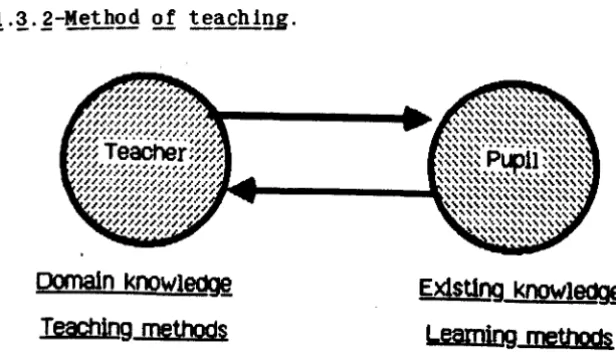
This work embodies a specific model of the teaching interaction. Let us
suppose that a teacher has her own (usable) representation of a domain of
knowledge, and that the pupil also has a representation of knowledge which may
be of relevance to the domain. The goal of teaching must be to provide the
pupil with a model of the domain (at least) as powerful as that of the teacher.
This model will not necessarily have the same internal form, since it must be
bound to differing cognitive structures in the two individuals, but both models
aust be consistent with the real world. A "direct teaching" strategy involves
the teacher in translating her model into a suitable external representation.
The learner then attempts to integrate features of this representation with her
preexisting cognitive structures, and possibly to modify the fora of these
structures. One way of categorising varieties of teaching interaction is by
locating the point in this "transfer of knowledge" at which major
reorganisation of the knowledge occurs. The following examples wIll illustrate
this;
In a traditional "chalk and talk" environment, the teacher generates an
external form from her domain knowledge which is reasonably independent of the
states of knowledge of the pupils whom she is teaching - at best it is based on
a simple "prototypical" student model. This leaves the student to do all the
work of adapting the knowledge for her own understanding. A further instance
of
a
situation in which the burden of adapting knowledge rests on the studentalone occurs when attempting to learn from a book.
At the opposite extreme, the tutor devotes much energy to developing an
accurate model of her pupil. She then combines this model with her domain
knowledge to generate an individualised course of tuition. In this approach,
the tutor must constantly update her model and reassess the presentation
method. A fairly complete exposition of this approach to education will be
found in the work of Jean-Jacques Rousseau [Rousseau 1762] . Rousseau's
philosophy is based on providing one teacher per child who tries to model the
child's interests and readiness to learn, and ensure that the appropriate
experiences occur in the environment to trigger each phase of learning. It
should be noted that it is actually possible to exert complete control over the
pupil by this method, while maintaining the impression of freedom. Rousseau's
own ideas of what is "natural" have a great influence on what the pupil is
allowed to learn.
Between these extremes there is a continuum of teaching styles. The above
framework permits a distinction to be .. ade between "~ood" and "bad" teachers
and "good" and "bad" learners. A good teacher is one who successfully
restructures information to make it easier to learn before presenting it. A
good learner is one who is capable of doing large a.ounts of reorganisation of
knowledge to make it fit into her existing cognitive structures, and of
modifying those structures when necessary. We can see that good learners are
less dependent on the ability of their teachers than are poor learners.
If we assume that the pupil has the clearest idea of her current state of
knowledge and that the teacher has the clearest understanding of the domain,
then it is reasonable to suppose that an optimal teaching interaction is one in
which the matter to be presented and the form of it's presentation is decided
by negotiation between the two parties. From this it follows that a study of
teaching should seek to identify the issues about which negotiation may take
place, and should investigate the form of that negotiation.
An examination of the teaching techniques applied in Intelligent Tutoring
systems to date shows that they concentrate on producing a copy of the
teacher's model of the domain in the head of the pupil. While this technique
is the most straightforward to study, it is a dangerous practical tool since it
has a strong tendency to produce uniformity among the pupils to whom it is
applied. It is also apparent that, unless much extra work is done by the pupil
in integrating this knowledge with her existing structures, her model cannot be
more powerful than that of the teacher. These techniques remain close to the
"chalk and talk" methods of teaching.
In its most restrictive form this approach is manifest in Computer Aided
Learning packages which make little attempt to adapt to the user. It is also
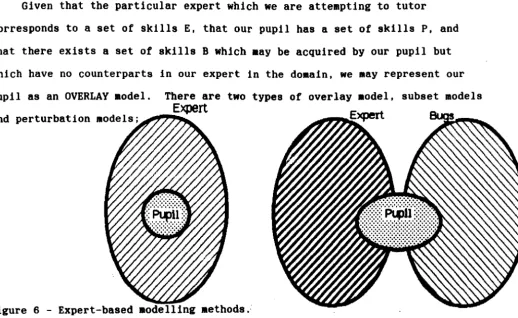
apparent in Intelligent systems which use overlay modelling (discussed in
chapter 5); the user model is built as a subset of a model of an expert in the
problem domain. The process of instructing the pupil involves finding
discrepancies between the two models and attempting to remove them. These
systems often use direct testing strategies to find evidence for the existence
of units of the model. This should not be confused with systems which maintain
a descriptive representation of an "expert" level of achievement. This is
necessary for assessment of the pupil, but the details of the experts approach
are not used in tutoring. In essence, this suggests that the teacher's expert
knowledge of the domain should be regarded as a black box, and any glass box
form which the pupil sees should be adapted to that individual.
An improvement of this type of model is to explicitly include
representations of variations on the expert skill which are not actually used
by the expert, but which reflect likely deviations from the model such as
simplified versions of complex rules. The "bug" representation of systems such
as BUGGY [Burton 1982] are examples of this category. This provides a better
means of categorising the difficulties of a pupil, but does not affect the
basic problem since these systems still have a goal of making the pupil into a
copy of the expert.
In IMPART, an attempt has been made to avoid this restrictive aspect of
the interaction. The system maintains a descriptive model of expert competence
in programming, and tries to detect discrepancies between this and a
descriptive model of the pupil's programming. When an inconsistency is
detected, the system brings it to the attention of the pupil so that the pupil
may make appropriate corrections to her model. No particular model of expert
problem-solving ability or bugs is explicitly maintained in the system for the
purpose of tutoring. The pupil model is derived by applying a model of the
learning process to the same information sources which the pupil is able to
access.
Most Intelligent Tutoring systems make use of a highly constrained
interaction such as Socratic tutoring [Collins 1980] . More recent systems
begin to permit mixed-initiative interaction with a greater degree of freedom
for the pupil, but they are still found to revert to their restrictive fora in
difficult situations in order to tie people to the model which they know about.
The method adopted in designing IMPART is to approach the problem from the
other end of this Freedom-Constraint dimension: the system leaves control of
the interaction to the pupil, and only interferes when it has a justification
for doing so.
The Educational Philosophy of "Discovery Learning" on which the
child-centred education movement (and recent computer applications such as LOGO at
MIT) has been based raises major issues about the degree and type of guidance
which should be given to a pupil. In particular, it is generally acknowledged
that totally "free" learning, in which a learner is simply left alone in an
environment, is a very poor use of available resources, and unlikely to lead to
high levels of attainment [Dearden 1967]. It is interesting to note that
although LOGO is often thought of as a free environment for learning, a case
study of LOGO use at MIT [Solomon 1976] shows an interaction which is actually
tightly constrained in practical terms, and in which the pupil exercises
virtually no control.
It is apparent that discovery learning offers advantages in terms of the
motivation of the individual. If we consider the form of teaching which is
necessary in "guided discovery" learning, we find that we can reduce the amount
of detail involved in negotiating the course of teaching, since much of the
learner's contribution can be in terms of actions in the environment. This
reduces the amount of direct interaction needed between teacher and pupil,
since the role of the teacher is now assessing the possible directions which
the pupil could follow at a given point, and encouraging those which she
considers to be most productive. This leaves the major problem of assessing the
likely value of a course of action.
It was decided to design a system which provides an environment in which a
pupil can "discover" the language Lisp. The system also contains a teaching
program which monitors the interaction of pupil and enVironment, and attempts
to make positive contributions to that interaction. The system has a goal of
detecting skills which the user is ready to learn, and encouraging the
exploration of those skills, either by manipulating the environment or by
making direct "teaching statements" to the pupil.
The thesis is divided into four sections, together with some appendices.
Part 1 (this section), provides a brief overview of the thesis and the
tutoring system which it describes. It also attempts to clarify the possible
roles which a computer can play in the educational process.
Part 2 discusses the basic issues in education and tutoring system design
which determined the nature of IMPART.
Part 3 is the central component of the thesis. It describes the tutoring
system in detail, and shows how the general issues which have been discussed
may be practically applied.
Part 4 summarizes the major points which the thesis has made.
The appendices list some of the More interesting parts of the
implementation.
The thesis attempts to discuss aspects of Education Theory and Tutoring
System design. It is unusual for these areas to appear together in a single
document, but their juxtaposition reflects the author's view that it is vitally
important to design tutoring systems with reference to a larger educational
framework. Both these aspects of tutoring system design require a substantial
amount of further research. Rather than attempting to produce a definitive
piece of work on either aspect this thesis aims to show the way in which these
areas should be related to make Intelligent Tutoring System design a truly
interdisciplinary field.
Chapter 2.
Overview of the
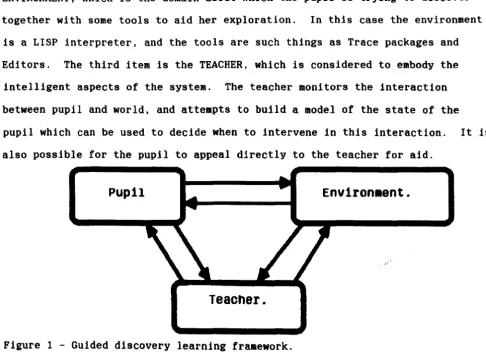
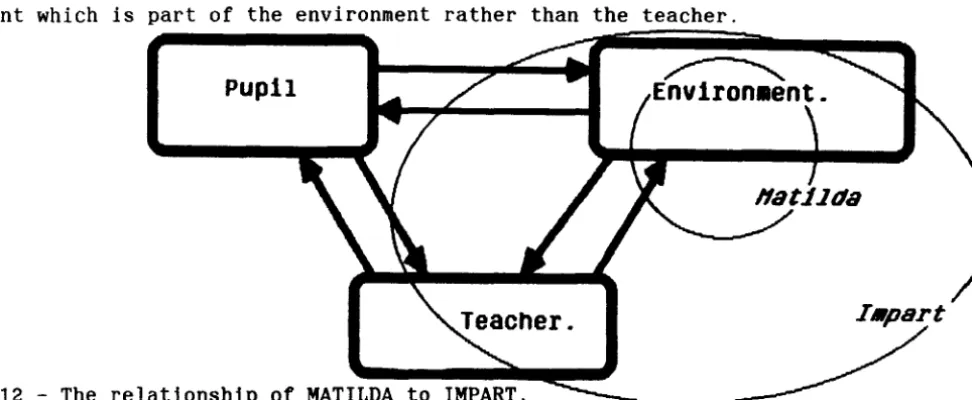
Conceptually, the system may be regarded as three separate entities. The
first is the PUPIL, which is a system user plus various interfacing packages to
enable her to interact smoothly with the system. The second is the
ENVIRONMENT, which Is the domain about which the pupil is trying to discover
together with some tools to aid her exploration. In this case the environment
is a LISP interpreter, and the tools are such things as Trace packages and
Editors. The third item is the TEACHER, which is considered to embody the
intelligent aspects of the system. The teacher monitors the interaction
between pupil and world, and attempts to build a model of the state of the
pupil which can be used to decide when to intervene in this interaction. It is
also possible for the pupil to appeal directly to the teacher for aid.
Pupil
Environ.ent.
Teacher.
Figure 1 - Guided discovery learning framework.
Let us examine the action of the system when dealing with a specific
problem. Assume that a task has been agreed between teacher and pupil which is
to define a function to extract the second element from a list;
(FRED (QUOTE (A B C») --> B
[image:25.568.33.519.202.553.2]One correct solution would be
(DE FRED (X)
(CAR(CDR X»)
and we will assume that the teacher is aware of this solution. Suppose
that the pupil offers the following definition;
(DE FRED (X)
(CDR (CAR (QUOTE X»»
The tutor executes the pupil's expression before it is completed in order
to find possible errors. A violation of the semantics due to an inappropriate
argument to CAR (i.e. X) is detected. It finds that there is one evaluation too
few on the variable X (by comparing this with the correct solution), and notes
that removing QUOTE would correct this. The tutor makes a simple patch to get
round this error and continues execution. A second error, due to an
inappropriate argument to CDR is found. Comparison with the correct solution
detects the difference in evaluation order, so this problem is also noted. It
is important to note that, rather than being "the right solution" to the
problem, what the system tries to generate is a solution using techniques which
are currently at the boundary of the pupil's skill level; the solution form is
indirectly determined by the user model.
The comparisons of solutions are not done in the programming language
itself, but rather in the underlying semantic representation. This enables the
system to identify the reasons for a difference. These differences can be used
to identify necessary changes in surface form, or can be discussed in their own
right.
The tutor now compares the detected errors with the user aodel. It finds
evidence that this pupil has experience of the aultiple-EVAL problea, but has
had less experience of the EVAL-order problem. The teaching strategies use
this to decide to make a simple statement of fact about the .foraer difficulty,
but pass control to a specialized teaching unit (a "topic controller") for a
more detailed discussion of EVAL-order.
The EVAL topic controller waits until the problem becomes manifest to the
pupil before doing anything. It takes this decision based on the evidence
which the user model provides for the pupil's ability to deal with error
situations, together with the pupil's experience of this type of problem. The
pupil tests the function with' (0 C A). An error results and the pupil
immediately asks for help. The topic controller attempts to illustrate the
error by breaking the problem into sub-problems which make the difficulties
more obvious. The tutor asks "WHAT is (CAR (QUOTE (D C A») ", then "WHAT sort
of argument does CDR expect". If this is insufficient to cause the user to
generate a correct answer then it uses a more informative technique.
An attempt has been made to produce a clear separation between the
knowledge sources in the system, so that the examination of the way in which
they interact to produce a reasonable teaching sequence is possible. A further
goal of this separation was to make the system capable of teaching different
programming languages with little overall modification.
!.,g.! .
.!-~t~.In effect, problems of syntax have been bypassed in this system. The
pupil works through a syntax-directed editor which is driven from a Backus-Naur
form description of the language. The editor generates a parse-tree of any
expression in the language, which is the form on which all other parts of the
system act. This technique was originally investigated in the EMILY system
[Hansen 1971] . The current system was designed for novice programmer's
rather than experts, so the constraints upon the editor design were different
from those of Emily. In particular, the overhead of learning to use the
interface was kept to a minimum.
The boundary between syntax and semantics is not perfectly defined, and
some problems are difficult to assign to either class. An example of this is
the question of declaring variables before using them. While many systems
assume this to be a high level of syntactic information (e.g. [Teitelbaum
1981] ), IMPART assigns it to the semantics, because it represents an aspect of
the language for which underlying principles exist.
An examination of standard techniques of program description showed that
although they are well suited to mathematical manipulations, they are not the
most appropriate representation for transferring a "psychologically reasonable"
model of the language to a pupil. For this reason a different semantic
representation was devised. This representation describes each statement in the
language in terms of preconditions for it's application plus a body of co.mands
to execute in order to achieve the appropriate effect. The coamands are drawn
from a set of about fifteen primitive operations which constitute the lowest
level of semantic description in the system. This has similarities with
certain aspects of Axiomatic and Operational semantics. In choosing this
representation, some of the constraints of mathematical consistency and
completeness for which other approaches have aimed, have been relaxed. The
form used is a type of Direct semantics, so it is unable to handle unusual
control flow features such as Jumps or Errors. Other limitations include an
inability to prove termination of a program. and some limits involving aliasing
of variables.
This declarative form of semantics is acted upon by different programs for
each of the applications to which it is put in the system. The most obvious
application is execution of expressions in lieu of an interpreter. The system
is often able to execute incomplete expressions and ignore those errors which
are due to the incompleteness. Describing statements of the language or
behaviour of an expression is done by mapping the semantics onto some simple
English descriptions of the primitive elements. Automatic generation of
problems and problem-solutions using the semantics is an important area, but is
was decided that it should not be a major research goal in the design of this
system, so it has not been examined in detail. The teaching methodology
requires that the action of programs can be made visible in such a way as to
avoid implying a particular mechanism, so some effort is devoted to providing
the teacher with different ways of displaying information during execution.
So far, the system has been applied to small domains, where it is possible
to detect correct problem solutions by exhaustive search. In real programming
domains the search space will be too large to apply this technique, so the
system requires the search to be constrained by likely solution forms. More
importantly, the student is unlikely to discover such techniques as recursion
by trial and error, so some representation ot these must exist it the teacher
is to guide the pupil towards them. These representations aust include
conceptual roles (such as "stopping condition") to which actual elements of the
program can be assigned. A representation such as that used in the
Programmer's Apprentice system [Rich 1981] is envisaged, but it will not be
incorporated into the systea until the relationship between these structures
and lower level progra . . ing knowledge has been further investigated.
Some "knowledge" about high level concepts of the language may be thought
to reside in the topic controllers of the domain, but this knowledge is not
accessible to the reasoning components of the system. In fact, this knowledge
is more about conventional methods of describing the units than about their
actual semantic form.
The student model of the system embodies most of the information which the
system has about the pupil. Some information about the dialogue state may also
be regarded as part of the user model.
The existence of a history of interaction in the system seems important
for several reasons. Being able to refer back to recent events in the
interaction helps provide a continuity to the teaching, and enables discussion
of features which the English interface cannot handle. Exactly which past
events can reasonably be referred to is not yet clear, and it is apparent that
a principled solution to this problem must involve another level of user
modelling. This may lead to a more selective form of history storage than is
currently used.
It may prove necessary for the system to do some updating of the user
model offline in order to maintain a reasonable interaction rate. What form
this processing will take has not been examined, but it is certainly the case
that human teachers consider problems which their pupils have presented them
outside direct teaching time. It is likely that a teachin~ system capable of
learning from experience would focus on this activity.
Part of the student model is maintained by building a language description
corresponding to the language which the student thinks she is using. In the
WUMPUS system [Goldstein 1982] , Goldstein identified a set of rules for
approaching new knowledge in ways based on previous knowledge. These
extrapolation rules identified possible forms of transition between "islands of
knowledge" in a "Genetic Graph". IMPART takes a similar approach, but the
transitions are generated during the interaction (rather than being wired into
the curriculum), and the rules which are used derive from a Machine Learning
methodology [Michalski 1983] A crude monitoring system attempts to assign
"success values" to each rule depending on how well the system's goals are
achieved if they involve that type of rule. More subtle techniques for
exploring and modelling the pupil's own extrapolation rules should be
investigated. It is interesting to note that there is a possibility of giving
the system a goal of extending the pupil's rule set.
The learning model is not claimed to produce the same hypotheses as the
pupil. Rather, it provides an upper and lower bound for the hypotheses which
the pupil could have generated at a particular point. These hypotheses can be
used as the basis for deductive reasoning mechanisms to predict consequences of
these hypotheses. Testing these predictions allows the system to bring the
bounds closer together until it has a sufficiently accurate model of the.
student (in some particular area) to make a tutoring contribution.
In knowing when to intervene, the system must have so.e idea of the
pupil's ability to handle the problem with which she is currently confronted.
In part this is achieved by examining the student's knowledge of the current
problem area, but it also involves knowing about the pupil's ability to trace a
bug from the sort of feedback which she receives. For this reason, the syste.
should monitor the effectiveness with which pupils can respond to error
.essages. A goal of the system is to i.prove this ability so that transfer to
nor.al interpreters is fairly straightforward.
Unlike most Inte11igent Tutoring systems, which are purely reactive, this
system is intended to participate in a structured interaction with the pupil.
Much of the work in this section makes use of recent progress in models of
conversation [Power 1979] [Reichmann 1978] . Control of the interaction is
shared between three major units;
1) Descriptors of domain.
Each concept about which the system is able to talk has a topic controller
associated with it. This topic controller embodies all domain specific aspects
of the concept, so it contains such things as outlines of various ways to
present and discuss a topic. It also contains mechanisms to assess it's own
importance at the current point in the interaction, and routines which enable
it to make some assessment of it's own success in modifying the user's model of
the problem_domain. These mechanisms may contribute to the interaction by
passing data to standard teaching strategies, or they may control an
interaction specific to their own domain. These controllers may be thought of
as including the tutorial goals of the teacher. Each controller can be
regarded as an agent, with associated declarative and procedural knowledge.
2) General interaction skills.
These skills have the purpose of maintaining the consistency and
smoothness of the interaction. They perform such tasks as marking subject
boundaries, and adjudicating in the process of topic selection by choosing a
topic controller on the basis of a bid indicating the likely importance and
relevance of the topic. Since these procedures make no assumptions about the
actual actions of a topic controller. they can integrate linguistic and
non-linguistic forms of interaction.
3) Teaching strategies.
Teaching strategies are special conversation techniques which can be
called by topic controllers. They are intended to represent those processes of
communication which are common to all areas of the domain. They include such
things as asking questions, giving examples, and making direct statements of
fact.
Since the focus of this research was on the design of a tutoring system,
the implementation was not carried to completion. Instead, a number of small
programs were produced intended to demonstrate the feasibility of the approach.
Figure 2 shows the extent of the implementation.
The architecture of IMPART is shown in terms of information flow between
components. It is probably best explained by following the passage of
information round the diagram, beginning with the pupil.
Our PUPIL may interact with a SYNTAX-DIRECTED EDITOR to produce
expressions in the language which she is learning. This editor produces a
parse-tree of the language statement which is transmitted to the INTERPRETER.
This transmission occurs at all stages of construction of the expression, so
that the system may provide information during construction of an expression.
When an expression is complete, and the student wishes to execute it, the
EDITOR sends it to the INTERPRETER. The INTERPRETER executes it and returns
results and error messages to the editor which displays them in an appropriate
form for the PUPIL (e.g. unparsing them). The system described so far
corresponds to the passive programming environment in which the PUPIL will
ultimately work.
Parsed expressions, with a description of their behaviour, are sent from
the INTERPRETER to the LEARNING MODEL, and the PATCHER. The LEARNING MODEL
applies learning mechanisms to generate a set of possible hypotheses which the
student could draw from the current example. These are passed to an ASSESSOR
which compares them with the actual language definition and filters out those
which are not valid. The resulting hypotheses are passed, as a
maximally-specific/minimally-specific pair, to the CONVERSATION CONTROLLER which stores
them as a record of that interaction step.
The PATCHER operates on expressions which have produced errors to find
specific modifications which would remove the error. It also produces a set
which identifies each basic error and the manifestations of that error. This
information is passed to the CONVERSATION CONTROLLER.
The CONVERSATION CONTROLLER operates by repeatedly invoking TOPIC
CONTROLLERS and enabling them to bid for control of the conversation. It gives
these controllers access to knowledge about the current state of the
interaction which has been drawn from different sources.
Each TOPIC CONTROLLER may pass information to one or more DISCOURSE GAMES
of either type. These GAMES may, in turn, invoke a language generator to
present information to the pupil in an appropriate form. In order to access
detailed information which it may require to instruct the pupil, each TOPIC
CONTROLLER may invoke the INTERPRETER, a PROBLEM GENERATOR and a PROBLEM
SOLVER. Each of these units can respond to instructions froa the CONTROLLER
(for example, the problem generator can be requested to produce a problem
involving values of atoms, the interpreter can be asked to reexecute an
expression while tracing particular components etc).
Direct interaction between pupil and teacher occurs via the parser (or
other input software) which directly affects the conversational context
maintained by the CONVERSATION CONTROLLER. This section has not been
implemented.
Figure.2 - I_ple_entation overview
Proble.
generator
Pupil
Parser
(keyword input)
~
Not
i~le.ented ~Si.Ple
version exists
The structure of IMPART which is shown in Figure 2 is suitable for
tutoring any programming language. To change language it is necessary to
provide alternative syntactic and semantic descriptions (in a form which will
be discussed later), and probably some additional topic controllers. All other
parts of the system operate on the basic semantic description, and hence do not
need to be changed for languages other than LISP.
IMPART itself is a particular instantiation of a more general guided
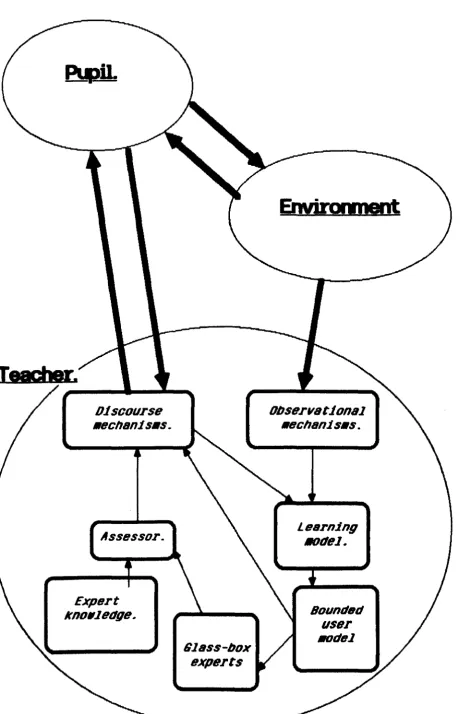
discovery architecture. This architecture is shown in figure 3. It will be observed that it focusses on the internal structure of the tutor. It is
claimed that this provides a framework within which tutoring systems for a wide
range of domains can be constructed. There are two key features; one is the
division into teacher, pupil and environment while the second is the central
position given to "bounded user modelling" and the model of learning.
The division into three parts distinguishes the active, changing
components which constitute the teacher, from the reactive system which the
pupil Is learning to understand. It is possible to conceive of a degenerate
case in which no interaction with the environment occurs, but in general a
pupil should apply things which are learnt in some environment.
The "bounded user modelling" approach which was described briefly above,
provides an alternative to expert-based modelling. Its centrality in this
system implies that the focus of the tutor's activity is concerned with
building and maintaining a model of the knowledge state of the pupil. An
adequate modelling .echanism is a prerequisite of any Intelligent Tutoring
System. All tutoring activities are strongly dependent upon the quality of this
modelling component.
In figure 3 the tutor interacts with the world via "discourse mechanisms"
and "observational mechanisms". The former deal directly with the pupil, the
latter with events that occur in the environment. Both these units provide
information which is acted upon by the "learning model". This "learning model"
generates sets of hypotheses which become the "bounded user model".
The "discourse mechanisms", in addition to an internal model of the
discourse structure which controls the interaction, may be affected by the
"bounded user model" and the "assessor". The "bounded user model" identifies
things which may usefully be pursued from the current conversational state (for
example, if atoms and lists have been talked about. the user model would
indicate that a discussion of datatypes would be reasonable. but the discourse
mechanisms alone would not be aware of this). The "assessor" identifies
differences between the performance of an "expert" in the domain. and a
"glass-box expert" which attempts to find the consequences which follow from
the hypotheses which are currently in the "bounded user model". The "glass-box
expert" is expected to work with techniques which are on the current bounds of
the pupil's understanding. but is not to be regarded as a model of the
problem-solving skills of the student; it is an approximation to such a model.
and should always be treated as an approximation. The "discourse mechanisms"
may directly invoke the "glass-box expert" to generate and solve problems.
In an actual implementation it is difficult to separate each of the
components of the general tutoring system architecture. In IMPART. for
example. the observational mechanisms include the syntax-directed editor and
the semantically-driven language interpreter. but these units also play roles
as part of the environment. and (to some extent) as part of the black-box
expert.
figure
3. - A
general
tutoring~em
structure
(BolI1ded
user
modeWng)~
Discourse
.echanis.s.
Assessor.
Expert
knol1ledge ..
Glass-box
experts
Envirorment
Observational
.echani s.s.
learning
IIOdel.
Boundlld
user
Chapter 3.
Computers in an educational
The computer is having a major effect upon many aspects of modern life.
It is a central focus of the technological revolution which we are currently
facing.
There seems to be a certain degree of inevitability in the way that computers
appear in all types of environment, so much so that they are often accepted
unquestioningly as a sign of progress in a particular area.
Within the Educational system the problems are particularly apparent.
Computers seem to be a vital part of every secondary curriculum, primarily in
terms of "computer awareness" (teaching people what computers can do), but also
in the role of aids to teaching. These trends are spreading to primary and
infant schooling.
There are two extreme positions which educationalists may hold with
respect to the issue of computers in education. On one side are those who
advocate wholesale acceptance of this technology while on the other are those
who simply ignore it in the hope that it will go away. It is remarkable that a
high percentage of teachers adopt one or the other of these extreme positions,
rather than possessing opinions which lie between them. Let us examine these
points more closely.
The group which advocate acceptance of the computer into all aspects of
education typically do so without good reason. A computer is considered to be
appropriate because it is high technology, and therefore progress. In taking
this attitude we are ignoring a fundamental tenet of any educational system;
Each new idea should be thoroughly tested and examined, and introduced ONLY if
it appropriate to do so. There is no merit in taking drill and practice
arithmetic from a book and placing it on a computer screen - nothing has been
added. Computers free machine-based programmed learning from the burden of
expensive task-specific hardware which was a major obstacle to this movement.
Unfortunately, this has the effect of eliminating the practical problems of the
approach without resolving the theoretical ones.
Another practical difficulty for this approach is that it typically talks
about the value of computers per se; there is no real appreciation that the
versatility of the computer is such that assessment should be carried out upon
each piece of software individually.
The teachers who reject computers altogether as an educational tool are
probably taking a sensible decision given the information which is available to
them. Most teachers have only seen the output of typical commercial software
houses.
The problems with these programs are many. A large number of software
companies with experience in fields other than education produce Educational
Software. It is only recently that such companies have begun to consult
educationalists about the design of their programs. Much of the early work
made use of the primitive facilities which a computer offers (such as
iteration) to produce very mechanistic software (such as rote learning
programs) which was economical in machine time, but of dubious educational
value. These programs often repeated the trends followed by the movement
towards programmed learning in Education which occured during the 1960's. It
is small wonder that teachers who see computers in this light dismiss them as
simply a more technological version of this unsucessful paradigm. A classic
dismissal of this type is that given by H.Broudy [Broudy 1969]. In this
paper the author points out that the most important element of a Socratic
Dialogue was Socrates. If a machine cannot support the level of reasoning
which Socrates must have used during a discourse then it can only
be a
shaa,simply giving the impression of a useful dialogue.
Unfortunately, the recent initiative to put "microcomputers in schools"
placed the emphasis on providing hardware without considering the problems of
educating teachers about the potential of these machines. As a result, both
the views given above have become more entrenched - there are more co.puters
sitting unused, and more alienated members of the teaching profession than
there were before.
There is a need to educate teachers about the facilities which properly
written software could offer. Until such information is made available it is
unreasonable to expect teachers to be able to decide about the applicability of
the computer to various educational tasks. I would propose that there are two
main themes to discuss; the first is identifying Educational tasks which can be
usefully tackled by existing technology, and the second is creating an
awareness of the new potential which Artificial Intelligence based techniques
could bring to education.
A major problem with existing Educational software is that it does not
adapt to the individual user, and as such produces a stereotyped interaction.
The dangers of non-adaptive systems will be discussed later. For the present,
we may note that the behaviour of a group of children is much more predictable
than that of an individual. It would seem reasonable, therefore, to propose
that current software methods could be justifiably applied to the production of
programs intended to promote interaction among a group of children. Anyone who
has watched a group of children interacting with a computer will know how much
argument can be produced by something as siaple as a hangaan program. The
ability to communicate ideas to your peers is important. If computers can help
to achieve this then we have found a role for them which is not adequately
covered by any other (currently practicable) method. Within this area. I
suggest there exist two major applications for the computer.
The first application is that of a "Quiz-master". By this I mean that the
computer should present problems to a group of pupils which are intended
to fire debate among them. These questions would be provided in advance
by a teacher as they would be for programmed learning software. The
difference is that the focus is not upon the answers given, but upon the
discussion which precedes those answers. The computer would not be aware
of such discussion, or capable of contributing to it.
The unique facility offered by the computer in this case is the prospect
of Immediate Feedback on answers (in a way which a book could not
provide), without inhibiting the discussion in the way that the presence
of a teacher would. It is important to note that correct use of such
software is not simply a matter of picking half a dozen pupils at random
and sitting them in front of the machine. The teacher is required to use
her judgement to set up groups who are likely to interact well together.
This highlights a general difficulty with current approaches to using
computers in education; it is wrong to attempt to use them in isolation
from other activities - they should be integrated with the curriculum and
become an extension to the teachers repertoire of tools rather than a
substitute teacher.
The second role which I would propose is that of "Computer as Pupil". It
is acknowledged that attempting to teach something is a powerful aethod
for clarifying and structuring that information. If pupils habitually
taught the subject that they are learning it would provide an outlet
through which to polish communicative skills, while also causing the pupil
to think about the material in such a way as to bring about deeper
understanding. There are certain practical difficulties in using this
technique in schools. The teacher cannot be a very convincing pupil since
such a role conflicts with the image of a teacher as a source of
knowledge. Recent Educational research has examined the provision of this
facility in the form of peer-group teaching [Furlong 1976] . It is
certainly the case that children impart information to their peers, but
the spirit of competition prevents a child's own class from being a good
audience. Another problem is that with all the children trying to teach
(often teaching the same thing), there aren't enough pupils to go roundl
I would suggest that the Computer can alleviate this problem by providing a medium through which pupils may teach. It seems unlikely that current
educational software methods could produce a computer which acts as an
appropriate pupil since this problem still presents major research
difficulties, but it may provide an intermediate device allowing pupils to
prepare educational material. The sort of interaction envisaged here is
that a group of pupils, having studied a given area, get together to
jointly produce a simple Computer Aided Instruction package for that area.
Existing author languages (if made slightly more friendly) are perfectly
adequate for this sort of work. Whether the end product is ever used is
irrelevant, since the educational experience occurs for the designers
during the design process.
The idea of pupils teaching each other through the computer is distinct
from the idea of learning by telling the computer what to do (an idea
associated with LOGO). In this case the pupils are directly concerned with the
process of ordering and presenting information to their peers. It directly
fosters the development of communication skills.
I propose to divide the potential applications for Artificial Intelligence
influenced computer use into two categories. The first is to use a computer as
an aid to thought in the way that Artificial Intelligence research uses it,
while the second is the application of systems which embody the results of
Artificial Intelligence research.
In research, the computer acts as a tool to clarify thought processes.
Producing a computer program based upon some theory gives a concrete form to
the abstract theory. The computer provides a simulation environment which may
represent things that are not directly perceivable in the real world.
Immediate feedback can be provided on the consistency and consequences of a
particular theory.
This view of the computer is at the base of those approaches to computers
in education which involve providing a programming environment for the pupil.
LOGO [Papert 1971] and PROLOG [Ennals 1981] have been applied within this
paradigm. It is important to note that this approach does not centre upon a
simple relationship between computer and child - the entire environment in
which the child operates is important. Some attempts to introduce such
approaches into the classroom have failed because it is not realized that they
require a large amount of teacher re-education, and a considerable expenditure
of effort in integrating the computer into the educational environaent. This
reflects the fact that much early research in this area ignored the large scale
context of the computer application.
Having said this, programming based approaches are very successful as aids
to Artificial Intelligence research, and it is likely that they can be equally
constructiv~ in other areas (such as teaching mathematics) PROVIDED APPROPRIATE
ENVIRONMENTS ARE DEVELOPED.
Artificial Intelligence research involves the production of co.puter based