ISSN Online: 2327-5227 ISSN Print: 2327-5219
DOI: 10.4236/jcc.2018.64006 Apr. 28, 2018 65 Journal of Computer and Communications
An Analysis on Position Estimation, Drifting
and Accumulated Error Accuracy during 3D
Tracking in Electronic Handheld Devices
Shanjidah Akhter
*, Pahlwan Rabiul Islam, Latifun Ahsin Bhuiyan, Mehedi Hasan,
A. F. M. Saifuddin Saif
Department of Computer Science and Engineering, American International University-Bangladesh (AIUB), Dhaka, Bangladesh
Abstract
This work focuses on a brief discussion of new concepts of using smartphone sensors for 3D painting in virtual or augmented reality. Motivation of this re-search comes from the idea of using different types of sensors which exist in our smartphones such as accelerometer, gyroscope, magnetometer etc. to track the position for painting in virtual reality, like Google Tilt Brush, but cost effectively. Research studies till date on estimating position and localiza-tion and tracking have been thoroughly reviewed to find the appropriate algo-rithm which will provide accurate result with minimum drift error. Sensor fu-sion, Inertial Measurement Unit (IMU), MEMS inertial sensor, Kalman filter based global translational localization systems are studied. It is observed, pre-vailing approaches consist issues such as stability, random bias drift, noisy ac-celeration output, position estimation error, robustness or accuracy, cost ef-fectiveness etc. Moreover, issues with motions that do not follow laws of physics, bandwidth, restrictive nature of assumptions, scale optimization for large space are noticed as well. Advantages of such smartphone sensor based position estimation approaches include, less memory demand, very fast oper-ation, making them well suited for real time problems and embedded systems. Being independent of the size of the system, they can work effectively for high dimensional systems as well. Through study of these approaches it is ob-served, extended Kalman filter gives the highest accuracy with reduced quirement of excess hardware during tracking. It renders better and faster re-sult when used in accelerometer sensor. With the aid of various software, er-ror accuracy can be increased further as well.
Keywords
3D Tracking, Error Accuracy, Extended Kalman Filter, Handheld Device, Position Estimation, Sensor, Virtual Reality, Augmented Reality
How to cite this paper: Akhter, S., Islam, P.R., Bhuiyan, L.A., Hasan, M. and Saif, A.F.M.S. (2018) An Analysis on Position Estimation, Drifting and Accumulated Error Accuracy during 3D Tracking in Electronic Handheld Devices. Journal of Computer and Communications, 6, 65-75.
https://doi.org/10.4236/jcc.2018.64006
Received: March 6, 2018 Accepted: April 25, 2018 Published: April 28, 2018
Copyright © 2018 by authors and Scientific Research Publishing Inc. This work is licensed under the Creative Commons Attribution International License (CC BY 4.0).
DOI: 10.4236/jcc.2018.64006 66 Journal of Computer and Communications
1. Introduction
Portable, compact, easily accessible, and cost-effective means of services and technology are of great use in recent times. A lot of works have been carried out in the field of computer algorithm and application development which is based on mobile and portable workstations like cellphone, smartphone, tablet, Person-al DigitPerson-al Assistant (PDA) etc. These devices are especiPerson-ally opted since they fea-ture few unique characteristics i.e. portability, cost effectiveness, multiple plat-form and OS compatibility, easy internet connectivity for firmware update, user friendly UI etc. Moreover, with the advances in semiconductor chip and inte-grated circuits technology, these devices now boast highly powerful processors and a wide range of sensors. A developer hence can take advantage of this po-werful yet portable computing ability of these devices to design innovative ap-plications. To accurately estimate position and localization, and to achieve effec-tive tracking, various combinations of sensors, algorithms have been designed and developed which work together in synchronization. After thorough scrutiny and analysis of relevant works in this area, it is found that they can be broadly categorized and discussed based on their methodology, framework, and experi-mental results. Hence our discussion is separated into three afore-mentioned kinds so that it is possible to critically analyze relevant works in an effective way considering every criterion and come up with a new idea.
2. Position Estimation Methodologies
2.1. Using Miniature Inertial Sensors
Various types of sensors have been used to accomplish various tasks. Miniature inertial sensors based on biomechanical models and sensor fusion algorithm can
accurately track human motion [1]. A rigid body can move freely in 3D space in
six degrees of freedom (6DOF) which refers to specific number of axes. The number of independent parameters is characterized in 6DOF which elucidates the configuration of mechanical system. The rigid body can move with X, Y and Z axes and change its orientation among these axes with the help of rotation which are usually referred as pitch, yaw and roll. 6DOF is mainly used in engi-neering and robotics to count the number of degrees of freedom of an object having 3D space. In short, it can be said that there are six parameters which are created during the movement of body. The movement of the cell phone can be tracked using 6DOF sensors of cellphone. Six degrees of freedom are more in number in case of robotics. Robotic arm has 18 degrees of freedom because three segments are found in its arm with each segment having six degrees of freedom
[2]. It is an expensive system for robotics and the cost of equipment, software
and personal requires can restraint use of this system only to large productions.
2.2. Using Sensor Fusion Approach
indi-DOI: 10.4236/jcc.2018.64006 67 Journal of Computer and Communications
vidual sensors to calculate accurate position and orientation information [3]. It proposes two sensor fusion algorithms to accomplish this task, the systematic confidence-weighted averaging algorithm and the application-specific robust certainty grid algorithm. TT (Time-Triggered) design requires detailed design phase. Data arrival at fusion node does not coincide due to variable propagation delays. This sensor fusion can be used in android devices for indoor positioning quite satisfactorily [4]. It focuses in estimating the position of the phone inside a building where the GPS signal is bad or unavailable. By using data from the de-vice’s different sensors, such as, accelerometer, gyroscope, and wireless adapter, the position is determined. Advantages of using sensor fusion are redundancy, complementary, timeliness and less costly information. However, it has higher power assumption.
2.3. Using Triaxial Accelerometers
Mobile robot position can be accurately recorded using accelerometer [5]. Here
Kalman filter is used to reduce error caused by random noise. Although it can reduce error caused by random noise as well as having low cost and small size, random bias drift problems can occur here. Tri-axial accelerometer has also been used to determine position and orientation precisely [6]. Triaxial accelerometers provide simultaneous measurements in three orthogonal directions, for analysis of all the vibrations being experienced by a structure. Here, each unit is a com-bination of three sensing elements, separated from one another and aligned at right angles with each other. It helps to diminish cost, amenity and upgrade tangential sensitivity, but it is bulkier in size. A combination of accelerometer, gyroscope, magnetometer can be used as well for 3D knee kinematics, having
low error percentage results [7]. A combination of two sensors has also been
used to develop the error propagation equations [8]. Beginning with the basic
multi-sensor triangulation equations to estimate a 3D target position, error propagation equations are derived by taking the appropriate partial derivatives with respect to various measurement errors. Gaussian measurement is also used.
2.4. Inertial Measurement Units (IMU)
Integrated electronic devices containing accelerometers, gyroscopes,
magneto-meters are incorporated in Inertial Measurement Units (IMU) [9]. IMUs are
in-tegrated electronic devices that contain accelerometers, magnetometers and gy-roscopes. This system is not free from drift error, a difference between the actual position and system detected position. Growth of quadratic error in position and linear error in velocity occurs due to constant error of acceleration in the time of integration. On the contrary, quadratic error in velocity and growth of cubic
er-ror in position appears because of constant erer-ror of gyroscope [10]. To mitigate
drift error, MEMS based low cost system has been designed for pedestrian navi-gation using only accelerometer and gyroscope sensors without incorporating a
DOI: 10.4236/jcc.2018.64006 68 Journal of Computer and Communications
as well [12]. A miniature inertial/magnetometer package wirelessly coupled to
PDA is reported to track pedestrian position effectively with or without GPS availability [13]. Using MEMS inertial sensor, it is possible to measure accurately
up to 50 cm in case of diameter [14]. The advantage of inertial sensor is being
self-contained and non-reliant on external field, disadvantage is it is typically rate measurement and expensive. Though the system does not require calibra-tion and is stride length independent, it can be affected to render erroneous data from surrounding metal infrastructures or buildings. Foot mounted inertial sensors have also been used in indoor environment for pedestrian localization
[15]. The system takes advantage of the low cost and small size of inertial sensors but it requires dedicated experiment space and walking range.
2.5. Kalman Filter Based Tracking
A widely-used approach of accurate tracking is Kalman filtering [16] [17]. This
approach has several advantages. It requires smaller memory allocation which makes it well suited for real time problems and embedded systems. It is a conve-nient form for online real-time processing. However, use of Kalman filter can sometimes make the final error level worse. 1D Kalman filter, a statistical tech-nique, can adequately describe the random structure of experimental data
through a connection with GPS and Wiener filter [18]. Here, the error is smaller
with time varying gain. Kalman filter can be implemented with an accelerometer sensor that gives excellent noise reduction, increases dynamic range, and reduces
displacement of mass under closed loop structure [19]. Kalman filter fusion
al-gorithm in IMU/UWB can be used to track human operators effectively [20].
Kalman filter approach has also been used for global pose estimation using multi
sensor fusion [21]. The system is made using Kalman filter for fusion of
Diffe-rential GPS (DGPS) or Real Time Kinematic (RTK) for AR (Augmented Reality) and IMU with visual orientation tracker. Altitude Kalman filter is not indepen-dent because of 9 parameters for altitude representation and not easy to use and understand, besides real-time kinematics is no longer useful.
2.6. Extended Kalman Filter (EKF)
The extended Kalman filter (EKF) is the nonlinear version of the Kalman filter
which linearizes about an estimate of the current mean and covariance [22]. EKF
usually gives less accurate measure of covariance. It is incorporated in designing
indoor positioning system based on IMU/magnetometer [23]. This filter also
renders better and faster result when used in accelerometer sensor. Besides EKF, Unscented Kalman filter (UKF) algorithm is used for better position accuracy
and reliability, uses U transform during filtering [24]. UKF is more appropriate
in solutions to nonlinear systems compared to EKF [25].
3. Framework of Position Estimation Approaches
DOI: 10.4236/jcc.2018.64006 69 Journal of Computer and Communications
modules [1]. The magnetic sensor is not always able to find out below-surface
defects, and inertial sensor is typically rate measurement and expensive. Com-puter, motion sensors (accelerometer) and rotation sensors (gyroscope) are used in inertial navigation system (INS) for continuous calculation of dead reckoning position, orientation and velocity of moving objects without external reference
[26]. In sensor-fusion approach, the application is structured as a single activity
with different layouts (views) [4]. The main processing line takes care of the
sensors reading which is handled by an event listener. When a new value from the sensors is sampled depending on the mode it will be processed by the posi-tioning engine, displayed on the screen or stored in a sampling array. The UI is handled from an independent thread, the screen updates are controlled by a ti-mer and by external calls from the positioning block. The mode changes are triggered either by the 30-user interaction (through the menu) or by special event in the block which handles the sensors (e.g. the calibration is completed).
IMUs work by the principle such as, the first and the second frames depend on orientation and mounting position, and remain constant during motion be-tween joint center and origin of their position [12]. Here, MT9 need six channels
to change and each channel needs to record separately [9]. On the other hand,
magnetometer calibration is done in implementing the Navshoe system based on inertial sensors [13].
Kalman filter based inertial motion capture system and UWB localization sys-tem for hybrid tracking incorporates measurements from the GypsyGyro-18
[20]. These are transformed to the Ubisense coordinate system using
transfor-mation matrix in the same coordinate system. Kalman filter is used for predic-tion step and correcpredic-tion of step, whereas the Ubisense system usually returns accurate positions. However, some measurements from the Ubisense system have big errors and shouldn’t be incorporated to the Kalman filter. In case of orientation estimation and position estimation, dedicated Kalman filter and
al-titude Kalman filter can be used together [21]. Altitude Kalman filter, a linear
Kalman filter is used to estimate altitude and vertical velocity by doing sensor fusion of acceleration and any altitude measurement sensor such as e.g. barome-ter or SONAR. Algorithm of the Kalman filbarome-ter has several advantages. This is a statistical technique that adequately describes the random structure of experi-mental measurements. This filter can consider quantities that are partially or completely neglected in other techniques (such as the variance of the initial es-timate of the state and the variance of the model error). It provides information about the quality of the estimation by providing the variance of the estimation error in addition to the best estimate. Kalman filter is well suited for online digi-tal processing. Its recursive structure allows its real-time execution without storing observations or past estimates. EKF orientation estimation method is ef-fective to provide accurate reconstructed trajectory in an indoor environment
[27]. EKF is also designed based on quaternions for heading estimation which is
DOI: 10.4236/jcc.2018.64006 70 Journal of Computer and Communications
4. Result Analysis of Reviewed Estimation Approaches
It is observed that miniature inertial sensors based on biomechanical models and sensor fusion algorithm can accurately track human motion and finds unknown
initial position [1]. In case of estimating the position of a phone by
sen-sor-fusion, a double integration is required to calculate position from
accelera-tion [4]. The INS algorithm needs large processing time. To reduce the effect of
the errors, the linear acceleration method is complemented with additional functions: movement detection, walking speed limit and step detection. This improved the INS position estimation significantly.
To successfully estimate the orientation and position of a triaxial accelerome-ter on industrial robot, two basic steps are observed [6]. First, the internal sensor parameters and the accelerometer with orientation of the sensor. Second, the position respect to the robot tool coordinate system. Here, there is no elimina-tion of error. On the other hand, two-sensor 3D posielimina-tion estimaelimina-tion technique comprises steps such as, 3D position estimation, then error propagation for two sensors, Tylor series expansion for unknown values, then error propagation with Gaussian statistics to target the position. However, these steps can be avoided
[8].
It is observed during calibration of IMUs for 3D orientation, spreading of
er-ror in absolute orientation is present [9]. Besides in the time of raw data
processing, the total error was split into component rotations about the global axis to further understand the sources of the orientation error. Each sensor needs to be mapped to the rigid body segment. In case of INS for pedestrians based on MEMS IMU, only accelerometer and gyroscope measurements were
considered (no magnetometers required) [11]. The sensor error model
parame-ters were included in the state vector of an extended Kalman filter. This
analyti-cal approach was appropriated for foot stance detection at zero-velocity [11].
Comparison on Razor IMU and Xsens MTi IMU was drawn as well. It is also observed that the experimentation of various systems depicts different levels of non-consistency. Noise and slow drifting occurs in IMU based gait analysis [12]. Accuracy of only 0.3 percent is observed in indoor, outdoor experimentation of
shoe-mounted inertial sensors based pedestrian tracking [13]. Indoor
environ-ment localization technique for pedestrians did not remove errors present [15].
It required a dedicated experiment space and the walking range.
The Kalman filter combines all previous predicted values and information in implementing accelerometer sensor data for three state positions in dynamic
system [19]. It is very inexpensive since it completes the whole process without
DOI: 10.4236/jcc.2018.64006 71 Journal of Computer and Communications
The solution is obtained with less computational time in respect of large cost overhead in modeling. R\q value of 28 could be good solution to reduce errors in
acceleration, velocity and position which are found from graph analysis [19]. It
is observed, Kalman filter based inertial motion capture system and UWB loca-lization system for hybrid tracking incorporating measurements from the
Gyp-syGyro-18 [20] in Ubisense system is not suitable, because Ubisense has small
data frequency (5 - 9 FPS) which causes extremely high latencies in industrial environments. Ubisense system having considerable amount of errors shouldn’t be incorporated to the Kalman filter. GypsyGyro-18 gives accumulated errors in global translational measurements. GypsyGyro-18 represents an error of 0.56 m regarding the pre-established path. This error is due to the GypsyGyro-18 foot-step extrapolation algorithm because it sometimes estimates wrongly when the feet meet the floor. That’s why they need to use UWB localization system. The GypsyGyro-18 global translational error has been reduced to 0.14 m and the re-sulting data rate is equal to the GypsyGyro-18 frequency (30 Hz). It consists of two components: an inertial motion capture system (GypsyGyro-18) and an UWB localization system (Ubisense). The MoCap (Motion Capture) system can register movements of the operator’s limbs with high precision, but global posi-tion of the operator in the environment is not determined with sufficient accu-racy. On the other hand, use of dedicated Kalman filter and altitude Kalman fil-ter together for orientation estimation and position estimation is achieved by a
hardware platform [21]. Kalman filter is then used for global pose estimation
using multiple sensors. GPS and DGPS are used as well, which is not necessary. A visual panorama tracker as additional input can communicate in limited dis-tance. Also, use of barometer gives less accurate results.
It is shown that robustness against measurement error is found using EKF
[29]. EKFs have been implemented for all possible combinations using
gyros-copes and accelerometers as control or measurement inputs [30]. EKF with
Taylor series expansion of observation matrix is used for superior performance
[31]. A comparison between Second-Order Extended Kalman Filter (SOEKF)
based on multiplicative noise model and the random matrix approach i.e. EKF
has been drawn. During the time of orientation changing, both SOEKF and EKF
provides better performance [32]. SOEKF Taylor series expansion matches more
accurately with the exact moments compared to First-order Taylor series expan-sion [33]. It is also observed that EKF is capable of incorporating different direc-tions during movement when compared to invariant extended Kalman filter (IEKF) [34].
5. Experimental Discussion
exact-DOI: 10.4236/jcc.2018.64006 72 Journal of Computer and Communications
ly match the subject (actor) being captured in miniature inertial sensors based
human motion tracking using sensor fusion algorithm [1]. Custom calibration of
inertial measurement units for 3D orientation is valid for only 22 days, with
er-ror increasing everyday [9]. Moreover, human knee being less close to a perfect
hinge joint, gait analysis of IMU based joint angle measurement is not
com-pletely accurate [12]. On the other hand, a large difference between altitudes
occurs at the beginning due to slow transition oscillation for global pose
estima-tion using multi sensor-fusion by Kalman filter approach [21]. Lack of accuracy
and drift over time is observed as well.
To compensate for the drift, existing sensor fusion systems use various types of external sensor, such as, GPS, ultrasonic beacons etc. In our approach, we
propose to implement a single camera SLAM [20] [21] with controller
smart-phone’s camera to obtain visual odometry of the handheld device in real-world
environment. Lucas-Kanade sparse optical flow [35] is used to track good
fea-tures between frames. We then calculate essential matrix to obtain rotation and translation information, which eliminates dependency on any external position-ing system. Proposed approach is tested on Sony Xperia Z2 smartphone, which runs on Android OS 6.0.1, API level 23. Android API's Sensor Manager Class is used to make use of events and information, such as, sensor’s type, time-stamp, accuracy, and sensor’s data. Android API provides a 3D vector indicating acce-leration along each device axis, excluding gravity. The smartphone used in the experiments consist of BMA2X20 Accelerometer, having a resolution of 0.019 m/s2 and maximum range of 39.227 m/s2.
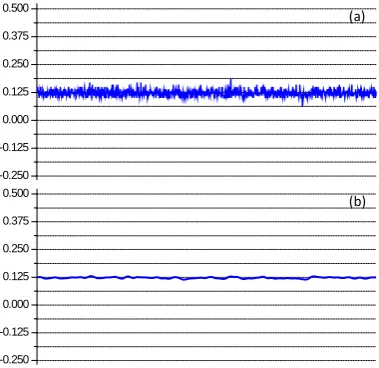
Accelerometers have very fast response but consists noise. Experimental data shows white noise propagation in raw linear acceleration over constant time domain with controller device in flat position. By using EKF, relatively smooth
[image:8.595.279.469.497.681.2]data is found as in Figure 1. During construction of EKF, we set three values.
Figure 1. Accelerometer linear acceleration data
from X-axis: (a) Noisy data (b) Smooth data after extended Kalman filtering (arbitrary units).
-0.250 -0.125 0.000 0.125 0.250 0.375 0.500
-0.250 -0.125 0.000 0.125 0.250 0.375 0.500
(a)
DOI: 10.4236/jcc.2018.64006 73 Journal of Computer and Communications
They are expectation value (0.001), process noise (1e-5) and measurement noise (0.0195). Data from linear acceleration of X, Y and Z-axis is sent to EKF to con-vert noisy data into smooth data. There is still some bias found when accelero-meter data is sent after filtering. Computing filtered or smooth data by double integration, we get position estimation of the handheld device. However, an is-sue of rise in drift is observed. Bias increases the amount of drift error as well. So, we accumulate long term average of bias for bias estimation. Then we calcu-late bias estimation before double integration to reduce drift. Inertial measure-ment sensors are MEMS based. Hence, flicker noise or 1/f noise is present.
6. Conclusion
It is observed from detailed analysis above; there is scope of state estimation (velocity, position and pose) by using accelerometer, gyroscope and magneto-meter sensors and EKF which requires further study. The significance of this approach is to be able to get room scale canvas and introduce immersive expe-rience to users. Extensive experimentation can be performed by using IMU of mobile device. Further analysis on estimating accurate drift and error can be performed as well. Monocular odometry to compute the accurate relation be-tween IMU provided position and visual localization in real world co-ordinate system is another scope of possible study. We propose to use monocular visual inertial system integrated with accelerometer to reduce observed flicker noise in li-near acceleration data. From monocular images, depth map can be created using concurrent inertial measurements and pose recovery. With Structure-from-Motion method we can estimate camera pose estimation and trajectory to get stable 3D coordinates for handheld device with reduced residual noise from IMU sensors.
References
[1] Roetenberg, D., Luinge, H. and Slycke, P. (2013) Xsens MVN: Full 6DOF Human Motion Tracking Using Miniature Inertial Sensors. Xsens Motion Technologies BV, Technical Report.
[2] Six Degrees of Freedom (6DOF)
https://www.techopedia.com/definition/12702/six-degrees-of-freedom-6dof
[3] Elmenreich, W. (2002) Sensor Fusion in Time-Triggered Systems. PhD Thesis, Technische Universitat Wien, Institut fur Technische Informatik, Vienna, Austria. [4] Shala, U. and Rodriguez, A. (2011) Indoor Positioning Using Sensor-Fusion in
An-droid Devices. Masters Thesis, Kristianstad University, Kristianstad, Sweden. [5] Liu, H. and Pang, G. (2001) Accelerometer for Mobile Robot Positioning. IEEE
Transactions on Industry Applications, 37, 812-819.
https://doi.org/10.1109/28.924763
[6] Axelsson, P. and Norrlöf, M. (2012) Method to Estimate the Position and Orienta-tion of a Triaxial Accelerometer Mounted to an Industrial Manipulator. IFAC Pro-ceedings Volumes, 45, 283-288. https://doi.org/10.3182/20120905-3-HR-2030.00066
[7] Kawano, K., Kobashi, S., Vagi, M., Kondo, K., Yoshiya, S. and Hata, Y. (2007) Ana-lyzing 3D Knee Kinematics Using Accelerometers, Gyroscopes and Magnetometers.
DOI: 10.4236/jcc.2018.64006 74 Journal of Computer and Communications
April 2007, San Antonio, TX, USA.
[8] Sanders-Reed, J.N. (2001) Error Propagation in Two-Sensor 3D Position Estima-tion. Optical Engineering, 40, 627-636. https://doi.org/10.1117/1.1353798
[9] Brodie, M.A., Walmsley, A. and Page, W. (2008) The Static Accuracy and Calibra-tion of Inertial Measurement Units for 3D OrientaCalibra-tion. Computer Methods in Bio-mechanics and Biomedical Engineering, 11, 641-648.
https://doi.org/10.1080/10255840802326736
[10] Siciliano, B. and Khatib, O. (2008) Springer Handbook of Robotics. Springer Science & Business Media, Berlin/Heidelberg.
https://doi.org/10.1007/978-3-540-30301-5
[11] Montorsi, F., Pancaldi, F. and Vitetta, G.M. (2013) Design and Implementation of an Inertial Navigation System for Pedestrians Based on a Low-Cost MEMS IMU.
IEEE International Conference on Communications Workshops, 9-13 June 2013,
Budapest, Hungary. https://doi.org/10.1109/ICCW.2013.6649201
[12] Seel, T., Raisch, J. and Schauer, T. (2014) IMU-Based Joint Angle Measurement for Gait Analysis. Sensors, 14, 6891-6909.https://doi.org/10.3390/s140406891
[13] Foxlin, E. (2005) Pedestrian Tracking with Shoe-Mounted Inertial Sensors. IEEE Computer Graphics and Applications, 25, 38-46.
https://doi.org/10.1109/MCG.2005.140
[14] Inertial Sensors. https://www.xsens.com/tags/inertial-sensors/
[15] Woodman, O. and Harle, R. (2008) Pedestrian Localisation for Indoor Environ-ments. Proceedings of the 10th International Conference on Ubiquitous Compu-ting, 21-24 September 2008, Seoul, Korea. https://doi.org/10.1145/1409635.1409651
[16] Brookner, E. (2002) Tracking and Kalman Filtering Made Easy. John Wiley & Sons, Inc., Hoboken.
[17] Welch, G. and Bishop, G. (1995) An Introduction to the Kalman Filter. Department of Computer Science, University of North Carolina, Chapel Hill, Tech. Rep. TR-95-041.
[18] Turner, R. The 1d Kalman Filter.
http://citeseerx.ist.psu.edu/viewdoc/download?doi=10.1.1.642.8451&rep=rep1&type =pdf
[19] Singhal, T., Harit, A. and Vishwakarma, D.N. (2012) Kalman Filter Implementation on an Accelerometer Sensor Data for Three State Estimation of a Dynamic System.
International Journal of Research in Engineering and Technology, 1, 330-334. [20] Corrales, J., Candelas, F. and Torres, F. (2008) Hybrid Tracking of Human
Opera-tors Using IMU/UWB Data Fusion by a Kalman Filter. Proceedings of the 3rd ACM/IEEE International Conference on Human-Robot Interaction, Amsterdam, 12-15 March 2008, 193-200.https://doi.org/10.1145/1349822.1349848
[21] Schall, G., Wagner, D., Reitmayr, G., Wieser, M., Teichmann, E., Schmalstieg, D., et al. (2009) Global Pose Estimation Using Multi-Sensor Fusion for Outdoor Aug-mented Reality. Proceedings of the 8th IEEE International Symposium on Mixed and Augmented Reality, Orlando, 19-22 October 2009, 153-162.
[22] Levy, S.D. The Extended Kalman Filter: An Interactive Tutorial for Nonexperts.
http://home.wlu.edu/~levys/kalman_tutorial
DOI: 10.4236/jcc.2018.64006 75 Journal of Computer and Communications
[24] Chen, G., Meng, X., Wang, Y., Zhang, Y., Tian, P. and Yang, H. (2015) Integrated WiFi/PDR/Smartphone using an Unscented Kalman Filter Algorithm for 3D In-door Localization. Sensors, 15, 24595-24614.https://doi.org/10.3390/s150924595
[25] Li, S.E., Li, G., Yu, J., Liu, C., Cheng, B., Wang, J., et al. (2018) Kalman Filter Based Tracking of Moving Objects using Linear Ultrasonic Sensor Array for Road Ve-hicles. Mechanical Systems and Signal Processing, 98, 173-189.
https://doi.org/10.1016/j.ymssp.2017.04.041
[26] Inertial Navigation System.
http://military.wikia.com/wiki/Inertial_navigation_system
[27] Hsu, Y.L., Wang, J.S. and Chang, C.W. (2017) A Wearable Inertial Pedestrian Na-vigation System with Quaternion-Based Extended Kalman Filter for Pedestrian Lo-calization. IEEE Sensors Journal, 17, 3193-3206.
https://doi.org/10.1109/JSEN.2017.2679138
[28] Deng, Z.-A., Hu, Y., Yu, J. and Na, Z. (2015) Extended Kalman Filter for Real Time Indoor Localization by Fusing WiFi and Smartphone Inertial Sensors. Microma-chines, 6, 523-543.https://doi.org/10.3390/mi6040523
[29] Bonnabel, S. and Slotine, J.J. (2015) A Contraction Theory-Based Analysis of the Stability of the Deterministic Extended Kalman Filter. IEEE Transactions on Auto-matic Control, 60, 565-569.https://doi.org/10.1109/TAC.2014.2336991
[30] Erdem, A.T. and Ercan, A.O. (2015) Fusing Inertial Sensor Data in an Extended Kalman Filter for 3D Camera Tracking. IEEE Transactions on Image Processing, 24, 538-548. https://doi.org/10.1109/TIP.2014.2380176
[31] Khan, M.W., Salman, N., Ali, A., Khan, A.M. and Kemp, A.H. (2015) A Compara-tive Study of Target Tracking with Kalman Filter, Extended Kalman Filter and Par-ticle Filter using Received Signal Strength Measurements. Proceedings of the 2015
International Conference on Emerging Technologies, Peshawar, 19-20 December 2015, 1-6.https://doi.org/10.1109/ICET.2015.7389222
[32] Yang, S. and Baum, M. (2017) Extended Kalman Filter for Extended Object Track-ing. Proceedings of the 2017 IEEE International Conference on Acoustics, Speech and Signal Processing, New Orleans, 5-9 March 2017, 4386-4390.
https://doi.org/10.1109/ICASSP.2017.7952985
[33] Yang, S. and Baum, M. (2016) Second-Order Extended Kalman Filter for Extended Object and Group Tracking. Proceedings of the International Conference on In-formation Fusion, Heidelberg, 5-8 July 2016, 1178-1184.
[34] Barrau, A. and Bonnabel, S. (2016) The Invariant Extended Kalman Filter as a Sta-ble Observer. IEEE Transactions on Automatic Control, 62, 1797-1812.
https://doi.org/10.1109/TAC.2016.2594085
[35] Foxlin, E. (1996) Inertial Head-Tracker Sensor Fusion by a Complementary Sepa-rate-Bias Kalman Filter. Proceedings of IEEE Virtual Reality Annual International Symposium, Santa Clara, 30 March-3 April 1996, 185-194.