ISSN Online: 2327-4379 ISSN Print: 2327-4352
DOI: 10.4236/jamp.2018.64056 Apr. 12, 2018 640 Journal of Applied Mathematics and Physics
Flatly Broadened and Highly Coherent
Supercontinuum Generation by Induced
Modulation Instability in ANDi-PCF
Chunfu Cheng
1,2, Yan Zeng
1,2, Yiwen Ou
1,2*, Zhangyong Yang
1,2, Zehao Chen
1,21Hubei Collaborative Innovation Center for High-efficiency Utilization of Solar Energy, Hubei University of Technology, Wuhan, China
2School of Science, Hubei University of Technology, Wuhan, China
Abstract
In this paper, a flatly broadened and highly coherent supercontinuum genera-tion by induced modulagenera-tion instability in ANDi-PCF is proposed. The nu-merical results show that the bandwidth of supercontinuun can be increased by increasing the modulation depth and the coherence property of supercon-tinuum can be improved with the optimal modulation frequency. A highly coherent supercontinuum with the 10 dB bandwidth of 1305 nm and the flat-ness of less than 10 dB can be obtained when seeding at the modulation depth of 0.3 and modulation frequency of 24 THz.
Keywords
Supercontinuum Generation, Flat, Coherent, Modulation Instability
1. Introduction
Supercontinuum (SC) is a physical phenomenon in which a large intensity ul-trashort optical pulse passes through a nonlinear medium, and the spectrum is greatly broadened due to the interaction of nonlinear effect and dispersion ef-fect. SC spectrum is wide, relatively stable, simple and inexpensive, so it has been widely used in spectral analysis, optical coherence photography and optical sensing [1]. However, many applications of SC are limited by the coherence property of SC. For examples, If the coherence degree is not high, the resolution of the nonlinear microscope will be reduced; in the optical coherence tomogra-phy system (OCT), the coherence degree determines the measurement resolu-tion level [2]; in terms of optical pulse compression, SC coherence degree
di-How to cite this paper: Cheng, C.F., Zeng, Y., Ou, Y.W., Yang, Z.Y. and Chen, Z.H. (2018) Flatly Broadened and Highly Cohe-rent Supercontinuum Generation by In-duced Modulation Instability in ANDi-PCF. Journal of Applied Mathematics and Phys-ics, 6, 640-646.
https://doi.org/10.4236/jamp.2018.64056
DOI: 10.4236/jamp.2018.64056 641 Journal of Applied Mathematics and Physics
rectly affects the quality of pulse compression [3] [4], and so on. Therefore, the coherence property of SC is very important which will ultimately affect the qual-ity and range of the end application.
In contrast to the normal dispersion region, the anomalous dispersion region can produce a wider SC spectrum, but its coherence properties are very low and it is difficult to be used in many practical applications [1] [2] [3] [4]. In recent years, with the rapid development of the high nonlinear photonic crystal fiber (PCF), ultra-wide and highly coherent SC has become a possibility in the normal dispersion region. By using the numerical simulation and experimental method, the researchers have extensively studied the generation of coherent SC. During 2002-2003, J. M. Dudley [5] and X. Gu [6] analyzed the coherence prosperities of the SC by using the method of first-order factor. In 2010 Alexander M. Heidt studied the SC generation in all-normal dispersion photonic crystal fiber (AN-Di-PCF) and analyzed the coherence properties of SC [7]. A SC with flatness of 1dB and bandwidth of 1080 nm was achieved. From 2012 to 2017, many re-search teams have studied the SC and rogue wave generation by induced mod-ulation instability in photonic crystal fiber [8] [9] [10] and they have pointed out the bandwidth can be increased by induced modulation instability. However, the effect of modulation instability on the coherence properties of SC has not been investigated. In this paper, we applied the seed depth and frequency in a pulsed light source to achieve highly coherent SC in ANDi-PCF. The results show that this method can improve the flatness and coherence of SC.
2. Principle and Theory
In this study, pulse propagation in the PCF is simulated using the Runge-Kutta algorithm to solve the generalized nonlinear Schrodinger equation [11]
1
2
2 0
(1 )[ ( , ) ( ) ( , ) ]
! 2
m m
m m m
i
A A i
A i A z d R A z
z m
β α γ τ τ τ τ τ
ω τ τ
+ +∞
−∞ ≥
∂ ∂ ∂ ′ ′ ′
= − + + −
∂
∑
∂ ∂∫
(1)where A z( , )τ is the complex field envelope at a propagation distance z in a re-tarded reference time frame τ traveling at the envelope group velocity. Since only short pieces of the PCF will be considered, loss in the fiber is neglected (
α
=0). The dispersion coefficients βm are associated with the Taylor expansion of thepropagation constant β( )w around the center frequency w0, and γ is the fre-quency dependent nonlinear coefficient. Dispersion effects are described by the first term on the right hand side of Equation (1); nonlinear effects correspond to the second one. The nonlinear response function R t( )= −(1 fR) ( )σ t + f h tR R( ) with fR=0.18 contains both instantaneous and delayed Raman contributions, the response hR which we use is the same as the analytic approximation in [1].
DOI: 10.4236/jamp.2018.64056 642 Journal of Applied Mathematics and Physics
estimated to be
γ
=27.3 (W−1∙km−1),and the up to 8-th order dispersioncoef-ficients are 2
2 6.9276 10
β = × − ps2/km, 3
3 3.59804 10
β = − × − ps3/km,
4
4 6.57756 10
β = × − ps4/km, 6
5 2.82896 10
β = × − ps5/km, 10
6 2.82896 10
β = × −
ps6/km, 12
7 1.45745 10
β = × − ps7/km, 14
8 2.91289 10
β = × − ps8/km, the effect of
more than 8-th order dispersion can be neglected due to the weak dispersion ef-fect of ANDi-PCF.
The modulated Gaussian input pulse envelope is assumed to have the follow-ing form
mod
2 2 2
0 0 0
( 0, ) ( i f ) exp( / (2 p)) exp[ ( )]
A z=
τ
= P +d P e π τ −τ
τ
iδφ τ
(2)where P0=20kw is the input peak power and we define the power
2 0 0
seed
P =d P
as the power of the seed, d0 means the modulation depth, fmod is the mod-ulation frequency, τp is the temporal width, which is related to FWHM pulse duration by TFWHM ≈1.665τp, δφ τ( ) is a small random phase fluctuation which is caused by Gaussian white noise [3] [4].
We take the Raman response function and high-order dispersion up to β8 into account to obtain the MI gain g( )Ω , it can be written as [8] [9] [10]:
0 0
( ) Im{ ( e 2 ( )) e}
g Ω = ∆ ± ∆ +k k γP R Ω ∆k (3)
where Ω is the modulation frequency, R( )Ω is Raman response for silica, ∆ke
and ∆ko are sums over odd and even order derivatives of propagation constant
β, respectively [8]:
2 1 2
2 1 2
0
1(2 1) 12 !
m m m m e m m k k m m β β ∞ ∞ + + = =
∆ = Ω ∆ = Ω
+
∑
,∑
, (4)The coherence properties of SC spectra can be characterized by calculating the wavelength dependence of the first-order coherence as following equation [1].
(1) 1 1 2 2
12 1 2
2 2
1 1 2 2
( , ) ( , )
( , ) ,
( , ) ( , )
A t A t
g t t
A t A t
λ λ λ λ λ ∗ < > − =
< >< > (5)
where the term in the angular brackets indicates an ensemble average over inde-pendently generated pairs of SC spectra through 20-times simulation results. The value of first-order coherence lies in the interval [0, 1], and a value of 1 de-notes perfect coherence.
3. Simulation and Discussion
DOI: 10.4236/jamp.2018.64056 643 Journal of Applied Mathematics and Physics (a) (b)
Figure 1. The propagation characteristics of an ultrashort laser pulse under the unseeded condition in ANDi-PCF. (a) spectral domain evolution; (b) time domain evolution. λ0 = 1550 nm, P0 = 20 kW.
DOI: 10.4236/jamp.2018.64056 644 Journal of Applied Mathematics and Physics (a) (b)
Figure 2. Effect of modulation depth on the (a) SC spectrum and (b) its coherence prop-erty.
[image:5.595.212.535.63.205.2](a) (b)
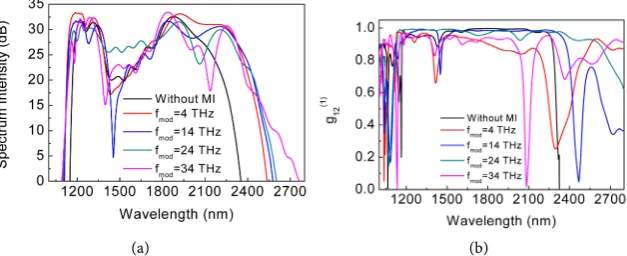
Figure 3. Effect of modulation frequency on the (a) SC spectrum and (b) its coherence property.
Figure 4. MI gain spectrum for the pump power of 20 kW as the function of seed fre-quency offset.
[image:5.595.217.531.257.385.2]DOI: 10.4236/jamp.2018.64056 645 Journal of Applied Mathematics and Physics (a) (b)
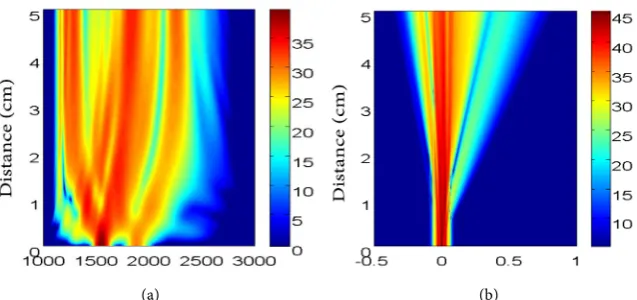
Figure 5. The propagation characteristics of an ultra short laser pulse under the seeded condition with a seed of 0.3 modulation depth at the modulation frequency of 24 THz. (a) spectral domain evolution; (b) time domain evolution.
formed the flat and highly coherent SC spectrum as shown in Figure 3. When the modulation frequency erty as shown in Figure 3(b). When the frequency is above the peak of gain spectrum, the generation mechanisms of SC are FWM and SPM [8], what’s more, the FWM process is very weak and very weak FWM sidebands are generated on the both side of the pump as is too large, the work off effect occurs between the seed and pump pulse and thus leads to the flatness and coherence of SC spectrum became worse.
4. Conclusion
In conclusion, the nonlinear propagation and SC generation is numerically in-vestigated. The results show that the flatness and coherence of SC can be im-proved by seeding with a proper modulation frequency and the bandwidth of SC can be increased by increasing the modulation depth. By selecting the optimal modulation parameters, a highly coherent supercontinuum with the 10 dB bandwidth of 1305 nm and the flatness of less than 10 dB can be obtained.
Acknowledgements
This work was supported by the National Nature Science Foundation of China (Grant Nos. 61475044), the International Science & Technology Cooperation Program of China (No. 2016YFE0124300), the Doctoral Scientific Research Foundation of Hubei University of Technology (No. BSQD2016047) and the Open Foundation of Hubei Collaborative Innovation Center for High-efficiency Utilization of Solar Energy (No. HBSKFZD2017003).
References
[1] Dudley, J.M., Genty, G. and Coen, S. (2006) Supercontinuum Generation in Pho-tonic Crystal Fiber. Rev. Mod. Phys., 78, 1135-1184.
https://doi.org/10.1103/RevModPhys.78.1135
Pho-DOI: 10.4236/jamp.2018.64056 646 Journal of Applied Mathematics and Physics tonic Crystal Fibers for Supercontinuum Light Sources: Applications to Optical Coherence Tomography Systems. Opti. & laser technol., 44, 976-980.
https://doi.org/10.1016/j.optlastec.2011.10.021
[3] Foster, M.A., Gaeta, A.L., Cao, Q. and Trebino, R. (2005) Soliton-Effect Compres-sion of Supercontinuum to Few-Cycle Durations in Photonic Nanowires. Opt. Ex-press, 13, 6848-6855.https://doi.org/10.1364/OPEX.13.006848
[4] Cheng, C., Zeng, Y., Ou, Y., Lv, H., Lv, Q. and Zhang, J. (2017) Few-Cycle Pulse Generation from Compression of Supercontinuum by Optimizing Initial Chirp in ANDi-PCF. Optik, 133, 66-72. https://doi.org/10.1016/j.ijleo.2017.01.001
[5] Dudley, J.M. and Coen, S. (2002) Coherence Properties of Supercontinuum Spectra Generated in Photonic Crystal and Tapered Optical Fibers. Opt. Lett., 27, 1180-1182. https://doi.org/10.1364/OL.27.001180
[6] Gu, X., Kimmel, M., Shreenath, A.P., Trebino, R., Dudley, J.M., Coen, S. and Win-deler, R.S. (2003) Experimental Studies of the Coherence of Microstructure-Fiber Supercontinuum. Opt. Express, 11, 2697-2703.
https://doi.org/10.1364/OE.11.002697
[7] Heidt, A.M. (2010) Pulse Preserving Flat-Top Supercontinuum Generation in All-Normal Dispersion Photonic Crystal Fibers. J. Opt. Soc. Am. B, 27, 550-559. https://doi.org/10.1364/JOSAB.27.000550
[8] Sørensen, S.T., Larsen, C., Møller, U., Moselund, P.M., Thomsen, C.L. and Bang, O. (2012) Influence of Pump Power and Modulation Instability Gain Spectrum on Seeded Supercontinuum and Rogue Wave Generation. J. Opt. Soc. Am. B, 29, 2875-2885. https://doi.org/10.1364/JOSAB.29.002875
[9] Yang, H., Chen, N., Wang, B., Tang, P. and Zeng, Q. (2016) Supercontinuum and Rogue Soliton Generation by Induced Modulational Instability in Photonic Crystal Fibre. J. Mod. Optic., 63, 1370-1377.
http://dx.doi.org/10.1080/09500340.2016.1148210
[10] Zhao, S., Yang, H., Chen, N. and Zhao, C. (2017) Controlled Generation of High-Intensity Optical Rogue Waves by Induced Modulation Instability. Scientific Reports, 7, 3926. https://doi:10.1038/srep39926
[11] Agrawall, G.P. (2001) Nonlinear Fiber Optics. Academic Press, New York.