A STUDY ON THE TEACHER EFFECTIVENESS OF SCHOOL TEACHERS
Sivasakthi R
Department of Education, Annamalai University,
ARTICLE INFO ABSTRACT
In the present investigation has been under taken in order to study the teacher effectiveness of school teachers in Chennai and Thiruvallur Districts. Teacher Effectiveness of school teachers’ scale was constructed and standardized by Kumar and Mutha (1974
random sample of 900 school teachers. It is found that teachers significantly differ in teacher effectiveness in respect of gender, place of school, level of teaching and they do not differ in teacher effectiveness in respect
monthly income of teachers.
INTRODUCTION
Education is the foundation on the basis of which the future of a country is largely determined. Education has been considered as the most important factor for bringing change in every aspect of human behaviour. While education develops the total personality of an individual it contributes also to the growth and development of society. Education is a dynamic force in the life of every individual, influencing his physical, mental, emotional, social and ethical development. Education implies experience, insight and adjustment on the part of the learner as he is stimulated toward growth and development.
Teacher effectiveness
Teacher effectiveness is a crucial factor which determines the academic achievements of the pupil both qualitatively and quantitatively. Teacher effectiveness as the degree of success of a teacher in performing instructional and other duties specified in his contract and demanded by the nature of his position. The knowledge of the subject, variety of teaching methods, ability to relate the subject to other fields, encouragement of student participation, creativity, intellectual efficiency, task involvement etc. are the characteristics of an effective teacher. Characteristics of an effective teacher more specifically factors like emotional intelligence, teaching attitude and job involvement contribute towards teacher effectiveness. It refers to the performance of primary, high and higher secondary school teachers in instructional as well as other duties of a teacher, while results in the academic excellence of the students.
*Corresponding author: [email protected]
ISSN: 0975-833X
International Journal of Current Research
Vol.
Article History: Received 14th
November, 2011 Received in revised form 18th
December, 2011 Accepted 29th
January, 2011 Published online 29th February, 2012
Key Words:
Teacher effectiveness, Descriptive survey method, Random sampling, Gender, Place of school, Marital status, Age, Type of management, Level of teaching, Years of experience and Monthly income of the teachers.
RESEARCH ARTICLE
A STUDY ON THE TEACHER EFFECTIVENESS OF SCHOOL TEACHERS
Rajammal, T. and Muthumanickam, R.
Annamalai University, Annamalainagar–608 002, Tamil Nadu, India.
ABSTRACT
In the present investigation has been under taken in order to study the teacher effectiveness of school teachers in Chennai and Thiruvallur Districts. Teacher Effectiveness of school teachers’ scale was constructed and standardized by Kumar and Mutha (1974) has been administrated to a random sample of 900 school teachers. It is found that teachers significantly differ in teacher effectiveness in respect of gender, place of school, level of teaching and they do not differ in teacher effectiveness in respect of marital status, age, type of management, years of experience and monthly income of teachers.
Copy Right, IJCR, 2012, Academic Journals
Education is the foundation on the basis of which the future of a country is largely determined. Education has been considered as the most important factor for bringing change in every aspect of human behaviour. While education develops ty of an individual it contributes also to the growth and development of society. Education is a dynamic force in the life of every individual, influencing his physical, mental, emotional, social and ethical development. Education ht and adjustment on the part of the learner as he is stimulated toward growth and development.
Teacher effectiveness is a crucial factor which determines the academic achievements of the pupil both qualitatively and quantitatively. Teacher effectiveness as the degree of success of a teacher in performing instructional and other duties specified in his contract and demanded by the nature of his position. The knowledge of the subject, variety of teaching ty to relate the subject to other fields, encouragement of student participation, creativity, intellectual efficiency, task involvement etc. are the characteristics of an effective teacher. Characteristics of an effective teacher more like emotional intelligence, teaching attitude and job involvement contribute towards teacher effectiveness. It refers to the performance of primary, high and higher secondary school teachers in instructional as well sults in the academic
Review of related literature
Amsarani (2002) made a study on "Teacher Effectiveness of Second Language Teachers in Higher Secondary Schools". The tool was used were 1. The Teacher Effectiveness Inventory prepared and validated by Amsarani and Chandrakumar (2002) (rated by the student
sheet (for the teachers). The sample consisted
and 1000 students selected from various Higher Secondary Schools in Nellai Kattabomman District. The major findings were : 1. The teacher effectiveness of
teachers is neither low nor high, just moderate in terms of cognitive aspect, is just moderate in terms of affective and psychomotor aspects, it ranges from moderate to low. 2. The Post Graduate English teachers of Government school, Government aided minority school, Government aided minority school are moderate in their teacher effectiveness and also in terms of the dimensions –
aspects. In the case of psychomotor aspects only Government school teachers. School teachers seem to go down from moderate to low where as the Government aided
school and Government aided – non minority school teachers are found to be just moderate. Kagathalal (2001) aimed to find out the relationship between teacher effectiveness and
educational qualification, (c) experience of teaching, (d) types of school, (e) caste and (f) the area of schools. Teacher Effectiveness Scale and Creative Personality Inventory were used as tools. The scale was administered to 1800 teachers (
female) of secondary schools in different parts of Gujarat. The major findings were : 1. The teachers of urban area posses more teacher effectiveness than the teachers of rural area in Gujarat. 2. There is no significant effect of sex, qualification and caste on the effectiveness of teachers. 3. The effect of experience of teaching on
ternational Journal of Current Research
Vol. 4, Issue, 02, pp.222-226, February,2012
INTERNATIONAL
OF CURRENT RESEARCH
A STUDY ON THE TEACHER EFFECTIVENESS OF SCHOOL TEACHERS
Tamil Nadu, India.
In the present investigation has been under taken in order to study the teacher effectiveness of school teachers in Chennai and Thiruvallur Districts. Teacher Effectiveness of school teachers’ ) has been administrated to a random sample of 900 school teachers. It is found that teachers significantly differ in teacher effectiveness in respect of gender, place of school, level of teaching and they do not differ in of marital status, age, type of management, years of experience and
, Academic Journals. All rights reserved.
Amsarani (2002) made a study on "Teacher Effectiveness of Second Language Teachers in Higher Secondary Schools". The tool was used were 1. The Teacher Effectiveness Inventory prepared and validated by Amsarani and Chandrakumar (2002) (rated by the students) 2. Personal data sheet (for the teachers). The sample consisted of 50 teachers and 1000 students selected from various Higher Secondary Schools in Nellai Kattabomman District. The major findings were : 1. The teacher effectiveness of Post Graduate English teachers is neither low nor high, just moderate in terms of cognitive aspect, is just moderate in terms of affective and psychomotor aspects, it ranges from moderate to low. 2. The Post Graduate English teachers of Government school, d minority school, Government aided – non minority school are moderate in their teacher effectiveness and cognitive and affective aspects. In the case of psychomotor aspects only Government seem to go down from moderate to low where as the Government aided – minority non minority school teachers Kagathalal (2001) aimed to find out the relationship between teacher effectiveness and (a) sex, (b) educational qualification, (c) experience of teaching, (d) types of school, (e) caste and (f) the area of schools. Teacher Effectiveness Scale and Creative Personality Inventory were used as tools. The scale was administered to 1800 teachers (1290 male and 510 female) of secondary schools in different parts of Gujarat. The major findings were : 1. The teachers of urban area posses more teacher effectiveness than the teachers of rural area in Gujarat. 2. alification and caste on the effectiveness of teachers. 3. The effect of experience of teaching on
the teacher effectiveness is found increasing up to the experience of 19 years, but it is found decreasing after that level of experience. Kumar (2005) made a study on "Teacher Effectiveness and Job Satisfaction of women teachers". The study was carried out with the main objective of study was carried out with the main objective of studying the relationship between Teacher Effectiveness and Job Satisfaction. The subjects were 120 women teachers working in High Schools of Chittoor District of Andhra Pradesh selected by following random sampling techniques. The tools used were Teacher Effectiveness Scale consisting of 50 items, Job Satisfaction Scale consisting of 100 items and Personal data sheet. The major findings were : 1. The findings showed low and positive correlation between Teacher Effectiveness and Job Satisfaction. 2. Only the management of the school has sufficient impact both on Teacher Effectiveness and Job Satisfaction. 3. The other variables included in the study – locality and subject of teaching had no significant effect on both Teacher Effectiveness and Job Satisfaction. 4. There is no significant difference between rural and urban teachers on Teacher Effectiveness.
Objectives of the study
1.To find out the levels of the teacher effectiveness of the following school teachers.
a. Gender (Male / Female) b. Place of school (Rural / Urban) c. Marital status (Married / Un married)
d. Age (Below 30 years / 30-40 years / Above 40 years) e. Type of management (Government school /
Government aided school / Private school) f. Level of teaching (Primary school, High school,
Higher secondary school)
g. Years of experience (Below 10 years / 10-20 years / Above 20 years)
h. Monthly income (Rupees10,000 / Rupees10,000-20,000 / RupeesRupees10,000-20,000 and above)
2. To find out the significant difference between the following groups of teachers on their teacher effectiveness.
a. Gender (Male / Female) b. Place of school (Rural / Urban) c. Marital status (Married / Un married)
d. Age (Below 30 years / 30-40 years / Above 40 years)
e. Type of management (Government school / Government aided school / Private school)
f. Level of teaching (Primary school, High school, Higher secondary school)
g. Years of experience (Below 10 years / 10-20 years / Above 20 years)
h. Monthly income (Rupees10,000 and below / Rupees10,000-20,000 / Rupees20,000 and above)
Hypotheses of the study
Following hypotheses were tested
1. Teachers effectiveness of following school teachers is high. a. Gender (Male / Female)
b. Place of school (Rural / Urban) c. Marital status (Married / Un married)
d. Age (Below 30 years / 30-40 years / Above 40 years e. Type of management (Government school /
Government aided school / Private school) f. Level of teaching (Primary school, High school, Higher
secondary school)
g. Years of experience (Below 10 years / 10-20 years / Above 20 years)
h. Monthly income (Rupees10,000 and below / Rupees10,000-20,000 / Rupees20,000 and above)
2. There is significant difference between the following groups of teachers on their teacher effectiveness.
a. Gender (Male / Female) b. Place of school (Rural / Urban) c. Marital status (Married / Un married)
d. Age (Below 30 years / 30-40 years / Above 40 years) e. Type of management (Government school /
Government aided school / Private school)
f. Level of teaching (Primary school, High school, Higher sec. school)
g. Years of experience (Below 10 years / 10-20 years / Above 20 years)
h. Monthly income (Rupees10,000 and below / Rupees10,000-20,000 / Rupees20,000 and above)
Methodology used
The present study aims at finding out the Teacher effectiveness of teachers. Therefore, the normative survey method has been used in the study.
Tools used
Teacher Effectiveness of school teachers scale was constructed and standardized by Kumar and Mutha (1974) was used in the present study. The tool consists of 69 items with five point scale. The scoring is from 1 -5. The score ranging from 69- 104 denote low effectiveness, score ranging from 105- 242 is considered as average effectiveness and score ranges from 243-345 is considered as high level of teacher effectiveness.
Sample of the study
The primary school, high school and higher secondary school teachers in Chennai and Thiruvallur Districts of Tamilnadu, India were taken as sample. The random sampling technique was used by the investigators for the selection of sample. A total of 900 school teachers have been selected for this study.
Statistical techniques used
Descriptive analysis and Differential analysis (‘t’ test and ‘F’ test) were used in the present study to test the hypotheses and interpret the data.
Statistical analysis and interpretation of data
(i) Descriptive analysis – Teacher effectiveness
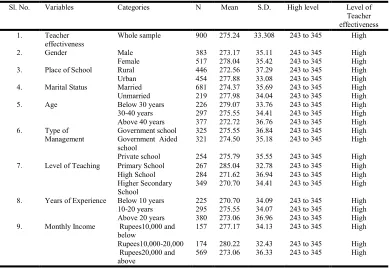
on their gender, place of school, marital status, age, type of management, level of teaching, years of experience and monthly income. Table-1 reveals the mean and standard deviation scores of the sub samples responsible for teacher effectiveness of teachers. The author of the tool suggested that the score ranging 243 and above denote high level of teacher effectiveness. The male and female teachers have high teacher effectiveness. The rural and urban teachers have high teacher effectiveness. The married and un married teachers have high
[image:3.612.110.499.76.345.2]
teacher effectiveness. The below 30 years, 30-40 years and above 40 years age group of experience of teachers have high teacher effectiveness. The government school, government aided school and private school teachers have high teacher effectiveness. The primary school, high school and higher secondary school teachers have high teacher effectiveness. The below 10 years, 10-20 years and above 20 years teaching experience of teachers have high teacher effectiveness. The Rupees10000 and below, Rupees10000-20000 and above Rupees20000 and above monthly income of teachers have Table -1 Descriptive Statistics for Teacher Effectiveness Scores
Sl. No. Variables Categories N Mean S.D. High level Level of
Teacher effectiveness
1. Teacher
effectiveness
Whole sample 900 275.24 33.308 243 to 345 High
2. Gender Male 383 273.17 35.11 243 to 345 High
Female 517 278.04 35.42 243 to 345 High
3. Place of School Rural 446 272.56 37.29 243 to 345 High
Urban 454 277.88 33.08 243 to 345 High
4. Marital Status Married 681 274.37 35.69 243 to 345 High
Unmarried 219 277.98 34.04 243 to 345 High
5. Age Below 30 years 226 279.07 33.76 243 to 345 High
30-40 years 297 275.55 34.41 243 to 345 High
Above 40 years 377 272.72 36.76 243 to 345 High
6. Type of Management
Government school 325 275.55 36.84 243 to 345 High
Government Aided school
321 274.50 35.18 243 to 345 High
Private school 254 275.79 35.55 243 to 345 High
7. Level of Teaching Primary School 267 285.04 32.78 243 to 345 High
High School 284 271.62 36.94 243 to 345 High
Higher Secondary School
349 270.70 34.41 243 to 345 High
8. Years of Experience Below 10 years 225 270.70 34.09 243 to 345 High
10-20 years 295 275.55 34.07 243 to 345 High
Above 20 years 380 273.06 36.96 243 to 345 High
9. Monthly Income Rupees10,000 and
below
157 277.17 34.13 243 to 345 High
Rupees10,000-20,000 174 280.22 32.43 243 to 345 High
Rupees20,000 and above
569 273.06 36.33 243 to 345 High
[image:3.612.104.505.371.447.2]
Table -2 ‘t’ Test Values for Teacher Effectiveness
Sl. No.
Variables Category N Mean S.D. ‘t’ Value Level of
significance
1. Gender Male 383 273.17 35.11 2.051 Significant at
0.05 level
Female 517 278.04 35.42
2. Place of School Rural 446 272.56 37.29 2.263 Significant at
0.05 level
Urban 454 277.88 33.08
3. Marital Status Married 681 274.37 35.69 1.317 Not significant
at 0.05 level
Unmarried 219 277.98 34.04
Table-3 ‘F’ Test Values for Teacher Effectiveness
Sl. No. Variables Category N Mean S.D. ‘F’ Value Level of Significance
1. Age Below 30 years 226 279.07 33.76 0.864 Not significant at 0.05 level
30-40 years 297 275.55 34.41
Above 40 years 377 272.72 36.76
2. Type of Management Government school 325 275.55 36.84 1.656 Not significant at 0.05 level
Government Aided school 321 274.50 35.18
Private school 254 275.79 35.55
3. Level of Teaching Primary School 267 285.04 32.78 4.307 Significant at 0.05 level
High School 284 271.62 36.94
Higher Sec. School 349 270.70 34.41
4. Year of Experience Below 10 years 225 270.70 34.09 0.539 Not significant at 0.05 level
10-20 years 295 275.55 34.07
Above 20 years 380 273.06 36.96
5. Monthly Income Rubees10,000 and below 157 277.17 34.13 1.457 Significant at 0.01 level
Rupees10,000- 20,000 174 280.22 32.43
[image:3.612.87.536.473.618.2]high teacher effectiveness. So, the hypothesis No.1 is accepted.
(ii) Differential analysis – Teacher effectiveness
Differential analysis involves the use of ‘t’ test. The ‘t’ test is used to determine whether the performance of two groups is significant or not. Table-2 shows the mean, standard deviation and ‘t’ values for the teacher effectiveness scores of the teachers based on their gender, place of school, marital status, age, type of management, level of teaching, years of experience and monthly income. The ‘t’ value calculated for the male and female teachers is 2.051 which is higher than the table value 1.96 to be significant at 0.05 level of significance. Therefore the hypothesis number 2(a) is accepted. It is referred that both male and female teachers differ significantly in their teacher effectiveness. From the Table-2 it is inferred that ‘t’ value calculated for the rural and urban teachers is 2.263 which is higher than the table value of 1.96 to be significant at 0.05 level of significance. Therefore the hypothesis number 2(b) is accepted. It is inferred that both rural and urban teachers differ significantly in their teacher effectiveness. From the Table -2 it is inferred that ‘t’ value calculated for the married and unmarried teachers is 1.317 which is less than the table value of 1.96 to be not significant at 0.05 level of significance. Therefore the hypothesis number 2(c) is rejected. It is inferred that both married and unmarried teachers do not differ significantly in their teacher effectiveness.
(iii) One way analysis of variance
Table-3 shows the mean and standard deviation and ‘F’ values for the teacher effectiveness scores of the teachers based on their age, type of management, level of teaching, years of experience and monthly income. From the Table -3 it is inferred that ‘F’ value calculated for the age below 30 years, 30 – 40 years and above 40 years of teachers is 0.864 which is less than the table value of 3.00 to be significant at 0.05 level of significance. Therefore, the hypothesis number 2(d) is rejected. It is inferred that the teachers below 30 years of age, 30 – 40 years and above 40 years of age do not differ significantly in their teacher effectiveness.From the Table-3 it is inferred that ‘F’ value calculated for the government school, government aided school and private school teachers is 1.656 which is less than the table value of 3.00 to be not significant at 0.05 level of significance. Therefore, the hypothesis number 2(e) is rejected. It is inferred that the teachers working in government school, government aided school and private school do not differ significantly in their teacher effectiveness. From the Table -3 it is inferred that ‘F’ value calculated for the primary school, high school and higher secondary school teachers is 4.307 which is higher than the table value of 3.00 to be significant at 0.05 level to significance. Therefore, the hypothesis number 2(f) is accepted. It is inferred that the teachers teaching in primary school, high school and higher secondary school differ significantly in their teacher effectiveness. From the Table -3 it is inferred that ‘F’ value calculated for the below 10 years, 10 – 20 years and above 20 years experienced teachers is 0.539 which is less than the table value of 3.00 to be not significant at 0.05 level of significance. Therefore, the hypothesis number 2(g) is rejected. It is inferred that below 10 years, 10 – 20 years and above 20 years experienced teachers do not differ significantly in their
teacher effectiveness. From the Table -3 it is inferred that ‘F’ value calculated for the Rupees10,000 and below, Rupees10,000 – 20,000 and Rupees20,000 and above monthly income of teachers is 1.457 which is less than the table value of 3.00 to be significant at 0.05 level of significance. Therefore, the hypothesis number 2(h) is rejected. It is inferred that the teachers with monthly income of Rupees10,000 and below, Rupees10,000 – 20,000 and Rupees20,000 and above do not differ significantly in their teacher effectiveness.
Findings
1. The teachers in general have high teacher effectiveness of their gender, place of school, marital status, age, type of management, level of teaching, years of experience and monthly income.
2. It is found that the male and female teachers differ significantly in their teacher effectiveness.
3. The rural and urban school teachers differ significantly in their teacher effectiveness.
4. It is found that the married and unmarried teachers do not differ significantly in their teacher effectiveness
5. It is found that the teachers below 30 years of age, 30-40 years and above 40 years of age do not differ significantly in their teacher effectiveness.
6. It is found that the teachers working in government schools, government aided schools and private schools do not differ significantly in their teacher effectiveness.
7. It is found that the teachers teaching in primary schools, high schools and higher secondary schools differ significantly in their teacher effectiveness.
8. It is found that the teachers with below 10 years of experience, 10-20 years and above 20 years of experience do not differ significantly in their teacher effectiveness.
9. It is found that the teachers with monthly income of Rubees10,000 and below, Rubees10000 – 20000 and Rubees20000 and above do not differ significantly in their teacher effectiveness.
Conclusion
Therefore teachers have to adopt certain characteristics in order to be effective in their profession.
REFERENCES
Amsarani, S.R. (2002). "Teacher Effectiveness of Second Language teachers in higher secondary schools". Journal of Research in Education, 2002-2003, Vol.I, No.2, (Oct. 2002), p.21.
Arora, K., (1978). "Differences between effective and in-effective teachers". New Delhi; S.Chand and Company, pp.31-38.
Borich (1992). "Teacher effectiveness and concluded that key behaviours characterizing effective teachers". Indian Educational Review, Vol.XXIII, No.3, (April 1992), pp.103-114.
Garner, J. (1973). "The nature of teaching and effectiveness of teachers". In : Lomax DE (ed.) 1973, The Education of Teachers in Britain, Wiley, London, pp.425-36.
Hough and Duncan (1970), "The Study of Teaching", New York; Holt, Rinehart and Winston, New York.
Kumar (2005). "Teacher Effectiveness and job satisfaction of Women teachers". Edutracks, Vol.4, No.7, March 2005, pp.29-30.
Kagathala, A.B. (2001). "A study of the effectiveness of teachers of secondary schools in Gujarat". Journal of Education and Psychology, Vol.LIX, No.4, (July - Dec.2001), pp.26-33.2, (October 2003), pp.17-27. Ryans, D.G., (1960). "Characteristics of teachers, their
description, Comparison and appraisal". Washington, D.C. American Council of Education, p.1.