http://www.scirp.org/journal/jcc ISSN Online: 2327-5227 ISSN Print: 2327-5219
DOI: 10.4236/jcc.2018.63008 Mar. 26, 2018 102 Journal of Computer and Communications
Performance of Polar Codes
for OFDM-Based UWB Channel
Doaa E. El. Matary
1*, Esam A. Hagras
2, Hala Mansour Abdel-Kader
11Communications and Electronics Department, Faculty of Engineering, Shoubra, Benha University, Cairo, Egypt 2Computer and Communications Department, Faculty of Engineering, Delta University, Mansoura, Egypt
Abstract
A multiuser Ultra Wide Band (UWB) channel suffers seriously from realis-tic impairments. Among this, multipath fading and interferences, such as Multiple Access Interference (MAI) and Inter Symbol Interference (ISI), that significantly degrade the system performance. In this paper, a polar coding technique, originally developed by Arikan, is suggested to enhance the BER performance of indoor UWB based Orthogonal Frequency Division Multiplexing (OFDM) communications. Moreover, Interleave Division Multiple Access (IDMA) scheme has been considered for multiuser detec-tion depending on the turbo type Chip-By-Chip (CBC) iterative detecdetec-tion strategy. Three different models as Symmetric Alpha Stable (SαS), Laplace model and Gaussian Mixture Model (GMM), have been introduced for ap-proximating the interferences which are more realistic for UWB system. The performance of the proposed Polar-coded IDMA OFDM-based UWB sys-tem is investigated under UWB channel models proposed by IEEE 802.15.3a working group and compared with Low Density Parity Check (LDPC)-coded IDMA OFDM-based UWB system in terms of BER performance and com-plexity under the studied noise models. Simulation results show that the complexity of the proposed polar-coded system is much lower than LDPC-coded system with minor performance degradation. Furthermore, the proposed polar-coded system is robust against noise and interferences in UWB indoor environment and gains a significant performance improvement by about 5 dB compared with un-coded IDMA-OFDM-UWB system under the studied noise models.
Keywords
Ultra Wide Band Channel, Non-Gaussian Noise, Polar Code, Multi Carrier Approach
How to cite this paper: El. Matary, D.E., Hagras, E.A. and Abdel-Kader, H.M. (2018) Performance of Polar Codes for OFDM-Based UWB Channel. Journal of Computer and Communications, 6, 102-117.
https://doi.org/10.4236/jcc.2018.63008
Received: February 21, 2018 Accepted: March 23, 2018 Published: March 26, 2018
Copyright © 2018 by authors and Scientific Research Publishing Inc. This work is licensed under the Creative Commons Attribution International License (CC BY 4.0).
http://creativecommons.org/licenses/by/4.0/
DOI: 10.4236/jcc.2018.63008 103 Journal of Computer and Communications
1. Introduction
In the world of wireless communication, Ultra Wide Band (UWB) is considered as an attractive technology due to its important features as robustness towards multipath fading, high data rates, improved channel capacity, low cost, low power consumption and low-complexity devices [1]. A variety of UWB systems can be designed to use the available UWB spectrum of 7.5 GHz [2].
The traditional design approach is known as Impulse-Radio UWB (IR-UWB) which based on a very short duration pulse in transmission. Although the im-pulse architectures offer relatively simple radio designs, their signals are usually impaired by fading and Inter Symbol Interference (ISI) due to multipath delay spread phenomenon which in turns leads to degradation of the overall system performance. Moreover, they provide little flexibility in spectrum management [2]. Therefore, to overcome these drawbacks, an alternative approach is known as Multicarrier UWB (MC-UWB) which based on multiple simultaneous carri-ers in transmission is introduced. In this type Orthogonal Frequency Division Multiplexing (OFDM) technique is employed to transmit information using or-thogonal carriers [3].
Regarding to a multiuser UWB indoor environment, the performance is mainly limited by inherent noise and interferences as Multiple Access Interfe-rence (MAI) and ISI which are poorly approximated by a Gaussian distribution because of their impulsive nature. Therefore, Gaussian approximation is ineffi-cient for UWB systems. Several alternative distributions for approximating im-pulsive noise in UWB systems are introduced and compared [4] [5]. These dis-tributions have in common heavy tailed behavior of their probability density function (pdf) that considered more realistic than Gaussian distribution [5].
For multiuser detection in UWB indoor environment, a recently proposed spread spectrum multiple access scheme, Interleave Division Multiple Access (IDMA) was introduced in [6]. In this scheme, each user’s chip sequence is in-terleaved by a user-specific distinct random interleaver which in turn reduces the MAI from other users. Furthermore, a simple Chip-By-Chip (CBC) iterative Multi User Detection (MUD) strategy is used at the receiver. These interleavers are considered the unique feature to distinguish between users for IDMA system [7]. Chip interleaving was first introduced in [7] to mitigate the burst impulsive noise disturbance. Moreover, IDMA features are: suitable for wide or narrow band transmission, low receiver cost, high power and spectral efficiency, diver-sity against fading and flexible rate adaptation [7] [8].
DOI: 10.4236/jcc.2018.63008 104 Journal of Computer and Communications Low Density Parity Check (LDPC) codes are considered as one of the most powerful FEC techniques due to their superior error correction capability with simple iterative decoding. Hence, these codes have been utilized in most of cur-rent UWB systems [11] [12]. Furthermore, LDPC coding technique has been combined with IDMA scheme based OFDM system to overcome the multipath channel imperfections efficiently and improve the performance as described in [13]. But on the other hand, the main challenge in any Broad-band Wireless Access (BWA) system is to transmit an error sensitive application data with a good trade-off between the performance and complexity. So, in recent studies, many authors are aware of the role of different coding techniques on system performance.
Recently, Polar codes are presented as an active research which are firstly proposed by Arikan [14] using a channel polarization concept [15]. Polar codes are considered as a capacity achieving codes with straight-forward construction, very low complexity of coding and decoding as well as the non-universality cha-racteristic [16] [17].
Therefore, Polar codes will be employed in this paper, as a channel coding, with IDMA scheme over OFDM based UWB channel corrupted by non Gaus-sian (impulsive) noise. Moreover, a comparative study is held between the pro-posed polar-coded IDMA OFDM-based UWB system and LDPC-coded system in [18] to clarify the trade-off between the system performance and complexity under the studied Gaussian and non-Gaussian noise models.
The remainder of the paper is organized as follows: Section 2 presents the UWB channel and noise models. Section 3 describes the Polar-coded OFDM-IDMA-UWB system model. The simulation results of the proposed sys-tem are introduced in Section 4 and finally Section 5 concludes the paper.
2. UWB Channel and Noise Models
The design of any communication system depends on studying the characteris-tics of the channel and noise nature. Indoor UWB environments are subjected to multipath fading and impulsive noise which have a strong effect on the system performance assessment. Hence, the accurate modeling of channel and noise is a very important issue. Such models create the facility for calculation of large and small-scale characteristics which are necessary for efficient system design [19].
2.1. UWB Channel Model
sub-DOI: 10.4236/jcc.2018.63008 105 Journal of Computer and Communications committee [20].
2.2. Impulsive Noise Model
The wide spread of electronic devices in indoor environments causes high level noise impulses as a form of the non-Gaussian noise [4]. That is, their pdf have heavy tailed behavior and go to zero more slowly than a Gaussian pdf. The noise in UWB channel can be modeled as [21]:
a I
n=n +n
(1)
where n is the total noise and can be divided into na which is background (AWGN) noise with zero mean and variance σ2, and
I
n which is the
Impul-sive noise with zero mean and variance 2
I
σ . Impulsive noise nI can be accu-rately modeled by three different models, symmetric alpha stable, Laplace model, Gaussian mixture model, which will be introduced below.
2.2.1. The Symmetric Alpha Stable Model
According to [22], the Symmetric Alpha Stable (S∝S) distribution can be com-pletely determined by two parameters: 1) a characteristic exponent ∝∈
[ ]
0, 2 , which indicates the characteristic of the tail of the S∝S distribution; 2) a diver-gence (or scale) parameter γ∈(
0,∞)
which is analogous to the variance of the Gaussian distribution. One difficulty of the S ∝ S distribution is that they have no closed-form expressions for their pdf f∝( )
r except for ∝ =1 (i.e., theCauchy distribution) and ∝ =2 (i.e., the Gaussian distribution). The pdf of
any random variable r at α = 1 (Cauchy detector) can be defined as [23]:
( )
(
)
Cauchy 2 2
1 π
f r
r γ
γ µ
=
+ −
(2)
where μ is the location parameter of the distribution.
2.2.2. The Laplace Model
The pdf of any random variable r of the Laplace noise model is given by [24]:
( )
Laplace
1
exp ,
2
r
f r x
C C
µ
−
= − − ∞ < < ∞
(3)
where μ is the location parameter (mean), and C is the scale parameter ( 2
2C =variance) and its value is always positive. By varying the scale parameter
C, different tail behaviors can be obtained [24].
2.2.3. The Gaussian Mixture Model
A simple two term mixture pdf of any random variable r is given by [25] [26]:
( ) (
) ( )
( ) (
)
( )2 ( )2
2 2
2 2
2 2
1
1 e e
2π 2π
g h
r r
GMM
g h
f r g r h r
µ µ
σ σ
σ σ
− −
− −
−
= − + = +
(4)
where g
( )
. is the nominal Gaussian pdf with varianceσ
g2 and h( )
. is the heavy tailed Gaussian with variance 2 2h g
DOI: 10.4236/jcc.2018.63008 106 Journal of Computer and Communications part’s relative variance with respect to (w.r.to) nominal Gaussian noise variance. The parameter ∈
[ ]
0,1 controls the contribution of impulsive component to the whole pdf [26].3. Polar-Coded IDMA-OFDM-UWB System Model
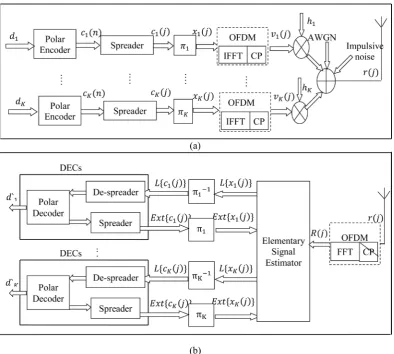
The proposed Polar-coded IDMA OFDM-based UWB system model for mul-ti-user communication scenario is depicted in Figure 1.
3.1. The Transmitter Structure
For simplicity, synchronous BPSK signaling is considered over time in-variant multipath channel. For theuser-k, the information data sequence dk∈
{ }
0,1 of length D is encoded using polar encoder into a coded sequence ck of length N. A polar code can be completely described by three-tuples (N, D, Ƒ), where N is the code length in bits, D is the number of information bits encoded per code-word, and Ƒ is a subset of N–D integer indices called frozen bit locationsfrom
{
0,1,,D−1}
[17]. [image:5.595.145.540.352.706.2]The construction of polar code depends on the choice of the subset Ƒ. This is corresponding to the selection of best D bit-channels among N, in terms of the
DOI: 10.4236/jcc.2018.63008 107 Journal of Computer and Communications bit error rate (BER) at a given value of (REb N0), where R is the code rate,
de-fined as the design-SNR [17].
The nth coded bit of user-k,
( )
, 1, 2, , kc n n= N is spread using a balanced spread sequence of length S. The same spreading code is applied to all users
{
1, 1}
k
S ∈ + − . The obtained chip sequence is written as
{
ck( )
j ,j=1, 2,,J}
,where J= ×N S is the chip length. A specific distinct chip level random
inter-leaver
{
πk,k=1, 2,,K}
is employed for user separation [7] [8].The interleaved chip sequences are mapped using BPSK onto the modulated symbols
{
xk( )
j ,j=1, 2,,J}
which are the elements of BPSK constellation.For simplicity, the symbol mapping process is not shown in Figure 1(a). The BPSK symbols xk
( )
j , considered an input to OFDM stage, are transmittedthrough orthogonal subcarriers by using Inverse Fast Fourier Transform (IFFT) operation, where the total number of subcarriers for OFDM transmission is de-noted by Nc. In addition, a Cyclic Prefix CP of length Lg, assumed to be larger than the channel length, is inserted to prevent ISI and ICI [11].
As a result, the time-domain data sequence, including CP, has the form:
1 2π , 0
1
e , , , 0, , 1
c
c N
i nt N
k k n g c
n c
v x t L N
N
−
=
=
∑
= − −(5) where xk n, is the modulated data of the OFDM symbol of the user-k which is
mapped to the nth sub-carrier. The OFDM signal
k
v is transmitted through the
multipath channel. It is assumed that the multipath channel impulses of each user, hk =
{
hk( ) ( )
0 ,hk 1 ,,hk(
L−1)
}
, are stationary in a frame period andmutually independent, where L denotes the number of resolvable paths. The output signal r j
( )
at any time instant j is a linear superposition of indepen-dently symbols for each user. The output of multipath channel is written as [11]:( )
( )
( ) ( )
1
K
k k
k
r j h j v j n j
=
=
∑
∗ +
(6) where ∗ denotes the convolution, hk the UWB channel coefficient for user-k
and n j
( )
=na( )
j +nI( )
j the total noise.3.2. The Receiver Structure
The turbo-type iterative receiver structure of the proposed system is depicted in Figure 1(b) which includes two main parts, Elementary Signal Estimator (ESE) and a bank of k single user A Posteriori Probability (APP) decoders (DECs) [13]. Successive Cancellation Decoder (SCD) of polar code, has been introduced to achieve desirable performance and complexity trade-offs [14]. At the receiver side, OFDM demodulation is carried out before iterative MUD process [10]. The received signal in frequency domain after OFDM demodulation, CP removal and FFT operation, can be expressed as
( )
( ) ( )
( )
1
K
k k
k
R j H j x j N j
=
=
∑
+(7) where xk
( )
j and Hk( )
j are respectively the data chip over the nDOI: 10.4236/jcc.2018.63008 108 Journal of Computer and Communications and the corresponding channel tap for the user-k estimated from
( )
1( )
2π( )
0 e
c
L i ln N
k l k
H j =
∑
=−h l ⋅ − ⋅N j , FFT of n j( )
, are samples of noise [11]. The received signal R j( )
is processed iteratively by means of ESE and DECs functions which discussed as follows.3.2.1. The ESE Function
The ESE performs coarse chip-by chip estimation. Re-write Equation (7), the received signal at time instant j is:
( )
( ) ( )
( )
1
K
k k k
k
R j H j x j ξ j
=
=
∑
+(8) where ξk
( )
j =∑
m k≠ Hm( ) ( )
j xm j +N j( )
represents a distortion (includinginterference plus noise) with respect to user-k. It is assumed that the channel coefficients Hk are known a priori at the receiver. Moreover, it is supposed that the received signal is perfectly synchronized. A CBC iterative detection based on Log Likelihood Ratio (LLR) of the received chip sequence approx-imated as either Gaussian or non-Gaussian noise. In case of Gaussian approxi-mation (i.e. n j
( )
=na( )
j only) and xk( )
j is treated as a random variablewith mean E x
(
k( )
j)
and variance Var x(
k( )
j)
(initialized to 0 and 1 respec-tively) [10]. Then from Equation (8), we have:( )
(
)
( )
(
( )
)
1 K k k kE R j H j E x j
=
=
∑
(9.a)
( )
(
)
( )
2(
( )
)
21
K
k k
k
Var R j H j Var x j σ
=
=
∑
+(9.b) where σ2 is the power of the background (AWGN) occurring during the jth
chip. Using the central limit theorem [11], ξk
( )
j in Equation (8) can beap-proximated by a Gaussian random variable with:
( )
(
k)
(
( )
)
(
k( ) ( )
k)
E ξ j =E R j −E H j x j
(10.a)
( )
(
)
(
( )
)
( )
2(
( )
)
k k k
Var ξ j =Var R j − H j Var x j
(10.b) The ESE outputs are the (LLRs) about
{
xk( )
j}
computed based on Equation (9) (using Equation (10)) as [10]:( )
(
)
(
(
( )
( )
( )
( )
)
)
( )
(
( )
)
( )
(
)
( )
(
)
( )
(
( )
)
( )
(
)
( )
(
)
( ) ( )
(
(
( )
)
)
( )
(
)
2 2 Pr 1| log Pr 1| exp 2 log exp 2 2 , k k k k k k k k k k k kx j R j
L x j
x j R j
R j E j H j
Var j
R j E j H j
Var j
H j R j E j
DOI: 10.4236/jcc.2018.63008 109 Journal of Computer and Communications In case of non-Gaussian approximation, ξk
( )
j can be approximated usingthree different non-Gaussian models as, Cauchy, Laplace, and Gaussian mixture model. As Cauchy and Laplace models considered a good approximation for impulsive noise only (i.e. n j
( )
=nI( )
j ) and ξk( )
j in Equation (8) has eitherCauchy or Laplace distribution, so we have:
( )
(
)
( )
(
( )
)
1 K k k kE R j H j E x j
=
=
∑
(12.a)
( )
(
)
( )
2(
( )
)
21
σ =
=
∑
K k k + Ik
Var R j
H j Var x j (12.b)
where 2
I
σ is the power of the impulsive noise occurring during the jth chip.
While, GMM is considered a good fit for both Gaussian and non-Gaussian noise (i.e. n j
( )
=na( )
j +nI( )
j ), ξk( )
j has GMM distribution, hence fromEqua-tion (8) we have:
( )
(
)
( )
(
( )
)
1 K k k kE R j H j E x j
=
=
∑
(13.a)
( )
(
)
( )
2(
( )
)
2 21
σ σ
=
=
∑
K k k + + Ik
Var R j
H j Var x j (13.b)
For Cauchy distribution (α = 1), the ESE outputs are the (LLRs) about
{
xk( )
j}
as follow [22]:( )
{
}
(
( )
(
( )
)
( )
)
( )
(
( )
)
( )
(
)
2 2 2 2log k k ,
k
k k
r j E j h j
L x j k j
r j E j h j
γ ξ γ ξ + − + = ∀ + − − (14)
The Cauchy detector has been used as a suboptimal detector to model the impulsive noise only with a robust performance, but it is still complex because of the need to calculate the log operation [17].
For Laplace model, the case in which the noise samples ξk
( )
j have a Laplacedistribution [4], the ESE outputs are the (LLRs) about
{
xk( )
j}
as follows:( )
{
}
( )
(
( )
)
( )
( )
(
( )
)
( )
( )
(
)
( )
( )
(
( )
)
( )
( )
(
( )
)
( ) ( )
(
( )
)
( )
( )
( )
(
)
( )
(
( )
)
( )
22 2 2 2
k k k k
k
k k k k
k k k k
k k k k
E j h j E j h j
r j r j
L x j
C
E j h j r j E j h j
r j E j h j r j E j h j
E j h j r j E j h j
ξ ξ ξ ξ ξ ξ ξ ξ − + = − − − − ≥ −
= + < < −
+ ≤ +
(15)
Laplace distribution has been used as a good approximation for impulsive noise also with complexity lower than Cauchy model since it needs to calculate the sum operation only. For GMM distribution, the case in which the noise samples ξk
( )
j have a GMM distribution, the ESE outputs are the (LLRs) about( )
DOI: 10.4236/jcc.2018.63008 110 Journal of Computer and Communications
( )
{
}
( ) ( ( )) ( ) ( ) ( ) ( ) (( ) ( ( )( )( ))( )) ( ) ( ( )) ( ) ( ) ( ) ( ) (( ) ( ( )( )( ))( )) 2 2 2 2 2 2 2 2 1 e e log 1 e ek k k k
k k
k k k k
k k
r j E j h j r j E j h j
Var j Var j
I
k
r j E j h j r j E j h j
Var j Var j
I
L x j
ξ ξ
ξ η ξ
ξ ξ
ξ η ξ
σ σ σ σ − − − − − − − + − + − − − + = − + (16)
GMM is considered an excellent fit to simulation because it can adapt between AWGN and impulsive noise but with high complexity since many parameters and operations need to be estimated. After the end of ESE process, The LLR-valued chip sequence L x
(
k( )
j)
is then de-interleaved to produce LLRs of( )
kc j ,
{
L c(
k( )
j)
}
which is delivered to DECs part discussed as follows.3.2.2. The DEC Function
The DECs in Figure 1(b) consists of SCD of polar code and soft in soft out CBC spread/de-spread operations. The DECs output are the extrinsic LLRs of ck
( )
j ,( )
(
)
{
Ext ck j}
, which is interleaved to produce{
Ext x(
k( )
j)
}
and then fed back to the ESE. In the next iteration,{
Ext x(
k( )
j)
}
is used as a priori information to update E x(
k( )
j)
and Var x(
k( )
j)
as [10]:( )
(
)
tanh(
( )
)
2k k
Ext x j E x j =
(17.a)
( )
(
)
(
( )
)
21
k k
Var x j = −E x j
(17.b) As discussed in Equation (10), E x
(
k( )
j)
and Var x(
k( )
j)
will be used in the ESE to update the interference mean and variance [11]. The effect of impul-sive noise is regarded as interference. Due to random interleaving and de-interleaving process, the impulsive noise is spread out over the interleaving block. These interleavers disperse the resultant sequences so that the adjacent chips are approximately uncorrelated, which facilitates the simple chip-by-chip detection scheme. This iterative process is repeated a preset number of times. In the final iteration, the DECs produce a hard decision on information bit which is decoded by Polar decoder. The iteration number can be adjusted depending on the system requirements and computational power [11].4. Simulation Results
DOI: 10.4236/jcc.2018.63008 111 Journal of Computer and Communications The simulation parameters are summarized as follows: Each user data length is 128 bits, Polar encoding is applied with rate = 1/2. FFT size = 256 and cyclic prefix = 32 was added to each OFDM symbol block to avoid the effect of in-ter-chip interference. A common length-32 spreading sequence is assigned to all users, and a randomly generated chip interleaver is allocated to each user. The maximum iteration number of IDMA receiver is 3. The simulation is performed for (1 - 32) users. It is assumed that all users initially are synchronous with equal power allocation. The receiver is assumed to have perfect knowledge of the channel state information.
The simulation has three cases: The first case studies the BER performance of the proposed polar-coded IDMA OFDM-based UWB system for multi-users (k
= 1, 8, 16, 32) under Gaussian and non-Gaussian noise models. The second case presents the performance and complexity comparison between the proposed system and LDPC-coded IDMA OFDM-based UWB system introduced in [18] under the studied noise models. Finally, the last case investigates the perfor-mance comparison between un-coded-IDMA-OFDM-UWB system and the proposed system under Gaussian and non-Gaussian noise models.
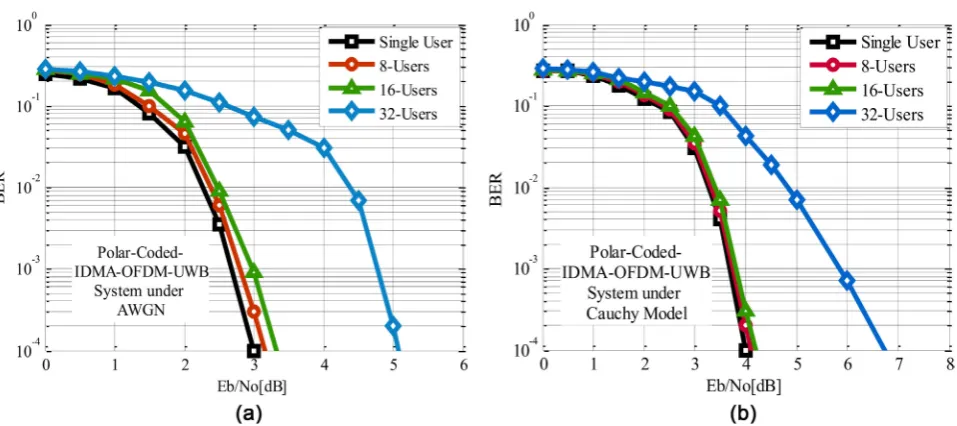
Figure 2 and Figure 3 show the performance of the proposed Polar-coded IDMA-OFDM UWB system for multi users (k = 1, 8, 16, 32) under the Gaussian and non-Gaussian noisy channel effect.
Figure 2(a) demonstrates the BER performance of the proposed system for multi-users under the effect of AWGN model. The results indicate the power of Polar coding technique on system performance. It can be seen that the proposed system achieves a significant improvement under Gaussian model with near sin-gle user performance for 1-16 users and degrades by about 2 dB for 32-users.
Figure 2(b) shows the BER performance of the proposed system for mul-ti-users under alpha-stable noise model effect with a characteristic exponent ∝ =1 (Cauchy distribution) which confirms the heavy tailed nature of impulsive noise. The results show that the system achieves a significant improvement un-der this model for all users with minor degradation by about 1 dB compared with AWGN model.
Figure 3(a) shows the BER performance of the proposed system for mul-ti-users under the effect of Laplacian noise model with a scale parameter C = 1 which is commonly used to represent the tail of impulsive noise. The results in-dicate that the BER performance is degraded by about 1.5 dB compared with AWGN model.
The BER performance of the proposed system for multi-users under GMM effect is introduced in Figure 3(b). The most common values used of impulsive and control parameters for GMM are η = 10 and = 0.1 respectively. It is ob-served that the performance is degraded by 2.5 dB with respect to AWGN mod-el.
DOI: 10.4236/jcc.2018.63008 112 Journal of Computer and Communications
Figure 2. BER performance of Polar-coded IDMA-OFDM-UWB system for multi-users. (a) under AWGN model; (b) under Cauchy model.
Figure 3. BER performance of Polar-coded IDMA-OFDM-UWB system for multi-users. (a) under Laplace model; (b) under GMM.
From the previous study, it can be noticed that Cauchy and Laplace models achieves a good performance compared with AWGN model than GMM. Fur-thermore, they are considered a good and simple approximation for impulsive noise while GMM can adapt between AWGN and impulsive noise but with high complexity since many parameters and operations needed to be estimated.
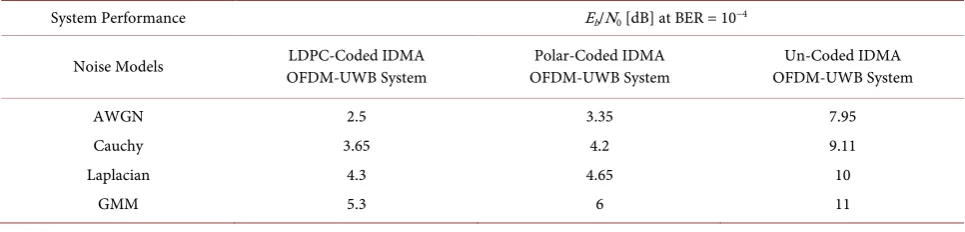
[image:11.595.62.541.323.515.2]Algo-DOI: 10.4236/jcc.2018.63008 113 Journal of Computer and Communications rithm (SPA) iteration = 7. It can be observed from Figure 4(a) that LDPC coded system achieves a slight improvement within (0.35 - 0.85) dB for multi users compared with the proposed polar coded system under the studied noise models as shown in Table 1. But on the other hand, the polar coded system outperforms the LDPC coded system from the complexity point of view as described below.
In case of polar code, the recursive structure of channel polarization construc-tion imposes a low complexity encoding and decoding algorithms. As in [16], the complexity of encoding and decoding of polar codes are the same of
(
log)
O N N as a function of code block-length and independent of the code rate while that of LDPC codes are
( )
2O N for encoding and O N
(
logN)
for decoding [27]. Therefore, the total complexity of polar code =(
log)
(
log)
2(
log)
O N N +O N N = O N N and that of LDPC code =
( )
2(
)
log
O N +O N N . Furthermore, the complexity for the LDPC decoding
al-gorithms is 7∗O N
(
logN)
since the SPA iteration number is 7 while the com-plexity for successive cancellation decoder of polar code = O N(
logN)
.Hence the overall complexity of the system (both encoder and decoder in-cluding the iteration of IDMA) for polar codes is
(
)
(
)
[image:12.595.56.539.612.728.2]3∗ ∗2 O NlogN = ∗6 O NlogN while for LDPC is
Figure 4. BER performance comparison for 16-users under the studied noise models. (a) between LDPC and Polar-coded OFDM-IDMA UWB systems; (b) between the un-coded and Polar-coded OFDM IDMA UWB systems.
Table 1. Performance Comparison between (LDPC and Polar) coded-IDMA-OFDM-UWB systems.
System Performance Eb/N0 [dB] at BER = 10−4
Noise Models OFDM-UWB System LDPC-Coded IDMA OFDM-UWB System Polar-Coded IDMA OFDM-UWB System Un-Coded IDMA
AWGN Cauchy Laplacian
GMM
2.5 3.65
4.3 5.3
3.35 4.2 4.65
6
DOI: 10.4236/jcc.2018.63008 114 Journal of Computer and Communications
( )
2(
)
( )
2(
)
3∗O N + ∗7 O NlogN = ∗3 O N +21∗O NlogN So, despite of the
performance of LDPC-coded system is better than polar-coded system, the com-plexity of LDPC-coded system exceeds the comcom-plexity of the polar-coded system
by
( )
2(
)
3∗O N + ∗15 O NlogN which make the polar codes do better from the
complexity point of view.
Finally, as shown in Figure 4(b), a comparative analysis is held between the proposed Polar-coded and un-coded-IDMA-OFDM-based UWB systems for 16-users under the studied noise models. It can be noticed that the polar-coded system achieves performance improvement within (4.6 - 5.35) dB compared with the un-coded system as demonstrated in Table 1.
Furthermore, our work outperforms the work introduced in [28] in terms of the performance and complexity. We verified that polar coded IDMA-OFDM system is robust against fading and interferences for multi-users UWB channel with better BER performance and much lower complexity compared with the system presented in [28].
5. Conclusions
In this paper Polar code is introduced instead of LDPC code in IDMA-OFDM based UWB system to mitigate the interferences and reduce the complexity. Moreover, a comparative analysis is held between the two systems from the as-pects of performance and complexity using non-Gaussian approximation for the interferences which are more realistic for UWB system.
The comparison shows that the proposed system is robust against noise and interferences with complexity much lower than LDPC-coded system. Therefore, polar coding technique can be considered a potential candidate for the emerging 5G communications due to its reliability with low decoding complexity.
References
[1] Sravanthi, J. and Swathi, S. (2017) Cooperative Communication in UWB OFDM Systems. International Journal of Engineering Science Invention, 6, 60-67.
[2] Sahukar, B. (2015) Differential Code Shift Reference Impulse Radio Ul-tra-Wideband Transceiver: Bit Error Rate Tests and Performance Assessments. Master of Applied Science, Dalhousie University, Halifax, Nova Scotia.
[3] Montojo-Bennassar and Juan, I. (2009) Adaptive OFDM-Based UWB. Ph.D. UC San Diego Electronic Theses and Dissertations, University of California, San Diego. [4] Beaulieu, N.C. and Young, D.J. (2009) Designing Time-Hopping Ultra-Wide
Bandwidth Receivers for Multi-User Interference Environments. Proceedings of the IEEE International Conference of Communication, Beijing, 27 February 2009, 255-284.
[5] Hu, B. and Beaulieu, N.C. (2008) On Characterizing Multiple Access Interference in TH-UWB Systems with Impulsive Noise Models. Proceedings of the IEEE Radio and Wireless Symposium, Orlando, 22-24 January 2008, 879-882.
https://doi.org/10.1109/RWS.2008.4463633
DOI: 10.4236/jcc.2018.63008 115 Journal of Computer and Communications https://doi.org/10.1109/MCOM.2005.1452830
[7] Ping, L., Liu, L., Wu, K.Y. and Leung, W.K. (2006) Interleave Division Multiple Access. IEEE Transactions on Wireless Communications, 5, 938-947.
https://doi.org/10.1109/TWC.2006.1618943
[8] Shukla, V., Shukla, M.K. and Pande, T. (2012) Multiuser Detection Using IDMA Scheme in UWB Home Environment. International Journal of Computer Applica-tions (0975-8887), 55, No.13. https://doi.org/10.5120/8816-2728
[9] Alagulakshmi and Arun, V. (2014) Performance Improvement of OFDM-IDMA with Modified SISO. International Journal of Research in Electronics & Communi-cation Technology, 2, 26-33.
[10] Yang, K. and Wang, X.D. (2006) A Multicarrier Interleave-Division UWB System.
IEEE Transactions on Wireless Communications, 5, 1827-1837.
https://doi.org/10.1109/TWC.2006.1673094
[11] Murugeswari, P., Janardhana, and Prabha, D. (2013) BER Performance of LDPC Code with TH-PPM over UWB Channel. International Journal of Scientific & En-gineering Research, 4, 267-271.
[12] Jayasheela, M., Rajeswari, A. and Prabha, D. (2012) Multi-User Detection Schemes for TH PPM UWB System Using LDPC Codes. International Journal of Computer Applications (0975-8887), 38, No. 11.
[13] Huang, W.-C., Lu, K.-S., Li, C.-P. and Li, H.-J. (2010) Performance Evaluation for LDPC Coded OFDM-IDMA Systems over Frequency Selective Fading Channels.
IEEE Transactions on Wireless Communications,Taiwan, 16-19 May 2010,1-5.
https://doi.org/10.1109/VETECS.2010.5493931
[14] Arikan, E. (2016) On the Origin of Polar Coding. IEEE Journal on Selected Areas in Communications, 34, 209-223. https://doi.org/10.1109/JSAC.2015.2504300
[15] Tal and Vardy, A. (2013) How to Construct Polar Codes. IEEE Transactions on In-formation Theory, 59, 6562-6582. https://doi.org/10.1109/TIT.2013.2272694
[16] Şaşoğlu, E. (2012) Polarization and Polar Codes. Foundations and Trends in Com-munications and Information Theory, 8, 259-381.
[17] Vangala, H., Viterbo, E. and Hong, Y. (2015) A Comparative Study of Polar Code Constructions for the AWGN Channel. arXiv:1501.02473v1 [cs.IT]
[18] Matary, D.E.E., Hagras, E.E.A. and Abdel-Kader, H.M. (2017) Multi-User Commu-nication Based OFDM-UWB System under Non-Gaussian Noisy Channel. Ameri-can Journal of Electrical and Electronic Engineering (AJEEE), 5, 136-143.
https://doi.org/10.12691/ajeee-5-4-3
[19] Molisch, A.F. (2009) Ultra-Wide-Band Propagation Channels. Proceedings of the IEEE, 97, 353-371. https://doi.org/10.1109/JPROC.2008.2008836
[20] Saleh, A.A.M. and Valenzuela, R. (1987) A statistical Model for Indoor Multipath Propagation. IEEE Journal on Selected Areas in Communication, 5, 128-137.
https://doi.org/10.1109/JSAC.1987.1146527
[21] Chen, X., Qu, F.Z. and Yang, L.Q. (2011) OFDM-IDMA for Power Line Communi-cation. 2011 IEEE International Symposium on Power Line Communications and Its Applications (ISPLC), Udine, Italy, 3-6 April 2011, 24-28.
[22] Ghannudi, H.E., Clavier, L., Azzaoui, N., Septier, F. and Rolland, P.-A. (2012) Alpha
Stable Interference Modeling and Cauchy Receiver for an IR-UWB Ad Hoc Net-work. IEEE Transactions on Communications, 58, 1748-1757.
Car-DOI: 10.4236/jcc.2018.63008 116 Journal of Computer and Communications
leton University Ottawa, Ontario, Canada.
[24] Bao, Y.P., Zhu, Y.D., Zhu, X.M. and Chu, Y.Z. (2015) A Spectrum Sensing Method Based on Fractional Lower Order Moments in Weakly Correlated Laplace Noise. 2015 Asia-Pacific Signal and Information Processing Association Annual Summit and Conference (APSIPA),Hong Kong, China, 16-19 December 2015, 892-896.
https://doi.org/10.1109/APSIPA.2015.7415399
[25] Guney, N., Delic, H. and Koca, M. (2006) Robust Detection of Ultra-Wideband Signals in Non-Gaussian Noise. IEEE Transaction on Microwave Theory and Tech-niques, 54, 1724-1730. https://doi.org/10.1109/TMTT.2006.872038
[26] Ayyar, A., Lentmaier, M., Giridhar, K. and Fettweis, G. (2009) Robust Initial LLRs for Iterative Decoders in Presence of Non-Gaussian Noise. 2009 IEEE International Symposium on Information Theory,Seoul, 28 June-3 July 2009, 904-908.
https://doi.org/10.1109/ISIT.2009.5205626
[27] Hesami, P. (2009) Channel Polarization and Polar Codes, Capacity Achieving. Uni-versity of Notre Dame, Notre Dame.
DOI: 10.4236/jcc.2018.63008 117 Journal of Computer and Communications
Nomenclature
APP: A Posteriori Probability
AWGN: Additive White Gaussian Noise BER: Bit Error Rate
BWA: Broad-band Wireless Access CBC: Chip-By-Chip
CM: Channel Model CP: Cyclic Prefix DECs: Decoders
ESE: Elementary Signal Estimator FEC: Forward Error Correcting FFT: Fast Fourier Transform GMM: Gaussian Mixture Model ICI: Inter Carrier Interference
IDMA: Interleave Division Multiple Access IFFT: Inverse Fast Fourier Transform IR: Impulse Radio
ISI: Inter Symbol Interference LDPC: Low Density Parity Check LLR: Log Likelihood Ratio LOS: Line of Sight
MAI: Multiple Access Interference MC: Multicarrier
MUD: Multi User Detection
OFDM: Orthogonal Frequency Division Multiplexing pdf: probability density function
SCD: Successive Cancellation Decoder SNR: Signal to Noise Ratio
SPA: Sum Product Alghorithm S-V: Saleh-Valenzuela