R E S E A R C H
Open Access
Low-complexity depth map compression in
HEVC-based 3D video coding
Qiuwen Zhang
1*, Ming Chen
2, Xinpeng Huang
1, Nana Li
1and Yong Gan
1Abstract
In this paper, a low-complexity algorithm is proposed to reduce the complexity of depth map compression in the high-efficiency video coding (HEVC)-based 3D video coding (3D-HEVC). Since the depth map and the corresponding texture video represent the same scene in a 3D video, there is a high correlation among the coding information from depth map and texture video. An experimental analysis is performed to study depth map and texture video correlation in the coding information such as the motion vector and prediction mode. Based on the correlation, we propose three efficient low-complexity approaches, including early termination mode decision, adaptive search range motion estimation (ME), and fast disparity estimation (DE). Experimental results show that the proposed algorithm can reduce about 66% computational complexity with negligible rate-distortion (RD) performance loss in comparison with the original 3D-HEVC encoder.
Keywords:3D video; 3D-HEVC; Depth coding; Low complexity
1 Introduction
Three-dimensional video standard has been recently fi-nalized by the Joint Collaborative Team on 3D Video Coding (JCT-3V), and the high-efficiency video coding (HEVC)-based 3D video coding (3D-HEVC) is devel-oped as an extension of HEVC [1-3]. For the efficient compression of 3D video data with multiview texture video and depth map, a number of coding tools are in-vestigated to exploit in 3D-HEVC such as inter-view motion prediction and disparity-compensated prediction [4]. This technique achieves the highest possible coding efficiency in multiview texture video compression, but it results in extremely large encoding time with small in-crease of depth coding efficiency which obstructs it from 3D-HEVC practical use. Therefore, it is necessary to de-velop a fast algorithm that can reduce the complexity of multiview depth map compression with minimal loss of coding efficiency in a 3D-HEVC encoder.
Recently, a number of approaches have been made to explore fast algorithms in depth map coding. A motion vector (MV) sharing algorithm is proposed in [5] to re-duce the complexity of depth map coding. An early
termination algorithm for depth coding is introduced in [6] based on the detection of the differences between the current macroblock (MB) and the co-located MBs in texture video. An intra prediction algorithm for depth coding is presented in [7] to reduce the number of candidate prediction directions for smooth regions. A low-complexity mode decision and motion estimation algo-rithm is proposed in [8] to take advantage of the texture motion information which may be usefully exploited in the encoding of the corresponding depth map. A novel depth and depth-color codec is proposed in [9] based on a shape-adaptive wavelet transform and an explicit encoding of the locations of major depth edges. A depth map compression algorithm [10] uses the corresponding texture video as side information to improve the coding performance. A fast motion search and mode decision algorithm is proposed in [11] to speed up the motion es-timation (ME) stages of the depth coding process, and a fast depth map method is proposed in our previous work [12] based on sharing motion vector and SKIP mode from the texture video to reduce complexity of depth coding. All these algorithms are efficient in reducing computational complexity with acceptable quality degrad-ation in coding performance for previous video coding standards. However, these algorithms are not directly applicable to the new standard 3D-HEVC, where high * Correspondence:[email protected]
1
College of Computer and Communication Engineering, Zhengzhou University of Light Industry, No. 5 Dongfeng Road, Zhengzhou 450002, China Full list of author information is available at the end of the article
computational complexity is intrinsically related to the use of new prediction coding structures for the 3D-HEVC encoder.
To this end, several fast algorithms [13-16] have been proposed for the 3D-HEVC encoder to reduce the com-plexity of depth map coding. A fast mode decision algo-rithm is proposed in [13] to early terminate the unnecessary prediction modes full rate-distortion (RD) cost calculation in 3D-HEVC. A low-complexity depth map coding algorithm based on the associated texture video is introduced in [14] to reduce the number of wedgelet candidates. A fast wedgelet partitioning algo-rithm is proposed in [15] to simplify the intra mode de-cision in 3D-HEVC depth map coding. A content adaptive complexity reduction algorithm is proposed in [16] to reduce the 3D-HEVC coding complexity by util-izing the correlations between the base view and the dependent view. The aforementioned algorithms are well developed for depth map coding achieving significant time savings in 3D-HEVC. However, the coding informa-tion correlainforma-tions between the depth map and the texture video are not fully studied. This situation results in a limited time saving. There is still some room for further reduction of computational complexity of the 3D-HEVC depth map compression.
The depth map represents a 3D scene information, which has the same content with similar characteristic of the texture video. Therefore, there is a high correl-ation among motion informcorrel-ation from depth map and texture video. In this paper, we propose a low-complexity depth compression algorithm using the cor-relation among motion information from depth map and texture video. The proposed algorithm consists of three approaches: early termination mode decision, adaptive search range ME, and fast disparity estimation (DE) for depth map coding. Experimental results illustrate that the proposed algorithm can significantly reduce the computational complexity of depth map compression while maintaining almost the same coding performance in comparison with the original 3D-HEVC encoder.
The rest of the paper is organized as follows. Section 2 analyzes the property of depth map and the correlation among motion information from depth map and texture video. A low-complexity depth coding algorithm base on adaptive search range ME and fast DE is presented in Section 3. Experimental results and conclusions are given in Sections 4 and 5, respectively.
2 Observations and analysis
In the test model of 3D-HEVC, the variable sizes the ME and DE to exploit both temporal and view correlation within temporally successive pictures and neighboring views. The coding unit (CU) is the basic unit of region splitting used for 3D-HEVC similar to macroblock in
H.264/AVC, which has a hierarchical quadtree structure having variable sizes from 64 × 64 to 8 × 8. The partition unit (PU) is the basic unit used for 3D-HEVC inter/intra prediction processes. At each treeblock, 3D-HEVC per-forms ME and DE with different PU sizes including 2N× 2N, 2N×N,N× 2N, andN×N.
Similar to HEVC for a treeblock, the mode decision process in 3D-HEVC is performed using all the possible prediction modes to find the one with the least RD cost using a Lagrange multiplier. The RD cost function (J) used in 3D-HEVC is defined as follows:
J¼Dþλ⋅SSE ð1Þ
where D specifies the bit cost to be considered for the 3D-HEVC mode decision, SSE is the average difference between the current treeblock and the matching tree-block, andλis the Lagrange multiplier. However, calcu-lation of the RD cost needs to execute both the ME and DE processes in 3D-HEVC, and these‘try all and select the best’method will result in high computational com-plexity and limit the use of 3D-HEVC encoders in prac-tical applications. Therefore, low-complexity algorithms, which can reduce the complexity of the ME and DE pro-cesses with negligible loss of coding efficiency, are extremely necessary for real-time implementation of 3D-HEVC encoders.
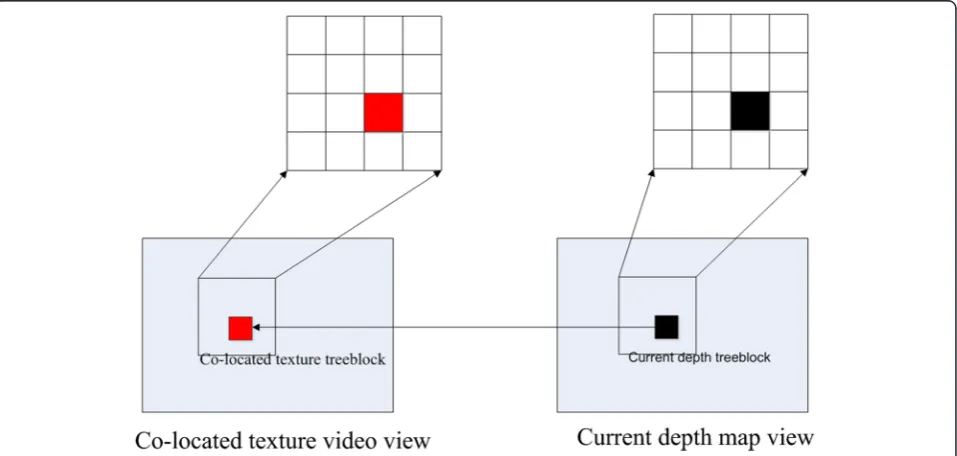
Therefore, the prediction mode of the depth map tree-block is similar to that of the corresponding texture video treeblock. Meanwhile, the homogeneous regions in the depth map have a strong spatial correlation, and thus, spatially neighboring depth map treeblocks have similar coding information. The relationship among the current depth map treeblock, co-located texture video treeblock, and spatially neighboring treeblock is shown in Figure 1. The reference picture in the co-located tex-ture view has the same POC value as the reference pic-ture of current depth map view.
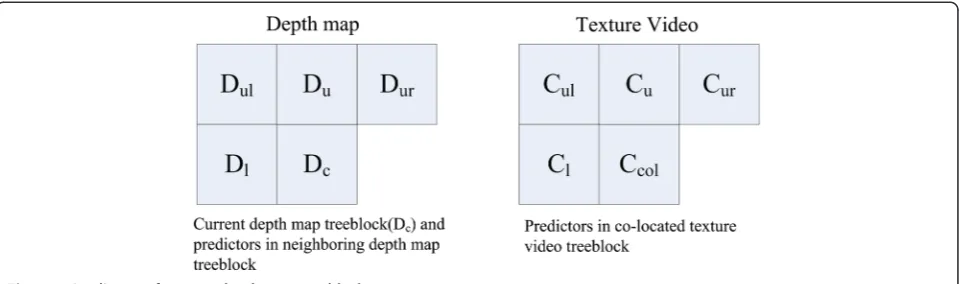
On the basis of these observations, we propose to analyze the depth intra prediction mode using the cod-ing information from the spatial neighborcod-ing depth map and the co-located texture video treeblock. The neigh-boring depth map and the co-located texture video tree-block are described as in Figure 2. Dc denotes the current depth map treeblock,Dl,Du,Dul, andDurdenote the neighboring treeblocks in the depth map. Ccol de-notes the co-located treeblock in the texture video and
Cl,Cu,Cul, andCurits left treeblock, up treeblock, upleft treeblock, and upright treeblock, respectively, as shown in Figure 2.
According to the coding information correlation with the mode maps of encoded frames, we define a set of intra mode predictors (P) for depth map treeblock as follows:
P¼fDl;Du;Dul;Dur;Ccol;Cl;Cu;Cul;Curg ð2Þ
Based on this predictor set, a mode complexity (C) parameter is defined according to the mode context of
the spatial neighboring depth map and the co-located texture video treeblock, and then, the mode characteris-tic of a depth map treeblock is estimated. The mode complexity of a depth map treeblock is described as follows:
C¼X
i∈P
βi⋅ηi ð3Þ
wherei is the related treeblock in predictorsP,βi is the
treeblock weight factor of each predictor in Equation2, and ηi is the treeblock mode factor of each predictor.
Only the prediction modes of those available neighbor-ing treeblocks in predictorsPwill be used. In 3D-HEVC, various prediction mode sizes are used in the mode deci-sion process. The mode factor of each predictor ηi can
be assigned based on the complexity of each mode as
follows: when the predictor i is SKIP mode, merge
mode, inter 2N × 2N, and intra 2N × 2N mode, ηi is
assigned with a small value ‘1;’ when the predictor i is inter 2N × N, inter N × 2N mode, ηi is assigned with a
medium value‘2;’when the predictoriis small-size inter modes, intra N × N mode (depth modeling modes (DMM) and region boundary chain (RBC) mode in the neighboring depth map treeblocks), and DE mode, ηiis
assigned with a large value‘3.’The treeblock weight fac-tors of these nine predicfac-tors have an additional property,
X
i
βi¼1.βiis defined according to the effect of related
treeblocks on current treeblock. Since treeblocks in the horizontal and vertical directions have a large effect on the current treeblock compared to treeblocks in the di-agonal direction, the weight factorsβifor the horizontal
and vertical treeblocks (Dl,Du,Cl, andCu) are set to 0.1,
and that of the diagonal direction treeblocks (Dul, Dur,
Cul, and Cur) are set to 0.05. In the case of the
co-located texture video treeblock, the treeblock weight fac-torβCcolis set to 0.4.
Generally, the larger the mode factor, the more com-plex the treeblock is. According to the value of C, each treeblock can be divided into three types.T1and T2are set to determine whether a treeblock belongs to the re-gion with the simple mode, normal mode, or complex mode. The criterion is defined as follows:
C≤T1 Treeblock∈simple mode region
T1<C<T2 Treeblock∈normal mode region
C≥T2 Treeblock∈complex mode region
8 < :
ð4Þ
whereT1andT2are mode-weight factors. Those
thresh-old settings are crucial for effective depth map compres-sion, and it is always a tradeoff between depth map coding quality and computational complexity reduction. From simulations on various test sequences, it can be found that the optimal threshold for each sequence de-pends on the sequence content. In order to cope with different texture characteristics of test sequences, exten-sive simulations have been conducted on eight video se-quences to analyze the thresholds for three types of treeblocks. Among these test sequences, Kendo,
Bal-loons, and Newspaper are in 1,024 × 768 resolution,
while Undo_Dancer, GT_Fly, Poznan_Street, Poznan_-Hall2, and Sharkare in 1,920 × 1,088 resolution, and the ‘Shark’ and ‘Undo_Dancer’ sequences are with a large global motion or rich texture, the ‘Kendo’, ‘Balloons’, ‘Newspaper’, and ‘Poznan_Street’ sequences are with a medium local motion or a smooth texture, and‘ Poznan_-Hall2’is a small global motion or a homogeneous texture sequence. The test conditions are as follows: I-B-P view structure; test full-length frames for each sequence; quantization parameter (QP) is chosen with 34, 39, 42, and 45; group of pictures (GOP) size = 8; treeblock size =
64; search range of ME is configured with 64; and context-adaptive binary arithmetic coding (CABAC) is used for en-tropy coding. Then, we calculated the average thresholds of those eight test sequences.
Table 1 shows the accuracies of the proposed algo-rithm using various thresholds. The accuracies here are defined as the ratio of the number of the simple mode, normal mode, and complex mode, which select the same best modes using the 3D-HEVC encoder as well as the proposed algorithm. It can be seen from Table 1 that when the threshold values areT1= 0.8,T2= 1.2, the aver-age accuracy of the proposed algorithm achieves more than 93% with a maximum of 97% in the ‘Shark’ se-quence. Based on extensive experiments,T1 andT2are set to 0.8 and 1.2, respectively, which achieve a good and consistent performance on a variety of test se-quences with different texture characteristics and mo-tion activities and fixed for each treeblock QP level in 3D-HEVC encoder.
3 Proposed low-complexity depth map compression algorithm
3.1 Early termination mode decision
The depth map is usually not the ground truth because existing depth map estimation methods still have diffi-culties to generate accurate depths at object edges or in areas with less texture. Distortion may occur during depth map estimation, which will result in a noisy depth map (caused by occlusion and areas of low texture), such that it would be inefficient to spend more bits to achieve an accurate representation of the depth map in 3D-HEVC coding. To overcome this problem, this paper proposes an early termination mode decision for 3D-HEVC, which takes into account the correlations be-tween coding information from texture videos and depth maps to speed up the coding process.
The depth map content is similar with that of texture video, and thus, the coding modes of texture and depth map are similar. By utilizing the information of the cor-responding treeblock in the texture video, the coding
information of previously encoded texture images at the same view can be effectively shared and reused. Such that we propose a novel early termination mode decision considering a co-located texture video. The merge/skip mode provides good coding performance and requires little complexity in the 3D-HEVC encoder, where the motion vector predictor (MVP) is adopted for the current treeblock to generate a compensated block. Meanwhile, the merge/skip mode is the dominant mode at low bitrates (high QPs) in the 3D-HEVC encoder, and the distribution is similar to that in the previous video coding standard, H.264/AVC. Once the merge/skip mode can be predecided, variable size ME and DE com-putation for a treeblock can be entirely saved. Usually, the decision to use merge/skip mode is delayed until the RD costs of all other modes (inter-, intra-, and DE-modes) have been calculated and merge/skip mode is found to have the minimum RD cost. Thus, if we can exploit previously encoded texture coding information to determine that those depth map treeblocks are encoded in merge/skip mode (this mode along with CU partition inherited to encode forcefully the depth tree-block without going further in depth quadtree level), we can skip the time-consuming process of computing RD costs on smaller block sizes for a high percentage of treeblocks and, thus, significantly reduce the computa-tion complexity of the 3D-HEVC mode decision process. Based on this consideration, the proposed algorithm introduces an early termination mode decision to skip checking unnecessary ME and DE by utilizing the co-located texture video prediction mode information. In our approach, we first take advantage of the relations of previously encoded texture images at the same view for early merge/skip mode decision. Since both depth map and texture video are generally captured at the same time, it is likely for each treeblock to have the same mo-tion and block partimo-tion informamo-tion. So when a
treeblock of depth map is encoded, we consider how the corresponding texture video treeblock (Ccolin Figure 2) was encoded. When the merge/skip mode is selected as the best prediction mode on the texture treeblock in the 3D-HEVC mode decision, it indicates that the current texture treeblock is located in a low-motion or static region. The motion of the texture treeblock can be predicted well using the merge/skip mode, which results in a lower energy residual after motion com-pensation compared to other prediction modes such as inter 2N× 2N, 2N×N, N× 2N, and N×N. Thus, no further processing of variable size ME and DE compu-tation is necessary.
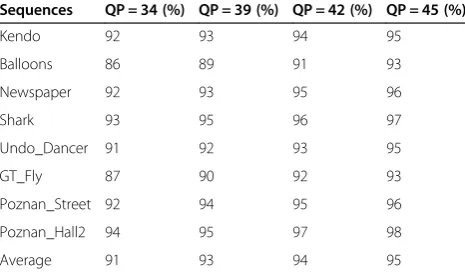
However, the proposed early termination mode deci-sion algorithm has a few strong assumptions: depth map content is not always similar to the color content, e.g., in a planar highly textured area, there is a high-color variance but depth is constant. Depth acquisition can be unreliable but the assumption that information can be discarded for this reason is questionable. Fi-nally, if motion estimation on color data is wrong with the proposed approach, errors can propagate to depth data even if the estimation from depth could be cor-rect. Based on this observation, we investigate the ef-fectiveness of the proposed early termination mode decision algorithm. By exploiting the exhaustive mode decision in the 3D-HEVC encoder under the afore-mentioned test conditions in Section 2, extensive simulations have been conducted on a set of test se-quences as listed in Table 2. Table 2 shows the hit rate of the early termination mode decision algorithm. This hit rate is defined as the ratio of the number of depth map treeblocks, which selects the same best prediction mode using the 3D-HEVC encoder as well as the pro-posed algorithm, to the total number of depth map treeblocks. The average hit rate of the proposed algo-rithm is larger than 93% with a maximum of 95% in
‘QP = 45’ and a minimum of 91% in ‘QP = 34’. The Table 1 Statistical analysis of accuracy for proposed
algorithm using various thresholds
Sequences T1= 0.6, T2= 1.0 (%) T
1= 0.7, T2= 1.1 (%) T
1= 0.8, T2= 1.2 (%) T
1= 0.9, T2= 1.3 (%)
Kendo 84 86 93 91
Balloons 76 83 91 92
Newspaper 81 85 94 92
Shark 85 89 97 95
Undo_Dancer 82 88 93 91
GT_Fly 80 84 91 87
Poznan_Street 81 85 89 90
Poznan_Hall2 82 86 95 93
Average 81 86 93 91
Table 2 Hit rate of the proposed early termination mode decision algorithm
Sequences QP = 34 (%) QP = 39 (%) QP = 42 (%) QP = 45 (%)
Kendo 92 93 94 95
Balloons 86 89 91 93
Newspaper 92 93 95 96
Shark 93 95 96 97
Undo_Dancer 91 92 93 95
GT_Fly 87 90 92 93
Poznan_Street 92 94 95 96
Poznan_Hall2 94 95 97 98
simulation results shown in Table 2 indicate that the proposed early termination mode decision algorithm can accurately reduce the unnecessary depth map CU mode by utilizing the information of the corresponding treeblock in texture video.
Based on this statistical tendency, the proposed depth map early termination algorithm checks the prediction modes from the co-located texture video: if texture tree-block (Ccol) has no motion, corresponding depth map treeblock (Dc) has motion due to unreliable depth esti-mation; therefore, the motion in the depth map can be ignored. When the texture video treeblock selects merge/skip as the best mode, it indicates that the motion can be efficiently represented using the current depth
map treeblock, and the variable size ME and DE compu-tation for a depth map treeblock can be skipped in the 3D-HEVC mode decision.
3.2 Adaptive search range motion estimation
ME is the most computationally expensive task in the 3D-HEVC encoder, which is defined as the search of the best matched treeblock within a predefined region in the reference frame. The larger ME search range produces higher computational load, and a very small ME search range may reduce the coding performance due to poor matching results. A suitable ME search range can reduce the computational complexity of 3D-HEVC and also maintain the good RD performance.
Table 3 Statistical analysis of motion vector distribution for three types of treeblocks
Sequences Treeblocks in simple mode region Treeblocks in normal mode region Treeblocks in complex mode region S1 (%) S2 (%) S3 (%) S1 (%) S2 (%) S3 (%) S1 (%) S2 (%) S3 (%)
Kendo 87.3 98.1 98.9 81.8 92.1 97.2 59.4 76.8 84.3
Balloons 85.5 96.3 97.1 79.6 91.3 96.1 47.2 69.2 79.8
Newspaper 86.2 97.4 98.3 78.9 90.8 96.5 49.8 71.3 81.6
Shark 89.2 97.9 99.4 82.1 92.5 97.3 51.5 73.4 86.2
Undo_Dancer 90.1 98.3 99.7 83.8 92.8 98.2 57.2 76.6 87.3
GT_Fly 91.2 99.2 100 84.1 93.2 99.4 59.3 78.2 90.2
Poznan_Street 88.6 96.5 98.2 77.5 90.3 96.5 43.2 69.3 81.4
Poznan_Hall2 86.3 96.8 97.6 76.3 91.1 95.7 39.8 64.7 78.2
Average 88.1 97.6 98.7 80.5 91.8 97.1 50.9 72.4 83.6
‘S1’,‘S2’, and‘S3’, respectively, represent the motion search windows of [SR/16 × SR/16], [SR/8 × SR/8], and [SR/4 × SR/4].
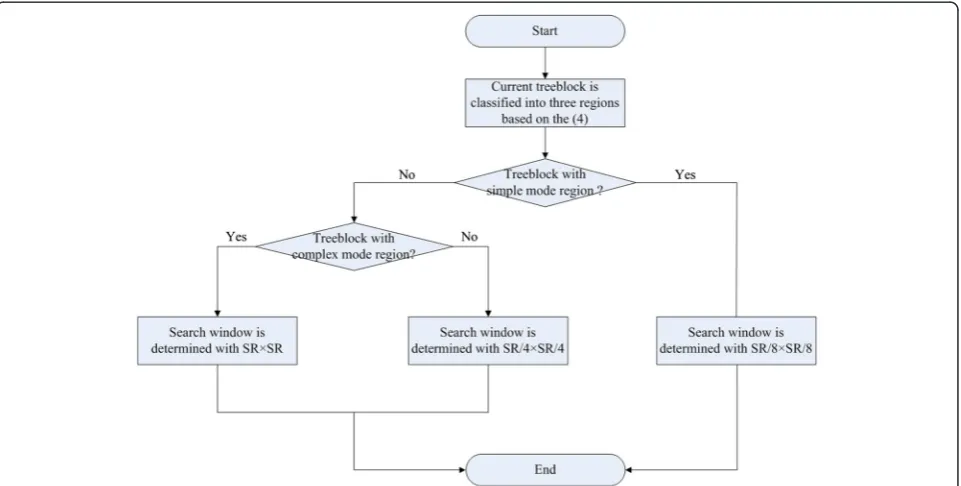
In 3D video coding, since both depth map and texture video represent the same scene, it is likely for the depth map and texture video treeblock to have similar motion information. Based on this observation, we propose to use the mode complexity parameter (C) defined in Equation 3 to speed up the procedure of depth map coding DE search range computational complexity. Ac-cording to the motion complexity of a depth map tree-block (based on Equation 3), we first classify the depth
map treeblock to different categories in terms of DE search range as follows:
Search rangedepth¼
SR=8SR=8 Treeblock∈simple mode region SR=4SR=4 Treeblock∈normal mode region SRSR Treeblock∈complex mode region
8 < :
ð5Þ
where SR represents the search range defined in the
configuration file of the 3D-HEVC, and Search
Table 4 Analysis of view prediction and temporal prediction distributions for three treeblock types
Sequences Treeblocks in simple mode region Treeblocks in normal mode region Treeblocks in complex mode region
T (%) V (%) T (%) V (%) T (%) V (%)
Kendo 98.9 1.1 88.2 11.8 60.2 39.7
Balloons 97.5 2.5 84.1 15.9 68.6 31.4
Newspaper 99.7 0.3 92.3 7.8 71.3 29.7
Shark 98.2 1.8 85.2 14.8 64.2 35.9
Undo_Dancer 97.7 2.2 92.7 7.3 58.9 41.1
GT_Fly 95.8 4.2 89.9 10.1 54.7 45.3
Poznan_Street 97.9 2.1 88.4 11.6 61.5 38.5
Poznan_Hall2 96.2 3.7 91.7 8.3 70.1 30.0
Average 97.7 2.2 89.1 11.0 63.7 36.4
‘T’and‘V’represent temporal prediction and view prediction, respectively.
range
depth is the adjusted search range of the
corre-sponding treeblock in the depth map.
To verify legitimacy of the proposed adaptive search range motion estimation algorithm, extensive simula-tions have been conducted on eight video sequences to analyze the motion vector distribution for these three types of treeblocks. By exploiting the exhaustive mode decision in 3D-HEVC under the aforementioned test conditions, we investigate the motion vector distribution for these three types of treeblocks.
Table 3 shows the motion vector distribution for each type of treeblocks. It can be seen from Table 3 that for treeblocks in the simple mode region, more than 97% of all motion vectors lie in the [SR/8 × SR/8] window. In other words, if the maximum search range is set to SR/ 8, it will most likely cover about 97% of all motion vec-tors. For the treeblocks in normal mode region, about 97% of all motion vectors lie in the [SR/4 × SR/4] win-dow. If the maximum search range is set to be SR/4, it will most likely cover about 97% of motion vectors. For the treeblocks in the complex mode region, the percent-age of all motion vectors that lie in the [SR/16 × SR/16], [SR/8 × SR/8], and [SR/4 × SR/4] windows are relatively low, only about 51%, 72%, and 84%, respectively, and thus, 3D-HEVC motion vector search range cannot be
reduced. The results shown in Table 3 demonstrate that the proposed adaptive search range motion estimation algorithm can accurately reduce the unnecessary ME search range in 3D-HEVC. A flowchart of the proposed adaptive search range motion estimation algorithm is given in Figure 3.
3.3 Fast disparity estimation for depth map coding
In the test model of 3D-HEVC, when coding the dependent views, the HEVC codec is modified by in-cluding some high-level syntax changes and the disparity-compensated prediction (DCP) techniques, similar to the inter-view prediction in the MVC exten-sion of H.264/AVC [4]. In addition, different from cod-ing dependent texture view, depth map is characterized by sharp edges and large regions with nearly constant values. The eight-tap interpolation filters that are used for ME interpolation in HEVC can produce ringing arti-facts at sharp edges in the depth map, which are visible as disturbing components in synthesized intermediate views. For avoiding this issue and for decreasing the en-coder and deen-coder complexity, the ME as well as the DE has been modified in a way that no interpolation is used. That means, for depth map, the inter-picture prediction is always performed with full-sample accuracy. For the actual DE, a block of samples in the reference picture is directly used as the prediction signal without interpolat-ing any intermediate samples. In order to avoid the transmission of motion and disparity vectors with an un-necessary accuracy, full-sample accurate motion and dis-parity vectors are used for coding the depth map. The transmitted motion vector differences are coded using full-sample instead of quarter-sample precision. This modified technique achieves the highest possible depth map coding efficiency, but it results in extremely large encoding time which obstructs 3D-HEVC from practical application. In this paper, a fast DE algorithm for depth map coding is proposed to reduce 3D-HEVC computa-tional complexity.
Table 5 Test sequence information
Sequence Resolution Frames Two-view case
Three-view case
Kendo 1,024 × 768 300 1-3 1-3-5
Balloons 1,024 × 768 300 1-3 1-3-5
Newspaper 1,024 × 768 300 2-4 2-4-6
Shark 1,920 × 1,088 300 1-5 1-5-9
Undo_Dancer 1,920 × 1,088 250 1-5 1-5-9
GT_Fly 1,920 × 1,088 250 9-5 9-5-1
Poznan_Street 1,920 × 1,088 250 5-4 5-4-3
Poznan_Hall2 1,920 × 1,088 200 7-6 7-6-5
Table 6 Results of each individual algorithm compared to 3D-HEVC encoder in two-view case
Sequences ETMD ASRME FDE
BDBR (%) BDPSNR (dB) Dtime (%) BDBR (%) BDPSNR (dB) Dtime (%) BDBR (%) BDPSNR (dB) Dtime (%)
Kendo 0.02 −0.01 −20.1 0.13 −0.03 −32.4 0.02 −0.00 −18.2
Balloons 0.01 −0.01 −17.3 0.09 −0.02 −36.8 0.02 −0.00 −22.7
Newspaper 0.00 −0.02 −26.8 0.21 −0.02 −42.1 0.04 −0.01 −15.6
Shark −0.07 0.00 −9.8 0.07 −0.01 −61.2 0.75 −0.06 −30.8
Undo_Dancer −0.12 0.01 −12.1 0.05 −0.01 −55.8 0.63 −0.05 −38.2
GT_Fly −0.08 0.00 −7.6 0.08 −0.01 −63.2 0.82 −0.07 −36.9
Poznan_Street 0.01 −0.01 −26.5 0.21 −0.03 −43.9 0.06 −0.00 −16.5
Poznan_Hall2 0.02 −0.02 −31.2 0.16 −0.02 −42.6 0.09 −0.01 −24.3
As mentioned in the above, disparity prediction is used to search the best matched block in frames from neigh-bor views. Although temporal prediction is generally the most efficient prediction mode in 3D-HEVC, it is some-times necessary to use both DE and ME rather than only use ME to achieve better predictions. In general, tem-poral motion cannot be characterized adequately, espe-cially for regions with non-rigid motion and regions with motion boundaries. For the former, ME based on simple translation movement usually fails and, thus, pro-duces a poor prediction. For the latter, regions with mo-tion boundaries are usually predicted using small mode sizes with a larger magnitude of motion vectors and higher residual energy [18]. Thus, the treeblocks with a simple mode region are more likely to choose temporal prediction (ME), and treeblocks with a complex mode region are more likely to choose inter-view prediction (DE).
By exploiting the exhaustive mode decision in the 3D-HEVC encoder under the aforementioned test experi-mental conditions in Section 3.2, we investigate the probabilities of choosing inter-view prediction and tem-poral prediction for each type of treeblocks in Table 4. For treeblocks with a simple mode region, the average
probabilities of choosing temporal prediction and inter-view prediction are 97.7% and 2.2%, respectively. For treeblocks with a normal mode region, they are 89.1% and 11.0%, respectively. For treeblocks with a complex mode region, the probabilities are 63.7% and 36.4%, re-spectively. We can see from Table 4 that treeblocks with a simple mode region are much more likely to choose temporal prediction. Thus, for a simple mode region, the procedure of the inter-view prediction can be skipped with only a very low miss detection ratio by using the optimal prediction mode chosen by the full inter-view and temporal prediction modes. But for com-plex mode region treeblocks and treeblocks with a nor-mal mode region, the average probabilities of choosing inter-view prediction are 36.4% and 11.0%, respectively. Although the test sequences such as ‘Poznan_Hall2’and
‘Newspaper’ contain a large area of the homogeneous textures and low-activity motion, which are more likely to be encoded with temporal prediction, the probability of inter-view prediction for a treeblock with a normal mode region and complex mode region is still highest. Thus, if we disable inter-view prediction in the normal mode region and complex mode region, the coding effi-ciency loss is not negligible.
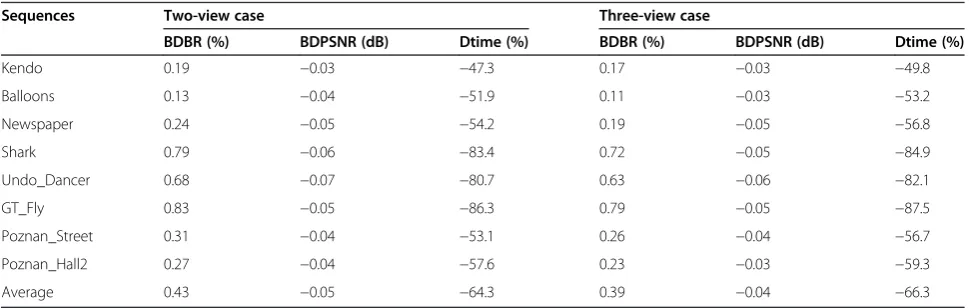
Table 8 Comparing the proposed overall algorithm compared with 3D-HEVC encoder
Sequences Two-view case Three-view case
BDBR (%) BDPSNR (dB) Dtime (%) BDBR (%) BDPSNR (dB) Dtime (%)
Kendo 0.19 −0.03 −47.3 0.17 −0.03 −49.8
Balloons 0.13 −0.04 −51.9 0.11 −0.03 −53.2
Newspaper 0.24 −0.05 −54.2 0.19 −0.05 −56.8
Shark 0.79 −0.06 −83.4 0.72 −0.05 −84.9
Undo_Dancer 0.68 −0.07 −80.7 0.63 −0.06 −82.1
GT_Fly 0.83 −0.05 −86.3 0.79 −0.05 −87.5
Poznan_Street 0.31 −0.04 −53.1 0.26 −0.04 −56.7
Poznan_Hall2 0.27 −0.04 −57.6 0.23 −0.03 −59.3
Average 0.43 −0.05 −64.3 0.39 −0.04 −66.3
Table 7 Results of each individual algorithm compared to 3D-HEVC encoder in three-view case
Sequences ETMD ASRME FDE
BDBR (%) BDPSNR (dB) Dtime (%) BDBR (%) BDPSNR (dB) Dtime (%) BDBR (%) BDPSNR (dB) Dtime (%)
Kendo 0.01 −0.01 −20.9 0.10 −0.02 −33.1 0.02 −0.00 −18.7
Balloons 0.01 −0.00 −18.1 0.07 −0.02 −37.3 0.02 −0.00 −23.6
Newspaper 0.00 −0.02 −27.8 0.19 −0.02 −42.7 0.03 −0.01 −15.9
Shark −0.05 0.00 −10.4 0.07 −0.01 −63.4 0.68 −0.05 −32.3
Undo_Dancer −0.09 0.01 −12.7 0.05 −0.01 −56.7 0.57 −0.04 −39.7
GT_Fly −0.07 0.00 −7.9 0.07 −0.01 −64.5 0.71 −0.05 −38.5
Poznan_Street 0.01 −0.01 −28.3 0.18 −0.03 −44.1 0.05 −0.00 −17.1
Poznan_Hall2 0.02 −0.01 −32.7 0.15 −0.02 −43.6 0.07 −0.01 −25.4
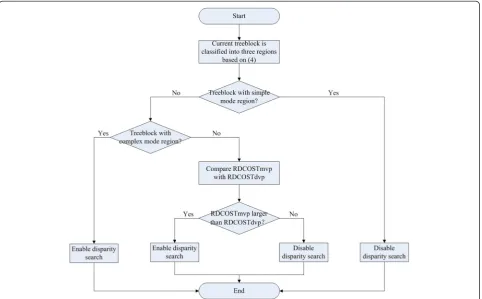
Based on the aforementioned analysis, we propose a fast disparity estimation algorithm in which a disparity search is selectively enabled. For treeblocks with a sim-ple mode region, disparity search is skipped (only the RD cost of the MVP is used); while for treeblocks with a normal mode region, the RD cost of the MVP is com-pared with that of the disparity vector predictor (DVP). If the RD cost of MVP is larger than that of DVP, the disparity search is enabled; otherwise, it is disabled. For treeblocks with a complex mode region, disparity search is enabled (all the RD cost of MVP and DVP are used). A flowchart of the scheme is given in Figure 4.
3.4 Overall algorithm
Based on the aforementioned analysis, including the ap-proaches of early termination mode decision, adaptive search range ME and fast DE for depth map coding, we propose a low-complexity depth map compression algo-rithm for 3D-HEVC as follows.
Step 1: start mode decision for a depth map treeblock. Step 2: locate the spatial neighboring depth map treeblock and its co-located texture video treeblocks (shown in Figure2) at the previously coded data. Derive the coding information from predictors in the depth map and texture video.
Step 3: derive the prediction mode of the co-located texture video treeblocks; if texture treeblock has no motion, perform early merge/skip mode decision and go to Step 7, else go to Step 4.
Step 4: computeCbased on Equation3andT1andT2 based on Equation4; classify the current depth map treeblock into the simple mode region, normal mode region, and complex mode region.
Step 5: perform adaptive search range ME
determination: for the treeblocks in a simple mode region, the search range window is reconfigured with [SR/8 × SR/8]; for the treeblock in a normal mode
region, the search range window is with [SR/4 × SR/4]; otherwise, the search range window is unchanged. Step 6: perform variable size DE: for treeblocks with a simple mode region, disparity search is skipped, while for treeblocks with a complex mode region, disparity search is enabled. For treeblocks with a normal mode region, the RD cost of the MVP is compared with that of the DVP.
Step 7: determine the best prediction mode. Go to step 1 and proceed with next depth map treeblock.
4 Experimental results
In order to confirm the performance of the proposed low-complexity depth map compression algorithm, which is implemented on the recent 3D-HEVC Test Model (HTM ver.5.1), we show the results obtained in the test on eight sequences released by the JCT-3V Group. The detailed information of the test sequences is provided in Table 5. All the experiments are defined under the common test conditions (CTC) [19] required by JCT-3V. The encoder configuration is as follows: two-view case (coding order: left-right) and three-view case (coding order: center-left-right); GOP length 8 with an intra period of 24; HEVC codecs are configured with 8-bit internal processing; the coding treeblock has a fixed size of 64 × 64 pixels and a maximum CU depth level of 4, resulting in a minimum CU size of 8 × 8 pixels; search range of the ME is configured with 64, inter-view motion prediction mode on, P-I-P inter-view prediction; and CABAC is used as the entropy coder. The proposed algorithm is evaluated with QP combina-tions for texture video and depth map (25, 34), (30, 39), (35, 42), and (40, 45) (the first number is the texture video QP, the second number gives the depth map QP). The experiments test full-length frames for each se-quence. After encoding, the intermediate rendered views were synthesized between each view. The intermediate rendered views are generated at the receiver using view Table 9 Comparing the proposed overall algorithm compared with CACRS algorithm [16]
Sequences Two-view case Three-view case
BDBR (%) BDPSNR (dB) Dtime (%) BDBR (%) BDPSNR (dB) Dtime (%)
Kendo −1.52 0.08 −14.7 −1.87 0.09 −15.1
Balloons −1.21 0.06 −21.4 −1.58 0.07 −22.8
Newspaper −0.81 0.03 −19.3 −0.92 0.04 −19.7
Shark −0.21 0.01 −33.9 −0.31 0.02 −35.2
Undo_Dancer −0.47 0.02 −29.2 −0.56 0.02 −31.1
GT_Fly −0.28 0.01 −36.2 −0.32 0.01 −38.6
Poznan_Street −0.96 0.07 −19.8 −1.26 0.08 −20.2
Poznan_Hall2 −2.12 0.11 −21.8 −2.87 0.13 −22.6
0 50 100 150 200 250 300 350 400 35 36 37 38 39 40 41 42 43 44 ) B d( w ei v d er e d n er f o R N S P e g ar e v A
Total depth bitrate(kbps)
3D-HEVC encoder Proposed algorithm
0 50 100 150 200 250 300
34 35 36 37 38 39 40 41 42 43 ) B d( w ei v d er e d n er f o R N S P e g ar e v A
Total depth bitrate(kbps)
3D-HEVC encoder Proposed algorithm
0 50 100 150 200 250 300 350 400
33 34 35 36 37 38 39 40 41 ) B d( w ei v d er e d n er f o R N S P e g ar e v A
Total depth bitrate(kbps)
3D-HEVC encoder Proposed algorithm
0 50 100 150 200 250 300 350 400
30 31 32 33 34 35 36 37 38 39 ) B d( w ei v d er e d n er f o R N S P e g ar e v A
Total depth bitrate(kbps)
3D-HEVC encoder Proposed algorithm
0 50 100 150 200 250 300 350 400
30 31 32 33 34 35 36 37 38 39 ) B d( w ei v d er e d n er f o R N S P e g ar e v A
Total depth bitrate(kbps)
3D-HEVC encoder Proposed algorithm
0 50 100 150 200 250 300 350 400 450 500
33 34 35 36 37 38 39 40 ) B d( w ei v d er e d n er f o R N S P e g ar e v A
Total depth bitrate(kbps)
3D-HEVC encoder Proposed algorithm
0 50 100 150 200 250 300 350
33 34 35 36 37 38 39 40 41 ) B d( w ei v d er e d n er f o R N S P e g ar e v A
Total depth bitrate(kbps)
3D-HEVC encoder Proposed algorithm
0 50 100 150 200
38 39 40 41 42 43 44 ) B d( w ei v d er e d n er f o R N S P e g ar e v A
Total depth bitrate(kbps)
3D-HEVC encoder Proposed algorithm
(a)
(b)
(c)
(d)
(e)
(f)
(g)
(h)
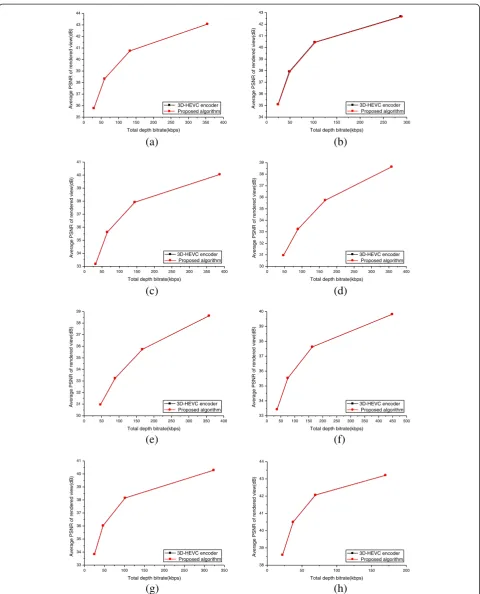
Figure 5RD curves of proposed overall algorithm and 3D-HEVC under different QP combinations.RD curves of proposed overall algorithm and 3D-HEVC under different QP combinations for texture video and depth map (25, 34), (30, 39), (35, 42), and (40, 45).(a)Kendo,
0 10 20 30 40 50 60 70 80 90 100
(40,45) (35,42)
(30,39) (25,34)
Coding time saving(%)
QP
Proposed algorithm
0 10 20 30 40 50 60 70 80 90 100
(40,45) (35,42)
(30,39) (25,34)
Coding time saving(%)
QP
Proposed algorithm
0 10 20 30 40 50 60 70 80 90 100
(40,45) (35,42)
(30,39) (25,34)
Coding time saving(%)
QP
Proposed algorithm
0 10 20 30 40 50 60 70 80 90 100
(40,45) (35,42)
(30,39) (25,34)
Coding time saving(%)
QP
Proposed algorithm
0 10 20 30 40 50 60 70 80 90 100
(40,45) (35,42)
(30,39) (25,34)
Coding time saving(%)
QP
Proposed algorithm
0 10 20 30 40 50 60 70 80 90 100
(40,45) (35,42)
(30,39) (25,34)
Coding time saving(%)
QP
Proposed algorithm
0 10 20 30 40 50 60 70 80 90 100
(40,45) (35,42)
(30,39) (25,34)
Coding time saving(%)
QP
Proposed algorithm
0 10 20 30 40 50 60 70 80 90 100
(40,45) (35,42)
(30,39) (25,34)
Coding time saving(%)
QP
Proposed algorithm
(a)
(b)
(c)
(d)
(e)
(f)
(g)
(h)
synthesis reference software (VSRS) algorithm provided by MPEG [20]. Since the depth map sequences are used for rendering instead of being viewed directly, we only compute the peak signal-to-noise ratio (PSNR) between the synthesized views using compressed depth map se-quences and the synthesized views using uncompressed depth map sequences. The experimental results are pre-sented in Tables 6, 7, 8, and 9 in which coding efficiency is measured with rendered PSNR and total bitrate (depth map), and computational complexity is measured with the consumed coding time. Since the proposed ap-proaches affect only depth map intra coding, results for texture video coding are identical; thus, the texture video results are not included in the table. The Bjonte-gaard Delta PSNR (BDPSNR) [21] represents the average texture quality for synthesized views PSNR gain, Bjonte-gaard Delta Bitrate (BDBR) represents the improvement of total bitrates for depth map coding, and ‘Dtime (%)’ represents the entire depth map coding time change in percentage.
4.1 Individual performance results of the proposed algorithms
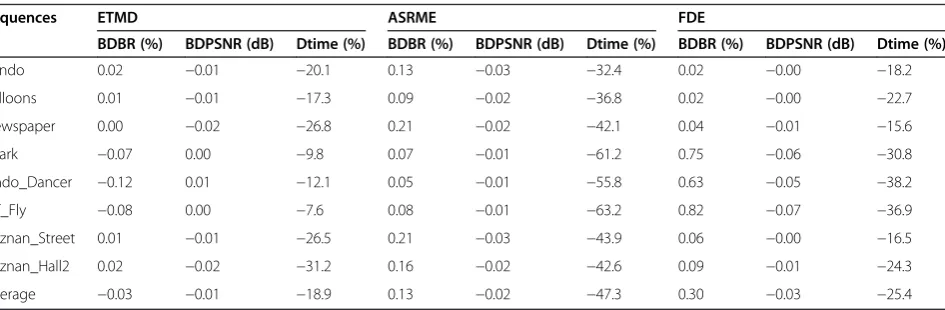
Tables 6 and 7 give individual evaluation results of the proposed algorithms compared with the original 3D-HEVC encoder (Table 6 in two-view case, Table 7 in three-view case), i.e., early termination mode decision (ETMD), adaptive search range motion estimation (ASRME), and fast disparity estimation (FDE), when they are applied alone. The proposed three algorithms can greatly reduce the encoding time with similar encoding efficiency for all sequences. For the ETMD algorithm, about 18.9% and 19.9% coding time has been reduced in the two-view and three-view conditions, respectively, with the highest gain of 32.7% in ‘Poznan_Hall2’ (two-view case) and the lowest gain of 7.6% in ‘GT_Fly’ (three-view case). It can be also observed that a consist-ent gain is obtained over all sequences under both con-ditions. The average PSNR drop for all the test sequences is 0.01 dB, which is negligible, and bitrate has been reduced by 0.02% to 0.03% on average, which indi-cates that the proposed ETMD algorithm can improve the bitrate performance for depth map compression in 3D-HEVC. For the proposed ASRME algorithm, 32.4% encoding time has been reduced with the maximum of 64.5% in two-view and three-view conditions. The coding efficiency loss is very negligible with a 0.02-dB PSNR drop or 0.11% to 0.13% bitrate increase. This result indicates that ASRME can efficiently skip unnecessary ME search
range computation in 3D-HEVC depth map coding. As far as the FDE algorithm, 25.4% and 26.4% coding time has been reduced in the two-view and three-view condi-tions, respectively; the average PSNR drop for all the test sequences is 0.02 to 0.03 dB, and the average increase of bitrate is 0.27% to 0.3%, which is negligible. The foregoing result analysis indicates that the FDE algorithm can effi-ciently reduce unnecessary DE computation time while maintaining nearly similar coding efficiency as the original 3D-HEVC encoder.
4.2 Combined results
In the following, we will analyze the experimental result of the proposed overall algorithm, which incorporates ETMD, ASRME, and FDE. The comparison result of the overall algorithm is shown in Table 8. The proposed overall algorithm reduces 64.3% and 66.3% encoding time on average under the two-view and three-view case, respectively, and achieves the better gain in coding speed among all the test sequence approaches compared to 3D-HEVC. Also shown is a consistent gain in coding speed for depth map compression with a minimum of 47.3% in ‘Kendo’ (two-view case) and the maximum of 87.5% in ‘GT_Fly’ (two-view case). For sequences with ground-truth depth map like‘Shark,’ ‘Undo_Dancer’, and
‘GT_Fly’, the proposed algorithm saves more than 80% coding time. The computation reduction is particularly high because the variable size ME and DE decision process of a significant number of depth map treeblocks are reasonably skipped. Meanwhile, the coding efficiency loss is negligible, where the average PSNR drop for the entire test sequences is 0.04 to 0.05 dB or the average in-crease of bitrate is 0.39% to 0.43%. Therefore, the pro-posed overall algorithm can reduce more than 64% depth map coding time with the same RD performance of the original 3D-HEVC encoder.
In addition to the 3D-HEVC encoder, we also compare the proposed overall algorithm with a state-of-the-art fast algorithm for 3D-HEVC (content adaptive complex-ity reduction scheme (CACRS) [16]) in Table 9. Com-pared with CACRS, the proposed overall algorithm performs better on all the sequences and achieves more than 24.5% coding time saving, with a minimum of 14.7% in ‘Kendo’ (two-view case) and the maximum of 38.6% in‘GT_Fly’(three-view case). Meanwhile, the pro-posed overall algorithm achieves a better depth map coding performance, with 0.05- to 0.06-dB PSNR in-crease or 0.95% to 1.21% bitrate dein-crease for all the test sequences compared to CACRS.
(See figure on previous page.)
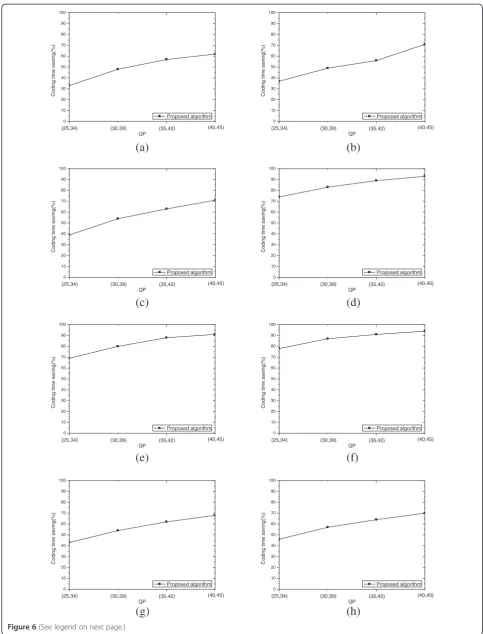
Figures 5 and 6 gives more detailed experiment results (RD and time-saving curves) of the proposed overall al-gorithm compared to 3D-HEVC in the three-view case. As shown in Figures 5 and 6, the proposed low-complexity depth map compression algorithm can achieve a consistent time saving over a large bitrate range with almost negligible loss in PSNR and increment in bitrate.
5 Conclusions
This paper presents a low-complexity depth map pression algorithm to reduce the computational com-plexity of the 3D-HEVC encoder by exploiting three fast approaches, i.e., early termination mode decision, adap-tive search range motion estimation, and fast disparity estimation for depth map coding. The recent 3D-HEVC test model is applied to evaluate the proposed algorithm. The experimental results show that the proposed algo-rithm can significantly reduce the computational com-plexity of depth map compression and maintain almost the same RD performances as the 3D-HEVC encoder.
Competing interests
The authors declare that they have no competing interests.
Acknowledgements
The authors would like to thank the editors and anonymous reviewers for their valuable comments. This work was supported in part by the National Natural Science Foundation of China under grant No. 61302118, 61401404, 61340059, and 61272038; the Scientific and Technological Project of Zhengzhou under Grant No.141PPTGG360; and in part by the Doctorate Research Funding of Zhengzhou University of Light Industry, under grant No. 2013BSJJ047.
Author details
1
College of Computer and Communication Engineering, Zhengzhou University of Light Industry, No. 5 Dongfeng Road, Zhengzhou 450002, China.2Software Engineering College, Zhengzhou University of Light Industry, Zhengzhou 450002, China.
Received: 11 March 2014 Accepted: 23 January 2015
References
1. GJ Sullivan, JM Boyce, C Ying, J-R Ohm, CA Segall, A Vetro, Standardized extensions of high efficiency video coding (HEVC). IEEE J. Sel. Top. Sign. Proces.7(6), 1001–1016 (2013)
2. GJ Sullivan, J-R Ohm, W-J Han, T Wiegand, Overview of the high efficiency video coding (HEVC) standard. IEEE Trans. Circuits Syst. Video Technol.
22(12), 1649–1668 (2012)
3. K Müller, H Schwarz, D Marpe, C Bartnik, S Bosse, H Brust, T Hinz, H Lakshman, P Merkle, H Rhee, G Tech, M Winken, T Wiegand, 3D high efficiency video coding for multi-view video and depth data. IEEE Trans. Image Process.22(9), 3366–3378 (2013)
4. L Zhang, G Tech, K Wegner, S Yea, inJoint Collaborative Team on 3D Video Coding Extensions (JCT-3V) Document JCT3V-E1005, 5th Meeting, 3D-HEVC test model 5 (Vienna, Austria 2013).
5. H Oh, YS Ho, inProc. The Pacific-Rim Symposium on Image and Video Technology, H.264-based depth map sequence coding using motion information of corresponding texture video (LNCS 2006),4319, 898–907 6. M Wang, X Jin, S Goto, inProc. 28th Picture Coding Symp., Difference
detection based early mode termination for depth map coding in MVC (2010), pp. 502–505
7. S Tsang, Y Chan, W Siu, Efficient intra prediction algorithm for smooth regions in depth coding. Electron. Lett.48(18), 1117–1119 (2012)
8. G Cernigliaro, F Jaureguizar, J Cabrera, N García, Low complexity mode decision and motion estimation for H.264/AVC based depth maps encoding in free viewpoint video. IEEE Trans. Circuits Syst. Video Techn.23(5), 769–783 (2013) 9. M Maitrea, MN Do, Depth and depth–color coding using shape-adaptive
wavelets. J. Vis. Commun. Image21(5–6), 513–522 (2010)
10. S Milani, P Zanuttigh, M Zamarin, S Forchhammer, inProc. IEEE Int. Conf. Multimedia and Expo(ICME), Efficient depth map compression exploiting segmented color data (Barcelona, 2011), pp.1–6
11. L Shen, P An, Z Liu, Z Zhang, Low complexity depth coding assisted by coding information from color video. IEEE Trans. Broadcasting60(1), 128–133 (2014) 12. Q Zhang, P An, Y Zhang, L Shen, Z Zhang, Low complexity multiview video
plus depth coding. IEEE Trans. Consumer Electron.57(4), 1857–1865 (2011) 13. Z Gu, J Zheng, N Ling P Zhang, inProc. 2013 IEEE International Conference
on Multimedia and Expo Workshops, Fast depth modeling mode selection for 3D HEVC depth intra coding (2013), pp. 1–4
14. Y Song, Y Ho, inProc. IEEE 11th IVMSP Workshop, Simplified inter-component depth modeling in 3D-HEVC, (2013), pp. 1–4
15. M Zhang, C Zhao, J Xu, H Bai, inProc. IEEE International Symposium on Circuits and Systems(ISCAS), A fast depth-map wedgelet partitioning scheme for intra prediction in 3D video coding (2013), pp.2852–2855
16. HRTohidypour, MT Pourazad, P Nasiopoulos, V Leung, inProc. 18th International Conference on Digital Signal Processing (DSP 2013), A Content Adaptive Complexity Reduction Scheme for HEVC-Based 3D Video Coding (2013), pp.1–5
17. M Winken, H Schwarz, T Wiegand, inProc. Picture Coding Symp., Motion vector inheritance for high efficiency 3D video plus depth coding (Krakow, Poland 2012), pp. 53–56
18. L Shen, Z Liu, T Yan, Z Zhang, P An, View-adaptive motion estimation and disparity estimation for low complexity multiview video coding. IEEE Trans. Circuits Syst. Video Technol.20(6), 925–930 (2010)
19. D Rusanovskyy, K Mueller, A Vetro,Common test conditions of 3DV core experiments(Joint Collaborative Team on 3D Video Coding Extensions (JCT-3V) document JCT3V-E1100, 5th Meeting, Vienna, AT, 2013) 20. M Tanimoto, T Fujii, K Suzuki, View Synthesis Algorithm in View Synthesis
Reference Software 2.0 (VSRS 2.0), (Lausanne, Switzerland, ISO/IEC JTC1/ SC29/WG11 M16090, Feb. 2008).
21. G Bjontegaard,Calculation of average PSNR difference between RD-curves (13th VCEG-M33 Meeting, Austin, TX, 2001)
Submit your manuscript to a
journal and benefi t from:
7Convenient online submission
7Rigorous peer review
7Immediate publication on acceptance
7Open access: articles freely available online
7High visibility within the fi eld
7Retaining the copyright to your article
![Table 9 Comparing the proposed overall algorithm compared with CACRS algorithm [16]](https://thumb-us.123doks.com/thumbv2/123dok_us/911642.1588961/10.595.56.541.101.256/table-comparing-proposed-overall-algorithm-compared-cacrs-algorithm.webp)