© 2019, IRJET | Impact Factor value: 7.211 | ISO 9001:2008 Certified Journal | Page 970
of material used for RCC change vastly from region to region. Thus experimental evaluation of bond slip properties for the actually available material becomes essential.
The short embedment length pull - out tests are done to evaluate the fundamental bond slip properties by many researcher. This work is an attempt to summarize experimental work done during 1982 to 2018.
Key Words
:
Bond slip, Bond strength, Cyclic loading, GFRP,
Monotonic loading, Pull out test,
1. INTRODUCTION
Strength of reinforcement concrete depends on the combined action of the concrete and its embedded reinforcement. This combined action is produced by bond stress at the surface of both the materials. The term bond refers to the adhesion between concrete and embedded reinforcement which resist the slipping of bar from the concrete. Bond is also responsible for transfer stresses from embedded bar to concrete and providing composite action between both the materials. Bond develops due to setting of concrete on drying which results in gripping of steel bars.
Bond in reinforced concrete is achieved through following mechanism:
Chemical adhesion due to the products of hydration i.e. cement in concrete.
Friction resistance due to surface roughness of reinforcement.
Gripping action by concrete shrinkage.
Mechanical interlock due to ribs provided on reinforcement.
The bond can be described ideally as a shearing stress between the surface of reinforcement and the concrete that surrounds it. That mechanism is determined by the relative displacement between reinforcement and concrete.
Fig -1.1: Pull out test set up
R. Eligehausen et. al.[10] studied local bond stress-slip
relationships of deformed bars under generalized excitations. Pietro G. Gambarova et. al.[9] studied behavior of
bond slip and splitting in reinforced concrete. K. Lungdren[6]
studied pull out tests of steel-encased specimens subjected to reversed cyclic loading. G. Appa Rao[3] studied the pullout
strength of ribbed bars in high-strength concrete. Ala’a H. Al-Zuhairi et. al.[1] studied bond–slip relationship of reinforcing
steel bars embedded in concrete. Juan Murcia-Delso et.al.[5]
studied bond-slip behaviour of confined large diameter reinforcing bars. Ismaeel H. Musa Albarwary et. al.[4] studied
bond strength of concrete with the reinforcement bars polluted with oil. Biruk Hailu Tekle et. al.[2] studied bond
properties of sand coated GFRP bars with Fly ash based Geopolymer concrete. P Eswanth et. al.[8] studied
experimental and theoretical investigations on bond strength of GFRP rebar in normal and high strength concrete. Mohammad Jamal Al-Shannag et. al.[7] studied bond
behaviour of steel bars embedded in concrete made with natural lightweight aggregates.
2. CHRONOLOGICALLY ARRANGED LITERATURE
REVIEW:
R.Eligehausen, E. P. Popov et. al. (1982), studied local
bond stress-slip relationships of deformed bars under generalized excitations. In this study, 120 specimens were tested with 12mm and 25mm bar diameters with
embedment length 5db. Confined concrete under monotonic
and cyclic loading for various bond conditions were investigated in an extensive experimental study. Fig. 2 shows
details of test specimen. During cycling loading the
© 2019, IRJET | Impact Factor value: 7.211 | ISO 9001:2008 Certified Journal | Page 971
Fig -2: Test specimenPietro G. Gambarova, GianPaolo Rosati (1996), studied behavior of bond slip and splitting in reinforced concrete as shown in Fig. 3. In this study, 20 specimens were tested in which 16 large and small diameter bars (db=14mm and
24mm) and 4 medium diameter bars (db=18mm). It was
concluded that, value of crack opening to bar diameter ratio, bond strength was higher for small diameters than for large diameter. In large diameters bond slip response, bond stiffness and bond confinement was more affected by splitting crack than small diameter bars.
Fig -3: Bond and splitting in reinforced concrete
K. Lungdren(2000), studied pull out tests of steel-encased specimens subjected to reversed cyclic loading. In this study, 14 tests were carried out in which 3 tests were loaded monotonically in one direction, 2 tests in opposite direction and 9 tests in cyclic loading. 16mm bar diameter with compressive strength 36MPa was taken. Steel tubes dimensions are 70mm diameter, 100mm height and 1mm thick. Test set is shown in Fig. 4. It was concluded that cyclic tests show a typical response for bond in cyclic loading, a steep unloading and then an almost constant, low load until the original monotonic curve was reached. Results provide valuable information about the splitting stresses that result from anchorage of reinforcement bars in concrete.
[image:2.595.314.554.441.734.2]
Fig - 4: Geometry and c/s of test specimen
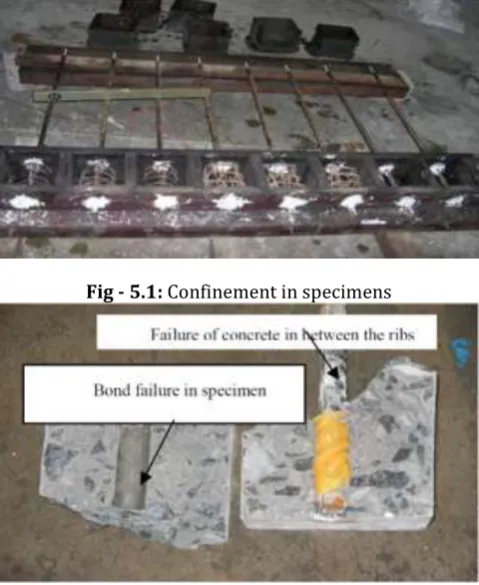
G. Appa Rao, R. Eligehausen et.al. (2007), Studied the pullout strength of ribbed bars in high-strength concrete. Effect of different parameters like bar diameter, strength of concrete, lateral confinement and embedment length were investigated. Forty confined (Spiral, tied) and unconfined specimen of dimension 150X150x150mm as shown in Fig. 5.1 were tested. In this experiment 16mm and 20mm diameter rebar embedded in two different concrete such as 40MPa and 50MPa with different embedment length 150mm and 50 mm were adopted. It was observed that ultimate bond strength and ductility increased due to spiral reinforcement. Splitting failure was noticed in unconfined specimens, while pullout failure in confined specimens as shown in Fig. 5.2.
Fig - 5.1: Confinement in specimens
[image:2.595.40.286.451.582.2]© 2019, IRJET | Impact Factor value: 7.211 | ISO 9001:2008 Certified Journal | Page 972
failure and for deformed bars splitting failure was observed.Increase in bonded length caused a decrease in the average bond strength.
[image:3.595.323.532.54.430.2]Fig -6: Details of test specimen
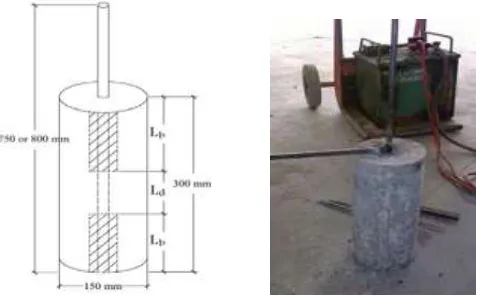
Juan Murcia-Delso, Andreas Stavridis (2011), studied bond-slip behaviour of confined large diameter reinforcing bars. 22 specimens in which 8 were subjected to monotonic loading and 14 to cyclic loading. In this experiment 35mm, 43mm and 57mm bar diameter with embedment length 5Db
[image:3.595.345.520.272.430.2]were used shown in Fig.6.1. Bond slip behaviour and compressive strength of concrete such as 35 MPa and 55 MPa was studied. Researcher’s proposed an analytical model to predict the cyclic bond-slip behaviour of reinforcing bars embedded in well-confined concrete. The model successfully reproduced bond-slip, including the degradation of the bond strength and bond stiffness under different load histories. Researchers claim that development length requirements in the current AASHTO Specifications for bridge structures in the U.S. are very conservative.
Fig -7.1: Details of test specimen
Fig -7.2: Bond stress vs. slip behaviour of deformed bars
[image:3.595.43.283.294.442.2]© 2019, IRJET | Impact Factor value: 7.211 | ISO 9001:2008 Certified Journal | Page 973
Fig –8.1: Concrete specimensFig –8.2:Cases of steel bar oil pollution
[image:4.595.243.576.50.269.2]Biruk Hailu Tekle, Amar Khennane et.al.(2016), studied bond properties of sand coated GFRP bars with Fly ash based Geopolymer concrete. In this paper, cylindrical specimens as shown in Fig.9 of 100mm diameter and 170mm height containing GFRP bars embedded in Fly ash based Geopolymer cement (GPC) concrete and Ordinary Portland cement (OPC) concrete having different embedded length such as three, six and nine times bar diameter were tested. GFRP bar diameters of 12.7 mm and 15.9mm were used. It was concluded thatpullout load increases with increasing embedment length, but the average bond strength decreases because of the splitting failure mode. The bond performance of sand-coated GFRP-reinforced GPC concrete is better than that of the OPC.
Fig –9: Set up of pull out test
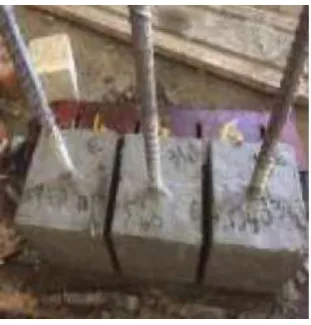
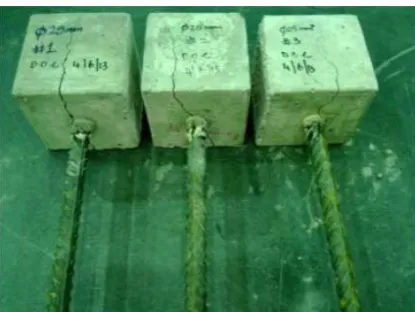
P Eswanth, G Dhinakaran (2017), studied experimental and theoretical investigations on bond strength of GFRP rebar in normal and high strength concrete. In this paper, 12 specimens having diameter such as 12mm and 16mm were embedded in 150X150X150mm cubes were subjected to direct tension pull out test as shown in Fig.10. It was observed that pull out load for normal strength concrete was lower as compared to high strength concrete. Splitting failure occurred for increased embedment lengths.
Fig -10:Cube specimens
[image:4.595.67.253.285.483.2] [image:4.595.354.510.404.567.2]© 2019, IRJET | Impact Factor value: 7.211 | ISO 9001:2008 Certified Journal | Page 974
Fig –11.1: Details of pull out specimenFig –11.2: Pull out specimen after testing
3. CONCLUSIONS
Literature review revels that pull out tests require careful attention with respect to embedment length. The major source of failure is lack of shear capacity. Many researchers have suggested new techniques and methods for experimental and analytical assessment of bond slip behaviour. Researchers have experimented on those techniques and done comparative analysis of the same.
This study gives an insight on various methods to study and improve performance of bond slip. This study will help to carry out experiments; on pull out specimen, manufactured from locally available construction material, sourced at site conditions.
[4] Ismaeel H.Musa Albarwary, James H.Haido, “Bond strength of concrete with the reinforcement bars polluted with oil”, European Scientific Journal, vol.9, No.6, pp. 255-272, February 2013.
[5] Juan Murcia-Delso, Andreas Stavridis, “Modelling the bond-slip behaviour of confined large-diameter reinforcing bars”, III ECCOMAS Thematic Conference on Computational Methods in Structural Dynamics and Earthquake Engineering, pp. 1-14, May 2011.
[6] K. Lungdren, “Pull out tests of steel-encased specimens subjected to reversed cyclic loading”, Materials and Structures, Vol. 33, pp. 450-456, September 2000.
[7] Mohammad Jamal Al-Shannag, Abdelhamid Charif, “Bond behavior of steel bars embedded in concretes made with natural lightweight aggregates”, Journal of King Saud University - Engineering Sciences, vol. 29, pp. 365-372, November 2018.
[8] P Eswanth, G Dhinakaran, “Experimental and Theoretical Investigations on Bond Strength of GFRP Rebars in Normal and High Strength Concrete”, IOP Conference Series: Earth and Environmental Science, vol. 80, pp. 1-6, 2017. [9] Pietro G. Gambarova, GianPaolo Rosati, “Bond and
splitting in reinforced concrete: test results on bar pull -out”, Materials and Structures, Vol. 29, pp. 267-276, Jun 1996.
[10] R. Elinghausen, E. P. Popov, “Local bow stress-slip relationships of deformed bars under generalized excitations”, Research Gate, January 1982.
[image:5.595.58.266.293.449.2]