1823
Generating Diverse Translations with Sentence Codes
Raphael Shu The University of Tokyo [email protected]
Hideki Nakayama The University of Tokyo [email protected]
Kyunghyun Cho New York University CIFAR Azrieli Global Scholar
Abstract
Users of machine translation systems may de-sire to obtain multiple candidates translated in different ways. In this work, we attempt to obtain diverse translations by using sen-tence codes to condition the sensen-tence
gener-ation. We describe two methods to extract
the codes, either with or without the help of syntax information. For diverse generation, we sample multiple candidates, each of which conditioned on a unique code. Experiments show that the sampled translations have much higher diversity scores when using reasonable sentence codes, where the translation quality is still on par with the baselines even under strong constraint imposed by the codes. In qualitative analysis, we show that our method is able to generate paraphrase translations with drastically different structures. The proposed approach can be easily adopted to existing translation systems as no modification to the model is required.
1 Introduction
When using machine translation systems, users may desire to see different candidate translations other than the best one. In this scenario, users usu-ally expect the system to show candidates with dif-ferent sentence structures.
To obtain diverse translations, conventional neural machine translation (NMT) models allow one to sample translations using the beam search algorithm, however, they usually share similar sentence structures. Recently, various methods (Li
et al.,2016;Xu et al., 2018) are proposed for
di-verse generation. These methods encourage the model to use creative vocabulary to achieve high diversity. Although producing creative words ben-efits tasks in the dialog domain, when applied to machine translation, it can hurt the translation quality by changing the original meaning.
In this work, we are interested in generating multiple valid translations with high diversity. To achieve this, we propose to construct the codes based on semantics-level or syntax-level informa-tion of target-side sentences.
To generate diverse translations, we constrain the generation model by specifying a particular code as a semantic or syntactic assignment. More concretely, we prefix the target-side sentences with the codes. Then, an NMT model is trained with the original source sentences and the prefixed target sentences. As the model generates tokens in left-to-right order, the probability of emitting each word is predicted conditioned on the assigned code. As each assignment is supposed to corre-spond to a sentence structure, the candidate trans-lations sampled with different assignments are ex-pected to have high diversity.
We can think such model as a mixture-of-expert translation model where each expert is capable of producing translations with a certain style indi-cated by the code. In the inference time, code as-signments are given to the model so that a selec-tion of experts are picked to generate translaselec-tions.
The key question is how to extract such sentence codes. Here, we explore two approaches. First, a simple unsupervised method is tested, which clus-ters the sentence embeddings and use the cluster ids as the code assignments. Next, to capture only the structural variation of sentences, we turn to syntax. We encode the structure of constituent parse trees into discrete codes with a tree auto-encoder.
Experiments on two machine translation
2 Proposed Approach
2.1 Extracting Sentence Codes
Our approach produces diverse translations by conditioning sentence generation with the sen-tence codes. Ideally, we would like the codes to capture the information about the sentence struc-tures rather than utterances. To extract such codes from target sentences, we explore two methods.
Semantic Coding Model The first method
ex-tracts sentence codes from unsupervisedly learned semantic information. We cluster the sentence em-beddings produced by pre-trained models into a fixed number of clusters, then use the cluster ids as discrete priors to condition the sentence gener-ation. In this work, we test two semantic coding models. The first model is based on BERT
(De-vlin et al.,2018), where the vectors corresponding
to the “[CLS]” token are clustered.
The second model produces sentence embed-dings by averaging FastText word embedembed-dings
(Bojanowski et al.,2017). Comparing to the
hid-den states of BERT, word embeddings are ex-pected to contain less syntactic information as the word order is ignored during training.
Syntactic Coding Model To explicitly capture
the syntactic diversity, we also consider to derive the sentence codes from the parse trees produced by a constituency parser. As the utterance-level information is not desired, the terminal nodes are removed from the parse trees.
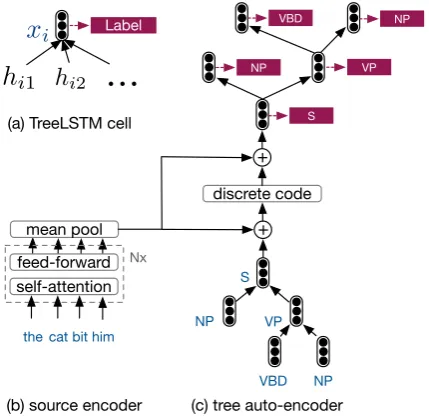
To obtain the sentence codes, we use a
TreeLSTM-based auto-encoder similar to Socher
et al. (2011), which encodes the syntactic
infor-mation into a single discrete code. As illustrated
in Fig. 1 (a), a TreeLSTM cell (Tai et al., 2015)
computes a recurrent state based on a given input
vector and the states ofNichild nodes:
hi=fcell(xi, hi1, hi2, ..., hiNi;θ). (1)
The tree auto-encoder model is shown in Fig.1
(c), where the encoder computes a latent tree rep-resentation. As the decoder has to unroll the vec-tor representation following a reversed tree struc-ture to predict the non-terminal labels, the stan-dard TreeLSTM equation cannot be directly ap-plied. To compute along the reversed tree, we
modify Eq.1for computing the hidden state of the
j-th child node given the parent-node statehi:
hij =fdec(hi;θj), (2)
self-attention
feed-forward Nx
(b) source encoder (c) tree auto-encoder
mean pool
discrete code
+ +
NP VP
NP VBD S
VP
VBD NP
NP
S
the cat bit him
(a) TreeLSTM cell
Label
h
<latexit sha1_base64="5Vvyf+Bf+wOqV4BOkHkduYgiiz8=">AAAB7XicbVDLSgNBEOyNrxhfUY9eBoPgKeyKoMegF48RzAOSJcxOOsmY2ZllZlYIS/7BiwdFvPo/3vwbJ8keNLGgoajqprsrSgQ31ve/vcLa+sbmVnG7tLO7t39QPjxqGpVqhg2mhNLtiBoUXGLDciuwnWikcSSwFY1vZ37rCbXhSj7YSYJhTIeSDzij1knNUS/jwbRXrvhVfw6ySoKcVCBHvVf+6vYVS2OUlglqTCfwExtmVFvOBE5L3dRgQtmYDrHjqKQxmjCbXzslZ07pk4HSrqQlc/X3REZjYyZx5Dpjakdm2ZuJ/3md1A6uw4zLJLUo2WLRIBXEKjJ7nfS5RmbFxBHKNHe3EjaimjLrAiq5EILll1dJ86Ia+NXg/rJSu8njKMIJnMI5BHAFNbiDOjSAwSM8wyu8ecp78d69j0VrwctnjuEPvM8fffmPDw==</latexit><latexit sha1_base64="5Vvyf+Bf+wOqV4BOkHkduYgiiz8=">AAAB7XicbVDLSgNBEOyNrxhfUY9eBoPgKeyKoMegF48RzAOSJcxOOsmY2ZllZlYIS/7BiwdFvPo/3vwbJ8keNLGgoajqprsrSgQ31ve/vcLa+sbmVnG7tLO7t39QPjxqGpVqhg2mhNLtiBoUXGLDciuwnWikcSSwFY1vZ37rCbXhSj7YSYJhTIeSDzij1knNUS/jwbRXrvhVfw6ySoKcVCBHvVf+6vYVS2OUlglqTCfwExtmVFvOBE5L3dRgQtmYDrHjqKQxmjCbXzslZ07pk4HSrqQlc/X3REZjYyZx5Dpjakdm2ZuJ/3md1A6uw4zLJLUo2WLRIBXEKjJ7nfS5RmbFxBHKNHe3EjaimjLrAiq5EILll1dJ86Ia+NXg/rJSu8njKMIJnMI5BHAFNbiDOjSAwSM8wyu8ecp78d69j0VrwctnjuEPvM8fffmPDw==</latexit><latexit sha1_base64="5Vvyf+Bf+wOqV4BOkHkduYgiiz8=">AAAB7XicbVDLSgNBEOyNrxhfUY9eBoPgKeyKoMegF48RzAOSJcxOOsmY2ZllZlYIS/7BiwdFvPo/3vwbJ8keNLGgoajqprsrSgQ31ve/vcLa+sbmVnG7tLO7t39QPjxqGpVqhg2mhNLtiBoUXGLDciuwnWikcSSwFY1vZ37rCbXhSj7YSYJhTIeSDzij1knNUS/jwbRXrvhVfw6ySoKcVCBHvVf+6vYVS2OUlglqTCfwExtmVFvOBE5L3dRgQtmYDrHjqKQxmjCbXzslZ07pk4HSrqQlc/X3REZjYyZx5Dpjakdm2ZuJ/3md1A6uw4zLJLUo2WLRIBXEKjJ7nfS5RmbFxBHKNHe3EjaimjLrAiq5EILll1dJ86Ia+NXg/rJSu8njKMIJnMI5BHAFNbiDOjSAwSM8wyu8ecp78d69j0VrwctnjuEPvM8fffmPDw==</latexit><latexit sha1_base64="5Vvyf+Bf+wOqV4BOkHkduYgiiz8=">AAAB7XicbVDLSgNBEOyNrxhfUY9eBoPgKeyKoMegF48RzAOSJcxOOsmY2ZllZlYIS/7BiwdFvPo/3vwbJ8keNLGgoajqprsrSgQ31ve/vcLa+sbmVnG7tLO7t39QPjxqGpVqhg2mhNLtiBoUXGLDciuwnWikcSSwFY1vZ37rCbXhSj7YSYJhTIeSDzij1knNUS/jwbRXrvhVfw6ySoKcVCBHvVf+6vYVS2OUlglqTCfwExtmVFvOBE5L3dRgQtmYDrHjqKQxmjCbXzslZ07pk4HSrqQlc/X3REZjYyZx5Dpjakdm2ZuJ/3md1A6uw4zLJLUo2WLRIBXEKjJ7nfS5RmbFxBHKNHe3EjaimjLrAiq5EILll1dJ86Ia+NXg/rJSu8njKMIJnMI5BHAFNbiDOjSAwSM8wyu8ecp78d69j0VrwctnjuEPvM8fffmPDw==</latexit> i1h
<latexit sha1_base64="oU4N2owU9MMPtxx7wPH567xUBE4=">AAAB7XicbVDLSgNBEOz1GeMr6tHLYBA8hd0g6DHoxWME84BkCbOTTjJmdmaZmRXCkn/w4kERr/6PN//GSbIHTSxoKKq66e6KEsGN9f1vb219Y3Nru7BT3N3bPzgsHR03jUo1wwZTQul2RA0KLrFhuRXYTjTSOBLYisa3M7/1hNpwJR/sJMEwpkPJB5xR66TmqJfx6rRXKvsVfw6ySoKclCFHvVf66vYVS2OUlglqTCfwExtmVFvOBE6L3dRgQtmYDrHjqKQxmjCbXzsl507pk4HSrqQlc/X3REZjYyZx5Dpjakdm2ZuJ/3md1A6uw4zLJLUo2WLRIBXEKjJ7nfS5RmbFxBHKNHe3EjaimjLrAiq6EILll1dJs1oJ/Epwf1mu3eRxFOAUzuACAriCGtxBHRrA4BGe4RXePOW9eO/ex6J1zctnTuAPvM8ff36PEA==</latexit><latexit sha1_base64="oU4N2owU9MMPtxx7wPH567xUBE4=">AAAB7XicbVDLSgNBEOz1GeMr6tHLYBA8hd0g6DHoxWME84BkCbOTTjJmdmaZmRXCkn/w4kERr/6PN//GSbIHTSxoKKq66e6KEsGN9f1vb219Y3Nru7BT3N3bPzgsHR03jUo1wwZTQul2RA0KLrFhuRXYTjTSOBLYisa3M7/1hNpwJR/sJMEwpkPJB5xR66TmqJfx6rRXKvsVfw6ySoKclCFHvVf66vYVS2OUlglqTCfwExtmVFvOBE6L3dRgQtmYDrHjqKQxmjCbXzsl507pk4HSrqQlc/X3REZjYyZx5Dpjakdm2ZuJ/3md1A6uw4zLJLUo2WLRIBXEKjJ7nfS5RmbFxBHKNHe3EjaimjLrAiq6EILll1dJs1oJ/Epwf1mu3eRxFOAUzuACAriCGtxBHRrA4BGe4RXePOW9eO/ex6J1zctnTuAPvM8ff36PEA==</latexit><latexit sha1_base64="oU4N2owU9MMPtxx7wPH567xUBE4=">AAAB7XicbVDLSgNBEOz1GeMr6tHLYBA8hd0g6DHoxWME84BkCbOTTjJmdmaZmRXCkn/w4kERr/6PN//GSbIHTSxoKKq66e6KEsGN9f1vb219Y3Nru7BT3N3bPzgsHR03jUo1wwZTQul2RA0KLrFhuRXYTjTSOBLYisa3M7/1hNpwJR/sJMEwpkPJB5xR66TmqJfx6rRXKvsVfw6ySoKclCFHvVf66vYVS2OUlglqTCfwExtmVFvOBE6L3dRgQtmYDrHjqKQxmjCbXzsl507pk4HSrqQlc/X3REZjYyZx5Dpjakdm2ZuJ/3md1A6uw4zLJLUo2WLRIBXEKjJ7nfS5RmbFxBHKNHe3EjaimjLrAiq6EILll1dJs1oJ/Epwf1mu3eRxFOAUzuACAriCGtxBHRrA4BGe4RXePOW9eO/ex6J1zctnTuAPvM8ff36PEA==</latexit><latexit sha1_base64="oU4N2owU9MMPtxx7wPH567xUBE4=">AAAB7XicbVDLSgNBEOz1GeMr6tHLYBA8hd0g6DHoxWME84BkCbOTTjJmdmaZmRXCkn/w4kERr/6PN//GSbIHTSxoKKq66e6KEsGN9f1vb219Y3Nru7BT3N3bPzgsHR03jUo1wwZTQul2RA0KLrFhuRXYTjTSOBLYisa3M7/1hNpwJR/sJMEwpkPJB5xR66TmqJfx6rRXKvsVfw6ySoKclCFHvVf66vYVS2OUlglqTCfwExtmVFvOBE6L3dRgQtmYDrHjqKQxmjCbXzsl507pk4HSrqQlc/X3REZjYyZx5Dpjakdm2ZuJ/3md1A6uw4zLJLUo2WLRIBXEKjJ7nfS5RmbFxBHKNHe3EjaimjLrAiq6EILll1dJs1oJ/Epwf1mu3eRxFOAUzuACAriCGtxBHRrA4BGe4RXePOW9eO/ex6J1zctnTuAPvM8ff36PEA==</latexit> i2...
<latexit sha1_base64="Ul1zjHMk9xZA8oyRXJLJOxn4TQw=">AAAB6nicbVBNS8NAEJ3Ur1q/qh69LBbBU0hE0GPRi8eK9gPaUDbbTbt0swm7E6GE/gQvHhTx6i/y5r9x2+agrQ8GHu/NMDMvTKUw6HnfTmltfWNzq7xd2dnd2z+oHh61TJJpxpsskYnuhNRwKRRvokDJO6nmNA4lb4fj25nffuLaiEQ94iTlQUyHSkSCUbTSg+u6/WrNc705yCrxC1KDAo1+9as3SFgWc4VMUmO6vpdikFONgkk+rfQyw1PKxnTIu5YqGnMT5PNTp+TMKgMSJdqWQjJXf0/kNDZmEoe2M6Y4MsveTPzP62YYXQe5UGmGXLHFoiiTBBMy+5sMhOYM5cQSyrSwtxI2opoytOlUbAj+8surpHXh+p7r31/W6jdFHGU4gVM4Bx+uoA530IAmMBjCM7zCmyOdF+fd+Vi0lpxi5hj+wPn8AUvkjSI=</latexit>
<latexit sha1_base64="Ul1zjHMk9xZA8oyRXJLJOxn4TQw=">AAAB6nicbVBNS8NAEJ3Ur1q/qh69LBbBU0hE0GPRi8eK9gPaUDbbTbt0swm7E6GE/gQvHhTx6i/y5r9x2+agrQ8GHu/NMDMvTKUw6HnfTmltfWNzq7xd2dnd2z+oHh61TJJpxpsskYnuhNRwKRRvokDJO6nmNA4lb4fj25nffuLaiEQ94iTlQUyHSkSCUbTSg+u6/WrNc705yCrxC1KDAo1+9as3SFgWc4VMUmO6vpdikFONgkk+rfQyw1PKxnTIu5YqGnMT5PNTp+TMKgMSJdqWQjJXf0/kNDZmEoe2M6Y4MsveTPzP62YYXQe5UGmGXLHFoiiTBBMy+5sMhOYM5cQSyrSwtxI2opoytOlUbAj+8surpHXh+p7r31/W6jdFHGU4gVM4Bx+uoA530IAmMBjCM7zCmyOdF+fd+Vi0lpxi5hj+wPn8AUvkjSI=</latexit>
<latexit sha1_base64="Ul1zjHMk9xZA8oyRXJLJOxn4TQw=">AAAB6nicbVBNS8NAEJ3Ur1q/qh69LBbBU0hE0GPRi8eK9gPaUDbbTbt0swm7E6GE/gQvHhTx6i/y5r9x2+agrQ8GHu/NMDMvTKUw6HnfTmltfWNzq7xd2dnd2z+oHh61TJJpxpsskYnuhNRwKRRvokDJO6nmNA4lb4fj25nffuLaiEQ94iTlQUyHSkSCUbTSg+u6/WrNc705yCrxC1KDAo1+9as3SFgWc4VMUmO6vpdikFONgkk+rfQyw1PKxnTIu5YqGnMT5PNTp+TMKgMSJdqWQjJXf0/kNDZmEoe2M6Y4MsveTPzP62YYXQe5UGmGXLHFoiiTBBMy+5sMhOYM5cQSyrSwtxI2opoytOlUbAj+8surpHXh+p7r31/W6jdFHGU4gVM4Bx+uoA530IAmMBjCM7zCmyOdF+fd+Vi0lpxi5hj+wPn8AUvkjSI=</latexit>
<latexit sha1_base64="Ul1zjHMk9xZA8oyRXJLJOxn4TQw=">AAAB6nicbVBNS8NAEJ3Ur1q/qh69LBbBU0hE0GPRi8eK9gPaUDbbTbt0swm7E6GE/gQvHhTx6i/y5r9x2+agrQ8GHu/NMDMvTKUw6HnfTmltfWNzq7xd2dnd2z+oHh61TJJpxpsskYnuhNRwKRRvokDJO6nmNA4lb4fj25nffuLaiEQ94iTlQUyHSkSCUbTSg+u6/WrNc705yCrxC1KDAo1+9as3SFgWc4VMUmO6vpdikFONgkk+rfQyw1PKxnTIu5YqGnMT5PNTp+TMKgMSJdqWQjJXf0/kNDZmEoe2M6Y4MsveTPzP62YYXQe5UGmGXLHFoiiTBBMy+5sMhOYM5cQSyrSwtxI2opoytOlUbAj+8surpHXh+p7r31/W6jdFHGU4gVM4Bx+uoA530IAmMBjCM7zCmyOdF+fd+Vi0lpxi5hj+wPn8AUvkjSI=</latexit>
x
i<latexit sha1_base64="fhCcXp/PIFsLrr08ImxUPJe8y0A=">AAAB6nicdVDJSgNBEK2JW4xb1KOXxiB4GnqGRJNb0IvHiGaBZAg9nZ6kSc9Cd48YhnyCFw+KePWLvPk3dhZBRR8UPN6roqqenwiuNMYfVm5ldW19I79Z2Nre2d0r7h+0VJxKypo0FrHs+EQxwSPW1FwL1kkkI6EvWNsfX8789h2TisfRrZ4kzAvJMOIBp0Qb6ea+z/vFEraxW62UXYRtt4JrTs2QCnZqZ2Xk2HiOEizR6Bffe4OYpiGLNBVEqa6DE+1lRGpOBZsWeqliCaFjMmRdQyMSMuVl81On6MQoAxTE0lSk0Vz9PpGRUKlJ6JvOkOiR+u3NxL+8bqqDqpfxKEk1i+hiUZAKpGM0+xsNuGRUi4khhEpubkV0RCSh2qRTMCF8fYr+Jy3XdrDtXJdL9YtlHHk4gmM4BQfOoQ5X0IAmUBjCAzzBsyWsR+vFel205qzlzCH8gPX2Cch/jiA=</latexit><latexit sha1_base64="fhCcXp/PIFsLrr08ImxUPJe8y0A=">AAAB6nicdVDJSgNBEK2JW4xb1KOXxiB4GnqGRJNb0IvHiGaBZAg9nZ6kSc9Cd48YhnyCFw+KePWLvPk3dhZBRR8UPN6roqqenwiuNMYfVm5ldW19I79Z2Nre2d0r7h+0VJxKypo0FrHs+EQxwSPW1FwL1kkkI6EvWNsfX8789h2TisfRrZ4kzAvJMOIBp0Qb6ea+z/vFEraxW62UXYRtt4JrTs2QCnZqZ2Xk2HiOEizR6Bffe4OYpiGLNBVEqa6DE+1lRGpOBZsWeqliCaFjMmRdQyMSMuVl81On6MQoAxTE0lSk0Vz9PpGRUKlJ6JvOkOiR+u3NxL+8bqqDqpfxKEk1i+hiUZAKpGM0+xsNuGRUi4khhEpubkV0RCSh2qRTMCF8fYr+Jy3XdrDtXJdL9YtlHHk4gmM4BQfOoQ5X0IAmUBjCAzzBsyWsR+vFel205qzlzCH8gPX2Cch/jiA=</latexit>
<latexit sha1_base64="fhCcXp/PIFsLrr08ImxUPJe8y0A=">AAAB6nicdVDJSgNBEK2JW4xb1KOXxiB4GnqGRJNb0IvHiGaBZAg9nZ6kSc9Cd48YhnyCFw+KePWLvPk3dhZBRR8UPN6roqqenwiuNMYfVm5ldW19I79Z2Nre2d0r7h+0VJxKypo0FrHs+EQxwSPW1FwL1kkkI6EvWNsfX8789h2TisfRrZ4kzAvJMOIBp0Qb6ea+z/vFEraxW62UXYRtt4JrTs2QCnZqZ2Xk2HiOEizR6Bffe4OYpiGLNBVEqa6DE+1lRGpOBZsWeqliCaFjMmRdQyMSMuVl81On6MQoAxTE0lSk0Vz9PpGRUKlJ6JvOkOiR+u3NxL+8bqqDqpfxKEk1i+hiUZAKpGM0+xsNuGRUi4khhEpubkV0RCSh2qRTMCF8fYr+Jy3XdrDtXJdL9YtlHHk4gmM4BQfOoQ5X0IAmUBjCAzzBsyWsR+vFel205qzlzCH8gPX2Cch/jiA=</latexit>
[image:2.595.310.525.62.270.2]<latexit sha1_base64="fhCcXp/PIFsLrr08ImxUPJe8y0A=">AAAB6nicdVDJSgNBEK2JW4xb1KOXxiB4GnqGRJNb0IvHiGaBZAg9nZ6kSc9Cd48YhnyCFw+KePWLvPk3dhZBRR8UPN6roqqenwiuNMYfVm5ldW19I79Z2Nre2d0r7h+0VJxKypo0FrHs+EQxwSPW1FwL1kkkI6EvWNsfX8789h2TisfRrZ4kzAvJMOIBp0Qb6ea+z/vFEraxW62UXYRtt4JrTs2QCnZqZ2Xk2HiOEizR6Bffe4OYpiGLNBVEqa6DE+1lRGpOBZsWeqliCaFjMmRdQyMSMuVl81On6MQoAxTE0lSk0Vz9PpGRUKlJ6JvOkOiR+u3NxL+8bqqDqpfxKEk1i+hiUZAKpGM0+xsNuGRUi4khhEpubkV0RCSh2qRTMCF8fYr+Jy3XdrDtXJdL9YtlHHk4gmM4BQfOoQ5X0IAmUBjCAzzBsyWsR+vFel205qzlzCH8gPX2Cch/jiA=</latexit>
Figure 1: Architecture of the TreeLSTM-based auto-encoder with a discretization bottleneck for learning the sentence codes.
where the internal implementation of the recurrent
function is same as Eq.1, however, each node has
a different parameterization depending on its posi-tion among siblings. Note that in the decoder side, no input vectors are fed to the recurrent computa-tion. Finally, the decoder states are used to predict target labels, whereas the model is optimized with cross-entropy loss.
As the source sentence already provides hints on the target-side sentence structure, we feed the source information to the tree auto-encoder to en-courage the latent representation to capture the syntax that cannot be inferred from the source sen-tence. To obtain the sentence codes from the latent
tree representation, we apply improved semantic
2.2 Diverse Generation with Code Assignment
Once we obtain the sentence codes, we prefix the target-side sentences in the training data with the corresponding codes. The resultant target sentence
has a form of “hc12i heociHere is a translation.”.
The “heoci” token separates the code and words.
We train a regular NMT model with the modi-fied training dataset. To generate diverse
transla-tions, we first obtain top-Kcodes from the
proba-bility distribution of code prediction. In detail, we
selectKsentence codes with the highest
probabil-ities. Then, conditioning on each code, we let the beam search continue to generate the sentence,
re-sulting inK translations conditioned on different
codes.
3 Related Work
Existing works for diverse text generation can be categorized into two major categories. The ap-proaches in the first categoriy sample diverse
se-quences by varying a hidden representation. Jain
et al. (2017) generates diverse questions by
in-jecting Gaussian noise to the latent in a VAE for
encouraging the creativity of results. Xu et al.
(2018) learnsK shared decoders, conditioned on
different pattern rewriting embeddings. The for-mer method is evaluated by assessing the ability of generating unique and unseen results, whereas the latter is evaluated with the number of unique uni/bi-grams and the divergence of word
distri-butions produced by different decoders.
Inde-pendent to this work, Shen et al. (2019) also
ex-plores mixture-of-expert models with an ensemble of learners. The paper discusses multiple training strategies and found the multiple choice learning works best.
The second category of approaches attempts to improve the diversity by improving decoding
algo-rithms. Li et al.(2016) modifies the scoring
func-tion in beam search to encourage the algorithm to promote hypotheses containing words from dif-ferent ancestral hypotheses, which is also
evalu-ated with the number of unique uni/bi-grams.
Ku-likov et al. (2018) uses an iterative beam search
approach to generate diverse dialogs.
Comparing to these works, we focus on generat-ing translations with different sentence structures. We still use beam search to search for best words in every decoding steps under the constraint of code assignment. Our approach also comes with
the advantage that no modification to the NMT model architecture is required.
4 Experiments
4.1 Experimental Settings
We evaluate our models on two machine transla-tion datasets: ASPEC Japanese-to-English dataset
(Nakazawa et al., 2016) and WMT14
German-to-English dataset. The datasets contain 3M and 4.5M bilingual pairs respectively. For the ASPEC Ja-En dataset, we use the Moses toolkit (Koehn
et al.,2007) to tokenize the English side and Kytea
(Neubig et al.,2011) to tokenize the Japanese side.
After tokenization, we apply byte-pair encoding
(Sennrich et al., 2016) to segment the texts into
subwords, forcing the vocabulary size of each lan-guage to be 40k. For WMT14 De-En dataset, we
use sentencepiece (Kudo and Richardson,2018) to
segment the words to ensure a vocabulary size of 32k.
In evaluation, we report tokenized BLEU for
ASPEC Ja-En dataset. For WMT14 De-En
dataset, BLEU scores are generated using
Sacre-Bleu toolkit (Post,2018). For models that produce
sentence codes during decoding, the codes are re-moved from translation results before evaluating BLEU scores.
4.2 Obtaining Sentence Codes
For the semantic coding model based on BERT, we cluster the hidden state of “[CLS]” token into 256 clusters with k-means algorithm. The cluster ids are then used as sentence codes. For models using FastText Embeddings, pre-trained vectors
(Com-mon Crawl, 2M words) are used. Please note
that the number of clusters is a hyperparameter, here we choose the number of clusters to match the number of unique codes in the syntax-based model.
To train the syntax coding model, we parse target-side sentences with Stanford CFG parser
(Klein and Manning, 2003). The
TreeLSTM-based auto-encoder is implemented with DGL,1
which is trained using AdaGrad optimizer for faster convergence. We found it helpful to pre-train the model without the discretization bottle-neck for achieving higher label accuracy.
Model BLEU Oracle DP
ASPEC Ja→En
Transformer Baseline 27.1 - 22.4
+Diverse Dec (Li et al.,2016) 26.9 - 26.2
+ Random Codes 27.0 - 4.9
+ Semantic Coding (BERT) 26.8 28.8 30.6
+ Semantic Coding (FastText) 27.3 28.5 31.1
+ Syntactic Coding 27.4 29.5 39.8
WMT14 De→En
Transformer Baseline 29.4 - 28.2
+Diverse Dec (Li et al.,2016) 29.1 - 31.0
+ Random Codes 29.5 - 3.8
+ Semantic Coding (BERT) 29.3 29.4 21.7
+ Semantic Coding (FastText) 28.5 29.2 28.8
[image:4.595.71.296.63.315.2]+ Syntactic Coding 29.3 30.7 33.0
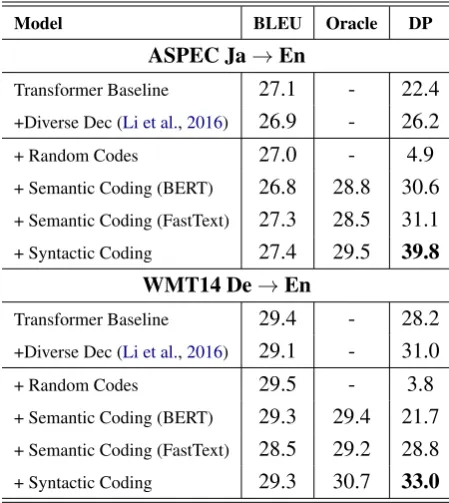
Table 1: Results for different approaches. The
BLEU(%) are reported for the first sampled candi-date. Oracle BLEU scores are produced with reference
codes. Diversity scores (DP) are evaluated with Eq.3.
4.3 Quantitive Evaluation of Diversity
As we are interested in the diversity among sam-pled candidates, the diversity metric based on the divergence between word distributions (Xu et al., 2018) can not be applied in this case. In order to qualitatively evaluate the diversity of generated translations, we propose to use a BLEU-based
dis-crepancy metric. SupposeY is a list of candidate
translations, we compute the diversity score with
DP(Y) = 1
|Y|(|Y| −1) X
y∈Y
X
y0∈Y,y06=y
1−∆(y, y0), (3)
where ∆(y, y0) returns the BLEU score of two
candidates. The equation gives a higher diversity score when each candidate contains more unique n-grams.
4.4 Experiment Results
We use Base Transformer architecture (Vaswani
et al.,2017) for all models. The results are
summa-rized in Table1. We sample three candidates with
different models, and report the averaged diversity score. The BLEU(%) is reported for the candi-date with highest confidence (log-probability). A detailed table with BLEU scores of all three can-didates can be found in supplementary material,
Tg以上の温度でIを消去できた。(Japanese)
A
1. It is possible to eliminate I at temperatures above Tg .
2. It is possible to eliminate I at temperatures higher than Tg .
3. It is possible to eliminate I at the temperature above Tg .
B
1. above Tg , I was able to be eliminated . 2. It was found that the photoresists were
eliminated at temperatures above Tg . 3. at the temperature above Tg , I was able
to be eliminated .
C
1. I could be eliminated at temperatures above Tg .
2. I was removed at temperatures above Tg . 3. It was possible to eliminate I at
temperatures above Tg .
Table 2: A comparison of candidates produced by beam search (A), semantic coding model based on BERT (B) and syntactic coding model (C) in Ja-En task
where the BLEU scores of the second and third candidates are on par with the baseline.
We compare the proposed approach to three baselines. The first baseline samples three candi-dates using standard beam search. We also tested
the diverse decoding approach (Li et al., 2016).
The coefficientγis chosen to maximize the
diver-sity with no more than 0.5 BLEU degradation. The third baseline uses random codes for conditioning.
As shown in the table, the model based on BERT sentence embeddings achieves higher diver-sity in ASPEC dataset, which contains only formal texts. However, it fails to deliver similar results in WMT14 dataset, which is more informal. This may be due to the difficulty in clustering BERT vectors which were never trained to work with clustering. The model using FastText embeddings is shown to be more robust across the datasets, al-though it also fails to outperform the diverse de-coding baseline in WMT14 dataset.
[image:4.595.303.523.63.229.2]5 Analysis and Conclusion
Table2gives samples of the candidate translations
produced by the models conditioning on different discrete codes, compared to the candidates pro-duced by beam search. We can see that the can-didate translations produced by beam search has only minor grammatical differences. In contrast, the translation results sampled with the syntactic coding model have drastically different grammars. By examining the results, we found the syntax-based model tends to produce one translation in active voice and another in passive voice.
To summarize, we show a diverse set of trans-lations can be obtained with sentence codes when a reasonable external mechanism is used to pro-duce the codes. When a good syntax parser exists, the syntax-based approach works better in terms of diversity. The source code for extracting discrete codes from parse trees will be publicly available.
Acknowledgement
The research results have been achieved by ”Re-search and Development of Deep Learning Tech-nology for Advanced Multilingual Speech Trans-lation”, the Commissioned Research of National Institute of Information and Communications Technology (NICT), JAPAN. This work was par-tially supported by JSPS KAKENHI Grant Num-ber JP16H05872, Samsung Advanced Institute of Technology (Next Generation Deep Learning: from pattern recognition to AI) and Samsung Elec-tronics (Improving Deep Learning using Latent Structure).
References
Piotr Bojanowski, Edouard Grave, Armand Joulin, and Tomas Mikolov. 2017. Enriching word vectors with
subword information. Transactions of the
Associa-tion for ComputaAssocia-tional Linguistics, 5:135–146.
Jacob Devlin, Ming-Wei Chang, Kenton Lee, and Kristina Toutanova. 2018. Bert: Pre-training of deep bidirectional transformers for language
understand-ing. CoRR, abs/1810.04805.
Unnat Jain, Ziyu Zhang, and Alexander G. Schwing. 2017. Creativity: Generating diverse questions
us-ing variational autoencoders. 2017 IEEE
Confer-ence on Computer Vision and Pattern Recognition (CVPR), pages 5415–5424.
Lukasz Kaiser and Samy Bengio. 2018.
Dis-crete autoencoders for sequence models. CoRR,
abs/1801.09797.
Dan Klein and Christopher D. Manning. 2003.
Accu-rate unlexicalized parsing. InACL.
Philipp Koehn, Hieu Hoang, Alexandra Birch, Chris Callison-Burch, Marcello Federico, Nicola Bertoldi, Brooke Cowan, Wade Shen, Christine Moran, Richard Zens, Chris Dyer, Ondrej Bojar, Alexandra Constantin, and Evan Herbst. 2007. Moses: Open source toolkit for statistical machine translation. In
ACL.
Taku Kudo and John Richardson. 2018. Sentencepiece: A simple and language independent subword tok-enizer and detoktok-enizer for neural text processing. In
EMNLP.
Ilya Kulikov, Alexander H. Miller, Kyunghyun Cho, and Jason Weston. 2018. Importance of a search
strategy in neural dialogue modelling. CoRR,
abs/1811.00907.
Jiwei Li, Will Monroe, and Daniel Jurafsky. 2016. A simple, fast diverse decoding algorithm for neural
generation.CoRR, abs/1611.08562.
Toshiaki Nakazawa, Manabu Yaguchi, Kiyotaka Uchi-moto, Masao Utiyama, Eiichiro Sumita, Sadao Kurohashi, and Hitoshi Isahara. 2016. Aspec: Asian
scientific paper excerpt corpus. InLREC.
Graham Neubig, Yosuke Nakata, and Shinsuke Mori.
2011. Pointwise prediction for robust, adaptable
japanese morphological analysis. In ACL, pages
529–533.
Matt Post. 2018. A call for clarity in reporting bleu
scores. InWMT.
Rico Sennrich, Barry Haddow, and Alexandra Birch. 2016. Neural machine translation of rare words with
subword units. CoRR, abs/1508.07909.
Tianxiao Shen, Myle Ott, Michael Auli, and
Marc’Aurelio Ranzato. 2019. Mixture models for
diverse machine translation: Tricks of the trade.
Richard Socher, Eric H Huang, Jeffrey Pennin, Christo-pher D Manning, and Andrew Y Ng. 2011. Dy-namic pooling and unfolding recursive autoencoders
for paraphrase detection. InAdvances in neural
in-formation processing systems, pages 801–809.
Kai Sheng Tai, Richard Socher, and Christopher D. Manning. 2015. Improved semantic representations from tree-structured long short-term memory
net-works. InACL.
Ashish Vaswani, Noam Shazeer, Niki Parmar, Jakob Uszkoreit, Llion Jones, Aidan N. Gomez, Lukasz Kaiser, and Illia Polosukhin. 2017. Attention is all
you need. InNIPS.
Qiongkai Xu, Juyan Zhang, Lizhen Qu, Lexing Xie, and Richard Nock. 2018. D-page: Diverse