Proceedings of the 56th Annual Meeting of the Association for Computational Linguistics (Long Papers), pages 1809–1819 1809
Weakly Supervised Semantic Parsing with Abstract Examples
Omer Goldman∗, Veronica Latcinnik∗, Udi Naveh∗, Amir Globerson, Jonathan Berant Tel-Aviv University
{omergoldman@mail,veronical@mail,
ehudnave@mail,gamir@post,joberant@cs}.tau.ac.il
Abstract
Training semantic parsers from weak su-pervision (denotations) rather than strong supervision (programs) complicates train-ing in two ways. First, a large search space of potential programs needs to be explored at training time to find a correct program. Second,spuriousprograms that accidentally lead to a correct denotation add noise to training. In this work we pro-pose that in closed worlds with clear se-mantic types, one can substantially allevi-ate these problems by utilizing an abstract representation, where tokens in both the language utterance and program are lifted to an abstract form. We show that these abstractions can be defined with a handful of lexical rules and that they result in shar-ing between different examples that alle-viates the difficulties in training. To test our approach, we develop the first seman-tic parser for CNLVR, a challenging vi-sual reasoning dataset, where the search space is large and overcoming spurious-ness is critical, because denotations are either TRUE or FALSE, and thus random programs are likely to lead to a correct denotation. Our method substantially im-proves performance, and reaches 82.5% accuracy, a 14.7% absolute accuracy im-provement compared to the best reported accuracy so far.
1 Introduction
The goal of semantic parsing is to map language utterances to executable programs. Early work on statistical learning of semantic parsers utilized
∗
Authors equally contributed to this work.
I:
k:[[{y loc: ..., color: ’Black’, type: ’square’, x loc: ... size: 20}, ...}]]
x:There is a small yellow item not touching any wall
y:True
z:Exist(Filter(ALL ITEMS, λx.And(And(IsYellow(x), IsSmall(x)), Not(IsTouchingWall(x, Side.Any))))))
Figure 1: Overview of our visual reasoning setup for the CN-LVR dataset. Given an image rendered from a KBkand an utterancex, our goal is to parsexto a programz that re-sults in the correct denotationy. Our training data includes
(x, k, y)triplets.
supervised learning, where training examples in-cluded pairs of language utterances and programs (Zelle and Mooney,1996;Kate et al.,2005; Zettle-moyer and Collins, 2005, 2007). However, col-lecting such training examples at scale has quickly turned out to be difficult, because expert annota-tors who are familiar with formal languages are re-quired. This has led to a body of work on weakly-supervised semantic parsing (Clarke et al., 2010;
Liang et al., 2011;Krishnamurthy and Mitchell,
2012; Kwiatkowski et al., 2013; Berant et al.,
2013;Cai and Yates,2013;Artzi and Zettlemoyer,
2013). In this setup, training examples correspond to utterance-denotation pairs, where adenotation is the result of executing a program against the en-vironment (see Fig.1). Naturally, collecting deno-tations is much easier, because it can be performed by non-experts.
Spurious-ness: Incorrect programs can lead to correct deno-tations, and thus the learner can go astray based on these programs. Of the two mentioned problems, spuriousness has attracted relatively less attention (Pasupat and Liang,2016;Guu et al.,2017).
Recently, the Cornell Natural Language for Vi-sual Reasoning corpus (CNLVR) was released (Suhr et al.,2017), and has presented an opportu-nity to better investigate the problem of spurious-ness. In this task, an image with boxes that con-tains objects of various shapes, colors and sizes is shown. Each image is paired with a complex nat-ural language statement, and the goal is to deter-mine whether the statement is true or false (Fig.1). The task comes in two flavors, where in one the input is the image (pixels), and in the other it is the knowledge-base (KB) from which the image was synthesized. Given the KB, it is easy to view CNLVR as a semantic parsing problem: our goal is to translate language utterances into programs that will be executed against the KB to determine their correctness (Johnson et al.,2017b;Hu et al.,
2017). Because there are only two return values, it is easy to generate programs that execute to the right denotation, and thus spuriousness is a major problem compared to previous datasets.
In this paper, we present the first semantic parser for CNLVR. Semantic parsing can be coarsely divided into alexicaltask (i.e., mapping words and phrases to program constants), and a structural task (i.e., mapping language composi-tion to program composicomposi-tion operators). Our core insight is that in closed worlds with clear seman-tic types, like spatial and visual reasoning, we can manually construct a small lexicon that clusters language tokens and program constants, and create a partially abstract representation for utterances and programs (Table1) in which the lexical prob-lem is substantially reduced. This scenario is ubiq-uitous in many semantic parsing applications such as calendar, restaurant reservation systems, hous-ing applications, etc: the formal language has a compact semantic schema and a well-defined typ-ing system, and there are canonical ways to ex-press many program constants.
We show that with abstract representations we can share information across examples and bet-ter tackle the search and spuriousness challenges. By pulling together different examples that share the same abstract representation, we can identify programs that obtain high reward across multiple
examples, thus reducing the problem of spurious-ness. This can also be done at search time, by augmenting the search state with partial programs that have been shown to be useful in earlier itera-tions. Moreover, we can annotate a small number of abstract utterance-program pairs, and automati-cally generate training examples, that will be used to warm-start our model to an initialization point in which search is able to find correct programs.
We develop a formal language for visual rea-soning, inspired by Johnson et al. (2017b), and train a semantic parser over that language from weak supervision, showing that abstract exam-ples substantially improve parser accuracy. Our parser obtains an accuracy of 82.5%, a 14.7% ab-solute accuracy improvement compared to state-of-the-art. All our code is publicly
avail-able at https://github.com/udiNaveh/
nlvr_tau_nlp_final_proj.
2 Setup
Problem Statement Given a training set of N
examples {(xi, ki, yi)}Ni=1, where xi is an
utter-ance,kiis a KB describing objects in an image and
yi ∈ {TRUE,FALSE} denotes whether the
utter-ance is true or false in the KB, our goal is to learn a semantic parser that maps a new utterancex to a programzsuch that whenzis executed against the corresponding KBk, it yields the correct de-notationy(see Fig.1).
Programming language The original KBs in CNLVR describe an image as a set of objects, where each object has a color, shape, size and location in absolute coordinates. We define a programming language over the KB that is more amenable to spatial reasoning, inspired by work on the CLEVR dataset (Johnson et al.,2017b). This programming language provides access to func-tions that allow us to check the size, shape, and color of an object, to check whether it is touch-ing a wall, to obtain sets of items that are above and below a certain set of items, etc.1 More for-mally, a program is a sequence of tokens describ-ing a possibly recursive sequence of function ap-plications in prefix notation. Each token is either a function with fixed arity (all functions have either one or two arguments), a constant, a variable or aλ
term used to define Boolean functions. Functions, constants and variables have one of the following
1We leave the problem of learning the programming
x:“There are exactly 3 yellow squares touching the wall.”
z:Equal(3, Count(Filter(ALL ITEMS, λx. And (And (IsYellow(x), IsSquare(x), IsTouchingWall(x))))))
¯
x:“There are C-QuantMod C-Num C-Color C-Shape touching the wall.” ¯
z:C-QuantMod(C-Num, Count(Filter(ALL ITEMS, λx. And (And (IsC-Color(x), IsC-Shape(x), IsTouchingWall(x))))))
Table 1: An example for an utterance-program pair(x, z)and its abstract counterpart(¯x,¯z)
x:“There is a small yellow item not touching any wall.”
z:Exist(Filter(ALL ITEMS, λx.And(And(IsYellow(x), IsSmall(x)), Not(IsTouchingWall(x, Side.Any)))))
x:“One tower has a yellow base.”
z:GreaterEqual(1, Count(Filter(ALL ITEMS, λx.And(IsYellow(x), IsBottom(x)))))
Table 2: Examples for utterance-program pairs. Commas and parenthesis provided for readability only.
atomic types:Int,Bool,Item,Size,Shape, Color,Side(sides of a box in the image); or a composite typeSet(?), andFunc(?,?). Valid programs have a return typeBool. Tables1and2
provide examples for utterances and their correct programs. The supplementary material provides a full description of all program tokens, their argu-ments and return types.
Unlike CLEVR, CNLVR requires substantial set-theoretic reasoning (utterances refer to various aspects of sets of items in one of the three boxes in the image), which required extending the language described byJohnson et al.(2017b) to include set operators and lambda abstraction. We manually sampled 100 training examples from the training data and estimate that roughly 95% of the utter-ances in the training data can be expressed with this programming language.
3 Model
We base our model on the semantic parser ofGuu et al.(2017). In their work, they used an encoder-decoder architecture (Sutskever et al.,2014) to de-fine a distributionpθ(z | x). The utterancex is
encoded using a bi-directional LSTM (Hochreiter and Schmidhuber,1997) that creates a contextual-ized representationhifor every utterance tokenxi,
and the decoder is a feed-forward network com-bined with an attention mechanism over the en-coder outputs (Bahdanau et al.,2015). The feed-forward decoder takes as input the lastK tokens that were decoded.
More formally the probability of a program is the product of the probability of its tokens given the history: pθ(z | x) = Qtpθ(zt | x, z1:t−1), and the probability of a decoded token is com-puted as follows. First, a Bi-LSTM encoder con-verts the input sequence of utterance embeddings into a sequence of forward and backward states
h{1F,B}, . . . , h{|xF,B| }. The utterance representation
ˆ
xisxˆ= [hF|x|;hB1]. Then decoding produces the
program token-by-token:
qt=ReLU(Wq[ˆx; ˆv;zt−K−1:t−1]),
αt,i ∝exp(qt>Wαhi), ct=X
i
αt,ihi,
pθ(zt|x, z1:t−1)∝exp(φ>ztWs[qt;ct]),
where φz is an embedding for program token z,
ˆ
v is a bag-of-words vector for the tokens in x,
zi:j = (zi, . . . , zj) is a history vector of size K,
the matrices Wq, Wα, Ws are learned parameters
(along with the LSTM parameters and embedding matrices), and ’;’ denotes concatenation.
Search: Searching through the large space of programs is a fundamental challenge in semantic parsing. To combat this challenge we apply sev-eral techniques. First, we use beam search at de-coding time and when training from weak super-vision (see Sec. 4), similar to prior work (Liang et al.,2017;Guu et al.,2017). At each decoding step we maintain a beamB of program prefixes of lengthn, expand them exhaustively to programs of lengthn+1and keep the top-|B|program prefixes with highest model probability.
x:One tower has a yellow base.
z: EqualInt 1 Count Filter ALL ITEMS λx And IsYellow x IsBottom x
s: Int Set Bool Item
[image:4.595.97.499.71.115.2]Bool Int Int Set BoolFunc BoolFunc Bool Bool Bool Bool Item
Figure 2: An example for the state of the type stackswhile decoding a programzfor an utterancex.
Given the constrains on valid programs, our modelp0θ(z|x)is defined as:
Y
t
pθ(zt|x, z1:t−1)·1(zt|z1:t−1)
P
z0pθ(z0 |x, z1:t−1)·1(z0 |z1:t−1)
,
where 1(zt | z1:t−1) indicates whether a certain program token is valid given the program prefix.
Discriminative re-ranking: The above model is a locally-normalized model that provides a dis-tribution for every decoded token, and thus might suffer from the label bias problem (Andor et al.,
2016; Lafferty et al., 2001). Thus, we add a globally-normalized re-ranker pψ(z | x) that
scores all|B|programs in the final beam produced byp0θ(z|x). Our globally-normalized model is:
pgψ(z|x)∝exp(sψ(x, z)),
and is normalized over all programs in the beam. The scoring function sψ(x, z) is a neural
net-work with identical architecture to the locally-normalized model, except that (a) it feeds the de-coder with the candidate programz and does not generate it. (b) the last hidden state is inserted to a feed-forward network whose output issψ(x, z).
Our final ranking score isp0θ(z|x)pgψ(z|x).
4 Training
We now describe our basic method for training from weak supervision, which we extend upon in Sec.5 using abstract examples. To use weak su-pervision, we treat the programzas a latent vari-able that is approximately marginalized. To de-scribe the objective, defineR(z, k, y) ∈ {0,1}to be one if executing programzon KBkresults in denotationy, and zero otherwise. The objective is then to maximizep(y|x)given by:
X
z∈Z
p0θ(z|x)p(y|z, k) =X
z∈Z
p0θ(z|x)R(z, k, y)
≈X
z∈B
p0θ(z|x)R(z, k, y)
whereZis the space of all programs andB ⊂ Z
are the programs found by beam search.
In most semantic parsers there will be relatively fewzthat generate the correct denotationy. How-ever, in CNLVR,yis binary, and so spuriousness is a central problem. To alleviate it, we utilize a property of CNLVR: the same utterance appears 4 times with 4 different images.2 If a program is spurious it is likely that it will yield the wrong de-notation in one of those 4 images.
Thus, we can re-define each training example to be(x,{(kj, yj)}4
j=1), where each utterancexis paired with 4 different KBs and the denotations of the utterance with respect to these KBs. Then, we maximizep({yj}4
j=1 |x,)by maximizing the ob-jective above, except thatR(z,{kj, yj}4
j=1) = 1 iff the denotation ofzis correct forallfour KBs. This dramatically reduces the problem of spuri-ousness, as the chance of randomly obtaining a correct denotation goes down from 12 to 161. This is reminiscent ofPasupat and Liang(2016), where random permutations of Wikipedia tables were shown to crowdsourcing workers to eliminate spu-rious programs.
We train the discriminative ranker analogously by maximizing the probability of programs with correct denotationP
z∈Bp g
ψ(z|x)R(z, k, y).
This basic training method fails for CNLVR (see Sec.6), due to the difficulties of search and spuriousness. Thus, we turn to learning from ab-stract examples, which substantially reduce these problems.
5 Learning from Abstract Examples
The main premise of this work is that in closed, well-typed domains such as visual reasoning, the main challenge is handling language composition-ality, since questions may have a complex and nested structure. Conversely, the problem of map-ping lexical items to functions and constants in the programming language can be substantially alleviated by taking advantage of the compact KB schema and typing system, and utilizing a
2We used the KBs in CNLVR, for which there are 4 KBs
Utterance Program Cluster #
“yellow” IsYellow C-Color 3
“big” IsBig C-Size 3
“square” IsSquare C-Shape 4
“3” 3 C-Num 2
“exactly” EqualInt C-QuantMod 5 “top” Side.Top C-Location 2 “above” GetAbove C-SpaceRel 6
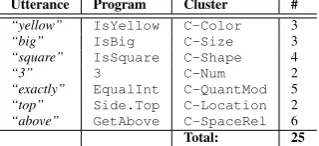
[image:5.595.102.262.64.137.2]Total: 25
Table 3: Example mappings from utterance tokens to pro-gram tokens for the seven clusters used in the abstract repre-sentation. The rightmost column counts the number of map-ping in each cluster, resulting in a total of 25 mapmap-pings.
small lexicon that maps prevalent lexical items into typed program constants. Thus, if we abstract away from the actual utterance into a partially ab-stract representation, we can combat the search and spuriousness challenges as we can generalize better across examples in small datasets.
Consider the utterances:
1. “There are exactly 3 yellow squares touching the wall.”
2. “There are at least 2 blue circles touching the wall.”
While the surface forms of these utterances are dif-ferent, at an abstract level they are similar and it would be useful to leverage this similarity.
We therefore define an abstract representation for utterances and logical forms that is suitable for spatial reasoning. We define seven abstract clus-ters (see Table3) that correspond to the main se-mantic types in our domain. Then, we associate each cluster with a small lexicon that contains language-program token pairs associated with this cluster. These mappings represent the canonical ways in which program constants are expressed in natural language. Table3shows the seven clusters we use, with an example for an utterance-program token pair from the cluster, and the number of mappings in each cluster. In total, 25 mappings are used to define abstract representations.
As we show next, abstract examples can be used to improve the process of training semantic parsers. Specifically, in sections 5.1-5.3, we use abstract examples in several ways, from generat-ing new traingenerat-ing data to improvgenerat-ing search accu-racy. The combined effect of these approaches is quite dramatic, as our evaluation demonstrates.
5.1 High Coverage via Abstract Examples
We begin by demonstrating that abstraction leads to rather effective coverage of the types of tions asked in a dataset. Namely, that many
ques-tions in the data correspond to a small set of ab-stract examples. We created abab-stract representa-tions for all 3,163 utterances in the training exam-ples by mapping utterance tokens to their cluster label, and then counted how many distinct abstract utterances exist. We found that as few as 200 ab-stract utterances cover roughly half of the training examples in the original training set.
The above suggests that knowing how to answer a small set of abstract questions may already yield a reasonable baseline. To test this baseline, we constructured a “rule-based” parser as follows. We manually annotated 106 abstract utterances with their corresponding abstract program (including alignment between abstract tokens in the utterance and program). For example, Table 1 shows the abstract utterance and program for the utterance “There are exactly 3 yellow squares touching the wall”. Note that the utterance“There are at least 2 blue circles touching the wall”will be mapped to the same abstract utterance and program.
Given this set of manual annotations, our rule-based semantic parser operates as follows: Given an utterancex, create its abstract representationx¯. If it exactly matches one of the manually anno-tated utterances, map it to its corresponding ab-stract programz¯. Replace the abstract program to-kens with real program toto-kens based on the align-ment with the utterance tokens, and obtain a final programz. Ifx¯does not match return TRUE, the majority label. The rule-based parser will fail for examples not covered by the manual annotation. However, it already provides a reasonable baseline (see Table4). As shown next, manual annotations can also be used for generating new training data.
5.2 Data Augmentation
Algorithm 1Decoding with an Abstract Cache
1: procedureDECODE(x, y, C, D)
2: // C is a map where the key is an abstract utterance and the value is a pair(Z,Rˆ)of a list of abstract pro-gramsZand their average rewardsR.ˆ Dis an integer. 3: x¯←Abstract utterance of x
4: A ←Dprograms inC[¯x]with top reward values 5: B1 ←compute beam of programs of length1 6: fort= 2. . . T do// Decode with cache 7: Bt←construct beam fromBt−1 8: At=truncate(A, t)
9: Bt.add(de-abstract(At))
10: forz∈BTdo//Update cache
11: Update rewards inC[¯x]using(¯z, R(z, y))
12: returnBT∪de-abstract(A).
to the program of the first utterance, withIsBlue replacingIsYellow.
More generally, we can sample any abstract ex-ample and instantiate the abstract clusters that ap-pear in it by sampling pairs of utterance-program tokens for each abstract cluster. Formally, this is equivalent to a synchronous context-free gram-mar (Chiang, 2005) that has a rule for generat-ing each manually-annotated abstract utterance-program pair, and rules for synchronously gener-ating utterance and program tokens from the seven clusters.
We generated 6,158 (x, z)examples using this method and trained a standard sequence to se-quence parser by maximizing logp0θ(z|x) in the model above. Although these are generated from a small set of 106 abstract utterances, they can be used to learn a model with higher coverage and ac-curacy compared to the rule-based parser, as our evaluation demonstrates.3
The resulting parser can be used as a standalone semantic parser. However, it can also be used as an initialization point for the weakly-supervised se-mantic parser. As we observe in Sec.6, this results in further improvement in accuracy.
5.3 Caching Abstract Examples
We now describe a caching mechanism that uses abstract examples to combat search and spurious-ness when training from weak supervision. As shown in Sec. 5.1, many utterances are identical at the abstract level. Thus, a natural idea is to keep track at training time of abstract utterance-program pairs that resulted in a correct denotation,
3Training a parser directly over the 106 abstract examples
results in poor performance due to the small number of ex-amples.
and use this information to direct the search pro-cedure.
Concretely, we construct a cache C that maps abstract utterances to all abstract programs that were decoded by the model, and tracks the aver-age reward obtained for those programs. For every utterancex, after obtaining the final beam of pro-grams, we add to the cache all abstract utterance-program pairs(¯x,z¯), and update their average re-ward (Alg. 1, line 10). To construct an abstract example (¯x,z¯) from an utterance-program pair
(x, z)in the beam, we perform the following pro-cedure. First, we createx¯by replacing utterance tokens with their cluster label, as in the rule-based semantic parser. Then, we go over every program token inz, and replace it with an abstract cluster if the utterance contains a token that is mapped to this program token according to the mappings from Table 3. This also provides an alignment from abstract program tokens to abstract utterance tokens that is necessary when utilizing the cache.
We propose two variants for taking advantage of the cacheC. Both are shown in Algorithm1.
1. Full program retrieval (Alg.1, line12):Given utterancex, construct an abstract utterancex¯, re-trieve the top D abstract programs A from the cache, compute the de-abstracted programsZ us-ing alignments from program tokens to utterance tokens, and add theDprograms to thefinalbeam.
2. Program prefix retrieval (Alg.1, line9):Here, we additionally consider prefixes of abstract grams to the beam, to further guide the search pro-cess. At each step t, let Bt be the beam of
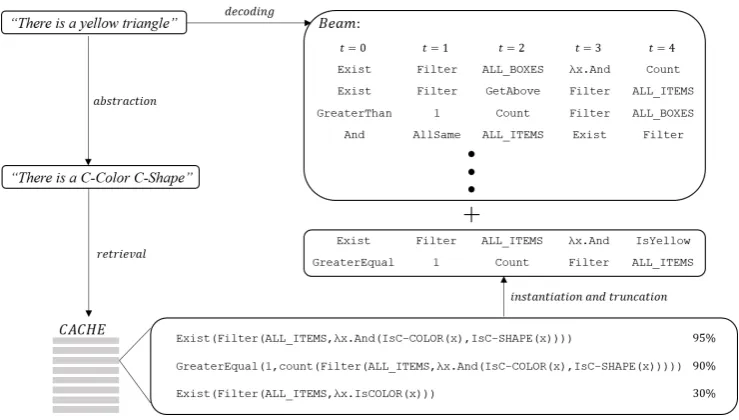
de-coded programs at stept. For every abstract pro-gramz¯ ∈ Aadd the de-abstracted prefix z1:t to Btand expandBt+1accordingly. This allows the parser to potentially construct new programs that are not in the cache already. This approach com-bats both spuriousness and the search challenge, because we add promising program prefixes to the beam that might have fallen off of it earlier. Fig.3
visualizes the caching mechanism.
A high-level overview of our entire approach for utilizing abstract examples at training time for both data augmentation and model training is given in Fig.4.
6 Experimental Evaluation
Figure 3: A visualization of the caching mechanism. At each decoding step, prefixes of high-reward abstract programs are added to the beam from the cache.
Figure 4: An overview of our approach for utilizing abstract examples for data augmentation and model training.
last 4 decoded tokens as input as well as encoder states. Token embeddings are of dimension 12, beam size is 40 andD = 10programs are used in Algorithm1. Word embeddings are initialized from CBOW (Mikolov et al., 2013) trained on the training data, and are then optimized end-to-end. In the weakly-supervised parser we encour-age exploration with meritocratic gradient updates withβ = 0.5(Guu et al.,2017). In the weakly-supervised parser we warm-start the parameters with the supervised parser, as mentioned above. For optimization, Adam is used (Kingma and Ba,
2014)), with learning rate of0.001, and mini-batch size of8.
Pre-processing Because the number of utter-ances is relatively small for training a neural model, we take the following steps to reduce spar-sity. We lowercase all utterance tokens, and also
use their lemmatized form. We also use spelling correction to replace words that contain typos. Af-ter pre-processing we replace every word that oc-curs less than 5 times with anUNKsymbol.
Evaluation We evaluate on the public develop-ment and test sets of CNLVR as well as on the hidden test set. The standard evaluation metric is accuracy, i.e., how many examples are cor-rectly classified. In addition, we report consis-tency, which is the proportion of utterances for which the decoded program has the correct deno-tation for all 4 images/KBs. It captures whether a model consistently produces a correct answer.
[image:7.595.83.516.320.467.2]Dev. Test-P Test-H Model Acc. Con. Acc. Con. Acc. Con. MAJORITY 55.3 - 56.2 - 55.4 -MAXENT 68.0 - 67.7 - 67.8
-RULE 66.0 29.2 66.3 32.7 -
[image:8.595.331.503.60.143.2]-SUP. 67.7 36.7 66.9 38.3 - -SUP.+DISC 77.7 52.4 76.6 51.8 - -WEAKSUP. 84.3 66.3 81.7 60.1 - -W.+DISC 85.7 67.4 84.0 65.0 82.5 63.9
Table 4: Results on the development, public test (Test-P) and hidden test (Test-H) sets. For each model, we report both accuracy and consistency.
when taking the KB as input, which is a maximum entropy classifier (MAXENT). For our models, we evaluate the following variants of our approach:
• RULE: The rule-based parser from Sec.5.1.
• SUP.: The supervised semantic parser trained on augmented data as in Sec.5.2(5,598 exam-ples for training and560for validation).
• WEAKSUP.: Our full weakly-supervised se-mantic parser that uses abstract examples.
• +DISC: We add a discriminative re-ranker (Sec.3) for both SUP. and WEAKSUP.
Main results Table 4 describes our main re-sults. Our weakly-supervised semantic parser with re-ranking (W.+DISC) obtains84.0accuracy and
65.0 consistency on the public test set and 82.5
accuracy and 63.9 on the hidden one, improving accuracy by14.7points compared to state-of-the-art. The accuracy of the rule-based parser (RULE) is less than 2 points below MAXENT, showing that a semantic parsing approach is very suitable for this task. The supervised parser obtains better performance (especially in consistency), and with re-ranking reaches 76.6 accuracy, showing that generalizing from generated examples is better than memorizing manually-defined patterns. Our weakly-supervised parser significantly improves over SUP., reaching an accuracy of81.7before re-ranking, and84.0 after re-ranking (on the public test set). Consistency results show an even crisper trend of improvement across the models.
6.1 Analysis
We analyze our results by running multiple abla-tions of our best model W.+DISCon the develop-ment set.
To examine the overall impact of our pro-cedure, we trained a weakly-supervised parser from scratch without pre-training a supervised parser nor using a cache, which amounts to a re-implementation of the RANDOMER algorithm (Guu et al., 2017). We find that the algorithm is
Dev.
Model Acc. Con.
RANDOMER 53.2 7.1
−ABSTRACTION 58.2 17.6
−DATAAUGMENTATION 71.4 41.2
−BEAMCACHE 77.2 56.1
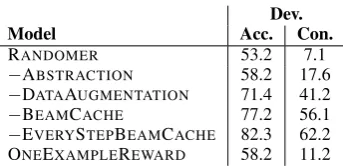
−EVERYSTEPBEAMCACHE 82.3 62.2 ONEEXAMPLEREWARD 58.2 11.2
Table 5: Results of ablations of our main models on the de-velopment set. Explanation for the nature of the models is in the body of the paper.
unable to bootstrap in this challenging setup and obtains very low performance. Next, we exam-ined the importance of abstract examples, by pre-training only on examples that were manually an-notated (utterances that match the106abstract pat-terns), but with no data augmentation or use of a cache (−ABSTRACTION). This results in perfor-mance that is similar to the MAJORITYbaseline.
To further examine the importance of abstrac-tion, we decoupled the two contributions, train-ing once with a cache but without data augmen-tation for pre-training (−DATAAUGMENTATION), and again with pre-training over the augmented data, but without the cache (−BEAMCACHE). We found that the former improves by a few points over the MAXENT baseline, and the latter per-forms comparably to the supervised parser, that is, we are still unable to improve learning by training from denotations.
Lastly, we use a beam cache without line 9 in Alg. 1 (−EVERYSTEPBEAMCACHE). This al-ready results in good performance, substantially higher than SUP. but is still3.4points worse than our best performing model on the development set. Orthogonally, to analyze the importance of ty-ing the reward of all four examples that share an utterance, we trained a model without this ty-ing, where the reward is 1 iff the denotation is correct (ONEEXAMPLEREWARD). We find that spuriousness becomes a major issue and weakly-supervised learning fails.
[image:8.595.81.281.62.136.2]three objects one of which is a circle”. In these cases the model either ignored one of the condi-tions, resulting in a program equivalent to“there is a box with three blue items”for the first case, or applied composition operators wrongly, out-putting an equivalent to“one of the gray boxes has exactly three circles” for the second case. How-ever, in some cases the parser succeeds on such examples and we found that 12% of the sampled utterances that were parsed correctly had a similar complex structure. Other, less frequent reasons for failure were problems with cardinality interpreta-tion, i.e. ,“there are 2”parsed as“exactly 2” in-stead of“at least 2”; applying conditions to items rather than sets, e.g.,“there are 2 boxes with a tri-angle closely touching a corner”parsed as“there are 2 triangles closely touching a corner”; and ut-terances with questionable phrasing, e.g.,“there is a tower that has three the same blocks color”.
Other insights are that the algorithm tended to give higher probability to the top ranked program when it is correct (average probability0.18), com-pared to cases when it is incorrect (average proba-bility0.08), indicating that probabilities are corre-lated with confidence. In addition, sentence length is not predictive for whether the model will suc-ceed: average sentence length of an utterance is
10.9when the model is correct, and11.1when it errs.
We also note that the model was successful with sentences that deal with spatial relations, but struggled with sentences that refer to the size of shapes. This is due to the data distribution, which includes many examples of the former case and fewer examples of the latter.
7 Related Work
Training semantic parsers from denotations has been one of the most popular training schemes for scaling semantic parsers since the beginning of the decade. Early work focused on traditional log-linear models (Clarke et al.,2010;Liang et al.,
2011;Kwiatkowski et al.,2013), but recently de-notations have been used to train neural semantic parsers (Liang et al.,2017;Krishnamurthy et al.,
2017;Rabinovich et al.,2017;Cheng et al.,2017). Visual reasoning has attracted considerable at-tention, with datasets such as VQA (Antol et al.,
2015) and CLEVR (Johnson et al.,2017a). The advantage of CNLVR is that language utterances are both natural and compositional. Treating
vi-sual reasoning as an end-to-end semantic parsing problem has been previously done on CLEVR (Hu et al.,2017;Johnson et al.,2017b).
Our method for generating training data resem-bles data re-combination ideas in Jia and Liang
(2016), where examples are generated automati-cally by replacing entities with their categories.
While spuriousness is central to semantic pars-ing when denotations are not very informative, there has been relatively little work on explicitly tackling it. Pasupat and Liang (2015) used man-ual rules to prune unlikely programs on the WIK -ITABLEQUESTIONS dataset, and then later uti-lized crowdsourcing (Pasupat and Liang,2016) to eliminate spurious programs. Guu et al. (2017) proposed RANDOMER, a method for increasing exploration and handling spuriousness by adding randomness to beam search and a proposing a “meritocratic” weighting scheme for gradients. In our work we found that random exploration during beam search did not improve results while merito-cratic updates slightly improved performance.
8 Discussion
In this work we presented the first semantic parser for the CNLVR dataset, taking structured repre-sentations as input. Our main insight is that in closed, well-typed domains we can generate ab-stract examples that can help combat the diffi-culties of training a parser from delayed super-vision. First, we use abstract examples to semi-automatically generate utterance-program pairs that help warm-start our parameters, thereby re-ducing the difficult search challenge of finding correct programs with random parameters. Sec-ond, we focus on an abstract representation of ex-amples, which allows us to tackle spuriousness and alleviate search, by sharing information about promising programs between different examples. Our approach dramatically improves performance on CNLVR, establishing a new state-of-the-art.
References
D. Andor, C. Alberti, D. Weiss, A. Severyn, A. Presta, K. Ganchev, S. Petrov, and M. Collins. 2016. Glob-ally normalized transition-based neural networks. arXiv preprint arXiv:1603.06042.
S. Antol, A. Agrawal, J. Lu, M. Mitchell, D. Batra, C. L. Zitnick, and D. Parikh. 2015. Vqa: Visual question answering. InInternational Conference on Computer Vision (ICCV). pages 2425–2433.
Y. Artzi and L. Zettlemoyer. 2013. Weakly supervised learning of semantic parsers for mapping instruc-tions to acinstruc-tions. Transactions of the Association for Computational Linguistics (TACL)1:49–62.
D. Bahdanau, K. Cho, and Y. Bengio. 2015. Neural machine translation by jointly learning to align and translate. InInternational Conference on Learning Representations (ICLR).
J. Berant, A. Chou, R. Frostig, and P. Liang. 2013. Se-mantic parsing on Freebase from question-answer pairs. InEmpirical Methods in Natural Language Processing (EMNLP).
Q. Cai and A. Yates. 2013. Large-scale semantic pars-ing via schema matchpars-ing and lexicon extension. In Association for Computational Linguistics (ACL).
J. Cheng, S. Reddy, V. Saraswat, and M. Lapata. 2017. Learning structured natural language representations for semantic parsing. In Association for Computa-tional Linguistics (ACL).
D. Chiang. 2005. A hierarchical phrase-based model for statistical machine translation. InAssociation for Computational Linguistics (ACL). pages 263–270.
J. Clarke, D. Goldwasser, M. Chang, and D. Roth. 2010. Driving semantic parsing from the world’s re-sponse. InComputational Natural Language Learn-ing (CoNLL). pages 18–27.
K. Guu, P. Pasupat, E. Z. Liu, and P. Liang. 2017. From language to programs: Bridging reinforce-ment learning and maximum marginal likelihood. In Association for Computational Linguistics (ACL).
S. Hochreiter and J. Schmidhuber. 1997. Long short-term memory. Neural Computation 9(8):1735– 1780.
R. Hu, J. Andreas, M. Rohrbach, T. Darrell, and K. Saenko. 2017. Learning to reason: End-to-end module networks for visual question answer-ing. InInternational Conference on Computer Vi-sion (ICCV).
R. Jia and P. Liang. 2016. Data recombination for neu-ral semantic parsing. InAssociation for Computa-tional Linguistics (ACL).
J. Johnson, B. Hariharan, L. van der Maaten, L. Fei-Fei, C. L. Zitnick, and R. Girshick. 2017a. Clevr: A di-agnostic dataset for compositional language and el-ementary visual reasoning. InComputer Vision and Pattern Recognition (CVPR).
J. Johnson, B. Hariharan, L. van der Maaten, J. Hoff-man, L. Fei-Fei, C. L. Zitnick, and R. Girshick. 2017b. Inferring and executing programs for visual reasoning. In International Conference on Com-puter Vision (ICCV).
R. J. Kate, Y. W. Wong, and R. J. Mooney. 2005. Learning to transform natural to formal languages. InAssociation for the Advancement of Artificial In-telligence (AAAI). pages 1062–1068.
D. Kingma and J. Ba. 2014. Adam: A method for stochastic optimization. arXiv preprint arXiv:1412.6980.
J. Krishnamurthy, P. Dasigi, and M. Gardner. 2017. Neural semantic parsing with type constraints for semi-structured tables. In Empirical Methods in Natural Language Processing (EMNLP).
J. Krishnamurthy and T. Mitchell. 2012. Weakly supervised training of semantic parsers. In Em-pirical Methods in Natural Language Processing and Computational Natural Language Learning (EMNLP/CoNLL). pages 754–765.
T. Kwiatkowski, E. Choi, Y. Artzi, and L. Zettlemoyer. 2013. Scaling semantic parsers with the-fly on-tology matching. InEmpirical Methods in Natural Language Processing (EMNLP).
J. Lafferty, A. McCallum, and F. Pereira. 2001. Con-ditional random fields: Probabilistic models for seg-menting and labeling data. InInternational Confer-ence on Machine Learning (ICML). pages 282–289.
C. Liang, J. Berant, Q. Le, K. D. Forbus, and N. Lao. 2017. Neural symbolic machines: Learning seman-tic parsers on Freebase with weak supervision. In Association for Computational Linguistics (ACL).
P. Liang, M. I. Jordan, and D. Klein. 2011. Learn-ing dependency-based compositional semantics. In Association for Computational Linguistics (ACL). pages 590–599.
T. Mikolov, K. Chen, G. Corrado, and Jeffrey. 2013. Efficient estimation of word representations in vec-tor space. arXiv.
P. Pasupat and P. Liang. 2015. Compositional semantic parsing on semi-structured tables. InAssociation for Computational Linguistics (ACL).
M. Rabinovich, M. Stern, and D. Klein. 2017. Abstract syntax networks for code generation and semantic parsing. InAssociation for Computational Linguis-tics (ACL).
A. Suhr, M. Lewis, J. Yeh, and Y. Artzi. 2017. A corpus of natural language for visual reasoning. In Associ-ation for ComputAssoci-ational Linguistics (ACL).
I. Sutskever, O. Vinyals, and Q. V. Le. 2014. Sequence to sequence learning with neural networks. In Ad-vances in Neural Information Processing Systems (NIPS). pages 3104–3112.
C. Xiao, M. Dymetman, and C. Gardent. 2016. Sequence-based structured prediction for semantic parsing. InAssociation for Computational Linguis-tics (ACL).
M. Zelle and R. J. Mooney. 1996. Learning to parse database queries using inductive logic program-ming. InAssociation for the Advancement of Arti-ficial Intelligence (AAAI). pages 1050–1055.
L. S. Zettlemoyer and M. Collins. 2005. Learning to map sentences to logical form: Structured classifica-tion with probabilistic categorial grammars. In Un-certainty in Artificial Intelligence (UAI). pages 658– 666.