2669
Iterative Search for Weakly Supervised Semantic Parsing
Pradeep Dasigi♥, Matt Gardner♥, Shikhar Murty♦,
Luke Zettlemoyer♣, andEduard Hovy♠
♥
Allen Institute for Artificial Intelligence, Seattle, Washington
♥Allen Institute for Artificial Intelligence, Irvine, California
♦Mila, Universit´e de Montr´eal♣University of Washington♠Carnegie Mellon University
Abstract
Training semantic parsers from question-answer pairs typically involves searching over an exponentially large space of logical forms, and an unguided search can easily be misled by spurious logical forms that coincidentally evaluate to the correct answer. We propose a novel iterative training algorithm that alter-nates between searching for consistent logical forms and maximizing the marginal likelihood of the retrieved ones. This training scheme lets us iteratively train models that provide guid-ance to subsequent ones to search for logical forms of increasing complexity, thus dealing with the problem of spuriousness. We eval-uate these techniques on two hard datasets: WIKITABLEQUESTIONS(WTQ) and Cornell Natural Language Visual Reasoning (NLVR), and show that our training algorithm outper-forms the previous best systems, on WTQ in a comparable setting, and on NLVR with signif-icantly less supervision.
1 Introduction
Semantic parsing is the task of translating natu-ral language utterances into machine-executable meaning representations, often calledprogramsor logical forms. These logical forms can be exe-cuted against some representation of the context in which the utterance occurs, to produce a de-notation. This setup allows for complex reason-ing over contextual knowledge, and it has been successfully used in several natural language un-derstanding problems such as question answer-ing (Berant et al., 2013), program synthesis (Yin and Neubig,2017) and building natural language interfaces (Suhr et al.,2018).
Recent work has focused on training seman-tic parses viaweak supervision from denotations alone (Liang et al., 2011; Berant et al., 2013). This is because obtaining logical form annotations
is generally expensive (although recent work has addressed this issue to some extent (Yih et al.,
2016)), and not assuming full supervision lets us be agnostic about the logical form language. The second reason is more important in open-domain semantic parsing tasks where it may not be pos-sible to arrive at a complete set of operators re-quired by the task. However, training semantic parsers with weak supervision requires not only searching over an exponentially large space of log-ical forms (Berant et al., 2013; Artzi and Zettle-moyer,2013;Pasupat and Liang,2015;Guu et al.,
2017, inter alia) but also dealing with spurious logical forms that evaluate to the correct denota-tion while not being semantically equivalent to the utterance. For example, if the denotations are bi-nary, 50%of all syntactically valid logical forms evaluate to the correct answer, regardless of their semantics. This problem renders the training sig-nal extremely noisy, making it hard for the model to learn anything without some additional guid-ance during search.
We introduce two innovations to improve learn-ing from denotations. Firstly, we propose an it-erative search procedure for gradually increasing the complexity of candidate logical forms for each training instance, leading to better training data and better parsing accuracy. This procedure is im-plemented via training our model with two inter-leaving objectives, one that involves searching for logical forms of limited complexity during train-ing (online search), and another that maximizes the marginal likelihood of retrieved logical forms. Second, we include a notion of coverage over the question in the search step to guide the training al-gorithm towards logical forms that not only eval-uate to the correct denotation, but also have some connection to the words in the utterance.
WIK-ITABLEQUESTIONS(WTQ) (Pasupat and Liang,
2015), an open domain task with significant lex-ical variation, and Cornell Natural Language Vi-sual Reasoning (NLVR) (Suhr et al., 2017), a closed domain task with binary denotations, and thus far less supervision. We show that: 1) in-terleaving online search and MML over retrieved logical forms (§4) is a more effective training algo-rithm than each of those objectives alone; 2) cov-erage guidance during search (§3) is helpful for dealing with weak supervision, more so in the case of NLVR where the supervision is weaker; 3) a combination of the two techniques yields 44.3%
test accuracy on WTQ, outperforming the previ-ous best single model in a comparable setting, and
82.9%test accuracy on NLVR, outperforming the best prior model, which also relies on greater su-pervision.
2 Background
2.1 Weakly supervised semantic parsing
We formally define semantic parsing in a weakly supervised setup as follows. Given a dataset where theithinstance is the triple{xi, wi, di},
represent-ing a sentencexi, the worldwiassociated with the
sentence, and the corresponding denotationdi, our
goal is to find yi, the translation of xi in an
ap-propriate logical form language (see §5.3), such thatJyiK
wi =d
i; i.e., the execution ofyiin world
wi produces the correct denotation di. A
seman-tic parser defines a distribution over logical forms given an input utterance:p(Y|xi;θ).
2.2 Training algorithms
In this section we describe prior techniques for training semantic parsers with weak supervision: maximizing marginal likelihood, and reward-based methods.
2.2.1 Maximum marginal likelihood
Most work on training semantic parsers from de-notations maximizes the likelihood of the deno-tation given the utterance. The semantic pars-ing model itself defines a distribution over logi-cal forms, however, notdenotations, so this maxi-mization must be recast as amarginalizationover logical forms that evaluate to the correct denota-tion:
max
θ
Y
xi,di∈D
X
yi∈Y|JyiKwi=di
p(yi|xi;θ) (1)
This objective function is called maximum marginal likelihood(MML). The inner summation is in general intractable to perform during training, so it is only approximated.
Most prior work (Berant et al.,2013;Goldman et al.,2018,inter alia) approximate the intractable marginalization by summing over logical forms obtained via beam search during training. This typically results in frequent search failures early during training when model parameters are close to random, and in general may only yield spuri-ous logical forms in the absence of any guidance. Since modern semantic parsers typically operate without a lexicon, new techniques are essential to provide guidance to the search procedure ( Gold-man et al.,2018).
One way of providing this guidance during search is to perform some kind of heuristic search up front to find a set of logical forms that evalu-ate to the correct denotation, and use those logical forms to approximate the inner summation (Liang et al.,2011;Krishnamurthy et al.,2017). The par-ticulars of the heuristic search can have a large im-pact on performance; a smaller candidate set has lower noise, while a larger set makes it more likely that the correct logical form is in it, and one needs to strike the right balance. In this paper, we re-fer to the MML that does search during training asdynamic MML, and the one that does an offline search asstatic MML.
The main benefit of dynamic MML is that it adapts its training signal over time. As the model learns, it can increasingly focus its probability mass on a small set of very likely logical forms. The main benefit of static MML is that there is no need to search during training, so there is a con-sistent training signal even at the start of training, and it is typically more computationally efficient than dynamic MML.
2.2.2 Reward-based methods
When training weakly supervised semantic parsers, it is often desirable to inject some prior knowledge into the training procedure by defining arbitrary reward or cost functions. There exists prior work that use such methods, both in a reinforcement learning setting (Liang et al.,2017,
2018), and otherwise (Iyyer et al., 2017; Guu et al.,2017). In our work, we define a customized cost function that includes a coverage term, and use a Minimum Bayes Risk (MBR) (Goodman,
2006) training scheme, which we describe in§3.
3 Coverage-guided search
Weakly-supervised training of semantic parsers relies heavily on lexical cues to guide the initial stages of learning to good logical forms. Tradi-tionally, these lexical cues were provided in the parser’s lexicon. Neural semantic parsers remove the lexicon, however, and so need another mech-anism for obtaining these lexical cues. In this section we introduce the use of coverage to in-ject lexicon-like information into neural semantic parsers.
Coverage is a measure of relevance of the candi-date logical formyito the inputxi, in terms of how
well the productions inyi map to parts ofxi. We
use a small manually specified lexicon as a map-ping from source language to the target language productions, and define coverage ofyias the
num-ber of productions triggered by the input utterance, according to the lexicon, that are included inyi.
We use this measure of coverage to augment our loss function, and train using an MBR based algo-rithm as follows. We use beam search to train a model to minimize the expected value of a cost functionC:
min
θ N
X
i=1
Ep˜(yi|xi;θ)C(xi, yi, wi, di) (2)
wherep˜is are-normalization1of the probabilities assigned to all logical forms on the beam.
We define the cost functionCas:
C(xi, yi, wi, di) =λS(yi, xi)+(1−λ)T(yi, wi, di)
(3) where the function S measures the number of items thatyiis missing from the actions (or
gram-mar production rules) triggered by the input utter-ancexigiven the lexicon; and the functionT
mea-sures the consistency of the evaluation ofyiinwi,
meaning that it is0ifJyiK
wi =d
i, or a valuee
oth-erwise. We seteas the maximum possible value of the coverage cost for the corresponding instance, to make the two costs comparable in magnitude.λ
is a hyperparameter that gives the relative weight of the coverage cost.
1Note that without this re-normalization, and with a -1/0 cost function based on denotation accuracy, MBR will max-imize the likelihood of correct logical forms on the beam, which is equivalent to dynamic MML.
4 Iterative search
In this section we describe the iterative technique for refining the set of candidate logical forms as-sociated with each training instance.
As discussed in §2.2, most prior work on weakly-supervised training of semantic parsers uses dynamic MML. This is particularly problem-atic in domains like NLVR, where the supervi-sion signal is binary—it is very hard for dynamic MML to bootstrap its way to finding good logi-cal forms. To solve this problem, we interleave static MML, which has a consistent supervision signal from the start of training, with the coverage-augmented MBR algorithm described in§3.
In order to use static MML, we need an ini-tial set of candidate logical forms. We obtain this candidate set using a bounded-length exhaus-tive search, filtered using heuristics based on the same lexical mapping used for coverage in§3. A bounded-length search will not find logical forms for the entire training data, so we can only use a subset of the data for initial training. We train a model to convergence using static MML on these logical forms, then use that model to initialize coverage-augmented MBR training. This gives the model a good starting place for the dynamic learning algorithm, and the search at training time can look for logical forms that are longer than could be found with the bounded-length exhaus-tive search. We train MBR to convergence, then use beam search on the MBR model to find a new set of candidate logical forms for static MML on the training data. This set of logical forms can have a greater length than those in the initial set, because this search uses model scores to not ex-haustively explore all possible paths, and thus will likely cover more of the training data. In this way, we can iteratively improve the candidate logical forms used for static training, which in turn im-proves the starting place for the online search al-gorithm.
Algorithm 1 concretely describes this process. Decodein the algorithm refers to running a beam search decoder that returns a set of consistent log-ical forms (i.e. T = 0) for each of the input ut-terances. We start off with a seed datasetD0 for which consistent logical forms are available.
5 Datasets
Input :DatasetD={X, W, D}; and seed setD0 ={X0, Y0}such that
X0⊂XandC(xi0, yi0, Wi, Di) = 0
Output:Model parametersθMBR Initialize datasetDMML=D0;
whileAcc(Ddev)is increasingdo θMML=MML(DMML);
InitializeθMBR=θMML;
UpdateθMBR=MBR(D;θMBR); UpdateDMML
=Decode(D;θMBR);
end
[image:4.595.311.524.71.215.2]Algorithm 1:Iterative coverage-guided search
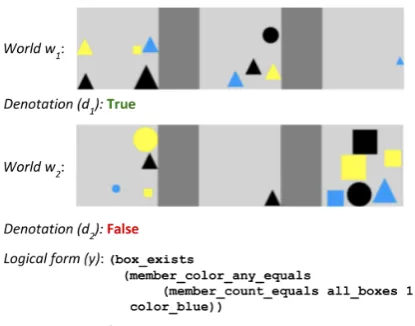
Figure 1: Example from NLVR dataset showing an ut-terance associated with two worlds and corresponding binary denotations. Also shown are the logical form and the actions triggered by the lexicon from the utter-ance.
and WIKITABLEQUESTIONS.
5.1 Cornell NLVR
Cornell NLVR is a language-grounding dataset containing natural language sentences provided along with synthetically generated visual contexts, and a label for each sentence-image pair indicating whether the sentence is true or false in the given context. Figure 1 shows two example sentence-image pairs from the dataset (with the same sen-tence). The dataset also comes with structured rep-resentations of images, indicating the color, shape, size, and x- and y-coordinates of each of the ob-jects in the image. While we show images in Fig-ure1for ease of exposition, we use the structured representations in this work.
Following the notation introduced in§2.1,xi in
[image:4.595.76.284.255.418.2]this example isThere is a box with only one item
Figure 2: Example from WIKITABLEQUESTIONS
dataset showing an utterance, a world, associated de-notation, corresponding logical form, and actions trig-gered by the lexicon.
that is blue. The structured representations asso-ciated with the two images shown are two of the worlds (w1i andw2i), in whichxi could be
evalu-ated. The corresponding labels are the denotations
d1i andd2i that a translationyi of the sentencexi
is expected to produce, when executed in the two worlds respectively. That the same sentence oc-curs with multiple worlds is an important property of this dataset, and we make use of it by defining the functionT to be0only if∀wj
i,d j iJyiK
wji =dj i.
5.2 WIKITABLEQUESTIONS
WIKITABLEQUESTIONSis a question-answering dataset where the task requires answering complex questions in the context of Wikipedia tables. An example can be seen in Figure 2. Unlike NLVR, the answers are not binary. They can instead be cells in the table or the result of numerical or set-theoretic operations performed on them.
5.3 Logical form languages
querying objects in boxes. This type specifica-tion of constants and funcspecifica-tions gives us a grammar with 115 productions, of which 101 are terminal productions (see Appendix A.1 for the complete set of rules in our grammar). Figure1shows an ex-ample of a complete logical form in our language. For WTQ, we use the functional query language used by (Liang et al.,2018) as the logical form lan-guage. Figure2shows an example logical form.
5.4 Lexicons for coverage
The lexicon we use for the coverage measure de-scribed in§3contains under 40 rules for each log-ical form language. They mainly map words and phrases to constants and unary functions in the tar-get language. The complete lexicons are shown in the Appendix. Figures1and2 also show the ac-tions triggered by the corresponding lexicons for the utterances shown. We find that small but pre-cise lexicons are sufficient to guide the search pro-cess away from spurious logical forms. Moreover, as shown empirically in§6.4, the model for NLVR does not learn much without this simple but cru-cial guidance.
6 Experiments
We evaluate both our contributions on NLVR and WIKITABLEQUESTIONS.
6.1 Model
In this work, we use a grammar-constrained encoder-decoder neural semantic parser for our experiments. Of the many variants of this basic architecture (see §7), all of which are essentially seq2seq models with constrained outputs and/or re-parameterizations, we choose to use the parser of Krishnamurthy et al. (2017), as it is particu-larly well-suited to the WIKITABLEQUESTIONS dataset, which we evaluate on.
The encoder in the model is a bi-directional recurrent neural network with Long Short-Term Memory (LSTM) (Hochreiter and Schmidhuber,
1997) cells, and the decoder is a grammar-constrained decoder also with LSTM cells. In-stead of directly outputting tokens in the logi-cal form, the decoder outputs production rules from a CFG-like grammar. These production rules sequentially build up an abstract syntax tree, which determines the logical form. The model also has an entity linking component for produc-ing table entities in the logical forms; this
com-ponent is only applicable to WIKITABLEQUES-TIONS, and we remove it when running experi-ments on NLVR. The particulars of the model are not the focus of this work, so we refer the reader to the original paper for more details.
In addition, we slightly modify the constrained decoding architecture from (Krishnamurthy et al.,
2017) to bias the predicted actions towards those that would decrease the value ofS(yi, xi). This is
done using a coverage vector,viSfor each training instance that keeps track of the production rules triggered byxi, and gets updated whenever one of
those desired productions is produced by the de-coder. That is, vSi is a vector of 1s and 0s, with 1s indicating the triggered productions that are yet to be produced by the decoder. This is similar to the idea of checklists used byKiddon et al.(2016). The decoder in the original architecture scores out-put actions at each time step by comout-puting a dot product of the predicted action representation with the embeddings of each of the actions. We add a weighted sum of all the actions that are yet to pro-duced:
sai =ea.(pi+γ∗viS.E) (4)
wheresai is the score of actionaat time stepi,ea
is the embedding of that action,piis the predicted
action representation,E is the set of embeddings of all the actions, andγis a learned parameter for regularizing the bias towards yet-to-be produced triggered actions.
6.2 Experimental setup
NLVR We use the standard train-dev-test split for NLVR, containing 12409, 988 and 989 sentence-image pairs respectively. NLVR con-tains most of the sentences occurring in multiple worlds (with an average of 3.9 worlds per sen-tence). We set the word embedding and action embedding sizes to 50, and the hidden layer size of both the encoder and the decoder to 30. We initial-ized all the parameters, including the word and ac-tion embeddings using Glorot uniform initializa-tion (Glorot and Bengio,2010). We found that us-ing pretrained word representations did not help. We added a dropout (Srivastava et al., 2014) of 0.2 on the outputs of the encoder and the decoder and before predicting the next action, set the beam size to 10 both during training and at test time, and trained the model using ADAM (Kingma and Ba,
WIKITABLEQUESTIONS This dataset comes with five different cross-validation folds of train-ing data, each containtrain-ing a different 80/20 split for training and development. We first show results aggregated from all five folds in §6.3, and then show results from controlled experiments on fold 1. We replicated the model presented in Krishna-murthy et al.(2017), and only changed the training algorithm and the language used. We used a beam size of 20 for MBR during training and decoding, and 10 for MML during decoding, and trained the model using Stochastic Gradient Descent (Kiefer et al.,1952) with a learning rate of 0.1, all of which are tuned on the validation sets.
Specifics of iterative search For our iterative search algorithm, we obtain an initial set of can-didate logical forms in both domains by exhaus-tively searching to a depth of 102. During search we retrieve the logical forms that lead to the cor-rect denotations in all the corresponding worlds, and sort them based on their coverage cost using the coverage lexicon described in§5.4, and choose the top-k3. At each iteration of the search step in our iterative training algorithm, we increase the maximum depth of our search with a step-size of 2, finding more complex logical forms and cover-ing a larger proportion of the traincover-ing data. While exhaustive search is prohibitively expensive be-yond a fixed number of steps, our training process that uses beam search based approximation can go deeper.
Implementation We implemented our model and training algorithms within the AllenNLP (Gardner et al., 2018) toolkit. The code and models are publicly available at https://github.com/allenai/ iterative-search-semparse.
6.3 Main results
WIKITABLEQUESTIONS Table 1 compares
the performance of a single model trained us-ing Iterative Search, with that of previously pub-lished single models. We excluded ensemble mod-els since there are differences in the way ensem-bles are built for this task in previous work, ei-ther in terms of size or how the individual mod-els were chosen. We show both best and
aver-2
It was prohibitively expensive to search beyond depth of 10.
3k is a hyperparameter that is chosen on the dev set at each iteration in iterative search, and is typically10or20
Approach Dev Test
Pasupat and Liang(2015) 37.0 37.1
Neelakantan et al.(2017) 34.1 34.2
Haug et al.(2018) - 34.8
Zhang et al.(2017) 40.4 43.7
Liang et al.(2018) (MAPO) (avg.) 42.3 43.1
[image:6.595.312.534.63.195.2]Liang et al.(2018) (MAPO) (best) 42.7 43.8 Iterative Search (avg.) 42.1 43.9 Iterative Search (best) 43.1 44.3
Table 1: Comparison of single model performances of Iterative Search with previously reported single model performances
Algorithm Dev acc. Test acc.
MAPO 42.1 42.7
Static MML 40.0 42.2
[image:6.595.323.508.265.349.2]Iterative MML 42.5 43.1 Iterative Search 43.0 43.8
Table 2: Comparison of iterative search with static MML, iterative MML, and the previous best result from (Liang et al.,2018), all trained on the official split 1 of WIKITABLEQUESTIONSand tested on the official test set.
age (over 5 folds) single model performance from
Liang et al. (2018) (Memory Augmented Policy Optimization). The best model was chosen based on performance on the development set. Our sin-gle model performances are computed in the same way. Note thatLiang et al.(2018) also use a lexi-con similar to ours to prune the seed set of logical forms used to initialize their memory buffer.
NLVR In Table 3, we show a comparison of the performance of ouriterative coverage-guided searchalgorithm with the previously published ap-proaches for NLVR. The first two rows correspond to models that are not semantic parsers. This shows that semantic parsing is a promising direc-tion for this task. The closest work to ours is the weakly supervised parser built by (Goldman et al.,
2018). They build a lexicon similar to ours for mapping surface forms in input sentences to ab-stract clusters. But in addition to defining a lex-icon, they also manually annotate complete sen-tences in this abstract space, and use those annota-tions to perform data augmentation for training a supervised parser, which is then used to initialize a weakly supervised parser. They also explicitly use the abstractions to augment the beam during de-coding using caching, and a separately-trained dis-criminative re-ranker to re-order the logical forms on the beam. As a discriminative re-ranker is or-thogonal to our contributions, we show their re-sults with and without it, with “Abs. Sup.” being more comparable to our work. Our model, which uses no data augmentation, no caching during de-coding, and no discriminative re-ranker, outper-forms their variant without reranking on the pub-lic test set, and outperforms their best model on the hidden test set, achieving a new state-of-the-art result on this dataset.
6.4 Effect of coverage-guided search
To evaluate the contribution of coverage-guided search, we compare the the performance of the NLVR parser in two different settings: with and without coverage guidance in the cost function. We also compare the performance of the parser in the two settings, when initialized with parameters from an MML model trained to maximize the like-lihood of the set of logical forms obtained from exhaustive search. Table 4 shows the results of this comparison. We measure accuracy and con-sistency of all four models on the publicly avail-able test set, using the official evaluation script. Consistency here refers to the percentage of logi-cal forms that produce the correct denotation in all the corresponding worlds, and is hence a stricter metric than accuracy. The cost weight (λin Equa-tion 3) was tuned based on validation set perfor-mance for the runs with coverage, and we found thatλ= 0.4worked best.
It can be seen that both with and without
ini-tialization, coverage guidance helps by a big mar-gin, with the gap being even more prominent in the case where there is no initialization. When there is neither coverage guidance nor a good ini-tialization, the model does not learn much from unguided search and get a test accuracy not much higher than the majority baseline of 56.2%.
We found that coverage guidance was not as useful for WTQ. The average value of the best per-formingλwas around0.2, and higher values nei-ther helped nor hurt performance.
6.5 Effect of iterative search
To evaluate the effect of iterative search, we present the accuracy numbers from the search (S) and maximization (M) steps from different itera-tions in Tables5and6, showing results on NLVR and WTQ, respectively. Additionally, we also show number of decoding steps used at each it-erations, and the percentage of sentences in the training data for which we were able to obtain consistent logical forms from the S step, the set that was used in the M step of the same iteration. It can be seen in both tables that a better MML model gives a better initialization for MBR, and a better MBR model results in a larger set of ut-terances for which we can retrieve consistent log-ical forms, thus improving the subsequent MML model. The improvement for NLVR is more pro-nounced (a gain of 21% absolute) than for WTQ (a gain of 3% absolute), likely because the initial exhaustive search provides a much higher percent-age of spurious logical forms for NLVR, and thus the starting place is relatively worse.
Complexity of Logical Forms We analyzed the logical forms produced by our iterative search al-gorithm at different iterations to see how they dif-fer. As expected, for NLVR, allowing greater depths lets the parser explore more complex logi-cal forms. Table7shows examples from the vali-dation set that indicate this trend.
7 Related Work
Most of the early methods used for training se-mantic parsers required the training data to come with annotated logical forms (Zelle and Mooney,
Dev. Test-P Test-H
Approach Acc. Cons. Acc. Cons. Acc. Cons.
MaxEnt (Suhr et al.,2017) 68.0 - 67.7 - 67.8
-BiATT-Pointer (Tan and Bansal,2018) 74.6 - 73.9 - 71.8 -Abs. Sup. (Goldman et al.,2018) 84.3 66.3 81.7 60.1 - -Abs. Sup. + ReRank (Goldman et al.,2018) 85.7 67.4 84.0 65.0 82.5 63.9
[image:8.595.91.508.65.170.2]Iterative Search 85.4 64.8 82.4 61.3 82.9 64.3
Table 3: Comparison of our approach with previously published approaches. We show accuracy and consistency on the development set, and public (Test-P) and hidden (Test-H) test sets.
No coverage + coverage Acc. Cons. Acc. Cons.
[image:8.595.83.281.367.516.2]No init. 56.4 12.0 73.9 43.6 MML init. 77.7 51.1 80.7 56.4
Table 4: Effect of coverage guidance on NLVR parsers trained with and without initialization from an MML model. Metrics shown are accuracy and consistency on the public test set.
Iter. Length % cov. Step Dev. Acc
0 10 51 M 64.0
1 12 65 S 81.6
M 76.5
2 14 65 S 82.7
M 81.8
3 16 73 S 85.4
M 83.1
4 18 75 S 84.7
[image:8.595.81.281.576.726.2]M 81.2
Table 5: Effect of iterative search (S) and maximization (M) on NLVR. % cov. is the percentage of training data for which the S step retrieves consistent logical forms.
Iter. Length % cov. Step Dev. Acc
0 10 83.3 M 40.0
1 12 70.2 S 42.5
M 42.5
2 14 71.3 S 43.1
M 42.7
3 16 71.0 S 42.8
M 42.5
4 18 71.0 S 43.0
M 42.7
Table 6: Iterative search on WIKITABLEQUESTIONS. M and S refer to Maximization and Search steps.
More recent research has focused on training se-mantic parsers withweak supervision(Liang et al.,
2011;Berant et al., 2013), or trying to automat-ically infer logical forms from denotations ( Pa-supat and Liang, 2016). However, matching the performance of a fully supervised semantic parser with only weak supervision remains a significant challenge (Yih et al.,2016).
The main contributions of this work deal with training semantic parsers with weak supervision, and we gave a detailed discussion of related train-ing methods in§2.2.
We evaluate our contributions on the NLVR and WIKITABLEQUESTIONS datasets. Other work that evaluates on on these datasets include Gold-man et al. (2018), Tan and Bansal (2018), Nee-lakantan et al.(2017),Krishnamurthy et al.(2017),
Haug et al.(2018), and (Liang et al.,2018). These prior works generally present modeling contri-butions that are orthogonal (and in some cases complementary) to the contributions of this paper. There has also been a lot of recent work on neural semantic parsing, most of which is also orthogo-nal to (and could probably benefit from) our con-tributions (Dong and Lapata,2016;Jia and Liang,
2016;Yin and Neubig,2017;Krishnamurthy et al.,
2017;Rabinovich et al., 2017). Recent attempts at dealing with the problem of spuriousness in-cludeMisra et al.(2018) andGuu et al.(2017).
0 There is a tower with four blocks
(box exists (member count equals all boxes 4))
1 Atleast one black triangle is not touching the edge
(object exists (black (triangle ((negate filter touch wall) all objects))))
2 There is a yellow block as the top of a tower with exactly three blocks.
(object exists (yellow (top (object in box (member count equals all boxes 3)))))
3
The tower with three blocks has a yellow block over a black block
(object count greater equals (yellow (above (black (object in box (member count equals all boxes 3))))) 1)
Table 7: Complexity of logical forms produced at different iterations, from iteration 0 to iteration 3; each logical form could not be produced at the previous iterations
8 Conclusion
We have presented a new technique for training semantic parsers with weak supervision. Our key insights are that lexical cues are crucial for guid-ing search durguid-ing the early stages of trainguid-ing, and that the particulars of the approximate marginal-ization in maximum marginal likelihood have a large impact on performance. To address the first issue, we used a simple coverage mechanism for including lexicon-like information in neural se-mantic parsers that do not have lexicons. For the second issue, we developed an iterative procedure that alternates between statically-computed and dynamically-computed training signals. Together these two contributions greatly improve seman-tic parsing performance, leading to new state-of-the-art results on NLVR and WIKITABLEQUES -TIONS. As these contributions are to the learn-ing algorithm, they are broadly applicable to many models trained with weak supervision. One poten-tial future work direction is investigating whether they extend to other structured prediction prob-lems beyond semantic parsing.
Acknowledgments
We would like to thank Jonathan Berant and Noah Smith for comments on earlier drafts and Chen Liang for helping us with implementation details of MAPO. Computations onbeaker.orgwere supported in part by credits from Google Cloud.
References
Yoav Artzi and Luke Zettlemoyer. 2013. Weakly su-pervised learning of semantic parsers for mapping instructions to actions. Transactions of the Associa-tion of ComputaAssocia-tional Linguistics, 1:49–62.
Jonathan Berant, Andrew Chou, Roy Frostig, and Percy Liang. 2013. Semantic parsing on freebase from question-answer pairs. In Proceedings of the 2013
Conference on Empirical Methods in Natural Lan-guage Processing, pages 1533–1544.
Li Dong and Mirella Lapata. 2016. Language to logical form with neural attention. InACL’16.
Matt Gardner, Joel Grus, Mark Neumann, Oyvind Tafjord, Pradeep Dasigi, Nelson F. Liu, Matthew E. Peters, Michael Schmitz, and Luke S. Zettlemoyer. 2018. Allennlp: A deep semantic natural language processing platform. CoRR, abs/1803.07640.
Xavier Glorot and Yoshua Bengio. 2010. Understand-ing the difficulty of trainUnderstand-ing deep feedforward neu-ral networks. In Proceedings of the thirteenth in-ternational conference on artificial intelligence and statistics, pages 249–256.
Vaibhava Goel and William J Byrne. 2000. Minimum bayes-risk automatic speech recognition. Computer Speech & Language, 14(2):115–135.
Omer Goldman, Veronica Latcinnik, Udi Naveh, Amir Globerson, and Jonathan Berant. 2018. Weakly-supervised semantic parsing with abstract examples. InACL.
Joshua Goodman. 1996. Parsing algorithms and met-rics. In Proceedings of the 34th annual meeting on Association for Computational Linguistics, pages 177–183. Association for Computational Linguis-tics.
Kelvin Guu, Panupong Pasupat, Evan Zheran Liu, and Percy Liang. 2017. From language to pro-grams: Bridging reinforcement learning and maxi-mum marginal likelihood. InAssociation for Com-putational Linguistics (ACL).
Till Haug, Octavian-Eugen Ganea, and Paulina Grnarova. 2018. Neural multi-step reasoning for question answering on semi-structured tables. In
ECIR.
Sepp Hochreiter and J¨urgen Schmidhuber. 1997. Long short-term memory. Neural computation, 9(8):1735–1780.
Robin Jia and Percy Liang. 2016. Data recombination for neural semantic parsing. InACL’16.
Chlo´e Kiddon, Luke Zettlemoyer, and Yejin Choi. 2016. Globally coherent text generation with neural checklist models. InProceedings of the 2016 Con-ference on Empirical Methods in Natural Language Processing, pages 329–339.
Jack Kiefer, Jacob Wolfowitz, et al. 1952. Stochastic estimation of the maximum of a regression function.
The Annals of Mathematical Statistics, 23(3):462– 466.
Diederik P Kingma and Jimmy Ba. 2014. Adam: A method for stochastic optimization. arXiv preprint arXiv:1412.6980.
Jayant Krishnamurthy, Pradeep Dasigi, and Matt Gard-ner. 2017. Neural semantic parsing with type con-straints for semi-structured tables. InProceedings of the 2017 Conference on Empirical Methods in Nat-ural Language Processing, pages 1516–1526.
Tom Kwiatkowski, Luke Zettlemoyer, Sharon Goldwa-ter, and Mark Steedman. 2011. Lexical generaliza-tion in ccg grammar inducgeneraliza-tion for semantic parsing. InProceedings of the conference on empirical meth-ods in natural language processing, pages 1512– 1523. Association for Computational Linguistics.
Chen Liang, Jonathan Berant, Quoc Le, Kenneth D Forbus, and Ni Lao. 2017. Neural symbolic ma-chines: Learning semantic parsers on freebase with weak supervision. In Proceedings of the 55th An-nual Meeting of the Association for Computational Linguistics (Volume 1: Long Papers), volume 1, pages 23–33.
Chen Liang, Mohammad Norouzi, Jonathan Berant, Quoc Le, and Ni Lao. 2018. Memory augmented policy optimization for program synthesis with gen-eralization. arXiv preprint arXiv:1807.02322.
Percy Liang, Michael I Jordan, and Dan Klein. 2011. Learning dependency-based compositional seman-tics. InACL.
Dipendra Misra, Ming-Wei Chang, Xiaodong He, and Wen tau Yih. 2018. Policy shaping and generalized update equations for semantic parsing from denota-tions. InEMNLP.
Arvind Neelakantan, Quoc V Le, Martin Abadi, An-drew McCallum, and Dario Amodei. 2017. Learn-ing a natural language interface with neural pro-grammer. InICLR.
Panupong Pasupat and Percy Liang. 2015. Compo-sitional semantic parsing on semi-structured tables. In Proceedings of the 53rd Annual Meeting of the Association for Computational Linguistics and the 7th International Joint Conference on Natural Lan-guage Processing (Volume 1: Long Papers), vol-ume 1, pages 1470–1480.
Panupong Pasupat and Percy Liang. 2016. Inferring logical forms from denotations. In Proceedings of the 54th Annual Meeting of the Association for Com-putational Linguistics (Volume 1: Long Papers), volume 1, pages 23–32.
Maxim Rabinovich, Mitchell Stern, and Dan Klein. 2017. Abstract syntax networks for code generation and semantic parsing. InACL.
Abigail See, Peter J Liu, and Christopher D Manning. 2017. Get to the point: Summarization with pointer-generator networks.ACL.
David A Smith and Jason Eisner. 2006. Minimum risk annealing for training log-linear models. In
Proceedings of the COLING/ACL on Main confer-ence poster sessions, pages 787–794. Association for Computational Linguistics.
Nitish Srivastava, Geoffrey Hinton, Alex Krizhevsky, Ilya Sutskever, and Ruslan Salakhutdinov. 2014. Dropout: A simple way to prevent neural networks from overfitting. The Journal of Machine Learning Research, 15(1):1929–1958.
Alane Suhr, Srinivasan Iyer, and Yoav Artzi. 2018. Learning to map context-dependent sentences to ex-ecutable formal queries. InProceedings of the 2018 Conference of the North American Chapter of the Association for Computational Linguistics: Human Language Technologies, Volume 1 (Long Papers), volume 1, pages 2238–2249.
Alane Suhr, Mike Lewis, James Yeh, and Yoav Artzi. 2017. A corpus of natural language for visual rea-soning. In Proceedings of the 55th Annual Meet-ing of the Association for Computational LMeet-inguistics (Volume 2: Short Papers), volume 2, pages 217–223.
Hao Tan and Mohit Bansal. 2018. Object ordering with bidirectional matchings for visual reasoning. In Pro-ceedings of the 2018 Conference of the North Amer-ican Chapter of the Association for Computational Linguistics: Human Language Technologies.
Zhaopeng Tu, Zhengdong Lu, Yang Liu, Xiaohua Liu, and Hang Li. 2016. Modeling coverage for neural machine translation. ACL.
Wen-tau Yih, Matthew Richardson, Christopher Meek, Ming-Wei Chang, and Jina Suh. 2016. The value of semantic parse labeling for knowledge base question answering. InACL.
Pengcheng Yin and Graham Neubig. 2017. A syntactic neural model for general-purpose code generation. InACL’17.
Luke S. Zettlemoyer and Michael Collins. 2005. Learning to map sentences to logical form: Struc-tured classification with probabilistic categorial grammars. InUAI’05.
Yuchen Zhang, Panupong Pasupat, and Percy Liang. 2017. Macro grammars and holistic triggering for efficient semantic parsing. In Proceedings of the 2017 Conference on Empirical Methods in Natural Language Processing, pages 1214–1223.
A Logical form language and lexicon for NLVR
Basic Types: bool (t),box (b),object (o),shape (s),color (c),number (n)
In the grammar and lexicon that follow we use the following placeholders,
quantifier∈ {any,all,none}
comparator∈ {equals,not equals,
lesser,lesser equals,
greater,greater equals}
color∈ {yellow,blue,black}
shape∈ {square,triangle,circle}
size∈ {big,medium,small}
location∈ {above,below,top,left,
right,bottom,corner,wall}
number∈ {1...9}
A.1 Grammar
Constants
b -> all_boxes c -> color_black,
color_blue, color_yellow n -> 1, 2, ..., 9
o -> all_objects s -> shape_circle,
shape_square, shape_triangle
Object filtering functions
<o,o> -> [location], [color], [shape], [size], same_color, same_shape, touch_object, touch_bottom, touch_top, touch_left, touch_right, touch_corner, touch_wall,
Box filtering functions
<b,<s,b>> ->
member_shape_[quantifier]_equals <b,<c,b>> ->
member_color_[quantifier]_equals <b,<n,b>> ->
member_count_[comparator]
member_color_count_[comparator], member_shape_count_[comparator] <b,b> -> member_color_different,
member_color_same, member_shape_different, member_shape_same
Assertion functions
<b,t> -> box_exists <o,t> -> object_exists
<b,<n,t>> -> box_count_[comparator] <o,<c,t>> ->
object_color_[quantifier]_equals <o,<s,t>> ->
object_shape_[quantifier]_equals <o,<n,t>> ->
object_color_count_[comparator], object_shape_count_[comparator], object_count_[comparator]
Other functions
<b,o> -> object_in_box
<<o,o>,<o,o>> -> negate_filter
A.2 Lexicon for NLVR
there is a box→box exists there is a [other]→object exists box. . .[color]→color [color] box. . .[shape]→shape [shape] not→negate filter
contains→object in box
touch. . .[location]→touch [location] [location]→[location]
[shape]→[shape] [color]→[color] [size]→[size] [number]→[number]
B Logical form language and lexicon for
WIKITABLEQUESTIONS
B.1 Lexicon for WIKITABLEQUESTIONS
at least→filter≥
[greater|larger|more] than→filter≥
at most→filter≤
no [greater|larger|more] than→filter≤
[next|below|after]→next
[previous|above|before]→previous [first|top]→top
[last|bottom]→bottom same→same as total→sum difference→diff average→average