Proceedings of the 56th Annual Meeting of the Association for Computational Linguistics (Long Papers), pages 1190–1199 1190
Extending a Parser to Distant Domains Using a Few Dozen Partially
Annotated Examples
Vidur Joshi, Matthew Peters, Mark Hopkins Allen Institute for AI, Seattle, WA
{vidurj, matthewp, markh}@allenai.org
Abstract
We revisit domain adaptation for parsers in the neural era. First we show that recent advances in word representations greatly diminish the need for domain adaptation when the target domain is syntactically similar to the source domain. As evidence, we train a parser on the Wall Street Jour-nal alone that achieves over 90%F1on the Brown corpus. For more syntactically dis-tant domains, we provide a simple way to adapt a parser using only dozens of partial annotations. For instance, we increase the percentage of error-free geometry-domain parses in a held-out set from 45% to 73% using approximately five dozen training examples. In the process, we demon-strate a new state-of-the-art single model result on the Wall Street Journal test set of 94.3%. This is an absolute increase of 1.7% over the previous state-of-the-art of 92.6%.
1 Introduction
Statistical parsers are often criticized for their per-formance outside of the domain they were trained on. The most straightforward remedy would be more training data in the target domain, but build-ing treebanks (Marcus et al., 1993) is expensive.
In this paper, we revisit this issue in light of re-cent developments in neural natural language pro-cessing. Our paper rests on two observations:
1. It is trivial to train on partial annotations using a span-focused model. Stern et al. (2017a) demonstrated that a parser with min-imal dependence between the decisions that produce a parse can achieve state-of-the-art performance. We modify their parser,
hence-Given [ the circle [ at the right ] with [ designated center, designated perpendicu-lar, and radius 5 ] ] .
In [ the figure above ] , [ [ AD = 4 ] , [ AB = 3 ] and [ CD = 9 ] ] .
[ Diameter AC ] is perpendicular [ to chord BD ] [ at E ] .
Figure 1: An example of partial annotations. An-notators indicate that a span is a constituent by en-closing it in square brackets.
forth MSP, so that it trains directly on individ-ual labeled spans instead of parse trees. This results in a parser that can be trained, with no adjustments to the training regime, from par-tial sentence bracketings.
2. The use of contextualized word represen-tations (Peters et al., 2017; McCann et al., 2017) greatly reduces the amount of data needed to train linguistic models. Contex-tualized word representations, which encode tokens conditioned on their context in a sen-tence, have been shown to give significant boosts across a variety of NLP tasks, and also to reduce the amount of data needed by an or-der of magnitude in some tasks.
Along the way, we provide several other notable contributions:
• We raise the state-of-the-art single-modelF1 -score for constituency parsing from 92.6% to 94.3% on the Wall Street Journal (WSJ) test set. A trained model is publicly available.1
• We show that, even without domain-specific training data, our parser has much less out-of-domain degradation than previous parsers on “newswire-adjacent” domains like the Brown corpus.
• We provide a version of MSP which pre-dicts its own POS tags (rather than requiring a third-party tagger).
2 The Reconciled Span Parser (RSP)
When we allow annotators to selectively anno-tate important phenomena, we make the process faster and simpler (Mielens et al., 2015). Unfor-tunately, this produces a disconnect between the model (which typically asserts the probability of a full parse tree) and the annotation task (which as-serts the correctness of some subcomponent, like a constituent span or a dependency arc). There is a body of research (Hwa, 1999; Li et al., 2016) that discusses how to bridge this gap by modifying the training data, training algorithm, or the train-ing objective.
Alternatively, we could just better align the model with the annotation task. Specifically, we could train a parser whose base model predicts ex-actly what we ask the annotator to annotate, e.g. whether a particular span is a constituent. This makes it trivial to train with partial or full anno-tations, because the training data reduces to a col-lection of span labels in either case.
Luckily, recent state-of-the-art results that model NLP tasks as independently classified spans (Stern et al., 2017a) suggest this strategy is cur-rently viable. In this section, we present the Rec-onciled Span Parser (RSP), a modified version of the Minimal Span Parser (MSP) of Stern et al. (2017a). RSP differs from MSP in the following ways:
• It is trained on a span classification task.
MSP trains on a maximum margin objec-tive; that is, the loss function penalizes the
1http://allennlp.org/models
violation of a margin between the scores of the gold parse and the next highest scoring parse decoded. This couples its training pro-cedure with its decoding propro-cedure, result-ing in two versions, a top-down parser and a chart parser. To allow our model to be trained on partial annotations, we change the train-ing task to be the span classification task de-scribed below.
• It uses contextualized word representa-tions instead of predicted part-of-speech tags. Our model uses contextualized word representations as described in Peters et al. (2018). It does not take part-of-speech-tags as input, eliminating the dependence of the parser on a newswire-trained POS-tagger.
2.1 Overview
We will view a parse tree as a labeling of all the spans of a sentence such that:
• Every constituent span is labeled with the se-quence of non-terminals assigned to it in the parse tree. For instance, span(2,4) in Fig-ure 2b is labeled with the sequencehS,VPi, as shown in Figure 2a.
• Every non-constituent is labeled with the empty sequence.
Given a sentence represented by a sequence of to-kens x of length n, definespans(x) = {(i, j) | 0≤i < j≤n}. Define aparsefor sentencexas a functionπ:spans(x)7→ LwhereLis the set of all sequences of non-terminal tags, including the empty sequence.
We model the probability of a parse as the inde-pendent product of its span labels:
P r(π|x) = Y
s∈spans(x)
P r(π(s)|x, s)
⇒logP r(π|x) = X
s∈spans(x)
logP r(π(s)|x, s)
Hence, we will train a base modelσ(l | x, s) to estimate the log probability of label l for span s
(given sentencex), and we will score the overall parse with:
score(π|x) = X
s∈spans(x)
S
VBG, ∅ NN, ∅ ∅
∅
∅
She enjoys playing tennis .
0 1 2 3 4 5
input
PRP, NP ∅
∅
VBZ, ∅ S, VP
VP . , ∅
(a) Spans classified by the parsing procedure. Note that leaves have their part-of-speech tags predicted in addition to their se-quence of non-terminals.
S
. . VP
S
VP
NP
NN tennis VBG
playing VBZ
enjoys NP
PRP She
[image:3.595.70.283.496.702.2](b) The resulting parse tree.
Figure 2: The correspondence between labeled spans and a parse tree. This diagram is adapted from figure 1 in (Stern et al., 2017a).
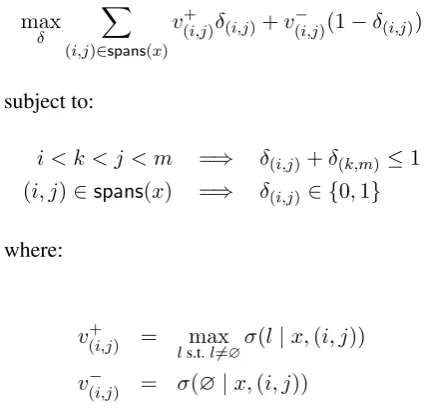
Note that this probability model accords mass to mis-structured trees (e.g. overlapping spans like (2, 5) and (3, 7) cannot both be constituents of a well-formed tree). We solve the following Integer Linear Program (ILP)2to find the highest scoring parse that admits a well-formed tree:
max
δ
X
(i,j)∈spans(x)
v(+i,j)δ(i,j)+v(−i,j)(1−δ(i,j))
subject to:
i < k < j < m =⇒ δ(i,j)+δ(k,m)≤1 (i, j)∈spans(x) =⇒ δ(i,j)∈ {0,1}
where:
v(+i,j) = max
ls.t.l6=∅
σ(l|x,(i, j))
v(−i,j) = σ(∅|x,(i, j))
2
There are a number of ways to reconcile the span con-flicts, including an adaptation of the standard dynamic pro-gramming chart parsing algorithm to work with spans of an unbinarized tree. However it turns out that the classification model rarely produces span conflicts, so all methods we tried performed equivalently well.
2.2 Classification Model
For our span classification model σ(l | x, s), we use the model from (Stern et al., 2017a), which leverages a method for encoding spans from (Wang and Chang, 2016; Cross and Huang, 2016). First, it creates a sentence encoding by running a two-layer bidirectional LSTM over the sentence to obtain forward and backward encodings for each position i, denoted by fi and bi respec-tively. Then, spans are encoded by the difference in LSTM states immediately before and after the span; that is, span (i, j) is encoded as the con-catenation of the vector differencesfj−fi−1and
bi−bj+1. A one-layer feedforward network maps each span representation to a distribution over la-bels.
Classification Model Parameters and Initializations
We preserve the settings used in Stern et al. (2017a) where possible. As a result, the size of the hidden dimensions of the LSTM and the feed-forward network is250. The dropout ratio for the LSTM is set to0.4. Unlike the model it is based on, our model uses word embeddings of length
di-Parser Rec Prec F1
RNNG (Dyer et al., 2016) - - 91.7
MSP (Stern et al., 2017a) 90.6 93.0 91.8 (Stern et al., 2017b) 92.6 92.6 92.6
[image:4.595.72.294.62.134.2]RSP 93.8 94.8 94.3
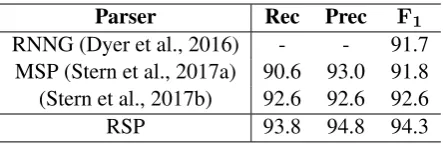
Table 1: Parsing performance on WSJTEST, along with the results of other recent single-model parsers trained without external parse data.
Recall Precision F1
all features 94.20 94.77 94.48
–ELMo 91.63 93.05 92.34
Table 2: Feature ablation on WSJDEV.
mension learned linear combination of the internal states of a bidirectional language model run on the input sentence as described in Peters et al. (2018). We refer to them below as ELMo (Embeddings from Language Models). For the learned em-beddings, words withnoccurrences in the train-ing data are replaced byhUNKi with probability
1+10n
1+n. This does not affect the ELMo component of the word embeddings. As a result, even com-mon words are replaced with probability at least
1
10, making the model rely on the ELMo embed-dings instead of the learned embedembed-dings. To make the model self-contained, it does not take part-of-speech tags as input. Using a linear layer over the last hidden layer of the classification model, part-of-speech tags are predicted for spans containing single words.
3 Analysis of RSP
3.1 Performance on Newswire
On WSJTEST3, RSP outperforms (see Table 1) all previous single models trained on WSJTRAINby a significant margin, raising the state-of-the-art re-sult from 92.6% to 94.3%. Additionally, our pre-dicted part-of-speech tags achieve 97.72%4 accu-racy on WSJTEST.
3For all our experiments on the WSJ component of the
Penn Treebank (Marcus et al., 1993), we use the standard split which is sections 2-21 for training, henceforth WSJ-TRAIN, section 22 for development, henceforth WSJDEV, and 23 for testing, henceforth WSJTEST.
4The split we used is not standard for part-of-speech
ging. As a result, we do not compare to part-of-speech tag-gers.
3.2 Beyond Newswire
The Brown Corpus
The Brown corpus (Marcus et al., 1993) is a standard benchmark used to assess WSJ-trained parsers outside of the newswire domain. When (Kummerfeld et al., 2012) parsed the various Brown verticals with the (then state-of-the-art) Charniak parser (Charniak, 2000; Charniak and Johnson, 2005; McClosky et al., 2006a), it achievedF1 scores between 83% and 86%, even though itsF1score on WSJTESTwas 92.1%.
In Table 3, we discover that RSP does not suf-fer nearly as much degradation, with an average
F1-score of90.3%. To determine whether this in-creased portability is because of the parser archi-tecture or the use of ELMo vectors, we also run MSP on the Brown verticals. We used the Stan-ford tagger5(Toutanova et al., 2003) to tag WSJ-TRAINand the Brown verticals so that MSP could be given these at train and test time. We learned that most of the improvement can be attributed to the ELMo word representations. In fact, even if we use MSP with gold POS tags, the average per-formance is3.4%below RSP.
Question Bank and Genia
Despite being a standard benchmark for parsing domain adaptation, the Brown corpus has con-siderable commonality with newswire text. It is primarily composed of well-formed sentences with similar syntactic phenomena. Perhaps the main challenge with the Brown corpus is a dif-ference in vocabulary, rather than a difdif-ference in syntax, which may explain the success of RSP, which leverages contextualized embeddings learned from a large corpus.
If we try to run RSP on a more syntactically di-vergent corpus like QuestionBank6 (Judge et al., 2006), we find much more performance degrada-tion. This is unsurprising, since WSJTRAINdoes not contain many examples of question syntax. But how many examples do we need, to get good performance?
5We used the english-left3words-distsim.tagger model
from the 2017-06-09 release of the Stanford POS tagger since it achieved the best accuracy on the Brown corpus.
6
Section F1
RSP MSP + Stanford POS tags MSP + gold POS tags Charniak
F (popular) 91.42 87.01 87.84 85.91
G (biographies) 90.04 86.14 86.91 84.56
K (general) 90.08 85.53 86.46 84.09
L (mystery) 89.65 85.61 86.47 83.95
M (science) 90.52 86.91 87.52 84.65
N (adventure) 91.00 86.53 87.53 85.2
P (romance) 89.76 85.77 86.59 84.09
R (humor) 89.54 84.98 85.69 83.60
[image:5.595.88.512.64.244.2]average 90.25 86.06 86.88 84.51
Table 3: Parsing performance on Brown verticals. MSP refers to the Minimal Span Parser (Stern et al., 2017a). Charniak refers to the Charniak parser with reranking and self-training (Charniak, 2000; Char-niak and Johnson, 2005; McClosky et al., 2006a). MSP + Stanford POS tags refers to MSP trained and tested using part-of-speech tags predicted by the Stanford tagger (Toutanova et al., 2003).
Training Data Rec. Prec. F1
WSJ QBANK
40k 0 91.07 88.77 89.91
0 2k 94.44 96.23 95.32
40k 2k 95.84 97.02 96.43
40k 50 93.85 95.91 94.87
40k 100 95.08 96.06 95.57
[image:5.595.84.280.328.441.2]40k 400 94.94 97.05 95.99
Table 4: Performance of RSP on QBANKDEV.
Training Data Rec Prec F1
WSJ GENIA
40k 0 72.51 88.84 79.85
0k 14k 88.04 92.30 90.12
40k 14k 88.24 92.33 90.24
40k 50 82.30 90.55 86.23
40k 100 83.94 89.97 86.85
40k 500 85.52 91.01 88.18
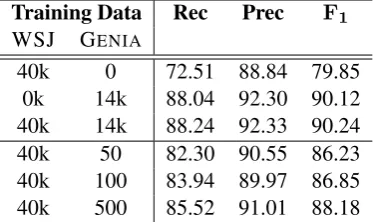
Table 5: Performance of RSP on GENIADEV.
For the experiments summarized in table 4 and table 5 involving 40k sentences from WSJTRAIN,
we started with RSP trained on WSJTRAIN, and fine-tuned it on minibatches containing an equal number of target domain and WSJTRAIN
sen-tences.
Surprisingly, with only 50 annotated questions (see Table 4), performance on QBANKDEVjumps 5 points, from 89.9% to 94.9%. This is only
1.5% below training with all of WSJTRAIN and QBANKTRAIN. The resulting system improves
slightly on WSJTESTgetting 94.38%.
On the more difficult GENIAcorpus of biomed-ical abstracts (Tateisi et al., 2005), we see a simi-lar, if somewhat less dramatic, trend. See Table 5. With 50 annotated sentences, performance on GE
-NIADEV jumps from 79.5% to 86.2%, outper-forming all but one parser from David McClosky’s thesis (McClosky, 2010) – the one that trains on all 14k sentences from GENIATRAIN and self-trains using 270k sentences from PubMed. That parser achieves 87.6%, which we outperform with just 500 sentences from GENIATRAIN.
These results suggest that it is currently feasi-ble to extend a parser to a syntactically distant do-main (for which no gold parses exist) with a cou-ple hours of effort. We explore this possibility in the next section.
4 Rapid Parser Extension
To create a parser for their geometry question an-swering system, (Seo et al., 2015) did the follow-ing:
• Designed regular expressions to identify mathematical expressions.
• Replaced the identified expressions with dummy words.
[image:5.595.88.275.482.593.2]FRAG
. . NP 24 and QS = 10 SYM
= NP PR , , NP PQRS PP
In the rhombus
(a) Training only on WSJTRAIN.
FRAG
.
. NP
PR = 24 and QS = 10 ,
, PP
In the rhombus PQRS
[image:6.595.71.296.63.219.2](b) Retraining on partial annotations.
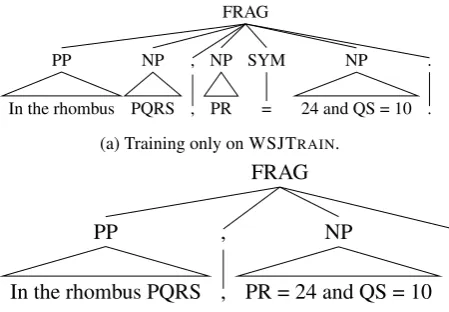
Figure 3: The top-level split for the development sentence “In the rhombus PQRS, PR = 24 and QS = 10.” before and after retraining RSP on 63 par-tially annotated geometry statements.
• Substituted the regex-analyzed expressions for the dummy words in the parses.
It is clear why this was necessary. Figure 3 (top) shows how RSP (trained only on WSJTRAIN) parses the sentence “In the rhombus PQRS, PR = 24 and QS = 10.” The result is completely wrong, and useless to a downstream application.
Still, beyond just the inconvenience of build-ing additional infrastructure, there are downsides to the “regex-and-replace” strategy:
1. It assumes that each expression always maps to the same constituent label. Con-sider “2x = 3y”. This is a verb phrase in the sentence “In the above figure, x is prime and2x = 3y.” However, it is a noun phrase in the sentence “The equation2x = 3yhas 2 solutions.” If we replace both instances with the same dummy word, the parser will almost certainly become confused in one of the two instances.
2. It assumes that each expression is always a constituent. Suppose that we replace the expression “AB <30” with a dummy word. This means we cannot properly parse a sen-tence like “When angleAB < 30, the lines are parallel,” because the constituent “angle
AB” no longer exists in the resulting sen-tence.
3. It does not handle other syntactic varia-tion. As we will see in the next section, the
geometry domain has a propensity for using right-attaching participial adjective phrases, like “labeled x” in the phrase “the segment labeled x.” Encouraging a parser to recognize this syntactic construct is out-of-scope for the “regex-and-replace” strategy.
Instead, we propose directly extending the parser by providing a few domain-specific examples like those in Figure 1. Because RSP’s model directly predicts span constituency, we can simply mark up a sentence with the “tricky” domain-specific constituents that the model will not already have learned from WSJTRAIN. For instance, we mark up NOUN-LABELconstructs like “chord BD”, and equations like “AD = 4”.
From these marked-up sentences, we can ex-tract training instances declaring the constituency of certain spans (like “to chord BD” in the third example) and the implied non-constituency of cer-tain spans (like “perpendicular to chord” in the third example). We also allow annotators to ex-plicitly declare the non-constituency of a span via an alternative markup (not shown).
We do not require annotators to provide span labels (although they can if desired). If a training instance merely declares a span to be a constituent (but does not provide a particular label), then the loss function only records loss when that span is classified as a non-constituent (i.e. any label is ok).
5 Experiments
5.1 Geometry Questions
We took the publicly available training data from (Seo et al., 2015), split the data into sentences, and then annotated each sentence as in Figure 1. Next, we randomly split these sentences into GEO -TRAIN and GEODEV7. After removing duplicate
sentences spanning both sets, we ended up with 63 annotated sentences in GEOTRAIN and 62 in GEODEV. In GEOTRAIN, we made an average of
2.8 constituent declarations and 0.3 (explicit) non-constituent declarations per sentence.
After preparing the data, we started with RSP trained on WSJTRAIN, and fine-tuned it on mini-batches containing 50 randomly selected WSJ
-TRAINsentences, plus all of GEOTRAIN. The re-sults are in table 6. After fine-tuning, the model
7G
Training Data GEODEV WSJTEST
correct constituents % error-free % F1
WSJTRAIN 71.9 45.2 94.28
WSJTRAIN+ GEOTRAIN 87.0 72.6 94.30
Table 6: RSP performance on GEODEV.
Training Data BIOCHEMDEV WSJTEST
correct constituents % error-free % F1
WSJTRAIN 70.1 27.0 94.28
WSJTRAIN+ BIOCHEMTRAIN 79.5 46.7 94.23
Table 7: RSP performance on BIOCHEMDEV.
• Given [ a circle with [ the tangent shown ] ] .
• Find the hypotenuse of [ the triangle labeled t ] .
[image:7.595.126.479.62.124.2]• Examine [ the following diagram with [ the square highlighted ] ] .
Figure 4: Three partial annotations targeting right-attaching participial adjectives.
gets 87% of the 185 annotations on GEODEV cor-rect, compared with 71.9% before fine-tuning8. Moreover, the fraction of sentences with no er-rors increases from 45.2% to 72.6%. With only a few dozen partially-annotated training exam-ples, not only do we see a large increase in do-main performance, but there is also no degradation in the parser’s performance on newswire. Some GEODEVparses have enormous qualitative differ-ences, like the example shown in Figure 3.
For the GEODEV sentences on which we get errors after retraining, the errors fall predomi-nantly into three categories. First, approximately 44% have some mishandled math syntax, like failing to recognize “dimensions 16 by 8” as a constituent, or providing a flat structuring of the equation “BAC = 1/4 * ACB” (instead of recog-nizing “1/4 * ACB” as a subconstituent). Sec-ond, approximately 19% have PP-attachment er-rors. Third, another 19% fail to correctly analyze right-attaching participial adjectives like “labeled x” in the noun phrase “the segment labeled x” or
8This improvement has a p-value of10−4under the
one-sided, two-sample difference between proportions test.
“indicated” in the noun phrase “the center indi-cated.” This phenomenon is unusually frequent in geometry but was insufficiently marked-up in our training examples. For instance, while we have a training instance “Find [ the measure of [ the angle designated by x ] ],” it does not explicitly highlight the constituency of “designated by x”. This suggests that in practice, this domain adap-tation method could benefit from an iterative cy-cle in which a user assesses the parser’s errors on their target domain, creates some partial annota-tions that address these issues, retrains the parser, and then repeats the process until satisfied. As a proof-of-concept, we invented 3 additional sen-tences with right-attaching participial adjectives (shown in Figure 4), added them to GEOTRAIN, and then retrained. Indeed, the handling of par-ticipial adjectives in GEODEV improved, increas-ing the overall percentage of correctly identified constituents to 88.6% and the percentage of error-free sentences to 75.8%.
5.2 Biomedicine and Chemistry
We ran a similar experiment using biomedical and chemistry text, taken from the unannotated data provided by (Nivre et al., 2007). We par-tially annotated 134 sentences and randomly split them into BIOCHEMTRAIN (72 sentences) and BIOCHEMDEV (62 sentences)9. In BIOCHEM -TRAIN, we made an average of 4.2 constituent
declarations per sentence. We made no non-constituent declarations.
Again, we started with RSP trained on WSJ
-TRAIN, and fine-tuned it on minibatches contain-ing annotations from 50 randomly selected WSJ
-9B
TRAIN sentences, plus all of BIOCHEMTRAIN. Table 7 shows the improvement in the percent-age of correctly-identified annotated constituents and the percentage of test sentences for which the parse agrees with every annotation. As with the geometry domain, we get significant improve-ments using only dozens of partially annotated training sentences.
6 Related Work
The two major themes of this paper, domain adap-tation and learning from partial annoadap-tation, each have a long tradition in natural language process-ing.
6.1 Domain Adaptation
Domain adaptation has been recognized as a ma-jor NLP problem for over a decade (Ben-David et al., 2006; Blitzer et al., 2006; Daum´e, 2007; Finkel and Manning, 2009). In particular, domain adaptation for parsers (Plank, 2011; Ma and Xia, 2013) has received considerable attention. Much of this work (McClosky et al., 2006b; Reichart and Rappoport, 2007; Sagae and Tsujii, 2007; Kawa-hara and Uchimoto, 2008; McClosky et al., 2010; Sagae, 2010; Baucom et al., 2013; Yu et al., 2015) has focused on how to best use co-training (Blum and Mitchell, 1998) or self-training to augment a small domain corpus, or how to best combine models to perform well on a particular domain.
In this work, we focus on the direct impact that just a few dozen partially annotated out-of-domain examples can have, when using a particular neural model with contextualized word representations. Co-training, self-training, and model combination are orthogonal to our approach. Our work is a spir-itual successor to (Garrette and Baldridge, 2013), which shows how to train a part-of-speech tagger with a minimal amount of annotation effort.
6.2 Learning from Partial Annotation
Most literature on training parsers from partial an-notations (Sassano and Kurohashi, 2010; Spreyer et al., 2010; Flannery et al., 2011; Flannery and Mori, 2015; Mielens et al., 2015) focuses on de-pendency parsing. (Li et al., 2016) provides a good overview. Here we highlight three important high-level strategies.
The first is “complete-then-train” (Mirroshan-del and Nasr, 2011; Majidi and Crane, 2013), which “completes” every partially annotated
de-pendency parse by finding the most likely parse (according to an already trained parser model) that respects the constraints of the partial annotations. These “completed” parses are then used to train a new parser.
The second strategy (Nivre et al., 2014; Li et al., 2016) is similar to “complete-then-train,” but inte-grates parse completion into the training process. At each iteration, new “complete” parses are cre-ated using the parser model from the most recent training iteration.
The third strategy (Li et al., 2014, 2016) trans-forms each partial annotation into a forest of parses that encodes all fully-specified parses per-mitted by the partial annotation. Then, the training objective is modified to support optimization over these forests.
Our work differs from these in two respects. First, since we are training a constituency parser, our partial annotations are constituent bracketings rather than dependency arcs. Second, and more importantly, we can use the partial annotations for training without modifying either the training al-gorithm or the training data.
While the bulk of the literature on training from partial annotations focuses on dependency pars-ing, the earliest papers (Pereira and Schabes, 1992; Hwa, 1999) focus on constituency parsing. These leverage an adapted version of the inside-outside algorithm for estimating the parameters of a prob-abilistic context-free grammar (PCFG). Our work is not tied to PCFG parsing, nor does it require a specialized training algorithm when going from full annotations to partial annotations.
7 Conclusion
Recent developments in neural natural language processing have made it very easy to build cus-tom parsers. Not only do contextualized word rep-resentations help parsers learn the syntax of new domains with very few examples, but they also work extremely well with parsing models that cor-respond directly with a granular and intuitive an-notation task (like identifying whether a span is a constituent). This allows you to train with either full or partial annotations without any change to the training process.
(and a layman’s understanding of syntactic build-ing blocks), they can get significant performance improvements. We envision an iterative use case in which a user assesses a parser’s errors on their target domain, creates some partial annotations to teach the parser how to fix these errors, then re-trains the parser, repeating the process until they are satisfied.
References
Eric Baucom, Levi King, and Sandra K¨ubler. 2013. Domain adaptation for parsing. InRANLP.
Shai Ben-David, John Blitzer, Koby Crammer, and Fer-nando Pereira. 2006. Analysis of representations for domain adaptation. InNIPS.
John Blitzer, Ryan T. McDonald, and Fernando Pereira. 2006. Domain adaptation with structural correspon-dence learning. InEMNLP.
Avrim Blum and Tom Mitchell. 1998. Combining la-beled and unlala-beled data with co-training. In Pro-ceedings of the eleventh annual conference on Com-putational learning theory. ACM, pages 92–100.
Eugene Charniak. 2000. A maximum-entropy-inspired parser. InANLP.
Eugene Charniak and Mark Johnson. 2005. Coarse-to-fine n-best parsing and maxent discriminative reranking. InProceedings of the 43rd Annual Meet-ing on Association for Computational LMeet-inguistics. Association for Computational Linguistics, pages 173–180.
James Cross and Liang Huang. 2016. Span-based con-stituency parsing with a structure-label system and provably optimal dynamic oracles. InEMNLP.
Hal Daum´e. 2007. Frustratingly easy domain adapta-tion. CoRRabs/0907.1815.
Chris Dyer, Adhiguna Kuncoro, Miguel Ballesteros, and Noah A. Smith. 2016. Recurrent neu-ral network grammars. CoRR abs/1602.07776. http://arxiv.org/abs/1602.07776.
Jenny Rose Finkel and Christopher D. Manning. 2009. Hierarchical bayesian domain adaptation. In HLT-NAACL.
Daniel Flannery, Yusuke Miyao, Graham Neubig, and Shinsuke Mori. 2011. Training dependency parsers from partially annotated corpora. InIJCNLP.
Daniel Flannery and Shinsuke Mori. 2015. Combin-ing active learnCombin-ing and partial annotation for do-main adaptation of a japanese dependency parser. In
IWPT.
Dan Garrette and Jason Baldridge. 2013. Learning a part-of-speech tagger from two hours of annotation. InProceedings of the 2013 Conference of the North American Chapter of the Association for Computa-tional Linguistics: Human Language Technologies. pages 138–147.
Rebecca Hwa. 1999. Supervised grammar induction using training data with limited constituent informa-tion. CoRRcs.CL/9905001.
John Judge, Aoife Cahill, and Josef Van Genabith. 2006. Questionbank: Creating a corpus of parse-annotated questions. InProceedings of the 21st In-ternational Conference on Computational Linguis-tics and the 44th annual meeting of the Associa-tion for ComputaAssocia-tional Linguistics. Association for Computational Linguistics, pages 497–504.
Daisuke Kawahara and Kiyotaka Uchimoto. 2008. Learning reliability of parses for domain adaptation of dependency parsing. InIJCNLP.
Jonathan K. Kummerfeld, David Leo Wright Hall, James R. Curran, and Dan Klein. 2012. Parser showdown at the wall street corral: An empirical investigation of error types in parser output. In
EMNLP-CoNLL.
Zhenghua Li, Min Zhang, and Wenliang Chen. 2014. Soft cross-lingual syntax projection for dependency parsing. InCOLING.
Zhenghua Li, Yue Zhang, Jiayuan Chao, and Min Zhang. 2016. Training dependency parsers with par-tial annotation.CoRRabs/1609.09247.
Xuezhe Ma and Fei Xia. 2013. Dependency parser adaptation with subtrees from auto-parsed target do-main data. InACL.
Saeed Majidi and Gregory R. Crane. 2013. Committee-based active learning for dependency parsing. InTPDL.
Mitchell P Marcus, Mary Ann Marcinkiewicz, and Beatrice Santorini. 1993. Building a large annotated corpus of english: The penn treebank. Computa-tional linguistics19(2):313–330.
Bryan McCann, James Bradbury, Caiming Xiong, and Richard Socher. 2017. Learned in translation: Con-textualized word vectors. InNIPS.
David McClosky. 2010. Any domain parsing: auto-matic domain adaptation for natural language pars-ing .
David McClosky, Eugene Charniak, and Mark John-son. 2006a. Effective self-training for parsing. In
HLT-NAACL.
David McClosky, Eugene Charniak, and Mark John-son. 2010. Automatic domain adaptation for pars-ing. InHLT-NAACL.
Jason Mielens, Liang Sun, and Jason Baldridge. 2015. Parse imputation for dependency annotations. In
ACL.
Seyed Abolghasem Mirroshandel and Alexis Nasr. 2011. Active learning for dependency parsing using partially annotated sentences. InIWPT.
Joakim Nivre, Yoav Goldberg, and Ryan T. McDon-ald. 2014. Constrained arc-eager dependency pars-ing. Computational Linguistics40:249–527.
Joakim Nivre, Johan Hall, Sandra K¨ubler, Ryan Mc-Donald, Jens Nilsson, Sebastian Riedel, and Deniz Yuret. 2007. The conll 2007 shared task on depen-dency parsing. In Proceedings of the 2007 Joint Conference on Empirical Methods in Natural guage Processing and Computational Natural Lan-guage Learning (EMNLP-CoNLL).
Fernando Pereira and Yves Schabes. 1992. Inside-outside reestimation from partially bracketed cor-pora. InACL.
M. E. Peters, M. Neumann, M. Iyyer, M. Gardner, C. Clark, K. Lee, and L. Zettlemoyer. 2018. Deep contextualized word representations. ArXiv e-prints
.
Matthew E. Peters, Waleed Ammar, Chandra Bhaga-vatula, and Russell Power. 2017. Semi-supervised sequence tagging with bidirectional language mod-els. InACL.
Barbara Plank. 2011. Domain adaptation for parsing. Citeseer.
Roi Reichart and Ari Rappoport. 2007. Self-training for enhancement and domain adaptation of statistical parsers trained on small datasets. InACL.
Kenji Sagae. 2010. Self-training without reranking for parser domain adaptation and its impact on semantic role labeling.
Kenji Sagae and Jun’ichi Tsujii. 2007. Dependency parsing and domain adaptation with lr models and parser ensembles. InEMNLP-CoNLL.
Manabu Sassano and Sadao Kurohashi. 2010. Using smaller constituents rather than sentences in active learning for japanese dependency parsing. InACL.
Min Joon Seo, Hannaneh Hajishirzi, Ali Farhadi, Oren Etzioni, and Clint Malcolm. 2015. Solving geome-try problems: Combining text and diagram interpre-tation. InEMNLP.
Kathrin Spreyer, Lilja Ovrelid, and Jonas Kuhn. 2010. Training parsers on partial trees: A cross-language comparison. InLREC.
Mitchell Stern, Jacob Andreas, and Dan Klein. 2017a. A minimal span-based neural con-stituency parser. CoRR abs/1705.03919. http://arxiv.org/abs/1705.03919.
Mitchell Stern, Daniel Fried, and Dan Klein. 2017b. Effective inference for generative neu-ral parsing. In Proceedings of the 2017 Conference on Empirical Methods in Natural
Language Processing, EMNLP 2017,
Copen-hagen, Denmark, September 9-11, 2017. pages 1695–1700. https://aclanthology.info/papers/D17-1178/d17-1178.
Yuka Tateisi, Akane Yakushiji, Tomoko Ohta, and Jun’ichi Tsujii. 2005. Syntax annotation for the ge-nia corpus. InCompanion Volume to the Proceed-ings of Conference including Posters/Demos and tu-torial abstracts.
Kristina Toutanova, Dan Klein, Christopher D. Man-ning, and Yoram Singer. 2003. Feature-rich part-of-speech tagging with a cyclic dependency net-work. In Human Language Technology Confer-ence of the North American Chapter of the Asso-ciation for Computational Linguistics, HLT-NAACL 2003, Edmonton, Canada, May 27 - June 1, 2003. http://aclweb.org/anthology/N/N03/N03-1033.pdf.
Wenhui Wang and Baobao Chang. 2016. Graph-based dependency parsing with bidirectional lstm. In Pro-ceedings of the 54th Annual Meeting of the Associa-tion for ComputaAssocia-tional Linguistics (Volume 1: Long Papers). volume 1, pages 2306–2315.