6053
Large-Scale Transfer Learning for Natural Language Generation
Sergey Golovanov*1, Rauf Kurbanov*1, Sergey Nikolenko*12, Kyryl Truskovskyi*1, Alexander Tselousov*, and Thomas Wolf*3
1Neuromation OU, Liivalaia tn 45, 10145 Tallinn, Estonia
2Steklov Mathematical Institute at St. Petersburg,
nab. r. Fontanki 27, St. Petersburg 191023, Russia
3Huggingface Inc., 81 Prospect St. Brooklyn, New York 11201, USA
[email protected],[email protected],
[email protected],[email protected],
[email protected],[email protected]
*All authors contributed equally, names in alphabetical order.
Abstract
Large-scale pretrained language models define state of the art in natural language process-ing, achieving outstanding performance on a variety of tasks. We study how these archi-tectures can be applied and adapted for natu-ral language generation, comparing a number of architectural and training schemes. We fo-cus in particular on open-domain dialog as a typical high entropy generation task, present-ing and comparpresent-ing different architectures for adapting pretrained models with state of the art results.
1 Introduction
Over the past few years, the field of natural lan-guage processing (NLP) has witnessed the emer-gence of transfer learning methods which have significantly improved the state of the art (Dai and Le, 2015; Peters et al., 2018; Howard and Ruder, 2018;Radford et al., 2018; Devlin et al.,
2018). These methods depart from classical super-vised machine learning where a predictive model for a given task is trained in isolation on a sin-gle dataset. Here, a model is pretrained on large text corpora and then fine-tuned on the target task. Such models are usually evaluated on natural lan-guage understanding (NLU) tasks such as text classification or question answering (Wang et al.;
Rajpurkar et al.,2016), but natural language gen-eration (NLG) tasks such as summarization, dia-log, or machine translation remain relatively un-derexplored. At first glance, large-scale pretrained models appear to be a natural fit for NLG since their pretraining objectives are often derived from language modeling. However, interesting ques-tions and problems still arise.
We consider a text-only NLG task where the generation of an output sequence of symbols y= (y1,. . .,ym) is conditioned on a contextX=
(x1,. . .,xK)composed of one or several sequences of symbolsxk= (xk
1,. . .,xkn). Severaltypesof
con-texts may warrant different treatment in the model. E.g., in case of dialog generation they may in-clude: (i) facts from a knowledge base, (ii) dia-log history, and (iii)the sequence of already gen-erated output tokens (y1,. . .,ym−1). Thus, there
arises a general question of how to adapt a single-input pretrained model to a multi-input down-stream generation task.
In this work, we study two general schemes to adapt a pretrained language model to an NLG task. In the single-input setting, contexts are concate-nated to create a sequence prefix from which the output is decoded as a continuation by the pre-trained language model following Radford et al.
(2018, 2019). The model can be used as is or with a small number of special token embeddings added to the vocabulary to identify the contexts. In themulti-inputsetting, the pretrained model is duplicated to form an encoder-decoder structure where the encoder processes contexts while the decoder generates the output.
2 Related work
Persona for Speaker 1 (P1)
I like to ski
My wife does not like me anymore I have went to Mexico 4 times this year I hate Mexican food
I like to eat cheetos P1: Hi
P2: Hello! How are you today? P1: I am good thank you, how are you.
P2: Great, thanks! My children and I were just about to watch Game of Thrones.
P1: Nice! How old are your children?
P2: I have four that range in age from 10 to 21. You? P1: I do not have children at the moment.
P2: That just means you get to keep all the popcorn for yourself. P1: And Cheetos at the moment!
P2: Good choice. Do you watch Game of Thrones? P1: No, I do not have much time for TV.
[image:2.595.75.289.59.217.2]P2: I usually spend my time painting: but, I love the show.
Table 1: Sample dialogue fromPersonaChatwith per-sona facts for Speaker 1 (P1). Speaker 2 (P2) also has a random persona (not shown).
increased computing capacities, it has now be-come feasible to pretrain deep neural language models. Dai and Le(2015);Ramachandran et al.
(2016) proposed unsupervised pretraining of a lan-guage model for transfer learning and to initial-ize encoder and decoder in a seq2seq model for machine translation tasks. Works in zero-shot machine translation used large corpora of mono-lingual data to improve performances for low-resource languages (Johnson et al., 2017; Wada and Iwata, 2018; Lample and Conneau, 2019). Most of the work transfering large-scale language models from and for monolingual NLG tasks fo-cus on classification and natural language under-standing (Kiros et al., 2015; Jozefowicz et al.,
2016). Recently, Radford et al. (2019) studied large-scale language models for various genera-tion tasks in the zero-shot setting focusing on sum-marization and translation and Wolf et al.(2019) presented early work on chit-chat.
3 Problem setting and dataset
NLG tasks can be divided into high entropy (story generation, chit-chat dialog) and low en-tropy (summarization, machine translation) tasks. We focus on the high entropy task of chit-chat di-alog to study the use and effect of various types of contexts: facts, history and previous tokens.
Table 1 shows a typical dialog from Per-sonaChat(Zhang et al.,2018b), one of the largest multi-turn open-domain dialog dataset available.
PersonaChat consists of crowdsourced conversa-tions between real human beings who were asked to chit-chat. Each participant was given a set of 4-5 profile sentences that define his/her persona
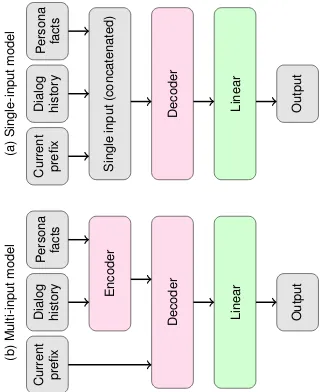
(a) Single-input model Current prefix Dialog histor y P ersona facts Single input (concatenated)
Decoder Linear Output
(b) Multi-input model Current prefix Dialog histor y P ersona facts Encoder
[image:2.595.337.497.62.258.2]Decoder Linear Output
Figure 1: General model architectures: (a) single-input model; (b) multi-input model.
Token embeddings Positional embeddings Context type embeddings (a) Single-input model
I
am an
ar
tist Hi
Hello ! Ho
w
are you toda
y
?
+
+
(b) Multi-input model
<
i
> I
am an artist
< / i > < p1 > Hi < / p1 > < p2 > Hello ! Ho w
are you toda
y ? < / p2 > + +
Figure 2: Token embeddings: (a) single-input model with CTE; (b) multi-input model with start/end tokens.
[image:2.595.307.524.300.458.2]×N Input Embedding Multi-Head Attention La y er Nor malization F eedf orw ard La y er La y er Nor malization Output + +
Figure 3: OpenAI GPT
×N
Dialog histor
y
embed.
Current state embed.
P
ersona inf
o
embed.
Multi- head att. Multi- head att. Multi- head att.
A vg La y er Nor malization + F eedf orw ard la y er + La y er Nor
malization . . .
. . . . . .
[image:2.595.314.516.496.718.2]for the conversation and asked to chitchat natu-rally and try to get to know each other. The dataset contains 162,064 utterances over 10,907 dialogs with 1,155 possible personas and 7 speaker turns per dialogue on average. Although it is one of the largest multi-turn dialogue datasets, PersonaChat
is still too small to train a large-scale model; state of the art models trained directly onPersonaChat
are very prone to overfitting (Dinan et al.,2019), hence the motivation for the present work.
4 Single- and multi-input adaptation
While we expect many more large-scale pretrained language models to become publicly available soon (Radford et al., 2019), our work is based on the only large-scale pretrained language model that was available at the time of this study, the OpenAI GPT (Radford et al.,2018). We refer to this publication for the details of the model, which is a 12-layer decoder-only Transformer (Vaswani et al., 2017) with masked multi-head attention. The model uses a bytepair encoding (BPE) vocab-ulary (Sennrich et al.,2015) with 40,000 merges and learned positional embeddings for sequences with at most 512 positions.
We now detail the various adaptation schemes we used to adapt this model to the task of open-domain dialogue. More specifically, in our target task the inputs to the model are: (i) a set of person-ality sentences, (ii) a dialog history involving two speakers, and (iii) the history of previously gener-ated tokens for auto-regressive generation.
In the first adaptation setting, which we call the single-input model, the pretrained language model is used as is to generate an output sequence y= (y1,. . .,ym) without any architectural
modifi-cations. Contexts are concatenated to create a se-quence prefix from which the output is then de-coded as a continuation. In this direction, sev-eral ways to construct prefixes from heterogeneous contexts can be investigated: (i) concatenating contexts with natural separators to make the test data distribution close to the training data ( Rad-ford et al., 2019) (in our case we added double quotes to each utterance to mimic dialog punc-tuation); (ii) concatenating contexts with addi-tional spatial-separator tokens (fine-tuned on the target task) to build an input sequence (Radford et al.,2018); (iii) concatenating contexts and sup-plementing the input sequence with a parallel se-quence of context-type embeddings (CTE) to be
added to the token and positional embeddings ( De-vlin et al., 2018). Each CTE shows the context type for its input token as shown on Fig.2a:winfoCTE for persona info,wCTEp1 for dialog history coming from person 1, andwCTEp2 for person 2. These vec-tors are also fine-tuned on the target task.
In the second adaptation scheme, the multi-input model, the pretrained language model is duplicated in an encoder-decoder architecture (Fig.1b). Similar to thesingle-inputmodel, natu-ral separators, spatial-separator tokens or context-type embeddings can be added for each persona fact and dialog utterance, surrounding the corre-sponding text with these tokens as preprocessing, as shown on Fig.2b. Persona information and dia-logue history are successively processed in the en-coder (Fig.4) to obtain two respective sequences of vector representations to be used as input to the decoder model. The multi-head attention lay-ers of the decoder are modified to process the three inputs as follows (see Fig.4). We copy the multi-headed attention layer of the decoder three times—for the embeddings of the current state, persona facts, and dialog history—averaging the results (Zhang et al.,2018a). The weights in both encoder and decoder are initialized from the pre-trained model.
Using both encoder and decoder allows to sepa-rate the contexts (dialogue history and persona in-formation) and alleviate the maximal length con-straint of 512 tokens. Weight sharing between encoder and decoder reduces the total number of model parameters and allows for multi-task learn-ing. On the other hand, untying the decoder and encoder lets the attention heads and architectures specialize for each task.
5 Results
We have performed a series of quantitative evalu-ation on the test subset of thePersonaChatdataset as well as a few quantitative evaluations.
set-Model METEOR NIST-4 BLEU Entropy-4 Distinct-2 Average Length Single-input (zero-shot) 0.07727 1.264 2.5362 9.454 0.1759 9.671 Single-input (additional embeddings) 0.07641 1.222 2.5615 9.234 0.1614 9.43
[image:4.595.99.498.62.106.2]Multi-input 0.07878 1.278 2.7745 9.211 0.1546 9.298
Table 2: Selected evaluation results and statistics.
1 1.5 2 2.5 3 3.5 4
8·10−2
0.1 0.12 0.14 0.16
Training epochs
W
ord
counts
SIM, persona MIM, persona SIM, history MIM, history
SIM, both MIM, both
1 2 3 4
2.4 2.5 2.6
Training epochs
BLEU
SIM, BLEU MIM, BLEU
0.071 0.073 0.075 0.077 0.079
METEOR
SIM, METEOR MIM, METEOR
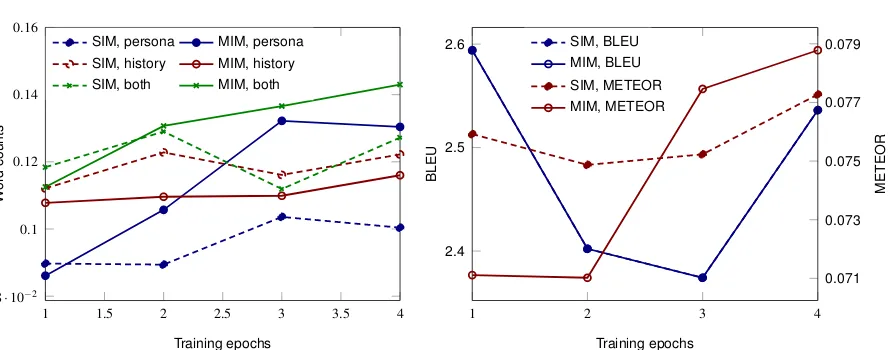
Figure 5: Results for single- (SIM) and multi-input (MIM) models; left: word statistics; right: evaluation metrics.
ting (no modification) and with additional em-beddings fine-tuned on the target task, and the
multi-input model in which the encoder and de-coder are not shared, which is thus a high-capacity model in comparison to the previous two models. We can see that both approaches reach compara-ble performances on the automatic metrics with the multi-input model performing better on ME-TEOR, NIST-4 and BLEU.
We investigated in greater detail the evolution of thesingle-inputandmulti-inputmodels during training to understand the origin of their differ-ences. To this aim, we tagged the words gener-ated by each model according to four categories: (i) content words that were mentioned in the per-sona facts, (ii) content words that were mentioned in the dialog history, (iii) content words that were mentioned in both, and (iv) all other generated words. Fig.5shows the statistics of these types of words along a representative training run obtained usingcompare-mt(Neubig et al.,2019).
An interesting observation is that single-input
andmulti-inputmodels adopt differing behaviors which can be related to an intrinsic difference be-tween two contextual inputs: dialog history and personality facts. While dialog history is very re-lated to sequentiality, personality facts are not se-quential in essence: they are not ordered, a well-trained model should be invariant to the ordering of the facts. Moreover, a personality fact can be relevant anywhere in a dialog. On the contrary,
di-alog history is sequential; it cannot be reordered freely without changing the meaning of the dialog and the relevance of a particular utterance of the dialog history is strongly dependent on its location in the dialog: older history becomes less relevant. This difference in nature can be related to dif-ferences in the models. Single-inputadaptation is closer to a bare language-model and the compari-son withmulti-inputmodel shows that the former tends to stay closer to the dialog history and con-sistently uses more words from the history than
multi-input model. On the other hand, splitting encoder and decoder makes persona facts avail-able to themulti-inputmodel in a non-sequential manner and we can see that themulti-inputmodel use more and more persona facts as the training evolves, out-performing the single-input model when it comes to reusing words from persona facts. We also note that the multi-input model, with its unshared encoder and decoder, may be able to specialize his sub-modules.
6 Conclusion
[image:4.595.81.526.130.305.2]archi-tectures we presented have different inductive bias with regards to the type of input context. Further work on these inductive biases could help under-stand how a pretrained transfer learning model can be adapted in the most optimal fashion to a given target task.
References
Andrew M. Dai and Quoc V. Le. 2015. Semi-supervised Sequence Learning. arXiv:1511.01432 [cs]. ArXiv: 1511.01432.
Jacob Devlin, Ming-Wei Chang, Kenton Lee, and Kristina Toutanova. 2018. Bert: Pre-training of deep bidirectional transformers for language understand-ing. arXiv preprint arXiv:1810.04805.
Emily Dinan, Varvara Logacheva, Valentin Malykh, Alexander Miller, Kurt Shuster, Jack Urbanek, Douwe Kiela, Arthur Szlam, Iulian Serban, Ryan Lowe, et al. 2019. The second conversational intelligence challenge (convai2). arXiv preprint arXiv:1902.00098.
Jeremy Howard and Sebastian Ruder. 2018. Fine-tuned language models for text classification.CoRR, abs/1801.06146.
Melvin Johnson, Mike Schuster, Quoc V. Le, Maxim Krikun, Yonghui Wu, Zhifeng Chen, Nikhil Thorat, Fernanda Vigas, Martin Wattenberg, and Greg Cor-rado. 2017. Googles multilingual neural machine translation system: Enabling zero-shot translation. Transactions of the Association for Computational Linguistics, 5:339–351.
Rafal Jozefowicz, Oriol Vinyals, Mike Schuster, Noam Shazeer, and Yonghui Wu. 2016. Exploring the Limits of Language Modeling. arXiv:1602.02410 [cs]. ArXiv: 1602.02410.
Ryan Kiros, Yukun Zhu, Ruslan Salakhutdinov, Richard S. Zemel, Antonio Torralba, Raquel Urta-sun, and Sanja Fidler. 2015. Skip-Thought Vectors. arXiv:1506.06726 [cs]. ArXiv: 1506.06726.
Guillaume Lample and Alexis Conneau. 2019.
Cross-lingual Language Model Pretraining. arXiv:1901.07291 [cs]. ArXiv: 1901.07291.
Alon Lavie and Abhaya Agarwal. 2007. Meteor: An automatic metric for mt evaluation with high levels of correlation with human judgments. In Proceed-ings of the Second Workshop on Statistical Machine Translation, StatMT ’07, pages 228–231, Strouds-burg, PA, USA. Association for Computational Lin-guistics.
Xiang Gao Bill Dolan Michel Galley, Chris Brockett and Jianfeng Gao. End-to-end conversation model-ing: Dstc7 task 2 description. In DSTC7 workshop (forthcoming).
Tomas Mikolov, Ilya Sutskever, Kai Chen, Greg S Cor-rado, and Jeff Dean. 2013. Distributed representa-tions of words and phrases and their compositional-ity. pages 3111–3119.
Graham Neubig, Zi-Yi Dou, Junjie Hu, Paul Michel, Danish Pruthi, and Xinyi Wang. 2019. compare-mt: A tool for holistic comparison of language gener-ation systems. In Meeting of the North American Chapter of the Association for Computational Lin-guistics (NAACL) Demo Track, Minneapolis, USA.
Kishore Papineni, Salim Roukos, Todd Ward, and Wei-Jing Zhu. 2002. Bleu: a method for automatic eval-uation of machine translation. InProceedings of the 40th Annual Meeting of the Association for Compu-tational Linguistics.
Jeffrey Pennington, Richard Socher, and Christopher Manning. 2014. Glove: Global vectors for word representation. InProceedings of the 2014 confer-ence on empirical methods in natural language pro-cessing (EMNLP), pages 1532–1543.
Matthew E. Peters, Mark Neumann, Mohit Iyyer, Matt Gardner, Christopher Clark, Kenton Lee, and Luke Zettlemoyer. 2018. Deep contextualized word rep-resentations.CoRR, abs/1802.05365.
Alec Radford, Karthik Narasimhan, Tim Salimans, and Ilya Sutskever. 2018. Improving language under-standing by generative pre-training. URL https://s3-us-west-2. amazonaws. com/openai-assets/research-covers/languageunsupervised/language under-standing paper. pdf.
Alec Radford, Jeffrey Wu, Rewon Child, David Luan, Dario Amodei, and Ilya Sutskever. 2019. Lan-guage Models are Unsupervised Multitask Learners. page 24.
Pranav Rajpurkar, Jian Zhang, Konstantin Lopy-rev, and Percy Liang. 2016. SQuAD: 100,000+ Questions for Machine Comprehension of Text. arXiv:1606.05250 [cs]. ArXiv: 1606.05250.
Prajit Ramachandran, Peter J. Liu, and Quoc V. Le. 2016.Unsupervised Pretraining for Sequence to Se-quence Learning. arXiv:1611.02683 [cs]. ArXiv: 1611.02683.
Rico Sennrich, Barry Haddow, and Alexandra Birch. 2015.Neural machine translation of rare words with subword units. CoRR, abs/1508.07909.
Ashish Vaswani, Noam Shazeer, Niki Parmar, Jakob Uszkoreit, Llion Jones, Aidan N Gomez, Łukasz Kaiser, and Illia Polosukhin. 2017. Attention is all you need. InAdvances in Neural Information Pro-cessing Systems, pages 5998–6008.
Alex Wang, Amanpreet Singh, Julian Michael, Felix Hill, Omer Levy, and Samuel R Bowman. GLUE: A Multi-Task Benchmark and Analysis Platform for Natural Language Understanding. page 14.
Thomas Wolf, Victor Sanh, Julien Chaumond, and Clement Delangue. 2019. TransferTransfo: A Transfer Learning Approach for Neural Network Based Conversational Agents. arXiv:1901.08149 [cs]. ArXiv: 1901.08149.
Biao Zhang, Deyi Xiong, and Jinsong Su. 2018a. Ac-celerating neural transformer via an average atten-tion network.CoRR, abs/1805.00631.
Saizheng Zhang, Emily Dinan, Jack Urbanek, Arthur Szlam, Douwe Kiela, and Jason Weston. 2018b.