5344
PTB Graph Parsing with Tree Approximation
Yoshihide Kato and Shigeki Matsubara
Information & Communications, Nagoya University Furo-cho, Chikusa-ku, Nagoya, 464-8601 Japan
Abstract
The Penn Treebank (PTB) represents syntactic structures as graphs due to nonlocal dependen-cies. This paper proposes a method that ap-proximates PTB graph-structured representa-tions by trees. By our approximation method, we can reduce nonlocal dependency identifica-tion and constituency parsing into single tree-based parsing. An experimental result demon-strates that our approximation method with an off-the-shelf tree-based constituency parser significantly outperforms the previous meth-ods in nonlocal dependency identification.
1 Introduction
In the Penn Treebank (PTB) (Marcus et al.,1993), syntactic structures are represented as graphs due to nonlocal dependencies, which capture syntac-tic discontinuities. This paper proposes a method that approximates PTB graph-structured represen-tations by trees. By our approximation method, we can reduce nonlocal dependency identification and constituency parsing into single tree-based parsing. The information loss of our approxima-tion method is slight, and we can easily recover original PTB graphs from the output of a parser trained using the approximated ones. An experi-mental result demonstrates that our approximation method with an off-the-shelf tree-based parser sig-nificantly outperforms the previous nonlocal de-pendency identification methods.
2 Nonlocal Dependency Identification
This section explains nonlocal dependencies in the PTB, and summarizes previous work on nonlocal dependency identification.
2.1 Nonlocal dependency in PTB
In the PTB, a nonlocal dependency is represented as an edge. One node is called anempty element,
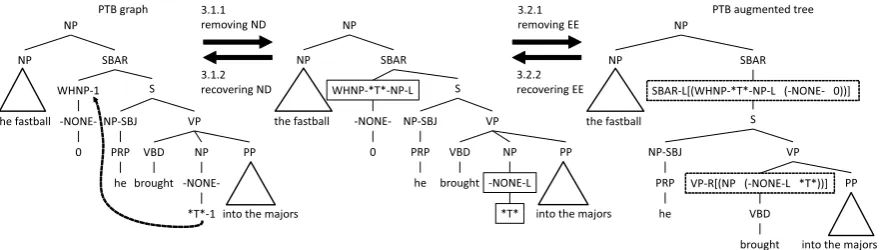
which is a covert element in the syntactic repre-sentation. The other is called afiller. PTB’s syn-tactic representations are graph-structured, while its constituency structures are represented by trees. Below, a syntactic representation in the PTB is called aPTB graph. The left graph in Figure1is an example of PTB graph. The empty elements are labelled with -NONE-. The terminal symbols such as0and∗T∗designate their types of the empty ele-ments.0and∗T∗represent a zero relative pronoun and a trace of wh-movement, respectively. If a ter-minal symbol of an empty element is indexed with a number, its corresponding filler exists in the PTB graph, and is indexed with the same number. For example, the empty element of type∗T∗is indexed with1and it has the corresponding fillerWHNP-1. For more details about PTB nonlocal dependen-cies, we refer readers to (Bies et al.,1995).
2.2 Previous Work
EW ƚŚĞĨĂƐƚďĂůů EW ^Z t,EWͲϭ ^ ͲEKEͲ Ϭ EWͲ^: WZW ŚĞ sW s ďƌŽƵŐŚƚ EW ͲEKEͲ ΎdΎͲϭ WW ŝŶƚŽƚŚĞŵĂũŽƌƐ ϯ͘ϭ͘ϭ ƌĞŵŽǀŝŶŐE ϯ͘ϭ͘Ϯ ƌĞĐŽǀĞƌŝŶŐE EW ƚŚĞĨĂƐƚďĂůů EW ^Z t,EWͲΎdΎͲEWͲ> ^ ͲEKEͲ Ϭ EWͲ^: WZW ŚĞ sW s ďƌŽƵŐŚƚ EW ͲEKEͲ> ΎdΎ WW ŝŶƚŽƚŚĞŵĂũŽƌƐ ϯ͘Ϯ͘ϭ ƌĞŵŽǀŝŶŐ ϯ͘Ϯ͘Ϯ ƌĞĐŽǀĞƌŝŶŐ EW ƚŚĞĨĂƐƚďĂůů EW ^Z ^ EWͲ^: WZW ŚĞ sW s ďƌŽƵŐŚƚ WW ŝŶƚŽƚŚĞŵĂũŽƌƐ ^ZͲ>;t,EWͲΎdΎͲEWͲ>;ͲEKEͲ ϬͿͿ sWͲZ;EW;ͲEKEͲ>ΎdΎͿͿ WdŐƌĂƉŚ WdĂƵŐŵĞŶƚĞĚƚƌĞĞ
Figure 1: PTB graph and PTB augmented tree.
the information about nonlocal dependencies.
3 Tree Approximation of PTB Graphs
This section proposes a new approach of nonlo-cal dependency identification. We reduce non-local dependency identification and constituency parsing into single tree-based parsing. In our ap-proach, a PTB graph is converted to a tree which approximately represents the PTB graph. The con-version consists of the following two steps:
Removing nonlocal dependency removes the edges between the empty elements and their fillers, and augments the labels of them. Augmented labels are used in order to recover the removed edges.
Removing empty element removes the empty el-ements and inserts new inner nodes that en-code the empty elements.
We call the trees obtained by this conversionPTB augmented trees. Figure1 shows an example of the conversion. Below, we explain each step in detail.
3.1 Removing nonlocal dependency
By removing the nonlocal dependency edges, a PTB graph becomes a tree. In order to approx-imately represent the edges in the resulting tree, we augment node labels in the annotation scheme identical to that proposed byKato and Matsubara (2016). In this scheme, the labels of empty el-ements and their fillers are augmented with spe-cial tags. We first describe the annotation scheme, and then how to recover removed edges using aug-mented labels.
3.1.1 Annotation approximately representing nonlocal dependency
Algorithm 1 is the annotation algorithm of Kato and Matsubara(2016). Here,posi(x, y)is the rel-ative position ofxforyand defined as follows:
posi(x, y) =
A (xis an ancestor ofy)
L (xoccurs to the left ofy)
R (xoccurs to the right ofy)
The tag OBJCTRL enables us to distinguish be-tween subject and object control.
Algorithm 1Removing nonlocal dependency
type(e)is the type of an empty elemente.
cat(x)is the category ofx.
par(x)is the parent ofx.
SBJ(x)means the label ofxhas the tagSBJ
Input: an empty elementeande’s co-indexed fillerf
remove the edge(e, f) assignposi(f, e)toe
iftype(e) =∗ ∧ ¬SBJ(f)then assignOBJCTRLtoe
end if
iftype(e)∈ {∗EXP∗,∗ICH∗,∗RNR∗,∗T∗}then assigntype(e),cat(par(e))andposi(f, e)tof
end if
For example, the left PTB graph in Figure1is converted to the middle tree. The boxes designate the augmented empty element and filler.
3.1.2 nonlocal dependency recovery
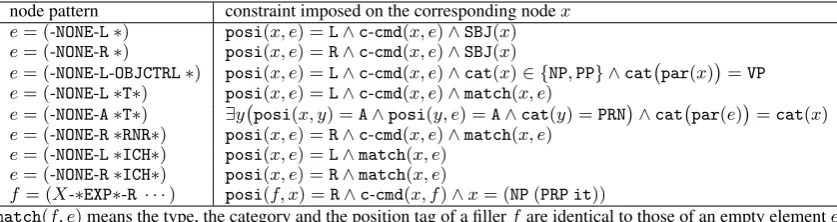
This section proposes a method of recovering non-local dependencies using the annotation described in the previous section. This method is based on heuristic rules, which are similar to, but simpler than those ofKato and Matsubara(2016).1
node pattern constraint imposed on the corresponding nodex e= (-NONE-L∗) posi(x, e) =L∧c-cmd(x, e)∧SBJ(x)
e= (-NONE-R∗) posi(x, e) =R∧c-cmd(x, e)∧SBJ(x)
e= (-NONE-L-OBJCTRL∗) posi(x, e) =L∧c-cmd(x, e)∧cat(x)∈ {NP,PP} ∧cat par(x)
=VP
e= (-NONE-L∗T∗) posi(x, e) =L∧c-cmd(x, e)∧match(x, e)
e= (-NONE-A∗T∗) ∃y posi(x, y) =A∧posi(y, e) =A∧cat(y) =PRN∧cat par(e)
=cat(x)
e= (-NONE-R∗RNR∗) posi(x, e) =R∧c-cmd(x, e)∧match(x, e)
e= (-NONE-L∗ICH∗) posi(x, e) =L∧match(x, e)
e= (-NONE-R∗ICH∗) posi(x, e) =R∧match(x, e)
f= (X-∗EXP∗-R · · ·) posi(f, x) =R∧c-cmd(x, f)∧x= (NP(PRP it))
[image:3.595.89.508.62.173.2]match(f, e)means the type, the category and the position tag of a fillerfare identical to those of an empty elemente.
Table 1: The rules for nonlocal dependency recovery
A rule consists of a node pattern and a con-straint. When there is a node that matches the pattern, we select the nearest node satisfying the constraint as its co-indexed node. Table1 summa-rizes the rules.2 Here,c-cmd(x, y)is the syntactic relation called c-command3 and holds iff the fol-lowing condition (1) is satisfied:
∃z. (zis a sibling ofx)∧posi(z, y) =A (1)
For example, the nonlocal dependency in Figure 1can be recovered by the fourth rule in Table1.
3.2 Removing empty elements
While the first step in the conversion can remove nonlocal dependency edges, the empty elements still remain. The second step removes empty ele-ments and encodes them as inner nodes. By this conversion, parsing algorithm require no special operations handling empty elements.
3.2.1 Encoding empty elements
Algorithm 2 removes and encodes empty ele-ments. For example, the middle tree in Figure1 is converted to the right one. The dotted boxes designate the inner nodes encoding the empty ele-ments. Here, note that[(NP(-NONE-L∗T∗))]is no more than a part of the label in the PTB augmented tree.
Kummerfeld and Klein(2017) represent empty elements in a similar way, but important differ-ence exists. Our method keeps empty element po-sitions (Land R) and no nonlocal dependencies, while they do not keep empty element positions and reserves nonlocal dependencies. Furthermore, while they require a specially-designed head rule
2In the third rule, ifcat(x) =PP,eis co-indexed with notxbutx’s childNP.
3 Kato and Matsubara (2016) follow Chomsky’s GB-theory (Chomsky,1981) to use this relation, because it holds between co-indexed nodes in most cases. We also use this relation.
Algorithm 2Encoding Empty element
null(x)means all the leaves ofxare empty elements.
node(l, C)creates a node with a labelland childrenC.
encode(x)converts the subtree rooted atxto a string.
label(x)is the label ofx.
Input: a nodex
hc1, . . . , cni ←children(x)
i←the leftmost position such that¬null(ci)
C← hcii
forjfromi+ 1tondo if¬null(cj)then
C←C· hcji else
C← hnode(cat(x) + ”R” +encode(cj), C)i end if
end for
forjfromi−1down to1do
C← hnode(cat(x) + ”L” +encode(cj), C)i end for
return node(label(x), C)
to avoid constructing cyclic graphs in parsing, our method does not need head rules in the first place.
3.2.2 Recovering empty elements
Algorithm 2 is lossless and Algorithm 3 can re-cover the empty elements from the inner nodes in-serted in Algorithm2.
4 Experiment
To evaluate the performance of our proposed method, we conducted an experiment using the PTB. We used the Kitaev and Klein (henceforth K&K) parser (Kitaev and Klein, 2018a)4. The K&K parser is a state-of-the-art tree-based parser, which can use ELMo (Peters et al., 2018) or BERT5(Devlin et al.,2018) as external data. PTB graphs in the training (sections 02–21) and de-velopment (section 22) data were converted into PTB augmented trees by our tree approximation
4
https://github.com/nikitakit/ self-attentive-parser
5The experiment using BERT is reported in (Kitaev and
Empty element Nonlocal dependency Nonlocal dependency detection identification identification
(Fillers are ignored.) (Unindexed empty elements are excluded.)
pre. rec. F1 pre. rec. F1 pre. rec. F1
(Johnson,2002) 85 74 79 73 63 68 – – –
(Dienes and Dubey,2003) – – – 81.5 68.7 74.6 – – –
(Campbell,2004) 85.2 81.7 83.4 78.3 75.1 76.7 – – –
(Schmid,2006) 86.0 82.3 84.1 – – – 81.7 73.5 77.4
(Cai et al.,2011) 90.1 79.5 84.5 – – – – – –
(Hayashi and Nagata,2016) 90.3 81.7 85.8 – – – – – –
(Kato and Matsubara,2016) 88.5 82.1 85.2 81.4 75.5 78.4 79.8 73.8 76.7
(Kummerfeld and Klein,2017) 89.5 81.6 85.4 74.3 67.3 70.6 – – –
post-processing (using gold PTB trees)
(Johnson,2002) 93 83 88 80 70 75 – – –
(Campbell,2004) 94.9 91.1 93.0 90.1 86.6 88.4 – – –
ours 92.6 87.7 90.1 88.1 83.4 85.7 88.4 81.1 84.6 ours (with ELMo) 94.2 90.3 92.3 89.9 86.2 88.0 90.4 84.1 87.2 ours (with BERT) 94.9 91.4 93.1 90.8 87.4 89.0 91.6 84.9 88.1
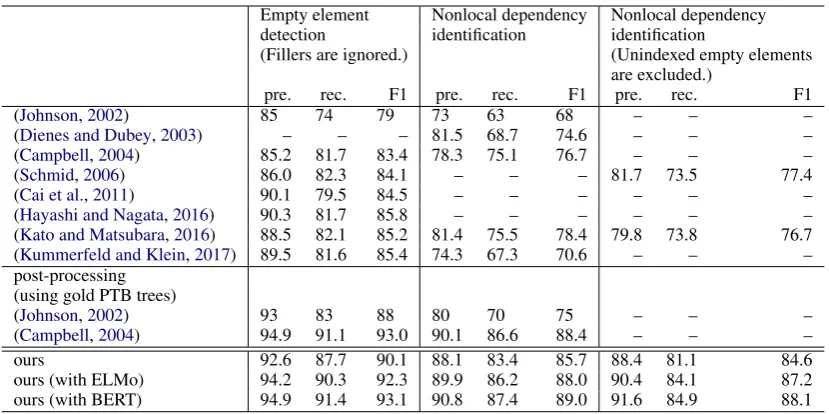
Table 2: Comparison for nonlocal dependency identification on the test data.
Algorithm 3Recovering empty element
decode(x)creates a tree by decoding a string assigned by
encodeand returns its root.
Input: a nodex C←children(x)
C0← hi whileC6=hido
pop the first elementcfromC
ifcis an inserted node andchas the tagLthen
C← hdecode(c)i ·children(c)·C
else ifcis an inserted node and has the tagRthen
C←children(c)· hdecode(c)i ·C
else
C0←C0· hci end if
end while
return node(label(x), C0)
method6, and a parsing model was trained using the PTB augmented trees. The hyperparameters for training were identical to those ofKitaev and Klein(2018a). We selected the model that maxi-mizes the F1 score on the development data, where we treated the node labels of PTB augmented trees as constituent labels. For the test data (section 23), PTB graphs were recovered from the PTB augmented trees generated by the parser. The ac-curacy of the nonlocal dependency identification was evaluated by the metric proposed byJohnson (2002).
First, we evaluated the performance of our ap-proximation method. We recovered PTB graphs from not the parser output but the gold PTB aug-mented trees in the development data. We
ob-6The conversion code is available at https://
github.com/yosihide/ptb2cf.
tained 99.5 F1 score in nonlocal dependency iden-tification where unindexed empty elements were excluded. This result means that the information loss is slight in our approximation method.
Table 2 summarizes the performances of our system and previous ones. These results demon-strate that our system significantly outperforms the previous methods in nonlocal dependency identi-fication. Although the main reason for this is be-cause of the performance of the K&K parser, the important point is that our proposed approxima-tion method enables us to use the K&K parser for the nonlocal dependency identification task. The previous methods that introduce additional operations cannot adopt such parser directly. On the other hand, although post-processing approach can use any parser in pre-processing, our approach outperforms the post-processing approach, even if the pre-processing parser is assumed to always generate gold PTB trees.
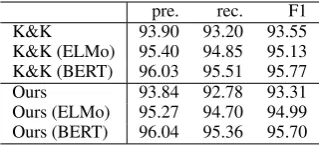
We converted PTB graphs into PTB trees to evaluate constituency parsing performance. Table 3shows the F1 scores of our and the K&K parser. These results demonstrate that our tree approxima-tion has little negative impact on the constituency parsing performance.
5 Conclusion
[image:4.595.92.507.60.267.2]pre. rec. F1 K&K 93.90 93.20 93.55 K&K (ELMo) 95.40 94.85 95.13 K&K (BERT) 96.03 95.51 95.77 Ours 93.84 92.78 93.31 Ours (ELMo) 95.27 94.70 94.99 Ours (BERT) 96.04 95.36 95.70
Table 3: Comparison for constituency parsing perfor-mance on the test data.
with other tree-based parsers. We can expect that the evolution of tree-based parsing technol-ogy makes our approach improve the accuracy of nonlocal dependency identification.
Acknowledgements
This research was partially supported by the Grant-in-Aid for Scientific Research (C) (17K00303) of JSPS.
References
Ann Bies, Mark Ferguson, Karen Katz, and Robert MacIntyre. 1995. Bracketing guidelines for Tree-bank II style Penn TreeTree-bank project. University of Pennsylvania.
Shu Cai, David Chiang, and Yoav Goldberg. 2011.
Language-independent parsing with empty ele-ments. In Proceedings of the 49th Annual Meet-ing of the Association for Computational LMeet-inguis- Linguis-tics: Human Language Technologies, pages 212– 216, Portland, Oregon, USA.
Richard Campbell. 2004. Using linguistic principles to recover empty categories. InProceedings of the 42nd Meeting of the Association for Computational Linguistics (ACL’04), Main Volume, pages 645–652, Barcelona, Spain.
Noam Chomsky. 1981. Lectures on government and binding: The Pisa lectures. Walter de Gruyter.
Jacob Devlin, Ming-Wei Chang, Kenton Lee, and Kristina Toutanova. 2018. BERT: pre-training of deep bidirectional transformers for language under-standing.CoRR, abs/1810.04805.
P´eter Dienes and Amit Dubey. 2003. Antecedent re-covery: Experiments with a trace tagger. In Pro-ceedings of the 2003 Conference on Empirical Meth-ods in Natural Language Processing, pages 33–40.
Kilian Evang and Laura Kallmeyer. 2011. PLCFRS parsing of English discontinuous constituents. In Proceedings of the 12th International Conference on Parsing Technologies, pages 104–116, Dublin, Ire-land.
Katsuhiko Hayashi and Masaaki Nagata. 2016.Empty element recovery by spinal parser operations. In Proceedings of the 54th Annual Meeting of the As-sociation for Computational Linguistics (Volume 2: Short Papers), pages 95–100, Berlin, Germany.
Mark Johnson. 2002. A simple pattern-matching al-gorithm for recovering empty nodes and their an-tecedents. InProceedings of 40th Annual Meeting of the Association for Computational Linguistics, pages 136–143, Philadelphia, Pennsylvania, USA.
Yoshihide Kato and Shigeki Matsubara. 2016.
Transition-based left-corner parsing for identifying PTB-style nonlocal dependencies. InProceedings of the 54th Annual Meeting of the Association for Computational Linguistics (Volume 1: Long Papers), pages 930–940, Berlin, Germany.
Nikita Kitaev and Dan Klein. 2018a. Constituency parsing with a self-attentive encoder. In Proceed-ings of the 56th Annual Meeting of the Association for Computational Linguistics (Volume 1: Long Pa-pers), pages 2676–2686.
Nikita Kitaev and Dan Klein. 2018b. Multilingual constituency parsing with self-attention and pre-training.CoRR, abs/1812.11760.
Jonathan K. Kummerfeld and Dan Klein. 2017. Pars-ing with traces: AnO(n4)algorithm and a structural
representation. Transactions of the Association for Computational Linguistics, 5:441–454.
Roger Levy and Christopher Manning. 2004. Deep dependencies from context-free statistical parsers: Correcting the surface dependency approximation. InProceedings of the 42nd Meeting of the Associa-tion for ComputaAssocia-tional Linguistics (ACL’04), Main Volume, pages 327–334, Barcelona, Spain.
Wolfgang Maier. 2015. Discontinuous incremental shift-reduce parsing. InProceedings of the 53rd An-nual Meeting of the Association for Computational Linguistics and the 7th International Joint Confer-ence on Natural Language Processing (Volume 1: Long Papers), pages 1202–1212, Beijing, China.
Mitchell P. Marcus, Beatrice Santorini, and Mary Ann Marcinkiewicz. 1993. Building a large annotated corpus of English: the Penn Treebank. Computa-tional Linguistics, 19(2):310–330.
Matthew Peters, Mark Neumann, Mohit Iyyer, Matt Gardner, Christopher Clark, Kenton Lee, and Luke Zettlemoyer. 2018. Deep contextualized word rep-resentations. In Proceedings of the 2018 Confer-ence of the North American Chapter of the Associ-ation for ComputAssoci-ational Linguistics: Human Lan-guage Technologies, Volume 1 (Long Papers), pages 2227–2237.