Proceedings of the 13th Linguistic Annotation Workshop, pages 144–154 144
The role of discourse relations in persuasive texts
Ines Rehbein
Leibniz ScienceCampus IDS Mannheim / ICL Heidelberg
Abstract
This paper investigates the use of explic-itly signalled discourse relations in persuasive texts. We present a corpus study where we control for speaker and topic and show that the distribution of different discourseconnectives
varies considerably across different discourse settings. While this variation can be explained by genre differences, we also observe varia-tion regarding the distribuvaria-tion of discourse
re-lationsacross different settings. This variation
cannot be explained by genre differences. We argue that the differences regarding the use of discourserelationsreflects different strategies of persuasion and that these might be due to audience design.
1 Introduction
This contribution studies the use of discourse con-nectives in persuasive texts that have been pro-duced in different communicative settings. Dis-course connectives are highly ambiguous and polyfunctional and can vary across different di-mensions, depending on the medium (spoken vs. written), the discourse situation (monologic vs. dialogic, formal vs. informal), the purpose of communication (informative vs. persuasive), and more. As we are most interested in investigating different strategies of persuasion, we focus on ex-plicit markers of concessive and contrastive dis-course relations, used by the speaker to provide a convincing argument that might persuade the hearer.
Work on discourse analysis and argumentation mining has highlighted the important role of dis-course connectives for analysing argumentation structure (Felder,2015;Stab and Gurevych,2014;
Eckle-Kohler et al.,2015). In addition,
psycholin-guistic studies have shown that explicit coherence marking not only improves sentence comprehen-sion but also results in a more positive
evalua-tion of the text by the reader (Kamalski et al.,
2006). This suggests that discourse connectives might play an important role in persuasion strate-gies.
We take this hypothesis as our starting point and investigate how different dimensions of variation in persuasive texts can impact the linguistic be-haviour of an individual speaker. To that end, we present a corpus study where we try to keep as many variables fixed and only vary the situational setting in which the texts were produced. We con-trol for speaker, topic and function (i.e. persuasive texts) but vary the situational setting of text pro-duction.
The data we use in our analysis are political articles, interviews and talks produced by Noam Chomsky. Our data covers spoken and written texts and ranges from highly edited to less edited, including monologic as well as dialogic data.
The variation of discourse settings in our data is accompanied by changes regarding the audience in the different discourse situations. For interviews, the audience is rather small, often on a one-on-one basis, but the hearers have the means to interact with the speaker. This is different from the situa-tion for public talks where we usually have a much larger audience that can be directly addressed by the speaker but has limited possibilities to interact with her. In the last setting, the speaker (or rather: the writer) has the least control and no reliable in-formation about his or her recipients. To account for this variation, we propose the use of the audi-ence design model (Bell,1984) (see§2.1).
of discourse relations in the different situational settings (§5). Finally, we discuss whether the dif-ferent distribution of discourse relations in each setting reflects different strategies used to pursue a communicative purpose (§6), and how these might relate to audience design.
2 Background
2.1 Discourse connectives in argumentative and persuasive text
In this work, we focus on the use of explicitly marked discourse relations in persuasive text. In particular, we investigate how different dimen-sions of variation impact a speaker’s linguistic be-haviour during the production of argumentative texts. The approach we take is a comparative study of discourse connectives in persuasive texts pro-duced by the same speaker, but in different dis-course situations.
Our investigation takes the following two ob-servations as its starting point. First, it has been shown that the use of discourse connectives and the distribution of explicit and implicit discourse relations is genre-dependent (see, e.g., Webber
(2009) for written genres orRehbein et al.(2016) for spoken texts).1 Second, Eckle-Kohler et al.
(2015) show that certain discourse connectives are highly predictive features for distinguishing claims and premises in argumentative texts.2 This suggests that discourse connectives play a crucial role as strategic devices for persuasion. We follow
O’Keefe(1990) and define persuasion as “a
suc-cessful intentional effort at influencing another’s mental state through communication in a circum-stance in which the persuadee has some measure of freedom”(O’Keefe,1990, p.5).
We distinguish persuasive from merely argu-mentative texts that rely on the neutral presenta-tion of a complete set of claims and premises and weigh these against each other. In contrast, per-suasive texts use additional rhetorical means to achieve their communicatve goal, such as
rhetor-1
Due to space considerations, we refrain from including a discussion on the definition ofregister, genreandtext typeas there is a lack of agreement on the definition of those terms. In the paper, we try to avoid those terms and instead use the termdiscourse settingto refer to the different situational set-tings of text production.
2
The authors, however, do not extend their study to dis-course relations but, lacking DR annotations, only look at the word forms of discourse connectives. This is not optimal as most connectives are highly ambiguous and can express a number of different discourse relations.
ical questions, emotional and sentiment-loaded language, a high ratio of imagery, repetition, hy-perbole, and more. In addition, presentational choices are made that select or focus on certain aspects of a topic or discourse entity, in order to validate the speaker’s point of view and to support her communicative goals. This is often refered to as framing (Entman,1993).
Stab and Gurevych (2014) look at
argumenta-tivetexts and try to automatically identify claims and premises. They find that discourse connec-tives are often indicative of certain argument com-ponents. Tan et al. (2016) investigate persuasion strategies in online discussion forums. They also try to identify argument structure based on dis-course connectives and report negative results for this approach, probably due to data sparseness.
Felder (2015) shows how concessive and
con-trastive discourse connectives can be used to iden-tify the central points of conflict in an argument, based on the selection or foregrounding of spe-cific subtopics that are used to frame the discourse. A certain topic can, for example, be discussed against the background of moral or economic ar-guments, and thus appeal to different groups of people with differing political views (also see the work ofCard et al.(2015,2016) on media frames). In his work, Felder uses discourse connectives as signals for identifying conflicting framing strate-gies but does not investigate their strategic func-tion in the discourse.
Kamalski et al. (2006) present two
psycholin-guistic experiments showing that the use of dis-course connectives not only has a positive effect on the hearer’s comprehension facility but also leads to a more positive evaluation of the text. This observation suggests that discourse connec-tives might be used as strategic devices in persua-sive text.
2.2 Audience design
channel. The audience design model has since been applied to many different discourse settings.
Litt (2012) extended the model for what he calls the “imagined audience”, accounting for style shifts in situations where the real audience is not known to the speaker and thus the speaker adapts her style to a mental model of a hearer. This is relevant for many broadcasting media, for example for social media platforms such as fo-rums, blogs or microtext messengers. Many stud-ies have described and quantified effects of audi-ence design in social media, looking at power rela-tions, politeness and other variables of style shifts
(Bramsen et al.,2011;Gilbert,2012;Prabhakaran
et al.,2012;niculescu mizil et al.,2012;
Danescu-Niculescu-Mizil et al., 2013; Pavalanathan and
Eisenstein,2015).
Applying the audience design model of Bell
(1984) to our data, we have to account for different types of audiences. In the interview situation, the speaker is talking to one or more adressees who are known to the speaker and who are able to in-teract with her. In oral talks, the audience is visi-ble to the speaker and can be directly addressed by her. However, the speaker usually has much less information about the hearers, and the audience has very limited means to actively take part in the communication even though there still is a certain amount of interaction through clapping, heckling or booing. This is different from the production situation of written articles where the text author has no knowledge or control about future readers of the text and thus the recipients can be consid-ered as the “imagined audience”, a mental model created in the mind of the author.
In the remainder of the paper, we present an an-notation study where we apply the audience design model to our data to see how well it can explain the differences in the use of discourse connectives and explicit discourse relations as strategic devices for persuasion.
3 Data
The data we use in our annotation study are arti-cles and talks by and interviews with Noam Chom-sky.3 We created a corpus with 428,679 tokens of articles, 302,672 tokens of talks and 138,866 tokens of interviews. All data has been pro-duced in a time period between 1985 and 2016.
3We collected the data from https://chomsky.
info.
From the larger corpus, we selected a smaller sam-ple for manual annotation with around 20,000 to-kens per discourse setting.4 The smaller dataset was also controlled for topic. All articles in the sample focus on issues related to Gaza/Middle East/Palestine and the texts were selected from a smaller time range, covering the years from 2008 to 2014.
To take a first step towards investigating our hypothesis that discourse connectives are used as strategic devices for persuasion, we first explore how different forms of discourse connectives are used in persuasive texts by the same speaker, but produced in different situational settings.
In the next step, we investigate whether varia-tion with regard to discourse connectiveformalso reflects variation regarding the choice of discourse relationsused to persue the communicative goal, or whether the observed variation can be explained simply by the use of different formsof discourse connectives that express thesame discourse rela-tion.
We argue that if we would find differences re-garding the use of discourse relationsin persua-sive texts controlled for speaker and topic but pro-duced in different situational settings, these differ-ences could not be easily explained based on genre differences but would need a situational model that also accounts for the hearer/reader, such as the au-dience design model.
4 Distribution of discourse connectives
We start with an exploration of the distribution of discourse connectives in the three subcorpora. We follow the tradition of Biber’s register anal-ysis (Biber 1995) and perform a Principal Com-ponent Analysis (PCA),5 based on the frequency of 22 causal, concessive and contrastive discourse connectiveforms, to identify the main variables of variance. The set we use includes the following connectives: accordingly, although, because, but, conversely, hence, however, instead, nevertheless, nonetheless, nor, rather, since, so, still, thereby, therefore, though, thus, whereas, while, yet. We split the different texts in the large corpus in sam-ples of 250 sentences each, count the frequency for each of the forms in the different samples and
4The token counts vary slightly as we did not cut off
sen-tences but incuded all additional tokens until the end of the sentence.
5We use the FactoMineR library in the statistical software
●
−6 −4 −2 0 2 4
−2
0
2
4
6
Individuals factor map (PCA)
Dim 1 (22.02%)
Dim 2 (7.72%)
● ● ● ● ● ● ● ● ● ● ● ● ● ● ● ● ● ● ● ● ● ● ● ● ● ● ● ● ● ● ● ● ● ● ● ● ● ● ● ● ● ● ● ● ● ● ● ● ● ● ● ● ● ● ● ● ● ● ● ● ● ● ● ● ● ● ● ● ● ● ● ● ● ● ● ● ● ● ● ● ● ● ● ● ● ● ● ● ● ● ● ● ● ● ● ● ● ● ● ● ● ● ● ● ● ● ● ● ● ● ● ● ● ● ● ● ● ● ● ● ● ●● ● ● ● ● ● ● ● ● ● ● ● ● ● ● article.1article.2 article.3 article.4 article.5 article.6 article.7 article.8 article.9 article.10 article.11 article.12 article.13 article.14 article.15article.16 article.17 article.18 article.19 article.20 article.21 article.22 article.23 article.24 article.25 article.26 article.27 article.28article.29 article.30 article.31 article.32 article.33 article.34 article.35 article.36 article.37 article.38 article.39 article.40 article.41article.42 article.43 article.44 article.45 article.46 article.47 article.48 article.49 article.50 article.51 article.52 article.53 article.54 article.55 article.56article.57 article.58 interview.59 interview.60 interview.61 interview.62 interview.63interview.64 interview.65 interview.66 interview.67 interview.68 interview.69 interview.70 interview.71 interview.72 interview.73 interview.74interview.75 interview.76 interview.77 interview.78 interview.79 interview.80 interview.81 interview.82 interview.83 interview.84 interview.85 interview.86 talk.87 talk.88 talk.89 talk.90 talk.91 talk.92 talk.93talk.94 talk.95 talk.96 talk.97 talk.98 talk.99 talk.100 talk.101 talk.102 talk.103 talk.104talk.105 talk.106 talk.107 talk.108 talk.109 talk.110 talk.111 talk.112 talk.113 talk.114 talk.115 talk.116 talk.117 talk.118 talk.119 talk.120 talk.121 talk.122 talk.123 talk.124 talk.125 talk.126 talk.127 talk.128 talk.129 talk.130 talk.131 talk.132 talk.133 talk.134 talk.135 talk.136 talk.137 article interview talk article interview talk ●
−1.0 −0.5 0.0 0.5 1.0
−1.0
−0.5
0.0
0.5
1.0
Variables factor map (PCA)
Dim 1 (22.02%)
Dim 2 (7.72%)
[image:4.595.76.514.72.285.2]accordingly although because but converseley hence however instead nevertheless nonetheless nor rather since so still thereby therefore though thus whereas while. yet accordingly although because but converseley hence however instead nevertheless nonetheless nor rather since so still thereby therefore though thus whereas while. yet accordingly although because but converseley hence however instead nevertheless nonetheless nor rather since so still thereby therefore though thus whereas while. yet accordingly although because but converseley hence however instead nevertheless nonetheless nor rather since so still thereby therefore though thus whereas while. yet accordingly although because but converseley hence however instead nevertheless nonetheless nor rather since so still thereby therefore though thus whereas while. yet accordingly although because but converseley hence however instead nevertheless nonetheless nor rather since so still thereby therefore though thus whereas while. yet accordingly although because but converseley hence however instead nevertheless nonetheless nor rather since so still thereby therefore though thus whereas while. yet accordingly although because but converseley hence however instead nevertheless nonetheless nor rather since so still thereby therefore though thus whereas while. yet accordingly although because but converseley hence however instead nevertheless nonetheless nor rather since so still thereby therefore though thus whereas while. yet
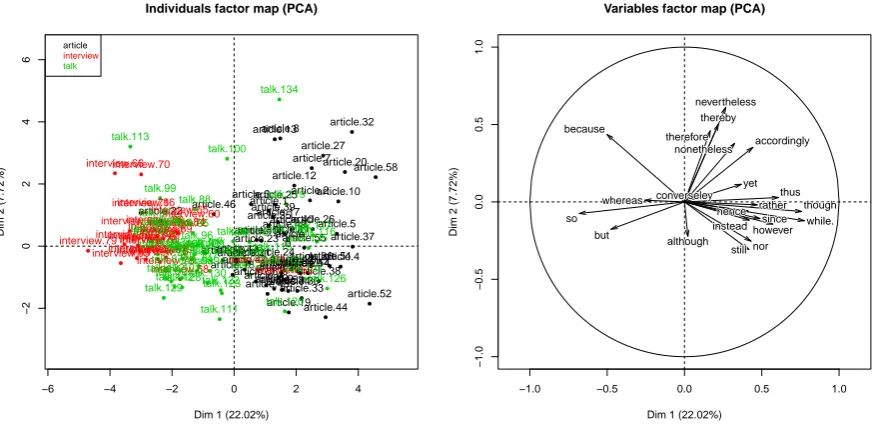
Figure 1: PCA on the larger dataset, showing the distribution of different discourse connective forms in persuasive articles, talks and interviews for the same speaker.
run the PCA on the data.
The PCA, despite having no other information but the frequency for each discourse connective, is able to separate the interviews from the articles along the first dimension. Figure 1 (left) shows how most of the interviews cluster at the left end of the dimension while the articles are positioned at the right end. The talks show a larger vari-ance in the use of discourse connectives, and some talk segments show an overlap with the interviews while in other talks the use of discourse connec-tives is more similar to the one in the articles.
Figure 1 (right) identifies the discourse con-nectives most typical for written articles (though, while, thus, however) and those that are used in the less edited, dialogic interview data (because, so, but).
Our analysis clearly confirms what has been shown before (Webber, 2009; Rehbein et al.,
2016), namely that the use of discourse connec-tives is highly genre-specific. In earlier genre stud-ies, however, the different genres represented texts with different communicative functions, i.e. infor-mative texts versus argumentative texts etc. There-fore, one might assume that the differences in the use of discourse connectives might reflect func-tional differences.
In our study, we try to eliminate this factor. We control for speaker and –in the smaller subcorpus– also for topic. All texts have a clear persuasive
goal, i.e. to convince the audience from a partic-ular political point of view. The main difference between the texts is thecommunication setting in which they were produced. This allows us to in-vestigate the role that discourse connectives play for strategies of persuasion, tailored towards a par-ticular setting and audience.
Given that the texts have the same persuasive function, we assume that the differences we ob-served reflect differences along two dimensions of variation that are correlated with the situa-tional settings of text production. In a more de-tailed analysis with more features than just the counts for different connective forms, similar to
Biber (1995); Biber and Conrad (2009);
Passon-neau et al.(2014), we would expect to find the two
dimensions displayed in figure2.
monological
highly
edited
less
edited
dialogical
Interview Article
[image:5.595.307.527.61.161.2]T alk
Figure 2: Dimensions of variation for different dis-course settings.
some interaction with the audience.
These two dimensions of variation might ex-plain the variance in the distribution of discourse connectives in the data, as the same discourse re-lations can be expressed via different connectives (or can also be left implicit). We thus hypothe-size that the differences we observe will disappear when we look at the level of discourse relations instead of discourse connectiveforms. As there is no one-to-one correspondence between discourse connectives and discourse relations and automatic tools are not yet reliable enough, we need to man-ually disambiguate the relations in the data.
5 Annotation study
We present an annotation study where we annotate all instances of discourse connectives that can ex-press a causal, contrastive or concessive discourse relation. We follow the framework of PDTB3
(Webber et al.,2016), a revised version of the Penn
Discourse Treebank scheme (Prasad et al.,2008). The question we would like to answer is: Does the difference in distribution of discourse connec-tives in the texts shown above reflect differences in the distribution of discourse relations, or are the same relationsexpressed bydifferent devicesthat are more adequate for a given discourse situation?
5.1 Discourse relations in argumentative text
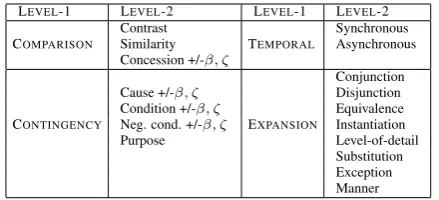
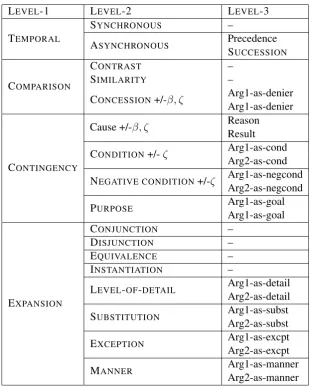
The revised version of the PDTB comprises some changes to the relation hierarchy. Some rela-tions in PDTB2 that were difficult to distinguish even for trained annotators have been merged in PDTB3, and inconsistencies regarding the annota-tion of the direcannota-tionality of the relaannota-tion have been removed. The direction describes the order of the arguments. In the PDTB scheme, Arg1 and Arg2
LEVEL-1 LEVEL-2 LEVEL-1 LEVEL-2 Contrast Synchronous
COMPARISON Similarity TEMPORAL Asynchronous
Concession +/-β, ζ
Conjunction Cause +/-β, ζ Disjunction Condition +/-β, ζ Equivalence
CONTINGENCY Neg. cond. +/-β, ζ EXPANSION Instantiation
[image:5.595.81.282.66.188.2]Purpose Level-of-detail Substitution Exception Manner
Table 1: First two levels of hierarchy in the PDTB3 (level 3 encodes the direction of the relation, if appli-cable).
are determined by position in inter-sentential rela-tions as well as in intra-sentential paratactic struc-tures (e.g. coordinations). In intra-sentential sub-ordinated structures, the subsub-ordinated clause is al-ways labelled Arg2, regardless of its position. The new relation hierarchy is shown in table1.
Additionally, some relations can be marked as either pragmatic (epistemic) (β; for implicit be-liefs) or asspeech acts(ζ).6These features should be understood as properties of the arguments, not of the relations (Webber et al., 2016). The ex-amples below illustrate the different relation types relevant to our study. We follow the PDTB con-ventions and mark the first argument in italics and the second argument in boldface. The discourse connective that signals the relation is underlined.
• Concession:
Althoughshe was qualified,she didn’t get the job.
• Contrast:
Mary likes to readwhileJohn loves cooking.
• Cause:
The street is wetbecauseit rained last night.
• Cause + Belief (+β):
She must be homebecausethe light is on.
• Cause + Speechact (+ζ):
He’s in Denverbecausehe just called me an hour ago.
5.2 Discourse connectives versus discourse relations
We manually disambiguate all discourse connec-tive forms in the smaller subcorpus that can ex-press a causal, concessive or contrastive relation. The data includes 20,000 tokens from each dis-course setting and was controlled for topic (table
2). The annotation was done by one trained lin-guist who had previous experience with PDTB-style annotations. As annotation tool, we used
6For a distinction between, content, epistemic and speech
the PDTB Annotator (Lee et al., 2016). We an-notated all senses for instances of discourse con-nectives from a set of 22 word forms (see section
4). This resulted in 1,614 annotated instances (ar-ticles: 395, talks: 633, interviews: 586).
As there was only one annotator, we cannot re-port inter-annotator agreement for this task. How-ever, in a comparable previous study on annotat-ing PDTB-style discourse relations on English, the same annotator showed an IAA of84.6% (percent-age agreement) and a Fleiss’κof 0.797 (Rehbein et al.,2016).
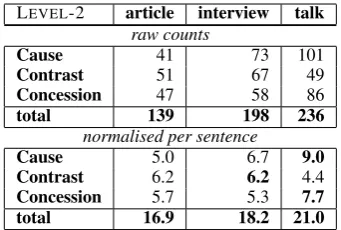
Table 3 shows the distribution of causal, con-cessive and contrastive senses for the different dis-course settings (see table 7 in the appendix for a complete list of all senses in PDTB3 (Webber
et al.,2016)). We decided to normalise raw counts
per sentence, as discourse relations mostly operate on the sentence or clause-level.7
The talks have the highest amount of signalled causal and concessive discourse relations in our corpus. The number of concessive relations, how-ever, is smaller than in the article and interview subcorpora. In contrast to the use of discourse connective forms, the distribution of discourse relations found in the data cannot be explained with regard to the two dimensions of variation we discussed above (monologic–dialogic and less edited–highly edited).
However, when looking at more fine-grained sense distinctions, also taking the PDTB level three senses into account that encode the direction of the relation, we make an interesting observa-tion (table 4). We can see that the higher num-ber of causal relations in the talks reflects a more frequent use of RESULT-type relations while the distribution of REASON-type relations in the three discourse settings is fairly similar. If we look at concessive relations, we see that the higher fre-quency in the talks is caused only by
Arg2-as-7Results for a normalisation based on clauses were not
significantly different from a sentence-based normalisation.
token sent clause annotations
article 20,020 822 2,062 395
interview 20,009 1,083 2,559 633
talk 20,011 1,123 2,623 586
[image:6.595.331.502.61.176.2]total 60,040 3,028 7,244 1,614
Table 2: Subcorpus used in the annotation study (anno-tations lists the number of annotated relations for each discourse setting).
LEVEL-2 article interview talk
raw counts
Cause 41 73 101
Contrast 51 67 49
Concession 47 58 86
total 139 198 236
normalised per sentence
Cause 5.0 6.7 9.0
Contrast 6.2 6.2 4.4
Concession 5.7 5.3 7.7
total 16.9 18.2 21.0
Table 3: Distribution of causal, concessive and con-trastive discourse relations (raw counts per discourse setting, and normalised counts per sentence)
LEVEL-2 LEVEL-3 article interv. talk
Cause Reason 2.43 2.12 2.49
Result 2.55 4.43 6.50
Result+β 0.12 0.18 0.00
Concession Arg1-denier 0.85 0.55 0.18
Arg2-denier 4.87 4.71 7.48
Table 4: Amount of level-3 causal and concessive dis-course relations (normalised per sentence;β: belief)
denier relations while instances of Arg1-as-denier are more frequent in the article subcorpus. We also found one instance of Concession where we were not able to annotate the direction (see example be-low). As the example is from the interviews part of the corpus, we assume that it might be a perfor-mance error and exclude it from the analysis.
(1) They can also be supplemented by various forms of direct action ,such as what is now called “ BDS , ” though that is only one of many tactical options.
To get a different perspective, we go back to the more coarse-grained level-2 senses but this time also include the SPEECHACT features (ζ) (table
5). Here we can see that the crucial difference be-tween the talks and the other two discourse set-tings regarding the CONCESSIONrelation can be traced back to the presence or absence of the ζ
feature. SPEECHACT-type relations hardly ever occur in the articles and interviews but are quite frequent in the political talks, thus showing that it is not only difference betweenoralandwritten that triggers the use of speechact relations.
LEVEL-2 FEATURES article interview talk
Concession -ζ 5.2 4.9 5.6
+ζ 0.5 0.4 2.0
[image:6.595.308.525.238.312.2] [image:6.595.81.281.659.714.2]6 Discussion
So far, we have shown that persuasive texts pro-duced by the same speaker in different situational settings do vary with regard to the distribution of discourse connective forms in the texts, and that this might reflect differences along the dimension of editedness and the degree of interaction in the texts.
Next, we have shown that the variation with re-gard to discourse connective forms in persuasive texts controlled for topic and speaker but produced in different discourse settings is not only due to stilistic choices made by the speaker. Instead, we also found variation on the level of discourse rela-tions, with causal result and concessive speechact relations being used far more often in the talks than in the other two discourse settings.
This variation cannot be easily explained with regard to genre differences as looking at the distri-bution of discourse relations should abstract away the stilistic differences between different connec-tive forms (e.g. formal–informal, highly edited– less edited). As we assume that that function of the texts is the same (persuasive text), we hypoth-esize that the variation in the distribution of dis-course relations in each communicative setting re-flects the use of different persuasive strategies em-ployed to persue the communicative goal.
6.1 Causal relations
Let us start by looking at the causal relations. While the frequency of REASON relations was more or less equal in all three subcorpora, we ob-served a substantially higher amount of RESULT
relations in the talks. Examples(2),(3)show typ-ical examples for REASONand RESULTrelations
in the talk subcorpus.
(2) He was removed from office soon af-ter because he was considered too
soft-hearted. REASON
(3) For US leaders, aggression means resis-tance.So,anyone who resists the United States is guilty of aggression. RESULT
The first example describes an event in the real world (removed from office) and presents the cause for this event (being too soft-harted). It can thus be categorised as a consequence–cause relation. Example(3), however, does not describe an event
but rather presents two claims, with the first claim providing the pragmatic justification for the sec-ond one. Please note that instances like (3) are not annotated as implicit beliefs. The reason for this becomes clear when modifying example(3), as shown below:
(4) For US leaders, aggression means resis-tance. So I believe, anyone who resists the United States is guilty of aggression.
The meaning of (4) is different from (3) where the subject of consciousness holding the belief ex-pressed in Arg2 are the US leaders while in the modified example the subject of consciousness is the speaker.8
Looking at more examples, one striking feature is the frequent use of the first person plural pro-noun (we; examples(5)–(7)below) in the talks.
(5) The countries we wanted to sell it to did n’t have dollars sowe had to provide them with dollars. RESULT
(6) And that makes sense if we own the world so any active resistance is aggression
against us. RESULT
(7) We did it so therefore it’s efforts to do
good. RESULT
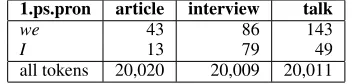
To check whether first person pronouns in gen-eral are more frequent in the talk subcorpus, we counted the number of occurrences ofIandwefor each discourse setting. Table6shows that, as ex-pected, the written texts have the lowest number of first person pronouns. First person pronouns are considered a marker of involvement and are of-ten used to discriminate spoken from writof-ten reg-isters (Biber, 1995, p.225). Here, however, they not only distinguish the written from the spoken texts but also set apart the talks from the inter-views. While in the latter bothI andweare used with high frequency, in the talks we observe a sig-nificantly higher number of first person plural us-age.
6.2 Concession and SpeechAct
Another difference between the three discourse settings concerns the substantially higher number
8The two claims in(3)are presented as facts in the world
1.ps.pron article interview talk
we 43 86 143
I 13 79 49
[image:8.595.93.269.63.105.2]all tokens 20,020 20,009 20,011
Table 6: Frequency of 1. person pronounsI, wein the three discourse settings.
of SPEECHACTrelations in the talks. This can not be ascribed to the medium, i.e. spoken language, as this relation type is not only rare in the writ-ten articles but also hardly ever occurs in the inter-views. Below are typical examples for CONCES
-SION+ SPEECHACTin the corpus.
(8) I hope I don’t have to describe it to you, butit killed several million people , de-stroyed three countries.
(9) I won’t go through the rest of the history butit continues pretty much like that.
(10) I won’t run through the whole story but
the basic facts are clear.
Again, we observe a high number of first person pronouns, here mostly the singular formI. All of these examples anchor the speech act in the here-and-nowby referring to the discourse situation and also by referencing a common ground shared be-tween speaker and audience. By doing so, the speaker presumes that the hearers agree with his point of view even without giving further details on the topic under discussion (examples(8)–(10)). This communicative strategy requires that the Ground(Langacker,1990), i.e. the immediate cir-cumstances of the speech event such as time and space, are shared between speaker and audience. This explains why this strategy cannot be used in written articles where the speaker only has access to an imagined audience at best, and no interaction is possible. In the interview setting, however, the increased level of interaction might interfere with the speaker’s construction of the shared common ground.
6.3 Political talks as oral narratives
Based on the results of our annotation study, we hypothesize that the differences in the distribution of discourse relations reflect the use of different strategies of persuasion in the different commu-nicative settings. We suggest that it might make sense to consider persuasive political talks as oral narratives in the sense of Labov and Waletzky
(1967), with the function of “transfer[ing] expe-rience from one person to another through oral narratives of personal experience” (Labov,2010). This fits well with the high number of personal pronouns in the talks which not only reflect a high amount of involvement but also give credibility to the narrative. Furthermore, the use of first person pronouns helps to create an impression of intimacy between speaker and audience and also lends the narrative authenticity (Malti-Douglas,1988, p.93). These ideas, however, are highly speculative and need to be tested empirically on a larger ba-sis and including more than one speaker.
7 Conclusions
We presented an annotation study where we inves-tigated the use of discourse connectives and dis-ourse relations in persuasive texts. The texts in our corpus are controlled for speaker and topic but produced in different communicative settings. We observed a substantial variation in the use of dis-course connectiveformsandrelations. While the first can be easily explained by genre differences, we argue that the second variation concerning the use of discourse relations might reflect different strategies of persuasion, and that models of audi-ence design might prove useful for understanding this variation.
Acknowledgments
I would like to thank the reviewers for their help-ful comments. This research has been conducted within the Leibniz Science Campus “Empirical Linguistics and Computational Modeling”, funded by the Leibniz Association under grant no. SAS-2015-IDS-LWC and by the Ministry of Science, Research, and Art (MWK) of the state of Baden-W¨urttemberg.
References
Allan Bell. 1984. Language style as audience design.
Language in society, 13(2):145–204.
Doublas Biber and Susan Conrad. 2009. Register,
genre, and style. Cambridge: Cambridge University
Press.
Douglas Biber. 1995. Variation across speech and
writing. Publisher: Cambridge University Press.
relationships from natural language. InThe 49th An-nual Meeting of the Association for Computational
Linguistics: Human Language Technologies, HLT
2011, pages 773–782.
Dallas Card, Amber E. Boydstun, Justin H. Gross, Philip Resnik, and Noah A. Smith. 2015. The media frames corpus: Annotations of frames across issues.
In Proceedings of the 53rd Annual Meeting of the
Association for Computational Linguistics and the 7th International Joint Conference on Natural Lan-guage Processing of the Asian Federation of Natural
Language Processing, ACL 2015, pages 438–444,
Beijing, China.
Dallas Card, Justin H. Gross, Amber E. Boydstun, and Noah A. Smith. 2016. Analyzing framing through the casts of characters in the news. InProceedings of the 2016 Conference on Empirical Methods in
Natural Language Processing, EMNLP 2016, pages
1410–1420, Austin, Texas, USA.
Cristian Danescu-Niculescu-Mizil, Moritz Sudhof, Dan Jurafsky, Jure Leskovec, and Christopher Potts. 2013. A computational approach to politeness with application to social factors. In The 51st Annual Meeting of the Association for Computational
Lin-guistics, ACL 2013, pages 250–259.
Judith Eckle-Kohler, Roland Kluge, and Iryna Gurevych. 2015. On the role of discourse mark-ers for discriminating claims and premises in argu-mentative discourse. In Proceedings of the 2015 Conference on Empirical Methods in Natural Lan-guage Processing, EMNLP 2015, Lisbon, Portugal,
September 17-21, 2015, pages 2236–2242.
Robert M. Entman. 1993. Framing: Toward clarifi-cation of a fractured paradigm. Communication, 43(4):51–58.
Ekkehard Felder. 2015. Lexik und grammatik der ago-nalit¨at in der linguistischen diskursanalyse. In Hei-drun Kmper and Ingo Warnke, editors,Diskurs –
in-terdisziplin¨ar. Zug¨ange, Gegenst¨ande, Perspektiven,
pages 87–121. Berlin/Boston: de Gruyter.
Eric Gilbert. 2012. Phrases that signal workplace hier-archy. InProceedings of the ACM 2012 Conference
on Computer Supported Cooperative Work, CSCW
’12, pages 1037–1046.
Howard Giles, Justine Coupland, and Nikolas Coup-land. 1991. Contexts of Accommodation:
Devel-opments in Applied Sociolinguistics. Cambridge:
Cambridge University Press.
Judith Kamalski, Leo Lentz, and Ted Sanders. 2006. Effects of coherence marking on the comprehension and appraisal of discourse. In Cognitive Science
Conference.
William Labov. 2010. Oral narratives of personal expe-rience. InCambridge Encyclopedia of the Language
Sciences. Cambridge: Cambridge University Press.
William Labov and Joshua Waletzky. 1967. Narrative analysis: oral versions of personal experience. In
Essays on the Verbal and Visual Arts: Proceedings of the 1966 Annual Spring Meeting of the
Ameri-can Ethnological Society, pages 12–44. University
of Washington Press, Seattle.
Ronald Langacker. 1990. Subjectification. Cognitive
Linguistics, 1:5–38.
Alan Lee, Rashmi Prasad, Bonnie L. Webber, and Ar-avind K. Joshi. 2016. Annotating discourse rela-tions with the PDTB annotator. In The 26th Inter-national Conference on Computational Linguistics, Proceedings of the Conference System
Demonstra-tions, COLING 2016, pages 121–125.
Eden Litt. 2012. Knock, knock. who’s there? the imag-ined audience. Journal of Broadcasting &
Elec-tronic Media, 56:330–345.
Fedwa Malti-Douglas. 1988. Blindness and
Autobiog-raphy: Al-Ayyam of Taha Husayn. Princeton
Uni-versity Press.
Cristian Danescu niculescu mizil, Lillian Lee, Bo Pang, and Jon Kleinberg. 2012. Echoes of power: Lan-guage effects and power differences in social inter-action. In The 21st International Conference on
World Wide Web, WWW 2012, pages 699–708.
Daniel J. O’Keefe. 1990. Persuasion: Theory and
re-search. Newbury Park, CA: Sage.
Rebecca J. Passonneau, Nancy Ide, Songqiao Su, and Jesse Stuart. 2014. Biber redux: Reconsidering di-mensions of variation in american english. In The 25th International Conference on Computational
Linguistics, COLING 2014, pages 565–576.
Umashanthi Pavalanathan and Jacob Eisenstein. 2015. Audience-modulated variation in online social
me-dia. American Speech, 90(2):187–213.
Vinodkumar Prabhakaran, Owen Rambow, and Mona Diab. 2012. Predicting overt display of power in written dialogs. In The 2012 Conference of the North American Chapter of the Association for Computational Linguistics: Human Language
Tech-nologies, NAACL 2012, pages 518–522.
R. Prasad, N. Dinesh, A. Lee, E. Miltsakaki, L. Robaldo, A.K. Joshi, and B.L. Webber. 2008. The penn discourse treebank 2.0. InProceedings of the 6 International Conference on Language Resources
and Evaluation, LREC’08. European Language
Re-sources Association.
Christian Stab and Iryna Gurevych. 2014. Identifying argumentative discourse structures in persuasive es-says. InConference on Empirical Methods in
Natu-ral Language Processing, EMNLP 2014, pages 46–
56.
Eve Sweetser. 1990. From Etymology to Pragmatics. Cambridge University Press, Cambridge.
Chenhao Tan, Vlad Niculae, Cristian Danescu-Niculescu-Mizil, and Lillian Lee. 2016. Winning arguments: Interaction dynamics and persuasion strategies in good-faith online discussions. In The
25th International Conference on World Wide Web,
WWW 2016, pages 613–624.
Bonnie L. Webber. 2009. Genre distinctions for dis-course in the penn treebank. InACL 2009, Proceed-ings of the 47th Annual Meeting of the Association for Computational Linguistics and the 4th Interna-tional Joint Conference on Natural Language
Pro-cessing of the AFNLP, 2-7 August 2009, Singapore,
pages 674–682.
Bonnie L. Webber, Rashmi Prasad, Alan Lee, and Ar-avind K. Joshi. 2016. A discourse-annotated corpus of conjoined vps. InThe 10th Linguistic Annotation
Workshop, LAW 2016.
LEVEL-1 LEVEL-2 LEVEL-3
TEMPORAL
SYNCHRONOUS –
ASYNCHRONOUS Precedence
SUCCESSION
COMPARISON
CONTRAST –
SIMILARITY –
CONCESSION+/-β, ζ Arg1-as-denier
Arg1-as-denier
CONTINGENCY
Cause +/-β, ζ Reason
Result
CONDITION+/-ζ Arg1-as-cond
Arg2-as-cond
NEGATIVE CONDITION+/-ζ Arg1-as-negcond
Arg2-as-negcond
PURPOSE Arg1-as-goal
Arg1-as-goal
EXPANSION
CONJUNCTION –
DISJUNCTION –
EQUIVALENCE –
INSTANTIATION –
LEVEL-OF-DETAIL Arg1-as-detail
Arg2-as-detail
SUBSTITUTION Arg1-as-subst
Arg2-as-subst
EXCEPTION Arg1-as-excpt
Arg2-as-excpt
MANNER Arg1-as-manner
[image:11.595.143.455.204.592.2]Arg2-as-manner