104
Detecting Argumentative Discourse Acts with Linguistic Alignment
Timothy NivenandHung-Yu Kao
Intelligent Knowledge Management Lab
Department of Computer Science and Information Engineering National Cheng Kung University
Tainan, Taiwan
[email protected],[email protected]
Abstract
We report the results of preliminary investiga-tions into the relainvestiga-tionship between linguistic alignment and dialogical argumentation at the level of discourse acts. We annotated a proof of concept dataset with illocutions and tran-sitions at the comment level based on Infer-ence Anchoring Theory. We estimated linguis-tic alignment across discourse acts and found significant variation. Alignment features cal-culated at the dyad level are found to be use-ful for detecting a range of argumentative dis-course acts.
1 Introduction
Argumentation mining remains a difficult problem for machines. Even for humans, understanding the substance of an argument can involve com-plex pragmatic interpretation (Cohen,1987). Con-sider the reply ofB in Figure 1. Absent broader conversational context, and perhaps knowledge of the background beliefs of B, it can be difficult to judge whether they are asking “which religions are correlated with increased life expectancy?” (pure questioning) or giving their opinion that “not just any religion is correlated with a longer life” (as-sertive questioning). Since only the latter is an ar-gumentative discourse unit (ADU) (Stede,2013), ambiguities like this therefore make it difficult to accurately identify the structure of argumentation. In this work we investigate using a subtle yet robust signal to resolve such ambiguity: linguis-tic alignment. Alignment can be calculated in an unsupervised manner and does not require textual understanding. It is therefore well suited to our current technology as an extra pragmatic feature to assist dialogical argumentation mining. Our hy-pothesis is that, since alignment has been shown to relate to communication strategies (Doyle and Frank, 2016), different alignment effects will be
A: ...To be able to claim that life expectancy and health are tied to religion you have to rule out hundreds of other factors: diet; lifestyle; racial characteristics; genetic pre-disposition (religion tends to run in families) etc...
[image:1.595.313.501.346.455.2]B: ...Can I just have ANY religion and have a longer life?
Figure 1: An example dyad from our dataset. Without disambiguating information it is hard to know if B’s reply is pure or assertive questioning.
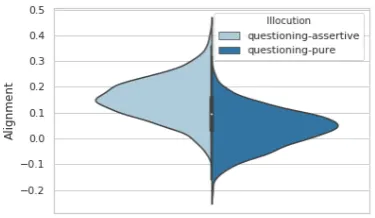
Figure 2: Posterior densities on alignment estimates for pure and assertive questioning in our dataset, indicating that alignment can help to disambiguate discourse acts.
observed over different argumentative discourse acts, providing signal for their detection. For ex-ample, Figure 2 shows our estimated posterior densities for alignment scores over pure and as-sertive questioning. On this basis, ifB’s comment in Figure 1 is accompanied by a significantly pos-itive alignment score, we would be correct more often than not classifying it as assertive question-ing.
In this preliminary work we aim to address the following questions:
1. Are the majority of argumentative discourse acts associated with significantly different alignment effects?
2 Background and Related Work
Linguistic alignment is a form of communica-tion accommodacommunica-tion (Giles et al., 1991) whereby speakers adapt their word choice to match their interlocutor (Niederhoffer and Pennebaker,2002). It can be calculated as an increase in the proba-bility of using a word category having just heard it, relative to a baseline usage rate. An exam-ple is given in Figure 3. Note that alignment is calculated over non-content word categories.1 While content words are clearly set by the topic of conversation, the usage rates of particular non-content word categories has shown to be a robust measure of linguistic style (Pennebaker and King,
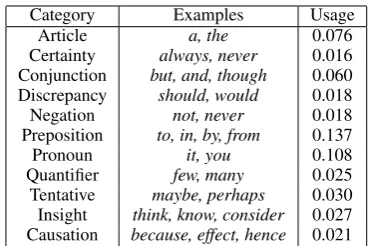
2000). Consistent with previous work, we fo-cus on alignment over the Linguistic Inquiry and Word Count (LIWC) categories (Pennebaker et al.,
2015), listed in Table 1.
Linguistic alignment is a robust phenomenon found in a variety of settings. It has been used to predict employment outcomes (Srivastava et al.,
2018), romantic matches (Ireland et al., 2011), and performance at cooperative tasks (Fusaroli et al., 2012; Kacewicz et al., 2014). People have been found to align to power (Willemyns et al., 1997; Gnisci, 2005; Danescu-Niculescu-Mizil et al.,2011), to people they like (Bilous and Krauss, 1988; Natale, 1975), to in-group mem-bers (Shin and Doyle,2018), and to people more central in social networks (Noble and Fernandez,
2015). The variety of these contexts suggest align-ment is ubiquitous and modulated by a complex range of factors.
Some previous work bears on argumentation. Binarized alignment features indicating the pres-ence of words from LIWC categories were found to improve the detection of disagreement in on-line comments (Rosenthal and McKeown,2015). We utilize more robust calculation methods that account for baseline usage rates which thereby avoid mistaking similarity for alignment (Doyle et al.,2016). Accommodation ofbody movements was found to decrease in face-to-face argumen-tative conflict where interlocutors had fundamen-tally differing opinions (Paxton and Dale, 2013;
Duran and Fusaroli,2017). In contrast we are con-cerned with linguistic forms of alignment.
1Previous work has indicated the primacy of word-based over category-based alignment (Doyle and Frank,2016). We leave investigation of alignment over words in argumentation to future work.
B’s reply A’s message has pronoun no pronoun
has pronoun 8 2
[image:2.595.331.500.61.105.2]no pronoun 5 5
Figure 3: Example of linguistic alignment using a bina-rized “by-message” calculation technique (Doyle and Frank,2016). B’s baseline usage rate of pronouns is 0.5, coming from the bottom row. The top row shows the probability ofB using a pronoun increases to0.8 after seeing one inA’s message.
Category Examples Usage
Article a, the 0.076
Certainty always, never 0.016 Conjunction but, and, though 0.060 Discrepancy should, would 0.018
Negation not, never 0.018
Preposition to, in, by, from 0.137
Pronoun it, you 0.108
Quantifier few, many 0.025
Tentative maybe, perhaps 0.030 Insight think, know, consider 0.027 Causation because, effect, hence 0.021
Table 1: LIWC dictionary categories we use, examples, and baseline production rates observed in our dataset of ∼1.5million comments on news articles.
We focus on the argumentative discourse acts of Inference Anchoring Theory (IAT) (Budzynska and Reed, 2011;Budzynska et al., 2016). IAT is well motivated theoretically, providing a princi-pled way to relate dialogue to argument structure. As noted above, an utterance that has the surface form of a question may have different functions in an argument - asking for a reason, stating a be-lief, or both. The IAT framework is designed to make these crucial distinctions, and covers a com-prehensive range of argumentative discourse acts. Two previous datasets are similar to ours. The US 2016 Election Reddit corpus (Visser et al.,
[image:2.595.323.508.202.325.2]Figure 4: Annotating discourse acts across a message-reply pair. The blue text spans areAsserting. The red span is Disagreeing, which always crosses the comments - in this case attacking the inference inA. IfAwas the reply we would annotate the purple span asArguing, as it offers a reason in support of the preceding assertion. In the reply, Arguingis provided by the green span, which is an instance ofAssertive Questioning. Note that we only annotate what is inB. This pair is therefore annotated as:{Asserting,Disagreeing,Assertive Questioning,Arguing}.
3 Dataset
In this section we outline our annotation process. So far we have 800 message-reply pairs but an-notated by just a single annotator. In future work we will scale up considerably with multiple an-notators, and include Mandarin data for cross-linguistic comparison.
3.1 Source
We scraped∼1.5M below the line comments from an academic news website, The Conversation,2 covering all articles from its inception in 2011 to the end of 2017. In order to maximize the gen-eralizabilty of our conclusions we selected com-ments covering a variety of topics. We also picked as evenly as possible from the continuum of con-troversiality, as measured by the proportion of deleted comments in each topic. More contro-versial topics are likely to see higher degrees of polarization, which should affect alignment across groups (Shin and Doyle, 2018). The most con-troversial topics we included are climate change and immigration. Among the least controversial areagricultureandtax.
Nevertheless this data source has its own pecu-liarities that attenuate liberal generalization. As the site is well moderated, comments are on topic and abusive comments are deleted, even if they also contain argumentative content. The messages are generally longer and less noisy than, for exam-ple, Twitter data. Moreover, many commenters are from research and academia. Therefore in general we see a high quality of writing, and of argumen-tation.
2https://theconversation.com/global
3.2 Annotation
The list of illocutions we chose to annotate are taken from Budzynska et al. (2016): Asserting, Ironic Asserting, (Pure/Assertive/Rhetorical) Questioning, (Pure/Assertive/Rhetorical) Chal-lenging, Conceding, Restating, and Non-Argumentative (anything else). The transitions we consider follow IAT conventions. Arguing holds over two units, where a reason is offered as support for some proposition. Disagreeing occurs where an assertion conflicts with another. Agreeing is instantiated by phrases such as “I agree” and “Yeah.”
Annotating Rhetorical
Question-ing/Challenging is the most difficult. As noted by Budzynska et al. (2016), there is no common specification forRhetorical Questioning. We follow their definition, by which Pure and Assertive Questioning/Challenging ask for the speaker’s opinion/evidence, and the Assertive and Rhetorical types communicate the speakers own opinion. Therefore thePurevarieties do not convey the speakers opinion, and the Rhetorical types do not expect a reply. Annotating Rhetor-ical Questioning/Challenging therefore requires a more complicated pragmatic judgment of the speaker’s intention.
Another difference from prior work relates to Concessions. Unlike Budzynska et al. (2016) we do not explicitly annotate the sub-type Popu-lar Concession- where a speaker concedes in or-der to prepare the ground for disagreement. A po-tential confound with the annotation scheme de-scribed so far is ambiguous cases ofAgreeingand Disagreeingin the same comment, which could be expected in aPopular Concession: “Yeah, I agree that X, but [counter-argument].” Because we are annotating at the level of the comment, we are able to distinguish these cases by considering combina-tions of discourse acts. APopular Concessionis distinguished by the presence ofConcedingalong with Disagreeing, optionally with Agreeing. A Pure Concessionis then distinguished by the pres-ence of Concedingand the absence of Disagree-ing. We therefore do not need to rule that only one ofAgreeing orDisagreeingcan occur in a single comment.
We found that Asserting (627/800), Arguing (463/800), and Disagreeing (402/800) are by far the most common individually, and as a combina-tion (339/800), reflecting the argumentative nature of our dataset. The distribution of comments over discourse acts is Zipfian. The lowest frequency discourse act is Ironic Asserting, which has only 12 annotations in our 800 comments.
4 Methodology
4.1 Alignment over Discourse Acts
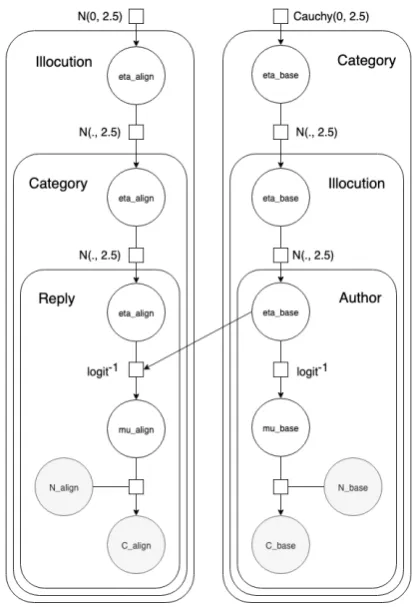
To estimate alignment scores across discourse acts we parameterize the message and reply genera-tion process as a hierarchy of normal distribu-tions, following the word-based hierarchical align-ment model (WHAM) (Doyle and Frank, 2016). Each message is treated as a bag of words and word category usage is modeled as a binomial draw. WHAM is based on the hierarchical align-ment model (HAM) (Doyle et al.,2016), adapted by much other previous work (Doyle and Frank,
2016;Yurovsky et al., 2016; Doyle et al., 2017). WHAM’s principal benefit over HAM is control-ling for message length, which was shown to be important for accurate alignment calculation (Doyle and Frank,2016). Our adaptation is shown in Figure 5. For further details of WHAM we refer the reader to the original work.
[image:4.595.312.519.59.363.2]A key problem we need to address is our inabil-ity to aggregate counts over all messages in a con-versation between two speakers (as in Figure 3).
Figure 5: Our adaptation of WHAM (Doyle and Frank, 2016) for estimating alignment over argumentative dis-course acts.
This is a virtue of the original WHAM model that provides more reliable alignment statistics. We cannot aggregate counts over multiple message-reply pairs since our target is the discourse acts in individual replies. However, we are helped somewhat by the long average comment length in our chosen genre (µ = 82.5 words, σ = 66.5). The lowest baseline category usage rate is approx-imately0.8%(µ= 3.6%,σ = 2.2%). Therefore an average comment length gives us enough op-portunity to see much of the effects of alignment on the binomial draw, but is likely to systemati-cally underestimate alignment. In future work we will investigate this phenomenon with simulated data, and continue to search for a solution that makes better use of the statistics.
Figure 6: Alignment estimates over IAT discourse acts and combinations of interest. The error bars represent 95% highest posterior density.
Bayesian posteriors for discourse act align-ments are then estimated using Hamiltonian Monte Carlo, implemented with PyStan ( Carpen-ter et al.,2017). We use1,000iterations of No U-Turn Sampling, with 500warmup iterations, and 3 chains. To address research question (1) we then compare the posterior densities of the last500 samples from each chain, and look for significant differences in the means.
4.2 Alignment Over Comments
In this preliminary work, we use a simpler method for local alignment at the individual comment-reply level that we found effective. We utilize the author baselines calculated for each LIWC cate-gory from the entire dataset. Then, for each mes-sage and reply, we calculate the local change in logit space from the baseline to the observed us-age rate, based on the binary criterion of whether the original message contained a word from the category. Formally, let the LIWC categories used in the first message beCa. For a LIWC category c, given the baseline logit space probability η(c) of the replier, and the observed usage rate r of words from category c in the reply, we calculate the alignment score as
s(c)=
(
logit(r)−η(c) c∈Ca
0 otherwise
We clip these values to be in the range [−5,5]
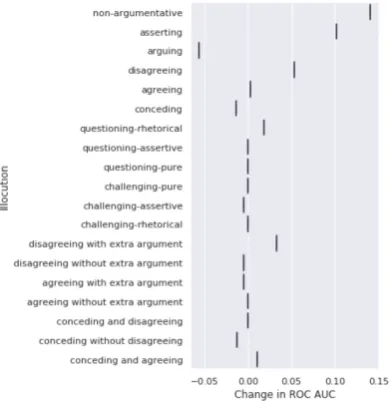
Figure 7: ROC AUC Performance change from bag of GloVe vectors due to adding alignment features.
to avoid infinite values and floor effects - for ex-ample where the reply does not contain a word from c. This range is large enough to cover the size of alignment effects we observed. Follow-ing this calculation method we end up with an11 -dimensional vector of alignments over each LIWC category for each reply.
4.3 Detecting Argumentative Discourse Acts
To investigate our second preliminary research question we perform logistic regression for each annotated comment and each discourse act. Our baseline is a bag of GloVe vectors (Pennington et al.,2014). We use the 25-dimensional vectors trained on 27 billion tokens from a Twitter cor-pus. We concatenate the 11-dimensional align-ment score vector to the bag of GloVe representa-tion and look for an increase in performance. We randomly split the dataset into 600 training data points, and200for testing. We implement logis-tic regression with Scikit-learn (Pedregosa et al.,
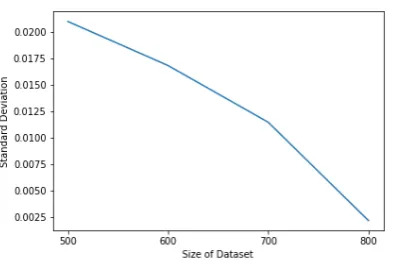
[image:5.595.86.272.75.260.2]Figure 8: Mean of the standard deviation of parameter estimates as a function of dataset size. For each dataset size we fit the model 10 times with a different random seed.
5 Results and Discussion
All data and code to reproduce these results are available on Github.3
5.1 Alignment and Discourse Acts
Figure 6 shows the alignment estimates over our annotated discourse acts. Due the limitations of our data we limit our preliminary research ques-tion to whether these differences are significant. We conducted pairwise t-tests for the significance of the difference between the means of our align-ment estimates for each discourse act. A clear majority were significant (p >> 0.05), with only 6.4%(22/342) insignificant. We therefore answer our first research question positively.
5.2 Detecting Discourse Acts
Figure 7 shows the change in ROC AUC of our logistic regression model with alignment features as compared to the baseline. In general alignment features are useful, with the net change over all discourse acts being positive. We therefore an-swer our second research question in the affirma-tive. However, arguing has taken an unexpected step backwards that requires further explanation. It could be a result of overfitting due to the small size of our dataset.
6 Reliability
Due to the limitations of our study we asked the question: how reliable are the alignment estimates presented here? We expect noise to come from three sources: (1) the small size of our dataset; (2) using a non-deterministic optimization algorithm;
3https://github.com/IKMLab/argalign1
(3) only having one annotator. We are unable to address (3) in the present work. However we in-vestigated (1) and (2) by fitting our model 10 times with different random seeds for different dataset sizes (500, 600, 700, and 800 data points) and cal-culating the standard deviation in the estimated pa-rameter means across the 10 runs. The results are given in Figure 8. We can see that by 800 data points the mean of the standard deviation has re-duced significantly to around0.002. Thus in the aggregate the parameters estimates appear to be converging already - although parameters with few data points still show larger variance. We clearly need more data for lower frequency discourse acts.
7 Conclusion and Future Work
We have reported what are likely to be robust re-sults showing significant difference among align-ment effects over argualign-mentative discourse acts in a below the line comments genre. Comment level alignment features were shown to be useful for detecting argumentative discourse acts in the ag-gregate. Our study is limited by a small dataset, which is particularly felt for low frequency dis-course acts, and an annotation scheme lacking multiple annotators. Therefore our immediate fu-ture work includes expanding our dataset and ac-quiring multiple annotations. We also plan to make our investigations more robust by including a cross-linguistic comparison with Mandarin data. Although these results are not robust enough to draw more interesting conclusions about the ob-served patterns, we make one suggestive observa-tion. Alignment appears higher for discourse acts that involve arguing. Non-argumentative, Agree-ing, andPure Questioningshow no alignment ef-fects. In general, Arguing and Disagreeing in-crease alignment. There is support in the previous literature for a view of alignment as modulated by engagement (Niederhoffer and Pennebaker,2002). Our genre can be characterized as a clash of opin-ions. If engaging in debate is modulating align-ment it would not be surprising if alignalign-ment ef-fects were higher over argumentative discourse acts. We leave a thorough treatment of this ques-tion to future work.
are some considerations that may account for this discrepancy. Previous work (Doyle and Frank,2016) showed that alignment was less pro-nounced in telephone than online textual conver-sation (Twitter). It was hypothesized that in the textual genre there is time to review the original message when composing a reply. There may also be time to reflect and choose a communica-tion strategy. In face-to-face argumentacommunica-tion, on the other hand, one is forced to react in the mo-ment, with far less time to prepare a considered response. Our tentative results appear to support a view alignment as modulated bycommunication strategy(Fusaroli et al.,2012).
We also need to apply our methods to existing datasets for comparison. In particular the US 2016 Election Reddit corpus (Visser et al.,2019) is al-ready annotated with IAT discourse acts. The IAC should also be used to further investigate the re-lationship between alignment and disagreement, particularly as our finding appears to contradict previous results.
Our methods, particularly the calculation of lo-cal alignment in replying comments, can be sharp-ened, especially as the volume of data grows. We also note that in our dataset repliers often directly quote large portions of text in the original mes-sage. This may skew alignment calculations in these instances. We will apply a preprocessing step in future to control for this. Another pecu-liar feature of our genre is that comments are of-ten directed to the broader audience. IAC is anno-tated with this aspect, and it will be important to investigate how this affects alignment. It may be worthwhile investigating methods that consider a broader context than the immediate message and reply. We also need to consider alignment over words as well as categories, particular as previ-ous research showed alignment over words to be a more primary phenomenon (Doyle and Frank,
2016).
Other phenomenon have been proposed to mod-ulate alignment in argumentation. It has been suggested that arguing a minority position may be accompanied by an increased need for persua-siveness (Pennebaker et al., 2003) (and therefore an increased usage of “causation” words). Argu-mentation schemes may also prove to modulate alignment. An argument from authority, for ex-ample as an eyewitness, could require a commu-nicative strategy that sounds authoritative -
hav-ing the power of knowledge. Previous results showed that power does not align but is aligned to. That would lead to the hypothesis that such an argument scheme should be correlated with a smaller or negative alignment effect. Modeling argument schemes directly may therefore help to improve the accuracy of argumentative alignment estimates.
Acknowledgements
We would like to thank the reviewers for their helpful comments.
References
Rob Abbott, Brian Ecker, Pranav Anand, and Mari-lyn A. Walker. 2016. Internet argument corpus 2.0: An sql schema for dialogic social media and the cor-pora to go with it. InLREC.
Frances R. Bilous and Robert M. Krauss. 1988. Domi-nance and accommodation in the conversational be-haviours of same- and mixed-gender dyads. Lan-guage & Communication, 8(3):183 – 194. Special Issue Communicative Accomodation: Recent De-velopments.
Kasia Budzynska, Mathilde Janier, Chris Reed, and Patrick Saint-Dizier. 2016. Theoretical foundations for illocutionary structure parsing. Journal of Argu-mentation and Computation, 7(1):91–108. Thanks to IOS PRESS editor. The definitive version is avail-able at http://www.iospress.nl/journal/argument-computation/. This papers appears in Volume 7 of Journal of Argumentation and Computation ISSN 1946-2166 The original PDF is available at: http://content.iospress.com/articles/argument-and-computation/aac005.
Katarzyna Budzynska and Chris Reed. 2011. Speech acts of argumentation: Inference anchors and pe-ripheral cues in dialogue. InComputational Models of Natural Argument.
Bob Carpenter, Andrew Gelman, Matthew Hoffman, Daniel Lee, Ben Goodrich, Michael Betancourt, Marcus Brubaker, Jiqiang Guo, Peter Li, and Allen Riddell. 2017. Stan: A probabilistic programming language. Journal of Statistical Software, Articles, 76(1):1–32.
Robin Cohen. 1987. Analyzing the structure of ar-gumentative discourse. Computational Linguistics, 13:11–24.
Gabriel Doyle and Michael C. Frank. 2016. Investigat-ing the sources of lInvestigat-inguistic alignment in conversa-tion. InProceedings of the 54th Annual Meeting of the Association for Computational Linguistics (Vol-ume 1: Long Papers), pages 526–536, Berlin, Ger-many. Association for Computational Linguistics.
Gabriel Doyle, Amir Goldberg, Sameer Srivastava, and Michael Frank. 2017. Alignment at work: Using language to distinguish the internalization and self-regulation components of cultural fit in organiza-tions. InProceedings of the 55th Annual Meeting of the Association for Computational Linguistics (Vol-ume 1: Long Papers), pages 603–612, Vancouver, Canada. Association for Computational Linguistics.
Gabriel Doyle, Dan Yurovsky, and Michael C. Frank. 2016. A robust framework for estimating linguis-tic alignment in twitter conversations. In Proceed-ings of the 25th International Conference on World Wide Web, WWW ’16, pages 637–648, Republic and Canton of Geneva, Switzerland. International World Wide Web Conferences Steering Committee.
Nicholas D. Duran and Riccardo Fusaroli. 2017. Con-versing with a devils advocate: Interpersonal coordi-nation in deception and disagreement. PLOS ONE, 12(6):1–25.
Riccardo Fusaroli, Bahador Bahrami, Karsten Olsen, Andreas Roepstorff, Geraint Rees, Chris Frith, and Kristian Tyln. 2012. Coming to terms: Quantifying the benefits of linguistic coordination. Psychologi-cal Science, 23(8):931–939. PMID: 22810169.
Howard Giles, Nikolas Coupland, and Justine Coup-land. 1991. Accommodation theory: Communica-tion, context, and consequence, Studies in Emotion and Social Interaction, page 168. Cambridge Uni-versity Press.
Augusto Gnisci. 2005. Sequential strategies of accom-modation: a new method in courtroom. The British journal of social psychology, 44 Pt 4:621–43.
Molly E. Ireland, Richard B. Slatcher, Paul W. East-wick, Lauren E. Scissors, Eli J. Finkel, and James W. Pennebaker. 2011. Language style matching pre-dicts relationship initiation and stability. Psycholog-ical Science, 22(1):39–44. PMID: 21149854.
Ewa Kacewicz, James W. Pennebaker, Matthew Davis, Moongee Jeon, and Arthur C. Graesser. 2014. Pronoun use reflects standings in social hierar-chies. Journal of Language and Social Psychology, 33(2):125–143.
Michael Natale. 1975. Convergence of mean vocal in-tensity in dyadic communication as a function of so-cial desirability. Journal of Personality and Social Psychology, 32:790–804.
Kate G. Niederhoffer and James W. Pennebaker. 2002. Linguistic style matching in social interaction. Jour-nal of Language and Social Psychology, 21(4):337– 360.
Bill Noble and Raquel Fernandez. 2015. Centre stage: How social network position shapes linguistic co-ordination. In Proceedings of the 6th Workshop on Cognitive Modeling and Computational Linguis-tics, pages 29–38, Denver, Colorado. Association for Computational Linguistics.
Alexandra Paxton and Rick Dale. 2013.Argument dis-rupts interpersonal alignment. Quarterly journal of experimental psychology (2006), 66:2092–102.
F. Pedregosa, G. Varoquaux, A. Gramfort, V. Michel, B. Thirion, O. Grisel, M. Blondel, P. Pretten-hofer, R. Weiss, V. Dubourg, J. Vanderplas, A. Pas-sos, D. Cournapeau, M. Brucher, M. Perrot, and E. Duchesnay. 2011. Scikit-learn: Machine learning in Python. Journal of Machine Learning Research, 12:2825–2830.
James Pennebaker, Ryan Boyd, Kayla Jordan, and Kate Blackburn. 2015. The development and psychomet-ric properties of liwc2015.
James Pennebaker and Laura King. 2000. Linguis-tic styles: Language use as an individual differ-ence. Journal of personality and social psychology, 77:1296–312.
James W. Pennebaker, Matthias R. Mehl, and Kate G. Niederhoffer. 2003. Psychological aspects of nat-ural language use: Our words, our selves. An-nual Review of Psychology, 54(1):547–577. PMID: 12185209.
Jeffrey Pennington, Richard Socher, and Christo-pher D. Manning. 2014. Glove: Global vectors for word representation. InEmpirical Methods in Nat-ural Language Processing (EMNLP), pages 1532– 1543.
Sara Rosenthal and Kathy McKeown. 2015. I couldn’t agree more: The role of conversational structure in agreement and disagreement detection in online dis-cussions. InSIGDIAL Conference.
Hagyeong Shin and Gabriel Doyle. 2018. Align-ment, acceptance, and rejection of group identities in online political discourse. InProceedings of the 2018 Conference of the North American Chapter of the Association for Computational Linguistics: Student Research Workshop, pages 1–8, New Or-leans, Louisiana, USA. Association for Computa-tional Linguistics.
Sameer B. Srivastava, Amir Goldberg, V. Govind Ma-nian, and Christopher Potts. 2018.Enculturation tra-jectories: Language, cultural adaptation, and indi-vidual outcomes in organizations.Management Sci-ence, 64(3):1348–1364.
Jacky Visser, Barbara Konat, Rory Duthie, Marcin Koszowy, Katarzyna Budzynska, and Chris Reed. 2019. Argumentation in the 2016 us presidential elections: annotated corpora of television debates and social media reaction.Language Resources and Evaluation.
Michael Willemyns, Cynthia Gallois, Victor J. Callan, and Jeffery Pittam. 1997. Accent accommodation in the job interview: Impact of interviewer accent and gender. Journal of Language and Social Psychol-ogy, 16(1):3–22.