Linking Climatic Variability with Spatial Performance in
Two Varieties of Quinoa Distributed in a Semi-Arid Zone
Sonia Montecinos1, Pablo Salinas1, Rómulo Oses2, Leticia González-Silvestre1, Marco A. Molina-Montenegro3*
1Centro de Estudios Avanzados en Zonas Áridas (CEAZA), Colina El Pino s/n, La Serena, Chile; 2Banco Base de Semillas-Instituto de Investigaciones Agropecuarias (INIA), Centro Regional Intihuasi, La Serena, Chile; 3Centro de Estudios Avanzados en Zonas Áridas (CEAZA), Facultad de Ciencias del Mar, Universidad Católica del Norte, Coquimbo, Chile.
Email: *[email protected]
Received September 28th, 2012; revised October 19th, 2012; accepted November 17th, 2012
ABSTRACT
Different crop varieties can respond in different ways to the climatic variations at local scale. Thus, in order to maxi- mize the yield for a determined crop, the response of different varieties submitted to local climatic conditions should be assessed. The main goal of this study was to evaluate the ecophysiological responses of two varieties of Quinoa (PRP and BO78) submitted to different conditions of thermal amplitude. We performed two experiments in both greenhouse and in 3 sites on experimental-field where were evaluated survival, photochemical efficiency, plant growth and dry biomass in both varieties and compared them with the mean of the thermal conditions recorded during the last 16 years in the Coquimbo Region, Chile. Overall, individuals of BO78 showed higher performance in the sites with lower ther- mal amplitude than those of PRP. By contrast, in sites with higher thermal amplitude individuals of PRP showed better survival, physiological performance and biomass and therefore higher performance. Our results suggest that while BO78 showed an ecotypic strategy, the PRP showed a plastic strategy to maintain higher performance in sites with moderate and high climatic variability. We consider that under an increase in desertification, semi-arid areas would be available for stress tolerant crops like Quinoa, but the success for the food security in these regions may depend upon the variety used.
Keywords: Quinoa; Thermal Amplitude; Plasticity; Ecophysiology; Crop Yield
1. Introduction
Climatic conditions play a pivotal role in the develop- ment of agricultural activities. The increase of the popu- lation makes it necessary to identify stress-tolerant plants with high nutritional qualities, in order to maintain food security [1,2]. In addition to water availability, the yields of the cultivars distributed in arid and semi-arid zones depend on chilling temperatures and diurnal temperature amplitude [3]. Thus if local characteristics such as the topography of a specific site show high spatial variability, different varieties or cultivars may respond in different ways. Therefore, only unraveling how different varieties or cultivars respond under regional or local climatic con- ditions will it be possible to find the best combination among varieties and sites in order to maximize perform- ance for a given crop.
The majority of studies evaluating the success of es- tablishment and production in crops have focused mainly on morphological traits [4-6]. Nevertheless, physiologi-
cal performance is thought to be the major mechanisms allowing organisms to adapt to novel, stressful or chang- ing environments. For instance, physiological traits that control the uptake of carbon dioxide and water use effi- ciency are highly plastic [7] and are key determinants of growth and crop yield [8].
One of the most adapted plant species to adverse cli- matic conditions is Quinoa (Chenopodium quinoa Willd).
This plant is highly nutritious, with very high protein content and a lot of minerals and vitamins [9]. Accumu- lating simple carbohydrates and changing in their en- zymes, it can grow in a variety of environmental condi- tions, such as very low chilling temperature and extreme diurnal temperature amplitude [10]. However both har- vest factors and nutritional properties depend on environ- mental conditions. For example, [9] showed that tem- perature is one of the main determinant factors in the spatial variability of Quinoa productivity. On the other hand, in a recent paper [2] showed that different varieties of Quinoa possess high tolerance to abiotic stress, but the magnitude of the response varies with each variety.
The goal of this article is to evaluate the spatial distri- bution of the potential performance of two Quinoa varie- ties in a semi-arid zone. Specifically, we matched the survival, photochemical efficiency and biomass of both varieties submitted to thermal amplitude variation with the records of 16 years of climatic conditions for this semi-arid zone.
2. Material and Methods
This study was carried-out in 3 sites along an East-West gradient: La Serena (30˚02'S, 71˚14'W), Vicuña
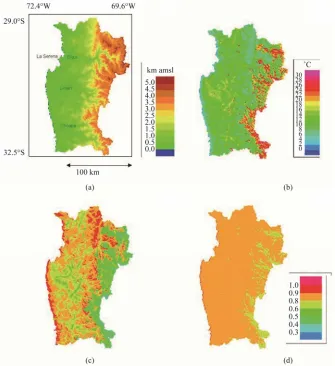
(30˚16'S, 70˚30'W) and Paihuano (30˚08'S, 70˚42'W) in the semi-arid Coquimbo Region of Chile, south of the hyperarid Atacama desert. It is characterized by a com- plex topography with altitude that varies from sea level increasing to the east, reaching heights of about 5000 min the Andes (Figure 1(a)). This region has 3 trans-
verse valleys, Elqui, Limarí and Choapa, where agricul- tural activities can be developed by using the water re- sources coming from the mountains.
2.1. Climatic Conditions
The climatic conditions were evaluated using the Karl- sruhe Atmospheric Mesoscale Model KAMM [11]. More information about the model can be found in [12]. We evaluated the mean meteorological conditions over a period of 16 years, from 1990 to 2006. The methodology is based on cluster analysis [13], which means that all days of the period are divided into groups, called clusters, which are similar in some way. The variables used to define similarity were the zonal and meridional winds, both at 500 hPa, and the temperature amplitude between 850 hPa and 500 hPa. The criteria used for clustering was the Euclidean Distance as the distance coefficient and Ward’s method as the grouping algorithm [14].
[image:2.595.132.467.342.708.2]For each cluster, a representative simulation with the KAMM model was performed. The initial atmospheric profiles required by the model were evaluated by taking the mean values of the members of each cluster. The necessary data for clustering and initialization were taken from the National Center for Environmental Prediction/
NCAR Reanalysis [15]. The profiles are used by the KAMM to construct the initial state of the atmosphere as start data for the simulations.
The simulations of the clusters were averaged taking into account the statistical weight of the clusters. The resulting mean diurnal cycles of the meteorological vari- ables were evaluated and compared with observations taken from 30 ground meteorological stations distributed in the Coquimbo Region. Since the model needs as input fields of topography, soil type and soil cover,we used the soil map based on the survey performed by CONAMA [16].
2.2. Germination and Growth Conditions
We used individuals of two Quinoa varieties (PRP and BO78) grown from seeds obtained from the National Seed Bank of Chile managed by INIA-Intihuasi (Vicuña, Chile). Seeds were surface-sterilized with 70% (v/v) ethanol for 5 min followed by 10% (v/v) commercial bleach for 5 min, and rinsed five times in sterile water. After stratification at 4˚C for three days to synchronize germination, seeds were sown in 12 × 12 cm Petri dishes containing autoclaved half-strength Murashige and Skoog medium (MS; [17]). Plates containing 25 seeds each were then arranged vertically in growth chambers at 21˚C (±2˚C) under a 16/8 h light/dark photoperiod (100
μmol·m–2·s–1 irradiance) for up to 12 days.
2.3. Greenhouse Experiment
One hundred and twenty one-month-old seedlings of each variety were transplanted to plastic pot (0.5 l) filled with commercial soil and distributed in growth chambers with different temperature amplitudes (Table 1). The
manipulative experiment of thermal amplitude lasted for 6 months and during this period we recorded the survival every day; at end of the experiment both physiological performance (Fv/Fm) and dry biomass were measured.
Plants were irrigated (50 ml/ind.) and supplemented with 0.2 g·l–1 of Phostrogen® (Solaris, NPK, 14:10:27) once
every 3 and 15 d, respectively.
We devised an ad hoc equation to provide an overall
estimate of the performance of the two varieties using the values of survival, Fv/Fm and biomass, using a scale of 0 to 1 for each. Fv/Fm was measured in this scale; percent survival was converted to decimal values. Since the maximum biomass was produced with 0 thermal ampli- tude, we divided the observed biomasses by this value for each strain. Because survival is the most important factor for performance in the semi-arid Coquimbo Re- gion, we weighted this character by 0.5 and used 0.25 as the weight for the other two variables. The performance measure with the scaled values was thus:
Performance 0.5 survival 0.25 Fv Fm 0.25 biomass
We considered this weighting because the most critical process to obtain a successful yield in the field of the semi-arid Coquimbo region is the survival of seedlings, followed by physiological performance and accumulation of biomass. The information obtained from this manipu- lative experiment was superimposed on the map of ther- mal amplitudes of the Coquimbo region, obtaining this way a map of potential performance for the Quinoa va- rieties.
2.4. Field Experiment
[image:3.595.58.540.579.735.2]Ninety one-month old seedlings of each variety were transplanted to plastic pot (30 l) filled with commercial soil and distributed in each study site (N = 15 individual/ variety/site). Individuals of both varieties of Quinoa were chosen for measurements of photosynthetic performance using an Infra-red gas analyzer (CIRAS-2; PP-Systems, Have-hill, MA, USA). Measurements were made on 12 adult individuals in each site, during two consecutive days,
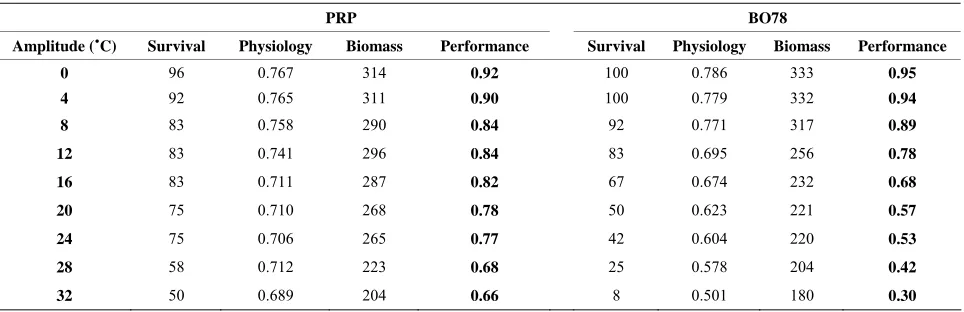
Table 1. Survival percentage, physiological performance (Fv/Fm) and dry biomass (g) in two varieties (PRP and BO78) of quinoa submitted to a manipulative experiment of thermal amplitude variation.
PRP BO78
Amplitude (˚C) Survival Physiology Biomass Performance Survival Physiology Biomass Performance
0 96 0.767 314 0.92 100 0.786 333 0.95
4 92 0.765 311 0.90 100 0.779 332 0.94
8 83 0.758 290 0.84 92 0.771 317 0.89
12 83 0.741 296 0.84 83 0.695 256 0.78
16 83 0.711 287 0.82 67 0.674 232 0.68
20 75 0.710 268 0.78 50 0.623 221 0.57
24 75 0.706 265 0.77 42 0.604 220 0.53
28 58 0.712 223 0.68 25 0.578 204 0.42
in the late growing season (November). Measurements were performed on leaves fully exposed to the sun, on a typical daily cycle (sunny day), because this condition is likely to be most representative of daily carbon gain. Photosynthetic performance was compared with a two- way ANOVA, where the varieties and sites were inde- pendent variables. On the other hand, individuals of Quinoa were randomly assigned to each of 3 sites and were measured prior to the start of experimental treat- ments (initial height). A one-way ANOVA showed no differences in initial height among groups (data not shown). Pots were randomly placed on bare ground ex- posed to natural environmental conditions. After 6 months, plant height was measured again and plant growth was determined as the difference between this measure and initial height for each individual. Plant growth was com- pared with a two-way ANOVA, where the varieties and sites were independent variables.
3. Results
3.1. Climatic Conditions
The mean temperature amplitudes are shown in Figure 1(b). It can be seen that the diurnal temperature ampli-
tude increases eastwards, with coastal values of about 8˚C and values up to 26˚C in the high Andes (Figure 1(b)). This effect may be due to the humidity coming
from the ocean, which increases the humidity near the coast and moderates the heating of the air, and the higher solar radiation and extreme drought condition in the An- des Range. On the other hand, minimum and maximum temperatures at the coast are about 12˚C and 20˚C, re-spectively, while in the Andes the minimum and maxi-mum temperatures values range between 12˚C and 14˚C, respectively, mainly in the high summits.
3.2. Greenhouse Experiment
Survival was higher in the BO78 variety than PRP below 8˚C thermal amplitude, at larger values this trend was reversed (Table 1). Similarly, photochemical efficiency
(Fv/Fm) and biomass were greater in individuals of BO78 than those belonging to variety PRP but only up to 8˚C, at greater thermal amplitude the trend was reversed (Table 1). Performance of both varieties decreased with
increase of thermal amplitude, being more notorious in BO78 than PRP (Table 1). Spatial variability in the per-
formance of Quinoa showed differences among varieties. Individuals of variety BO78 showed higher performance in the coast zones (lesser thermal amplitude) with a sharp decrease inland (Figure 1(c)). Inversely, those individu-
als of variety PRP showed better overall performance than BO78, maintaining their performance relatively constant from coast to inland with a smooth decrease in the foothills where the thermal amplitude exceeds 30˚C
(Figure 1(d)).
3.3. Field Experiment
The photosynthetic performance of Quinoa individuals was significantly higher in the coastal site (F1, 66 = 83.93;
p < 0.001) than others most continental (Figure 2(a)). On
the other hand, interaction was significant (F2, 66 = 111.57;
p < 0.001) because those individuals of BO78 variety showed higher photosynthetic performance in the coastal site decreasing toward inland, but PRP variety showed similar photosynthetic performance along the gradient (Figure 2(a)). Similarly, plant growth was significantly
higher in the coastal site (F1, 66 = 5.21; p < 0.001) com-
pared with the other two sites (Figure 2(b)). Interaction
factor was significant (F2, 66 = 9.82; p < 0.001) because
while BO78 variety showed a steeper decrease from coastal site to inland site, those of PRP variety showed a smooth increase on the same gradient (Figure 2(b)).
4. Discussion
Quinoa is one of the most consumed crops worldwide and is very tolerant to abiotic stress [18]. Nevertheless, it
has been demonstrated that abiotic conditions can affect many ecophysiological processes, which makes its pro- duction highly dependent upon environmental variation [19]. Despite the limitations for cultivation the demand is growing constantly, thus many studies have aimed to evaluate the effects of climate variability on physiology and production [20].
In this study we found that different varieties of Qui- noa subjected to high thermal amplitude conditions de- creased their photosynthetic parameters, thus affecting the accumulation of fresh biomass and therefore per- formance. Similar results have been found in other stud- ies. For instance, [21] demonstrated negative impacts of climate variability on production in many crops, where the temperature variability increased the risks to yield, as shown via computer simulation and experimental studies. On the other hand, it has been reported that thermal os- cillation may reduce both photosynthesis parameters and survival percentage, affecting the final performance of a determined crop [22]. Although both varieties decreased their performance in both field and greenhouse condi- tions when they were exposed to higher thermal ampli- tudes, they did so in different ways. Those individuals belonging to variety BO78 showed higher performance at lower thermal amplitude than PRP, but the latter showed higher performance under a higher thermal amplitude scenario.
These results suggest that the varieties respond in dif- ferent ways to thermal amplitude; while BO78 showed an ecotypic response, those individuals belonging to PRP showed a plastic response. Similar responses have been shown previously for others varieties of Quinoa under abiotic stress [20,23]. For example, a recent study showed that PRP and BO78 displayed different strategies in order to cope with salt stress; both proved to be toler- ant varieties, with plastic and ecotypic mechanisms, re- spectively [2].
It has been shown that plants can respond to chal- lenges imposed by environmental conditions by means of phenotypic plasticity and/or ecotypic differentiation [24]. Ecological theory predicts that phenotypic plasticity should be the main adaptive mechanism in heterogeneous or changing environments, whereas relatively stable en- vironments should select for locally adapted ecotypes [25]. Thus, PRP and BO78 may be successful varieties in zones with lower and higher thermal amplitudes, respec- tively, determining that each variety shows better per- formance in certain areas of the environmental conditions prevailing in the semi-arid region of Coquimbo.
Patterns of precipitation and temperature are changing globally [26]. In a global change scenario, semi-arid ar- eas would be available for stress tolerant crops, showing different yields according to the variety used. Although it is important to understand how different varieties of
crops respond to temporally and spatially changing envi- ronments, we are still far from understand the optimal “variety-site” interaction underlying the undisputable success of Quinoa crop. This study has identified pro- mising avenues of research to accomplish such a goal.
5. Acknowledgements
This work was partially supported by CONICYT, Project FONDEF D05I10038 and the International Exchange Project BMBF-CONICYT 066-2007. Authors thank SCC (Steinbuch Centre for Computing, Karl Institut für Tech- nologie (KIT), Germany) for the supply of computing time on NEC SX8 in the context of Campos Grid Project. Also, we thank to I. Bischoff-Gauss and N. Kalthoff for useful discussion.
REFERENCES
[1] T. J. Flowers, “Improving Crop Salt Tolerance,” Journal of Experimental Botany, Vol. 55, No. 396, 2004, pp. 307- 319. doi:10.1093/jxb/erh003
[2] K. Ruiz-Carrasco, F. Antognoni, A. Konotie-Coulibaly, S. Lizardi, A. Covarrubias, E. A. Martínez, M. A. Molina- Montenegro, S. Biondi and A. Zurita-Silva, “Variation in Salinity Tolerance of Four Lowland Varieties of Quinoa (Chenopodium quinoa Willd.) as Assessed by Growth,
Physiological Traits, and Sodium Transporter Gene Ex- pression,” Plant Physiology and Biochemistry, Vol. 49,
No. 11, 2011, pp. 1333-1341. doi:10.1016/j.plaphy.2011.08.005
[3] B. Kruk, P. Insausti, A. Razul and R. Benech-Arnold, “Light and Thermal Environments as Modified by a Wheat Crop: Effects on Weed Seed Germination,” Journal of Applied Ecology, Vol. 43, No. 2, 2006, pp. 227-236. doi:10.1111/j.1365-2664.2006.01140.x
[4] P. W. Barnes, S. D. Flint and M. M. Caldwell, “Morpho- logical Responses of Crop and Weed Species of Different Growth Forms to Ultraviolet-B Radiation,” American Journal of Botany, Vol. 77, No. 10, 1990, pp. 1355-1360. doi:10.2307/2444596
[5] H. W. Koyro and S. S. Eisa, “Effect of Salinity on Com- position, Viability and Germination of Seeds of Cheno- podium quinoa Willd,” Plant and Soil, Vol. 302, 2008, pp.
79-90. doi:10.1007/s11104-007-9457-4
[6] N. S. Mattson and W. R. Leatherwood, “Potassium Sili- cate Drenches Increase Leaf Silicon Content and Affect Morphological Traits of Several Floriculture Crops Grown in a Peat-Based Substrate,” HortScience, Vol. 45, No. 1,
2010, pp. 43-47.
[7] M. S. Heschel, S. E. Sultan, S. Glover and D. Sloan, “Population Differentiation and Plastic Responses to Drought Stress in the Generalist Annual Polygonum per- sicaria,” International Journal of Plant Sciences, Vol.
165, No. 5, 2004, pp. 817-824. doi:10.1086/421477 [8] M. A. Molina-Montenegro, A. Zurita-Silva and R. Oses,
Investigación Agraria, Vol. 38, No. 1, 2011, pp. 65-74.
[9] M. Rosa, M. Hilal, J. A. González and F. E. Prado, “Changes in Soluble Carbohydrates and Related Enzymes Induced by Low Temperature during Early Develop- mental Stages of Quinoa (Chenopodium quinoa) Seed-
lings,” Journal of Plant Physiology, Vol. 161, No. 6,
2004, pp. 683-689. doi:10.1078/0176-1617-01257 [10] J. F. Bois, T. Winkel, J. P. Lhomme, J. P. Raffaillac and
A. Rocheteau, “Response of Some Andean Cultivars of Quinoa (Chenopodium quinoa Willd.) to Temperature:
Effects on Germination, Phenology, Growth and Freez- ing,” European Journal of Agronomy, Vol. 25, No. 4, 2006, pp. 299-308. doi:10.1016/j.eja.2006.06.007 [11] G. Adrian and F. Fiedler, “Simulation of Unstationary
Wind and Temperature Fields over Complex Terrain and Comparison with Observations,” Contribution to Atmos- pheric Physics, Vol. 64, 1991, pp. 27-48.
[12] S. Montecinos, W. Boersch-Supan, V. Favier, O. As- tudillo and Y. Tracol, “Impacts of Agricultural Activities on the Regional Climate in an Arid Zone in Chile,” Die Erde, Vol. 139, 2008, pp. 77-95.
[13] M. R. Anderberg, “Cluster Analysis for Applications,” Academic Press, New York, 1973.
[14] J. H. Ward, “Hierarchical Grouping to Optimize an Ob-jective Function,” Journal of the American Statistical Association, Vol. 58, No. 301, 1963, pp. 236-244.
doi:10.1080/01621459.1963.10500845
[15] E. Kalnay, M. Kanamitsu, R. Kistler, W. Collins, D. Deaven, L. Gandin, M. Iredell, S. Saha, G. White, J. Woollen, Y. Zhu, M. Chelliah, W. Ebisuzaki, W. Higgins, J. Janowiak, K. C. Mo, C. Ropelewski, J. Wang, A. Leetmaa, R. Reynolds, R. Jenne and D. Joseph, “The NCEP/NCAR 40-Year Reanalysis Project,” Bulletin of the American Meteorological Society, Vol. 77, No. 3,
1996, pp. 437-471.
doi:10.1175/1520-0477(1996)077<0437:TNYRP>2.0.CO ;2
[16] CONAMA, “Catastro y Evaluación de Recursos Vege- tacionales nativos de Chile,” Universidad Austral de Chile, Pontificia Universidad Católica de Chile, Uni- versidad Católica de Temuco, Chile, 1999.
[17] T. Murashige and F. Skoog, “A Revised Medium for Rapid Growth and Bioassays with Tobacco Tissue
Cul-tures,” Physiologia Plantarum, Vol. 15, No. 43, 1962, pp.
473-479. doi:10.1111/j.1399-3054.1962.tb08052.x [18] E. A. Martínez, E. Veas, C. Jorquera, R. San Martín and P.
Jara, “Re-Introduction of Chenopodium quinoa Willd.
into arid Chile: Cultivation of Two Lowland Races under Extremely Low Irrigation,” Journal of Agronomy and Crop Science, Vol. 195, No. 1, 2009, pp. 1-10.
doi:10.1111/j.1439-037X.2008.00332.x
[19] S. Geerts, D. Raes, M. Garcia, C. Taboada, R. Miranda, J. Cusicanqui, T. Mhizha and J. Vacher, “Modeling the Po- tential for Closing Quinoa Yield Gaps under Varying Water Availability in the Bolivian Altiplano,” Agricul- tural Water Management, Vol. 96, 2009, pp. 1652-1658.
doi:10.1016/j.agwat.2009.06.020
[20] J. A. González, M. Gallardo, M. Hilal, M. Rosa and F. E. Prado, “Physiological Responses of Quinoa (Chenopo-
dium quinoa Willd.) to Drought and Waterlogging
Stresses: Dry Matter Partitioning,” Botanical Studies, Vol.
50, No. 1, 2009, pp. 35-42.
[21] J. R. Porter and M. A. Semenov, “Crop Responses to Climatic Variation,” Philosophical Transaction of the Royal Society B, Vol. 360, No. 1463, 2005, pp. 2021- 2035. doi:10.1098/rstb.2005.1752
[22] H. R. Huarte and R. L. Benech-Arnold, “Understanding Mechanisms of Reduced Annual Weed Emergence in Al- falfa,” Weed Science, Vol. 51, No. 6, 2003, pp. 876-885.
doi:10.1614/P2002-140
[23] S. E. Jacobsen, C.Monteros, J. L. Christiansen, L. A. Bravo, L. J. Corcuera and A. Mujica, “Plant Responses of Quinoa (Chenopodium quinoa Willd.) to Frost at Various Phenological Stages,” European Journal of Agronomy,
Vol. 22, No. 2, 2005, pp. 131-139. doi:10.1016/j.eja.2004.01.003
[24] C. D. Schlichting and M. Pigliucci, “Phenotypic Evolu- tion: A Reaction Norm Perspective,” Sunderland, Sinauer, 1998.
[25] M. A. Molina-Montenegro, C. Atala and E. Gianoli, “Phenotypic Plasticity and Performance of Taraxacum of- ficinale (Dandelion) in Habitats of Contrasting Environ-
mental Heterogeneity,” Biological Invasions, Vol. 12, No.
7, 2010, pp. 2277-2284. doi:10.1007/s10530-009-9638-6 [26] IPCC, “Intergovernmental Panel of Climate Change,”