COMMISSION OF THE EUROPEAN COMMUNITIES
COMMUNITY SUPPORT
FRAMEWORK
1989-93
for the development and structural adjustment
of the regions whose development is lagging behind
(Objective 1)
PORTUGAL
LIBRARY
-=-=--
---
--
-~--=--
---
-=gi
-
- -
--~=
-
-
~-
-
--- ---.11111111=
-C\I """
,...
~-~
cc
~
::, g
w>
.c"'C
Cl)
C:
I,. Cl)
(.)
C:
0
(.)
Ill
C:
0
C'l
Cl)
a:
COMMISSION OF THE EUROPEAN COMMUNITIES
COMMUNITY SUPPORT FRAMEWORK
1989-93
for the development and structural
adjustment of the regions whose
development is lagging behind
(Objective 1)
PORTUGAL
This document has been prepared for use within the Commission. It does not necessarily represent the Commission's official position.
This publication is also available in the following languages:
FR ISBN 92-826-0179-X
PT ISBN 92-826-0180-3
Cataloguing data can be found at the end of this publication
Luxembourg: Office for Official Publications of the European Com-munities, 1990
ISBN 92-826-0178-1
Catalogue number: CB-38-89-007-EN-C
©
ECSC-EEC-EAEC, Brussels• Luxembourg, 1989Reproduction is authorized, except for commercial purposes, provided the source is acknowledged.
Contents
Introduction by Mr Bruce Millan, Member of the Commission responsible for regional policies 5
Objectives of the structural Funds 7
Chapter 1. Development problems and priorities for assistance 9
1.1. Development problems 9
1.2. Priorities for assistance 10
Chapter 2. Forms of assistance 13
2.1. Forms of assistance . . . 13
2.2. Regionalization of assistance 16
2.3. Data-processing equipment for monitoring the Community support framework, related measures and technical
assis-tance . . . 18
Chapter 3. Assistance from the ESF in connection with Objectives 3 and 4 . . . . 21
3.1. Socio-economic situation 21
3.2. Main trends in employment 21
3.3. Strategy and priorities . . . 21
3.4. Priorities - Objective 3 and Objective 4 22
3.5. Forms of assistance . . . 23
3.6. Monitoring and assessment 23
Chapter 4. Indicative financing plan 25
4.1. Community loans . . . 25
4.2. Community programmes 25
4.3. Financial tables 26
Chapter 5. Macroeconomic situation 33
Chapter 6. Community policies and additionality 35
6.1. Coordination of and compliance with Community policies 35
6.2. Additionality . . . 37
Chapter 7. Implementation provisions 39
7.1. Technical assistance . . . 39
7 .2. Monitoring and control . . . . 39
7.3. Guidelines for monitoring and implementation of program-mes . . . .
7.4. Information and publicity
Annex I - Regional profile
Annex II - Commission Decision of 31 October 1989
41 42
43
Introduction
by
Mr Bruce Millan
Member of the Commission
responsible for regional policies
The adoption and publication of the Community support
frameworks for Objective 1 regions marks a first and vitally
important step in putting into operation the reform of the
Community's structural Funds which was agreed in 1988.
Together the seven Community support frameworks provide
for ECU 36.2 billion in Community funding between now
and the end of 1993 in support of agreed priority measures
to boost development in the regions concerned (which are
listed in full on page 7).
The structural Funds' reform was a requirement of the
Single European Act. The Single Act not only committed
the Community to completing the internal market by 1992 :
it contained too a commitment to strengthen economic and
social cohesion throughout the Community, recognizing
that widening regional disparities could threaten the
success-ful realization of the single market. The Community is
pledged, through the Single Act, to open up the
opportuni-ties of 1992 to all its citizens.
The Community's principal instruments for fulfilling this
commitment are its three structural Funds (the European
Regional Development Fund, the European Social Fund
and the Guidance Section of the European Agricultural
Guidance and Guarantee Fund) and a number of loan
instruments (principally the European Investment Bank, the
European Coal and Steel Community and the New
Com-munity Instrument). The Single Act required the overhaul of
these various instruments so that they could be brought to
bear on the Community's structural problems m a more
concerted and thus more effective way.
The Community support framework (CSF) is one of the
principal innovations introduced by the reform. The CSF is
geared to one of the five common objectives established by
the framework regulation. Objective 1 is 'promoting the
development and structural adjustment of the regions whose
development is lagging behind'. Negotiated between the
Member State concerned and the Commission, the CSF
establishes the agreed development priorities which are to be
the focus of Community assistance and since it represents an
indicative financial commitment on the part of the
Com-munity for a five-year period, it provides a sound basis for
planning.
'Partnership' is another requirement introduced by the
reform.
It means the close involvement of regional and local
bodies with the Commission and national authorities in
planning and implementing development measures in their
areas. On the basis of the CSF, all the parties concerned in
the partnership will develop programmes and projects which
will turn the priorities identified in the CSF into actions on
the ground.
The Community support framework is thus the key to
Community financial support for structural adjustment and
economic development in each region concerned for the next
five years. In deciding to publish the CSFs in this form, my
intention is to underline their importance and their interest
for a readership extending well beyond official circles in
Brussels and national capitals.
I look forward to working closely with all those involved in
the 'partnership' established by the reform, to make these
Community support frameworks operational and bring
increased prosperity to the regions.
Objectives of the structural Funds
Community action through the structural Funds, the EIB and other existing financial instruments shall support the achievement of the general objectives set out in Article 130a and 130c of the Treaty by contributing to the attainment of the following five priority objec-tives:
1. promoting the development and structural adjustment of the regions whose development is lagging behind (Objective l);
2. converting the regions, frontier regions or parts of regions (including employment areas and urban communities) seriously affected by industrial decline (Objective 2);
3. combating long-term unemployment (Objective 3);
4. facilitating the occupational integration of young people (Objective 4);
5. with a view to reform of the common agricultural policy:
(a) speeding up the adjustment of agricultural structures (Objective 5
a);
(b) promoting the development of rural areas (Objective 5 b).
Spain
France
Greece
Ireland
Italy
Portugal
Regions concerned by Objective 1
Andalusia, Asturias, Castilla y Leon, Castilla-La Mancha, Ceuta-Melilla, Valencia, Extremadura, Galicia, Canary Islands, Murcia
French overseas departments, Corsica
the entire country
the entire country
Abruzzi, Basilicata, Calabria, Campania, Molise, Apulia, Sardinia, Sicily
: the entire country
Chapter 1
Development problems and priorities for assistance
1.1. Development problems
1Portugal as a whole is remote from the main markets of the Community, with the regions of Madeira and the Azores being particularly handi-capped in this respect. Communications infrastruc-ture is, therefore, of prime importance for the development process.
Despite its small size, Portugal has to contend with marked internal imbalances, with the main dispari-ties in development giving rise to a narrow coastal strip in the west between Braga and Setubal, where the concentration of population and productive activity is fairly pronounced, and a less heavily populated interior, which is very much dependent on the primary sector.
In the south of the country, there is quite a sharp division between the interior and the coast, with its high concentration of urban and tourist areas, manufacturing, processing, and service activities.
A decline in economic activity and population is discernible in all the frontier areas. In general, the main features of development in Portugal are:
- Inadequate economic infrastructure, whether as
regards communications, telecommunications and energy or the plant and machinery required more specifically to raise economic productivity in the individual sectors of the economy (includ-ing research and technology): on account of these shortcomings, there is a tendency towards saturation of the coastal area and the areas concerned are becoming less attractive to inves-tors. The autonomous regions of the Azores and Madeira are particularly hard-hit because of the high cost of infrastructure, especially ports and airports, which has to be tailored to their particular development needs;
- Potential for tourist development based on
nat-ural resources and on a cultnat-ural and historical heritage which is unique in the Community. Naturally, this potential will have to be exploited in such a way as to ensure protection of the country's environment and historical heritage;
1 See the annex for the regional profile of Portugal.
- Comparatively underdeveloped productive
structure, with traditional low-productivity sec-tors playing a major role: Direct support for product investment is required to complement the increased productivity that can be generated by improving the infrastructures that make up the business environment, by fostering man-power skills and by promoting entrepreneur-ship. Alongside the measures being carried out under the Pedip programme, regional imbal-ances need to be reduced by encouraging invest-ment in the less-developed regions, consolidat-ing traditional industrial and craft activities, introducing innovation into manufacturing processes and improving management skills, notably through recourse to specialist services;
- Poorly skilled or unskilled workforce as a result
of serious shortcomings in general education and in vocational training: Comparative analy-sis of the education system, research and voca-tional training shows up the extent of Portugal's backwardness; the illiteracy rate stands at 15 % ; the average length of education for the workforce is 4.5 years (7.6 years in the Com-munity as a whole); just under 70 % of workers have gone no further than primary education and 30 % have not received any vocational training; only about 6 % of managers, senior executives and professional people are highly
qualified; and the proportion of GDP spent on
R&D (0.6 % ) is the second lowest in the Com-munity.
Consequently, enormous efforts are needed to develop education and vocational training alike, not only as regards infrastructures but also with a view to improving the quality of the measures to be implemented.
- Agriculture characterized by low productivity, a
- Particular vulnerability of regions heavily dependent on recession-hit industries or those under threat of recession: these regions face special unemployment problems which call for determined action to bring about industrial conversion;
- Lack of infrastructures necessary for local
development and lack of encouragement for local and regional initiatives to promote devel-opment;
- Problems affecting the environment and human
resources: these must be resolved in conjunc-tion with the other sectoral policies (agriculture, transport, industry and tourism), whether at central or regional level.
1.2. Priorities for assistance
The Commission has applied the following princi-ples to determine priorities:
(a) Preparing the regions of Portugal for the Com-munity-wide market in 1992: It is of the utmost importance that they should be able to share in the economic dynamism generated by the pros-pect of the large internal market. With this in mind, the development strategy will need to be geared to creating appropriate industrial struc-tures, a process in which developing the voca-tional skills of the labour force will play a key role. Implementation of cross-frontier and inter-regional cooperation at Community level is also of particular importance in achieving this objec-tive, and the development strategy should be directed towards setting in place appropriate industrial structures;
(b) Preparing Portugal's human resources to meet the needs of the productive sector and in partic-ular to come to terms with the profound changes which will occur: This is essential to the success of an overall development strategy based on boosting productivity and creating higher-quality and better-paid jobs without any increase in the unemployment rate.
Vocational training and measures to foster employment should be a priority matter for sectors with growth and development potential once the single market has been created and workers in ailing sectors or sectors under threat of disappearance retrained;
(c) Striking a balance between a regional and a sectoral approach : The Portuguese plan was drawn up with national and sectoral issues in mind, but it must be remembered that certain sectoral programmes are essential for the devel-opment of the regions. Where possible, support for regional measures has been retained where they are effective;
(d) Emphasis on productive investment rather than investment in infrastructure : The Commission has laid down clear guidelines on the encour-agement of productive investment, particularly through the joint financing of aid schemes. In the case of infrastructure investment, however, assistance should be focused on those categories of investment which have the greatest possible impact on economic development;
(e) Striking a better balance between grants and loans: Recourse to loans can be considered even in the absence of any Community grants. Lower rates of assistance are applied to infra-structure investments generating revenue, e.g.
energy and telecommunications. However,
unduly generous loans may create internal bud-getary problems and contribute to an increase in the public-sector deficit;
(f) Need to take account of the anticipated
econ-omic impact of the various measures selected and their contribution to the realization of other Community policies, especially environ-mental policy, and consideration of macroecon-omic policy objectives;
(g) Capitalizing on the measures under way, e.g. Pedip and the Community programmes, and incorporating them harmoniously into the over-all development strategy.
1.2.1. Definition of priorities for
assistance
On the basis of the proposals in the Regional Development Plan for Portugal and applying the method for determining priorities as described above, the Commission has in agreement with the Member State devised the following development strategy:
Priority 1 - Creation of economic infrastructures with a direct impact on balanced economic growth
(a) Communications and telecommunications
Among other things, to link Portugal to the main European road and rail networks and to establish sound communication links between and within regions so as to expand markets, reduce the costs of goods and mitigate the effects of the country's peripheral location; improved transmission of information is also essential.
(b) Energy
( c) Science and technology
To train research workers and to set up specialist
R&D centres, design centres, research laboratories and other infrastructures that will help Portugal to meet the challenge of the Community-wide market in 1992.
(d) Services
Focus on exploiting the potential for tourism.
Priority 2 - Support for productive investment and directly related infrastructures
To support the major investment drive which will be mounted in Portugal over the next few years, this being the only way of modernizing the econ-omic fabric of the country and creating permanent jobs.
Priority 3 - Development of human resources
(a) Education
To construct, adapt and modernize educational infrastructures by selecting investments on the basis of their actual contribution to regional develop-ment.
The quality of teaching must be improved, and technical and vocational schools should increase their roles steadily.
(b) Improvement of the training structure
To provide training infrastructure and facilities, to strengthen the network of employment centres, to improve the training of instructors, development officers, and employment and vocational-training experts, to promote local employment initiatives, to set up small and medium-sized firms, to provide recruitment aid and aids for employment on com-munity work schemes for the long-term unem-ployed over 25, and to establish a monitoring network for the employment market.
( c) Apprenticeship
To provide theoretical trammg outside firms as part of a training contract.
(d) Multisectoral, multipriority and multiregional training measures
This section includes training in preparation for careers which are important to a number of devel-opment priorities or sectors of economic activity.
(e) Training measures directly linked to development priorities
In order to provide a full range of training meas-ures, this section includes all measures aimed at meeting the skilled manpower requirements of the multifund integrated operation programmes cater-ing for the other development priorities.
Measures referred to in Article 1 (2) of Regulation ( EEC) No 4255/88
In addition, it is planned to carry out measures within the framework of the innovatory technical assistance operations under the Community pro-grammes relating to training, advice and guidance for the reintegration of the long-term unemployed, and the social dialogue. These are described on page 13 and are common to all ESF operations.
Priority 4 - Improving the competitiveness of agricultural and rural development
All measures under this priority are designed :
(a) to improve the physical and structural conditions of production;
(b) to develop human resources in a rural context
by improving the level of training for farmers, including the infrastructures for training, research and experimentation, and by preparing farmers for alternative occupations;
(c) to improve the efficiency of agricultural holdings and to enhance the value of agricultural products
by modernizing agricultural holdings, including the development of complementary activities, and by modernizing structures for the processing and mar-keting of agricultural products;
(d) to redirect production and to improve quality
by switching to crops or varieties better adapted to the market situation, by undertaking improvements in plant health and crop improvements, and by promoting high-quality products.
(e) to foster rural development
by exploiting the indigenous potential of the rural areas, giving preference to a multisectoral approach and concentrating on development centres in the rural areas.
Priority 5 - Industrial conversion and restructuring
Priority 6 - Exploiting the growth potential of regions and local development
(a) Regions of mainland Portugal
In particular, the aim is to improve the quality of life and standard of living in the regions by exploit-ing existexploit-ing development potential. The increase in productivity and the exploitation of human resources associated with that improvement in the standard of living will help check the movement of population towards coastal areas.
(b) Autonomous regions
The main aims are to diversify the productive base, to increase productivity, to support the tourist trade and to improve basic infrastructures, particu-larly transport infrastructures, which will help to reduce the isolation of those regions.
1.2.2. Measures to be examined
The Portuguese Government has submitted two programmes, one for the most peripheral regions
that is intended to combat the problems which arise from the fact that they are islands remote from the main centres of population and one for frontier areas that is intended to promote balanced develop-ment and to encourage the population to remain in the regions along the frontier between Portugal and Spain, plus a plan for investment in natural gas infrastructures, aimed at diversifying the sources of
energy supply. The Portuguese Government
stresses that linking up with the European network is particularly significant in the context of the internal energy market.
For these reasons, it has asked the Commission to include the two measures in future Community initiatives. The Commission is considering this request.
Chapter 2
Forms of assistance
2.1. Forms of assistance
Taking each priority in turn, the following forms of assistance will be applicable:
Priority 1 - Creation of economic infrastructures with a direct impact on balanced economic growth
(a) Communications and telecommunications
Three operational programmes 1 and two major
projects:
- the first operational programme is concerned
with improving communications and covers various types of infrastructure, including roads connecting major centres, railways and ports, with Community support being concentrated on the infrastructures which will contribute most towards improving the movement of the factors of production and finished products;
- the rural telecommunications programme will
help ensure that, in the outlying parts of the country, economic activity is backed up by essential telecommunications equipment; - the ST AR programme, which will run until
1991, concerns infrastructures and assistance for economic agents who use or produce mod-ern telecommunications equipment or services;
- the two projects concerning road infrastructures
(Costa do Estoril motorway and North-South highway).
(b) Energy
Two operational programmes:
- the Valoren programme (already under way),
which will run until 1991, concerns investments in public infrastructures intended to exploit indigenous energy potential and to assist in the conservation and efficient use of energy under the SIURE scheme, also part-financed by the Pedip additional contribution;
- the energy transmission and distribution
opera-tional programme concerns the transmission
1 The amounts involved are given in Table 3.
and distribution of electricity and the distribu-tion of gas in Lisbon, Porto and Coimbra. Improvement of the electricity transmission and distribution network will reduce energy losses.
(c) Science and technology
which includes an integrated operational pro-gramme to develop human resources in the field of science and technology and to establish the neces-sary infrastructure. The programme, which dove-tails with the harmonization of Community models and with the participation in European scientific and technological development, covers the whole
country. It is intended to correct the pronounced
geographical imbalances in this sector. Implemen-tation of this open-ended programme will
contrib-ute to R&D expenditure in 1993 an amount
equiv-alent to some 1 % of GDP.
(d) Services sector
which includes a single operational programme for establishing tourist infrastructures that will increase the efficiency of private tourist investment and exploit indigenous resources and potential.
Priority 2 - Support for productive investment and directly related infrastructures
This priority includes
- the national programme of Community interest
for assistance to productive activity, which has already been approved but for which further funds will be provided: The objectives of the programme are to increase private productive investment in industry and tourism and to channel such investment towards the most out-lying areas of the country, to support industrial modernization and innovation with regard to tourism, to create jobs and to encourage the establishment of development poles through business initiatives;
- the specific programme for the development of
The objectives of the programme are
• to revitalize the existing industrial base;
• to establish and develop new industries, in particular those manufacturing new prod-ucts with a high technological content and new capital goods;
•
•
to eliminate or reduce comparative struc-tural disadvantages;
to promote the dynamic specialization of Portuguese industry and to improve internal and external competitiveness;
- the aid scheme for the modernization of the
distributive trades, which is designed to correct regional imbalances in the sector, to modernize the technical and management structure of economic units, to give a boost to the distribu-tive network and to promote conversion of commercial firms.
Priority 3 - Development of human resources
(a) Education
A single integrated operational programme cover-ing the whole of mainland Portugal and intended to make education generally available, among other things by reducing the illiteracy rate from 15 % to 10 % . It is also intended to modernize educational infrastructure, notably by setting up new education centres and introducing computer equipment into schools.
The quality of education must be improved (train-ing of instructors and experts in guidance and working methods), while the technical and voca-tional training sectors will have to increase their roles steadily.
(b) Improvement of the training structure
A single integrated operational programme aimed at securing an across-the-board improvement in the output of the vocational training and job-creation schemes. This will require investment, in particular in equipping training and employment centres to cope with modern technologies and in training instructors, employment experts and development officers. The creation of a monitoring network for the employment market will undoubtedly help fur-ther to stimulate local employment initiatives and to increase the success rate for business start-ups and the effectiveness of recruitment aids for newly created jobs, especially in the most disadvantaged regions of Portugal.
(c) Apprenticeship
A single operational programme covering the theoretical part of apprenticeship training.
(d) Multisectoral, multipriority and multiregional training measures
These fall into two operational programmes, the first of which covers the training of unskilled, semi-skilled and skilled workers as well as middle and senior managers (including entrepreneurs) at national level. Under this programme, the training needs for each development priority or sector of economic activity will be spelt out, together with the follow-up and monitoring methods required to ensure close coordination between the training authorities and the authorities responsible for the individual sectors of the economy. The other pro-gramme is a horizontal propro-gramme covering train-ing in the new information technologies.
(e) Training measures directly linked to development priorities
These measures represent the vocational training part of operations, integrated operational pro-grammes and multifund operational propro-grammes covered by other development priorities. They con-stitute back-up measures for the following pro-grammes:
Priority I
Science and technology integrated operational pro-gramme
Priority 2
Pedip integrated operational programme
Priority 5
Setubal integrated development operation Vale do Ave multifund operational programme
Priority 6
Integrated development operation for the Norte Alentejano
Multifund operational programme for Madeira Multifund operational programme for the Azores
An overall amount will be allocated to the regional operational programmes as and when they are drawn up.
Measures referred to in Article 1 ( 2) of Regulation ( EEC) No 4255/88
These measures concern: innovatory operations; technical assistance; measures aimed at advising and guiding the long-term unemployed back into the labour market, and transitional measures within the framework of the social dialogue.
(a) Operations of an innovatory nature; these will be defined in the course of time and will involve the exchange of experience, the transfer of technology and know-how, and the implemen-tation of new approaches to training and employment and will be linked to Portugal's general development objectives;
(b) Technical assistance to improve training struc-tures and manpower skills : The actual details of such measures will be determined in the light of needs arising during implementation of the operation training programmes;
(c) Advice and guidance for the reintegration of the long-term unemployed. These measures will be implemented as necessary.
It is to be remembered that measures forming a part of existing Community programmes must be included in the corresponding operational pro-gramme or global grant presented in the implemen-tation of the framework.
Priority 4 - Improving the competitiveness of agriculture and rural development
This priority can be divided into the following five subpriorities:
- improvement of the production, processing and
marketing conditions for agricultural prod-ucts;
- development of human resources in a rural
context;
- improvement in the efficiency of agricultural
holdings and enhancement of the value of agri-cultural products;
- direction of production, including ancillary
activities and quality improvements;
- promotion of rural development.
Support for agricultural and rural development will be provided under these subpriorities and will take account of the need to strengthen the economic and social fabric.
The aforementioned rural development measures and those which, alongside assistance from the other Funds, form part of the programmes under Priority 6 are intended:
- to create non-agricultural activities, thereby
providing alternative sources of income;
- to adapt vocational training to the needs of the
new activities introduced into the regions con-cerned.
Priority 5 - Industrial conversion and restructuring
Having as objectives the diversification and increased profitability of production, and a reduc-tion of unemployment by the take up of manpower created by reconversion shake-outs particularly in the regions threatened by an actual or potential industrial downturn.
This priority consists of an integrated development operation and three operational programmes:
- the integrated operation covers the Setubal
peninsula, an area beset by the severe difficul-ties in the steel and shipbuilding industries and having to contend with the highest unemploy-ment rate in Portugal. The aims of the opera-tion are to reduce the unemployment rate, to encourage diversification of the economy, to boost competitiveness by introducing new tech-nologies and lowering production costs, and to develop new forms of management and voca-tional training;
- the Resider and Renaval operational
pro-grammes also cover the Setubal peninsula and are designed to diversify the region's productive base and to provide employment for the work-ers made redundant as a result of the restructur-ing of the steel and shipbuildrestructur-ing industries;
- the multifund operational programme for the
Vale do Ave in the Norte region, which has the highest concentration of traditional industries (textiles), is intended to make better use of available productive capacity and to improve vocational training in schools.
Priority 6 - Exploiting the growth potential of regions and local development
(a) Regions of mainland Portugal
An initial batch will be replaced in 1990, and a second in 1991, by operational programmes cover-ing the same NUTS level II region or territory, as appropriate. Which programmes will be multifund will be decided on the basis of each level II preparatory study.
all measures taking place in the region concerned. As regards programmes, it is proposed that assis-tance will be from the three structural Funds.
Provision is also made for a global grant to permit subsidized loans to municipalities.
(b) Autonomous regions
Two multifund operational programmes, one for each autonomous region, a large-scale project and the NPCI for the Azores, which has already been approved.
2.2. Regionalization of assistance
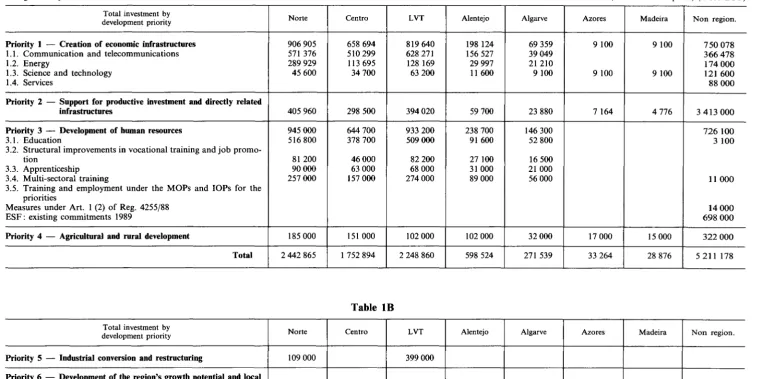
Table IA below shows planned expenditure on the parts of national programmes which can be broken down by region. In order to provide a picture of total assistance in each region, an analysis has been carried out for each region of the regional adapta-tions of national measures and the impact of purely regional measures.
2.2.1. The main features of the Norte region are its very pronounced dependence on the primary sector, a very inadequate communications and transport network, and a poorly skilled workforce. The concentration of productive activity (manufac-turing and services) in the metropolitan area of Oporto creates problems of population and urban growth. To overcome these problems, the pro-gramme to improve communications includes: completion of Oporto's inner and outer ring roads, which should relieve congestion in an area at present saturated by private and commercial traf-fic; construction of almost all of highway 4 (Oporto-Quintanilha), which will constitute the link between the coastal region of Oporto, the Spanish frontier and the European road network; comple-tion of the port terminal at Leixoes and construc-tion of the port at Vila do Conde.
The rural telecommunications programme, which, in the Norte region, covers the areas of Vila Real, Mirandela and Viseu and which is designed pri-marily to facilitate the installation of telephones and to reduce installation costs, is also intended to help resolve the more general communications problems.
The Prodep programme, which aims to modernize education infrastructures, improve the quality of education and provide general access to education, is of particular importance in a region with a very high illiteracy rate.
Agriculture, the most important sector of activity in the region, will benefit greatly from assistance under the Pedap and from the different forms of aid aimed at improving agricultural structures, modernizing holdings, reducing production costs and adapting production to market requirements.
The Pniciap aid schemes will add greatly to the support available for boosting productive activity and to the growth of private productive investment in industry and tourism.
As regards the regional measures, the integrated development programme for Tras-os-montes and Alto Douro is justified as it covers one of the least-developed isolated areas in Portugal. It is designed to modernize agriculture by improving agricultural structures, converting production sys-tems, stepping up and diversifying production, improving processing and marketing structures, and strengthening regional services and local agri-cultural organizations. It will also develop the basic infrastructure network, improve communications and health conditions, provide support for infra-structures linked to productive activities, and exploit indigenous potential.
Further south, the metropolitan area of Oporto will benefit from an operational programme to improve infrastructures. In the Vale do Ave region, the intention is to implement an operational pro-gramme which will modernize the entrepreneurial· capacity of a region whose economy is dominated by the textile industry.
There will also be two global grants in this region aimed at part-financing economic and social infra-structures, local planning and development studies and support for productive activities. They will give rise, at the latest in 1991, to operational pro-grammes.
2.2.2. The Centro region is marked by a balanced distribution of population. Industry is more widely dispersed along the coast and more densely concen-trated inland. Dependence on the primary sector remains quite high. The region's main problems are inadequate basic infrastructures (particularly as regards transport, water engineering, education and tourism) and lack of support for productive activi-ties, and notably the development of indigenous potential and manpower training.
The programme of aid schemes and the Pedip will assist productive activity while agriculture will receive support from the Pedap, particularly as regards the construction of rural roads, and small-scale irrigation projects, rural electrification and the formation of health-protection groups.
Regional measures for the Centro region include three global grants for part-financing economic and social infrastructures, local planning and develop-ment studies, and support for productive activity. They will give rise, at the latest in 1991, to three operational programmes.
2.2.3. The Lisboa e Vale do Tejo region is domi-nated by the Lisbon metropolitan area, where political, administrative and service functions are concentrated and where there are serious communi-cations problems.
The programme for improving communications in the region includes a number of measures aimed at making the movement of the factors of production, goods and people more efficient, such as comple-tion of Lisbon's inner and outer ring roads and construction of the Odivelas radial road and of a number of railway stations on the Sintra and Cascais lines.
The Pedap will contribute chiefly to the construc-tion of rural roads and small-scale irrigaconstruc-tion proj-ects and to rural electrification.
The Prodep will have a particularly important role to play in this region since existing school buildings are in a poor state of repair and migration to the Lisbon metropolitan area is leading to overcrowd-ing in schools.
As regards regional measures, the planned Costa do Estoril motorway and the North-South highway will help improve traffic flows. The region also includes the Setubal peninsula, where development has been based on heavy industry (mainly steel, shipbuilding and ancillary processing activities), with consequences for the environment and urban development, while, more recently, the interna-tional crisis in these sectors has led to a worsening of the economic and social situation. The integrated development operation for the Setubal peninsula and the Resider and Renaval programmes will go some way towards resolving these problems.
One multifund operational programme is also plan-ned with the object of strengthening infrastructures and support facilities for productive activity in the western region, and two global grants for financing small-scale economic and social infrastructure proj-ects and local planning and development studies.
2.2.4. Traditionally, the Alentejo has been heavily dependent on agriculture and has been character-ized by a fairly low level of productivity.
In this region, the Pedap will contribute to support programmes for boosting productivity in the olive sector and construction of rural roads providing agricultural machinery with access to farms, as well as to programmes of small-scale irrigiation, drain-age and soil-conservation projects permitting the introduction of new crops and helping to increase productivity.
The programme for improving communications in this region includes the construction of a road between Sines and Faro and the rebuilding of the western quay in the port of Sines. These measures are essential since Sines is one of the development poles in the region. They are aimed at exploiting the potential of the deep-water port and developing the opportunities arising from the refining and processing of oil products.
At regional level, the integrated development oper-ation for Norte Alentejano will p1a} a crucial role in the development of the area by improving the network of support infrastructures for the expan-sion and modernization of agriculture and its adap-tation to European requirements, exploiting tourist potential and expanding managerial capabilities.
Four global grants are planned for this region; they will have the same features as those described for the other regions and will also be transformed into operational programmes at the latest in 1991.
2.2.5. The Algarve region has experienced tremen-dous growth in recent years, mainly by exploiting its potential for tourism. However, it is having to contend with problems stemming from unplanned settlement patterns, deterioration of the environ-ment, excessive dependence on tourism, and imbal-ances in development between the high-density tourism of the coastal strip and the interior.
The intention is to press ahead with the measures already receiving support under the programme of aid schemes, and notably the scheme for tourism and the Pedap, which will contribute to small-scale irrigation projects aimed at improving productivity in what is a fairly dry region. The Prodep will also provide assistance in the region, albeit on a fairly modest scale.
As regards regional measures, two global grants complete the framework of assistance for the region. They will be transformed into operational programmes at the latest in 1991.
As a matter of priority, support will go especially to programmes for improving both internal com-munications and comcom-munications with the rest of the country ( construction of airports, ports, roads; purchase of aircraft; etc.).
A programme for the Azores based on develop-ment of the tourist sector has already been approved.
2.3. Data-processing equipment for
monitoring the Community
support framework, related
measures and technical
assistance
Effective monitoring of the Community support framework and the measures under it will require the installation of appropriate data-processing equipment not at present available in Portugal. At the same time, provision should be made for the software needed for this purpose. For the measures to be financed under the heading of technical
Portugal Objective I
[image:21.868.59.828.79.458.2]Total investment by development priority
Priority 1 - Creation of economic infrastructures 1.1. Communication and telecommunications 1.2. Energy
1.3. Science and technology 1.4. Services
Priority 2 - Support for productive investment and directly related infrastructures
Priority 3 - Development of human resources 3.1. Education
3.2. Structural improvements in vocational training and job promo-tion
3.3. Apprenticeship 3.4. Multi-sectoral training
3.5. Training and employment under the MOPs and IOPs for the priorities
Measures under Art. I (2) of Reg. 4255/88 ESF: existing commitments 1989
Priority 4 - Agricultural and rural development
Total
Total investment by development priority
Priority 5 - Industrial conversion and restructuring
Priority 6 - Development of the region's growth potential and local development
6.1. Mainland regions 6.2. Autonomous regions
Total
-'°
Table lA
Provisional financial plan by region National measures
Norte Centro LVT
906 905 658 694 819 640
571 376 510 299 628 271
289 929 113 695 128 169
45 600 34 700 63 200
405 960 298 500 394 020
945 OOO 644 700 933 200
516 800 378 700 509 OOO
81 200 46000 82 200
90 OOO 63 OOO 68 OOO
257 OOO 157 OOO 274 OOO
185 OOO 151 OOO 102 OOO
2 442 865 I 752 894 2 248 860
Table lB
Norte Centro LVT
109 OOO 399 OOO
482 OOO 299 OOO 277 OOO
482 OOO 299 OOO 277 OOO
591 OOO 299 OOO 676 OOO
( at 1989 constant prices) ( 1 OOO ECU)
Alentejo Algarve Azores Madeira Non region.
198 124 69 359 9100 9100 750 078
156 527 39 049 366 478
29 997 21 210 174 OOO
11 600 9 100 9 100 9 100 121 600
88 OOO
59 700 23 880 7 164 4 776 3 413 OOO
238 700 146 300 726 100
91 600 52 800 3 100
27 100 16 500
31 OOO 21 OOO
89 OOO 56 OOO 11 OOO
14000 698 OOO
102 OOO 32 OOO 17 OOO 15 OOO 322 OOO
598 524 271 539 33 264 28 876 5211178
Alentejo Algarve Azores Madeira Non region.
188 OOO 122 OOO 485 OOO 309 OOO 21 200
188 OOO 122 OOO
485 OOO 309 OOO
Chapter 3
Assistance from the ESF in connection with
Objectives 3 and 4
3.1. Socio-economic situation
The socio-economic situation of Portugal may be summed up as follows: low level of per capital income, low productivity, poorly skilled labour force, predominance of agriculture, excessive dependence on traditional industries and services, inadequate infrastructure endowment, major imbal-ances in development within the country, and peripheral geographical situation.
Portugal has 10.2 million inhabitants and a
com-paratively low unemployment rate (under 6 % ). It
faces a situation of general underemployment and a serious mismatch between supply and demand in the sectors employing skilled workers. The econ-omic structure is that of a country undergoing slow industrialization: 20 % of the labour force is engaged in agriculture, 33 % in industry (textiles,
clothing, footwear, etc.) and 47 % in services
(tour-ism, distribution and non-market services, etc.).
3.2. Main trends in employment
Supply of employment
Employment trends during the 1980s have been a continuation of those discernible during the preced-ing period: job losses in the primary sector and considerable employment gains in the secondary sector and especially in the tertiary sector, which is the most dynamic part of the Portuguese econ-omy.
The various macroeconomic scenarios predict an
annual growth rate of employment of 0.9 %
between 1989 and 1992. The figure will be higher in transport, communications, distribution, banking and insurance, and civil engineering.
Total industry employment will fall slightly, partic-ularly in the following branches : machinery other than electrical machinery, electrical equipment, and means of transport.
Demand for employment
The demand for employment expanded sharply during the 1970s, and particularly from 1974 onwards, mainly as a result of
- the large numbers of women entering the labour
force and of young people in search of their first jobs (high birth-rate during the 1960s);
- the process of decolonization, with the return of
about 800 OOO people;
- a reversal in migration flows as a result of the
international economic recession.
Growth in the demand for employment has contin-ued during the 1980s although the situation on the labour market has improved since 1986.
With regard to the level of skills of those in search of employment, the long-term unemployed ( 42 % of job-seekers) in particular have received little educa-tion and virtually no vocaeduca-tional training and tend to be passive and insular in outlook.
Characteristics of unemployment
Unemployment, now averaging less than 6 %, is
unevenly spread throughout Portugal. Urban areas are particularly affected while underemployment is greater in rural areas.
The uneven spread of unemployment is even more marked among the groups with the poorest pros-pects of finding work: women (64 % of job-seekers) and young people ( 50 % ).
These are also the groups most affected by long-term unemployment.
3.3. Strategy and priorities
Strategy
series of measures which will act in support of the country's economic development and make for better management of human resources. To the extent that they will make it easier to improve the skills of those in work in order to meet the needs of the productive system as it stands and in prepara-tion for the profound changes which a wider mar-ket will bring about, they are an essential part of a strategy to increase productivity and maintain the level of employment.
The measures in connection with Objectives 3 and 4 provide indispensable back-up for those under Objective 1. The planned assistance for the occupa-tional integration of the long-term unemployed and young people will contribute to a new strategy for an active employment policy aimed at providing the labour market with the skilled manpower which the productive system needs.
The proposed strategy is intended to rectify the mismatch between the skills on off er and the actual needs of the labour market while taking account of existing shortcomings and rigidities in the educa-tion system. The aims of the strategy are:
(a) to introduce vocational training measures with a view to bringing demand for employment into line with supply;
(b) to exploit the potential offered by the unem-ployed by stimulating the supply of jobs through special job-promotion premiums; (c) to offer all possible technical support to
maxi-mize the impact of the measures to be taken.
In the case of the long-term unemployed over 25 (Objective 3), which have their own special charac-teristics, the strategy to be deployed will need in essence
- to act on the supply of jobs with a view to
providing the long-term unemployed with stable employment in new economic activities;
- to promote retraining in the interests of job
mobility and mobility as between sectors while at the same time encouraging re-integration into working life.
In the case of young people (Objective 4), the aim will be twofold:
- to encourage their occupational integration by
developing their skills in conjunction with work experience;
- to act on the supply of jobs with a view to
providing young people with stable employment in new economic activities.
Priorities
The priorities for both the long-term unemployed and young people laid down for the period covered by the Community support framework are:
Priority 1 - Increase in the level of vocational
skills;
Priority 2 - Direct support for job creation;
Priority 3 - Occupational integration of
less-favoured groups - the
handicap-ped, women and migrants.
Measures referred to in Article 1 (2) of Regulation (EEC) No 4255/88
Assistance will be provided under various
pro-grammes affecting about 360 OOO people
through-out the period concerned and comprising mainly measures to do with
- vocational training;
- vocational guidance;
- support for contract work;
- support for business start-ups by the
self-employed;
- preparation, monitoring and assessment.
3.4. Priorities -
Objective 3 and
Objective 4
An increasing number of young people are exper-iencing difficulties in starting working life, while on the labour market there is clearly a major need both for advanced skills and skills at a lower level.
To counteract this imbalance on the labour market, the policy designed, within the CSP, to reduce youth unemployment provides for several types of training and job-promotion measures.
The policy will involve active encouragement for the occupation and social integration of the long-term unemployed, combining various types of training and job-creation schemes, the aim being to exert a real impact on the level of long-term unemployment and improve the conditions for young people starting working life. The measures in question may be broken down as follows:
Priority 1 - Technological and basic vocational training
Priority 1 has an intersectoral component and is designed mainly to establish an effective skill-training structure. Back-up measures are planned to meet guidance and counselling needs.
Priority 2 - Recruitment aid and aids for those wishing to set up in business on their own
Priority 3 - Measures to assist disadvantaged groups
The target sector for these measures consists of migrants, women and the handicapped. An analysis of unemployment reveals that the most disadvan-taged are also more vulnerable on the labour market. In Portugal, a growing number of migrants, women and the handicapped experience specific difficulties as regards occupational and social integration.
Under the Community support framework, a pol-icy has been formulated for reducing unemploy-ment through training measures and measures to assist adjustment to working life. These measures are broken down in such a way as to meet both the needs of the long-term unemployed and those of unemployed young people. As a guide, the details for each target group are as follows :
(a) Migrants
Training measures to enhance the skills acquired by migrants in the host country and thereby to facili-tate their occupational integration when they return. Back-up measures are planned to assist young migrants to find work and to integrate into society;
(b) Women
Training measures to improve skills and thereby open up a wider range of opportunities, as regards both type of occupation and terms of employment. Raising the awareness of those who have any influence at whatever level on the occupational position of women (instructors, job counsellors, heads of firms, etc.) so as to change attitudes and mentalities regarding the role of women on the employment market;
( c) The handicapped
Vocational training measures and premiums to promote open employment: Back-up measures are planned to facilitate the occupational integration of the handicapped.
Measures referred to in Article 1 (2) of Regulation ( EEC) No 4255/88
For the description of these measures, see page 13.
3.5. Forms of assistance
The forms of assistance planned for each objective are as follows:
(a) Objective 3
1. one operational programme for Priority 1 2. one operational programme for Priority 2 3. one operational programme for migrants 4. one operational programme for women
5. one operational programme for the handicapped
(b) Objective 4
1. one operational programme for Priority 1 2. one operational programme for Priority 2
3. one operational programme for young
migrants
4. one operational programme for young women 5. one operational programme for handicapped
young people.
The form of assistance for the measures referred to in Article 1 (2) of Regulation (EEC) No 4255/88 will be determined subsequently.
3.6. Monitoring and assessment
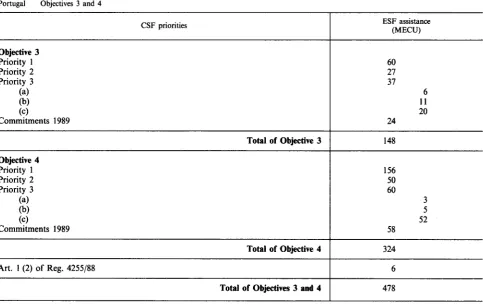
Table lC
Provisional financial plan by objective and by priority
Portugal Objectives 3 and 4
CSF priorities ESF assistance
(MECU)
Objective 3
Priority I 60
Priority 2 27
Priority 3 37
(a) 6
(b) 11
(c) 20
Commitments 1989 24
Total of Objective 3 148
Objective 4
Priority 1 156
Priority 2 50
Priority 3 60
(a) 3
(b) 5
(c) 52
Commitments 1989 58
Total of Objective 4 324
Art. 1 (2) of Reg. 4255/88 6
[image:26.570.56.540.109.414.2]Chapter 4
Indicative financing plan
4.1. Community loans
The envelopes for Community loans shown in the financial tables constitute an offer allowing the partial meeting of the needs of national financing arising from the total cost of the priority measures, taking account of the indicative envelopes of Com-munity grants.
The financial contribution of the EIB and other Community loan instruments is therefore an esti-mation, the amount being a function of the projects submitted by the promoters with the agreement of the competent national authorities and approved by the services of the EIB and the Commission.
The Bank and the Commission agree to examine, following their usual criteria, requests for loans for eligible investment not foreseen in the present CSF, notably in the areas of infrastructure, energy, industry and related services. The total volume of
Community loans to Portugal, without needing to be programmed, may be significantly greater than that which is shown in the financial tables. For example, the yearly average for EIB loans in these regions has gone from ECU 186 million in 1986 to ECU 580 million in 1988. On its side the ECSC will also examine every request for loans in the coal mining and steel making sectors, and industrial or energy investments which contribute to a reduction in the output of those ECSC products whose financial envelope is not included in this CSF.
4.2. Community programmes
N
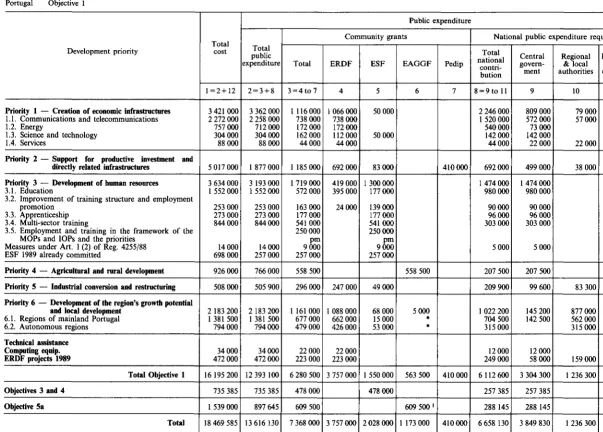
0\ Table 2
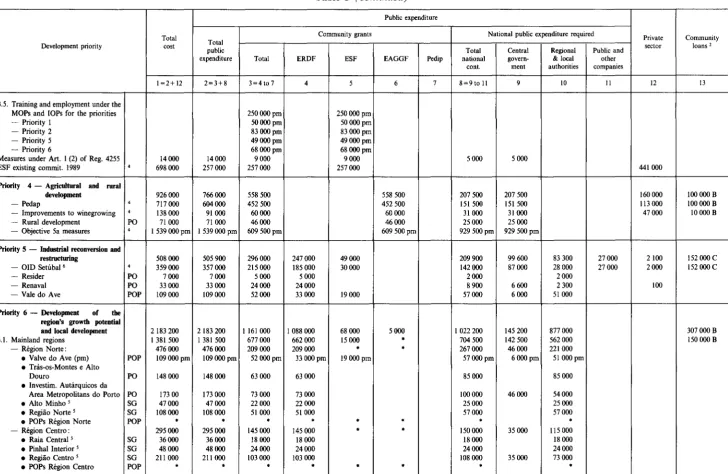
Provisional financial plan by development priority
Portugal Objective 1 (at 1989 constant prices) (1 OOO ECU)
Public expenditure
Community grants National public expenditure required Total
Total Private Community
Development priority cost public Total Central Regional Public and sector loans 2
national
expenditure Total ERDF ESF EAGGF Pedip contri- govern- & local other bution ment authorities companies
1=2+12 2=3+8 3 =4 to 7 4 5 6 7 8=9to II 9 10 11 12 13
Priority 1 - Creation of economic infrastructures 3 421 OOO 3 362 OOO 1116000 I 066 OOO 50000 2 246 OOO 809 OOO 79000 I 358 OOO 59 OOO 1246000 B
1.1. Communications and telecommunications 2 272 OOO 2 258 OOO 738 OOO 738 OOO I 520 OOO 572 OOO 57000 891 OOO 14000 918 OOOB
1.2. Energy 757 OOO 712 OOO 172000 172 OOO 540000 73 OOO 467 OOO 45 OOO 293 OOO B
1.3. Science and technology 304 OOO 304 OOO 162 OOO 112000 50000 142000 142000 35 OOO B
1.4. Services 88 OOO 88 OOO 44000 44000 44000 22000 22000
Priority 2 - Support for productive investment and
directly related infrastructures 5 017 OOO I 877 OOO I 185 OOO 692 OOO 83 OOO 410000 692 OOO 499000 38 OOO 155 OOO 3 140 OOO I 000000 B
Priority 3 - Development of human resources 3 634000 3 193 OOO I 719 OOO 419000 I 300 OOO 1474000 1474000 441 OOO
3.1. Education I 552 OOO I 552 OOO 572 OOO 395 OOO 177 OOO 980 OOO 980 OOO
3.2. Improvement of training structure and employment
promotion 253 OOO 253 OOO 163 OOO 24000 139 OOO 90000 90000
3.3. Apprenticeship 273 OOO 273 OOO 177000 177000 96000 96000
3.4. Multi-sector training 844000 844000 541 OOO 541 OOO 303 OOO 303 OOO
3.5. Employment and training in the framework of the 250 OOO 250 OOO
MOPs and IOPs and the priorities pm pm
Measures under Art. I (2) of Reg. 4255/88 14000 14000 9000 9000 5 OOO 5000
ESF 1989 already committed 698 OOO 257 OOO 257 OOO 257 OOO 441 OOO
Priority 4 - Agricultural and rural development 926 OOO 766 OOO 558 500 558 500 207 500 207 500 160000 100000 B
Priority 5 - Industrial conversion and restructuring 508 OOO 505 900 296 OOO 247 OOO 49000 209 900 99 600 83 300 27 OOO 2100 152 OOO C
Priority 6 - Development of the region's growth potential
and local development 2 183 200 2 183 200 1161 OOO I 088 OOO 68 OOO 5 OOO I 022 200 145 200 877 OOO 307000 B
6.1. Regions of mainland Portugal I 381 500 I 381 500 677 OOO 662000 15 OOO * 704 500 142 500 562 OOO 150000 B
6.2. Autonomous regions 794 OOO 794000 479 OOO 426000 53 OOO * 315 OOO 315 OOO 157000 B
Technical assistance
Computing equip. 34000 34000 22000 22000 12000 12 OOO
ERDF projects 1989 472000 472000 223 OOO 223 OOO 249 OOO 58 OOO 159 OOO 32000
Total Objective 1 16 195 200 12 393 100 6 280 500 3 757 OOO I 550 OOO 563 500 410 OOO 6112600 3 304 300 I 236 300 I 572 OOO 3 802 100 2 805 OOO B+C
Objectives 3 and 4 735 385 735 385 478 OOO 478 OOO 257 385 257 385
Objective Sa I 539 OOO 897 645 609 500 609 500 I 288 145 288 145 641 355
[image:28.867.58.661.80.511.2]N
Portugal Objective 1
Development priority
Priority 1 - Creation of economic infra-structures
1.1. Communications and telecommuni-cations
- STAR1
- Prodac - Route Nord-Sud - Autoroute Estoril - Rural telecommunications 1.2. Energy
- Valoren 1
- Protede - Serra de Estrela - Sabugueiro II - Pracana
- Alto LindosofTouved 1.3. Science and technology
- Science 2
1.4. Services
- Tourism infrastructure
Priority 2 - Support for productive investment and directly
related infrastructures
- Pedip 9
- Pniciap
- Com. aid schemes
Priority 3 - Development of human resources
3.1. Education - Prodep
3.2. Structural improvements in voca-tional training and job promotion - Structural imp.
3.3. Apprenticeship - Apprenticeship 3.4. Multisectoral training
- Horizontal training - Technical training
Total cost
1=2+12
3 421 OOO 2 272 OOO
4 124000
PO I 881 OOO
GP 54000 GP 87 OOO PO 126000 757 OOO
4 174000 PO 375 OOO GP II OOO
GP 12000
GP 32000 GP 153 OOO 304 OOO
POI 304 OOO 88 OOO PO 88 OOO
5017000
4 3 746 OOO 4 1184 OOO RA 87000
3 634 OOO I 552 OOO
POI I 552 OOO 253 OOO POI 253 OOO 273 OOO PO 273 OOO 844000
PO 679 OOO
PO 165 OOO
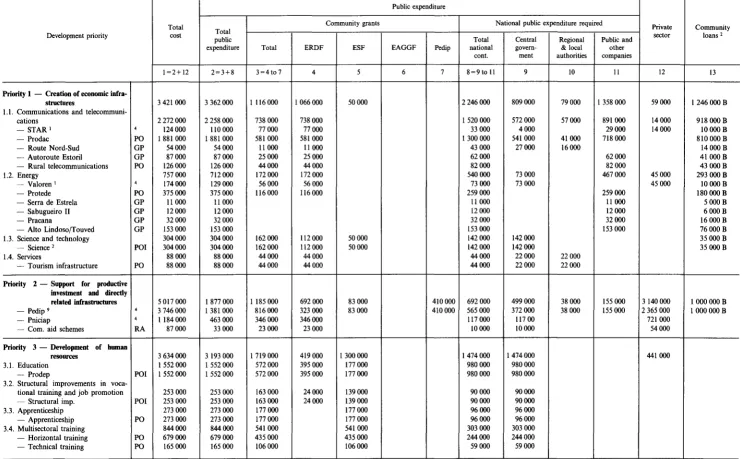
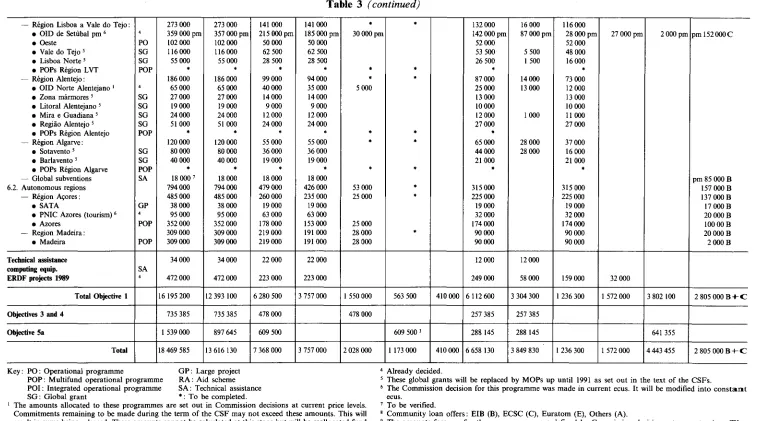
Table 3
Provisional financial plan by development priority and development measures
( at 1989 constant prices) ( 1 OOO ECU)
Public expenditure
Community grants National public expenditure required
Private Community Total
sector loans 2
public Total Central Regional Public and
expenditure Total ERDF ESF EAGGF Pedip national govern- & local other cont. ment authorities companies
2=3+8 3=4to7 4 5 6 7 8=9 to II 9 10 11 12 13
3 362 OOO I 116000 I 066 OOO 50000 2 246000 809 OOO 79000 I 358 OOO 59000 1246000 B 2 258 OOO 738 OOO 738 OOO I 520 OOO 572 OOO 57 OOO 891 OOO 14000 918 OOO B
110 OOO 77 OOO 77000 33 OOO 4000 29000 14000 10000 B
I 881 OOO 581 OOO 581 OOO I 300 OOO 541 OOO 41 OOO 718 OOO 810000B
54000 II OOO 11 OOO 43 OOO 27000 16000 14 OOO B
87000 25 OOO 25 OOO 62000 62000 41 OOO B
126 OOO 44000 44000 82000 82 OOO 43 OOOB
712000 172 OOO 172000 540 OOO 73 OOO 467 OOO 45 OOO 293 OOO B
129000 56 OOO 56 OOO 73 OOO 73 OOO 45000 10 OOO B
375 OOO 116000 116000 259 OOO 259 OOO 180000 B
II OOO II OOO II OOO 5000B
12000 12000 12000 6000B
32 OOO 32 OOO 32 OOO 16 OOO B
153 OOO 153 OOO 153 OOO 76000B
304 OOO 162 OOO 112 OOO 50000 142 OOO 142 OOO 35 OOO B
304000 162 OOO 112000 50000 142 OOO 142 OOO 35 OOO B
88 OOO 44000 44000 44000 22000 22000
88 OOO 44000 44000 44000 22000 22000
I 877 OOO I 185 OOO 692 OOO 83 OOO 410000 692 OOO 499 OOO 38 OOO 155 OOO 3 140 OOO I OOO OOO B I 381 OOO 816000 323 OOO 83 OOO 410 OOO 565 OOO 372000 38 OOO 155 OOO 2 365 OOO I OOOOOOB
463 OOO 346 OOO 346 OOO 117000 11700 721 OOO
33 OOO 23 OOO 23 OOO 10000 10000 54000
3 193 OOO I 719 OOO 419 OOO 1300000 1474 OOO 1474 OOO 441 OOO I 552 OOO 572 OOO 395 OOO 177 OOO 980 OOO 980 OOO
I 552 OOO 572 OOO 395 OOO 177 OOO 980 OOO 980 OOO 253 OOO 163 OOO 24000 139 OOO 90 OOO 90000 253 OOO 163 OOO 24000 139 OOO 90000 90000
273 OOO 177 OOO 177 OOO 96000 96000
273 OOO 177000 177 OOO 96000 96000
844000 541 OOO 541 OOO 303 OOO 303 OOO 679 OOO 435 OOO 435 OOO 244000 244000
[image:29.865.62.808.59.518.2]N
00
Development priority
3.5. Training and employment under the
MOPs and I0Ps for the priorities - Priority I
- Priority 2 - Priority 5 - Priority 6
Measures under Art. I (2) of Reg. 4255 ESF existing commit. 1989
Priority 4 - Agricultural and rural development
- Pedap
- Improvements to winegrowing - Rural development
- Objective Sa measures
Priority 5 - Industrial reconversion and
restructuring
- OID Setubal 6
- Resider - Renaval - Vale do Ave
Priority 6 - Development of the region's growth potential and local development
6.1. Mainland regions - Region Norte:
• Valve do Ave (pm) • Tnis-os-Montes e Alto