Munich Personal RePEc Archive
Mandating Access: Assessing the NIH’s
Public Access Policy
Staudt, Joseph
Center for Economic Studies (CES), U.S. Census Bureau
February 2019
Online at
https://mpra.ub.uni-muenchen.de/92620/
Mandating Access: Assessing the NIH’s Public Access
Policy
∗
Joseph Staudt
†February 2019
Abstract
In 2008, the National Institutes of Health (NIH) mandated that the full text of NIH-supported articles be made freely available on PubMed Central (PMC) – the NIH’s repository of biomedical research. This paper uses ∼1 million NIH articles and several matched com-parison samples to examine how this “PMC mandate” impacted researcher access to the biomedical literature and publishing patterns in biomedicine. Estimates of the mandate’s impact on forward citations to NIH articles tend to be noisy and inconsistent across samples, models, and specifications, and the largest upper limits of confidence intervals cannot rule out substantial increases. However, the most credible estimates suggest that the mandate had a relatively modest effect on citations, which is consistent with most researchers having widespread access to the biomedical literature prior to the mandate, leaving little room for the mandate to increase access. I also find that NIH articles are more likely to be published in traditional subscription-based journals (as opposed to “open access” journals) after the mandate. This indicates that any discrimination the mandate induced, by subscription-based journals against NIH articles, was offset by other factors – possibly the decisions of editors and submission behavior of authors.
Keywords: economics of science, open access, nih, nih public access policy, policy
evalua-tion.
JEL Classification Numbers: 031, 034, 038
∗I gratefully acknowledge financial support from NIH Grant P01 AG039347. I would also like to thank
Bruce Weinberg, David Blau, Daeho Kim, Richard Steckel, Robert Munk, Garrett Senney, Wei Yang Tham, Wei Cheng, Elisabeth Perlman, Martha Stinson, and workshop participants at Ohio State University and the U.S. Census Bureau for many helpful comments and discussions. All remaining mistakes are my own.
†U.S. Census Bureau, Center for Economic Studies (CES), 4600 Silver Hill Rd, Suitland, MD 20746.
1
Introduction
Economists have long argued that scientific advancement is crucial for economic growth. Since science is a cumulative process (Aghion et al., 2008;Aghion and Howitt, 1992;Mokyr,
2002; Murray et al., 2009; Romer, 1990; Scotchmer, 1991), its advancement depends on re-searchers having broad access to the scientific literature. This insight has facilitated the increasingly common practice, by departments, universities, and funding agencies, of man-dating that affiliated scientific articles be made open access – “digital, online, free of charge, and free of most copyright and licensing restrictions” (Suber, 2012, p. 4).1 In keeping with
this trend, the National Institutes of Health (NIH) implemented a mandate in 2008, which stipulates that,regardless of where it is published, any NIH-funded article must be submitted to PubMed Central (PMC) – the NIH’s repository of biomedical research (and the most com-monly used such repository). The full text of the final peer-reviewed version of the article is then made freely available on PMC within 12 months of publication.2 This paper examines
how the NIH’s “PMC mandate” impacted researcher access to the biomedical literature as well as how it impacted publishing patterns in biomedicine.
Promoting scientific advancement by increasing access to the biomedical literature was an important concern underpinning the implementation of the PMC mandate.3 At the time,
most empirical work indicated that open access articles receive substantially more citations than non-open access articles. Using a sample of computer science articles,Lawrence(2001) found that articles freely available online receive 336% more citations than those not available online. Using a sample of physics and mathematics articles,Harnad and Brody(2004) found that articles freely available in arXiv (a large repository of freely downloadable scientific articles) receive 298% more citations than those not in arXiv. Similarly, Metcalfe (2005),
Metcalfe (2006), andDavis and Fromerth (2007) found that astrophysics, solar physics, and mathematics articles posted on arXiv receive about 100%, 260%, and 35% more citations
1
See the Registry of Open Access Repositories Mandatory Archiving Policies (ROARMAP) for a list of open access mandates.
2
Note that the PMC mandate does not require NIH-funded articles to be published in an open access
journal such as those in the BioMed Central (BMC) or Public Library of Science (PLOS) portfolios. Nor does it require authors to use grant funds to purchase open access status for their NIH-funded article in an otherwise subscription-based journal (most publishers allow authors to pay article processing charges (APCs)
to make an article open access). The PMC mandate simply requires that,no matter where an NIH article is
published, the post-refereed (but possibly pre-print) version of the article mustalso be submitted to PubMed Central (PMC), where it will be made fully and freely available to anyone with an internet connection.
3
In testimony to the House Judiciary Committee, then NIH Director Elias Zerhouni stated: “The policy
has two basic premises: 1) the integration and accessibility of biomedical research will speed discoveries
than articles not posted. Antelman(2004) found that articles in philosophy, political science, electrical and electronic engineering, and mathematics receive 45%, 86%, 51%, and 91% more citations when they are freely available online. Walker (2004) examined articles in an oceanography journal, and found that articles whose authors paid to have them freely available received 280% more downloads. Craig et al. (2007) provide a useful review of this early literature.
These results suggested that restrictions on researcher access to the scientific literature had bite, potentially hindering scientific progress. This paper leverages the PMC mandate as a natural experiment to examine whether open access increases researcher access to the biomedical literature. If, prior to the mandate, some researchers had difficulty accessing NIH articles, then, after the mandate, we should observe an increase in the rate at which NIH articles are cited in follow-on research. In particular, there should be an increase in citations to NIH articles published in traditional subscription-based (toll access) journals, which prior to the mandate (and unlike NIH articles published in open access journals), would have been unavailable to researchers without a subscription to the journal.
I identify the effect of the PMC mandate on researcher access by using (∼1 million) NIH-funded articles combined with several sets of comparison articles to estimate difference-in-differences models, which allow me to examine how citations to NIH articles changed after the mandate was implemented in 2008. The main estimates vary widely across samples, models, and specifications, so I focus on confidence intervals, which allow me to examine what effects can be ruled out with statistical confidence and to bound the plausible increase in citations caused by the mandate. This approach suggests that, while the maximum upper limit on the entire set of 95% confidence intervals (CIs) cannot rule out large increases in citations after implementation of the PMC mandate (up to 46.8%), more credible upper confidence limit estimates suggest a much more modest upper bound on this increase (a bit less than 8%).4 Thus, even the largest upper confidence limit estimates are smaller than the point
estimates found in most early work examining the impact of open access on citations. By way of comparison, most of my point estimates are small and statistically indistinguishable from zero, and several are actually negative. My largest point estimate implies that the PMC mandate increased citations by 22.4% (statistically insignificant) with more credible point estimates suggesting an increase of no more than of 3.7%. The more credible estimates are
4
consistent with recent work, which takes seriously the endogeneity of open access, showing that, in contrast to earlier work, making articles open access does not substantially increase citations to those articles (Evans and Reimer, 2009; McCabe and Snyder, 2014; Gaule and Maystre, 2011; Davis et al., 2008; Davis,2011b; Bryan and Ozcan, 2016; Kim, 2012). That said, from the perspective of policymakers, a probable modest upper bound combined with a possible large upper bound, may be enough to justify the implementation of the PMC mandate. Moreover, it is important to note that these results do not indicate whether the mandate increased access for doctors, inventors, or other consumers of the biomedical literature.5
Most work on the relationship between open access and citations has used samples domi-nated by researchers affiliated with universities or research hospitals in rich countries. These researchers’ access to the entire biomedical literature may explain why the increase in total
citations tends to be modest when an article becomes open access. In contrast, researchers in poor countries or at commercial enterprises (especially start-ups) may have more limited access to the biomedical literature in the absence of the mandate (Ware and Monkman,
2009;Houghton et al.,2011), and thus may disproportionately benefit from NIH articles be-coming freely available on PubMed Central. To examine this possibility, I also estimate how citations from researchers in poor/developing countries and from researchers at commercial enterprises are impacted by the PMC mandate.
Again focusing on confidence intervals, the largest upper limits do not rule out substan-tial increases in citations – up to 62.8% from researchers at commercial enterprises and up to 49.5% from researchers in poor/developing countries. However, more credible estimates again suggest more modest upper bounds – a 9.6% increase for citations from researchers at commercial enterprises and a still large 18.0% increase for citations from researchers in poor/developing countries. Even these upper confidence limit estimates are smaller than most point estimates found in the early literature examining the effect of open access on citations. As with my point estimates of the PMC mandate’s impact on total citations, my point estimates for citations from researchers in poor/developing countries and at commer-cial enterprises vary widely across samples, models, and specifications. Overall, the point estimates for both groups tend to be small, are often statistically insignificant, and are some-times negative. The more credible point estimates suggest that the PMC mandate increased citations by no more than 4.3% from researchers at commercial enterprises and by no more than 6.5% from researchers in poor/developing countries. To my knowledge, Davis (2011a),
5
Bryan and Ozcan(2016) find that the PMC mandate increased patent-to-article citations by 25 to 51
percent. Teplitskiy et al.(2017) estimate that the odds an open access journal is referenced on Wikipedia
Evans and Reimer (2009),Faber Frandsen (2009), andGaul´e (2009) have examined the im-pact of open access on citations from poor countries and no one has examined the imim-pact on citations from commercial enterprises.
Given the non-rivalrous nature of ideas, ideas’ importance for economic growth, and the cumulative nature of science, it is crucial to understand the impacts of restrictions (and the lifting of restrictions) on access to scientific research. This is especially true for biomedical research, which is estimated to yield large returns (Murphy and Topel,2003). By analyzing how the abolition of a particular set of restrictions (the PMC mandate) impacts access to the biomedical literature, this paper fits into an “open science” literature that examines the extent to which restrictions on access to scientific literature and materials can impede scientific progress (Furman and Stern,2011;Murray et al.,2009;Sampat and Williams,2015;
Williams, 2013).
Though not as widely discussed as researcher access, another potential impact of the PMC mandate is the alteration of publication patterns in the biomedical sciences. In particular, the mandate may have induced toll access journals to discriminate, at the margin, against NIH articles. From a journal’s point-of-view, making NIH articles freely available on PubMed Central risks reducing subscription revenue. For this reason, prominent publishers of toll access journals strongly opposed the PMC mandate.6 However, a couple factors may work
to attenuate discrimination. First, if journal editors are only concerned with an article’s scientific merit, and do not take the publisher’s revenue into account when making decisions, then journal discrimination against NIH articles may be reduced. Second, authors can also influence the distribution of articles across toll and open access journals by deciding where to submit their work. To the extent that authors value “open science”, the PMC mandate reduces one of the main costs of publishing an NIH article in a toll access journal – restricted
6
Indeed, the Association of American Publishers, which represents all major publishers in biomedicine, specifically warned that the PMC mandate would undermine its members’ economic incentives by making their content available online (www.publishers.org/issues/5/9). For news accounts of debate surrounding
the mandate and publishers’ opposition, see Weiss (2007), Giles (2007), and English and Joseph (2008).
One member of the publishing industry explicitly suggested that “Another possible implication [of the PMC mandate] is that journals may no longer be willing to review and accept articles with unsustainable terms
attached” (McMullan, 2008). Moreover, the publishing industry strongly backed the Fair Copyright in
Research Works Act (introduced in 2008 and 2009) and the Research Works Act (introduced in 2011), which aimed to repeal the PMC mandate. There are a few strands of additional evidence suggesting that the PMC
mandate may have induced journals to discriminate against NIH articles. Seamans(2001) found that, in a
sample of mostly non-profit journals, 17.64 percent expressed reservations about accepting submissions of
theses and dissertations available on the web. Howard (2011) documents several university press editors’
reluctance to publish theses and dissertations that can be found “immediately on Google or by going to the
university page and just clicking and downloading it...”. Finally, as noted by (Suber,2012, p. 173), medicine
access – by ensuring that these articles are freely available on PubMed Central. Several studies using surveys and interviews, suggest that at least some authors do, in fact, value open science.7 Moreover, prior to the mandate, NIH-funded authors – either because they
value open science or because they want to maximize their articles’ exposure – may have been more willing to use scarce grant dollars to pay the submission or publication fees that are typically required to publish in open access journals.8 Without paying such fees, their
articles would exist indefinitely behind a paywall. In contrast, after the mandate, authors know that, regardless of whether an article is published in an open or toll access journal, it will be made freely available on PubMed Central. Thus, some NIH-funded authors may have been less inclined to pay open access fees and instead opted to submit their NIH articles to toll access journals, which typically charge more modest submission fees.
From a policy perspective, the NIH aims to fund lines of research with the highest overall merit and impact (see reviewer criteria). If the PMC mandate induces discrimination, by toll access journals against NIH articles, this reduces the number of outlets available to NIH articles, possibly decreasing the flow of follow-on research and hindering the advancement of the very research lines the NIH deems most crucial to promote. Thus, it is imperative to understand whether the net impact of the PMC mandate was dominated by discrimination against NIH articles or if mitigating factors such as editor/author decisions attenuated such discrimination.
I use several samples of NIH and comparison articles combined with difference-in-differences models to examine the net effect of the PMC mandate on publishing patterns in biomedcine. Specifically, I examine the impact of the mandate on the probability that an article is published in a traditional toll access journal. Across most samples, models, and specifications, the effect of the PMC mandate is precisely estimated and suggests an increase, of up to 2%, in the probability that an NIH article is published in a toll access journal. From a policy perspective, these results suggest that a significant potential downside of the PMC
7
When asked about their reasons for publishing in open access journals, Swan and Brown (2004) find
that authors’ most common response (92%) is the “principle of free access for all readers”. Further, when asked if they would have published in the same journal had it been toll access, nearly half said they would not and another third said they did not know. After interviewing 14 biomedical faculty from UNC-Chapel
Hill and Duke,Warlick and Vaughan(2007) report that 9 view open access as an important part of deciding
where to publish and 2 say it is increasingly important. Moreover, 9 say that “free access” is the most important motivation for publishing in an open access journal. In addition, nearly 17,000 (as of March 2018) researchers have signed their name to the “Cost of Knowledge” protest, pledging to refrain from publishing in or providing referee/editorial work for Elsevier journals. One of the main reasons for this protest is the perception that Elsevier restricts open access. See: http://thecostofknowledge.com/
8
The NIH has always allowed publication and printing costs to be charged to grants.
Sec-tion 7.9 of the NIH Grants Policy Statement states that, “Publication costs for electronic
and print media, including distribution, promotion, and general handling are allowable.” See:
mandate – discrimination against NIH articles – was either unrealized or attenuated by other factors, such as the decisions of editors and authors.9
Moving forward, the paper is organized as follows. Section 2 describes the data. Section 3 discusses the details of the PMC mandate and my econometric strategy. Section 4 presents the results, and Section 5 concludes.
2
Data
The data used in this paper are obtained from three main sources: MEDLINE, Web of Science (WOS), and the Directory of Open Access Journals (DOAJ). MEDLINE is a bibliographic database maintained by the National Library of Medicine and is the most comprehensive index of the biomedical literature.10 It includes a variety of information about each indexed
article, including the year and journal in which it is published and any grants that support it (in particular, NIH grants). WOS is maintained by Clarivate Analytics and indexes the references of journals across all fields (including those in MEDLINE).11It enables the tracking
of citation relationships between MEDLINE articles. DOAJ is the most comprehensive index of open access journals across all fields, and it enables the labeling of journals in MEDLINE as open or toll access. For more details on all data, see Appendix A.
2.1
Outcome Variables
The first set of outcomes are designed to measure whether the PMC mandate increased access to the biomedical literature. I first examine the total number of 2-year forward citations that an article receives. Next, I examine the number of 2-year forward citations that an article receives from particular subsets of authors. Specifically, I restrict the count of 2-year forward citations to those from authors at commercial enterprises and to those from
9
Ideally, I would use submission data in addition to publication data to study the effects of author/editor behavior. Such data would allow me to directly examine whether rates of submission, by authors, of NIH articles to different journal types changed after the mandate. Similarly, I would be able to examine whether rates of acceptance, by editors, of NIH articles at different journal types changed. Unfortunately, I am not aware of any publicly available source of submission data.
10
Technically, MEDLINE is a subset of a larger database called PubMed (distinct from PubMed Central). However, the data in MEDLINE have undergone rigorous quality control and are readily available for use by researchers.
11
The other two main sources of citation data are Scopus (Elsevier) and Google Scholar. Like WOS, Scopus is proprietary and identifies citations using lists of journals. In contrast, Google Scholar crawls the web looking for citations. Though Google Scholar tends to be more comprehensive than either WOS or Scopus, it does not allow bulk data access. Fortunately, the overlap between the three sources of data is substantial and the correlations between citations from the three sources are close to 1 – especially in Health
and Medical Sciences. SeeMart´ın-Mart´ın et al.(2018) for an overview of these three sources of citation data
authors at institutions located in poor or developing countries.12 Since the WOS citation
data end in mid-2014, I end the analysis for 2-year forward citation measures in 2011, which ensures that all articles have a full 2 years to accrue citations.13 In Section 4.2, I probe the
robustness of the main results by estimating models that use all citations ever received as the outcome variable, which allows for an analysis of the PMC mandate’s longer run impact on citations. In addition, I estimate models that use, as outcomes, dummy variables indicating whether an article receives any citations within two years of publication and whether an article receives a citation any time after publication.
The second set of outcomes are designed to measure how the PMC mandate impacted publishing patterns in biomedicine – specifically, whether an article is published in an open access or toll access journal. The primary way a journal is identified as open access is if it is indexed by the Directory of Open Access Journals (DOAJ). If it is not indexed in DOAJ, it is classified as toll access.14 To probe the quality of this open access indicator, I also construct
an alternative measure using the PubMed Central Open Access Subset (PMC-OAS) – the set of open access articles in PubMed Central. The fraction of articles that do not belong to the PMC-OAS (that is, are toll access) is computed for each journal. This fraction, is used as an alternative outcome measuring a journal’s openness.
2.2
NIH Articles and Comparison Articles
There are 2,050,044 articles in MEDLINE tagged as being funded by the National Institutes of Health (NIH). 956,801 of these are published between 2003 and 2013 (the time frame for the analysis of publishing patterns) and 745,076 between 2003 and 2011 (the time frame for
12
I identify articles affiliated with a commercial enterprise using MapAffil (Torvik, 2015) and articles
from poor/developing countries using a combination of MapAffil and the United Nations National Accounts. MapAffil uses author affiliations in MEDLINE to assign, to each MEDLINE article, information on location and organization type. Unfortunately, until 2014, only the affiliation of the first author was recorded in MEDLINE. Thus, for my time period (2003-2013), an article can only be assigned as having been produced by an author at a commercial organization or in a poor/developing country on the basis of the first author’s affiliation information. See Appendix A for details.
13
The WOS citation data end in mid-2014 because this was the time period the data were extracted from the WOS database (by WOS staff) and transferred for research purposes under NIH Grant P01 AG039347.
14
the analysis of researcher access).
To pin down counterfactual outcomes, I construct several sets of comparison articles using non-NIH articles. The first comparison sample is the set of all non-NIH articles in MEDLINE published between 2003 and 2013 (2011). There are 7,482,563 (5,809,078) such articles. I refer to this set of comparison articles as the “MEDLINE” comparison sample. The second set of comparison articles is the set of all non-NIH articles published in the same journal and year as at least one NIH article.15 There are 5,792,555 (4,455,039) such articles.
I refer to this set of comparison articles as the “Journal” sample.
The third set of comparison articles is constructed using the PubMed Related Citations Algorithm (PRCA), which uses key words (MeSH terms) and text from titles and abstracts, to identify, for any given article, a set of “similar” articles.16 First, I use the PRCA to
harvest similar articles for each NIH article. After restricting the set of harvested articles to those that are published in the 2003-2013 (2011) period and are not themselves NIH articles, there are a total of 3,171,838 (2,542,714) unique comparison articles. I refer to this set of comparison articles as the “Full PRCA” sample.
The final set of comparison articles is a subset of the Full PRCA sample. Taking advan-tage of a similarity score that the PRCA delivers for each harvested article, I am able to identify the particular comparison article that most closely matches each NIH article and im-plement a 1-to-1 matching (without replacement) algorithm. I refer to this set of comparison articles as the “1-to-1 PRCA” sample.
In sum, in order to estimate counterfactual outcomes, I construct four comparison sam-ples: the “MEDLINE”, “Journal”, “Full PRCA”, and “1-to-1 PRCA” samples. I use four alternative comparison samples because, a priori, it is not obvious which non-NIH articles should serve as comparisons. As shown below, the 1-to-1 PRCA sample contains the set of non-NIH articles that are most similar to the set of NIH articles, making it an intuitively attractive comparison sample. However, this similarity is driven by the PRCA algorithm, which, as mentioned, identifies comparison articles using key words and text that are similar to a corresponding NIH article. This could be problematic if, for example, the PMC man-date caused “high-quality” non-NIH funded researchers to enter fields similar to those of NIH-funded researchers. Such a migration would make NIH articles more likely to match to high-quality articles after the mandate, effectively conditioning away part of the PMC
man-15
Ideally, I would use journals published in the same journal issue. However, the journal issue element in the MEDLINE data is often missing, making this strategy infeasible.
16
date’s effect on citations. Conversely, if the PMC mandate caused “high-quality” non-NIH funded researchers to move away from fields dominated by NIH-funded researchers, then NIH articles will be less likely to match to high-quality articles after the mandate, which would misleadingly inflate the PMC mandate’s effect on citations. Though it seems unlikely that the PMC mandate caused non-NIH funded researchers to migrate into or out of fields previously dominated by NIH funded researchers, concerns about implicitly conditioning on variables affected by the PMC mandate lead me to take a conservative approach and report results from multiple comparison samples. More generally, it is important not to control for any variable affected by the PMC mandate (Stuart et al.,2014), which, as discussed be-low, also leads me to always report estimates with and without conditioning on article-level covariates.
2.3
Covariates
The data allow me to construct a rich set of article-level covariates. These include the number of backward citations, the number of backward citations published in open access journals (which is a proxy for the open access milieu in which an article is published), the number of unique n-grams (1-, 2-, and 3-grams)17 that an article uses in either the title or abstract,
the number of “top” n-grams an article “originates”, the number “top” n-grams for which an article is an “early adopter” (these are proxies for article quality that are independent of citations),18 the number of “Descriptor” Medical Subject Heading (MeSH) terms that
tag an article, the number of “Qualifier” MeSH terms that tag an article (these are proxies for the disciplinary diversity of an article), the number of authors, an indicator for whether the author is a corporate entity, a set of indicator variables for the type of institution to which the first author belongs (e.g. university, hospital, etc.), a set of fixed effects for the country in which the first author works, a set of indicator variables characterizing an article’s “Publication Type” (e.g. whether the article is a review article, a clinical trial, etc.), a set of indicator variables characterizing the languages in which the article is published, and the number of non-NIH grants that support the article. When the outcome variable is the count of 2-year forward citations, I also estimate specifications that include journal fixed effects. Journal fixed effects cannot be included when the outcome variable is the toll access indicator
17
In this paper, I define an n-gram as a word (1-gram), a word pair (2-gram), or a word triplet (3-gram). See Appendix B for more information on the extraction and processing of text from the title and abstract of MEDLINE articles.
18
An article “originates” an n-gram if the article uses the n-gram in the n-gram’s vintage year (first year the n-gram appears in the MEDLINE corpus). An article is an “early adopter” of an n-gram if the article uses the n-gram within 5 years of the n-gram’s vintage. A “top” n-gram is one that, compared to all other
n-grams in its vintage, is in the top 0.01% in terms of total mentions in the MEDLINE corpus. SeeStaudt
because there is no within-journal variation in this outcome. When the outcome variable is the toll access indicator, all specifications also include journal start year fixed effects. See Appendix A for details on all covariates.
2.4
Summary Statistics
Appendix Tables A.1.1 through A.1.4 present summary statistics for each of the four compar-ison samples (excluding country and journal fixed effects). In the MEDLINE sample during the pre-mandate period, 13 of the 46 covariates (28.3%) have an absolute standardized mean difference (between NIH and non-NIH articles) above 0.25, a commonly used rule-of-thumb to assess the balance of a variable between two groups (Rubin, 2001; Stuart, 2010).19 13
of the 46 covariates are also imbalanced during the post-mandate period. During both the pre- and post-mandate periods in the Journal sample, 10 (21.7%) covariates are imbalanced. In the full PRCA sample, 10 (21.7%) and 5 (10.9%) covariates are imbalanced, and in the 1-to-1 PRCA sample, 3 (6.5%) and 2 (4.3%) covariates are imbalanced. Thus, balance tends to improve as we move from the MEDLINE to the Journal to the Full PRCA Sample, and the 1-to-1 PRCA sample is very well-balanced. In general, NIH articles tend to cite more articles, use more top n-grams, are tagged with more MeSH terms, have more authors, are less likely to have a corporate author, are more likely to be a “Journal Article”, are less likely to be an “Irregular Article”, and are more likely to be published in English.
It is crucial to stress that identification in a difference-in-difference (DID) setting does not depend on on the similarity of covariate or outcome variablelevels. Indeed, DID allows for a constant additive (or multiplicative) difference between the mean outcomes of the the treatment and control groups, only requiring that the trends be similar. Thus, while covariate balance may increase the plausibility of the identification strategy, the identification strategy does not depend on balance. The covariates are also potentially useful for increasing the precision of estimates.
As noted, a potential concern is that the covariates may themselves be impacted by the PMC mandate (Rosenbaum, 1984). Since the data are a set of pooled cross sections, covariates cannot be defined as pre-treatment covariates. To partially address this issue, I restrict the set of covariates to those that are generated prior to the publication of the article. For instance, the number of backward citations or the number of grants that support an article are determined prior to publication. In contrast, forward citations, which are not included in the set of covariates, are determined after publication. Of course, variables that
19
The standardized mean difference is defined as ( ¯Xnih−X¯non)/
p
(vnih+vnon)/2, where ¯Xnih andvnih
are the mean and variance of covariate X for NIH articles and ¯Xnon and vnon are the same quantities for
are determined prior to publication may still be impacted by the mandate, so this does not fully deal with the issue. Indeed, the mandate conceivably impacted all covariates. Thus, I always present specifications with and without article-level covariates.
3
Research Design
3.1
Details of the NIH Public Access Policy (“PMC Mandate”)
On February 3, 2005 the National Institutes of Health (NIH) issued a policy statement that requested all NIH-supported articles to be submitted to PubMed Central (PMC), the NIH’s full-text repository of freely available biomedical research. Regardless of where the article was published, submission to PMC would make it accessible to anyone with an internet connection. This request became effective on May 2, 2005.20 Despite the request, a 2006
NIH report to Congress revealed that voluntary compliance with this request was below 4 percent (Suber, 2008). Thus, Congress instructed the NIH to change the request to a mandate – the “PMC mandate”. On January 11, 2008 the NIH announced that the full text of all NIH-supported articles accepted for publication on or after April 7, 2008 were to be submitted, in final peer-reviewed form, to PubMed Central immediately upon acceptance for publication.21 This mandate for submission to PubMed Central applies to all NIH-funded
articles, regardless of where they are published. Though journals (who retain the copyright to NIH articles they publish) have the right to delay a published NIH-article’s availability on PubMed Central for up to one year, it is thereafter freely accessible to anyone.22 By
2012, compliance with the PMC mandate stood at 75 percent, and it continued to increase thereafter (Grant, 2012;Van Noorden, 2014).
It is worth emphasizing that the PMC mandate neither requires NIH-funded articles to be published in an open access journal, nor does it require authors to use grant funds
20
Specifically, the policy statement read: “beginning May 2, 2005, NIH-funded investigators are requested to submit to the NIH National Library of Medicine’s (NLM) PubMed Central (PMC) an electronic version of the author’s final manuscript upon acceptance for publication, resulting from research supported, in whole or in part, with direct costs from NIH.” http://grants.nih.gov/grants/guide/notice-files/NOT-OD-05-022.html.
21
The Public Access Policy was the NIH’s response to Division G, Title II, Section 218 of PL 110-161 (Consolidated Appropriations Act, 2008), which states: “The Director of the National Institutes of Health shall require that all investigators funded by the NIH submit or have submitted for them to the National Library of Medicine’s PubMed Central an electronic version of their final, peer-reviewed manuscripts upon acceptance for publication, to be made publicly available no later than 12 months after the official date of publication, provided that the NIH shall implement the public access policy in a manner consistent with copyright law.”
22
The embargo period is a “grand compromise” (Salmon, 2016) that seeks to accommodate publisher
concerns about maintaining revenue streams. For overviews about publishing embargoes, see Imboden
to purchase open access status for their NIH-funded article in an otherwise subscription-based journal. The PMC mandate only requires that, no matter where an NIH article is published (particularly, in this context, regardless of whether it is published in an open or toll access journal), the post-refereed (but possibly pre-print) version of the article mustalso
be submitted to PubMed Central, where it will be made fully and freely available to anyone with an internet connection.
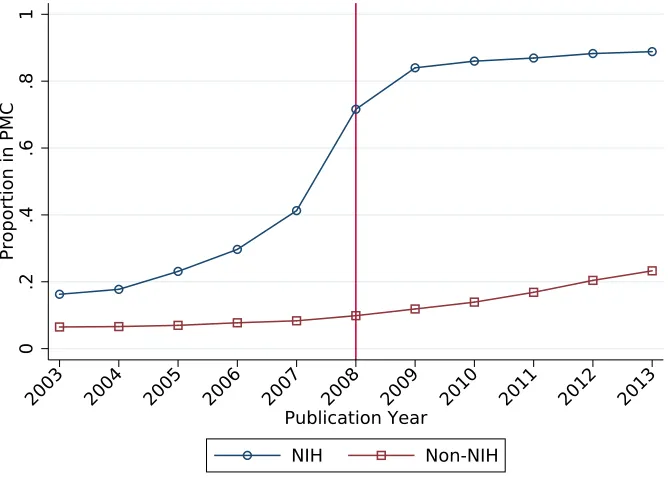
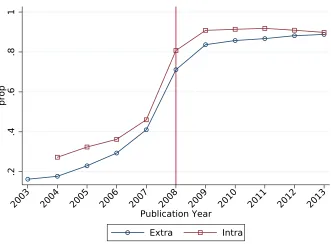
The increase in compliance for NIH articles published after 2008 can be seen in Figure 1. The figure shows the proportion of NIH and non-NIH articles in my sample that have their full text freely available on PubMed Central (PMC) as of the date I downloaded the data (10/18/2018). The proportion of NIH articles published between 2003 and 2007 that are available on PMC as of October 2018 increases from under 20 percent to slightly over 40 percent. There is a steep jump to about 70 percent for articles published in 2008, and then there is a continual climb to a little over 90 percent for articles published in 2013. The proportion of non-NIH articles that are available on PMC as of October 2018 increases steadily from about 6 percent in 2003 to about 23 percent in 2013. Thus, it clear that NIH articles are much more likely than non-NIH to be available on PMC and there is a sharp jump in compliance with the PMC mandate for NIH articles published after 2008.23
3.2
Econometric Strategy
The treatment of interest is the requirement to submit an article to PubMed Central immedi-ately upon acceptance for publication. My core estimates of the effect of this treatment come from standard difference-in-differences (DID) models. Each article in the sample is either an NIH article (Ni = 1) or a comparison article (Ni = 0) and is either published before (Pi = 0) or after (Pi = 1) the PMC mandate. In the difference-in-differences (DID) framework, the impact of the mandate can be identified by estimating the following equation:
E[Yi|Xi, Ni, Pi] =G[βt+γNi+δ(Pi×Ni) +ρXi]. (1)
Yi is an outcome variable, βt is a full set of publication year fixed effects, Pi is an indicator that turns on in 2009,Ni indicates whether an article is NIH-supported, andXi is a vector of article-level covariates (see section 2.3). δ is the parameter of interest, measuring the impact
23
This figure is similar to figures produced inBryan and Ozcan(2016). It is constructed using data from
of the mandate under this model.
When the outcome variable is an indicator designed to measure publication patterns in biomedicine (e.g. an indicator for being published in a toll access journal), I estimate equation (1) using all articles in each of my four samples. When the outcome is a citation measure, I want to estimate equation (1) using only the subset of articles published in journals actually affected by the PMC mandate. Articles (NIH or comparison) published in open access journals should not be impacted by the mandate because any researcher can access and cite these articles, by definition, both before and after the mandate. Thus, for citation measures, my main DID estimates are obtained using only the sample of articles published in toll access journals.
For identification using the DID framework, no other variable, unrelated to the PMC mandate, can differentially affect the outcomes for NIH and comparison articles around 2008. In the case of citation outcomes, we can directly examine this possibility by estimating equation (1) using the set of articles published in open access journals to obtain placebo estimates. In the absence of other variables differentially impacting the citations to NIH articles, we should not observe a citation effect for articles published in open access journals because researchers have access to these articles both before and after 2008. Thus, I also estimate triple differences (DDD) models, with a journal’s open access status as the third layer of difference, to identify the effect of the PMC mandate on citations. In the DDD setting, an article is either published in a toll access (“subscription”) (Si = 1) or open access
(Si = 0) journal, and the impact of the mandate can be identified by estimating the following equation:
E[Yi|Xi, Ni, Pi, Si] =G[βt+γ1Ni+γ2Si+γ3(Si×Ni)+γ4(Pi×Ni)+γ5(Pi×Si)+δ(Pi×Si×Ni)+ρXi].
(2) In this equation, Si indicates whether article i is published in a toll access journal, and the other variables are defined as in equation (1). Again, δ is the parameter of interest, measuring the impact of the PMC mandate under the DDD model.
(Ciani and Fisher, 2013).24 This setup gives the parameter of interest, δ, a semi-elasticity
interpretation – the percent change in the number of citations received by an NIH article after the PMC mandate. Section 4.2 shows that the results are quite robust to changes in this modeling decision.
As noted in the introduction, and will be shown in the next section, the citation estimates are unstable across samples, models, and specifications. Thus, I organize the discussion of these results around the upper limits of 95% confidence intervals, which will give an indication of the maximum plausible effects of the PMC mandate on researcher access to the biomedical literature. Since confidence intervals depend on standard errors as well as point estimates, it is worth noting how I compute the standard errors. Abadie et al. (2017) suggest that clustering the standard errors at the journal level may be unnecessarily conservative in this context since my sample is close to the population of all biomedical articles and there are few journals (clusters) in the population unobserved in my sample. However, since I am trying to bound the maximum plausible impacts of the mandate, I opt for the conservative approach of clustering at the journal level and using these standard errors to compute the upper limits of 95% confidence intervals. Section 4.2 discusses the results when Eicker-Huber-White standard errors, which do not allow for arbitrary correlation of error terms within cluster, are used to compute upper limits of 95% confidence intervals.
4
Results
4.1
Access to the Biomedical Literature
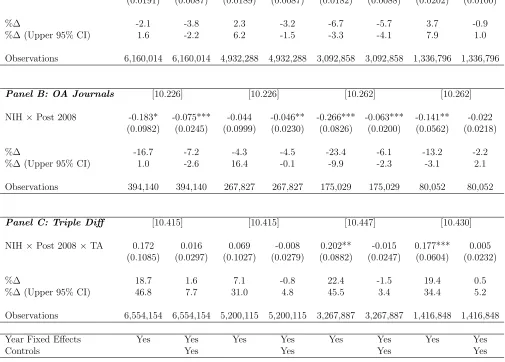
Table 1 displays the Poisson pseudo maximum likelihood (PPML) estimates of the PMC mandate’s impact on the count of 2-year forward citations received by NIH articles. Panels A and B display the PPML estimates of δ from the difference-in-differences (DID) model in equation (1) for articles published in toll access and open access journals, respectively. Panel C displays the estimates of δfrom the triple differences (DDD) model in equation (2). The table also shows the implied percent changes (%∆) based on the point estimate and the upper limit of the 95% confidence interval.25,26
24
Since citations to an article are often zero, log-linearization is not a feasible strategy in this con-text. Another possibility is to transform the outcome variable using the inverse hyperbolic sine function:
IHS(Yi) =ln(Yi+ p
1 +Y2
i ). However, the mean for some citation variables is quite small (see tables A.1.1
through A.1.4), making this transformation inappropriate for these outcomes (Bellemare and Wichman,
2018).
25
Let ˆδbe a point estimate of δ. Then %∆ and %∆ (Upper 95% CI) are computed as 100∗(eδˆ−1) and
100∗(eul
−1) where ul= ˆδ+ 1.96∗SE(ˆδ) is the upper limit of the 95% confidence interval forδ.
26
Overall, the estimates across samples, models, and specifications are quite inconsistent. The percentage changes implied by the point estimates range from -6.7% to 3.7% for articles published in toll access journals, -23.4% to to -2.2% for articles published in open access journals, and from -1.5% to 22.4% for the triple difference. Given the instability of the estimates, I focus on confidence intervals to determine a plausible upper bound on the PMC mandate’s impact on the count of 2-year forward citations.
For articles published in toll access journals, the estimates suggest a modest upper bound on the impact of the mandate – the largest upper limit of a 95% CI, across all samples and specifications, is obtained using the 1-to-1 PRCA sample and estimating the model without covariates (column 7). This estimate implies that, at best, the PMC mandate increased the count of 2-year forward citations by 7.9% for NIH articles published in toll access journals.
However, as noted in Section 3.2, the validity of the DID estimates relies on the assump-tion that citaassump-tion ratios between NIH and comparison articles are not changing for reasons unrelated to the PMC mandate. The estimates using articles published in open access jour-nals hint that this assumption may be violated. Since these articles are freely available both before and after the mandate, the relative rate of citation between NIH and comparison articles published in open access journals should not be affected by the mandate. In fact, all estimates in Panel B suggest that citations to NIH articles (relative to comparison arti-cles) published in open access journals declined after the mandate. Moreover, this relative decline is always estimated to be steeper than the estimated relative decline for NIH articles published in toll access journals.
The difference in citation decreases for NIH articles (relative to comparison articles) pub-lished in open access journals (steeper decrease) and toll access journals (shallower decrease) explains the mostly positive triple difference (DDD) estimates in Panel C. The largest up-per limit of a 95% CI, over all samples and specifications, is obtained using the MEDLINE sample and estimating the model without covariates (column 1). It implies that the PMC
published in toll access journals (corresponding to Panel A of Table 1) and articles published in open access journals (corresponding to Panel B of Table 1). Table A2.3 displays the estimates using the DDD equation (2) for articles published in any journal type (corresponding to Panel C of Table 1). Across all three tables, the NIH dummy is always positive and is always precisely estimated (though not always statistically different from 0), indicating that NIH articles tend to receive more citations than comparison articles. The number of backward citations (references) and the number backward citations to articles that are, themselves, published in open access journals are positively related to 2-year forward citations. Also, an article’s use of age 0 and age 5 top concepts – measures of article quality – and an article’s increased usage of MeSH descriptors – a measure of disciplinary diversity – are positively associated with the count of 2-year forward citations (see
mandate may have increased the count of 2-year forward citations by up 46.8%. Thus, in contrast to the DID estimates for articles published in toll access journals, the DDD esti-mates do not rule out substantial increases in the count of 2-year forward citations received by NIH articles after the PMC mandate (though even this upper bound is smaller than the effect of open access on citations implied by most of the early literature in this area).
Since the upper bounds implied by the DID and DDD estimates of the PMC mandate’s impact on the count of 2-year forward citations are quite different, it is natural to ask: is the smaller DID upper bound or the larger DDD upper bound more credible? The answer largely depends on whether the relative citation rates between NIH and comparison articles published in open access journals are actually a good counterfactual for what would have happened, in the absence of the PMC mandate, to the relative citation rates between NIH and comparison articles published in toll access journals. Visual evidence presented next indicates that the series of relative citation rates for articles published in open and toll access journals were not on parallel paths prior to the mandate, suggesting that the DID estimates using articles published in toll journals may be more credible than the DDD estimates. Also, interpretation of the DDD estimates is complicated by the fact that, as shown in Section 4.3, the the toll access indicator in the triple difference is endogenous – that is, the probability of an article being published in a toll access journal is affected by the PMC mandate. This also suggests that the DID estimates using articles published in toll access journals may be preferable to the DDD estimates. Finally, it is worth noting that all of the largest percent increases implied by the DDD estimates are from specifications that do not include covariates. For all samples except the Journal Sample, this is primarily because adding covariates significantly attenuates the negative impact of the PMC mandate on citations received by NIH articles published in open access journals. For instance, estimates without covariates obtained using the 1-to-1 PRCA sample, suggest that NIH articles published in open access journals received 13% fewer citations after the mandate. Adding covariates attenuates this reduction to 2.2%. This causes the relative differences in citation rates after the mandate to be smaller between the groups of articles published in toll and open access journals, giving rise to more modest DDD estimates. Indeed, in DDD models with covariates, the maximum upper limit of the 95% CIs implies a percent increase of no more than 7.7% – which is very close to the upper bound of 7.9% implied by the DID estimates obtained using articles published in toll access journals.
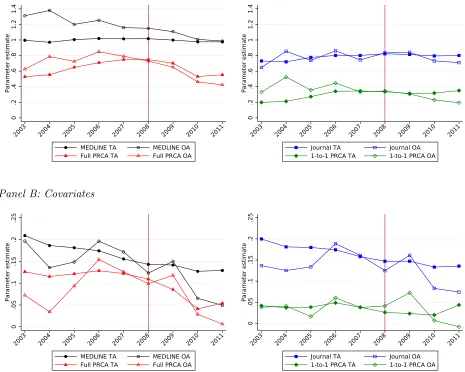
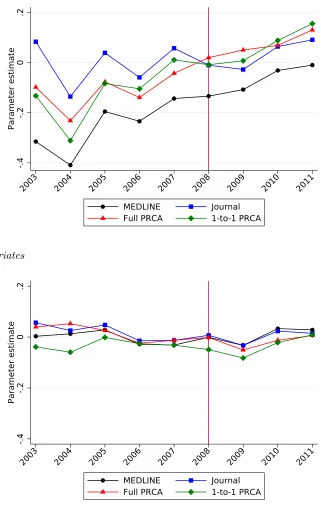
and the blue, red, and green series of dots represent estimates obtained using the Journal, Full PRCA, and 1-to-1 PRCA samples. Solid dots represent estimates obtained using articles published in toll access journals and the hollow dots are the estimates obtained using articles published in open access journals. Finally, Panels A and B represent series of estimates using specifications without and with covariates.
Consistent with Panel A of Table 1, there is little visual evidence that the PMC mandate increased citations to NIH articles (relative to comparison articles) published in toll access journals. If anything, there appears to be a slight decrease. However, consistent with Panel B of Table 1, it appears that the relative citation rate declines even more rapidly for articles published in open access journals. If the series constructed using articles published in open access journals are reasonable counterfactuals for the corresponding series constructed using articles published in toll access journals, then they represent the baseline of what we would expect to see in the absence of the mandate – in this case, the relative citation ratio for NIH articles published in toll access journals would have declined even more in the absence of the PMC mandate, meaning the mandate had a positive effect on citations to NIH articles published in toll access journals.
In specifications without covariates, visual evidence suggests that, during the pre-mandate period, the open access series best tracks the toll access series in the Journal sample. This sample also produces the smallest post-mandate percent increase in the count of 2-year forward citations – 7.1% for the point estimate and 31.0% for the upper limit of the 95% CI. In contrast, the open access series that worst tracks the toll access series during the pre-mandate period is in the MEDLINE sample, which also produces the largest post-mandate percent increases. Overall, the visual evidence suggests that the relative citation rates for articles published in open access journals may not be valid counterfactuals for what would have happened to relative citation rates for articles published in toll access journals in the absence of the mandate. Panel B shows that, in all samples, adding covariates substan-tially reduces the estimated difference between NIH and comparison articles (note that the scale of the y-axis is more compact when moving from Panel A to B). Otherwise, the broad trends are the same – both toll access and open access series decline after the PMC mandate, but the decline is steeper for the open access series. However, the differences become very small and insignificant, which leads to the small estimated DDD effects observed in Panel C of Table 1.
Panels A and B represent series of estimates using specifications without and with covariates. During the pre-mandate period, the relative citation ratio (articles published in toll access journals relative to articles published in open access journals) of ratios (NIH relative to comparison articles) is smallest for articles in the Journal sample, followed by articles in the two PRCA samples, and the MEDLINE sample. In all cases (except, perhaps, the Journal sample), the effect, on the count of 2-year forward citations, of being an NIH article published in a toll access journal increases during the pre-mandate period and then continues to increase after the PMC mandate. This explains the large positive estimates in Panel C of Table 1 for specifications that do not include covariates. It also again casts doubt on the validity of the open access series serving as a counterfactual for the toll access series. When covariates are included, the effect, on the count of 2-year forward citations, of being an NIH article published in a toll access journal is relatively flat in both the pre and post mandate periods, which explains the small coefficients in Panel C of Table 1 when covariates are included.
Taken together, these results suggest that the impact of open access on the count of 2-year forward citations, as facilitated by the PMC mandate, is smaller than suggested by most of the early literature in this area, and probably much smaller. However, given the very conservative approach, the upper bound on the portfolio of estimates – obtained by estimating the triple difference equation (2), without covariates, using the MEDLINE sample – is still quite high: nearly 47%. That said, more credible estimates – DDD estimates with covariates and DID estimates using articles published in toll access journals – suggest a much more modest upper bound of the PMC mandate, perhaps 8%, which is consistent with recent literature that takes seriously the endogeneity of open access. Moreover, as noted, most of the point estimates are small, statistically insignificant, and are often negative. The largest – obtained by estimating the triple difference, without covariates, using the Full PRCA sample – suggests a statistically insignificant increase of 22.4%, but more credible estimates suggest an increase of no more than 3.7%. However, from the standpoint of policymakers, even a probable modest upper bound combined with a possible large upper bound, may be enough to justify the implementation of the PMC mandate.
Though the previous results suggest that the PMC mandate’s effect on overall access to the biomedical literature is difficult to pin down – it is likely modest, but I cannot rule out large effects – it might be possible to more accurately assess the effect on particular sub-groups of researchers that had limited access to NIH articles prior to the mandate, gaining access only after it went into effect. To this end, I examine citations from authors at commercial enterprises and authors in a poor/developing country.
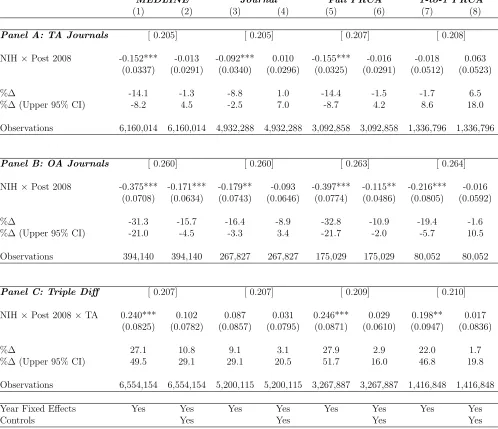
of 2-year forward citations restricted to those coming from researchers at a commercial enterprise (Table 2) and researchers in a poor/developing country (Table 3). Again, Panels A and B display the estimates of the DID model in equation (1) for articles published in toll access and open access journals, respectively, and Panel C displays the estimates of the DDD model in equation (2). Similar to the point estimates of the PMC mandate’s impact on total citations, the point estimates for citations from researchers in poor/developing countries and at commercial enterprises vary widely across samples, models, and specifications. For both groups, they tend to be small, are often statistically insignificant, and are sometimes negative. The more credible point estimates – DDD estimates with covariates and DID estimates using articles published in toll access journals – suggest that the PMC mandate increased citations by no more than 4.3% from researchers at commercial enterprises and by no more than 6.5% from researchers in poor/developing countries.
Returning focus to confidence intervals, when the outcome is citations received from re-searchers at a commercial enterprise, the largest upper confidence limit for articles published in toll access journals implies that the mandate increased the count of 2-year forward cita-tions from these researchers to NIH articles by no more than 9.6%. When the outcome is the count of 2-year forward citations received from researchers in a poor/developing country, the largest upper confidence limit suggests a larger plausible effect: 18.0%. However, the esti-mates for articles published in open access journals are again all negative and most are large and statistically significant. This again leads to DDD estimates that are larger than DID estimates for articles published toll access journals (though they are usually not statistically significant). The upper bounds suggest that the PMC mandate may have increased citations to NIH articles from researchers at commercial enterprises by up to 62.8% and citations from researchers in poor/developing countries by up to 49.5%. In specifications with covariates, these upper bounds are attenuated, but remain large – 30.1% and 29.1%. Thus, like the total count of 2-year forward citations, I am not able to rule out large increases in 2-year forward citations coming from researchers at commercial enterprises or in poor/developing countries. However, even these upper bounds are modest relative to the early literature on the effects of open access on citations.
rather than estimatethe effect of the PMC mandate. That said, for reasons outlined above, I view the most credible estimates as coming from the DID estimates using articles published in toll access journals. Thus, I believe it is unlikely that the PMC mandate increased the count of 2-year forward citations by more than 7.9%, and unlikely increased the count of 2-year forward citations from researchers at commercial enterprises and researchers in poor/developing countries by more than 9.6% and 18.0%. Using the maximum percent change implied by the DID point estimates as a plausible best guess of the mandate’s effect on the count of 2-year forward citations suggests an increase of 3.7% for total citations, 4.3% for citations from researchers at commercial enterprises, and 6.5% for citations from researchers in poor/developing countries.
4.2
Robustness
This section probes the robustness of the main results in Table 1. First, I examine how the decision to cluster the standard errors at the journal level affects the upper bound on the plausible effects of the PMC mandate. The standard errors reported in Table 1 are clustered at the journal level. However, as noted in Section 3.2, this may be unnecessarily conservative since my sample is close to the population of all biomedical articles and there are few journals (clusters) in the population unobserved in my sample (Abadie et al.,2017). Thus, for comparison, Table A3 replicates the results in Table 1 using Eicker-Huber-White standard errors. For all estimates, the standard errors decline substantially. This, of course, implies smaller upper limits of the 95% CIs. The largest plausible increase now arises from the DDD estimates without covariates using the Full PRCA sample, but is cut from 46.8% to 27.6%. Thus, even with less conservative standard errors, I cannot rule out a fairly substantial increase in citations after the PMC mandate (though the more credible estimates in Panel A now suggest an even smaller upper bound – perhaps 5.3%).
in poor/developing countries also suggest relatively modest upper bounds of the mandate’s impact – 8.8% and 8.3% – which are actually smaller than the upper bounds of 9.6% and 18.0% for the counts of 2-year forward citations. However, as before, relatively large negative estimates for articles published in open access journals lead to DDD estimates that tend to be positive. The DDD estimates suggest an upper bound of 49.4% on the mandate’s impact on the total count of all forward citations ever received, which is quite similar to the upper bound of 46.8% for 2-year forward citations. For researchers at commercial enterprises and researchers in poor/developing countries, the DDD estimates suggest upper bounds of 54.9% and 52.4% on the count of all forward citations, which compare to the upper bounds of 62.8% and 51.7% for the counts of 2-year forward citations. Adding covariates again significantly attenuates these upper bounds to no more than 7.8% (total count of all forward citations), 33.1% (count of all forward citations from researchers at commercial enterprises), and 19.4% (count of all forward citations from researchers in poor/developing countries). These compare to 7.7%, 30.1%, and 29.1% for the count of 2-year forward citations. In sum, the results are robust to changing the outcome from the count of 2-year forward citations to the count of all forward citations – the upper bound of the mandate’s effects are likely modest, but possibly large.
Table A5 replicates Table 1 using, as the outcome variable, an indicator for whether an article receives a forward citation within 2 years of publication. Nearly all DID estimates for articles published in both toll access and open access journals are negative and statisti-cally significant. However, the estimates are again almost always more negative for articles published in open access journals leading to mostly positive, and sometimes statistically significant, DDD estimates. As with the count, the upper bounds of the effect of the PMC mandate on the probability of receiving a 2-year forward citation, are larger in specifica-tions without covariates (15.0%) than specificaspecifica-tions with covariates (8.4%). Thus, the upper bound on the increase in the probability of receiving at least one 2-year forward citation is smaller (in percentage terms) than the upper bound on the count of 2-year forward cita-tions. However, since approximately 90% of NIH articles in the pre-mandate period received at least one citation within 2-years of publication, there was not much room for the mandate to increase the probability of citation.
are comparable for articles published in both journal types, leading to small DDD point estimates. The largest DDD upper limit of the 95% CIs, over all samples and specifications, implies that the PMC mandate increased the probability of ever receiving a forward citation by no more than 7.7%, which is a smaller (in percentage terms) upper bound than those obtained for the other three outcomes. Again, since 94-95% of NIH articles during the pre-mandate period receive at least one citation, the mandate did not have much room to increase this probability. In sum, the main takeaways from Table 1 – that the PMC mandate likely had a modest impact on researcher access to the biomedical literature, but may have had a large impact – is reinforced by using alternative definitions of access.
Third, I examine the robustness of the results to changes in the assumptions on the functional form of the conditional mean of the outcome variable. Recall from Section 3.2, that the results in Table 1 are obtained by modeling the conditional mean of the count of 2-year forward citations using the exponential function and using Poisson pseudo maximum likelihood (PPML) to estimate the model. The main reason for this choice was my belief that, for this particular outcome, the common trends assumption underlying DID and DDD is more plausible in multiplicative rather than additive form (Ciani and Fisher,2013;Bryan and Ozcan,2016). Table A7 replicates Table 1 assuming the parallel trends assumption holds in additive form. That is, I treat equations (1) and (2) as linear in levels and estimate them using ordinary least squares (OLS). Though these models are probably misspecified, the OLS estimates are nevertheless quite consistent with the PPML estimates. Typically the signs are the same across samples and specifications, and the percent changes implied by the OLS point estimates and upper 95% confidence limits are often similar to those implied by the PPML estimates.27 For articles published in toll access journals, the DID estimates suggest
a modest upper bound on the effect of the PMC mandate on the count of 2-year forward citations: an increase of 6.1% (which is slightly smaller than the PPML estimate). Once again, substantially more negative estimated impacts for articles published in open access journals lead to positive DDD estimates, which imply an upper bound of 27.3%, which is smaller than the bound implied by the PPML estimates, but is still substantial. As before, all specifications that include covariates imply modest upper bounds. Thus, functional form assumptions are not driving the main results.
Fourth, I examine whether open access mandates from organizations other than the NIH are driving the results. As noted in the introduction, the National Institutes of Health is not the only funder of biomedical science that has introduced open access mandates
27
Let ˆδbe the estimate ofδin equations (1) or (2). For the linear model in levels, %∆ and %∆ (Upper
95% CI) are computed relative to the mean of the outcome variable, ¯y: 100∗(ˆδ/y¯) and 100∗(ul/y¯) where
in recent years. Indeed, the Registry of Open Access Repositories Mandatory Archiving Policies (ROARMAP) has documented a precipitous increase in the number of organizations requiring various forms of open access for the research they support. This gives rise to the concern that some comparison articles are invalid because they are themselves subject to an open access mandate of a different organization. To ensure that articles subject to non-NIH open access mandates are not attenuating the estimated impact of the PMC mandate on citations, I eliminate these articles from the comparison groups and re-estimate the results in Table 1, which are presented in Table A8. The DID estimates for articles published in toll access journals are very similar to the core estimates, and the DID estimates for articles published in open access journals are identical by construction (because comparison articles published in open access journals are not eliminated from the sample) except for the 1-to-1 PRCA sample (because, to keep it 1-to-1, I eliminate NIH articles paired with a comparison article subject to a non-NIH open access mandate). Thus, the DDD estimates are also very similar, with the upper bound on the PMC mandate’s impact on the count of 2-year forward citations increasing slightly to 52.2%, with much more modest implied bounds for specifications with covariates.
Finally, I examine whether the PMC mandate differentially impacted articles supported through the NIH’s intramural research program relative to those supported extramurally through NIH grants. The worry is that compliance with the mandate may be different for these two groups. Figure A1 shows that, though intramurally supported articles are always submitted to PubMed Central at a higher rate than extramurally supported articles, the rate of increase in submissions is roughly the same over time. I also examine the differ-ential impacts by restricting the sample to NIH articles, and estimating equations (1) and (2), replacing the indicator for an article being NIH with an indicator for an article being intramurally supported by the NIH. The estimates of δ, which are displayed in Table A9, allow me to examine whether citations changed differentially for intramurally and extramu-rally supported NIH articles. Given results in Figure A1, it is unsurprising that almost all models and specifications suggest no statistically significant differences in the count of 2-year forward citations between intramurally and extramurally supported NIH articles after the mandate.
4.3
Publishing Patterns in Biomedicine
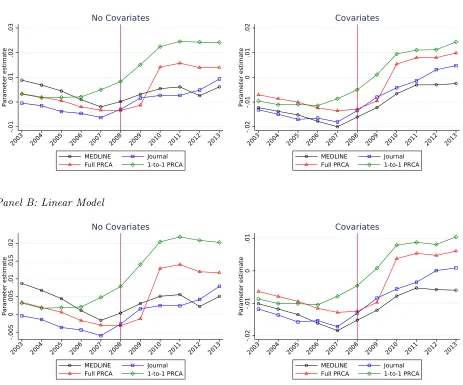
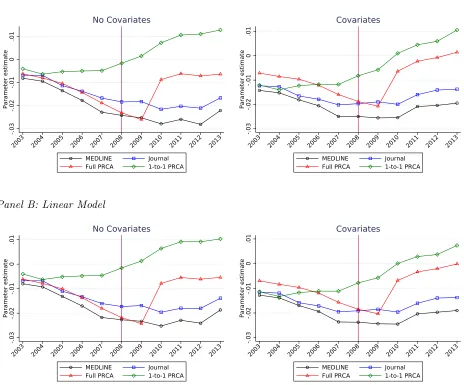
of Open Access Journals (DOAJ definition) and 2) the fraction of a journal’s articles that do not belong to the PubMed Central Open Access Subset (PMC-OAS definition). Figure 4 uses the DOAJ definition and Figure 5 uses the PMC-OAS definition. Panels A of each figure display the results assuming a Poisson model and using pseudo maximum likelihood (PPML) to obtain the estimates. Panels B of each figure display the results assuming a linear model in levels and using ordinary least squares (OLS) to obtain the estimates. The graphs on the left and right are obtained using specifications without and with covariates, respectively. Each dot represents a point estimate of the NIH indicator interacted with a calendar year.
Figure 4 shows that, relative to comparison articles in the 1-to-1 PRCA sample, the propensity of NIH articles to be published in toll access journals was relatively constant between 2003 and 2006 and then rapidly increased between 2007 and 2010 before settling at a permanently higher level. Relative to comparison articles in the MEDLINE, Journal, and Full PRCA samples, the propensity of NIH articles to be published in toll access journals declined between 2003 and 2007, abruptly changed direction and then rapidly increased before (usually) settling at a permanently higher level around 2010. These general patterns are present using both the Poisson and linear models and whether or not covariates are included in the regression specifications.
Figure 5 shows broadly similar patterns. Relative to comparison articles in the 1-to-1 PRCA sample, the propensity of NIH articles to be published in toll access journals was flat between 2003 and 2007, and then increased thereafter – though it does not seem to settle at a permanently higher level. As before, relative to comparison articles in the MEDLINE, Journal, and Full PRCA samples, the propensity of NIH articles to be published in toll access journals declined during the pre-mandate period. Relative to comparison articles in the Full PRCA sample, this propensity sharply reversed course and jumped to a permanently higher level between 2009 and 2010. In contrast, relative to comparison articles in the MEDLINE and Journal samples, this propensity did not sharply reverse course, but it did stop declining. Again, these general patterns are true using both the Poisson and linear models and whether covariates are included or not.
Taken together, Figures 4 and 5 provide striking visual evidence that, relative to com-parison articles, the propensity of NIH articles to be published in toll access journals either increases after the PMC mandate or at least stops decreasing. This is not consistent with the hypothesis that the PMC mandate induced discrimination, by toll access journals, against NIH articles. At the very least, any such discrimination seems to have been offset by other factors – possibly the decisions of editors and the submission behavior of authors.
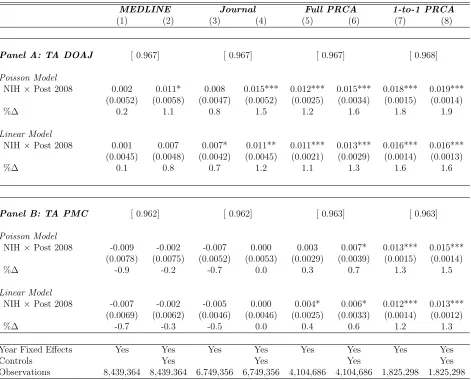
NIH articles to be published in a toll access journal. Panel A uses the DOAJ definition of toll access and Panel B uses the PMC-OAS definition. For each definition of toll access, two models are estimated on each of the four samples. First, the conditional mean in equation (1) is modeled as Poisson and is estimated using PPML. Second, the conditional mean is modeled as linear in levels and is estimated using OLS.
Using the DOAJ definition of toll access, all estimates, across all models, samples, and specifications are positive. Estimates from specifications with covariates tend to be a bit higher than those from specifications without covariates, especially in the MEDLINE and Journal samples. Estimates using the Poisson model imply percent changes in the propensity of NIH articles to be published in toll access journals ranging from 0.2% to 1.9% and estimates using the linear model in levels imply percent changes ranging from 0.1% to 1.6%. In addition to being positive, all estimates using the Journal, Full PRCA, and 1-to-1 PRCA sample are statistically significant.
Using the PMC Open Access Subset definition of toll access yields quite similar results in that most estimates imply a small increase in the propensity of NIH articles to be published in toll access journals after the PMC mandate. In contrast to the estimates in Panel A, the the percent changes implied by point estimates using the Poisson and linear models are between -0.9% and 0% for the MEDLINE and Journal samples (though none are statistically significant). However, as can be seen in Figure 5, these negative estimates are the result of the declining propensity of NIH articles to be published in a toll access journal (relative to the comparison articles) during the pre-mandate period. This trend stops, but fails to reverse, after the mandate, giving rise to the negative point estimates. The estimates using the two PRCA samples are always positive and are usually statistically significant. Estimates using the Poisson model imply percent changes in the propensity of NIH articles to be published in toll access journals ranging from -0.9% to 1.5% and estimates using the linear model in levels imply percent changes ranging from -0.7% to 1.3%.
5
Conclusion
This paper examined the impacts of the National Institutes of Health’s 2008 PubMed Central (PMC) mandate on researcher access to the biomedical literature and publishing patterns in biomedicine. Two main findings emerge from the analysis.
First, I find that the effects of the PMC mandate on researcher access to the biomedical literature are difficult to pin down – point estimates are noisy and vary substantially across samples, models, and specifications. However, by focusing on the upper limits of confidence intervals, I am able to bound the plausible increase in citations to NIH articles