Stack-propagation: Improved Representation Learning for Syntax
Yuan Zhang∗ CSAIL, MIT
Cambridge, MA 02139, USA
David Weiss
Google Inc
New York, NY 10027, USA
Abstract
Traditional syntax models typically lever-age part-of-speech (POS) information by constructing features from hand-tuned templates. We demonstrate that a better approach is to utilize POS tags as a reg-ularizer of learned representations. We propose a simple method for learning a stacked pipeline of models which we call “stack-propagation”. We apply this to de-pendency parsing and tagging, where we use the hidden layer of the tagger network as a representation of the input tokens for the parser. At test time, our parser does not require predicted POS tags. On 19 lan-guages from the Universal Dependencies, our method is 1.3% (absolute) more accu-rate than a state-of-the-art graph-based ap-proach and 2.7% more accurate than the most comparable greedy model.
1 Introduction
In recent years, transition-based dependency parsers powered by neural network scoring func-tions have dramatically increased the state-of-the-art in terms of both speed and accuracy (Chen and Manning, 2014; Alberti et al., 2015; Weiss et al., 2015). Similar approaches also achieve state-of-the-art in other NLP tasks, such as constituency parsing (Durrett and Klein, 2015) or semantic role labeling (FitzGerald et al., 2015). These approaches all share a common principle: re-place hand-tuned conjunctions of traditional NLP feature templates with continuous approximations learned by the hidden layer of a feed-forward net-work.
∗Research conducted at Google.
However, state-of-the-art dependency parsers depend crucially on the use of predicted part-of-speech (POS) tags. In the pipeline or stacking
(Wolpert, 1992) method, these are predicted from an independently trained tagger and used as fea-tures in the parser. However, there are two main disadvantages of a pipeline: (1) errors from the POS tagger cascade into parsing errors, and (2) POS taggers often make mistakes precisely be-cause they cannot take into account the syntactic context of a parse tree. The POS tags may also contain only coarse information, such as when us-ing the universal tagset of Petrov et al. (2011).
One approach to solve these issues has been to avoid using POS tags during parsing, e.g. either using semi-supervised clustering instead of POS tags (Koo et al., 2008) or building recurrent repre-sentations of words using neural networks (Dyer et al., 2015; Ballesteros et al., 2015). However, the best accuracy for these approaches is still achieved by running a POS tagger over the data first and combining the predicted POS tags with additional representations. As an alternative, a wide range of prior work has investigated jointly modeling both POS and parse trees (Li et al., 2011; Hatori et al., 2011; Bohnet and Nivre, 2012; Qian and Liu, 2012; Wang and Xue, 2014; Li et al., 2014; Zhang et al., 2015; Alberti et al., 2015). However, these approaches typically require sacrificing either ef-ficiency or accuracy compared to the best pipeline model, and often they simply re-rank the predic-tions of a pipelined POS tagger.
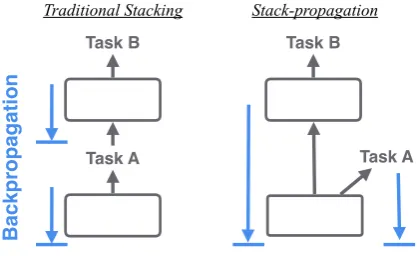
In this work, we show how to improve accuracy for both POS tagging and parsing by incorporat-ing stackincorporat-ing into the architecture of a feed-forward network. We propose a continuous form of stack-ing that allows for easy backpropagation down the pipeline across multiple tasks, a process we call
B
a
c
k
p
ro
p
a
g
a
ti
o
n
Task A Task B
Traditional Stacking Stack-propagation
[image:2.595.77.286.68.196.2]Task A Task B
Figure 1: Traditional stacking (left) vs. Stack-propagation (right). Stacking uses the output of Task A as features in Task B, and does not allow backpropagation between tasks. Stack-propagation uses a continuous and differentiable link between Task A and Task B, allowing for backpropagation from Task B into Task A’s model. Updates to Task A act as
regularizationon the model for Task B, ensuring the shared component is useful for both tasks.
“stack-propagation” (Figure 1). At the core of this idea is that we use POS tags asregularization in-stead offeatures.
Our model design for parsing is very simple: we use the hidden layer of a window-based POS tagging network as the representation of tokens in a greedy, transition-based neural network parser. Both networks are implemented with a refined ver-sion of the feed-forward network (Figure 3) from Chen and Manning (2014), as described in Weiss et al. (2015). We link the tagger network to the parser by translating traditional feature templates for parsing into feed-forward connections from the tagger to the parser (Figure 2). At training time, we unroll the parser decisions and apply stack-propagation by alternating between stochastic up-dates to the parsing or tagging objectives (Figure 4). The parser’s representations of tokens are thus regularized to be individually predictive of POS tags, even as they are trained to be useful for pars-ing when concatenated and fed into the parser work. This model is similar to the multi-task net-work structure of Collobert et al. (2011), where Collobert et al. (2011) shares a hidden layer be-tween multiple tagging tasks. The primary differ-ence here is that we show how to unroll parser transitions to apply the same principle to tasks with fundamentally different structure.
The key advantage of our approach is that at test time, we do not require predicted POS tags for parsing. Instead, we run the tagger network up to the hidden layer over the entire sentence, and then dynamically connect the parser network to
the tagger network based upon the discrete parser configurations as parsing unfolds. In this way, we avoid cascading POS tagging errors to the parser. As we show in Section 5, our approach can be used in conjunction with joint transition systems in the parser to improve both POS tagging as well as parsing. In addition, because the parser re-uses the representation from the tagger, we can drop all lexicalized features from the parser network, lead-ing to a compact, faster model.
The rest of the paper is organized as follows. In Section 2, we describe the layout of our combined architecture. In Section 3, we introduce stack-propagation and show how we train our model. We evaluate our approach on 19 languages from the Universal Dependencies treebank in Section 4. We observe a >2% absolute gain in labeled ac-curacy compared to state-of-the-art, LSTM-based greedy parsers (Ballesteros et al., 2015) and a
>1% gain compared to a state-of-the-art, graph-based method (Lei et al., 2014). We also evaluate our method on the Wall Street Journal, where we find that our architecture outperforms other greedy models, especially when only coarse POS tags from the universal tagset are provided during train-ing. In Section 5, we systematically evaluate the different components of our approach to demon-strate the effectiveness of stack-propagation com-pared to traditional types of joint modeling. We also show that our approach leads to large reduc-tions in cascaded errors from the POS tagger.
I
ate
a
snack
today
…
…
I
ate
a
sandwich with
cheese
I
sandwich with
cheese
ate
a
PRON
VERB
DET
NOUN
ADP
NOUN
Parsing loss
{
{
Window-based
classifier
PRON
VERB
DET
NOUN NOUN
I
ate
a
sandwich with
cheese
I
sandwich with
cheese
ate
a
PRON
VERB
DET
NOUN
ADP
NOUN
Parsing loss
{
{
I
ate
a
sandwich with
cheese
I
sandwich with
cheese
ate
a
PRON
VERB
DET
NOUN
ADP
NOUN
Parsing loss
{
{
I
ate
a
sandwich with
cheese
I
sandwich with
cheese
ate
a
PRON
VERB
DET
NOUN
ADP
NOUN
Parsing loss
{
{
{
Transition-based
parser
I
ate
a
snack
today
I
ate
ate
a
ate
snack
ate
Transition-based
parser
{
I
ate
a
snack
today
…
…
I
ate
a
sandwich with
cheese
I
sandwich with
cheese
ate
a
PRON
VERB
DET
NOUN
ADP
NOUN
Parsing loss
{
{
Window-based
classifier
PRON
VERB
DET
NOUN NOUN
I
ate
a
sandwich with
cheese
I
sandwich with
cheese
ate
a
PRON
VERB
DET
NOUN
ADP
NOUN
Parsing loss
{
{
I
ate
a
sandwich
with
cheese
I
sandwich
with
cheese
ate
a
PRON
VERB
DET
NOUN
ADP
NOUN
Parsing loss
{
{
I
ate
a
sandwich
with
cheese
I
sandwich
with
cheese
ate
a
PRON
VERB
DET
NOUN
ADP
NOUN
Parsing loss
{
{
{
Transition-based
parser
I
ate
a
snack
today
I
ate
ate
a
ate
snack
ate
Transition-based
parser
{
I
ate
a
snack
today
…
…
I
ate
a
sandwich with
cheese
I
sandwich with
cheese
ate
a
PRON
VERB
DET
NOUN
ADP
NOUN
Parsing loss
{
{
Window-based
classifier
PRON
VERB
DET
NOUN NOUN
I
ate
a
sandwich with
cheese
I
sandwich with
cheese
ate
a
PRON
VERB
DET
NOUN
ADP
NOUN
Parsing loss
{
{
I
ate
a
sandwich
with
cheese
I
sandwich
with
cheese
ate
a
PRON
VERB
DET
NOUN
ADP
NOUN
Parsing loss
{
{
I
ate
a
sandwich
with
cheese
I
sandwich
with
cheese
ate
a
PRON
VERB
DET
NOUN
ADP
NOUN
Parsing loss
{
{
{
Transition-based
parser
I
ate
a
snack
today
I
ate
ate
a
ate
snack
ate
Transition-based
parser
{
I ate a snack today
… …
Tagger network (window-based)
PRON VERB DET NOUN NOUN
Parser network (state-based) I ate a snack Buffer
I ate ate
a ate snack ate Parser state
SHIFT (nsubj)LEFT SHIFT SHIFT LEFT(det)
ate a a snack today today
RIGHT (dobj)
ate today
SHIFT RIGHT(tmod)
today ate ate … … Stack Discrete state updates Connections depend on state (e.g. stack, parse)
Discrete
[image:3.595.80.523.66.228.2]link NN link Parser network Tagger network stack:1 stack:0 input:0
Figure 2: Detailed example of the stacked parsing model.Top:The discrete parser state, consisting of the stack and the buffer, is updated by the output of the parser network. In turn, the feature templates used by the parser are a function of the state. In this example, the parser has three templates,stack:0,stack:1, andinput:0. Bottom:The feature templates create many-to-many connections from the hidden layer of the tagger to the input layer of the parser. For example, the predicted root of the sentence (“ate”) is connected to the input of most parse decisions. At test time, the above structure is constructed dynamically as a function of the parser output. Note also that the predicted POS tags are not directly used by the parser.
2 Continuous Stacking Model
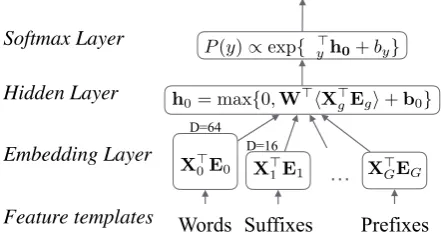
In this section, we introduce a novel neural net-work model for parsing and tagging that incorpo-rates POS tags as a regularization of learned im-plicit representations. The basic unit of our model (Figure 3) is a simple, feed-forward network that has been shown to work very well for parsing tasks (Chen and Manning, 2014; Weiss et al., 2015). The inputs to this unit are feature matrices which are embedded and passed as input to a hidden layer. The final layer is a softmax prediction.
We use two such networks in this work: a window-based version for tagging and a transition-based version for dependency parsing. In a traditional stacking (pipeline) approach, we would use the discrete predicted POS tags from the tagger as features in the parser (Chen and Manning, 2014). In our model, we instead feed the continuous hidden layer activations of the tag-ger network as input to the parser. The primary strength of our approach is that the parser has ac-cess to all of the features and information used by the POS tagger during training time, but it is al-lowed to make its own decisions at test time.
To implement this, we show how we can re-use feature templates from Chen and Manning (2014) to specify the feed-forward connections from the tagger network to the parser network. An interesting consequence is that because this structure is a function of the derivation produced by the parser, the final feed-forward structure of the stacked model is not known until run-time.
Prefixes W o rd s
Feature
extraction
Su ffixe s C lu st e rsEmbedding
Hidden (Relu)
Softmax
Words SuffixesX>0E0 X>1E1 … X>GEG P(y)/exp{ y>h0+by}
h0= max{0,W>hX>gEgi+b0}
Embedding Layer Hidden Layer Softmax Layer Feature templates D=64 D=16
Figure 3: Elementary NN unit used in our model. Feature matrices from multiple channels are embedded, concatenated together, and fed into a rectified linear hidden layer. In the parser network, the feature inputs are continuous representa-tions from the tagger network’s hidden layer.
However, because the connections for any specific parsing decision are fixed given the derivation, we can still extract examples for training off-line by unrolling the network structure from gold deriva-tions. In other words, we can utilize our approach with the same simple stochastic optimization tech-niques used in prior works. Figure 2 shows a fully unrolled architecture on a simple example.
2.1 The Tagger Network
[image:3.595.309.530.325.443.2]fea-The fox jumps . stack buffer
det
[image:4.595.234.526.71.236.2](a) Parser configuration c.
Figure 4: A schematic for the PARSER
stack-propagation update. a: Example parser configurationcwith correspond-ing stack and buffer. b: Forward and backward stages for the given single ex-ample. During the forward phase, the tagger networks compute hidden acti-vations for each feature template (e.g.
stack0 andbuffer0), and activations are fed as features into the parser network. For the backward update, we backpropa-gate training signals from the parser net-work into each linked tagging example.
Tagger
Forward
Feature Extractor Embedding Layer Hidden Layer
w0=fox, w-1=the, …
w0=jumps, w-1=fox, …
Parser
… … implicit bu↵er0
implicit stack0
Backward
stack0.lab=det,…
Embedding Layer … … Hidden Layer
Softmax Layer
Xlabel ximplicit
stack0
(b) Forward and backward schema for (a).
ximplicitbu↵er0 ximplicitstack0
ximplicitbu↵er0
implicit stack0
implicit bu↵er0
tures for POS tagging that are deterministically ex-tracted from the training data. As in prior work, the features are divided into groups of different sizes that share an embedding matrixE. Features for each group gare represented as a sparse ma-trix Xg with dimension Fg × Vg, where Fg is
the number of feature templates in the group, and
Vgis the vocabulary size of the feature templates.
Each row ofXg is a one-hot vector indicating the
appearance of each feature.
The network first looks up the learned embed-ding vectors for each feature and then concate-nates them to form the embedding layer. This em-bedding layer can be written as:
h0= [XgEg | ∀g] (1)
where Eg is a learnedVg ×Dg embedding
ma-trix for feature group. Thus, the final size|h0| = P
gFgDg is the sum of all embedded feature
sizes. The specific features and their dimensions used in the tagger are listed in Table 1. Note that for all features, we create additional null value that triggers when features are extracted outside the scope of the sentence. We use a single hidden layer in our model and apply rectified linear unit (ReLU) activation function over the hidden layer outputs. A final softmax layer reads in the acti-vations and outputs probabilities for each possible POS tag.
2.2 The Parser Network
The parser component follows the same design as the POS tagger with the exception of the fea-tures and the output space. Instead of a window-based classifier, features are extracted from an
arc-Features (g) Window D
Symbols 1 8
Capitalization +/- 1 4 Prefixes/Suffixes (n= 2,3) +/- 1 16
Words +/-3 64
Table 1: Window-based tagger feature spaces. “Symbols” indicates whether the word contains a hyphen, a digit or a punctuation.
standard parser configuration1 cconsisting of the
stacks, the bufferband the so far constructed de-pendencies (Nivre, 2004). Prior implementations of this model used up to four groups of discrete features: words, labels (from previous decisions), POS tags, and morphological attributes (Chen and Manning, 2014; Weiss et al., 2015; Alberti et al., 2015).
In this work, we apply the same design princi-ple but we use animplicitly learned intermediate representation in the parser to replace traditional discrete features. We only retain discrete features over the labels in the incrementally constructed tree (Figure 4). Specifically, for any token of inter-est, we feed the hidden layer of the tagger network evaluated for that token as input to the parser. We implement this idea by re-using the feature tem-plates from prior work as indexing functions.
We define this process formally as follows. Let
fi(c) be a function mapping from parser
config-urationsc to indices in the sentence, wherei de-notes each of our feature templates. For example, in Figure 4(a), wheni =stack0,fi(c)is the
in-1Note that the “stack” in the parse configuration is
dex of “fox” in the sentence. Let htagger1 (j) be the hidden layer activation of the tagger network evaluated at tokenj. We define the inputXimplicit
by concatenating these tagger activations accord-ing to our feature templates:
ximpliciti ,htagger1 (fi(c)). (2)
Thus, the feature group Ximplicit is the
row-concatenation of the hidden layer activations of the tagger, as indexed by the feature templates. We have that Fimplicit is the number of feature
templates, and Vimplicit = Htagger, the
num-ber of possible values is the numnum-ber of hidden units in the tagger. Just as for other features, we learn an embedding matrix Eimplicit of size
Himplicit×Fimplicit. Note that as in the POS
tag-ger network, we reserve an additional null value for out of scope feature templates. A full exam-ple of this lookup process, and the resulting feed-forward network connections created, is shown for a simple three-feature template consisting of the top two tokens on the stack and the first on the buffer in Figure 2. See Table 1 for the full list of 20 tokens that we extract for each state.
3 Learning with Stack-propagation In this section we describe how we train our stack-ing architecture. At a high level, we simply apply backpropagation to our proposed continuous form of stacking (hence “stack-propagation.”) There are two major issues to address: (1) how to handle the dynamic many-to-many connections between the tagger network and the parser network, and (2) how to incorporate the POS tag labels during train-ing.
Addressing the first point turns out to be fairly easy in practice: we simply unroll the gold trees into a derivation of (state, action) pairs that pro-duce the tree. The key property of our pars-ing model is that the connections of the feed-forward network are constructed incrementally as the parser state is updated. This is different than a generic recurrent model such as an LSTM, which passes activation vectors from one step to the next. The important implication at training time is that, unlike a recurrent network, the parser decisions are conditionally independent given a fixed his-tory. In other words, if we unroll the network structure ahead of time given the gold derivation, we do not need to perform inference when training with respect to these examples. Thus, the overall
training procedure is similar to that introduced in Chen and Manning (2014).
To incorporate the POS tags as a regularization during learning, we take a fairly standard approach from multi-task learning. The objective of learn-ing is to find parametersΘthat maximize the data log-likelihood with a regularization onΘfor both parsing and tagging:
max
Θ λ
X
x,y∈T
log(PΘ(y|x))+ X
c,a∈P
log (PΘ(a|c)), (3)
where{x, y}are POS tagging examples extracted from individual tokens and{c, a}are parser (con-figuration, action) pairs extracted from the un-rolled gold parse tree derivations, andλis a trade-off parameter.
We optimize this objective stochastically by al-ternating between two updates:
• TAGGER: Pick a POS tagging example and
update the tagger network with backpropaga-tion.
• PARSER: (Figure 4) Given a parser
con-figuration c from the set of gold contexts, compute both tagger and parser activations. Backpropagate the parsing loss through the stacked architecture to update both parser and tagger, ignoring the tagger’s softmax layer parameters.
Method ar bg da de en es eu fa fi fr hi id it iw nl no pl pt sl AVG
NO TAGS
B’15 LSTM 75.6 83.1 69.6 72.4 77.9 78.5 67.5 74.7 73.2 77.4 85.9 72.3 84.1 73.1 69.5 82.4 78.0 79.9 80.1 76.6 Ours (window) 76.1 82.9 70.9 71.7 79.2 79.3 69.1 77.5 72.5 78.2 87.1 71.8 83.6 76.2 72.3 83.2 77.8 79.0 79.8 77.3
UNIVERSAL TAGSET
B’15 LSTM 74.6 82.4 68.1 73.0 77.9 77.8 66.0 75.0 73.6 78.0 86.8 72.2 84.2 74.5 68.4 83.3 74.5 80.4 78.1 76.2 PipelinePtag 73.7 83.6 72.0 73.0 79.3 79.5 63.0 78.0 66.9 78.5 87.8 73.5 84.2 75.4 70.3 83.6 73.4 79.5 79.4 76.6 RBGParser 75.8 83.6 73.9 73.5 79.9 79.6 68.0 78.5 65.4 78.9 87.7 74.2 84.7 77.6 72.4 83.9 75.4 81.3 80.7 77.6 Stackprop 77.0 84.3 73.8 74.2 80.7 80.7 70.1 78.5 74.5 80.0 88.9 74.1 85.8 77.5 73.6 84.7 79.2 80.4 81.8 78.9 Table 2: Labeled Attachment Score (LAS) on Universal Dependencies Treebank. Top:Results without any POS tag observa-tions. “B’15 LSTM” is the character-based LSTM model (Ballesteros et al., 2015), while “Ours (window)” is our window-based architecture variant without stackprop. Bottom: Comparison against state-of-the-art baselines utilizing the POS tags. Paired t-tests show that the gain of Stackprop over all other approaches is significant (p < 10−5 for all but RBGParser, which is
p <0.02).
3.1 Implementation details
Following Weiss et al. (2015), we use mini-batched averaged stochastic gradient descent (ASGD) (Bottou, 2010) with momentum (Hinton, 2012) to learn the parameters Θ of the network. We use a separate learning rate, moving average, and velocity for the tagger network and the parser; the PARSER updates all averages, velocities, and
learning rates, while the TAGGERupdates only the
tagging factors. We tuned the hyperparameters of momentum rateµ, the initial learning rateη0 and
the learning rate decay stepγ using held-out data. The training data for parsing and tagging can be extracted from either the same corpus or different corpora; in our experiments they were always the same.
To trade-off the two objectives, we used a ran-dom sampling scheme to perform 10 epochs of PARSER updates and 5 epochs of TAGGER
up-dates. In our experiments, we found that pre-training with TAGGER updates for one epoch
be-fore interleaving PARSER updates yielded faster
training with better results. We also experimented using the TAGGER updates solely for initializing
the parser and found that interleaving updates was crucial to obtain improvements over the baseline.
4 Experiments
In this section, we evaluate our approach on sev-eral dependency parsing tasks across a wide vari-ety of languages.
4.1 Experimental Setup
We first investigated our model on 19 lan-guages from the Universal Dependencies Tree-banks v1.2.2 We selected the 19 largest
cur-2http://universaldependencies.org
rently spoken languages for which the full data was freely available. We used the coarse universal tagset in our experiments with no explicit morpho-logical annotations. To measure parsing accuracy, we report unlabeled attachment score (UAS) and labeled attachment score (LAS) computed on all tokens (including punctuation), as is standard for non-English datasets.
For simplicity, we use the arc-standard (Nivre, 2004) transition system with greedy decoding. Be-cause this transition system only produces projec-tive trees, we first apply a projectivization step to all treebanks before unrolling the gold derivations during training. We make an exception for Dutch, where we observed a significant gain on develop-ment data by introducing the SWAPaction (Nivre,
2009) and allowing non-projective trees.
For models that required predicted POS tags, we trained a window-based tagger using the same features as the tagger component of our stacking model. We used 5-fold jackknifing to produce pre-dicted tags on the training set. We found that the window-based tagger was comparable to a state-of-the-art CRF tagger for most languages. For ev-ery network we trained, we used the development data to evaluate a small range of hyperparameters, stopping training early when UAS no longer im-proved on the held-out data. We use H = 1024
hidden units in the parser, andH = 128 hidden units in the tagger. The parser embeds the tag-ger activations withD= 64. Note that following Ballesteros et al. (2015), we did not use any aux-iliary data beyond that in the treebanks, such as pre-trained word embeddings.
Method UAS LAS NO TAGS
Dyer et al. (2015) 92.70 90.30 Ours (window-based) 92.85 90.77
UNIVERSAL TAGSET
Pipeline(Ptag) 92.52 90.50
Stackprop 93.23 91.30
FINE TAGSET
Chen & Manning (2014) 91.80 89.60 Dyer et al. (2015) 93.10 90.90 Pipeline (Ptag) 93.10 91.16
Stackprop 93.43 91.41
[image:7.595.78.286.64.280.2]Weiss et al. (2015) 93.99 92.05 Alberti et al. (2015) 94.23 92.36
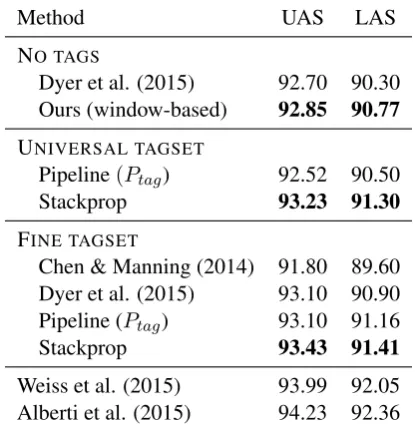
Table 3: WSJ Test set results for greedy and state-of-the-art methods. For reference, we show the most accurate models from Alberti et al. (2015) and Weiss et al. (2015), which use a deeper model and beam search for inference.
converter (De Marneffe et al., 2006). We followed standard practice and used sections 2-21 for train-ing, section 22 for development, and section 23 for testing. Following Weiss et al. (2015), we used section 24 to tune any hyperparameters of the model to avoid overfitting to the development set. As is common practice, we use pretrained word embeddings from the word2vec package when training on this dataset.
4.2 Results
We present our main results on the Universal Tree-banks in Table 2. We directly compare our ap-proach to other baselines in two primary ways. First, we compare the effectiveness of our learned continuous representations with those of Alberti et al. (2015), who use the predicted distribution over POS tags concatenated with word embeddings as input to the parser. Because they also incorpo-rate beam search into training, we re-implement a greedy version of their method to allow for direct comparisons of token representations. We refer to this as the “Pipeline (Ptag)” baseline. Second, we
also compare our architecture trained without POS tags as regularization, which we refer to as “Ours (window-based)”. This model has the same archi-tecture as our full model but with no POS supervi-sion and updates. Since this model never observes POS tags in any way, we compare against a re-current character-based parser (Ballesteros et al.,
Model Variant UAS LAS POS
Arc-standard transition system
Pipeline (Ptag) 81.56 76.55 95.14
Ours (window-based) 82.08 77.08 -Ours (Stackprop) 83.38 78.78
-Joint parsing & tagging transition system
Pipeline (Ptag) 81.61 76.57 95.30
[image:7.595.308.538.64.202.2]Ours (window-based) 82.58 77.76 94.92 Ours (Stackprop) 83.21 78.64 95.43
Table 4: Averaged parsing and POS tagging results on the UD treebanks for joint variants of stackprop. Given the window-based architecture, stackprop leads to higher parsing accura-cies than joint modeling (83.38% vs. 82.58%).
2015) which is state-of-the-art when no POS tags are provided.3 Finally, we compare to RGBParser
(Lei et al., 2014), a state-of-the art graph-based (non-greedy) approach.
Our greedy stackprop model outperforms all other methods, including the graph-based RBG-Parser, by a significant margin on the test set (78.9% vs 77.6%). This is despite the limitations of greedy parsing. Stackprop also yields a 2.3% absolute improvement in accuracy compared to using POS tag confidences as features (Pipeline
Ptag). Finally, we also note that adding
stack-prop to our window-based model improves accu-racy in every language, while incorporating pre-dicted POS tags into the LSTM baseline leads to occasional drops in accuracy (most likely due to cascaded errors.)
5 Discussion
Stackprop vs. other representations. One un-expected result was that, even without the POS tag labels at training time, our stackprop archi-tecture achieves better accuracy than either the character-based LSTM or the pipelined baselines (Table 2). This suggests that adding window-based representations–which aggregate over many features of the word and surrounding context– is more effective than increasing the expressive-ness of individual word representations by using character-based recurrent models. In future work we will explore combining these two complemen-tary approaches.
We hypothesized that stackprop might provide larger gains over the pipelined model when the
3We thank Ballesteros et al. (2015) for their assistance
Token married by ajudge. Don’tjudgea book by andwalkedaway satisfied when Iwalkin the door Neighbors mesmerizing as arat. doesn’tchangethe company’s tried, andtriedhard upset when Iwentto
Astaple! won’tchargeyour phone andincorporatedinto Imeanbesides me day at abar, then go don’twasteyour money andbelongedto the Ifeltas if I
[image:8.595.70.537.64.130.2]Pattern a [noun] ’nt [verb] and [verb]ed I [verb]
Table 5: Four of examples of tokens in context, along with the three most similar tokens according to the tagger network’s activations, and the simple pattern exhibited. Note that this model was trained with the Universal tagset which does not distinguish verb tense.
POS tags are very coarse. We tested this latter hy-pothesis on the WSJ corpus by training our model using the coarse universal tagsets instead of the fine tagset (Table 3). We found that stackprop achieves similar accuracy using coarse tagsets as the fine tagset, while the pipelined baseline’s per-formance drops dramatically. And while stack-prop doesn’t achieve the highest reported accura-cies on the WSJ, it does achieve competitive ac-curacies and outperforms prior state-of-the-art for greedy methods (Dyer et al., 2015).
Stackprop vs. joint modeling. An alternative to stackprop would be to train the final layer of our architecture to predict both POS tags and dependency arcs. To evaluate this, we trained our window-based architecture with the integrated transition system of Bohnet and Nivre (2012), which augments the SHIFT transition to predict POS tags. Note that if we also apply stackprop, the network learns from POS annotations twice: once in the TAGGERupdates, and again the PARSER
up-dates. We therefore evaluated our window-based model both with and without stack-propagation, and with and without the joint transition system.
We compare these variants along with our re-implementation of the pipelined model of Alberti et al. (2015) in Table 4. We find that stackprop is always better, even when it leads to “double count-ing” the POS annotations; in this case, the result is a model that is significantly better at POS tagging while marginally worse at parsing than stackprop alone.
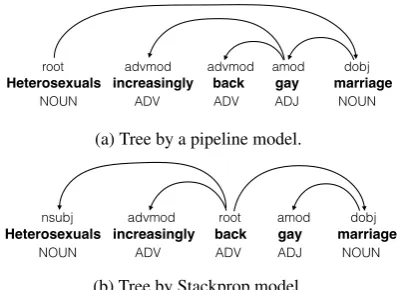
Reducing cascaded errors. As expected, we observe a significant reduction in cascaded POS tagging errors. An example from the English UD treebank is given in Figure 5. Across the 19 lan-guages in our test set, we observed a 10.9% gain (34.1% vs. 45.0%) in LAS on tokens where the pipelined POS tagger makes a mistake, compared to a 1.8% gain on the rest of the corpora.
Heterosexuals increasingly back gay marriage
root advmod advmod amod dobj
NOUN ADV ADV ADJ NOUN
(a) Tree by a pipeline model.
Heterosexuals increasingly back gay marriage nsubj advmod root amod dobj
NOUN ADV ADV ADJ NOUN
(b) Tree by Stackprop model.
Figure 5: Example comparison between predictions by a pipeline model and a joint model. While both models pre-dict a wrong POS tag for the word “back” (ADV rather than VERB), the joint model is robust to this POS error and predict the correct parse tree.
Decreased model size. Previous neural parsers that use POS tags require learning embeddings for words and other features on top of the parameters used in the POS tagger (Chen and Manning, 2014; Weiss et al., 2015). In contrast, the number of to-tal parameters for the combined parser and tag-ger in the Stackprop model is reduced almost by half compared to the Pipeline model, because the parser and tagger share parameters. Furthermore, compared to our implementation of the pipeline model, we observed that this more compact parser model was also roughly twice as fast.
[image:8.595.317.520.193.338.2]6 Conclusions
We present a stacking neural network model for dependency parsing and tagging. Through a sim-ple learning method we call “stack-propagation,” our model learns effective intermediate represen-tations for parsing by using POS tags as regular-ization of implicit representations. Our model out-performs all state-of-the-art parsers when evalu-ated on 19 languages of the Universal Dependen-cies treebank and outperforms other greedy mod-els on the Wall Street Journal.
We observe that the ideas presented in this work can also be as a principled way to optimize up-stream NLP components for down-up-stream appli-cations. In future work, we will extend this idea beyond sequence modeling to improve models in NLP that utilize parse trees as features. The basic tenet of stack-propagation is that the hidden lay-ers of neural models used to generate annotations can be used instead of the annotations themselves. This suggests a new methodology to building deep neural models for NLP: we can design them from the ground up to incorporate multiple sources of annotation and learn far more effective intermedi-ate representations.
Acknowledgments
We would like to thank Ryan McDonald, Emily Pitler, Chris Alberti, Michael Collins, and Slav Petrov for their repeated discussions, suggestions, and feedback, as well all members of the Google NLP Parsing Team. We would also like to thank Miguel Ballesteros for assistance running the character-based LSTM.
References
Chris Alberti, David Weiss, Greg Coppola, and Slav Petrov. 2015. Improved transition-based parsing and tagging with neural networks. InProceedings of EMNLP 2015.
Miguel Ballesteros, Chris Dyer, and Noah A. Smith. 2015. Improved transition-based parsing by model-ing characters instead of words with lstms. Proced-dings of EMNLP.
Bernd Bohnet and Joakim Nivre. 2012. A transition-based system for joint part-of-speech tagging and la-beled non-projective dependency parsing. In Pro-ceedings of the 2012 Joint Conference on Empiri-cal Methods in Natural Language Processing and Computational Natural Language Learning, pages 1455–1465. Association for Computational Linguis-tics.
L´eon Bottou. 2010. Large-scale machine learning with stochastic gradient descent. InProceedings of COMPSTAT’2010, pages 177–186. Springer.
Danqi Chen and Christopher D Manning. 2014. A fast and accurate dependency parser using neural net-works. InProceedings of the 2014 Conference on Empirical Methods in Natural Language Processing (EMNLP), volume 1, pages 740–750.
Ronan Collobert, Jason Weston, L´eon Bottou, Michael Karlen, Koray Kavukcuoglu, and Pavel P. Kuksa. 2011. Natural language processing (almost) from scratch. JMLR.
Marie-Catherine De Marneffe, Bill MacCartney, and Christopher D. Manning. 2006. Generating typed dependency parses from phrase structure parses. In Proceedings of Fifth International Conference on Language Resources and Evaluation, pages 449– 454.
Greg Durrett and Dan Klein. 2015. Neural crf parsing. InProceedings of the Association for Computational Linguistics. Association for Computational Linguis-tics.
Chris Dyer, Miguel Ballesteros, Wang Ling, Austin Matthews, and Noah A Smith. 2015. Transition-based dependency parsing with stack long short-term memory.ACL.
Nicholas FitzGerald, Oscar Tckstrm, Kuzman Ganchev, and Dipanjan Das. 2015. Semantic role labeling with neural network factors. In Proceed-ings of the 2015 Conference on Empirical Methods in Natural Language Processing (EMNLP ’15). Jun Hatori, Takuya Matsuzaki, Yusuke Miyao, and
Jun’ichi Tsujii. 2011. Incremental joint pos tag-ging and dependency parsing in chinese. In IJC-NLP, pages 1216–1224. Citeseer.
Geoffrey E Hinton. 2012. A practical guide to training restricted boltzmann machines. InNeural Networks: Tricks of the Trade, pages 599–619. Springer. Terry Koo, Xavier Carreras P´erez, and Michael Collins.
2008. Simple semi-supervised dependency parsing. In46th Annual Meeting of the Association for Com-putational Linguistics, pages 595–603.
Tao Lei, Yu Xin, Yuan Zhang, Regina Barzilay, and Tommi Jaakkola. 2014. Low-rank tensors for scor-ing dependency structures. In Proceedings of the 52nd Annual Meeting of the Association for Com-putational Linguistics, volume 1, pages 1381–1391.
Zhenghua Li, Min Zhang, Wanxiang Che, Ting Liu, and Wenliang Chen. 2014. Joint optimization for chinese POS tagging and dependency parsing. IEEE/ACM Transactions on Audio, Speech & Lan-guage Processing, pages 274–286.
Mitchell P. Marcus, Beatrice Santorini, and Mary Ann Marcinkiewicz. 1993. Building a large annotated corpus of English: The Penn Treebank. Computa-tional Linguistics, 19(2):313–330.
Joakim Nivre. 2004. Incrementality in deterministic dependency parsing. In Proceedings of the Work-shop on Incremental Parsing: Bringing Engineer-ing and Cognition Together, IncrementParsing ’04, pages 50–57, Stroudsburg, PA, USA. Association for Computational Linguistics.
Joakim Nivre. 2009. Non-projective dependency pars-ing in expected linear time. In Proceedings of the Joint Conference of the 47th Annual Meeting of the ACL and the 4th International Joint Conference on Natural Language Processing of the AFNLP, pages 351–359.
Slav Petrov, Dipanjan Das, and Ryan McDonald. 2011. A universal part-of-speech tagset. arXiv preprint arXiv:1104.2086.
Xian Qian and Yang Liu. 2012. Joint chinese word segmentation, pos tagging and parsing. In Pro-ceedings of the 2012 Joint Conference on Empirical Methods in Natural Language Processing and Com-putational Natural Language Learning, pages 501– 511. Association for Computational Linguistics. Zhiguo Wang and Nianwen Xue. 2014. Joint pos
tag-ging and transition-based constituent parsing in chi-nese with non-local features. InProceedings of the 52nd Annual Meeting of the Association for Compu-tational Linguistics, pages 733–742.
David Weiss, Chris Alberti, Michael Collins, and Slav Petrov. 2015. Structured training for neural net-work transition-based parsing. In Proceedings of ACL 2015, pages 323–333.
David H Wolpert. 1992. Stacked generalization. Neu-ral networks.