Authors
Luigi Ascione, Jean-François Caron, Patrice Godonou, Kees van IJselmuijden, Jan Knippers, Toby Mottram, Matthias Oppe, Morten Gantriis Sorensen, Jon Taby, Liesbeth Tromp
Editors
Luigi Ascione, Eugenio Gutierrez, Silvia Dimova, Artur Pinto, Steve Denton
Support to the implementation, harmonization
and further development of the Eurocodes
THE DESIGN OF FRP
Contact information Silvia Dimova
Address: Joint Research Centre, Via Enrico Fermi 2749, TP 480, 21027 Ispra (VA), Italy E-mail: [email protected]
Tel.: +39 0332 78 9063
This publication is a Science and Policy Report by the Joint Research Centre, the European Commission’s in-house science service. It aims to provide evidence-based scientific support to the European policy-making process. The scientific output expressed does not imply a policy position of the European Commission. Neither the European Commission nor any person acting on behalf of the Commission is responsible for the use which might be made of this publication.
JRC Science Hub
https://ec.europa.eu/jrc
JRC99714
EUR 27666 EN
PDF ISBN 978-92-79-54225-1
ISBN 978-92-79-54226-8
ISSN 1831-9424 doi:10.2788/22306 LB-NA-27666-EN-N
ISSN 1018-5593 doi:10.2788/851558 LB-NA-27666-EN-C
© European Union, 2016
Reproduction is authorised provided the source is acknowledged.
Printed in Italy
How to cite: L. Ascione, J.-F. Caron, P. Godonou, K. van IJselmuijden, J. Knippers, T. Mottram, M. Oppe, M. Gantriis Sorensen, J. Taby, L. Tromp; Prospect for new guidance in the design of FRP; EUR 27666 EN; doi:10.2788/22306
Abstract
Over the last twenty years, many innovative solutions have confirmed the usefulness of composite structures realized with FRPs (Fibre Reinforced Polymer or Plastic). The need of European standards for use of fibre-reinforced polymer composites in civil engineering was justified in 2007 in the JRC Report EUR 22864 EN. The new European technical rules will be developed using the existing organization of CEN/TC250.
The present report has been worked out in the frame of CEN/TC250/WG4 activities. The report encompasses: • Part I, which introduces the policy framework and the CEN/TC250 initiative
• Part II, which gives a prospect for CEN guidance for the design and verification of composite structures realized with FRPs
The report presents scientific and technical background intended to stimulate debate and serves as a basis for further work to achieve a harmonized European view on the design and verification of such structures. This has been the main impulse to include the work item of the Fibre Reinforced Polymer Structures in the Mandate M/515 with high priority.
FOREWORD
The construction sector is of strategic importance to the EU as it delivers the buildings and infrastructure
needed by the rest of the economy and society. It represents more than 10% of EU GDP and more than
50% of fixed capital formation. It is the largest single economic activity and it is the biggest industrial employer in Europe. The sector employs directly almost 20 million people. Construction is a key element
not only for the implementation of the Single Market, but also for other construction relevant EU Policies,
e.g. Sustainability, Environment and Energy, since 40-45% of Europe’s energy consumption stems from
buildings with a further 5-10% being used in processing and transport of construction products and components.
The EN Eurocodes are a set of European standards which provide common rules for the design of construction works, to check their strength and stability against extreme live loads such as fire and earthquakes. In line with the EU’s strategy for smart, sustainable and inclusive growth (EU2020),
Standardisation plays an important part in supporting the industrial policy for the globalization era. The improvement of the competition in EU markets through the adoption of the Eurocodes is recognized in the "Strategy for the sustainable competitiveness of the construction sector and its enterprises" - COM (2012)433, and they are distinguished as a tool for accelerating the process of convergence of different national and regional regulatory approaches.
With the publication of all the 58 Eurocodes Parts in 2007, the implementation in the European countries
started in 2010 and now the process of their adoption internationally is gaining momentum. The
Commission Recommendation of 11 December 2003 stresses the importance of training in the use of the Eurocodes, especially in engineering schools and as part of continuous professional development courses for engineers and technicians, which should be promoted both at national and international level. It is recommended to undertake research to facilitate the integration into the Eurocodes of the latest developments in scientific and technological knowledge.
In May 2010 DG GROW issued the Programming Mandate M/466 EN to CEN concerning the future work
on the Structural Eurocodes. The purpose of the Mandate was to initiate the process of further evolution of the Eurocode system. M/466 requested CEN to provide a programme for standardisation covering:
- Development of new standards or new parts of existing standards, e.g. a new construction material and
corresponding design methods or a new calculation procedure;
- Incorporation of new performance requirements and design methods to achieve further harmonisation
of the implementation of the existing standards.
Following the answer of CEN, in December 2012 DG GROW issued the Mandate M/515 EN for detailed work programme for amending existing Eurocodes and extending the scope of structural Eurocodes. In May 2013 CEN replied to M/515 EN. Over 1000 experts from across Europe have been involved in the development and review of the document. The CEN/TC250 work programme encompasses all the requirements of M/515 EN, supplemented by requirements established through extensive consultation with industry and other stakeholders. The set-up of the Project Teams on the work programme is in a final stage and the publishing of the complete set of new standards is expected by 2020.
The standardisation work programme of CEN/TC250 envisages that the new pre-normative documents will first be published as JRC Science and Policy Reports, before their publication as CEN Technical Specifications. After a period for trial use and commenting, CEN/TC 250 will decide whether the Technical Specifications should be converted into ENs.
of fibre-reinforced polymer composites in civil engineering was justified in 2007 in the JRC Report EUR 22864 EN.
This pre-normative document is published as a part of the JRC Report Series “Support to the
implementation, harmonization and further development of the Eurocodes” and presents preliminary
proposals relating to Prospect for New Guidance in the Design of Composite Structures Realized with FRP
(Fibre Reinforced Polymer or Plastic) Materials. It was developed by CEN/TC250 Working Group (WG) 4 on Fibre Reinforced Polymer Structures. This JRC Science and Policy Report presents scientific and technical background intended to stimulate debate and serves as a basis for further work to achieve a harmonized European view on the design and verification of composite structures realized with FRPs. This has been the main impulse to include the work item of the Fibre Reinforced Polymer Structures in the Mandate M/515 with high priority.
The report is subdivided into two parts:
- Part I, which introduces the policy framework and the CEN/TC250 initiative
- Part II, which gives a prospect for CEN guidance for the design and verification of composite structures
realized with FRPs
The editors and authors have sought to present useful and consistent information in this report. However, users of information contained in this report must satisfy themselves of its suitability for the purpose for which they intend to use it.
The report is available to download from the “Eurocodes: Building the future” website (http://eurocodes.jrc.ec.europa.eu).
Ispra, January 2016
Artur Pinto, Eugenio Gutierrez, and Silvia Dimova
European Laboratory for Structural Assessment (ELSA)
Institute for the Protection and Security of the Citizen (IPSC), Joint Research Centre (JRC)
Luigi Ascione
Convenor of CEN/TC250/WG4 on Fibre Reinforced Polymer Structures
Steve Denton
REPORT SERIES “SUPPORT TO THE IMPLEMENTATION, HARMONIZATION AND FURTHER
DEVELOPMENT OF THE EUROCODES”
In the light of the Commission Recommendation of 11 December 2003, DG JRC is collaborating with DG
ENTR and CEN/TC250 “Structural Eurocodes”, and is publishing the Report Series “Support to the
implementation, harmonization and further development of the Eurocodes” as JRC Science and Policy Reports. This Report Series includes, at present, the following types of reports:
1. Policy support documents, resulting from the work of the JRC in cooperation with partners and stakeholders on “Support to the implementation, promotion and further development of the Eurocodes and other standards for the building sector”;
2. Technical documents, facilitating the implementation and use of the Eurocodes and containing information and practical examples (Worked Examples) on the use of the Eurocodes and covering the design of structures or its parts (e.g. the technical reports containing the practical examples presented in the workshop on the Eurocodes with worked examples organized by the JRC);
3. Pre-normative documents, resulting from the works of the CEN/TC250 and containing background information and/or first draft of proposed normative parts. These documents can be then converted to CEN Technical Specifications;
4. Background documents, providing approved background information on current Eurocode part. The publication of the document is at the request of the relevant CEN/TC250 Sub-Committee;
5. Scientific/Technical information documents, containing additional, non-contradictory information on current Eurocode part, which may facilitate its implementation and use, or preliminary results from pre-normative work and other studies, which may be used in future revisions and further developments of the standards. The authors are various stakeholders involved in Eurocodes process and the publication of these documents is authorized by relevant CEN/TC250 Sub-Committee or Working Group.
Editorial work for this Report Series is performed by the JRC together with partners and stakeholders, when appropriate. The publication of the reports type 3, 4 and 5 is made after approval for publication by CEN/TC250, or the relevant Sub-Committee or Working Group.
The publication of these reports by the JRC serves the purpose of implementation, further harmonization and development of the Eurocodes. However, it is noted that neither the Commission nor CEN are obliged to follow or endorse any recommendation or result included in these reports in the European legislation or standardisation processes.
ACKNOWLEDGEMENTS
This report has been prepared for the development of a future European guidance for the design and verification of composite structures realized with FRPs under the aegis of CEN/TC250. CEN/TC250 acknowledges the substantial contribution of the many international experts of CEN/TC250/WG4 and others, who have supported the works by their essential input and reviews, notably:
• Eugenio Gutierrez who chaired the European Working Group convened by the JRC ELSA Unit in
2006-2007 and was the main contributor to the JRC Report EUR 22864 EN “Purpose and justification for new design standards regarding the use of fibre-reinforced polymer composites in civil engineering”.
• Convenors of Task Groups: Luigi Ascione,Jean-François Caron, Miroslav Cerny, Joäo Ramôa Correia, Patrice Godonou, Kees van IJselmuijden, Jan Knippers, Toby Mottram, Matthias Oppe, Wendel Sebastian, Morten Gantriis Sorensen, Ioannis Stefanou, Jon Taby, Liesbeth Tromp, Frédéric Waimer.
• Representatives of National Authorities and Standardisation Bodies: Keely Andrews, Heiki Aasmann, Etienne Cailleau, Patrice Godonou, Marianne Goor, Tomas Jirak, Mark Lurvink, Thomas Nolan, Suzanne Peters, Andreas Schleifer.
Luigi Ascione
Convenor of CEN/TC250/WG4 on Fibre Reinforced Polymer Structures
Reference to the front pictures:
Hybrid GFRP-steel bridge across highway A27, Utrecht, The Netherlands
Solar charging station, Joué les Tours, France.
CONTENTS
PART I: POLICY FRAMEWORK
1
Purpose, justification and benefits ... 13
1.1 Introduction ... 13
1.2 Trends in the construction sector ... 13
1.3 Need for European Guidelines ... 14
2
Examples of composite structures in Europe ... 15
3
CEN/TC250 initiative/Mandate 515 ... 27
3.1 Background and justification of the work with priority ... 27
3.2 Interface to the EN Eurocodes for structural design ... 30
4
Approach to execution of the Mandate ... 31
4.1 Step-by-step development ... 31
4.2 Organization of the work ... 31
4.2.1 Liaisons within CEN/TC250 family ... 31
PART II: PROSPECT FOR CEN GUIDANCE
1
GENERAL ... 39
1.1 SUBJECT AND SCOPE ... 39
1.2 NORMATIVE REFERENCES ... 39
1.3 GUIDELINES ... 41
1.4 ASSUMPTIONS ... 42
1.5 TERMS AND DEFINITION ... 43
1.5.1 TERMS RELATING TO FIBRE-REINFORCED POLYMER ... 43
1.5.2 ABBREVIATIONS ... 45
1.6 SYMBOLS ... 46
1.7 AGREEMENTS ON AXES ORIENTATIONS ... 49
2
BASIS OF DESIGN ... 51
2.1 BASIC REQUIREMENTS ... 51
2.2 DURABILITY ... 52
2.3 VERIFICATION BY THE PARTIAL FACTORS METHOD ... 53
2.3.1 LOAD EFFECTS CALCULATION ... 54
2.3.1.1 LOAD EFFECTS DUE TO ERECTION OR INSTALLATION ... 54
2.3.1.2 THERMAL LOAD EFFECTS ... 54
2.3.1.3 PRESTRESSES ... 54
2.3.2 DESIGN VALUES OF THE PROPERTIES OF MATERIALS, ELEMENTS AND PRODUCTS ... 54
2.3.3 DESIGN CAPACITY ... 55
2.3.4.1 FRP LAMINATES AND STRUCTURES ... 56
2.3.4.2 JOINTS ... 57
2.3.5 APPROACH TO SPECIAL PROBLEMS BY USING CONVERSION FACTORS ... 57
2.3.6 RELEVANT CONVERSION FACTORS ... 58
2.3.6.1 TEMPERATURE ... 58
2.3.6.2 HUMIDITY ... 59
2.3.6.3 CREEP ... 59
2.3.6.4 FATIGUE ... 61
2.3.6.5 ADHESIVE JOINTS ... 62
2.4 REQUIREMENTS FOR FASTENERS ... 62
2.5 REFERENCES ... 62
3
MATERIALS ... 65
3.1 GENERAL ... 65
3.1.1 FIBRES, RESINS, ADHESIVE, PLY AND LAMINATE PROPERTIES ... 66
3.1.2 FRP BEAM ELEMENTS ... 67
3.1.3 SANDWICH: CORES AND PANELS ... 67
3.2 DURABILITY TESTS ... 67
3.3 REFERENCES ... 69
4
DURABILITY ... 71
4.1 GENERAL ... 71
4.2 MEASURES FOR SPECIFIC ENVIRONMENTAL CONDITIONS ... 72
4.2.1 UV RADIATION ... 72
4.2.2 THERMAL MATERIAL EFFECTS ... 72
4.2.3 HUMIDITY, WATER AND CHEMICALS ... 73
4.2.4 STATIC CHARGE ... 74
4.2.5 FIRE ... 74
5
BASIS OF STRUCTURAL DESIGN ... 77
5.1 ANALYSIS CRITERIA ... 77
5.2 VERIFICATION CRITERIA ... 77
5.3 STRAIN EVALUATION ... 78
5.4 BEHAVIOUR IN THE CASE OF FIRE ... 78
5.5 DESIGN ASSISTED BY TESTING ... 78
5.6 REFERENCES ... 78
6
ULTIMATE LIMIT STATES ... 81
6.2 ULTIMATE LIMIT STATES OF PROFILES ... 81
6.2.1 NORMAL FORCE ... 81
6.2.1.1 AXIAL TENSION ... 81
6.2.1.2 AXIAL COMPRESSION ... 82
6.2.2 FLEXURE ... 83
6.2.2.1 IN-PLANE FLEXURE ... 83
6.2.2.2 COMBINATION OF BENDING AND AXIAL TENSILE FORCE ... 84
6.2.2.3 COMBINATION OF BENDING AND AXIAL COMPRESSION FORCE ... 85
6.2.3 SHEAR ... 85
6.2.4 TORSION ... 87
6.2.5 BENDING AND SHEAR ... 88
6.3 ULTIMATE LIMIT STATES OF LAMINATED PLATES AND SHELLS ... 88
6.3.1 RESISTANCE VERIFICATIONS ... 88
6.3.1.1 PLY LEVEL ... 88
6.3.1.2 LAMINATE LEVEL... 89
6.3.2 STABILITY VERIFICATIONS ... 89
6.4 ULTIMATE LIMIT STATES OF SANDWICH PANELS ... 89
6.4.1 FACING FAILURE ... 90
6.4.2 TRANSVERSE SHEAR FAILURE ... 91
6.4.3 FLEXURAL CRUSHING OF THE CORE ... 92
6.4.4 LOCAL CRUSHING OF THE CORE ... 92
6.4.5 Global BUCKLING ... 93
6.4.6 SHEAR CRIMPING ... 95
6.4.7 FACE WRINKLING ... 96
6.4.8 INTRACELL BUCKLING ... 96
6.5 FATIGUE ... 97
6.5.1 GENERAL ... 97
6.5.2 FATIGUE RESISTANCE ... 98
6.5.2.1 MIXED-MODE FATIGUE LIFE PREDICTION ... 99
6.5.2.2 COMPONENT FATIGUE TESTING FOR COMPLEX MIXED MODE EFFECTS ... 100
6.6 REFERENCES ... 100
7
SERVICEABILITY LIMIT STATES ... 105
7.1 GENERAL ... 105
7.2 DEFORMATIONS ... 105
7.2.2 DEFORMATION UNDER INCIDENTAL LOADS ... 105
7.2.3 DEFORMATION UNDER QUASI-PERMANENT LOADS ... 106
7.3 VIBRATION AND COMFORT ... 106
7.3.1 VIBRATION ... 106
7.3.2 COMFORT ... 106
7.4 DAMAGE ... 106
7.5 REFERENCES ... 106
8
CONNECTIONS ... 109
8.1 GENERAL ... 109
8.2 DESIGN CRITERIA ... 109
8.3 BOLTED JOINTS ... 110
8.3.1 GENERAL ... 110
8.3.2 DESIGN CRITERIA ... 112
8.3.3 BOLTED JOINTS SUBJECTED TO IN PLANE ACTIONS ... 113
8.3.3.1 NET-TENSION FAILURE ... 114
8.3.3.2 PIN-BEARING FAILURE ... 114
8.3.3.3 SHEAR-OUT FAILURE ... 115
8.3.3.4 BOLT-SHEAR FAILURE ... 116
8.3.4 BOLTED JOINTS SUBJECTED TO OUT OF PLANE ACTIONS ... 116
8.3.4.1 PULL-OUT FAILURE ... 116
8.3.4.2 BOLT FAILURE FROM TENSILE FORCES ... 116
8.3.5 BOLTED JOINTS SUBJECTED TO IN AND OUT OF PLANE ACTIONS ... 117
8.3.6 REFERENCES ... 117
8.4 ADHESIVE BONDED JOINTS... 118
8.4.1 GENERAL ... 118
8.4.2 CONSTITUTIVE LAWS OF THE INTERFACE ... 119
8.4.3 INTERFACE FAILURE ... 120
8.4.3.1 FAILURE DUE TO DEBONDING OF THE JOINT ... 120
8.4.3.2 FAILURE DUE TO DEBONDING AND OPENING OF THE JOINT ... 120
8.4.4 ULTIMATE LIMIT STATE OF THE JOINT ... 121
8.4.5 PRACTICAL DESIGN REGULATIONS ... 121
8.4.6 BONDING CONTROL ... 122
8.4.6.1 DESTRUCTIVE TESTS... 122
9
PRODUCTION, REALIZATION, MANAGEMENT AND MAINTENANCE ... 123
9.1 GENERAL ... 123
9.2 QUALITY PLAN ... 123
9.3 MATERIALS ... 124
9.4 PRODUCTION ... 124
9.4.1 GEOMETRIC TOLERANCES, IMPERFECTIONS AND DEVIATIONS IN FIBRE ALIGNMENT ... 125
9.4.2 CONNECTIONS ... 125
9.5 HANDLING AND STORAGE ... 126
9.6 INSTALLATION ... 126
9.7 USE ... 127
9.8 MAINTENANCE, INSPECTION AND REPAIR ... 127
9.8.1 MAINTENANCE ... 127
9.8.2 INSPECTION ... 128
9.8.3 REPAIRS ... 128
10
ANNEX A (CONVERSION FACTOR
ηcv,20) ... 131
10.1 REFERENCES ... 133
11
ANNEX B (INDICATIVE VALUES OF FIBRES, RESINS, PLY AND LAMINATE PROPERTIES) ... 135
11.1 GENERAL ... 135
11.2 FIBRES ... 135
11.2.1 GENERAL ... 135
11.3 RESIN... 136
11.3.1 GENERAL ... 136
11.3.2 THERMOSET RESINS... 136
11.4 FILLERS AND ADDITIVES ... 137
11.5 CORE MATERIALS ... 137
11.6 PLY PROPERTIES ... 138
11.6.1 GENERAL ... 138
11.6.2 INDICATIVE VALUES FOR PLY STIFFNESS PROPERTIES ... 139
11.6.2.1 UD PLIES ... 139
11.6.2.2 BI-DIRECTIONAL PLIES ... 140
11.6.2.3 MAT PLY ... 141
11.6.3 INDICATIVE VALUES FOR PLY STRENGTH PROPERTIES ... 142
11.6.4 LINEAR COEFFICIENT OF EXPANSION FOR PLIES ... 142
11.6.5 COEFFICIENT OF THERMAL CONDUCTIVITY FOR PLIES ... 144
11.7 LAMINATE PROPERTIES ... 145
11.7.1 GENERAL ... 145
11.7.2 STIFFNESS AND STRENGTH ... 146
11.7.2.1 INTERLAMINAR SHEAR STRENGTH OF LAMINATES (ILSS) ... 146
11.7.3 THERMAL EXPANSION FOR LAMINATES ... 147
11.7.4 COEFFICIENT OF THERMAL CONDUCTIVITY FOR LAMINATES ... 147
11.7.5 SWELLING OF LAMINATE ... 147
11.7.6 MATERIAL PROPERTIES FOR FATIGUE ANALYSIS ... 147
11.8 REFERENCES ... 148
12
ANNEX C (VALUES OF
N
c,Rd2FOR DOUBLE SYMMETRIC PROFILES) ... 149
12.1 REFERENCES ... 151
13
ANNEX D (VALUES OF
M
Rd2FOR DOUBLE SYMMETRIC PROFILES) ... 153
13.1 REFERENCES ... 156
14
ANNEX E (LOCAL INSTABILIY OF THE WEB PANEL) ... 157
14.1 References ... 160
15
ANNEX F (INSTABILITY OF ORTHOTROPIC SYMMETRICAL PLATES) ... 161
15.1 GENERAL ... 161
15.2 ANALYTICAL SOLUTIONS FOR FLAT PLATES ... 161
15.2.1 GENERAL ... 161
15.2.2 PLATES IN COMPRESSION ... 161
15.2.3 SHEAR FORCE ... 162
15.2.4 PURE BENDING LOAD ... 163
15.2.5 COMBINED LOADS ... 163
15.3 REFERENCES ... 164
16
ANNEX G (SIMPLIFIED CONSTITUTIVE INTERFACE LAWS) ... 167
16.1 REFERENCES ... 168
17
ANNEX H (FATIGUE TESTING) ... 169
17.1 DEFINING AN S-N DIAGRAM BY TESTING ... 169
17.2 CLD DIAGRAMS ... 170
PROSPECT FOR NEW GUIDANCE IN THE DESIGN OF FRP
STRUCTURES
1
PURPOSE, JUSTIFICATION AND BENEFITS
1.1
INTRODUCTION
CEN/TC250 has taken the initiative to prepare a document addressing the purpose and justification for new European technical rules and associated standards for the design and verification of composite structures realized with FRPs (Fibre Reinforced Polymer or Plastic). CEN/TC250 formed a CEN Working Group WG4 to further develop the work item. The Working Group, after about three years of activity and many meetings, drew up a first proposal of Scientific Technical Report. The successive update drafts have been presented and discussed on the occasion of the meetings of CEN/TC250.
The CEN/TC250 initiative was motivated by the expanding and extensive construction of new structures entirely made with FRPs. The corresponding market is becoming more and more important in Europe during the last two decades.
The analysis of the present situation in the construction sector and the identification of the design concepts provided by the current structural design codes and trends in the construction market are the bases for the perspective of the future generation of codes for the design and verification of such structures.
The initiative of CEN/TC250 also follows the action exerted by JRC and in particular by Eugenio Gutierrez,
Silvia Dimova and Artur Pinto who published in 2007 the JRC Report entitled “Purpose and justification for
new design standards regarding the use of fibre-reinforced polymer composites in civil engineering” [01].
1.2
TRENDS IN THE CONSTRUCTION SECTOR
Over the last twenty years, several innovative solutions have confirmed the usefulness of composite structures realized with FRPs (Fibre Reinforced Polymers or Plastics), both within and outside Europe. The main types of FRP in consideration here are GFRP (Glass Fibre Reinforced Polymers) and CFRP (Carbon Fibre Reinforced Polymers). These solutions are often imposed by specific needs such as the requirement for speed of assembly on site or the necessity for an enhanced resistance to aggressive environments, which in turn reduces overall and maintenance costs. In addition, the lightweight of the FRP composite makes the assembly and the launch of the structure easier, besides offering a geotechnical advantage for all structures that have to rest on deformable soils. The superior strength to weight ratio of FRP thus allows for a greater load bearing capacity, when compared to conventional building materials.
Within this context, the use of FRP profiles, shell structures and sandwich panels is particularly advantageous for applications in the Civil Engineering field. FRP bearing structures are therefore widely used for the construction of buildings for industrial or residential purposes. FRP usage is also increasingly widespread for civil engineering works and ranges from lock gates, to entire bridges or bridge decks both for pedestrian and vehicular traffic.
-
Better opportunities for prefabrication;
-
Reduced traffic downtime during assembly and launch of the structure;
-
Reduced risks for accidents associated with onsite work;
-
Reduced manpower costs associated with onsite work;
-
Competitive prices over the structure’s live cycle;
-
High quality of the finished structure;
-
Great freedom in architectural shape;
-
Superior suitability for the enlargement of existing bridges;
-
Great adaptability for a wide range of accessory solutions such as railing systems, walkways,
inspection parapets, roof panels, balconies, façade cladding, viaduct and bridge edge
elements;
-
Easier transportation of structural components to areas of difficult access, e.g. those hit by
natural disasters.
The most frequently used FRP manufacturing techniques for buildings and civil engineering works
are pultrusion and vacuum assisted resin infusion also called Vacuum Assisted Resin Transfer
Moulding (VARTM). Other common manufacturing processes are prepregging, hand lay-up,
filament winding and compression moulding.
An idea of the market volume that revolves around the FRPs in Europe can be deduced from the
following data relative to the latest five-year period: the total annual production for GFRP (Glass
Fibre Reinforced Polymer) only was about 1 Million tons, of which 35% was for the civil
construction field.
1.3
NEED FOR EUROPEAN GUIDELINES
Because of their steadily increasing market volume and given the complexity of FRP structures, it became obvious that it is necessary to develop a standardization document for both the production of FRP structural elements and the practical rules for the design and verification of structures to be used for buildings and civil engineering works.
Several countries have contributed to the development of currently available guidelines, among which it may be appropriate to mention the following ones:
EUROCOMP Structural Design of Polymer Composites (Design Code and Handbook, Finland, France, Sweden, UK, 1996);
CUR 96 Fibre Reinforced Polymers in Civil Load Bearing Structures (Dutch Recommendation, 2003);
DIBt DIBt – Medienliste 40 für Behälter, Auffangvorrichtungen und Rohre aus Kunststoff, Berlin (Germany, May 2005);
CNR-DT 205/2007 Guide for the Design and Construction of Structures made of Pultruded FRP elements (Italian National Research Council, October 2008);
ACMA Pre–Standard for Load and Resistance Factor Design of Pultruded Fiber Polymer
Structures (American Composites Manufacturer Association, November 2010); DIN 13121 Structural Polymer Components for Building and Construction (Germany, August
2010);
BÜV Tragende Kunststoff Bauteile im Bauwesen [TKB] – Richtlinie für Entwurf,
Bemessung und Konstruktion (Germany, 2010).
The increasing number of structural FRP applications has led to a growing interest from researchers around the world, with a profusion of international conferences and scientific contributions as a result. These activities address both mechanical modelling and testing of numerical models, as well as studies on laboratory samples and real scale prototypes. In addition, numerous international journals are now specifically dedicated to work discussing FRP composite materials and structures used in building and civil engineering works.
The experience so far gained through the realization of FRP composite structures in many European and non-European countries, as well as the theoretical and experimental understanding gained in this field makes it possible today to develop a single set of guidelines aimed for the EC countries. These guidelines may compile a body of rules based on the considerable scientific and technological progress achieved by member countries in this field, to be applied to the design and execution of FRP composite structures.
2
EXAMPLES OF COMPOSITE STRUCTURES IN EUROPE
• Realizations in Denmark
Kolding, Denmark. Pedestrian and cycle bridge from 100% pultruded GFRP profiles. The bridge is 40 m long and 3.2 m wide. Its total weight is 120 kN The load capacity is 5 kN/m2. The bridge was inspected after 15 years’ service life and no damage was found. Contractor: Fiberline Composites A/S, Middelfart, Denmark, 1997.
Nørre Aaby, Denmark. Construction of a pedestrian and cycle bridge with 100% pultruded Glass FRP (GFRP) profiles. The bridge is 23 m long and was built to replace an existing Reinforced Concrete (RC) bridge, damaged from usage and corrosion. It weighs only 60 kN compared to around 1200 kN for a RC bridge. Consequently, it was possible to reuse the existing foundation. The bridge was installed in just two hours, thus avoiding disruption to traffic. Contractor: Fiberline Composites A/S, Middelfart, Denmark. 2007.
Copenhagen, Denmark. Renovation of a sewage plant with 1200 m2 pultruded GFRP coverings. The sewage plant is one of the biggest in Northern Europe and chose GFRP due to high durability requirements. Contractor: Fiberline Composites A/S, Middelfart, Denmark. 2008.
Svendborg, Denmark. Construction of a pedestrian and cycle bridge with pultruded GFRP Deck. The bridge is 40 m long and 3.2 m wide. The bridge was installed in just two hours, thus avoiding disruption to traffic. Contractor: Fiberline Composites A/S, Middelfart, Denmark, 2009.
Copenhagen, Denmark. Renovation of a metro tunnel with pultruded phenolic GFRP gratings. The gratings were part of an upgrade of the emergency exits, and were made in phenolic resin in order to achieve the specified fire rating “B”. Contractor: Fiberline Composites A/S, Middelfart, Denmark, 2012.
Esbjerg, Denmark. Pedestrian and cycle bridge with pultruded GFRP deck. The bridge is constructed with steel beams adhesively bonded to the GFRP deck. It is 18 m long and 3 m wide. Contractor: Fiberline Composites A/S, Middelfart, Denmark, 2012.
• Realizations in France
Joué les Tours, France. Solar charging station (SUDI™). Structure made to more than 80 % of its weight in composite (GFRP specific pultruded profiles and low pressure moulding parts). It supports 40 m2 of solar panel. Contractor: SOLUTIONS COMPOSITES, Mettray (37), France.
Ephemeral cathedralof Creteil, France. Realization of a GFRP gridshell, made with pultruded tubes. Gridshells offer an important freedom of shape for the designer. The covered surface is 350 m2. 1775 m of pultruded tubes were used. The weight of the structure is 5 kg/m2. Design: Navier laboratory. Contractor: Structural engineering company T.E.S.S., 2014.
• Realizations in Germany
Klipphausen (Dresden), Germany. It is the first road bridge built from 100 % GFRP pultruded beams and deck in Germany. Contractor: Fiberline Composites A/S, Middelfart, Denmark, 2002.
Hamm Uentrop, Germany. Construction of a 100% GFRP cooling tower as a beam-column system made from more than 100t of pultruded structural profiles. Contractor: Fiberline Composites A/S, Middelfart, Denmark, 2005.
Neumünster, Germany. 100% GFRP cooling tower as a beam-column system made from more than 40t of pultruded structural profiles. Contractor: Fiberline Composites A/S, Middelfart, Denmark, 2008.
• Realiza
• Realiza
ations in Icel
ations in Ital land y Rein pede mad long Ham in a whe Cont Den Mitt beam pultr Com Hell bea pult Com Archa Cons pultr Anco nbek, Hamb estrian bridg de of steel bea g and 3.5 mburgerstraße
factory and ere they were
tractor: Fib mark. 2009.
elsburen, Ger m-column sys ruded struct posites A/S, M
lisheidi, Icela m-column sy truded struc mposites A/S,
aeological a struction of a ruded profiles ona, 2004.
urg, Germa e (Holländer ams and a GF m wide, e. The module
then transpo placed in po berline Com
rmany. 100% stem made f tural profile Middelfart, De
nd. 100% G ystem made ctural profile Middelfart, D
rea of Piti pedestrian b . Contractor:
ny. Constru rbrücke). The FRP pultruded it crosses es of the brid orted by roa osition on the mposites A/
GFRP coolin from more t es. Contracto
enmark, 2013
GFRP cooling from more t es. Contracto Denmark, 2008
gliano, Gros bridge. Span 2 ECT System, C
ction of a e bridge was d deck. 100 m the busy ge were built d to Reinbek foundations. S, Middelfart,
g tower as a than 120t of or: Fiberline
.
tower as a than 100t of or: Fiberline 8.
S. Maria Paganica Church, L’Aquila (Italy). Replacing the roof of the church damaged by the earthquake of April 2009. GFRP pultruded members. Designers: prof. Salvatore Russo, ing. Alessandro Adilardi. Contractor: Top Glass S.p.A, Osnago (LC), 2010.
Salerno (Italy). Pedestrian bridge at the University of Salerno. Length: 148 m; main span: 37 m. GFRP pultruded I-beam. The deck is made of GFRP sandwich panels. Designer: prof. Luciano Feo, 2014 (In construction).
• Realizations in Netherlands
Spie lock Tota widt requ com DSM Beka Lock Emm Four thick kg/m Desi sligh supp acco 1991 Euro Flori /ped GFR brid desi Aa-D com The Slen ever Gele CUR Cons sand insta eringsluis, We -gate in the al width of the th 3.5 m, he uest from R mmittee. Prod
M (resins), P aert (pultrude
k gates, ETA men, (The Net
r doors, per kness 122 m m3. Produced igned and p htly curved to port 2.6 m ording the CU
1. Engineered ope, 2012.
iadebrug, V destrian bridg P pultruded d ge is 127.5 gned to carry Dee, Schijnde mposite deck m
Netherlands, der canopy w ry 10 m). Inst een (The Ne R96 and the
struction m dwich and alled by Poly P
erkendam, th Netherlands, e lock is 6 m. eight 6.5 m.
Rijkswaterstaa uced by Polym PPG (glass f ed profiles), 20
Lock KW28, therlands)
gate: heigh m, specific w by VARTM. roduced as
resist creep d water heigh R96 and the E d, produced a
Venlo (The ge with stee deck (BIJL plan
m long and y vehicles up l, the Netherl materials Bijl
2012. with dimensio talled at the D etherlands). C
Eurocodes ade in Fib steel HE-M Products, 200
he Netherland , installed in
Dimensions o Has been d at through marin in coop fibre reinforc
000.
, canal Erica ht 5.0 m, le weight of the flexible, thin deformations ht difference Eurocodes EN and installed Netherland el beams cov
nk 500 mm x 6 m wide a to 12t weight lands and ma
Profielen B.V
ons 43 m x 1 DSM Chemelo Calculated a
EN 1990 an bre Reinforc profiles. Pr 09.
ds. First FRP Werkendam. of each panel: developed on the SMOZ-peration with cement) and
– Ter Apel, ength 3.5 m, e doors 1000 n flat doors, . These doors . Engineered 1990 and EN by FiberCore
ds). Bicycle vered with a 55 mm). The nd has been t. Contractor: nufacturer of V., Heijningen,
• Realizaations in Porrtugal Hyb (The of 7 tons widt all h (Calc 1990 and integ Fibe Sint desi Mai stru mem tram Engi stag 62 p of p with rang Infra unde Euro and 2014
S. M with stee deck Már rid GFRP-stee e Netherlands
1 m), width 6 s of resin in th of the brid orizontal load culated accor 0 and EN 199
glued. Ducts grated. Engi erCore Europe
Sebastiaansb gned accordi n girders in cture with ad mbers. Table m. Moveable ineered by Ro ge, not yet in p
park bridges, park bridges, h lengths ran
ging from 1.5 aCore Inside
ersides. Engin ocodes EN 19
installed by 4-2015 (34 br
Mateus Bridge h a span of 1 el girders bon k with panel-t rio Sá, Portuga
el bridge acro ). Traffic brid 6.5 m. Made w
one shot). C ge, carrying E ds of the bridg rding the CUR 91) The GRP-s for rainwate neered, prod , 2013.
bridge, Delft ng to CUR96 steel. Vacuum dhesive and b
lift bridge fo deck: span oyal Haskonin production, 20
Rotterdam, (T Eurocode p ging from 6. 5 to 4.5 m.
deck made neered accor 90 and EN 19 FiberCore E idges).
e, Viseu. Ped 3.3 m and 2 ded to a mul to-panel snap al, 2013.
oss highway ge. Length 14 with VARTM i Composite de Eurocode traf ge, including c R96 and the E -steel joint is er and electr duced and
(The Netherl 6, EN 1990 a m infused GF bolted connec or vehicle load
n 34 m, w ngDHV. Desig 013-2014.
The Netherlan pedestrian/bic
.6 to 17.3 m GRP sandw e with VART rding the CU 991. Engineer Europe 2013
destrian hybr m of width. lti-cellular GF p-fit connectio
A27, Utrecht 42 m (2 spans njections, (11 ck spans the ffic loads and collision loads Eurocodes EN s both bolted ric cables are installed by
ands). Bridge and EN 1991. FRP sandwich ctions to steel ds (LM1) and width 12 m. n and tender
nds). A family cycle loading, m and widths ich structure TM. Facetted R96 and the red, produced (32 bridges),
• Realizations in Russia
Train station Kosino, Chertanovo in Moscow. The pedestrian bridge is 41.4 m long by 3 m wide and it is made with FRP structural profiles jointed by bolting. It consists of three spans - two of 15 m and one of 13 m length – prefabricated and assembled on site. The bridge was installed in just 49 minutes. The job lasted a total of about three hours and was carried out on Sunday morning to avoid rail traffic interruption. Contractor: Fiberline Composites A/S, Middelfart, Denmark, 2004.
P. Vernadskogo subway station, Moscow, Russia. Arched walkway realized with FRP profiles moulded by infusion. The bridge is the first one made of composite moulded by vacuum infusion. This technology offers the possibility of eliminating the processes of assembly and decreases the manpower costs. Length: 22.6 m; width: 2.8 m; weight: 55 kN. Contractor: Lightweight Structures BV, Delft, The Netherlands, 2008.
Salavat, Russia. 100% GFRP cooling tower as a beam-column system made from more than 100t of pultruded structural profiles. Contractor: Fiberline Composites A/S, Middelfart, Denmark, 2007.
• Realizations in Spain
Railway crossing over the high speed line Madrid-Barcelona, near Lleida city (Spain). Pedestrian walkway with GFRP profiles. The footbridge is 3 m wide and 38 m long. Contractor: Fiberline Composites A/S, Middelfart, Denmark, 2004.
Cueva de-Arrikrutz Oñati, Spain. A pedestrian walkway with GFRP profiles and grids was been built inside the cave. The bridge, 400 m long, takes visitors to a depth of 55 m. This solution is ideal to prevent degradation due to strongly corrosive moisture in the atmosphere. At the same time, the resistance of the profiles provides a sturdy non-slip decking, while preserving the beauty of the cave. Contractor: Fiberline Composites A/S, Middelfart, Denmark, 2007.
• Realizations in United Kingdom
Golf Club in Aberfeldy (Scozia). The length of the cable-stayed pedestrian bridge is 113 m long and has a main span of 63 m. The two piers and the deck are made with GFRP, while the stays are made of aramid fibre cables. The only parts that are not in composite are the foundations that are made of reinforced concrete, and the steel connection between the stays and the pedestrian walkway, 1992.
• Realizaations in Swiitzerland Mot mot desi pult Fibe Grea Cana web cellu type glass teste 10 m Unive The dete abut Ltd. M Pipex Pont 12.5 Kelle A/S, Mün mad 5 flo amo A/S, torway M6, orway. The gned to carry ruded profil erline Compos
ter Manchest al traffic brid
beams (DWB lar deck and
was changed for this spe ed
million cycles ersity of Brist DWB deck ar riorated con ments and fo Main contract x Ltd / Strongw
teresina, Sw 5 m for tempo er). GFRP pro Middelfart, D
nchensteiners de of GFRP pu oors with a ounts to 120
Middelfart, D
Lancashire, U bridge is 52 y vehicles up les “FBD 6 ites A/S, Midd
ter, UK. The 1 ge comprises Bs) laid on th the main lon d from carbon ecific applicat
s of local w tol, supervised rrangement w ncrete deck,
undations we tor - Askam C well, 2012.
itzerland. Fo orary use in th ofiles. Contrac Denmark, 199
trasse, Basil ultruded beam
total of 15 m2. Contrac Denmark, 199
UK. Road br 2 m long an p to 400 kN w 600 ASSET”.
delfart, Danm
13 m wide, 9 s pultruded G heir sides to ngitudinal bea n in the stan tion. This dec wheel load fa d by Dr Wend weighs 40% o
so the or ere re-used. D Construction L
ootbridge in he winter (des
ctor: Fiberline 7.
lea. Eyecatc m. The buildin
m of height; ctor: Fiberline
9.
ridge over a nd has been weight. GFRP Contractor: mark, 2006.
m long Moss GFRP double act as both a ams. The fibre ndard DWB to ck was proof
unde atigue at the
del Sebastian of the origina riginal bridge Designer - SKM Ltd. Supplier
2 spans of igner: prof. T. e Composites
3
CEN/TC250 INITIATIVE/MANDATE 515
3.1
BACKGROUND AND JUSTIFICATION OF THE WORK WITH PRIORITY
The CEN/TC250 initiative is motivated by the lack of an applicable set of European-wide technical rules to deal with the enormously expanding construction activities in designing and verifying composite structures realized with FRPs.
The availability of Guidelines for the building and construction sector will facilitate the free movement of FRP materials and the activities of consulting or contracting companies within the European Community. This field offers all the prospects for a progressive expansion, with substantial positive impacts of economic nature. Such a development would undoubtedly be favoured by the existence of a body of shared rules able to ensure a uniform level of quality and safety in the production and the use of FRP structures.
The broad interest in the development of a European-wide harmonised and acknowledged coherent set of technical specifications (TS) or Eurocode parts for the design and verification of composite structures realized with FRPs is demonstrated by the impressive number of 56 highly motivated members in CEN/TC250/WG4 bringing in their specific expertise.
Official members
Name E-mail Nominated by
1 Luigi Ascione (Convenor)
[email protected] UNI, Italy 2 Heiki Aasmann [email protected] EVS, Estonia
3 Keely Andrews [email protected] BSI, United Kingdom 4 Lone Døjbak Andersen [email protected] DS, Denmark 5 Andrea Benedetti [email protected] UNI, Italy
6 Etienne Cailleau [email protected] AFNOR, France
7 Jean-François Caron [email protected] AFNOR, France 8 Miroslav Cerny [email protected] UNMZ, Czeck republic
9 Joäo Ramôa Correia [email protected] IPQ, Portugal
14 Patrice Godonou [email protected] SIS, Sweden 15 Marianne Goor [email protected] DS, Denmark 16 Eugenio Gutierrez [email protected] JRC, Italy
17 Reza Hagani [email protected] SIS, Chalmers University of Technology, Sweden
18 Ivonne Hagman [email protected] NEN, the Netherlands 19 Rolph Holthuijsen [email protected] NEN, the Netherlands 20 Marketa Jindrakova [email protected] UNMZ, Czech Republic
21 Tomas Jirak [email protected] UNMZ, Czech Republic 22 Wojcieech Karwowski w.karwowskil.pw.edu.pl WKN, Poland
23 IJselmuijden, Kees van [email protected] NEN, the Netherlands 24 Jan Knippers [email protected] DIN, Germany
25 Fragoulis Krokos [email protected] ELOT, Greece
26 Aiva Kukule [email protected] LVS, Latvia 27 Francois Landon [email protected] AFNOR, France 28 Robert Lignowski [email protected] PKN, Poland
29 Mark Lurvink [email protected] NEN, the Netherlands 30 Toby Mottram [email protected] BSI, UK 31 Sten Nielsen [email protected] DS, Denmark 32 Thomas Nolan [email protected] NSAI, Ireland 33 Matthias Oppe [email protected] DIN, Germany 34 Huseyin Ozturk [email protected] TSE, Turkey 35 Carlo Paulotto [email protected] Acciona, Spain
36 Leonids Pakrastins [email protected] LVS, Latvia 37 Pawel Poneta [email protected]
[email protected] Mostostal Warszawa S.A., Poland 38 Andreas Schleifer [email protected] DIN, Germany
41 Ioannis Stefanou [email protected] AFNOR, France 42 Jon Taby [email protected] SN, Norway
43 Thanasis Triantafillou [email protected] ELOT, Greece
44 Liesbeth Tromp [email protected] Royal HaskoningDHV, The Netherlands
45 Duska Vargovic [email protected] HZN, Croatia
46 Frédéric Waimer [email protected] University of Stuttgart, Germany 47 Tracey Wilkins [email protected] BSI, United Kingdom
48 Roko Zarnic [email protected] SIST, Slovenia
The following experts have also contributed as observers
1 Francis P. Farrugia [email protected] Standards and Metrology Institute, Malta
2 Luciano Feo [email protected] University of Salerno, Italy 3 André Madarasz [email protected] NBN, Belgium
4 Suzanne Peters [email protected] NEN, the Netherlands 5 Martin Poljanšek [email protected] JRC, EU
3.2
INTE
The propos principles a
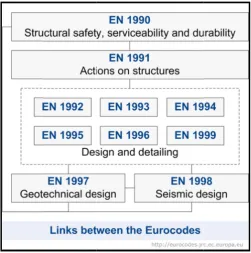
Thus, the te relevant EN new structu
It is recomm and applica
ERFACE TO T
sed new Eur nd fundame
echnical rule N Eurocodes
ures made w
mended tha tion rules se
THE EN EUR
ropean tech ental require
[image:32.595.172.424.292.546.2]es for such s (Figure 1.1) with FRPs and
t the part in et within this
F
ROCODES F
nical rules f ments of the
structures ar by identifyin d that realize
nterfacing EN Eurocode.
Figure 1.1 - L
OR STRUCT
for Fibre Rei e EN Eurocod
re not self-st ng and distin ed with tradit
N 1991 for a
Links betwee
TURAL DESI
inforced Pol des. tanding rule nguishing the tional materactions on st
en Eurocodes
GN
ymer Struct
s but they c e differences
ials.
tructures ag
s.
tures are re
complement s between t
grees with th
lated to the
rules of the he design of
he principles e
e f
4
APPROACH TO EXECUTION OF THE MANDATE
4.1
STEP-BY-STEP DEVELOPMENT
The works of the future generation of Eurocodes will be performed in several steps:
- Step 1: Preparation and publication of a “Science and Policy Report”, subject to agreement of
CEN/TC250.
- Step 2: After agreement of CEN/TC250, preparation and publication of CEN Technical Specifications
(previously known as ENV).
- Step 3: After a period for trial use and commenting, CEN/TC250 will decide whether the CEN Technical
Specifications should be converted into Eurocode Parts.
As a conclusion, the procedure in several steps does not predetermine to draft immediately new Eurocodes or new Eurocode Parts. In fact the procedure allows for a progressive development, agreed by CEN/TC250, in order to take into account observations from national experts and users.
The production of Science and Policy Reports is declared as pre-normative work and as such will not be funded under Mandate M/515.
The preparation of the new European technical rules in step 2 could be initiated by CEN/TC250 after launching the Mandate M/515.
4.2
ORGANIZATION OF THE WORK
4.2.1
LIAISONS WITHIN CEN/TC250 FAMILY
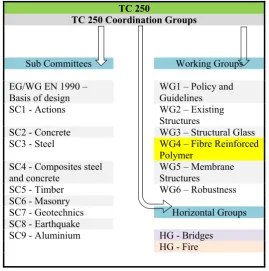
In document [02] CEN/TC250 replies to the Mandate M/515 setting a detailed work programme together with additional supporting information. In this context the new European technical rules for the design and verification of composite structures realized with FRPs will be developed using the existing organization of CEN/TC250 [03] (Figure 1.2).
TC 250
TC 250 Coordination Groups
Sub Committees Working Groups
EG/WG EN 1990 –
Basis of design WG1 – Policy and Guidelines
SC1 - Actions WG2 – Existing
Structures
SC2 - Concrete WG3 – Structural Glass
SC3 - Steel WG4 – Fibre Reinforced
Polymer SC4 - Composites steel
and concrete
WG5 – Membrane Structures
SC5 - Timber WG6 – Robustness
SC6 - Masonry
SC7 - Geotechnics Horizontal Groups
SC8 - Earthquake
SC9 - Aluminium HG - Bridges
[image:34.595.163.433.70.342.2]HG - Fire
Figure 1.2 - Diagram showing the CEN/TC250 structure.
The main task of CEN/TC250/WG4 is not to undertake research work. In fact CEN/TC250/WG4 will be in close contact with scientific organisations. In consequence CEN/TC250 is responsible for implementation of results of research in codes of practice.
In particular with regard to the new European technical rules for the design and verification of composite structures realized with FRPs, the following organizations as stakeholders will be involved and consulted:
- National Standardisation Bodies;
- CEN Committees for construction products, construction materials, execution and testing;
- Government organizations involved in Building and Construction Regulations, and trade relating to
construction;
- Professional Bodies (e.g. National and European Associations representing Consulting Engineers,
Designers and Contractors);
- International Scientific and Technical Organisations (e.g. fib, ECCS, JCSS, IABSE, etc.);
- EOTA;
- Certification bodies;
- Producers of construction products and materials who rely on existing structures for their structural
- and others.
References
[01] JRC Scientific and Technical Report (EUR 22864 EN): “Purpose and justification for new design
standards regarding the use of fibre-reinforced polymer composites in civil engineering” by E. Gutierrez, S. Dimova, and A. Pinto, 2007.
[02] European Commission Mandate M/515 EN “Mandate for amending existing Eurocodes and extending
the scope of structural Eurocodes”, 2012.
PROSPECT FOR NEW GUIDANCE IN THE DESIGN OF FRP
STRUCTURES
Preamble
This Part II presents scientific and technical proposals intended to serve as a starting point for further work to achieve a harmonized European view on the design and verification of composite structures realized with FRPs. Its fundamental purpose is to stimulate debate. To enable this objective to be fulfilled, it contains preliminary proposals for technical provisions and identifies key issues requiring further discussion. It is emphasised, however, that it is not intended for use in practice at this stage.
It is proposed that new European technical rules for such structures are related to the principles and fundamental requirements of the EN Eurocodes. Thus, technical rules for FRP structures would not be self-standing rules but rather they will complement rules of the relevant EN Eurocodes.
New European technical rules for the design and verification of composite structures realized with FRPs are planned for all types of buildings, bridges, and construction works exposed to all kind of actions.
CEN/TC250 policy, as set out in resolutions 254 and 255, is that the work for all new Parts of the Eurocodes, including the new European technical rules for FRP new structures follows a step-by-step approach, as follows:
1. Step: Preparation and publication of a JRC “Science and Policy Report” (S&P report), subject to
agreement of CEN/TC250.
2. Step: After agreement of CEN/TC250, preparation and publication of CEN Technical Specifications
(previously known as ENV).
3. Step: After a period for trial use and commenting, CEN/TC250 will decide whether the CEN Technical
Specifications should be converted into Eurocode Parts.
The stepwise procedure allows for a progressive development in order to consider observations from national experts and users and to take into account comments received by CEN members.
It should be noted that the initial purpose of the “Science and Policy Report” was widened complying with CEN/TC250 decision 340 by adding an overview of the state of the art and a collation of existing national regulations and standards for the design and verification of composite structures realized with FRPs.
The structure of Part II represents the actual result of the preliminary but deep discussions in Working Group WG4. They should be considered as guidance for the evaluation of a harmonized approach in the frame of the decision making process in step 2.
Key issues
In particular it should be noted that the Working Group WG4 has recorded key issues that could require further discussion in the next steps.
In this context the following key issues have been identified:
1. The technical rules for FRP structures are not intended to be independent (self-standing) rules but to
complement the existing rules of the relevant EN Eurocodes;
2. Appropriate calibration of the partial and conversion factors;
3. Effects of the fire;
4. Ultimate Limit States of sandwich structures;
5. Ultimate Limit States of laminates plates;
6. Predictive formulae for bolted joints in laminated plates;
7. Use and limits of bonded joints;
8. Effects of fatigue.
1
GENERAL
1.1
SUBJECT AND SCOPE
(1) The goal of this scientific and technical report is to stimulate the debate about future guidelines
and rules for the structural design and calculation of Fibre Reinforced Polymers (FRP) used in load-bearing structures, for buildings and civil engineering works.
(2) The topics taken into account address the thermoset FRP parts with a fibre volume percentage of at
least 15 %.
(3) The report applies to FRP structures made of (i) profiles, (ii) plates and shells or (iii) sandwich
panels.
(4) Structures in which micro-cracks are not permissible fall outside the scope of this report.
(5) The report does not include reinforcing rods, cables or external reinforcement to existing structures
using FRP.
(6) The structural elements taken into account are realized by means of the following main
manufacturing processes: prepregging, pultrusion, compression moulding, resin transfer moulding, filament winding and hand lay-up. Sandwich structures, consisting of a core (foam, wood or honeycomb) covered by FRP face sheets, are also included.
1.2
NORMATIVE REFERENCES
EN 1997:2011 Geotechnical design - Part 1: General rules
EN-ISO 62:1999 Plastics. Determination of water absorption
EN-ISO 75-1:2012 Plastics - Determination of temperature of deflection under load - Part 1:
General test method
EN-ISO 75-2:2012 Plastics - Determination of temperature of deflection under load - Part 2:
Plastics and ebonite
EN-ISO 75-3:2004 Plastics - Determination of temperature of deflection under load - Part 3:
High-strength thermosetting laminates and long fibre reinforced plastics
EN-ISO 178:1997 Plastics. Determination of flexural properties
EN-ISO 527-4:1997 Plastics. Determination of tensile properties. Part 4: Test conditions for
isotropic and orthotropic fibre-reinforced plastic composites
EN-ISO 527-5:1997 Plastics. Determination of tensile properties. Part 5: Test conditions for
unidirectional fibre-reinforced plastic composites
EN-ISO 1172:1998 Textile glass reinforced plastics. Prepregs, moulding compounds and laminates - Determination of the textile-glass and mineral-filler content - Calcination methods
EN 1990:2002 Eurocode 0: Basis of structural design, including national annexes
EN 1997-1:2005 Eurocode 7: Geotechnical design – Part 1: General rules, including national
annexes
EN 05/01/1991:2003 Eurocode 1: Actions on structures – Part 1-5: General actions – Thermal
actions
EN 1991-1-6:2005 Eurocode 1: Actions on structures – Part 1-6: General actions – Actions during
execution
EN 6721-11:2012 Plastics – Determination of dynamic mechanical properties – Part 11: Glass
transition temperature
EN 13706-1:2002 Reinforced Plastic composites- Specification for pultruded profiles - Part 1:
Designation
EN 13706-2:2002 Reinforced Plastic composites- Specification for pultruded profiles - Part 2:
Methods of Test and General Requirements
EN 13706-3:2002 Reinforced Plastic composites- specification for pultruded profiles - Part 3:
Specification requirements
EN 13121-1:2003 GRP tanks and vessels for use above ground - Part 1: Raw materials -
Specification conditions and acceptance conditions
EN 13121-2:2003 GRP tanks and vessels for use above ground - Part 2: Composite materials -
Chemical resistance
EN 13121-3:2008 GRP tanks and vessels for use above ground - Part 3: Design and
workmanship
EN 13121-4:2005 GRP tanks and vessels for use above ground - Part 4: Delivery, installation
and maintenance
EN-ISO 14125:1998 Fibre-reinforced plastic composites. Determination of flexural properties
EN-ISO 14126:1999 Fibre-reinforced plastics. Determination of compressive properties in the
in-plane direction
EN-ISO 14129:1997 Fibre-reinforced plastic composites. Determination of the in-plane shear
EN-ISO 14130:1997 Fibre-reinforced plastic composites. Determination of apparent interlaminar shear strength by short-beam method
EN 16245: 2013 Fibre-reinforced plastic composites – Part 1-5: Declaration of raw material
characteristics
ASTM D 695:2010 Standard Test Method for Compressive Properties of Rigid Plastics
ASTM D 790:2010 Standard Test Method for Flexural Properties of Unreinforced and Reinforced
Plastics and Electrical insulating Materials
ASTM D 792:2008 Standard Test Method for Density and Specific Gravity (Relative Density) of
Plastics by Displacement
ASTM D 2344:2006 Standard Test Method for Short Beam Strength of Polymer Matrix Composite
Materials and their Laminates
ASTM D 2990:2009 Standard Test Methods for Tensile, Compressive, and Flexural Creep and
Creep-Rupture of Plastics
ASTM D 3039:2008 Standard Test Method for Tensile Properties of Polymer Matrix Composite
Materials
ASTM D 34I0: 2008 Standard Test Method for Compressive Properties of Polymer Matrix
Composite Materials with Unsupported Gage Section by Shear Loading
ASTM D 3518:2007 Standard Test Method for in-Plane Shear Response of Polymer Matrix
Composite Materials by Tensile Test of a ±45° Laminate
ASTM D 4255:2007 Standard Test Method for in-Plane Shear Properties of Polymer Matrix
Composite Materials by the Rail Shear Method
Specific standards relative to the sandwich panels are reported in §3.1.3, while specific standards relative to durability tests are reported in §3.2.
1.3
GUIDELINES
CUR 96 Fibre Reinforced Polymers in Civil Load Bearing Structures (Dutch
Recommendation, 2003);
EUROCOMP Structural Design of Polymer Composites (Design Code and Handbook, 1996);
BD90/05 Design of FRP Bridges and Highway Structures (The Highways Agency,
Scottish Executive, Welsh Assembly Government, the Department for Regional Development Northern Ireland, May 2005);
DIBt DIBt – Medienliste 40 für Behälter, Auffangvorrichtungen und Rohre aus
CNR-DT 205/2007 Guide for the Design and Construction of Structures made of Pultruded FRP elements (Italian National Research Council, October 2008);
ACMA Pre–Standard for Load and Resistance Factor Design of Pultruded Fiber
Polymer Structures (American Composites Manufacturer Association, November 2010);
DIN 13121 Structural Polymer Components for Building and Construction (August 2010);
BÜV Tragende Kunststoffbauteile im Bauwesen [TKB] – Richtlinie für Entwurf,
Bemessung und Konstruktion (in German, 2014).
1.4
ASSUMPTIONS
(1) Designs and calculations are considered to fulfil the requirements stated in this scientific and
technical report on condition that:
- the selection of the structural system, the design and calculation of the structure is carried out by
suitably qualified and experienced personnel;
- the production of material and structural parts, and construction on site are undertaken by
personnel with the right professional skills and experience;
- proper supervision and quality control take place while the work is carried out, for example at the
design and engineering firm, during the production of materials and parts, when assembling the materials and parts in factory or workshop, on construction site, etc.;
- the materials are used as described in this report or else equivalent relevant product or processing
standards, normative requirements, and/or product specifications are followed;
- the manufacturing process for materials and parts fulfils the appropriate European product and
process standards, to the extent not otherwise specified in this report. If no product and process standard is available, the designer, manufacturer and contractor should guarantee the required reliability of materials and structural properties through quality assurance measures. It should be shown that material and structural properties and geometrical tolerances satisfy at least the values specified in the design;
- the structure is properly maintained in accordance with maintenance instructions;
- the structure will be used in accordance with the design and calculation assumptions.
(2) FRP materials have a temperature-dependent behaviour due to the polymeric nature of their
matrix. The following temperature ranges are considered for service conditions:
- normal temperature: from -20 o C to +40 o C;
- elevated temperature: up to the maximum service temperature (dependent on the Tg, see
1.5
TERMS AND DEFINITION
Anisotropic:non-isotropic; non-uniform mechanical and/or physical properties in different directions.
Characteristic value: value having a prescribed probability of not being attained in a hypothetical unlimited test series. This value generally corresponds to a specified fractile of the assumed statistical distribution of the particular property under examination.
Conversion factorη: a conversion factor shall be applied where it is necessary to convert the test results into values which can be assumed to represent the behaviour of the material or product in the structure or the ground.
Design working life: assumed period for which a structure or part of it is to be used for its intended purpose with anticipated maintenance but without major repair being necessary.
Fatigue: phenomenon which consists in the reduction of the material strength or product resistance resulting from the effects of repeated actions.
Isotropic: having uniform properties in all directions.
Limit states: states beyond which the structure no longer fulfils the relevant design criteria.
Load: any cause of stresses or deformations in a structure.
Partial load factors: numerical values for partial load factors are recommended as basic values that provide an acceptable level of reliability about the loads.
Partial material factors: numerical values for partial material factors are recommended as basic values that provide an acceptable level of reliability about the properties of materials and products.
Nominal value: value fixed on non-statistical bases, for instance on acquired experience or on physical conditions.
Orthotropic:a situation involving two or three axes of symmetry.
Serviceability limit states: states that correspond to conditions beyond which specified service requirements for a structure or structural member are no longer met.
Ultimate limit states: states associated with collapse or with other similar forms of structural failure.
1.5.1
TERMS RELATING TO FIBRE-REINFORCED POLYMER
Carbon fibres: fibres consisting of very long, thin chains of carbon molecules, produced by pyrolysis of synthetic fibres such as rayon, polyacrylonitrile (PAN) or pitch in an inert atmosphere.
Discontinuous fibre mat: fibre mat of short (30-50 mm) fibre bundles that are laid criss-cross and joined together by a binding agent (or stitching). Often called CSM (chopped strand mat).
Epoxy resin: thermoset resin system based on epoxy groups. Cure is produced by cross-linking of the epoxy groups through the addition of a hardener system.
Fibre spraying: method of producing FRP whereby resin and short fibres are applied in layers with a spray gun, followed by manual rolling. It is an open mould technique with one hard mould side.
Filament winding: method of producing FRP whereby resin-coated fibre bundles are wound around a mould. It is an open mould technique with one hard mould side.
First ply failure: FRP failure criterion whereby it is assumed that the maximum bearing capacity of the laminate is reached when the maximum bearing capacity of the weakest ply is reached. This usually concerns matrix failure in plies loaded transverse to the fibre.
Glass fibre: fibre made from silica (SiO2). Distinctions are made between E glass, S glass, R glass and others, each with their own characteristics as to rigidity, strength, electrical resistance, etc. E-glass is the most common type of glass. R-glass has higher stiffness and strength than E-glass.
Glass transition temperature (Tg): The temperature at which the polymer passes from the glassy state to the rubbery state.
Hand lay-up: method of producing FRP whereby the resin is applied to the fibre reinforcement in layers by manual rolling. It is an open mould technique with one hard mould side.
Laminate: FRP built up from plies in layers, in principle with varying fibre orientation(s) and thickness(es).
Non-crimp fabric: uni-, bi- or multi-directional fibre reinforcement whereby one, two or more layers of continuous fibre glass bundles are laid in different directions on top of one another and stitched. Known as NCF (= non-crimp fabric) or stitched fabric.
Panel: flat laminate (plate) with specific parameters.
Ply: elementary layer of FRP with essentially orthotropic material properties from which a laminate is built
up.
Polyester resin: thermoset resin system made from unsaturated polyester dissolved in styrene.
Prepregging: method of producing FRP whereby prepregs are placed on a mould and then consolidated using a vacuum (with or without overpressure) and heat. It is a closed mould technique with one hard and one soft mould side.
Prepregs: fibre reinforcements which are pre-impregnated with epoxy resin and then partially hardened (B-stage).