warwick.ac.uk/lib-publications
Original citation:
Lockton, Dan, Harrison, David, Cain, Rebecca, Stanton, Neville A. and Jennings, P. A.
(2013)
Exploring problem-framing through behavioural heuristics.
International Journal of
Design, 7 (1). pp. 37-53.
Permanent WRAP url:
http://wrap.warwick.ac.uk/70062
Copyright and reuse:
The Warwick Research Archive Portal (WRAP) makes this work of researchers of the University of
Warwick available open access under the following conditions.
This article is made available under the Creative Commons Attribution
Non-Commercial-NoDerivs 2.5 Licence (CC BY-NC-ND 2.5) and may be reused according to the conditions of the
license. For more details see:
https://creativecommons.org/licenses/by-nc-nd/2.5/
A note on versions:
Introduction
Design for behaviour change (Lilley, 2009; Wever, 2012) is part of what Redström (2005) calls “a progression towards the user becoming the subject of design” (p. 124), with “design as an intervention into multiple and interpenetrating technical, material and social systems” (Mazé & Redström, 2008, p. 55). Dubberly and Pangaro (2007, p. 1302) note design’s growing concern with “ways of behaving”, and popular guidebooks and toolkits explaining the practical applicability of a range of behavioural principles to design have become common in recent years, particularly in interaction design, service design and user experience design (e.g., Anderson, 2010, 2011; Dirksen, 2012; Lockton, Harrison, & Stanton, 2010a; Pfarr, Cervantes, Lavey, Lee, Hintzman, & Vuong, 2010; Weinschenk, 2009, 2011).
Much of this focuses on changing behaviour: the aim generally is to translate psychological principles or effects into strategies or techniques which can be applied via the design of
products and services, to influence users’ behaviour, often for social benefit (e.g., Tromp, Hekkert, & Verbeek, 2011; Visser, Vastenburg, & Keyson, 2011) or environmental benefit (e.g.,
Lockton, Cain, Harrison, Giudice, Nicholson, & Jennings, 2011;
Mazé & Redström, 2008). The field overlaps substantially
with the aims of persuasive technology (Fogg, 2003), and may contribute to transformation design (Sangiorgi, 2011) as design is employed to facilitate change.
As design practice becomes increasingly focused on
people, modelling human behaviour is becoming an explicit aspect
of designers’ responsibilities (Keinonen, 2010). The different
approaches taken to understanding behaviour can result in a wide spectrum of strategies, framing both problems and solutions in a variety of ways (e.g., Brand, 2004; Lidman & Renström,
2011; Lockton et al., 2010a; Tang & Bhamra, 2008; Tromp et
al., 2011; Wever, van Kuijk, & Boks, 2008; Zachrisson & Boks, 2012). What is still needed is an approach to modelling which links insights from contextual research (with users themselves) to possible design strategies (Lockton, Harrison, & Stanton,
2012). This has the potential to be particularly valuable in design
for behaviour change, giving designers greater understanding of
users’ behaviour and how to influence it.
The research question we explored in this paper, is whether
it is possible to develop an approach that links insights from user research with applicable design techniques in the context of
Exploring Problem-framing through Behavioural Heuristics
Dan Lockton
1,2,*, David J. Harrison
2, Rebecca Cain
1, Neville A. Stanton
3, & Paul Jennings
11 Experiential Engineering, WMG, University of Warwick, Coventry, UK
2 Cleaner Electronics Research, Brunel Design, School of Engineering & Design, Brunel University, London, UK 3 Transportation Research Group, Engineering & the Environment, University of Southampton, Southampton, UK
Design for behaviour change aims to influence user behaviour, through design, for social or environmental benefit. Understanding and
modelling human behaviour has thus come within the scope of designers’ work, as in interaction design, service design and user experience
design more generally. Diverse approaches to how to model users when seeking to influence behaviour can result in many possible strategies, but a major challenge for the field is matching appropriate design strategies to particular behaviours (Zachrisson & Boks, 2012).
In this paper, we introduce and explore behavioural heuristics as a way of framing problem-solution pairs (Dorst & Cross, 2001) in terms
of simple rules. These act as a ‘common language’ between insights from user research and design principles and techniques, and draw
on ideas from human factors, behavioural economics, and decision research. We introduce the process via a case study on interaction
with office heating systems, based on interviews with 16 people. This is followed by worked examples in the ‘other direction’, based on
a workshop held at the Interaction ’12 conference, extracting heuristics from existing systems designed to influence user behaviour, to
illustrate both ends of a possible design process using heuristics.
Keywords – Interaction Design, Design for Behaviour Change, Design for Sustainable Behaviour, Heuristics, Modelling, Mental Models, Problem-Framing.
Relevance to Design Practice – Heuristics could be a useful tool for helping designers to frame ‘behavioural problems’ via contextual research with users, and with mapping to relevant design principles and examples. They can help to ensure that users themselves, and their understanding of situations, are included in the design process when seeking to influence behaviour.
Citation: Lockton, D., Harrison, D. J., Cain, R., Stanton, N. A., & Jennings, P. (2013). Exploring problem-framing through behavioural heuristics. International Journal of Design, 7(1), 37-53.
Received August 7, 2012; Accepted February 6, 2013; Published April 30, 2013.
Copyright: © 2013 Lockton, Harrison, Cain, Stanton, & Jennings. Copyright for
this article is retained by the authors, with first publication rights granted to the
International Journal of Design. All journal content, except where otherwise noted, is licensed under a Creative Commons Attribution-NonCommercial-NoDerivs 2.5 License. By virtue of their appearance in this open-access journal, articles are free to use, with proper attribution, in educational and other non-commercial settings.
design for behaviour change, through modelling both interaction behaviour and design techniques in terms of simple abstracted
‘rules’–behavioural heuristics. The approach complements
but differs from other nascent modelling approaches used within design for behaviour change and persuasive technology, drawing on ideas from human factors, behavioural economics, and decision research to explore and frame behavioural problem-solution pairs (Dorst & Cross, 2001) in-context, rather than starting with classifying design strategies.
This paper takes an exploratory approach to examine the
potential of using behavioural heuristics as part of the design process in design for behaviour change: we are not claiming
this to be a definitive solution to the question of how to specify
relevant design techniques, but rather we are suggesting that this is an approach which may be useful to practitioners seeking to model user behaviour through insights from user research. Further, we wish to stimulate discussion in the area of design for behaviour change. We start by reviewing how models of human behaviour play an important part in design for behaviour change, and how they link to different ways of framing problem/solution spaces. We then consider the potential of investigating users’ mental models, and propose behavioural heuristics as a
lower-level approach to modelling in comparison to conventional mental models, which seek to model behavior in a more comprehensive way. We do this by drawing on ideas from a
number of fields.
Via a case study concerning users’ interaction with heating systems, we introduce the idea of heuristics, followed by worked
examples in the ‘other direction’, extracting heuristics from case studies of existing systems designed to influence user behaviour,
to illustrate both ends of a possible design process using heuristics. We then discuss the potential place of behavioural heuristics within a design process for behaviour change, including their use in conjunction with other approaches.
The Place of Modelling in Design for
Behaviour Change
In the academic literature on design for behaviour change,
some critical reflection has centred on issues such as ethics
(Gram-Hansen, 2010; Pettersen & Boks, 2008) or on users’
understanding of the ‘persuasive’ intentions of the designers
(Crilly, 2011), but perhaps the central research challenge in this
emerging field, at least from the perspective of design practice,
is that of matching the most effective and appropriate design strategies to particular behaviours (Zachrisson & Boks, 2012).
Diverse approaches to how to model and ‘treat’ users when seeking to influence behaviour can result in a wide spectrum of strategies, a phenomenon familiar to ‘non-design’ fields which regularly deal with behavioural interventions, such as healthcare (Nuffield Council on Bioethics, 2007; Michie, van
Stralen, & West, 2011). Some researchers have built programmes around the exploration of particular models and strategies
for influencing behaviour and user experience (e.g., affective
and emotional design: Ozkaramanli & Desmet, 2012; Desmet
& Hekkert, 2009). There are also many ‘design for behaviour
change’ approaches that involve classifying multiple techniques via different dimensions and categories with the aim of helping designers explore the strategies available (Brand, 2004; Lidman
& Renström, 2011; Lockton et al., 2010a; Tang & Bhamra, 2008; Tromp et al., 2011; Wever et al., 2008; Zachrisson & Boks, 2012).
Others (Fogg & Hreha, 2010; Lockton, Harrison, & Stanton, 2010b) have aimed to guide designers towards strategies which
may be most applicable to particular ‘target behaviours’, more along the lines of TRIZ (Altshuller, 1994).
Models and Frames
As Froehlich, Findlater, and Landay (2010) put it, “even if it is not explicitly recognised, designers [necessarily] approach a problem
with some model of human behaviour” (p. 2000)–modelling is central to design (Alexander, 1964; Ayres, 2007; Dubberly &
Pangaro, 2007), though the models employed may be diverse.
The range of designers’ models of human behaviour can be
especially evident in design for behaviour change, where every concept proposed inherently embodies a model of how users will behave as a result of the design (Lockton, Harrison, &
Dan Lockton is a Senior Research Associate at the Helen Hamlyn Centre for Design, Royal College of Art, London. He specialises in design for behaviour
change, for social and environmental benefit, and his PhD at Brunel University
focused on developing Design with Intent, a design pattern toolkit for this
emerging field. From 2010-12 he was a researcher at WMG, University of Warwick, and at Brunel University, working with startup CarbonCulture on a
digital platform for reducing workplace CO2 emissions, through connecting
staff with data in more engaging ways. Dan is interested in ‘public understanding of everyday systems’–how we understand and interact with the technology (and institutions) around us, and how this could be improved for social benefit. He
does consultancy as Requisite Variety.
David J. Harrison, PhD, is Professor of Design Research at Brunel
University, lecturing in Environmentally Sensitive Design and leading the
Cleaner Electronics Research Group. He has research interests in sustainable design methods, low-impact electronics manufacturing and innovative energy generation and storage. Professor Harrison has a PhD in Robotics, and worked for six years at the BBC, mainly on the BBC Computer Literacy Project. He
held a Royal Society Fellowship in the Parliamentary Office and Science and Technology, before joining Brunel in 1994.
Rebecca Cain, PhD, is Associate Professor in Experience-Led Innovation at the International Institute of Product and Service Innovation, WMG and leads healthcare design research in the Experiential Engineering Group. Dr Cain’s research aims to improve people’s experiences of spaces, places, products and services through better design. Her core research interests are: the involvement of users in the design process, and the methods to do this; and understanding
the relationship between design and users’ emotional response–in particular,
design’s impact on health and wellbeing.
Neville A. Stanton, PhD, holds the Chair of Human Factors in Transport at the University of Southampton, and is a widely cited expert on human factors and
cognitive ergonomics in technological domains. His research interests include
intelligent transport systems in vehicles and flight deck design. Professor
Stanton is an editor of Ergonomics and on the editorial board of Theoretical Issues in Ergonomics Science and the International Journal of Human Computer Interaction. He has published over 150 peer-reviewed journal papers and 14 books on human factors and ergonomics.
Paul Jennings, EngD, is Professor of Experiential Engineering and head
of Digital Technologies at WMG. Professor Jennings has been involved in
Stanton, 2012). Argyris and Schön (1974, p. 28) suggested that “an interventionist is a man struggling to make his model of man come true”, and each of the interventionists’ models represents a
particular way of framing both ‘problem’ and ‘solution’ in terms
of what affects and is affected by human behaviour. We should, of course, remember that “all models are wrong, but some are useful” (Box & Draper, 1987, p. 424); likewise, concerns with
the very notion of ‘the user’ (e.g., Keinonen, 2010; Krippendorff,
2007) are noted, but we argue that it remains a useful construct in this kind of modelling.
Rasmussen (1986) refers to different models of users each
“support[ing] the choice of an interface design that will activate
a category of behaviour” (p. 61), and this arguably applies to all
kinds of intervention, not just interface design. For example, a
designer modelling users as primarily ‘lazy’ or uninterested may try to influence users’ decisions by making the ‘target’ behaviour
the easiest choice, such as a default setting (Frederick, 2002;
Johnson & Goldstein, 2003; Kesan & Shah, 2006), whereas a
designer modelling users as being motivated by intrinsic factors such as social relatedness (Deci & Ryan, 1985) or connectedness (Visser et al., 2011) may apply techniques emphasising that a user is contributing to the well-being of the wider community in
making particular choices. The resulting design solutions may aim to influence the same ultimate target behaviour, but can differ
substantially through modelling humans “at several levels of
abstraction” (Rasmussen, 1983, p. 266).
The models used by designers thus provide some structure to problem/solution ‘spaces’ (Maher, Poon, & Boulanger, 1996), framing and redefining the “problematic situation” (Schön, 1983, p.68) in a variety of ways, each of which exposes new aspects
of the problem (Rith & Dubberly, 2007; Rittel & Webber, 1973). Hey (2008) found that design teams will re-frame problem/solution spaces repeatedly over the course of a project,
negotiating an evolving ‘common’ frame which aims to
reconcile the perspectives and needs of both designers and users. Design becomes “a process of enquiry during which meaning is constructed with diverse stakeholders” (Kimbell, 2011, p. 49);
‘solutions’ will not be ‘perfect’ resolutions (Ebenreuter, 2007) but
will address certain perspectives and interpretations of meaning.
Problem-solution Pairs
Dorst and Cross (2001) suggest that the emergent formation
of ‘bridges’–pairing one representation of the problem with an apposite solution–is what defines the insight of the ‘creative leap’. Cross (2006) describes an example of a design brief
concerning a way to transport a hiker’s backpack on a mountain
bike: this included a number of potential sub-problems. The
designers in the study “oscillat[ed] between sub-solution and sub-problem areas… partial models of the problem and solution are constructed side-by-side” (p. 57), with each concept addressing particular representations of the problem, creating
problem-solution pairs. A particular sub-solution (a moulded plastic tray) enabled a number of the partial models to be mapped onto each other.
As Cross (2006) explains, this interpretation differs from models of the design process emphasising clear ‘stage’-based separation between a defined problem specification and the
generation of multiple alternative solutions; the generation of partial solutions enables the problem to be modelled and examined in different ways and the original brief reframed. Likewise, problem-solution pairs could be also a valuable unit of analysis in design for behaviour change, explicitly incorporating a particular model of the problematic situation, and indeed the context in which the solution is applicable. A problem-solution
pair rooted in a problem context itself can be seen to be ‘solving’
the problem in a different way compared with a solution which
only addresses its ‘symptoms’ (something which arguably
characterises many approaches to behaviour change, for example those based solely on rewarding or punishing people for particular behaviours).
Using this framework, if designers are going to try to address particular behavioural ‘problems’ they need to do sufficient research with users to develop models matching
the contextual reality of their situated decision-making
(Suchman, 2007). This means that contextual user research is
essential. However, as design for behaviour change becomes
seen as less about influencing broad public opinions and
attitudes (e.g., towards the environment, or health), and much more about understanding and developing empathy (Postma, Zwartkruis-Pelgrim, Daemen, & Du, 2012) user participation as described by Ho and Lee (2012) also becomes essential.
User participation in this sense allows designers to take into
account the contextual factors affecting how people make situated decisions about how to act in everyday life, which includes expectations of outcomes, perceptions of meaning and perceived affordances.
Similar ideas have been discussed in cybernetics, which offers a number of useful constructs for designers working with behaviour (Dubberly & Pangaro, 2007). Conant and Ashby’s
(1970) ‘Good Regulator’ theorem states that “every good
regulator of a system must be a model of that system”, with the corollary that modelling is a necessary part of regulating a system’s behaviour; indeed, Beer (1974, p. 34) notes that “no regulator can actually work unless it contains a model of whatever is to be regulated”. Designers may not see themselves
as ‘regulators’–even those explicitly involved in behaviour change–but as Scholten (2009-10, p. 3) has argued, an implication
of Conant and Ashby is simply that “every good solution must be a model of the problem it solves”: not too far from Dorst and Cross’s (2001) concept of problem-solution pairs.
Mental Models and Heuristics in
Design for Behaviour Change
One approach to understanding and modelling user behaviour in context is to investigate users’ own understanding and
mental models of the systems with which they are interacting; as Krippendorff (2007) puts it, “designers who intend to design something that has the potential of being meaningful to others need to understand how others conceptualize their world”
There are different ways of defining and representing
mental models (Jones, Ross, Lynam, Perez, & Leitch., 2011;
Moray, 1996). One definition commonly used in human-computer
interaction (HCI) is described broadly by Carroll, Olson, and Anderson (1987) as: “knowledge of how the system works, what its components are, how they are related, what the internal
processes are, and how they affect the components” (p. 6). Users’
mental models thus allow them “not only to construct actions for novel tasks but also to explain why a particular action produces
the results it does” (p. 6).
In the context of influencing behaviour change, mental
models could be important if a user’s current model leads him or her to behave or interact with a system in a way which is
undesirable, dangerous, inefficient or otherwise deemed deserving
of intervention. For example: Besnard, Greathead, and Baxter
(2004) discuss how an erroneous mental model held by the flight
crew can be considered a major factor in the 1989 Kegworth air
crash in Leicestershire, England; Kempton’s (1986) investigation
of home heating control found that patterns of thermostat use (some more wasteful of fuel than others) were largely consistent with two different mental models of how thermostats work (the
‘valve’ model and the ‘threshold’ or ‘switch’ model); Thaler’s (1999) work on ‘mental accounting’ suggests that different ways of modelling and categorising everyday financial transactions can
lead people to make irrational or myopic budgeting decisions to their own detriment; Senge (1990) looks at how tacit but wrong mental models can lead to poor organisational performance, and
how ‘surfacing’ and changing them can improve matters. The aim of a designer seeking to change behaviour via
mental models would usually be to shift the user’s mental model (if incorrect) to a more accurate one, perhaps by making the system model evident (an aim of ecological interface design: Burns & Hajdukiewicz, 2004), via a series of analogical steps bridging the two models (Clement, 1991), or by increasing
the repertoire of models available to users–as Papert (1980)
put it, “[learning] anything is easy if you can assimilate it to your collection of models” (p. vii). Alternatively, an aim could be to redesign a system so that it appears to work in the way that the user assumes, working with the existing model even if incorrect. In both cases, the effectiveness of the approach could be examined by measuring behaviour changes that have occurred as a result of intervention.
Both approaches require investigating users’ current
mental models of the systems they use–within design research
and in human factors, methods such as interviews, verbal protocol analyses, structured tasks (e.g., Payne, 1991), eye-tracking, cultural probes (Gaver, Dunne, & Pacenti, 1999), ethnography and shadowing can all help reveal aspects of subjects’ understandings and internal representations of situations, via examining and mapping interaction behaviour, routines, shifts in focus or even the errors people make. Even with an extensive palette of
methods, the fundamental difficulty nevertheless remains; mental
models are “not available for direct inspection or measurement”
(Jones et al., 2011, p. 46).
Lower-level Modelling:
Behavioural Heuristics as Problem-solution Pairs
As part of an industrial collaboration project, we have investigated aspects of people’s mental models of heating, ventilation and air conditioning (HVAC) and energy use, and perceptions of the role played by behaviour, at home and at work.
The aim was to use the insights gained to design feedback systems
which lead to lower energy use through behaviour change. We interviewed people about their behaviour and usage patterns of heating systems. From these interviews we found that, in many cases, interviewees did not, in context, consider much of the system beyond their immediate interactions with it.
This issue has been recognised in some treatments of
mental models, such as Collins and Gentner’s (1987) concept
of ‘pastiche models’ (which recognises that the models applied
at different levels may be inconsistent). Rather than making
decisions based on macro-level comprehension of a ‘whole’
mental model (such as it may be), it often appeared that people’s reported interaction decisions were determined by sets of
individual ‘rules’ considered at the micro-level–“If this is the situation, do that”, “If I have that problem, this is how I fix it”–intended to satisfice (Simon, 1956, 1969) for the situation at hand. The idea is reminiscent of Argyris and Schön’s (1974) theories-in-use, or Minsky’s (1983) suggestion that “the only way a person can understand anything very complicated is to
understand it at each moment only locally” (p. 189)–and raises
questions about how appropriate it is to consider designing
‘whole system’ solutions as opposed to decomposition into
lower-level sub-problems and sub-solutions. From a design perspective, should designers try to understand users on
the level of individual behaviours, or in larger ‘units’ such as personas? This issue is considered further in the section ‘Discussion: fitting into design practice’.
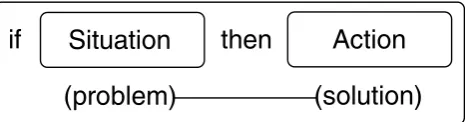
Returning to the interviews, many explanations given by interviewees were something closer to Dorst and Cross’s (2001) problem-solution pairs than full-blown mental models: they were, essentially, heuristics for how to interact with the system in a range of situations rather than explanations of how the whole system was believed to work. Each heuristic presented a certain way of framing the problematic situation perceived by the interviewee, and the immediate behavioural solution
undertaken (Figure 1). The section of this paper titled ‘Case
study: extracting heuristics around interaction with heating’ elaborates on the study.
Situation
Action
if
then
[image:5.595.311.544.670.731.2](problem)
(solution)
Using Heuristics to Simplify the
Problem / Solution Space
What are heuristics? There are a number of definitions, but the
term as used in current behavioural economics and decision
science generally refers to simple, frugal ‘rules of thumb’, tacit
or explicit, for making decisions and solving problems. Groner, Groner, and Bischof (1983) note that they are “used to reduce the
search space of a given problem” (p. 16), and this is a common
thread through research with heuristics in different disciplines, including mathematical problem-solving (Pólya, 1945), education
(Papert, 1980), artificial intelligence (Newell, 1983), cooperation
in groups (Gardner, Ostrom, & Walker, 1992), behavioural
economics (Gilovich, Griffin, & Kahneman, 2002; Tversky &
Kahneman, 1974) and decision research (Gigerenzer & Selten,
2001; Gigerenzer, Todd, & ABC Research Group., 1999).
Heuristics are qualitatively different to other components of behavioural models such as attitudes and habits: instead they characterise the phenomenon of people bounding or simplifying the problem/solution spaces they experience, framing situations in terms of a particular perspective, tentative assumption or salient piece of information, rather than undertaking an exhaustive analysis of all possible courses of action. For
example, Tversky and Kahneman’s (1973) availability heuristic
involves deciding on the likelihood of an event based on how easy it is to bring to mind similar events, and Goldstein and Gigerenzer’s (1999) recognition heuristic involves attributing a higher value to objects which are recognised than those which are not; just as Pólya’s (1945) exhortation to “Look at the unknown! And try to think of a familiar problem having the same or a similar unknown” (p. 73) involves starting to solve
a mathematical problem by finding a point of comparison with
other problems.
In different circumstances, the application of heuristics
has been considered both harmful and potentially beneficial. Much behavioural economics discourse (e.g., Thaler & Sunstein,
2008) concerns ways to overcome biases introduced by the use
of heuristics, whereas the ‘ecological rationality’ approach (e.g., Todd & Gigerenzer, 2012) focuses on situations where the use
of particular heuristics is actually adaptive, and thus on how to improve decision-making through exploiting (or changing) the information structure of people’s decision environments. From a design perspective, it seems clear that there are circumstances
where simplification is valuable to users (Colborne, 2010; Krug, 2006), and others where it can cause problems (just as with
mental models).
Within ‘design for behaviour change’, to date little attention
has been paid to the possibilities and implications of heuristics.
Rogers and her collaborators (Kalnikaitė et al., 2011; Rogers, 2011; Todd, Rogers, & Payne, 2011) have used an ecological
rationality approach in the design of a shopping trolley-mounted system giving supermarket shoppers simple, salient information
on the ‘food miles’ of products, but there is also the possibility for
heuristics to be used as part of user research and problem-framing for design, as the remainder of this paper will discuss.
Simple Rules and Levels of Abstraction
The notion of modelling behaviour in terms of ‘if... then...’ rules
has been explored in a number of disciplines, not necessarily
under the ‘heuristics’ banner.
Aside from the obvious parallels in computer programming itself, examples include: von Wright’s (1972) treatment of practical inference mechanisms, e.g., “I intend to make it true that
E. Unless I do A, I shall not achieve this. Therefore I must do A” (p. 44); Argyris and Schön’s (1974) discussion of representing theories of action in the form “in situation S, if you want to achieve consequence C, do A” (p. 5); and the ‘fuzzy’ rule-based
problem-solving method developed by Hunt and Rouse (1982)
and Rouse (1983), which includes context-specific S-rules [e.g.,
“if: The engine will not start and the starter motor is turning and
the battery is strong, then: Check the gas gauge” (Hunt & Rouse, 1982, p. 293)] and more generally applicable context-free T-rules
[e.g., “if: The output of I is bad and I depends on Y and Z, and Y
is known to be in working, then: Check Z” (Hunt & Rouse, 1982,
p. 294)]. Minsky (2006) compares a ‘rule-based reaction machine’ approach of following basic “If situation → Do action” rules with goal-driven “If situation and goal → Do action” and deliberative “If situation + Do action → Then result” mental simulations.
Within human factors, Rasmussen’s (1983, 1986) Skills, Rules and Knowledge (SRK) framework situates rule-based behaviour in the context of other kinds of human performance. As opposed to skill-based behaviour, which comprises automatic patterns of response with simple feedback and without conscious attention, and knowledge-based behaviour, which makes use of stored knowledge, conscious analysis and mental simulations,
rule-based behaviour is essentially the use of heuristics. It is “consciously controlled by a stored rule or procedure that may have been derived empirically during previous occasions, communicated from other persons’ know-how as an instruction or cookbook recipe, or it may be prepared on occasion by conscious
problem solving and planning” (Rasmussen, 1986, p. 102).
Rule-based behaviour is informed by signs in the environment, which “indicate a state in the environment with reference to certain conventions for acts...they serve to activate stored patterns of behaviour” (p. 108). Rasmussen gives the example of a
flowmeter gauge in a pipeline with a valve, with four particular
positions identified on the scale. The rules or “stereotype acts” are
“If valve open, and: if indication C: OK; if indication D: adjust
flow; If valve closed, and: if indication A: OK; if indication B: recalibrate meter” (p. 107). In rule-based behaviour, when errors
(‘incorrect’ behaviour) occur, they may be due to misclassifying
the situation and hence applying the wrong rule (Reason, 1990).
Another aspect of Rasmussen’s (1983, 1986) framework
relevant to modelling user behaviour is the treatment of
abstraction in task analysis, including users’ decision-making when interacting with systems. An abstraction hierarchy–in
human factors research often created as a phase of cognitive work analysis (Jenkins, Stanton, Salmon, & Walker, 2008;
from functional purpose to physical form, with different models of the system (means and ends) applicable at each level of abstraction. From a design perspective, what occurs is “a process of iteration between considerations at the various levels [of abstraction] rather than an orderly transformation from a description of purpose to a description in terms of physical form”
(Rasmussen, 1983, p. 265); similar approaches to abstraction and decomposition have been discussed by Alexander (1964), de Bono
(1993) and Straker and Rawlinson (2002), while Dörner (1983),
specifically in the context of heuristics, discusses the use of multiple levels of ‘resolution’ of problematic situations to enable the selection of appropriate strategies. Ishikawa’s (1990) fishbone
cause-and-effect diagrams, as used in quality management, also have much in common with this modelling approach, and we
make use of a similar ‘5 Whys’ (e.g., Pylipow & Royall, 2001) or ‘laddering’ (Hawley, 2009) technique below in the section ‘Elaborating the heuristics: five whys and further abstraction’.
The abstraction notion, and the resolution into ‘means and
ends’ as a representation of the system at each level, again has parallels with Dorst and Cross’s (2001) problem-solution pairs in design and the concept of simple behavioural heuristics. By identifying the levels of abstraction at which users’ heuristics can be considered to be operating, it is possible to understand better the context in which the behaviour is occurring, and frame the problem accordingly as part of the design process.
Case Study:
Extracting Heuristics
Around Interaction with Heating
This case study illustrates one practical application of the
heuristics idea within user research, as part of a design for behaviour change project.
Sixteen office workers at two organisations (a government
department and a university, both in London) were interviewed individually as part of a study of building users’ understanding of energy use. As part of a wider series of structured questions and exercises, we asked interviewees to describe what actions they
would take, at work, if they were i) too hot, and ii) too cold. These
are effectively behavioural heuristics as outlined above: simple
‘if... then...’ statements describing behaviour in response to
particular contextual conditions: we do not claim or aim to imply any deeper insight into human decision-making than simply asking people to express what they would do, in this particular form. Interviewees were subsequently (as described in the section
‘Elaborating the heuristics: 5 Whys and further abstraction’) asked
to elaborate the reasons behind the heuristics given, following a
laddering or 5 Whys-type method–for each answer given by an
interviewee, the interviewer reframed this as a further “Why?”
question–see Figure 2(a) for an example. The number of times “Why?” was asked was not always five; the intention here was not necessarily to determine a ‘root cause’ (assuming such a thing
exists), but instead to derive multiple, iterated levels of abstraction for each heuristic, enabling a more diverse set of representations for problem-framing.
Heuristic Statements as Situated Strategies
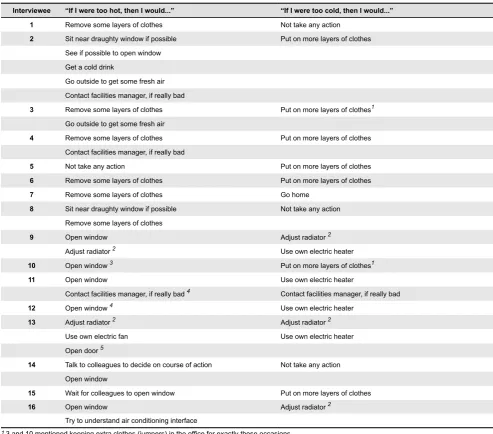
Table 1 shows the heuristic statements given by interviewees for both the ‘too hot’ and ‘too cold’ conditions; where multiple
answers are present, each is presented in the order mentioned
by the interviewees, as a kind of ‘else’ clause. Interviewees 1-8
worked in a building with locked windows and ceiling-mounted HVAC controlled by a building management system (BMS); one interviewee (2) remembered that some windows had previously been unlocked (during a period when the air conditioning was switched off) and included this as part of her set of heuristics.
The ‘draughty’ windows mentioned by two interviewees had a
noticeable draught around the frame when closed.
Interviewees 9-13, 15 and 16 worked in buildings with
central heating, radiators and opening windows, while interviewee
14’s office had an opening window as well as BMS-controlled HVAC, but no user controls on the floor-mounted heating vents. The only interviewee with an air conditioner under her control, 16, preferred not to use it since she was unsure of the interface.
From the point of view of understanding the links between behaviour and energy use, an important implication here is that the “If I were too hot, then I would open the window” (or variant)
heuristics given by 9-12 and 14-16 have the potential to lead directly to energy inefficiency: if the radiators are on, opening the window as first recourse, rather than adjusting the radiator, will
simply lead to heat being wasted, with no feedback loop to the
building manager or BMS. Indeed, in the case of 14, in an office
with BMS-controlled HVAC, opening the window to cool down may cause the thermocouple temperature sensor in the room to signal the BMS to increase the amount of heating. Interviewees 9,11,12 and 13’s use of their own electric heaters and fans would be against the policies of many building managers, as well as increasing energy use. Other heuristics of potential interest or concern to building managers include 7’s declaration that she might simply “go home” from work if she were too cold in the
office, and 2 and 8 who both choose to sit near (unintentionally)
draughty window frames because of the lower temperature
(and fresher air) this affords. This kind of empirical ‘revealed
preference’ is valuable as an insight into the real day-to-day comfort needs of building users, along the lines of some of the post-occupancy evaluation insights uncovered by Hadi and Halfhide (2009).
While the specific insights in this case are of most
relevance to the HVAC context, and probably the particular workplaces studied, the aim from the perspective of this article
is simply to demonstrate how the first stage of asking users for their ‘situated strategy’ heuristics in response to particular problems can be practically carried out. The next stage continues
that demonstration.
Elaborating the Heuristics:
5 Whys and Further Abstraction
After recording the simple heuristic statements, we then used a 5 Whys process to ask interviewees to elaborate their statements.
The full series of five levels of abstraction was not reached
reasons. From the energy use perspective, cases in which we were particularly interested were where interviewees said that
they would open the window (9-12, 14-16) or, in 15’s case, wait
for colleagues to open the window, if too hot, since as outlined
above, this has the potential for significant energy inefficiency
through behaviour.
Figure 2(a) shows an example of the 5 Whys chain for interviewee 12, based on his reasons for opening the window if
too hot. In some cases, as here, the ‘causal chain’ branches and
re-joins, as the same ultimate reason is given for more than one reason along the way. In this case, 12 revealed that while one of the immediate reasons he opens the window is simply that the
radiator valve is stuck, there are also deeper factors around his experiences with contacting maintenance staff, and ultimately his perception of what his job entails and what is out of scope. It is our contention that each of these reasons essentially implies a problem-solution pair.
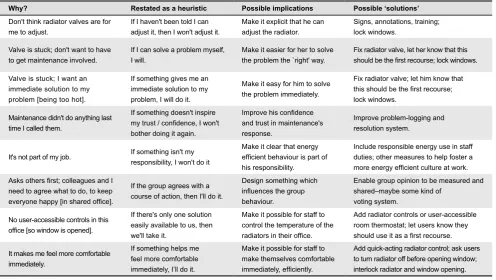
As Figure 2(b) shows, it is trivial to suggest ‘solutions’ at each level based on providing alternative ways of fixing one or more of the reasons given by the interviewee–fixing the radiator
valve, improving maintenance’s problem-logging procedures
and including energy use as part of staff’s responsibility–but
each of these solutions is acting on a different way of framing
[image:8.595.50.544.112.546.2]the problematic behaviour. The ‘ultimate’ reason may be a lack
Table 1. Interviewees’ statements about what they would do if too hot or too cold in the office.
Interviewee “If I were too hot, then I would...” “If I were too cold, then I would...”
1 Remove some layers of clothes Not take any action
2 Sit near draughty window if possible Put on more layers of clothes See if possible to open window
Get a cold drink
Go outside to get some fresh air Contact facilities manager, if really bad
3 Remove some layers of clothes Put on more layers of clothes1 Go outside to get some fresh air
4 Remove some layers of clothes Put on more layers of clothes Contact facilities manager, if really bad
5 Not take any action Put on more layers of clothes
6 Remove some layers of clothes Put on more layers of clothes
7 Remove some layers of clothes Go home
8 Sit near draughty window if possible Not take any action Remove some layers of clothes
9 Open window Adjust radiator 2
Adjust radiator 2 Use own electric heater
10 Open window 3 Put on more layers of clothes1
11 Open window Use own electric heater
Contact facilities manager, if really bad 4 Contact facilities manager, if really bad
12 Open window 4 Use own electric heater
13 Adjust radiator 2 Adjust radiator 2
Use own electric fan Use own electric heater
Open door 5
14 Talk to colleagues to decide on course of action Not take any action Open window
15 Wait for colleagues to open window Put on more layers of clothes
16 Open window Adjust radiator 2
Try to understand air conditioning interface
13 and 10 mentioned keeping extra clothes (jumpers) in the office for exactly these occasions.
2 The radiators had simple manual (rather than thermostatic) valves, so it was not possible to adjust temperature directly. 3 10 commented “I don’t think the radiator valves are there for me to adjust”.
4 11 and 12 noted that the radiator valves in each of their offices were stuck ‘on’ and so were not adjustable by hand.
of perceived responsibility for energy use, but the immediate
situated reason of a stuck radiator valve is no less ‘valid’ as a problem to be addressed (it is certainly quicker to fix). Some will be ‘design’ solutions, others not.
This analysis of individual interviewees’ reasoning
was made more generally applicable by restating each of the reasons given, at different levels of abstraction, as a heuristic, and tabulating them so that common elements can be more
easily identified. As Table 2 shows, once restated as heuristics, extracting design ‘implications’ from each is relatively simple, if
subjective: the heuristic is again just a problem-solution pair, and
for each, possibly applicable ‘solutions’ are easy to conceive. It
is noticeable that the design implications frame the problem as being variously about changes to physical equipment (to lead to changes in behaviour) and changes to people’s behaviour through service or support changes: there is no hard distinction between what might be considered service design or product design. It is
important to remember that while some of the possible ‘solutions’ listed in Table 2 appear more complex than the existing responses in Table 1, many of these existing responses were essentially ‘unacceptable’ to building managers, due to energy inefficiency. Equally, it is important to note that the interpretations in Table 2
[image:9.595.53.539.249.439.2]Figure 2. (a) The 5 Whys chain for interviewee 12 and (b) with immediate ‘solutions’ for each reason.
Table 2. Restating interviewees’ reasons for opening windows as heuristics.
Why? Restated as a heuristic Possible implications Possible ‘solutions’
Don't think radiator valves are for me to adjust.
If I haven't been told I can adjust it, then I won't adjust it.
Make it explicit that he can adjust the radiator.
Signs, annotations, training; lock windows.
Valve is stuck; don't want to have to get maintenance involved.
If I can solve a problem myself, I will.
Make it easier for her to solve the problem the `right' way.
Fix radiator valve, let her know that this
should be the first recourse; lock windows.
Valve is stuck; I want an immediate solution to my problem [being too hot].
If something gives me an immediate solution to my problem, I will do it.
Make it easy for him to solve the problem immediately.
Fix radiator valve; let him know that
this should be the first recourse;
lock windows. Maintenance didn't do anything last
time I called them.
If something doesn't inspire
my trust / confidence, I won't
bother doing it again.
Improve his confidence
and trust in maintenance's response.
Improve problem-logging and resolution system.
It's not part of my job. If something isn't my responsibility, I won't do it
Make it clear that energy
efficient behaviour is part of
his responsibility.
Include responsible energy use in staff duties; other measures to help foster a
more energy efficient culture at work. Asks others first; colleagues and I
need to agree what to do, to keep
everyone happy [in shared office].
If the group agrees with a course of action, then I'll do it.
Design something which
influences the group
behaviour.
Enable group opinion to be measured and shared–maybe some kind of
voting system. No user-accessible controls in this
office [so window is opened].
If there's only one solution easily available to us, then we'll take it.
Make it possible for staff to control the temperature of the
radiators in their office.
Add radiator controls or user-accessible room thermostat; let users know they
should use it as a first recourse.
It makes me feel more comfortable immediately.
If something helps me feel more comfortable immediately, I’ll do it.
Make it possible for staff to make themselves comfortable
immediately, efficiently.
[image:9.595.51.548.487.767.2]are inherently subjective–we are not claiming that the heuristics,
implications and solutions are the only way of dealing with users’ comments, but they represent a set of possible ways of framing
the problems and solutions concerned. Useful framings might not emerge within five levels of questions; on the other hand, they
may emerge straight away.
In the case study in question, the next stage of the process was to identify which of the possible implications and concepts were likely to be actionable in the subsequent stages of the
project, in the specific workplaces concerned. But in the wider field of design for behaviour change, something along the lines
of Zachrisson and Boks’ (2012) challenge introduced at the start of section 1 is relevant: is it possible to match design strategies with particular heuristics across domains and problems? Are there other situations where, for example, the “If the group agrees with
a course of action, then I’ll do it” heuristic mentioned in Table 2
also applies? And if so, do the pertinent design implications and
concepts exhibit similar principles? Ultimately, could extracting
and abstracting behavioural heuristics, through user research,
provide a ‘common language’ of problem-solution pairs enabling
translation between design principles for behaviour change and the kinds of behavioural situations in which they apply?
Reverse Engineering of
Existing Examples
To explore the potential of this ‘common language’ approach, we attempted to ‘reverse engineer’ existing examples of systems known to be designed to influence user behaviour, to
uncover heuristics which users are (potentially) assumed to
be following for the intended behaviour to occur. To do this
we applied a process similar to the 5 Whys decomposition employed in interviews with users, this is essentially a mirror image of the interview process: interrogating existing examples to obtain heuristics at different levels of abstraction, rather than interviewing users themselves. After partially exploring
one example ourselves–perhaps ‘obvious’ because of its ubiquity, but nevertheless successful–see ‘Example: Amazon
recommendations’ below, workshop participants at an interaction design industry conference were then invited to carry out the decomposition process on three further examples (see below
‘Examples: Codecademy, OPOWER and Foodprints’).
Example:
Amazon Recommendations
Amazon, the online retailer, is well-known for its recommendation
engine (e.g., Iskold, 2007); as of 2006, 35 per cent of the
company’s sales came via recommendation elements on the
website (Marshall, 2006). Users (potential customers) browsing for products, such as books, are–in addition to basic product information–presented with a number of page elements using variants of ‘social proof’ (Anderson, 2010; Cialdini, 2007) to influence their decision-making, based on extensive, ongoing background analysis of shopping habits by Amazon. These can
include “Frequently bought together”, “Customers who bought this item also bought”, “What other items do customers buy after viewing this item?”, “Customers also bought items by”,
“Customers who bought items in your recent history also bought” and “Listmania” (which features customer-curated recommended lists of items with similar characteristics), as well as reviews
of the item by other customers, who can give one to five stars
and write comments (in turn, users can rate the reviews as being
helpful or not, and the ‘most helpful’ reviews are promoted in page position; frequent and well-regarded reviewers receive ‘flair’
next to their names).
Each of these many elements–in a slightly different way–uses the behaviour and opinions of other users, individually or as a ‘community’ to attempt to influence the behaviour of the potential customer. They could all be classified as using ‘social
proof’ as a design principle, but this misses the nuances of the
approach. The fact that Amazon uses so many variants–and
presumably tracks closely the effectiveness of each with different
customers and market segments–suggests that slightly different models of behaviour underlie each element, and what ‘works’ for some users does not work for everyone in terms of influencing
behaviour (Kaptein & Eckles, 2010). Each variant makes slightly different assumptions about how people will respond the
heuristics that are being followed. What might glibly be classified as ‘social proof’ comprises assumptions such as:
• People will do what they see other people doing.
• People will value or do what seems to be most popular.
• People value or respect others’ opinions and actions.
• People want to learn more about a subject.
• People will buy multiple items at the same time.
There are many other possible assumptions, of course.
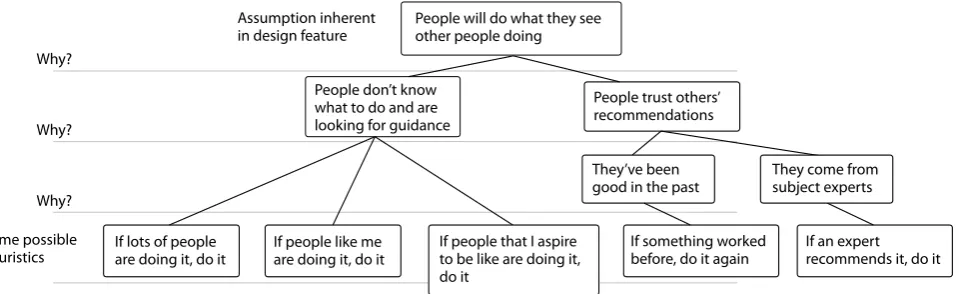
But taking “People will do what they see other people doing” as an example statement, if we follow a similar process of asking
“Why?” repeatedly, as in the section ‘Elaborating the heuristics: 5 Whys and further abstraction’ –“Why will people do what they see other people doing?”–we are able to tease out some possible
factors (Figure 3), which can easily be expressed as heuristics.
For the five heuristics uncovered, it is not too difficult to
think of design techniques which are directly relevant:
• If lots of people are doing it, do it → Show directly
how many (or what proportion of) people are choosing an option.
• If people like me are doing it, do it → Show the user that
his or her peers, or people in a similar situation, make a particular choice.
• If people that I aspire to be like are doing it, do it → Show the user that aspirational figures are making a particular
choice.
• If something worked before, do it again → Remind the
user what worked last time.
• If an expert recommends it, do it → Show the user that expert figures are making a particular choice.
As with the implications and concepts in Table 2, each
technique has the property of framing both problem and solution in a particular way. If user research with Amazon customers led to the expression of a heuristic such as “If people that I aspire to
be like are doing it, do it”, then a way of framing the specification
clear; depending on the heuristics uncovered, it might be that majority preference, authority-based messaging, friend-based recommendations, peer voting, celebrity or expert endorsement, or some other techniques entirely could match groups of users’ heuristics better. Sometimes, as with Amazon, a product or service will use more than one technique simultaneously, employing multiple elements, to try to satisfy multiple heuristics, or perhaps because the designers are not sure which heuristics are being used by individual users. Kaptein and Eckles’ (2010) work on persuasion profiling suggests a way forward which would
allow directly targeted elements tailored to what influences
individual users.
Examples:
Codecademy, OPOWER and Foodprints
The analysis outlined above with the Amazon example is
exploratory, rough and subjective, carried out by one of the authors. In practice, working with heuristics in design for behaviour change would need to be done as part of a design process, by
designers rather than solely academics. To explore how this would
work, a workshop session was run at Interaction ’12 in Dublin, Ireland, a major interaction design industry conference. Forty-one participants, including designers and researchers, worked in groups on exploring the assumptions inherent in elements of three
current digital services designed to influence users’ behaviour:
Codecademy offers interactive tutorials in Javascript
and Python, using a range of design techniques to encourage
participants to sign up and remain motivated. There is ‘gamification’ (Deterding, Dixon, Nacke, O’Hara, & Sicart,
2011) in terms of badges and points, but the focus of the user experience is rapid feedback and a structured progression,
intended to maintain engagement. As part of the ‘2012 Code Year’ initiative (which received 300,000 sign-ups in the first
week: Pavlus, 2012), other techniques such as commitment & consistency and social proof (Cialdini, 2007) come into play, as participants share their commitment.
OPOWER provides a service to electricity and gas
suppliers where customers receive ‘Home Energy Reports’
featuring comparisons with the average energy used by neighbours
(with similar size homes) and by the most efficient comparable
neighbours. The bills then suggest improvements that customers can make in order to improve their performance. The focus of the graphics is not financial, and the energy quantities given are normative–comparisons with a customer’s ‘peer group’. The graphs are paired with ‘smiley faces’, giving an alternative way of interpreting performance–shying away from criticism, only neutral or positive terms are used (and no ‘sad faces’: Schultz,
Nolan, Cialdini, Goldstein, & Griskevicius,, 2007). A randomised
controlled trial based on 600,000 households in the US (Allcott,
2011), found an average 2% reduction in energy use among households receiving the OPOWER reports.
Foodprints (Figure 4), part of the CarbonCulture platform,
combines a web app, ‘dashboard’, and physical loyalty cards
and stamps in company canteens to help staff reduce their meat and dairy intake, for both environmental (carbon footprint) and
health reasons. The app uses some gamification elements (points, ‘hidden treasure’, etc) and a ‘social proof’ ticker showing the meals that colleagues have recorded. The points contribute
towards winning prizes, though not in competition with other users (Nicholson, 2011).
Through a similar decomposition process to the one described in ‘Example: Amazon recommendations’, groups
extracted a handful of statements of possible heuristics for each
example (Table 3), with possible implications for design choices. These are by no means necessarily criteria that the developers
of Codecademy, OPOWER or Foodprints had in mind for their
products, but each heuristic / implication could be exemplified with
elements of the products concerned.
Thus, if a similar behavioural heuristic–e.g., “If my neighbour does it, I should do it”–were uncovered from user
research in a different context with a different product, the
design element from OPOWER fulfilling the “Show users
what their neighbours are doing” criterion could be used as an example on which to base a new element. In this particular case OPOWER’s visual comparisons with the energy used by neighbours is presented as part of a printed report, but as Atwood (2012) notes, the example translates well into wholly unrelated contexts, such as the design of the reputation system for online question-and-answer forums.
People will do what they see other people doing
People trust others’ recommendations
They’ve been good in the past
If something worked
before, do it again If an expert recommends it, do it People don’t know
what to do and are looking for guidance
If lots of people
are doing it, do it If people like meare doing it, do it Why?
Why?
Why?
They come from subject experts
If people that I aspire to be like are doing it, do it
Assumption inherent in design feature
[image:11.595.64.544.100.247.2]Some possible heuristics
In the workshop, participants went on to assemble sets of
heuristics into fictional ‘personas’, for whom they then generated
design concepts. While outside the scope of this paper, it is worth noting in passing the possibility of using heuristics as a way of
triggering designers to think outside their own perspective on a
problem–“ design for someone who’s following this rule rather
than that one” or “design so that people following either of these
[image:12.595.53.546.153.322.2]rules will be satisfied”.
Figure 4. The Foodprints online dashboard and cards (Nicholson, 2011).
Table 3. Possible heuristics, and design implications, extracted by workshop participants.
Example Possible heuristics Possible implications for design choices Codecademy If something helps me improve myself, do it. Show users that they are improving themselves.
If I feel like I am accomplishing something, then keep going. Make it clear what users are accomplishing. If something makes me feel better about my self-discipline, do it. Congratulate users for their self-discipline. If it makes me look more knowledgeable in the eyes of others,
then I will continue to take part. Enable users to show off their knowledge to other users. If I can track my progress, then I will stay engaged. Enable users to track their progress easily.
If the challenge pushes me the right amount, then I will stay engaged.
Make sure that the level of difficulty progresses in line with users'
developing abilities.
OPOWER If my neighbour does it, I should do it. Show users what their neighbours are doing. If life’s a competition, I will try to win it. Frame activities as part of a competition. If I can see that it saves me money, I will do it. Show users the money they will save.
If I set myself goals, I will try to meet them. Make it easy for users to set themselves goals and track their progress.
If I don’t want to be the ‘weak link’, I will act in the desired way. Emphasise that trying will avoid the user becoming the ‘weak link’. If I want to be ‘normal’, I should do it. Emphasise what is ‘normal’ for the group.
If I get appreciation from others, I will continue to do it. Give users explicit appreciation, from other users as well as directly.
If it stops me being the ‘bad guy’, I will do it. Congratulate users for being the ‘good guy’.
If it stops me feeling guilty, I will do it. Enable users to overcome guilt.
If it makes me feel good about being sustainable, then I will do it. Show users that they are being more sustainable, and congratulate them for it.
Foodprints If I get a reward, then I will do it. Give users rewards for taking part. If it is not too much effort, then I will do it. Make it easy to take part without much effort. If I can feel good about myself, then I will do it. Make it easy for users to feel good about themselves. If I can show off about how well I am doing, then I will do it. Enable users to show off what they're doing to other users.
If I can see benefits in more than one part of my life, then I will do it. Emphasise multiple benefits in different areas of life
(e.g., carbon footprint and health).
If it makes me feel healthier, then I will do it. Emphasise health benefits and show users how taking part could be helping their health.
If it does not punish me for days when I don't take part,
then I will keep going. Don't punish occasional users or those who miss days.
[image:12.595.51.547.352.765.2]Discussion:
Fitting into Design Practice
Where do behavioural heuristics fit into a design process forbehaviour change?
The two approaches which were explained in the sections ‘Case study: extracting heuristics around interaction with heating’ and ‘Reverse engineering of existing examples’ are something
like a pincer movement, arriving from two directions at heuristics
as a common language of problem-solution pairs. The points
where the approaches meet are at various levels of abstraction, but these help provide design practitioners with a variety of routes
between user research in a particular behavioural situation, and design principles for behaviour change which are relevant in that context; the levels of abstraction are necessarily different ways of modelling the problem / solution space, rather than a deterministic
single route from current behaviour to desired behaviour. Using
behavioural heuristics in the design process, starting from the behavioural situation itself, could thus comprise:
• Contextual research with users of the product, service
or environment in question, including ‘5 Whys’-style
interviews to extract and elaborate the heuristics potentially being followed.
• Analysing and grouping the heuristics uncovered to segment users according to heuristics being followed, and to identify different levels of design intervention feasible, by mapping heuristics to relevant design techniques.
• Generating design concepts based on relevant techniques, and making a selection of those to develop further based on appropriate criteria.
• Prototyping and/or implementing solutions, and evaluating the effects on behaviour as appropriate.
The aim is for heuristics to become a tool for helping designers to frame ‘behavioural problems’ via contextual research
with users, and with mapping to relevant design principles (and examples). Before the use of heuristics can be presented
as a complete ‘system’, this is of course one important element
requiring further development: developing a process for this mapping, in a way which is applicable by designers engaged in
user research, fitting into methods and processes already used.
We suggest that this will enable many of the diverse current approaches to classifying design for behaviour change techniques (e.g., Brand, 2004; Fogg & Hreha, 2010; Lockton et al., 2010a;
Lidman & Renström, 2011; Tang & Bhamra, 2008; Tromp et
al., 2011; Wever et al., 2008; Zachrisson & Boks, 2012) to be described in common language, and so more easily applied as part of a design process as problems are investigated and re-framed.
The focus is initially at least on the immediate context of
interaction, but a laddering approach to interviewing can help
elaborate elements of users’ attitudes and ‘background’ reasons for particular behaviour. This offers the potential of addressing all three of the ‘A-B-C’ of attitudes, behaviour and context inherent in behavioural models such as Guagnano, Stern, and Dietz (1995) and Stern (2000) which thus far have not received much attention within design research. It is true that the behavioural heuristics approach as presented in this paper is mainly concerned
with investigating and re-designing existing systems rather
than creating entirely novel ones–and this can be seen as a limitation–but as Michl (2002) suggests, most commercial design practice is ‘redesign’ in some form. Linking heuristics to design
techniques for behaviour change could enable the process to become more generative, enabling the development of innovative solutions rooted in real problems.
A Possible Extension
One possible refinement of “if... then” heuristics could be
structuring them along the lines of Minsky’s (1974, p. 1) concept of frames in artificial intelligence, which represent “a stereotyped
situation, like being in a certain kind of living room, or going to a child’s birthday party”, with attached information about how to proceed and what can be expected.
This would capture the idea of familiar situations being recognised by users and particular heuristics being enacted, also
thereby explicitly taking learned experience into account–nd
drawing on knowledge from usability research around interaction design patterns and conventions. For example, if someone needs to use a mobile phone he or she has never used before to make a call, the interaction process could be modelled in terms of heuristics involving recognising interface or physical form elements (or not), looking for labels and familiar (or not) icons, and so on, in order to work out how to make a call. Each heuristic has the potential
for design intervention to influence the user’s behaviour. The idea
also recalls Klein’s (1999) recognition-primed decision model, which considers how “decision makers size up the situation to recognise which course of action makes sense, and the way they evaluate that course of action by imagining it” (p. 24): essentially, a stage of pattern recognition, and a stage (if necessary) of rapid mental simulation before deciding to carry out the action
or modify it. The elements of the model important in a design
practice context are likely to be different to those in which the models were developed, but that need not stop our appropriation and adoption of models which offer us useful perspectives during the design process.
Applicability, Limitations and Justification
It is true that the use of heuristics for modelling can be seen as extremely reductionist: representing users as bundles of rules is close to treating “the human as a system component” (Jääskö &
Keinonen, 2006, 2010; Rasmussen, 1986, p. 61), maybe even the “trivial machine” of von Foerster (2002). The intention is,
nevertheless, to represent, via a very simple modelling approach, the contexts in which interaction behaviour occurs with the products and services we design.
While simple statements of “if... then” heuristics will not capture many of the nuances of the situated strategies people use, they do permit a more granular framing of problems and possible solutions than a number of existing approaches to design for behaviour change, and indeed than conventional approaches to