University of Warwick institutional repository:http://go.warwick.ac.uk/wrap
A Thesis Submitted for the Degree of PhD at the University of Warwick
http://go.warwick.ac.uk/wrap/73976
This thesis is made available online and is protected by original copyright. Please scroll down to view the document itself.
The Many Behind the Few: The Lives and Emotions of Erks
and WAAFs of RAF Bomber Command 1939 -1945.
By Dan Ellin
1161835
Department of History
Thesis submitted for the degree of PhD in History at the
University of Warwick.
2 TABLE OF CONTENTS
Acknowledgements 5
Abstract 7
List of Figures 9
Abbreviations.
11
Introduction 14
1: RAF Culture and Cultural Representations of RAF Ground
Personnel 39
Cultural representations 41
RAF Culture 44
Hierarchy of Trades 47
The Erk 53
Race and Class 64
Gender and WAAF ‘Dilution’ 68
Conclusion 90
2: Recruitment, Selection and Training 92
Recruitment and Conscription: Volunteers and the
National Service Act 96
Recruitment and Initial Training Centres 101
Initial training 115
Health and Hygiene: ‘FFI’s, Lectures and
3 ‘GVK’ Tests and Psychological Profiling 125
Trade Training 134
Conclusion 142
3: Living and Working Conditions 145
Living Conditions 149
Bomber stations as Total Institutions 157
Hierarchy of Trades 167
Working Conditions: Mechanics, Fitters and Riggers
on ‘the Flights’ 172
Armourers and ‘Gash Trades’ 179
Those ‘Beyond the Perimeter Track’ 180
Dangers and Risks: RAF Health and Safety and
Traumatic Events 185
Conclusion 195
4: The Lives and Emotions of Ground Personnel 198
Emotions 200
Fear and Anxiety 202
Loss and Grief 214
Loss of Aircraft 217
Guilt 219
Boredom 223
Emotional Norms and Emotional Communities 224
Identity 232
4
Conclusion 241
5: The Medical Officer's Role in RAF Bomber Command 245
The ‘Typical’ Medical Officer 247
The Social Construction of Mental Health 257
Mental Health in the RAF 267
Neuropsychiatric ground Personnel 274
WAAFs 278
Identifying Malingering 283
Conclusion 296
6: The Treatment of ground personnel in NYDN centres 299
The Scale of the Problem 305
Diagnosis 313
Treatment 322
Disposal 329
Pensions 337
Conclusion 343
Conclusion 346
Appendices 358
A. Map of Bomber Command Stations 1940 - 1945 358 B. RAF Trades, Volunteers and National Service Act Recruits 359 C. WAAF Trades, Volunteers and National Service Act Recruits 362
D. Trades and Pay Groups 366
E. Daily rates of pay for ground personnel and air NCO air crew 369
5 ACKNOWLEDGEMENTS
When nearing the end of my thesis I opened a word document I had previously created labelled ‘Conclusion.’ I found I had written: ‘PhDs take at least three years and alienate you from your friends and family. ’I would like to thank my wife, Nisey, for her support and understanding, and for working in undesirable jobs to make ends meet. To all my ‘ankle-biters’ who are now (nearly) all adults, I have to apologise for times when I was frightening and grumpy, and special thanks must go to Beth for adding commas. Thanks to Mum and Dad, for their support of all kinds, and John Clark and Lizzie Wilson for helping in my decision that academia was an adventure I should undertake.
I thank my supervisor, Mathew Thomson, and Anne Law, curator at the RAF Wickenby Memorial Collection. Special thanks must go to Heather Hughes, and others from Lincoln’s International Bomber Command Centre, for enabling me to fly in ‘Vera’ the Canadian Warplane Heritage Museum’s Lancaster during her tour of the UK in the summer of 2014. Thank you to the Economic and Social Research Council and the University of Warwick Doctoral Training Centre for my funding and enabling me to give conference papers at exotic places in Europe and North America.
6 works of Spike Milligan, Vivian Stanshall and Alan Alda, I would probably never have started, and if I had I would never have got anywhere near finishing.
DECLARATION
This thesis is the author’s own work and has not been submitted for a degree at
7 ABSTRACT
This thesis examines the lives and emotions of male and female ground personnel who served in Bomber Command during the Second World War. Histories of Bomber Command usually focus on the flyers, or on the strategy of the bombing campaign. The experiences of four fifths of the service, the ground personnel, are often neglected. They are frequently reduced to two dimensional stereotypes, as the ‘Erk’ who serviced the aircraft, or the WAAF ‘chop girl’ whose sexual promiscuity presaged death. The RAF assigned personnel to different trades ranging from the most technical to the most mundane. The central theme of this thesis is the gendered hierarchy of trades within Bomber Command. It was constructed in part by
widespread beliefs about fear, heroism and stoicism, the interconnected discourses of class and gender, and specific quirks of RAF culture. These included its trade
selection process, dialect, pay scale, and trades’ perceived importance to the raison d’être of Bomber Command. The hierarchy is important in explaining the
9 FIGURES
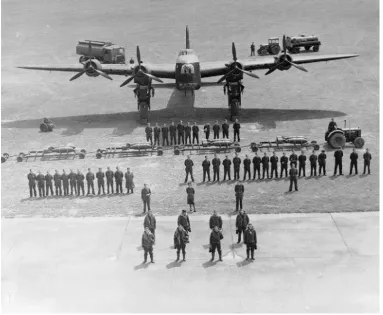
0.1 The air and ground crews responsible for a Short Stirling 33
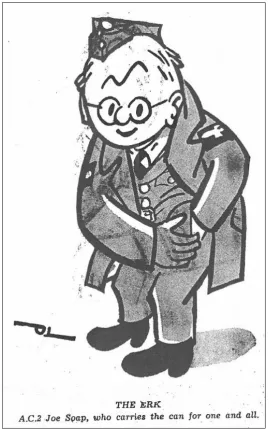
1.1 The Erk: AC2 Joe Soap 55
1.2 Recruit 1425371 62
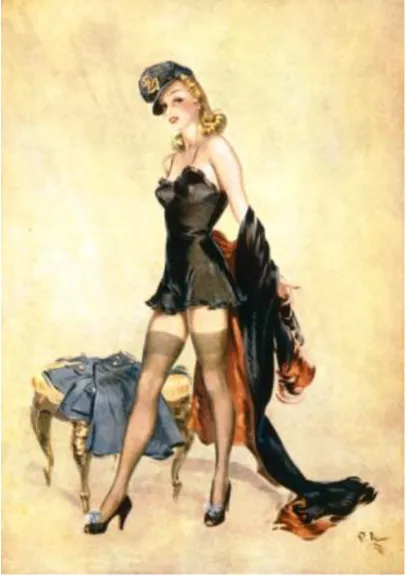
1.3 Off with the old on with the new 83
1.4 serve in WAAF with the men who fly 84
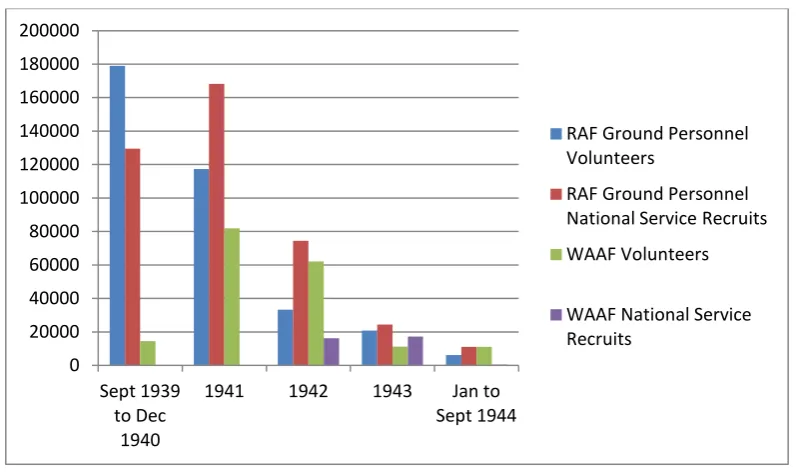
2.1 Recruiting for the Royal Air Force 3rd September 1939 to 2nd September 1944 98
2.2 Initial Training at West Kirby September 1940 116
2.3 Bayonet practice at West Kirby 118
2.4 Trade test board 138
2.5 Standard efficiency tests 139
3.1 Map of RAF Wickenby 146
3.2 Flight Mechanic (engine) 173
3.3 Ground crew work on a Halifax 175
3.4 Ground crew Shelter at Wickenby 177
10
3.6 Causes of fatalities and injuries 188
4.1 Ad Astras at Wickenby 239
4.2 RAF Wickenby Maintenance Wing Group Cup Final Football Team 1944-45 239
5.1 The medical officer 254
5.2 Crashed Mosquito 275
5.3 Lead Swinging 284
6.1 Attendance of new neuropsychiatric out-patients at NYDN centres during 1942 306
6.2 Diagnosis of 250 psychiatric consecutive male and female cases 311
6.3 Diagnosis of 200 consecutive cases of psychological disorders at Rauceby 317
6.4 Diagnosis of RAF patients 1 September 1940 to 31 August 1941 at Matlock 317
6.5 Psychological disorders of invalided patients 335
11 ABBREVIATIONS
In the 1940s, it was common to use a full-stop in between the letters of acronyms, (R.A.F. for example). Following modern practice however, I have omitted them, except where they are included in direct quotations.
A/C Aircraft
ACH Aircrafthand
AC1 Aircraftsman first Class
AC2 Aircraftsman Second Class
ACW2 Aircraftswoman Second Class
AM Air Ministry
AMO Air Ministry Order
AMCO Air Ministry Confidential Order
ARP Air Raid Precautions
ATS Auxiliary Territorial Service
AWL Absent Without Leave
BCATP British Commonwealth Air Training Plan
BMJ British Medical Journal
CO Commanding Officer
CTTB Central Trade test Board
DAH Disordered Action of the Heart
DGMS Director General Medical Services
12
DRO Daily Routine Orders
DWAAF Director Women’s Auxiliary Air Force
EMS Emergency Medical Services
ENSA Entertainments National Service Association
FFI Free From Infection
FPRC Flying Personnel Research Committee
GD General Duties or Ground Defence
HCU Heavy Conversion Unit
IWM Imperial War Museum
LAC Leading Aircraftsman
LACW Leading Aircraftswoman
LMF Lack of Moral Fibre
HMSO His Majesty’s Stationary Office
MOA Mass-Observation Archive
MO Medical Officer
MOI Ministry of Information
MRC Modern Records Centre University of Warwick
MSU Mobile Signals Unit
MT Motor Transport
NAAFI Navy Army and Air Force Institute
NCO Non Commissioned Officer
NSA National Service Act
NYDN Not Yet Diagnosed Neuropsychiatric
13
OTU Operational Training Unit
PNB Pilot, Navigator, Bomb Aimer
PT Physical Training
RAF Royal Air Force
RAFVR Royal Air Force Volunteer Reserve
RAFMH Royal Air Force Museum Hendon
RAMC Royal Army Medical Corps
RCAF Royal Canadian Air Force
RDF Radio Direction Finding (Radar)
RT Radio Telephone
SD Special Duties
SSQ Station Sick Quarters
TNA The National Archives
USAAF United States Army Air Force
VE Day Victory in Europe Day (8 May 1945)
WAAF Women's Auxiliary Air Force
WL Wellcome Library
WMC RAF Wickenby Memorial Collection
WOM Wireless Operator/ Mechanic
WOP Wireless Operator
WReN Women's Royal Naval Service
WT Wireless Telephone
14 INTRODUCTION
Eric Sykes ‘Ode to the Erk’ (1942)
Wherever you walk, you will hear people talk, Of the men who go up in the air.
Of the dare-devil way, they go into the fray; Facing death without turning a hair.
They'll raise a cheer and buy lots of beer, For a pilot who's home on leave;
But they don't give a jigger For a flight mech or rigger
With nothing but 'props' on his sleeve.1 They just say 'Nice day' and then turn away, With never a mention or praise.
And the poor bloody ‘erk’ who does all the work; Just orders his own beer And pays!
They've never been told of the hours in the cold That he spends sealing Germany's fate.
How he works on a kite, till all hours of the night; And then turns up next morning at eight.
He gets no rake-off for working till take off; Or helping the aircrew prepare;
But whenever there's trouble, it's 'Quick at the double'; The man on the ground must be there.
Each flying crew could tell it to you; They know what this man's really worth. They know he's part of the RAF's heart, Even though he stays close to earth.
He doesn't want glory, but please tell his story; Spread a little of his fame around.
He's one of the few so give him his due; Three cheers for the man on the ground.2
1 The ‘props’ on his sleeve refers to the representation of a propeller which was the badge of rank of a
leading Aircraftman (LAC).
2 RAF Wickenby Memorial Collection (WMC), E. Sykes, ‘Three Cheers For The Men On The
15 Concentrating on RAF Bomber Command between 1939 and 1945, this thesis
examines the lives and emotions of ‘WAAFs’ of the Women’s Auxiliary Air Force, and ‘Erks’, as low ranking RAF ground personnel were colloquially known.3
Throughout this thesis ‘ground personnel’ will refer to service personnel, of all ranks, and all trades who were not air crew; ‘ground crew’ refers only to those mechanics, riggers and fitters who worked directly on the aircraft. Flyers accounted for only 16 per cent of the home force, indeed between 1942 and 1944 there were more women in the service.4 At its peak in 1944, more than 190,000 male and female ground personnel worked to support around 36,000 Bomber Command air crew;5 ground personnel accounted for more than four-fifths of the population on an operational station. As the poem suggests, ground personnel acknowledged that, despite playing a vital role in the war, their importance was largely unrecognised; they are also often overlooked in popular and academic histories. Men and women from a wide variety of social groups, including exiles from occupied Europe, and volunteers from the British Empire and the Dominions, served in Bomber Command. Ground personnel included ‘professionals’ who joined in the interwar period, and volunteers and conscripts who were ‘in for the duration.’ Beginning with an
examination of their recruitment and training, this thesis investigates what it was like
War. See for example: T. Bint, ‘626 Squadron and RAF Wickenby: The Ground crews’ (2012) http://www.626-squadron.co.uk/groundcrew.htm (accessed 22 January 2015). The actor and comedian Eric Sykes was a leading aircraftman in the RAF during the war. He joined in mid 1941 and after being trained as a wireless operator he served in a Mobile Signals Unit (MSU) in Europe after D-day. However, he was never posted to an operational aerodrome. See: E. Sykes, If I Don’t Write it, Nobody
Else Will, (London, Harper Perennial, 2006), p. 131. Songs with similar sentiments were sung at station concert parties. See for example Ward- Jackson W. C. (ed) Airman’s Song Book, (London, Sylvan Press, 1945), p.168, 173.
3
It is likely that the etymology of ‘Erk’ was a bastardisation of ‘aircraftsman’, or its acronym, A.C., the lowest rank in the RAF.
4 Air Ministry, Royal Air Force Personnel Statistics for the period 3rd September 1939 to 1st
September 1945, (Air Ministry, 1946), pp. 1-5.
16 to serve as ground personnel on an operational bomber station. Engaging with the history of emotions, it asks how they coped with hardship, while the final chapters consider the medical treatment of those who were perceived to be insufficient to the task.
Historiography
The historiography of the RAF prioritises ‘the cult of the flyer’,6
while social and cultural histories, and the historiography of wartime mental health, usually examine either combatants or civilians. The lives and experiences of non-combatant ground personnel are infrequently addressed. In the political context of the Cold War and its aftermath, historians have debated the ethics and morality of the bombing, its
economic effectiveness, and strategic counter-factuals as new evidence became available. The materiel and strategies of RAF have been compared and contrasted to the USAAF, and there is a multitude of other publications on Bomber Command.7 First published in 2001, Mark Connelly examines representations of Bomber Command during and after the war and how the modern impression of Bomber Command has been constructed,8 and most recently Richard Overy considered the technological, strategic and political influences on the bombing war. From both sides of the conflict, he discusses the experiences of those who carried out the bombing,
6 M. Francis, The Flyer: British Culture and the Royal Air Force 1939-1945, (Oxford, Oxford
University Press, Oxford, 2008), p. 201.
7 See for example: P. Bishop, Bomber Boys: Fighting Back 1940-1945, (London, Harper press, 2007),
M. Middlebrook, The Nuremburg Raid: 31-31March 1944, (London, Cassell, 2000), D. Richards, The Hardest Victory: RAF Bomber Command in the Second World War, (London, Penguin, 2001) or K. Wilson, Bomber Boys: The Ruhr, the Dambusters and bloody Berlin, (London, Casell, 2005), A. C. Grayling, Among the Dead Cities: was the Allied bombing of civilians in WWII a necessity or a crime? (London, Bloomsbury, 2006).
17 and those who were unfortunate enough to be targeted.9 Some examinations of the psychological effects of combat on air crew have been published, and several studies have considered the RAF policy on ‘lack of moral fibre’ (LMF).10
In The Flyer, Martin Francis examines the place of the RAF airman in British popular culture during the war. He discusses gender and how the concepts of courage, cowardice and fears impacted on airmen’s masculinity, but in focusing on ‘the flyer’ Francis does not examine the overwhelming majority of RAF personnel.11 As yet there has been very little academic interest in ground personnel. Some work has been published on women in the WAAF, but this tends to be anecdotal and descriptive rather than analytical.12 An exception is the feminist historian Tessa Stone, who examined women of the WAAF through the lens of the ‘double helix’ model of gender relations; she focuses on their role as workers and their adoption of uniform.13
9
R. Overy, The Bombing War: Europe 1939-1945, (London, Allen Lane, 2013).
10 Although the RAF admitted that some emotional casualties had genuine medical reasons for their
inability to fly, many were seen to have a weakness of character. The term ‘Lack of Moral Fibre’ (LMF) was first recorded as being used by the RAF in March 1940 after a meeting to discuss the treatment and disposal of men, without a medical reason to explain their actions, who openly admitted they did not intend to fly. See: J. McCarthy, ‘Air crew and ‘Lack of Moral Fibre’ in the Second World War’ War and Society, Vol.2, 1984, pp. 87-101. See also: J. Terraine, The Right of the Line, (Ware, 1997), S. Brandon, ‘LMF in Bomber Command 1939-45: Diagnosis or Denouncement?’ in Freeman & Berrios (eds) 150 Years of British Psychiatry, Vol. 2: The Aftermath, (Athlone, 1996), pp. 119-129. A. D. English, The Cream of the Crop: Canadian Air crew, 1939 – 1945, (Montreal & Kingston), 1996. E. Jones, ‘LMF: The Use of Psychiatric Stigma in the Royal Air Force during the Second World War’ The Journal of Military History, 70 (2006), pp. 439-458. B. Shephard, A War of Nerves,
(London, 2000). See also: B. Shephard, ‘Pitiless Psychology: the role of prevention in British military psychiatry in the Second World War’ History of Psychiatry, 40, 4 (1999), pp. 491-524, and M. K. Wells, Courage and Air Warfare: The Allied Air crew Experience in the Second World War, (London, 1995).
11 Francis, The Flyer.
12 See for example: B. E, Escott, Woman in Air Force Blue: The story of women in the Royal Air Force from 1918 to the present day, (Wellingborough, 1989) and B. E. Escott, Our Wartime Days: The WAAF, (Stroud, 2005) For autobiographical sources see for example: P. Beck, Keeping Watch: A WAAF in Bomber Command, (Manchester, 2004) M. Gane-Pushman, We All Wore Blue: Experiences in the WAAF, (Stroud, 2006) D, Lindo, A WAAF at War: Wartime Jottings of a WAAF Driver 1941 – 1946, (Fontwell, 1992). S. Pickering, Tales of a Bomber Command WAAF (& her horse), (Bognor Regis, 2002) and J. Wyndham, Love is Blue: A Wartime diary, (London, 1987).
13 T. Stone, ‘Creating a (Gendered?) Military Identity: the Women’s Auxiliary Air Force in Great
18 However, by including a more in depth consideration of male ground personnel identities using the theories of Raewyn Connell, David Morgan, and Frank Barrett,14 this thesis will examine the gendered cultural hierarchy of the RAF from a more inclusive and wider perspective.
Theoretical approaches including class and gender are more frequently applied to other areas of twentieth century conflicts, and several are pertinent to my thesis. Histories of emotion and gender have been more often applied to combatants in the First World War however, and there has been a renewed interest in what enabled these men to keep going in spite of the odds that they faced. In The Secret Battle: Emotional Survival in the Great War Michael Roper applies Kleinian psychology to combatants’ memoirs, letters and diaries.15
He examines the emotional damage caused by the war and how support from home and from comrades enabled combatants to attempt to come to terms with their role in the war. This thesis will occasionally use a similar methodology; as well as receiving support from their families, ground personnel relied on friendship groups and emotional communities. After his seminal work on World War One, Paul Fussell considered understanding and behaviour in the Second World War. Through poetry and literature he examined the discourses of war, and considered ‘the rationalizations and euphemisms’
combatants used to come to terms with their part of the ‘unacceptable actuality’ of
Stone, ‘The integration of women into a military service: the Women's Auxiliary Air Force in the Second World War.’ PhD thesis (University of Cambridge, 1999).
14 R. W. Connell, Masculinities (Second Edition), (Cambridge, Polity Press, 2010), F. J. Barrett, ‘The
Organizational construction of hegemonic masculinity: The case of the U.S. Navy’, Gender, Work and Organization, 3, 3, (1996), pp. 129-142. D. Morgan, ‘Theatre of War: Combat, the military and masculinity’ in: Brod, H & Kaufman, M (eds), Theorizing Masculinities, (London, Sage Publications, 1994), pp. 165-182.
15 M. Roper, The Secret Battle: Emotional Survival in the Great War. (Manchester, Manchester
19 the industrialised slaughter.16 Sonya Rose examines the impact of gender, race and class on the citizenship and national identity of the non-combatant work force, and the relationship between individuals and society.17 As a period of rapid social change, wars are often regarded as a pivotal point in various narrative trajectories such as the decline in the importance of class culture, the rise of democracy, feminist emancipation and the creation of the ‘modern self.’18
James Hinton examines how, by negotiating conflicting cultural sources and discourses, ‘individuals sought to construct a coherent sense of their own identities.’19
My research will also highlight ontological conflicts between individual identities and the responsibilities of a communal wartime citizenship in this previously understudied group. In particular this thesis examines how ground personnel constructed their identity and a sense of meaning through language, shared identities, ‘otherings’ and binary oppositions within the hierarchical structure of Bomber Command.
The ‘no neuroses myth’, that the public stoically accepted the hardships of war and only a small minority suffered and broke down was formed during the war and was perpetuated in popular history.20 Using oral interviews, Penny Summerfield has defined two contrasting discourses with which women constructed their wartime roles: women were either ‘heroic’, (enjoying masculine roles and seeing the war as a
16
P. Fussell, Wartime: Understanding and Behaviour in the Second World War, (Oxford, Oxford University Press, 1990), p. ix.
17 S. Rose, Which People’s War? National Identity and Citizenship in Wartime Britain 1939 – 1945,
(Oxford, 2003).
18
See for example: C. Taylor, Sources of the Self: The making of the modern identity, (Cambridge, Cambridge University Press,1989), C. Langhamer, The English in Love: The Intimate Story of an Emotional Revolution, (Oxford, Oxford University Press, 2013), and K. A. Cerulo, ‘Identity
Construction: New Issues, New Directions’, Annual Review of Sociology, 23, (1997), pp. 385-409.
19 J. Hinton, Nine Wartime Lives: Mass Observation and the Making of the Modern Self, (Oxford,
2010), p. 17.
20
20 period of dramatic change) or they were ‘stoic’ (enduring the war and creating a narrative of continuity).21 My work examines how men and women in the military, but not in a combat role, fit this paradigm. Seen in comparison to heroic flyers and stoic civilians who endured the Blitz, members of the WAAF and RAF ground personnel either maintained their role as efficient workers dedicated to the war effort, or failed. The bravery and masculinity of those who broke down could be called into question, and failures were either diagnosed as congenitally weak and predisposed to psychoneuroses or regarded as unpatriotic malingerers. My thesis engages with the historiographies of civilian war neuroses and ‘LMF’ within the RAF. Unlike many studies of the history of military psychiatry and mental health, it considers the treatment of patients with a strong understanding of their place in the social structure of the military.22 By engaging with mid twentieth-century ideas of mental health and theories concerning predisposition to neuroses in this previously unexamined group, my thesis will inform areas of the History of Medicine and in particular give new perspectives on the history of psychiatry.
Often focussing on a single emotion,23 the history of emotions studies the social construction of how feelings were expressed and the history of how displays of
21
P. Summerfield, Reconstructing Women’s Wartime Lives: Discourse and Subjectivity in Oral
Histories of the Second World War, (Manchester, 1998), pp. 78-105.
22 See for example: J. Bourke, ‘Disciplining the Emotions: Fear, Psychiatry and the Second World
War’ in: Cooter, R. Harrison, M. and Sturdy, S. (eds) War Medicine and Modernity, (Stroud, Sutton Publishing, 1999), pp. 225-234, E. Jones, and S. Wessely, ShellShock to PTSD: Military Psychology from 1900 to the Gulf War, (Hove, Psychology Press, 2005), N. Thalassis, ‘Useless Soldiers: The Dilemma of Discharging Mentally Unfit Soldiers during the Second World War’ Social History of Medicine 23, 1, (2010), pp. 98-115, M. Thomson, ‘Status, Manpower, and Mental Deficiency in the First World War’, in Cooter, R. Harrison, M. and Sturdy, S. (eds.), War, Medicine and Modernity,
(Stroud, Sutton Press, 1999), pp. 149-66, B. Shephard, ‘‘Pitiless Psychology’: the role of prevention in British military psychiatry in the Second World War’ History of Psychiatry, 40, 4, (1999), pp. 491-524, and B. Shephard, A War of Nerves, (London, Jonathon Cape, 2000).
23 See for example: J. Bourke, Fear: A Cultural History, (London, Virago Press 2006), S. J. Matt,
21 emotion were regarded.24 Joanna Bourke’s work on fear is most pertinent to this study.25 This thesis will also examine fear and other emotions (including anxiety, grief and boredom), commonly experienced in wartime in a previously overlooked group.
Cultural Representations of Bomber Command
Although Churchill’s famous speech about ‘The Few’ had originally included the role played by all the RAF and the importance of Bomber Command’s disruption of the German’s build up of invasion barges in winning ‘The Battle of Britain’,26
the dominant narrative of the RAF was of heroes of Fighter Command defending homes, businesses and the civilian population. The supremacy of the Spitfire and Fighter Command was quickly established in wartime propaganda and in popular culture, and has continued in the decades afterwards.27 Nationwide Battle of Britain
anniversary services were held in the month of September throughout the war (and since) to raise funds and to commemorate ‘Battle of Britain Day’ 15 September, the supposed turning point of the battle. These celebrations prioritised the fighters over the bombers and the importance of the RAF’s defensive rather than offensive role, as it fitted rather better into the powerful cultural construction of the British underdog
24
S. Matt, ‘Current Emotion Research in History: Or, Doing History from the Inside Out,’ Emotion Review 3, 1, (2011), p. 118.
25 Bourke, Fear, and J. Bourke, ‘The Emotions in War: Fear and the British and American Military,
1914 – 45’ Historical Research, 74. 185, (2001), pp. 314–330. See also: Fussell, Wartime, pp. 273-283.
26 W. S. Churchill, Never Give in! The Best of Winston Churchill’s Speeches, (New York, Hyperion,
2003), p. 238. In his speech on 20 August 1940 he went on to say: ‘but we must never forget that all the time, night after night, month after month, our bomber squadrons travel far into Germany, find their targets in the darkness by the highest navigational skill, aim their attacks, often under the heaviest fire, often with serious loss, with deliberate careful discrimination, and inflict shattering blows upon the whole of the technical and war-making structure of the Nazi power.’
27 M. Hastings, Bomber Command, (London, Michael Joseph, 1980), p. 42, 346. See for example: L.
22 winning against the odds.28 Naming and defining an event or period of history is a political rather than a historical necessity,29 and the ‘Battle of Britain’ was soon defined as having a beginning and an end, and Fighter Command was seen to win a decisive victory that could be celebrated. In contrast, while Arthur Harris, the commander of Bomber Command from early 1942, was keen to describe different ‘battles’ over specific targets, operations against German targets were a constant throughout the war, and the bombing of German cities and the targeting of German morale failed to bring about the victory Harris hoped it would achieve.30 Although after D-day there was less about Bomber Command in the press, for much of the war a large amount of ‘print and celluloid were devoted to it.’31
Throughout the war the public were ‘firmly in favour’ of the bombing campaign against Germany.32
The popular press ‘hinted at Bomber Command’s awesome powers of mass
destruction’,33
but for most of the war the popular narratives concerning Bomber Command were of the accurate bombing of military targets, and, fighting for survival against the elements, flak, searchlights and fighters, either a heroic sacrifice, or a safe return to England against the odds. However ‘the British people must have had knowledge of what British bombing policy actually entailed.’34
By the last stages of the war, the myths of accurate bombing of military targets could not be maintained due to a growing awareness of the effects of area bombing. The continuing
controversy over the effectiveness and ethics of bombing has shaped the personal testimony of individual members of Bomber Command recorded since the war.
28
A. Calder, The Myth of the Blitz, (London, Pimlico, 2008), p. 4.
29 Ashplant, Dawson, & Roper, Commemorating War, p.55. 30 Overy, The Bombing War, p. 619.
31
Connelly, Reaching for the Stars, p. 128.
32 M. Connelly, ‘The British People, the Press, and the Strategic Air Campaign against Germany’, Contemporary British History 16, 2, (2002). p 40.
23 Parallels have been drawn between Harris and the bombing campaign, and the
futility and stubbornness of Haig and the attrition and sacrifice of the trench warfare of The First World War.35
Partially constructed by propaganda,36 unifying discourses were a particularly strong part of the hegemonic narrative of the war.37 To encourage volunteers and to enlighten new recruits about the recruitment and training process, an official
narrative of life on a bomber command station began to be created during the war itself. Propaganda in books such as Bill Hooper’s Behind the Spitfires,38 as well as films, newsreels, newspapers, public recruiting events and marches also helped to construct a narrative of life in the RAF. To counter the general belief that women in uniform suggested immorality and promiscuity,39 as well as the Markham report,40 books such as Girls you Amaze Me and Kiss the Girls Goodbye, and films such as The Gentle Sex informed the public and potential women recruits what to expect in military service.41 Serving WAAFs were also recruited as publicity officers,42 and early in the war other ranks were encouraged to record their experiences for potential
35 M. Middlebrook, The Nuremburg Raid: 31-31March 1944, (London, Cassell, 2000), p. 10. See also:
Overy, The Bombing War, p. 52, 288, 325, 609, and Hastings, Bomber Command, p.243.
36 Rose, Which People’s War, p. 21.
37 Summerfield, Reconstructing Women’s Wartime Lives, p.12.
38 Raff, Behind the Spitfires, (London, Methuen, 1941). ‘Raff’ was the pseudonym of Bill Hooper. See
also: B. Boothroyd, Adastral Bodies, (London, Allen and Unwin, 1942). B. Boothroyd, Are Sergeants Human? (London, Allen and Unwin, 1944).J. Hammerton, ABC of the RAF: New & Enlarged Edition, (London, Amalgamated Press, 1943). A. J. Brown, Ground Staff, (London, Eyre and Spottiswoode, 1943).
39
A. Calder, The People’s War: Britain 1939-1945, (London, Pimlico, 1994), p. 335.
40 Following the public concern about the morality of the conditions in the women’s services an
investigation was carried out and the report, chaired by Violet Markham, was published in 1942. See: Markham, V. Cazalet, T. Elliot, W. Milner, J. Munro, D. Stocks, J. L. Summerskill, E. Sykes, F. ‘Report of the Committee on Amenities and Welfare Conditions in the Three Women’s Services’ (1942), The National Archives (TNA), CAB 66/27/41.
41 J. Nicholson, Kiss the Girls Goodbye, (London, Hutchinson & Co, 1944). V. Noble, Girls, You Amaze Me, (London, Hurricane Books, 1943). L. Howard, The Gentle Sex, (Two Cities Film, 1943).
24 propaganda and recruitment purposes.43 A final discourse that should be considered was that, in order to win the war, the British armed forces needed to modernise and become as ruthlessly efficient as the enemy were perceived to be.44 The RAF, as the youngest and most modern service, was regarded as the epitome of this efficiency. Early in the war they were seen as the only force capable of taking the war to the enemy and, regardless of their capability to do so,45 the bombing of German industry and cities was thought to be an important step towards victory.46
As Martin Francis maintains, it is important to consider how understanding of the campaign of area bombing influenced representations and self-understandings of Bomber Command; it is more complicated than a simple binary between opposing representations of the command as either war criminals or victims made scapegoats ‘by an embarrassed military and political establishment’.47
Michael Roper and others have argued it has become hard to formulate a unified public memory since the war.48 A multitude of conflicting and competing narratives exist simultaneously, but certain ‘signal events’ dominate the cultural memory of the war.49
Continuing the wartime fixation with the Spitfires of Fighter Command, one popular conception of the history of the war has reduced the story of the RAF to the ‘few’ who saved Britain during a few months in 1940; indeed, the one remaining airworthy Lancaster
43 ‘Log of events submitted by W.A.A.F. detachments at various R.A.F. Stations’, (1940), TNA, AIR
24/1641. ‘Log of events submitted by W.A.A.F. detachments at various R.A.F. Stations’, (1940-1941), TNA, AIR 24/1642.
44 This one of the messages of Powell and Pressburger’s film The Life and Death of Colonel Blimp,
(Archers, 1943). See also: Fussell, Wartime, pp. 3-13.
45 Connelly, Reaching for the Stars, p. 39. 46 Brown, Ground Staff, pp. 166-169. 47 Francis, The Flyer, p.172.
48 Ashplant, Dawson, & Roper, Commemorating War, p.26. S. Arnold-de Simine, Mediating Memory in the Museum, (Basingstoke, Palgrave Macmillan, 2013), p. 21.
49 F. Houghton, ‘The “Missing Chapter” Bomber Command aircrew memoirs in the 1990s and 2000s’
25 bomber in this country has become part of the Battle of Britain Memorial Flight. Bomber Command’s role does not sit comfortably within the discourse of the war being a good war, or Britain’s ‘finest hour’,50 but a popular narrative has been created around 617 squadron’s famous raid against the dams in the Ruhr valley. Influenced by the 1955 film The Dam Busters,51 the raid has become a synecdoche for Bomber Command and, like the film, the Lancaster bomber itself has come to represent Bomber Command’s campaigns in public memory. The dams raid is acceptable in public opinion because it is portrayed as a skilful and daring precision attack against a legitimate target. The targets were inanimate concrete objects; the bouncing bomb Barnes Wallis designed only indirectly killed people, and at a great cost to the air crews.
Similar to the ‘memory boom’ identified by Jay Winter decades after the First World War,52 as they reached their old age, many veterans of the Second World War felt the need to tell their stories and actively to transmit the past to future
generations.53 Often encouraged by the sequence of fiftieth anniversaries that began in 1989,54 squadron and station associations, newsletters and reunions - ‘fictive kinships’ and ‘families of remembrance’ - were formed as an act of memorialisation to share experiences and to reaffirm the events of the war.55 Physical memorials were
50 Rose, Which People’s War, p. 1. See also: W.C. Sellar and R.J. Yeatman 1066 And All That,
(London, Harmondsworth, 1969).
51
M. Anderson, The Dam Busters, (Associated British Picture Corporation, 1955). See also: P. Brickhill, The Dam Busters, (London, The Companion Book Club, 1952).
52 J. Winter, Remembering War: The Great War Between Historical Memory and History in the Twentieth Century (New Haven, Yale University, 2006), passim.
53 Ashplant, Dawson, & Roper, Commemorating War, p.44. 54 Houghton, ‘The Missing Chapter’, p. 155.
55 Winter, Remembering War, pp. 136-137. Ashplant, Dawson, & Roper, Commemorating War, p.29.
26 created by these groups,56 and personal testimony was recorded and either published, or saved in archives. It must be acknowledged that individual memory of events was likely to have been reconstructed through a discussion of events with others, through retelling, as well as with the aid of diaries, personal papers, and official records such as unit operational record books (ORBs).57 In the last few decades, the counter narrative of the injustice that the Command did not receive official commemoration has become prevalent in the media. The controversy about area bombing and the Dresden raids were countered by tales of the sacrifice made by the flyers and the unfairness of their lack of recognition.58 Official commemoration came slowly: the memorial to Arthur Harris was unveiled in 1992, the Bomber Command Memorial in Green Park in London 2012, and the issue of the Bomber Command clasp to veterans in 2013.59 Bomber Command’s role in the war remains contentious even today.
Methodology and sources
Like other studies of the wartime RAF, use has been made of administrative sources such as Operation Record Books (ORBs), and other official reports and publications preserved in museums and archives. To study personal responses to service in Bomber Command however, different sources have been drawn on. Some archived oral history has been utilised, in addition to sources such as archived letters, diaries and Mass-Observation reports created during the war, but this thesis relies heavily on life writing, published and unpublished personal testimonies created in the decades
56 M. Ingham, Air Force Memorials of Lincolnshire, (Leicester, Midland Publishing, 1995). 57 ORBs were de-classified in the 1970s following the thirty year rule and enabled an explosion of
new memoirs and histories to be written and published. See J. Falconer, RAF Bomber Command in Fact, Film and Fiction, (Stroud, Sutton Publishing, 1996), p. 52.
58 Houghton, ‘The Missing Chapter’, pp. 155-174.
59 The International Bomber Command Memorial Centre will be opened in Lincoln in 2015. See:
27 since the end of the war. While this may be regarded as problematic, it is
unproductive and restrictive to prioritise the ‘cult of the archive.’ It is the uses made of the sources and how they are interpreted that is important.60 If treated with sensitivity and an awareness of potential pitfalls, such witting sources can be revealing, and, when used alongside sources contemporary to the war, the effect of the passage of time since the events they describe can be negotiated. It was decided at the start of the research that while I would make use of archived oral history, I would not conduct my own interviews. The numbers of personnel who are still alive are rapidly diminishing, and tend to be those who were in the service towards the end of the war. It was felt that there were already sufficient sources available. The
sources used tend to discuss shared events and themes; narratives of ground personnel’s experiences in Bomber Command established during the war were expanded on by later sources. Commonalities included accounts of their recruitment and training, including kitting out and medical inspections, followed by descriptions of the living and working conditions, as well as the cold, the food and long hours. All sources, whether produced during the war or decades afterwards, commented on the heroism of those who flew.
No source is ever produced in a vacuum. All sources have been constructed in the cultural context of the time in which they were produced, they have been influenced by hegemonic narratives or discourses, and either support or contradict them. Sources produced during the war were influenced by propaganda and popular public narratives of the war. Later sources are mediated between their author’s memory and cultural influences such as official and revisionist histories, shared life
28 stories, newspaper articles, films and the like.61 They often involve the meaning that people make themselves and express in their own words and narratives.62
During the war individuals negotiated their place within hegemonic or alternative narratives; their experiences recorded in letters, diaries and Mass-Observation reports were filtered through the public culture.63 Individuals
unconsciously picked and chose aspects from cultural texts to help them construct their own identity and selfhood.64 Consequently, wartime letters and diaries were already intertwined with established narratives and discourses. They can be regarded as a lens onto how their authors rationalised and consumed collective narratives while creating their own personal stories. As Jörg Friedrich argues in The Fire, the bomb-loads and the proportions of incendiaries to high explosive carried made it clear to air crew what the intention of the bombing of German cities was.65
Armourers would also know the capabilities of the ordnance and, in the context of the war, may have had to come to terms with the role they were playing. The intended audience of a source should be remembered however, as there may be conflict in some sources. Letters could be edited so as not to concern loved ones, the author may have written what they felt they should write when they wrote home,66 and while such sources contemporary to the war may be free from teleology, even diaries were a performance to the self. There is a similar intended audience to
61 L. Noakes, & J. Pattinson, (eds) British Cultural Memory and the Second World War, (London
Bloomsbury, 2014), p. 4. See also: L. Noakes, War and the British: Gender and National Identity, 1939-91, (London, I. B. Tauris, 1998), p. 12.
62 T. G. Ashplant, G. Dawson, & M. Roper, Commemorating War: The Politics of Memory, (London,
Transaction Publishers, 2004), p.12.
63 Rose, Which People’s War, pp. 20-26. See also: Ashplant, Dawson, & Roper, Commemorating War, p.12 and C. Langhamer, The English in Love: The Intimate Story of an Emotional Revolution,
(Oxford, Oxford University Press, 2013), p. xvii.
64 Hinton, Nine Wartime Lives, p .19.
65 J. Friedrich, (Trans’ Brown, A.) The Fire: The Bombing of Germany 1940-1945, (New York,
Columbia University Press, 2006), pp. 44-46.
29 Observation sources.67 Here, as well as private reports and journals, some Mass-Observation correspondents reported conversations. Although some were recorded covertly, some interviews and observations were overt and undertaken with groups of people. Even covertly recorded conversations involved an element of
performance, affected by individual’s expectations of what was acceptable to their
peers.68 Similar considerations need to be applied to ‘retrospectively crafted narratives’, oral history, and published and unpublished memoirs. 69
Memory is fallible even immediately after the event, and sources produced in the decades after the war will have been altered by the intervening years, by reconstructions and interpretations, and conflicting discourses. Like the construction of identity, memory is also culturally mediated.70
Survivor narratives often support the dominant narrative, for example oral history often conforms to the concept of the ‘people’s war’;71 memories at odds with the hegemonic narrative are often ‘muffled.’72
The majority of the sources used were produced before the recent memorials and medals were commissioned. In the
testimony of personnel who served in Bomber Command, an agenda to set the record straight and to right the perceived injustice of the Command’s lack of recognition since the end of the war is often evident. While this is easiest to identify in the
67 Hinton, Nine Wartime Lives, pp. 5-6. Mass-Observation sources are similar to oral history and
autobiography. For a discussion of this see: L. Noakes, War and the British: Gender and National Identity, 1939-91, (London, I. B. Tauris, 1998), pp. 80-85.
68 See for example: ‘Interviews with 54 Ground Defence men, Fire Staff, Police, Cooks, Drivers and
Orderlies’, (1941), Mass-Observation Archive (MOA), SxMOA1/2/29/4/A/2. See also: WAAF: Reports from an Observer, (1941-1942). MOA, SxMOA1/2/32/3/2.
69 Hinton, Nine Wartime Lives, p. 5.
30 memoirs and testimony of air crew,73 it can also be seen in sources created by ground personnel. Sources tend to support a narrative of air crew’s heroic sacrifice and the ‘sectional narratives’ of injustice. Sources created by ex ground personnel often highlight the risk and sacrifice of the flyers and focus on events and narratives of less controversial roles during the war. These ‘sectional narratives’ which have not yet
secured recognition and acceptance into the dominant narratives,74 often include descriptions of operation Manna, supplying food to the occupied low countries, and missions to bring home freed prisoners of war. The creators of many of the sources used in this thesis were effectively doubly marginalised because they were not flyers and because they served in Bomber Command. As expected from a marginalised group,75 compared to air crew, male ground personnel have produced less life writing, memoirs or archived material. More material concerning female rather than male ground personnel is available. This may be because female personnel felt they had a sufficiently different, interesting or historically important tale to tell, indeed a substantial proportion of sources created by men involve those who served overseas at some point. It would seem that they felt that this made their stories of historical note. Many men may have been reluctant to record their stories because, in common with the dominant narrative of the war, they did not play a big part in the war effort and they have been perceived as un-heroic. The reluctance to tell their story or leave a record of their lives has been problematic for the study of emotions.
73 See for example F. Musgrove, Dresden and the Heavy Bombers: An RAF Navigator’s Perspective,
(Barnsley, Pen and Sword, 2005), M. Tripp, The Eighth Passenger: a flight of recollection and discovery, (London, William Heinemann Ltd, 1969) or D. Charlwood, No Moon Tonight,
(Manchester, Crecy Publishing, 2007).
31 The recent study of the history of emotions uses a careful choice of texts produced by a community,76 usually in order to discern how far emotions were restrained or expressed.77 For this study, in a similar way to which Fussell used literature, contemporary sources such as films and novels can be used in an attempt to understand the ‘dominant emotionology’, (the cultural expectations of acceptable
behaviour and appropriate expressions of emotion).78 Letters, diaries, Mass-Observation and poems are also used to create this picture, but also to examine to what extent individuals conformed to or resisted the norms of society. It should not be forgotten that these records and recollections are not representative of the lives of others. Using memoirs and oral history created after the war to recover how people felt requires care and sensitivity. Although to a lesser extent, in some visual sources such as photographs, film, or cartoons, an interpretation of body language and expression may be made, emotions can only really be accessed through written or spoken language.79 However, as with written sources, the changing meaning and the risk of anachronistic modern interpretations has to be considered. It is important to try to understand the interpretation and understanding of emotions at the time; all the same, problems of memory and the effect of the intervening years on memoirs and oral history apply to individuals’ reports of their emotions.
Everyone makes up stories about themselves. Usually they present
themselves in a positive light,80 and tempered by the idea that anything that ground personnel experienced was unremarkable compared to the life of the flyers, there
76 B. Rosenwein in: J. Plamper, ‘The History of Emotions: an Interview with William Reddy, Barbara
Rosenwein, and Peter Stearns’ History and Theory, 49, 2, (2010), p. 253.
77
Matt, ‘Current Emotion Research in History’, p. 120.
78 P. N. Stearns, & C. Z. Stearns, ‘Emotionolgy: Clarifying the History of Emotions and Emotional
Standards’ The American Historical Review, 90, 4, (1985), p. 830.
32 appears to be reluctance in many sources to moan about their lot or to divulge really unpleasant stories. In many sources produced during or shortly after the war,
witnesses seem prepared to talk about someone else who broke down, but not to admit to their own weakness. Later sources seem less reluctant to display their own emotions, although in some sources created in the last decades of the twentieth century descriptions of traumatic events are described through the lens of their author’s understanding of PTSD. In all sources however, as discovered by Michael Roper in his study of letters from the previous war, Freudian ‘parapraxes’, ‘slips of the pen, grammatical errors, contradictions, repetitions…[can] give the merest glimpse of emotional states.’81
Similarly, the emotional impact of retelling stories is evident in oral history through uncharacteristic stuttering or pauses. This ‘bottom up’ social, cultural and ethnographic methodology will be combined with a ‘top down’ approach using ‘official’ records. By close reading and psychological interpretation of such sources, this thesis contrasts dominant discourses with the experiences and emotions of those with the lowest status in the force.
Thesis Themes
Martin Francis acknowledges that the ‘institutional culture’ of the RAF was influenced by the ‘stiflingly hierarchical and class bound’ wider society of the 1940s.82 ‘Wingless wonders’ or ‘penguins’ were marginalised in the RAF; as Mark Wells acknowledges ‘these humorous nicknames... [were] clues to the existence of a clearly defined social hierarchy, at the top of which stood the pilots.’83
The central theme of this thesis is how the gendered hierarchy of RAF Bomber Command was
81 Roper, The Secret Battle, p. 21. 82 Francis, The Flyer, p. 46.
33 culturally constructed, and how it affected the lives of male and female personnel. The hierarchy was more complex than the structure of rank or pay scales. RAF medics endorsed the idea that some roles were ‘pansy job[s]’,84 and it is also evident in ‘Ode to the Erk.’ Mentioning ‘flight mechs’ (mechanics) and ‘riggers’ who worked on the aircraft and those who helped the air crew ‘prepare’, the poem does
[image:36.595.114.498.316.631.2]not include the others further behind the scenes, the clerks, cooks and drivers. Official records make similar omissions. Figure 0.1. shows the personnel ideally needed to keep a Short Stirling flying.
FIG. 0.1. Photographs. Royal air Force Bomber Command 1942 -1945, IWM, CH 5988.85
84 C. P. Symonds and D. J. Williams, ‘Investigations Of Psychological Disorders in Flying Personnel
by Unit Medical Officers’ in: Air Ministry, Psychological Disorders in Flying Personnel of the Royal Air Force Investigated During The War 1939-1945, (London, His Majesty’s Stationary Office, 1947), p.95.
34 The eight members of the air crew are in the foreground of the picture; immediately behind them is the meteorological officer, a WAAF parachute packer and the Flying Control officer. The next row consists of 12 flight maintenance crew, and 18 ground service crew; behind them is a bomb train, its driver and 11 armourers. Behind the bomber is a petrol bowser, an oil bowser and their drivers.86 The groups are arranged to create the rough cruciform shape of an aircraft, but they also symbolically
demonstrate the hierarchy of the RAF. Although the ground crews are part of the service as a whole, they are literally and figuratively behind the aircrew; importantly the vast majority of those who served in other roles are absent. Those in the
photograph represent only one of around seventy possible trades for women and merely a handful of the hundred or so ground trades open to men in the RAF.87
This thesis examines the gendered hierarchy within the RAF more fully than previous works which focus exclusively either on the flyers or on WAAFs. It will show that the hierarchy of Bomber Command was complex and nuanced. It was constructed by the legacy of the civilian class structure, and by a combination of signifiers particular to the culture of the RAF: the division of labour into specific trades, their pay scales and their respective levels of skill and importance to the war effort. Within the culture of Bomber Command, the trades with the closest
association to aircraft or air crew had the highest status, and the power that came from rank and authority was sometimes subverted.
Ground personnel occupied a position in society between civilians and combatants. In bringing this significant group of the wartime population into focus,
86 The photograph also depicts the ideal, in practice much smaller teams of ground crew serviced the
aircraft.
87 For a list of some of the trades open to RAF and WAAF personnel and the numbers of volunteers
35 this thesis will also have an impact on the understanding of wartime experience, work and citizenship. Michael Roper pointed out that, in the trenches of the First World War, even when absent, women played a role in the creation of masculinity.88 However, although it was very unusual in a military environment, men and women worked together in the RAF. This study will consider the implications of this relationship for male constructions of technical expertise and heroism, and the corresponding emotions and internal conflicts of women of the WAAF. Women performed male roles and threatened male personnel. This thesis addresses a significant gap in the historiography of the RAF during the Second World War as well as informing debates surrounding the social and cultural history of the home front, the history of emotions and the history of medicine.
Through an examination of a selection of contemporary novels, films, cartoons and propaganda, chapter one examines cultural representations of the RAF personnel as seen by the wartime population, and by the study of relationships, and the language peculiar to the service, the chapter introduces the concept of the hierarchy of trades and roles implicit but recognisable in the wartime RAF. It
considers how perceptions of both the Erk and the WAAF were constructed, and how the ‘dilution’ of trades previously thought of as masculine by WAAF personnel impacted on both male and female identities. Chapter two describes the expansion of Bomber Command, and the recruitment, initial training, trade selection and training of ground personnel. It examines attempts to use psychological testing to facilitate the trade selection of ground personnel, and discusses individuals’ reaction to common experiences including their inoculations and medical inspections. In its
36 examination of the living and working conditions on operational bomber stations, chapter three develops the concept of the hierarchy of RAF and WAAF trades further. It examines three groups of personnel, those who worked directly with the aircraft and members of air crew, those who sometimes did, and those, such as clerks and ground defence personnel furthest removed from the raison d'être of the Air Force. It discusses how the sometimes harsh living and working conditions impacted on the lives of ground personnel and describes some of the dangers and traumatic events they faced. Chapter four directly examines the lives and emotions of ground personnel. It begins with a discussion of the history of emotions and examines the emotional regimes of the RAF. It highlights the wartime construction of fear and anxiety, and personnel’s responses to traumatic events, loss and grief. Personnel had to cope with a range of events and resultant emotions including the loss of aircraft and air crew, guilt, and boredom. I suggest that as well as relying on superstition and ritual, as part of the hierarchy of the RAF, personnel coped with the stresses of performing their duty during wartime because they were supported by emotional communities that were largely constructed around their trade groups.
37 history, the final chapters consider the medical treatment of ground personnel and how personnel suspected or diagnosed with neuroses and mental health issues were perceived and treated by the RAF authorities and the RAF medical profession.
Chapter five concentrates on the role of the RAF medical officer. It considers the social construction of mental health in popular culture. It engages further with the trope of stoic endurance, with diagnoses of hysteria and anxiety, and it examines the wartime belief that certain people were more predisposed to neuropsychiatric illness. It considers the problem of malingerers, and the medical officers’ conflict of duty: to do what was best for the individual patient, or for the needs of the RAF and the war effort. In doing so it highlights the perceived difference between male and female patients, and the medical legitimisation of the RAF hierarchy. The final chapter focuses on the role of RAF neuropsychiatric specialists at ‘Not Yet Diagnosed Neuropsychiatric’ (NYDN) centres in RAF hospitals. The chapter discusses the merits of treatments and disposal of personnel, and the pensions awarded to personnel invalided from the service for neuropsychiatric illnesses.
38 Ground personnel ‘were accustomed to playing eighth fiddle’ during the war,89 From necessity, the discourses of the heroism and supremacy of the flyer were created during the war by propaganda; they have been perpetuated and strengthened in the decades after 1945. Since then, the veterans of Bomber Command have struggled for official recognition and acceptance of their role in the war, and
attention has continued to be focussed on the air crew. This thesis contributes to the historiography of the RAF and the Second World War by bringing a significant but neglected group of the wartime population into focus. Located within popular culture somewhere between the stoic civilian population and the heroic fighting man, this thesis gives them a voice. In doing so, this thesis is important in adjusting our understanding of RAF Bomber Command and our picture of wartime experience, work and citizenship.
39 1
RAF CULTURE AND CULTURAL REPRESENTATIONS OF RAF GROUND
PERSONNEL
I sometimes think that, after the air crews and maintenance crews, it is the common A.C.2 who deserves the thanks of the country for showing “devotion to duty” in trying circumstances, and I for one never cease to admire their eternal cheerfulness. Many joined the R.A.F. to fly, but for one reason or another failed to pass the necessary tests and have had to be content with a back seat on the ground floor.1
Squadron leader A. J. Brown, the author of Ground Staff, from which this quote was taken, served as an intelligence officer in Bomber Command. As an example of wartime propaganda, his book reveals the inherent hierarchy within RAF Bomber Command. Maintenance crews followed the air crew in the hierarchy, and it is implicit that, having ‘failed’ to become air crew, low ranking ground personnel were marginalised. Equal to a private in the Army, an AC2, or aircraftman, second-class, was the lowest rank in the RAF.
This chapter examines popular wartime representations of RAF ground personnel, the culture peculiar to those within the Air Force itself, and the unspoken hierarchy of Bomber Command. Texts including films, popular novels, humorous books, the press and recruitment material will be used as sources to examine the RAF in popular culture, while official RAF publications, Mass-Observation archives,
40 diaries, oral history and published and unpublished memoirs will be utilised in the study of the internal workings of the RAF. The RAF’s distinctive vernacular is particularly useful in revealing hidden power structures, and the Erk and WAAF’s position in the Air Force.
As Michael Roper argues, there are two distinct methodologies that can be used to examine identity, gender and emotions; to look at cultural norms through discourse and texts, and to examine individual’s lives and how they negotiate their identity on a psychological level.2 While chapter four utilises the second
methodology and considers how individuals negotiated their own emotions and identities, this chapter examines how RAF and WAAF ground personnel were constructed in the popular media and in the culture of Bomber Command, and it considers the discourses that framed this construction. Through the examination of both male and female ground personnel, this chapter will engage with recent historiography, in particular the work of Martin Francis and Tessa Stone. In The Flyer, Francis examines the place of the RAF airman in British popular culture during the war but only briefly considers ground personnel.3 From a feminist perspective, Stone examines the gendered identity of women in the WAAF, but her study, using oral testimony, does not include male perspectives.4 She admits that a
2 M. Roper, ‘Slipping out of View: Subjectivity and Emotion in Gender History’ History Workshop Journal, 59 (2005), pp. 57-59. M. Roper, ‘Between Manliness and Masculinity: The “War
Generation” and the Psychology of Fear in Britain, 1914–1950’ Journal of British Studies, 44, 2, (2005), pp. 343-362. See also J. Hinton, Nine Wartime Lives, (Oxford, Oxford University Press, 2011), p. 19.
3 M. Francis, The Flyer: British Culture and the Royal Air Force 1939-1945, (Oxford, Oxford
University Press, Oxford, 2008).
4 See: T. J. Stone, ‘The integration of women into a military service: the Women's Auxiliary Air Force
41 study of the experiences male ground personnel is overdue.5 Both Francis and
Stone’s work will be re-examined by placing them in the wider context of the rest of
the Air Force.
Cultural Representations
By the 1930s, ‘the cult of the air fighter’ had been created. RAF flyers were regarded as a technically minded and heroic elite, who offered an alternative to the brutal slaughter of trench warfare.6 After war was declared, this public image of the RAF was reinforced by the Air Ministry and by official propaganda; several authors and poets were employed by the Air Ministry in their public relations department.7 By 1941, the RAF was the service ‘most admired’ by the public.8
Literature was produced for both service and civilian audiences by authors such as David Masters and the cartoonist Bill Hooper under his pseudonym ‘Raff’,9 and films became an important source of the construction of the RAF, and especially the flyer, in popular imagination.10
The British propaganda machine deliberately and of necessity attempted to construct the perception of national identity and unity which, for the consideration of
5 Stone, ‘The integration of women into a military service’, p. 234, 275.
6 M. Paris, ‘The Rise of the Airmen: The Origins of Air Force Elitism, c. 1890-1918’ Journal of Contemporary History, 28, 1, (1993), p. 124.
7 Francis, The Flyer, p.157.
8 A. Calder, The People’s War: Britain 1939-1945, (London, Pimlico, 1994), 249. 9 D. Masters, ‘So Few’: The Immortal Record of the Royal Air Force, (London, Eyre and
Spottiswoode, 1941), and Raff, Behind the Spitfires, (London, Methuen, 1941). Other sources include: Air Ministry, Bomber Command: The Air Ministry Account of Bomber Command’s Offensive Against
the Axis September, 1939-July, 1941, (London, HMSO, 1941), Air Ministry, Bomber Command Continues: The Air Ministry Account of Bomber Command’s Offensive Against Germany July 1941- June 1942, (London, HMSO, 1942), Ministry of Information, We Speak from the Air: Broadcasts by the RAF, (London, HMSO, 1942), D. G. Barnes, Cloud Cover, (London, Rich & Cowan, 1943), W. Buchan, The Royal Air Force at War, (Letchworth, John Murray and The Pilot Press, 1941), and C. H Ward-Jackson, No Bombs At All: Some short stories of the Royal Air Force, (London, Sylvan Press, 1944).
10 Francis, The Flyer,p. 30. See for example: M. Powell. B. D. Hurst, A. Brunel, The Lion has Wings,
42 Bomber Command, has two important aspects. The British were depicted as stoic underdogs, fighting a ‘good war’ against Nazi aggression and their tactics of ‘Blitzkrieg’, indiscriminate bombing and terror.11
In order to win, sacrifices and changes needed to be made. The concept of ‘fair play’ and the inefficient ‘Colonel Blimps’ who were responsible for early British setbacks and defeats had to make
way for ruthlessly efficient modern warfare.12 Bomber Command fits more closely with the more problematic narrative of the need for ruthless efficiency, while, fitting firmly into the narrative of the ‘good war’, Fighter Command and the ‘Battle of Britain’ has achieved dominance in public memory. The RAF depicted by the
popular media was frequently the fighters of the Battle of Britain, public school boys of the Royal Air Force Volunteer Reserve (RAFVR), epitomised by Richard Hillary in his book The Last Enemy.13 After the success of Fighter Command in the late summer of 1940, both the Spitfire and the fighter pilot became synecdoches for the RAF. Most trainee air crew wanted to fly fighters; Bomber Command and Coastal Command pilots were regarded as second rate ‘bus drivers’.14
However, bomber air crew were also utilised by official propaganda throughout the war. The teamwork of
11 S. Rose, Which People’s War?National Identity and Citizenship in Wartime Britain 1939 – 1945,
(Oxford, Oxford University Press, 2003), p. 1. See also: L. Noakes, War and the British: Gender and National Identity, 1939-91, (London, I. B. Tauris, 1998), p. 11.
12 See for example: Anon, ‘Train Britons to be Tough’ The Daily Mail, 5 September 1942, p. 3, and
M. Powell, E. and Pressburger, The Life and Death of Colonel Blimp (Archers, 1943).
13 Gardiner, Wartime Britain, pp. 320-321. R. Hillary, The Last Enemy, (London, Macmillan, 1942). 14