warwick.ac.uk/lib-publications
Original citation:
Xie, Zhibin, Chen, Yunfei, Gao, Yan, Wang, Yajun and Su, Yinjie. (2017) Wireless powered
communication networks using peer harvesting. IEEE Access, 5 . pp. 3454-3464.
Permanent WRAP URL:
http://wrap.warwick.ac.uk/87966
Copyright and reuse:
The Warwick Research Archive Portal (WRAP) makes this work by researchers of the
University of Warwick available open access under the following conditions. Copyright ©
and all moral rights to the version of the paper presented here belong to the individual
author(s) and/or other copyright owners. To the extent reasonable and practicable the
material made available in WRAP has been checked for eligibility before being made
available.
Copies of full items can be used for personal research or study, educational, or not-for profit
purposes without prior permission or charge. Provided that the authors, title and full
bibliographic details are credited, a hyperlink and/or URL is given for the original metadata
page and the content is not changed in any way.
Publisher’s statement:
“© 2017 IEEE. Personal use of this material is permitted. Permission from IEEE must be
obtained for all other uses, in any current or future media, including reprinting
/republishing this material for advertising or promotional purposes, creating new collective
works, for resale or redistribution to servers or lists, or reuse of any copyrighted component
of this work in other works.”
A note on versions:
The version presented here may differ from the published version or, version of record, if
you wish to cite this item you are advised to consult the publisher’s version. Please see the
‘permanent WRAP URL’ above for details on accessing the published version and note that
access may require a subscription.
Abstract—In this work, we consider a wireless powered communication (WPC) network consisting of one hybrid access point (H-AP) and K wireless nodes. The H-AP broadcasts wireless energy to nodes in the downlink and receives information from K nodes abided by TDMA protocol in the uplink. The wireless nodes have energy harvesting (EH) capabilities and can harvest energy from H-AP and other nodes in different assigned time slots. We propose two new schemes for the WPC network that perform energy harvesting among peer nodes. In the first scheme, each wireless node harvests energy from peer nodes transmitting in the previous time slots, while each wireless node harvests energy from all nodes in the second scheme. The maximization of the sum achievable throughput and the minimization of the required harvested energy are studied. An effective heuristic optimization algorithm is proposed to solve them. The contribution of this work includes the proposal of two new peer harvesting schemes, the formulation of two relevant optimizations and their solutions using heuristic optimization algorithm, which has better technical adaptability for solving complicated objective functions. Simulation results demonstrate the effectiveness of the proposed schemes in WPC networks.
Index Terms—Energy harvesting, maximization of sum achievable throughput, minimization of required harvested energy, particle swarm optimization, wireless power.
I. INTRODUCTION
OR an energy-constrained wireless network, energy harvesting (EH) is a promising technology to prolong the network life. Whether traditional near-field wireless power transfer (WPT) using inductive and resonant coupling or far-field WPT via radiated electromagnetic waves, both of them
Manuscript received December 11, 2016.
This work was supported in part by the National Natural Science Foundation of China (NSFC) under Grant 61401180, 61371114 and the Natural Science Fund of the Jiangsu Higher Education Institutions under Grant 13KJB510007.
Zhibin Xie is with the Department of Electronics, School of Electronic and Information, Jiangsu University of Science and Technology, Zhenjiang, China (e-mail: [email protected]).
Yunfei Chen is with the School of Engineering, University of Warwick, Coventry, UK (e-mail: [email protected]).
Yan Gao is with the School of Electronic and Information, Nanjing College of Information Technology, Nanjing, China (e-mail: [email protected]).
Yajun Wang is with the Department of Information and Computing Sciences, School of Mathematics and Physics, Jiangsu University of Science and Technology, Zhenjiang, China (e-mail: [email protected]).
Yinjie Su is with the Department of Electronics, School of Electronic and Information, Jiangsu University of Science and Technology, Zhenjiang, China (e-mail: [email protected]).
draw considerable research interests these years [1][2]. In particular, the far-field WPT is meaningful for wireless powered communication (WPC) networks. A fundamental tradeoff was first studied for simultaneous wireless information and power transfer (SWIPT) in [3][4]. These results aroused the interest of researchers. Subsequently, wireless communication with EH technology was presented in [5][6].
Since then, various perspectives of EH, with different system models or applications, emerged in large numbers. Among these typical research studies, Zhang considered SWIPT
problem in multiple-input multiple-output (MIMO)
broadcasting system with separated or co-located receiver [7]. For the co-located receiver, the results of time switching and power splitting mode provide some meaningful references for subsequent researches. The SWIPT problem was also studied for a broadband communication system with one multi-antenna base station and passive mobiles [8]. Orthogonal frequency division multiplexing (OFDM) and transmitting beamforming were used for realizing information transmission and wireless power transfer in this paper.
Furthermore, wireless power transfer was investigated based on relay networks [9]-[13]. The maximization of achievable throughput was considered for a relay-assisted WPC system [9]. Energy-harvesting relaying system has taken into account the Nakagami-m fading and interference in [10]. Reference [11] considered a two-way amplify-and-forward OFDM relay networks to realize the SWIPT with time switching mode. A multicell network deployment where the base station of each cell communicates with its cell-edge user with the assistance of an amplify-and-forward relay node was optimized to achieve feasible joint resource allocation [12]. Relaying schemes and deploying antenna numbers were studied in wireless powered MIMO relay networks [13].
Besides, for EH communication networks, Tutuncuoglu and Yener showed the optimum transmission policies, and Yang and Ulukus presented the optimal packet scheduling method [14][15]. Both of their works revealed the storage constraints of the rechargeable batteries should be taken into account in designing efficient transmission strategies. Ju studied a wireless powered communication system using one hybrid access point (H-AP) and a set of users without any energy sources [16]. A similar wireless communication network consisting of a full-duplex H-AP and a set of wireless users with energy harvesting capabilities is considered in [17]. Two optimization problems of sum throughput maximization and total time minimization were characterized for the proposed
Wireless Powered Communication Networks
Using Peer Harvesting
Zhibin Xie,
Member, IEEE
, Yunfei Chen,
Senior
Member, IEEE
, Yan Gao, Yajun Wang, and Yinjie Su
system model. A wireless powered cooperative communication network was considered in [18]. Two types of models, where the wireless nodes move with fixed APs or the APs move with fixed wireless nodes, were studied in [19]. A joint optimal design for multiple-input single-output (MISO) WPC network was proposed in [20]. Che also proposed a co-channel energy and information transfer scheme for WPC system [21]. Zhong considered a point-to-point wireless powered communication system, and presented its closed-form expressions of the average throughput for delay intolerant and delay tolerant transmission modes in [22]. A unified framework was proposed to jointly study wireless EH and interference alignment (IA) in [23]. Simultaneously, SWIPT based on opportunistic communications was proposed for IA network by Zhao too [24]. By allocating transmitting power, round-trip energy efficiency (EE) was optimized for a SWIPT massive MIMO system with frequency division duplex [25]. In [26], its springboard was not quite the same as traditional optimization objectives of wireless powered networks, authors optimized the weighted sum of multiple users' energy efficiencies based on time allocation and power control for WPC systems.
Recently, around the network secure, the research of EH problems raised suddenly [27]-[31]. For example, aiming at relay energy harvesting efficiency, a minimum problem of source transmission power was studied for relay-aided multicast network with authorized and unauthorized users in [27]. The maximum ratio transmission and transmitting antenna selection schemes were investigated for wireless powered wiretap channel, and the closed-form expressions of two schemes were derived for the achievable secrecy outage probability and average secrecy rate [28]. Reference [29] maximized the achievable secrecy sum rate under transmitting power constraint and energy harvesting constraint. For multiuser MISO network, Zhu studied the minimum transmitting power under secrecy rate outage probability of authorized users, and harvested energy outage probability of EH receivers [30]. Tang and Li derived the maximum secrecy throughput for a secrecy system with an H-AP node, a wireless powered source node, a destination node and multiple eavesdroppers [31].
A. Prior Related Work
A related system model was considered in [16] and [17]. Reference [16] presented an EH network model which a set of users can harvest energy in downlink and transmit information in uplink. In [17], the difference is that a dual-function H-AP is assumed to be equipped with two antennas to perform downlink energy transfer and uplink communication, respectively. Comparatively speaking, the optimum time allocation between energy harvesting and information transmission is complex. Chen considered a half-duplex single antenna wireless powered communication network [18]. In this system model, there are one H-AP, one relay and one source. A time switching cooperative communication scheme is studied to achieve downlink wireless energy transfer and uplink wireless information transmission. In all of these works, the wireless nodes only harvest energy from the H-AP. This is different
from our work using peer harvesting. In some applications, energies carried by the transmitted signals of the nodes may not be trivial and therefore, can be harvested. For example, in a cafeteria with several laptops, the received power from a neighboring laptop may be comparable to that from the base station outside the cafeteria, although the laptop has a smaller transmission power.
In this work, we propose a WPC network consisting of one
H-AP and K wireless nodes where EH among nodes is also
performed. At the same time, we propose two EH schemes for this WPC network. In serial EH (SEH) scheme, the kth node
only harvests energy from the previous k-1 transmitting nodes
and goes to sleep after data transmission. In circular EH (CEH)
scheme, the kth node not only harvests energy from the
previous k-1 transmitting nodes, but also from the following
K-k nodes. Although CEH can always achieve better
performance, it is more complicated than SHE and requires the energy harvester to be turned on all the time without sleeping. Therefore, the proposed schemes can offer different tradeoffs between performance and complexity, and can be applied to different scenarios. SEH is suitable for a network with mobile nodes and unbalanced topology structure, where some nodes are a bit far away from the H-AP but closer to the pervious nodes. SEH is also suitable for applications with simple energy storage and management. CEH is suitable for a network with fixed and clustered nodes, where all nodes are close to each other. CEH is also suitable for applications where energy storage and management are not restricted by complexity.
On basis of the proposed schemes, both the maximization of sum achievable throughput and the minimization of required harvested energy are considered. Generally speaking, global optimization problems can be solved by stochastic global optimization algorithms or deterministic global algorithms. For the maximization of sum achievable throughput problems, we show that they are convex optimization problems. A heuristic numerical optimization algorithm framework consisting of recursion and particle swarm optimization (PSO), which is a feasible stochastic global optimization method [32]-[34], is proposed to solve these optimization problems. One can see that the proposed optimization algorithm is effective and straightforward way. For the minimization of required harvested energy problems, the considered network models are not convex optimization problems. In addition, the considered problems have complicated target functions, and they are hard to realize convexification or get satisfactory boundaries. Therefore, we present their numerical solutions based on the proposed effective heuristic optimization algorithm.
B. Summary of challenges and contributions
The new technical challenges brought by our new idea of peer harvesting include the following.
The peer harvesting have not been studied in the literature,
transmission. Thus, we need to analyze the extra harvested energy at each node.
Two optimization problems need to be formulated for
practical designs. Since the optimization is more complicated than the existing works without peer harvesting and the objective functions of proposed schemes are difficult, we have to use feasible and low complexity method to achieve the optimization process. The main merits of this paper are listed as follows.
This paper presents two new schemes for WPC system.
Effective peer harvesting methods are used to improve the gain of WPC system. Specifically, in SEH, the kth node
harvests energy serially from the H-AP and previous k-1
transmitting nodes and goes to sleep after data transmission. For the CEH, each node can harvest energy from the H-AP and other nodes when it doesn’t transmit information. They are suitable to different scenarios. That is, the network has moderate energy gain by SEH with fewer computational complexity. Otherwise, the network can offer better achievable throughput performance, when it adopts CEH scheme.
This paper proposes a heuristic recursive optimization
algorithm using PSO to search optimum solutions of two optimizations based on different working modes. The proposed recursive optimization method can effectively solve the optimization problems, regardless of the complexity of objective functions. Put another way, it has better adaptability technically to solve some objective functions that are complex multidimensional problem. As a result, it doesn’t need too many extra works to simplify the objective function to fit the needs of solving process. Otherwise, it will occupy more time on expression derivation instead of optimization. Relatively speaking, the proposed methods can offer a more simple way if someone just wants to satisfy an engineering requirement. The rest of this paper is organized as follows. Section II introduces the WPC system model. The proposed schemes are presented in Section III. Section IV optimizes the sum achievable throughput and minimization of the required harvested energy, and presents the heuristic algorithm flow charts. Numerical simulation results and discussions are presented in Section V. Section VI is the conclusions.
II. SYSTEM MODEL
Consider a wireless powered communication network with
one H-AP (node 0) and K wireless nodes (nodes 1, ,K ).
Assume that all nodes are equipped with a single antenna. In addition, assume that the H-AP has a constant energy and that
the K nodes do not have any embedded energy supply. In the
first time slot, the H-AP transfers the initial energy to all the wireless nodes in the down link for t0T seconds, where T is the
total duration of communication and 0<t0<1. In the second time
slot, node 1 transmits information to the H-AP for t1T seconds,
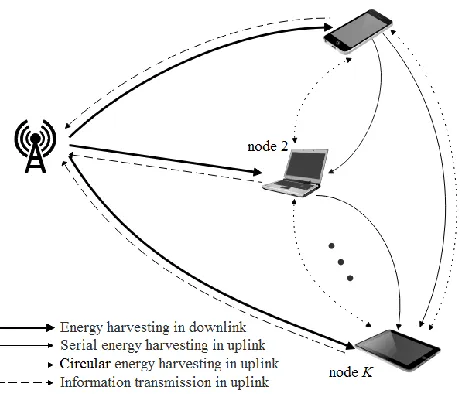
followed by node 2 for t2T seconds, until node K for tKT seconds. One has t0 t1 tK 1. WPC system model is shown in
Fig.1, and adopts two operating schemes. In the SEH scheme,
the kth node only harvests energy serially from the previous k-1 nodes when they transmit information to the H-AP. In the CEH
scheme, the kth node not only harvests energy from the
[image:4.612.320.550.110.307.2]previous k-1 nodes, but also from the (k+1)th to the Kth nodes.
Fig. 1. WPC network model
Assume that the H-AP assigns the random transmission order and initial time slots via the control channel, and the WPC system abides by the TDMA protocol [35]. This means that the nodes can transmit signals in the assigned time slot and then harvest energy or go to sleep in their idle time slots. Because each time slot just exists one user node to transmit data, other nodes can estimate their CSI between themselves and working node, respectively. Finally, H-AP achieves optimization and schedule based on nodes’ feedback information.
Let hk,i and | hk,i |2 be the channel gain and channel power from the ith node to the kth node
i k, 0, ,K i, k
, respectively. Also, since all nodes transmit data in different time slots, there is no interference. In the time slot tiT, the received signal at the kth node is then expressed as
,
,
k i k i i i i k i
y t T
h
t T x t T
z t T
(1)where xi(tiT) is the transmitted signal with
2
i i i
x t T P
,
Pi is the transmission power of the ith node , zk(tiT) is the additive white Gaussian noise with mean 0 and variance 2.
For avoiding cumbersome notation, the index (tiT) will be suppressed. Assume that the harvested energy is stored in a rechargeable battery, and that the transmitting power P0 of the
H-AP is sufficiently large such that the harvested energy from receiver noise is negligible. Thus, the energy of the kth node harvested from the ith node is
, 2
, , , 1, , ,
k i
k k i i k i k i
E Pt TD h k K (2) where 0k 1 is the conversion efficiency of the kth node, Dk,i and k i, are the distance and path loss exponent from the
ith node to the kth node, respectively. According to
2
2
log 1 ,
k k k
R B P (3)
where, Bk is the bandwidth of channel from the kth node’s to
H-AP, Pk is the average transmitting power of the kth node over the bandwidth Bk.
III. PEER HARVESTING SCHEMES
A. Serial Energy Harvesting
In SEH, the kth node only harvests energy from the
1st, 2nd, , k1 thnodes that have transmitted before it, and
then goes to sleep after its own transmission. The timing diagram of SEH for energy harvesting and information transmission is shown in Fig. 2.
The harvested energy of the kth node is thus
,
1
2
, ,
0
, 1, , ,
k i
k
k k i i k i k i i
E Pt TD h k K
[image:5.612.53.292.220.471.2]
(4)Fig. 2. The timing diagram of SHE
Using (4), the transmitting power of the kth node is
,k k k k
P E t T (5)
where k determines the portion of harvested energy used for
information transmission. Similar to [16] and [18], we assume that all the nodes exhaust the harvested energy for uplink data
transmission. Thus, the achievable throughput of the kth node
in bps/Hz can be get based on (3) and [16]
2 2
2 0,
log 1 ,
k k k k
C t t h P (6)
where t
t t0 1 tK
.B. Circular Energy Harvesting
For CEH scheme, the timing diagram of energy harvesting and information transmission is shown in Fig. 3. In CEH, the
kth node not only harvests energy from the previous k-1 nodes
that have transmitted information before it, but also harvests energy from the following K-k nodes that will transmit after it.
In other words, the kth node does not go to sleep after its own
data transmission but keeps harvesting energy from others. Therefore, its optimization and derivation are more
mathematically involved. Assume that all nodes exhaust the harvested energy for transmitting information and do not consider energy storage and power allocation for future transmission like many existing works, such as [16] and [18]. Otherwise, complicated power control over multiple frames have to be used, which is beyond the scope of this work and also increases overheads [14] [15]. From the second
transmission on, the harvested energy of the kth node is
, ,
1
P, F,
1
1 2 2
, , , ,
0 1
, 1, ,
= k i k i ,
n n k k k
n n
k K
k i i k i k i k i i k i k i
i i k
F F F k K
Q t TD h Q t TD h
(7)
where
n is the harvested energy from nodes transmittingbefore it in the nth communication, and
n1 represents the harvested energy from nodes transmitting after it in the (n-1)th transmission. Thus, each node in CEH has more energy thanthat in SEH. The transmitting power of the kth node is
,k k k k
Q
F t T (8) and the achievable throughput of the kth node is
2 2
2 0,
log 1 .
k k k k
[image:5.612.316.554.318.558.2]D t t h Q
(9)Fig. 3. The timing diagram of CEH
IV. OPTIMIZATION
A. Maximization of the Sum Achievable Throughput
For SEH, in each block, the sum achievable throughput is
1
.
K k k
C C
t t (10)
For CEH, the sum achievable throughput after the first transmission is given by
1
.
K k k
D D t
t (11)
0
P1 : max or
s.t. 1, 0.
K k k k C D t t
t t t
(12)
Lemma: Ck
t , Dk
t are concave functions of t for
1, ,
k K .
Proof:
1,0 1,0 2,0 2,12,0 1,0 2,1
2
1 1 0 0 1,0 1,0
2
1 1 1 0 1,0 1,0 0 1 1 1 0 1
2 2
2 2 0 0 2,0 2,0 1 1 2,1 2,1
2 2 2
2 2 2 0 2,0 2,0 1 1 1,0 2,1 1,0 2,1 0 2
2 2 0 2
,
,
,
,
E P t TD h
P P D h t t P f t t
E P t TD h Pt TD h
P P D h D D h h t t
P f t t
, 1 2 , , 0 0 0 2 21 0 1 1 2 0,1 1 0 1
2 2
2 0 2 2 2 0,2 2 0 2
,
.
Thus,
, log 1
, log 1
K i
K
K K i i K i K i i
K K K K K
E Pt TD h
P t t P f t t
C t t t h f t t
C t t t h f t t
2 2
0 2 0, 0
, log 1
K K K K K K
C t t t h f t t
From the above, Ck(t) is only a function of tkand t0. Because
Hessian of Ck(t) is a negative semi-definite matrix, Ck(t) is a concave function of t for any given k
1, ,K
[36]. For CEH, 1 F,
n k
F is determined by the previous communications and can
be considered as a constant for the current transmission. In this case, Dk(t) is also a function of tk and t0, and is a concave
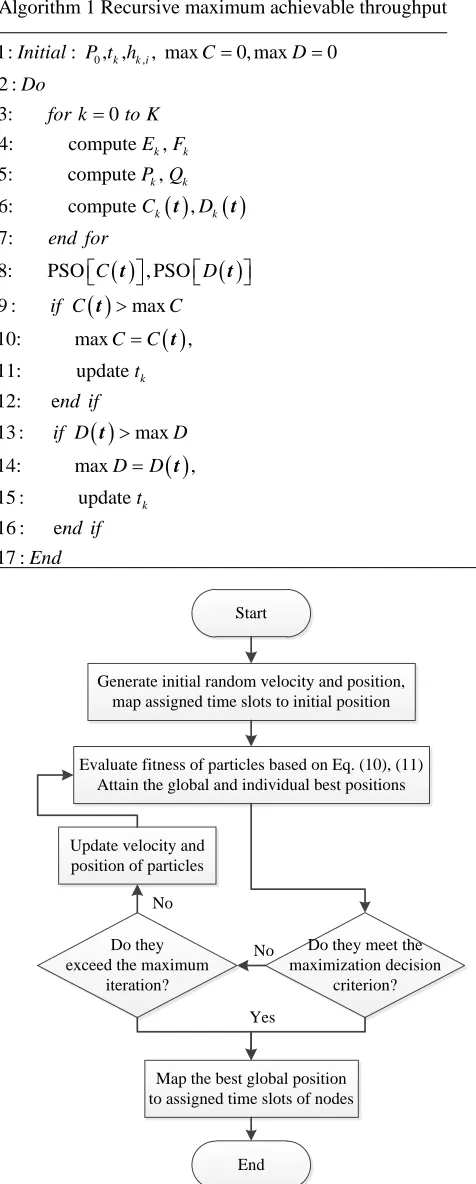
function of t. This completes the proof of Lemma. ■ From this Lemma, C(t), D(t) are concave functions of t since they are the sums of Ck(t), Dk(t), respectively. This means that (12) has an optimum solution. In addition to the convex optimization, in this work, we propose a much easier but heuristic optimization framework based on PSO, and utilize recursive method to search for the optimum solution. The proposed numerical optimization algorithm has better technical adaptability to solve more complicated objective functions, unlike convex optimizations that require extra work to simplify the objective function. The PSO[A(t)] represents the process that iteration optimization algorithm searches the optimal solution of A(t) using standard PSO method, and when the difference of the previous and current solutions is smaller than 10-3, the algorithm will stop. The proposed algorithm has the
following pseudo-code.
0 ,
Algorithm 1 Recursive maximum achievable throughput
1: : , , , max 0, max 0
2 :
3: 0
4: compute ,
5: compute ,
6: compute ,
7:
k k i
k k k k
k k
Initial P t h C D
Do
for k to K
E F P Q C D t t
8: PSO , PSO
9 : max
10: max ,
11: update
12: e
13 : max
14: max ,
15 : update
16 : e
17 :
k
k
end for
C D
if C C
C C
t
nd if
if D D
D D t nd if End t t t t t t Start
Generate initial random velocity and position, map assigned time slots to initial position
Evaluate fitness of particles based on Eq. (10), (11) Attain the global and individual best positions
Do they meet the maximization decision
criterion? Do they
exceed the maximum iteration? Update velocity and position of particles
Map the best global position to assigned time slots of nodes
End No
No
Yes
Fig. 4. Basic procedure for maximization of the sum achievable throughput based on PSO
[image:6.612.49.305.48.417.2] [image:6.612.316.554.61.653.2]positions represent the initial time slots t which abide by uniform distribution between 0 and 1. Learning factors are 2.8 and 1.3, respectively. After initialization of velocity and position, fitness function is calculated and evaluated based on Eq. (10), (11). Then, requisite parameters are computed based on updating formulas. At last, the optimal solution is found through continuous iteration. Jointly Algorithm 1 and Fig. 4, the proposed optimization framework can avoid complicated mathematical calculations based on recursive computation and attain the optimal solution in a probabilistic manner with limited steps. Compared with convex optimization, the merit of heuristic optimization is that its computational cost is mainly used for solving the fitness function.
B. Minimization of the Required Harvested Energy
For applications with miniaturization of batteries, another optimization can be performed to minimize the required consumed energy. In this case, the nodes will harvest minimum energy to maintain operations. As mentioned above, the complicated power control and energy management produced by accumulated energy are not considered, as this is beyond the scope of the paper and also makes WPC too complicated for simple applications that the EH aims for.
For the network model of [16], where all nodes only harvest energy from H-AP, the required consumed energy of the kth node can be expressed as following equation according to (3)
/ 2 2 0,2 1
,
k k
I t T
k k
k
G t T
h
t (13)
where t
t t0 1 tK
, Ik is the kth user’s targeted information of unit bandwidth, and (13) considers the influence of uplink channel power.Because the harvested energy of kth node is
,0 2
0 0 ,0 ,0 , 1, , .
k
k k k k
E
P t TD h k K (14)The required harvested energy of the kth node can be
normalized as
,0
/
2
,0 2 2
,0 0, ,0
2 1
,
k k k
I t T
k k
k k k k
G t T
D h h
t (15)
where (15) shows the required harvested energy from H-AP. Based on (4), in SHE, the required harvested energy of the
kth node comes from both the H-AP and the previous
transmitting nodes as
, ,0 1 2 / 2 2,0 0, ,
1
2 2 / 2
, 0, ,0 ,0
2 1
2 1 .
k i k k
k i i
k I t T
k k k k k i
i I t T
k i i i k k
E t T h D
h h t T D h
t (16)Similarly, the required harvested energy in CEH is the same as (16) in the first communication based on (7). From the second communication, it is
, ,0 1 2 / 2 2,0 0, ,
1
2 2 / 1 2
, 0, F, ,0 ,0
2 1
2 1 .
k i k k
k i i
k I t T
k k k k k i
i I t T n
k i i i k k k
F t T h D
h h t T F D h
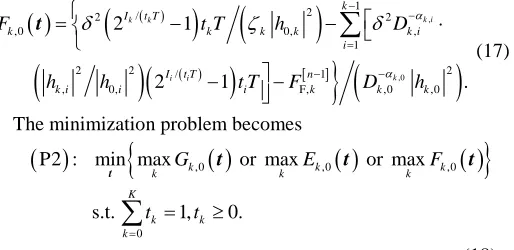
t (17)The minimization problem becomes
,0
,0
,0
0
P2 : min max or max or max
s.t. 1, 0.
k k k
k k k
K
k k k
G E F
t t
t t t t
(18) This optimization problem P2 aims to minimize the maximum required harvested energy. As the second-order derivative of (15) with respect to tkexists, it is a strict convex function and has an optimal solution. However, the Hessian of (16) and (17) are indefinite matrices, and their object functions are complicated. In order to facilitate comparison of three models, the numerical solutions of (18) can also be searched by using the proposed heuristic optimization framework.
The proposed algorithm has the following pseudo-code in
Algorithm 2, the required harvested energy
,0 , ,0 , ,0
k k k
G t E t F t can be computed recursively by
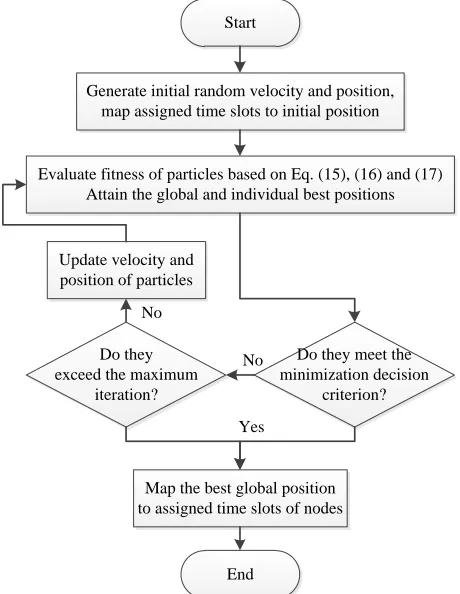
general expressions (15), (16) and (17). The optimization PSO-based complies with the following flowchart Fig. 5.
,
,0 ,0 ,0
,0 ,0 ,0
Algorithm 2 Recursive minimum required harvested enerngy
1: : , ,
2 :
3: 0
4: compute , ,
5:
6 : min = , min , min
7:
k k k i
k k k
k k k
Initial I t h Do
for k to K
G E F
end for
G G E E F F
t t t
t t t
,0 ,0 ,0
,0 ,0
,0
,0
PSO , PSO , PSO
8 : min
9: min ,
10: update 11: e
12 : min
13: min ,
14 : update 15 :
k k k
k k k k k k
G E F
if G G
G G
t nd if
if E E
E E t
t t t
t t t t
,0 ,0 e16 : min
17: min ,
18 : update 19 : e
20 :
k
k k
nd if
if F F
F F t nd if End t t
[image:7.612.317.574.53.178.2]optimization algorithm PSO-based to search the required minimum harvested energy (corresponding to Step 7-19 of Algorithm 2). According to Fig. 5, we can know that its implementation and parameters are similar to Fig. 4, and its process can also avoid complicated mathematical calculations and attain the optimal solution in a probabilistic manner with limited steps. To save space, the details are not repeated here. But by comparing the two algorithms and their flowcharts respectively, we can find that the proposed heuristic optimization algorithms, which consist of recursive algorithm and particle swarm optimization, don’t need to make too many changes and have good technical adaptability and flexibility to solve the proposed schemes.
Start
Generate initial random velocity and position, map assigned time slots to initial position
Evaluate fitness of particles based on Eq. (15), (16) and (17) Attain the global and individual best positions
Do they meet the minimization decision
criterion? Do they
exceed the maximum iteration? Update velocity and position of particles
Map the best global position to assigned time slots of nodes
End No
No
[image:8.612.61.291.215.512.2]Yes
Fig. 5. Basic procedure for minimization of the required harvested energy based on PSO
C. Schedule
The random transmission order mentioned in Section II, which is assigned by H-AP, simulates a time access priority communication network actually, i. e., “first-come, first-serve” basis. If these user nodes work with a scheduling order based on channel statement information (CSI), it should make some gains. However, for the proposed two schemes, their targets are complicated functions of CSI, which are between H-AP and nodes, and between nodes to nodes. We can’t get straightforward scheduling orders of nodes in terms of the channel gain. Even though assume the channel of network is reciprocity, there are still three kinds of orders, which are downlink, uplink and energy harvesting link among the nodes, coexisting in the network. They are complex coupling problems and not suitable to a WPC network which is normally for
simple applications. Thus, we schedule work order by considering channel gain of uplink only, which has the most direct influence on optimization objectives. That is, ascending order schedule and descending order schedule are considered based on uplink channel gain. The problems P1 and P2 also become as follows
0 2 , 0P3 : max or
s.t. 1, 0 sort , 1, 2, , ,
K
k k i
k
C D
t t h i K
t
t t
; (19)
,0 ,0 ,0
0 0
2 ,
P4 : min max or max or max
s.t. 1, 0 sort , 1, 2, ,
k k k
k k k
K
k k
i
k h
G E F
t t i K
t t t t
; ,
(20)
where sort
denotes to get the ascending or descending order of uplink channel power, respectively. Their solutions can be still solved using the proposed algorithms without too much change, and the H-AP only allocates transmission order according to the ranking results of channel power but not random access.D. Fairness
In order to offer fair access for SEH, we propose a schedule by extending time dimension to meet the fairness requirement of each node. Fig. 6 is the diagram of schedule, the ‘dot arrow’ denotes a connector because of limited line-width space. For example, the time orders of fair access will be {1, 2, 3; 1, 3, 2; 2, 1, 3; 2, 3, 1; 3, 1, 2; 3, 2, 1} for 3 nodes. That is, in this network, every access nodes have to obey a protocol that exchange their time extension for reducing computational complexity, and there are K factorial time extensions for K nodes in this schedule. Luckily, there should be not too many nodes generally, so that it will not need too many time extensions in such a WPC network. Of cause, if some nodes can’t perform the protocol, they will not be allowed to access the network. Alternatively, these nodes which regard time as the important resource can choose CEH scheme to get fair harvesting energy. Compared with the proposed fair access schedule of SEH, the nodes can transfer information and harvest energy at all the time slots in CEH scheme to make sure fair chance.
1 2 … K
3
1
1 … K
…
K …
K
K-1 1
2
K K-1 … 1
…
[image:8.612.315.562.562.680.2]… …
Fig. 6. The fairness-based scheduling diagram
V. NUMERICAL RESULTS AND DISCUSSION
harvest-then-transmit and TDMA protocol. The transmitting power at the H-AP is 23dBm. The noise power is -70dBm. The conversion efficiency of all nodes is 0.6. The number of particles is 50, initial velocities and positions are uniform distribution between 0 to 0.1 and 0 to 1, respectively, and learning factors c1 =2.8, c2 = 1.3. Simulation environment is
Windows 7 (32-bit), Matlab R2012b, Intel(R) Core(TM) i3 CPU [email protected], RAM 2 GB.
Fig. 7 presents the achievable throughput of each node in three modes, SEH, CEH and OEH, where OEH represents the result in [10]. In this experiment, the time slots of AP and three nodes are fixed as t0, t1, t2, t3=0.7, 0.1, 0.1, 0.1 without
optimization. One sees that the achievable throughput of each node is close to 2 bps/Hz in OEH. In SEH, node 1 is about 2 bps/Hz, node 2 is about 2.065 bps/Hz and node 3 is about 2.117 bps/Hz. In CEH, node 1 is about 2.117 bps/Hz, node 2 is about 2.125 bps/Hz and node 3 is about 2.130 bps/Hz. The first node in SEH has the same performance as that in OEH, because it does not have any extra harvested energy. However, node 2 and node 3 have more harvested energy. For CEH, the three nodes have about 6% gain over OEH. Also, practical systems have bandwidths on the order of kHz or MHz, which could magnify the throughput gain. Thus, the gain is considerable.
Fig. 7. The achievable throughput of nodes in different blocks with
,0 10m, , 2m, ,0 4, , 2
k k i k k i
D D .
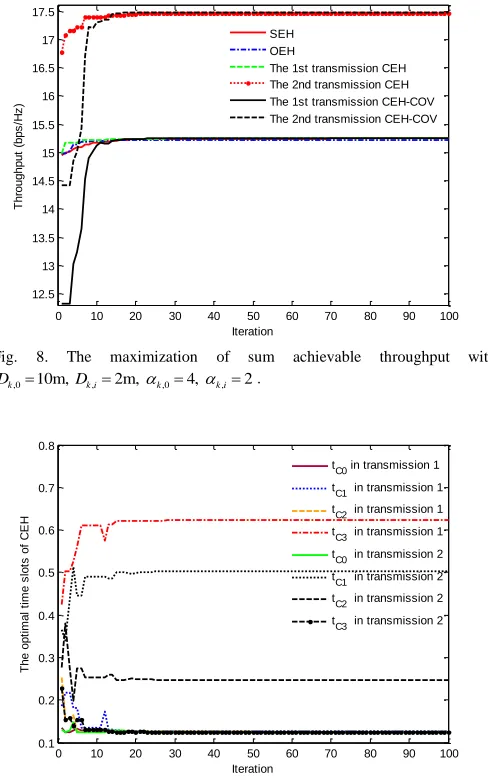
The optimized sum achievable throughput is shown in Fig. 8. CEH-COV denotes the result from convex optimization instead of Algorithm 1. In the first transmission, the maximum sum achievable throughput of SEH, OEH, and CEH are 15.2468 bps/Hz, 15.2196 bps/Hz, 15.2471 bps/Hz using the proposed algorithms, respectively. One sees that the optimal throughputs of the SEH and CEH are almost the same, both of which are larger than OEH. In the second transmission, the maximum sum achievable throughput of CEH is 17.4662 bps/Hz. Thus, it is about 10% better than OEH in [10], and the performance gain is more significant with larger bandwidth. Also, Algorithm 1 and convex optimization algorithm give almost identical maximum throughput for CEH in the first transmission. However, in the second transmission, it is 0.1% worse than convex optimization algorithm. Fortunately, the gap of
throughput is small and their convergence are almost the same so that it can meet the actual requirements.
Fig. 8. The maximization of sum achievable throughput with
,0 10m, , 2m, ,0 4, , 2
k k i k k i
D D .
Fig. 9. The optimal time slots of CEH for sum achievable throughput with
,0 10m, , 2m, ,0 4, , 2
k k i k k i
D D .
Fig. 10. The minimization of required harvested energy with
,0 , ,0 ,
1.35b / Hz, k 10m, k i 5m, k 4, k i 3.5
I D D .
1 1.5 2 2.5 3 3.5 4 4.5 5
1.98 2 2.02 2.04 2.06 2.08 2.1 2.12 2.14 2.16
The number of the time slot
T
h
ro
u
g
h
p
u
t
(b
p
s
/H
z
) node 1-SEH
node 2-SEH node 3-SEH
node 1-OEH node 2-OEH node 3-OEH node 1-CEH node 2-CEH node 3-CEH
0 10 20 30 40 50 60 70 80 90 100
12.5 13 13.5 14 14.5 15 15.5 16 16.5 17 17.5
Iteration
Th
ro
u
g
h
p
u
t
(b
p
s
/H
z
)
SEH OEH
The 1st transmission CEH The 2nd transmission CEH The 1st transmission CEH-COV The 2nd transmission CEH-COV
0 10 20 30 40 50 60 70 80 90 100
0.1 0.2 0.3 0.4 0.5 0.6 0.7 0.8
Iteration
Th
e
o
p
ti
m
a
l
ti
m
e
s
lo
ts
o
f
C
E
H
tC0 in transmission 1
tC1 in transmission 1 tC2 in transmission 1
tC3 in transmission 1
tC0 in transmission 2 tC1 in transmission 2
tC2 in transmission 2 tC3 in transmission 2
0 10 20 30 40 50 60 70 80 90 100
1.4 1.6 1.8 2 2.2 2.4 2.6 2.8
3x 10 -7
Iteration
E
n
e
rg
y
(
J
)
SEH OEH
[image:9.612.317.561.91.482.2] [image:9.612.57.280.344.517.2] [image:9.612.320.563.523.712.2]Fig. 9 presents the optimal time slots of CEH for sum
achievable throughput in different transmissions. Let tCk
denotes the time slot of the kth node in CEH. In the first transmission, tC3 of node 3 is the largest time slot, and other
nodes’ time slots are similar. It implies that the node 3 should be assigned more time to achieve better performance. This is particularly true as node 3 can harvest more energy in the first transmission. In the second transmission, node 1 has the largest time slot, node 2 has a smaller time slot, and the H-AP and node 3 have similar time slots. From the second transmission on, the optimal time slots are primarily determined by the path loss and the channel gain, because all nodes experience similar energy harvesting and accumulating processes.
Fig. 10 shows the minimization of required harvested energy based on the proposed algorithms. In the first transmission, the minimum required harvested energies of SEH and CEH are
both 7
1.5087 10 J , and the minimum required harvested
energy of OEH is 1.646010-7J. From the second transmission
of CEH, its minimum required harvested energy becomes 1.475910-7J, less than that for the first transmission. Thus,
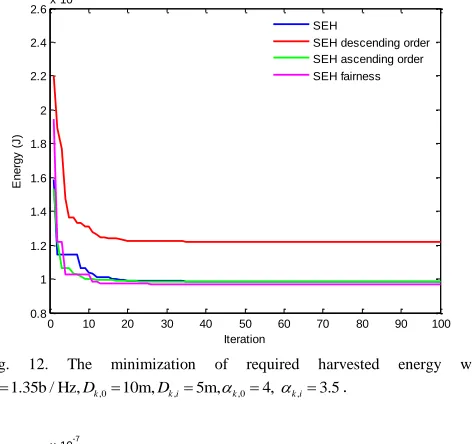
CEH could be 10% better than OEH in this case as well. In following simulations, we evaluate the impact of scheduling order and the fair time slots allocation to SEH, respectively. In two experiments, their CSI are same. Fig. 11 presents sum achievable throughput, and Fig. 12 shows required harvested energy. It can be observed that the maximum sum achievable throughput is achieved by descending schedule in Fig. 11, and the minimum required harvested energy is attained by the schedule fairness-based in Fig. 12. Their performance trends are not uniform in two figures, but are bigger sum achievable throughput corresponding to smaller required harvested energy, and vice versa. Compare with original SHE scheme, schedule sort-based can’t always realize better performance with arbitrary CSI. Similarly, the schedule fairness-based can achieve -1% and 2% gains in Figs. 11 and 12, respectively.
Fig. 11. The maximization of sum achievable throughput with
,0 10m, , 2m, ,0 4, , 2
k k i k k i
D D .
Fig. 12. The minimization of required harvested energy with
,0 , ,0 ,
1.35b / Hz, k 10m, k i 5m, k 4, k i 3.5
[image:10.612.321.557.60.282.2]I D D .
[image:10.612.324.549.278.455.2]Fig. 13. The minimum required harvested energy of SEH with different number of particles with I1.35b / Hz,Dk,010m,Dk i, 5m,k,04,k i, 3.5.
TABLE I
The cost of primary programs of PSO with 20 and 50 particles Function
Name Calls
Total Time (S)
Self Time
(S)3 Particles
Main Program 1 3.4391 0.449
50 Update
Particles 5000 1.708 0.865 Compute
Fitness 5000 0.843 0.330 Recursive
Process 2801 0.513 0.513 Main Program 1 1.9242 0.454
20 Update
Particles 2000 0.657 0.267 Compute
Fitness 2000 0.390 0.108 Recursive
Process 1238 0.282 0.282
The minimum required harvested energy of SEH with different numbers of particles are shown in Fig. 13. The numbers of particles are from 10 to 50. One can see that the
0 10 20 30 40 50 60 70 80 90 100
16.4 16.6 16.8 17 17.2 17.4 17.6
Iteration
Th
ro
u
g
h
p
u
t
(b
p
s
/H
z
)
SEH
SEH descending order SEH ascending order SEH fairness
0 10 20 30 40 50 60 70 80 90 100
0.8 1 1.2 1.4 1.6 1.8 2 2.2 2.4 2.6x 10
-8
Iteration
E
n
e
rg
y
(
J
)
SEH
SEH descending order SEH ascending order SEH fairness
0 10 20 30 40 50 60 70 80 90 100
1 1.5 2 2.5 3 3.5
4x 10 -7
Iteration
E
n
e
rg
y
(
J
)
[image:10.612.52.294.507.706.2] [image:10.612.314.566.512.685.2]performance is improved with particles numbers increasing. However, the improvement is minor when the number is close to 50. In other words, while the number of particle increases continuously, the performance of the proposed algorithms is not improved obviously, but the computational complexities are growing.
Table I shows the cost of primary programs of the proposed heuristic recursive optimization algorithm using PSO with 20 and 50 particles. The larger number of particles leads to more costs, although it achieves better performance in Fig. 13. Therefore, a just right particle number is more favorable for the proposed numerical optimization algorithm PSO-based. In Table I, 1, 2 The total time of main program includes other
processing time, such as storage data, plotting figures and file configuration et al. 3 Self time is the time spent in a function
excluding the time spent in its child functions. Self time also includes overhead resulting from the process of profiling.
VI. CONCLUSIONS AND FUTURE WORKS
This paper has proposed two energy harvesting schemes to optimize sum achievable throughput and required harvested energy. Both of them are presented numerical optimization solutions based on heuristic algorithms. To achieve the maximum sum achievable throughput, CEH is better than SEH, but CEH is more computationally complicated. Also, to achieve minimum required harvested energy, SEH and CEH have similar performances. Simulation results have shown the considerable performance gain of the new schemes.
For WPC system, there are still many challenges to be tackled. For example, power control may be used to improve its performance further, the tradeoff between optimal transmission order and implementation complexity should be investigated, although they are complicated coupling problems, and how can user-centric fairness be guaranteed is also an important target for future works.
REFERENCES
[1] N. Shinohara, “Power without wires,” IEEE Microwave Magazine, vol. 12, no. 7, pp. S64–S73, Dec. 2011.
[2] N. Shinohara, Wireless Power Transfer via Radiowaves. NewYork, NY, USA: Wiley, 2014.
[3] L. R. Varshney, “Transporting information and energy simultaneously,” in Proc. IEEE International Symposium on Information Theory, Toronto, ON, Jul. 6-11, 2008, pp. 1612-1616. [4] P. Grover and A. Sahai, “Shannon meets Tesla: Wireless information
and power transfer,” in Proc. IEEE International Symposium on Information Theory, Austin, TX, Jun. 13-18, 2010, pp. 2363-2367. [5] O. Ozel, K. Tutuncuoglu, J. Yang, S. Ulukus, and A. Yener,
“Transmission with energy harvesting nodes in fading wireless channels: Optimal policies,” IEEE Journal on Selected Areas in Communications, vol. 29, no. 8, pp. 1732–1743, Sep. 2011.
[6] C. K. Ho and R. Zhang, “Optimal energy allocation for wireless communications with energy harvesting constraints,” IEEE Transactions on Signal Processing, vol. 60, no. 9, pp. 4808–4818, Sep. 2012. [7] R. Zhang and C. K. Ho, “MIMO broadcasting for simultaneous wireless
information and power transfer,” IEEE Transactions on Wireless Communications, vol. 12, no. 5, pp. 1989-2001, May 2013.
[8] K. Huang, E. Larsson, “Simultaneous Information and Power Transfer for Broadband Wireless Systems,” IEEE Transactions on Signal Processing, vol. 61, no. 23, pp. 5972 - 5986, Dec. 2013.
[9] C. Zhong, G. Zheng, Z. Zhang, and G. K. Karagiannidis, “Optimum wirelessly powered relaying”, IEEE Signal Processing Letters, vol. 22, no. 10, pp. 1728-1732, Oct. 2015.
[10] Y. Chen, “Energy-harvesting AF relaying in the presence of interference and Nakagami-m Fading”, IEEE Transactions on Wireless Communications, vol. 15, no. 2, pp. 1008-1017, Feb. 2016.
[11] G. Huang, D. Tang, “Wireless Information and Power Transfer in Two-Way OFDM Amplify-and-Forward Relay Networks”, IEEE Communications Letters, vol. 20, no. 8, pp. 1563-1566, Aug. 2016. [12] A. A. Nasir, D. T. Ngo, X. Zhou, R. A. Kennedy, and S. Durrani, “Joint
Resource Optimization for Multicell Networks With Wireless Energy Harvesting Relays”, IEEE Transactions on Vehicular Technology, vol. 65, no. 8, pp. 6168-6183, Aug. 2016.
[13] Y. Huang, B. Clerckx, “Relaying Strategies for Wireless-Powered MIMO Relay Networks”, IEEE Transactions on Wireless Communications, vol. 15, no. 9, pp. 6033-6047, Sep. 2016.
[14] K.Tutuncuoglu and A.Yener, ‘Optimum Transmission Policies for Battery Limited Energy Harvesting Nodes’, IEEE Transactions on wireless communications, vol. 11, no. 3, pp.1180-1189, Mar. 2012. [15] J.Yang and S.Ulukus, ‘Optimal Packet Scheduling in an Energy
Harvesting Communication System’, IEEE Transactions on communications, vol. 60, no. 1, pp. 220-230, Jan. 2012.
[16] H. Ju and R. Zhang, “Throughput maximization in wireless powered communication networks,” IEEE Transactions on Wireless Communications, vol. 13, no. 1, pp. 418-428, Jan. 2014.
[17] X. Kang, C. K. Ho, and S. Sun, “Full-duplex wireless-powered communication network with energy causality,” IEEE Transactions on Wireless Communications, vol. 14, no. 10, pp. 5539-5551, Oct. 2015. [18] H. Chen, Y. Li, J. L. Rebelatto, B.F. Uchoa-Filho and B. Vucetic,
“Harvest-Then-Cooperate: Wireless-Powered Cooperative Communications,” IEEE Transactions on Signal Processing, vol. 63, no. 7, pp. 1700-1711, Apr. 2015.
[19] Y. L. Che, L. Duan, and R. Zhang, “Spatial throughput maximization of wireless powered communication networks,” IEEE Journal on Selected Areas in Communications, vol. 33, no. 8, pp.1534-1548, Aug. 2015. [20] Q. Sun, G. Zhu, C. Shen, X. Li, and Z. Zhong, “Joint beamforming design
and time allocation for wireless powered communication networks”, IEEE Communications Letters, vol. 18, no. 10, pp. 1783-1786, Oct. 2014. [21] Y. L. Che, J. Xu, L. Duan, and R. Zhang, “Multi-antenna wireless powered communication with co-channel energy and information transfer,” IEEE Communications Letters, vol. 19, no. 2, pp. 2266-2269, Dec. 2015.
[22] C. Zhong, X. Chen, Z. Zhang, and G. Karagiannids, “Wireless powered communications: performance analysis and optimization,” IEEE Transactions on Communications, vol. 63, no. 12, pp. 5178-5190, Dec. 2015.
[23] N. Zhao, F. R. Yu, and V. C. M. Leung, “Wireless energy harvesting in interference alignment networks”, IEEE Communications Magazine, vol. 53, no.6, pp. 72-78, Jun. 2015.
[24] N. Zhao, F. R. Yu, V. C.M. Leung, “Opportunistic Communications in Interference Alignment Networks with Wireless Power Transfer”, IEEE Wireless Communications, vol. 22, no. 1, pp. 88-95, Feb. 2015. [25] L. Zhao, X. Wang, “Round-Trip Energy Efficiency of Wireless Energy
Powered Massive MIMO System with Latency Constraint”, IEEE Communications Letters, DOI: 10.1109/LCOMM.2016.2616858. [26] Q. Wu, W. Chen, D. W. K. Ng, J. Li, and R. Schober, “User-Centric
Energy Efficiency Maximization for Wireless Powered Communications”, IEEE Transactions on Wireless Communications, vol. 15, no. 10, pp. 6898-6912, Oct. 2016.
[27] H. Gao, T. Lv, W. Wang, N. C. Beaulieu, “Energy-Efficient and Secure Beamforming for Self-Sustainable Relay-Aided Multicast Networks”, IEEE Signal Processing Letters, vol. 23, no. 11, pp. 1509-1513, Nov. 2016.
[28] X. Jiang, C. Zhong, X. Chen, T. Duong, T. Tsiftsis, and Z. Zhang, “Secrecy performance of wirelessly powered wiretap channels,” IEEE Transactions on Communications, vol. 64, no. 9, pp. 3858--3871, Sep. 2016.
[29] Q. Li, Q. Zhang, J. Qin, “Secure Relay Beamforming for SWIPT in Amplify-and-Forward Two-Way Relay Networks”, IEEE Transactions on Vehicular Technology, vol. 65, no. 11, pp. 9006-9019, Nov. 2016. [30] Z. Zhu, Z. Chu, Z. Wang, and I. Lee, “Outage Constrained Robust
[31] L. Tang, Q. Li, “Wireless Power Transfer and Cooperative Jamming for Secrecy Throughput Maximization”, IEEE Wireless Communications Letters, vol. 5, no. 5, pp. 556-559, Oct. 2016.
[32] J. Kennedy, R. Eberhart, “Particle swarm optimization,” IEEE International Conference on Neural Networks, 1995. Proceedings, Perth, WA, Nov. 27 -Dec. 01, 1995, vol.4, pp. 1942-1948.
[33] M. Clerc, J. Kennedy, “The particle swarm-explosion, stability, and convergence in a multidimensional complex space,” IEEE Transactions on Evolutionary Computation, vol. 6 , no. 1, pp. 58-73, Feb. 2002.
[34] K. E. Parsopoulos, M. N. Vrahatis, “On the computation of all global minimizers through particle swarm optimization, ” IEEE Transactions on Evolutionary Computation, vol. 8, no. 3, pp. 211-224, Jun. 2004. [35] E. Gholami, A. M. Rahmani, and M. D. T. Fooladi, “Adaptive and
Distributed TDMA Scheduling Protocol for Wireless Sensor Networks,” Wireless Personal Communications, vol. 80, no. 3, pp. 947-969, 2015. [36] S. Boyd and L. Vandenberghe, Convex Optimization. Cambridge