warwick.ac.uk/lib-publications
Original citation:
Wojcik, Jacek D. and Wang , Jihong. (2017) Technical feasibility study of thermal energy
storage integration into the conventional power plant cycle. Energies.
Permanent WRAP URL:
http://wrap.warwick.ac.uk/85871
Copyright and reuse:
The Warwick Research Archive Portal (WRAP) makes this work of researchers of the
University of Warwick available open access under the following conditions.
This article is made available under the Creative Commons Attribution 4.0 International
license (CC BY 4.0) and may be reused according to the conditions of the license. For more
details see:
http://creativecommons.org/licenses/by/4.0/
A note on versions:
The version presented in WRAP is the published version, or, version of record, and may be
cited as it appears here.
Energies 2017, 10, x; doi: www.mdpi.com/journal/energies
Article
Technical Feasibility Study of Thermal Energy
Storage Integration into the Conventional Power
Plant Cycle
Jacek D. Wojcik * and Jihong Wang
School of Engineering, University of Warwick, Coventry CV4 7AL, UK; [email protected]
* Correspondence: [email protected]; Tel.: +44-2476-528142
Academic Editor: Bahman Shabani
Received: 7 December 2016; Accepted: 1 February 2017; Published: 2017
Abstract: The current load balance in the grid is managed mainly through peaking fossil-fuelled
power plants that respond passively to the load changes. Intermittency, which comes from renewable energy sources, imposes additional requirements for even more flexible and faster responses from conventional power plants. A major challenge is to keep conventional generation running closest to the design condition with higher load factors and to avoid switching off periods if possible. Thermal energy storage (TES) integration into the power plant process cycle is considered as a possible solution for this issue. In this article, a technical feasibility study of TES integration into a 375-MW subcritical oil-fired conventional power plant is presented. Retrofitting is considered in order to avoid major changes in the power plant process cycle. The concept is tested based on the complete power plant model implemented in the ProTRAX software environment. Steam and water parameters are assessed for different TES integration scenarios as a function of the plant load level. The best candidate points for heat extraction in the TES charging and discharging processes are evaluated. The results demonstrate that the integration of TES with power plant cycle is feasible and provide a provisional guidance for the design of the TES system that will result in the minimal influence on the power plant cycle.
Keywords: thermal energy storage (TES); flexible operation; power plant; efficiency; steam cycle
1. Introduction
To achieve significant CO2 emission reduction, energy networks will face great challenges in managing large-scale deployment of intermittent renewable generation, increased load from electrification of transportation and space heating. The amount of electricity generated must be constantly equal to the load demand, and the entire process must be well controlled and managed. Constant load balance is managed mainly through fossil-fuelled peaking power plants that respond passively to the load changes. Any imbalance beyond critical boundary conditions may lead to unstable operation and possible blackouts. To achieve significant CO2 emission reduction, energy networks are facing great challenges in managing large-scale deployment of intermittent power generation from renewable sources [1,2]. Additionally, the total power generation capacity must meet the highest peak load demand, although the average load demand is much lower. That leads to excessive infrastructure investment, and consequently many power plants have to work at low load factors with low generation efficiencies [3,4]. Operating profiles of conventional power plants also significantly changed due to the increasing share of intermittent renewable generation [5]. Former base load power plants have to follow rigorous dispatching scenarios, including fast ramp rates, possible low load levels and cycling operations involving overnight shutdowns [6–8].
to explore the strategy and technologies for achieving flexible and efficient thermal power plant operation. It is anticipated that the increased unit flexibility might be achieved by Thermal Energy Storage (TES) integration into the power plant process cycle [9]. Excess thermal energy generated during low electrical load demand can be stored and reused during high load demand periods of time, when the electricity price is high [10]. TES should also help to avoid overnight shutdowns by reducing minimum allowable load level operation. The heat energy released from storage during the discharging process can boost the power plant output and provide valuable overload capacity for frequency response. The TES energy buffer should also smooth power plant operation, increasing the lifetime of power plant components [7].
Energy storage technologies as a key solution for the future secure power system operation have become a hot topic in recent years. Several review articles assessing the current state of the art technologies confirming high interest in this area have been published [11,12]. TES conceptual design has been already investigated in nuclear [13], coal-fired power plants [14], industrial waste heat recovery systems [15] and also hybrid solutions [16]. Whereas most of the solutions are conceptual only, currently, the most mature TES technology is applied to concentrated solar power (CSP) plants [17–19], with well-known phase change material properties [20]. In this article, TES integration into a conventional thermal plant is investigated in depth.
TES integration into a conventional coal-fired power plant has been already investigated by Pacific Northwest Laboratory (Richland, Washington, USA) in 1990 [21,22]. This conceptual design and the cost estimations of TES integration revealed substantial improvement in the economic attractiveness of meeting peak and intermediate loads. A sensible heat storage concept with two storage tanks filled with nitrate salt (60% sodium, 40% potassium) has been selected. The generation of thermal energy and its conversion to electricity have been temporarily decoupled by the TES system, which requires substantial changes in the process cycle. The evaluation indicates that TES integration produces 5%–20% lower cost power than the conventional cycling plant, and this solution is also feasible for advanced coal combustion technologies, such as integrated gasification combined cycle (IGCC) [23,24].
Another simulation work has been conducted by Vandersickel et al. [25]. A latent heat energy storage integration concept in a coal-fired power plant has been assessed for a commercially available heat transfer medium, like nitrates solar salt (NaNO3-KNO3), HITEC molten salt (NaNO3-NaNO2-KNO3) and others. Several different charging and discharging scenarios have been assessed, indicating high (over 60%) coal-to-coal efficiency. This feasibility study has been verified using the power plant model implemented in the EBSILON Professional software package (STEAG Energy Services GmbH, Essen, Germany; www.steag-energyservices.com) for the design and 40% load level condition. The concept also requires substantial investment costs, as higher feedwater pressure is required, and feedwater pumps have to be replaced.
There is also noticeable interest in TES integration in the industry. Peak Power Integrated Solution concept presented by Alstom Thermal Services (Alstom Power GmbH, Germany) is one example, where a sensible TES system is linked to a low pressure preheating train in the conventional power plant process cycle [26,27]. Feedwater, as a storage medium, is preheated in parallel to the process loop during low load demand. The main advantage of this system is that the preheated feedwater can be discharged almost instantaneously allowing one to increase power plant ramp rates. The system also offers a 5%–10% overload capacity and a 5%–15% reduction of the minimum load. The disadvantages of this solution come from the low energy density and variable discharging temperature characterising all sensible TES systems.
All previously-presented solutions indicate high potential for successful TES system integration in the conventional power plant cycle. This task is complex and requires careful parameter assessment, especially for off-design conditions. The proposed solutions very often require substantial changes to the power plant process loop and hardware upgrades. An initial assessment has been also performed for a limited number of off-design conditions.
the plant process steam/water parameters within the entire plants’ operational load level range, not only for just one/two off-design operational points previously reported. The feasibility study performed in this paper helps to find the most suitable locations for TES system integration for both the TES charging and discharging process. As many of the currently-operating conventional power plants might be equipped with a TES system, retrofitting is considered to avoid unnecessary redesign and additional costs. The proposed solution aims to bring the minimal influence to the power plant process loop without major changes in existing components and their alignment (hardware). Although no particular TES material is investigated, the result provides guidance for thermal engineers to exploit the full potential of TES integration, find suitable thermal materials and design TES systems: heat exchangers (HX), storage tanks, etc. The paper explores and presents a new route to avoid excessive investments in new peaking fossil fuel power plants that have very low load factors and to allow the power plants to operate closer to their rated power. Finally, the solution leads to a possible route of improving power generation efficiency, while it operates flexibly to response load changes.
In the first section of this paper, a subcritical power plant model is described, and the model performance is presented without the TES system. Then, the feasible integration strategies analysis is presented for the TES system charging and discharging processes. The simulation results from both processes are presented, which reveal the plant performance, boundary conditions and efficiency in the function of the plant load level. The best candidate location points for the integration of both processes are assessed. Furthermore, the steam/water parameters are given as a function of plant load level, which could help find the most suitable TES design and thermal material properties to get the highest possible efficiency of the system.
2. Power Plant Modelling and Simulation Platform
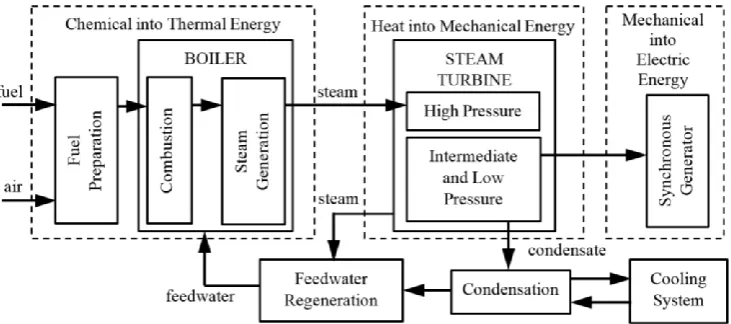
[image:4.595.115.481.497.659.2]As it is almost impossible to implement any kind of heat extraction experiments without concrete pre-studies in a real power plant, mathematical modelling and simulation of the plant process cycle can be considered as the first step towards the real implementation. The mathematical model was developed for describing the major process of the transformation of the fuel chemical energy into thermal energy (heat), then thermal energy into mechanical (rotational) energy and, finally, electric energy [28–30]. The structure of the system model realisation is illustrated in Figure 1.
Figure 1. Power plant process flowchart.
www.simulationrsi.com), EBSILON Professional, gProms (Process Systems Enterprise Limited, London, UK; www.psenterprise.com), MATLAB/Simulink (MathWorks, Natick, MA, USA; www.mathworks.com), MMS (nHance Technologies Inc., Lynchburg, VA, USA;
www.nhancetech.com), SIMODIS (SImulation MODeling Integrated System,
www.ieav.cta.br/efa/lev/projeto/simodis), PowerSim (Seoul, Korea) and ProTRAX (TRAX LLC Energy Solutions, Lynchburg, VA, USA; energy.traxintl.com). These packages have different functionality using pre-developed component libraries for modelling of coal, gas or combined cycle gas turbine (CCGT) units.
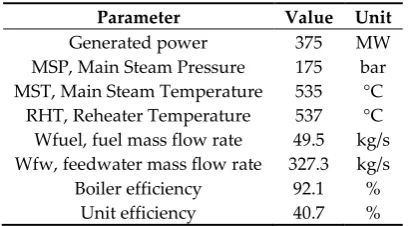
[image:5.595.196.401.468.581.2]The ProTRAX Simulation System has been chosen as a simulation platform for power plant modelling work. This software package is a powerful tool allowing engineers who are already familiar with the equipment and the entire power plant process to effectively develop high fidelity models for both process and control system analysis. It is a modular structuring software at the component level, and an extensive library incorporated in the program allows one to interconnect modules into any physically-realistic configurations. Mathematical models of modules are based on first principles conservation relations, the second law of thermodynamics and relations for heat transfer and fluid mechanics. Mathematical equations describing the model behaviour are not represented generically by any comprehensive subroutine. For example, the most complex aspect of heat transfer modelling is based on a module-by-module basis, and the equations are tailored to the effect known to occur in an individual component. Therefore, it is necessary to study in detail each module description to accurately simulate the component [32]. Many years of experience using the software can demonstrate the usability of the tool as a top class real-time simulator for power plant companies, as well as research institutions. The main advantage of using such a platform is to accurately simulate off-design conditions, which is highly important in the low load factor operation scenarios considered in this paper. For the feasibility study, a 375-MW subcritical oil-fired thermal power plant model has been developed and used in the ProTRAX v7.2 software environment. This case study was selected based on available documentation. The main parameters of the model are listed in Table 1.
Table 1. The 375 MW oil-fired power plant model parameters.
Parameter Value Unit
Generated power 375 MW MSP, Main Steam Pressure 175 bar MST, Main Steam Temperature 535 °C
RHT, Reheater Temperature 537 °C Wfuel, fuel mass flow rate 49.5 kg/s Wfw, feedwater mass flow rate 327.3 kg/s Boiler efficiency 92.1 %
Unit efficiency 40.7 %
The power plant model consists of the steam-water loop, fuel-air-flue gas loop, the electrical system with synchronous generator and the auxiliary system connected to the grid. Each important component of the process loop is implemented. A master control system is employed with the possibility to work in two modes: Boiler follow (BF) or Turbine follow (TF). The fastest BF mode has been selected to ensure rapid unit response to load changes in the grid. The output power is controlled by main turbine control valve (CV) throttling action. The model can also work in two pressure control system operation modes: Fixed pressure (FP) or Sliding pressure (SP) mode. Local controllers are also implemented to control the water level in: the boiler drum, condenser, deaerator and two feedwater preheaters. The master and local control systems are based on the standard proportional-integral (PI) controllers.
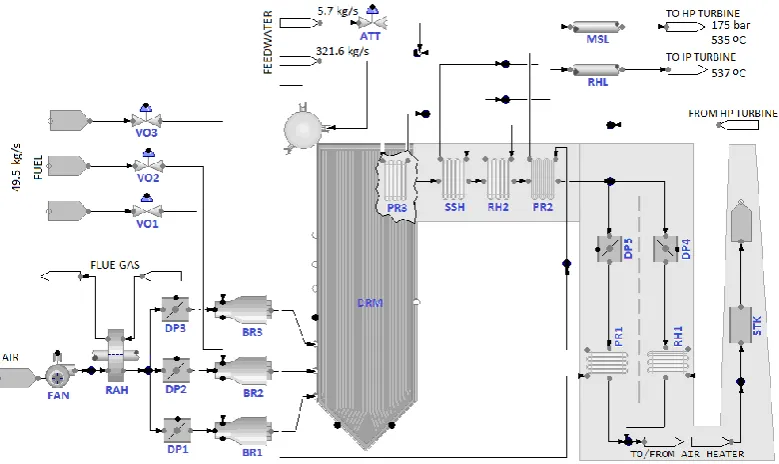
reheater steam temperature (RHT) is controlled by flue gas circulation in the boiler second pass via two dampers’ adjustment (DP4 and DP5).
[image:6.595.103.493.112.344.2]Figure 2. Boiler model implemented in ProTRAX v7.2 software environment, where: VO1–VO3, fuel
control valves; ATT, Attemperator valve; FAN, air Fan; RAH, air preheater; DP1–DP5, air/flue gas Dampers; BR1–BR3, oil Burners; DRM, boiler furnace Drum; PR1–PR3, SSH, Superheater stages; RH1–RH2, Reheater stages; MSL, Main Steam Line; RHL, Reheater Line; STK, boiler Stack.
The balance of plant model is depicted in Figure 3. It consists of high, intermediate and low pressure (HP, IP and LP) steam turbine stages. The HP turbine is split into three stages in the simulation model (depicted as GOV, HP1 and HP2). There are two steam taps located in the HP part: the first one represents the overall steam turbine leakages (TLK), whereas the second one supplies superheated steam to the high pressure feedwater preheater (HPFP). After expansion in the HP part, steam is returned to the boiler reheater, heated up to 537 °C and directed back to the IP steam turbine. There are two IP turbine stages (IP1, IP2). Between these stages, another steam tap is located to deliver steam to the deaerator (DEA). The third steam tap supplying steam to the low pressure feedwater preheater (LPFP) is located between the IP and LP parts of the turbine. The LP part is represented by only one stage (LPT). Superheated steam after expansion is condensed in a condenser (CNDR). The steam-water loop is implemented as the complete closed-loop system, so also, a make-up water system is implemented (CLC). The feedwater is circulated through a condenser pump (CDP) and preheated in the LPFP and deaerator. The main boiler feedwater pump (BFP) increases the pressure of feedwater and after heating up in the HPFP is supplied to the boiler drum. A small part of the feedwater is also directed to the superheater attemperator to control the MST. Although there are three HPFP and four LPFP stages in the power plant, for simplification, only one stage of each one has been used in the modelling work.
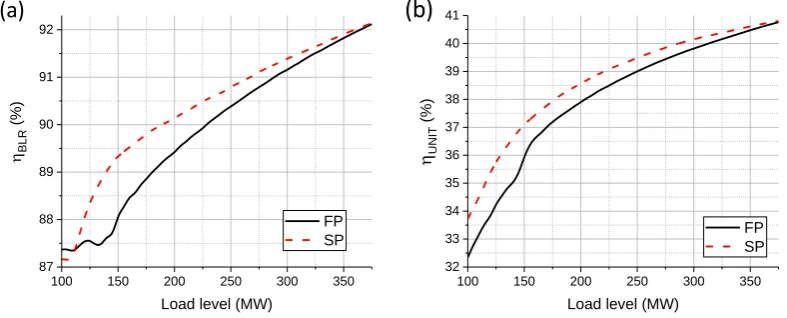
To fully assess the potential of TES integration, it is necessary to initially accomplish the model performance check without any modifications. According to the distributed control system (DCS), the power plant is able to operate within the 100–375-MW load level range. FP control mode implies constant steam pressure of 175 bar of the main steam line over the unit’s load range. High CV throttling action causes substantial energy losses, especially for lower load levels. As the steam turbine requires less steam mass flow rate and less pressure at the lower load levels, consequently greater efficiency and reduced emission can be achieved in SP mode. On the other hand, reduced pressure throttling provides a narrower steam reserve in the boiler drum, so the power plant will not be able to provide the modest amount of fast reserve. The difference in boiler efficiency (ηBLR) and
The boiler efficiency (ηBLR) varies between 87% and 92%, and it is calculated based on the
following formula:
η𝐵𝐿𝑅(%) = 100 ×𝑒𝑛𝑒𝑟𝑔𝑦 𝑜𝑢𝑡𝑝𝑢𝑡𝑒𝑛𝑒𝑟𝑔𝑦 𝑖𝑛𝑝𝑢𝑡
= 100 ×𝑊SSH× 𝐻SSH+ 𝑊RH2× 𝐻RH2− 𝑊CRP× 𝐻CRP− 𝑊FW× 𝐻FW− 𝑊ATT× 𝐻ATT 𝑊BR1× 𝐻BR1+ 𝑊BR2× 𝐻BR2+ 𝑊BR3× 𝐻BR3+ 𝑊FAN× 𝐻FAN
(1)
[image:7.595.83.519.218.420.2]where W, mass flow; H, enthalpy; points on the Figure 2: SSH, Superheater outlet; RH2, Reheater outlet; CRP, reheater inlet; FW, Feedwater inlet; ATT, superheater Attemperator inlet; BR1–BR3, Burner fuel inlet; FAN, Fan inlet.
Figure 3. Balance of Plant model implemented in ProTRAX v7.2 software environment, where: CRP,
reheater inlet pipe; CV, main Control Valve; GOV, HP1 (High Pressure), HP2, IP1 (Intermediate Pressure), IP2, LPT (Low Pressure) steam turbine stages; VACP, Vacuum Pump; CDP, Condenser Pump; BFP, Boiler Feedwater Pump; DEA, Deaerator; CNDR, Condenser; CLC, make-up water control valve; LPDV, Low Pressure Preheater level control Valve; HPDV, High Pressure Preheater level control Valve; DLV, Deaerator Level control Valve; FWV, drum level control valve; R1, RS1– RS3, steam/water pipe with thermal lag; TLK, steam turbine leakage.
100 150 200 250 300 350 87
88 89 90 91 92
(a)
BLR
(%)
Load level (MW)
FP SP
100 150 200 250 300 350 32
33 34 35 36 37 38 39 40 41
(b)
UNIT
(%)
Load level (MW)
FP SP
Figure 4. Boiler efficiency (η𝐵𝐿𝑅) (a) and unit efficiency (η𝑈𝑁𝐼𝑇) (b) in fixed pressure (FP) and sliding
[image:7.595.79.473.552.711.2]The total unit generation efficiency (ηUNIT) also takes into consideration auxiliary power
consumption in the plant, and it is calculated based on the following equation:
η𝑈𝑁𝐼𝑇(%) = 100 ×𝑒𝑛𝑒𝑟𝑔𝑦 𝑜𝑢𝑡𝑝𝑢𝑡𝑒𝑛𝑒𝑟𝑔𝑦 𝑖𝑛𝑝𝑢𝑡
= 100 × 𝑃GEN− 𝑃AUX
𝑊BR1× 𝐻BR1+ 𝑊BR2× 𝐻BR2+ 𝑊BR3× 𝐻BR3+ 𝑊FAN× 𝐻FAN+ 𝑊CLC× 𝐻CLC
(2)
where PGEN is the power plant output power (electrical); PAUX the auxiliary power (feedwater, condenser pumps and air fan); W, the mass flow; H, the enthalpy; BR1–BR3, Burner fuel inlet; FAN, Fan inlet; CLC, makeup water inlet.
Whereas there is no difference in unit efficiencies for the designed condition (full load), it is clearly seen that the unit in SP operating mode is able to reach up to 1% higher efficiency than in FP mode for the lowest load levels.
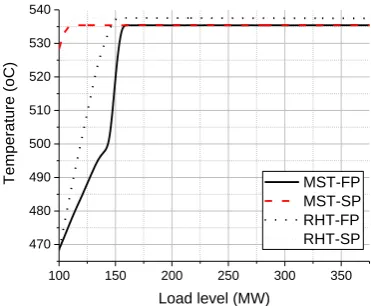
The effective power plant operational range is restricted by steam parameters, as steam temperatures at the main steam line and reheater line decrease below the rated values for certain conditions. In Figure 5, it is clearly seen that MST and RHT decrease below the rated values for low load levels. The minimum load level is restricted to 155 MW in FP mode and 110 MW in SP mode. Therefore, the minimum load level should be maintained above these values for secure power plant operation, as any rapid load change can cause steep temperature gradients, result in severe component thermal stresses and equipment lifetime decrease. Higher unit efficiency and increased plant operational range at low load levels make SP control mode more preferred and widely used in industry.
100 150 200 250 300 350 470
480 490 500 510 520 530 540
Te
mpe
rature (oC)
Load level (MW)
MST-FP MST-SP RHT-FP RHT-SP
Figure 5. Main Steam Temperature (MST) and Reheater Temperature (RHT) as a function of load
level in FP and SP operation modes.
3. Analysis of Feasible Integration Strategies
The principals of each TES system are to store heat (or cold) to be used later and overcome the mismatch between energy generation and energy use [10,33]. The general concept of TES integration in the power plant cycle is to take the heat out from the plant process cycle during low load demand and send it to storage. The heat should be returned back to the process loop when it is required, usually during high load demand, when the electricity price is high. The general idea of TES integration into the plant cycle is briefly explained in Figure 6.
[image:8.595.202.388.392.545.2]not discussed in the paper, and two main TES processes are simulated: the charging and discharging process. In the plant process cycle, the superheated steam is used as the heat transfer fluid (HTF) and the source of heat. As it is not possible to effectively keep the superheated steam in a storage tank, the heat from the superheated steam should be exchanged with suitable thermal material filling the storage tank in the TES charging process. Usually, the most cost effective solutions can be achieved using retrofitting; therefore, only relatively easily accessible points for steam extraction from the plant process loop are considered. Extraction points could be located at the inlet and outlet from the steam turbine and also at steam taps to feedwater preheaters. Seven different possible locations for TES steam extraction points are considered in the steam-water loop for the TES charging process. These points (T0A–T5) are shown in Figure 6, which also corresponds to Figure 3:
On the main steam line, just before and after the main control valve (T0A and T0B respectively); At the inlet and outlet from the boiler reheater (T2 and T3 respectively);
[image:9.595.143.456.279.421.2] At the steam taps to feedwater preheaters: HPFP, the deaerator and LPFP (T1, T4 and T5, respectively).
Figure 6. Thermal energy storage (TES) general description, where: HTF, heat transfer fluid; LPFP,
low pressure feedwater preheater; HPFP, high pressure feedwater preheater; HX, Heat Exchanger; T0A–T5, C, D, these corresponds to the points in Figure 3.
Superheated steam used in the TES charging process should be promptly returned back to the steam-water loop, as the loop is very sensitive to any imbalances. Return points are located at the deaerator and condenser (D and C in Figure 3). There are direct-contact type HX that allow for direct steam and water mixing, so it is possible to return steam or water from the TES charging process. The return point is chosen based on the minimal pressure difference between TES extraction and return points to avoid any unnecessary pressure throttling on the TES control valve. The deaerator (D) is chosen as the return point for extraction points T0A–T3, whereas the condenser (C) is selected for extraction points T4 and T5.
4. Simulation Test and Results
This feasibility study is not focused on any particular TES technology and design, so the entire TES system is designed as a black box with the operation conditions suitable for both charging and discharging processes. Inlet and outlet steam/water parameters are taken into consideration to assess the maximum possible heat transfer in the TES charging and discharging processes. The main aim is to extract the maximum heat to and from the TES system with the minimum negative influence on the power plant process cycle. Although the ProTRAX software platform is capable of dynamic process simulations, a steady state analysis has been performed for load levels within the entire plant operational range of 100–375 MW. The results are presented for TES charging and discharging processes in two pressure control system modes: FP and SP mode. It is assumed that only one TES configuration is tested at a time for the TES charging process. The TES discharging process has been tested for bypasses low pressure, high pressure and both feedwater preheaters.
4.1. TES Charging Process
The TES charging process requires a TES control valve implementation for each considered charging point separately. Superheated steam is taken from one point at a time (T0A–T5). A simple PI controller maintains constant steam mass flow to the TES HX within the range of 0–100 kg/s (with 5 kg/s step). The TES charging power (PTES) is proportional to the steam mass flow and the difference
in enthalpies between the inlet and outlet points of TES HX and can be calculated according to the following equation:
𝑃𝑇𝐸𝑆= 𝑊𝑇𝐸𝑆× (𝐻𝑖− 𝐻𝑜) (3)
where WTES is the mass flow rate of extracted steam; Hi and Ho are the specific enthalpies of the inlet
and outlet streams of HX.
To get the maximum available charging power PTES, it is necessary to ensure the maximum
available steam mass flow and the maximum possible difference in enthalpies between TES HX inlet and outlet nodes. Therefore, the steam condensation process should occur in TES HX in the TES charging process. To assume the minimum negative influence on the plant cycle, the water parameters at the outlet from TES HX are equal to the water parameters in the devices’ return point: deaerator tank or condenser tank (depending on the TES charging point). Pressure drop across TES HX is considered to be constant within the entire load level range (0.3 bar). The remaining pressure drop between the TES steam extraction point and the water return point is reached on the TES control valve. It is also essential to assess the power penalty on the plant process cycle (dP) caused by steam extraction in the TES charging process. In this case, it is necessary to disable the power plant master control system, leaving all local controllers active. The power penalty is the difference between requested load level and the actual value of generated power. The real benchmark for the TES charging process is the difference between TES charging power PTES and the power penalty dP,
according to the following equation:
𝑏𝑒𝑛𝑐ℎ𝑚𝑎𝑟𝑘 = 𝑃𝑇𝐸𝑆− 𝑑𝑃 (4)
Simulation results shown in Figure 7 indicate four main restrictions in the maximum possible steam mass flow (WTES) in TES charging mode:
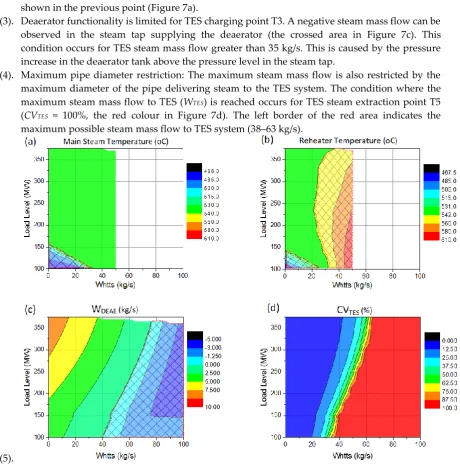
(1). Main steam temperature (MST) restriction: MST should be kept constant (535 °C ± 10%) within the entire load level range. The power plant model is not able to reach the rated MST value for the lowest load levels: <155 MW in FP mode and <110 MW in SP mode (Figure 5). Additional steam extraction for the TES charging process allows one to increase MST for the lowest load levels for TES extraction points located before the reheater (T0A–T2). In this case, it is possible to extend the plant operational range for low load levels. No influence has been noticed for TES points located downstream of the reheater (T3–T5). Figure 7a shows an example for point T1, where MST is too low for the lower load levels (100–150 MW) and WTES 0–30 kg/s (the
(2). Reheater steam temperature (RHT) restriction: RHT should be kept constant (537 °C ± 10%) within the entire load level range. RHT acts similar to MST for low load levels. Additionally, RHT rises suddenly with increasing TES steam mass flow extraction for points T0A–T2; therefore, the maximum TES steam mass flow is restricted to 20–30 kg/s. This is caused by insufficient reheater cooling, as the steam mass flow through the reheater is much smaller than through the superheater. This is the main limiting factor for all TES extraction points located before the reheater. Furthermore, no influence has been noticed for points located downstream of the reheater (T3–T5). Figure 7b shows an example for point T1, where the RHT is too high for
WTES higher than 20–30 kg/s (the crossed area). RHT also acts similar for low load levels as MST
shown in the previous point (Figure 7a).
(3). Deaerator functionality is limited for TES charging point T3. A negative steam mass flow can be observed in the steam tap supplying the deaerator (the crossed area in Figure 7c). This condition occurs for TES steam mass flow greater than 35 kg/s. This is caused by the pressure increase in the deaerator tank above the pressure level in the steam tap.
(4). Maximum pipe diameter restriction: The maximum steam mass flow is also restricted by the maximum diameter of the pipe delivering steam to the TES system. The condition where the maximum steam mass flow to TES (WTES) is reached occurs for TES steam extraction point T5
(CVTES = 100%, the red colour in Figure 7d). The left border of the red area indicates the
maximum possible steam mass flow to TES system (38–63 kg/s).
(5).
Figure 7. Simulation results: (a) Main steam temperature for TES charging point T1; (b) Reheater
temperature for TES charging point T1; (c) Steam mass flow to deaerator (WDEAE) for TES charging
point T3; and (d) TES valve opening degree (CVTES) for TES charging point T5. The crossed area
represents the limit of the parameters’ range.
A superposition of all specified restrictions for each investigated scenario allows one to draw an available power plant operational range for all investigated TES charging points. The maximum available TES steam mass flow (WTES) is depicted in Figure 8. The maximum value is reached for
[image:11.595.77.538.195.661.2]reached for the assumed diameter of the pipe delivering steam to TES HX. TES steam mass flow is significantly restricted for all TES extraction points located before the reheater (points T0A–T2), although in FP mode, it is possible to reach slightly higher values than in SP mode. The main benefit in SP mode is slightly extended operational range for the lowest load levels below 150 MW. It is really important that power plants are able to operate for the lowest possible load levels allowing for TES charging at the same time.
100 150 200 250 300 350 0 20 40 60 80 100
(a)
WTES (kg/s )Load Level (MW)
T0A T0B T1 T2 T3 T4 T5 Fixed Pressure
100 150 200 250 300 350 0 20 40 60 80 100
(b)
Sliding PressureWTES
(kg/s)
Load Level (MW)
[image:12.595.83.517.163.323.2]T0A T0B T1 T2 T3 T4 T5
Figure 8. Maximum steam mass flow (WTES) to TES in fixed pressure (a) and sliding pressure (b)
operating mode.
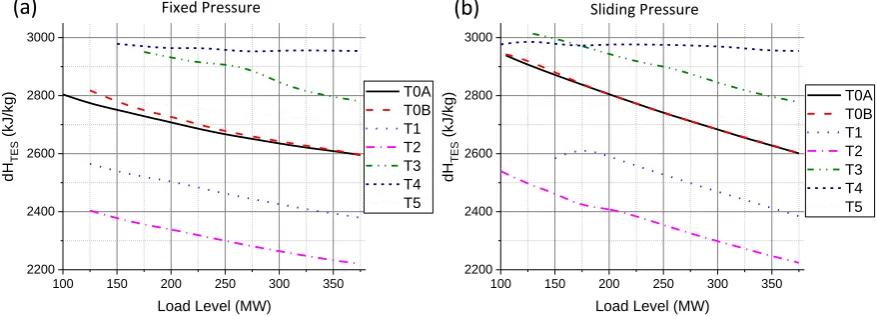
SP operation mode also allows one to get a higher difference in TES inlet and outlet enthalpies (dHTES) for all extraction points located before the reheater (Figure 9). The difference is more visible
at lower load levels. The condensation process, which occurs in TES HX, helps to obtain the highest possible difference in enthalpies, as the enthalpy of saturated water is much lower than saturated steam.
100 150 200 250 300 350 2200
2400 2600 2800 3000
(a)
Fixed PressuredH
TES
(kJ
/kg)
Load Level (MW)
T0A T0B T1 T2 T3 T4 T5
100 150 200 250 300 350 2200
2400 2600 2800 3000
(b)
Sliding PressuredH
TES
(kJ/kg
)
Load Level (MW)
T0A T0B T1 T2 T3 T4 T5
Figure 9. Difference in enthalpy (dHTES) at the inlet and outlet point of TES HX in fixed pressure (a)
and sliding pressure (b) operating mode.
TES charging power (PTES), as the result of multiplication of the above values, reaches the
[image:12.595.77.516.451.609.2]100 150 200 250 300 350 0 50 100 150 200 250 300
(a)
Fixed PressurePTES
(MW)
Load Level (MW)
T0A T0B T1 T2 T3 T4 T5
100 150 200 250 300 350 0 50 100 150 200 250 300
(b)
Sliding PressurePTES
(MW)
Load Level (MW)
[image:13.595.87.516.79.237.2]T0A T0B T1 T2 T3 T4 T5
Figure 10. TES charging power (PTES) in fixed pressure (a) and sliding pressure (b) operating mode.
The power penalty (dP) on the plant cycle during the TES charging process is proportional to the charging power PTES (Figure 11). The smallest values are reached for the charging point located at
the outlet from the superheater (T0A).
100 150 200 250 300 350 0 10 20 30 40 50 60 70
(a)
Fixed PressuredP (MW)
Load Level (MW)
T0A T0B T1 T2 T3 T4 T5
100 150 200 250 300 350 0 10 20 30 40 50 60 70
(b)
Sliding PressuredP (MW)
Load Level (MW)
[image:13.595.86.516.321.476.2]T0A T0B T1 T2 T3 T4 T5
Figure 11. Power penalty on the plant cycle (dP) in fixed pressure (a) and sliding pressure (b)
operating mode.
The benchmark value (benchmark) calculated according to Equation (4) is presented in Figure 12 and takes into consideration the power penalty (dP) during the TES charging process. According to the obtained results, the best candidate points are all locations downstream of the boiler reheater: points T4, T3 and T5, respectively. Slightly lower values can be reached in SP mode, but the main advantage is the extended plant operational range for low load levels.
100 150 200 250 300 350 0 50 100 150 200 250
(a)
Fixed Pressurebe
nc
hma
rk (MW)
Load Level (MW)
T0A T0B T1 T2 T3 T4 T5
100 150 200 250 300 350 0 50 100 150 200 250
(b)
Sliding Pressurebe
nc
hma
rk (MW)
Load Level (MW)
T0A T0B T1 T2 T3 T4 T5
[image:13.595.89.518.604.760.2]Another important factor in determining a potential TES integration is the superheated stream temperature (TTESin) entering TES HX in the charging process (Figure 13). High Temperature Thermal
Storage (HTTS) systems require temperature levels above 400 °C [17,18,34], which could be achieved only for extraction points closest to the main steam line and the reheater line: T3, T0A and T0B, respectively. The steam temperature is relatively uniform across the plant load level in FP operation mode. SP mode offers elevated steam temperature for all points located upstream of the boiler reheater due to lower pressure throttling at the TES control valve (up to 70 °C for the lowest load level). TES HX inlet temperature for all points located downstream of the boiler reheater remains at the same level, as the pressure difference between the FP and SP control system modes is marginal.
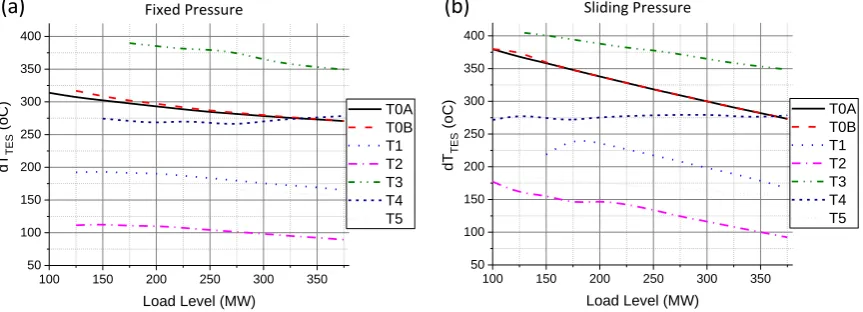
The results for temperature gradients across TES HX in charging mode are depicted in Figure 14. To ensure the minimal TES influence of the TES charging process on the plant cycle, the temperature level at the outlet from TES HX equals the temperature level in the device’s discharging point (deaerator or condenser tank). There is a considerable difference between temperature levels in the deaerator and condenser (about 150 °C). SP mode also offers slightly elevated temperatures for all TES charging points located upstream of the boiler reheater.
100 150 200 250 300 350 200
300 400 500
(a)
Fixed PressureTTESin
(oC)
Load Level (MW)
T0A T0B T1 T2 T3 T4 T5
100 150 200 250 300 350 200
300 400 500
(b)
Sliding PressureTTESin
(oC)
Load Level (MW)
[image:14.595.82.521.282.439.2]T0A T0B T1 T2 T3 T4 T5
Figure 13. TES inlet temperature in fixed pressure (a) and sliding pressure (b) operating mode.
100 150 200 250 300 350 50 100 150 200 250 300 350 400
(a)
Fixed PressuredT
TES
(oC)
Load Level (MW)
T0A T0B T1 T2 T3 T4 T5
100 150 200 250 300 350 50 100 150 200 250 300 350 400
(b)
Sliding PressuredT
TES
(oC)
Load Level (MW)
T0A T0B T1 T2 T3 T4 T5
Figure 14. Temperature gradient across the TES tank in fixed pressure (a) and sliding pressure (b)
operating mode.
Unit generation efficiency (ηUNIT) during the TES charging process is depicted in Figure 15. The
[image:14.595.85.517.485.641.2]100 150 200 250 300 350 24
26 28 30 32 34 36 38 40
(a)
Fixed PressureUN
IT
(%)
Load Level (MW)
T0A T0B T1 T2 T3 T4 T5 noTES
100 150 200 250 300 350 24
26 28 30 32 34 36 38 40
(b)
Sliding PressureUN
IT
(%)
Load Level (MW)
[image:15.595.84.520.79.238.2]T0A T0B T1 T2 T3 T4 T5 noTES
Figure 15. Unit efficiency (ηUNIT) in fixed pressure (a) and sliding pressure (b) operating mode.
The best candidate point selection for the TES charging process is a multi-dimensional task, and all presented parameters have to be taken into consideration. Taking into account both the benchmark value and the stream temperature (TTESin), the best candidate point for steam extraction in
the TES charging process is the boiler reheater outlet (T3) with the peak value of the TES charging power for moderate load levels around 275 MW.
4.2. TES Discharging Process
The heat from the TES system should be used by bringing it back into the power plant process loop. During normal power plant operation, a part of the superheated steam from the steam turbine is extracted to feedwater preheaters (HPFP, deaerator and LPFP) for the feedwater preheating process, increasing the efficiency of the cycle at the same time. The heat from TES could be used for the same purpose instead of using the superheated steam from the steam turbine. Steam extraction to feedwater preheaters is stopped during the TES discharging process, and more steam flows through the steam turbine stages allowing for increased electricity generation. In the power plant cycle, there are two possible locations for the TES discharging process. A bypass could be built around LPFP and/or HPFP. Although the deaerator is one of the feedwater preheaters, no bypassing is considered in this case. This component is crucial for the oxygen and other dissolved gas removal processes from the feedwater before entering into the main feedwater pumps. Any negligence in this process could cause serious feedwater pump damage and overall boiler equipment corrosion. Ideal feedwater preheater substitution requires identical feedwater parameters when the heat from the TES system is used instead. LPFP and HPFP feedwater parameters in FP and SP operation modes within the entire power plant load level range are depicted in Figures 16 and 17.
100 150 200 250 300 350 50 75 100 125 150 175 200 225 250 275
(a)
Fixed PressureLoad Level (MW)
Win Tin Tout Pin Pout Hin Hout 20 40 60 80 100 120 20 22 24 26 100 150 200 250 300 350 400 450 500 550
100 150 200 250 300 350
50 75 100 125 150 175 200 225 250 275
(b)
Sliding PressureLoad Level (MW)
[image:16.595.85.504.89.245.2]W Tin Tout Pin Pout Hin Hout 20 40 60 80 100 120 20 22 24 26 100 150 200 250 300 350 400 450 500 550
Figure 16. LPFP feedwater parameters in fixed pressure (a) and sliding pressure (b) operating mode;
where: W, mass flow (kg/s); T, temperature (°C); P, pressure (bar); H, enthalpy (kJ/kg); in, inlet; out, outlet.
100 150 200 250 300 350
50 100 150 200 250 300 350
(a)
Fixed PressureLoad Level (MW)
W Tin Tout Pin Pout Hin Hout 160 180 200 220 240 260 280 300 60 80 100 120 140 160 180 700 800 900 1000 1100 1200 1300
100 150 200 250 300 350
50 100 150 200 250 300 350
(b)
Sliding PressureLoad Level (MW)
W Tin Tout Pin Pout Hin Hout 160 180 200 220 240 260 280 300 60 80 100 120 140 160 180 700 800 900 1000 1100 1200 1300
Figure 17. HPFP feedwater parameters in fixed pressure (a) and sliding pressure (b) operating mode;
where: W, mass flow (kg/s); T, temperature (°C); P, pressure (bar); H, enthalpy (kJ/kg); in, inlet; out, outlet.
[image:16.595.85.513.320.476.2]100 150 200 250 300 350 0
10 20 30 40 50
(a)
P (MW)
Load Level (MW) LP
HP LP+HP
30 40 50 60 70 80 90 100 2
4 6 8 10 12 14
(b)
P (%)
Load Level (%) LP
[image:17.595.84.494.88.238.2]HP LP+HP
Figure 18. Power plant capacity increase (ΔP) for the TES discharging process: (a) in MW; (b) in % of
registered capacity; where: LP, low pressure feedwater preheater bypass; HP, high pressure feedwater preheater bypass; HP + LP, both LP and HP feedwater preheaters bypass.
As the power output increases during the TES discharging process, the unit efficiency (η𝑈𝑁𝐼𝑇)
calculated based on Equation (2) also increases. The simulation results are presented in Figure 19. LPFP bypassing allows for a 2% efficiency increase in the entire load level range, whereas HPFP substitution allows for a further efficiency increase to the maximum value of 45% for load levels above 75%. The highest available efficiency can be achieved for both HPFP and LPFP bypassing and can reach 47% for load levels above 80%.
100 150 200 250 300 350
32 34 36 38 40 42 44 46 48
UN
IT
(%)
Load Level (MW)
noTES LP HP LP+HP
30 40 50 60 70 80 90 100
Load Level (%)
Figure 19. Unit efficiency (η𝑈𝑁𝐼𝑇) in the TES discharging process where: no TES, no preheater substitution; LP, low pressure feedwater preheater bypass; HP, high pressure feedwater preheater bypass; HP + LP, both LP and HP feedwater preheaters bypass.
The TES discharging process allows one to effectively increase the operational flexibility of the power plant, as it is possible to operate at a lower load factor and to generate electricity with the same efficiency as for the plant designed condition. In the case of LPFP bypassing, the load level could be reduced to 65%, and the unit efficiency is still maintained at the level of 41%. HPFP bypassing allows for further load level reduction down to 47%. HPFP and LPFP bypassing allows for further plant load reduction to 39%.
[image:17.595.206.398.380.547.2]4.3. Boundary Conditions for TES Integration in the Plant Process Cycle
Superheated steam extraction for the TES charging process causes the steam and water parameters to change in the plant process loop. The boundary conditions for maximum heat extraction come from several factors. The first one comes from superheated steam temperature deviations at the main steam and the reheater line. This significantly reduces the maximum steam mass flow for all TES charging points located upstream of the reheater outlet. Another restriction comes from physical boundaries, like the maximum pipe diameter delivering steam to the TES system. Furthermore, parameters in the deaerator can change significantly, leading to feedwater deaeration process obstruction. All of these restrictions allow for drawing an allowable plant operational range as a function of the load level for each considered TES point separately. Additionally, to get the highest possible enthalpy difference, the steam condensation process should occur in TES HX. Another important factor that has to be taken into consideration is the steam temperature at the inlet and outlet of TES HX. These parameters will allow one to choose the most suitable type of TES system (sensible, latent or chemical) and make an initial design assessment. All of these factors should be taken into account in the TES charging point selection. Steam and water parameters in the plant process loop can change significantly for different assumptions and different steam/water conditions at the TES HX inlet and outlet points in the charging process.
This feasibility study also defines the requirements for the TES discharging process, as all feedwater parameters are known as a function of the plant load level. It should help to design TES HXs accurately and assess the potential for feedwater preheater bypassing.
5. Conclusions
The feasibility study of TES integration into a conventional power plant cycle performed in this article confirms that the power plant model is able to accommodate the TES system for each considered location with different impacts on the steam-water process loop. Superheated steam extraction for the TES charging process causes steam/water parameters to change in the process cycle allowing one to draw a TES charging operational map. The best location for the TES system should ensure the lowest power penalty dP and the highest TES charging power PTES at the same
time. Another important factor is the steam temperature entering TES HX with the highest values reached for charging points located closest to the boiler outlets. Plant pressure control system mode also has a significant influence on the results, as the SP mode offers a wider TES operational range and higher steam temperatures, especially for lower load levels. This is very beneficial as the charging process should occur for the possible lowest load levels. The best candidate point selection for the TES charging process is a multi-dimensional task, and all previously-presented parameters have to be carefully taken into consideration.
Furthermore, the TES discharging process can be successfully applied to the steam-water loop. Both feedwater preheaters could be bypassed, and additional steam mass flow through steam turbine stages allows for increased power generation. The TES discharging process supports power plant generation during the peak load demand, increases unit efficiency and improves overall power plant flexibility. The TES concept also helps to maintain optimum thermodynamic efficiency, allowing the power plant to work closer to its design condition, and increases the power plant component lifetime. Retrofitting, as one of the major assumptions in this paper, is feasible as the steam turbine can accommodate a 15% increase in power generation above the design level. Further work is required to identify a suitable TES system to match the HTF parameters investigated in this work. The TES technology choice will have significant influence on the feasibility of the system integration, as different TES technologies have different constructive, structural and economic implications.
Acknowledgments: This work was funded by Engineering and Physical Sciences Research Council (EPSRC)
Author Contributions: J.D.W conducted the literature search, performed the modelling and simulation work,
the results analysis and contributed to the writing of the paper. J.W. as the project leader initiated the idea of TES integration into the power plant cycle and contributed to the writing of the paper.
Conflicts of Interest: The authors declare no conflict of interest.
References
1. Martinez, S.R.; Hughes, W. Bringing Variable Renewable Energy Up to Scale—Options for Grid Integration
Using Natural Gas and Energy Storage; Technical Report 006/15; ESMAP: Washington, DC, USA, 2015.
2. Akhmatov, V. Analysis of Dynamic Behavior of Electric Power Systems with Large Amount of Wind Power; Electric Power Engineering, Ørsted-DTU; Technical University of Denmark: Lyngby, Denmark, 2003. 3. Glensk, B.; Rosen, C.; Schiavo, R.B.; Rabiee, S.; Madlener, R.; De Doncker, R. Economic and Technical
Evaluation of Enhancing the Flexibility of Conventional Power Plants; E.ON Energy Research Center Series
Volume 7, Issue 3; Aachen University: Aachen, Germany, 2016.
4. Fraunhofer-Institute for Wind Energy and Energy System Technology (IWES). The European Power System
in 2030: Flexibility Challenges and Integration Benefits; An Analysis with a Focus on the Pentalateral Energy
Forum Region; Agora Energiewende: Berlin, Germany, 2015.
5. Richter, M.; Möllenbruck, F.; Obermüller, F. Flexibilization of steam power plants as partners for renewable energy systems. In Proceedings of the 2016 Power Systems Computation Conference (PSCC), Genoa, Italy, 20–24 June 2016.
6. Guo, S.; Wang, J.; Wei, J.L.; Zachrades, P. A new model-based approach for power plant Tube-ball mill condition monitoring and fault detection. Energy Convers. Manag. 2014, 80, 10–19.
7. EPSRC Project. Flexible and Efficient Power Plant: Flex-E-Plant. Available online: http://www.gow.epsrc.ac.uk/NGBOViewGrant.aspx?GrantRef=EP/K021095/1 (accessed on December 5, 2016).
8. Draganescu, M.; Guo, S.; Wojcik, J.; Wang, J.; Liu, X.J.; Hou, G.L.; Xue, Y.L.; Gao, Q.R. Generalized predictive control for superheated steam temperature regulation in a supercritical coal-fired power plant.
CSEE J. Power Energy Syst. 2015, 1, 69–77.
9. Garvey, S.D.; Eames, P.C.; Wang, J.H.; Pimm, A.J.; Waterson, M.; MacKay, R.S.; Giulietti, M.; Flatley, L.C.; Thomson, M.; Barton, J.; et al. On Generation-Integrated Energy Storage. Energy Policy 2015, 86, 544–551. 10. Li, G.; Zheng, X. Thermal energy storage system integration forms for a sustainable future. Renew. Sustain.
Energy Rev. 2016, 62, 736–757.
11. Aneke, W.; Wang, M. Energy storage technologies and real life applications—A state of the art review.
Appl. Energy 2016, 179, 350–377.
12. Luo, X.; Wang, J.; Dooner, M.; Clarke, J. Overview of Current Development in Electrical Energy Storage Technologies and the Application Potential in Power System Operation. Appl. Energy 2015, 137, 511–536. 13. Edwards, J.; Bindra, H.; Sabharwall, P. Exergy analysis of thermal energy storage options with nuclear
power plants. Ann. Nuclear Energy 2016, 96, 104–111.
14. Richter, M.; Möllenbruck, F.; Starinski, A.; Oeljeklaus, G.; Görner, K. Flexibilization of Coal-fired Power Plants by Dynamic Simulation. In Proceedings of the 11th International Modelica Conference, Versailles, France, 21–23 September 2015.
15. Miró, L.; Gasia, J.; Cabeza, L.F. Thermal energy storage (TES) for industrial waste heat (IWH) recovery: A review. Appl. Energy 2016, 179, 284–301.
16. Zhu, Y.; Zhai, R.; Peng, H.; Yang, Y. Exergy destruction analysis of solar tower aided coal-fired power generation system using exergy and advanced exergetic methods. Appl. Therm. Eng. 2016, 108, 339–346. 17. Gil, A.; Medrano, M.; Martorell, I.; Lázaro, A.; Dolado, P.; Zalba, B.; Cabeza, L.F. State of the art on high
temperature thermal energy storage for power generation. Part 1—Concepts, materials and modellization.
Renew. Sustain. Energy Rev. 2010, 14, 31–55.
18. Medrano, M.; Gil, A.; Martorell, I.; Potau, X.; Cabeza, L.F. State of the art on high temperature thermal energy storage for power generation. Part 2—Case studies. Renew. Sustain. Energy Rev. 2010, 14, 56–72. 19. Torras, S.; Pérez-Segarra, C.; Rodríguez, I.; Rigola, J.; Oliva, A. Parametric study of two-tank TES systems
for CSP plants. In Proceedings of the International Conference on Concentrating Solar Power and Chemical Energy Systems, SolarPACES 2014, Beijing, China, 16–19 September 2014.
21. Drost, M.K.; Antoniak, Z.I.; Brown, D.R.; Somasundaram, S. Thermal Energy Storage for Power Generation; Prepared for the U.S. Department of Energy under Contract DE-AC06-76RLO1830; Pacific Northwest Laboratory: Washington, DC, USA, 1989.
22. Drost, M.K.; Somasundaram, S.; Brown, D.R.; Antoniak, Z.I. Thermal Energy Storage for Coal-Fired Power Generation. In Proceedings of the Conference: Fossil Fuel Plant Cycling Meeting, Washington, DC, USA, 4–6 December 1990.
23. Wang, Y.; Wang, J.; Luo, X.; Guo, S.; Lv, J.; Gao, Q. Dynamic modelling and simulation of IGCC process with Texaco gasifier using different coal. Syst. Sci. Control Eng. 2015, 3, 198–210.
24. Yang, Z.W.; Wang, Z.; Wu, Y.X.; Wang, J.; Lu, J.F.; Li, Z.; Ni, W. Dynamic model for an oxygen-staged slagging entrained flow gasifier. Energy Fuel 2011, 25, 3646–3656.
25. Vandersickel, A.; Von Gamm, M.; Angerer, M.; Spliethoff, H. Highly Load-flexible Coal-Fired Power Plants through the Integration of Molten Salt Storage. In Proceedings of the International Renewable Energy Storage Conference IRES2015, Düsseldorf, Germany, 9–11 March 2015.
26. Alstom. Peak Power—Cost-Effective Thermal Energy Storage. Available online: http://www.alstomenergy.gepower.com/Global/Power/Resources/Documents/Brochures/peak-power-wa ter-based-energy-storage-solution-for-steam-plants-epslanguage=en-GB.pdf (accessed on December 5, 2016).
27. Schuele, V.; Bierewirtz, F.; Renjewski, D.; Clement, O. Hybrid or Flexible—Integrated Approach for Renewables Integration. Power Plant Symposium 2012, Republic of Serbia. Available online: http://www.e2012.drustvo-termicara.com/presentations/download/31 (accessed on December 5, 2016). 28. Mohamed, O.; Wang, J.; Guo, S.; Wei, J.L.; Al-Duri, B.; Lv, J.; Gao, Q. Mathematical Modelling for Coal Fired
Supercritical Power Plants and Model Parameter Identification Using Genetic Algorithms; A Book Chapter in
Electrical Engineering and Applied Computing; Springer Netherlands, 2011.
29. Mohamed, O.I.; Wang, J.; Al-Duri, B.; Lu, J.F.; Gao, Q.R.; Xue, Y.L. Study of a multivariable coordinate control for a supercritical power plant process. Int. J. Energy Eng. 2012, 2, 210–217.
30. Liu, X.J.; Kong, X.B.; Hou, G.L.; Wang, J. Modelling of a 1000 MW power plant ultra super-critical boiler system using Fuzzy-Neural network methods. Energy Convers. Manag. 2013, 65, 518–527.
31. Oko, E.; Wang, M. Dynamic modelling, validation and analysis of coal-fired subcritical power plant. Fuel
2014, 135, 292–300.
32. TRAX LLC. ProTRAX Simulation System. Analysist’s Instruction Manual; TRAX LLC, Lynchburg, VA, February 2016.
33. Cabeza, L.F. Advances in Thermal Energy Storage Systems. Methods and Applications; Elsevier Science & Technology: Cambridge, United Kingdom, 2014.
34. IEA-ETSAP and IRENA. Thermal Energy Storage—Technology Brief. January 2013. Available online: https://www.irena.org/DocumentDownloads/Publications/IRENA-ETSAP%20Tech%20Brief%20E17%20T hermal%20Energy%20Storage.pdf (accessed on accessed on December 5, 2016).
35. UNIPER Technologies Limited, Ratcliffe Power Station, Nottingham, UK. Personal communication, February 2016.
36. Rayaprolu, K. Boilers for Power and Process; CRC Press: Boca Raton, FL, USA, 2009.