Industrial Management & Data Systems
A cost-effective decision-making algorithm for an RFID-enabled HMSC network design: A multi-objective approach
Ahmed Mohammed, Qian Wang, Xiaodong Li,
Article information:
To cite this document:
Ahmed Mohammed, Qian Wang, Xiaodong Li, (2017) "A cost-effective decision-making algorithm for an RFID-enabled HMSC network design: A multi-objective approach", Industrial Management & Data Systems, Vol. 117 Issue: 9, pp.1782-1799, https://doi.org/10.1108/IMDS-02-2016-0074
Permanent link to this document:
https://doi.org/10.1108/IMDS-02-2016-0074
Downloaded on: 11 October 2017, At: 03:58 (PT)
References: this document contains references to 56 other documents. The fulltext of this document has been downloaded 17 times since 2017*
Access to this document was granted through an Emerald subscription provided by All users group
For Authors
If you would like to write for this, or any other Emerald publication, then please use our Emerald for Authors service information about how to choose which publication to write for and submission guidelines are available for all. Please visit www.emeraldinsight.com/authors for more information.
About Emerald www.emeraldinsight.com
Emerald is a global publisher linking research and practice to the benefit of society. The company manages a portfolio of more than 290 journals and over 2,350 books and book series volumes, as well as providing an extensive range of online products and additional customer resources and services.
Emerald is both COUNTER 4 and TRANSFER compliant. The organization is a partner of the Committee on Publication Ethics (COPE) and also works with Portico and the LOCKSS initiative for digital archive preservation.
*Related content and download information correct at time of download.
A cost-effective decision-making
algorithm for an RFID-enabled
HMSC network design
A multi-objective approach
Ahmed Mohammed and Qian Wang
School of Engineering, University of Portsmouth, Portsmouth, UK, and
Xiaodong Li
Department of Mathematics, University of Portsmouth, Portsmouth, UK
Abstract
Purpose–The purpose of this paper is to investigate the economic feasibility of a three-echelon Halal Meat Supply Chain (HMSC) network that is monitored by a proposed radio frequency identification (RFID)-based management system for enhancing the integrity traceability of Halal meat products and to maximize the average integrity number of Halal meat products, maximize the return of investment (ROI), maximize the capacity utilization of facilities and minimize the total investment cost of the proposed RFID-monitoring system. The location-allocation problem of facilities needs also to be resolved in conjunction with the quantity flow of Halal meat products from farms to abattoirs and from abattoirs to retailers.
Design/methodology/approach–First, a deterministic multi-objective mixed integer linear programming model was developed and used for optimizing the proposed RFID-based HMSC network toward a comprised solution based on four conflicting objectives as described above. Second, a stochastic programming model was developed and used for examining the impact on the number of Halal meat products by altering the value of integrity percentage. Theε-constraint approach and the modified weighted sum approach were proposed for acquisition of non-inferior solutions obtained from the developed models. Furthermore, the Max-Min approach was used for selecting the best solution among them.
Findings–The research outcome shows the applicability of the developed models using a real case study. Based on the computational results, a reasonable ROI can be achievable by implementing RFID into the HMSC network.
Research limitations/implications– This work addresses interesting avenues for further research on exploring the HMSC network design under different types of uncertainties and transportation means. Also, environmentalism has been becoming increasingly a significant global problem in the present century. Thus, the presented model could be extended to include the environmental aspects as an objective function.
Practical implications–The model can be utilized for food supply chain designers. Also, it could be applied to realistic problems in the field of supply chain management.
Originality/value–Although there were a few studies focusing on the configuration of a number of HMSC networks, this area is overlooked by researchers. The study shows the developed methodology can be a useful tool for designers to determine a cost-effective design of food supply chain networks.
KeywordsMulti-objective optimization, RFID, Halal, Supply chain design, Facility location-allocation problem, Stochastic programming
Paper typeResearch paper
Industrial Management & Data Systems
Vol. 117 No. 9, 2017 pp. 1782-1799 Emerald Publishing Limited 0263-5577
DOI 10.1108/IMDS-02-2016-0074
Received 21 February 2016 Revised 31 July 2016 3 October 2016 16 October 2016 Accepted 17 October 2016
The current issue and full text archive of this journal is available on Emerald Insight at: www.emeraldinsight.com/0263-5577.htm
© Ahmed Mohammed, Qian Wang and Xiaodong Li. Published by Emerald Publishing Limited. This article is published under the Creative Commons Attribution (CC BY 4.0) licence. Anyone may reproduce, distribute, translate and create derivative works of this article ( for both commercial & non-commercial purposes), subject to full attribution to the original publication and authors. The full terms of this licence may be seen at: http://creativecommons.org/licences/by/4.0/legalcode
The authors would like to express the authors’gratitude to the Higher Committee for Education Development (HCED) in Iraq for the financial support in this study. Also, the authors would like to thank the anonymous referees whose thorough reviews and insightful comments made a valuable contribution to this paper.
1782
IMDS
117,9
Nomenclature Deterministic model Sets
I set of farmsi∈I
J set of abattoirsj∈J
K set of retailersk∈K
Given parameters
CEi;a RFID equipment (E) cost required for farmi
CEj;b RFID equipment (E) cost required for abattoirj
CIi;a RFID implementation (I) cost required for farmi
CIj;b RFID implementation (I) cost required for abattoirj
Cti RFID tag cost per item at farmi Ctj RFID tag cost per item at abattoirj CTij;u unit transportation (T) cost per mile
from farmito abattoirj
CTjk;v unit transportation (T) cost per mile from abattoirjto retailerk
Chi;a handling cost per item at farmi Chj;b handling cost per item at abattoirj
duij travel distance of livestock from farmito abattoirj
dvjk travel distance of Halal meat products from abattoirjto retailerk
W transportation capacity per vehicle
Sai maximum supply capacity of farmi
Sbj maximum supply capacity of abattoirj
Dbj minimum demand of abattoirj
Dgk minimum demand of retailerk
Puij integrity percentage of livestock through first transportation link u from farmito abattoirj
Pvjk integrity percentage of meat
products through second
transportation linkv from abattoir jto retailerk
Rai return of investment for farmi Rbj return of investment per item for
abattoirj
Decision variables xu
ij quantity of units transported
through the first transportation linkufrom farmito abattoirj
xv
jk quantity of units transported
through second transportation link vfrom abattoirjto retailerk
yai {1: if farmiis open, 0: otherwise
ybj {1: if abattoirjis open, 0: otherwise
Stochastic model Sets
Ω set of scenariosξ∈Ω
Given parameters
Puijx integrity percentage of livestock through the first transportation linku from farm ito abattoir jin scenarioξ
Pvjkx integrity percentage of meat
products through the second transportation linkv from abattoir jto retailerkin scenarioξ
Probξ Probability of scenarioξ
Decision variables xu
ijx quantity of units transported
through the first transportation linku from farm ito abattoir jin scenarioξ
xv
jkx quantity of units transported
through the second transportation link v from abattoirjto retailerkin scenarioξ
yaix {1: if farmiin scenarioξis open, 0: otherwise
ybjx {1: if abattoirjin scenarioξis open, 0: otherwise
1. Introduction
Today, a cost-effective design of efficient food supply chain networks is crucial for retailers to maintain a share in the increasingly competitive market. The design of a food supply chain network, however, often involves a trade-off decision-making process by minimizing its total cost and transportation time, whilst maintaining quality of food to be delivered to customers. In practice, such a trade-off decision may also vary over time due to the consistent change in conditions of the unpredictable market. Thus, the performance of a supply chain network needs also to be evaluated
1783
RFID-enabled
HMSC network
design
consistently providing a timely and right decision based on alternative solutions (Shen, 2007; Shankaret al., 2013).
In recent years, safety and quality of food has been the major issue on which consumers require more transparent information relating to food they purchase at supermarkets. For Muslim communities in the UK, integrity of Halal food is essential. The Islamic term Halal means “allowed” or “permitted” in its English translation and it is often used to describe food products that are permissible for Muslims to eat or drink under the Islamic Shari’ah (laws). Production of Halal meat products, for instance, needs to comply with the Islamic Shari’ah in each process of livestock feeding, slaughtering, packing, storing and transporting before being sold at supermarkets. If a specific process of the Halal Meat Supply Chain (HMSC) is not handled, accordingly, retailers and consumers at the end of the chain may treat these meat products as non-Halal. Today, consumption of Halal meat products is a well-known diet not merely among Muslim but also many non-Muslim people and Halal meat production and distribution is one of fast-growing sectors in the world. However, the HMSC concept is a challenge and often confusing for supply chain designers because of the specific rules that need be followed. A radio frequency identification (RFID)-based monitoring system was proposed to monitor the process in production throughout the HMSC and distribution through the transportation (Mohammed and Wang, 2015). The implementation of RFID is subject to extra costs that may break-down the chain in presenting an unfeasible supply chain network in terms of economical costs. Consequently, it is important to optimize the HMSC network design to balance the extra costs and merchandize quality. The optimization of an RFID-enabled HMSC is a typical multi-objective problem since it is associated with several variables and imprecise parameters. Nevertheless, this field is overlooked by researchers, although there were a few studies focusing on various configurations rather than optimizations of HMSC networks (Lodhi, 2009; Zulfakaret al., 2012).
This paper contributes to the knowledge in investigating the economic feasibility of a three-echelon HMSC network that is monitored by implementing an RFID-based system to improve the integrity traceability of Halal meat products. To help design a cost-effective RFID-based HMSC network, first, a deterministic four-objective mixed integer linear programming model was developed and used for investigating the proposed RFID-based HMSC network in terms of number of facilities to open to the HMSC network and optimal quantity flow of Halal meat products towards a compromised solution based on four conflicting objectives: minimizing the total investment cost of the HMSC network, maximizing the average integrity number of Halal meat products, maximizing the return of investment (ROI) and maximizing the capacity utilization (percent) of facilities (i.e. farms and abattoirs) and a comparison in the total investment cost using the RFID-based HMSC and the non-RFID-based HMSC. Second, a stochastic programming model was developed and used for examining the effect on the HMSC network design by altering the integrity percentage of Halal meat products. To obtain non-inferior solutions based on the developed multi-objective model, two methods were used. This includes the ε-constraint approach and the modified weighted sum (MWS) approach that aim at obtaining accurate non-inferior solutions values. Subsequently one of these solutions can be selected using the Max-Min approach. The study shows that the proposed models can be a useful tool as a decision maker for HMSC supply chains network design.
2. Literature review
Related research is reviewed under two categories: RFID-enabled applications in supply chain management and multi-objective approaches in solving supply chain problems.
1784
IMDS
117,9
In the context of food supply chains, many studies using RFID techniques for improving tracecibility in ensuring safety and/or originality of food products provided in food supply chain sectors (Manos and Manikas, 2010; Zailaniet al., 2010). Kelepouris et al. (2007) studied the main requirements of traceability and examined how the technology of RFID can address these requirements. Expósito et al. (2013) proposed an RFID-based monitoring system used for tracing a wine supply chain. Barge et al. (2014) described an item-level traceability system for cheese products in a dairy factory as each piece of cheese is attached with an RFID tag containing cheese identifications such as cheese type, production date and expiry date. Chenet al. (2014) proposed a new type of RFID application, namely, 2G-RFID-Sys using the Internet of Things technology with RFID sensor tags (semi-passive tags integrated with sensors) that can monitor food temperatures in a refined smart cold supply chain.
Furthermore, the implementation of RFID technology has been gaining an ever-increasing popularity in different applications in logistics and supply chain management (Nathet al., 2006; Hou and Huang, 2006; So Parket al., 2010). Rafiqueet al. (2016) presented a literature study that shows how RFID-based lean manufacturing is helpful for handling barriers affecting lean manufacturing. Lu et al. (2006) presented a framework and five-step deployment process aimed at developing a holistic approach for implementing RFID-enabled manufacturing in manufacturing enterprises. Wanget al.(2010) discussed the trend of RFID-based supply chains and logistics sectors in a future prospective view. Giadaaet al.(2016) developed a smart logistic unit based on radio frequency technology to support the management of the food supply chain, in order to guarantee the shelf life of products in agreement with logistic efficiency and system sustainability. Zhong et al. (2013) proposed a RFID-enabled real-time manufacturing execution system for mass-customization production shop-floor management including real-time data collection, real-time scheduling as well as real-time work in progress tracing and tracking.
Multi-objective optimization refers to an optimization of multiple decision-making objectives concurrently. These objectives are possibly conflicting. The multi-objective mathematical model can be useful for solving the facility location-allocation problem of a supply chain design based on conflicting objectives (Gen and Cheng, 1997; Deb, 2001; Barroset al., 1998; Jayaramanet al., 1999; Krikkeet al., 1999; Mohammed and Wang, 2017). These objectives may be involved in such as minimization of costs of investing and running a supply chain network, maximization of its incomes and customer satisfaction and minimization of the environmental impacts (Dinget al., 2006; Villegas et al., 2006; Bhattacharya and Bandyopadhyay, 2010; Cheshmehgazet al., 2013; Hiremathet al., 2013). Nozick and Turnquist (2001) proposed a mathematical model used for optimization of locations of distribution centers based on costs of facility, inventory, transportation and service coverage. Cakravastiaet al.(2002) provided a mixed integer multi-objective model for determining a selection of suppliers of a supply chain. Chen and Lee (2004) introduced a multi-product, multi-stage and multi-period scheduling model used for seeking a fair profit distribution, a safe inventory level and a maximum customer service level. Guilléna et al. (2005) formulated a mixed integer multi-objective mathematical model used for optimizing a supply chain design by achieving a maximization of the total profit under uncertainty of financial risk and demand. The similar studies were conducted by Shen (2006), Bojarskiet al.(2009) and Chibeles-Martinset al.(2012). Tzenget al.(2006) offered a production and distribution model using a multi-objective programming method for maximizing profits of the enterprise and quality of customer services. For the research work of multi-objective approaches, it can refer to a study by Shenet al. (2003). Sabri and Beamon (2000) developed a two-objective programming model aiming
1785
RFID-enabled
HMSC network
design
to minimize the total cost and maximize the volume flexibility of plants of a supply chain. Lee and Dong (2009) proposed a mathematical model for optimizing the design of a closed-loop supply chain network using the scenario-based programming method. Vahdani et al.(2012) developed a fuzzy bi-objective optimization model in assisting the design of a closed-loop supply chain by minimizing costs of facilities and transportation as objectives. In other studies, Kannanet al.(2012) developed an integrated, multi echelon, multi-period, multi-product mixed integer linear programming model used for optimizing the distribution and inventory level of a closed-loop supply chain network using a genetic algorithm. Niknamfar (2015) presented a multi-objective non-linear model using a non-dominated sorting genetic algorithm and a non-dominated ranking genetic algorithm for solving a production-distribution planning problem of a three-level supply chain. Zhang et al. (2015) proposed a dynamical optimization method for shop-floor material handling based on real-time and multi-source manufacturing data. It integrates three important features including a new allocation strategy for move tasks, intelligent trolleys with the capability of active sensing and self-decision and the combination optimization method of move tasks to reduce the transport cost and energy. Teimouryet al. (2013) developed a multi-objective model for a supply chain of perishable fruits and vegetables. The model used for identifying the best import quota policy of fruits and vegetables. Harris et al. (2014) proposed a multi-objective optimization approach for solving a facility location-allocation problem for a supply chain network where financial costs and CO2 emissions are considered as objectives.
Talaeiet al.(2015) presented a bi-objective facility location-allocation model for a closed-loop supply chain network design. Robust and fuzzy programming approaches were used to investigate the effects of uncertainties of the variable costs, as well as the demand rate on the network design. Bortolini et al. (2016) developed a three-objective distribution planner to tackle the tactical optimization issue of a fresh food distribution network. The optimization objectives were to minimize operating cost, carbon footprint and delivery time; the work, however, did not consider other costs and the effect of uncertainty that may occur.
The main contributions of this paper are:
(1) investigate the feasibility of a proposed RFID-based HMSC in terms of economic costs;
(2) design the HMSC network with respect to the additional costs in investment;
(3) present a trade-off among the considered objectives;
(4) examine the impacts of integrity uncertainty on the HMSC network design;
(5) develop a modified solution approach aiming to obtain accurate solutions values; and
(6) evaluate the potential benefits of the RFID-based HMSC in terms of costs by comparing it with the HMSC without using the RFID technology.
3. The HMSC network model
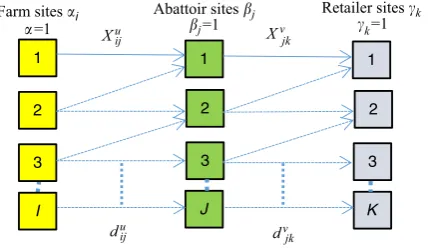
Figure 1 illustrates a three-echelon HMSC network, which consists of farms, abattoirs and retailers. To ensure the integrity of Halal meat products, an RFID-based monitoring system was proposed to monitor the process in production at farms and abattoirs and distribution through the transportation (Mohammed and Wang, 2015). In order to help designers determine a cost-effective HMSC design, a multi-objective mathematical model was developed as an aid for quantifying the investment cost, the ROI, the integrity number of Halal meat products and capacity utilization (percent) of the HMSC-related facilities.
1786
IMDS
117,9
3.1 The deterministic model
Thus, the RFID-based HMSC multi-objective model can be formulated as follows:
MinOF1¼
X
iAI
CEi;aþCIi;a
yai þX
jAJ
CEj;bþCIj;b
ybjþX
iAI
X
jAJ
Ctixu ij
þX
jAJ
X
kAK
CtjxvjkþX
iAI
X
jAJ
Chi;axuijþX
jAJ
X
kAK
Chj;bxvjkþX
iAI
X
jAJ
CTij;u x
u ij W d u ij þX
jAJ
X
kAK
CTjk;v x
v jk W d v jk X
iAI
Chi;axuij þX
jAI
Chj;bxvjk (1)
whereOF1refers to the minimization of the total cost:
MaxOF2¼
X
ieJ
X
jeJ
PuijxuijþX
jeJ
X
keK
Pvjkxvjk (2)
whereOF2refers to the maximization of integrity number of Halal meat products:
MaxOF3¼
X
ieI
X
ieJ
RaixuijþX
jAJ
X
kAK
Rbjxvjk (3)
whereOF3refers to the maximization of the ROI:
MaxOF4¼
X
iAI
X
jAJ
xu ij
Saþ
X
jAJ
X
kAK
xv jk
Sb (4)
whereOF4refers to the maximization of capacity utilization (percent) of HMSC facilities.
By minimizing objectiveOF1 based on the non-RFID-based HMSC model, it is given
as follows:
MinOFnon1 ¼X
iAI
X
jAJ
CTij;u x
u ij
W
duijþX
jAJ
X
kAK
CTjk;v x
v jk
W
dvjk
þX
iAI
Chi;axuijþX
jAI
Chi;bxvjk (5)
Subject to the following constraints:
X
iAI
xuijpSaiyai 8jAJ (6)
1
2
3
K
Farm sites i
1 2 3 I 1 2 3 J
Abattoir sites j
Xuij
Retailer sites k
=1 j=1 Xv
jk
k=1
du
[image:7.493.116.331.83.207.2]ij dvjk
Figure 1. The three-echelon HMSC
1787
RFID-enabled
HMSC network
design
X
jAJ
xvjkpSbjybj 8kAK (7)
X
iAI
xuijXDbj 8jAJ (8)
X
jAJ
xv jkXD
g
k 8kAK (9)
DbjXX
kAK
xvjk 8jAJ (10)
xuij;xvjkX0; 8i;j;k; (11)
yia;ybjAf0;1g; 8i;j (12)
For Equation (1), it minimizes the total investment cost of the RFID-based HMSC. The total investment cost includes costs of RFID-related equipment and implementation, and transportation and material handling of Halal meat products. For Equation (2), it maximizes the integrity number of Halal meat products. For Equation (3), it maximizes the ROI. For Equation (4), it maximizes the capacity utilization ( percent) of HMSC facilities. For Equation (5), it determines the minimum total cost for the non-RFID-based HMSC; the cost includes the transportation cost and the material handling cost. Equations (6) and (7) are capacity constraints of farms and abattoirs, respectively. For Equation (8)-(10), respectively, it ensures that all demands in product quantity are satisfied as requested by abattoirs and retailers. For Equation (11) and (12), respectively, it limits the decision variables to be binary and non-negative.
3.2 The stochastic model
The stochastic programming model is often used for dealing with uncertain parameters that may affect a scenario of a system or entity (Coelloet al., 2007; Birge and Louveaux, 1997; Al-Othmanet al., 2008). Considering a decisiony, which is influenced by scenariosof elementr, the result of decisionyis defined byz(y,r). Assuming a set of scenariosS, i.e. {rs,s¼1,…,S} andPsis the probability ofrs. By minimizing objectiveOF, it can be described as follows:
MinOF¼X
S
s¼1
Psz yð;rsÞ (13)
By minimizing objectiveOF2based on the stochastic objective function, it is given in the
following formula:
MaxOF2¼
X
xAO
X
ieJ
X
jeJ
PuijxxuijxProbxþ
X
xAO
X
jeJ
X
keK
PvjkxxvjkxProbx (14)
where OF2 refers to the maximization of integrity number of Halal meat products by
altering the value of integrity percentage, subject to:
X
iAI
xuijxpSaiyaix 8ðjAJ;xAOÞ (15)
X
jAJ
xv jkxpSbjy
b
jx 8ðkAK;xAOÞ (16)
1788
IMDS
117,9
X
iAI
xu
ijxXDbj 8ðjAJ;xAOÞ (17)
X
jAJ
xv
jkxXDgk 8ðkAK;xAOÞ (18)
DbjXX
kAK
xv
jkx 8ðjAJ;xAOÞ (19)
xu
ijx;xvjkxX0; 8i;j;k;x; (20)
yixa;ybjxAf0;1g; 8i;j;z (21)
4. Solution approaches
In order to obtain non-inferior solutions based on a multi-objective model, a number of solution approaches were found through a literature review. In this work, theε-constraint approach and the MWS approach were utilized as described below.
4.1 The epsilon-constraint approach
With this approach, the multi-objective model can be converted into a mono-objective model in which a single objective is optimized and other objectives are shifted to the constraints to be less than or equal to a given target valueεnthat gradually varies from a minimum value
to a maximum value of the constrained objective (Ehrgott, 2005). By minimizing objective OF, the equivalent objective function can be formulated as follows:
MinOF ¼X
iAI
CEi;aþCIi;a
yaiþX
jAJ
CEj;bþCIj;b
ybjþX
iAI
X
jAJ
Ctixuij
þX
jAJ
X
kAK
CtjxvjkþX
iAI
X
jAJ
Chi;axuijþX
jAJ
X
kAK
Chj;bxvjkþX
iAI
X
jAJ
CTij;u x
u ij W d u ij þX
jAJ
X
kAK
CTjk;v x
v jk W d v jk X
iAI
Chi;axuijþX
jAI
Chi;bxvjk (22)
Equation (22) is subject to the following constraints:
X
ieJ
X
jeJ
Puijxu ijþ
X
jeJ
X
keK
Pvjkxv jk
!
Xe1 (23)
X
ieJ
X
jeJ
PuijxuijþX
jeJ
X
keK
Pvjkxvjk
!min
pe1p
X
ieJ
X
jeJ
PuijxuijþX
jeJ
X
keK
Pvjkxvjk
!max (24) X ieI X jeJ
Raixu ijþ
X
jAJ
X
kAK
Rbjxv jk
!
Xe2 (25)
1789
RFID-enabled
HMSC network
design
X
ieI
X
jeJ
RaixuijþX
jAJ
X
kAK
Rbjxvjk
!min
pe2p
X
ieI
X
jeJ
RaixuijþX
jAJ
X
kAK
Rbjxvjk
!max
(26)
X
iAI
X
jAJ
xu ij
Saþ
X
jAJ
X
kAK
xv jk
Sb
!
Xe3 (27)
X
iAI
X
jAJ
xu ij
Saþ
X
jAJ
X
kAK
xv jk
Sb
!min
pe3p
X
iAI
X
jAJ
xu ij
Saþ
X
jAJ
X
kAK
xv jk
Sb
!max
(28)
Additional constraints include Equations (6)-(12).
In the above model, the first objective is retained as an objective function in Equation (22), and objective functions 2-4 were considered as constraints; i.e. Equation (23) restricts the value of the second objective function to be greater than or equal to ε1 that varies between a
minimum value and a maximum value for objective 2 as Equation (24). Equation (25) restricts the value of the third objective function to be greater than or equal toε2that varies between a
minimum value and a maximum value for objective 3 in Equation (26). Equation (27) restricts the value of the fourth objective function to be greater than or equal toε3that varies between a
minimum value and a maximum value for objective 4 in Equation (28).
4.2 The MWS approach
With the MWS approach,Zcan be minimized by the formula as follows:
MinZ ¼ZsZd (29)
whereZrefers to the solution function. We know:
Zs¼ w1m1
w2m2
w3m3
w4m4
(30)
s:t:
m1¼ OF1OFU1
OFU1
h i
m2¼ OF2OFU2
OFU2
h i
m3¼ OF3OFU3
OFU3
h i
m4¼ OF4OFU4
OFU4
h i
0XwnX1 n¼ð1;2;3;4Þ
X4
n¼1
wn¼1
8 > > > > > > > > > > > > > > > > > < > > > > > > > > > > > > > > > > > : (31)
Setwnn ¼ wnOFUn
= OFUnOFn
, then:
Zd¼wn1OF1þwn2OF2þwn3OF3þwn4OF4
¼ w1OFU1
OFU1OF1
OF1þ
w2OFU2
OFU2OF2
OF2þ
w3OFU3
OFU3OF3
OF3þ
w4OFU4
OFU4OF4
OF4 (32)
1790
IMDS
117,9
Thus,Zcan be minimized using the following equation:
MinZ ¼ w1m1w2m2w3m3w4m4
w1OFU1
OFU1OF1
OF1þ
w2OFU2
OFU2OF2
OF2þ
w3OFU3
OFU3OF3
OF3þ
w4OFU4
OFU4OF4
OF4
(33)
The constraints contain Equations (6)-(12) and (31).
With this approach, a mono-objective function mixed integer linear programming model was established that can be optimized using LINGO or Xpress.
4.3 The Max-Min approach
In this case, the Max-Min approach was applied for selecting a trade-off solution among the non-inferior set of solutions obtained from the objective functionOFbased on a satisfaction valueWOFx. For the detail about this approach, it refers to the study Lai and Hwang (1992)
and Basu (2004). The formula of using the Max-Min approach is given below:
Max
x min WOFxW
ref
OFx
n o
n o
¼Max
x min
OFmaxx OF xð Þ
OFmaxx OFminx
!
Wref
OFx
( )
( )
(34)
s:t: WOFx ¼
1 OF xð ÞpOFminx
OFmax
x OF xð Þ OFmax
x OFminx
OFminx pOF xð ÞpOFmaxx
0 OF xð ÞXOFmaxx
8 > > > < > > > : 8
> > > < > > > :
(35)
whereOFmaxx andOFminx are the maximum value and the minimum value of the objective functionOFx, respectively. Within the non-inferior setWrefOFx which is a minimal satisfaction
value accepted for objective functionOFx. The minimal satisfaction is assigned by decision
makers in consonance to their preferences.
[image:11.493.86.392.253.347.2]5. Computational results and analysis
Table I shows a range of application data over a year period in London-South East area from the UK Halal Meat Committee (Halal Meat Committee (HMC) UK, 2014). For instance, the supply capacity of farmsi(Sai) is given in a range GBP2,500-4,400. These data were used for generating the computational results as a case study, which comprises 5 farms, 11 retailers and 6 abattoirs. The travel distances between farms and abattoirs or between abattoirs and retailers were estimated using the Google map. The case study was investigated based on assumptions that there are no restrictions for sharing the HMSC network resources, i.e. any farm can supply the Halal meat products to any abattoir, and any abattoir can supply the Halal meat products to any retailer, and there is a steady demand from retailers.
I¼5 CEj;b¼4K-7.5K (GBP) Dgk¼100-500 duij¼23-400
J¼6 CI;b
j ¼700-1.2K (GBP) P
u
ij¼0.90-0.95 d
v
jk¼110-162
K¼11 Sai¼2.5K-4.4K Pvjk¼0.91-95 W¼100
CEi;a¼4K-8K (GBP) Sbj¼1.2K-1.8K Rai¼60 Chi;a¼4 (GBP)
CIi;a¼400-800 (GBP) Dbj¼800-1.3K Rbj ¼40 Chj;a¼4 (GBP)
[image:11.493.41.473.538.616.2]Cti¼0.15 (GBP) Ctj¼0.15 (GBP)
Table I.
Parameters used for the case study
1791
RFID-enabled
HMSC network
design
In this study, the deterministic model was coded using the LINGO11 software and the
stochastic programming model was coded using the Xpress IVE software on a personal laptop Corei5 2.5gigahertz with a 4gigbyte RAM.
5.1 Results of the deterministic model
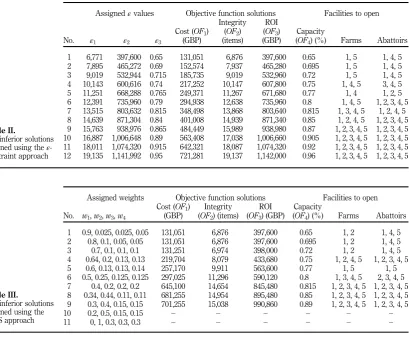
To obtain the non-inferior solutions, two solution approaches were used as described in Section 4. Table II shows a list of results of 12 non-inferior solutions obtained using the
ε-constraint approach by altering the incremental epsilon value of 1,124 between 6,771 and 19,137 for objective 2, of 67,672 between 397,600 and 1,141,992 for objective 3 and of 0.025 between 0.65 to 0.95 for objective 4, respectively. Table III shows the results of 11 non-inferior solutions obtained using the MWS approach where each objective was individually optimized as an optimal value ofOFU1;OFU2;OFU3;OFU4, respectively, by altering the scalarization values (w1,w2,w3,w4) in Equation (33).
It can be seen in Table III that there is no feasible solution if the weights for the first objective are assigned less than 0.3. This implies that decision makers may not ignore the importance of this result for the HMSC network design. Also shown in Table III, the non-inferior solutions can be obtained by opening the less number of abattoirs, compared to the results shown in Table II. For instance, the result for solution 5 shown in Table II, it requires
Assignedεvalues Objective function solutions Facilities to open
No. ε1 ε2 ε3
Cost (OF1) (GBP)
Integrity (OF2) (items)
ROI (OF3) (GBP)
Capacity
(OF4) (%) Farms Abattoirs
1 6,771 397,600 0.65 131,051 6,876 397,600 0.65 1, 5 1, 4, 5
2 7,895 465,272 0.69 152,574 7,937 465,280 0.695 1, 5 1, 4, 5
3 9,019 532,944 0.715 185,735 9,019 532,960 0.72 1, 5 1, 4, 5
4 10,143 600,616 0.74 217,252 10,147 607,800 0.75 1, 4, 5 3, 4, 5
5 11,251 668,288 0.765 249,371 11,267 671,680 0.77 1, 4 1, 2, 5
6 12,391 735,960 0.79 294,938 12,638 735,960 0.8 1, 4, 5 1, 2, 3, 4, 5
[image:12.493.36.446.283.621.2]7 13,515 803,632 0.815 348,498 13,868 803,640 0.815 1, 3, 4, 5 1, 2, 4, 5 8 14,639 871,304 0.84 401,008 14,939 871,340 0.85 1, 2, 4, 5 1, 2, 3, 4, 5 9 15,763 938,976 0.865 484,449 15,989 938,980 0.87 1, 2, 3, 4, 5 1, 2, 3, 4, 5 10 16,887 1,006,648 0.89 563,408 17,038 1,006,660 0.905 1, 2, 3, 4, 5 1, 2, 3, 4, 5 11 18,011 1,074,320 0.915 642,321 18,087 1,074,320 0.92 1, 2, 3, 4, 5 1, 2, 3, 4, 5 12 19,135 1,141,992 0.95 721,281 19,137 1,142,000 0.96 1, 2, 3, 4, 5 1, 2, 3, 4, 5
Table II.
Non-inferior solutions obtained using theε -constraint approach
Assigned weights Objective function solutions Facilities to open
No. w1,w2,w3,w4
Cost (OF1) (GBP)
Integrity (OF2) (items)
ROI (OF3) (GBP)
Capacity
(OF4) (%) Farms Abattoirs
1 0.9, 0.025, 0.025, 0.05 131,051 6,876 397,600 0.65 1, 2 1, 4, 5
2 0.8, 0.1, 0.05, 0.05 131,051 6,876 397,600 0.695 1, 2 1, 4, 5
3 0.7, 0.1, 0.1, 0.1 131,251 6,974 398,000 0.72 1, 2 1, 4, 5
4 0.64, 0.2, 0.13, 0.13 219,704 8,079 433,680 0.75 1, 2, 4, 5 1, 2, 3, 4, 5
5 0.6, 0.13, 0.13, 0.14 257,170 9,911 563,600 0.77 1, 5 1, 5
6 0.5, 0.25, 0.125, 0.125 297,025 11,296 590,120 0.8 1, 3, 4, 5 2, 3, 4, 5 7 0.4, 0.2, 0.2, 0.2 645,100 14,654 845,480 0.815 1, 2, 3, 4, 5 1, 2, 3, 4, 5 8 0.34, 0.44, 0.11, 0.11 681,255 14,954 895,480 0.85 1, 2, 3, 4, 5 1, 2, 3, 4, 5 9 0.3, 0.4, 0.15, 0.15 701,255 15,038 990,860 0.89 1, 2, 3, 4, 5 1, 2, 3, 4, 5
10 0.2, 0.5, 0.15, 0.15 – – – – – –
11 0, 1, 0.3, 0.3, 0.3 – – – – – –
Table III.
Non-inferior solutions obtained using the MWS approach
1792
IMDS
117,9
three abattoirs, compared to the result for solution 5 shown in Table III that it requires two abattoirs at weightsw1¼0.6,w2¼0.13,w3¼0.13 andw4¼0.14. With this solution, it leads
to a maximal ROI of GBP563,600, a maximal integrity number of 9,911 items of Halal meat products and a maximal capacity utilization of 77 percent under the total investment cost of GBP257,170. The result shows that the MWS approach is more effective than the
ε-constraint approach for gaining a better solution.
It is noteworthy that in Tables II and III, the value of maximum ROI for the all solutions is more than the total cost which proves the feasibility in terms of economic costs of the proposed RFID-enabled HMSC after one-year period for the RFID implementation.
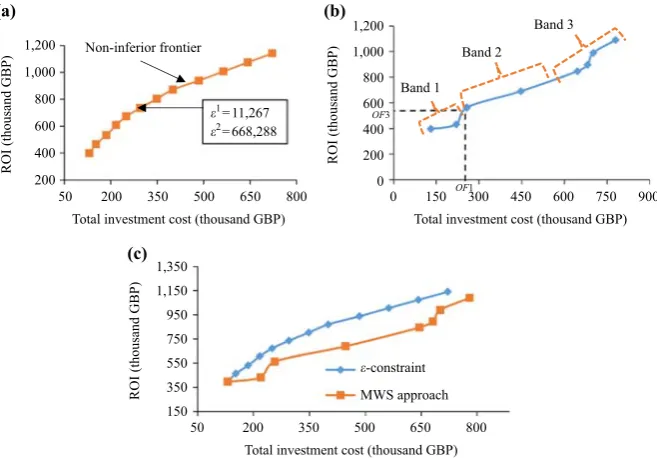
Figure 2 explains the computational results of solutions in a relation between the total minimal investment cost and the maximal ROI. These solutions are divided into three bands shown in Figure 2(b) according to the assigned weight values. In band 1, by adjusting the varying weight values in a range at 0.9, 0.025, 0.025, 0.05 and 0.64, 0.12, 0.12, 0.12, respectively; it gives the value of OF1 moderately increases from GBP131,051 to
GBP220,000 and the value ofOF3increases from GBP397,600 to GBP433,680, respectively.
This implies that the HMSC may be configured with the lower cost investment. In contrast, by adjusting the weight values in a range at 0.64, 0.12, 0.12, 0.12 and 0.5, 0.25, 0.125, 0.125, respectively; it gives the value ofOF1a moderate increase from GBP220,000
to GBP645,000 and the value of OF3 increases from GBP433,680 to GBP845,480,
respectively; this implies that the HMSC is configured with a compromised solution (i.e. solution 5 in Table III). Similarly, shown in band 3, the HMSC is configured with the higher ROI. A number of solutions were also identified and these results are placed in the middle of the non-inferior frontier shown in Figure 2(a). For instance, by giving an assigning ofε1¼11,267 andε2¼668,288, it yields a total investment cost of GBP249,938
and a ROI of GBP735,930. Figure 2(c) shows comparative results obtained under
Non-inferior frontier 1,200
1,000
800
600
400
200 0
0 150 Band 1
2
= 668,288 1
= 11,267
Band 2
OF1
OF3
Band 3
300 450 600 750 900 1,200
1,000
800
600
400
200
50 200 350
1,350
1,150
950
750
550
350
150
50 200 350 500 650 800
500 650 800
Total investment cost (thousand GBP)
(a) (b)
(c)
Total investment cost (thousand GBP)
Total investment cost (thousand GBP)
ROI (thousand GBP)
ROI (thousand GBP)
ROI (thousand GBP)
-constraint MWS approach
[image:13.493.57.386.362.591.2]Notes: (a) The -constraint approach; (b) the MWS approach; (c) the -constraint and the MWS approaches
Figure 2.
ROI in relation to the total investment cost
1793
RFID-enabled
HMSC network
design
the same constraints using the ε-constraint and the MWS approaches, respectively. It gives non-linear results of the ROI in response to the total investment cost. Figure 2(c) shows the total investment cost of GBP131,000 leading to the ROI of GBP397,600 using both approaches. After this point, the ROI increases over the increase of the total investment cost. Nevertheless, the ROI does not increase significantly if the total investment cost increases up to GBP220,000, but it increases sharply after the total investment cost increases more GBP220,000 using the MWS approach. By comparison, the ROI increases significantly over the increase of the total investment cost using the
ε-constraint approach.
To design the HMSC network, decision makers often need to find a solution based on a number of alternative possibilities using a decision-making approach. To this aim, the Max-Min approach was applied. Based on this approach, solution 1 (shown in Table III) is determined as the best solution, where WrefOF
1 ¼0:5;W
ref
OF2 ¼0:5; W
ref
OF3 ¼0 andW
ref
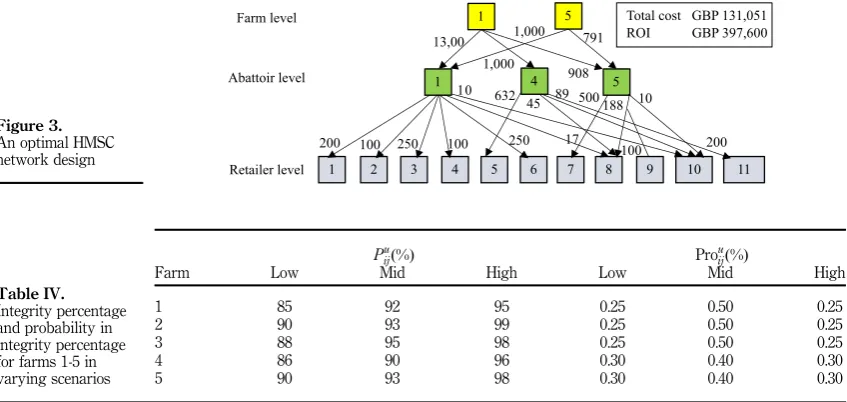
OF4¼0, i.e. in this case the decision maker seeks a compromised solution based on a cost/integrity-oriented HMSC network design. Figure 3 demonstrates an example of the established HMSC network design based on solution 1 which was obtained withw1¼0.9,
w2¼0.025,w3¼0.025 andw4¼0.05. This network design includes an establishment of
two farms which are located in Warwickshire and Leicestershire and three abattoirs which are located in Warwick, Birmingham and Norfolk, respectively. Figure 3 also illustrates the optimal quantity flow of Halal meat products from farms to abattoirs and from abattoirs to retailers. It shows that farm 1 is requested to supply 1,000 livestock to abattoir 5 which supplies 500 Halal meat products to retailer 7; 188 Halal meat products to retailer 8; 100 Halal meat products to retailer 9; and 10 Halal meat products to retailer 10, respectively.
5.2 Results of the stochastic model
Table IV shows a sample of varying integrity percentages and probability in response to each of integrity percentage by assigning a value from low to high levels associated with five farms based on 243 scenarios (35) as a case study. For instance, the integrity
100 Farm level
Abattoir level
Retailer level 1 2 3 4 5 6 7 8 9 10 11
4
1 5
791
1,000
1 5
13,00 1,000
908
250
100 100 250 17 200
200
10 632 89
45 500188 10
[image:14.493.22.446.414.615.2]Total cost GBP 131,051 ROI GBP 397,600
Figure 3.
An optimal HMSC network design
Puijð Þ% Prouijð Þ%
Farm Low Mid High Low Mid High
1 85 92 95 0.25 0.50 0.25
2 90 93 99 0.25 0.50 0.25
3 88 95 98 0.25 0.50 0.25
4 86 90 96 0.30 0.40 0.30
5 90 93 98 0.30 0.40 0.30
Table IV.
Integrity percentage and probability in integrity percentage for farms 1-5 in varying scenarios
1794
IMDS
117,9
percentages of the farmiin scenario 1 is (85, 90, 88, 86, 90). And the associated probability in scenario 1 is (0.25, 0.25, 0.25, 0.30, 0.30). Then, the scenario probability (Probξ) is 0.25×0.15×0.15×0.25×0.25¼0.0003515625.
Table V shows the results of a set of non-inferior solutions based on the stochastic model using theε-constraint approach. It shows that solution 1 has a maximal ROI of GBP397,611, a maximal integrity number of 7,634 Halal meat products, a maximal capacity utilization of 65 percent and a minimal total investment cost of GBP147,094; it gives two farms and three abattoirs that need to be opened for the specified HMSC network.
Figure 4 shows the values of objective function seeking for maximization of the integrity number of Halal meat products based on solution 5 which has the 12 selected scenarios. As shown in Figure 4, in scenario 12, it yields the highest value of OF2¼12,698 Halal meat products. By contrast, in scenario 1, it yields the
lowest value ofOF2¼10,984 Halal meat products. It is noted in Figure 4 that by altering
the integrity percentage of Halal meat products, the capacity utilization (percent) varies. For instance, with a decrease of the average integrity percentage by 5 percent in scenario 1, the integrity number of Halal meat products decreases by 3.3 percent only. In scenario 12, with an increase of the average integrity percentage to 5 percent, it leads to 2.2 percent increase in the integrity number of Halal meat products. This is because the result was obtained by optimizing four conflicting objectives at a time as a compromised solution.
Assignedεvalues Values of objective function Facilities open
No. ε1 ε2 ε3
Cost (OF1) (GBP)
Integrity (OF2) (items)
ROI (OF3) (GBP)
Capacity
(OF4) (%) Farm Abattoir
1 6,771 397,600 0.65 147,094 7,634 397,611 0.65 1, 5 1, 4, 5
2 7,895 465,272 0.69 178,104 8,682 465,291 0.7 1, 4, 5 1, 4, 5
3 9,019 532,944 0.715 206,143 9,717 532,971 0.71 1, 4, 5 1, 4, 5
4 10,143 600,616 0.74 236,143 10,750 600,651 0.755 1, 4, 5 1, 4, 5
5 11,251 668,288 0.765 293,004 11,791 668,315 0.775 1, 3, 4, 5 1, 4, 5
6 12,391 735,960 0.79 356,042 12,914 735,961 0.855 1, 2, 3, 4, 5 1, 4, 5
7 13,515 803,632 0.815 356,042 12,914 735,961 0.815 1, 3, 4, 5 1, 3, 5
8 14,639 871,304 0.84 513,414 15,057 871,332 0.9 1, 2, 3, 4, 5 1, 3, 4
[image:15.493.103.345.486.610.2]9 15,763 938,976 0.865 596,544 15,882 938,983 0.95 1, 2, 3, 4, 5 1, 2, 3
Table V.
Results of a set of non-inferior solutions of the stochastic model
10,000 10,500 11,000 11,500 12,000 12,500 13,000
OF
2
(Items)
S0 S1 S2 S3 S4 S5 S6 S7 S8 S9 S10 S11 S12
Scenario Corresponding scenario
OF2= 11,251 Base case
2.2%
–3.3%
Figure 4.
The value ofOF2in response to each of the selected integrity scenarios
1795
RFID-enabled
HMSC network
design
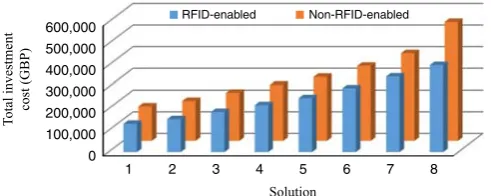
5.3 The HMSC network design with and without the RFID implementation: a comparison Figure 5 shows the comparative result of the total investment cost of the HMSC network with or without the RFID implementation based on the eight non-inferior solutions obtained from the RFID-based HMSC multi-objective model and the non-RFID-based HMSC model. It can be seen in Figure 5 that it leads to a decrease in the total investment cost of an average GBP50,552 after a year period of the RFID implementation into the HMSC network, compared to the same HMSC network without the RFID implementation. This decrease is a result for the elimination of several manual operations. As shown in Figure 5, for solution 1, it yields a total investment cost of GBP158,555 of the non-RFID-based HMSC network compared to a total investment cost of GBP131,051 of the RFID-based HMSC network. For solution 5, it yields an average decrease in difference in the total investment cost of GBP45,068 after the RFID implementation. The result shows that the RFID implementation for the HMSC network is economically feasible.
6. Conclusions
In this paper, a deterministic model using the multi-objective approach was developed and used for examining the economic feasibility of a proposed RFID-based HMSC network with respect to minimizing the total investment cost, maximizing the average integrity of Halal meat products, maximizing the ROI and maximizing the capacity utilization of farms and abattoirs. Furthermore, a stochastic programming model was also developed for investigating the effect of varying integrity percentage that affects the number of Halal meat products of the HMSC network. Two solution approaches, which are theε-constraint approach and the MWS approach, were applied and two sets of non-inferior solutions were generated and compared based on the developed multi-objective model. The Max-Min approach was proposed to select the best non-inferior solution. A case study was used for demonstrating the applicability of the developed models and a comparison of computational results based on the deterministic model and the stochastic model are presented in the paper. The conclusion shows that the proposed RFID-based HMSC is economically feasible and it leads to a decrease in the total investment cost of an average GBP50,552 after a year period. The developed models can also be useful for determining a cost-effective design of a HMSC network.
A number of other avenues are recommended to improve the developed multi-objective model such as exploring the HMSC network design considering different types of uncertainties (e.g. costs, demands and capacities of related facilities) and transportation means. Also, environmentalism has been becoming increasingly a significant global problem in the present century. Thus, the presented model could be extended to include the environmental aspects as an objective function.
0 100,000 200,000 300,000 400,000 500,000 600,000
T
o
tal investment cost (GBP)
1 2 3 4 5 6 7 8
Solution
[image:16.493.151.397.515.613.2]RFID-enabled Non-RFID-enabled
Figure 5.
Comparative results of the total investment cost between the non-RFID-based HMSC and the RFID-based HMSC
1796
IMDS
117,9
References
Al-Othman, W.B.E., Lababidi, H.M.S., Alatiqi, I.M. and Al-Shayji, K. (2008),“Supply chain optimization of petroleum organization under uncertainty in market demands and prices”,European Journal of Operational Research, Vol. 189 No. 3, pp. 822-840.
Barge, P., Gay, P., Merlino, V. and Tortia, C. (2014),“Item-level radio-frequency identification for the traceability of food products: application on a dairy product”,Journal of Food Engineering, Vol. 125, pp. 119-130.
Barros, A.I., Dekker, R. and Scholten, V. (1998),“A two-level network for recycling sand: a case study”,
European Journal of Operational Research, Vol. 110 No. 2, pp. 199-214.
Basu, M. (2004), “An interactive fuzzy satisfying method based on evolutionary programming technique for multi-objective short-term hydrothermal scheduling”, Electric Power Systems Research, Vol. 69 Nos 2-3, pp. 277-285.
Beamon, B.A. (2000),“A multi-objective approach to simultaneous strategic and operational planning in supply chain design”,Omega, Vol. 28 No. 5, pp. 581-598.
Bhattacharya, R. and Bandyopadhyay, S. (2010), “Solving conflicting bi-objective facility location problem by NSGA II evolutionary algorithm”,International Journal of Advanced Manufacturing Technology, Vol. 51 Nos 1-4, pp. 397-414.
Birge, J.R. and Louveaux, F. (1997), Introduction to Stochastic Programming, Springer Series in Operations Research, Springer-Verlag, New York, NY.
Bojarski, A., Laínez, J.M., Espuña, A. and Puigjaner, L. (2009),“Incorporating environmental impacts and regulations in a holistic supply chains modeling: an LCA approach”,Computers and Chemical Engineering, Vol. 33 No. 10, pp. 1747-1759.
Bortolini, M., Faccio, M., Ferrari, M., Gamberi, M. and Pilati, F. (2016), “Fresh food sustainable distribution: cost, delivery time and carbon footprint three-objective optimization”,Journal of Food Engineering, Vol. 174, pp. 56-67.
Cakravastia, A., Toha, I.S. and Nakamura., N. (2002),“A two-stage model for the design of supply chain networks”,International Journal of Production Economics, Vol. 80 No. 3, pp. 231-248. Chen, C.-L. and Lee, W.-C. (2004),“Multi-objective optimization of multi-echelon supply chain networks,
with uncertain product demands and prices”,Computers and Chemical Engineering, Vol. 28 Nos 6-7, pp. 1131-1144.
Chen, Y.-Y., Wang, Y.-J. and Jan, J.-K. (2014),“A novel deployment of smart cold chain system using 2G-RFID-Sys”,Journal of Food Engineering, Vol. 141, pp. 113-121.
Cheshmehgaz, H.R., Desa, M.I. and Wibowo., A. (2013),“A flexible three-level logistic network design considering cost and time criteria with a multi-objective evolutionary algorithm”,Journal of Intelligent Manufacturing, Vol. 24 No. 2, pp. 277-293.
Chibeles-Martins, N., Pinto-Varela, T., Barbósa-Póvoa, A.P. and Novais, A.Q. (2012),“A simulated annealing algorithm for the design and planning of supply chains with economic and environmental objectives”,Computer Aided Chemical Engineering, Vol. 30, pp. 21-25.
Coello, C.A.C., Lamont, G.B. and Veldhuisen, D.A.V. (2007), Evolutionary Algorithms for Solving Multi- Objective Problems, Springer.
Deb, K. (2001), Multi-Objective Optimization using Evolutionary Algorithms, John Wiley & Sons, New York, NY.
Ding, H., Benyoucef, L. and Xie., X. (2006), “A simulation-based multi-objective genetic algorithm approach for networked enterprises optimization”, Engineering Applications of Artificial Intelligence, Vol. 19 No. 6, pp. 609-623.
Ehrgott, M. (2005),Multicriteria Optimization, 2nd ed., Springer, New York, NY.
Expósito, I., Gay-Fernández, J.A. and Cuiñas, I. (2013),“A complete traceability system for a wine supply chain using radio-frequency identification and wireless sensor networks”,
IEEE Antennas and Propagation Magazine, Vol. 55 No. 2, pp. 255-267.
1797
RFID-enabled
HMSC network
design
Gen, M. and Cheng, R. (1997), Genetic Algorithms and Engineering Design, John Wiley & Sons, New York, NY.
Giadaa, L.S., Lucab, S., Rosaa, M. and Marioa, E. (2016),“Predictive shelf life model based on RF technology for improving the management of food supply chain: a case study”,International Journal of RF Technologies, Vol. 7 No. 1, pp. 31-42.
Guilléna, G., Melea, F.D., Bagajewiczb, M.J., Espuña, A. and Puigjanera, L. (2005),“Multiobjective supply chain design under uncertainty”,Chemical Engineering Science, Vol. 60 No. 6, pp. 1535-1553. Harris, I., Mumford, C.L. and Naim, M.M. (2014),“A hybrid multi-objective approach to capacitated
facility location with flexible store allocation for green logistics modeling”,Transportation Research Part E, Vol. 66, pp. 1-22.
Hiremath, N.C., Sahu, S. and Tiwari, M.K. (2013),“Multi objective outbound logistics network design for a manufacturing supply chain”,Journal of Intelligent Manufacturing, Vol. 24 No. 6, pp. 1071-1084. Halal Meat Committee (HMC) UK (2014), available at: www.halalhmc.org/;
www.halalhmc.org/certified-outlets.htm/ (accessed October 26, 2014).
Hou, J.L. and Huang, C.H. (2006),“Quantitative performance evaluation of RFID applications in the supply chain of the printing industry”,Industrial Management & Data Systems, Vol. 106 No. 1, pp. 96-120.
Jayaraman, V., Guige, V.D.R. and Srivastava, R. (1999), “A closed-loop logistics model for manufacturing”,Journal of the Operational Research Society, Vol. 50 No. 2, pp. 497-508. Kannan, G., Sasikumar, P. and Devika, K. (2012),“A genetic algorithm approach for solving a closed
loop supply chain model: a case of battery recycling”,Applied Mathematical Modelling, Vol. 34 No. 3, pp. 655-670.
Kelepouris, T., Pramatari, K. and Doukidis, G. (2007),“RFID‐enabled traceability in the food supply chain”,Industrial Management & Data Systems, Vol. 107 No. 2, pp. 183-200.
Krikke, H., Van Harten, R. and Schuur, P.C. (1999),“Reverse logistic network re-design for copiers”,
OR Spektrum, Vol. 21, pp. 381-409.
Lai, Y.L. and Hwang, C.L. (1992),Fuzzy Mathematical Programming, 1st ed., Springer, Berlin. Lee, D. and Dong, M. (2009), “Dynamic network design for reverse logistics operations under
uncertainty”,Transportation Research Part E, Vol. 451 No. 1, pp. 61-71. Lodhi, A. (2009),Understanding Halal Food Supply Chain, 1st ed., HFRC UK, London.
Lu, B.H., Bateman, R.J. and Cheng, K. (2006), “RFID enabled manufacturing: fundamentals, methodology and application perspectives”, International Journal of Agile Systems and Management, Vol. 1 No. 1, pp. 73-92.
Manos, B. and Manikas, I. (2010), “Traceability in the Greek fresh produce sector: drivers and constraints”,British Food Journal, Vol. 112 No. 6, pp. 640-652.
Mohammed, A. and Wang, Q. (2015),“Integrity of an RFID-enabled HMSC network”,Proceedings of the Third International Conference on Digital Enterprise and Information Systems,Shenzhen, pp. 79-86. Mohammed, A. and Wang, Q. (2017),“The fuzzy multi-objective distribution planner for a green meat
supply chain”,International Journal of Production Economics, Vol. 184, pp. 47-58.
Nath, B., Reynolds, F. and Want, R. (2006), “RFID technology and applications”,IEEE Pervasive Computing, Vol. 5, pp. 22-24.
Niknamfar, A.H. (2015),“Multi-objective production-distribution planning based on vendor-managed inventory strategy in a supply chain”,Industrial Management & Data Systems, Vol. 115 No. 6, pp. 1086-1112.
Nozick, L.K. and Turnquist, M.A. (2001),“A two-echelon inventory allocation and distribution center location analysis”,Transportation Research Part E, Vol. 37 No. 6, pp. 425-441.
Rafique, M.Z., Ab Rahman, M.N., Saibani, N., Arsad, N. and Saadat, W. (2016), “RFID impacts on barriers affecting lean manufacturing”,Industrial Management & Data Systems, Vol. 116 No. 8, pp. 1585-1616.
1798
IMDS
117,9
Shankar, B.L., Basavarajappa, S., Chen, J.C.H. and Kadadevaramath, R.S. (2013), “Location and allocation decisions for multi-echelon supply chain network– a multi objective evolutionary approach”,Expert Systems with Applications, Vol. 40 No. 2, pp. 551-562.
Shen, Z.J. (2006), “A profit maximizing supply chain network design model with demand choice flexibility”,Operations Research Letters, Vol. 34 No. 6, pp. 673-682.
Shen, Z.J., Coullard, C. and Daskin, M. (2003), “A joint location-inventory model”,Transportation Science, Vol. 37 No. 1, pp. 40-55.
Shen, Z.-J.M. (2007),“Integrated supply chain design models: a survey and future research directions”,
Journal of Industrial and Management Optimization, Vol. 3 No. 1, pp. 1-27.
So Park, K., Koh, C.E. and“Ted”Nam, K. (2010),“Perceptions of RFID technology: a cross-national study”,Industrial Management & Data Systems, Vol. 110 No. 5, pp. 682-700.
Talaei, M., Farhang, B., Pishvaee, M.S., Bozorgi-Amiri, A. and Gholamnejad, S. (2015),“A robust fuzzy optimization model for carbon-efficient closed-loop supply chain network design problem: a numerical illustration in electronics industry”,Journal of Cleaner Production, Vol. 15 No. 1, pp. 959-6526.
Teimoury, E., Nedaei, H., Ansari, S. and Sabbaghi, M. (2013),“A multi-objective analysis for import quota policy making in a perishable fruit and vegetable supply chain: a system dynamics approach”,Computers and Electronics in Agriculture, Vol. 93, pp. 37-45.
Tzeng, G.-T., Hung, Y.-M. and Chang, M.-L. (2006),“Multiple objective planning for production and distribution model of supply chain: case of bicycle manufacturer”,Journal of Scientific and Industrial Research, Vol. 65, pp. 309-320.
Vahdani, B., Tavakkoli-Moghaddam, R., Modarres, M. and Baboli, A. (2012),“Reliable design of a forward/reverse logistics network under uncertainty: a robust-M/M/c queuing model”,
Transportation Research Part E, Vol. 48 No. 6, pp. 1152-1168.
Villegas, J.G., Palacios, F. and Medaglia, A.L. (2006), “Solution methods for the bi-objective (cost-coverage) unconstrained facility location problem with an illustrative example”,Annals of Operations Research, Vol. 147 No. 1, pp. 109-141.
Wang, Q., McIntosh, R. and Brain, B. (2010),“A new-generation automated warehousing capability”,
International Journal of Computer Integrated Manufacturing, Vol. 23 No. 6, pp. 565-573. Zailani, S., Arrifin, Z., Abd Wahid, N., Othman, R. and Fernando, Y. (2010),“Halal traceability and
halal tracking systems in strengthening halal food supply chains for food industry in Malaysia (a review)”,Journal of Food Technology, Vol. 8 No. 3, pp. 74-81.
Zhang, Y., Zhang, G., Du, W., Wang, J., Ali, E. and Sun, S. (2015),“An optimization method for shopfloor material handling based on real-time and multi-source manufacturing data”, International Journal of Production Economics, Vol. 165, pp. 282-292.
Zhong, R.Y., Dai, Q.Y., Qu, T., Hu, G.J. and Huang, G.Q. (2013),“RFID-enabled real-time manufacturing execution system for mass-customization production”, Robotics and Computer-Integrated Manufacturing, Vol. 29 No. 2, pp. 283-292.
Zulfakar, M.H., Jie, F. and Chan, C. (2012),“Halal food supply chain integrity: from a literature review to a conceptual framework”,Proceeding of the 10th ANZAM Operations Supply Chain and Service Management,Melbourne, pp. 1-23.
Corresponding author
Ahmed Mohammed can be contacted at: [email protected]
For instructions on how to order reprints of this article, please visit our website: www.emeraldgrouppublishing.com/licensing/reprints.htm
Or contact us for further details:[email protected]
1799
RFID-enabled
HMSC network
design
This article has been cited by:
1. ZhongDr Ray Y., Dr Ray Y. Zhong, TanProfessor Kim, Professor Kim Tan, BhaskaranProfessor Gopalakrishnan, Professor Gopalakrishnan Bhaskaran. 2017. Data-driven food supply chain management and systems. Industrial Management & Data Systems117:9, 1779-1781. [Citation] [Full Text] [PDF]