warwick.ac.uk/lib-publications
Original citation:
Guo, Weisi, Deng, Yansha, Li, Bin, Zhao, Chenglin and Nallanathan, Arumugam. (2016)
Eavesdropper localization in random walk channels. IEEE Communications Letters .
Permanent WRAP URL:
http://wrap.warwick.ac.uk/80322
Copyright and reuse:
The Warwick Research Archive Portal (WRAP) makes this work by researchers of the
University of Warwick available open access under the following conditions. Copyright ©
and all moral rights to the version of the paper presented here belong to the individual
author(s) and/or other copyright owners. To the extent reasonable and practicable the
material made available in WRAP has been checked for eligibility before being made
available.
Copies of full items can be used for personal research or study, educational, or not-for profit
purposes without prior permission or charge. Provided that the authors, title and full
bibliographic details are credited, a hyperlink and/or URL is given for the original metadata
page and the content is not changed in any way.
Publisher’s statement:
“© 2016 IEEE. Personal use of this material is permitted. Permission from IEEE must be
obtained for all other uses, in any current or future media, including reprinting
/republishing this material for advertising or promotional purposes, creating new collective
works, for resale or redistribution to servers or lists, or reuse of any copyrighted component
of this work in other works.”
A note on versions:
The version presented here may differ from the published version or, version of record, if
you wish to cite this item you are advised to consult the publisher’s version. Please see the
‘permanent WRAP url’ above for details on accessing the published version and note that
access may require a subscription.
Eavesdropper Localization
in Random Walk Channels
Weisi Guo
1, Yansha Deng
2, Bin Li
3, Chenglin Zhao
3, Arumugam Nallanathan
2Abstract—Eavesdroppers are notoriously difficult to detect and
locate in traditional wireless communication systems, especially if they are silent. We show that in molecular communications, where information molecules undergo random walk propagation, eavesdropper detection and localization is possible if the eaves-dropper is an absorbing receiver. This is due to the fact that the random walk process has a finite return probability and the eavesdropper is a detectable energy sink of which its location can be reverse estimated.
Index Terms—molecular communication, security.
I. INTRODUCTION
Molecular communications has gained significant research attention in recent years, providing an alternative and attractive way to communicate at small-scales and in biological environ-ments [1], [2]. Its applications include targeted drug delivery [1], [3], [4] and industrial monitoring [2]. In order for small devices to communicate in a secure manner [5], detection of eavesdroppers is important [6]. Yet, this area has received little attention and we believe this paper is the first to examine how to detect molecular communication eavesdroppers.
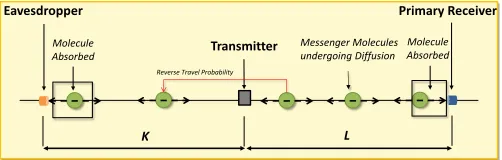
In traditional radio-frequency (RF) systems, silent eaves-droppers are notoriously difficult to detect and localize. Whilst unintentional circuit leakage radiation emitted by all RF sys-tems can aid detection [7], this is not possible for molecu-lar systems. In molecumolecu-lar communications, the data bearing molecules undergo diffusion (see Fig. 1), and one unique feature of the random walk (RW) channel is that the molecules have a finite probability to travel in an opposite direction without reflection. This property can be exploited to detect the silent eavesdropper.
In this paper, our contribution is that we exploit the aforementioned attributes of the RW channel to show that an eavesdropper can be detected and its position accurately estimated. We do so for an eavesdropper that is positioned at an arbitrary location and validate our closed-form expressions through molecule dynamic simulations. As far as we are aware, no existing molecular communications work has considered how to detect the presence of another receiver and locate it in a RW channel.
II. FORMULATION
The Brownian motion of information molecules can gen-erally be described by the RW model (see Fig. 1). In nor-mal diffusion, the probability density function (PDF) of the
1W. Guo is with the University of Warwick, UK. 2Y. Deng and A.
Nallanathan are with King’s College London, UK. 3B. Li and C. Zhao is
with Beijing University of Posts and Telecommunications, China. This work is funded by Royal Society and NSFC Grant IE150708.
Primary Receiver
Molecule Absorbed
Transmitter
Messenger Molecules undergoing Diffusion
Eavesdropper
Molecule Absorbed
K L
Messenger Molecules undergoing Diffusion
[image:2.612.313.564.177.257.2]Reverse Travel Probability
Fig. 1. Illustration of eavesdropping in 1-D molecular communication channel.
molecule position at displacementxfrom the transmitter and at any given timet is [8]
P(x, t) = 1
(4πDt)1/2exp
− x
2
4Dt
, (1)
where D is the diffusion coefficient (mass diffusivity). Throughout this paper, we consider the hitting distribution of one-dimensional (1-D) molecular motion with no more than two receivers, and generalization to higher dimensions with multiple receivers is left for future work. The 1-D equations are appropriate for modeling semi-infinite channels (i.e., pipes), where the length dimension is significantly larger than the width and height. As shown in Fig. 1, a transmitter lies atx= 0and emits information molecules that can be absorbed by fully absorbing receivers (modelled as boundary walls). We first present the molecule position PDF for symmetrical boundaries and then derive it for asymmetric boundaries.
A. Single Boundary
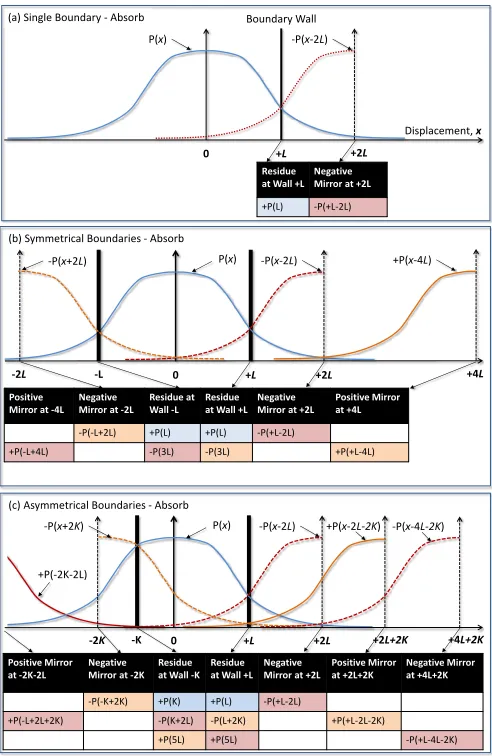
In the presence of a single boundary wall (primary receiver) atx= +L, the typical scenarios include: i) reflection (receiver rejects molecules, with PDF Pˆ), and ii) absorption (receiver absorbs molecules, with PDF Pˇ) at the boundary wall. By exploiting the linear property of the RW process, the PDF of the free molecule can be expressed as a superposition of the original boundary-free RW process P(x, t) and another RW process starting at a negative mirror locationP(x−2L, t)(see Fig. 2a), such that the PDF of thefree moleculesis [9]
ˆ
P1(x, L, t) =P(x, t) +P(x−2L, t) reflect,
ˇ
P1(x, L, t) =P(x, t)−P(x−2L, t) absorb.
(2)
the absorbed molecules up to time is
H1(L, t) = 1−
Z +L
x=−∞
ˇ
P1(x, L, t) dx=erfc
L
√
4Dt
, (3)
and the rate of molecule absorption is given by: h1(L, t) =
dH1(L, t)/dt=√4πDtL 3exp(−L
2/4Dt), which is well
estab-lished, and can be proven using simple initial and boundary conditions [10], but not easily expandable to multiple absorb-ing receivers.
B. Symmetrical Boundaries
In the presence of two symmetrically placed boundary walls at x=−L andx= +L, we analyse the PDF for reflection and absorption. The solutions are also well known and some of which can be found in [9]. As before, the PDF of the free molecule can be expressed as a superposition of the original boundary-free RW processP(x, t) and mirrored RW processes. As shown in Fig. 2b, the complication arises when the initial negative mirrors from x=±2L (for thex=±L
walls) will cause a reminder residue term at the opposite
x=∓L walls. The residue term at each wall is −P(3L, t). Hence, there is a need to create multiple positive mirrors that act to cancel each other out at x = ±4L. Using geometric reasoning, the negative images are at ±2L and the positive images at±4L. Hence, the free molecules’ PDF for symmetric absorbing walls is
ˇ
P2s(x, L, t) =
+∞
X
n=−∞
P(x+ 4nL, t)−P(x+ (4n−2)L, t)
.
(4)
Similarly, it can be shown that the free molecules’ PDF for symmetric reflecting walls is: Pˆ2s(x, L, t) =P
+∞
n=−∞P(x+
2nL, t). The PDF for multiple boundaries can be approximated by only considering the first few mirror terms (i.e., for small values ofn(e.g., n= -1, 0, 1)), if the absorbers are sufficiently far away from the transmitter.
C. Asymmetrical Absorbing Boundaries
Most existing applied physics and statistics research has focused on singular or symmetrical boundaries [9], and asym-metric boundaries are more complex and received less atten-tion in literature. In this paper, we consider the general case of two absorbing walls placed at x=-K and x=+L, where K6=L and the parameters can take on any values. The geometric reasoning (similar to the symmetric case [9]) is based on cancelling out the molecule residue at the walls, so that the boundary conditions of zero flux and zero concentration are maintained. This is achieved with the aid of negative and positive mirror pulses, which are transmitted from a cascade of mirrors, which extend in distance from 0 to +∞ on the positive axis (wall L side) and from 0 to -∞on the negative axis (wall K side). In effect, the complex diffusion equation is approximated by an infinite series of hitting distributions, and the mirrors form an intuitive analogy (see Fig.2c).
• the positive images (including original signal) are atx−
2n(L+K):P−∞+ ,+∞=P+∞
n=−∞P(x−2n[L+K], t);
Displacement, x
+L +2L
Boundary Wall
0
P(x) -P(x-2L)
(a) Single Boundary - Absorb
+L +2L
0
-P(x-2L) (b) Symmetrical Boundaries - Absorb
-2L -L -P(x+2L)
Positive Mirror at -4L
Negative Mirror at -2L
Residue at Wall -L
Residue at Wall +L
Negative Mirror at +2L
Positive Mirror at +4L
-P(-L+2L) +P(L) +P(L) -P(+L-2L)
+P(-L+4L) -P(3L) -P(3L) +P(+L-4L)
+4L
+P(x-4L)
+L +2L
0
P(x) -P(x-2L) (c) Asymmetrical Boundaries - Absorb
-2K -K -P(x+2K)
Positive Mirror at -2K-2L
Negative Mirror at -2K
Residue at Wall -K
Residue at Wall +L
Negative Mirror at +2L
Positive Mirror at +2L+2K
Negative Mirror at +4L+2K
-P(-K+2K) +P(K) +P(L) -P(+L-2L)
+P(-L+2L+2K) -P(K+2L) -P(L+2K) +P(+L-2L-2K)
+P(5L) +P(5L) -P(+L-4L-2K)
+2L+2K
+P(x-2L-2K) -P(x-4L-2K)
+4L+2K Residue
at Wall +L Negative Mirror at +2L
+P(L) -P(+L-2L)
+P(-2K-2L)
[image:3.612.315.561.57.435.2]P(x)
Fig. 2. Illustration of diffusion with mirrored processes and boundary residue cancellation for a) a single absorbing boundary, b) 2 symmetrical absorbing boundaries, and c) 2 asymmetrical absorbing boundaries.
• the negative images in the positive axis are atx+ 2[nL+
(n−1)K]: P−∞− ,−1 = −P+∞
n=+1P(x−2[nL+ (n−
1)K], t);
• the negative images in the negative axis are atx+2[nK+
(n−1)L]: P+1−,+∞ = −P−∞
n=−1P(x−2[nK + (n+
1)L], t);
The resulting free molecules’ PDF for asymmetric absorb-ing walls is
ˇ
P2a(x, L, K, t) =P−∞+ ,+∞+P−∞− ,−1+P − +1,+∞
=
+∞
X
n=−∞
P(x−xa, t)−
+∞
X
n=+1
P(x−xb, t)
−
−∞
X
n=−1
P(x−xc, t),
(5)
withxa = 2n(L+K),xb= 2
nL+ (n−1)K
, and xc =
2
nK+ (n+ 1)L
. It can be observed that Eq. (5) is reduced to the symmetric case given by Eq. (4) whenK=L.
0 0.02 0.04 0.06 0.08 0.1 0.12 0.14 0.16 0.18 0.2 Time [s] 0 0.01 0.02 0.03 0.04 0.05 0.06 0.07 0.08
Fraction of Total Absorbed Molecules
Theory L=2µm, K=3µm
Sim. L=2µm, K=3µm
Theory L=2µm, K=2µm
[image:4.612.59.280.63.190.2]Sim. L=2µm, K=2µm
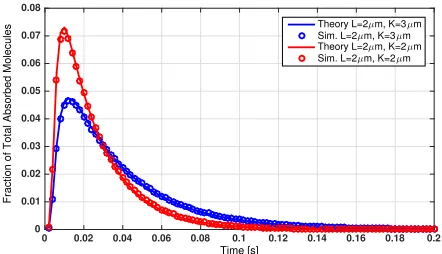
Fig. 3. The fraction of newly absorbed molecules at both receivers. Simulation parameters:D = 79.4µm2/s,L= 2µm,K= 3µm,T
s = 2ms, simulation
stepδt= 10−5s, and repetition is 1000.
absorbed by both receivers is derived as
H2a(x, L, K, t) = 1−
Z +L
−K
ˇ
P2a(x, L, K, t) dx
=1−
∞
X
n=−∞
1
2 erf
L−xa
√
4Dt
−erf
−K−xa
√ 4Dt ! + ∞ X n=1 1 2 erf
L−x
b
√
4Dt
−erf
−K−x
b √ 4Dt ! + −1 X
n=−∞
1
2 erf
L−xc
√
4Dt
−erf
−K−xc
√
4Dt
!
.
(6)
The expected fraction of newly absorbed molecules (both receivers) during any sampling time Ts can be derived as
h∗2a(x,L, K, t, t+Ts) =
H2a(x, L, K, t+Ts)−H2a(x, L, K, t),
(7)
where for the extremely smallTs, we derive the resulting rate
of absorption as
h2a(x, L, K, t) =
dH2a(L, K, t)
dt
= √ 1
4Dt3
+∞
X
n=−∞
(x−xa) exp
x−x
a √ 4Dt +L −K − +∞ X n=+1
(x−xb) exp
x−x
b √ 4Dt +L −K − −∞ X
n=−1
(x−xc) exp
x−xc
√ 4Dt +L −K . (8)
In Fig. 3, we validate our derived results for the expected fraction of newly absorbed molecules (both receivers) during any sampling time Ts in Eq. (7) via the molecule-based
simulation for both symmetrical and asymmetrical receivers. The details of particle-based simulation follows from [11].
III. DETECTION ANDLOCALIZATION
Having formulated the probability functions for RW in the presence of reflecting and absorbing receivers, this section will devise a scheme to detect the presence of an eaves-dropper (silent) and estimate its position. In general there are
two reasons why we select transmitter side detection of the eavesdropper. Molecule communication channels are generally one directional and receivers cannot affect the transmission strategy easily. Furthermore, the rate of molecules absorbed at the receiver is generally quite small in value and cannot easily detect a distant eavesdropper’s presence. For these two reasons, it is more practical to consider that the transmitter can determine to transmit secret information or not by itself based on the the received molecules at the transmitter side. At the transmitter (x= 0), it is clear that the presence of an eavesdropper will significantly reduce the number of returning molecules hitting it. If the molecules passing can be counted using a passive receiver without affecting the RW process, then the detection of the eavesdropper is possible. Passive receivers can be constructed using optical detectors, which can count and analyse molecules without capturing and consuming the molecules like chemical receivers do.
Let us assume that a transmitter (x = 0) with a passive detector, attempts to detect the molecules passing it after t
seconds since aδ(t)pulse release. In the presence of a single primary receiver, the detected number is Pˇ1(0, L, t) - see
Eq.(2). When a secondary eavesdropper is added, we showed that the resulting molecules detected is Pˇ2a(0, L, K, t) - see
Eq.(5). Therefore, the difference is given by
∆PTx= ˇP1(x= 0, L, t)−Pˇ2a(x= 0, L, K, t)
=
+∞
X
n=−∞,n6=0
−P(−xa, t) +
+∞
X
n=+2
P(−xb, t) +
−∞
X
n=−1
P(−xc, t),
(9)
where xa, xb, and xc are given below Eq. (5) and are all a
function of the eavesdroppers’s relative locationK.
A. First Order Approximation
By examining Eq. (9), one can see that it is an infinite sum of negative exponential functions, which decay in value rapidly with increased distance from the emitter (increased |n|). In order to obtain a tractable location estimator, we only consider the dominant term (nearest mirror, i.e.,|n|= 1), such that ∆PTx(x = 0) ≈ P(2K, t)−2P(2(L+K)). We note that within this, the P(2K, t) term dominates, provided that
Lis sufficiently large. Therefore, the estimated eavesdropper’s distance (K˜Tx) from the transmitter can be derived by solving for K in Eq. (9):
˜
KTx=
q
−Dtlog((4πDt)1/2∆P
Tx), (10)
where the timetcan be interpreted as the expected propagation time for diffusion from transmitter to receiver. The approxi-mate estiapproxi-mate of K is independent of the primary receiver’s locationL. The accuracy of this approximation is presented in terms of the distance estimation error (|K˜Tx−K|
K ) below. That
(a) (b)
Poor Approximation Regime
|n|=1 with single dominant term approximation
|n|=1,2: approximation High Count Difference
(c) (d)
|n|=1,2,3: approximation
Poor Approximation Regime
[image:5.612.54.294.57.381.2]Poor Approximation Regime
Fig. 4. Eavesdropper detection and localization results: (a) Distinguishability: ratio change in hitting probability∆PTx/Pˇ2a(0, L, t), and (b-d) Estimation
error that results from first order|n|= 1dominant term approximation,|n|= 1,2approximation, and|n|= 1,2,3approximation. Parameters:t= 0.1s, andL= 1mm.
B. Differentiability and Accuracy Results
The results shown in Fig. 4a show that a higher diffusion coefficient and a closer eavesdropper location (small K/L) will increase the ratio change ∆PTx/Pˇ2a(0, L, t), allowing
for higher signal variation and easier distinguishability of the eavesdropper’s existence from noise. This is intuitive, as an eavesdropper very close to the transmitter will absorb more molecules and its existence is easily detectable. The combined results in Fig. 4 show the following: a closer eavesdropper yields higher distinguishability (subplot a), but when the first order approximation and dominant term is applied for tractability reasons, a closer eavesdropper also causes higher error percentages (subplot b). Using exhaustive search, the location can be found for higher order approximations (subplot c-d), and the error is reduced significantly. Therefore, at low
K/L ratios, low complexity numerical methods need to be used to estimate the eavesdropper’s location (K) in the infinite series given in Eq.(9), which is the subject of future work. The rapid changes in error at low K values are purely a result of poor approximation accuracy due to only considering the first order.
In general, uncertainly in estimating the eavesdropper’s location from sensing the discrepancies from molecule count is subject to counting noise from the stochastic arrival of
molecules. It has been shown that the binomial distributed noise can be approximated to a Normal distribution [2]. We add the noise to the molecules counted by the sensor and the results in Fig. 4 show that the estimation error is quite sensitive to noise, but when using higher order approximations and for non-smallK/Lvalues, the error can be reduced to below 10%.
IV. CONCLUSIONS
In this paper, we demonstrated the potential of accurate passive eavesdropper detection and localization in molecular communications. Eavesdropper detection is made possible due to the fact that the random walk process has a finite return probability, and the existence of an absorbing eavesdropper acts as a detectable energy sink of which its location can be reverse estimated. The main contribution of the paper is the de-velopment of a detection scheme whereby the transmitter em-ploys a passive receiver to count discrepancies in the number of molecules passing. Eavesdroppers that are stationed close to the transmitter can be easily identified, but complex numerical calculations are needed to reverse-estimate its location. For a eavesdropper that is further away from the transmitter than the primary receiver (K > L), the location can be estimated using a simple first term approximation and achieve a high accuracy, especially for low diffusion coefficient values. Future work will focus on expanding the framework to consider multiple eavesdroppers in higher dimensions, and expanding the applicability to the field of graph theory with sinks.
REFERENCES
[1] I. Akyildiz, M. Pierobon, S. Balasubramaniam, and Y. Koucheryavy, “The internet of Bio-Nano things,” IEEE Communications Magazine, vol. 53, no. 3, pp. 32–40, Mar. 2015.
[2] N. Farsad, H. B. Yilmaz, A. Eckford, C.-B. Chae, and W. Guo, “A com-prehensive survey of recent advancements in molecular communication,”
IEEE Communications Surveys and Tutorials, 2016.
[3] L. Felicetti, M. Femminella, G. Reali, and P. Lio, “A molecular commu-nication system in blood vessels for tumor detection,” inACM Nanocom, 2014.
[4] Y. Chahibi, M. Pierobon, S. O. Song, and I. F. Akyildiz, “A molecular communication system model for particulate drug delivery systems,”
IEEE Transactions on Biomedical Engineering, vol. 60, no. 12, pp. 3468–3483, 2013.
[5] V. Loscri, C. Marchal, N. Mitton, G. Fortino, and A. Vasilakos, “Security and Privacy in Molecular Communication and Networking: Opportuni-ties and Challenges,” IEEE Transactions on Nanobioscience, vol. 13, no. 3, 2014.
[6] F. Dressler and F. Kargl, “Towards security in nano-communication: Challenges and opportunities,”Nano Communication Networks, vol. 3, no. 3, pp. 151–160, 2012.
[7] A. Mukherjee and A. Swindlehurst, “Detecting passive eavesdroppers in the MIMO wiretap channel,” in IEEE International Conference on Acoustics, Speech and Signal Processing (ICASSP), Mar. 2012. [8] W. Guo, T. Asyhari, N. Farsad, H. Yilmaz, A. Eckford, and C. Chae,
“Molecular communications: Channel model and physical layer tech-niques,”IEEE Wireless Communications, Aug. 2016.
[9] Y. Kantor and M. Kardar, “Anomalous diffusion with absorbing bound-ary,”Physics Review E, vol. 76, Dec. 2007.
[10] H. B. Yilmaz, A. C. Heren, T. Tugcu, and C.-B. Chae, “Three-Dimensional Channel Characteristics for Molecular Communications With an Absorbing Receiver,”IEEE Communications Letters, vol. 18, no. 6, 2014.
[11] Y. Deng, A. Noel, M. Elkashlan, A. Nallanathan, and K. C. Cheung, “Molecular communication with a reversible adsorption receiver,” in