
The availability, utilization and effectiveness of innovation policy instruments within public procurement
98
0
0
Full text
(2) ABSTRACT (English) Purpose: On average twelve percent of the GDP is spend in public procurement (OECD, 2017b, p.172). Due to the economic significance of public procurement, public procurement is frequently used to accomplish secondary policy objectives, such as innovation. Within the search for procuring innovation, demand-side instruments are often underrecognized. Through the development of a framework, and an instrument usage and effectiveness analysis, this thesis aims to provide knowledge about the availability, usage and effectiveness of demand-side public procurement innovation policy instruments. Design: The framework of available innovative demand-side instruments within public procurement is based on existent literature, existent case-studies and government websites. The categorization of the framework is based on Vedung’s sticks, carrots and sermons approach. The usage and effectiveness analysis are preformed using qualitative comparison analysis (QCA). The input is provided through a questionnaire filled out by 24 public procurements experts functioning as country representatives. Findings: Demand-side innovation instruments range from regulative (i.e. restrictive laws and set targets), to materialistic (i.e. R&D funding), to knowledge transfer (i.e. websites and training). The full framework is provided in the study. Different combinations of instruments lead to different effectiveness levels. Generally speaking, knowledge transfer instruments and materialistic instruments are preferred over regulative instruments. Within materialistic instruments, one is advised to choose instruments within the category R&D funding, whereas government declarations are a safe choice for knowledge transfer instruments. Value: The newly structured framework, based on the Vedung categorization, provides an overview of the availability of different innovation instruments that did not previously exist within the public procurement literature. Secondly, this research provides an overview of how often specific demand-side innovation instruments are available. Thirdly, this study minimizes the gap between potential and actual perceived benefits of demand-side innovation policy instruments within public procurement. Keywords: public procurement; innovation; policy; instruments; demand; effectiveness; usage; framework; QCA I.
(3) ABSTRACT (Nederlands) Doel: Gemiddeld wordt twaalf procent van het bruto binnenlands product uitgegeven aan openbare aanbestedingen (OECD, 2017b, p.172). Vanwege de grote economische impact van deze aanbestedingen wordt publieke inkoop steeds vaker ingezet voor secundaire beleidsdoeleinden zoals het inkopen van innovatie. Uit de literatuur blijkt dat de instrumenten om innovatie te stimuleren aan de aanbodzijde veelal bekend zijn, daarentegen zijn de mogelijke innovatie instrumenten aan de vraagzijde onvoldoende bestudeerd en erkend. Middels de ontwikkeling van een raamwerk en analyse van het instrumentgebruik en de effectiviteit, tracht deze studie inzicht te verschaffen in de beschikbaarheid, het gebruik en de effectiviteit van instrumenten binnen het innovatiebeleid aan de vraagzijde van overheidsopdrachten. Ontwerp: Het raamwerk van beschikbare innovatie instrumenten aan de vraagzijde van openbare aanbestedingen is gebaseerd op bestaande literatuur, casestudies en overheidspagina's van 23 verschillende landen. De categorisatie van het kader is gebaseerd op het model van Vedung, welke beleid categoriseert onder ‘stok, wortel en preek’, gebaseerd op de stok-wortel metafoor. De analyse voor gebruik en effectiviteit van de instrumenten is uitgevoerd middels een kwalitatieve vergelijking analyse (QCA). De data is verzameld uit een vragenlijst die verspreid is onder 24 experts in openbare aanbestedingen, welke functioneren als landvertegenwoordigers binnen dit onderzoek. Bevindingen: Innovatie instrumenten aan de vraagzijde variëren van regulerend (bv. beperkende wetgeving of gestelde doelen), materialistische instrumenten (bv. R&Dfinanciering) tot kennisoverdracht instrumenten (bv. websites en training). Het volledige kader is weergegeven in de studie. Verschillende combinaties van instrumenten leiden tot verschillende levels van effectiviteit. Over het algemeen hebben materialistische- en kennisoverdracht-instrumenten de voorkeur boven regulerende instrumenten. Binnen de materialistische instrumenten wordt de subcategorie R&D-financiering boven andere subcategorieën geprefereerd. Binnen de categorie kennisoverdracht worden actieplannen van de overheid als een veilig instrument beschouwt om innovatie te bevorderen. Waarde: Het nieuwe raamwerk, gebaseerd op de Vedung-categorisatie, biedt een categorisatie van de beschikbaarheid van innovatie-instrumenten aan de vraagzijde. Daarnaast geeft deze studie een indicatie van de frequentie van de beschikbaarheid van instrumenten ten II.
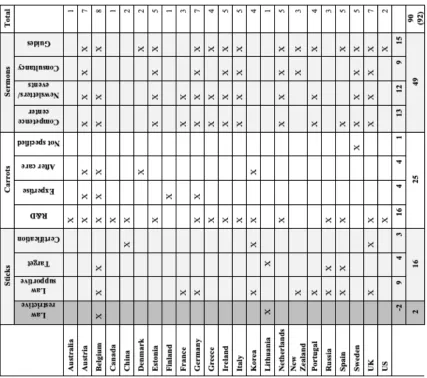
(4) opzichte van de andere instrumenten. Ten slotte minimaliseert deze studie de kloof tussen de potentiële voordelen die bediscussieerd worden in de literatuur en de werkelijke voordelen volgens vak professionals.. MANAGEMENT SUMMARY On average twelve percent of the GDP is spend in public procurement (OECD, 2017b, p.172). Due to the economic significance of public procurement, public procurement is frequently used to accomplish secondary policy objectives, such as innovation. Within the search for procuring innovation, demand-side instruments are often underrecognized. Demandside instruments are instruments in which the government (buyer) ensures the procurement of innovation. Based on literature, case-studies and government websites the following framework was developed, that indicates the different types of demand-side innovation instruments that could be used to increase innovations through public procurement. Sermons refer to the instruments within the category of knowledge transfer, whereas sticks are regulative instruments and carrots are materialistic instruments. This framework can be used by practitioners to spot gaps and opportunities within the current available innovation instruments of a government or public organisation.. This framework was constructed based on the information (case-studies, literature, and government websites) of 23 countries. Comparing the instruments availability throughout the III.
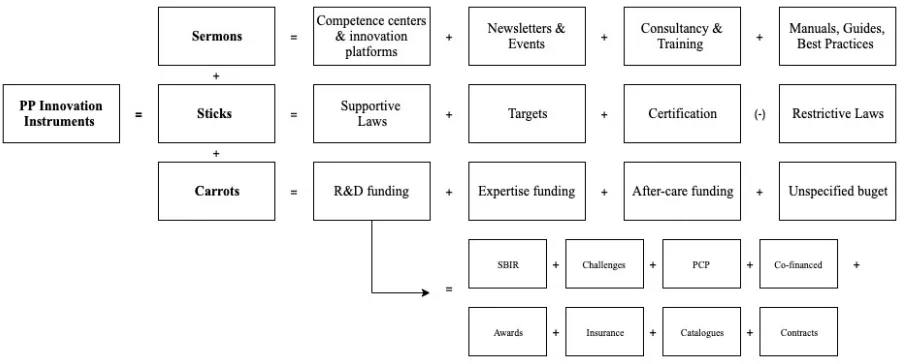
(5) 23 countries provides an overview of which instruments are used where and how often. A frequency count indicates that instruments in the sermon category are available twice as often, compared to sticks and carrots. Additionally, the subcategories of restrictive laws, targets, certification, expertise funding, aftercare funding and non-specified government budgets are not frequently found (in less than 5 out of the 23 countries). R&D funding and guides on the other hand, are often available in countries (in at least 15 out of 23 countries). Based on the framework, a questionnaire was developed, which formed the basis of the usage analysis of the instruments. The usage analysis is preformed using qualitative comparison analysis (QCA) where the data is provided through a questionnaire, filled out by 24 public procurements experts functioning as country representatives. The results include the combinations of instruments that are used by the most countries. For example, if materialistic instruments were used by countries to procure innovations, most countries used a combination of instruments within the categories of R&D funding, expertise funding, aftercare funding and unspecified budget funding. For R&D funding, however, no frequently occurrent pattern was found, as most countries use unique combinations of instruments. (𝟏) 𝒈𝒆𝒏𝒆𝒓𝒂𝒍 𝒊𝒏𝒔𝒕𝒓𝒖𝒎𝒆𝒏𝒕𝒔 𝒖𝒔𝒂𝒈𝒆 𝒑𝒂𝒕𝒕𝒆𝒓𝒏 = 𝑚𝑎𝑡𝑒𝑟𝑖𝑎𝑙𝑖𝑠𝑡𝑖𝑐 + 𝑟𝑒𝑔𝑢𝑙𝑎𝑡𝑖𝑣𝑒 + 𝑖𝑛𝑓𝑜𝑟𝑚𝑎𝑡𝑖𝑣𝑒 𝑖𝑛𝑠𝑡𝑟𝑢𝑚𝑒𝑛𝑡𝑠 (𝟐) 𝒓𝒆𝒈𝒖𝒍𝒂𝒕𝒊𝒗𝒆 𝒊𝒏𝒔𝒕𝒓𝒖𝒎𝒆𝒏𝒕𝒔 𝒖𝒔𝒂𝒈𝒆 𝒑𝒂𝒕𝒕𝒆𝒓𝒏 = 𝑟𝑒𝑠𝑡𝑟𝑖𝑐𝑡𝑖𝑣𝑒 𝑙𝑎𝑤𝑠 + 𝑠𝑢𝑝𝑝𝑜𝑟𝑡𝑖𝑣𝑒 𝑙𝑎𝑤𝑠 + 𝑡𝑎𝑟𝑔𝑒𝑡𝑠 + 𝑐𝑒𝑟𝑡𝑖𝑓𝑖𝑐𝑎𝑡𝑖𝑜𝑛 (𝟑) 𝒎𝒂𝒕𝒆𝒓𝒊𝒂𝒍𝒊𝒔𝒕𝒊𝒄 𝒊𝒏𝒔𝒕𝒓𝒖𝒎𝒆𝒏𝒕𝒔 𝒖𝒔𝒂𝒈𝒆 𝒑𝒂𝒕𝒕𝒆𝒓𝒏 = 𝑅&𝐷 𝑓𝑢𝑛𝑑𝑖𝑛𝑔 + 𝑒𝑥𝑝𝑒𝑟𝑡𝑖𝑠𝑒 𝑓𝑢𝑛𝑑𝑖𝑛𝑔 + 𝑎𝑓𝑡𝑒𝑟𝑐𝑎𝑟𝑒 𝑓𝑢𝑛𝑑𝑖𝑛𝑔 + 𝑢𝑛𝑠𝑝𝑒𝑐𝑖𝑓𝑖𝑒𝑑 𝑏𝑢𝑑𝑔𝑒𝑡𝑠 𝑓𝑢𝑛𝑑𝑖𝑛𝑔 (𝟒) 𝑹&𝑫 𝒇𝒖𝒏𝒅𝒊𝒏𝒈 𝒊𝒏𝒔𝒕𝒓𝒖𝒎𝒆𝒏𝒕𝒔 𝒖𝒔𝒂𝒈𝒆 𝒑𝒂𝒕𝒕𝒆𝒓𝒏 = 𝑢𝑛𝑖𝑞𝑢𝑒 𝑐𝑜𝑚𝑏𝑖𝑛𝑎𝑡𝑖𝑜𝑛𝑠 𝑝𝑒𝑟 𝑐𝑜𝑢𝑛𝑡𝑟𝑦 (𝟓) 𝒊𝒏𝒇𝒐𝒓𝒎𝒂𝒕𝒊𝒗𝒆 𝒊𝒏𝒔𝒕𝒓𝒖𝒎𝒆𝒏𝒕𝒔 𝒖𝒔𝒂𝒈𝒆 𝒑𝒂𝒕𝒕𝒆𝒓𝒏 = 𝑐𝑜𝑚𝑝𝑒𝑡𝑒𝑛𝑐𝑒 𝑐𝑒𝑛𝑡𝑒𝑟𝑠 & 𝑖𝑛𝑓𝑜𝑟𝑚𝑎𝑡𝑖𝑜𝑛 𝑝𝑙𝑎𝑡𝑓𝑜𝑟𝑚𝑠 + 𝑛𝑒𝑤𝑠𝑙𝑒𝑡𝑡𝑒𝑟𝑠 & 𝑒𝑣𝑒𝑛𝑡𝑠 + 𝑐𝑜𝑛𝑠𝑢𝑙𝑡𝑎𝑛𝑐𝑦 & 𝑡𝑟𝑎𝑖𝑛𝑖𝑛𝑔 + 𝑔𝑔𝑢𝑖𝑑𝑒𝑠 & 𝑚𝑎𝑛𝑢𝑎𝑙𝑠 + 𝑜𝑣𝑒𝑟𝑛𝑚𝑒𝑛𝑡 𝑑𝑒𝑐𝑙𝑎𝑟𝑎𝑡𝑖𝑜𝑛𝑠 & 𝑎𝑐𝑡𝑖𝑜𝑛 𝑝𝑙𝑎𝑛𝑠 Additionally, the usage analysis indicated discrepancies that managers should be aware of. First of all, the standard deviation of the usage variables was on average higher compared to the IV.
(6) standard deviation of effectiveness variables. This indicates that respondents are more unanimous about which instruments are effective, compared to which instruments are used. Consequently, one should focus on the instruments that are perceived as more effective instead of more used (i.e. one should be aware that there is a difference). On a similar note, the means of the effectiveness of instruments is also higher compared to the means of the usage of instruments. This indicates that there is still an opportunity for management to increase the usage towards the effectiveness levels. Lastly, there is a discrepancy between the indicated usage in the first and second questionnaire. Whereas the first questionnaire was solely filled in by highly ranked procurement experts, the second questionnaire was distributed irrespectively of the hierarchy. This indicates that there is discrepancy between the usage on top level and on second level. This calls for an increase in awareness of innovation instruments in lower parts of the organizational hierarchy. The effectiveness analysis was performed in a similar manner as the usage analysis. The analysis led to combinations of instruments that are perceived as most effective to increase the effectiveness of procurement of innovations, as well as instruments that are perceived as more effective compared to other instruments. The following blueprint indicates a simplified overview of the most effective instruments to increase procurement of innovations. First of all, materialistic (carrots) and knowledge transfer (sermons) instruments are preferred over the regulative instruments (sticks). Secondly, within the carrot categorization, R&D funding is preferred over the other sub-categories to achieve the highest effectiveness. Nevertheless, expertise funding and after care funding are favourable complements to R&D funding. When implementing the sticks categorization, supportive laws are preferable. Within sermons, many combinations can lead to an effective knowledge transfer, however, the presence of government declarations is the only categorization that always leads to high effectiveness. Lastly, some instruments are perceived as significantly more effective compared to others. It is advised to choose co-funding over small business innovation research (SBIR) or pre-commercial procurement, and co-funding, awards, challenges, and contracts over unsolicited proposals. Similarly, supportive laws and targets should be chosen before choosing for restrictive regulation.. V.
(7) MANAGEMENT SUMMARY (Nederlands) Gemiddeld wordt twaalf procent van het bruto binnenlands product uitgegeven aan openbare aanbestedingen (OECD, 2017b, p.172). Vanwege de grote economische impact van deze aanbestedingen wordt publieke inkoop steeds vaker ingezet voor secundaire beleidsdoeleinden zoals het inkopen van innovatie. Uit de literatuur blijkt dat de instrumenten om innovatie te stimuleren aan de aanbodzijde veelal bekend zijn, daarentegen zijn de mogelijke innovatie instrumenten aan de vraagzijde onvoldoende bestudeerd en erkend. Instrumenten aan de vraagzijde zijn instrumenten waarbij de overheid (als koper) de vraag voor de inkoop van innovatie delegeert (i.p.v. de aanbieder). Op basis van literatuur, casestudies en overheidswebsites is het volgende raamwerk ontwikkeld, dat de verschillende categorieën van innovatie instrumenten aan de vraagzijde weergeeft, die kunnen worden gebruikt om innovaties doormiddel van openbare aanbestedingen te vergroten. ‘Sermon’ verwijst naar de instrumenten die binnen de categorie kennisoverdracht vallen, ‘sticks’ zijn regulatieve instrumenten en ‘carrots’ zijn materialistische instrumenten. Dit raamwerk kan door vak professionals worden gebruikt om de huidige beschikbare innovatie instrumenten binnen de organisatie te vergelijken met het raamwerk, door zo nieuwe mogelijkheden te ontdekken.. VI.
(8) Dit raamwerk is opgebouwd uit literatuur, casestudies en overheidswebsites van 23 landen. Het vergelijken van de beschikbaarheid van de instrumenten in de 23 landen geeft een overzicht van welke instrumenten waar en hoe vaak gebruikt worden. Een frequentie-telling geeft aan dat ‘sermons’ twee keer zo vaak beschikbaar zijn in vergelijking met ‘sticks’ en ‘carrots’. Daarnaast komen de volgende subcategorieën weinig voor (in minder dan 5 van de 23 landen): beperkende wetten, targets, certificatie, expertise financiering, financiering van nazorg en de niet gespecificeerde overheidsbudgetten. R&D-financiering en handboeken zijn daarentegen vaak beschikbaar (in meer dan 15 van de 23 landen). Op basis van het raamwerk is een vragenlijst ontwikkeld die de basis vormt voor de analyse over het gebruik van de innovatie instrumenten. De analyse voor het gebruik van de instrumenten is uitgevoerd middels een kwalitatieve vergelijkingsanalyse (QCA). De data is verzameld uit een vragenlijst die verspreid is onder 24 experts in openbare aanbestedingen, welke functioneren als landvertegenwoordigers binnen dit onderzoek. De resultaten omvatten de combinaties van instrumenten die door de meeste landen worden gebruikt. Als landen bijvoorbeeld materialistisch instrumenten gebruiken om innovaties aan te schaffen, gebruikten de meeste landen een combinatie van R&D-financiering instrumenten, expertise financieringsinstrumenten, nazorg financiering en niet gespecificeerde budgetfinanciering. Binnen de R&D-financiering, daarentegen, wordt geen frequent patroon aan combinaties gevonden. De meeste landen gebruikten unieke combinaties van verscheidene instrumenten.. VII.
(9) (𝟏) 𝒂𝒍𝒈𝒆𝒎𝒆𝒏𝒆 𝒈𝒆𝒃𝒓𝒖𝒊𝒌𝒆𝒓𝒔𝒑𝒂𝒕𝒓𝒐𝒐𝒏 𝒗𝒂𝒏 𝒊𝒏𝒏𝒐𝒗𝒂𝒕𝒊𝒆 𝒊𝒏𝒔𝒕𝒓𝒖𝒎𝒆𝒏𝒕𝒆𝒏 = 𝑚𝑎𝑡𝑒𝑟𝑖𝑎𝑙𝑖𝑠𝑡𝑖𝑠𝑐ℎ + 𝑟𝑒𝑔𝑢𝑙𝑎𝑡𝑖𝑒𝑓 + 𝑖𝑛𝑓𝑜𝑟𝑚𝑎𝑡𝑖𝑒𝑓 (𝟐) 𝒈𝒆𝒃𝒓𝒖𝒊𝒌𝒆𝒓𝒔𝒑𝒂𝒕𝒓𝒐𝒐𝒏 𝒗𝒂𝒏 𝒓𝒆𝒈𝒖𝒍𝒂𝒕𝒊𝒆𝒗𝒆 𝒊𝒏𝒔𝒕𝒓𝒖𝒎𝒆𝒏𝒕𝒆𝒏 = 𝑏𝑒𝑝𝑒𝑟𝑘𝑒𝑛𝑑𝑒 𝑤𝑒𝑡𝑔𝑒𝑣𝑖𝑛𝑔 + 𝑠𝑢𝑝𝑝𝑜𝑟𝑡𝑒𝑛𝑑𝑒 𝑤𝑒𝑡𝑔𝑒𝑣𝑖𝑛𝑔 + 𝑡𝑎𝑟𝑔𝑒𝑡𝑠 + 𝑐𝑒𝑟𝑡𝑖𝑓𝑖𝑐𝑎𝑡𝑖𝑒 (𝟑)𝒈𝒆𝒃𝒓𝒖𝒊𝒌𝒆𝒓𝒔𝒑𝒂𝒕𝒓𝒐𝒐𝒏 𝒗𝒂𝒏 𝒎𝒂𝒕𝒆𝒓𝒊𝒂𝒍𝒊𝒔𝒕𝒊𝒔𝒄𝒉𝒆 𝒊𝒏𝒔𝒕𝒓𝒖𝒎𝒆𝒏𝒕𝒆𝒏 = 𝑅&𝐷 𝑓𝑖𝑛𝑎𝑛𝑐𝑖𝑒𝑟𝑖𝑛𝑔 + 𝑒𝑥𝑝𝑒𝑟𝑡𝑖𝑠𝑒 𝑓𝑖𝑛𝑎𝑛𝑐𝑖𝑒𝑟𝑖𝑛𝑔 + 𝑛𝑎𝑧𝑜𝑟𝑔 𝑓𝑖𝑛𝑎𝑛𝑐𝑖𝑒𝑟𝑖𝑛𝑔 + 𝑛𝑖𝑒𝑡 𝑔𝑒𝑠𝑝𝑒𝑐𝑖𝑓𝑖𝑐𝑒𝑒𝑟𝑑𝑒 𝑜𝑣𝑒𝑟ℎ𝑒𝑖𝑑𝑠𝑏𝑢𝑔𝑒𝑡𝑡𝑒𝑛 (𝟒) 𝒈𝒆𝒃𝒓𝒖𝒊𝒌𝒆𝒓𝒔𝒑𝒂𝒕𝒓𝒐𝒐𝒏 𝒗𝒂𝒏 𝑹&𝑫 𝒇𝒊𝒏𝒂𝒏𝒄𝒊𝒆𝒓𝒊𝒏𝒈 𝒊𝒏𝒔𝒕𝒓𝒖𝒎𝒆𝒏𝒕𝒆𝒏 = 𝑝𝑒𝑟 𝑙𝑎𝑛𝑑 𝑢𝑛𝑖𝑒𝑘𝑒 𝑐𝑜𝑚𝑏𝑖𝑛𝑎𝑡𝑖𝑒𝑠 𝑣𝑎𝑛 𝑣𝑒𝑟𝑠𝑐ℎ𝑖𝑙𝑙𝑒𝑛𝑑𝑒 𝑖𝑛𝑠𝑡𝑟𝑢𝑚𝑒𝑛𝑡𝑒𝑛 (𝟓) 𝒈𝒆𝒃𝒓𝒖𝒊𝒌𝒆𝒓𝒔𝒑𝒂𝒕𝒓𝒐𝒐𝒏 𝒗𝒂𝒏 𝒊𝒏𝒇𝒐𝒓𝒎𝒂𝒕𝒊𝒆𝒗𝒆 𝒊𝒏𝒔𝒕𝒓𝒖𝒎𝒆𝒏𝒕𝒆𝒏 = 𝑐𝑜𝑚𝑝𝑒𝑡𝑒𝑛𝑐𝑒 𝑐𝑒𝑛𝑡𝑒𝑟𝑠 & 𝑖𝑛𝑓𝑜𝑟𝑚𝑎𝑡𝑖𝑒 𝑝𝑙𝑎𝑡𝑓𝑜𝑟𝑚𝑠 + 𝑛𝑖𝑒𝑢𝑤𝑠𝑏𝑟𝑖𝑒𝑣𝑒𝑛 & 𝑒𝑣𝑒𝑛𝑒𝑚𝑒𝑛𝑡𝑒𝑛 + 𝑐𝑜𝑛𝑠𝑢𝑙𝑡𝑎𝑛𝑐𝑦 & 𝑡𝑟𝑎𝑖𝑛𝑖𝑛𝑔 + 𝑔𝑖𝑑𝑠𝑒𝑛 & ℎ𝑎𝑛𝑑𝑏𝑜𝑒𝑘𝑒𝑛 + 𝑎𝑐𝑡𝑖𝑒𝑝𝑙𝑎𝑛𝑛𝑒𝑛 𝑣𝑎𝑛 𝑑𝑒 𝑜𝑣𝑒𝑟ℎ𝑒𝑖𝑑 Naast de gebruikerspatronen van de innovatie instrumenten, gaf de analyse nog drie inzichten. Allereerst: de standaarddeviatie van de gebruiksvariabelen lag gemiddeld hoger in vergelijking met de standaarddeviatie van de effectiviteitsvariabelen. Dit geeft aan dat de respondenten het meer eens zijn over welke instrumenten effectief zijn dan dat ze hetzelfde gebruikerspatroon hebben. Bijgevolg moet men zich concentreren op de instrumenten die als effectief(er) worden beschouwd in plaats van de instrumenten die meer gebruikt worden (men moet zich ervan bewust zijn dat er een verschil is). Evenzo is het gemiddelde van de effectiviteit van de instrumenten ook hoger in vergelijking met het gemiddelde van het gebruik van het instrument. Dit geeft aan dat het management de mogelijkheid heeft om het gebruik van de instrumenten te verhogen naar de bijbehorende effectiviteitslevels. Ten slotte is er een discrepantie tussen het aangegeven gebruik van de instrumenten in de eerste en tweede vragenlijst. Waar de eerste vragenlijst uitsluitend werd ingevuld door hooggeplaatste inkoopdeskundigen werd de tweede vragenlijst ook onder lagere ranken verspreid. Het verschil in aangegeven gebruik geeft aan dat het inkoopmanagementteam tijd en energie moet steken in het toenemen van de bewustwordingen van het bestaan en gebruik van de innovatie instrumenten in de lagere delen van de organisatie hiërarchie.. VIII.
(10) De analyse voor effectiviteit van de instrumenten is uitgevoerd middels dezelfde methode als de gebruiksanalyse. De analyse leidde tot combinaties van instrumenten die als het meest effectief worden beschouwd, evenals instrumenten die als effectiever worden beschouwd in vergelijking tot andere instrumenten. De volgende blauwdruk geeft een vereenvoudigd overzicht weer van de meest effectieve instrumenten. Allereerst hebben materialistische (carrots) en kennisoverdracht (sermons) instrumenten de voorkeur boven regulerende instrumenten (sticks). Ten tweede heeft R&D-financiering binnen de carrots-categorie de voorkeur boven de andere subcategorieën. Financiering voor expertise en nazorg zijn echter een goede aanvulling op R&D-financiering. Wanneer instrumenten van de stick-categorisatie worden geïmplementeerd, hebben ondersteunende wetten de voorkeur.. Binnen sermons,. kunnen veel verschillende combinaties leiden tot effectieve kennisoverdracht, maar de aanwezigheid van overheidsverklaringen en actieplannen is de enige subcategorie die altijd leidt tot een hoge effectiviteit. Ten slotte worden sommige instrumenten als aanzienlijk effectiever beschouwd dan anderen. Zo wordt geadviseerd om cofinanciering te verkiezen boven ‘Small Business Innovation Research’ (SBIR) of ‘Pre-commercial Procurement’ (PCP). Awards, challenges, en contracten worden geprefereerd boven ongevraagde voorstellen (unsolicited proposals). Evenzo moeten ondersteunende wetten en doelen worden verkozen boven de beperkende regelgeving.. IX.
(11) Table of Contents ABSTRACT (ENGLISH). I. ABSTRACT (NEDERLANDS). II. MANAGEMENT SUMMARY. III. MANAGEMENT SUMMARY (NEDERLANDS). VI. LIST OF TABLES. XIV. LIST OF FIGURES. XV. LIST OF EQUATIONS. XV. LIST OF ABBREVIATIONS 1. 1.1 1.2. INTRODUCTION: INNOVATION WITHIN THE PUBLIC PROCUREMENT CONTEXT PUBLIC PROCUREMENT AS A NEW SOURCE OF INNOVATION RESEARCH OUTLINE: THE NEED FOR IDENTIFICATION AND MEASUREMENT OF DEMAND-SIDE. XVI 1 1. INNOVATION POLICY INSTRUMENTS WITHIN PUBLIC PROCUREMENT 1.3 THESIS OUTLINE: EXPLANATION OF EACH CHAPTER. 2 4. 2. CONCEPTUAL BACKGROUND: DEFINING AND CONCEPTUALIZING PUBLIC PROCUREMENT OF INNOVATIONS. 5. 2.1. DEFINITIONS: PROCUREMENT OF INNOVATIONS, INNOVATION, INNOVATION POLICY AND. INNOVATION INSTRUMENTS 2.2 STICKS, CARROTS AND SERMON ANALOGY AS CLASSIFICATION FOR INNOVATION POLICY INSTRUMENTS WITHIN PUBLIC PROCUREMENT 2.3 DEVELOPMENT STAGES OF PUBLIC PROCUREMENT AS CONSTRAIN FOR PROCUREMENT OF INNOVATION. 5 5 6. 3. STEP 1 – INTRODUCTION: LITERATURE STUDY ON EXISTENCE OF PUBLIC PROCUREMENT INNOVATION POLICY INSTRUMENTS FRAMEWORK. 7. 4. DESIGN: DEVELOPING A DEMAND-SIDE PUBLIC PROCUREMENT INNOVATION POLICY INSTRUMENTS FRAMEWORK. 8. 4.1. 8. DATA COLLECTION: EVIDENCE FROM SCIENTIFIC LITERATURE AND GOVERNMENT WEBSITES. X.
(12) 4.2 4.3. FOCUS GROUP: 23 COUNTRIES SELECTED FOR FRAMEWORK DEVELOPMENT FROM DATA TO FRAMEWORK DEVELOPMENT: CONSTANT COMPARISON ANALYSIS AND. 8 9. TRIANGULATION TO CATEGORIZE DATA INTO A DEVELOPED FRAMEWORK 4.4 FROM FRAMEWORK DEVELOPMENT TO CROSS-COMPARISON ANALYSIS: OCCURRENCES OF STICKS, CARROTS AND SERMONS CATEGORIES PROVIDE PATTERNS IN TERMS OF INSTRUMENT AVAILABILITY.. 10. 5.. 10. RESULTS OF LITERATURE ANALYSIS OF POLICY INSTRUMENTS. 5.1 STICKS: EXISTENCE OF REGULATORY INSTRUMENTS WITHIN THE AVAILABILITY FRAMEWORK 10 5.1.1 LAWS, TARGETS AND CERTIFICATION CONSTITUTE THE STICK CATEGORIZATION 10 5.1.2 WORLDWIDE AGREEMENTS AND DIRECTIVES THAT REGULATE PROCUREMENT OF INNOVATIONS 11 5.1.3 RESTRICTIVE LAWS: EXCLUSION FROM BIDDING AND NON-EXISTED INFRASTRUCTURE CONSTRAINTS PROCUREMENT OF INNOVATIONS 12 5.1.4 SUPPORTIVE LAWS: OBLIGATORY DISCLOSURE OF PROCUREMENT PLANS AND LEGISLATION OF ADDITIONAL DEMANDS SUPPORT PROCUREMENT OF INNOVATIONS 12 5.1.5 INCREASING PROCUREMENT OF INNOVATION THROUGH TARGET SETTING 13 5.1.6 CERTIFICATION: LABELING OF INNOVATIVE PRODUCTS AND SERVICES AS A STRATEGY TO PROVIDE ADVANTAGES THAT SUPPORT THE PROCUREMENT OF INNOVATIONS 14 5.2 CARROTS: EXISTENCE OF MATERIALISTIC INSTRUMENTS WITHIN THE AVAILABILITY FRAMEWORK 14 5.2.1 R&D FUNDING, EXPERTISE FUNDING, AFTER-CARE FUNDING AND NON-SPECIFIED GOVERNMENT BUDGETS CONSTITUTE THE CARROT CATEGORY 14 5.2.2 EUROPEAN COMMISSION INITIATIVES SUPPORT PROCUREMENT OF INNOVATIONS 15 5.2.3 R&D FUNDING: EXISTENCE OF MATERIALISTIC RESEARCH AND DEVELOPMENT INSTRUMENTS WITHIN THE AVAILABILITY FRAMEWORK 16 5.2.4 EXPERTISE FUNDING: INNOVATIVE CONSULTING REIMBURSEMENT TO SUPPORT INNOVATIVE IDEAS 20 5.2.5 AFTER CARE FUNDING: MATERIALISTIC RESOURCES FOR MARKET IMPLEMENTATION TO SPUR INNOVATION 20 5.2.6 SWEDEN’S BUDGET FOR INNOVATIONS WITHOUT A PRE-SPECIFIED PURPOSE AS AN INSTRUMENT TO INCREASE PROCUREMENT OF INNOVATIONS 21 5.3 SERMONS: EXISTENCE OF KNOWLEDGE TRANSFER INSTRUMENTS WITHIN THE AVAILABILITY FRAMEWORK 21 5.3.1 COMPETENCE CENTERS, NEWSLETTERS & EVENTS, CONSULTANCY & TRAINING, GUIDES CONSTITUTE THE SERMON CATEGORY 21 5.3.2 THE UNITED NATIONS DEVELOPMENT PROGRAM AND THE EUROPEAN COMMISSION TOOLS OFFER KNOWLEDGE TRANSFER INSTRUMENTS WORLDWIDE 22 5.3.3 COMPETENCE CENTERS AND INNOVATION PLATFORMS AS A STARTING POINT FOR ENCOURAGING INNOVATIONS THROUGH PROCUREMENT 22 5.3.4 DISTRIBUTIVE INSTRUMENTS SUCH AS NEWSLETTERS AND EVENTS TO INCREASE PROCUREMENT OF INNOVATION AWARENESS 24 5.3.5 CONSULTANCY AND TRAINING: E-LEARNING, COURSES AND CERTIFICATES TO INCREASE UNDERSTANDING 24 5.3.6 GUIDES, MANUALS, HANDBOOKS AND BEST PRACTICES TO INCREASE PROCUREMENT OF INNOVATION ACCESSIBILITY 25. XI.
(13) 6. DISCUSSION: CROSS-ANALYSIS OF AVAILABLE PUBLIC PROCUREMENT POLICY INSTRUMENTS 26 7. STEP 2 – INTRODUCTION: VALIDATING THE FRAMEWORK THROUGH EXPERTS’ EXPERTISE. 28. 8. STEP 3 – INTRODUCTION: QUALITATIVE COMPARISON ANALYSIS (QCA) ON USAGE AND EFFECTIVENESS OF PUBLIC PROCUREMENT INNOVATION INSTRUMENTS 29 9. METHODOLOGY: ANALYSING THE USAGE AND EFFECTIVENESS OF INSTRUMENTS THROUGH QCA 30 9.1. SAMPLING: ANALYSIS IS BASED ON PUBLIC PROCUREMENT EXPERTS SELECTED AS COUNTRY REPRESENTATIVES 30 9.2 DEVELOPMENT OF THE QUESTIONNAIRE 31 9.3 DATA GATHERING: CONDUCTING A QUALITATIVE COMPARISON ANALYSIS (QCA) 32 9.3.1 SMALL SAMPLE SIZE, EQUIFINALITY, NON-NORMAL DISTRIBUTION AND THE CONFIGURATIONS TABLE AS DECISIVE CHARACTERISTICS FOR A PREFERENCE TOWARDS QCA 32 9.3.2 STEP BY STEP PROCEDURE OF THE QCA ANALYSIS 33 10. QCA RESULTS: ASSESSING USAGE AND EFFECTIVENESS OF INNOVATION INSTRUMENTS 10.1 RESULTS OF USAGE ANALYSIS, PREFORMED WITH QCA 10.1.1 USING INSTRUMENTS FROM THE STICK, CARROT AND SERMON CATEGORY IS THE MOST. 37 37. FREQUENT PATTERN FOR GENERAL INSTRUMENT USAGE 37 10.1.2 A COMBINATION OF ALL SUBCATEGORIES OF STICK INSTRUMENTS IS MOST FREQUENTLY USED BY COUNTRIES 37 10.1.3 NO USAGE OF ANY MATERIALISTIC INSTRUMENTS IS THE REALITY FOR SEVEN COUNTRIES 38 10.1.4 MANY COUNTRIES USE ALL CATEGORIZED INFORMATIVE INSTRUMENTS TO AT LEAST A MODERATE EXTENT 40 10.2 RESULTS OF USAGE ANALYSIS, PREFORMED WITH QCA 41 10.2.1 GENERAL INSTRUMENT EFFECTIVENESS IS A CORE-FUNCTION OF CARROT OR SERMON EFFECTIVENESS 41 10.2.2 THE CORE CONDITION OF STICK EFFECTIVENESS IS THAT EFFECTIVE SUPPORTIVE LAWS ARE PRESENT 42 10.2.3 CARROT EFFECTIVENESS IS PRIMARILY BASED ON THE PRESENCE OF EFFECTIVE R&D FUNDING 44 10.2.4 TO ACHIEVE SERMON EFFECTIVENESS, SIX DIFFERENT CORE SOLUTIONS ARE OPTIONAL 46. 11.. STEP 4 – VALIDATION OF THE USAGE AND EFFECTIVENESS ANALYSIS. 47. 12.. METHODOLOGY: VALIDATING THE USAGE AND EFFECTIVENESS ANALYSIS. 48. 12.1. SAMPLING: ANALYSIS IS BASED EXTERNAL QUESTIONNAIRE. 48. XII.
(14) 12.2 12.3. QUESTIONNAIRE DESIGN AND DEVELOPMENT DATA GATHERING: CONDUCTING USAGE AND EFFECTIVENESS ANALYSIS USING NON-. 48. PARAMETRIC TESTS. 49. 13. RESULTS: VALIDATING THE USAGE AND EFFECTIVENESS OF INNOVATION INSTRUMENTS. 52. 13.1 13.2. 52 53. VALIDATING THE RESULTS OF THE USAGE ANALYSIS VALIDATING THE RESULTS OF THE EFFECTIVENESS ANALYSIS. 14. DISCUSSION: EFFECTIVELY USING PUBLIC PROCUREMENT TO INCREASE INNOVATION. 56. 14.1. MANAGERIAL IMPLICATIONS: A BLUEPRINT FOR IMPLEMENTATION OF PUBLIC PROCUREMENT INNOVATION INSTRUMENTS COMBINATIONS 56 14.2 CONTRIBUTION TO LITERATURE: INSTRUMENT CATEGORIZATION AND FREQUENCY IDENTIFICATION 58 15.. LIMITATIONS AND FUTURE RESEARCH. 59. 16.. ACKNOWLEDGEMENTS. 61. REFERENCES. 62. APPENDIX I: FREQUENCY TABLE R&D FUNDING. 1. APPENDIX II: CASE-STUDY TEMPLATE (GUIDANCE). 2. APPENDIX III: QUESTIONNAIRE. 2. APPENDIX IV: CONSISTENCY TABLE EFFECTIVENESS. 7. APPENDIX V: TRUTH TABLES QCA, EFFECTIVENESS. 9. APPENDIX VI: EXTERNAL QUESTIONNAIRE IRSPP. 11. XIII.
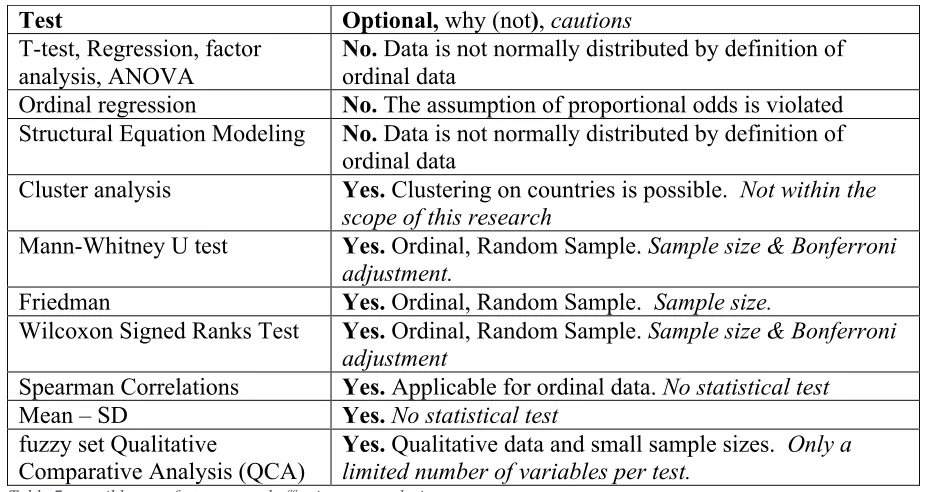
(15) LIST OF TABLES Table 1: development stages in public procurement (adapted from Telgen, Harland & Knight, 2007, p.20-22). .............................................................................................................................7 Table 2: scientific literature overview .........................................................................................8 Table 3: countries selected for the literature review ....................................................................9 Table 4: frequency table PP innovation policy instruments ......................................................27 Table 5: countries represented at the international research study ............................................28 Table 6: country sample questionnaire 1 ...................................................................................31 Table 7: possible tests for usage and effectiveness analysis ......................................................33 Table 8: consistency table fs QCA instrument usage ................................................................36 Table 9: fs QCA analysis, general usage truth table ..................................................................37 Table 10: fs QCA analysis, sticks usage truth table ..................................................................38 Table 11: fs QCA analysis, carrot usage truth table ..................................................................39 Table 12: fs QCA analysis, R&D funding usage truth table .....................................................40 Table 13: fs QCA analysis, sermon usage truth table ................................................................41 Table 14: fs QCA analysis, general effectiveness of instruments .............................................42 Table 15: Wilcoxon signed-rank tests on sticks ........................................................................43 Table 16: fs QCA analysis, effectiveness of stick instruments..................................................43 Table 17: fs QCA analysis, effectiveness carrot instruments ....................................................44 Table 18: Wilcoxon signed-rank tests on R&D funding ...........................................................45 Table 19: Wilcoxon signed-rank tests on R&D funding (2) ......................................................46 Table 20: fs QCA analysis, effectiveness sermon instruments ..................................................47 Table 21: Questions utilized from external questionnaire .........................................................49 Table 22: possible tests for usage and effectiveness analysis ....................................................50 Table 23: categorization of instruments in question B8, B13, C3 .............................................51 Table 24: statistically significant effects of usage of innovation policy instruments on strategic and operational effectiveness within an innovation project.......................................................54 Table 25: categorized overview of statistically significant effects of usage of innovation policy instruments on strategic and operational effectiveness within an innovation project ...............55 Table 26: fs QCA analysis, truth table general effectiveness ......................................................9 Table 27: fs QCA analysis, sticks effectiveness ........................................................................10 Table 28: fs QCA analysis, truth table carrot effectiveness ......................................................10 Table 29: fs QCA analysis, truth table sermon effectiveness ....................................................10. XIV.
(16) LIST OF FIGURES Figure 1: the research approach ...................................................................................................4 Figure 2: the research approach ...................................................................................................7 Figure 3: sticks framework ........................................................................................................11 Figure 4: carrots framework ......................................................................................................15 Figure 5: R&D funding framework ...........................................................................................16 Figure 6: sermons framework ....................................................................................................22 Figure 7: the availability framework .........................................................................................26 Figure 8: the research approach .................................................................................................28 Figure 9: the research approach .................................................................................................30 Figure 10: the research approach ...............................................................................................48 Figure 11: usage of instrument tools (validation analysis) ........................................................52 Figure 12: patterns in sermon, sticks and carrot usage (validation analysis) ............................52 Figure 13: blueprint for choosing effective innovation policy instruments...............................58. LIST OF EQUATIONS Equation 1: general instrument effectiveness model .................................................................32 Equation 2: most frequently found instrument usage patterns, per category.............................56. XV.
(17) LIST OF ABBREVIATIONS AgID ANI ANOVA BRII CAD CDP CDTI CEO, CFO, CPO CONSIP EAFIP EAS EC ERDF ESIF FAQ GDP GSRT ION ISO KOINNO KOSBIR MEAT NHS OECD PCP PIANOo PIO PP PPI PPPI service centre PTI Q&A QCA R&D SBIR SBRI SME SD TechFar UNDP WTO ZIM. Digital Italy Agency Agency National Innovation Analysis of Variance Business Research and Innovation Initiative Canadian Dollars Continuous Professional Development Centre for the development of industrial technology Chief Executive Officer, Chief Financial Officer, Chief Procurement Officer Concessionaria Servizi Informativi Pubblici European Assistance For Innovation Procurement Enterprise Estonia European Commission European Regional Development Fund European Structural Investment Fund Frequently Asked Questions Gross Domestic Product General Secretariat for Research and Technology Innovationsfördernde Öffentliche Beschaffung International Organization for Standardization Kompetenzzentrum innovative Beschaffung Korean Small Business Innovation Research Program Most Economically Advantageous Tender National Health Service Organisation for Economic Co-operation and Development Pre-Commercial Procurement Professioneel en Innovatief Aanbesteden, Netwerk voor Overheidsopdrachtgevers Programma Innovatieve Overheidsopdrachten Public Procurement Procurement of Innovative Solutions Public Procurement of Innovations service centre Procurement Transformation Institute Question and Answer Qualitative Comparison Analysis Research & Development Small Business Innovation Research Small Business Research Initiative Small and Medium Enterprises Standard deviation Technical Federal Acquisition Regulation United Nations Development Program World Trade Organization Central Innovation Program XVI.
(18) 1. Introduction: Innovation within the public procurement context 1.1 Public procurement as a new source of innovation “Carrying out innovations is the only function which is fundamental in history” (Schumpeter, 1939, p.102). Innovations defined as new combinations of knowledge and resources, which are subjected to commercial practice (Schumpeter, 1934, p. 65), are according to Schumpeter at the center of the economic evolution, where “creative destruction” is the “essence of capitalism” (Schumpeter, 1942, p.104). Innovation is often linked to the vitality of firms in terms of a sustainable advantage. Nevertheless, innovation typically creates benefits for everyone while incurring all the costs oneself, also known as positive externalities in classical economic theory (Jaffe, Newel & Stavins, 2004, p.84). Consequently, the opportunity to foster innovation might lay with the government: to create an environment supportive for innovations, e.g. through public procurement. The governmental purchase of goods and services is called public procurement. On average twelve percent of Gross Domestic Product (GDP) is spent on public procurement, whereas 29 percent of total government expenditures is allocated to public procurement (OECD, 2017b, p.172). In the Netherlands, for example, public procurement accounts for 20.2 percent of GDP, which equals almost half of government spending (OECD, 2017b, p.172). Twenty percent of the Dutch GDP translates to over 147 billion euros spend on public procurement in 2017, indicating the economic significance of public procurement within a country (Statistica, 2018). This economic significance consequently emphasizes the strategic potential within public procurement. Due to its large economic volume, public procurement is frequently used to accomplish secondary policy objectives (OECD, 2017b, p.174). These secondary policy objectives can relate to either environmental, economic and/or social challenges. Examples include ‘green public procurement’, the ‘support of small and medium enterprises (SMEs)’, but also ‘innovative goods and services’ (Magina, 2019, p.4). In the 2018 public procurement survey of OECD, hundred percent of the OECD countries have developed a green public procurement strategy or policy, 93 percent have developed a policy or strategy for the support of SMEs, and 83 percent have developed a strategy or policy for innovative goods and services (Magina, 2019, p.4). Underlining the usage of public procurement as a strategic policy tool for innovation among others. 1.
(19) 1.2 Research Outline: The need for identification and measurement of demand-side innovation policy instruments within public procurement Whilst there are noticeable opportunities for innovation through public procurement, Edler and Georghiou (2007, p. 961) argue for “the need to take demand, more concretely public demand, more into the focus of innovation policy making”. Within innovation, demand-side innovations are often underrecognized, as innovation typically relies on the supply of products, services and ideas (Edler & Georghiou, 2007, p.949).. Similarly, public procurement of. innovation can be either demand or supply driven, depending on if the initiative is taken by the buyer (government) or supplier. This study focuses on the demand side of innovations, in which the government takes the initiative. Elder and Georghiou (2007, p.952), define demand-side policies as the following: “all public measures to induce innovations and/or speed up diffusion of innovations through increasing the demand for innovations, defining new functional requirement for products and services or better articulating demand”. Although Edler and Georghiou (2007) urge for more focus on the demand-side of innovation policy, some research already has been done (see Aschhoff & Sofka (2009), Edler & Georghiou (2007), Edquist & Zabala-Iturriagagoitia (2012), Hommen & Rolfstam (2008), Mowery & Rosenberg (1979) and Rothwell (1984)). Additionally, domestic case-studies on demand-side policies are available (see Audretsch (2003), Choi, Lee, & Lee (2014), Li (2011), Rammer (2011) and Zaparucha & Muths (2011)). However, studies to date specifically focused on identifying and classifying public procurement innovation policy instruments into a framework. Additionally, the availability of such demand-side policies within countries has not been studied before. Research as such could include for example, how many countries use subsidies to increase the demand for innovative procurement or how often are websites used by countries to inform organizations about public procurement innovation opportunities. Therefore, a research gap exists in the availability of public procurement innovation policy instruments. To fill this gap, the following research question is asked: RQ1: Which innovation policy instruments are available within public procurement institutions? Whereas the potential of strategic procurement for innovation objectives is often recognized, as proven by the developed policies and strategies—as 83 percent of the OECD countries have developed a strategy for innovative goods or services—evidence of the benefits 2.
(20) is not equally visible (OECD, 2017a, p.42). This is –at least partially—a result of an uneven follow-up and measurement system between different secondary policy objectives. Whereas 74 percent of the OECD countries have a measurement system for ‘green public procurement’ and 68 percent have a measurement system for the ‘support of small and medium enterprises (SMEs)’, merely 32 percent of the countries have such a system for ‘innovative goods and services’ (Magina, 2019, p.5-6). Hence, the lack of a measurement system indicates a missed opportunity in terms of evidence of the benefits and effectiveness of such innovation policies. In summary, due to the economic significance of public procurement, public procurement is increasingly being used for secondary policy objectives (OECD, 2017b, p.174). One of these secondary policy objectives is innovation. Hence, Schumpeter’s notion that “Carrying out innovations is the only function which is fundamental in history” (Schumpeter, 1939, p.102) is –at least partially—recognized by governments in terms of applying innovation policies and strategies. However, the evidence of the benefits and effectiveness of such policies and strategies is missing (OECD, 2017a, p.42). Accordingly, this thesis aims to reduce this discrepancy by sketching an overview of the utilization and effectiveness of innovation policies within public procurement by asking the following research questions: RQ2: Do patterns in public procurement innovation policy instruments prevail in terms of usage? RQ3: Do patterns in public procurement innovation policy instruments prevail in terms of effectiveness? To answer the first research question, the current literature and government websites are reviewed to develop a framework of available innovation instruments within public procurement. This framework will then be validated by public procurement experts of fifteen countries during an international research study, using case-studies in which the experts indicate the available instruments within their country. Afterwards, to answer the second and third research question, a qualitative comparison analysis (QCA) will be performed based on the developed framework. The analysis is based on a questionnaire where public procurement experts (such as government chief procurement officers) are functioning as country representatives of 24 countries and are asked to indicate the perceived usage and effectiveness of innovation policy instruments within their government, in relation to public procurement. Hence, the perceived usage and effectiveness of innovation instruments are measured by the 3.
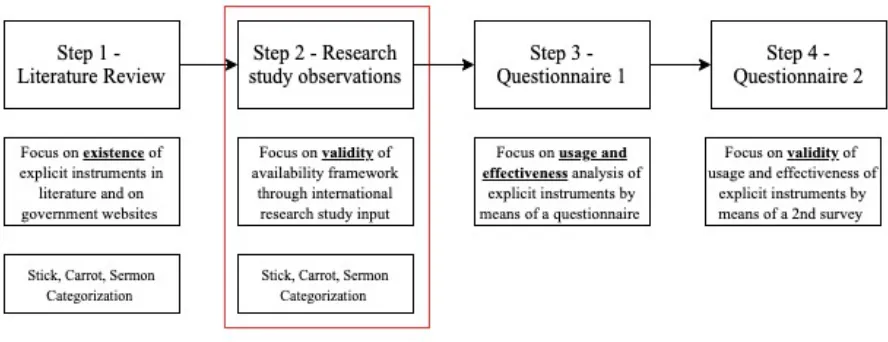
(21) opinions of the public procurement experts. Afterwards, a more widely distributed questionnaire, conducted by the international research study committee, will serve as a validity analysis on the usage and effectiveness results.. 1.3 Thesis outline: Explanation of Each Chapter Figure 1 visualizes the research approach this study. First, the theoretical background of procurement of innovations is discussed, functioning as a theoretical clarification before the development of the framework. Secondly, in the following four chapters the existing literature will be reviewed, and an availability framework will be developed, as part of the first step. Within this first step which starts at chapter three, chapter three serves as an introduction, chapter four indicates the design of the framework, chapter five provides the results of the literature review, whereas chapter six serves as a discussion and cross-analysis. Chapter seven validates the developed framework (i.e. step two). From chapter eight till ten, step three will be conducted, including an introduction, the methodology and the results of the usage and effectiveness analysis, using qualitative comparison analysis. The last step includes the validation of the usage and effectiveness analysis. For this step a different questionnaire will be used, which will be analysed using different non-parametric tests and descriptive statistics. Similar to the previous steps, this step also consists of three chapters: the introduction, the methodology and the results. The last two chapters will conclude this research with the discussion and conclusion. In the discussion, the managerial implication and the contribution to literature are explained. In the conclusion, the limitations and opportunities for future research are discussed.. Figure 1: the research approach. 4.
(22) 2. Conceptual background: Defining and conceptualizing public procurement of innovations 2.1 Definitions: Procurement of innovations, innovation, innovation policy and innovation instruments First, a clarification should be made between ‘innovations in procurement’ and ‘procurement of innovations’. This thesis concerns itself with the latter; procurement of innovations. That is, the process of buying of innovative products and services by the government (Hommen and Rolfstam, 2008, p.21). Innovations in procurement, i.e. innovations within the process of public procurement (Hommen and Rolfstam, 2008, p.21), are not within the scope of this paper. The notion of innovation is close to a century old, were in 1934, Schumpeter defined it as new combinations of knowledge and resources, which are subjected to commercial practice (p. 65). A newer definition however, is “new creations of economic and societal significance carried out by firms” (Edquist & Zabala-Iturriagagoitia, 2012, p.1758; Borrás and Edquist, 2013, p.1513). Over the century, different definitions of innovation evolved, encompassing many perspectives, ranging from very broad to very narrow. Consequently, this wide range of perspectives is reflected in the wide range of definitions and interpretations of an innovation policy. Increasing the difficulty of a definition for innovation policy is the fact that innovation policy is a relatively new term that gained popularity around the millennium (Edler and Fagerberg, 2017, p.3). Innovation policy is in this research defined as “all combined actions that are undertaken by public organizations that influence innovation processes” (Borrás and Edquist, 2013, p.1513). Closely related to policies are policy instruments, which are described as the techniques developed in order to achieve policy ideas (Edler and Fagerberg 2017, p.11). 2.2 Sticks, carrots and sermon analogy as classification for innovation policy instruments within public procurement Policy instruments, described as the techniques developed in order to achieve policy ideas (Edler and Fagerberg 2017, p.11) have a range of variations. Examples of such instruments— among others—include informative websites, subsidies and laws. To provide an overview of such instruments, a classification is desired. A commonly used classification of Public Policy Instruments is the ‘sticks, carrots and sermons’ approach by Vedung (Bemelmans-Videc, Rist & Vedung, 2011, p.1). This categorization is based on the carrot and stick metaphor, referring to the reward and punishment options to induce desired behavior. One might use the stick as 5.
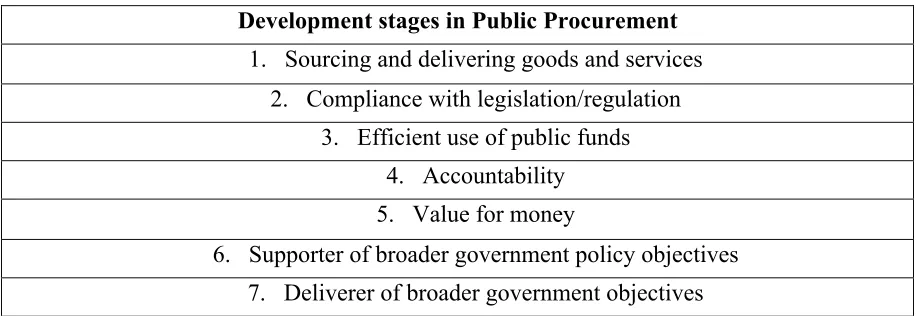
(23) punishment to induce innovation, whereas a carrot represents the reward for inducing innovation, and the sermon represents the necessary knowledge to induce innovation. Sticks are classed as regulative instruments, whereas carrots represent the economic means, and sermons the informative measures. The first category, regulations, entails formal rules and directives that are enforced by the government. The focal point of regulations being on the authoritative relationship between regulator (government) and the subjects regulated (Bemelmans-Videc, Rist & Vedung, 2003, p.10). Carrots, the second category, revolves around materialistic resources (e.g. a subsidy or tax reduction). The sermons category refers to the transfer of knowledge, such as providing training and online information platforms (Bemelmans-Videc, Rist & Vedung, 2011, p.11).. 2.3 Development stages of Public Procurement as constrain for procurement of innovation The public procurement strategy of a country can be classified in terms of stage of development, where the stage of development is dependent on the country. Differences in development impact the initial focus on secondary policy objectives such as innovation. Telgen, Harland and Knight (2007, p.20-22) developed a seven-stage framework on public procurement development, ranging from ‘sourcing and delivering goods and services’ (stage 1) to ‘deliverer of broader government objectives’ (stage 7). Table 1 displays the seven stages. In the first four stages, the focus lies solely on procurement of goods and services, disregarding the strategic usage of public procurement. Meaning that, from stage five onwards, the focus shifts from reactive to proactive, with contributed procured value as the main objective. From stage five onwards, strategic potential of public procurement is recognized. From stage six onwards, the focus shifts towards external, with a specific focus on policy objectives such as the stimulation of innovation. In the seventh stage, public procurement leads the social change, taking full responsibility for delivering a policy (Telgen, Harland & Knight, 2007, p.20-22). Hence, innovation through public procurement will be an activity reserved for countries and institutions that are at least within development stage five, as before stage five is strictly functional—i.e. non-strategic. Even though, in reality, stages are not always mutually exclusive (e.g. certain local municipalities, government institutions or projects are within a higher stage compared to the foundation of the country), it is an important notion that not all countries are in a similar 6.
(24) development stage and hence do not have a—similar—focus on public procurement of innovation. Consequently, not all countries will be represented and focused on equally in the public procurement innovation policy instrument framework. Development stages in Public Procurement 1. Sourcing and delivering goods and services 2. Compliance with legislation/regulation 3. Efficient use of public funds 4. Accountability 5. Value for money 6. Supporter of broader government policy objectives 7. Deliverer of broader government objectives Table 1: development stages in public procurement (adapted from Telgen, Harland & Knight, 2007, p.20-22).. 3. Step 1 – Introduction: Literature study on existence of public procurement innovation policy instruments framework A research gap exists in the availability of public procurement innovation policy instruments. To fill this gap, the following research question is asked: RQ1: Which innovation policy instruments are available within public procurement institutions? This question can be answered trough the development of a framework that includes the available innovation policy instruments in public procurement, which will be the first step of this study (figure 2). The framework will be presented using the policy categorization of Vedung (i.e. the stick, carrot, sermon approach). First, the methodology of this framework is explained. Secondly, the three categories—sticks, carrots and sermons—are presented in detail. Lastly, the discussion of the framework, in terms of patterns of existence is provided.. Figure 2: the research approach. 7.
(25) 4. Design: Developing a demand-side public procurement innovation policy instruments framework 4.1 Data collection: Evidence from scientific literature and government websites The framework of public procurement innovation policy instruments is based on scientific literature and government websites. The initial search for scientific literature was based on search terms such as ‘public procurement’, ‘innovation’, ‘instruments’ and ‘policy’. It became evident that while innovation opportunities through public procurement were largely empirically studied, the availability of public procurement innovation policy instruments are understudied empirically. Instruments that were found, were found in the case-studies of scientific literature. The second row of table 2 provides an overview of example studies found in relation to this demand-side public procurement innovation theory, whereas the third row indicates literature that includes case-studies on demand-side policies and instruments within public procurement of innovation. Hence, in addition to the case-studies, the instrument availability framework is extended with non-scientific literature, in the form of governmental websites. The initial search terms include the name of the 23 sampled countries, ‘procurement’, ‘innovation’, ‘policy’, and ‘instruments’. Later on, other search terms emerged such as ‘financial’, ‘economic’, ‘competence center’, ‘information’, ‘regulation’, ‘unsolicited proposals’, ‘government declaration’, ‘innovation action plan’ and ‘laws’. Theme Preeminent Scientific Articles Innovation through Aschhoff & Sofka (2009), Edler & Fagerberg (2017), Edler & public procurement Georghiou (2007), Edler et al (2005), Edquist & Zabala-Iturriagagoitia (2012), Georghiou et al (2014), Hommen & Rolfstam (2008), Mowery & Rosenberg (1979), Rothwell and Zegveld (1981) And Rothwell (1984) (wider body of literature available) Public Procurement Audretsch (2003), Block (2008), Choi, Lee & Lee (2014), Edler et al innovation policy (2005), Georghiou et al (2014), Lee & Jo (2018), Li (2011), Rammer instruments (i.e. (2011), Yeow & Edler (2012) and Zaparucha & Munths (2011) case studies) (Extended with non-scientific literature) Table 2: scientific literature overview. 4.2 Focus group: 23 countries selected for framework development The seven stages by Telgen, Harland and Knight (2007) indicated the different phases of public procurement development, including its consequences for secondary policy objectives such as innovation. As a consequence, the focus group of this research is on developed countries, 8.
(26) who are believed to engage in activities of stage five and higher in the public procurement development framework (Telgen, Harland & Knight, 2007, p.20-22). This means that countries who solely focus on sourcing and delivering goods and services (stage 1); compliance with regulation (stage 2); efficient use of public funds (stage 3) and accountability (stage 4) are not included in the framework, as the focus of these governments does not lie with secondary policy objectives such as innovation. It is expected that countries from stage five onwards do—at least partially—focus on procurement of innovation, hence the focus of this research is on those countries. Based on the researcher’s interpretation on the supposed development stage of the country, the following 23 countries were selected (table 3). 1. Australia 5. China 9. France 13. Italy 17. New Zealand 21. Sweden. 2. Austria 6. Denmark 10. Germany 14. Korea 18. Portugal 22. UK. 3. Belgium 7. Estonia 11. Greece 15. Lithuania 19. Russia 23. US. 4. Canada 8. Finland 12. Ireland 16. Netherlands 20. Spain. Table 3: countries selected for the literature review. 4.3 From data to framework development: Constant comparison analysis and triangulation to categorize data into a developed framework After the literature search, instruments were categorized according to the ‘carrots, sticks and sermons’ approach. This categorization was done based on the deductive (i.e. categories are identified beforehand) coding (i.e. constant comparison analysis) of the researcher (Leech & Onwuegbuzie, 2007, p.565). To ensure validity, alongside the researcher, one other researcher independently categorized the instruments into the carrots, sticks, and sermons categories (Burnhard, 1991, p.462). Comparing the deductive coding of the two researchers, no adjustments had to be made since the instruments were categorized identically by both researchers. Afterwards, a similar process was executed for defining the subcategories within the three categories. However, this time an inductive constant comparison analysis was done (i.e. sub-categories are not identified beforehand) (Leech & Onwuegbuzie, 2007, p.565). Afterwards, triangulation was performed by a second researcher using deductive coding. Based on the deductive coding no adjustments had to be made since the instruments were categorized identically by both researchers. After the constant comparison analysis and triangulation, sticks, for example, had four subcategories. These subcategories include law restrictive, law. 9.
(27) supportive, target, and certification. After coding the initial framework was built which will be discussed later on.. 4.4 From framework development to cross-comparison analysis: Occurrences of sticks, carrots and sermons categories provide patterns in terms of instrument availability. Based on the initial framework, the first analysis was done. The first analysis focuses on the availability of a certain instrument within the 23 countries. Listwise, for each country it is investigated (using literature and government websites) if they have an instrument within each of the subcategories. The sum of one subcategory (e.g. supportive laws) can be compared to the other subcategories (e.g. certification) to analyze which subcategories are most frequently available. Afterwards, an availability pattern between carrots, sticks and sermons can be prevailed based on total occurrences (see table 4, on page 27). 5. Results of literature analysis of policy instruments 5.1 Sticks: Existence of regulatory instruments within the availability framework 5.1.1. Laws, targets and certification constitute the stick categorization. Sticks (formalized rules) were defined into four categories: law supportive, targets and certification and restrictive laws (figure 3). In total eighteen examples of formal regulations were found based on the literature review. Of these eighteen, nine of these examples are supportive laws. In this instance, supportive laws primarily relate to the legislation of additional demands within the procurement process and the obligatory disclosure of public procurement innovation plans. Important is to note that standards and directives set by the World Trade Organization (WTO), International Organization for Standardization (ISO) and the European Commission (EC) are not included in the total occurrences table but are widely accepted. No systematic combinations are found within countries (i.e. a country that does have a restrictive law does not necessarily not have a supportive law, and certification is for example not a substitute nor a complement of a supportive law). Sections 3.2 till 3.6 explain innovation instruments categorized into these four categories more in detail.. 10.
(28) Figure 3: sticks framework. 5.1.2. Worldwide agreements and directives that regulate procurement of innovations. A ‘stick’ instrument that is not specifically linked to a country, but rather to a worldwide formalized instrument, is the ‘Agreement on Government Procurement’, set by the World Trade Organization. This agreement ensures “open, fair and transparent conditions within government procurement markets” (WTO, 2019). This treaty is internationally binding for 20 WTO member countries, whereas another 34 members (i.e. countries) participate as observers. This ‘Agreement on Government procurement’ was revised and entered into force in 2014, however, the fist agreement on government procurement exists since 1981 (WTO, 2019). The International Standards Organization provides comparable standards as the World Trade Organization, which are also widely accepted (OECD, 2017a, p.81). The European Commission’s (EC) directives are based on the current WTO agreement (Georgiou et al, 2014, p.3). From 18 April 2016 onwards, countries of the European Union have to conform their national legislation with the newest version of these directives (European Commission, 2016a). Within these new EC directives are the innovation partnership, precommercial procurement (PCP), and procurement of innovative solutions (PPI). The innovation partnership constitutes of a competitive phase (finding the most suitable partner), the R&D phase, and the commercial phase. This procedure allows for a simplified process combining both the development and purchase of products (European Commission, 2016d). Compared to the innovation partnership, PCP solely focuses on the R&D phase. Hence, PCP procedure can be used for procuring innovative products and services that have no near-to-the-market solutions yet, and R&D is needed. For a PPI, there are near-to-the market solutions, hence, no new R&D is needed (European Commission, 2019a). Within PPI, the “public sector uses its purchasing power to acts as early adopter of innovative solutions”, thus solely focusing on the commercial phase (European Commission, 2018c). PCP, on the other hand, is a development competition with four phases: design, prototyping, development and testing. It starts with several suppliers competing in parallel for the best solution for the market. The number of suppliers is reduced after each phase (European Commission, 2018b). PCP is thus complementary with PPI 11.
(29) (European Commission, 2018c). Additionally, from October 2018 onwards, the use of eprocurement will be mandatory for all EU member countries (European Commission, 2016b). 5.1.3. Restrictive laws: Exclusion from bidding and non-existed infrastructure constraints procurement of innovations. Within the restrictive laws, two examples are found in the 23 countries. Article 78, in the Belgium Law entails that suppliers of the prototype are excluded from bidding on supplying the innovative product (Georghiou, Edler, Uyarra & Yeow, 2014, p.4). On the other hand, the Lithuanian government does not specify one restrictive law but is restrictive in the sense that it does not offer supportive laws. In Lithuania, the existing legal relation does not facilitate the development of innovative products through public procurement, it for example, does not have a model for pre-commercial procurement, as described in the European Directives (OECD, 2017a, p.127).. 5.1.4. Supportive laws: Obligatory disclosure of procurement plans and legislation of additional demands support procurement of innovations. Supportive laws are the largest subcategory within the ‘sticks’ category. In total, nine examples are found. In the Belgium National Procurement act, article 87, the Belgium government specifies the following: ‘the contracting authority may attach special conditions to the contract, provided that they are related to the subject of the contract […] These conditions may. relate. to. economic,. innovation,. environmental. or. social. or. labor-related. considerations’(Public Procurement BE, 2016). Similarly, the German government also allows for the imposition of additional demands upon suppliers, including requests for innovations (Rammer, 2011, p.16). The “MEAT” (most economically advantageous tender) criteria of Portugal, implemented in the Public Contracts Code of 2008, also allow for special conditions such as innovations in addition to price (OECD, 2017a, p.83,143). Additionally, the Public Contracts Code mandates the use of e-procurement and allows for green award criteria (OECD,2017a, p.143). Hence, one form of supportive regulation is the legislation of enforcing additional demands. More broadly, New Zealand introduced the ‘government rules of sourcing’ which includes rules for sustainable and inclusive procurement through 7 sections and 71 rules (Ministry of 12.
(30) Business Innovation & Employment New Zealand, 2019a). An example of such a rule is rule 20: ‘transitioning to a net-zero emissions economy and designing waste out of the system’. These rules will be officially enacted from the first October onwards and aim for continuous innovation, requiring high standards in the procurement processes (Ministry of Business Innovation & Employment New Zealand, 2019a, p.37). A different type of supportive law is enacted by France. France established legislation allowing for price premiums to be offered to provide preferential treatment to innovative SME’s (Zaparucha & Muths, 2011, p.14). In Russia, innovation is ensured through law in two-fold. Firstly, state-owned enterprises are obliged to procure innovation based on their percentage of shares (OECD, 2017a, p.147). Secondly, state-owned enterprises also have to disclose their agenda for procuring innovations (OECD, 2017a, p. 147). Relatively similar are the ‘white paper innovation nation’ initiative of the UK, and the regulation for public procurement of innovation of Spain. While the white paper innovation is terminated, the initiative mandated ministries to disclose an Innovation Procurement Plan (DIUS, 2008, p.3). Similarly, Spain’s existing regulation, mandates all ministries to define a budget for procurement of innovation (OECD, 2017a, p.150). Korea takes the initiatives of the Russia, UK and Spain one step further by specifying the percentage that should be spend on procurement of innovations. In one of the nine policies focused on procurement of innovation, the Korean government specifies the following: ’enterprises should fulfill 20% of procurement with innovative procurement’ and ‘new technology-certified products are expected to account for 20% of the procurement of a specific product type’ (OECD, 2017a, p. 125). Similar to this policy is the technology development preferential purchase policy. Among others, this policy mandates that ten percent of all SMEproduct purchases should be spend on developed technology products (OECD, 2017a, 125).. 5.1.5. Increasing procurement of innovation through target setting. Whereas Korea sets strict laws on percentages specified for public procurement of innovations, other countries document targets in their government declarations. The city of Ghent (Belgium), for example, introduced a city target in 2014 for its ICT procurement, aiming for ten percent of its budget to be spend on innovation (European Commission, 2014a). Lithuania defined its target as a percentage of total procurement. Whereas in the base year, 2012, 1.17 percent of total procurement was spent on procurement of innovations, the ministry of 13.
(31) Economy targets for two percent in 2017 and five percent in 2020 (Government of the Republic of Lithuania, 2013). Similar to Lithuania, Russia set its target for 2017 at 2.5 percent for procurement of innovations, with the aim to increase it to five percent in the future and Spain’s target is currently set at three percent (OECD, 2017a, p.147). 5.1.6. Certification: Labeling of innovative products and services as a strategy to provide advantages that support the procurement of innovations. Korea offers in total nine policies on procurement of innovation, categorized by direct support (4 policies), indirect support (3 policies) and R&D support (2 policies), which to some all extent use certification (Choi, Lee & Lee, 2014, p.99-100). This certification implies that a certain product, service, or firm is labeled as innovative (different certification based on different categories), giving it various advantages. These advantages include immunity for losses, access to sales channels, guaranteed governmental reputation, and direct purchasing opportunities (OECD, 2017a, p.125). China’s strategy is similar: national innovation certification serves as a label of high demand, indicating that those technologies or products should have priority on financial incentives (Li, 2011, p.13-14). Another certification method is used in the UK, where the use of certifications serves as quality label within public procurement to reduce uncertainty in UK institutions. An example is the National Health Service (NHS), which uses specified demonstration procurement procedures (Yeow & Edler, 2012, p. 485-488). 5.2 Carrots: Existence of materialistic instruments within the availability framework 5.2.1. R&D funding, expertise funding, after-care funding and non-specified government budgets constitute the carrot category. Whereas sticks revolve around formal regulation, carrots revolve around the economic means or materialistic resources (Bemelmans-Videc, Rist & Vedung, 2003, p.10). Hence, whereas a supportive law (stick) is a rule that has to be complied with, a carrot can be a financial incentive that is voluntary applied for. The category carrot constitutes of four subcategories; (1) R&D funding, (2) Expertise funding, (3) after-care and (4) non specified budgets (Figure 4). ‘Not specified’ relates to governments who indicated a budget for public procurement of innovation but did not specify how that budget should be spend. In total 25 examples of materialistic resource instruments were found based on the literature review. Of these 25, 16 of 14.
(32) these examples were focused on R&D funding, which is over sixty percent. In this instance, R&D funding mostly relates to innovation challenges (almost 60%), and co-financing (over 20%). Besides R&D funding instruments (64%), materialistic resources are also available in terms of expertise funding (20%) and funding for after care (20%). Furthermore, additional funding can be retrieved through European funds such as Horizon 2020.In the sections below, the instruments that belong to these categories are discussed.. Figure 4: carrots framework. 5.2.2. European Commission initiatives support procurement of innovations. Beside the materialistic resources that are made available through country budgets, there is also public procurement innovation funding available through the European Union. This is mainly through two funds: Horizon 2020—part of Europe 2020, the innovation union—and the European Regional Development Fund (ERDF). To date, horizon 2020 is the biggest research and innovation program, budgeting close to eighty billion of funding from 2014 till 2020 (European Commission, 2018a). Within this budget, 142 million is allocated to procurement of innovations (European Commission, 2014b). This procurement of innovations is done through pre-commercial procurement (PCP) processes or through public procurement of innovation (PPI) processes (European commission, 2014b). One can either get funding to undertake the PCP or PPI, or to identify opportunities and prepare future PCP’s or PPI’s (European Commission, 2014b). Through synergies with Horizon 2020, the European Structural and Investment Funds (ESIF) can provide additional support. Existing since 1975, one of the components of the ESIF is the European Regional Development Fund (ERDF) (European Commission, 2019b). These funds provide financial means for structural development and adjustments of economies. Procurement of innovations could be seen as development, hence the opportunity for financial support. One example is the ‘Innovation purchasing program’ of Estonia, which is financed through the ERDF fund (Republic of Estonia, 2019).. 15.
(33) 5.2.3. R&D funding: Existence of materialistic research and development instruments within the availability framework. 5.2.3.1 The availability innovation challenges and other R&D funding instruments The largest subcategory within the category carrots is research and development funding. R&D funding can be done through innovation competitions (SBIR, Challenges and PreCommercial-Procurement), or through co-financing, innovation awards, insurances, catalogues or pre-specified contracts (figure 5). Most frequent are the innovation competitions in the form of Small Business Innovation Research (SBIR). Appendix I provides a frequency table of the number of occurrences within each subcategory of R&D funding. In total nineteen examples of R&D funding instruments were found based on the literature review. Which, as a subcategory, is comparable to the main category of sticks, which had eighteen occurrences. The biggest category is SBIR, which comprises almost 32 percent of this subcategory. However, innovation competitions as a whole (SBIR+ Challenges+ PCP) comprise of almost sixty percent of all R&D funding opportunities.. Figure 5: R&D funding framework. 5.2.3.2 Six countries use Small Business Innovation Research (SBIR) to increase the procurement of innovations Small Business Innovation Research (SBIR) originates from the United States, where it was first introduced in the seventies, as a response to the competitiveness crisis (Audretsch, 2003, p.130). The idea was that in order to restore the competitiveness of the United States, four percent of the annual budget should be spent on funding small innovative companies (Audretsch, 2003, p.132). Currently, a similar rule applies, as 3.2 percent of the R&D budget should be spent on SBIR, under the condition that the budget of a federal agency exceeds a hundred million US dollar (SBA, 2019). Over one billion is spent each year on this competitive awards-based program (Audretsch, 2003, p.132). SBIR comprises of three phases: (1) feasibility study, (2) development phase and (3) the to the market phase. The first phase lasts for six months and 16.
(34) funding in this phase cannot exceed 150 thousand US dollars. Afterwards, approximately forty percent proceeds to the second stage, where funding is limited to one million US dollars. The last phase, commercializing the product is done through private sector investments (SBA, 2019). After successfully passing the SBIR process, funding is still available through public venture capital funds (Block, 2008, p.191). While the SBIR originated in the United States, other countries adopted similar competitive awards-based programs. In Ireland, ‘Enterprise Ireland’ adopts a SBIR program, using PCP, which resulted in 11 challenges in 2018 (Enterprise Ireland, 2019). Similarly, the Netherlands adapted the “US experience” with the “EU vision”. The process is identical to the US, hence the US experience, but it is accessible for all companies, hence the EU vision (Tweede Kamer, 2017). Similar to Ireland, the Dutch variant is mostly focused on pre-commercial procurement. Current projects include circular innovations of waste and historical transcription with artificial intelligence (Rijksdienst voor Ondernemend Nederland, 2019). Compared to the US, the scope is smaller: 58 calls in twelve years with a total budget of 102 million (Tweede Kamer, 2017). Similar to Ireland and the Netherlands, is the Small Business Research Initiative (SBRI) of the United Kingdom, led by ‘Innovative UK’. The SBRI also combines the US program with the EU rules for PCP (OECD, 2017a, p.163). The Australian variant is called ‘Business Research and Innovation Initiative’ (BRII). BRII annually budgets two million Australian dollars for feasibility studies (a maximum of a hundred thousand per project) and ten million Australian dollars for proof of concept (maximum of a million each) (Australian Government, 2019). Larger of scope is the Korean Small Business Innovation Research program (KOSBIR), where both the process and the budget are similar to the US’s SBIR (Lee & Jo, 2018, p. 49). Over fifteen percent of Korean’s government budget for research and development was spent on KOSBIR, equaling almost three thousand billion won (2.5 billion US dollars) (Lee & Jo, 2018, p.49). Hence, in total, six country out of 23 countries used a form of the SBIR programs 5.2.3.3 Innovation Challenges: Governments’ expressions of interest list allow for competitions towards innovative solutions The second subcategory within R&D funding is the ‘innovation challenges’. Whereas the SBIR programs are competitive award-based programs with three specific phases, other countries make use of innovation competitions without pre-specified phases, usually referring 17.
Figure



+7


Outline
R&D funding: Existence of materialistic research and development instruments within the availability framework
Sermons: Existence of knowledge transfer instruments within the availability framework
Data Gathering: Conducting a Qualitative Comparison Analysis (QCA) 1 Small sample size, equifinality, non-normal distribution and the
Methodology: Validating the usage and effectiveness analysis 1 Sampling: Analysis is based external questionnaire
Results: Validating the usage and effectiveness of innovation instruments 1 Validating the results of the usage analysis
Acknowledgements
Related documents
Resume recovery feature of Stellar Phoenix Photo Recovery allows you to recover photos, audio and video files using saved scan information file or image file.. You can use the
The companies Berlin Partner GmbH and ZukunftsAgentur Branden- burg GmbH (Brandenburg Economic Development Board) support with a large range of services, from recruiting
• Taxpayers subject to the provisions of Title II of the Income Tax Law (ITL) which have declared taxable income of $644,599,005 or more in the immediately preceding tax
The algorithm will only match applicants employers preferred for NESP positions to NESP positions and applicants employers preferred for NETP positions to NETP positions. This way
In the previous sections, we dis- cuss the expectation that a neural network exploiting the fractional convolution should perform slightly worse than a pure binary (1-bit weights
Steele of Stanford University Online High said that shift is already underway: In a recent survey of ASCA members, she and her colleagues found that more than one-fourth of
• Our goal is to make Pittsburgh Public Schools First Choice by offering a portfolio of quality school options that promote high student achievement in the most equitable and
College Mathematics (3 Credits) Biology (6 Credits) Arts and Humanities 3 Arts and Humanities 3 TOTAL 35 20 8.00 **Total up RED # ** Excess credits 0.00 8.00 Analyzing and
