You Cannot Stay Mad At This Face…Can You?
The Relationship Between Message Delivery, Crisis Responsibility
and Public Responses To Crisis.
Name:
Master:
Marten Peer Nickoleit
Communication Studies
S1210351
Supervisor:
Faculty:
Dr. H.A. van Vuuren
Behavioural, Management and
Drs. M.H. Tempelman
Social Sciences
Date:
Master Thesis – Marten Peer Nickoleit – University of Twente
Abstract
During a crisis organizations see their finances and reputation on the line as the public reacts to the
crisis. Therefore, a crisis calls for immediate and adequate organizational responses to limit the
negative public responses as much as possible. However, the responsibility an organization has to
take for the crisis event differs and depends on the context of the crisis. Coombs (2007) provided a
guideline of three different crisis clusters with low, moderate and high crisis responsibility.
Dependent on the cluster different crisis responses are more suitable than others. Apology has been
found to be a very effective response for moderate and high crisis responsibility situations. The
delivery of this crisis response can differ in the level of media richness. This study measures the
public responses of public anger, negative word-of-mouth, negative intentions of the CEO and the
company, trust in the company’s actions and competencies and forgiveness. A 2 (media richness: low
vs. high) x 2 (crisis responsibility: moderate vs. high) design was used to explore how these variables
influence the public responses of a crisis. Media richness was tested by using video taped and written
apologies. The results show a significant impact of crisis responsibility on the dependent variables.
No influence was found for message delivery as well as no interaction effect between crisis
responsibility and message delivery.
Keywords
Table of Content
Abstract
1 Introduction ... 1
2 Theoretical Framework ... 3
2.1 Crisis response ... 3
2.2 Public responses to corporate crisis ... 4
2.3 Independent variables ... 6
2.4 Conceptual model ... 14
3 Methodology ... 15
3.1 Research design and materials ... 15
3.2 Procedure ... 19
3.3 Participants ... 20
3.4 Measures ... 21
3.5 Adjusted conceptual model... 24
3.6 Assumption testing ... 25
4 Results ... 27
4.1 Descriptive statistics ... 27
4.2 Hypothesis testing ... 28
4.3 Hypotheses ... 30
5 Discussion ... 33
5.1 Limitations ... 34
5.2 Practical implications ... 36
1
1
Introduction
In today’s society the internet became one of the most important communication channels ever
since. It is used for a variety of interaction and communication. As part of this social media, for
example, offer a great opportunity to network and to reach a big audience in a short amount of time.
In the context of danger and crisis this fast pace spread of information is a great opportunity to warn
other people of a potential threat. The Love-Parade disaster which happened in Duisburg, Germany,
in 2010 is one of these examples. Participants gathered to have an open-air party in Duisburg which
ended in a disaster with a human stampede and 10 deaths. Participants made use of the social media
network Twitter to warn other people to not attend the festival anymore during this disaster. The
police often make use of such social media as well to warn and inform the public about suspects and
other occurrences. Additionally, many people make use of the internet to receive their news. Here,
the internet offers more possibilities to visually present the news but also other forms of responses
(e.g. organizational spokesperson) than traditional media do. Therefore, the internet can be classified
to be a richer medium than solely printed media.
However, in times of crisis, social media offer a shade side of the medal as well. The fast
spread of rumors and the ability to attend any conversation is a potential threat to organizations. As
summarized in Lambret and Barki (2018) the ability to “add one’s voice to the Internet conversation is
a new power to influence held by social media users who are continuously reacting (rather than
reasoning) to anything occurring online and offline.”. The potential organizational threat lies in the
fast-growing conversation about the respective crisis, which can damage the organizational image
and reputation if unanswered by the organization.
Consequently, organizations need to respond to the crisis to firstly warn its stakeholders of
potential risks when using their products (e.g. food poisoning) and secondly to limit the reputational
damage. Here, the internet offers a great opportunity to the organization in crisis as it grants access
to the same big audience. According to crisis management literature different organizational
responses are needed depending on the crisis context and the crisis responsibility held by the
organization (Coombs, 2007). However, Benoit and Drew (1997) found evidence that apology
messages seem to be more effective than denial or bolstering responses when crisis responsibility is
moderate or high, and Kiambi and Shafer (2016) add that apology is more effective than
compensation when the organization is highly responsible. Secondly, the internet offers a different
message delivery than traditional media. It is possible to not only reach out to the public with a
written organizational statement (as for example a newspaper would offer) but it is also possible to
deliver a video tape message to directly address the public. By doing so the organizational
shock in order to step up to the transgression. As described in Tang and Gray (2018) a spokesperson
(e.g. CEO) can grant the organization a human face and emotions such as suffering and remorse,
whereas organizations are generally seen as to lack these emotions. This is especially true for richer
media.
Current literature often investigated which type of crisis response seems to be more
adequate in the respective crisis context, but it was less focused upon the actual delivery of the
response (video taped response vs. written response) in combination with the organizational crisis
responsibility (moderate vs high). Further, the effects of message delivery type and crisis
responsibility on public anger, negative word-of-mouth, negative intentions, distrust and forgiveness
are examined. The general research question is formulated:
RQ: How do message delivery and corporate crisis responsibility affect the public responses of
public anger, negative word-of-mouth, negative intentions, distrust and forgiveness?
The objectives of this paper are to enrich this part of the crisis management literature by
providing an overview of the current academic literature with focus on crisis management literature
as a foundation for the framework. The second section of this paper presents the chosen
methodology to test the proposed framework, followed by the analyses which are made. Lastly,
3
2
Theoretical Framework
Corporate crises have serious consequences for the organization and their stakeholders as well.
Depending on the crisis context, stakeholders may be at risk not only financial wise (e.g. broken or
not properly working devices) but even their health can be on the line (e.g. food poisoning).
Therefore, the organization needs to respond to the crisis publicly in a fast and proper way to keep
their stakeholders save and the consequences of the crisis at the lowest level possible. Secondly,
corporate crises endanger the respective organization in different ways. Stakeholders may be driven
to see the organization in a negative light or even decide to not engage with the organization
anymore. As a result the organizational reputation or even the actual selling numbers decrease in a
significant way. Therefore, crisis management needs to adequately and quickly respond to negative
publicity in order to limit the damage (Coombs, 2007). This chapter will give an overview of the
important variables in this study, followed by the formulation of the hypotheses.
2.1
Crisis response
When a company faces a corporate crisis, it is not only endangered financial wise, but also sees its
corporate image and reputation on the line. Negative word-of-mouth and customer’s negative future
intentions can decrease the organizations selling numbers (Coombs, 2007). Therefore, the
organization needs to keep the costs at the lowest level possible.
Crisis researchers emphasize that the organization in crisis should take immediate and
adequate action in order to limit the damage it takes (Coombs, 2006; Chung & Lee, 2017). For each
crisis, an organization has to take either low, moderate or high responsibility for that same crisis
event. The situational crisis communication theory (SCCT) by Coombs (2007) provides guidelines to
classify whether the level of responsibility is low, moderate or high and which crisis response is most
appropriate. Additionally, the SCCT provides three clusters of crisis response strategies: (1) denial, (2)
diminish and (3) rebuild strategies. These strategies are characterized as primary response strategies
with scapegoat as an example for denial strategies where crisis management accuses a group or
person outside the organization for the crisis. Excuse is an example for diminishing response
strategies where it is tried to minimize organizational responsibility by claiming inability to control
the crisis and lastly apology as an example of rebuild strategies.
Benoit and Drew (1997) investigated the effectiveness of different corporate reactions to
crises and distilled corporate apology messages as more effective than denial or bolstering
responses. The SCCT adds, that corporate apology messages should only be used when the
organization has to take moderate or high responsibility for the occurrence of the crisis. In other
Secondly, according to Kiambi and Shafer (2016) a corporate apology is more effective than
actual compensation for crises with high corporate crisis responsibility. Stakeholders were more
positive towards organizations which offered apologies instead of compensation and were less angry
towards those.
2.2
Public responses to corporate crisis
As apologetic messages try to limit the damage and the public’s negative responses
The crisis response tries to mitigate the public’s negative reactions to the crisis. These reactions can
be anger and negative word-of-mouth (Coombs & Holladay, 2008) which may not only lead to
stakeholders breaking interaction with the company but advice significant others to do the same as
well. Being suspicious of the company or its employees and highly distrusting them can be a
stakeholder reaction as well. Lastly, the ultimate goal of apologetic messages is to awaken
forgiveness in the transgressed party and to reestablish the relationship. This part of the chapter
gives deeper insight in these variables and explains their importance.
Public anger
Coombs and Holladay (2008) identified public anger as a key factor following corporate crisis. Public
anger, understood as anger of the broad public, is able to damage or even end an organization’s
relationships with important stakeholders. Additionally, public anger can have a negative impact on
stakholder’s word-of-mouth about the organization. These stakeholders may say bad things about
the organization or advice their significant others not to engage with the organization. Kim and
Cameron (2011) found evidence that anger has a negative relationship with corporate reputation.
Therefore, public anger does threaten the organization in crisis directly. Furthermore, Coombs and
Holladay (2007) found in their study about communication dynamics that anger is directly related to
the level of crisis responsibility. This means, an organization with a high crisis responsibility will face a
high level of public anger.
Negative word-of-mouth
Word-of-mouth (WOM) is defined in Cheng, Lam and Hsu (2006 p.97) as “an informal,
person-to-person communication between a perceived noncommercial communicator and a receiver regarding
a brand, a product, an organization, or a service”. WOM is very important in the context of buying
behavior and purchase decisions. Often, especially when the decision to buy a certain product or
service is perceived as ambiguous, people rely on the information and experiences of their significant
5 paragraph, negative WOM is expected to be a direct consequence of corporate crisis. This is in line
with the study of Coombs and Holladay (2008).
In the study of Cheng, Lam and Hsu (2006) negative WOM is divided into two parts. First,
negative WOM can be a type of retaliatory action which can be defined as a sort of revenge and to
actually hurt the organization. Secondly, negative WOM is used to warn others that there might be a
risk when consuming the product or service of an organization. In this study, both types of negative
WOm are included as both are considered as damaging the organization.
Jung and Seock (2017) argue that organizational apology following a crisis positively affects
customer’s perceptions of justice, which in return impacts customers perceived satisfaction. By
holstering customer satisfaction, organizational apology improves customers WOM regarding the
organization.
Negative impressions
Negative impressions represent the public belief of an organization or its CEO during a crisis. Here,
the public beliefs that the organization or the CEO can be held responsible for the occurrence and
the belief is negative in nature (Chung & Lee, 2017). In addition, Wan and Schell (2007) describe
when people become “suspicious” of an organization as negative impression as well.
Distrust
As trust is building on other people’s perception of being trustworthy, distrust can be understood as
the absence of perceived trustworthiness. According to Mayer, Davis and Schoorman (1995) there
are three antecedents of trustworthiness: ability, benevolence and integrity. A lack of one or more
antecedents of trust would lead to distrust which is in line with the definition of distrust in the study
of Chung and Lee (2017). According to them distrust is defined as “a cognitive perception that an
organization is incompetent, exhibits irresponsible behavior, and violates obligations”. Incompetence
can be understood as a lack of the organization’s ability to do a promised action, exhibition of
irresponsible behavior is the counterpart of benevolence, and ultimately a violation of obligations
matches a lack of integrity.
Forgiveness
When we apologise for a misconduct, we automatically try to awake forgiveness in the victim
(Szablowinski, 2012). Forgiveness becomes the ultimate objective of an apology and it is sought to
reestablish the damaged relationship between two parties. This is supported by the study of
forgiveness. They found that apology seems to be a major ingredient for forgiveness and should be
sought in times of corporate crisis.
2.3
Independent variables
As Coombs (2007) explains in the SCCT there are different ways in crisis responses and they depend
on the crisis situation the organization faces. Additionally, they not only depend on the level of crisis
responsibility but may differ in the used method to deliver the message. Different scenarios are
possible. For example, a crisis manager may choose to publish a written explanation and apology in a
well-known newspaper. On the other hand, it is possible that crisis management decides that a high
ranked employee (e.g. CEO) publishes a video taped message to communicate the crisis response.
The following part gives deeper insight in these variables.
Message delivery
As summarized in Hans and Hans (2015) about the aspects of kinesics, haptics and proxemics,
non-verbal communication holds great value in human interaction. The proverb “actions speak louder
than words” demonstrates this value. Communication research suggests that between 7% and 35%
of a message is delivered through words and the rest through non-verbal communication. This
demonstrates the great value provided by non-verbal communication. As an example, people are
often in shock when they see a picture of a tyrant in a normal, everyday situation or the “normal”
face of a murderer as these people do not appear as “monsters” which may have been the
perception before.
Messages, and apologies as one of them, often differ in their level of vividness. Vividness is
defined in Coyle’s and Thorson’s (2001) study about the effects of progressive levels of vividness in
marketing related websites as “the representational richness of a mediated environment as defined
by its formal features; that is, the way in which an environment presents information to the senses.”
[p.67]. Vividness has two subdimensions, breadth as the first one and depth as the second one.
Breadth refers to the number of different senses engaged by the medium, and depth as to which
extend the medium replicates parts of the sensory system (Coyle & Thorson, 2001). Fortin and
Dholakia (2005) add that vividness is also referred to as media richness. They refer to Daft’s and
Lengel’s (1986) study about organizational information requirements, media richness and structural
design in which “richness is defined as information-carrying capacity of data.” [p.11]. Face-to-face is
considered the richest medium, followed by telephone, personal documents (e.g. letters),
impersonal documents and as last numeric documents. According to Daft and Lengel (1986) media
vary in richness because of different levels of immediate feedback capacity, the number of utilized
7 multiple cues (e.g. body language, tone of voice), personal contact and message content in natural
language are involved. Therefore, a videotaped apology is considered more vivid and therefore richer
than the literal transcription of the apology because even though face-to-face communication, and
therefore immediate feedback and personal contact, is not achieved, non-verbal cues like body
language and tone of voice and natural language are involved.
Media richness and public anger
Xu, Cenfetelli and Aquino (2012) found in their study about the influence of media cue multiplicity on
deceivers and those who are being deceived that media cue richness has influence on the moral
anger of the participant in the context of being deceived. The underlying dynamic of this relationship
is based on the Interpersonal Deception Theory (IDT) derived from Burgoon and Buller (1996).
According to IDT deceiver and receiver behaviors and cognition vary as the context of the
communication varies. Positivity bias, defined as people presuming others to be truthful, is more
likely to be present in face-to-face communication. Media with low cue multiplicity may steer the
audiences focus on limited stimuli and more on the task than on process-oriented issues (e.g.
building rapport). In contrast richer media improve the exchange of multiple types of information
(e.g. gestures, facial expressions) and enhances one’s likability. Ultimately, the richer the medium
was perceived the more moral anger diminished. They refer to “the set of emotions that arise from
being deceived” (Xu, Cenfetelli & Aquino, 2012) [p. 3] as moral anger. There are consequences for
the deceiver as moral anger can motivate a deceived party to punish the deceiver. Therefore, it is
expected that:
H1a: Respondents exposed to the video apology will have less anger towards the organization than
respondents exposed to the written apology.
Media richness and negative word-of-mouth
WOM as defined as informal, person-to-person communication between two or more people is very
important in the context of corporate crisis, as it is often used in ambiguous situations. Vazquez,
Dennis and Zhan (2017) found proof in their study about consumer communications via mobile
instant messaging, that media richness is strongly and directly related to positive WOM. The more
social and richer a channel is perceived the more likely it is that people feel involved with the media
channel. Ultimately this involvement translates to the feeling of emotional satisfaction with the
H1b: Respondents exposed to the video apology will express less negative word-of-mouth than
respondents exposed to the written apology.
Media richness and negative impressions
As earlier described, rich media do have a superior capacity of social cues compared to less rich
media. In the study of Tanis and Postmes (2003) about ambiguity reduction and impression
formation of different media, they found strong support that the amount of social cues has an impact
on the positivity of impression formation in computer-mediated communication (CMC). Underlying is
the assumption that social cues are important for the reduction of ambiguity of personal impressions
and that this reduction leads to a higher degree of intimacy and better contact quality. Based on
Rutter and Stephenson (1979) and their cluelessness model “cluelessness leads to psychological
distance, psychological distance leads to task-oriented and depersonalized content, and task-oriented
depersonalized content leads in turn to a deliberate, unspontaneous style and particular types of
outcomes” (Rutter, 1987, p. 74). Therefore, more cues decrease the psychological distance.
Additionally, the social information processing theory by Walther (1992) adds that social cues and
information about the communicators are important to develop positive relationships. Not only has
the amount of social cues positive influence on ambiguity reduction, but the mere presence of
already neutral social cues lead to positive impressions. As negative impressions are the opposite of
positive impressions, it is therefore expected that:
H1c: Respondents exposed to the video apology will express less negative impressions of the
organization than respondents exposed to the written apology.
In addition, the study of Turk, Jin, Stewart, Kim and Hipple (2012) about the interplay of an
organization’s prior reputation and CEO visibility, they found evidence that the visibility of CEOs in
online videos, released as crisis responses, resulted in higher attitudes scores. This is based on their
finding that shareholders preferred a present CEO when corporate crisis responses were published,
as opposed to CEOs not being visible.
Therefore, it is expected that:
H1d: Respondents exposed to the video apology will express less negative impressions of the CEO
9
Media richness and distrust
As earlier described distrust can be understood as the absence of perceived trustworthiness.
According to Aljukhadar, Senecal and Ouellette (2010) and their study about the effects of media
richness and privacy disclosure, trust is influenced by media richness by enhancing social presence.
According to them consumers observe and evaluate an agent’s trustworthiness through nonverbal
cues and while doing so, the mere observing already increases trust. Finally, the richer the medium
was the more trust could have been evoked. This is supported by Lewicki and Polin (2013) which
argue that when a negotiator emotionally signals to be cooperative nonverbal cues themselves
create a foundation for trust. Therefore:
H1e: Respondents exposed to the video apology will express less distrust than respondents exposed
to the written apology.
Media richness and forgiveness
As earlier described forgiveness is a very important objective in times of crisis, as it reestablishes
damaged relationships. Even though apology is very important to achieve being forgiven the
relationship between a greater amount of cues (e.g. body language) and forgiveness remains rather
undiscovered. As summarized in Hill (2013) nonverbal cues are associated to be effective when used
in apology as they may refer to the internal state of transgressors and are eventually judged by the
audience of the apology in terms of sincerity. However, if these cues are judged as not honest and
sincere, the apology seems to be non-effective. Consequently, forgiveness is rather achieved through
the level of the apologetic speaker’s skill to express an honest and sincere apology than through
non-verbal cues themselves. Therefore:
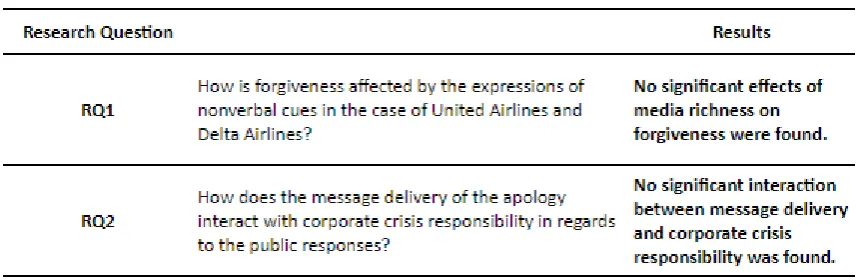
RQ1: How is forgiveness affected by the expressions of nonverbal cues in the case of United Airlines
and Delta Airlines?
Corporate crisis responsibility (CCR)
As earlier mentioned, the SCCT by Coombs (2007) provides guidelines how an organization should
react when it faces a crisis. The organization's actions have to be immediate and adequate. The
adequate actions an organization should take are highly dependent on the level of corporate crisis
responsibility. Coombs distinguished three clusters of crisis responsibility, namely: victim cluster,
accidental cluster and preventable cluster. Here the victim cluster means low level of crisis
responsibility which is rising onto the preventable cluster with a maximum of crisis responsibility. As
appropriate for a preventable or accidental crisis than for a victim crisis. As summarized in Coombs
(2007) and De Blasio and Veale (2009) SCCT extends Attribution Theory (AT). Anger and sympathy are
the core emotions in AT and a person attributes responsibility to an organization during crisis and will
experience an emotional response to the crisis. When the organization will be held responsible for
the event, the behavioral response will be negative, and the person will feel anger. Vice versa, the
person will feel sympathy when the organization is not held responsible for the crisis event.
By taking the level of crisis responsibility into account this study wants to figure out if there
are any influences on how a corporate apology may be received by the public. As a victim crisis
relates to the lowest level of crisis responsibility, why should an organization apologize when they
are victims of the crisis as well. Therefore, this study takes the factor of moderate and high crisis
responsibility into account. Here, it is assumed that higher corporate crisis responsibility leads to
higher negative outcomes.
CCR and public anger
As described before public anger is a key factor of corporate crisis and in fact threatens the corporate
reputation directly. Coombs and Holladay (2007) found in their study about communication
dynamics that anger is directly related to the level of crisis responsibility. This is based on the
attributional theory of achievement motivation and emotion by Weiner (1985). According to this
theory, anger, as well as gratitude, guilt, pity and shame are connected to the controllability
dimension. Then, the more controllable a crisis is perceived by stakeholders, the more these
emotions derive from this crisis situation. This means, an organization with a high crisis responsibility
will face a high level of public anger.
H2a: Respondents exposed to the moderate crisis responsibility apology will have less anger
towards the organization than respondents exposed to the high crisis responsibility apology.
CCR and negative word-of-mouth
As earlier, word-of-mouth (WOM) is defined as being informal, person-to-person communication and
is a direct consequence of corporate crisis. As summarized in the article of Coombs (2015) about the
value of communication during a crisis and how to apply the right communication strategies during a
crisis, the level of CCR attributed by the stakeholders of an organization to this certain organization,
is directly linked to negative word-of-mouth. Again, this is based on the attribution theory. The more
people attribute crisis responsibility to the organization the more negative their intentions, described
as purchase intention and word-of-mouth become. This is also explained by Coombs and Holladay
11 H2b: Respondents exposed to the moderate crisis responsibility apology will express less negative
word-of-mouth than respondents exposed to the high crisis responsibility apology.
CCR and negative impressions
As summarized in the first chapter of the handbook of crisis communication by Park and Len-Ríos
(Fediuk, Coombs & Botero, 2010) about the effect of injured party on attributions of crisis
responsibility, research has shown that crisis responsibility, as perceived by the organizational
stakeholders, has a direct relationship to stakeholders negative impressions towards the
organization. This is grounded in impression management, where communication is used to influence
an organization's impression, which is endangered by crisis. The more crisis responsibility was
attributed to the organization the more negative impressions were found. Therefore:
H2c: Respondents exposed to the moderate crisis responsibility apology will have less negative
impressions of the organization than respondents exposed to the high crisis responsibility
apology.
H2d: Respondents exposed to the moderate crisis responsibility apology will have less negative
impressions of the CEO than respondents exposed to the high crisis responsibility apology.
CCR and distrust
As earlier described distrust, as understood as the absence of perceived trustworthiness, is the
consequence of the lack of one or more antecedents of trust. Park and Len-Ríos (Fediuk, Coombs &
Botero; 2010) summarized in the 29th chapter of the handbook of crisis communication that an
increased level of perceived crisis responsibility directly leads to decreased levels of trust and
therefore to more distrust. This is because trust, as one of the most important antecedents of
organizational reputation, is highly endangered by the level of attributed responsibility. Again, this is
argued based on the attribution theory, where controllability over a crisis is directly associated with
the level of distrust elicited (Lee, 2004). Therefore:
H2e: Respondents exposed to the moderate crisis responsibility apology will express less distrust
CCR and forgiveness
As described earlier, forgiveness is sought to be the ultimate objective of an apology. Earlier research
aims short in discovering direct links between the level of perceived corporate crisis responsibility
and the willingness of victims to forgive the certain transgressor. However, Coombs (2015) distilled in
his article about the value of communication during a crisis, that psychological research found
evidence that people tend to forgive competence trust violations easier than they do forgive
integrity-based trust violations. This holds true for the field of accidental acts and intentional acts.
Since competence and integrity are two very important elements of an organization, they do differ in
the amount of responsibility attributed by stakeholders when transgressions took place. Accidental
crises are considered as competence trust violations, whereas intentional crises are considered to be
integrity based. Therefore, it is expected that:
H2f: Respondents exposed to the moderate crisis responsibility apology will be more forgivable
than respondents exposed to the high crisis responsibility apology.
Interaction between message delivery and corporate crisis responsibility
In the following paragraph a possible interaction effect of message delivery and crisis responsibility
on the dependent variables will be discussed.
During crisis events the public will form attitudes about the organization in crisis when being exposed
to crisis information (e.g. news articles). The organizational response to the crisis has the goal to shift
these negative attitudes towards more positive ones, by trying to persuade the public. In the
literature, the Elaboration Likelihood Model (ELM) (Petty & Cacioppo, 1986) offers a widely accepted
perspective on persuasion and attitude change. The ELM suggests that recipients of persuasive
information process these in one of two ways: the first one is the central route which is present
when the recipient is highly involved and elaborates the information with great effort. The second
way is the peripheral route, being the opposite of the central route, recipients devote a low amount
of cognitive effort to elaborate the information presented. As summarized in Angst and Agarwal
(2009) the framing of presented arguments is more important when the central route is present,
whereas peripheral cues (e.g. attractiveness, charisma) have greater influence when the elaborative
effort is low.
Coombs and Holladay (2009) argued, based on Pfau and Wan (2006), that the focus on the
message source (peripheral cues) should be greater in video messages because less involvement is
required by the audience. Text messages, in which the content (arguments) is more thoughtfully
13 the context. Therefore, video messages, as a source of peripheral cues and more likely to be
processed with low elaborative effort, seem to be more persuasive when the involvement of the
audience is low. On the opposite, text messages are more effective when the involvement is high
because the audience is not distracted by peripheral cues.
Drawing on Coombs (2007) SCCT, earlier explained in this chapter, the different crisis clusters
result in different attributions of crisis responsibility by stakeholders. The victim cluster with the
lowest attribution, the accidental with moderate and the preventable cluster with the highest
attribution of responsibility. Additionally, accidental crises are considered unintentional and
uncontrollable by the organization, whereas preventable crises are considered controllable. Based on
the SCCT McDonald, Sparks and Glendon (2010) studied stakeholder’s reactions to crisis
communication and causes. They found evidence that crisis controllability had great impact on the
level of stakeholder involvement. The more the crisis was seen as controllable by the organization
the stronger stakeholders were involved resulting in more negative emotions. Therefore, the higher
the attribution of crisis responsibility the more involved the stakeholders become.
Summarized it is argued that the combination of the ELM with crisis responsibility and
message delivery leads to the following assumption. As text messages are likely to be processed in a
central way and video messages in a peripheral way and accidental crises result in less involvement
than preventable crises: text messages seem to be more appropriate for preventable crises and video
messages seem to be more appropriate for accidental crises. This leads to the following question:
RQ2: How does the message delivery of the apology interact with corporate crisis responsibility in
2.4
Conceptual model
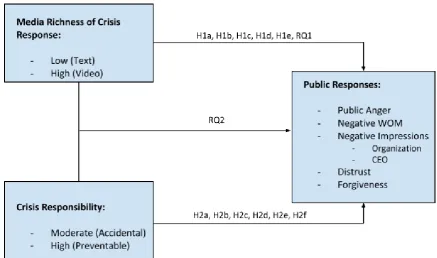
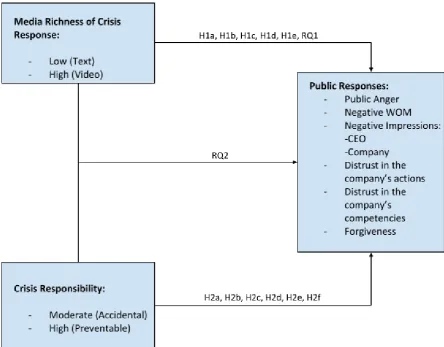
In this study a 2 (Media richness of the crisis response: low vs. high) x 2 (Crisis responsibility:
moderate vs. high) design is used. In total four different categories are present. Figure 1 represents
[image:17.595.76.514.181.439.2]the model with the related hypotheses and the research question.
15
3
Methodology
In this chapter the applied method of the study will be explained. Starting with the research design,
the used materials and procedures will be explained, followed up by a description of respondents
and the dependent measures.
3.1
Research design and materials
The goal of this study is to shed light on the effects of different apology types and crisis responsibility
on (1) public anger, (2) negative word-of-mouth, negative impressions towards (3) the CEO and (4)
the company, (5) distrust and (6) forgiveness.
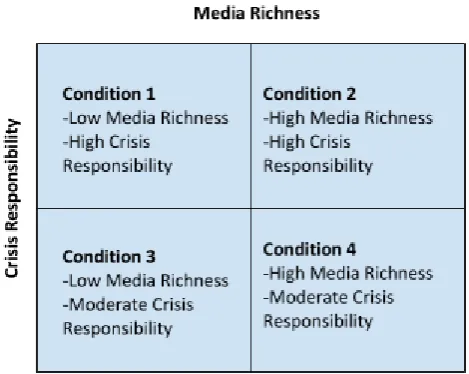
This study makes use of a 2 (Apology type: video vs text) x 2 (Crisis responsibility: moderate vs high)
between-subjects research design. In sum 4 different conditions were used to investigate the effects
of apology type and crisis responsibility on the 6 dependent variables. Figure 2 gives an overview of
[image:18.595.73.308.312.499.2]these conditions.
Figure 2.
Experimental conditions
Stimuli Materials
In this paragraph the used materials are described. To represent the organizational crises Delta
Airlines Flight Cancellations and United Airlines Flight 3411 Passenger Beating were selected due to a
number of criteria. Both crises belong to the airline industry, making comparison between these
events more valid. Even though videotaping a study assistant, apologizing as the organizations CEO,
would result in more control over the differences in the two videos it is decided to make use of real
videos of the CEOs published on the social media platform Youtube because both crises are real life
events. Both videos are shorter than 3 minutes in length and contain the four components (1)
responsibility, (2) sympathy, (3) compensation and (4) assurance which are crucial for apologies (Lee
Crisis responsibility: moderate vs high
This part of the paragraph describes the crisis responsibility attributed to both crisis events. Starting
with explanations of both selected crises and the pretest of the crisis responsibility, following up by
the media richness materials with the respective pretest.
Delta Airlines Crisis (moderate)
First, Delta Airlines Flight Cancellations was used for the moderate crisis responsibility condition. On
December 17th, 2017, a fire at the Hartsfield-Jackson Atlanta International Airport resulted in a huge
power outage leaving the whole airport without power for 11 hours. During this time of the year,
many people are traveling via airplanes to be close to their relatives during the Christmas vacation.
800 flights in total had to be cancelled and passengers were uninformed about the situation for
several hours. Important to note is that ultimately this crisis falls under the level of victim crisis
instead of an accidental crisis (moderate CR). The fire which broke out was not caused by United
Airlines staff, still the airline published a video of their CEO Edward Bastion apologizing for a
backup-system which did not work. To make sure that both crises happened within the same industry, the
crisis introduction of the Delta Airlines crisis was manipulated in a way that respondents get the
impression of an accidental crisis (moderate CR). The manipulation stated that the power loss
resulted from a fire which was accidentally caused by Delta Airlines staff and that the implemented
backup-system failed to work. As described in the SCCT (Coombs, 2007) technical errors fall under
the accidental cluster of organizational crises and have moderate crisis responsibility attributed.
United Airlines Crisis (high)
Secondly, the United Airlines Flight 3411 Passenger Beating was used to represent the high crisis
responsibility condition. On April 9th, 2017, manager of United Airlines regional branch United
Express offered travel vouchers to passengers of Flight 3411 to make room for airline staff which
needed to be at Louisville International Airport. Because all passengers denied the offer by United
Express a random selection of passengers was made to be removed from the flight. Among these
passengers was David Dao, a pulmonologist. Dao declined to leave the airplane when airline staff
insisted him to leave. Hereupon, aviation security officers violently removed Dao from the airplane.
In the process Dao’s face hit an armrest resulting in Dao losing consciousness while bleeding. This
crisis represents the preventable crisis cluster, attributed with high crisis responsibility. The SCCT
(Coombs, 2007) states that organizational misdeed with injuries falls under this cluster as
17
Pretest of Crisis Introductions
Both crises were introduced with a short crisis introduction (Appendix B) to make sure that
respondents had a basic knowledge of the respective crisis they were exposed to and to give the
participant the understanding of the respective corporate crisis responsibility. As the moderate crisis
responsibility introduction was manipulated, a pretest was conducted to check if respondents got the
intended impression of the crises. In total 10 respondents read the introductions and answered a
crisis responsibility scale from Brown and Ki (2013) on a 5-point Likert-scale. Examples of these items
are “The cause of the crisis was an intentional act by someone in the organization.” and “The crisis
was preventable by the organization.”. The total mean for the moderate crisis responsibility
condition was slightly below the Likert-mean of 3 indicating a slightly below moderate responsibility
(M = 2.9, SD = .86). In addition, the total mean for the high crisis responsibility condition was
indicating a higher crisis responsibility (M = 3.9, SD = .6). Furthermore, respondents were asked to
range the crisis responsibility on a scale of 1 to 7 directly (1 = low crisis responsibility vs. 7 = high
crisis responsibility). Respondents judged the moderate crisis responsibility introduction with (M =
4.9, SD = 1.4) which is in the intended range. The high crisis responsibility introduction was directly
judged with (M = 6.5, SD = .7) which is high. Even though the high crisis responsibility condition was
rated with a mean of 3.9 on the 5-point Likerscale, which is not extremely high, a paired sample
t-test revealed significant differences between both conditions, with t(9)= -4.49, p= .002. Therefore,
both introductions were understood as intended and implemented in the study.
Media richness of crisis response: video vs text
As described in the theoretical framework message delivery can differ in their amount of media
richness. To represent this variable, it is chosen to make use of video tapes showing the respective
CEO as a rich medium. A video is able to show body language, tone of voice and natural language and
therefore can be considered a rich medium. Secondly, literal transcripts of the CEO’s speech is used
for the poor medium condition. By doing so the non-verbal cues (indicators for media richness) are
removed without the danger of different results based on different wording.
Both companies released apology videos to communicate about the crisis event. In both
videos the CEO of the respective company apologizes for the crisis event. In the case of Delta Airlines,
the CEO Edward Bastion sits in the middle of the screen. The video is 3 minutes long and the CEO is
filmed in what appears to be his office. The video of United Airlines shows the CEO Oscar Munoz with
a total length of 1minute 40 seconds. He is shown in the middle of the screen in front of a dark blue
Pretest of Message Delivery
Real life video messages have been chosen in order to make the study as realistic as possible. As both
videos are real life apologies, there are differences between them (e.g. person speaking, background,
etc.). To make sure these differences are not fundamental and might be responsible for the
outcomes of this study, pretesting was conducted. During this pretest the general possibility for
comparison of the videos has been tested in order to ensure that the videos are applicable for this
study. In total 8 participants participated in the pretest of the high media richness of message
delivery condition. During the pretest, respondents were asked to watch both videos once and to
write down differences and similarities they encounter. After writing down their first impression of
differences and similarities, respondents were asked to discuss their overall impression and if they
had any problems seeing and hearing/understanding the CEOs and who was responsible for the crisis
according to them.
In total 8 respondents participated in the pretest. The most prominent similarity codes were
apology and setup, whereas the most prominent difference codes were speech and setup. This
means that respondents pointed out that both CEOs apologized for the crisis event and the
similarities in the setup. These similarities are that both CEOs are shown in the middle of the screen
and both are wearing suits. Additionally, both videos were seen as video-taped in a professional way.
Furthermore, according to Lee and Chung (2012) an apology has to contain four components,
namely: (1) responsibility, (2) sympathy, (3) compensation and (4) assurance. To protect the study
against differences within the apologies itself both apologies were analyzed in terms of apology
components. Ultimately all apology components were found in both apologies.
Secondly, the most prominent differences were that one CEO spoke freely whereas the other
one seemed to read off a text. Delta Airlines CEO Edward Bastion was filmed in what seems to be his
office. In the background pictures of an airport are visible. Oppositional United Airlines CEO Oscar
Munoz is shown in front of a dark blue, neutral background. Additionally, the video message of
United Airlines was subtitled. Even though this is a difference between the two video messages it
was decided to implement the videos because all respondents stated that they had no problems in
either seeing or understanding the speaking of the CEOs. To preserve the realisticness of the study
19 Image 1. United Airlines CEO Oscar Munoz
Image 2. Delta Airlines CEO Edward Bastian
3.2
Procedure
Convenience sampling was used to collect participants for this study. With the help of the online
survey platform Qualtrics the final instrument was conducted. Respondents were reached out to
with the use of social media and the University of Twente’s Sona System platform.
In the beginning, respondents received very general information about the topic of this
study. In depth information about the study was avoided in order to not bias the following response.
confidentiality and their right to withdraw. An informed consent was added as well and if the
respondent decided not to participate or to stop during the participation their data was not taken
over into the final data set. The respondent had to be an adult in order to participate.
After reading the introduction of the study, the respondent was randomly assigned to one of
the four conditions. She or he received a short introduction about the respective crisis (moderate CR
vs high CR) and was asked to either watch the video apology or read the text apology of the CEO
(Video vs Text). Lastly, the respondent answered questions regarding the constructs of (1) anger, (2)
negative word-of-mouth, (3) negative impression: CEO, (4) negative impression: company, (5) trust
and (6) forgiveness and demographic information. It is important to say that participants who were
assigned to the moderate CR condition received a debriefing at the very end of the survey in which
they were informed about the manipulation of the Delta crisis introduction. To protect Delta Airlines
against reputational damage caused by the manipulation in this study, the respondent was informed
that Delta Airlines was not responsible for the power outtake at the Atlanta Airport. Finally, the
respondent was given the possibility to withdraw from the survey after being informed about the
manipulation. The survey was written in English.
3.3
Participants
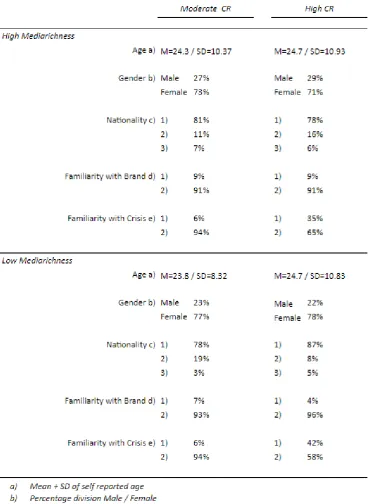
After the data collection 289 responses were taken over into the final data set. In total a drop-out
rate of 19.3 % (69 incomplete responses or withdrawal) can be reported. A G*Power analysis
suggested 269 participants for this study which is achieved. In total 216 (74.7%) Females and 73
(25.3%) Males participated, with their age ranging from 19 up to 77, with a M = 27.5 years old.
Participants were mostly German with N = 235 (81.3%) and Dutch N = 39 (13.5%) accounting for
94.8% of the whole sample. Furthermore, 269 of the respondents (93.1%) were no customers of the
respective Airline company before and 225 (77.9%) did not know about the particular crisis before.
21 Table 1. Demographic distribution of sample characteristics
3.4
Measures
As earlier stated, public anger, negative word-of-mouth, negative impressions of the CEO, negative
impressions of the company, distrust and forgiveness were the dependent variables in this study. All
items were measured on a 5-point Likert scale ranging from (1) Totally disagree up to (5) Totally
Appendix A. To check, whether the proposed independent variables, displayed in the conceptual
research model, are correctly measured a confirmatory factor analysis (CFA) is performed. The CFA
sheds light on the correctness of the model, scales with less explained variance than 50% are
considered insufficient. Items which have a smaller coefficient than .6 are labeled as non-sufficient
and are removed from the factorial model. Furthermore, to ensure reliability of the instrument,
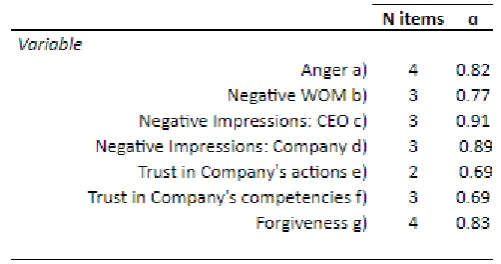
Cronbach’s reliability analysis is performed. Table 3 shows the summarized Cronbach’s alphas of the
instrument.
Anger
Anger was measured using a 5-item scale from the study of Lee and Chung (2012) about corporate
apology and crisis communication. As this scale asks about the respondents perceived feelings, the
answer options ranged from (1) not at all up to (5) very strong. An example of these items is “To
what extent do you experience the following feelings (e.g. madness) towards the company?”.
Confirmatory factor analysis was conducted and revealed that one anger item, ‘To what extent do
you experience the following feeling (madness) towards the company?’, had to be removed. The other items measured a single construct with an eigenvalue of 2.63 and explain 65.75% variance with
factor loadings ranging from .70 to .85. Secondly, Cronbach’s alpha ɑ = .82 shows good internal
consistency.
Negative word-of-mouth
To measure negative word-of-mouth a three-item scale from Coombs and Holladay (2008) and their
study about the comparison of apology to equivalent crisis response strategies was used. One
example of these items is “I would say negative things about the company and its service to other
people.”. Again, factor analysis confirmed that all three items load on a single construct with an
eigenvalue of 2.07 with explained variance of 68.95% and Cronbach’s alpha ɑ = .77, which is good.
Factor loadings ranged from .77 to .87 in total.
Negative impression: CEO and Company
To measure both, negative impressions towards the CEO and the company, a 3-item scale from De
Blasio and Veale (2009) was used. They studied the influence on consumer perceptions after
organizational crises. The same scale was used for both variables and adapted accordingly. Examples
of the items are “I am disappointed with the CEO.”and “I evaluate the company negatively.”. All 3
items, in both cases, were measured on a 5-point Likert-scale (disagree-agree) and factor analysis
23 eigenvalue of 2.53 and is accounting for 84.19% of variance and Cronbach’s alpha ɑ = .91for the CEO
construct. Here, factor loadings ranged from .88 to 9.4.
Additionally, the eigenvalue of the single factor in the company construct was 2.45 explaining
81.79% of variance with factor loadings from .88 to .92, Cronbach’s alpha was found to be ɑ = .89,
which is good.
Trust
Another dependent variable is trust. An 11-item scale from Hon and Grunig (1999) and their
guidelines for measuring relationships in public relations was used to measure the three components
associated with trust: competence, benevolence and integrity. An example of these items is “I think it
is important to watch this company closely to that it does not take advantage of people like me.”.
Confirmatory factor analysis revealed that the single construct of trust should be divided into two
new constructs explaining 52% of variance, namely: Trust in company’s actionswith ‘This organization treats people like me fairly and justly’ and ‘Whenever this organization makes and
important decision, I know it will be concerned about people like me’ as the first construct. These two
items focus on ethics regarding stakeholders when the company makes decisions. Both items were
part of the integrity component of the trust scale from Hon and Grunig before. Here, Cronbach’s
reliability analysis demonstrated sufficient internal consistency (ɑ = .69). The second new construct
Trust in the company’s competences consists of three items ‘I feel confident about this organization’s
skills’, ‘This organization has the ability to accomplish what it says it will do’ and lastly ‘This
organization is known to be successful at the things it tries to do’.
The three items completely focus on the respondents assessments regarding the company’s skills to
accomplish something. The items resemble the company’s competence of the Hon and Grunig scale.
Again, with a Cronbach’s alpha of ɑ = .69. Table 2 shows the rotated component matrix of the trust
scale. The remaining items were labeled as dependability items by Hon and Grunig and are
characterized by the company making decisions for the respondent. Respondents may have been
confused by the ambiguous wording of “I am very willing to let this organization make decisions for
people like me” or “I believe that this organization takes the opinions of people like me into account
Table 2. Rotated component matrix of the trust scale
Forgiveness
The last dependent variable is forgiveness. It was measured by using a 5-item scale derived from the
study of Xie and Peng (2009) about reparation of customer trust after negative publicity. One
example of these items is “Given the company’s response, I would forgive it.”. Confirmatory factor
analysis revealed that one item ‘Given the company’s response, I would condemn it.’ had to be removed. All other items loaded on a single construct with an eigenvalue of 2.67, accounting for
66.85% of variance with a respective Cronbach’s alpha of ɑ = .83, which is good. Factor loadings
ranged from .78 to .86.
Table 3. Cronbach’s alphas of the instrument
3.5
Adjusted conceptual model
The conceptual model which was earlier described in the theoretical framework has to be adjusted
because of the changes in the methodology. The final model is shown in figure 3. It is necessary to
point out the changes in the dependent variables section. Distrust, as the absence of trust, breaks
[image:27.595.72.323.453.585.2]25 Figure 3. Adjusted conceptual model
3.6
Assumption testing
To be able to apply parametric tests a few assumptions have to be met. This paragraph focuses on
testing these assumptions, namely: Normality (normal distribution of the data) and Homogeneity
(same variance across all conditions).
Normality
Shapiro-Wilks test was conducted to test if the data is normally distributed across the four
conditions: media richness of the crisis response (low / high) and crisis responsibility (moderate /
high). Significant results from the Shapiro-Wilk test of normality indicate that the data is not normally
distributed, therefore failing the assumption of normality and parametric testing is not applicable. A
possible explanation for these results could be outliers in the data set which skew the data. However,
outliers may provide important information and therefore should be kept if possible. One way to
Rank transformation, as part of data transformation, ensures normal distribution, while
robustness and little loss of statistical power are granted (Conover & Iman, 1981). Their article
bridges the gap between parametric and non-parametric tests. When using this method, all
observations will be ranked from the smallest observation, as 1, to the largest observation, as N. Ties
in observations will be assigned by the mean. Rank transformation was applied to the observations of
media richness and crisis responsibility.
Homogeneity
The second assumption which has to be met is the assumption of homogeneity, meaning all
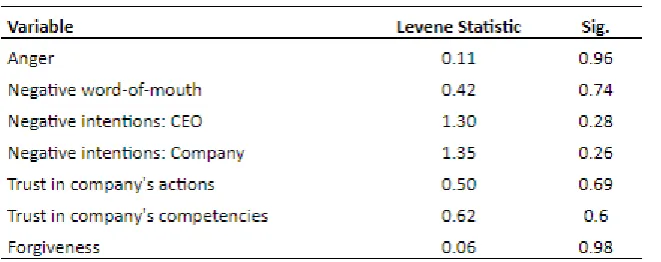
conditions have the same variance. After conducting the rank transformation, Box’s test of equality
of covariance and Levene’s test of equality of error variance were carried out. Results are shown in
table 4 and 5. Both tests had non-significant results (p > .05) indicating that the assumption of
homogeneity is met.
[image:29.595.74.405.502.633.2]Table 4. Box’s test of equality of covariance matrices.
27
4
Results
The results of this study will be presented in this chapter. Firstly, the main effects of media richness
and corporate crisis responsibility are discussed, followed by the interaction between these
variables. In the end, an overview of the hypotheses and answers to the research questions will be
given.
4.1
Descriptive statistics
This paragraph deals with the descriptive statistics of the dependent variables and the respective
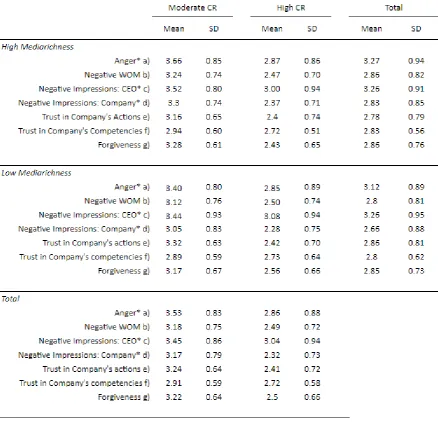
conditions with a total of N=289. Table 6 shows the mean (M) and standard deviation (SD). First, descriptives of the independent variables will be discussed, followed by descriptives of interaction
effects. Statements in the survey were recoded in the sense that high numbers indicate positive
organizational outcomes.
Media richness
Results of table 6 show that media richness had positive effect on anger, negative impression of the
CEO and negative impressions of the company. A negative effect was found regarding the trust in the
company’s actions.
Crisis responsibility
Participants were less angry in the moderate crisis responsibility condition (MCR) than participants in
the high crisis responsibility condition (HCR). Next, less negative word-of-mouth intention was
expressed in the MCR than in HCR. Participants had less negative impressions of the CEO in the MCR
than in the HCR condition, as well as of the company. Furthermore, more trust in the company’s
actions was displayed in the MCR condition than in the HCR condition. Trust in the company’s
competencies was higher in the MCR condition as well. At last, participants were more forgivable in
the MCR condition than in the HCR condition.
Media richness and crisis responsibility
In the following possible interaction effects between both independent variables are discussed.
Interaction effects were found for negative word-of-mouth, trust in the company’s actions, trust in
Table 6. Descriptive statistics per condition
4.2
Hypothesis testing
In this paragraph the hypotheses, as argued in the theoretical framework, are going to be tested. To
test whether the independent variables (media richness and crisis responsibility) had significant
impact on the dependent variables (public responses), a Multivariate Analysis of Variance (MANOVA)
was conducted. Wilks’ lambda is used to test the group means of the dependent variables (public
responses). Both independent variables were tested for significant impact, as well as for an
interaction effect between them. The results are shown in table 7.
The results indicate that there is a significant impact of crisis responsibility on public
29 confirmed for media richness p = .13, as well as an interaction effect between media richness and
crisis responsibility p = .64.
Table 7. Multivariate test for variance.
Furthermore, a test of between subjects was conducted to get more information about the
relationships of media richness and crisis responsibility with public responses. These results are
displayed in table 8.
It shows significant effects of crisis responsibility on all dependent variables with anger
F(1,285)=45.60; p = .00; negative word-of-mouth F(1,285)=72.56; p = .00; negative impressions of the
CEO F(1,285)=16.84; p = .00; negative impressions of the company F(1,285)=97.99; p = .00; trust in
the company’s actions F(1,285)=115.66; p = .00 and competencies F(1,285)=9.22; p = .00 and at last
forgiveness with F(1,285)=99.89; p = .00.
No statistically significant effects were found for the hypothesized relationship between
Table 8. Test of between subjects design effects
4.3
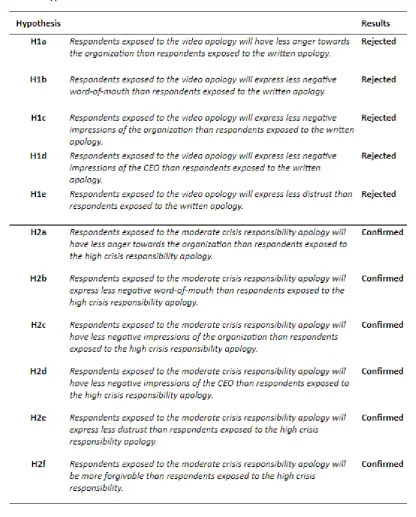
Hypotheses
In this paragraph the hypotheses, argued in the theoretical framework, will be confirmed or rejected,
31 Table 9. Hypotheses
33
5
Discussion
In this chapter the general discussion and conclusion of the study are presented. The purpose of the
study was to examine the roles of message delivery and corporate crisis responsibility on public
anger, negative word-of-mouth, negative intentions, distrust and forgiveness.
Message delivery: richness of media
Academic literature suggests that the differences in message delivery influence the earlier
mentioned public responses (Xu, Cenfetelli & Aquino, 2012; Tanis & Postmes, 2003; Vazquez, Dennis
& Zhan, 2017). It is argued that the presence of non-verbal cues impacts these variables in a more
positive manner than message delivery without these cues.
However, this study does not support these findings. All hypotheses but negative impressions
of the company are found to be non-significant and therefore not supported. Still this significant
effect is found to be of small size indicating other underlying factors. Other factors besides the
persuasiveness of non-verbal cues seem to be present in the context of message delivery and crisis
responses. It might be an explanation that video messages create a feeling of personalization in the
audience which leads to these results. The CEO, as the organizational spokesperson, gives the
organization a “face”. For example, it could be that when a transgressed party suddenly sees the
“face” of the transgressor that instead of feeling less angry, the transgressed party has a real person
to channel its anger towards, resulting in even more anger. On the other hand, a sincere video
message in which sympathy and honesty is communicated, might lead to decreased levels of
anger. However, if sympathy and honesty are not expressed by the CEO, as the face of the
organization, opposite effects are most likely.
It is worth noticing that Coombs and Holladay (2009) did not find significant results either
when investigating differences in video or print message delivery in the context of crisis response.
Future research might have a deeper and closer look on this topic regarding the differences in
delivery, type of crisis response communicated by print or video messages and the spokesperson
displayed. It is suggested that future research should take a deeper look at the differences regarding
media channels and the delivered crisis response. It might be possible that certain crisis responses
are best delivered by video messages whereas others are best delivered in a printed format (e.g.
denial responses).
Crisis Responsibility
Previous crisis management literature suggests a strong influence of crisis responsibility on the
dependent variables used in this study. This study supports these findings (Coombs, 2015; Fediuk,
be significant and therefore, the hypotheses are confirmed. It is shown that a crisis with less
corporate crisis responsibility evokes less anger towards this company. This was also found in the
study by Coombs and Holladay (2007) about negative communication dynamics during crisis.
Secondly, the crisis with less crisis responsibility has led to less negative word-of-mouth and less
negative impressions of both, the company and the CEO. Furthermore, respondents exposed to the
crisis with moderate crisis responsibility displayed more trust towards the company’s actions and
competencies and were ultimately more forgivable. Again, this is in line with previous crisis literature
(Lee, 2004; Coombs, 2015; Fediuk, Coombs & Botero, 2010).
Message delivery & crisis responsibility
Based on the Elaboration Likelihood Model (ELM) it was argued that an interaction effect between
message delivery and crisis responsibility is possible. RQ2 was formulated as: “How does the message
delivery of the apology interact with corporate crisis responsibility in regards to the public
responses?”. This study does not support this interaction between message delivery and crisis
responsibility. It is possible that, even when the ELM suggests otherwise, severe transgressions call
for a spokesperson to step up and take the word in the name of the organization. In the case of an
airplane crash, with a high level of crisis responsibility, it may be advisable for the company to
release a video message with the CEO as the spokesperson to express sympathy and honesty. Such a
video message may be perceived as more personal by stakeholders and might have a greater impact.
On the other hand, less sincere transgressions, which result in less involvement by the audience,
could be answered with a written statement by the organization since they are less time consuming
and need less resources. Again, it is suggested that future research takes a look into this topic. It
would be worth studying which channel, regarding the media richness, is best suited for certain crisis
responses, as they differ in their level of crisis responsibility.
5.1
Limitations
In this paragraph several limitations are discussed that need to be addressed to provide future
research with suggestions to avoid error and bias. First, convenience sampling has been used to
reach the required number of respondents. This sort of sampling limits the ability to achieve a
representative population sample, because certain characteristics are overrepresented. Examples in
this study are that most of the respondents are German, students and therefore highly educated and
around their mid-twenties. A different sampling approach might be beneficial for future research. As
an example, stratified sampling allows a more representative sample because it ensures that specific,
predefined characteristics are included in the sample (Hardon & Hodgkin, 2004). Additionally,