LEVERAGING SERVERLESS CLOUD
COMPUTING ARCHITECTURES
Developing a serverless architecture design framework based on best practices
utilizing the potential benefits of serverless computing
MASTER THESIS
BOLSCHER, R.T.J. (ROBIN, STUDENT M-BIT)
i
LEVERAGING SERVERLESS CLOUD COMPUTING
ARCHITECTURES
Developing a serverless architecture design framework based on best practices
utilizing the potential benefits of serverless computing
Master Thesis
August 2019
Author
Name R.T.J. Bolscher (Robin)
Programme MSc Business Information Technology
E-mail [email protected]
Institute University of Twente
PO Box 217 7500AE Enschede The Netherlands
Graduation Committee
Name Dr. Maya Daneva
E-mail [email protected]
Department Faculty of Electrical Engineering,
Mathematics & Computer Science (EWI), Services, Cybersecurity & Safety (SCS)
Name Prof. Dr. Maria-Eugenia Iacob
E-mail [email protected]
Department Faculty of Behavioural, Management and
Social Sciences (BMS), Industrial
iii
Preface
Before you lies the master thesis titled “leveraging serverless cloud computing architectures”. The thesis presents a research effort that mainly consists of an extensive literature analysis. Based on this analysis a framework is constructed that aims to support and improve the design process of serverless cloud computing architectures. It has been written as part of finalizing the Business Information Technology (BIT) master programme at the University of Twente. I have been fully engaged with this research effort from February to August 2019.
Personally, I have always been fond of designing and creating things. Since I was a kid I had the urge to ‘build something’. This finally resulted in me pursuing my bachelor’s degree in Creative Technology. During these studies I discovered a passion for applying software technology to fulfil this urge. Since then I have had the chance to apply this passion in practice as a software engineer in a number of companies, next to pursuing my bachelor’s and master’s degree. This background is what eventually drove me to focus my master thesis research on the topic of serverless cloud computing. I tried to combine my practical experience and academic skills with the goal of creating something useful for software professionals.
I would like to thank my supervisors, Maya and Maria, for their motivating and open-minded guidance during this process. Especially, considering the fact that I was stubborn enough to try and find my own path towards a master thesis project and that this resulted in the direction of my master thesis being somewhat unconventional for a typical BIT student. Additionally, I would like to thank my roommates, friends, family and especially my girlfriend Maaike, who gave me space to focus on my studies and kept supporting me throughout the tough times. Finally, I would like to thank the participants that voluntarily decided to help me evaluate the framework I constructed.
I hope you enjoy reading this thesis.
v
Abstract
vii
Acronyms
API Application Programming Interface
AWS Amazon Web Services
BaaS Backend-as-a-Service
CDN Content Delivery Network
CRUD Create Read Update Delete
DDOS Distributed Denial of Service
DNS Domain Name System
DSRM Design Science Research Methodology
FaaS Function-as-a-Service
I/O Input/output
IoT Internet-of-Things
IS Information Systems
SADF Serverless Architecture Design Framework
SOA Service Oriented Architecture
TAM Technology Acceptance Model
TOSCA Topology and Orchestration Specification for Cloud Applications
UI User Interface
VM Virtual Machine
ix
Table of Figures
Figure 1 Serverless function example ... 3
Figure 2 Sequence diagram of basic FaaS consumption ... 4
Figure 3 Research methodology process overview ... 13
Figure 4 Optimization of resource utilization by serverless computing compared to conventional VMs deployment. (a) Resource utilization in the cloud. (b) Zoom-in of resource utilization in the cloud with VMs. (c) Zoom-in of resource utilization in the cloud with serverless © 2018 IEEE 19 Figure 5 Sequence diagram for client focused composition pattern ... 33
Figure 6 Basic example of a serverless composition service implementation ... 34
Figure 7 Example of database connection pooling in a serverless function ... 39
Figure 8 Example of 'ports and adapter' based architecture © 2019 Vacation Tracker ... 41
Figure 9 Example of monolithic serverless function code pattern ... 43
Figure 10 Example of serverless function service code pattern ... 43
Figure 12 Example of serverless function nano-service code pattern ... 44
Figure 11 Example serverless function with separated core logic ... 44
Figure 13 Serverless computing benefits and challenges map ... 47
Figure 14 Flow chart to determine serverless suitability ... 50
Figure 15 Artefact design process overview ... 54
Figure 16 Graphical representation of serverless architecture design framework ... 58
Figure 17 Decoupled core logic and function handler ... 65
Figure 18 Monolithic serverless function example ... 66
Figure 19 Service serverless function example ... 66
Figure 20 Nano-service serverless function example ... 67
Figure 21 Process description of traffic detection and presentation ... 72
Figure 22 Process description of controlling actuators based on live traffic data ... 72
x
Figure 24 Process description of manual control by road supervisors ... 73
Figure 25 Process description of historic traffic data report generation ... 74
Figure 26 Architecture design view 1 (entails case processes 1,2 and 4) ... 81
Figure 27 Architecture design view 2 (entails case processes 3 and 5) ... 82
Figure 28 Revised graphical representation of SADF ... 94
Table of Tables
Table 1 Mapping of research methodology steps onto research questions ... 14Table 2 Mapping cross-viewpoint variables onto viewpoints ... 57
Table 3 Serverless benefits and challenges ... 62
xi
Table of Contents
Chapter 1. Introduction ... 1
1. 1. Introduction to serverless computing... 1
1. 2. Benefits and challenges of serverless computing ... 5
1. 3. Problem statement ... 6
1. 4. Research motivation ... 7
1. 5. Research objective ... 7
Chapter 2. Research methodology ... 9
2. 1. Research questions... 9
2. 2. Research process ... 10
2. 3. Expected contributions ... 13
2. 4. Thesis structure ... 14
Chapter 3. Literature review ... 15
3. 1. Literature review process ... 15
3. 2. Benefits of serverless computing... 17
3. 3. Challenges of serverless computing ... 22
3. 4. Characteristics of serverless suitability ... 27
3. 5. Composition of serverless applications ... 30
3. 6. Best practices for creating and migrating towards a serverless architecture ... 37
3. 7. Conclusions... 46
Chapter 4. Artefact design ... 53
4. 1. Artefact design process ... 53
4. 2. Literature analysis description ... 54
4. 3. Design of the serverless architecture design framework ... 54
4. 4. Conclusion ... 70
xii
5. 1. Case description ... 71
5. 2. Process analysis ... 72
5. 3. Conclusion ... 74
Chapter 6. Evaluation ... 75
6. 1. Case study ... 75
6. 2. Semi-structured interviews ... 84
6. 3. Conclusions and recommendations... 91
Chapter 7. Conclusions and recommendations ... 95
7. 1. Benefits and challenges of serverless computing ... 95
7. 2. Serverless suitability characteristics ... 95
7. 3. Serverless composition ... 96
7. 4. Serverless specific best practices ... 97
7. 5. Serverless architecture design framework ... 97
7. 6. Limitations... 99
7. 7. Recommendations and future work ... 101
References ... 103
Appendix 1. Serverless architecture design legend ... 107
1
Chapter 1.
Introduction
This chapter will present an introduction to serverless computing (Section 1. 1. ), and presents the summary of a literature review on the potential benefits and challenges of the serverless computing technology (Section 1. 2. ).
1. 1. Introduction to serverless computing
Serverless computing is a new and interesting cloud computing concept concerned with the deployment of small pieces of software applications and services (Baldini, Castro, et al., 2017). Since 2014 many of the tech giants have invested in this new cloud computing paradigm resulting in various serverless computing cloud services, for example AWS Lambda (Amazon Web Services), AWS Cognito (Amazon Web Services), Google Cloud Functions (Google), Google Firebase (Google), IBM Cloud Functions (IBM), Microsoft Azure Functions (Microsoft), Apache OpenWisk (Apache) and Auth0 (Auth0). Furthermore, Gartner reports that ”the value of [serverless computing] has been clearly demonstrated, maps naturally to microservice software architecture, and is on a trajectory of increased growth and adoption” (Lowery, 2016).
1. 1. 1. Definition of serverless computing
According to Baldini, Castro, et al. (2017) the term ‘serverless computing’ is coined by the technology industry, therefore it lacks a standardized formal definition. The academic community only recently started giving attention to this topic, a search for “serverless computing” on Scopus shows 63 publications since 2016, with the vast majority in 2017 (20) and 2018 (36). Two definitions of serverless computing, stemming from 2017 and 2018, were found:
1. “[Serverless computing is] a programming model and architecture where small code snippets are executed in the cloud without any control over the resources on which the code runs” (Baldini, Castro, et al., 2017).
2. “Serverless computing is a form of cloud computing that allows users to run event-driven and granularly billed applications, without having to address the operational logic” (Van Eyk et al., 2018).
Both definitions touch upon some of the key features of serverless computing:
1. Allows for granularly billing by cloud service providers. 2. An event-driven programming model and architecture. 3. Handles most, if not all, operational concerns.
4. Removes control over resources.
There are some additional key features not completely covered by the definitions though, for example the following mentioned by Chapin and Roberts (2017):
2
6. Auto-scaling and provisioning. 7. Implicit high availability. 8. Implicit fault tolerance.
Both definitions of serverless computing are quite accurate and overlapping, even though they use different terminology. For the purpose of the research in this thesis we will consider the term ‘serverless computing’as indicated below. It is grounded on the definitions of Baldini, Castro, et al. (2017) and Van Eyk et al. (2018):
“A form of cloud computing that removes all operational concerns for users while allowing
granular scaling and billing by supporting a programming model and event-driven software architecture that uses small code functions as individual deployment units.”
It is important to note that serverless computing is a misnomer in the sense that serverless computing does not actually refer to the absence of servers in cloud computing (Jonas, Pu, Venkataraman, Stoica, & Recht, 2017; Spillner, 2017). From a software developer’s perspective the name seems more appropriate; serverless computing abstracts away most resource related concerns (e.g. over-/under provisioning, fault tolerance, scalability, deployment) in such a way that the developers do not have to think about the server to which their code will be deployed (Baldini, Castro, et al., 2017; Hendrickson et al., 2016; Varghese & Buyya, 2018; Villamizar et al., 2017).
Chapin and Roberts (2017) categorize two different types of serverless computing implementations: (1) Backend-as-a-Service (BaaS) and (2) Function-as-a-Service (FaaS).
1. BaaS is concerned with replacing server side components that were usually implemented and deployed by the software application owner through off-the-shelf external third party services. BaaS services expose their functionality, such as a managed database cluster (e.g. Google Firebase (Google)) or authentication components (e.g. Auth0 (Auth0) and Amazon Cognito (Amazon Web Services)), through an API.
2. FaaS is a new method of creating and deploying server-side software applications, based on individual functions as deployment unit. Examples of FaaS providers are AWS Lambda (Amazon Web Services), Google Cloud Functions (Google), IBM Cloud Functions (IBM), Microsoft Azure Functions (Microsoft) and Apache OpenWisk (Apache). The most widely adopted FaaS implementation currently available is AWS Lambda (Amazon Web Services), many people refer to FaaS implementations as serverless computing (Chapin & Roberts, 2017). However, FaaS is just one implementation of the serverless computing concept (Chapin & Roberts, 2017; McGrath, Short, Ennis, Judson, & Brenner, 2016; Varghese & Buyya, 2018; Yan, Castro, Cheng, & Ishakian, 2016).
3 explicit distinction will be made in this thesis due to the technical and architectural differences. Therefore, the main subject of this thesis will be based on the serverless computing implementation FaaS, whenever BaaS is discussed this will be explicitly mentioned.
1. 1. 2. Introduction to serverless functions
A serverless function is the basic deployment unit of FaaS. Whereas conventional cloud computing considers large all-encompassing software applications (or services in case of Service Oriented Architectures (SOA) or microservice architectures) as the basic deployment unit, FaaS allows individual deployment of functions or operations (Chapin & Roberts, 2017).
These functions are all separately deployed in lightweight containers which can individually be started (provisioned) the moment the cloud service provider receives an event that wants to use that specific function of the software application (McGrath & Brenner, 2017; Varghese & Buyya, 2018). Containers are the next evolution in lightweight virtualization techniques for cloud deployment (Pahl, Brogi, Soldani, & Jamshidi, 2018), and pose several advantages over traditional Virtual Machine (VM) based deployment such as quick provisioning (server start up time) and less storage and processing overhead (Hendrickson et al., 2016; Tosatto, Ruiu, & Attanasio, 2015).
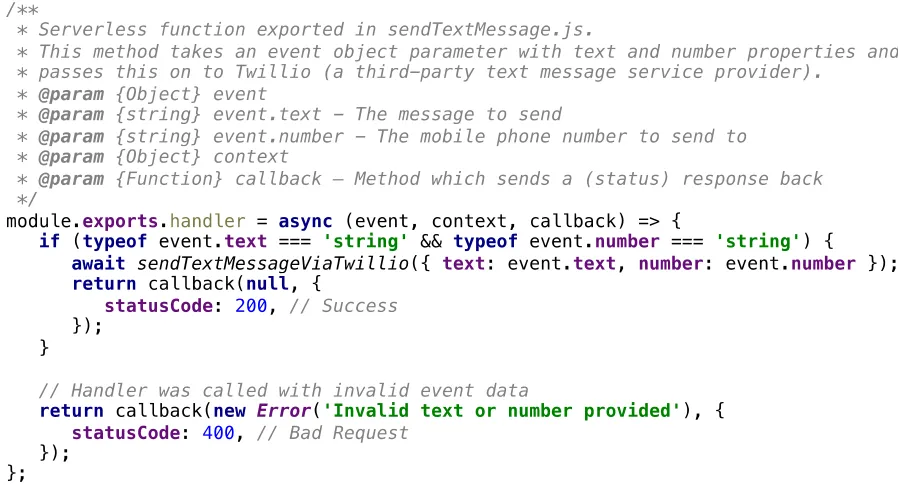
[image:17.612.69.518.433.679.2]A simplified example of a serverless function is demonstrated in Figure 1, it shows a simplified function that handles an incoming event and sends a text message using the provided event data via a third-party text message service provider named Twillio (Twillio). Twillio itself can be considered an implementation of serverless computing, since it functions as a BaaS by providing various communication related functionalities through an API on a pay-per-use basis.
4
An important difference between conventional long-running software applications (e.g. microservices) is that serverless functions are inherently stateless (Chapin & Roberts, 2017; McGrath et al., 2016). This is enforced by the life cycle of the function instances themselves; they are provisioned on request and deprovisioned whenever possible. Any temporary state stored in memory would be deleted upon deprovisioning. This brings challenges for software developers (forced to use external persistency services), but also opportunities, due to the stateless nature of serverless functions they can be horizontally scaled extremely easy, merely by increasing concurrency (Chapin & Roberts, 2017).
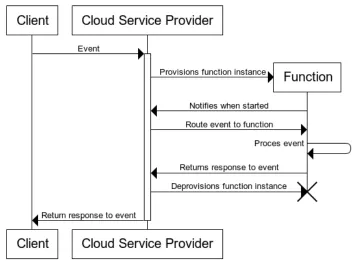
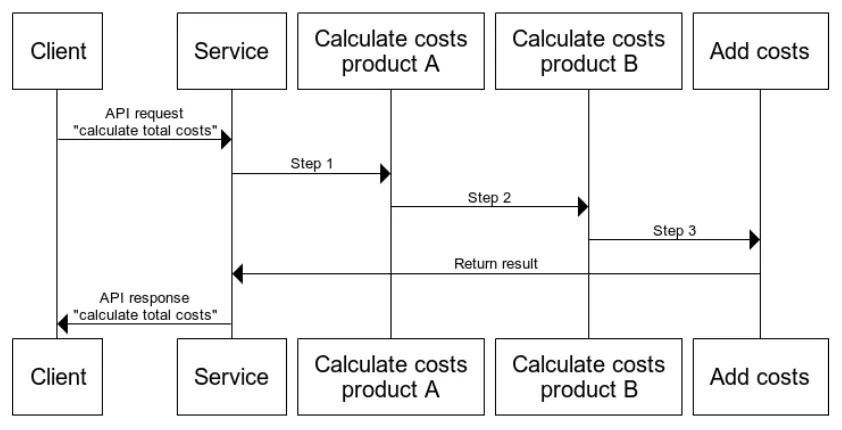
The process of consuming a serverless function is shown in Figure 2 and can be summarized on a high abstraction level as follows:
1. Cloud service provider detects an incoming event. 2. A container will be created running the function.
3. The event will be routed to this container once it has started. 4. The function will process the event.
[image:18.612.129.481.337.602.2]5. Finally the container will be terminated.
Figure 2 Sequence diagram of basic FaaS consumption
5 alleviate this problem by keeping the function “warm” for an arbitrary number of minutes after it has been used; basically the container, including the function, is not directly destroyed after use, but kept idle for some time. This eliminates cold start delay since the container can be re-used.
1. 2. Benefits and challenges of serverless computing
Serverless computing offers several benefits over conventional cloud deployment. This paragraph will shortly address the most prevalent benefits found in recent literature, more detailed analysis can be found in Section 3. 2.
Whereas conventional cloud deployment of monolithic applications poses scaling issues, a microservice or serverless computing architecture allows for far more granular scaling and therefore optimizes resource utilization (Van Eyk et al., 2018; Villamizar et al., 2017). Because of the optimized resource utilization, over and under provisioning is minimized, resulting in reduced operational costs. In contrast to conventional VM based deployments, where the application owner pays for the allocation of the resources whether it is being used or not (Varghese & Buyya, 2018), serverless computing offers a cost model based on execution time rather than resource allocation (Adzic & Chatley, 2017; Eivy, 2017; Villamizar et al., 2017). The latter further aligns the operational costs to actual business demand.
Furthermore, serverless computing, and FaaS in particular, presents novel architectural opportunities for software developers and software architects such as inherent fault tolerance, effortless parallelisation of computing and the composition of various serverless functions to create business value through workflows (Jonas et al., 2017; van Eyk, Iosup, Seif, & Thömmes, 2017; Varghese & Buyya, 2018; Wagner & Sood, 2016; Yan et al., 2016).
Finally, serverless computing potentially improves the development process by reducing lead time (Adzic & Chatley, 2017; Baldini, Castro, et al., 2017; Chapin & Roberts, 2017), reducing risk (Chapin & Roberts, 2017; Ivanov & Smolander, 2018), and allowing software developers to choose the best language, dependencies and tools for a specific serverless function, in contrast to being stuck with the decisions made many years ago in a different context in the case of a monolithic application (Van Eyk et al., 2018).
Serverless computing also poses some severe challenges compared to conventional cloud deployment. This paragraph will shortly address the most prevalent benefits found in recent literature. More detailed analysis can be found in Section 3. 3.
6
general, the unpredictability of FaaS performance makes it difficult to provide Quality-of-Service guarantees which are often desired in business contexts (Yan et al., 2016).
Second, serverless computing brings new or additional development complexities. Developers need to update their knowledge on the concept and learn to work with new tools specific to FaaS development and deployment (Chapin & Roberts, 2017; van Eyk et al., 2017), and monitoring, debugging and versioning becomes more difficult in a serverless context (Baldini, Castro, et al., 2017; McGrath et al., 2016; van Eyk et al., 2017; Villamizar et al., 2017).
Third, FaaS brings the risk of potential vendor lock-in according to various authors (Adzic & Chatley, 2017; Baldini, Castro, et al., 2017; Chapin & Roberts, 2017; Eivy, 2017; Villamizar et al., 2017). Serverless functions are often developed for a specific FaaS platform and might not be deployable to other platforms without necessary changes, besides, FaaS platforms offer a lot of additional services such as platform specific storage adapters, scaling, monitoring and logging tools, authentication components etc., when serverless functions are becoming dependent on these platform provided services it becomes increasingly more difficult to move to another FaaS platform eventually.
Fourth, it is not trivial to decompose existing applications into serverless functions (Hendrickson et al., 2016; McGrath et al., 2016). The ability to do this is necessary to move existing (monolithic) applications towards a microservice or serverless oriented architecture.
Finally, the potential operational cost reductions are not so straightforward as they might appear. According to Eivy (2017) the cost reductions “heavily depend on the execution behaviour and volumes of the application workloads”. Therefore, serverless computing needs to be applied with care to prevent unexpected high costs.
Concluding, serverless computing has the potential to be of great benefit to software developers, software architects and software application owners, by improving the software quality while reducing costs. However, the challenges presented above need careful consideration on a per-case basis in order to ensure the successful application of serverless computing.
1. 3. Problem statement
7 components shared by FaaS platforms, facilitating new deployments and enabling comparisons of designs”. The proposed reference architecture is just an example of the gap in usable knowledge with regard to serverless architectures. Because of this missing or scattered knowledge, practitioners are, for example, likely to underutilize, misuse, implement anti-patterns, or generate substantially more costs than would be necessary and by doing so forgoing the envisioned benefits of serverless computing.
1. 4. Research motivation
The most desirable benefits of serverless computing are aligning operational costs with actual business demand and cost savings in general, but also more secondary benefits are identified such as improved agility, reduced lead time, et cetera.
Many businesses currently are not using serverless computing technology or are underutilizing it due to the many unknowns such as complex cost structures, performance challenges and uncertainties regarding the implementation of this concept into the current application architecture.
The motivation of this research effort is that serverless computing has a lot to offer to software application architects, developers and owners, however due to the novelty of the technology and the relatively high architectural and economic impact, its adoption is lacking behind or at the very least, is not maximally utilized. Switching to a serverless architecture requires a thoughtful switch, similar to the one architects and developers had to make when microservices where becoming a more common architectural style. It certainly is not a one-size-fits-all kind of approach. A successful serverless computing adoption depends on many factors and requires many important nonarbitrary considerations.
I hope this work can contribute to the successful adoption of serverless computing by providing software architects, developers and owners with the handlebars, insights and references to make informed decisions for their specific applications and to maximize the potential of this interesting new approach to deploying software in the cloud.
1. 5. Research objective
In order to improve the serverless computing adoption, and maximize utilization of the corresponding benefits, the objective of this thesis is to create a framework for designing serverless architectures which can be used by software architects and developers who want to move an existing application to a serverless architecture or who want to design a new serverless architecture from scratch. Additionally, this research aims to be interesting for software application owners as well due to the high economic impact of the serverless software architecture.
8
9
Chapter 2.
Research methodology
This chapter is dedicated to describing the research methodology that is used for this research. It describes the proposed research questions (Section 2. 1. ), the research process that will be followed to answer these research questions (Section 2. 2. ), the expected contributions of this thesis (Section 2. 3. ) and presents the structure of the remainder of this thesis (Section 2. 4. ).
2. 1. Research questions
Based on our research objective, a number of core research questions were defined as follows:
RQ1. What are the currently known benefits and challenges of serverless computing?
RQ2. What are the existing approaches or characteristics to determine which parts of an application are suitable to be implemented in a serverless way?
RQ3. How could cloud native architectures be composed and orchestrated to enable the full potential of serverless computing?
RQ4. What are the best practices for creating a serverless application from scratch, and for migrating a non-serverless architecture to a serverless architecture?
RQ5. How can these best practices be applied in a form that supports software architects and developers in the process of designing a serverless application architecture?
In the following paragraphs the reasoning and goals of the proposed research questions are further elaborated.
2. 1. 1. Research question 1
In order to apply serverless computing it is key to know what this technology has to offer in addition to the traditional commonly used cloud computing concepts. Besides, knowing which challenges the technology currently faces creates a new level of insight which is useful when thinking about the questions proposed in RQ4 and RQ5.
2. 1. 2. Research question 2
10
2. 1. 3. Research question 3
This question looks at how the granular serverless building blocks can be composed and orchestrated into large cloud native architecture solutions in such a way that the full potential of serverless computing is achieved. Important to consider for this question is the concept of a hybrid cloud architecture.
Hybrid cloud applications (a combination of various types of cloud computing, on-premise, private/public cloud, third-party services, linked together through orchestration) pose a challenge because of the heterogenous nature of the system. It is important to know how to use and develop these different sorts of cloud computing services in conjunction, and to find out how to maximize the benefits of each individual sort of service to create economical, easy-to-develop and highly performant systems. New approaches might be required to assemble serverless components into larger systems that are easier to understand and reason about.
The goal of this research question is to gather knowledge on the various possibilities regarding composability of serverless applications.
2. 1. 4. Research question 4
This research question focusses on defining best practices for creating serverless applications from scratch and the migration from non-serverless architectures towards hybrid serverless architectures. This question heavily relies on RQ2 and RQ3, which already propose some important characteristics of this process.
The goal of this research question is to formalize the body of knowledge concerned with the creation and/or migration of hybrid serverless applications into a set of considerations and choices which can assist software architects and developers when faced with similar challenges.
2. 1. 5. Research question 5
This research question analyses and combines the knowledge gathered by RQ1, RQ2, RQ3 and RQ4. Additionally, it looks at how to create a framework which implements the said knowledge into a form that is usable by software architects and software developers. The goal is to create a serverless architecture design framework which will aid practitioners in the process of designing a serverless architecture while applying best practices found in literature. This framework will be evaluated by applying it to a case study which entails the design of a serverless application architecture and by performing semi-structured interviews with a set of practitioners.
2. 2. Research process
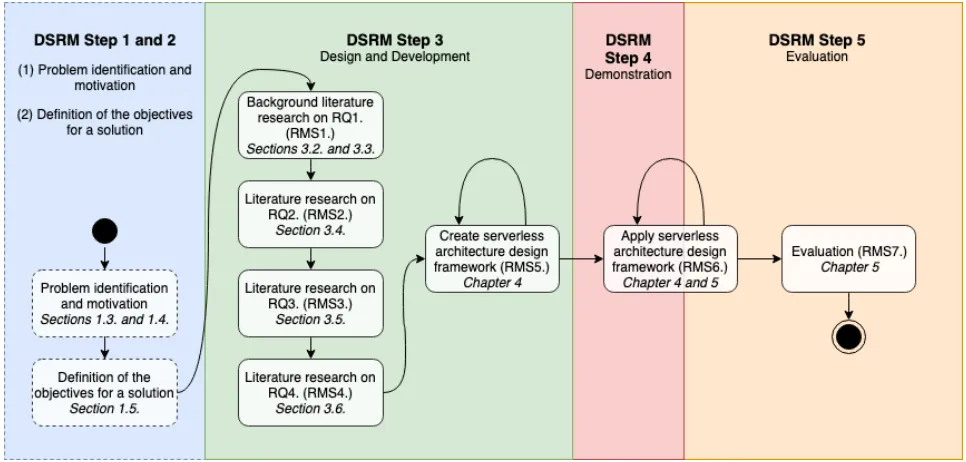
11 which will be performed using a structured review approach as proposed by Webster and Watson (2002). The second is concerned with applying this knowledge to design, demonstrate and evaluate a framework (steps RMS5, RMS6 and RMS7).
The DSRM was chosen since it offers a formal method for doing design science research specifically for the Information Systems (IS) domain with a focus on producing an artefact that addresses a predefined problem. The DSRM describes six distinct process steps:
1. Problem identification and motivation 2. Definition of the objectives for a solution 3. Design and development
4. Demonstration 5. Evaluation 6. Communication
The first two DSRM steps are covered by respectively Sections 1. 3. “Problem statement”, 1. 4. “Research motivation”, and 1. 5. “Research objective”. The third, fourth and fifth steps are addressed in the remaining chapters of this thesis. The sixth step is not specifically addressed, however this thesis as a whole can be considered to represent the communication step as it presents and discusses the results of the application of the DSRM. To answer the research questions and reach the research objective a number of consecutive research methodology steps (RMS) have to be taken which are described below.
Part 1 – Background and literature research
RMS1. Literature research on the benefits and challenges of serverless computing.
This step creates the theoretical basis upon which can be built in the next steps by answering RQ1. A large part of this step is already set forth in Chapter 1.
RMS2. Literature research on identifying characteristics that makes chunks of applications suitable to benefit from serverless computing.
The goal of this step is to answer RQ2 by delivering a set of characteristics that can help software developers and architects to determine if a piece of code could/should be deployed serverless or not.
RMS3. Literature research on the composition, orchestration/choreography of (hybrid) serverless applications.
12
RMS4. Literature research on best practices for creating a serverless application from scratch and for migrating a non-serverless architecture to a serverless architecture.
The goal of this step is to gain insight into best practices for creating serverless application architectures. This is needed in order to implement this knowledge into a form that can be used by software architects and developers.
Part 2 – Design, demonstration and evaluation of framework
RMS5. Create a serverless architecture design framework.
Deliverable of this step is a serverless architecture design framework created using the gathered knowledge (steps RMS1 through RMS4) which serves as a basis for the next steps of this research. For this step the DSRM is utilized.
RMS6. Apply and evaluate the serverless architecture design framework.
This step entails an application and evaluation of the serverless architecture design framework. It will be applied on a case study which will function as a first evaluation of the framework.
RMS7. Evaluation of the serverless architecture design framework with domain experts.
The final step of this research method is the evaluation of the serverless architecture design framework produced by the DSRM in steps RMS5 and RMS6. This will be done by performing semi-structured interviews with a number of domain experts; preferably three to four. According to Boyce and Neale (2006) “in-depth interviews are useful when you want detailed information about a person’s thoughts and behaviours“. Since this is exactly the goal of the evaluation, semi-structured interviews are chosen as evaluation method. Moreover, this type of interview was chosen due to the rather broad nature of the problem domain. Additionally, it is hoped that the domain experts will take the opportunity given by semi-structured interviews to divert from the topic where needed to provide valuable insights and knowledge the researchers could not have predicted beforehand. Additionally, the Technology Acceptance Model (TAM) by Davis, Bagozzi, and Warshaw (1989) will be applied to measure some important aspects of the proposed artefacts such as perceived usefulness and perceived ease-of-use.
13
Figure 3 Research methodology process overview
2. 3. Expected contributions
The research efforts in this work are expected to have a twofold contribution to both researchers and practitioners in the area of serverless computing.
First, an extensive literature review will be conducted on the topic of serverless computing and the proposed research questions RQ1, RQ2, RQ3 and RQ4. This is expected to contribute to the state-of-the-art on this topic by synthesizing the relevant literature into a comprehensive overview and making relevant connections between the accumulated knowledge.
14
2. 4. Thesis structure
[image:28.612.85.530.328.555.2]This thesis is organized as follows. Chapter 3. presents the literature review that serves as the theoretical foundation of this work. Chapter 4. describes the creation of the serverless architecture design framework (SADF). Chapter 5. describes the case that will be used to apply and evaluate the serverless architecture design framework. Chapter 6. presents the demonstration and evaluation of the SADF based on a case study and interviews. Chapter 7. will conclude this work by summarizing the knowledge and experiences gathered during the execution of this research, additionally it will present recommendations for practitioners and researchers. Finally, Section 7. 6. will discuss some of the most important limitations to this research effort.
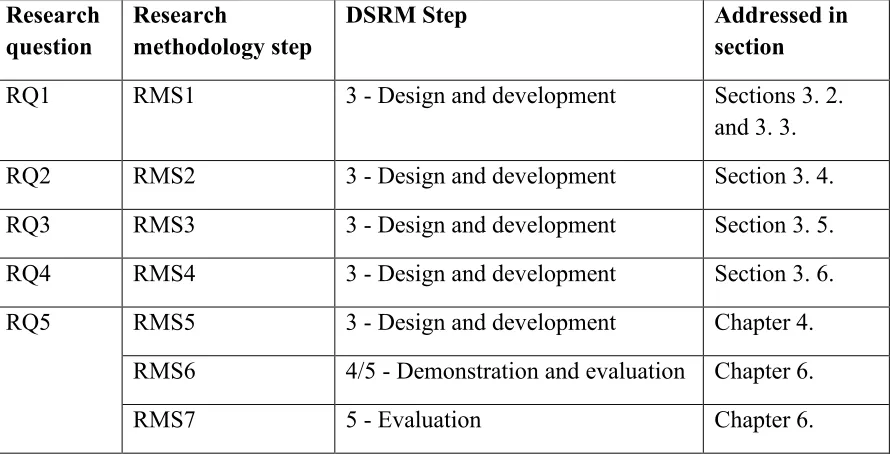
Table 1 presents a mapping of the research methodology steps (RMS) as presented in Section 2. 2. onto the research questions and the DSRM steps. This shows the direct relation between the actions that will be performed during this research effort and the research questions they try to address. Additionally, the final column describes in what specific section of this thesis the research question and corresponding RMSs will be addressed.
Research question
Research
methodology step
DSRM Step Addressed in section
RQ1 RMS1 3 - Design and development Sections 3. 2.
and 3. 3.
RQ2 RMS2 3 - Design and development Section 3. 4.
RQ3 RMS3 3 - Design and development Section 3. 5.
RQ4 RMS4 3 - Design and development Section 3. 6.
RQ5 RMS5 3 - Design and development Chapter 4.
RMS6 4/5 - Demonstration and evaluation Chapter 6.
RMS7 5 - Evaluation Chapter 6.
15
Chapter 3.
Literature review
This chapter presents the main theoretical contribution of this thesis which consists of several separate literature reviews on the subjects of: benefits and challenges of serverless computing (resp. Section 3. 2. and Section 3. 3. ), characteristics of serverless suitability (Section 3. 4. ), composition of serverless applications (Section 3. 5.) and finally best practices for creating and migrating towards a serverless architecture (Section 3. 6. ). This chapter will conclude with the implications of the found literature for this work by answering the research questions as presented in Section 2. 1.
3. 1. Literature review process
There are various separately executed literature reviews presented in this chapter. Even though they were executed separately they followed the same review process: a structured review approach as proposed by Webster and Watson (2002). The literature reviews presented here are not exhaustive and are merely structured (and not systematic) in order to quickly create a broad base of information which in turn can be built upon later on in this research effort. Roughly the following steps were executed for each literature review:
1. Establish search keywords 2. Execute search on Scopus
3. Select relevant and recent papers by reading titles and abstracts 4. Select useful papers by reading them thoroughly
5. Based on the resulting papers execute additional explorative literature research
The main scientific literature source used is Scopus, however, in some cases (especially the explorative review part) Google Scholar was used as additional source.
3. 1. 1. Literature review process RQ1
This section shortly addresses the structured literature review for RQ1 which tries to answer the question of “What are the currently known benefits and challenges of serverless computing?”. This literature review is addressed in both Section 3. 2. and Section 3. 3. This literature research was very much explorative, as it served as the initial deep dive into the subject matter. Notwithstanding, the following search queries were used as basis for this explorative research:
16
3. 1. 2. Literature review process RQ2
This section describes the literature review executed for the purpose of answering RQ2 “What are the existing approaches or characteristics to determine which parts of an application are suitable to be implemented in a serverless way?”. The result of this review is described in Section 3. 4. The following search queries were executed:
1. “serverless AND computing” 2. “serverless AND code”
3. “serverless AND computing AND code AND characteristics” 4. “serverless AND suitable”
5. “serverless AND code AND suitability”
3. 1. 3. Literature review process RQ3
This section presents the structured literature review executed in order to answer RQ3 “How could cloud native architectures be composed and orchestrated to enable the full potential of serverless computing?”. The results are presented in Section 3. 5. The following search keywords were used:
1. “serverless AND composition” 2. “serverless AND architecture” 3. “serverless AND orchestration”
This resulted in respectively 6 papers (1st query), 107 papers (2nd query) and 9 papers (3rd query). Due to the large number of results for the second search query, the fact that the papers were spread over a large time period (2009 to 2019), and the large concentration of publications in 2017 (22) and 2018 (36), was decided to only include papers for this query from 2017 through 2019.
After filtering all publications based on their abstracts (and duplicate results) there were 2 papers (1st query), 19 papers (2nd query) and 5 papers (3rd query) left. Next, the papers were read thoroughly and selected based on their relevance towards to topic of state-of-the-art serverless composition. This resulted in a final 13 papers; 2 papers (1st query), 9 papers (2nd query) and 2 papers (3rd query).
Some additional papers were found through explorative literature research or originate from earlier stages of this research, these papers are incorporated into the text where applicable.
3. 1. 4. Literature review process RQ4
This section presents the structured literature review executed in order to answer RQ4 “What are the best practices for creating a serverless application from scratch, and for migrating a non-serverless architecture to a non-serverless architecture?”. The results are presented in Section 3. 5. The following search keywords were used:
17 2. “serverless AND best practices”
3. “serverless AND guidelines” 4. “serverless AND migration”
This resulted in respectively 2 papers (1st query), 6 papers (2nd query), 1 paper (3rd query) and 12 papers (4th query). After reading the papers’ title and abstract there was respectively 1 paper (2nd query) and 2 papers (4th query) left that were expected to be relevant to this literature review. Reading the papers thoroughly resulted in 2 papers that were included in this review.
Since the academic literature yielded very little results, also (exploratively found) grey literature is included for this review (e.g. blog posts by practitioners, company presentations and white papers). Additionally, since a lot of literature research on the topic of serverless computing has preceded this review, a lot of relevant information was extract from papers that were found through previous reviews related to research questions RQ1, RQ2 and RQ3. The grey literature and the previously found literature complementary make up for the lack of paper results for this specific research question.
3. 2. Benefits of serverless computing
This section is concerned with answering the first part of RQ1 “What are the currently known benefits and challenges of serverless computing?”. Serverless computing offers several benefits over conventional cloud deployment; granular scaling ability, optimisation of resource utilization, reduction of operational costs, architectural opportunities and improvements to the development process. This paragraph presents a non-exhaustive summary of the most important benefits found in literature.
3. 2. 1. Granular scaling opportunities
The nature of serverless computing allows for very granular scaling compared to more conventional types of cloud computing. As noted by Villamizar et al. (2017) and Van Eyk et al. (2018) scaling a monolithic application is difficult since it comprises of many different services, one service might be in high demand and therefore unnecessarily degrading the performance of all constituent services. The only solution is to scale the whole monolithic application, even though some services might be sitting idle (Van Eyk et al., 2018; Villamizar et al., 2017).
18
This is why companies like Amazon started creating products like AWS Lambda (Amazon Web Services) to fill that gap. These serverless computing services enable creating microservices, without the need to manage servers, that can easily be deployed and are automatically scaled (Villamizar et al., 2017).
Another benefit stemming from the granular scaling capabilities is the ability to parallelize heavy workloads almost instantly as demonstrated by McGrath et al. (2016) and their Trek10 media management service application (MMS) example. The Trek10 MMS is able to re-size several hundred images in about the same time it would take to re-size just one image. This has been realized by applying a fan-out approach; a “master” function takes the image resize request and invokes a new “worker” function to perform the CPU intensive task of resizing the image. This parallelization reduces the total execution time of resizing hundreds of images as each image is being resized by a different serverless computing instance.
An important note to make here is that scaling serverless computing functions is done automatically by the cloud service provider, without any required configuration (Chapin & Roberts, 2017). Depending on the cloud service provider there are some scaling configuration options, however the gist is that for each incoming request a new function instance will be created, running on its own resources, hence the automatic and configuration-less scaling. Because of its automatic scaling capability, serverless computing is especially useful in contexts where demand is hard to predict and experiences large spikes and drops.
3. 2. 2. Optimizing resource utilization
The most obvious benefit of serverless computing, and actually a result of the granular scaling opportunities, is the improved alignment of resource usage to actual demand. In conventional VM based deployments a server has to be continuously running the deployed software application, moreover, the resources available to the VM must be of such performant level in order to be able to handle peak demand at all times which results in continuous high costs and unnecessary over-provisioning (Chapin & Roberts, 2017).
19 Serverless computing optimizes resource utilization by being extremely granularly scalable (Van Eyk et al., 2018). For each incoming event a new function instance is provisioned (if there are no free warm instances available at that moment), meaning that serverless computing scales horizontally almost instantly compared to demand (Chapin & Roberts, 2017). This results in basically zero under-provisioning, and due to the fact that instances are automatically deprovisioned when not used, there is also zero over-provisioning. The optimization of resource utilization of serverless computing compared to conventional VMs is demonstrated in Figure 4 as presented by Van Eyk et al. (2018).
Figure 4 Optimization of resource utilization by serverless computing compared to conventional VMs deployment. (a) Resource utilization in the cloud. (b) Zoom-in of resource utilization in the cloud with VMs. (c) Zoom-in of resource utilization in the cloud with serverless © 2018 IEEE
Another benefit of serverless computing is the implicit built-in fault tolerance. If an error occurs within a serverless computing instance when processing an event, the instance is restarted and provided the same input in order to retry (Jonas et al., 2017). This is related to optimizing resource utilization since the conventional approach to handle fault tolerance is to deploy fail-over instances, which doubles the operational costs and is part of over-provisioning (Singh, Singh, & Chhabra, 2012).
3. 2. 3. Reducing operational costs
Conventional cloud computing requires a software application to be hosted on a VM or inside a container (Varghese & Buyya, 2018). The software application owner pays for the whole time the VM or container is running the software application, regardless of whether it is being used or not; a cost model of ‘per VM per hour’, ignoring idle time (Varghese & Buyya, 2018).
20
zero’ (Baldini, Castro, et al., 2017), meaning that cloud service providers can destroy all deployed instances resulting in zero costs for the software application owner as long as it is not being used. The cost model for FaaS is based on execution time rather than resource allocation (Adzic & Chatley, 2017; Eivy, 2017; Villamizar et al., 2017). Different cloud service providers use different billing schemes, an example taken from AWS (Amazon Web Services) shows that depending on the required RAM (ranging from 128MB to 3008MB) a software application owner would pay from US$ 0.000000208 to US$ 0.000004897 per 100ms of execution time. The cloud service provider can offer these low prices due to the fact that there is not one large VM continuously running the entire software application, rather, the software application is divided into many small serverless functions.
Serverless deployment is not necessarily equally beneficial in all contexts. Especially (parts of) software applications that are not highly utilized benefit from cost reductions due to serverless deployment (Warzon, 2016). Furthermore, software applications that experience inconsistent, burst and compute intensive workloads are expected to benefit from cost reductions when deployed serverless (Baldini, Castro, et al., 2017; Chapin & Roberts, 2017).
It is nonarbitrary to determine how low-utilized a software application has to be in order for it to be cheaper when deployed serverless, to this end Warzon (2016) performed a breakeven analysis between AWS Lambda (Amazon Web Services) and AWS EC2 (Amazon Web Services) which at least gives an idea on when serverless deployment would be cheaper than conventional deployment. The breakeven analysis has no singular answer, since there are various configuration options for both AWS Lambda (e.g. RAM and CPU) and AWS EC2 (different instance types). The smallest AWS Lambda configuration (128MB RAM) with a function execution time of 100ms is cheaper than a AWS EC2 m4.large instance up till 295,000 requests/hour. More frequent requests and an m4.large instance becomes cheaper to run continuously. When execution time and/or required RAM rises for AWS Lambda functions, the breakeven point lowers quickly; 200ms and 512MB breaks even at 64,000 requests/hour, 200ms and 1GB at 34,000 requests/hour and 1sec and 1GB at 7,100 requests/hour.
21 Their findings are that both the labour cost of developing the game and the resource costs of running the necessary cloud infrastructure are reduced, additionally the authors mention a risk reduction due to inherent FaaS features such as high availability, scaling and security.
Another benefit mentioned earlier is also responsible for cost reductions: implicit failover. Conventional failover implementations require an additional instance to be running all the time to pick up the pieces once another instance has failed. This results in double the costs of running the software application without failover. FaaS has inherent failover, whenever a function execution fails it will be retried on a newly provisioned function, hence making conventional costly failover implementations superfluous (Jonas et al., 2017; Wagner & Sood, 2016).
Cost reductions are a huge intrinsic benefit. Moreover the lower costs create new opportunities that used to be too costly. The shift from capital to operational expenses is one of them, cloud computing in general removes the necessity of purchasing expensive hardware before a software application can be deployed. Serverless computing further improves this by enabling companies to almost perfectly align the costs of hosting a software application to actual business processes due to its ‘pay-as-you-go’ cost model, additionally it allows companies to monitor costs more granularly on a per business process basis (van Eyk et al., 2017). Removing barriers to versioning is another accessory opportunity, each serverless function deployment receives a unique numeric identifier, and multiple versions of a serverless function can be deployed simultaneously, this empowers developers in a way that was never possible with conventional cloud deployment since it would cost twice as much to have two versions of the same software application deployed at once (Adzic & Chatley, 2017; Van Eyk et al., 2018).
3. 2. 4. Architectural opportunities
Serverless computing, and FaaS especially, presents new architectural opportunities to software application developers and architects. One of these opportunities is touched on before, inherent fault tolerance provided by FaaS (Jonas et al., 2017; Wagner & Sood, 2016). This removes the need for developing and managing fault tolerance from the start, these saved efforts could therefore be spend more effectively.
Another opportunity is the effortless parallelisation of computing. Due to the automatic horizontal scaling of serverless functions it is very easy to distribute and parallelize computing when desired (Varghese & Buyya, 2018). An example is the ExCamera application described by Van Eyk et al. (2018) where the authors used FaaS for improving the performance of editing, transforming and encoding videos by parallelizing these tasks over many concurrent serverless functions. McGrath and Brenner (2017) describe similar performance improvements through parallelisation; a media management service application that parallelised image resizing making the execution time independent of how many resizes are being executed simultaneously.
22
due to the provided data flow and event-based abstractions (Yan et al., 2016). This is further substantiated by van Eyk et al. (2017) who envision a ‘workflow’ like composition of serverless functions in order to facilitate development. Amazon recognized this need and developed the AWS Step Functions (Amazon Web Services) service which allows “[the coordination of] multiple AWS services into serverless workflows”, or in other words, it enables the chaining or composing of serverless functions.
3. 2. 5. Improvements to the development process
A different category of benefits is that of development process improvements. For example, the independent serverless functions allow developers to choose the best language, dependencies and tools for that specific use case (Van Eyk et al., 2018). This way they are not bound to choices made in the past which may not work for their current challenge.
Reducing lead time is another major potential benefit to the development process, not only does it save labour costs, it also empowers developers to more quickly try and test potential solutions which enables faster feedback and improves rapid iterations (Adzic & Chatley, 2017; Baldini, Castro, et al., 2017; Chapin & Roberts, 2017). As a consequence of reducing lead time due to migration from a monolithic architecture to a serverless driven architecture Adzic and Chatley (2017) note that the release frequency for a real software application (Yubl) could be greatly increased, from 6 releases a month to more than 80. This reduction is mainly caused by the fact that serverless functions remove the need to manage infrastructure and other operational aspects for developers, which in turn allows them to focus their time and effort on business logic (Adzic & Chatley, 2017; Baldini, Castro, et al., 2017).
Finally, reduction of risk is mentioned as a result of adopting serverless computing (Chapin & Roberts, 2017). While Chapin and Roberts (2017) do not mention any further specifics, Ivanov and Smolander (2018) note that serverless can reduce risk by providing easy deployment and rollbacks due to the atomic nature of serverless functions.
3. 3. Challenges of serverless computing
23
3. 3. 1. Performance challenges
Various authors describe performance as one of the main challenges FaaS is currently facing (Baldini, Castro, et al., 2017; Chapin & Roberts, 2017; van Eyk et al., 2017; Van Eyk et al., 2018). Examples of these performance issues are relatively long wait-times due to cold starts (Baldini, Castro, et al., 2017; Chapin & Roberts, 2017; van Eyk et al., 2017) and high latency due to the HTTP transport protocol (Chapin & Roberts, 2017) but also currently very basic scaling and scheduling policies (Baldini, Castro, et al., 2017; van Eyk et al., 2017).
Cold starts are especially challenging since the nature of this challenge is inherent to FaaS, the deprovisioning of functions when not in use. Depending on the load on a specific serverless function it might or might not cause performance issues, for example, a function that is being used at least once a second only experiences cold starts once every 10000 executions, or 0,01% of the time (Chapin & Roberts, 2017). As Chapin and Roberts (2017) mention, the cold start problem makes predicting FaaS performance especially difficult, but the authors feel that this problem might be minimized or addressed in the future.
Another interesting performance challenge is that not only on application level performance issues might occur, but also on the underlying serverless platform managed by the cloud provider, this makes it much more difficult to predict or optimize code performance (Chapin & Roberts, 2017).
The unpredictability of FaaS performance makes it hard, if not impossible, to provide Quality-of-Service guarantees (Yan et al., 2016).
3. 3. 2. Development and operations complexities
Since serverless computing is a new architectural concept, it requires developers to change their modus operandi in some aspects. Let’s consider state, most cloud software developers are accustomed to developing stateful microservices or monolithic applications, e.g. user sessions, caching, et cetera, due to the nature of serverless functions this is not possible (Baldini, Castro, et al., 2017; Chapin & Roberts, 2017). Therefore, developers are forced to use external stateful components, even persisting the tiniest amount of state. This might increase complexity, but surely changes how software developers create software.
Another aspect regarding the development process that poses additional challenges when adopting FaaS is integration testing. Not all cloud service providers offer the tools to test serverless functions locally, without additional costs of running in the cloud (van Eyk et al., 2017). This brings extra complexity, as suddenly running tests becomes costly (since the cloud provider charges for tests equally as any other user would use the serverless function), requires deployment (next to already deployed serverless functions), and increases complexity due to its distributed nature (Chapin & Roberts, 2017; van Eyk et al., 2017).
24
al. (2016) explain this as due to the individual deployability of serverless functions that can occur across arbitrary parts of a versioned software application. This is in line with the findings of Villamizar et al. (2017) who noted during the application of a serverless architecture in a laboratory setting that due to the many separately versioned parts of such an architecture it is very important to maintain a proper service versioning by properly defining an upgrade process and increasing coordination among teams.
Vendor-interoperability is another challenge for developers. Each serverless computing vendor requires different implementations of serverless functions, hence there is a need for a vender-agnostic definition or platform which enables developers to move their functions without adaptation between various cloud service providers (van Eyk et al., 2017). Besides, each platform might behave different from another; scaling, resource usage, performance, all might be subject to change between various cloud service providers. Therefore it is important for developers to really understand the specific platform to which the application is (going to be) deployed (Baldini, Castro, et al., 2017).
Finally, specific tooling for serverless function development and deployment is required for various reasons. For example to enable developers in testing and running their code locally (van Eyk et al., 2017) and to allow distributed monitoring (Chapin & Roberts, 2017). Besides that, deploying large-scale serverless applications quickly becomes unmanageable, serverless deployment tools should assist developers in easy-deployment (Chapin & Roberts, 2017), preferably across multiple cloud service providers as for example the Serverless Framework (Serverless Inc., 2019) currently does.
Monitoring and debugging becomes especially hard in a serverless context (Baldini, Castro, et al., 2017). Functions only live for a short amount of time and are completely destroyed afterwards, removing any trace of their execution (Baldini, Castro, et al., 2017), therefore it is not possible to attach a remote debugger (Chapin & Roberts, 2017). Besides, distributed monitoring and debugging is still an area of improvement, it should enable developers or operations personnel to trace a business request through all the individual components that are processing the request and form a response or action (Chapin & Roberts, 2017). In conventional cloud computing the concept of a stack trace often presents developers with the necessary information to track down bugs, such a concept does not exist for (distributed) serverless computing (Yan et al., 2016).
25
3. 3. 3. Serverless composition
Serverless function composition is another area that requires attention. Composition allows software developers to create patterns or workflows by calling serverless functions from other serverless functions resulting in a business function. Another aspect of this challenge is that of the hybrid cloud, there are more than one cloud platforms provided by various cloud service providers, according to Baldini, Castro, et al. (2017) it is unlikely that one platform will have all the functionality a developer could need and will work for every use case, therefore it is important to consider that composition should be possible between different cloud platforms.
An interesting research challenge that is posed by van Eyk et al. (2017) concerns the currently missing reference architecture for serverless cloud computing applications. Such a reference architecture would guide software architects and developers by providing examples and best practices with regard to implementing (hybrid) serverless cloud applications. According to van Eyk et al. (2017) a reference architecture “would provide developers and researchers with an understanding of the main components shared by FaaS platforms, facilitating new deployments and enabling comparisons of designs”.
3. 3. 4. Increased monitoring complexity
Monitoring becomes more complex as the software to be monitored becomes more complex, this also holds for serverless functions due to its distributed nature. Villamizar et al. (2017) and Chapin and Roberts (2017) identify the challenge of tracing the flow of a request made by an end-user through the various cloud infrastructure components and software services (distributed monitoring), something that used to be trivial when there was only a single software application deployed. Not only is monitoring more complex in a serverless context, it is also more important since the execution of the functions is directly and linearly related to the operational costs (Yan et al., 2016). Therefore, monitoring needs to be used to see for example if cost savings can be made, or if a bug is causing growing costs.
3. 3. 5. Migration and decomposition efforts
26
costlier and less effective than compute operations in a serverless function context (Baldini, Castro, et al., 2017).
3. 3. 6. Threat of vendor lock-in
Another important issue is the threat of vendor lock-in. Many authors mention that there are various reasons for FaaS users to be subject to vendor lock-in by the cloud service provider (Adzic & Chatley, 2017; Baldini, Castro, et al., 2017; Chapin & Roberts, 2017; Eivy, 2017; Villamizar et al., 2017). Serverless functions are often developed for a specific FaaS platform such as AWS Lambda, which brings inherent vendor lock-in potential (Villamizar et al., 2017) since it might take additional effort, or is just not possible, to move the function to a different cloud platform. Besides, many FaaS platforms offer additional services such as platform specific storage adapters, scaling, logging and monitoring, configuration management, authentication services and more (Adzic & Chatley, 2017). These services seem rather convenient at first, but might make it impossible to move to a different FaaS vendor when desired (Baldini, Castro, et al., 2017).
Adzic and Chatley (2017) make another important observation; serverless architectures enable client applications to connect directly to storage and authentication services, this results in more tightly coupled software which in turn requires a lot of rewriting and refactoring when one would move from one cloud platform to another.
3. 3. 7. Security concerns
Some authors argue that serverless functions bring additional security challenges. Yan et al. (2016) describe it as “understanding the attack surface of a serverless composition is an on-going issue”, whereas van Eyk et al. (2017) state that centralizing operational logic in the infrastructure reduces the attack surface, but also that the new security issues introduced by FaaS (such as resource sharing) are not fully understood yet. The risk of resource sharing is supported by Wagner and Sood (2016), they argue that if an attacker would be able to break out of the serverless function container it would have access to all the containers running code on that specific machine.
3. 3. 8. Reducing operational costs
As discussed before in Section 3. 2. operational cost reduction is one of the main benefits of adopting serverless cloud computing. Achieving these cost reductions however is not as straightforward as it might appear, the potential savings of serverless computing “heavily depend on the execution behaviour and volumes of the application workloads” (Eivy, 2017).
27 Another aspect that should not be forgotten when thinking about cost reductions through serverless computing is that of the additional service usage. One of the advantages of FaaS is that the cloud service provider offers many services that connect directly to the serverless functions and offer functionalities such as authentication, storage, monitoring etc. FaaS is a pay-per-use service, and so are the additional services. It is very likely that a FaaS implementation will use an API Gateway, external storage (Amazon S3, DynamoDB) and will have data egress (data leaving the local network to an external location), the usage costs of these services potentially add up, especially relatively to the low execution cost of serverless functions (Eivy, 2017).
Eivy (2017) also describes a real-world case study where a cost analysis was performed for a to-be-developed public facing API endpoint. The usage was projected at 150 executions per second initially, but could grow to 30,000 executions per second over the next year. Initially FaaS looked like a perfect fit for this situation, however, when looking closer at the expected growth of the endpoint, FaaS appeared to become three times more expensive than a conventional reserved compute instances approach.
3. 4. Characteristics of serverless suitability
This section is concerned with providing an answer to RQ2 “What are the existing approaches or characteristics to determine which parts of an application are suitable to be implemented in a serverless way?”. To answer this question a literature review is conducted aimed at finding software related characteristics that help identify the fit- or unfitness of a part of a software application to be implemented and deployed in a serverless fashion.
Serverless has been growing in popularity for quite some time, however it is still not entirely clear in which situations to use this architecture, and just as important, in which situations to not use this architecture (Grumuldis, 2019). Use cases, often provided by cloud platform providers, demonstrate a situation in which serverless can be beneficial, however they do not demonstrate in which situations it is not (Grumuldis, 2019). Therefore, it is important to have the knowledge to make these decisions as a software developer, software architect or software application owner.
After analysing the literature that was found by executing the search queries defined for this review (as described in Section 3. 1. 2. ) a categorization of serverless suitability characteristics is created with the purpose of grouping similar characteristics together: response time, invocation patterns, types of operations, data limits, vendor dependence and runtime restrictions. This categorization is used in the following sections to group and present the findings of this literature review.
3. 4. 1. Response time
28
(accumulation of resource provisioning and execution) can be considered acceptable (Völker, 2018).
On the other hand, serverless is a good fit for performing background tasks which do not directly respond to users (Völker, 2018), or which continue running in the background without keeping the user waiting.
Another aspect to consider related to the response time is the expected size of the serverless function deployment package. Besides the limitations set by various cloud platform providers (e.g. AWS limits the package size to 50MB, and the extracted package size to 250MB), the package size relates to the cold-start time (Grumuldis, 2019). Larger packages, with a lot of dependencies for example, take longer to initialize which in turn degrades the response time of that specific function (Abad, Boza, & Eyk, 2018).
3. 4. 2. Invocation patterns
This characteristic is highly connected to the operational costs of a serverless function. It depends on the invocation frequency and invocation density whether a piece of code can be cost efficiently deployed in a serverless fashion or not. This is supported by Eivy (2017) who states that cost reductions “heavily depend on the execution behaviour and volumes of the application workloads”.
In general can be concluded that software applications which experience either low utilization or dynamic and irregular workloads are a good fit for serverless architectures (Grumuldis, 2019; Völker, 2018). This can be explained in twofold. First, serverless functions can scale to zero, meaning there will be no costs incurred when the function is not used. Second, due to the fact that serverless functions scale automatically and very quickly there is extremely little over and under provisioning while still keeping up with demand.
Software applications that experience a moderate and especially consistent load are often better suited when deployed on a light always-on dedicated VM as there is no need to scale for peak loads and the advantage of scaling to zero of serverless functions would not be used due to the consistent load.
A more general note of consideration, while serverless functions scale effortlessly, it is important to make sure that the services being called by these functions scale as well. Otherwise applying a serverless architecture will only move the bottleneck to less flexible parts of the system (Grumuldis, 2019).