UNF Graduate Theses and Dissertations Student Scholarship
2013
Program Evaluation in the Nonprofit Sector : An
Exploratory Study of Leaders' Perceptions
Gail A. Patin
University of North Florida
This Doctoral Dissertation is brought to you for free and open access by the Student Scholarship at UNF Digital Commons. It has been accepted for inclusion in UNF Graduate Theses and Dissertations by an authorized administrator of UNF Digital Commons. For more information, please contactDigital Projects.
© 2013 All Rights Reserved
Suggested Citation
Patin, Gail A., "Program Evaluation in the Nonprofit Sector : An Exploratory Study of Leaders' Perceptions" (2013).UNF Graduate Theses and Dissertations. 457.
PROGRAM EVALUATION IN THE NONPROFIT SECTOR: AN EXPLORATORY STUDY OF LEADERS’ PERCEPTIONS
By Gail A. Patin
A dissertation submitted to the Doctoral Faculty of the College of Education and Human Services in Educational Leadership in partial fulfillment for the degree of
Doctor of Education
UNIVERSITY OF NORTH FLORIDA
COLLEGE OF EDUCATION AND HUMAN SERVICES August, 2013
The dissertation of Gail Patin is approved:
________________________________________ _________________
Katherine L. Kasten, Chair Date
__________________________________________________ _____________________
Cheryl Fountain, Ed.D. Date
__________________________________________________ _____________________
Warren Hodge, Ph.D. Date
__________________________________________________ _____________________
Georgette Dumont, Ph.D. Date
Accepting for the Department:
__________________________________________________ ____________________
Jennifer J. Kane, Ph.D., Chair Date
Department of Leadership, School Counseling & Sport Management
Accepting for the College:
__________________________________________________ _____________________
Larry G. Daniel, Ph.D., Dean Date
College of Education & Human Services
Accepting for the University:
______________________________________ __________________
Len Roberson, Ph.D., Dean Date
Acknowledgements
There are not enough words or ways to thank the many people who have traveled with me on this journey. First, I truly thank Dr. Katherine Kasten for serving as my dissertation chair. Her wisdom, guidance, and patience helped me stay the course. I am a better person for knowing her.
I must also thank the rest of my dissertation committee: To Dr. Warren Hodge for his recommendations that helped bring out the best in me; to Dr. Cheryl Fountain for her astuteness and keen attention to detail; to Dr. Georgette Dumont for her knowledge and zeal regarding the nonprofit sector. I was truly blessed to be in the company of such remarkable people.
I must also thank the leaders in the Northeast Florida nonprofit sector that participated in the study. Their interest in the subject, gift of time, and wisdom are deeply appreciated.
I must thank my supervisor and friend, Ellen Siler, for all of the support and flexibility she afforded me during the course of this venture. She made a dream possible.
I also must thank Dr. Walter Shepherd for helping me know myself better and Cohort 18 for sharing this adventure with me.
I owe a huge debt of gratitude to my family and friends. Seeking a doctorate degree is ultimately a very selfish endeavor. I cannot thank my family and friends enough for giving me the space to achieve this goal. Their understanding of my many absences from their lives has not gone unnoticed. Thank you to my Mom and Marina for having confidence in me. Thank you to my Father for his example of the pursuit of higher education.
Finally, I would like to thank Kim Marsh for the many Saturdays and Sundays she spent alone while I studied. Most importantly, her unfailing love and humor have sustained me.
Table of Contents
Acknowldegements ... iii
Table of Contents ... iv
List of Tables ... viii
List of Figures ... ix
Abstract ... x
Chapter 1: Introduction ... 1
Statement of Purpose ... 2
Significance of the Study ... 3
Research Questions ... 4
Summary of Methods and Procedures ... 4
Assumptions/Delimitations/Limitations ... 6
Definition of Key Terms ... 8
Organization of the Study ... 11
Chapter 2: Review of the Literature ... 13
Nonprofit Sector ... 13
Nonprofit Governance ... 15
Successful Nonprofits... 20
Nonprofit Accountability... 21
Nonprofit Organizations and Program Evaluation ... 41
Program Evaluation Capacity ... 46
Conceptual Framework ... 55 Summary ... 58 Chapter 3: Methodology... 60 Research Design ... 60 Research Questions ... 67 Description of Setting ... 68 Participants ... 69 Data Collection ... 71
Validity and Trustworthiness ... 78
Researcher as Instrument ... 79
Ethical Considerations... 82
Delimitations and Limitations ... 84
Summary ... 85
Chapter 4: Findings ... 87
Description of Participants... 88
Summary of Methodology ... 92
Data Analysis ... 93
Summary ... 139
Chapter 5: Conclusion ... 142
Summary of Results ... 142
Discussion of Results ... 143
Limitations of the Study ... 152
Major Conclusions ... 154
Recommendations ... 160
Conclusion ... 165
Appendix A: IRS Tax Exempt Categories ... 167
Appendix B: Interview Questions... 169
Appendix C: Interview Informed Consent ... 170
Appendix D: First Delphi Round Surveys ... 172
Appendix E: Approval Emails from Authors ... 178
Appendix F: Initial Second Round Delphi Survey... 185
Appendix G: Revised Second Round Delphi Survey ... 191
Appendix H: Third Round Delphi Survey... 197
Appendix I: Example Fourth Round Delphi Survey ... 202
Appendix J: Transcriber Confidentiality Statement ... 209
Appendix K: IRB Approval ... 211
Appendix M: Words/Ideas Clusters for Esssential Capacity Elements ... 226 References ... 236 Vita ... 250
List of Tables
Number Title Page
Table 1 Summary of Program Evaluation Categories and Approaches 40
Table 2 Organizational Age Frequencies 89
Table 3 Organizational Annual Budget Frequencies 90
Table 4 Organizational Staff Size Frequencies 90
Table 5 Nonprofit Years Experience Frequencies of Study Participants 91
Table 6 Education Frequencies of Study Participants 91
Table 7 Demographic Frequencies of Study Participants 92
Table 8 Initial Content Analysis Categories for the Role of Program Evaluation 95
Table 9 Program Evaluation Rating Responses Frequencies 108
Table 10 The Role of Program Evaluation in the Northeast Florida Nonprofit
Sector Delphi Survey Results 109
Table 11 Program Evaluation Essential Capacity Elements Rating Responses
Frequencies 130
Table 12 Delphi Survey Results of Essential Program Evaluation Capacity
Elements 131
Table 13 Current Program Evaluation Capacity Rating Frequencies 134 Table 14 Delphi Survey Results of Current Program Evaluation Capacity 135
List of Figures
Number Title Page
Figure 1 Conceptual Framework 58
Figure 2 Color-Coding Content Analysis Process 96
Abstract
The purpose of the study was to understand the role of and capacity for program
evaluation from the perspectives of leaders in the Northeast Florida nonprofit sector. The study was a two-phased qualitative design and had three research questions related to the role of program evaluation, the capacity for program evaluation, and the influence of the relationship between providers and funders on these efforts. The first phase was a nominal group process using the Delphi survey method. The second phase involved in-depth interviews. Study participants were chosen based on specific criteria.
The Delphi phase had four rounds of surveys. Findings from the Delphi phase of the study indicated that leaders in Northeast Florida perceived there were eight distinct roles of program evaluation. The roles included assessing impact of programs, advancing organizational learning, cultivating funding collaborations, informing program management decisions,
enhancing communication with multiple stakeholders, facilitating quality assurance, determining resource allocation, and validating organizational credibility. Findings regarding the essential capacity elements needed for program evaluation efforts included having sufficient time,
sufficient financial resources, a positive culture, functional program evaluation designs/methods, sufficient human resources, realistic expectations from the philanthropic community, ongoing collaboration, and ongoing training. Study participants reported that these capacity elements were lacking in the Northeast Florida nonprofit sector.
Interviews produced similar findings as the Delphi survey. In particular, the use of reflective practice as a role within program evaluation efforts and as a program evaluation approach were core topics of interviews. Additional findings from the study were related to program evaluation capacity development strategies, the dynamics of the relationships between
providers and funders, and the influence of these variables on the culture of the Northeast Florida nonprofit sector.
Chapter 1: Introduction
The nonprofit sector is an integral part of American society. Nearly 1.5 million nonprofit organizations are registered with the IRS, representing almost $2 trillion of revenue and over $4 trillion in assets (Roeger, Blackwood, & Pettijohn, 2011). Increasingly, government is divesting itself from providing essential services to United States citizens and contracting with nonprofits to fill the void (Candler & Dumont, 2010; Hall, 2010). The evolution of the nonprofit sector from a grassroots movement to a multi-million dollar industry has prompted the public, funders, and regulators to require accountability from nonprofits through assessment of organizational and program effectiveness. In short, communities want to know that their dollars invested produce results and make an impact in society as commissioned.
Although the genesis of evaluating program effectiveness harkens back to the 1960s, the push for organizational accountability through determination of effectiveness in the nonprofit sector took root in the 1990s. Furthermore, funding sources increasingly are linking
documenting outcomes and impact to continuation of funds (Hendricks, Plantz, & Pritchard, 2008). Currently, the intense focus on validating the efficacy of nonprofit programs does not appear to be decreasing.
Unfortunately, nonprofits are playing catch-up to meet the growing accountability demands for information regarding effectiveness that results from quality program evaluation efforts. Funders and nonprofits allocate minimal resources for program evaluation. Nonprofit staff rarely have the time, resources, education, skills, or knowledge to conduct quality program evaluations (Carman, 2007; Carman & Fredericks, 2009). Furthermore, staffing issues of
nonprofits also inhibit institution of a quality program evaluation agenda (Kegeles, Rebchook, & Tebbetts, 2005). This lack of program evaluation capacity has direct bearing on the quality of program evaluation efforts in the nonprofit sector.
Even so, information regarding the use and sustainability of quality program evaluation agendas in the nonprofit sector is unclear. In particular, the level of collaboration between leaders of nonprofit organizations and funding organizations influence the uses of and capacity for program evaluation in the nonprofit sector (Carman & Fredericks, 2009). The lack of candidness between these two groups of leaders seems embedded in the type of relationships forged. In a recent study, Carman (2011) found most of the nonprofits in the study participated in program evaluation efforts only at the bequest of funders or because of other external
pressures. Participation in program evaluation was only for compliance purposes and not to increase the effectiveness of the program. Sixteen percent used program evaluation as a means to an end such as to secure more resources. Only 23% of the agencies reported using program evaluation to inform decision-making and improve performance. Clearly, the reasons for implementing program evaluation are diverse, and the majority of the nonprofits examined did not initiate program evaluation efforts for their constituents’ benefit or to promote organizational learning (Carman, 2011).
Statement of Purpose
As a leader in the nonprofit sector for over 25 years, I have experienced the growing mandates from funders and other stakeholders for documenting successful outcomes from the programs I have supervised. Juxtaposed with these external pressures for accountability was my own internal need to know if my agency was making a positive difference in the lives of our constituents. However, I experienced much frustration with these demands due to limited
program evaluation capacity issues such as lack of knowledge and resources. Yet I sensed that the current zeitgeist regarding program evaluation in the nonprofit sector was ripe for
cooperative program evaluation strategies. More pointedly, I have operated from the assumption that the manner of collaboration between funders and management of nonprofit organizations directly influences program evaluation efforts (Carman, 2011). Consequently, I surmised that learning the perceptions regarding this topic from both human services providers’ (providers) and funding organizations’ (funders) leaders in the nonprofit sector would be essential.
For the present study, it was important to gain knowledge regarding the role of and capacity for program evaluation from the leaders of nonprofit human services providers and funding organizations, as both groups have influence to shape future program evaluation agendas and policies for the nonprofit sector. Therefore, the purpose of the present study was to
understand the role of and capacity for program evaluation in the nonprofit sector from the perspectives of nonprofit leaders.
Significance of the Study
The nonprofit sector is at a critical development point. Gone are the days of volunteers haphazardly putting together programs to help people. As external forces place more services on nonprofits or during a time of economic downsizing, the demand for demonstrating
accountability or a return on investments is greater (Behrens & Kelly, 2008; Candler & Dumont, 2010; Murray, 2010; Woodwell, 2005). The present study provided information about the perceptions among the leaders of nonprofit human services providers and funding organizations regarding the role of and capacity for program evaluation in the Northeast Florida nonprofit sector. Nonprofit organizations and funders may use the information to create common understanding of the multiple factors related to the role of program evaluation in the nonprofit
sector as well as the elements of program evaluation capacity. Additionally, the present study advanced knowledge in the field by providing information that may help (a) develop stronger collaborations between leaders of funding and nonprofit organizations, (b) advance strategic planning around program evaluation agendas, and (c) increase understanding regarding the essential elements needed for program evaluation capacity in nonprofit organizations to meet program evaluation demands.
Research Questions
The purpose of this present study was to understand the role of and capacity for program evaluation in the Northeast Florida nonprofit sector from the perspectives of leaders from
nonprofit human services providers and funding/philanthropic organizations. The three research questions posited for the present study were the following:
What are the perceptions of nonprofit and funding organizations’ leaders
regarding the role (e.g., meaning, purposes, benefits, approaches, and utilization) of program evaluation in the Northeast Florida nonprofit sector?
What are the perceptions of nonprofit and funding organizations’ leaders
regarding how the relationships between service providers and funders influence program evaluation efforts in the Northeast Florida nonprofit sector?
What are the perceptions of nonprofit and funding organizations’ leaders regarding the development of program evaluation capacity in the Northeast Florida nonprofit sector?
Summary of Methods and Procedures
I used the Delphi method and in-depth interviews to ascertain the perceptions of the leaders from both nonprofit human services providers and funding organizations. The Delphi method uses experts in the field to obtain subjective knowledge and to quantify the collective consciousness of the selected group regarding a specific topic (Geist, 2010; Hung, Altschuld, &
Lee, 2008; Landeta, 2006; Skulmoski, Hartman, & Krahn, 2007). In the present study, the leaders of nonprofit organizations and funding organizations were the experts providing
information on the role of and capacity for program evaluation in the Northeast Florida nonprofit sector. I used purposeful sampling to select panelists for the present study. I used multi-round Internet-based surveys to gather the data and provide feedback to participants. As the researcher, I was the only one who knew the identity of participants and individual responses. However, participation among panelists was anonymous, which is consistent with recommendations from the literature on the implementation of the Delphi method (Gupta & Clarke, 1996; Hung et al., 2008; Landeta, 2006; Landeta & Barrutia, 2011; Linstone & Turoff, 2002; Ziglio, 1996).
As a follow-up to the survey results, I interviewed a sub-group of panelists. Interviews fostered greater understanding from the perspectives of participants (Marshall & Rossman, 2006; Patton, 2002a). I chose participants for the interview portion of the present study in order to explore the responses provided during the Delphi process. In particular, I was interested in any outlier responses and used the interview process to better understand their perceptions.
Furthermore, I also interviewed others in the field who did not participate in the Delphi surveys phase but were recommended by others in the study because of their leadership status in the Northeast Florida nonprofit sector or their expertise and insight regarding the subject. Ultimately, the use of interviews provided robust data and fostered deeper understanding
regarding the stated research questions regarding the role of and capacity for program evaluation in the Northeast Florida nonprofit sector.
I used content analysis to identify categories, themes, and patterns from an analysis of the qualitative responses from the first exploratory Delphi survey round. I primarily used inductive coding (Marshall & Rossman, 2006; Patton, 2002a) so that the responses of the panelists
determined the areas for rating in the subsequent rounds. I analyzed the descriptive quantitative rated responses using frequencies, means, and standard deviations. Data were ranked based on the overall means of categories. I analyzed information from the interviews in the same manner that I analyzed the qualitative responses from the first exploratory Delphi survey round.
In order to have a holistic view of the data, I reported both the qualitative and quantitative data (Tapio, Paloniemi, Varho, & Vinnari, 2011). I used tables to present the quantitative data of frequencies, means, and standard deviations. However, because this is an exploratory qualitative study, I reported in much more detail the qualitative data gleaned from the Delphi surveys and the interviews. Presentation of these data included the results of content analysis for categories, themes, and patterns for both the Delphi surveys and the narrative from the interviews.
Additionally, I included information from secondary data (e.g., websites, reports, and annual reports) provided by participants that was relevant to the subject (Marshall & Rossman, 2006).
Assumptions/Delimitations/Limitations
The overall research design and methodology of the present study was limited by certain assumptions. A key assumption of the present study was that the experience of experts in any particular field produces knowledge that has value (B. Johnson & Christensen, 2008). Eisner (1998) described this as “connoisseurship” and argued that all knowledge is based on experience. This is hallmark of qualitative research design and methodology.
Furthermore, an assumption of the present study was that participants chosen for the study responded honestly and that the study participants had specific knowledge and experience regarding program evaluation efforts, and the level of program evaluation capacity, as well as an understanding of the relationships between providers and funders as these relate to the Northeast Florida nonprofit sector. Another assumption of the present study was that the study
participants’ perceptions have bearing on the reality and/or reflect the reality of the role of and capacity for program evaluation in their individual organizations and the Northeast Florida nonprofit sector as a whole.
Another assumption of the present study was that group affiliation (providers or funders) influences participants’ perceptions regarding program evaluation efforts. A closely related assumption was that providers and funders may not communicate regularly regarding all of the varying aspects of the role of and capacity for program evaluation. Additionally, an underlying assumption related to the present study methodology was that honest communication regarding the topic between the two groups may result in negative repercussions for providers (e.g., restricted or loss of access to resources). Consequently, the methodology limited participants from interacting directly. Another assumption of the present study was that program evaluation capacity building has positive outcomes.
Assumptions also shaped the design of the present study. One assumption was that the Delphi methodology would yield useful data to inform the present study. Likewise, I assumed that I, as the researcher, would be able to accurately document the voice of participants. It was also assumed that I would ask the right or best questions for the exploratory Delphi survey round and the interviews. Finally there was an assumption made that I, as the researcher, would be able to bracket and account for my own subjectivity.
Delimitations included restricting the setting for the present study to the five county Northeast Florida area (Baker, Clay, Duval, Nassau, St. Johns counties) and to nonprofit human services and funding agencies. Another delimitation was the restrictive criteria and sampling method used for selecting Delphi panelists and people interviewed for the present study.
Finally, a delimitation was that the present study occurred during a single point in time. Parameters for the research design and these delimitations are discussed in more detail in Chapter 3 and Chapter 4.
Limitations for the present study included a lack of diversity of participants and
construction issues with the Delphi surveys. Another limitation was how participants interpreted instructions in the Delphi survey. These limitations are discussed in more detail in Chapter 4 and Chapter 5.
Definition of Key Terms
For the purpose of the present study, the following operational and commonly accepted definitions were used.
501c3 nonprofit organizations- 501c3 organizations are one of over 25 Internal
Revenue Service classifications of tax-exempt status. These are organizations established for religious, charitable, scientific, public safety testing, literary, educational, fostering international amateur sports competitions, and prevention of abuse to animals or children purposes. This category of exempt organizations also includes private foundations. This category also has the largest number of organizations (Internal Revenue Code, 2010; U.S. Department of the Treasury, Internal Revenue Service, 2011; Roeger et al., 2011).
Board of Directors- The governing volunteer board of a nonprofit agency that is legally
responsible for the nonprofit organization to which they are affiliated (Axelrod, 2005; Renz, 2010; Worth, 2009).
Chief Executive- The top staff position of a nonprofit organization appointed by the
board of directors to carry out the day-to-day operations of the organization. This is typically a compensated position. The two most common titles for this position are
Executive Director or Chief Executive Officer (Herman, 2010; Herman & Heimovics, 2005; Worth, 2009).
Developmental evaluation- Developmental evaluation is a contemporary evaluative
purpose posited by Patton (2011) that focuses on “innovation development to guide adaptation to emergent and dynamic realities in complex environments” (p. 1).
Evaluation agenda- An evaluation agenda is a strategic written plan that delineates
specifically the purposes, uses, models, methods, and areas of program evaluation for any given nonprofit agency.
Formative evaluation- Formative evaluation includes evaluation efforts for the purpose
of improving (B. Johnson & Christensen, 2008) something. In the present study, the focus would be on improving programs of nonprofit organizations.
Funding/philanthropic organizations (funders) – These are organizations or entities
that provide funding to nonprofit human services agencies. Typically, funding organizations are nonprofit agencies as well (e.g., foundations, United Way) or government entities at the federal, state, or local levels.
Mission- The mission is the purpose(s) and the “reason for existence” of a nonprofit
organization (Knauft, Berger, & Gray, 1991, p. 3).
Nonprofit human services providers (providers)- Nonprofit human services providers
are a common designation for a subclass of 501c3 organizations whose missions focus on helping people in need such as the poor, victims of violence, child abuse victims, people in crisis, youth services, services for the elderly, and other such organizations.
Nonprofit organization’s programs/service delivery- The services and/or activities
Nonprofit sector- The nonprofit sector is the third segment of society, alongside with business and government, that encompasses organizations that typically have tax-exempt status and provide a specific societal benefit/social good to the community. Another key feature is dependence on public and private support for sustainability (Hopkins & Gross, 2010; Worth, 2009).
Organizational accountability- For the present study, the idea that nonprofits have to
answer to various stakeholders (e.g., constituents, the public, funders, government, regulators) for various areas such as finances, mission, services, and human resources (Candler & Dumont, 2010; Murray, 2005, 2010).
Organizational effectiveness- A multivariate determination of organizational processes
and the degree to which an organization achieves identified organizational goals, such as the mission, in the most efficient manner (Herman & Renz, 1999; Murray, 2005, 2010). For the present study, organizational effectiveness is a sub-component of organizational accountability as the information regarding effectiveness is often provided to
stakeholders as a means of accountability.
Perception- For the purpose of the present study, perception is defined as “the way in
which something is regarded, understood, or interpreted” (“Perception”, 2013). Belief would be considered a synonym in the present study for perception as
Merriam-Webster.com designates the two words as being related (“Belief”, 2013).
Program effectiveness- The degree to which the goals and objectives of a nonprofit
organization’s programs/service delivery are realized and the outcome and impact the program has on constituents. This is one part of organizational effectiveness.
resources (e.g., funds, knowledge, skills, time) essential to implementing and maintaining quality program evaluation in nonprofit organizations (Carman, 2007; Carman &
Fredericks, 2009; Compton et al., 2002; Stockdill, Baizerman, & Compton, 2002).
Quality program evaluation- Quality program evaluation is the purposeful collection
of specific information about various aspects of a program to answer questions focused on one or more explicit purposes in a methodical way following standards established by the Joint Committee on Standards for Education Evaluation for multiple purposes of utilization such as validating effectiveness, measuring impact, assessing outcomes, improving services, and informing decision making (Carman, 2007; Compton, Glover-Kudon, Smith, & Avery, 2002; Patton, 1997, 2002a ; Yarbrough, Shulha, Hopson, & Caruthers, 2011).
Summative evaluation- Summative evaluation includes evaluation efforts for the
purpose of “determining the overall effectiveness and usefulness” (B. Johnson & Christensen, 2008, p. 11) of something. In the present study, the focus for summative evaluations would be on programs of nonprofit organizations.
Organization of the Study
I organized the present study into five chapters. The first chapter introduces the study and further details the purpose of the study, the significance of the research, research questions, summary of method employed, assumptions, and definition of key terms.
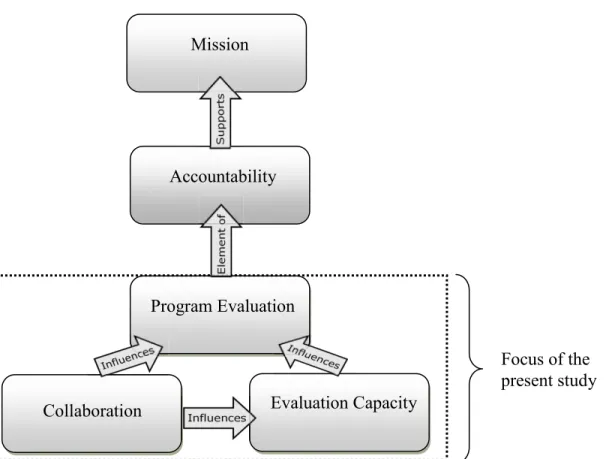
The second chapter is a review of the literature. The review of the literature summarizes information on the state of the nonprofit sector and the theories that informed the conceptual framework of the present study. The theories that influenced the study include the significance of mission to the viability of nonprofit organizations, organizational accountability, program
evaluation theory and models, program evaluation capacity, and the importance of collaboration between nonprofit service providers and funding organizations.
Chapter 3 features the methodology used in the present study. Additionally, the chapter details the research design inclusive of the treatment of the data, the description of setting, participant selection, data collection, validity and trustworthiness, the impact of the researcher as instrument, ethical considerations, limitations/delimitations, and a summary.
Chapter 4 includes demographic information regarding the individual participants, represented organizations, detailed information on data analysis, and findings from the study presented through the context of each research question. The chapter concludes with a brief synopsis of the overall findings.
Chapter 5 includes a discussion of the results referencing theoretical frameworks from a review of the literature. Additionally, the chapter includes major conclusions, implications for further research, and suggestions for practice particularly for the Northeast Florida nonprofit sector. The chapter concludes with a summary and reference to the purpose of the present study in the context of the conceptual framework.
Chapter 2: Review of the Literature
The review of the literature summarizes information on the state of the nonprofit sector and the theoretical frameworks that informed the conceptual framework of the present study. The theoretical frameworks included the significance of mission to the viability of nonprofit organizations (mission centrality), organizational accountability, program evaluation theory and models, program evaluation capacity, and the importance of collaboration between nonprofit human services providers and funding organizations.
Nonprofit Sector
The nonprofit sector is a significant part of North American culture representing the fastest growing industry in the United States having experienced a 25% increase in the past decade (Urban Institute, n.d). Nationally, the nonprofit sector represents 9% of income to United States wage earners, employs 10% of wage earners, represents over 5% of the gross national product, engages over 25% of the adult population as volunteers, and garners nearly three billion dollars in private donations (National Center for Charitable Statistics [NCCS], n.d.; Roeger et al., 2011; Urban Institute, n.d.).
Although a plethora of divergent nonprofit agencies exist in the United States, a simple definition for the nonprofit sector is that it is comprised of private organizations established to meet a public need (Mendel, 2010). In the United States, a primary characteristic of nonprofit organizations that differentiates the industry from for-profit business is having tax exempt status (Roeger et al., 2011). In section 501(c-f) of Title 26 of the United States Code, the Federal Government designated several different types of organizations in the United States eligible for
tax exemption (see Appendix A for complete list). The most widely known and largest of the exempted categories is the 501(c) 3 designation, which includes charitable organizations and private foundations (Internal Revenue Code, 2010; U.S. Department of the Treasury, Internal Revenue Service, 2011, 2112; Roeger et al., 2011). Additionally, organizations may incorporate with state governments as not-for-profit entities instead of, or in addition to, seeking tax exempt status under the IRS (Gronbjerg, Liu, & Pollak, 2009). For the purpose of the present study, my focus is on IRS tax exempt 501c3 organizations specifically targeting human services agencies, private foundations, and other funding entities.
Although the term nonprofit sector is the most familiar term, other labels are also used to describe the industry such as third sector, independent sector, charitable sector, voluntary sector, tax-exempt sector, civil society sector, community-based organizations (CBOs), private
government, nongovernmental organizations (NGO’s), social sector, or (more narrowly) 501(3) status (Carman, 2007; Gronbjerg et al., 2009; Hall, 2010; Mendel, 2010; Worth, 2009). For the purpose of this review of the literature, I used the more common designation of nonprofits, nonprofit agencies, or nonprofit organizations to describe the industry.
The roots of the nonprofit sector reach back to the genesis of the colonization of the United States at which time Harvard University and religious organizations formed to assist the disenfranchised (Hall, 2010). However, historically U. S. nonprofits were not categorized as such due to the lack of differentiation between public and private entities. Instead, the culture of the time focused on citizens engaging in collective efforts to meet community goals (Hall, 2010; Mendel, 2010). Foreign visitors noted the phenomenon of the early United States citizenry creating organizations to advance societal objectives (Hall, 2010; Worth, 2009). Alexis de Tocqueville noted, “Americans of all ages, all conditions, and all dispositions constantly form
associations . . . . Wherever at the head of some new undertaking you see the government in France, or a man of rank in England, in the United States you will be sure to find an association” (as cited in Hall, 2010, p. 9).
The current designation of the nonprofit sector in the United States as a distinguishable segment of society alongside government and businesses took shape in the last quarter of the 20th century (Hall, 2010; Worth, 2009). Of the three, research by Handy et al. (2010) found that nonprofits were perceived to be the more trustworthy sector as compared to the business and government sectors. The researchers surveyed 1,169 university students using a Likert scale specifically asking the respondents’ level of agreement to statements regarding the
trustworthiness of nonprofits as compared to business and government. Additionally, the researchers noted that respondents were more likely to demonstrate this trust by supporting nonprofits more through donations and volunteer work. Similarly, in 2011, data collected from a survey initiated by the Nonprofit Center of Northeast Florida provided further evidence of this trust as 67% of the respondents agreed that nonprofits were better situated to help the community than government (Flagg & Rankin, 2011). Ways in which citizens engage the services of
nonprofit organizations may include using hospitals, recreational activities, human services organizations, the arts, or educational institutions (Littlepage & Oldakowski, 2006).
Nonprofit Governance
Understanding the governance structure of nonprofit organizations is central to
appreciating the unique position the nonprofit sector holds in American society. The governance of a nonprofit organization is a complicated dance between the chief executive and the board of directors. The board of directors in partnership with the chief executive are the top leadership for nonprofit organizations (Axelrod, 2005; Worth, 2009).
By design, the board of directors and the chief executive are an example of shared leadership. Pearce and Conger (2003) provided a definition of shared leadership: “A dynamic, interactive influence process among individuals in groups for which the objective is to lead one another to the achievement of group or organizational goals or both” (p. 1). Further defining characteristics of shared leadership focused on the interactional process among members which produced “mutual learning, greater shared understanding, and eventually, positive action” (Fletcher & Käufer, 2003, p. 23). The organizational structure of a nonprofit organization has shared leadership within the board of directors and with the chief executive. Both the board and the chief executive have unique roles and responsibilities of this interdependent partnership in order to ensure the viability of the organization (Axelrod, 2005; Worth, 2009).
The nonprofit board of directors is typically comprised of volunteers in the community who have an interest in the mission of the organization. The board of directors is not just a group of individuals loosely connected by their involvement with the organization. A nonprofit board acts as a single entity. No particular member can make a decision or speak without consent from the board as a whole. The board elects a member as the chair who serves as the spokesperson for the board of directors (J. Carver, 1997).
The purpose of the board of directors is to safeguard the investment of the community regarding the mission of the nonprofit organization (Axelrod, 2005; J. L. Miller, 2002; Worth, 2009). The legal mandate regarding board of directors’ responsibilities includes the duties of care, loyalty, and obedience (Axelrod, 2005; Worth, 2009). The duty of care mandates that board members maintain oversight of the organization's finances and operations through active participation, understanding provided information, making informed decisions, and questioning actions as appropriate. The duty of loyalty means that board members must put the needs of the
nonprofit organization above all other considerations. Finally, the duty of obedience requires that board members ensure that the organization obeys all applicable laws and regulations, adheres to the mission, pursues established organizational goals, and practices within the framework of established policies (Axelrod, 2005; Worth, 2009).
Dovetailing with these overarching mandates are the common responsibilities for nonprofit boards. These functions of the board include board development, mission attainment, strategic planning, stewardship of resources, fund-raising efforts, ambassadorship to the greater community, and programmatic accountability (Axelrod, 2005; Bradshaw, Murray, & Wolpin, 1992; W. A. Brown, 2005; Gill, Flynn, & Reissing, 2005; Jackson & Holland, 1998; Nobbie & Brudney, 2003; Renz, 2010). Ultimately, nonprofit boards are the community representatives for public charities (Ostrower, 2007). J. Carver and M. Carver (2009) reported, “The board must first have an adequate vision of its own job. That role is best conceived neither as volunteer-helper nor as watchdog but as trustee-owner” (p. 3).
Although the nonprofit board is the principal leader of an organization, the position of the chief executive does not exist merely at the disposal of the nonprofit board. The board of
directors hires or appoints the chief executive to assist with achieving goals and advancing the organizational mission (Axelrod, 2005; Renz, 2010; Sherlock & Nathan, 2007). The chief executive often provides the main source of continuity for the community, board of directors, and other staff members. The chief executive augments stability through mission promotion, setting priorities, and developing key relationships (Worth, 2009). A chief executive hones many skills in order to fulfill the expectations of the position. Sherlock and Nathan (2007) noted several skills such as reflective practice, political acumen, open communication style, and
The chief executive’s most pivotal role relates to assisting the board with responding to its legal responsibilities to the organization (Herman & Heimovics, 2005). Furthermore, the CEO’s effective engagement and development of the board is paramount to success (Worth, 2009). Herman and Heimovics (2005, p. 158) listed several necessary strategies chief executives employed with boards of directors: (a) promoting relationships among board members and the chief executive, (b) being respectful, (c) focusing the board on the future, (d) updating board on key information related to the mission of the organization, (e) providing administrative support and resources for board projects, (f) facilitating achievement of goals and affirmation of success, and (g) planning for executive leadership succession.
Different governance models exist regarding the shared leadership relationship between the chief executive and the nonprofit board (Herman, 2010; Worth, 2009). Models of nonprofit governance elucidate the different strategies used for the leadership of nonprofit organizations. The Carver governance model focuses the attention of the board on developing and monitoring policies. This model creates rigid boundaries between staff and board responsibilities that isolate board members from the everyday reality of the nonprofit (Worth, 2009). In the Carver model of board governance, the chief executive is often responsible for the overall operation of the
organization that includes the supervision of other staff, program development, service delivery, fiscal management, fund raising, volunteer management, and public relations (Sherlock & Nathan, 2007; Worth, 2009). However, the board of directors prescribes the degree of freedom that a chief executive has to carry out these duties (J. Carver, 1997; J. Carver & M. Carver, 1997).
Another governance model is the “governance as leadership” model. In this model, the board focuses on fiduciary responsibilities, strategic planning, and creative thinking. The board
works in partnership with the chief executive in addressing all three areas in order to be effective leaders. It is essential in the governance as leadership model for the chief executive and the board to participate together in the three areas (Worth, 2009).
An alternative model relevant for board governance is the board-centered leadership model described by Herman and Heimovics (2005). The main task of the chief executive in this approach is to ensure that the board fulfills all legal and public responsibilities. The chief executive makes it a priority to assist the board in developing and maintaining leadership status of the organization.
However, Iecovich and Bar-Mor (2007) found tension for power often existed between the chief executive and the chairperson of the board. More often than not, the chief executive was more dominant in the relationship rather than an equal partner with the chairperson. Similarly, Chait, Ryan, and Taylor (2005) argued that the board of directors and the chief executive often switched leadership responsibilities for the organization, leaving the chief executive with more influence than the board. Yet regardless of the model used for governance, boards that received explicit training regarding roles and responsibilities functioned more effectively with the chief executive and were able to successfully advance the mission of the organization (Nobbie & Brudney, 2003). This is particularly important because the leadership apex as described (board of directors, chief executive) is responsible for ensuring that the nonprofit organization adheres to the mission of the organization, which is central to overall organizational accountability of a nonprofit organization (Knauft et al., 1991).
Accountability to organizational mission, the public, and stakeholders is a primary responsibility of the board of directors of a nonprofit organization and cannot be overstated. Effective nonprofit boards evaluate performance of the overall board, individual board members,
executive leadership of the organization, and organizational performance (Axelrod, 2005; J. L. Miller, 2002; Renz, 2010). However, many nonprofit governing bodies do not implement quality evaluation strategies. In spite of the importance of evaluation to the health of nonprofits, Ostrower (2008) concluded,
Particularly troubling is that almost half of the nonprofit organizations say their boards do not monitor their own performance. Furthermore, more than one-fourth said that their boards do not assess whether the organization is accomplishing its mission, either on an annual or bi-annual basis. (p. 2)
This lack of attention to evaluating board performance and mission attainment is concerning because these are core responsibilities of boards (Worth, 2009) and may impact the success of the organization.
Successful Nonprofits
A review of the literature regarding nonprofits focused on the characteristics of
successful nonprofit organizations. Knauft et al. (1991) argued that a high performing nonprofit organization has four essential characteristics: (a) a revered mission for stakeholders to rally around, (b) motivational leaders focused on mission attainment, (c) an active board that worked in shared leadership with the executive officer, and (d) ability to obtain financial support and skilled staff. Letts, Ryan, and Grossman (1999) emphasized the ability to build capacity as an indicator of a high performing organization. Elements of capacity building included investing resources in program development, creating a learning organizational culture, developing staff, engaging key stakeholders, and focusing on expansion. The authors also indicated that it is essential to focus partnerships with funding sources on organizational capacity growth efforts rather than program delivery. Crutchfield and Grant (2008) found that high impact nonprofit
organizations were successful advocates for change, promoted shared leadership, engaged stakeholders, created innovative funding opportunities, collaborated successfully with other nonprofit organizations, and were flexible to meet ever-changing external forces (p. 6). Other important characteristics of high performing nonprofit organizations included the importance of investment in technology, use of a strategic plan, data-driven decisions, clearly-defined goals, and use of an effective system of checks and balances (Brinckerhoff, 2000; Light, 2002). The commonality from the review of the literature is that successful nonprofits have strong
leadership, are mission-driven, develop strong coalitions with other interested groups,
successfully engage stakeholder financial support, and are able to garner other needed resources. Yet these referenced descriptions of successful nonprofit organizations provided little information on the actual accountability strategies the organizations used to ensure effective service delivery aligned with mission attainment. Indeed, the authors placed scant emphasis on how to institute accountability strategies at all levels of the organization. Although the authors emphasized the need for program evaluation (e.g., program effectiveness, measuring change, bench marking, and performance standards), studying nonprofit organizations without detailing how the organizations measure program effectiveness, outcomes, impact on society, and
improvement strategies may be shortsighted.
Nonprofit Accountability
At the time of the present study, nonprofit organizations exist in a climate of extreme accountability. Due to the intense focus on accountability by various stakeholders (e.g., funding organizations, government, and regulators), accountability theory informs the present study and is so crucial to nonprofit operations that experts labeled it the “accountability movement” (Carman, 2007, 2010; Murray, 2005, 2010). Cutt and Murray (2000) defined accountability as
The obligation to render an account for a responsibility which has been conferred. This definition presumes the existence of at least two parties, one who allocates responsibility and one who accepts it with an undertaking to report on, and account for, the manner in which it has been discharged. (p. 1)
For nonprofit agencies, promotion of organizational mission is a primary component of
accountability (Brinckerhoff, 2000; Candler & Dumont, 2010; R. S. Kaplan, 2001). Numerous stakeholders require nonprofits to provide evidence of performance as it relates to mission achievement (Murray, 2005, 2010). However, Murray (2005) noted that the organizational accountability efforts are fraught with issues because of subjective political expectations and tensions.
At the forefront are stakeholders who fund nonprofit organizations such as private charitable foundations, United Way, and all levels of government (local, state, federal). Other stakeholders include regulating agencies, clients, the public, elected officials, volunteers, boards of directors, and nonprofit agency staff (Candler & Dumont, 2010; Carman & Fredericks, 2009; R. S. Kaplan, 2001; Sherlock & Nathan, 2007). Although stakeholders agree about the need for organizational accountability, the criteria for determination are divergent (Forbes, 1998; Herman & Renz, 1999; Newcomer, 1997; Sowa, Selden, & Sandfort, 2004). These often vague factors of accountability make it difficult for nonprofit organizations. Koppel (2005) described this
phenomenon as Multiple Accountabilities Disorder (MAD):
The contention is that the organization suffering from MAD oscillates between behaviors that are consistent with conflicting notions of accountability. The organization will sometimes emphasize the directives of principals, while at other times try to focus on
customers. In the long run, overseers and constituents are displeased and the organization struggles. (p.95)
Traditionally, accountability for nonprofit organizations concentrated on fiscal measures and business practices (Plantz, Greenway, & Hendricks, 1997). Organizations such as
GuideStar, Charity Navigator, the Better Business Bureau, and the Internal Revenue Service use financial information and ratios as a gauge for organizational accountability standards (Coe, 2007; Eckerd & Moulton, 2011; Murray, 2005, 2010; Worth 2009). In the wake of scandals involving public companies and nonprofit organizations, the federal government also instituted tighter financial and governance regulations through the Sarbanes-Oxley Act (J. Carver & M. Carver, 2009; Mendel, 2010; Ostrower, 2007). The government also increased scrutiny of nonprofit organizations’ finances through conducting hearings, emphasis on enforcement of current laws, and recommendations for sound governance for nonprofits (Worth, 2009).
Although financial soundness is important, the scope of nonprofit organizational accountability is much more extensive. Herman and Renz (1999) argued that nonprofit organizational accountability indicators “will never be reducible to a single measure” (p. 110) and did not place a lot of stock in program evaluation outcomes as metrics of effectiveness. Yet Worth (2009) linked measures of effectiveness directly to organizational accountability.
Candler and Dumont (2010) noted that measuring organizational performance of a nonprofit agency was complex and difficult. Furthermore, limited understanding, lack of clarity between accountability and effectiveness frameworks, disagreement on applicable measures, and a diversity of definitions of effective performance, and resistance from organizational leaders handicapped meaningful accountability strategies (Baruch & Ramalho, 2006).
Organizational Effectiveness Strategies
Several theoretical frameworks exist that use multi-faceted approaches to assess the effectiveness of different organizational elements. Organizational effectiveness metrics provide information for overall organizational accountability. Worth (2009) highlighted several metrics of organizational effectiveness: financial ratios, using peer benchmarks, mission attainment, program outcomes, and social value. Sowa et al. (2004) suggested, “Given the complexity of the topic, organizational effectiveness should be conceived of and modeled as a multilevel,
multidimensional, and structurally integrated concept” (p. 724).
Quinn and Rohrbaugh (1981) introduced the Competing Values Framework (CVF) based on information from several organizational effectiveness theorists. The authors concluded that organizational effectiveness was on a continuum among elements in three broad categories that “compete” for scarce organizational resources. The first category entails the degree to which an organization focuses attention on the good of the people versus the good of the organization. The second category centers on organizational design or structure and the degree to which it is rigid or flexible. The last category of the CVF is the emphasis an organization places on process versus outcomes. However, Herman and Renz (1999) argued that using the CVF is complex.
The dashboard developed by Paton (2003) is another multivariate theoretical framework used for organizational effectiveness. The author prescribed areas of importance for review: (a) current results to include focus on achievements, fiscal information, and marketing information; (b) underlying performance that emphasizes the cost effectiveness of organizational outcomes; (c) risk management at all levels of the organization; (d) an annual assessment of organizational assets to include tangible, human resources, and reputational assets; and (e) keeping the
(Paton, 2003, p. 142). Although multidimensional in scope, Paton geared the dashboard towards internal effectiveness strategies but did not emphasize the roles of external stakeholders.
Frameworks for organizational effectiveness provide different strategies to determine effectiveness. Furthermore, determination of organizational effectiveness is a subcomponent of organizational accountability. Much of the information regarding organizational effectiveness can be used on a broader scale to address organizational accountability.
Organizational Accountability Frameworks
Organizational accountability frameworks include a broader focus on to “who” and for “what” nonprofit organizations are responsible (Candler & Dumont, 2010; Ebrahim, 2010; R. S. Kaplan, 2001). Candler and Dumont (2010) posited the non-profit accountability framework focused on accountability to various stakeholders in different areas. Their non-profit
accountability framework theory informs the present study through the emphasis on multiple areas of accountability with multiple stakeholders. The authors were very thorough in listing the numerous stakeholders that included members, clients, constituents, donors, government, general public, media, NGO staff, and partners/allies. Areas of accountability in this model included financial resources, volunteers, reputational capital, goods and services, social capital, policy impact, law, formal mission, and ethics (p. 263). The strength of the nonprofit accountability framework is the breadth of areas of accountability cross-referenced with the span of
stakeholders.
The balanced scorecard is another theoretical framework for organizational
accountability. The balanced scorecard also features elements for determining organizational effectiveness. The balanced scorecard adopts an accommodating multi-dimensional approach centered on accountability to multiple stakeholders such as shareholders, customers, and
employees. Furthermore, the balanced scorecard emphasizes learning, adaptation, and change as key strategies (Ahmed, Ahmed, Nawaz, Dost, & Khan, 2011; Chen & Jones, 2009; R. S. Kaplan & Norton, 1992).
R. S. Kaplan and Norton (1992) conceptualized the balanced scorecard framework originally for the business sector. Simplistic in design, yet comprehensive in application, the authors of the balanced scorecard presented the framework as a new way to assess organizations beyond a one-dimensional financial perspective. The components of the balanced scorecard include an analysis of (a) financial perspective that focuses on shareholders and the bottom line; (b) customer perspective which takes into account an organization’s standing with consumers; (c) internal business perspective that examines business systems, processes, and products; and (d) innovation and learning perspective that emphasizes product improvement, employee
satisfaction, staff development, and valuing of personnel. The authors noted the novelty of their approach:
The scorecard puts strategy and vision, not control, at the center. It establishes goals but assumes that people will adopt whatever behaviors and take whatever actions are
necessary to arrive at those goals. The measurements are designed to pull people towards the overall vision. (R. S. Kaplan & Norton, 1992, p. 79)
As a combined framework for addressing organizational accountability and effectiveness
strategies, nonprofit agencies widely adopted and adapted the balanced scorecard approach. The flexibility of use of the balanced scoreboard is apparent in the combined framework for
organizational accountability and organizational effectiveness measures. Furthermore,
nonprofits often used the balanced scorecard framework (Carman, 2007; Chen & Jones, 2009; Kriemadis, Kotsovos, & Alexopoulos, 2009; Murray, 2005, 2010). R. S. Kaplan (2001) adapted
the balanced scorecard for nonprofits by shifting the emphasis to organizational mission rather than the financial interest of shareholders.
The balanced scorecard adapted for nonprofit organizations is a particular theoretical framework of interest for organizational accountability because the framework has been easily adaptable to nonprofits by the realignment of mission as central over revenue. In the nonprofit model of the balanced scorecard, the mission of the organization is central. This is particularly salient because, as noted previously, accountability to organizational mission is the paramount concern for nonprofit organizations (Brinckerhoff, 2000). In order to assure mission integrity, accountability for the nonprofit must focus on meeting outcomes that align with the mission. Charity Navigator introduced this concept through their newest rating component that focuses on how nonprofits report results. The first rating element is “alignment of mission, solicitations, and resources” (Charity Navigator, n.d.).
Additionally, another key component of the nonprofit balanced scorecard is the focus on assessing the effectiveness and impact of organizational activities/services on program
participants. These essential and intertwined points of organizational accountability cannot be determined without information produced from a quality program evaluation. The balanced scorecard provides a structure for program evaluation through inclusion of measures, objectives, targets, and initiatives for all key areas (R. S. Kaplan & Norton, 1992).
Accountability and Program Evaluation
Differences exist among organizational accountability, organizational effectiveness, and program evaluation. Organizational accountability is multi-dimensional and a broad concept regarding nonprofits answering to various stakeholders for many different factors regarding the organization as a whole. Organizational effectiveness focuses on demonstrating the health and
viability of the total organization through various metrics. Program evaluation is a
sub-component of organizational accountability and effectiveness (Murray, 2005, 2010). Program evaluation efforts provide information on overall organizational effectiveness and accountability. Carman (2007) found that nonprofit leaders invested time, finances, and organizational resources in areas of organizational accountability such as audits, regulatory body reviews, licensing requirements, and compliance with accreditation standards. However, they were ignorant regarding the facets of authentic program evaluation. Carman noted:
These data suggest that although community-based organizations are indeed busy doing activities that we might associate with being more accountable or practicing good management, this does not mean they are conducting evaluation—meaning specific activities that are intended to inform program managers, funders, and evaluators about the results (and processes) of their programs, which would then be used to help improve service delivery. (Carman, 2007, p. 65)
Accordingly, information gleaned from oversight and compliance measures of accountability did not translate to measurement of impact, program effectiveness, or mission obtainment (Carman, 2007). Consequently, program evaluation theory informs the present study, as leaders of nonprofit organizations must understand the diverse roles of program evaluation and the many program evaluation approaches. This knowledge is an essential building block as program evaluation efforts are a vital component of overall organizational accountability.
Program Evaluation
The recorded history of evaluation dates back thousands of years. Ancient Chinese documents recorded evaluations of personnel (Mark, Henry, & Julnes, 2000). The biblical account of creation documented God as an evaluator of creation, “God saw all that he had made,
and it was very good” (Genesis 1:31, New International Version; Patton, 1997). Patton (2002a) also detailed an account of a systematic evaluation program documented in the book of Daniel in the Bible. Indeed, evaluation seems an inherent aspect of the human experience (Patton, 1997). The genesis of program evaluation as a profession in the United States dates back to the 1960s when various social service initiatives funded by the federal government were required to account for the effectiveness of their programs (Chelimsky, 1997; Chelimsky & Shadish, 1997; Duignan, 2003; Febey & Coyne, 2007; Madaus & Stufflebeam, 2000; Mark et al., 2000). Influenced by education, human resources, business, the research community, and growing demand for accountability, program evaluation developed into a distinct discipline (Mark, et al., 2000; Patton, 1997, 2002a; Scriven, 1981; W. K. Kellogg Foundation, 2004a). Furthermore, Urban and Trochim (2009) posited that evaluation is a natural bridge between the research and practice communities, making evaluation pivotal to both.
Scriven (1981) defined evaluation as “the process of determining the merit, worth and value of something; or the product of that process” (p. 53). A broadened definition offered by Patton (2010) is “the systematic collection of information about the activities, characteristics, and outcomes of programs to make judgments about the program, improve program
effectiveness, and/or inform decisions about future programming” (p. 13). In addition to these two definitions for evaluation is a range of thought regarding the objectivity or subjectivity of evaluation. On one hand, Scriven prescribed a more positivistic view of evaluation as being objective (Chelimsky, 1997; Dugan, 1996). However, detractors of a value-free operational definition of evaluation argued that evaluation can never be free of subjectivity (Chelimsky, 1997; Stufflebeam, 2001). Evaluation may occur across many disciplines and levels of inquiry such as organizations, programs, projects, human resources venues, systemic analysis, policies,
goods, and services (Davidson, 2005; Mark et al., 2000; Scriven, 1981). Roles of Program Evaluation
The three types of evaluative purposes are formative, summative, and the more recent developmental (Patton, 2011). Formative and summative are the most common and traditional groupings for evaluative purposes (Arnett, 1993; Davidson, 2005; Newcomer, Hatry, & Wholey, 2010; Patton, 1997, 2002a). Scriven (1981) reasoned that formative evaluation centers on improvement while summative evaluation facilitates decision-making. Developmental evaluation is a contemporary evaluative purpose posited by Patton (2011) that focuses on “innovation development to guide adaptation to emergent and dynamic realities in complex environments” (p. 1). Patton differentiated this evaluative purpose from formative and summative evaluations because of the emphasis on information to advance change.
The use of summative evaluation may include descriptions of organizational achievements or shortcomings, prescribing value, funding determination, accountability to funders or governing bodies, appraisal of effectiveness, and measurement of causal relationships among variables (Chelimsky, 1997; Davidson, 2005; Mark et al., 2000; Patton, 1997, 2002a; Scriven, 1981). Developmental evaluation specifically includes facilitating the needed evolutional change of systems, programs, or policies in order to advance the organizational mission (Patton, 2011). Ultimately, the common purposive theme among these three types of evaluation is an assessment of the product, service, or process under scrutiny for the betterment of the beneficiaries of the program under evaluation (Patton, 2002a; Posavac & Carey, 2003).
Explicit benefits of program evaluation are related to the more distinct roles for which program evaluation is used in the nonprofit sector. Eckerd and Moulton (2011) distinguished three main areas of concentration for the role of program evaluation in nonprofits:
These uses of evaluation can be categorized into three purposes: instrumental, where the results directly change the organization’s behavior; conceptual, where results indirectly change the organization through learning; and symbolic, where results are used purely for signaling purposes and no change occurs. (p.101)
More pointedly, one of the roles of program evaluation in the nonprofit sector is assessing the alignment of activities and outcomes with organizational mission (Eckerd & Moulton, 2011; Murray, 2005). This role of program evaluation is consistent with the emphasis placed on organizational mission in the previously noted accountability frameworks (Candler & Dumont, 2010; R. S. Kaplan, 2001). Furthermore, boards of nonprofits are responsible for ensuring mission alignment (Axelrod, 2005; Worth, 2009).
A review of the literature detailed other roles of program evaluation in the nonprofit sector. A most often cited role of program evaluation is to provide information for reports to stakeholders such as funders, board members, regulatory entities, and the general public (Carman & Fredericks, 2009; Cousins et al., 2008). Other reasons for and the benefits of instituting quality program evaluation in nonprofit organizations go beyond the requirements of regulatory and funding bodies (Eckerd & Moulton, 2011; Mark et al., 2000; Stevenson, Florin, Mills, & Andrade, 2002). As mentioned previously, using information to improve programs is another reason for implementing evaluation strategies (Fetterman, 1996; R. L. Miller & Campbell, 2006; Patton, 2002a; Stufflebeam, 2001; 2007). An additional key reason cited for implementing program evaluation includes promoting a learning environment in the organization (Patton, 1999, 2007, 2010; Stevenson et al., 2002; Woodwell, 2005).
Additional roles of program evaluation beneficial to the nonprofit sector include (a) quality assurance assessment, (b) increasing knowledge/learning, (c) outcomes measurement, (d)
determining program effectiveness, (e) program innovation, (f) assisting with management decisions, (g) increasing revenue, (h) legitimizing organization, (i) assistance with strategic planning , and (j) assessment of impact (Carman, 2007, 2011; Carman & Fredericks, 2008, 2009; Cousins et al., 2008; Kehrer, 1993). These different roles of program evaluation are not unique to the nonprofit sector. Lee, Altschuld, and Hung (2008) found similar purposes for the role of program evaluation in the educational sector.
Linked to these different purposes for program evaluation in the nonprofit sector are different models or approaches. A variety of approaches exists that focus on the different purposes or needs for an evaluation. Understanding the different approaches is important to developing an evaluation agenda that best meets the needs of any given organization.
ProgramEvaluationApproaches
Different approaches serve different purposes of program evaluation for the nonprofit sector. Many approaches (models) of program evaluation theory inform the present study for the purpose of demonstrating the plethora of options from which nonprofits may choose to best suit their evaluation purposes and provide data for overall organizational effectiveness and
accountability. Stufflebeam (2001) categorized the different approaches into four broad categories: pseudo evaluations, questions and methods oriented, improvement/accountability, and social agenda/advocacy. Others categorize evaluation approaches according to the focus of the evaluation such as need, process, outcome, or efficiency (Posavac & Carey, 2003). Still others categorize evaluations based on the method used such as quantitative, qualitative, or mixed (B. Johnson & Christensen, 2008). I chose to categorize evaluation approaches into five categories adapted from Patton (1997) and Stufflebeam (2001): knowledge-focused, oversight-focused, impact-oversight-focused, comprehensive-oversight-focused, and participatory-focused. I assigned an