Original citation:
LHCb Collaboration (Including: Back, John J., Craik, Daniel, Dossett, D., Gershon, Timothy J., Kreps, Michal, Latham, Thomas, Pilar, T., Poluektov, Anton, Reid, Matthew M., Silva Coutinho, R., Wallace, Charlotte, Whitehead, M. (Mark) and Williams, Matthew P.). (2013) Study of DJ meson decays to D+π−, D0π+ and D∗+π− final states in pp collisions. Journal of High Energy Physics, Volume 2013 (Number 9). Article number 145. ISSN 1029-8479
Permanent WRAP url:
http://wrap.warwick.ac.uk/58072
Copyright and reuse:
The Warwick Research Archive Portal (WRAP) makes this work of researchers of the University of Warwick available open access under the following conditions.
This article is made available under the Creative Commons Attribution 3.0 (CC BY 3.0) license and may be reused according to the conditions of the license. For more details see: http://creativecommons.org/licenses/by/3.0/
A note on versions:
The version presented in WRAP is the published version, or, version of record, and may be cited as it appears here.
JHEP09(2013)145
Published for SISSA by Springer
Received: July 18, 2013 Accepted: September 3, 2013 Published: September 26, 2013
Study of
D
Jmeson decays to
D
+π
−,
D
0π
+and
D
∗+π
−final states in
pp
collisions
The LHCb collaboration
E-mail: [email protected]
Abstract:A study ofD+π−,D0π+andD∗+π−final states is performed usingppcollision data, corresponding to an integrated luminosity of 1.0 fb−1, collected at a centre-of-mass energy of 7 TeV with the LHCb detector. The D1(2420)0 resonance is observed in the
D∗+π−final state and theD∗2(2460) resonance is observed in theD+π−,D0π+andD∗+π−
final states. For both resonances, their properties and spin-parity assignments are obtained. In addition, two natural parity and two unnatural parity resonances are observed in the mass region between 2500 and 2800 MeV. Further structures in the region around 3000
MeV are observed in all theD∗+π−,D+π− and D0π+ final states.
Keywords: Spectroscopy, Hadron-Hadron Scattering, Charm physics
JHEP09(2013)145
Contents
1 Introduction 1
2 Detector 3
3 Event selection 3
4 Mass spectra 4
5 Simulation 7
6 Mass fit model 7
7 Fit to the D∗+π− mass spectrum 8
8 Spin-parity analysis of theD∗+π− system 10
9 Fit to the D+π− and D0π+ mass spectra 11
10 Cross-checks and systematic uncertainties 17
11 Discussion and conclusions 18
The LHCb collaboration 22
1 Introduction
Charm meson spectroscopy provides a powerful test of the quark model predictions of the Standard Model. Many charm meson states, predicted in the 1980s [1], have not yet been observed experimentally. The expected spectrum for the cu¯ system is shown in figure 1
(the spectrum of the cd¯system is almost identical). The JP states having P = (−1)J and therefore JP = 0+,1−,2+, . . . are called natural parity states and are labelled asD∗, while unnatural parity indicates the series JP = 0−,1+,2−, . . . The low-mass spectrum of thecu¯ system is comprised of the ground states (1S), the orbital excitations with angular momentum L=1, 2 (1P, 1D), and the first radial excitations (2S). Apart from the ground states (D, D∗), only two of the 1P states, D1(2420) andD∗2(2460) [2], are experimentally well established since they have relatively narrow widths (∼30 MeV).1 In contrast, the broadL= 1 states,D0∗(2400) andD10(2430), have been established by the Belle and BaBar experiments in exclusiveB decays [3,4].
JHEP09(2013)145
1S 2S 1D 1P 1F
Mass (MeV)
2000
2500
3000
−
D(1864) 0
−
D*(2023) 1
−
(2558) 0 0
D
−
*(2618) 1 1
D
−
*(2796) 1 1
D
−
(2801) 2 2
D
−
(2806) 2 2
D
−
*(2806) 3 3
D
+ *(2380) 0 0
D
+ (2419) 1 1
D
+ (2469) 1 1
D
+ *(2479) 2 2
D
+ *(3074) 2 2
D
+ (3074) 3 3
D
+ (3079) 3 3
D
+ *(3084) 4 4
[image:4.595.94.498.86.294.2]D
Figure 1. Modified Godfrey-Isgur mass predictions [1]. The figure shows thecu¯spectrum in which the masses have been scaled such that the ground state coincides with theD0mass. The 2−states, not shown in the original publication, have been inserted following the splitting structure of the 1P states.
The theoretical predictions are in agreement (within 20–30 MeV) with observations for the 1S states and theJP = 2+ andJP = 1+ 1P states. In thecs¯system, theJP = 0+ and
JP = 1+ states (bothL= 1) have predicted masses about 100 MeV higher than the mea-sured masses of theDsJ mesons. To quantitatively assess the accuracy of the quark model predictions, assumptions are needed to formulate a wave equation for quark-antiquark bound states starting from the QCD Lagrangian [5]. Nevertheless, the discrepancy between the predictions of various models and the mass measurements [6–9] suggests that some observed states in the c¯scase are not simple quark-antiquark configurations. Possible in-terpretations include more complex structures, such as bound states (“molecules”) of other mesons [10], or mixtures of conventional quark-antiquark with four-quark components [11]. The properties of hadrons can be computed from the QCD Lagrangian using lattice calculations and the resulting cu¯, cd¯and c¯s mass spectra can be compared to measure-ments. However, the calculation of hadronic quantities for dynamical light quarks is still a challenging task and different results are obtained [12–17].
To search for excited charmed mesons, labelled DJ, BaBar analyzed the inclu-sive production of the D+π−, D0π+ and D∗+π− final states in the inclusive reaction
e+e−→c¯c→D(∗)πX, where X is any additional system [18].2 They observe four sig-nals, labelled D(2550)0, D∗(2600)0, D(2750)0 and D∗(2760)0, and the isospin partners
D∗(2600)+ andD∗(2760)+.
This paper reports a search for DJ mesons in a data sample, corresponding to an integrated luminosity of 1.0 fb−1, of pp collisions collected at a centre-of-mass energy of 7 TeV with the LHCb detector.
JHEP09(2013)145
2 Detector
The LHCb detector [19] is a single-arm forward spectrometer covering the pseudorapidity range 2< η <5, designed for the study of particles containingb orcquarks. The detector includes a high precision tracking system consisting of a silicon-strip vertex detector sur-rounding the pp interaction region, a large-area silicon-strip detector located upstream of a dipole magnet with a bending power of about 4 Tm, and three stations of silicon-strip detectors and straw drift tubes placed downstream. The combined tracking system has momentum resolution that varies from 0.4% at 5 GeV to 0.6% at 100 GeV, and impact parameter resolution of 20µm for tracks with high transverse momentumpT with respect to the beam direction. The impact parameter is defined as the perpendicular distance between the track path and the position of a pp collision. Charged hadrons are identified using two ring-imaging Cherenkov (RICH) detectors. Photon, electron and hadron candi-dates are identified by a calorimeter system consisting of scintillating-pad and pre-shower detectors, an electromagnetic calorimeter and a hadronic calorimeter. Muons are identified by a system composed of alternating layers of iron and multiwire proportional chambers. The trigger [20] consists of a hardware stage, based on information from the calorimeter and muon systems, followed by a software stage which applies a full event reconstruction.
3 Event selection
The search forDJ mesons is performed using the inclusive reactions
pp→D+π−X, pp→D0π+X, pp→D∗+π−X, (3.1)
whereX represents a system composed of any collection of charged and neutral particles. The charmed mesons in the final state are reconstructed in the decay modes
D+→K−π+π+, D0 → K−π+ and D∗+ → D0π+. Charged tracks are required to have good track fit quality, momentum p >3 GeV andpT>250 MeV. These conditions are re-laxed to lower limits for the pion originating directly from theD∗+ decay. Tracks pointing to a pp collision vertex (primary vertex) are rejected by means of an impact parameter requirement in the reconstruction of the D+ and D0 candidates. All tracks used to re-construct the mesons must have a distance of closest approach to each other smaller than 0.5 mm. The cosine of the angle between the momentum of the D meson candidate and its direction, defined by the positions of the primary vertex and the meson decay vertex, is required to be larger than 0.99999. This ensures that the D meson candidates are pro-duced at the primary vertex and reduces the contribution from particles originating from
b-hadron decays. The reconstructed D+, D0 and D∗+ candidates are combined with all the right-sign charged pions in the event. Each of the D+π−, the D0π+, and the D∗+π−
JHEP09(2013)145
of D+→K−π+π+ decays, a small D∗+ signal in the D0π+ mass spectrum is removed by demanding ∆m≡m(K−π+π+)−m(K−π+)>152 MeV.
In order to reduce combinatorial background, the cosine of the angle between the momentum direction of the charged pion in the D(∗)π± rest frame and the momentum
direction of theD(∗)π±system in the laboratory frame is required to be greater than zero. Due to the possible presence of multiple primary vertex candidates, it is required that the
D(∗) and theπ± point to the same primary vertex.
To reduce any dependence on the mass scale, the invariant mass of the D(∗)π± system is calculated from the measured mass difference. For example, theD0π+ invariant mass is given by
m(D0π+) =m(K−π+π+)−m(K−π+) +mD0, (3.2)
wheremD0 is the known value of theD0 mass [2].
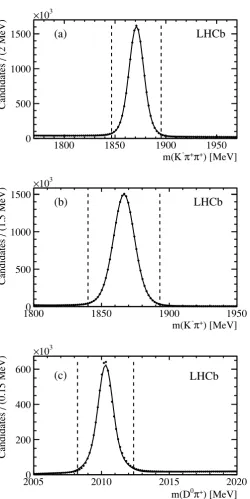
Figure 2shows theK−π+π+,K−π+ andD0π+invariant mass spectra after the selec-tion criteria are applied. The distribuselec-tions are fitted by the sum of two Gaussian funcselec-tions, with a common mean to describe the signal shape and a linear term to describe the com-binatorial background. The mean mass resolutions for the three distributions are 8.1, 8.8 and 0.69 MeV, respectively. The signal regions, indicated by the dashed vertical lines, for the D+,D0 and D∗+ candidates correspond to ±3σ around the peak values and con-tain 15.1×10⁶, 20.4×10⁶ and 6.4×10⁶ candidates for theD+π−,D0π+ andD∗+π−modes, respectively.
4 Mass spectra
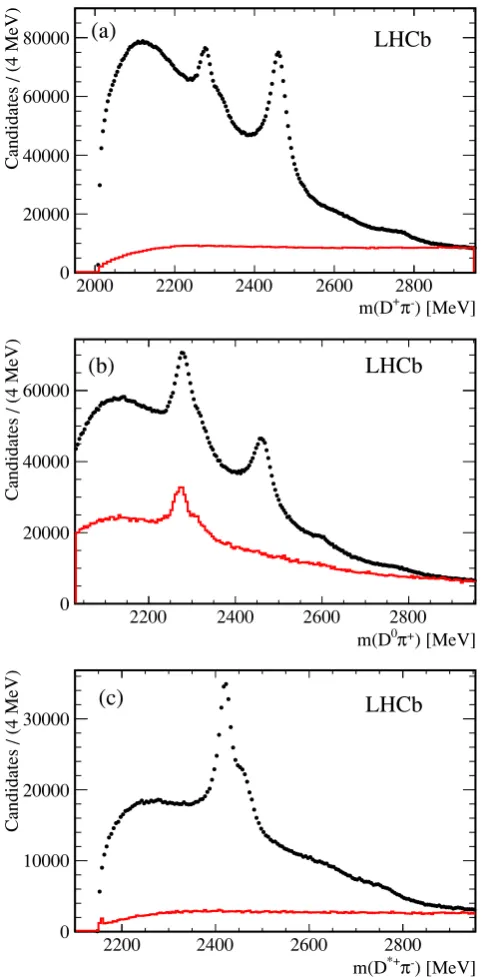
The D+π−,D0π+ and D∗+π− mass spectra are shown in figure 3. The D+π− and D0π+
mass spectra evidence strong D2∗(2460) signals, while in the D∗+π− mass spectrum clear
D1(2420)0 and D∗2(2460)0 signals are visible. A further reduction of the combinatorial background is achieved by performing an optimization of the signal significance and purity as a function of pT of the D(∗)π± system using the well known D1(2420) and D∗2(2460) resonances.3 For this purpose, we fit the three mass spectra as explained in section 7 and section 9 and obtain, for each resonance, the signal yield NS and background yield
NB events. We compute the signal significance S = NS/ √
NS+NB and signal purity
P = NS/(NS+NB) and find that the requirement pT(D(∗)π) >7.5 GeV provides a good compromise between significance and purity. After the optimization 7.9×10⁶, 7.5×10⁶ and 2.1×10⁶ D+π−,D0π+ andD∗+π− candidates are obtained. We also study the dependence of the signal to background ratio in the three mass spectra on the pseudorapidity of the
D(∗)π system and find a very weak correlation. We analyze, for comparison and using the same selections, the wrong-signD+π+,D0π−andD∗+π+ combinations which are also shown in figure3.
The D+π− mass spectrum, figure 3(a), shows a double peak structure around 2300 MeV due to cross-feed from the decay
D1(2420)0 orD∗2(2460)0 →π−D∗+(→D+π0/γ) (32.3%), (4.1)
JHEP09(2013)145
) [MeV]
+
π
+
π
-m(K
1800 1850 1900 1950
Candidates / (2 MeV)
0 500 1000 1500
3
10
×
LHCb (a)
) [MeV]
+
π
-m(K
1800 1850 1900 1950
Candidates / (1.5 MeV)
0 500 1000 1500
3
10
×
LHCb (b)
) [MeV]
+
π
0
m(D
2005 2010 2015 2020
Candidates / (0.15 MeV)
0 200 400 600
3
10
×
[image:7.595.173.424.82.582.2]LHCb (c)
Figure 2. Invariant mass distribution for (a)D+→K−π+π+, (b) D0→K−π+, and (c)D∗+→ D0π+decays. The solid lines are the results from the fits described in the text. The vertical dashed
lines indicate the signal regions.
JHEP09(2013)145
) [MeV]
-π
+
m(D 2000 2200 2400 2600 2800
Candidates / (4 MeV)
0 20000 40000 60000
80000 (a) LHCb
) [MeV]
+
π
0
m(D 2200 2400 2600 2800
Candidates / (4 MeV)
0 20000 40000 60000
LHCb (b)
) [MeV]
-π
*+
m(D 2200 2400 2600 2800
Candidates / (4 MeV)
0 10000 20000
[image:8.595.169.416.85.574.2]30000 (c) LHCb
Figure 3. Invariant mass distribution for (a)D+π−, (b)D0π+and (c)D∗+π−candidates (points). The full line histograms (in red) show the wrong-sign mass spectra for (a) D+π+, (b) D0π− and
(c)D∗+π+ normalized to the same yield at highD(∗)π masses.
The D0π+ mass spectrum, figure 3(b), shows an enhanced double peak structure around 2300 MeV due to cross-feed from the decays
D1(2420)+ orD2∗(2460)+→π+D∗0(→D0π0) (61.9%) (→D0γ) (38.1%) .
JHEP09(2013)145
The D2∗(2460)+ signal and weak structures around 2600 and 2750 MeV are observed. In comparison, the wrong-sign D0π− mass spectrum does show the presence of structures in the 2300 MeV mass region, similar to those observed in the D0π+ mass spectrum. These structures are due to cross-feed from the decay
D1(2420)0 orD∗2(2460)0 →π−D∗+(→D0π+) (67.7%) . (4.3)
TheD∗+π−mass spectrum, figure3(c), is dominated by the presence of theD
1(2420)0 and D2∗(2460)0 signals. At higher mass, complex broad structures are evident in the mass region between 2500 and 2800 MeV.
5 Simulation
Simulated events are used to study the effects of the detector on the observed mass res-olution. The pp collisions are generated using Pythia 6.4 [22] with a specific LHCb configuration [23]. Decays of hadronic particles are described by EvtGen [24] and the interaction of the generated particles with the detector and its response are implemented using theGeant4toolkit [25,26] as described in ref. [27].
Simulated events are reconstructed in the same manner as data. We analyze samples of full detector simulations to estimate the reconstruction efficiency, mass resolution and possible bias in the reconstruction chain. We also make use of simple event generator level simulations [28] to study kinematic effects. The tight trigger conditions and selection criteria have the effect of producing very low integrated efficiencies, which we calculate to be (0.149±0.004)%, (0.056±0.005)% and (0.064±0.003)% forD+π−,D0π+ andD∗+π−
candidates, respectively.
To estimate the detector resolution we compare generated and reconstructed invariant masses and obtain experimental resolutions as functions of the reconstructed mass. The analysis of these simulated samples shows no bias in the reconstructed invariant masses. We estimate resolutions which, in the mass region between 2000 and 2900 MeV, are similar for the three mass spectra and range from 1.0 to 4.5 MeV as a function of the mass. Since the widths of the resonances appearing in the three mass spectra are much larger than the experimental resolutions, resolution effects are neglected.
6 Mass fit model
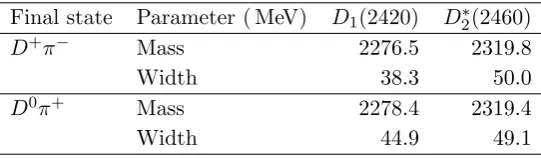
Binnedχ2 fits to the three mass spectra are performed. TheD∗2(2460) andD0∗(2400) signal shapes in two-body decays are parameterized with a relativistic Breit-Wigner that includes the mass-dependent factors for a D-wave and S-wave decay, respectively. The radius enter-ing in the Blatt-Weisskopf [29] form factor is fixed to 4 GeV−1. Other resonances appearing in the mass spectra are described by Breit-Wigner lineshapes. All Breit-Wigner expres-sions are multiplied by two-body phase space. The cross-feed lineshapes fromD1(2420) and
JHEP09(2013)145
Final state Parameter ( MeV) D1(2420) D2∗(2460)
D+π− Mass 2276.5 2319.8
Width 38.3 50.0
D0π+ Mass 2278.4 2319.4
[image:10.595.162.433.83.162.2]Width 44.9 49.1
Table 1. Breit-Wigner parameters describing the cross-feed from D1(2420) and D∗2(2460) in the
D+π− andD0π+ final states.
sequentially in order to test theχ2improvement when a new contribution is included. The backgroundB(m) is described by an empirical shape [18]
B(m) = P(m)ea1m+a2m2 form < m0,
B(m) = P(m)eb0+b1m+b2m2 form > m0, (6.1)
whereP(m) is the two-body phase space and m0 is a free parameter.
The two functions and their first derivatives are required to be continuous at m0 such that
b1 =a1+ 2m0(a2−b2), (6.2)
b0 =m0(a1−b1) +m20(a2−b2) . (6.3)
Therefore the background model has four free parameters: m0, a1, a2 and b2.
7 Fit to the D∗+π− mass spectrum
Due to the three-body decay and the availability of the helicity angle information, the fit to the D∗+π− mass spectrum allows a spin analysis of the produced resonances and a separation of the different spin-parity components. We define the helicity angleθH as the angle between the π− and the π+ from the D∗+ decay, in the rest frame of the D∗+π−
system. Full detector simulations are used to measure the efficiency as a function of θH, which is found to be uniform.
It is expected that the angular distributions are proportional to sin2θH for natural parity resonances and proportional to 1 +hcos2θH for unnatural parity resonances, where
h > 0 is a free parameter. The D∗π decay of a JP = 0+ resonance is forbidden.
There-fore candidates selected in different ranges of cosθH can enhance or suppress the different spin-parity contributions. We separate the D∗+π− data into three different categories, summarized in table 2. The candidate yields for these categories are given in table 3, which also reports the mass intervals, the number of bins, and the resultingχ2/ndf in the fits to the different mass spectra.
JHEP09(2013)145
Category Selection natural parity fraction (%)
[image:11.595.95.500.85.146.2]Enhanced unnatural parity sample |cosθH|>0.75 8.6 Natural parity sample |cosθH|<0.5 68.8 Unnatural parity sample |cosθH|>0.5 31.2
Table 2. Definition of the categories selected by different ranges of cosθH, and fraction of the total
natural parity contribution.
Final state Selection Fit Range Number Candidates χ2/ndf
(MeV) of bins (×106)
D+π− Total 2050–3170 280 7.90 551/261
D0π+ Total 2050–3170 280 7.50 351/262
D∗+π− Total 2180–3170 247 2.04 438/234
D∗+π− Natural 0.98 263/229
parity sample
D∗+π− Unnatural 1.06 364/234
parity sample
D∗+π− Enhanced unnatural parity 0.55 317/230 sample
Table 3. Mass intervals, number of bins, yields, andχ2/ndf in the fits to the different mass spectra.
fit to the mass spectrum, three further resonances are needed. We label themDJ(2580)0,
DJ(2740)0, andDJ(3000)0. The presence of these states in this sample indicates unnatural parity assignments.
The masses and widths of the unnatural parity resonances are fixed in the fit to the natural parity sample. The fit is shown in figure5 and the obtained resonance parameters are summarized in table4. The mass spectrum shows that the unnatural parity resonance
D1(2420)0 is suppressed with respect to that observed in the enhanced unnatural parity sample. There is a strong contribution of the natural parity D2∗(2460)0 resonance and contributions from theDJ(2580)0,DJ(2740)0 andDJ(3000)0 states. To obtain a good fit, two additional resonances are needed, which we labelD∗J(2650)0 andD∗J(2760)0.
The unnatural parity sample is used as a cross-check. In this fit, the parameters of all the resonances are fixed to the values obtained from the previous fits. The fit is shown in figure6. We observe, as expected, small contributions from the natural parity resonances. We also fit the totalD∗+π−mass spectrum, again with all the resonance parameters fixed. The data and fit are shown in figure7.
[image:11.595.88.507.189.355.2]JHEP09(2013)145
) [MeV]
-π
*+
m(D
2200 2400 2600 2800 3000
Candidates / (4 MeV)
0 5000 10000
LHCb
pull
-5 0 5
2200 2400 2600 2800 3000
[image:12.595.125.457.79.362.2]0 500 1000
Figure 4. Fit to the D∗+π− mass spectrum, enhanced unnatural parity sample, as defined in table 2. The dashed (blue) line shows the fitted background, the dotted (red) line the D1(2420)0
contribution. The inset displays theD∗+π−mass spectrum after subtracting the fitted background.
The full line curves (blue) show the contributions from DJ(2580)0, DJ(2740)0, and DJ(3000)0
states. The top window displays the pull distribution where the horizontal lines indicate±3σ. The pull is defined as (Ndata−Nfit)/
√ Ndata.
8 Spin-parity analysis of the D∗+π− system
In order to obtain information on the spin-parity assignment of the states observed in the
D∗+π− mass spectrum, the data are subdivided into ten equally spaced bins in cosθH. The ten mass spectra are then fitted with the model described above with fixed resonance parameters to obtain the yields as functions of cosθH for each resonance.
The resulting distributions for D1(2420)0 and D2∗(2460)0 are shown in figure 8. They have been fitted using the functions described in table 5. A good description of the data is obtained in terms of the expected angular distributions for JP = 1+ and JP = 2+ resonances.
Figure 9shows the resulting distributions for theDJ∗(2650)0 andD∗J(2760)0 states. In this case we compare the distributions with expectations from natural parity, unnatural parity andJP = 0−. In the case of unnatural parity, the h parameter, in 1 +hcos2θ
H, is constrained to be positive and therefore the fit givesh= 0. In both cases, the distributions are best fitted by the natural parity hypothesis.
JHEP09(2013)145
) [MeV]
-π
*+
m(D
2200 2400 2600 2800 3000
Candidates / (4 MeV)
0 5000 10000
LHCb
pull
-5 0 5
2200 2400 2600 2800 3000
[image:13.595.124.457.80.362.2]0 500 1000 1500
Figure 5. Fit to thenatural parity sample D∗+π− mass spectrum. The dashed (blue) line shows the fitted background, the dotted lines the D1(2420)0 (red) and D∗2(2460)0 (blue) contributions.
The inset displays the D∗+π− mass spectrum after subtracting the fitted background. The full
line curves (red) show the contributions from DJ(2580)0,DJ(2740)0, andDJ(3000)0. The dotted
(blue) lines display the DJ∗(2650)0 andD∗J(2760)0 contributions. The top window shows the pull distribution where the horizontal lines indicate±3σ.
hypothesis is also considered for DJ(2580)0. The results from the fits are given in table 5. In all cases unnatural parity is preferred over a natural parity assignment.
9 Fit to the D+π− and D0π+ mass spectra
TheD+π−andD0π+mass spectra consist of natural parity resonances. However these final states are affected by cross-feed from all the resonances that decay to the D∗π final state. Figures3(a) and (b) show (in the mass region around 2300 MeV) cross-feed contributions fromD1(2420) andD2∗(2460) decays. However we also expect (in the mass region between 2400 and 2600 MeV) the presence of structures originating from the complex resonance structure present in theD∗πmass spectrum in the mass region between 2500 and 2800 MeV. To obtain an estimate of the lineshape and size of the cross-feed, we normalize the
D∗+π− mass spectrum to the D+π− mass spectrum using the sum of the D1(2420)0 and
D∗2(2460)0 yields in the D∗+π−mass spectrum (Nsig) and the sum of the cross-feed in the
D+π−mass spectrum (NDfeed+π−). We estimate that each resonance appearing in theD∗+π− should also appear in theD+π− mass spectrum with a yield given by
JHEP09(2013)145
) [MeV]
-π
*+
m(D
2200 2400 2600 2800 3000
Candidates / (4 MeV)
0 5000 10000 15000
LHCb
pull
-5 0 5
2200 2400 2600 2800 3000
[image:14.595.126.457.81.359.2]0 500 1000 1500
Figure 6. Fit to theunnatural parity sample D∗+π−mass spectrum. The dashed (blue) line shows the fitted background, the dotted lines the D1(2420)0 (red) and D∗2(2460)0 (blue) contributions.
The inset displays theD∗+π−mass spectrum after subtracting the fitted background. The full line
curves (red) show the contributions fromDJ(2580)0,DJ(2740)0, andDJ(3000)0states. The dotted
(blue) lines display the DJ∗(2650)0 andD∗J(2760)0 contributions. The top window shows the pull distribution where the horizontal lines indicate±3σ.
where RD+π− =Nfeed
D+π−/Nsig. Here N(D∗+π−) is the yield measured in the D∗+π− final state,N(D+π−) is the expected yield in theD+π−mass spectrum andRD+π− = 1.41±0.02 where the uncertainty is statistical only.
Assuming similar yields for theD1(2420)+ andD2∗(2460)+ resonances, we estimate for theD0π+ channel,
N(D0π+) =N(D∗+π−)RD0π+, (9.2)
whereRD0π+ =Nfeed
D0π+/Nsig = 1.87±0.02 is the corresponding value for theD0π+channel. To obtain the expected lineshape of the cross-feed in the D+π− final state, we
per-form a study based on a generator level simulation. We generate DJ∗(2650)0,D∗J(2760)0,
DJ(2580)0 and DJ(2740)0 decays according to the chain described in eq. (4.1). Given the small branching fraction of the D∗+ → D+γ decay, (1.6 ± 0.4)%, we only generate the
D∗+ →D+π0 decay. The parameters of the resonances are as reported in table 4and the decays to D∗+π− are uniform over phase space. We then compute the resulting D+π−
JHEP09(2013)145
) [MeV]
-π
*+
m(D
2200 2400 2600 2800 3000
Candidates / (4 MeV)
0 10000 20000
LHCb
pull
-5 0 5
2200 2400 2600 2800 3000
[image:15.595.125.457.80.361.2]0 1000 2000 3000
Figure 7. Fit to the total D∗+π− sample. The dashed (blue) line shows the fitted background, the dotted lines the D1(2420)0 (red) and D2∗(2460)0 (blue) contributions. The inset displays the
D∗+π− mass spectrum after subtracting the fitted background. The full line curves (red) show the
contributions fromDJ(2580)0, DJ(2740)0, andDJ(3000)0 states. The dotted (blue) lines display
the D∗J(2650)0 and D∗J(2760)0 contributions. The top window shows the pull distribution where the horizontal lines indicate±3σ.
H
θ
cos -1 -0.5 0 0.5 1
)H
θ
dN/d(cos
0 20000 40000 60000 80000
LHCb 0 (2420) 1 (a) D
H
θ
cos -1 -0.5 0 0.5 1
)H
θ
dN/d(cos
0 5000 10000 15000 20000 25000
LHCb 0 (2460) 2 * (b) D
Figure 8. Distributions of (a)D1(2420)0and (b)D2∗(2460)0candidates as functions of the helicity
angle cosθH. The distributions are fitted with unnatural and natural parity functions, respectively.
[image:15.595.130.462.464.615.2]JHEP09(2013)145
Resonance Final Mass (MeV) Width (MeV) Yields ×103 Significance
state (σ)
D1(2420)0 D∗+π− 2419.6± 0.1 ±0.7 35.2± 0.4 ±0.9 210.2±1.9 ±0.7
D∗2(2460)0 D∗+π− 2460.4± 0.4 ±1.2 43.2± 1.2 ±3.0 81.9±1.2 ±0.9
DJ∗(2650)0 D∗+π− 2649.2± 3.5 ±3.5 140.2± 17.1 ±18.6 50.7±2.2 ±2.3 24.5
DJ∗(2760)0 D∗+π− 2761.1± 5.1 ±6.5 74.4± 3.4 ±37.0 14.4±1.7 ±1.7 10.2 DJ(2580)0 D∗+π− 2579.5± 3.4 ±5.5 177.5± 17.8 ±46.0 60.3±3.1 ±3.4 18.8
DJ(2740)0 D∗+π− 2737.0± 3.5 ±11.2 73.2± 13.4 ±25.0 7.7±1.1 ±1.2 7.2
DJ(3000)0 D∗+π− 2971.8± 8.7 188.1± 44.8 9.5±1.1 9.0
D∗2(2460)0 D+π− 2460.4± 0.1 ±0.1 45.6± 0.4 ±1.1 675.0±9.0 ±1.3
DJ∗(2760)0 D+π− 2760.1± 1.1 ±3.7 74.4± 3.4 ±19.1 55.8±1.3 ±10.0 17.3 DJ∗(3000)0 D+π− 3008.1± 4.0 110.5± 11.5 17.6±1.1 21.2
D∗
2(2460)+ D0π+ 2463.1± 0.2 ±0.6 48.6± 1.3 ±1.9 341.6±22.0±2.0
D∗J(2760)+ D0π+ 2771.7± 1.7 ±3.8 66.7± 6.6 ±10.5 20.1±2.2 ±1.0 18.8
[image:16.595.87.511.81.325.2]D∗J(3000)+ D0π+ 3008.1 (fixed) 110.5 (fixed) 7.6±1.2 6.6
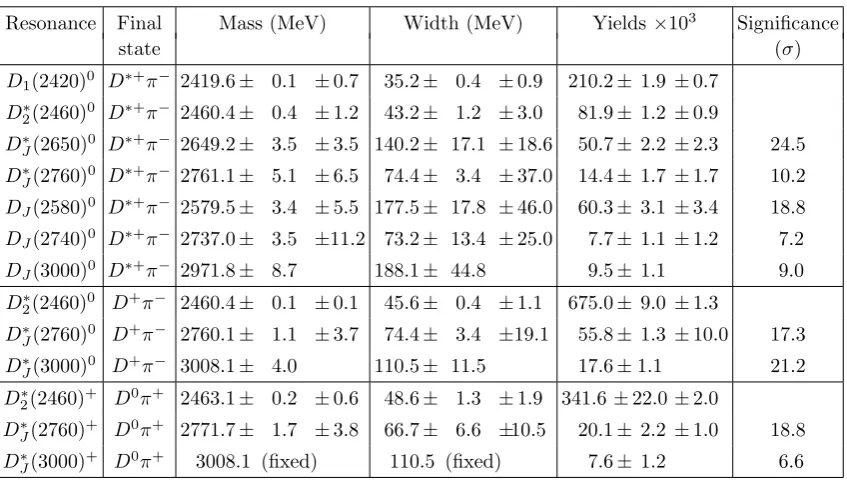
Table 4. Resonance parameters, yields and statistical significances. The first uncertainty is sta-tistical, the second systematic. Significances are evaluated using the method described in the text.
H
θ
cos
-1 -0.5 0 0.5 1
)H θ dN/d(cos 0 2000 4000 6000 8000 10000 12000 14000 16000 LHCb 0 (2650) J * (a) D H θ cos
-1 -0.5 0 0.5 1
) H θ dN/d(cos 0 500 1000 1500 2000 2500 3000 3500 4000 LHCb 0 (2760) J * (b) D
Figure 9. Distributions of (a)D∗J(2650)0and (b)DJ∗(2760)0candidates as functions of the helicity angle cosθH. The distributions are fitted with natural parity (black continuous), unnatural parity
(red, dashed) andJP = 0− (blue, dotted) functions.
overall resulting structures obtained for theD∗0 →D0π0andD∗0 →D0γdecays are scaled according to their branching fractions and the distribution is scaled by the factor RD0π+ discussed above. The resulting contribution is superimposed on theD0π+ mass spectrum shown in figure12.
[image:16.595.128.469.385.532.2]JHEP09(2013)145
H
θ cos
-1 -0.5 0 0.5 1
)H θ dN/d(cos 0 5000 10000 15000 LHCb (2580) J (a) D H θ cos
-1 -0.5 0 0.5 1
)H θ dN/d(cos 0 1000 2000 3000 LHCb (2740) J (b) D H θ cos
-1 -0.5 0 0.5 1
[image:17.595.93.504.87.243.2])H θ dN/d(cos 0 1000 2000 3000 4000 5000 LHCb (3000) J (c) D
Figure 10. Distributions of (a)DJ(2580)0, (b)DJ(2740)0and (c) DJ(3000)0 candidates as
func-tions of the helicity angle cosθH. The distributions are fitted with natural parity (black continuous)
and unnatural parity (red, dashed) functions. In (a) theJP = 0− (blue, dotted) hypothesis is also
tested.
Resonance JP χ2/ndf JP χ2/ndf JP χ2/ndf h Parameter
Function Function Function
D1(2420)0 1+ 0.67/8 3.30± 0.48
1 +hcos2θH
D∗2(2460)0 2+ 8.5/9 sin2θH
D∗J(2650)0 Natural 6.8/9 unnatural 200/9 0− 342/9
sin2θH Const. cos2θH
D∗J(2760)0 Natural 5.8/9 unnatural 26/9 0− 94/9
sin2θH Const. cos2θH
DJ(2580)0 natural 151/9 Unnatural 3.4/8 0− 23/9 4.2± 1.3 sin2θH 1 +hcos2θH cos2θH
DJ(2740)0 natural 34/9 Unnatural 6.6/8 3.1± 2.2
sin2θH 1 +hcos2θH
DJ(3000)0 natural 36.6/9 Unnatural 10/8 1.5± 0.9
sin2θH 1 +hcos2θH
Table 5. Results from the fits to the cosθHangular distributions for the resonances observed in the
D∗+π− mass spectrum. The resulting χ2/ndf for different spin-parity assignments are reported.
For each resonance, the expected angular distributions are indicated, where his a free parameter. The favoured spin-parity assignment is indicated in bold font.
[image:17.595.87.511.315.573.2]JHEP09(2013)145
) [MeV]
-π
+
m(D
2200 2400 2600 2800 3000
Candidates / (4 MeV)
0 20000 40000 60000
LHCb
pull
-5 0 5
2500 3000
[image:18.595.124.457.79.361.2]0 2000 4000 6000
Figure 11. Fit to the D+π− mass spectrum. The filled histogram (in red) shows the estimated cross-feeds from the high mass D∗π resonances. The dashed (blue) line displays the fitted back-ground. The dotted (blue) line shows the D∗2(2460)0 contribution. The inset displays the mass
spectrum after the fitted background subtraction. The full (blue) curves show the D∗J(2760)0 and
DJ∗(3000)0 contributions. The top window displays the pull distribution where the horizontal lines indicate±3σ.
We expect, in both theD+π− and D0π+ mass spectra, the presence ofD∗J(2650) and
D∗J(2760) states. Enhancements in these mass regions can be seen in the two mass spectra shown in figure 11 and figure 12. However the D∗J(2650) region is strongly affected by cross-feed. We include a simple Breit-Wigner function to describe these mass regions and obtain M = 2621.7±1.4 MeV and Γ = 119.7±6.5 MeV for the D+π− final state and
M = 2599.9±0.9 MeV and Γ = 72.3±4.0 MeV for the D0π+ final state. However the parameters so far obtained are strongly biased by the presence of the cross-feed and we therefore report, for theD∗J(2650) resonance, only the results obtained from the fit to the
D∗+π− mass spectrum.
To obtain good quality fits we add broad structures around 3000 MeV, which we label
D∗J(3000)0 and D∗
JHEP09(2013)145
) [MeV]
+
π
0
m(D
2200 2400 2600 2800 3000
Candidates / (4 MeV)
0 20000 40000 60000
LHCb
pull
-5 0 5
2500 3000
[image:19.595.126.456.88.368.2]0 2000 4000 6000
Figure 12. Fit to theD0π+ mass spectrum. The filled histogram (in red) shows the estimated
cross-feeds from the high mass D∗π resonances. The dashed (blue) line displays the fitted back-ground. The dotted (blue) line shows the D2∗(2460)+ contribution. The inset displays the mass
spectrum after the fitted background subtraction. The full (blue) curves show theD∗J(2760)+ and
DJ∗(3000)+ contributions. The top window displays the pull distribution where the horizontal lines
indicate±3σ.
The fits to the D+π− and D0π+ mass spectra are shown in figure 11 and figure 12, respectively. Masses, widths, yields, and significances for the all the fitted resonances are displayed in table4. All the statistical significances are well above 5σ.
10 Cross-checks and systematic uncertainties
Several cross-checks are performed to test the stability of the fits and their correct statistical behaviour. We first repeat all the fits, including the spin-parity analysis, lowering the pT requirement from 7.5 to 7.0 GeV. We find that all the resonance parameters vary within their statistical uncertainties and that the spin-parity assignments are not affected by this selection.
JHEP09(2013)145
The systematic uncertainties on the resonance parameters and yields reported in table4
are estimated as follows. The background lineshape uncertainty is estimated using an alternative functionB(m) = (m−mth)ae−b1m−b2m
2−b3m3
, wheremthis the threshold mass. This function gives acceptable fits for theDπmass spectra but generally a worse description of the threshold region.
The background lineshapes are additionaly tested by random variation of their param-eters. For each mass spectrum, we generate and fit 500 new histograms where the resonance parameters and yields are fixed to the values obtained from the data, while the background yield is fixed but has parameters varying within ±3σ from the values obtained from the data. The distributions obtained from these fits are used to obtain systematic uncertainties due to the background lineshape. For the uncertainty due to the background lineshape the largest value between the estimates from the two methods described above is taken.
In the fits to the D∗+π− mass spectra, where resonances have in some cases fixed parameters, we let the resonance parameters float sequentially. The procedure is repeated for each helicity sample and for the fit to the total mass spectrum. The Breit-Wigner shapes used to describe the DJ∗(2760) resonance in theD+π− andD0π+ mass spectra are replaced by a relativistic Breit-Wigner functions with different spin assignments. We also include the D∗0(2400) resonance with parameters fixed to the known values and obtain a small improvement in the fit to theD+π− mass spectrum but a yield consistent with zero in the fit to theD0π+ mass spectrum.
The various estimated systematic uncertainties are added in quadrature. We do not report systematic uncertainties on the structures labelled as DJ(3000)0 and D∗J(3000)+ because, being at the limit of the mass spectra, they are strongly correlated with the background parameters.
11 Discussion and conclusions
A study of the D+π−, D0π+, and D∗+π− final states is reported using a sample of pp
collision data, corresponding to an integrated luminosity of 1.0 fb−1, collected at a centre-of-mass energy of 7 TeV with the LHCb detector. We observe the D1(2420)0 resonance in theD∗+π− final state, and the D2∗(2460) resonance in theD+π−,D0π+ and D∗+π− final states, measuring their parameters and confirming their spin-parity assignment [2]. We also observe two natural parity resonances D∗J(2650)0 and DJ∗(2760)0 in the D∗+π− mass spectrum and measure their angular distributions. The analysis of the D+π− and D0π+
mass spectra supports the presence ofD∗J(2760) while the analysis of theD∗J(2650) region is inconclusive due to the presence of cross-feed from the resonances appearing in theD∗π
JHEP09(2013)145
this analysis are in partial agreement with the results from BaBar experiment [18], although for some resonances, especially the DJ∗(2650)0 state, we measure different parameters.
The main source of the difference between the two analyses is related to the method of obtaining theD∗J(2650)0 parameters which, in the BaBar approach, are extracted from the fit to theD+π−mass spectrum and then fixed in the analysis of theD∗+π−mass spectrum. Due to the correlation between the resonances parameters, this procedure also affects the properties of the other states appearing in the D∗+π− mass spectrum. In the present analysis, as stated above, we measure important cross-feeds in the 2500–2600 MeV region of the D+π− and D0π+ final states and therefore we obtain the D∗
J(2650)0 parameters from the D∗+π− final state only.
We compare the quark-model predictions given in figure1with our mass measurements and spin-parity analysis reported in table 4and table 5, respectively. The BaBar analysis suggests aJP = 0− assignment for theDJ(2580)0 state (labelled 2S D0(2558) in figure 1). Our results are consistent with the BaBar measurement, but cannot confirm it, due to the superposition of many relatively broad resonances in a limited mass region which complicates the extraction of the resonances parameters.
The DJ∗(2650)0 resonance is observed to decay to D∗+π−, has natural parity and therefore is expected to decay to Dπ. However the presence of this state in theDπ mass spectra is obscured by the presence of cross-feeds from the D∗π channels. We tentatively identify the DJ∗(2650)0 resonance as a JP = 1− state (2SD∗1(2618)).
The D∗J(2760)0 is observed in the D∗+π− and D+π− decay modes with consistent
parameters. We also observe theDJ∗(2760)+in theD0π+final state which can be identified as a JP = 1− state (1D D1∗(2796)). The DJ(2740)0 could be identified as the JP = 2− (1D D2(2801)) resonance, although in this case the measured and predicted mass do not agree well. Definitive spin-parity assignments will be possible if these states are observed inB decays.
Acknowledgments
JHEP09(2013)145
Open Access. This article is distributed under the terms of the Creative CommonsAttribution License which permits any use, distribution and reproduction in any medium, provided the original author(s) and source are credited.
References
[1] S. Godfrey and N. Isgur,Mesons in a relativized quark model with chromodynamics, Phys. Rev.D 32(1985) 189[INSPIRE].
[2] Particle Data Groupcollaboration, J. Beringer et al.,Review of Particle Physics (RPP),
Phys. Rev.D 86(2012) 010001 [INSPIRE].
[3] Bellecollaboration, K. Abe et al.,Study ofB− →D∗∗0π− (D∗∗0→D(∗)+π−) decays,
Phys. Rev.D 69(2004) 112002 [hep-ex/0307021] [INSPIRE].
[4] BaBarcollaboration, B. Aubert et al.,Dalitz plot analysis ofB−→D+π−π−,Phys. Rev.
D 79(2009) 112004[arXiv:0901.1291] [INSPIRE].
[5] P. Colangelo, F. De Fazio and R. Ferrandes,Bounding effective parameters in the chiral Lagrangian for excited heavy mesons,Phys. Lett.B 634(2006) 235[hep-ph/0511317] [INSPIRE].
[6] M. Di Pierro and E. Eichten,Excited heavy-light systems and hadronic transitions,Phys. Rev.D 64(2001) 114004[hep-ph/0104208] [INSPIRE].
[7] D. Ebert, R. Faustov and V. Galkin,Heavy-light meson spectroscopy and Regge trajectories in the relativistic quark model,Eur. Phys. J.C 66(2010) 197[arXiv:0910.5612] [INSPIRE].
[8] P. Colangelo, F. De Fazio, F. Giannuzzi and S. Nicotri,New meson spectroscopy with open charm and beauty,Phys. Rev.D 86 (2012) 054024[arXiv:1207.6940] [INSPIRE].
[9] P. Colangelo and A. Khodjamirian,QCD sum rules, a modern perspective,hep-ph/0010175 [INSPIRE].
[10] T. Barnes, F. Close and H. Lipkin,Implications of aDK molecule at 2.32 GeV, Phys. Rev.
D 68(2003) 054006[hep-ph/0305025] [INSPIRE].
[11] J. Vijande, F. Fernandez and A. Valcarce,Open-charm meson spectroscopy,Phys. Rev.D 73
(2006) 034002[Erratum ibid. D 74(2006) 059903] [hep-ph/0601143] [INSPIRE].
[12] G.S. Bali,The DsJ(2317): what can the lattice say?,Phys. Rev.D 68(2003) 071501
[hep-ph/0305209] [INSPIRE].
[13] UKQCDcollaboration, A. Dougall, R. Kenway, C. Maynard and C. McNeile,The spectrum
ofDsmesons from lattice QCD,Phys. Lett.B 569(2003) 41[hep-lat/0307001] [INSPIRE].
[14] H.-W. Lin, S. Ohta, A. Soni and N. Yamada,Charm as a domain wall fermion in quenched lattice QCD, Phys. Rev.D 74(2006) 114506[hep-lat/0607035] [INSPIRE].
[15] QCDcollaboration, S. Dong et al.,The Charmed-strange meson spectrum from overlap fermions on domain wall dynamical fermion configurations,PoS(LAT2009)090
[arXiv:0911.0868] [INSPIRE].
[16] M. Gong et al.,Study of the scalar charmed-strange mesonDs∗0(2317)with chiral fermions,
PoS(LATTICE 2010)106[arXiv:1103.0589] [INSPIRE].
JHEP09(2013)145
[18] BaBarcollaboration, P. del Amo Sanchez et al.,Observation of new resonances decaying to
Dπ andD∗πin inclusive e+e− collisions near √s= 10.58GeV,Phys. Rev.D 82(2010)
111101[arXiv:1009.2076] [INSPIRE].
[19] LHCbcollaboration, The LHCb detector at the LHC,2008JINST 3S08005[INSPIRE].
[20] R. Aaij et al.,The LHCb trigger and its performance in 2011,2013JINST 8P04022 [arXiv:1211.3055] [INSPIRE].
[21] M. Adinolfi et al., Performance of the LHCb RICH detector at the LHC, Eur. Phys. J.C 73
(2013) 2431[arXiv:1211.6759] [INSPIRE].
[22] T. Sj¨ostrand, S. Mrenna and P.Z. Skands,PYTHIA 6.4 physics and manual,JHEP 05
(2006) 026[hep-ph/0603175] [INSPIRE].
[23] I. Belyaev et al.,Handling of the generation of primary events in Gauss, the LHCb simulation framework,IEEE Nucl. Sci. Symp. Conf. Rec.2010(2010) 1155.
[24] D. Lange, The EvtGen particle decay simulation package,Nucl. Instrum. Meth.A 462
(2001) 152[INSPIRE].
[25] GEANT4collaboration, J. Allison et al.,Geant4 developments and applications,IEEE
Trans. Nucl. Sci.53(2006) 270.
[26] GEANT4collaboration, S. Agostinelli et al.,GEANT4: A Simulation toolkit,Nucl.
Instrum. Meth.A 506(2003) 250[INSPIRE].
[27] LHCbcollaboration, The LHCb simulation application, Gauss: Design, evolution and experience,J. Phys. Conf. Ser. 331(2011) 032023 [INSPIRE].
[28] GENBOD, CERN Program Library.
JHEP09(2013)145
The LHCb collaboration
R. Aaij40, B. Adeva36, M. Adinolfi45, C. Adrover6, A. Affolder51, Z. Ajaltouni5, J. Albrecht9, F. Alessio37, M. Alexander50, S. Ali40, G. Alkhazov29, P. Alvarez Cartelle36, A.A. Alves Jr24,37,
S. Amato2, S. Amerio21, Y. Amhis7, L. Anderlini17,f, J. Anderson39, R. Andreassen56,
J.E. Andrews57, R.B. Appleby53, O. Aquines Gutierrez10, F. Archilli18, A. Artamonov34,
M. Artuso58, E. Aslanides6, G. Auriemma24,m, M. Baalouch5, S. Bachmann11, J.J. Back47, C. Baesso59, V. Balagura30, W. Baldini16, R.J. Barlow53, C. Barschel37, S. Barsuk7, W. Barter46,
Th. Bauer40, A. Bay38, J. Beddow50, F. Bedeschi22, I. Bediaga1, S. Belogurov30, K. Belous34,
I. Belyaev30, E. Ben-Haim8, G. Bencivenni18, S. Benson49, J. Benton45, A. Berezhnoy31, R. Bernet39, M.-O. Bettler46, M. van Beuzekom40, A. Bien11, S. Bifani44, T. Bird53,
A. Bizzeti17,h, P.M. Bjørnstad53, T. Blake37, F. Blanc38, J. Blouw11, S. Blusk58, V. Bocci24,
A. Bondar33, N. Bondar29, W. Bonivento15, S. Borghi53, A. Borgia58, T.J.V. Bowcock51,
E. Bowen39, C. Bozzi16, T. Brambach9, J. van den Brand41, J. Bressieux38, D. Brett53, M. Britsch10, T. Britton58, N.H. Brook45, H. Brown51, I. Burducea28, A. Bursche39,
G. Busetto21,q, J. Buytaert37, S. Cadeddu15, O. Callot7, M. Calvi20,j, M. Calvo Gomez35,n,
A. Camboni35, P. Campana18,37, D. Campora Perez37, A. Carbone14,c, G. Carboni23,k,
R. Cardinale19,i, A. Cardini15, H. Carranza-Mejia49, L. Carson52, K. Carvalho Akiba2, G. Casse51, L. Castillo Garcia37, M. Cattaneo37, Ch. Cauet9, R. Cenci57, M. Charles54,
Ph. Charpentier37, P. Chen3,38, N. Chiapolini39, M. Chrzaszcz25, K. Ciba37, X. Cid Vidal37,
G. Ciezarek52, P.E.L. Clarke49, M. Clemencic37, H.V. Cliff46, J. Closier37, C. Coca28, V. Coco40, J. Cogan6, E. Cogneras5, P. Collins37, A. Comerma-Montells35, A. Contu15,37, A. Cook45,
M. Coombes45, S. Coquereau8, G. Corti37, B. Couturier37, G.A. Cowan49, D.C. Craik47,
S. Cunliffe52, R. Currie49, C. D’Ambrosio37, P. David8, P.N.Y. David40, A. Davis56, I. De Bonis4,
K. De Bruyn40, S. De Capua53, M. De Cian11, J.M. De Miranda1, L. De Paula2, W. De Silva56, P. De Simone18, D. Decamp4, M. Deckenhoff9, L. Del Buono8, N. D´el´eage4, D. Derkach54,
O. Deschamps5, F. Dettori41, A. Di Canto11, H. Dijkstra37, M. Dogaru28, S. Donleavy51,
F. Dordei11, A. Dosil Su´arez36, D. Dossett47, A. Dovbnya42, F. Dupertuis38, P. Durante37, R. Dzhelyadin34, A. Dziurda25, A. Dzyuba29, S. Easo48,37, U. Egede52, V. Egorychev30, S. Eidelman33, D. van Eijk40, S. Eisenhardt49, U. Eitschberger9, R. Ekelhof9, L. Eklund50,37,
I. El Rifai5, Ch. Elsasser39, A. Falabella14,e, C. F¨arber11, G. Fardell49, C. Farinelli40, S. Farry51,
V. Fave38, D. Ferguson49, V. Fernandez Albor36, F. Ferreira Rodrigues1, M. Ferro-Luzzi37, S. Filippov32, M. Fiore16, C. Fitzpatrick37, M. Fontana10, F. Fontanelli19,i, R. Forty37,
O. Francisco2, M. Frank37, C. Frei37, M. Frosini17,f, S. Furcas20, E. Furfaro23,k,
A. Gallas Torreira36, D. Galli14,c, M. Gandelman2, P. Gandini58, Y. Gao3, J. Garofoli58,
P. Garosi53, J. Garra Tico46, L. Garrido35, C. Gaspar37, R. Gauld54, E. Gersabeck11, M. Gersabeck53, T. Gershon47,37, Ph. Ghez4, V. Gibson46, L. Giubega28, V.V. Gligorov37,
C. G¨obel59, D. Golubkov30, A. Golutvin52,30,37, A. Gomes2, H. Gordon54,
M. Grabalosa G´andara5, R. Graciani Diaz35, L.A. Granado Cardoso37, E. Graug´es35,
G. Graziani17, A. Grecu28, E. Greening54, S. Gregson46, P. Griffith44, O. Gr¨unberg60, B. Gui58, E. Gushchin32, Yu. Guz34,37, T. Gys37, C. Hadjivasiliou58, G. Haefeli38, C. Haen37, S.C. Haines46,
S. Hall52, B. Hamilton57, T. Hampson45, S. Hansmann-Menzemer11, N. Harnew54, S.T. Harnew45,
J. Harrison53, T. Hartmann60, J. He37, T. Head37, V. Heijne40, K. Hennessy51, P. Henrard5, J.A. Hernando Morata36, E. van Herwijnen37, A. Hicheur1, E. Hicks51, D. Hill54, M. Hoballah5,
C. Hombach53, P. Hopchev4, W. Hulsbergen40, P. Hunt54, T. Huse51, N. Hussain54,
D. Hutchcroft51, D. Hynds50, V. Iakovenko43, M. Idzik26, P. Ilten12, R. Jacobsson37, A. Jaeger11,
E. Jans40, P. Jaton38, A. Jawahery57, F. Jing3, M. John54, D. Johnson54, C.R. Jones46,
JHEP09(2013)145
I.R. Kenyon44, T. Ketel41, A. Keune38, B. Khanji20, O. Kochebina7, I. Komarov38,
R.F. Koopman41, P. Koppenburg40, M. Korolev31, A. Kozlinskiy40, L. Kravchuk32, K. Kreplin11,
M. Kreps47, G. Krocker11, P. Krokovny33, F. Kruse9, M. Kucharczyk20,25,j, V. Kudryavtsev33, T. Kvaratskheliya30,37, V.N. La Thi38, D. Lacarrere37, G. Lafferty53, A. Lai15, D. Lambert49, R.W. Lambert41, E. Lanciotti37, G. Lanfranchi18, C. Langenbruch37, T. Latham47,
C. Lazzeroni44, R. Le Gac6, J. van Leerdam40, J.-P. Lees4, R. Lef`evre5, A. Leflat31, J. Lefran¸cois7,
S. Leo22, O. Leroy6, T. Lesiak25, B. Leverington11, Y. Li3, L. Li Gioi5, M. Liles51, R. Lindner37, C. Linn11, B. Liu3, G. Liu37, S. Lohn37, I. Longstaff50, J.H. Lopes2, N. Lopez-March38, H. Lu3,
D. Lucchesi21,q, J. Luisier38, H. Luo49, F. Machefert7, I.V. Machikhiliyan4,30, F. Maciuc28,
O. Maev29,37, S. Malde54, G. Manca15,d, G. Mancinelli6, J. Maratas5, U. Marconi14, R. M¨arki38,
J. Marks11, G. Martellotti24, A. Martens8, A. Mart´ın S´anchez7, M. Martinelli40, D. Martinez Santos41, D. Martins Tostes2, A. Massafferri1, R. Matev37, Z. Mathe37,
C. Matteuzzi20, E. Maurice6, A. Mazurov16,32,37,e, B. Mc Skelly51, J. McCarthy44, A. McNab53,
R. McNulty12, B. Meadows56,54, F. Meier9, M. Meissner11, M. Merk40, D.A. Milanes8, M.-N. Minard4, J. Molina Rodriguez59, S. Monteil5, D. Moran53, P. Morawski25, A. Mord`a6, M.J. Morello22,s, R. Mountain58, I. Mous40, F. Muheim49, K. M¨uller39, R. Muresan28,
B. Muryn26, B. Muster38, P. Naik45, T. Nakada38, R. Nandakumar48, I. Nasteva1, M. Needham49,
S. Neubert37, N. Neufeld37, A.D. Nguyen38, T.D. Nguyen38, C. Nguyen-Mau38,o, M. Nicol7, V. Niess5, R. Niet9, N. Nikitin31, T. Nikodem11, A. Nomerotski54, A. Novoselov34,
A. Oblakowska-Mucha26, V. Obraztsov34, S. Oggero40, S. Ogilvy50, O. Okhrimenko43,
R. Oldeman15,d, M. Orlandea28, J.M. Otalora Goicochea2, P. Owen52, A. Oyanguren35,
B.K. Pal58, A. Palano13,b, M. Palutan18, J. Panman37, A. Papanestis48, M. Pappagallo50, C. Parkes53, C.J. Parkinson52, G. Passaleva17, G.D. Patel51, M. Patel52, G.N. Patrick48,
C. Patrignani19,i, C. Pavel-Nicorescu28, A. Pazos Alvarez36, A. Pellegrino40, G. Penso24,l,
M. Pepe Altarelli37, S. Perazzini14,c, E. Perez Trigo36, A. P´erez-Calero Yzquierdo35, P. Perret5, M. Perrin-Terrin6, G. Pessina20, K. Petridis52, A. Petrolini19,i, A. Phan58, E. Picatoste Olloqui35, B. Pietrzyk4, T. Pilaˇr47, D. Pinci24, S. Playfer49, M. Plo Casasus36, F. Polci8, G. Polok25,
A. Poluektov47,33, E. Polycarpo2, A. Popov34, D. Popov10, B. Popovici28, C. Potterat35,
A. Powell54, J. Prisciandaro38, A. Pritchard51, C. Prouve7, V. Pugatch43, A. Puig Navarro38, G. Punzi22,r, W. Qian4, J.H. Rademacker45, B. Rakotomiaramanana38, M.S. Rangel2, I. Raniuk42,
N. Rauschmayr37, G. Raven41, S. Redford54, M.M. Reid47, A.C. dos Reis1, S. Ricciardi48,
A. Richards52, K. Rinnert51, V. Rives Molina35, D.A. Roa Romero5, P. Robbe7, D.A. Roberts57,
E. Rodrigues53, P. Rodriguez Perez36, S. Roiser37, V. Romanovsky34, A. Romero Vidal36, J. Rouvinet38, T. Ruf37, F. Ruffini22, H. Ruiz35, P. Ruiz Valls35, G. Sabatino24,k,
J.J. Saborido Silva36, N. Sagidova29, P. Sail50, B. Saitta15,d, V. Salustino Guimaraes2,
C. Salzmann39, B. Sanmartin Sedes36, M. Sannino19,i, R. Santacesaria24, C. Santamarina Rios36, E. Santovetti23,k, M. Sapunov6, A. Sarti18,l, C. Satriano24,m, A. Satta23, M. Savrie16,e,
D. Savrina30,31, P. Schaack52, M. Schiller41, H. Schindler37, M. Schlupp9, M. Schmelling10,
B. Schmidt37, O. Schneider38, A. Schopper37, M.-H. Schune7, R. Schwemmer37, B. Sciascia18,
A. Sciubba24, M. Seco36, A. Semennikov30, K. Senderowska26, I. Sepp52, N. Serra39, J. Serrano6, P. Seyfert11, M. Shapkin34, I. Shapoval16,42, P. Shatalov30, Y. Shcheglov29, T. Shears51,37,
L. Shekhtman33, O. Shevchenko42, V. Shevchenko30, A. Shires52, R. Silva Coutinho47,
M. Sirendi46, T. Skwarnicki58, N.A. Smith51, E. Smith54,48, J. Smith46, M. Smith53,
M.D. Sokoloff56, F.J.P. Soler50, F. Soomro18, D. Souza45, B. Souza De Paula2, B. Spaan9, A. Sparkes49, P. Spradlin50, F. Stagni37, S. Stahl11, O. Steinkamp39, S. Stevenson54, S. Stoica28,
S. Stone58, B. Storaci39, M. Straticiuc28, U. Straumann39, V.K. Subbiah37, L. Sun56,
JHEP09(2013)145
V. Tisserand4, M. Tobin38, S. Tolk41, D. Tonelli37, S. Topp-Joergensen54, N. Torr54,
E. Tournefier4,52, S. Tourneur38, M.T. Tran38, M. Tresch39, A. Tsaregorodtsev6, P. Tsopelas40,
N. Tuning40, M. Ubeda Garcia37, A. Ukleja27, D. Urner53, A. Ustyuzhanin52,p, U. Uwer11, V. Vagnoni14, G. Valenti14, A. Vallier7, M. Van Dijk45, R. Vazquez Gomez18,
P. Vazquez Regueiro36, C. V´azquez Sierra36, S. Vecchi16, J.J. Velthuis45, M. Veltri17,g,
G. Veneziano38, M. Vesterinen37, B. Viaud7, D. Vieira2, X. Vilasis-Cardona35,n, A. Vollhardt39,
D. Volyanskyy10, D. Voong45, A. Vorobyev29, V. Vorobyev33, C. Voß60, H. Voss10, R. Waldi60, C. Wallace47, R. Wallace12, S. Wandernoth11, J. Wang58, D.R. Ward46, N.K. Watson44,
A.D. Webber53, D. Websdale52, M. Whitehead47, J. Wicht37, J. Wiechczynski25, D. Wiedner11,
L. Wiggers40, G. Wilkinson54, M.P. Williams47,48, M. Williams55, F.F. Wilson48, J. Wimberley57,
J. Wishahi9, M. Witek25, S.A. Wotton46, S. Wright46, S. Wu3, K. Wyllie37, Y. Xie49,37, Z. Xing58, Z. Yang3, R. Young49, X. Yuan3, O. Yushchenko34, M. Zangoli14, M. Zavertyaev10,a, F. Zhang3,
L. Zhang58, W.C. Zhang12, Y. Zhang3, A. Zhelezov11, A. Zhokhov30, L. Zhong3and A. Zvyagin37
1
Centro Brasileiro de Pesquisas F´ısicas (CBPF), Rio de Janeiro, Brazil 2 Universidade Federal do Rio de Janeiro (UFRJ), Rio de Janeiro, Brazil
3 Center for High Energy Physics, Tsinghua University, Beijing, China
4 LAPP, Universit´e de Savoie, CNRS/IN2P3, Annecy-Le-Vieux, France
5 Clermont Universit´e, Universit´e Blaise Pascal, CNRS/IN2P3, LPC, Clermont-Ferrand, France
6 CPPM, Aix-Marseille Universit´e, CNRS/IN2P3, Marseille, France
7
LAL, Universit´e Paris-Sud, CNRS/IN2P3, Orsay, France 8
LPNHE, Universit´e Pierre et Marie Curie, Universit´e Paris Diderot, CNRS/IN2P3, Paris, France 9
Fakult¨at Physik, Technische Universit¨at Dortmund, Dortmund, Germany 10
Max-Planck-Institut f¨ur Kernphysik (MPIK), Heidelberg, Germany 11
Physikalisches Institut, Ruprecht-Karls-Universit¨at Heidelberg, Heidelberg, Germany 12
School of Physics, University College Dublin, Dublin, Ireland 13
Sezione INFN di Bari, Bari, Italy 14 Sezione INFN di Bologna, Bologna, Italy
15 Sezione INFN di Cagliari, Cagliari, Italy
16 Sezione INFN di Ferrara, Ferrara, Italy
17 Sezione INFN di Firenze, Firenze, Italy
18 Laboratori Nazionali dell’INFN di Frascati, Frascati, Italy
19
Sezione INFN di Genova, Genova, Italy 20
Sezione INFN di Milano Bicocca, Milano, Italy 21
Sezione INFN di Padova, Padova, Italy 22
Sezione INFN di Pisa, Pisa, Italy 23
Sezione INFN di Roma Tor Vergata, Roma, Italy 24
Sezione INFN di Roma La Sapienza, Roma, Italy 25
Henryk Niewodniczanski Institute of Nuclear Physics Polish Academy of Sciences, Krak´ow, Poland 26
AGH - University of Science and Technology, Faculty of Physics and Applied Computer Science, Krak´ow, Poland
27 National Center for Nuclear Research (NCBJ), Warsaw, Poland
28 Horia Hulubei National Institute of Physics and Nuclear Engineering, Bucharest-Magurele,
Romania 29
Petersburg Nuclear Physics Institute (PNPI), Gatchina, Russia 30
Institute of Theoretical and Experimental Physics (ITEP), Moscow, Russia 31
Institute of Nuclear Physics, Moscow State University (SINP MSU), Moscow, Russia 32
Institute for Nuclear Research of the Russian Academy of Sciences (INR RAN), Moscow, Russia 33
Budker Institute of Nuclear Physics (SB RAS) and Novosibirsk State University, Novosibirsk, Russia
34
JHEP09(2013)145
35 Universitat de Barcelona, Barcelona, Spain
36 Universidad de Santiago de Compostela, Santiago de Compostela, Spain
37
European Organization for Nuclear Research (CERN), Geneva, Switzerland 38
Ecole Polytechnique F´ed´erale de Lausanne (EPFL), Lausanne, Switzerland 39
Physik-Institut, Universit¨at Z¨urich, Z¨urich, Switzerland 40
Nikhef National Institute for Subatomic Physics, Amsterdam, The Netherlands 41
Nikhef National Institute for Subatomic Physics and VU University Amsterdam, Amsterdam, The Netherlands
42
NSC Kharkiv Institute of Physics and Technology (NSC KIPT), Kharkiv, Ukraine
43 Institute for Nuclear Research of the National Academy of Sciences (KINR), Kyiv, Ukraine
44 University of Birmingham, Birmingham, United Kingdom
45 H.H. Wills Physics Laboratory, University of Bristol, Bristol, United Kingdom
46 Cavendish Laboratory, University of Cambridge, Cambridge, United Kingdom
47 Department of Physics, University of Warwick, Coventry, United Kingdom
48
STFC Rutherford Appleton Laboratory, Didcot, United Kingdom 49
School of Physics and Astronomy, University of Edinburgh, Edinburgh, United Kingdom 50
School of Physics and Astronomy, University of Glasgow, Glasgow, United Kingdom 51
Oliver Lodge Laboratory, University of Liverpool, Liverpool, United Kingdom 52
Imperial College London, London, United Kingdom 53
School of Physics and Astronomy, University of Manchester, Manchester, United Kingdom 54
Department of Physics, University of Oxford, Oxford, United Kingdom 55 Massachusetts Institute of Technology, Cambridge, MA, United States
56 University of Cincinnati, Cincinnati, OH, United States
57 University of Maryland, College Park, MD, United States
58 Syracuse University, Syracuse, NY, United States
59 Pontif´ıcia Universidade Cat´olica do Rio de Janeiro (PUC-Rio), Rio de Janeiro, Brazil,
associated to2 60
Institut f¨ur Physik, Universit¨at Rostock, Rostock, Germany, associated to 11
a
P.N. Lebedev Physical Institute, Russian Academy of Science (LPI RAS), Moscow, Russia b
Universit`a di Bari, Bari, Italy c
Universit`a di Bologna, Bologna, Italy d
Universit`a di Cagliari, Cagliari, Italy e
Universit`a di Ferrara, Ferrara, Italy f
Universit`a di Firenze, Firenze, Italy g Universit`a di Urbino, Urbino, Italy
h Universit`a di Modena e Reggio Emilia, Modena, Italy i Universit`a di Genova, Genova, Italy
j Universit`a di Milano Bicocca, Milano, Italy k Universit`a di Roma Tor Vergata, Roma, Italy
l
Universit`a di Roma La Sapienza, Roma, Italy m
Universit`a della Basilicata, Potenza, Italy n
LIFAELS, La Salle, Universitat Ramon Llull, Barcelona, Spain o
Hanoi University of Science, Hanoi, Viet Nam p
Institute of Physics and Technology, Moscow, Russia q
Universit`a di Padova, Padova, Italy r
![Figure 1. Modified Godfrey-Isgur mass predictions [1]. The figure shows the cu¯ spectrum in whichthe masses have been scaled such that the ground state coincides with the D0 mass](https://thumb-us.123doks.com/thumbv2/123dok_us/9574184.461417/4.595.94.498.86.294/figure-modied-godfrey-predictions-gure-spectrum-whichthe-coincides.webp)