A Novel Power Efficient Clustering Technique with a
Fault Tolerance Mechanism based on Type -2 Fuzzy
Logic, in a Multi-hop WSN
Preeti Saroj
M.Tech Student
Department of Computer Science and Engineering Uttarakhand Technical University Dehradun
Sanjay Kumar,
PhD Assistant ProfessorDepartment of Computer Science and Engineering Uttarakhand Technical University Dehradun
ABSTRACT
The main concern of this research paper is to improve lifetime and energy efficiency in wireless sensor network. There is a problem statement that when we increase the network lifetime by using type-2 fuzzy logic for selection scheme of cluster head. After the CH fails, there are problem in existing scheme is chained transmission of data packets and CH dependency on each other for transmission of data. Thus, when one sensor node fails, the whole sensor network will die. In this paper, to observe the problem we use fault tolerance schema. In starting of each round CH receives acknowledged packet if in a preset time slot this packet is not receiving than a fault alleged to occur at the CH.
General Terms
The proposed work is improvement in energy efficiency of the wireless sensor network and fault tolerance and thus improving the network lifetime, efficient energy using fuzzy logic in the entire network.
Keywords
Energy efficiency, fuzzy type-2, fault tolerance, WSN
1.
INTRODUCTION
WeWireless Sensor Networks are basically a collection of a huge number of sensor nodes. These sensor nodes are a low power device that is use in monitoring huge field for like essential purpose, for example maximization of network existence, energy optimization, etc. Here is the major element of sensor node is the sensing module, battery, computing, actuation, communication module and power converter. They are radioactivity so they have to drop the power of sometime where in case of sensor network they are the battery base device. So the battery is the source of the power unless otherwise mentions the sensor node can be the additional unit called actuation unit that affect mobility to it. Besides, we have power conversion because we don’t take the direct power supply to convert it and then we need an A/D power convertor. The main operation, if sensor network it is to comes data from the devices that is to comes data from the device that a scattered around and then whatever the data is gathered there are processes and mind up then finally they are allocated among the nodes.
2.
RELATED WORK
Clustering based routing protocol in WSNs has a main role in the energy efficiency and network lifetime. There is wide variety of hierarchical routing protocol, but in there, we are interested in clustering based routing protocol and an intelligent algorithm that used fuzzy logic (FL). The clustering based routing protocol are the main concern to elect the CH and collect data from the every node and send aggregate data to BS. In the year 2000 W. R. Heinzelman, A.
6
3.
NETWORK MODEL
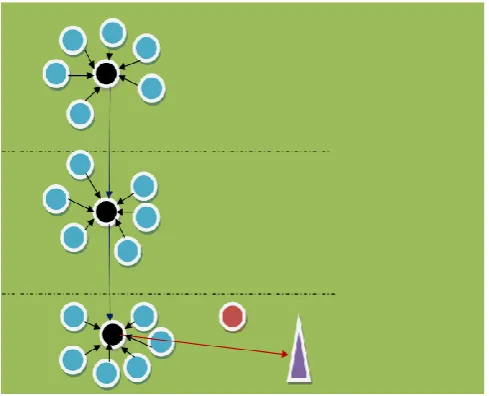
In the proposed protocol CH election by type-2 fuzzy logic using if then else operations are making less energy consume and lifetime increase in WSN. The Network model has following characteristics
There are four types of nodes used in the network Cluster head, Sensor nodes, Stand-By CH and Base -station
Here we used hierarchical clustering to partition the network into clusters. The entire network divided into various dynamic clusters.
Each cluster consists a layer partitions and connected by CH every cluster.
Each CH is dynamic, thus when the present CH die the other sensor node take place of this CH
The selection process of CH is chose by type-2 fuzzy logic.
The Type-2 fuzzy logic used if -then-else rules.
Each CH transfer data from one CH to other CH into up to down level and the process continued until data arrives at BS.
4.
PROPOSED MODEL
PIn this paper CH election by type-2 fuzzy logic using
If-then-else operation, which is consist of three phases in each round.
4.1 Phase 1
Cluster formation phase: Type-2 FL used static clustering formation is formation performed only one time at the starting of network formation. Cluster formation starts with divides various clusters in whole sensor network. Each cluster consist various sensor nodes, selected CHs and one base station.
N = no of sensor node
I = id of sensor node
4.2 Phase 2
Cluster head selection phase: After cluster formation finished CH selection phase begin. In this phase check I nodes probability compare to other sensor node then higher energy sensor node elect as CH. Then send acknowledgement (ACK) message to sensor node and when all sensor node received
ACK message. They are joining to nearby CH.
4.3 Phase 3
[image:2.595.55.300.132.330.2]In this phase when fault occur CH send message to all sensor node. In each round check the fault when any CH decrease energy level it recovers automatically elected another CH. Which sensor node has higher energy in comparison to present CH and all sensor nodes is selects as new CH.
Figure 3.1 Network model
Algorithm
START1. Initialize N number of nodes.
2. Create N number nodes distributed over region.
3. I is ID of sensor nodes in current round.
4. Node[i].statement = initial state. For each node [i]
5. Collect data and send all data to current CH in each sensor.
6. Input parameters: Residual energy (RE), Concentration (CO), Distance to BS (DS).
7. Node[i].RE = residual energy of nodes[i]
8. Node[i].CO = concentration of each nodes[i].
9. Node[i].DS = distance of node[i] to BS.
10. Analysis through Fuzzy inference system (FIS)
11. Probability = FIS (node[i].RE, node[i].CO, node[i].DS).
12. Comparing the result form FIS (Fuzzy inference System)for electing CH
13. If (node[i].probability>I nodes[j].probability)
14. Node[i].statement = CH
15. Advertise CH message
16. Else
17. On receiving CH_message
18. Select the nearest CH
19. Send NODE_JOIN to the nearest CH
20. End
21. When fault occur in CH
22. If (node [CH]. Probability<I nodes (j).probability )
23. Node[CH].statement = fault
24. Then
25. New CH selection
27. Reject
28. End
29. End
30. Transfer data form one CH to other CH in chain form and up to down.
31. BS collects all data from last CH.
32. End
33. End
5.
RESULTS
We have introduced faults in rounds multiple of 11th, 13th and 17th.The faulty rounds are prime numbers which are selected
to provide faults at a steady manner in order to study them for long course of network simulation .In round 11*13=143th both CH1 and CH2 goes down and recovered. In 11*17=187th round both CH1 and CH3 goes down and cluster is recovered.
5.1 Parameters
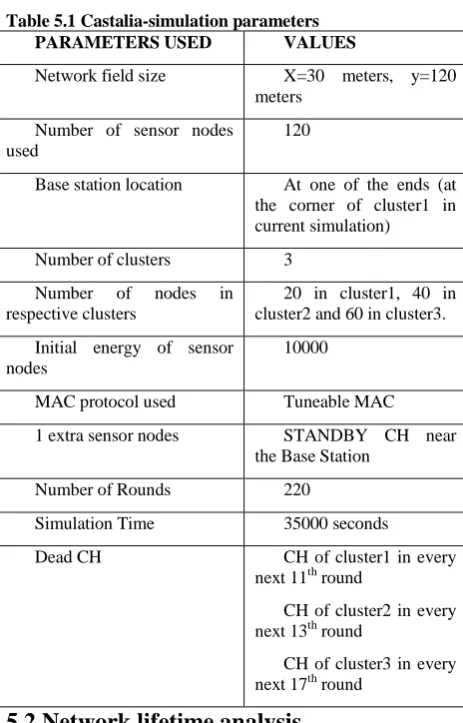
[image:3.595.314.556.297.547.2]Following are the parameters used in the simulation
Table 5.1 Castalia-simulation parameters
PARAMETERS USED VALUES
Network field size X=30 meters, y=120 meters
Number of sensor nodes used
120
Base station location At one of the ends (at the corner of cluster1 in current simulation)
Number of clusters 3
Number of nodes in respective clusters
20 in cluster1, 40 in cluster2 and 60 in cluster3.
Initial energy of sensor nodes
10000
MAC protocol used Tuneable MAC
1 extra sensor nodes STANDBY CH near the Base Station
Number of Rounds 220
Simulation Time 35000 seconds
Dead CH CH of cluster1 in every
next 11th round
CH of cluster2 in every next 13th round
CH of cluster3 in every next 17th round
5.2 Network lifetime analysis
The life of the sensor relies on the remaining energy and other factors like fault and environment. Hence it is required to detect and recover the nodes in the network. This approach we distribute the sensor nodes across 3 clusters of different sizes and faults are introduced in every 11th, 13th and 17th round after which the fault detection algorithm detects the fault in mid of the running phase. When a CH of any cluster fails then the Fuzzification and De-fuzzification processes are done again in order to select new cluster head/heads. Meanwhile all
the other nodes wait for recovery process to complete. As there are 20 nodes in cluster1 and a fault is introduced at every 11th round i.e. 11, 22, 33, 44, 55, 66, so on .Thus,
The maximum rounds cluster1 sustains is = 20x11 = 220.
That is all the sensors of cluster 1 dies within 220 rounds. As there is chained communication through CH3 (of cluster3) to CH2 to CH1 and finally sink, when cluster1 dies there are no more sensors to receive data from the other clusters and hence the network stops working at 220. However if there were no fault detection and recovery mechanisms and faults would have occurred at cluster2 then whole network would have been died immediately until next round . Figure 5.1 shows the alive sensors in each round.
The increased network life time can be calculated as follows:
Worst case: when fault occurs at round1 at CH2
Then the efficiency of network is recovered by 100%
Best case: when fault occurs after all the nodes in cluster2 dies of except 1 node.
[image:3.595.51.283.304.666.2] Average case: The sensors die at a steady rate, as simulated by us.
Figure 5.1 Total Alive sensors per Rounds
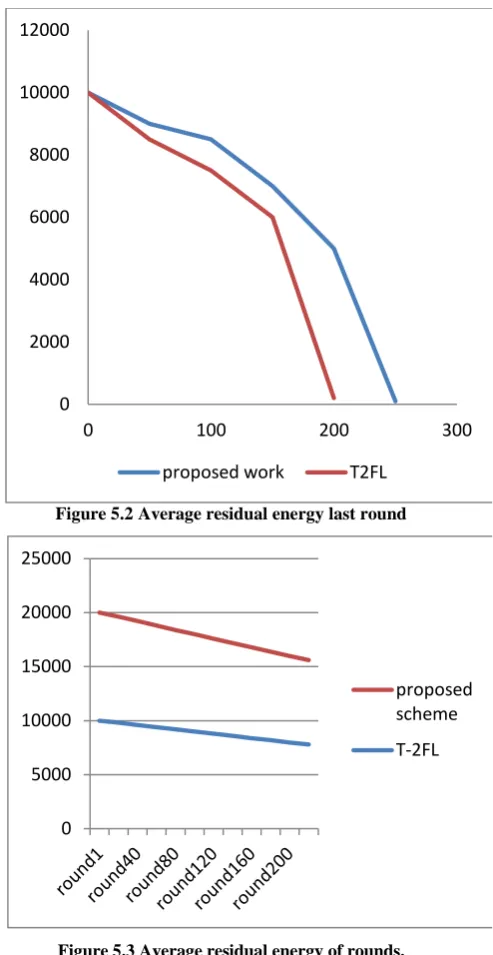
Following is the graph showing Average Residual Energy or remaining energy which is calculated by the formula
ARE=
here REiis the Residual Energy of sensor I and n= number of
8 Figure 5.2 Average residual energy last round
Figure 5.3 Average residual energy of rounds.
6.
CONCLUSION & FUTURE WORK
The proposed algorithm is fault tolerant and energy-efficient, which partitions the network into clusters, utilizes temporary-cluster-heads (CHs). Fault at hardware or software level is inevitable.
Thus the study of Fault recovery mechanism and developing new ones is necessary because today data is not only limited to storage devices like HDD, real time data is precious even of an instance of time which help us in Analysis in various areas like IOT,weather forecast, defence systems, airlines routes etc.
In the current Algorithm at 220th round whole cluster1 fails and as there is no other medium to transmit our data packets rather through cluster1, the whole Network is down and our future work. Standby BS also has limited energy and will have surely exhausted if it had played the role to recover the cluster. Cluster2 is the main bottleneck and hence our future work will be on to make a more dynamic algorithm that analyse the standby BS energy drainage and communication, which is independent of any cluster, or cluster heads.
7.
REFERENCES
[1] W. R. Heinzelman, A. Chandrakasan, and H. Balakrishnan, “Energyefficient communication protocol for wireless microsensor networks,” in Proc. 33rd Hawaii Int. Conf. Syst. Sci. (HICSS), Washington, DC, USA, Jan. 2000, pp. 1–10.
[2] W. B. Heinzelman, A. P. Chandrakasan, and H. Balakrishnan, “An application-specific protocol architecture for wireless microsensor networks,” IEEE Trans. Wireless Commun., vol. 1, no. 4, pp. 660–670, Oct. 2002.
[3] S. Lindsey and C. S. Raghabendra, “PEGASIS: Power efficient gathering in sensor information systems,” in Proc. IEEE Aerosp. Conf., Mar. 2002, pp. 3-1125–3-1130.
[4] I. Gupta, D. Riordan, and S. Sampalli, “Cluster-head election using fuzzy logic for wireless sensor networks,” in Proc. Commun. Netw. Services Res. Conf., May 2005, pp. 255 260.
[5] J.-M. Kim, S.-H. Park, Y.-J. Han, and T. Chung, “CHEF: Cluster head election mechanism using fuzzy logic in wireless sensor networks,” in Proc. ICACT, Feb. 2008, pp. 654–659..
[6] A. Alkesh, A. K. Singh, and N. Purohit, “A moving base station strategy using fuzzy logic for lifetime enhancement in wireless sensor network,” in Proc. Int. Conf. Commun. Syst. Netw. Technol., Jun. 2011, pp. 198–202.
[7] H. Taheri, P. Neamatollahi, O. M. Younis, S. Naghibzadeh, and M. H. Yaghmaee, “An energy-aware distributed clustering protocol in wireless sensor networks using fuzzy logic,” Ad Hoc Netw., vol. 10, no. 7, pp. 1469–1481, 2012.
[8] T. Sharma and B. Kumar, “F-MCHEL: Fuzzy based master cluster head election leach protocol in wireless sensor network,” Int. J. Comput. Sci. Telecommun., vol. 3, no. 10, pp. 8–13, Oct. 2012.
[9] Izadi, D., Abawajy, J. and Ghanavati, S. (2013). A new energy efficient cluster-head and backup selection scheme in WSN. 2013 IEEE 14th International Conference on Information Reuse & Integration (IRI). [10] Saber AMRI, Med Lassaad KADDACHI, Abdelbasset
TRAD (2014) Energy-Efficient Multi-hop Hierarchical Routing Protocol using Fuzzy Logic (EMHR-FL) for WSN.978-1-4799-3351-8/14/$31.00 ©2014 IEEE.
[11] Hassan EL ALAMI, Abdellah NAJID (2016) Energy-Efficient Fuzzy Logic Cluster Head selection in Wireless Sensor Networks. 978-1-4673-7689-1/16/$31.00 ©2016 IEEE.
[12] Padmalaya Nayak, Bhavani Vathasavai (2017) Energy efficency clustering algorithm for multi-hop wireless sensor network using type-2 fuzzy logic. IEEE sensor journal VOL.17,NO.14,JULY 15,2017.
[13] Z. W. Siew, C. F. Liau, A. Kiring, M. S. Arifianto, and K. T. K. Teo, “Fuzzy logic based cluster head election for wireless sensor network,” in Proc. 3rd CUTSE Int. Conf., Miri, Malaysia, Nov. 2011, pp. 301–306.
[14] V. Nehra, R. Pal, and A. K. Sharma, “Fuzzy-based leader selection for topology controlled PEGASIS protocol for 0
2000 4000 6000 8000 10000 12000
0 100 200 300
proposed work T2FL
0 5000 10000 15000 20000 25000
proposed scheme
lifetime enhancement in wireless sensor network,” Int. J. Comput. Technol., vol. 4, no. 3, pp. 755–764, Mar./Apr. 2013.
[15] G. Ran, H. Zhang, and S. Gong, “Improving on LEACH protocol of wireless sensor networks using fuzzy logic,” J. Inf. Comput. Sci., vol. 7, no. 3, pp. 767–775, 2010. [16] H. Ando, L. Barolli, A. Durresi, F. Xhafa, and A.
Koyama, “An intelligent fuzzy-based cluster head selection system for WSNs and its performance evaluation for D3N parameter,” in Proc. Int. Conf. Broadband, Wireless Comput., Commun. Appl., Nov. 2010, pp. 648–653.
[17] Animesh Shrivastava and Singh Rajawat,” An Implementation of Hybrid Genetic Algorithm for
Clustering based Data for Web Recommendation System,”International journal of computer science and engineering, Volume-2, Issue -4, April 2014.
[18] Z. Arabi, “HERF: A hybrid energy efficient routing using a fuzzy method in wireless sensor networks,” in Proc. Int. Conf. Intell. Adv. Syst. (ICIAS), Jun. 2010, pp. 1–6.
[19] E. H. Mamdani and S. Assilian, “An experiment in linguistic synthesis with a fuzzy logic controller,” Int. J. Man-Mach. Stud., vol. 7, no. 1, pp. 1–13, 1975.