warwick.ac.uk/lib-publications
A Thesis Submitted for the Degree of PhD at the University of Warwick
Permanent WRAP URL:
http://wrap.warwick.ac.uk/99635/
Copyright and reuse:
This thesis is made available online and is protected by original copyright. Please scroll down to view the document itself.
Please refer to the repository record for this item for information to help you to cite it. Our policy information is available from the repository home page.
Isolation, Characterisation and Reactivity of
Five-Coordinate Pt
IV
Complexes
By Paul Anthony Shaw
A thesis submitted for the partial fulfilment
of the requirements for the degree of
Doctor of Philosophy in Chemistry
Supervised by Dr Jon Rourke
Presented to
The University of Warwick
Department of Chemistry
i
Table of Contents
Acknowledgements ... v
Declaration ... vi
Abstract ... vii
Abbreviations ... viii
Introduction ... 1
1.1. Overview of Organometallic Chemistry ... 1
1.2. General Features of Oxidative Addition and Reductive Elimination Reactions ... 4
1.3. Coordinatively Unsaturated Complexes ... 9
1.4. Dihydrogen Complexes ... 11
1.5. Oxidative Addition of C-H Bonds ... 12
1.5.1. Oxidative Addition of Intermolecular C-H Bonds ... 13
1.5.2. Oxidative Addition of Intramolecular C-H Bonds ... 17
1.6. H/D Exchange at Metal Centres ... 21
1.7. The Shilov System ... 22
1.8. Past Work in the Rourke Group ... 24
1.9. Thesis Aims and Objectives, and Approach... 28
1.9.1. The General Approach ... 28
1.9.2. General Thesis Aims and Objectives ... 29
1.9.3. Characteristation Techiques ... 29
Oxidative Addition with PhICl2 ... 31
2.1. Introduction ... 31
2.2. Triphenylphosphine Derivative 1-Ph ... 34
2.3. Alkyl phosphines ... 38
2.3.1. Tributylphosphine Derivative 1-Bu ... 38
2.3.2. Tripropylphosphine Dervative 1-Pr ... 46
2.4. Tri(o-tolyl)phosphine Derivative 1-Tol ... 55
2.5. Conclusion ... 61
Oxidative Addition with RX Compounds and Subsequent Reductive Elimination . 62 3.1. Introduction ... 62
3.2. C^N^C = 2,6-di(4-fluorophenyl)pyridine ... 66
3.2.1. Reactivity of PtII Complexes with RX Compounds ... 66
3.2.2. Reaction of PtIVRX Complex with AgBF4 ... 72
ii
3.2.4. Reaction with KX Salts... 77
3.2.5. Recyclometallation ... 79
3.2.6. Asymmetric Aryl-Aryl: Reaction of Me-1-Pr with a second equivalent of MeI 81 3.3. C^N^C = 2-(4-fluorophenyl)-6-tertbutylpyridine ... 84
3.3.1. Introduction ... 84
3.3.2. Addition of MeI ... 86
3.3.3. Addition of a second equivalant of MeI to Me-21, and One-Pot Synthesis ... 90
3.3.4. Addition of BnBr and AllylBr, and One-Pot Synthesis ... 92
3.4. Conclusion ... 93
Activation of C(sp2)-H bonds at Electrophilic Five-Coordinate PtIV centres and subsequent reductive elimination ... 95
4.1. Introduction ... 95
4.2. Symmetric Diaryl C^N^C Dicyclometallated PtII Complex 1-Bn ... 98
4.2.1. Oxidation of 1-Bn with PhICl2 ... 99
4.2.2. Initiation of a Reductive Elimination Reaction with a Lewis Acid ... 103
4.2.3. Initiation of a Reductive Elimination Reaction with AgBF4 ... 107
4.2.4. Comparison of the Two Reductive Elimination Products (28 and 30) ... 108
4.3. Asymmetric Diaryl C^N^C Dicyclometallated PtII Complex Me-1-Bn ... 113
4.3.1. Oxidation of Me-1-Bn with PhICl2 ... 113
4.3.2. Initiation of a Reductive Elimination Reaction with a Lewis Acid or Heat ... 115
4.3.3. Initiation of a Reductive Elimination Reaction with AgBF4 ... 119
4.4. Further Reactivity of the Three-Coordinate Complex 30 ... 123
4.4.1. Addition of CO ... 123
4.4.2. Addition of H2 ... 124
4.4.3. H/D Exchange ... 125
4.5. Conclusion ... 129
Conclusions and Future Work ... 130
Experimental ... 132
6.1. General Considerations ... 132
6.2. Starting Materials (C^N^C = 2,6-di(4-fluorophenyl)pyridine) ... 133
6.2.1. Synthesis of 1-Bu and 1-Pr (air sensitive phosphines) ... 133
6.2.2. Synthesis of 1-Tol and 1-Bn (air stable phosphines) ... 135
6.3. Starting materials (C^N^C = 2-(4-fluorophenyl)-6-tertbutyl pyridine) ... 137
6.3.1. Synthesis of 20-Pr ... 137
iii
6.4. Synthesis of the Complexes from Chapter 2 ... 140
6.4.1. Synthesis of 4-Ph(c) ... 140
6.4.2. Synthesis of 3-Bu(t) and 3-Bu(c) ... 141
6.4.3. Synthesis of 7-Bu(c) via 5-Bu and 6-Bu(t) ... 143
6.4.4. Synthesis of 3-Pr(t) and 3-Pr(c) ... 146
6.4.5. Synthesis of 7-Pr(c) via 5-Pr and 7-Pr(c)... 148
6.4.6. Synthesis of 2-Pr(t) and 2-Pr(c) ... 151
6.4.7. Synthesis of 4-Pr(t) and 4-Pr(c) ... 152
6.4.8. Synthesis of 3-Tol(c), 7-Tol(t) and 8 ... 154
6.4.9. Synthesis of 6-Tol(c) ... 157
6.5. Synthesis of the Complexes from Chapter 3 ... 158
6.5.1. Synthesis of 9 ... 158
6.5.2. Synthesis of 11 via 10 ... 165
6.5.3. Synthesis of 12 ... 170
6.5.4. Synthesis of Me-13-L ... 174
6.5.5. Synthesis of Me-1-Pr and Me-1-Bn ... 180
6.5.6. Synthesis of 14(t) and 15 ... 182
6.5.7. Synthesis of 17 ... 184
6.5.8. Synthesis of 18 ... 185
6.5.9. Synthesis of 19 ... 186
6.5.10. Synthesis of 22(RX) and R-23 ... 187
6.5.11. Synthesis of 24 ... 192
6.5.12. Synthesis of Me-21 and Bn-21 ... 193
6.5.13. Synthesis of Me-22(Me) and Me2-23 ... 194
6.5.14. Synthesis of Me2-23 and Bn2-23 by 1-pot ... 196
6.6. Synthesis of the Complexes from Chapter 4 ... 197
6.6.1. Synthesis of 27(t) ... 197
6.6.2. Synthesis of Me-27(t) ... 198
6.6.3. Synthesis of 25 and 26 ... 199
6.6.4. Synthesis of Me-25(b) and Me26(b) ... 201
6.6.5. Synthesis of 27(c) and 28... 203
6.6.6. Synthesis of Me-27(c), Me-28(a) and Me-28(b) ... 205
6.6.7. Synthesis of 29 ... 209
6.6.8. Synthesis of 30 ... 210
iv
6.6.10. Synthesis of 31 ... 213
6.6.11. Synthesis of 32 ... 214
6.6.12. Synthesis of 33 ... 215
References ... 216
Appendix ... 227
8.1. Crystal Data ... 227
8.1.1. Lookup Table for Crystal Data ... 227
8.2. Chart Data ... 229
8.2.1. Table of Data for Figure 4.12 and Figure 4.13 ... 229
8.2.2. Table of Data for Figure 4.14 ... 230
v
Acknowledgements
I would first like to express my gratitude Dr. Jon Rourke, whose guidance shaped this thesis. Many thanks go, also, to Guy Clarkson for the many crystal structures determined and presented in this thesis. I greatly appreciate the funding from the EPSRC, which allowed me to conduct my research.
Thanks are also due to the many people I have shared office and lab space with over the course of my Ph.D. research, from whom I have been able to learn about chemistry beyond my own field of expertise, and gained friendships.
vi
Declaration
I hereby declare that this thesis is my own work. To the best of my knowledge and belief, it contains neither material previously published or written by another person, nor material which has been accepted for the award of any other degree or diploma of a university or institute of higher education, except where due acknowledgement is made in the text.
Sections cotainining work carried out by past members of the Rourke group include
“Section 2.2. Triphenylposphine derivative 1-Ph” and “Section 2.3.1. Tributyl phosphine derivative 1-Bu”. Full aknowledgements to contributions are made in the paragraph directly below the respective section titles in the thesis text.
Paul Anthony Shaw
List of published journal articles based on the work presented in this thesis:
P. A. Shaw, J. M. Phillips, C. P. Newman, G. J. Clarkson and J. P. Rourke, Chem.
Commun., 2015, 51, 8365-8368.
P. A. Shaw, J. M. Phillips, G. J. Clarkson and J. P. Rourke, Dalton Trans., 2016, 45, 11397-11406.
P. A. Shaw, G. J. Clarkson and J. P. Rourke, Organometallics, 2016, 35, 3751–3762.
P. A. Shaw and J. P. Rourke, Dalton Trans., 2017, 46, 4768-4776.
P. A. Shaw, G. J. Clarkson and J. P. Rourke, Chem. Sci., 2017, 8, 5547–5558.
vii
Abstract
The oxidative addition to square planar dicyclometallated C^N^C PtII 16 valence electron complexes (C^N^C= 2,6-di(4-fluorophenyl)pyridine and 2-(4-fluorophenyl)-6-tertbutylpyridine) was studied with Cl2 (via PhICl2) and alkyl halides (e.g. MeI, BnBr and
allylBr). The two-step nature of the process meant that PtIV 16 valence electron
five-coordinate intermediates could be identified. The product of oxidation was an octahedral 18 valence electron product with the new groups added mutually trans across the metal, with isomerisation seen with time. However, in the case of the chlorine-based oxidant, PhICl2, this was only part of the story, where further reactivity depended on the phosphine
coordinated in the fourth coordination site. Oxidation of the PPh3 derivative gave a
long-lived five-coordinate intermediate (lasting about four hours) before combination with the second chloride. Complexes containing PBu3, PPr3 and P(o-Tol)3 trapped the
five-coordinate complex with agostic interactions, eventually leading to transcyclometallation products.
In parallel to these studies, abstraction of X- from the octahedral PtIV oxidation products gave another path to the five-coordinate intermediates, and in most cases, they could be trapped with pyridine. Whilst we did not see any evidence of aryl-Cl coupling, we were able to isolate several three-coordinate monocyclometallated PtII products, which came about through aryl-R reductive elimination via a long-lived five-coordinate complex which were characterised in solution. Addition of a mild base led to the activation of the C(sp2)-H bond, reforming the five-membered ring. Addition of another equivalent of the alkyl halide, and subsequent addition of AgBF4 showed 100% regioselectivity for reductive
coupling of the R group to the ring substituted previously. When C^N^C was 2-(4-fluorophenyl)-6-tertbutylpyridine), the reductive elimination reaction was spontaneous under the reaction conditions for RX addition, showing complete selectivity of C(sp3 )-C(sp2) over C(sp3)-C(sp3).
Further to these reactions, the PBn3 derivative was also treated with PhICl2, which led to
the formation of a PtIV tricyclometallated product. When the halide was removed from the tricyclometallated complex (again with AgBF4), reductive elimination of the coordinated
benzyl and aryl group gave a three-coordinate complex with a strained nine-membered ring. Two distinct mechanisms were identified for the inversion of the ring, one of which included the breaking of the C-C bond to reform the five-coordinate intermediate. The fourth coordination site was open enough to allow chloride, CO and H2 to coordinate.
Coordination of H2 was not seen directly, instead a product with no cyclometallation and a
viii
Abbreviations
Bn Benzyl
C^N^C Dicyclometallated ligand. ^ symbol denotes linkages
COSY COrrelated SpectroscopY
d doublet
e- electron
ESI-MS ElectroSpray Ionisation Mass Spectrometry
FWHH Full Width at Half Height
HMBC Heteronuclear Multiple-Bond Correlation spectroscopy
HR-MS (ESI) High Resolution Mass Spectrometry (ElectroSpray Ionisation)
HOMO Highest Occupied Molecular Orbital
HSQC Heteronuclear Single-Quantum Correlation spectroscopy
J J-Coupling
LUMO Lowest Occupied Molecular Orbital
m multiplet
Me methyl
NMR Nuclear Magnetic Resonance
nOe nuclear Overhauser effect
PBn3 Tribenzylphosphine
PBu3 Tri-nbutylphosphine
pen pentet
Ph Phenyl
PoTol3 Tri(o-tolyl)phosphine
PPh3 Triphenylphosphine
ppm parts per million
PPr3 Tri-npropylphosphine
py pyridine
q quartet
RT Room Temperature
s sex
Singlet sextet
t triplet
1
Introduction
1.1. Overview of Organometallic Chemistry
An organometallic compound is commonly defined as one containing a M-C bond. The existence of these compounds has been known for around 200 years, but only in the last 50 or so years has the study of these complexes been described within the emerging field of organometallic chemistry. The rise of interest in these compounds can be attributed to their use as catalysts and as reagents in organic synthesis, making them of high value to industry.
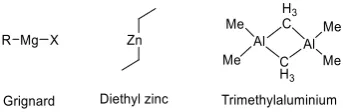
Arguably, the simplest organometallic complexes are those of main group metals, where only M-C σ-bonds are possible. These complexes are often seen in organic synthesis, used as strong bases, and anionic carbon synthons. Common examples include butyl lithium, Grignard reagents (general structure RMgX), diethyl zinc, and trimethyl aluminium (Figure 1.1).
Figure 1.1 Examples of main group organometallic compounds.
[image:11.595.247.419.385.441.2]More interesting, is the bonding of carbon to transition metals, which have d-orbitals and multiple stable oxidation states. The d-orbital lobes can overlap with carbon p-orbitals and therefore form multiple bonds to the same carbon. Compounds containing M-C multiple bonds (i.e. M=C and M≡C, known as alkylidene and alkylidyne complexes respectively) have been characterised (Figure 1.2). The original synthesis of these compounds was pioneered by Schrock and Fischer.1–3
2 Alkenes can coordinate to metals, where the electrons of the π bond are donated to the metal. The first example was synthesized by Zeise in 1827.4 Zeise’s salt is a PtII trichloro complex with an η2 coordinated ethene (Figure 1.4). The crystal structure showed that the
ethene was coordinated to the platinum “side on” with the plane of the alkene orthogonal to the bond to the metal. Metals can also coordinate to extended π systems such as 1,3-butadiene. Figure 1.3 shows a complex with three equivalents of 1,3-butadiene (each coordinated η4) coordinated to a single molybdenum (with two of the dienes omitted for
clarity) exemplifying metals coordinating to extended π systems.5
Figure 1.3 Structures of Zeise’s salt (left) and molybdenum tris(butadiene) (right).
Aromatic rings can also coordinate to metals. When they coordinate via all of the carbons they form speces with names like sandwich complexes and piano stools. Ferrocene is one such organometallic complexes, and the first to be synthesized (Figure 1.4).6 During the original synthesis of ferrocene, Pauson and Kealy reacted the cyclopentadienyl anion with an iron salt.7 While they expected η1 coordination of two cyclopentadienyl ligands, they were surprised to find that this was not the case when they realised that the complex was stable to air. It was later discovered that that the two cyclopentadienyl ligands were each coordinated η5. This was based on the results of several spectroscopic techniques including infra-red spectroscopy where only one C-H stretching frequency was seen. The sandwich structure was later proven by NMR and crystal structure.8
Figure 1.4 Incorrect (left) and correct (right) structures of ferrocene.
Organometallic complexes are very rare in nature, with the most well-known being vitamin B12. This essential vitamin has a Co-R bond, and is responsible for several C-H/C-C bond
3 Main group organometallic complexes are used in stoichiometric amounts, which creates a lot of metal waste, especially when industrial reaction scales are considered. Transition metals, however, are commonly used as catalysts, where a far smaller quantity of the metal is required.
There are a few exceptions to the “requirement of a M-C bond” definition for an organometallic complex, where the definition has been expanded to sometimes include metals with coordinated phosphines. This is more relevant for organometallic catalysts, where the inactive catalyst may not have a M-C bond, but will during the catalytic cycle.
A general catalytic cycle is shown in Figure 1.5. Typically, the catalytic cycles begin with
an inactive pre-catalyst which is relatively easy to manipulate before the reaction. Activation can be spontaneous in situ, sometimes only requiring the dissociation of a ligand (or the coordination of the substrate). Next, a substrate might oxidatively add to the activated metal catalyst, followed by modifying steps to alter the added group. In the final step, the product can reductively eliminate, and the active catalyst is regenerated (completing the cycle). Note that the term “modification steps” is intentionally vague in this instance as the number of possible reactions that can occur at this step are too numerous to be explained here (also the focus of this thesis is on the oxidative addition and reductive elimination steps).
Figure 1.5 Illustration of a general catalytic cycle.
4 employ enantio-pure BINAP ligands to successfully select the desired enantiomer of the alcohol product (sometimes up to 100 % enantioselectivity), in a process called asymmetric hydrogenation (Scheme 1.1).9
Scheme 1.1
Topics covered in the remainder of this chapter aim to give a broad overview of several important topics in organometallic chemistry relevant to the work in this thesis. This includes:
• Oxidative addition/reductive elimination • Coordinatively unsaturated complexes • Oxidative addition of alkanes
• Shilov chemistry
The chapter closes with the synthesis of the C^N^C dicyclometallated complexes synthesized previously in the Rourke group. Previous work (both from the Rourke group and elsewhere) that more closely resembles the work of a particular chapter are discussed in the introduction section of those chapters.
1.2. General Features of Oxidative Addition and Reductive Elimination Reactions
In the 1960s an effort was made to group similar organometallic transformations together. Oxidative addition emerged as a reactivity pattern of similar but distinct mechanisms.10 There are several distinct reaction mechanisms which can fall under the umbrella term of
“oxidative addition”, and may even compete, meaning that the reactions can be very
sensitive to any change in the reaction. In the realm of organometallic chemistry, molecules like H2 can be described as better oxidants than oxygen when reaction rates are
5 Oxidative addition and reductive elimination are connected by the microscopic reversibility principle.12 This means that reductive elimination is the reverse of oxidative addition, and therefore the reactions share the same reaction mechanisms, just in the opposite order (relative to the other). Overall, in a typical oxidative addition reaction (including the reactions presented in the results chapters of this thesis) the oxidation state increases by two, the coordination number increases by two and the number of metal valence electrons is increased by two (Figure 1.6).13 The opposite is true for reductive
elimination.
Figure 1.6 Illustration of a general oxidative adition and reductive elimination.
For an oxidative addition reaction to occur, the metal complex must have 16 valence
electron or fewer (to allow the metal to accommodate the two extra electrons from the incoming group), and have a stable oxidation state two greater than the current oxidation
state. Oxidative addition therefore favours lower oxidation states. A famous example includes the oxidative addition of RX compounds to magnesium to form Grignard reagents (RMgX).
Conversely, for reductive elimination reactions, the metal valence electron count is less of an issue. The complex requires an oxidation state two less than the current oxidation state, and so reductive elimination reactions favour higher oxidation states. Over the last 40 years C-C coupling reactions have gained a lot of attention (and Nobel prizes), as being able to form a C-C bond is very powerful in the synthesis of complex organic molecules. Important examples include the famous Suzuki and Heck cross-coupling reactions.14–17 Reductive elimination of C-X18 (where X is a halogen) and C-O19,20 have also gained a lot of attention in the literature.
There are several known mechanisms of oxidative addition and reductive elimination including: ionic, radical, SN2 and concerted. Radical and ionic mechanisms are not thought
to be relevant to this project, and will not be explained here.
An SN2 type oxidative addition is seen with more polar bonds such as alkyl halides and
some non-polar diatomics such as Cl2. Metals can donate electron density into the σ*
6 which can later coordinate to the metal. Just like an SN2 reaction for organic molecules the
new M-Y bond forming, and the X-Y bond breaking are simultaneous, which has implications on the stereochemistry of Y (stereochemistry inversion). If Y-X adds to a square planar complex, the initial product is expected to have X and Y taking coordination sites on opposite sides of the metal, as this geometry would not require the movement of the other ligands.
Figure 1.7 Illustration of a general SN2-type oxidative addition or oxidative addition reaction.
An SN2 type reductive elimination first requires the dissociation of X- (Figure 1.7). The
reaction therefore requires a labile M-X bond, where X- can exist as a stable anion (e.g.
halides). This reveals a coordinatively unsaturated complex. X- then attacks the σ* orbital
of Y to break the M-Y bond. Where there are many options for X- to attack, the preference
depends on many factors including accessibility of the M-Y σ* orbital, and the stability of the product (i.e. Br- is unlikely to attack a phosphine or amine).
7
Figure 1.8 Illustration of the orbital overlap of d-orbitals and X-Y molecular orbitals and a general
illustration of concerted oxidative addition and reductive elimination reactions.
X-Y can coordinate to the metal via the electron density of the X-Y σ-bond. Metals can also donate electron density back to X-Y into the σ* orbital. The greater the degree of this
back-bonding, the more elongated the X-Y σ-bond becomes (as it becomes weaker). With enough back-bonding, the X-Y bond breaks to give the oxidatively added product. In a
8
Figure 1.9 Illustration to describe the selectivity of reductive elimination reactions.13
Formation of a coordinatively unsaturated complex is therefore the initial step in both SN2
and many concerted reductive elimination mechanisms. Recent work in the Sanford group looked at the competition between these two mechanisms. They studied a derivative of their complex where pyridine took the sixth coordination site of their complex (Scheme 1.2).25 Pyridine was chosen as it is a labile ligand (which would reveal a coordinatively unsaturated complex), but also poorly nucleophilic (ruling out an SN2 reductive elimination
pathway). Heating the complex led only to the concerted reductive elimination of F-Calkyl.
Scheme 1.2
The next step was to replace the pyridine with the nucleophilic pro-ligand 4-toluenesulfonamide.26 Heating the complex gave the analogous F-Calkyl reductive coupled
product. Also seen was a N-Calkyl reductive elimination product. Since the
4-toluenesulfonamide group was trans to the C(sp3), a concerted N-Calkyl reductive
9 The SN2 N-Calkyl reductive coupling pathway was therefore in competition with the F-Calkyl
concerted reductive coupling pathway. The reaction can be pushed towards 100% conversion to the C-N reductive elimination product by adding excess toluenesulfonamide. With more toluenesulfonamide in solution, as soon as a 4-toluenesulfonamide ligand dissociates, another can attack the C-Pd bond (outcompeting the F-Calkyl coupling pathway).
As in organic chemistry, an SN2 attack at a chiral carbon results in the inversion of the
stereocentre because the nucleophile attacks on the face opposite the leaving group. A concerted reductive elimination mechanism will instead give retention the stereocentre as
the leaving group would just replace the metal on the same face. A recent paper describes an example in which the reductive elimination mechanism can be chosen by the inclusion of an additive (Scheme 1.3).27 When XeF2 (a source of F-) was reacted with a cationic
platinum alkyl complex, the fluoride coordinated to the metal, which was followed by the concerted reductive elimination of C-F.
Scheme 1.3
When acetate was added before XeF2, the acetate coordinated to the metal. The fluoride
(unable to coordinate to the metal) attacked the cyclohexyl ring at the Pt-C via an SN2
reductive elimination mechanism. Note that in each case the reactive platinum centre was five-coordinate before the reductive elimination of the fluorinated cyclohexyl ring.
1.3. Coordinatively Unsaturated Complexes
Oxidative addition and reductive elimination reactions are often seen to go via coordinatively unsaturated intermediates. These species are known to be highly reactive and short-lived, meaning that the study of these species is of academic interest.28,29
10 with an 18 valence electron octahedral complex, and removing a negatively charged species (e.g. Cl-) or a neutral species (e.g. phosphine or DMSO). The example in Figure 1.10 is modelled on work presented in this thesis.
Figure 1.10 Illustration of the formation of a 16 valence electron coordinatively unsaturated species.
The Goldberg group have shown how stable five-coordinate complexes may be observed (Scheme 1.4).30 By looking at the 16 valence electron complex with three methyl groups
cis to each other (and a geometry which would favour reductive elimination), one would imagine that the evolution of ethane gas would be facile. However, it is completely stable
at room temperature. They found that the complex required temperatures as high as 150 °C before it will begin to evolve ethane gas. The stability of the five-coordinate complex is
thought to be because of the anionic nacnac ligand (nitrogen analogue of acetyl acetonate) making the complex neutral overall. The reductive elimination step led to the activation of one of the iPr chains, forming a new five-coordinate species with a six-membered cyclometallated ring. Further elimination of methane gave a stable three-coordinate species.
Scheme 1.4
11
Scheme 1.5
When R’ = Me, cyclometallation of the R group (and subsequent reductive elimination of
methane) was seen. When R = tBu the cyclometallation reaction occurred below -80 °C whilst when R = iPr, full conversion to the cyclometallated complex required elevated temperatures (45 °C), with the reaction complete after 12h. The reaction is therefore driven
by sterics, where the R’ groups clash with the R groups. The larger the two groups, the closer the R group is to the metal, which encourages the C-H bond activation. This also explains why the tBu derivative reacts faster than the iPr derivative.
1.4. Dihydrogen Complexes
Stable dihydrogen complexes are quite common in the literature.32 Like alkene complexes,
the H-H bond lengths are shown to be elongated when compared to free H2, showing a
degree of back bonding to the hydrogen (and therefore requiring low metal oxidation state metals). The dihydrogen complex is therefore seen as an intermediary between an oxidatively added complex (i.e. a dihydride) and the free H2. The range of typical H-H
bods in dihydrogen complexes lies between 0.8 and 1.1 Å (the length of a “free”
dihydrogen molecule is 0.74 Å).32 Dihydrogen complexes with longer H-H bond lengths are described as stretched, but more commonly as compressed dihydrides, as the H-H σ -bond displays more characteristics of being broken. This can be measured by H (or H-D) coupling constants. As the H-H bond shows more “broken” character, the coupling constant drops dramatically (from around 30 Hz to around 2 Hz). However, the most precise method of determining bond lengths is neutron diffraction.
The earliest dihydrogen complexes were synthesized by the Kubas group in 1984 (Figure 1.11).33,34 A feature of these complexes (which can also be seen in many more recent examples) is the presence of strong trans directing CO ligands, which sympathetically aid the coordination of the H2 group. This effect plays into the antisymbiosis effect (which is
12
Figure 1.11 Illustration of a Kubas Complex.
Vaska’s complex is the standard complex for the study of oxidative addition reactions (Scheme 1.6).36 Various analogues have been synthesized, with different phosphines and X groups in order to probe oxidative addition reactions. In the coordination of H2, Vaska’s
complex has shown to be able to reversibly add H2 under relatively mild conditions.
For example, under vacuum, the product of the oxidative addition of H2 (an IrIII octahedral
complex) will lose H2, and reform Vaska’s complex.
Scheme 1.6
Reaction of H2 with Vaska’s complex (a square planar 16 valence electron iridium
complex) leads to an octahedral dihydride complex, with the two hydrogens mutually cis. The reaction is thought to go through a five-coordinate trigonal bipyramidal intermediate, where the H2 group is part of the trigonal plane. This mechanism shows that square planar
complexes are not inert to oxidative addition reactions via concerted mechanisms.
1.5. Oxidative Addition of C-H Bonds
C-H bonds are usually thought to be quite inert due to the high bond dissociation energy (~100 kcal/mol for an alkyl C-H bond).37. Before hydrocarbons are suitable for use in synthesis, they are currently functionalised first by oxidation or radical processes. These processes require vast amounts of energy, and are wasteful.
The holy grail of organometallic chemistry is in the selective functionalisation of C-H bonds in organic synthesis without the need for activated precursors.38,39 There are already many papers that discuss methods of selective C-H bond activation.40 In the famous Heck
reaction, protons on terminal alkenes are selectively activated.16 Large ligands coordinated
13 proximity to the metal.41 Other mechanisms besides oxidative addition exist41–48 but with the exception of cyclometallation deprotonation (covered in section 1.5.2) these mechanisms will not be covered in this thesis.
Oxidative addition reactions of C-H can be split into two distinct types: intermolecular and intramolecular (Figure 1.12), which just describes whether the substrate is coordinated to the metal prior to activation. Oxidative addition of C-H bonds is directly comparable with that of H2, except H2 lacks the possibility of intramolecular assistance. Like the
coordination of H2, oxidative addition of a C-H bond is known to first require coordination
of the C-H bond, forming a three-centred two-electron bond.49 Efficient back-bonding
lengthens the C-H bond until it breaks.
Figure 1.12 Illustration of general intra- and intermolecular C-H bond activation.
1.5.1. Oxidative Addition of Intermolecular C-H Bonds
Intermolecular coordination of a C-H bond gives a σ-complex (Figure 1.12). These are transient species, where the hydrocarbon is likely to simply dissociate from the metal. While there are many crystal structures of dihydrogen complexes. The weakness of the interaction for coordinated C-H bonds (compared to dihydrogen complexes) is because of the bulkiness of the alkane (compared to a tiny H2 molecule). The Weller group reported
the first unambiguous examples of X-Ray crystal structure of σ-complexes (Error! Reference source not found.).50 The crystal was made by the addition of H2 to a crystal of
a rhodium norbornadiene complex (H2 reduced norbornadiene to norbornane) at -173 °C.
When the addition of H2 was performed at RT, the norbornane was displaced by an aryl
group of the [BArF4]- counterion within hours. In the 13C SSNMR, the characteristic peaks
14
Scheme 1.7
The Weller group later reported the single crystal to single crystal synthesis of the
norbornane rhodium complex which proved to be stable in air and at RT by using the analogous bidentate phosphine ligand 1,2-bis(dicyclopentylphosphino)ethane.51,52 More recently Weller and co-workers have used similar techniques, alongside DFT calculations, to look at a pentane analogue of the previously mentioned structure.53
Previous to the Weller group’s findings, the Meyer group reported an X-Ray crystal structure of an electro-rich uranium complex with a cyclohexane molecule in close proximety to the metal.54 Alkanes (namely heptane) have also been reported to be trapped between porphyrin rings in the solid-state with short Fe-C distances.55 The moieties around
the porphyrin are thought to be responsible, “shielding” the heptane from solvent during the crystalisation.
Coordination of the terminal C-H bonds of an alkane has shown to be disfavoured, with a preference for coordination to C-H bonds nearer the middle of the alkane, which can be expected by the 10 kJ/mol difference in bond dissociation energy.53,56,57 There is also
evidence of preferential binding to axial vs equatorial C-H bonds.58 Direct observation of
intermolecular alkane σ complexes are still quite rare in the literature, but these transient species have been observed by NMR and IR at low temperatures (which decreases the rate
of dissociation).57,59
Conversely, direct observation of the oxidative addition of saturated hydrocarbons is quite
common. These are usually trapped by using metals complexes with very low oxidation states to make reductive elimination of the C-H bond unfavourable. This was first seen in complexes synthesized by Janowicz and Berman in 1982 (Scheme 1.8).60
15 The selectivity of alkane oxidative addition favours primary alkanes (the reverse of the
trend seen for σ-complexes), likely due to the reduced steric crowding at the metal centre (as this would favour the reverse reaction). This can be seen in the borylation of alkanes, which is a topic too vast to be covered here, and has been covered in some depth in a review by Hartwig et al..61
After C(sp3)-H bonds were shown to add to metals, the next step was to functionalise the
alkane, and make the process catalytic. The most important process to mention at this point would be the Shilov system, which is explained in Section 1.7. A more recent example by Nishiyama, reporting an iridium complex that activates alkanes (namely octane) to form an
alkane complex at 160 °C (Scheme 1.9).62 The mechanism reported mechanism is via a concerted metalation deprotonation, where the oxidative addtion is assisted by the acetate groups which are coordinated to the metal deprotonating the alkane.63,64 Goldberg and co-workers then found that upon heating the complex to 200 °C, the complex would eliminate octenes.65 Most recently it has been reported that the starting material could be regenerated with O2.66
Scheme 1.9
Intermolecular oxidative addition of C(sp2)-H bonds is much easier, owing to the relative
stability of the oxidative addition product, examples of these were seen in the literature around 20 years earlier. To mention again the borylation of C-H bonds, C(sp2)-H bonds
will be activated in preference over C(sp3)-H bonds.
An early example of arene C-H bond activation from 1965 by Chatt and Davidson showed the oxidative addition of naphthalene to a Ru(0) complex (Scheme 1.10). A RuII complex
16
Scheme 1.10
Chatt and Davidson also discuss the reversibility of the C-H bond activation, noting that the complex also exists as a five-coordinate Ru(0) complex with an η2 naphthalene group (Scheme 1.11). This was suggested by the reactivity of the complex towards I2, and the
liberation of naphthalene upon treatment with PEt3 (where it is likely that the phosphine is
displacing the neutral naphthalene). This was probably also one of the first observations of an η2 arene complex (but without direct evidence, such as NMR data).
Scheme 1.11
Most commonly, an arene ligand will be seen coordinated via all of the carbon atoms of the aromatic ring (i.e. benzene will form an η6 complex). Coordinating in this way forms a cap on the metal (e.g. sandwich and piano stool complexes). Greater hapticity leads to greater stability because of the chelate effect. η2 coordinated arenes are relatively labile ligands, meaning that they are easier to displace (like the naphthalene in the earlier example). There are however, many examples of stable η2 arene complexes in the
literature, including complexes of rhenium (Figure 1.13),68 osmium69, ruthenium70 and
mixed metals (including ruthenium and osmium on the same aryl ring).71
Figure 1.13 Illustration of an arene complex observed in solution.
17 1.5.2. Oxidative Addition of Intramolecular C-H Bonds
When σ-complexes form from C-H bonds which are tethered to the metal at a remote location, it is known as an agostic interaction (Figure 1.12). These interactions remain three-centre, two electron interactions.72,73 Because the coordination of the C-H bond is
assisted by the chelate effect (meaning that there is no entropic barrier of making one complex from two), it should be unsurprising that there are more examples of agostic
interactions than intermolecular σ-complexes.74–76 Agostic interactions can stabilize higher
oxidation states via donation of electron density from the C-H σ-bond.74 Agostic M-H
bond lengths are around 1.8-2.3 Å, with M-H-C bond angles typically around 90 - 140°.
Neutron diffraction studies have demonstrated that a standard M-H bond is a little shorter than this at around 1.6 – 1.7 Å.60 The short M-H distance and small M-H-C bond angle suggests a greater involvement of the metal with the C-H σ-bond. In the 1H NMR spectrum, the peak for the coordinated proton is likely to be seen upfield from that of the uncoordinated peak.
Agostic interactions are dynamic, with the coordinated hydrogen likely to exchange with symmetrically equivalent protons. In the 1H NMR spectrum, a coordinated methyl group will typically only show a single resonance for that methyl group.77 This also has implications on the 1JH-M coupling constant, as the true value of the coupling constant is
shared across the equivalent protons. Agostic interactions have shown to favour the binding of C-H over C-D. Partial deuteration affects both the chemical shift and 1JH-Pt
coupling constant.78
Anagostic interactions can be mistaken for agostic interactions, as both can be represented as M-H interactions (Figure 1.14). Anagostic interactions are identified by longer M-H bond lengths (2.3-2.9 Å) and larger M-H-C bond angles (110-170°), and the bonding is thought to be largely electrostatic (similar to a hydrogen bond) where the δ+ hydrogen is attracted to the electron rich metal. For some anagostic complexes (such as the example in Figure 1.14) the interaction can be forced by the geometric constraints of the ligands.
18 A C-H bond interaction can typically be assigned as agostic or anagostic with electron counting. In Figure 1.14 (left), the titanium of the octahedral complex (left) can be assigned as being TiIV, meaning a d0 metal. There are six ligands (not counting the M-H
interaction), each contributing two electrons. This means that the complex is 12 valence electron, which is low for a normal octahedral complex (where 18 valence electron is common). The donation of electrons from a C-H bond, would add an extra two electrons, making a 14 valence electron complex, which is closer to 18 valence electron. The C-H bond interaction is therefore agostic, as donation of electron density from the C-H bond is required to stabilize the low electron count of the complex.
In the square planar complex (Figure 1.14, right), the platinum can be assigned as PtII, meaning a d8 metal. Four ligands contributing two electrons each, means this is a 16 valence electron complex. There are many examples of stable 16 valence electron square planar complexes, and so an extra two from a C-H bond is unnecessary. The M-H interaction here is therefore anagostic.
With this distinction between agostic and anagostic interactions only recently being identified, many previously reported agostic complexes are now being reclassified as anagostic. Yet, new research shows that the distinction between agostic and anagostic can be blurry.79
Agostic species are thought to play a role in some catalytic cycles. There are proposed mechanisms which suggest that the coordination of a C-H bond (from the substrate) is responsible for the enantioselectivity of the product. Zeigler-Natta catalysts are used in the polymerisation of alkenes. Agostic species are proposed as intermediates in chain propagation (Figure 1.15), and may be responsible for the retention of tacticity.78
Figure 1.15 Illustration of a proposed alkene chain propagation mechanism including agostic interactions.
The letter P represents the propagated chain.
19 (and regiospecific). Cyclometallation reactions involving aryl C-H bond activation feature predominantly in the literature.
These reactions often occur without a change in oxidation state of the metal. Instead, the proton is removed by a base which may have even been previously coordinated to the metal. The three most important coordination assisted metalation (CAM) cyclometallation mechanisms are shown in Figure 1.16. One mechanism involves a concerted mechanism where the formation of M-C results in the elimination of HX. Overall, this can be seen as X- being replaced by C-. This is also the highest energy mechanism of the three, as the
M-X bond is relatively strong. The remaining two mechanisms use a weak base, and differ by
whether or not the base coordinates to the metal.63,81
Figure 1.16 Illustrations of three important CAM reactions.
Although palladium is a relatively labile metal centre (required for its catalytic activity), cyclometallated complexes of palladium with four-82 five-83 six-84 and even seven-85 membered rings can be seen in the literature, with five-membered being most common. Ring sizes larger than six-membered are quite rare and tend to require stabilization, as reductive elimination pathways become more favourable.
The term “Ortho-metallation” (a special case of cyclometallation) was coined because of the prevalence of similar reactions in the literature. It describes the cyclometallation of bi-aryl rings, where the ortho- position of the second ring is commonly activated.86 The metal first coordinates to a heteroatom (e.g. the nitrogen of bipy or 2-phenylpyridine), or a pre-existing ligand added earlier (e.g a biphenyl added via a prior intramolecular C-H activation, or transmetallation of M-R).87 Because of the shape of these ligands, the ortho
position of the second ring is held close to the metal, allowing for the formation five-membered metallocycles. Many examples for PtII and PdII can be seen in the literature,
20
Scheme 1.12
Some of the earliest orthometallated complexes were synthesized in the 1960s. The Zelewsky group studied the electrochemical properties of dicyclometallated platinum complexes using mono-substituted pyridines. These were synthesized by reacting PtIICl2(SEt2)2 with 2-phenyl pyridines (lithiated at the ortho position) which gave only one
product; ML2, with the ligands in a N-N cis arrangement (Scheme 1.13).92,93
Scheme 1.13
These bis-cyclometallated complexes react cleanly with simple alkyl halides giving only
one isomer, with the alkyl halide added cis to the metal (an octahedral complex with a fac-C3 geometry).94 The PtIV complex had a noticeable blue shift in the phosphorescence
compared to the PtII starting material.95 This has led to a great deal of research focussed on the role of these cyclometallated complexes in LEDs.80,96–98 Cyclometallated platinum complexes have a number of applications in their own right, from chemical sensors to catalysts in the Fischer-Tropsch synthesis.95,99,100 They also show promise as anti-cancer agents.101,102
With the synthesis of the first Pt-alkene complex (Zeise’s salt)4 in 1827, and the first AuI
-alkene complex in the late 1960s,103 the synthesis of a stable AuIII-alkene complex
remained elusive. AuIII has a high reduction potential (which is responsible for its use in
catalysis), which meant past attempts to synthesize the AuIII-alkene complex instead led to the formation of AuI or Au(0) products when exposed to alkenes. The Bochmann group
21
Scheme 1.14
N-heterocyclic carbene complexes of AuIII have proven to be efficient catalysts for a number of transformations.107 The Bochmann group has probed the addition of a number of groups to their dicyclometallated (C^N^C)AuCl complexes (Scheme 1.15).
Scheme 1.15
This allows these complexes to be probed for catalytic ability, as addition of a group is the first step. Because AuI and AuIII are isoelectronic with Pt(0) and PtII respectively, the chemistry of these cyclometallated compounds are of interest to this thesis.108
1.6. H/D Exchange at Metal Centres
Before the use of transition metals, the most efficient method of making benzene-d6 was by
boiling C6H6 in deuterated sulfuric acid (which was itself made by the reaction of
deuterium oxide and H2SO4) at high temperatures, with long reaction times, giving 98 %
deuterium incorporation, which equates to around 14 % being C6D5H. Leitch was able to
reduce the amount of C6D5H to less than 4 % by using platinum black and deuterium oxide
in the place of sulphuric acid.109 Later Garnett found that sp3 protons could be exchanged
cleanly for deuterium in methyl-benzene compounds (from toluene all the way up to mellitene).110–113 Garnett explained that the methyl hydrogens are also exchanged because
the C(sp3)-H bonds are activated by hyperconjugation, where the C(sp3)-H bonds have
22 Alexander Shilov was the first to demonstrate that H-D exchange could also occur at alkanes. The discovery of both H/D exchange at metal centres and the Shilov system have been some of the most noteworthy additions to the research in C-H activation.114 A
recently published review celebrates 50 years since the initial contributions made by Shilov, and the research inspired from his work.115 An example includes catalysts that can
dehydrogenate alkanes (e.g. making benzene from cyclohexane).116,117
H/D exchange occurs through a concerted mechanism, shown in Figure 1.17. H/D exchange has since been observed at several different transition metal centres.118
Deuterium labelling is now a standard technique to prove C-H bond activation where other
techniques (e.g. NMR or IR) may be inconclusive. Because of the relative zero point energies between either side of the equilibrium, inverse kinetic effects have been seen.119
Figure 1.17 Illustration of H/D exchange at a metal centre.
The Goldberg group also showed that their three-coordinate complex seen in Scheme 1.4 would undergo H/D exchange in the presence of deuterated alkanes, exchanging the protons on the iPr chains (Scheme 1.16).120,121 The mechanism includes the oxidative addition of R-D, followed by reductive elimination of iPr-D. When iPr-H oxidatively adds to the metal, R-H can then reductively eliminate to leave the deuterium on the alkyl chain. These steps can then be repeated until all the protons on the iPr chains have been exchanged.
Scheme 1.16
1.7. The Shilov System
Shilov later discovered how to functionalise saturated hydrocarbons into more useful alcohols (and alcohol precursors including R-Cl). The Shilov system can functionalise
23 from oil, because of the relative inertness of C-H bonds. Small alcohols are currently made by a steam reformation process, reacting CH4 and H2O to form methanol and hydrogen,
and therefore requires high temperatures and pressures.
Figure 1.18 Illustration of a general Shilov cycle.
The Shilov system is somewhat selective, preferring to activate stronger C-H bonds. In longer chain alkanes, the Shilov system shows a preference for the chain ends. The
[image:33.595.237.430.139.242.2]hydrocarbon (such as methane or ethane) oxidatively adds to the PtII complex, followed by the reductive elimination of HCl (therefore no change in oxidation state overall). The PtII-R complex is then oxidised with an equivalent of a PtIV complex. Reductive elimination of ROH or RCl follows, giving the newly functionalized product. It was proven with isotope labelling that the PtII with the coordinated R group is oxidised, rather than the R group migrating onto the PtIV complex before the elimination of product (Figure 1.19).122,123
Figure 1.19 Illustrations of proposed mechanisms in the Shilov system.
The main drawback of the Shilov system is the price of the oxidant, requiring an equivalent
of PtIV for every equivalent of product made. Because of this, a lot of research has been carried out in this area to improve the system, including different oxidants.124–127 The oxidant must be selective (only oxidizing the PtII with the coordinated R group) in order to make the system catalytic.128 A promising PtII complex with a bipyridyl ligand uses SO3/H2SO4 as an oxidant, and produces methyl bisulphate from methane.129 Yet, more
recent research suggested that this can be easily outcompeted with simple K2[PtCl4].130
All of the platinum species in the catalytic cycle of the Shilov system are surrounded by
24 how many water, hydroxides or chlorides are attached at any given time. The arrangement of these groups could have a large effect on the efficacy of the catalyst, and so the exact mechanism of the Shilov system is also unknown.131,132 More recent work has looked at the
effect of bidentate ligands (including biphosphines) on the selectivity of the reductive elimination reaction.20,131,133 Some ligand systems have also shown to be selectively
oxidized by molecular oxygen.134,135 There is also an example of the post-transition metal
thallium (as O=Tl(TFA)3, where TFA is trifluoro acetate) showing promise in the
activation of methane, ethane and propane in the presence of a TFA solvent to give TFA esters.136
1.8. Past Work in the Rourke Group
This section focusses solely on the synthesis and derivatization of the starting materials 1-DMSO and 21-DMSO. Important past work in the Rourke group relevant to this thesis is presented in the introduction sections of the relevant results chapter.
1-DMSO is the PtII starting material for much of the chemistry discussed in this thesis (Scheme 1.17). Coordinated to the PtII metal centre is a dicyclometallated C^N^C pincer ligand (where both coordinated carbons are sp2 hybridized) and a coordinated DMSO. The pro-ligand (di(4-fluorophenyl)pyridine) can be synthesized by reacting 2,6-dibromoropyridine with 4-fluorophenyl boronic acid, in a Suzuki-type reaction, to give 2,6-di(4-fluorophenyl)pyridine in close to quantitative yields.137
Scheme 1.17
The pro-ligand was reported to react with K2[PtCl4] in acetic acid at reflux for a week,
which gave an insoluble yellow powder (Scheme 1.18).138–140 The powder was shown to be a chlorideibridged dimer A where one of the fluoro-phenyl rings has cyclometallated. The reported mechanism begins with the displacement of a chloride on the PtCl42- for the
25
Scheme 1.18
The reported crystal structure of a Cl bridged dimer analogous to A (differing only by a substitution at the 4- position on the nitrogen) showed that the Pt-Cl bond for the Cl-C trans chloride was longer than the other Pt-Cl bond (Scheme 1.18). This was expected based on the trans effect, where an aryl ligand is a better trans labilising ligand than a pyridine.
The addition of DMSO to A displaces one of the chloride ligands, and therefore separates the dimer. Water and a mild base (e.g. K2CO3) are then added to the reaction mixture,
resulting in full conversion to 1-DMSO within a day (Scheme 1.19).
Scheme 1.19
DMSO is a relatively labile ligand, allowing it to be replaced with other ligands (including tripropyl- and tributylphosphine used in this project). Derivatization with trimethyl phosphine was reported to be clean and also high yielding allowing for the synthesis of the reported trimethylphosphine derivative (Scheme 1.20).141 An equivalent of phosphine was added to a solution of 1-DMSO under an inert atmosphere, with full conversion to the PMe3 derivative 1-Me within seconds. This is also a general scheme for the derivatization
of 1-DMSO for other air sensitive phosphines.
26
Scheme 1.20
Aryl-alkyl C^N^C complexes have been used extensively in the Rourke group. Synthesis and full characterization of the analogous dicyclometallated complex 21-DMSO (with the pro-ligand 2-(4-fluorophenyl),6-tertbutyl pyridine) has already been reported (Scheme 1.21).142 In these complexes there is both a C(sp3) and a C(sp2) coordinated to the
platinum. In this thesis, the chemistry of a derivative of 21-DMSO is limited to Section
3.3.
Synthesis of the pro-ligand first involves the reaction of 2,6-dichloropyridine with
tBuMgCl (a Grignard reagent) and a CuI catalyst, which replaces one of the chlorides on
the pyridine ring with a tBu group. Replacement of the other chloride is achieved (as before) with 4-fluorophenyl boronic acid in a Suzuki-type reaction which gave the pro-ligand in a modest 25 % overall yield.
Scheme 1.21
After the pro-ligand was heated in acetic acid with K2[PtCl4] at reflux for a couple of
weeks, a monocyclometallated complex was collected B, where the platinum is also coordinated to the C(sp2) (Scheme 1.22). A “dual-agostic” (or possibly an agostic and an
anagostic) interaction from the tBu protons was shown by the presence of platinum
satellites (1J
H-Pt = 15.5 Hz) and a crystal structure which shows two hydrogens pointing
towards the platinum. The fourth coordination site was taken by a chloride.
The reaction of analogous pro-ligands (where the tBu group is replaced with a H, Et or nPr) also give monocyclometallated complexes. When R was H, the remaining coordination sites were taken by a chloride and second equivalent of the pro-ligand (coordinated via the nitrogen), giving C. When R was Et or nPr, chloride bridged dimers D were seen.
)-27 Pt bond has been exchanged for an C(sp3)-Pt bond. Displacement of the agostic interaction for the DMSO ligand would be disfavoured due to the clash of the DMSO with the tBu group. Even though the reaction forms a weaker Csp3)-Pt bond, it is offset by the reduction
of steric clash, where the flat fluoro-phenyl ring is free to rotate out of the way of the chloride.
Scheme 1.22
A palladium complex analogous to F (where the third and fourth coordination sites are taken by a single acetyl acetonate group) showed an aryl-Pd bond being exchanged for an alkyl-Pd bond, where an isomerisation occurs at room temperature over the course of a
couple of weeks (Scheme 1.23).143 Because no new ligand was introduced, and the bond exchange still occurred, it is expected that steric clash of the acetyl acetone with the tBu group was thought to be the driving force of the reaction.
28 Finally, to make complex 21-DMSO, 20-DMSO was reacted with a mild base to give the dicyclometallated complex. 21-DMSO is analogous to the starting material 1-DMSO, differing only by the C^N^C ligand (Scheme 1.24).
Scheme 1.24
1.9. Thesis Aims and Objectives, and Approach
1.9.1. The General Approach
Previous work in the Rourke group has looked at the oxidative addition of Cl2 (delivered
with PhICl2) to square planar PtII complexes. Typically the products are simple PtIV
dichlorides. The mechanism of reaction with PhICl2, means that the two chlorides are
added to the metal in a two-step process; initial addition of Cl+, followed by the addition of Cl-. Thus, before the Cl- adds, a coordinatively unsaturated electrophilic PtIV intermediate is present. Another route to this same species would be the removal of Cl- from the coordinatively saturated PtIV dichloride.
The study of reactive intermediates is of great interest academically as they are often not seen in more labile systems (such as where M = Pd or Au) but they are crucially important in determining both the reactivity and selectivity of catalysts. Therefore, the aim of this project was to look at oxidation reactions and to trap and control reactive five-coordinate intermediates. Coordinatively unsaturated complexes can by stabilised by steric hinderance, or trapped out by the coordination of a neutral entity (inter- or intra-molecular).
The platinum complexes previously studied by the Rourke group have planar C^N or C^N^C ligands, which are used as anchors to monitor isomerisation reactions at the metal centre. Ligands of this type have shown to reduce the reactivity of the metal centre, which allowed for the synthesis of the first AuIII alkene complex by the Bochmann group
29 steric crowding at the metal centre leads to the formation of a C(sp3)-Cl reductive elimination product, where the C(sp3) was initially coordinated to the metal as part of the C^N^C ligand.
1.9.2. General Thesis Aims and Objectives
• To investigate the products resulting from oxidative addition of PhICl2, MeI,
AllylBr and BnBr to doubly cyclometallated PtII complexes of C^N^C ligands. • To investigate intercepting reactive Pt(IV) intermediates resulting from oxidative
addition of PhICl2, MeI, AllylBr and BnBr with intermolecular reactions and
intramolecular interactions
• To investigate how complexes in which the reactive intermediates are stabilised by
intramolecular interactions can be used to subsequently activate C-H bonds.
• To investigate reductive elimination reactions at PtIV complexes of doubly cyclometallated C^N^C ligands, initiated by halide abstraction reactions.
1.9.3. Characteristation Techiques
For both HR-MS (ESI) and ESI-MS the peaks quoted come from positive ion spectrometry as the complexes made in this thesis can form positive ions more easily. Some are already positively charged species, whilst others can lose negatively charged ligands (such as halogens), or gain positively charged ions (such as Na+). Because the atoms present in the following compounds have several isotopes, a pattern appears in the shape of the natural abundance of these isotopes. It should therefore be noted that the values quoted from HR-MS (ESI) and ESI-HR-MS spectra relate to the peak corresponding to the lightest natural weight (e.g. 12C or 194Pt).
The complexes reported in this thesis have many NMR active nuclei (with spin = ½): 1H,
13C, 19F, 31P and 195Pt, which allows for relatively easy characterization of compounds. 13C, 19F and 31P NMR experiments were run with 1H decoupling (written as 13C {1H}, 19F {1H}
and 31P {1H}) to ensure that the resulting spectra are easier to interpret.
30 -6500 ppm)144 and the shifts are very sensitive to the electron density at the metal centre. This means that we can infer changes in oxidation state from changes in the 195Pt shift. In this thesis -1500 – -2400 ppm would suggest a PtIV species, whilst -3000 – -4500 ppm
would suggest a PtII species.
The fluorine atoms present in the C^N^C ligands are for characterisation purposes, giving connectivity information, and are not thought to have any real effect on the ring (Figure 1.20). Presence of 4J
F-Pt platinum satellites on the fluorine peaks indicates whether a
fluoro-phenyl ring is coordinated. Figuring out the connectivity for the alkyl-aryl pyridine derivatives (such as 20 and 21) is more difficult as the tert-butyl group does not have fluorines. However, the general idea of looking for platinum satellites in the 19F{1H} spectra was still implemented with good success.
Figure 1.20 Illustration of the correlation of platinum satellites and fluoro-phenyl ring connectivity.
For the complexes in the following chapters, the phosphine ligand is rarely expected to be trans to anything other than a halogen or a pyridyl nitrogen (which have similar trans directing strength) implying that the Pt-P bond strength will remain consistent. The 1JP-Pt
coupling constant of the platinum satellites seen in the 31P{1H} NMR spectrum can
therefore also be used as an indicator of a change in the oxidation state of the platinum. Lower oxidation states have higher degrees of back bonding of electron density from the metal to phosphorus, increasing bond strength (therefore larger coupling constants, with the opposite being true for higher oxidation states). However, if the phosphorus is trans to a strong donating group (such as a carbon), the Pt-P bond is weakened, and therefore a
31
Oxidative Addition with PhICl
22.1. Introduction
The C^N monocyclometallated PtIICl(DMSO) complex has been reported to react with the chlorine-based, oxidant iodobenzene dichloride (PhICl2, a yellow solid that can be easily
manipulated) shown in Scheme 2.1.145 The PtIV product had the newly added chloride ligands mutually trans, which was expected as the oxidative addition of electrophilic reagent are known to add via an SN2-type mechanism.146,147 Addition of the two chlorides
on opposite sides of the metal meant that the other ligands have not had to move, retaining the arrangement of the square-planar starting material. Formally this is an addition of Cl+ to a 16 valence electron square planar PtII complex, giving a five-coordinate 16 valence electron PtIV complex, followed by combination with Cl- to give an 18 valence electron PtIV octahedral complex.
Scheme 2.1
In acetone new peaks begin to appear in the 1H NMR spectrum, as the compound begins to isomerise, where the DMSO ligand is cis to both C and N of the C^N ligand. This isomerisation is reversible, giving a statistical mixture of the two isomers, showing that the energy difference between the two isomers is small. With further time in solution, both products eventually isomerised to a third and final product. The DMSO was shown to be trans to the aryl ring and bound via the oxygen. This can be explained by the relief of steric clash (by placing the methyl groups further away), but also by “transphobia” where placing a hard donor opposite a hard acceptor is preferred (the O is a stronger π donor than S).148 Based on this principle, when DMSO was opposite the chloride or the pyridine,
32 The related dicyclometallated (C^N^C) PtIIDMSO complex 1-DMSO was reported to react with PhICl2, which also initially gave a trans dichloro- complex (Scheme 2.2).141
Formation of a product with this geometry can again be rationalized by the two-step addition of the chlorine across the planar PtII starting material, requiring no movement of
the other ligands. Full isomerisation to the cis dichloro- complex can be seen within a week in solution at room temperature.
Scheme 2.2
Isomerisation of the trans dichloro- complexes to the cis geometry can be rationalized by the placing of the larger ligand out of the plane of the C^N^C ligand. The reported X-ray crystal structure of the S-N trans isomer 3-DMSO(t) (left),149 and the S-N cis isomer 3-DMSO(c) (right) illustrates this preference (Figure 2.1).
Figure 2.1: Reported crystal structures of 3-DMSO(t) (left) and 3-DMSO(c) (right), thermal ellipsoids
drawn at 50% probability level.149
33
Figure 2.2 Illustration of steric clash with a L-N geometry.
A trapped five-coordinate intermediate has been reported, made by adding excess DMSO before the addition of oxidant, which gave the cationic “double-DMSO” complex (Scheme 2.3).150 The presence of two DMSO peaks with platinum satellites in 1H NMR spectrum
led to the assigned geometry with the two DMSO groups cis to each other, both bound to platinum by sulfur. This complex quickly transformed into a mixture of the cis and trans dichloro- complex at room temperature by simple ligand substitution, giving the neutral
complexes.
Scheme 2.3
To expand on this chemistry, different phosphine derivatives have been synthesised from
1-DMSO, including: triphenyl, tributyl, tripropyl and tri(o-tolyl)phosphine (1Ph, 1-Bu, 1-Pr and 1-Tol, respectively). Oxidizing these complexes allowed for the study of the effect of bulkier ligands and intramolecular interactions, where the two-step addition of Cl2 (from
PhICl2) can be exploited. Reactions can be carried out and studied by NMR at low
34 2.2. Triphenylphosphine Derivative 1-Ph
It should be noted that the following section contains work incompletely explored by past members of the Rourke group.149,151 Full NMR characterisation of 1-Ph,2-Ph, 3-Ph(t) and
3-Ph(c) was completed previously, yet the absolute structure of 2-Ph remained tentative. The work presented in this section aimed to remove this ambiguity.
Triphenylphosphine is used extensively in organic synthesis. Examples include the Mitsunobu reaction,152 and as a ligand for palladium (e.g.
tetrakis-(triphenylphosphine)palladium(0)) used in Suzuki coupling reactions. The C^N^C PtIIPPh 3
complex 1-Ph was synthesised from 1-DMSO by simple ligand displacement (Scheme
2.4), as described earlier. Full characterisation was completed by a past member of the Rourke group.151
Scheme 2.4
The crystal structure (from crystals grown by a past member of the Rourke group)151 can explain features in the 1H NMR spectrum, in which the protons ortho to Pt and F are greatly upfield shifted relative to the other aryl peaks at 5.81 ppm (Figure 2.3).150
Figure 2.3 Reported crystal structure of 1-Ph, thermal ellipsoids drawn at 50% probability level.151