Munich Personal RePEc Archive
From realism to instrumentalism - and
back? Methodological implications of
changes in the epistemology of
development economics
Gräbner, Claudius
11 June 2016
Online at
https://mpra.ub.uni-muenchen.de/76607/
From realism to instrumentalism - and back?
Methodological implications of changes in the
epistemology of development economics
Claudius Gräbner
∗December 2016
Abstract
The paper highlights the importance of epistemological reasoning in
eco-nomics by stressing the practical implications of different epistemological
starting points. Most importantly, these epistemological starting points
deter-mine how one chooses among competing explanations and deterdeter-mine accepted
research methods.
The argument gets illustrated by identifying recent epistemological shifts in
the development economics literature and by highlighting their methodological
implications: After the realist research program of the Cowles Commission, a
shift towards less theory-dependent instrumentalism took place. Recently, this
movement has come under critique and a return to a realist program focusing on
the identification of economic mechanisms is discussed. We present and discuss
two potential methodological answers to such an epistemological reorientation
that can be found in the literature: the New Keynesian program with its focus
∗
on DSGE models, and the complexity approach with its agent-based models.
(136 words)
Keywords: mechanism-based explanations, realism, instrumentalism, agent-based
com-putational modeling, New Keynesian economics
1 Introduction
Whether the assumptions of economic models should be descriptively accurate is one of
the most significant debates in economics. Since assumptions are always to some degree
descriptivesly inaccurate, economists usually refer to the particular ‘nature of economic
theory’ (e.g. Blume and Durlauf (2006)) to justify their use of ‘unrealistic’ assumptions.
What is this particular feature of economic theory? How could we understand a real
system by using a model which is not a one-to-one depiction of this system, but is only an
imperfect representation of it?
This is an epistemological question1
and over time, economists have developed very
different strategies to answer it.
These strategies range from instrumental2
approaches such as Friedman’s justification
of models as prediction instruments (Friedman, 1953)3
, through hybrid approaches such as
the idea of models as analogies to reality (Gilboa, Postlewaite, Samuelson, & Schmeidler,
2014), to realist positions such as Sudgen’s concept of models as “credible worlds” (Sugden,
2000)4
or Mäki’s idea of “models as isolations and surrogate systems” (Mäki, 2009a). All
these approaches represent different ways of using models to generate new knowledge.
1
Epistemology is the area of philosophy that deals with questions on the necessary and sufficient conditions for the creation of ‘knowledge’ (Steup, 2014).
2
The term ‘instrumentalism’ (or ‘instrumentalist approach’) here refers to the particular positivist epistemological position. It must not be confused with the pragmatist concept of instrumentalism. The latter is not mainly concerned with epistemology but the construction of policy instruments that aim at increasing the well-being of people (Hayden, 2006, chapter 2).
3
There has been a debate on whether Friedman’s essay could also be interpreted in a realist way (Mäki, 2009b), in particular if one shares Mäki’s distinction betweenrealism andrealisticness. But it seems that many economic philosophers and Friedman himself agree that the fundamental orientation of the 1953 article is instrumental (Boland, 1979, 2010).
4
Epistemology: How can models - in principal - generate knowledge about the real world?
Methodology:What modeling approach is most adequate for the question at hand?
Concrete models, theories, or applications
Build upon
[image:4.595.192.406.71.267.2]Builds upon
Figure 1: An illustration of the structure of economic research that highlights the hier-archical dependency among the different levels of theory: for example, every methodological consideration must always refer to epistemological arguments. While the existence of the relationship is a logical necessity, only a historical investigation of this relationship is able to elucidate its particular nature.
To what extent, one may ask, are such epistemological (i.e. meta-theoretical) elaborations
relevant for the daily modeling challenges economists usually face? We will argue that
they are very relevant since epistemological concepts have direct implications for economic
methodology, i.e. the question of which modeling tool is adequate to the concrete question
at hand. This is illustrated in figure 1: by deciding on the final modeling approach, every
application builds upon an implicit or explicit comparison of potential modeling approaches.
The arguments put forward in this comparison always are epistemological arguments since
they refer to the adequateness of the different methods to generate knowledge. In other
words: methods must fit the epistemological approach, and different methods fit to
different epistemologies. The following example from applied macroeconomics illustrates
the practical relevance of such meta-theoretical considerations:
There is an increasing debate on whether macroeconomic models should be made
agent-based. Agent-based models (ABM) allow more realistic assumptions than general
equilibrium models, but they usually do not allow for a closed form solution of their
equations. For economists sticking to Friedman’s idea of models as prediction machines,
the ability of ABM to allow for more realistic assumptions does not have any valuein itself.
considers models to represent ‘credible worlds’ where the adequateness of assumptions
matters. This means that if the prevalent epistemology of economics is changing, then so
should the methodological toolkit that is accepted for economic research.
We will see later how the dominant epistemology of economics has indeed undergone
important changes in the recent past: after a certain trend towards an instrumentalist way
of modeling until the 1990s, in particular in the field of development economics, economists
now implicitly rediscover the (realist) concept of mechanism-based explanations. Although
we welcome this trend, much confusion could be avoided if economists appreciated more the
value of epistemology and made their epistemological considerations more explicit. The first
goal of the paper is therefore to highlight and describe these changes of the prevalent
episte-mology of economics.This exercise will then allow us to address its second goal: to elaborate
on the methodological implications of this recent change towards mechanism-based
ex-planations and to assess the different methodological reactions of the economics community.
The rest of this paper is structured as follows: Section 2 summarizes two ideal
epistemo-logical strategies to use formal models in economics and paves the way for the application
that follows. Section 3 investigates the recent implicit change in the epistemology of
development economics.Section 4 discusses the methodological implications of this shift
and assesses two different reactions the economics profession has undertaken recently.
Section 5 summarizes the paper and illustrates the relevancy of the results for future
research.
2 Instrumentalist and mechanism-based explanations
How can we give epistemic meaning to models of which the assumptions are at odds with
reality? In the course of the post-WWII period, different answers have been given to this
two epistemological ideal types:5
According to what we call the instrumentalist approach,
for example, the realism of assumptions per se is an irrelevant factor for judging the
usefulness of models. Instead, a model is useful if it is able to provide reasonably accurate
predictions about the system under investigation. The particular mechanisms that operate
in reality and that have caused the status quo are of no interest as long as the model
is able to predict the status quo by some arbitrary procedure. The most famous claim
for such an approach in economics is Friedman (1953) and this view is still prominent in
several economic research communities.
The concept that we want to contrast this instrumentalist approach with is more in
the philosophical tradition of realism. Mechanism-based explanations are not primarily
concerned with generating adequate predictions (although good mechanism-based theories
often can provide reasonable predictions). Rather, they prioritize the identification of the
particular economic, social or cognitive mechanisms having caused the status quo over the
provision of predictions. But mechanism-based explanations differ from purely descriptive
analysis. Such analysis is concerned with one particular case and aims for a very detailed
exposition of the particular events leading from one situation to another. Instead of being
focused on particular case studies, mechanism-based explanations are part of theories of
medium-range: mechanisms are no universal laws, but are expected to have a certain
generality (Hedström & Swedberg, 2005).
Thomas Schelling defines a mechanism as a “a plausible hypothesis, or a set of plausible
hypotheses, that could be the explanation of some social phenomenon, the explanation
being in terms of interactions among individuals or between individuals and some
ag-gregate” (Schelling, 2005, p. 33). As mechanisms are to be considered “sequences of
states within a given system” (Bunge, 2004), the ‘explanation’ mentioned by Schelling
means the identification of such a sequence. Of course, identifying such a sequence is
not straightforward and involves a couple of methodological difficulties. This illustrates
5
already the close relation between epistemology and methodology.6
The distinction between instrumental and realist approaches is not always straightforward
and many distinctions are fuzzy(Reiss, 2012). For example, the fact that considering
adequate mechanisms may often increase the ability of a model to predict the future. The
following example should make the distinction clear: Let us consider the way one could
investigate the structure of social interactions or networks within an economic model. From
empirical investigations we know that social networks are usually highly clustered, consist
of different communities, have small diameters and heavy tailed degree distributions. It
would be useful to recreate such networks computationally and to consider them explicitly
in economic models. In such a case one needs do develop algorithms that grow a network.
Such an algorithm may resemble social mechanisms that could also be operating in reality.
Alternatively, it may use artificial mechanisms of which we know that they do not operate
in reality, but that nevertheless create the networks with the desired properties.
For example, one of the most famous models in network theory is Barabasi and Alberts’
method to generate networks with a particular heavy tailed degree distribution (Barabasi
& Albert, 1999): new vertices are added step by step and get randomly connected to
existing vertices. The probability that a new vertex gets connected to an existing one is a
increasing function of the degree of the existing vertex. Consequently, vertices that already
have a large number of connections, are likely to acquire even more connections. This
mechanisms has many names, e.g. preferential attachment or the Mathew effect. Despite
being abstract, it usually comes with a natural interpretation and may well represent (or
at least approximate) mechanisms operating in reality.
Another important algorithm developed by Clauset, Moore, and Newman (2008) seeks
to generate networks resembling the community structure that can often be observed in
real world networks. In contrast to the Barabasi-Albert model, the algorithm proceeds
6
by randomly generating communities (i.e. groups of vertices whose connections follow a
similar statistical pattern) and then connecting them such that in the end the network
quite accurately resembles several large-scale statistics obtained from real world networks.
In contrast to the preferential attachment model above, there is no natural interpretation
in the sense that the algorithm tells us anything about the mechanisms that have generated
the network in reality.
Unfortunately, only a fraction of relevant network properties (such as the heavy-tailed
degree distributions) can be recreated using ‘mechanism-based’ algorithms. Many other
properties of interest must be generated via algorithms that do not resemble real world
mechanisms. From an instrumental viewpoint the fact that does not represent any
draw-back. For those seeking mechanism-based explanations, however, this situation motivates
further research on mechanism-based algorithms.
While usually not discussed explicitly in economics papers, the practical implications of
these two ideal epistemological approaches are huge. In particular, they provide different
answers to two important and practically highly relevant questions: firstly, how much
importance is given to the descriptive realism of assumptions. secondly, how can we
discriminate between two competing explanations that are both consistent with the data?
2.1 The importance of the descriptive adequacy of model assumptions
Explicit (and graphical) meta-frameworks can facilitate the identification of epistemological
differences. They also help to illustrate why the descriptive adequacy of assumptions is
more important if one seeks mechanismic explanations and methods used to this end must
be flexible enough to formalize a wider range of assumption than methods useful for an
instrumentalist investigation. Therefore, I will introduce a meta-framework for thinking in
terms of models (based upon Miller and Page (2007) and Mäki (2009a)).
According to Mäki (2009a) – who refers extensively to Giere (1988) – models have two
For a model to be a representation of reality means to serve as a surrogate for the real
world (Mäki, 2009a). This means that the model is built as an image of the real world.
Successfully building a model that represents the real world is a first step to understand
it. One may already fail at this stage because it is also possible to study a model for its
own sake - for the beauty of its math or because one likes the story associated with the
model. One may also fail in building a model as a surrogate because one misses some of
the essential properties of the system one wishes to investigate.
What the essential properties of a system are is a question of ontology, i.e. a question
of what actually exists. It is important to make clear what kind of system one wishes to
investigate and what are its essential properties before reasoning about how knowledge
about these systems could - in principle - be generated.7
In cases were the essential
properties of the SUI do not have an epistemic counterpart in the model, it is not to be
considered a surrogate, but rather a substitute that is studied instead of the real world,
not as a measure to understand it (Mäki, 2009a).
It is therefore not surprising that people from different ontological starting points judge
models differently. For example, critical realists may find it difficult to analysis parts of
the economy they consider being open systems (or being characterized by what they call
‘demi-regularities’) with formal models that in themselves are closed systems. Instead they
argue for different ways of describing (i.e. representing) the reality. The only possibility to
ensure a productive exchange among the different communities is transparency and the
willingness to deal with the ontological and epistemological implications and assumptions
of models explicitly.
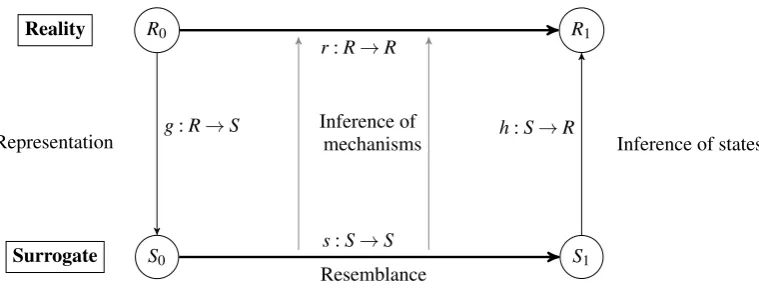
To this end,it is intuitive to interpret our meta-framework as the mapping process in
figure 2: The process of building a model as a representation of reality means to reduce the
complexity of the real world. The process of reducing the real world R to the model can
be described by a function g :R→S. For the state of the real world at time t0 (denoted
R0 in figure 2) it gives a corresponding model in state S0. The surrogate (or the model)
is always less complex than the real world. We therefore call g thecomplexity reduction
7
R0
S0
R1
S1
Reality
Surrogate
g:R→S
Representation h:S→R
Resemblance
s:S→S
Inference of states
r:R→R
[image:10.595.107.487.76.223.2]Inference of mechanisms
Figure 2: A development of Mäki’s MISS concept, where we interpret modeling as a mapping process (following Miller and Page (2007)) and distinguish between the inference of mechanisms and states.
function of the model. Note that S0 could consist, for example, of sentences, equations, or
algorithms, depending on the type of model. Note also that figure 2 captures a universal
feature of models: every model (or description if one wishes to avoid the term ‘model’)
necessarily reduces the complexity of the real world, simply because “any (discursive or
formal) theory must necessarily abstract or isolate” (G. Hodgson, 2006, p. 128).
The second aspect of a model is the resemblance aspect. It is related to the process of
model exploration. Model exploration is the activity of studying the behavior of a model.
To speak with figure 2, it means to study the transition function of the model, denoted by
s. This function transforms the state of the model at timet0, denoted byS0, to the state at
t1, denoted by S1. The general idea is to learn something by the model exploration about
the behavior of the real world, i.e. the transition function r that is, in its completeness,
too complicated to be understood directly. The process of model exploration may take the
form of solving a system of equations or conducting a Gedankenexperiment, depending on
the type of the model (i.e. formal or verbal).
Figure 2 nicely illustrates the different ways models are expected to generate knowledge
depending on whether one refers to instrumentalist or mechanism-based explanations: a
model that tries to provide mechanism-based explanations is built in a way such that the
world (r). This similarity can be assessed by comparing the intermediate outcomes of the
model with that of reality, by seeking the competence of domain experts, or by referring to
the results of other disciplines, e.g. psychology. As I will argue more extensively in section
4, this is also the reason why methods suitable for the study of mechanisms must allow for
a more flexible complexity reduction function: the form of representation constrains the
number of mechanisms that can be conjectured in the resulting model.
In contrast, a model that is mainly concerned with providing useful predictions does
not necessarily resemble the transition function function of reality in any sense but the
outcome it produces. Therefore, the flexibility of the complexity reduction function here
is less of an issue. In the extreme case, it employs some very abstract machine learning
algorithms that manipulate the state of the model such that it matches the state of the
real world in the future as closely as possible.
Besides putting different weight on the adequacy of the representation aspect of a model,
different epistemologies also require different concepts to distinguish among competing
explanation that provide equally good predictions.
2.2 How to discriminate among competing explanations
Suppose there are two models or procedures that perform equally well in predicting
the dynamics of the system under investigation. It is common to use Occam’s razor to
discriminate among them: if two procedures provide equally good predictions, the simpler
procedure should be preferred. Because of its reference to prediction, Occam’s razor is
particularly useful if one is working within an instrumentalist approach. It is less suitable
for discriminating among mechanism-based explanations. There are at least two reasons for
this: firstly, several mechanisms can have the same implications, a common phenomenon
referred to as equifinality. Secondly, determining the complexity (or the simplicity) of a
mechanism is often impossible given the fact that most measures for complexity that come
A viable alternative would be to use the ‘deepness’ of an explanation (Bunge, 1962)
as a discrimination device: one explanation can be said to be deeper than another if it
uses more detailed and plausible mechanisms to explain an observed fact. The following
example makes this distinction clear:
“Why does a rise inreal per-capita income lead to increased per capita expenditure on
consumption?” This is a central question if one wishes to understand the sustainability
of positive growth rates: if people would not increase their consumption, positive growth
rates are unlikely to exist in the long run. Let us consider two possible explanations
for this pattern: The first is a classical approach that assumes agents maximizing their
utility for a given preference relation which, among others, must obey the axiom of local
non-satiation. This assumption is necessary for the results of classical demand theory
to hold (Mas-Colell, Whinston, & Green, 1995). Starting from these assumptions there
is a number of studies that derive the empirically observed consumption patterns as an
equilibrium solution by assuming substitution effects due to the inferiority and superiority
of goods (e.g. Dixit and Stiglitz (1977), Wadman (2000)).
However, as Witt (2001) points out, the majority of the explanatory content of these
studies comes from the assumption of local non-satiation (Witt, 2001, p. 24). But where
does this assumption come from, despite being a ‘standard assumption of microeconomic
theory” (Mas-Colell et al., 1995)? As argued by Witt (2001, 2010), consumption always
serves the satisfaction of certain needs and wants. These needs and wants can be either
physiologically determined and thus homeostatic (e.g. the need to collect food and shelter),
or they can be non-physiological and non-homeostatic (e.g. the want for group conformity
or status seeking). Witt proposes an explanation on the grounds of hiscontinuity hypotheses
according to which the origins of preferences are to be explained by evolutionary theory. He
refers to the limited cognitive resources of human beings and the need for social cognitive
learning which is then the vantage point for the social construction of symbolic commodity
characteristics. Because of these symbolic properties, which are the results of a social
social status. As a consequence, the demand for these (often rather expensive) goods
rises.8
Of course, the first type of model is much simpler than the second one, and both
reach the same result. But the model by Witt (2001, 2010) considers the mechanisms
underlying the formation of the preference structure. In the classical case they are simply
assumed. Witt’s model therefore ultimately leads to a ‘deeper’ explanation of the changing
consumption in times of economic growth.9
Using Occam’s razor as an alternative discrimination device would be less clear: since
the first type of model is ‘simpler’ and both approaches come to the same conclusions, one
may be tempted to use Occam’s razor to support the first one. Defenders of Occam’s razor
could then argue that the second theory explains the observed facts better than the first
one, but then they would lack a concept giving substance to this judgement (i.e. to make
clear what ‘better’ does mean in this context). As the concept of deep explanations is not
useful in the context of an instrumentalist epistemology, Occam’s razor is rather useless
in the context of a realist epistemology. This again represents an important practical
implication of the choice among epistemologies.
The next section applies the concepts described above and shows that the dominant
epistemology in economics has actually changed during the last decades.
3 Mechanism-based and instrumentalist explanation in
development economics
The shift between instrumental and mechanism-based explanations and their relation to
economic methodology can be nicely illustrated by focusing on the field of development
economics after WWII.
8
This is a very reduced form of the overall argument. Refer to Witt (2001) and Witt (2010) for a fuller description.
9
3.1 From realism to instrumentalism...
An important starting point for economic theory in the post-WWII period was Haavelmo’s
seminal contribution on the “Probability Approach in Econometrics” (Haavelmo, 1944). It
can be considered the vantage point for the research program of the Cowles Commission
that was dominant in the post-war period until the late 1980s. According to the exponents
of the Cowles Commission, there are causal mechanisms operating in the real world, and
quantitative, econometric techniques should be used to identify these mechanisms. This
requires several a priori restrictions before analyzing the data. These restrictions (e.g.
about the functional forms and the closure of the model) must come from economic theory
(Moneta, 2005). This means that the primary interest of the Cowles Commission program
was to identify (and quantify) social mechanisms.
This approach later was criticized for the underlying theory, most famously through
the Lucas Critique (1976) according to which macroeconomic models used by the Cowles
Commission neglect the rationality and adaptability of economic agents at the micro
level. Lucas and others argued for the use of quantitative models built upon the rational
expectations hypothesis. This would guarantee that agents respond to policies in an
optimal way. But as nicely shown by Moneta (2005), there was no disagreement between
the adherents of the Cowles Commission and adherents of the rational expectations
re-search program that economic (causal) mechanisms should be the final subject of economic
research. It might therefore be fair to say that Lucas and his colleagues were demanding a
particular form of theoretical underpinnings for empirical work (or, speaking with figure
2: a particular complexity reduction function): the theory should be microfounded and
based on the rational expectations hypothesis. Or, put differently, their concern was more
of a methodological, rather than epistemological kind.
Two important streams of research marked a departure from this strategy. One on the
macroeconomic, the other on the microeconomic level. Firstly, the macroeconomic research
that restrictions based on economic theory - including the rational expectations hypothesis
- often seem to be arbitrary and not guided by empirical data. Adherents to this program
therefore tried to do their research with at least a priori theory as possible. Consequently,
their reference to concrete mechanisms was marginal. On the methodological side, they
preferred estimating unrestricted reduced form equations and using nonparametric
ap-proaches over the analysis of structural equations and parametric estimation techniques.
The underlying epistemological shift was a movement away from mechanism-based
to-wards instrumental, and prediction oriented explanations. Or, speaking with figure 2, the
ultimate goal of research was not to infer the mechanisms operating the real world (i.e. to
study the relation between functions s andr), but ‘merely’ to infer future states of reality
(i.e. working out the relationship s◦h).
Secondly, on the microeconomic level, the methodological movement towards randomized
controlled experiments (RCT) from the 1990s was motivated by a similar scepticism and a
change in the underlying epistemology: According to Deaton (2010), economists stopped
believing that economic theory could provide a reasonable base for program evaluation.
Rather than from economic theory, the explanatory power should come from elaborated
randomization procedures that then allow the application of standard econometric
tech-niques to identify the effect of the policy program.10
According to Pawson and Tilley
(1997), who assessed the success of RCTs outside economics, the RCT-way of program
evaluation focuses on whether a program has worked or not - without explicitly tackling
the question of why it worked or not. The latter would require a theory of the underlying
mechanisms - and this recourse to theory is exactly what many of the proponents of RCT
wanted to avoid (Deaton, 2010).
In both cases, the underlying shift in the epistemological orientation of the researchers
went hand in hand with important methodological changes: a shift to reduced form
equations in macroeconometrics, and a shift towards RCT in microeconometrics.
10
3.2 ...back to realism?
This epistemological shift away from mechanism-based explanations is now beginning to
be criticized:
For example, both Deaton (2010) and Grüne-Yanoff (2016) stress that without a direct
consideration of economic mechanisms, results from empirical studies can hardly be
generalized. Deaton shows that without identifying the particular mechanisms that were
the causes for the success or failure of the project it is not clear whether the project can
be expected to be successful in another instance. Successful intervention always requires
knowledge of the underlying mechanisms (Schelling, 2005; Deaton, 2010; Rodrik et al.,
2004; Hallak & Levinsohn, 2004; Grüne-Yanoff, 2016): Deaton (2010) uses the example
of a poverty reduction program using conditional cash transfers that has been found
successful in Mexico. Without knowing why and how the program has worked, however,
it is impossible to say whether it would also be successful in, say, Kenia: the different
cultural and institutional framework in Kenia may affect the mechanisms that have led to
the success in Mexico in such a way that the project looses its positive effect. To make a
reasonable prediction one must study the interaction effects among different mechanisms
and the economic environment - and this requires mechanisms to be considered explicitly
in both theory and practice (Deaton, 2010).11
Also, the literature on the relationship between economic growth and trade focused
on determining the correlation between various trade policies and economic growth and
it is not clear how and through which channels international trade affects economic
development (Hallak & Levinsohn, 2004). This makes it very difficult to develop adequate
trade policy. Rodrik et al. (2004) also stress that policy makers regularly operate in
second-best environments. Therefore they must adjust their measures to the institutional
setting they are operating in - and that this adjustment process requires knowledge of the
(macro- and microeconomic) mechanisms at stake.
An ultimate argument in favour of mechanism-based explanations is that only a reference
to concrete mechanisms provides us with more means to judge the plausibility of an
11
explanation: Hedström and Swedberg (2005) exemplify this with the empirical result
that exposure to electromagnetic fields increases the frequency of childhood leukemia.
Without the provision of a plausible (in this case bio-physical) mechanism explaining this
relationship it remains impossible to say whether it is a causal relationship or an omitted
variable that has caused this result.
If one accepts these epistemological arguments in favor of mechanism-based explanations,
one must ask whether particular methodological changes must accompany this shift.
4 Methodological implications of mechanism-based explanations
One of the key objectives of this paper is to emphasize that research methods and
episte-mologies must fit each other. Not all methods are compatible with every epistemological
approach (Gräbner, 2015). If one is interested in identifying particular social mechanisms
one should not rely too much on machine learning algorithms which may do an excellent job
for providing good predictions. On the other hand, models that seem to capture important
mechanisms of the real world but potentially showing chaotic behavior are not well suited
to provide (point) predictions. It is thus unlikely that research methods developed in an
instrumentalist environment can be successful in identifying social mechanisms. What
does that imply for development economists if we follow the arguments of section 3.2
and assume that a shift back to more mechanism-based explanations is adequate? The
meta-theoretical framework from section 2.1 suggests at least two criteria for successful
modeling techniques when it comes to the conjecturing of social mechanisms:
The first property concerns its ability to formalize flexible assumptions. Otherwise, it is
not possible to conjecturing more complex (and interesting) social mechanisms. The reason
for this can be derived directly from figure 2: Successfully isolating a mechanism in a model
means to establish a similarity between the transition function in the model (s) and the
transition function of reality (r). Establishing such a similarity requires a certain degree of
accuracy in the representation process. For example, for a modeling approach that is built
excluded from consideration: all mechanisms involving true uncertainty (e.g. heuristic
formation) or those based on the structured interaction of heterogeneous agents cannot be
implemented directly in such models. One may be able to replicate the consequences of
these mechanisms. But this would not be a mechanism-based explanation any more.
A second feature that is helpful for generating mechanism-based explanations is that of
modularity. This means that it should be possible to extend the complexity of a model
gradually to include additional mechanisms without changing the overall functioning of
the model. Neoclassical economists usually try to follow this demand by relying on a
small number of core models that they extend to match other more specific situations.12
This makes it easier to understand where the reasons for different modelling outcomes
come from: one implements a model with and without the mechanism under consideration
and compares the outcome of the two models. If the rest of the model remains the same
(which is the definition of modularity), one has successfully isolated the effect of this
additional mechanism. This is particularly important if one is interested in what we
termed deep explanations above: starting with a highly complex model from scratch often
causes confusion about the functioning of the model. Instead, one should start with a
simple model as possible and add more mechanisms sequentially. Of course, understanding
the effect of a mechanism in a model is different to identify causal mechanisms in reality.
Inferring from the behaviour of a formal model to the functioning of the real world involves
a process of interpretation and reflection, otherwise one would conflate epistemology with
ontology. However, understanding better the necessary and sufficient conditions for an
outcome to occur in the model can help tremendously in reasoning about reality. Better
understanding reality or to make policy decisions is ultimately a matter of judgement to
choose among and relate different causal structures suggested by different models to each
other (Dow, 2004).
How can economists react to the demands of mechanism-based explanation? Two
12
main strategies can be distinguished and both are currently pursued in the economics
community:
The first, more conservative, methodological reaction could be a renewed focus on
models with rational expectations and a close relation between empirical research and
economic theory. On the macroeconomic level, this is the strategy associated with the
New Keynesian paradigm and their DSGE models. On the microeconomic level, Modern
Behavioral Economics that tries to identify deviations from rational behavior and alter the
utility functions of agents to capture these deviations come to mind.13
Such a strategy has
both advantages and disadvantages: on the one hand it bears the danger of not adequately
considering the criticism that ultimately led to the departure towards more instrumentalist
methods: Sims and other economists tried to minimize the impact of economic theory
because they were not satisfied with it (Deaton, 2010). Adherents of the New Keynesian
approach and modern behavioral economists need to take this criticism seriously. On
the other hand, a new focus on rational expectation modeling would help to preserve
previously obtained knowledge and to relate the new work with existing results. Also,
economists are usually well trained in rational expectation modelling so a reorientation
would not require much additional training.
A second, more innovative but risky methodological reaction would be the attempt to
broaden the theoretical and empirical toolbox of economics and to consider the use of
new research methods that meet the demands for mechanism-based explanations, but
also consider the criticism of earlier approaches. Classical behavioural economics and
complexity economics are two examples for research communities that currently pursue
this strategy. Both approaches have departed significantly from mainstream economic
theory. In particular, they try to avoid using utility maximizing rational agents as their
fundamental entity and seek to use closure strategies that are more general than the
classical equilibrium. Again, such an approach has advantages and disadvantages: on the
13
one hand it bears the danger of inter-paradigmatic losses, makes it difficult to relate to
existing models, and requires economists to learn methods that are not yet part of most
graduate programs. On the other hand, such an approach would allow the consideration
of very different assumptions and would facilitate the direct investigation of the economic
implications of many social and cognitive mechanisms that cannot be captured in the
conventional maximization-cum-equilibrium approach.
In the following we will discuss the two movements in more detail.
4.1 The New Keynesian way: a close integration of theory and empirics
DSGE models were developed as a response to the Lucas critique that criticized Keynesian
macroeconometric models for ignoring individual rationality and for having proposed
policy measures that have led to the period of stagflation in the 60s and 70s. The response
of Lucas and other economists was the concept of rational expectations. The resulting real
business cycle (RBC) models built upon rational agents optimizing over time, thus forming
expectations consistent with the model. Today’s state of the art are New Keynesian
DSGE models that address the shortcomings of the RBC literature by including market
frictions and financial markets. They are well-grounded in neoclassical microeconomics
and effectively bring together theoretical and empirical economists: the literature on how
to calibrate and estimate DSGE models is huge. But while new estimation techniques are
developed frequently and by different statistical paradigms (in particular both frequentist
and Bayesian approaches), unfortunately, there are still some severe problems with the
way DSGE models are usually confronted with empirical data (Fagiolo & Roventini, 2012).
Also, while proponents of the New Keynesian paradigm refer to the effort undertaken
to add new mechanisms to DSGE models (e.g. by introducing a moderate level of agent
heterogeneity (Massaro, 2013)), critiques argue that the technical design of DSGE models
poses strict limits to the mechanisms considered in these models (e.g. Leijonhufvud
(2014)).14
14
In the end, the New Keynesian approach in macroeconomics seems to be what Kuhn
(1962) considered the repair of an established research paradigm: New Keynesian economists
try to expand their theory with a small, but accepted set of methods within the well-known
optimization-cum-equilibrium approach. While they constantly work on relaxing particular
assumptions and on integrating new mechanisms into their models, other mechanisms
will ever remain outside their reach. Interestingly, they justify this by a peculiar mixture
between instrumentalist and realist epistemology: adding mechanisms to DSGE models is
usually considered positive (which is a realist argument), but the fact that some mechanisms
are just outside the reach of their modelling frameworks is not considered a bad thing, as
long as the models serve their purpose (which is an instrumentalist argument).
4.2 The Complexity approach: rethinking economics from the bottom up
In contrast to the DSGE research community (that consists mainly of genuine economists),
the complexity approach to economics is an interdisciplinary movement. Many of the
researchers have a background in the natural or computer sciences. This indicates why
the willingness of complexity scholars to give up established economic concepts is much
higher than of New Keynesian economists. What holds the heterogeneous complexity
community together is the (ontological) believe that the economy is a complex adaptive
system. And while the methodological toolkit of complexity economists is very diverse, a
significant number of researchers use agent-based computational models (ABM) to study
the economy.
The idea of ABM is to express the fundamental economic entities (in particular economic
agents) as software objects, to specify their relations among each other and with their
artificial environment, and then to conduct computational experiments to derive the
systemic implications of this initial configuration.
Because ABMs are solved numerically they do not necessarily rely on the concept of
economic equilibrium. Indeed, one of the major motivations for using ABM is the wish
ABM concern their ability to study the mutual dependencies of different ontological levels
(Gräbner & Kapeller, 2015) or to directly represent the decision making of boundedly
rational agents (Tesfatsion, 2006). This flexibility represents a huge potential for studying
the economy from a realist perspective, and to develop mechanism-based explanations for
economic phenomena that could not be developed in a general equilibrium model. 15
But the flexibility of ABM may also considered a major weakness of these models. To
use the example of human decision making: since there is only one way to be rational,
but infinitely many ways to be boundedly rational (Gigerenzer, 2016), one needs very
good reasons for the specification of an ABM.16
In other words, while some consider
the optimization-cum-equilibrium approach in orthodox economics to be a ‘straitjacket’
(Farmer, 2013, p. 383), others may consider it a useful ‘disciplining device’.
In any case, model verification and validation must play a key role in the ABM approach.
As for DSGE modelling, the literature on empirical estimation and calibration is growing
tremendously (Fagiolo, Moneta, & Windrum, 2007; Brenner & Werker, 2007; Guerini &
Moneta, 2016). In contrast to DSGE models, ABM can be calibrated not only on the macro
level, but also on the micro level, in particular with respect to the agent behaviour and
other intermediate results.17
Again, this both represents a strength that, if not sufficient
in-formation is available, can turn into a weakness if the model specification becomes arbitrary.
4.3 Discussion
The central claim of this paper has been that methods must fit epistemologies and that there
are good reasons to change the underlying epistemology in development economics towards
a focus on mechanism-based explanations. Consequently, some change in the methodology
15
But it does not mean that using ABM automatically represents a departure of an instrumenalitst epistemology, let alone a more radical departure than DSGE models. As a flexible tool, it is compatible with a wide range of epistemological orientations others than those of complexity economics.
16
On the other hand, this unambiguity of rationality might itself be an illusion. As Gigerenzer (2016) makes clear, the statement that there is only one way to be rational holds only in situations of risk -as soon -as there is uncertainty, there is no ‘best’ way of making a decision, yet alone to optimize one’s utility, any more, and the consideration of different heuristics becomes inevitable.
17
of economics must also take. How do two of the most prominent methodological reactions
fit to a re-focusing on mechanism-based explanations? Complexity economics and ABM
certainly represent a potentially more radical shift towards mechanism-based explanations
than the New Keynesian approach.
As mentioned above, mechanisms are to be understood as “sequences of states within a
given system” (Bunge, 2004), and a mechanism-based ‘explanation’ therefore means the
conjecturing of such a sequence.
For particular mechanisms to be conjectured, the representation of a model must be
sufficiently adequate. For example, if a particular method – such as DSGE modeling – does
not allow one to express true uncertainty, then all mechanisms for which true uncertainty
is important cannot be conjectured by such a method. Mechanisms involving the social
learning of ecologically rational heuristics that allow agents to make decisions within a
context of true uncertainty, for example, could not be conjectured using DSGE models.
For the purist advocate of mechanism-based explanations this is a serious drawback of
this method. She would either reject the use of such a method entirely, or at least call for
methodological pluralism such that this kind of situation can be analysed with different
methods. For a less purist advocate of mechanismic explanation, or even an instrumentalist,
this inability of the method is not per se a problem – only if the effect of true uncertainty
could not be replicated by the particular method she would started to be worried.
Thus, the potential flexibility of the complexity reduction function in ABM translates
into greater potential for conjecturing mechanisms – a clear advantage of this method.
One might argue, however, that because of their analytical core, DSGE models are better
off when it comes to the verification of a mechanism within the model. To address this
issue in the ABM approach, greater transparency, better verification methods and a closer
collaboration between empirical and theoretical work is needed. One way to achieve the
latter point lies in the concept of evidential pluralism, as suggested by Moneta and Russo
(2014): within such an approach, ABM can capture themechanisticknowledge demanded by
the authors, while the entire explanation also makes use of sufficient statistical knowledge
pluralism’ is certainly an important subject for future research.
5 Summary and outlook
Epistemological reasoning is an important part of economic research. This fact is not yet
adequately reflected in the typical structure of economic research papers which usually do
not discuss epistemological issues explicitly. Given the important practical implications of
epistemological orientations, this is a very unfortunate state of affairs.
To illustrate this practical relevance of epistemology we have looked at significant changes
of the epistemological orientation in development economics in the recent past. The changes
from realism to instrumentalism and back that have taken place created the need for
methodological innovations since different epistemologies fit to different methodologies.
Given the current tendency towards mechanism-based explanations, we have discussed
two different methodological reactions that could accompany this epistemological shift, at
least for macroeconomics: on the one side, New Keynesian economists argue for the use of
more sophisticated DSGE models, while many complexity economists favour the use of
agent-based models.
Both approaches represent a movement towards a more realist assessment of the economy,
but they differ in the extent of this movement: The New Keynesian approach remains
much more in the realm of neoclassical economics than the complexity approach.
As in this case, where members of the respective research community are very critical of
the methods used by the others, we believe that many methodological debates in economics
are at the core about epistemology: researchers prefer different methods because they
differ in they way they compare the quality of theories and in their strategy to make their
models meaningful.
Therefore, a more explicit epistemological debate could advance many of the deadlocked
dialogues among competing research communities. Such a dialogue could also help
identi-fying differences in ideology that may also explain the difficult relationship among various
debate and their influence could - hopefully - be reduced. 18
Beyond this clarification the paper highlighted a number of meta-theoretical concepts that
are useful for economic theorizing: we explained why an excessive focus on Occam’s razor as
a mean to discriminate between competing explanations can be misleading if mechanismic
explanations are sought for. Economists that aim for mechanismic explanations, and there
seem to be ever more of them, should rather strive for deep explanations.
Furthermore, a more open and critical assessment of the methodological toolkit available
to economists is desirable. Contrary claims that, for example, proclaim the end of
methodological debate in macroeconomics and see the New Keynesian way of modeling as
only viable way of doing macroeconomics (e.g. Goodfriend (2007)), are not helpful for
the progress of economics. This relates to another, more abstract, implication of taking
epistemological debates seriously: tolerance for different research approaches in economics
is very important. Since disputes about epistemological orientations usually cannot be
finally resolved within a reasonable timespan, and the example of development economics
discussed above showed that there is often a back and forth between different dominant
epistemologies, different epistemological orientations and their methodological implications
should be tolerated within the profession (see also Dobusch and Kapeller (2012)).
Our elaborations above indicated that there is not only no ‘one correct model’, but
probably not ‘one correct epistemology’. Rather, a pluralism of different epistemological
(and consequently methodological) approaches must be not only tolerated but actively
supported. For such a pluralism to be productive, however, it is important that
epistemo-logical considerations are made more explicitly such that a productive exchange among
the different approaches becomes feasible. Otherwise, an unproductive pluralism of many
different, isolated communities, all with their own accepted set of models and unable to
understand what is going on in other communities, will be the inevitable result.
18
It is the important task of economic methodologists to support a productive pluralism
by identifying the different epistemologies and to relate different research approaches to
each other (see already Elsner (1986)). Arguments against such a productive pluralism,
such the statement of Goodfriend (2007), not only increase the danger of theoretical and
methodological lock-ins - they also make the economics profession less innovative, and
in the end less successful in explaining reality - regardless of how ‘explanation’ is to be
References
Barabasi, A. & Albert, R. (1999). Emergence of scaling in random networks. Science, 286,
509–512.
Blume, L. E. & Durlauf, S. N. (2006). Introduction. In L. E. Blume & S. N. Durlauf
(Eds.), The economy as an evolving complex system, iii: current perspectives and
future directions (Chap. 1, pp. 1–4). Oxford University Press.
Boland, L. A. (1979). A critique of friedman’s critics. Journal of Economic Literature,
17(2), 503–522.
Boland, L. A. (2010, November). The methodology of positive economics: reflections on
the milton friedman legacy, uskali mäki, editor. cambridge university press, 2009.
xvii + 363 pages.Economics and Philosophy,26(3), 376–382.
Brenner, T. & Werker, C. (2007). A taxonomy of inference in simulation models.
Compu-tational Economics, 30(3), 227–244.
Bunge, M. (1962). The complexity of simplicity. The Journal of Philosophy,59(5), 113–135.
Bunge, M. (2004). How does it work? The search for explanatory mechanisms. Philosophy
of the Social Sciences, 34(2), 182–210.
Clauset, A., Moore, C., & Newman, M. (2008, May). Hierarchical structure and the
prediction of missing links in networks. Nature, 453(7191), 98–101.
Colander, D., Howitt, P., Kirman, A., Leijonhufvud, A., & Mehrling, P. (2008). Beyond
dsge models: toward an empirically based macroeconomics. American Economic
Review, 98(2), 236–40. doi:10.1257/aer.98.2.236
Deaton, A. (2010). Instruments, randomization, and learning about development. Journal
of Economic Literature, 48(2), 424–55. doi:10.1257/jel.48.2.424
Dixit, A. K. & Stiglitz, J. E. (1977, June). Monopolistic competition and optimum product
diversity. The American Economic Review, 67(3), 297–308.
Dobusch, L. & Kapeller, J. (2012). Heterodox united vs. mainstream city? sketching a
framework for interested pluralism in economics. Journal of Economic Issues,46(4),
Dow, S. C. (2004, September). Strucutred pluralism. Journal of Economic Methodology,
11(3), 275–290.
Elsner, W. (1986). Ökonomische institutionenanalyse - paradigmatische entwicklung der
ökonomischen theorie und der sinn eines rückgriffs auf die ökonomische klassik am
beispiel der institutionenanalyse („property rights“). Berlin, DE: Duncker & Humblot.
Fagiolo, G., Moneta, A., & Windrum, P. (2007). A critical guide to empirical validation of
agent-based models in economics: methodologies, procedures, and open problems.
Computational Economics,30, 195–226.
Fagiolo, G. & Roventini, A. (2012, June). On the scientific status of economic policy: a
tale of alternative paradigms. The Knowledge Engineering Review, 27(2), 163–185.
Farmer, J. D. (2013). Hypotheses non fingo: problems with the scientific method in
economics. Journal of Economic Methodology, 20(4), 377–385.
Friedman, M. (1953). The methodology of positive economics. In Essays in positive
economics (pp. 3–46). Chicago, IL, University of Chicago Press.
Giere, R. (1988). Explaining science. Chicago, IL: University of Chicago Press.
Gigerenzer, G. (2016). Rationality without optimization: bounded rationality. In L. Macchi,
M. Bagassi, & R. Viale (Eds.), Cognitive unconscious and human rationality (pp. 3–
22). Combridge, MA: The MIT Press.
Gilboa, I., Postlewaite, A., Samuelson, L., & Schmeidler, D. (2014). Economic models as
analogies. The Economic Journal, Accepted manuscript.
Goodfriend, M. (2007, Fall). How the world achieved consensus on monetary policy.Journal
of Economic Perspectives,21(4), 47–68.
Gräbner, C. (2015). Formal Approaches to Socio Economic Policy Analysis - Past and
Perspectives. Forum for Social Economics. doi:10.1080/07360932.2015.1042491
Gräbner, C. & Kapeller, J. (2015). New perspectives on institutionalist pattern modelling:
systemism, complexity and agent-based modelling. Journal of Economic Issues,
49(2), 433–440. doi:10.1080/07360932.2015.1042491
Grüne-Yanoff, T. (2016, November). Why behavioural policy needs mechanistic evidence.
Guerini, M. & Moneta, A. (2016). A method for agent-based models validation. LEM
Working Paper Series,2016/16.
Haavelmo, T. (1944). The probability approach in econometrics. Econometrica,12, iii–vi,
1–115.
Hallak, J. C. & Levinsohn, J. (2004). Fooling ourselves: evaluating the globalization and
growth debate. NBER Working Paper 10244.
Hayden, F. G. (2006).Policymaking for a Good Society: The Social Fabric Matrix Approach
to Policy Analysis and Program Evaluation. New York: Springer.
Hedström, P. & Swedberg, R. (2005). Social mechanisms: an introductory essay. In P.
Hedström & R. Swedberg (Eds.),Social mechanisms. an analytical approach to social
theory (pp. 1–31). Combridge, UK et al.: Cambridge University Press.
Hodgson, G. M. (2015). Conceptualizing capitalism. institutions, evolution, future. Chicago:
University of Chicago Press.
Hodgson, G. (2006). Economics in the shadows of darwin and marx. Cheltenham, UK,
Northampton, MA, USA: Edward Elgar.
Kao, Y.-F. & Velupillai, K. V. (2015). Behavioural economics: classical and modern. The
European Journal of the History of Economic Thought, 22(2), 236–271.
Kuhn, T. (1962). The structure of scientific revolutions. Chicago, IL: University of Chicago
Press.
Leijonhufvud, A. (2014). Economics of the crisis and the crisis of economics.The European
Journal of the History of Economic Thought, 21(5), 760–774.
Lucas, R. J. (1976, January). Econometric policy evaluation: a critique.Carnegie-Rochester
Conference Series on Public Policy. 1(1), 19–46.
Mäki, U. (2009a). Missing the world. models as isolations and credible surrogate systems.
Erkenntnis,70(1), 29–43.
Mäki, U. (Ed.). (2009b). The methodology of positive economics: reflections on the milton
friedman legacy. Cambridge, UK: Cambridge University Press.
Mas-Colell, A., Whinston, M. D., & Green, J. R. (1995). Microeconomic theory. Oxford:
Massaro, D. (2013). Heterogeneous expectations in monetary {dsge} models. Journal of
Economic Dynamics and Control, 37(3), 680–692.
Miller, J. H. & Page, S. E. (2007). Complex adaptive systems. an introduction to
computa-tional models of social life. Princeton: Princeton University Press.
Moneta, A. (2005). Some Peculiarities of the Concept of Casuality in Macroeconometrics.
History of Economic Ideas, 13(3), 57–82.
Moneta, A. & Russo, F. (2014). Causal models and evidential pluralism in econometrics.
Journal of Economic Methodology,21(1), 54–76.
Pawson, R. & Tilley, N. (1997). Realistic evaluation. London, UK, SAGE Publications.
Reiss, J. (2012). Idealization and the aims of economics: three cheers for instrumentalism.
Economics and Philosophy,28(3), 363–383.
Rodrik, D., Subramanian, A., & Trebbi, F. (2004). Institutions rule: the primacy of
institutions over geography and integration in economic development. Journal of
Economic Growth,9, 131–165.
Schelling, T. C. (2005). Social mechanisms and social dynamics. In P. Hedström & R.
Swedberg (Eds.), Social mechanisms. an analytical approach to social theory (pp. 32–
44). Combridge, UK et al.: Cambridge University Press.
Simon, H. A. (1981). The sciences of the artificial. Cambridge, Massachusetts: The MIT
Press.
Sims, C. A. (1980). Macroeconomics and reality. Econometrica, 48(1), 1–48.
Spiegler, R. (2011). ‘Bun can’t we get the same thing with a standard model?’ Rationalizing
bounded-rationality models. Economics and Philosophy, 27(1), 23–43.
Steup, M. (2014). Epistemology. In E. N. Zalta (Ed.), The stanford encyclopedia of
philosophy (Spring 2014).
Sugden, R. (2000). Credible worlds: the status of theoretical models in economics. Journal
of Economic Methodology, 7(1), 1–31.
Tesfatsion, L. (2006). Agent-based computational economics: a constructive approach to
economics (Chap. 16, Vol. 2, pp. 831–880). Handbook of Computational Economics.
Elsevier.
Wadman, W. (2000).Variable quality in consumer theory: toward a dynamic microeconomic
theory of the consumer. Armonk, NY, M.E. Sharpe.
Witt, U. (2001). Learning to consume - a theory of wants and the growth of demand.
Journal of Evolutionary Economics, 11(1), 23–36.
Witt, U. (2010). Symbolic consumption and the social construction of product