warwick.ac.uk/lib-publications
Original citation:
Sinha, Anubhav, Vendra, C. Madhav Rao and Wen, Jennifer X. (2017) Evaluation of
engineering models for vented lean hydrogen deflagrations. In: International Colloquium on the Dynamics of Explosions and Reactive Systems (ICDERS), Boston, USA, 30 Jul - 4 Aug 2017
Permanent WRAP URL:
http://wrap.warwick.ac.uk/97150
Copyright and reuse:
The Warwick Research Archive Portal (WRAP) makes this work by researchers of the University of Warwick available open access under the following conditions. Copyright © and all moral rights to the version of the paper presented here belong to the individual author(s) and/or other copyright owners. To the extent reasonable and practicable the material made available in WRAP has been checked for eligibility before being made available.
Copies of full items can be used for personal research or study, educational, or not-for-profit purposes without prior permission or charge. Provided that the authors, title and full
bibliographic details are credited, a hyperlink and/or URL is given for the original metadata page and the content is not changed in any way.
A note on versions:
The version presented here may differ from the published version or, version of record, if you wish to cite this item you are advised to consult the publisher’s version. Please see the ‘permanent WRAP URL’ above for details on accessing the published version and note that access may require a subscription.
Evaluation of Engineering Models for Vented Lean
Hydrogen Deflagrations
Anubhav Sinha, Vendra C. Madhav Rao and Jennifer X. Wen*
Warwick FIRE, School of Engineering, University of Warwick, Coventry CV4 7AL, UK
Introduction
Hydrogen gas produced from the renewable energy source can be the prefect future energy carrier. It will not only reduce the demands for depleting hydrocarbons fuels but will also help in reducing the greenhouse gas emissions. The 20-ft ISO standard containers are widely considered for building self-contained portable fuel cell based power generation units. Safety analysis of these installations is essential to prevent any future catastrophic accidents. The present paper evaluates existing engineering models to predict vented explosion peak overpressures in case of an accident release of hydrogen in these container. Such predictions are required in the design of venting panels, which are commonly used to prevent damage to enclosures by reducing overpressure of combusting gases.
Although various engineering models and empirical correlations have been developed, a number of which have been included in engineering standards and guidelines [4-7]. These correlations, however, often have conflicting recommendations [3]. None of the engineering models in the public domain have been validated with vented hydrogen tests data in realistic configurations, such as ISO shipping containers, used in hydrogen energy applications. Evaluating/improving these engineering models with the aid of full scale experimental data and computational fluid dynamics (CFD) based numerical modelling is a main objective of the HySEA project supported by the Fuel Cells and Hydrogen 2 Joint Undertaking (FCH 2 JU) under the Horizon 2020 Framework Program for Research and Innovation.
The present study aims to assess capabilities of existing engineering models for vented deflagrations of lean hydrogen-air mixtures. As hydrogen has much higher flame speeds than hydrocarbon fuels like methane and propane, it is not possible to use models derived for hydrocarbons directly with hydrogen flames. The leaner flames of hydrogen are also susceptible to instabilities like Darius-Landau instability, Rayleigh-Taylor instability, which are often overlooked in the derivation of engineering models.
In this study, four engineering models are evaluated by comparing their predictive capability with experimental results. The models considered include NFPA-68 [4], EN-14994 [5], Bauwens et al. [6] and Molkov and Bragin [7]. The models predictions are compared with the available experimental data from Bauwens et al. [6], Kumar [2,8] and Daubech et al. [1] as well as fresh data for standard 20 feet ISO shipping containers carried out by GexCon AS [10] as part of the HySEA project. These containers are expected to be widely used for self-contained portable hydrogen fuel cell power units.
Anubhav Sinha Engineering Models for Vented Lean Hydrogen
26th ICDERS – July 30th - August 4th, 2017 – Boston, MA 2
Model evaluations
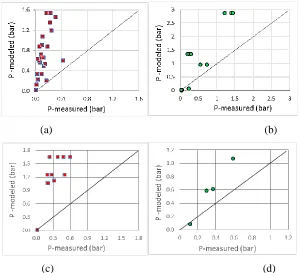
NFPA-68 - The National Fire Protection Association’s (NFPA) standard on Explosion protection by deflagration venting (2013) model [4] considers mixture composition, dimensions of the enclosure and vent area. The predicted and measured data points for Bauwens et al. [6] and Daubech et al. [1], Kumar [2], and Kumar [8] cases are shown in Figure 1.
(a) (b)
[image:3.612.171.470.170.443.2](c) (d)
Figure 1. Comparison of the measured and calculated values of overpressure for (a) Bauwens et al. [6] and (b) Daubech et al. [1], (c) Kumar [8], and (d) Kumar [2] cases using NFPA-68 [4].
As evident from the above plots, the NFPA model is consistently predicting higher values of overpressure as compared to the measurements. The enclosure based on this design will be capable to withstand higher overpressures than required, but it will also result in over-design and higher cost.
EN-14994 -
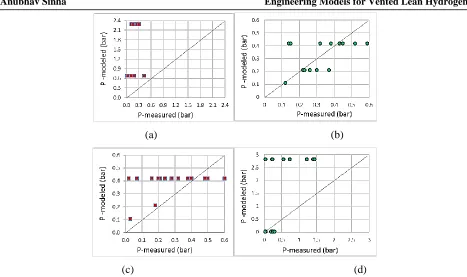
The EN-14994 model is divided into two formulations, one for a compact enclosure (withL/D≤2) and the other for elongated enclosure (with L/D>2). The data sets used in the present study comprises of both types of enclosures. The gas explosion constant ‘KG’ is taken as 550 bar. From Figure
2, clustering of data points along horizontal axis is observed. This is due to the fact that for the same fuel and same enclosure geometry, the EN-14994 formulation considers dependence only on the vent area. Hence the clusters are different data point having the same vent area, and hence calculated to have the same overpressure value by the model. Also, the pressure is over-predicted for most data points except very few instances. It must be noted that various physical properties may vary, even for the same fuel and same geometry, for example, with the change in equivalence ratio or change in ignition point. So the model should be able to incorporate these variations in order to give accurate predictions.
Bauwens et al. [6] model -
T
his is a comprehensive model taking into account several physical(a) (b)
[image:4.612.85.552.84.361.2](c) (d)
Figure 2. Comparison of the measured and calculated overpressure for (a) Bauwens et al. [6],(b) Kumar [2], (c) Kumar [8] and (d) Daubech et al. [1] cases using the EN-14994 [5] formulation.
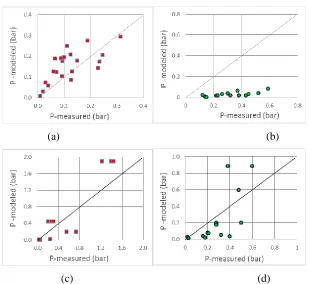
severely under-predicted by this model. For Kumar’s experiments [2, 8] before ignition, fans were used to enhance the initial turbulence levels, which is not accounted for in this model. Moreover, this model uses various parameters including flame-speed, which might be difficult to obtain accurately for very lean mixtures of hydrogen. The model constants kT and ΞA have been used with the recommended values given
by Bauwens et al. [6] for data from Daubech et al. [1] while for other experiments, modified constants, as per recommendations of Jallais, S., & Kudriakov [3] are used (kT = 10.78m -1, and ΞA = 3.17). The first
pressure peak P1 predicted by this model is used in this study. Another aspect to consider for a robust model formulation is to specify the way in which the model parameters are calculated. Different approaches to calculate physical properties can result in discrepancy.
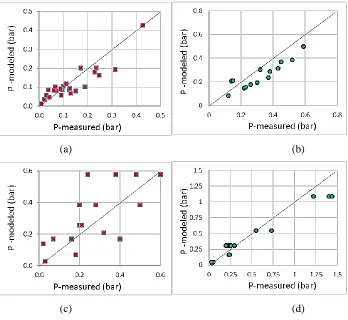
Molkov and Bragin model [7] - This model is based on the dependence of deflagration overpressure on turbulence Bradley number. The model uses several parameters like flame wrinkling, initial turbulence, flame surface area, laminar flame speed, etc. to calculate overpressure. Figure 4 shows that the model predicts reasonably well most data sets considered. The pressure values are, however, slightly under-predicted in general. The formulation used here is the best fit form proposed by the authors. For conservative estimates, the conservative form of the proposed formulation can be used. It gives the pressure prediction as 2.6 times the prediction of the best fit model shown here. It is also noted that the predicted values match well the data of Kumar [2] and produces a lot of scatter with another set of Kumar’s experiments in the same configuration [8].
Anubhav Sinha Engineering Models for Vented Lean Hydrogen
26th ICDERS – July 30th - August 4th, 2017 – Boston, MA 4 (a) (b)
[image:5.612.166.476.110.394.2](c) (d)
Figure 3. Comparison of the measured and calculated values of overpressure for (a) Bauwens et al. [6] , (b) Kumar [2] , (c) (d) Daubech et al. [1] , and (d) Kumar [8] cases using the model of Bauwens et al. [6].
Predictions for 20-ft ISO containers
The standard 20 feet ISO shipping containers for hydrogen fuel cell power units have typical dimensions of 20’ × 8’× 8’.6”. Recently some experiments on these containers have been undertaken by GexCon as part of the HySEA project. Two predictions at 15% hydrogen concentration with and without obstacles (bundle of hydrogen bottles as obstacles) are compared with available experimental peak overpressures. Predictions for hydrogen concentrations of 18%, 21% and 24% are also presented even though there is no experimental data available. The measurements and predictions are in good agreement for the models of Bauwens et al. [6] while more discrepancies are found with that of Molkov and Bragin [7] as shown in Table 1. The EN14994 model does not account for either fuel concentration or obstacles and hence it predicts the same overpressure for all the cases. The NFPA model does account for fuel concentration but does not account for obstacles smaller than a limiting value in its formulation, hence it gives different overpressure for different fuel concentrations but same for with and without obstacles. The results highlight the importance for these the formulations adopted in NFPA-68 and EN-14994 be upgraded to account for these effects.
Concluding remarks
formulation does not consider equivalence ratio of the fuel and hence gives the same value for the same geometry. Moreover EN-14994 formulations do not incorporate the effect of obstacles. The models of
(a) (b)
[image:6.612.147.495.145.465.2](c) (d)
Figure 4. Comparison of the measured and calculated overpressure for (a) Bauwens et al. [6] and (b) Kumar [2], (c) Kumar [8] and (d) Daubech et al. [1] using Molkov and Bragin [7] formulation.
Table 1. Comparison of the measurements and predictions of the four engineering models for vented hydrogen deflagrations in a 20 feet ISO container
H2 % Obstacles Pexpt P-EN14994 P-NFPA PBauwens PMolkov
1 15% No 0.025 0.012 0.028 0.026 0.049
2 15% Yes 0.072 0.012 0.028 0.069 0.084
[image:6.612.110.532.547.702.2]Anubhav Sinha Engineering Models for Vented Lean Hydrogen
26th ICDERS – July 30th - August 4th, 2017 – Boston, MA 6 Bauwens et al. [6] and Molkov and Bragin [7] have both incorporated some physical aspects of the phenomena. The predictions of both models are generally within the error bands of experimental uncertainties except a few exceptions. Finally all four models were evaluated for the predictions of the recent test of GexCon [10] for a 20 feet ISO shipping container. The measurements and predictions are in good agreement for the models of Bauwens et al. [6] while more discrepancies are found with that of Molkov and Bragin [7]. The EN-14994 does not account for either fuel concentration or obstacles and hence it predicts the same overpressure for all the cases. The NFPA-68 does account for fuel concentration but does not account for obstacles smaller than a limiting value in its formulation, hence it gives different overpressure for different fuel concentrations but same for with and without obstacles. The results highlight the importance for the formulations adopted in NFPA-68 and EN-14994 to be upgraded to account for these effects.
The shortcoming of the empirical models can be traced to the parameters that are overlooked and the overall impact of these parameters on overpressure. For example, in an effort to evaluate the effect of initial turbulence on overpressure, Kumar [2] observed that hydrogen did not ignite for some cases of very lean mixtures while it was ignited for the same mixture composition if turbulence was induced prior to the spark. The effect of turbulence on the overpressure was clearly evident in his experiments [2]. The effect of ignition location is also an important factor for a mode but has been overlooked. The impact of obstacles on the overpressure is of practical interest and warrants further research. There is also a dearth of experimental data for vented lean hydrogen combustion for which several aspects are not fully understood. The scatter in laminar burning velocity of hydrogen for lean mixture compositions make it difficult to interpolate across conditions with no experimental data. Any ambiguity in calculation of model parameters will eventually result in erroneous predictions. Further improvement of the existing engineering models in the light of the fresh experimental already generated in the HYSEA as well as some more to be generated within the next year will be desirable.
Acknowledgement
The HySEA project is supported by the Fuel Cells and Hydrogen 2 Joint Undertaking (FCH 2 JU) under the Horizon 2020 Framework Program for Research and Innovation.
References
[1] Daubech, J., Proust, C., Jamois, D., Leprette, E. (2011, September). Dynamics of vented hydrogen-air deflagrations. In 4. International Conference on Hydrogen Safety (ICHS 2011)
[2] Kumar, R. K. (2009). Vented Turbulent Combustion of Hydrogen-Air Mixtures in A Large Rectangular Volume. In 47th AIAA aerospace sciences meeting including the new horizons forum and aerospace exposition. Paper AIAA 2009-1380.
[3] S. Jallais and S. Kudriakov, An inter-comparison exercise on engineering models capabilities to simulate hydrogen vented explosions, ICHS 2013, Brussels, Sep. 2013.
[4] NFPA 68. (2007): Standard on explosion protection by deflagration venting, 2007 Edition, National Fire Protection Association, Quincy, MA 02269.
[5] EN 14994 (2007). Gas explosion venting protective systems
[6] Bauwens, C. R., Chao, J., & Dorofeev, S. B. (2012). Effect of hydrogen concentration on vented explosion overpressures from lean hydrogen–air deflagrations. International journal of hydrogen energy, 37(22), 17599-17605.
[7] Molkov, V., Bragin, M. (2015). Hydrogen–air deflagrations: Vent sizing correlation for low-strength equipment and buildings. International Journal of Hydrogen Energy, 40(2), 1256-1266.
[8] Kumar, K. (2006, January). Vented combustion of hydrogen-air mixtures in a large rectangular volume. In 44th AIAA Aerospace Sciences Meeting and Exhibit (p. 375).
[9] www.gaseq.co.uk