warwick.ac.uk/lib-publications
Original citation:
Somer, Tiia, Hallaq, Bilal and Watson, Tim. (2016) Utilising journey mapping and crime
scripting to combat cyber crime and cyber warfare attacks. Journal of Information Warfare,
14 (4). pp. 39-49.
Permanent WRAP URL:
http://wrap.warwick.ac.uk/83156
Copyright and reuse:
The Warwick Research Archive Portal (WRAP) makes this work by researchers of the
University of Warwick available open access under the following conditions. Copyright ©
and all moral rights to the version of the paper presented here belong to the individual
author(s) and/or other copyright owners. To the extent reasonable and practicable the
material made available in WRAP has been checked for eligibility before being made
available.
Copies of full items can be used for personal research or study, educational, or not-for-profit
purposes without prior permission or charge. Provided that the authors, title and full
bibliographic details are credited, a hyperlink and/or URL is given for the original metadata
page and the content is not changed in any way.
A note on versions:
The version presented here may differ from the published version or, version of record, if
you wish to cite this item you are advised to consult the publisher’s version. Please see the
‘permanent WRAP URL’ above for details on accessing the published version and note that
access may require a subscription.
Utilising Journey Mapping and Crime Scripting
to
Combat Cyber Crime and Cyber Warfare Attacks
Tiia Somer, Tallinn University of Technology,[email protected] Bil Hallaq, University of Warwick,[email protected]
Tim Watson, University of Warwick,[email protected]
Abstract
Modern society is now reliant on digital communication and networks for conducting a wide array of tasks, ranging from simple acts such as browsing the web through to mission critical tasks such as the management of critical infrastructure and industrial controls. This reliance shows a growing emphasis on strategic importance of cyberspace (Sharma, 2010). While organisations and individuals are keenly exploiting the benefits of cyberspace, these same platforms have also opened new avenues for nefarious actors in the pursuit of their criminal activities to attack, disrupt, or steal from organisations and individuals. Criminal organisations and lone criminals worldwide have access to powerful, evolving capabilities which they use to identify and target their victims allowing for the perpetration of a wide variety of cyber crimes. Cyber attacks and the term ‘cyber warfare’1has come to use more regularly and it is apparent that a new class of weapons has emerged: software viruses, Trojan horses, logic bombs, etc. and where such weapons exist, then attackers exist also. The modus operandi of nation-state actors is not much different from that used by cyber criminals – with the exception of their end goals.
This paper discusses ways in which utilising methods from typically non-cyber disciplines – business and criminology – can successfully be applied to the cyber domain in order to help in the fight against and prevention of cyber attacks, including those used in Cyber Warfare. Through the provision of a visual representation, this paper clarifies how journey mapping and crime scripting can help in building an understanding of the steps criminals or adversaries in general undertake during execution of a cyber criminal or cyber warfare attacker. In essence, within our work we have deconstructed the lifecycle of attack events and translated the steps within it into a visualisation map to show the full event process, highlighting key steps as well as positive and negative events. Such work can be applied to military defence area, as it can aid in the decision processes when undertaking steps in pursuit, prevention, preparation and protection. The end goals of the two differ, but tactics and techniques – reconnaissance for, preparation of and execution of attacks – uses the same modus operandi.
Keywords
Cyber attack, cyber crime, cyber warfare, journey mapping, crime scripting, cyber attack pathways, E-CRIME Project
Introduction
It is an established fact that the internet has greatly affected the way societies and people operate. Worldwide internet usage has increased to more than 3.5 billion users at the beginning of 2014 (Internet Usage and World Population Statistics, 2014). In addition to people, internet connectivity today extends to digital devices, with
more things connected to the Internet than people. Gartner predicts that the number of internet connected devices will reach 25 billion for 2020 (Gartner, 2014).
While organisations and individuals are quick to exploit the business and personal benefits of internet, they often give less consideration that cyberspace offers a plethora of benefits to those who wish to attack them. Hacker groups, criminal organisations and espionage units worldwide have access to powerful, evolving capabilities, which they use to identify and target their victims and commit cyber crimes.
This article is based on research conducted as part of the Economic Impacts of Cybercrime (E-CRIME) project of the Seventh Framework Programme, funded by the European Union. The majority of this work has been conducted with the help of desktop research and insights from a group of experts; the conclusions drawn and statements made rely on the Deliverable 2.3. “Detailed appendixes on cyber crime inventory and networks in non-ICT sectors” of the E-CRIME project. The work was conducted by means of a review of the existing literature and an evaluation of the published approaches, as well as by conducting expert interviews. Sources of information included journals and conference proceedings in the fields of law, criminology and information systems, reports published by think-tanks and law enforcement agencies as well as scholarly textbooks. The “Cyber Kill Chain” introduced by Lockheed Martin (Lockheed Martin) has provided a good base into understanding the cyber attack event chain, but with the current work we attempted to simplify the process into as few steps as possible, with the aim of finding potential ways to combat cyber crime.
Interviews of experts were also undertaken as a further means of data collection with the main consideration being: even though cyber attacks and cyber crime has been researched extensively, the specific criminal “journeys” and stepping stones the cyber criminals take within crime cycles have not been subject to such research methods previously to the best of the authors knowledge based on publically available information.
The interviews followed interview guide, providing an informal grouping of topics. Once completed, the results of the interviews provided extra data and some interesting nuances. The authors prioritized interview results, since the main focus was the provision and mapping of criminal journeys. The results, however, are relevant for cyber attacks in general – i.e. not only cyber crime – since attackers use certain patterns, tactics and techniques, irrespective of whether they are criminals or nation-state actors.
The expert groups of interviews for this paper consisted of law enforcement operating at regional, national and international levels, industry based cyber security experts as well as experts from academia. The aim was to reach a common conclusion, and not to research single activities at the micro levels. Different focus groups each had specific expertise and points of view to the topic of the research, which with the method chosen allowed for analysis of the experiences and requirements of a wider audience.
Cyber crime
Cyber crime is increasing in both complexity and intensity, reflecting an increased level of sophistication. For the purposes of this work our focus on cyber crime includes different aspects and extensions of modern crime: from development and sale of attack tools, services to plan and execute attacks and culmination in the laundering of stolen or illegally obtained assets. Cyber criminals increasingly operate in the same manner as legitimate business networks with clearly established business objectives and trusted supply chains for services or products that require outsourcing or development. The cyber criminals know what they are looking for, what goals they want to achieve and how to achieve these goals – and they are willing to spend time to research and plan their actions (CISCO 2014).
identification of possibilities to deter criminals and manage risks deriving from the perpetration of cyber criminal activities.
Relevance to Cyber warfare
The cyber attack campaigns today use tactics and techniques similar to cyber criminals: denial of service attacks (Ottis 2008), information gathering malicious software (Kaspersky 2015), new sophisticated targeted weapons like Stuxnet (De Falco 2012), espionage and infiltration into systems for the purpose of data exfiltration (Lancaster University 2014). The development of Malware or denial of service attacks can have grave consequences by influencing command and control capabilities or systems to a great extent. Such activities can potentially change the course of power supremacy.
The difference between cyber crime and cyber war is vague (Denker 2011). The definitions are manifold and discussions are ongoing whether cyber war is cyber crime or vice versa. Our aim is not to define neither of the two, but focus on how to best deconstruct the attacks: tactics, methodologies and techniques used, targets and consequences--regardless of attribution. One clear difference between the cyber crime and cyber war is the underlying intent in the conduct of attacks and the end goals to be achieved (Trend Micro 2013). The intent of cyber criminals is to get personal gain (usually monetary), the intent of cyber warriors is to gain political supremacy using cyber means.
Having analysed writings (Bernik, 2013, PC World 2012) on cyber warfare (Clarke 2010) and on cyber crime (Goodman 2015, Olson 2013), we have concluded that even though the intent and end goals are different, the underlying attack cycle remains the same in both: preparing for the attack, executing the attack, and exit strategy.
This work has taken methods used in typically non-cyber disciplines – business and criminology – and applied these to the cyber domain in order to deconstruct attacks – criminal or military – and finding ways of prevention, fighting against them, or finding countermeasures.
Cyber crime journey
Three phases are critical to the development of our journeys from the perspective of the criminal:
1. Preparation phase
a. Decision to engage in criminal activity b. Choosing a victim
c. Choosing a method 2. Execution phase
a. Conducting the crime 3. Monetization/Reward phase
a. Exit
Various sources show the developments of global cybercrime and related threat landscape. The United Nations Comprehensive Study on Cybercrime of 2013 states that cybercrime globally shows a broad distribution across financially driven acts, computer-content related acts, but also attacks against the confidentiality, integrity and availability of data and computer systems (United Nations 2013) which is key to take into consideration in understanding cyber criminal journeys. The 2015 RSA outlook on the changing threat landscape of cybercrime states that the most important trend developing within the past few years, is the rapid advancement of cybercrime-as-a-service model. What this development means, is that more criminals can participate in the chain and that these criminal do not need to understand the complete chain of the crime nor how to conduct any specific part of it, for example spam, DDoS or phishing. Nor do they need to have the technical requirements in house to the conduct of the crime itself (RSA 2015). The ENISA Threat Landscape 2015 states that from cybercrime-as-a-service model, the most mature are botnet-related service models (ENISA 2015). ENISA also states that the most rapidly growing service is provision of ransomware-related services.
Other studies have been undertaken specifically for cyber warfare (Geol, 2011) state, “Cyberwarfare is a potent weapon in political conflicts, espionage, and propaganda. Difficult to detect a priori, it is often recognized only after significant damage has been done“.
Intelligence agencies can today gather large amounts of information that can then be used for any – including – military – purpose. In the military context, this can create decisive information superiority. In discussing Russia-Ukraine conflict in 2015, Weedon explains (Weedon 2015) how this can be achieved: preparing the ground for conventional military operations via cyber means: using denial and deception. Weedon shows the technical aspects of alleged Russian cyber operations in the Russia-Ukraine conflict, including samples of malware, tactics used by hackers and results achieved.
Pakharenko (Pakharenko 2015) has provided an overview of cyber attacks that took place during the revolution in Ukraine. During the street demonstrations, actions were taking place in cyberspace as well: physical and logical attacks against opposition servers, smartphones, websites. In Crimea attacks were even more sophisticated: from severing network cables to influencing satellites. At the same time cyber espionage operations were conducted in Eastern Ukraine: using location data of mobile phones and Wi-Fi networks to target military units, and isolating parts of the country from the rest on Internet.
These points clarify the importance of journey mapping and crime scripting in order to provide those combatting cyber crime and cyber warfare with a clear understanding of the complete attack cycle, including the various aspects and actors which may take part at different phases of a cyber attack.
Journey mapping
Journey mapping is a methodological tool that has been traditionally used in business to map customer experience, as well as in criminology generally under the name of crime scripts. Journey mapping is also often used by strategy consultancies and public organisations to shape customer strategies and public service transformational programmes. In criminology, crime scripts have been used to deconstruct complex crimes into component parts even from a relatively small data set. Within this work we have used such methods from these typically non-cyber disciplines and shown that they can be successfully applied to the cyber domain.
Cyber criminal scripting
Scripts can be used to present different crimes, but are believed to be of particular use for new or complex crimes (Brayley, 2011). It has also been suggested that crime scripts can be used as an innovative way to gain a more detailed understanding of complex forms of crime in a review of organized crime-reduction strategies (Levi, 2004). As previously stated in this paper, cyber crime is a rapidly developing field with an evolving trend of the cybercrime-as-a-service model. This will bring more participants into the cyber crime journey or cycle, making it more complex to understand for those dedicated to prevention and fight against cyber crime.
Why can criminal journey maps be useful?
By schematically representing an anticipated sequence of actions, scripts are able to provide us with a cognitive representation of how we believe a sequence of events has occurred and will occur (Borrion, 2013), including for our purposes, the steps a criminal takes to commit a cyber crime. In this situation, the value of crime scripting as a crime analysis mechanism is believed to be in its potential to assist in the fight against such crime (Borrion, 2013) through the identification ofpinch points. For example, by graphically presenting the typical sequence of events for a crime that has been derived from many examples of that type of crime, analysts are able to identify specific metaphorical gates the criminal must pass through if their crimes are to succeed. Once these points are identified, the logic is that those seeking to prevent such crimes will now know where best to focus their energies, whether this be through legislative or regulatory changes, the development of new technological countermeasures, development of general awareness campaigns, the behaviour change of potential victims, or increased monitoring by police forces so as to capture or deter the cyber criminals. As stated in many cybercrime related sources, cyber crimes are becoming more complex, involving more parties each conducting independent steps within various phases of any one crime (RSA 2015, ENISA 2015). The understanding of each step, however minor within this crime cycle, will become more vital. The journey maps developed provide a cognitive representation of how we believe a cyber crime takes place from preparation to monetization and exit.
Some crime scripts list a sequence of actions and don’t draw a diagram, others draw a graphical representation showing a series of actions and decision points. In graphical presentations, scripts are usually drawn as series of boxes, linked by arrows indicating direction of flow (where boxes indicate actions or decisions). As the same crime can be committed in different ways, so can different routes/tracks co-exist on one script.
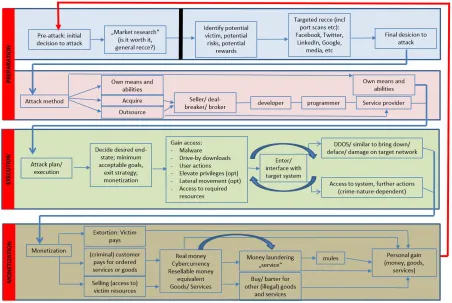
There are various levels of scripts and selection depends on the script’s intended application (Brayley, 2011). For the purposes of the current work, we developed a high-level journey map detailing a general cyber crime cycle (Figure 1). This is a general depiction of a single cyber crime act, from which more detailed maps in different categories can been drawn. In order to be of practical use in understanding cyber crime, more detailed journey maps for different criminal journeys are needed, providing crime sequences from preparation to exit for these specific journeys.
potential risk of getting caught is not worth the reward. The monetization phase includes a tangible payment in some form with laundering and/or mules often being utilised, although in some instances the criminals will not have a monetary objective which is discussed in the next section. The final result culminates in a personal gain or fulfilment of end-results as set out in the initial stages for the attackers regardless of the primary motivation of the attackers.
Mapping and scripting a general cyber criminal journey
Figure 1 represents a high-level journey map detailing a general crime cycle from the criminal’s perspective. This general cyber criminal journey and journeys for any follow-on specific crimes have been developed with the help of desktop research and insights from experts as part of the E-Crime 7thframework project as already mentioned in this paper. The benefits for investigators and defenders of producing this visual representation of the general cycle are that;
(a) By identifying the commonalities in the conduct of what may seem very different cyber crimes, we can expose the sequence of events that underpin the majority of these.
(b) By comparing detailed maps of multiple different cyber crimes against this general crime cycle, those tasked with preventing and/ or defending against such crimes can see best where to focus their resources for maximum effect.
c) Experiment via virtualised or desktop exercises the application of countermeasures at various points along the pathway with the goal of taking forward the most effective ones for application in real word scenarios.
The principles introduced with Figure 1 are usable for any cyber attack, not only cyber crime.
[image:7.595.72.524.375.678.2]component requires the identification of potential victims and attack methods, the conducting of targeted reconnaissance and finally deciding to execute the criminal act. The attack itself can then be executed in three ways, either; (1) by using their own existing means and abilities. As an example in case they have access to their own botnet, malware or exploit already, they will use these and will not go through all the steps in the process but move to the execution phase directly. (2) By buying the respective means and/or capabilities from other criminals – this brings other sectors into the process (special markets, forums, stores, sellers, brokers, developers, etc.), or (3) Outsourcing the required criminal activities by paying another criminal to conduct it as a service (crime-as-a-service).
The execution phasestarts with an attack plan. In the plan the criminal decides upon a desired end-state, their minimum acceptable goals, and monetisation and exit strategies. During the attack, the criminal gains access to victim’s resources through any number of means, including malware, drive-by downloads, user actions via phishing techniques or other illicit activities. Once the criminal gains access to the victim’s system, they will map the compromised network, often looking for further opportunities to exploit. Thereafter the criminal enters or interfaces with the target system and based on their desired and decided goals and end-states they take the commensurate actions. Within this phase of mapping the compromised network, the criminal may notice other vulnerabilities that may become useful in their reaching of stated end-results and will take advantage of these, i.e. committing different crimes which were not originally part of their attack plan.
The monetisation phaseinvolves obtaining tangible benefits. These benefits include direct monetary gain, for example where the victim’s monetary assets are stolen, or the victim pays the criminal directly in cases of extortion, such as ransomware or DDoS extortion schemes. Or indirect monetary gain whereby the victim’s resources can be turned to tangible assets which are traded or sold, for example selling access to the victim’s machine to others. The payment can be conducted in real currency, crypto-currency, resalable money equivalents (such as gaming assets), or in goods and services (real or virtual, legal or illegal). In some cases money laundering services are used, in other cases other means such as setting up mules to withdraw cash from banks might be used. Clearly though in some cases the monetization phase is excluded, examples of such cases include Hacktivists or those with ideological or other motivations.
In any case the crime ends with an exit strategy as set out by the criminal culminating in some type of personal gratification be it monetary or otherwise. As pointed out earlier, a difference between cyber crime and cyber warfare is the intent of attacks and the end goals to be achieved (Trend Micro 2013). While the intent of cyber criminals is to get some kind of monetary reward, the intent of cyber warriors is to gain political supremacy using cyber means. In order to gain political advantage, generation of revenue is not necessary – a successful outcome for hackers could be manipulation of data. As we saw in the recent Russia-Ukraine conflict, physical and logical attacks against opposition servers, smartphones, websites were conducted; as were cyber espionage operations to target military units, and isolating parts of the country from the rest on Internet (Pakharenko 2015).
Conclusion
Within this report, the authors have shown how traditional crime scripting can provide useful insights into understanding the lifecycle of a general cyber-criminal journey. It also shows how methods and techniques from typically non-cyber disciplines can be successfully applied to the cyber domain. Such mapping and scripting can be modified and further detailed for specific crime scenarios and graphically represented. In addition to cyber crime, such mapping can also be used for cyber attacks of any kind, and not only for criminal purposes as we have shown here with cyber warfare related attacks.
References
Bernik, I., 2013. Cybercrime and Cyber Warfare
Brayley, H., Cockbain, E., Laycock, G., 2011. The value of crime scripting: Deconstructing Internal Child Sex Trafficking, Policing, Volume 5, Number 2, pp. 132–143
Borrion, H., 2013. Quality assurance in crime scripting, Crime Science 2013, 2:6. Available online at:
http://www.crimesciencejournal.com/content/2/1/6
CISCO, 2014. Annual Security Report. Available online at:
http://www.cisco.com/web/offer/gist_ty2_asset/Cisco_2014_ASR.pdf
Clarke, R., 2012. Cyber War. New York, HarperCollins Publishers, 2012.
De Falco, M. 2012. Stuxnet Facts Report. A technical and Strategic Analysis. NATO Cooperative Cyber Defence Center of Excellence, Tallinn, 2012. Available online at:
https://ccdcoe.org/sites/default/files/multimedia/pdf/Falco2012_StuxnetFactsReport.pdf
Denker, K. 2011. Cyber war and Cyber crime – Implications of a Vague Difference. Available online at: https://www.inter-disciplinary.net/wp-content/uploads/2011/04/kaiwpaper.pdf
The Economic Impacts of Cyber Crime, FP7-SEC-2013.2.5-2. D2.3 Detailed appendixes on cyber crime inventory and networks in non-ICT sectors. T.Sõmer, R.Ottis, T.Lepik, M.Lagazio, B.Hallaq, D.Simms, T.Mitchener-Nissen. March 2015
ENISA Threat Landscape 2015. ENISA 2015. Available for download at:
https://www.enisa.europa.eu/activities/risk-management/evolving-threat-environment/enisa-threat-landscape/etl2015
Gartner, 2014. http://www.gartner.com/newsroom/id/2905717
Geol, S., 2011. Cyberwarfare: Connecting the dots in Cyber Intelligence. Communications of the ACM, Vol. 54 No. 8, Pages 132-140 10.1145/1978542.1978569
Goodman, M., 2015. Future Crimes. New York, Random House, 2015
Internet Usage and World Population Statistics, 2015. http://www.internetworldstats.com/stats.htm
Kaspersky 2015. The Duqu 2.0. Technical details, Kaspersky 2015. Available online at:
https://securelist.com/files/2015/06/The_Mystery_of_Duqu_2_0_a_sophisticated_cyberespionage_actor_retu rns.pdf
Lancaster University 2014. Detecting and Preventing Data Exfiltration. Available online at:
https://www.cpni.gov.uk/Documents/Publications/2014/2014-04-11-de_lancaster_technical_report.pdf
Lockheed Martin http://www.lockheedmartin.com/content/dam/lockheed/data/corporate/documents/LM-White-Paper-Intel-Driven-Defense.pdf
Ottis, R. 2008. Analysis of the 2007 Cyber Attacks against Estonia from the Information Warfare Perspective. Proceedings of the 7th European Conference on Information Warfare and Security, Plymouth, 2008. Reading: Academic Publishing Limited, pp 163-168.
Pakharenko, G., 2015. Cyber Operations at Maidan: A First-Hand Account. In Geers, K. (Ed.) Cyber War in Perspective. NATO CCDCOE Publications, Tallinn 2015.
PC World, 2012. When Is a Cybercrime an Act of Cyberwar? Available online at:
http://www.pcworld.com/article/250308/when_is_a_cybercrime_an_act_of_cyberwar_.html
RAND Corporation. Available online at: http://www.rand.org/topics/cyber-warfare.html
RSA 2015. CYBERCRIME 2015: An Inside Look at the Changing Threat Landscape. Available online at: https://www.emc.com/collateral/white-paper/rsa-white-paper-cybercrime-trends-2015.pdf
Sharma, Amit, “Cyber Wars: A Paradigm Shift from Means to Ends”, Strategic Analysis, Vol. 34, No. 1, 2010, pp. 62-73. http://www.tandfonline.com/toc/rsan20/34/1
Trend Micro, 2013. When do we call a cyber attack an act of cyber war? Available online at:
http://blog.trendmicro.com/trendlabs-security-intelligence/when-do-we-call-a-cyber-attack-an-act-of-cyber-war/
United Nations 2013. United Nations Office on Drugs and Crime, Comprehensive Study on Cybercrime, February 2013. Available online at:
<http://www.unodc.org/documents/organized-crime/UNODC_CCPCJ_EG.4_2013/CYBERCRIME_STUDY_210213.pdf