warwick.ac.uk/lib-publications
Original citation:Currie, Graeme, Burgess, Nicola and Tuck, Penelope. (2016) The (un)desirability of hybrid managers as ‘controlled’ professionals : comparative cases of tax and healthcare
professionals. Journal of Professions and Organization, 3 (2). pp. 142-153.
Permanent WRAP URL:
http://wrap.warwick.ac.uk/77083
Copyright and reuse:
The Warwick Research Archive Portal (WRAP) makes this work by researchers of the University of Warwick available open access under the following conditions. Copyright © and all moral rights to the version of the paper presented here belong to the individual author(s) and/or other copyright owners. To the extent reasonable and practicable the material made available in WRAP has been checked for eligibility before being made available.
Copies of full items can be used for personal research or study, educational, or not-for profit purposes without prior permission or charge. Provided that the authors, title and full bibliographic details are credited, a hyperlink and/or URL is given for the original metadata page and the content is not changed in any way.
Publisher’s statement:
This is a pre-copyedited, author-produced PDF of an article accepted for publication in Journal of Professions and Organization following peer review. The version of record Currie, Graeme, Burgess, Nicola and Tuck, Penelope. (2016) The (un)desirability of hybrid managers as ‘controlled’ professionals : comparative cases of tax and healthcare professionals. Journal of Professions and Organization, 3 (2). pp. 142-153. is available online at
http://dx.doi.org/10.1093/jpo/jow003
A note on versions:
The version presented here may differ from the published version or, version of record, if you wish to cite this item you are advised to consult the publisher’s version. Please see the ‘permanent WRAP URL’ above for details on accessing the published version and note that access may require a subscription.
1
The (un)desirability of hybrid managers as ‘controlled’ professionals:
Comparative cases of tax and healthcare professionals
Introduction
This article extends insight into the role of hybrid managers that combine professional and
managerial responsibilities (Llewellyn, 2001), and who are increasingly pervasive in public services
organizations (Burgess & Currie, 2013). We address debate about whether development of hybrid
manager roles represents controlled professionalism or organizing professionalism (Noordegraaf,
2015). Associated with the latter, we are keen to understand whether the activities of hybrid
managers transcend executive managers’ or policy-makers’ interests to serve a broader societal
interest, thereby retaining a hallmark of professionalism (Brint, 2015).
Our article is structured as follows. In the first section of the article we review literature about the
policy context with a focus upon controlled professionalism through hybrid managers (Noordegraaf,
2015) and research gaps regarding its effect. We then present three contrasting cases, tax inspectors
that enact a customer relationship manager role, and then two further cases of nurses that enact
ward management roles orientated towards quality improvement, but with different outcomes in
terms of controlled or organizing professionalism. Following which, we further examine the
desirability of their hybrid managerial role from a societal viewpoint. In our conclusion, we highlight
our theoretical contribution and suggest further research.
The Effects of Policy: Hybrid Managers as Controlled Professionals?
Understanding the interaction of professionalism and managerialism has moved beyond a dualistic
and oppositional characterisation, with hybridisation of professional work now seen as somewhat
desirable (Bevort & Suddaby, 2015; Blomgren & Waks, 2015; Farrell & Morris, 2003; Loewenstein,
2014; Noordegraaf, 2015; Postma et al., 2014; Skelcher & Smith, 2014). Consequently, we see
managerial and professional principles that might have previously been conceived as contradictory,
2
quality, as well as well as offering quality in the treatment of a case, becomes central to professional
practice (Nooredegraaf, 2015).
One particularly significant aspect of hybridisation for professionals has been their enactment of
hybrid managerial roles. Hybrid managers are ‘mediating persons’, looking through a ‘two way
window’ of sets of ideas belonging to management and those belonging to professional practice
(Llewellyn, 2001). We note the existence of hybrid managers in private sector settings, such as the
professional services context of accounting firms (Bevort & Suddaby, 2015; Burns & Baldvinsdottir,
2007; Granlund & Lukka, 1998; Howieson, 2003), however, the focus of our analysis is upon hybrid
managers within public services organizations.
Recently, policy has sought to increase the numbers of hybrid managers and orientate their role
towards proactive, strategic behaviours, through which they manage their colleagues towards
organizational, rather than professional, ends (McGivern et al., 2015). In a UK hospital context for
example, whilst general managers or ‘pure plays’ represent around 3 per cent, hybrid managers now
represent around 30 per cent of staffing (Walshe & Smith, 2011; Buchanan et al., 2013). Reflecting
this, analysis of what hybrid managers actually do within public services organizations, most notably
in healthcare, has become more pronounced (Denis et al., 2001; Ferlie et al., 2012; Ferlie et al.,
2013; Hoff, 2000; Iedema et al., 2004; Montgomery, 2001; Schneller & Singh, 2000). However, we
note hybrid managers were evident in public services organizations prior to policy emphasis upon
their ranks, enacting more traditional roles as ‘first amongst equals’, where they represented
professional peers (Mintzberg, 1979). Further, policy-makers did not immediately look to hybrid
managers to implement entrepreneurial governance associated with ‘New Public Management’
(Hood, 1991) and ‘Reinventing Government’ (Osborne and Gaebler, 1992). Rather policy makers
sought to develop a cadre of general managers to drive reforms towards more efficient, effective,
and responsive public services (Currie & Procter, 2005). Then, even when seeking to develop hybrid
3
settings, clinicians commonly engaged with hybrid managerial roles only when they saw it as giving
them more influence collectively, or enhancing status individually, otherwise they remained
reluctant to enact such roles (Currie & Spyridonidis, 2015; McGivern et al., 2015).
As well as in health care, hybrid managers are evident in a wide range of public services settings,
extending from teachers in secondary schools (Busher & Harris, 1999) to lecturers in further
education (Alexiadou, 2001; Gleeson & Shain, 1991) and higher education (Clegg & McAuley, 2005;
Hellawell & Hancock, 2001; Parker & Jary, 1995), social workers (Jones, 1999), research scientists in
the public sector (McAuley et al., 2000), academics in higher education (Clegg & McAuley, 2005), tax
inspectors (Currie et al., 2015b), civil servants in central government agencies (Thomas & Dunkerley,
1999).
In considering how the enactment of hybrid managerial roles might play out, Noordegraaf (2015)
offers interesting insight through distinguishing between ‘controlled’ professionalism and
‘organizing’ professionalism. The former aims at disciplining professional work within organizational
settings and structures. In contrast, the latter aims at going beyond hybridity. Organizing
professionalism embeds organizing roles and capacities within professional action. It privileges
professional processes in order to deal with complex cases in demanding environments. On the one
hand, the development of hybrid managers might be viewed as controlled professionalism. With
controlled professionalism, the policy intent is to convert professionals into managers and
reconstitute clinicians’ subjectivities through their co-option into such roles, enabling professional
governance from a distance (Martin & Learmonth, 2012). On the other hand, the development of
hybrid managers can be seen as part of the emerging phenomenon of organizing professionalism,
within which hybrid managers are connected to other stakeholders, such as policy-makers, executive
managers and the public and clients, but where the locus of control remains within the professional
4
Notwithstanding prospects for organizing professionalism, the thrust of literature tends to be more
critical regarding the effects of hybridisation, viewing the development of hybrid managers as one of
continuing controlled professionalism (Noordegraaf, 2015). Following which empirical analysis
highlights tension around the bringing together of managerial and professional perspectives for
hybrid managers, from a control perspective because professional autonomy and discretion is
threatened (Freidson, 2001; Raelin, 1985) or from an institutionalist perspective because
managerialism and professionalism represent rival logics (Bevort & Suddaby, 2015; Pache & Santos,
2013; Reay & Hinings, 2009). As a consequence, there is emphasis within extant literature upon the
(identity) transition towards a more managerial agenda that hybrid managers undergo in the
enactment of their new role. For example, in the healthcare setting, literature theorises identity
transition challenges faced by nurses (Croft et al., 2015a, 2015b; Currie & Croft, 2015) and doctors
(McGivern et al., 2015; Spyridonidis et al., 2015). A similar line of debate about identity transition
faced by healthcare professionals is apparent within the specific confines of the Journal of
Professions and Organization (Blomgren & Waks, 2015; Carvalho, 2014).
To develop the argument within this article, we present three contrasting studies, in terms of their
outcomes regarding controlled or organized professionalism. The first study focuses upon hybrid
managers drawn from the ranks of tax inspectors that enact a greater customer-orientated role in a
regulatory organization, the tax agency (Currie et al., 2015b). The two other studies focus upon
hybrid managers drawn from the ranks of nurses at ward level that mobilise knowledge for quality
improvement in a hospital (Burgess & Currie, 2013; Burgess et al., 2016; Currie et al., 2015a). In the
first hospital we see quality improvement realised in way not evident in the second hospital. Even
within the same public services domain, we thus see outcomes may differ regarding enactment of
hybrid managerial roles.
Regarding our focal actors, whilst the notion of being a professional is increasingly contested (Evetts,
5
occupational professionals (Evetts, 2003), the latter by virtue of experiencing significant and
common training for their professional role, as well as associated socialisation (Tuck, 2010). The
article takes each of the studies in turn, considering what hybrid managers do in each setting,
framed by notions of controlled and organizing professionalism (Noordegraaf, 2015), and follow this
with discussion of whether hybrid managers serve societal interest.
Tax Agency: Tax Inspectors as Hybrid Managers
In this study, role transition for professionals moving towards hybrid managerial roles, which
encompass a greater customer orientation, is analysed (Currie et al., 2015b). Specifically, reforms to
the national tax agency in the United Kingdom are examined, focusing on attempts to shift hybrid
managers, drawn from the ranks of tax inspectors, away from a focus on tax compliance, towards a
greater customer focus. The latter is consistent with changes since the early-1990s in the UK across a
wide swathe of public services organizations (Baines & Cunningham, 2011; Bolton & Houlihan, 2005;
Carter et al, 2011; Korzynski & Ott, 2004; Rosenthal & Peccei, 1997). Within the tax agency (HMRC),
hybrid managers, from the ranks of tax inspectors, were labelled ‘customer relationship managers’
(Riley, 2012). We note one of the specific characteristics of the hybrid managers’ role as customer
relationship managers in the tax agency is a focus upon commercial goals, specifically about the
creation of wealth by multinational corporations (MNCs) and managing resources towards this,
which has been highlighted as a particular aspect of policy reforms extending beyond tax agencies
(Doolin, 2002; Kuranmaki, 2004: Llewellyn, 2001; Wiesel & Modell, 2014). As such, our empirical
case of tax inspectors provides a particularly interesting extension of extant professions literature
because a hybrid manager’s role goes beyond demands that they lead or manage their professional
peers towards organizational interest. Empirically underpinning the study are documentary data
relating to reform from 2003 to 2012 and 43 semi-structured interviews with senior tax inspectors:
6
have chosen to leave HMRC in the face of demands to relinquish their previous more technical role
to enact a more customer-focused role.
Empirical analysis shows how, for tax inspectors moving into hybrid managerial roles, the ground has
shifted in the wake of policy intended to change the nature of their profession. This has had a
significant impact on those amongst their ranks transitioning into hybrid manager roles. Their
specialist expertise was becoming diluted as they were expected by policy makers and senior
managers to become more generalist managers of customers. The tax inspector has traditionally
behaved as a technical expert, predisposed towards ensuring that standards, rules and regulations
are tightly adhered to; i.e. a regulator role (Tuck, 2010). Within this role, tax inspectors have
traditionally orientated their efforts towards those taxpayers failing to comply. Tax inspectors are
now being required to orientate towards those taxpayers that aspire to comply, as much, if not more
than, those that non-comply, in their role as ‘customer relationship managers’, as illustrated in the
following quote from a hybrid manager: “In some MNCs the tax function is quite marginal to the
main business and we try to give them as much support as possible”. Meanwhile another hybrid
manager described how “you’ve got to get the balance right, clearly identify what the issue is, trying
to make the corporate client compliant, but also maintaining the customer focus”. This compares to
their traditional role more orientated towards regulation: “With the tax inspectors [who deal with
the large corporate taxpayers], there tends to be a huge emphasis on technical expertise … they are
kept at arm’s length from corporate taxpayers … It used to be very clean arguments about
interpretation of the legislation, and whether particular facts of a taxpayer’s position applied to the
legislation … and whether corporates have then paid the right amount of tax”. That the contribution
of hybrid managers is towards customer care, as much as technical discharge of their duties, is
visible in what one hybrid manager described as, “our performance wall where we present our
customer performance, which is about how our customers perceive us … this is what our promotion,
7
In summary of the case, the effect of New Public Management reform is evident in hybridising
professional expertise and organizational forms (Kuranmaki & Miller, 2006, 2011), specifically how
customer-orientated reform becomes embedded in governance practices (Wiesel & Modell, 2014).
Co-operation and partnership between organizations, including regulatory agencies and their clients,
is emphasised within such reforms, linked to which are distinctive managerial control practices in
co-opting professionals towards hybridisation (Kuranmaki & Miller, 2011).
Hospital: Ward Managers as Hybrid Managers
Another aspect of hybrid manager’s roles expected by policymakers, as outlined in the introduction,
is that they integrate professional and managerial perspectives in improving the quality of care, not
just focusing upon its delivery to the individual client but also, more strategically to inform how
quality of care is organized (Noordegraaf, 2015). The reported study focuses upon the role of hybrid
nurse managers at ward level in a hospital context to improve care of older people (Currie et al.,
2015a), specifically to reduce falls of older people within hospital, which represent the most highly
reported untoward incident around safety and quality of older person’s care (National Patient Safety
Agency, 2007). The study took place across two hospital cases. In the Hospital 1, we carried out 67
interviews, 16 hours of focus group discussion with 48 clinical staff, and 40 hours of observation of
relevant meetings where falls management was discussed amongst frontline professionals and
hybrid managers, with data gathering equally taking place in each hospital case. In Hospital 2, we
carried out 60 interviews and 20 hours of observation.
The ward manager has been described as a ‘mini-general manager’, with responsibility for budget,
overseeing development and morale of nursing staff, supporting medical staff, delivering service
improvements and improving patient experience (Buchanan et al., 2013: 17). The focus of
illustration upon the ward manager is illuminating because, ‘[the ward manager is] vital to the
8
the centre of the patient experience and can oversee and co-ordinate the different dimensions of
service provision to patients’ (Royal College of Nursing, 2009: 3, 4).
Hospital 1: Hybrid managers enacting a strategic quality improvement role
Empirical analysis reveals how, in one hospital, the ward manager contributed towards the delivery
of safe, high quality care to older patients, with an emphasis upon reducing falls. One ward manager
took a proactive approach to improving falls prevention awareness after leading a team undertaking
Root Cause Analysis of the serious incident. She brought together research-based evidence about
what constituted best practice in falls management, and local understandings of the care system for
frail elderly patients. She then delegated her deputy to undertake a project around falls in their
clinical area, and subsequently made the deputy ward manager falls ‘champion’ for the ward. The
ward manager also used time out days to disseminate learning and actions from Root Cause
Analysis, utilising her deputies to capture any staff not attending the time out day. She described
herself as embracing the managerial role because it allowed her to improve quality of healthcare
beyond that possible as an isolated clinical practitioner.
Similarly, another ward manager described how she led organizational learning amongst her peer
professional group: “It’s basically the senior nurses … brought together to address the falls problem
... we meet as a directorate, practice development matrons, matrons, health and safety matrons,
anybody who kind of might have to get the information together”. This shared learning is then
communicated back to the ward: “And we report back to them here via staff meetings, forwarding
emails, and we also have a board which we update for more regular information”. Meanwhile,
having equipped senior members of her team with skills and knowledge around quality and safety
improvements, the ward manager was able to spend time accessing latest best practice, “through
internet searches, but also through external events, where I learn what other hospitals are doing,
9
Finally, another ward manager in the hospital involved herself in the governance committees,
“particularly the one about in-patient falls, where I was able to get at the Chief Nursing Officer and
Chief Executive to gain their attention and present some potential solutions that we had
implemented locally [at ward level] of relevance to the rest of the hospital”.
Hospital 2: Hybrid managers orientated towards regulatory compliance
The vignettes above highlight that hybrid managers, with responsibility for clinical service delivery,
are uniquely placed within healthcare organizations to broker knowledge necessary to improve
patient safety. However, such a contribution cannot be assumed. In another hospital, what hybrid
managers do appears much more circumscribed. Here, in a context where the hospital was subject
to pressures about the quality of care, ward managers exhibited an orientation towards compliance
with the demands of executive managers above them, who, in turn, were responding to external
regulatory pressures (Nicolini et al., 2011). One hybrid manager admitted that, “a lot of stuff we do
has nothing to do with safety or risk. All they talk about here is meeting targets and coming in under
budget. I get an email every few days about how many patients the hospital has discharged and so
on. I never get any information about how many times we’ve harmed anyone, much less how we can
actually learn from such incidents”. This was a consequence of, “a bureaucratic process that sits
around all of this where somebody at the Department of Health or in one of the agencies nationally
writes something and says ‘right, this needs to change,’ or ‘this is dangerous,’ sends it out to the
service and in many instances people just go ‘oh, another piece of article, another instruction,
another bit of work to do’”. We also highlight that when organizations are under performance
pressures, doctors may exhibit concern about threats to pre-existing resource allocation, and so
stymie service change driven by hybrid managers. “I used to make recommendations for changes.
People seemed to take notice. But after a point I felt increasingly powerless, really, because we
10
them”. Professional hierarchy may thus ‘bite back’ and reduces any strategic discretion by nurses
enacting hybrid managerial roles (Currie & Spyridonidis, 2015).
In summary, our empirical cases again highlight variegation in the role that hybrid managers enact.
In explaining this, we note organizational contingencies, with more discretion given to hybrid
managers in a better performing organization, whilst hybrid managers are pushed towards
compliance with regulatory demands, and simultaneously squeezed by powerful professionals to
whom nurses are subordinate, in the poorer performing organization.
Is what hybrid managers do, desirable in public services organizations?
The article has set out a number of contributions made by hybrid managers that meet the aims of
policymakers towards more customer-orientated public service and quality improvement. However,
we should not accept this uncritically. In particular, emphasising the word ‘public’ in public services,
we want to consider if what hybrid managers do, is desirable from the public’s perspective.
Most obviously, of the three studies outlined above, the public are likely to be critical of co-option of
tax inspectors to hybrid managerial roles that encompass a greater customer-orientation, on the
basis that tax avoidance is facilitated. A report from the Treasury Committee concerned with the
administration and effectiveness of HMRC starkly presents public concern about tax avoidance
(www.publications.parliament.uk/pa/cm201012/cmselect/cmtreasy/731/73102.htm.):
159. A particular source of controversy has been HMRC’s settlement of large tax cases involving corporations. Allegations have been made in the press that cases have been settled inappropriately for a lower yield than might otherwise have been achieved.
162. The public needs to be assured that cases involving large sums of money are being settled correctly. Equally it is unfair on HMRC staff and damaging to public confidence that the Department can be the subject of repeated allegations it cannot refute, even if they are groundless.
Reflecting public concerns, the UK’s more left-leaning broadsheet newspaper, The Guardian, has
been running a high profile campaign to highlight tax avoidance by multi-national corporations:
11
parliamentary committee. The lack of disclosure in the long-running dispute with the US investment bank meant there was a danger the public would think there was “one rule for some companies, and another for individual taxpayers”, said Labour MP Chuka Umanna. Without directly attacking the appearance of preferential treatment for the US investment bank, Umanna said he was concerned that the case echoed the tax deal with Vodaphone that led to demonstrations and protests by the campaigners, UK Uncut. Vodaphone was accused of saving £6bn in tax after it agreed a deal with HMRC. ( www.guardian.co.uk/business/2011/may/13/mps-demand-details-of-deal-to-let-goldman-sachs-avoid-tax/print, ‘Minutes of Parliamentary Committees reflect broader concerns about corporate tax avoidance’)
The economic argument may be one that multi-national corporations merely move their
headquarters elsewhere and so deprive the UK of much needed tax revenue if they are not
supported in their aims to minimise tax payment.
Nevertheless this is an argument particularly hard for the public to swallow in parsimonious times
for public spending. Tax inspectors run the danger of undermining their professional authority. In its
ideal form, professional authority is characterised by a moral or ethical imperative at its core
(Carr-Saunders & Wilson, 1933; Flexner, 1915; Tawney, 1921). This forms the basis of more civically
oriented professionalism (Brint, 2015). A professional is assumed to have higher motives –
commitment to altruistic service; invest their expertise with a moral capacity; a professional concept
of service, which involves an intense, personal commitment, ‘a humanitarian sentiment
individualised’ (Melosh, 1989). One might argue that facilitating tax avoidance of MNCs attacks the
ideal purpose of tax inspectors as professionals. Recognising this, some hybrid managers suggested,
“we give them [MNCs] very good service, but I’ll also give them a hard time where they are
non-compliant”. Thus there was a variegated response from hybrid managers towards their
customer-orientated role, with many recognising their professional legitimacy was likely to be undermined
should they not exhibit the type of trusteeship demanded by the public (Brint, 2015). As highlighted
in literature about transition of healthcare professionals into hybrid managerial roles (McGivern et
al., 2015), some tax inspectors enacted a more representative role where they attempted to buffer
their professional peers from managerial intrusion and claimed, “our professional ethos is still there
… in this office everybody is more technical and more professional now”. Further, as well as a decline
12
relationships, as a consequence of reduction in staff numbers and ensuing work intensification
(Carter et al., 2011).
The case of the hospital suffering from poor performance also exhibited a hybrid manager
contribution that might not be appreciated by the public. As extant literature highlights, hybrid
managers are often caught between the two worlds of managerialism and professionalism (Denis et
al., 2001; Ferlie et al., 2012; Ferlie et al., 2013; Hoff, 2000; Iedema et al., 2004; Montgomery, 2001;
Schneller & Singh, 2000). Many tend towards representing their profession and buffering it from
managerial intrusion, meanwhile others are co-opted into a managerial agenda that focuses upon
compliance with external regulatory demands (Croft et al., 2015a, 2015b; McGivern et al., 2015). Our
own study of hybrid managers’ role in managing quality of services for care of older persons (Currie
et al., 2015a) highlighted the dysfunctional nature of a compliance culture towards which hybrid
managers might orientate (Nicolini et al., 2011), with one hybrid manager complaining, “If we don’t
comply with the latest target, we will have money effectively taken away from us. And for all that we
protest and say, ‘Well we are doing it. We just haven’t got the computer systems to monitor it,’ well
it doesn’t butter any parsnips. So everybody runs around making a computer system that can record
compliance with a specific target… there is a universal truth there which is that if something
becomes a national priority and if the hospital stands to lose money either directly or indirectly as a
consequence of compliance, then you comply.” In this case, whilst expressing disagreement with a
need to comply, it appeared difficult for the hybrid managers to resist imposition of policy-driven
targets, despite it not aligning with their professional practice: “we haven’t got time to actually do
any actions towards quality improvement because we’re too busy writing action plans to comply
with organizational requirements”.
Through the illustrations above, public concern about some of the things that hybrid managers do
across different public services settings is highlighted. Consequently, we suggest we should not
13
and customer relationship management, as the right thing to do, at least as regards its enactment,
which is framed by controlled professionalism (Noordegraaf, 2015). Instead, we should remain
critical of policy intent towards hybrid managers and its effect upon the public subject to service
delivery. At the same time, in contrast within the higher performing hospital, hybrid managers
enacted their quality improvement role in way more aligned with social trusteeship (Brint, 2015), so
neither should we assume hybrid managers cannot enact their role in public interest consistent with
organizing professionalism (Noordegraaf, 2015). Perhaps it remains a matter of implementation
rather than the principle of hybrid managers that needs to be addressed?
Conclusion
In the introduction we set out how we wanted to move away from analysis of hybrid managers’
views about their own (identity) transition, or about analysis of the interaction across institutional
logics embedded in hybrid managers’ activities, which have dominated extant literature. In the
introduction to the article, we suggested that hybrid managers reflect organizing professionalism.
However, it may be that the roles enacted by hybrid managers are more characteristic of ‘controlled
professionalism’, where well run organizations deliver products in which accountability, results and
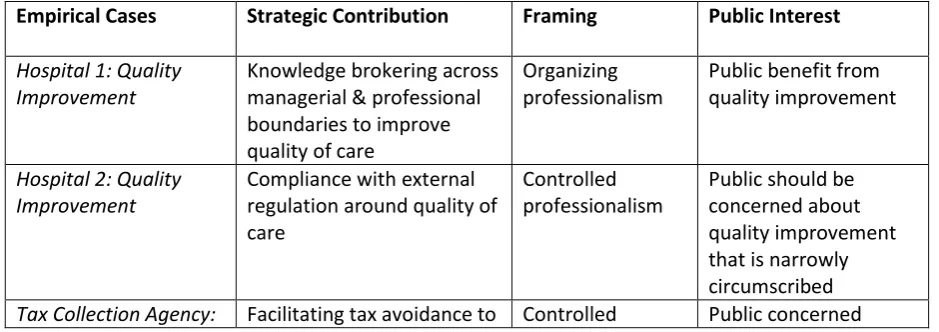
efficiency are foregrounded (Noordegraaf, 2015). Table 1 summarises analysis across the three
[image:14.595.64.534.595.761.2]empirical cases.
Table 1: Strategic Contribution of Hybrid Managers in the Public Sector
Empirical Cases Strategic Contribution Framing Public Interest
Hospital 1: Quality Improvement
Knowledge brokering across managerial & professional boundaries to improve quality of care
Organizing professionalism
Public benefit from quality improvement
Hospital 2: Quality Improvement
Compliance with external regulation around quality of care
Controlled professionalism
14
Customer Relations keep MNCs in the country professionalism about tax avoidance
The organizing professionalism perspective applies to the empirical examples of hybrid managers
contributing to quality improvement in our first hospital, but not the second hospital, where hybrid
managers’ contribution to quality improvement is stymied by a context more characteristic of
controlled professionalism. We suggest organizing professionalism is more likely where hospital
performance is judged ‘good’ by regulators, thus executive managers accommodate greater
professional autonomy. In contrast, controlled professionalism is more likely where hospital
performance is judged ‘poor’, with executive managers concerned that professionals are tightly
managed towards performance criteria set by regulators (Nicolini et al., 2011). Such a suggestion
resonates with comparative case analysis by Currie and Spyridonidis (2015), which highlighted a
more autonomous role for nurse managers taking on managerial roles around translation of clinical
guidelines in a high performing hospital, with the managerial efforts of their peers in another poor
performing hospital stymied by both executive managers in way more characteristic of controlled
professionalism. Highlighting differential power across professional groups, they noted that a more
autonomous role for nurse managers was likely to be squeezed by doctors (and executive managers)
in poorer performing hospitals because pre-existing resource allocation and interest of powerful
professionals were threatened. In the study reported here (Burgess & Currie, 2013; Burgess et al.,
2015; Currie et al., 2015), framed by organizing professionalism in the high performing hospital,
hybrid managers enact a strategic knowledge brokering role that bridges professionals and
managerial interests, as envisaged by policymakers in their search for a panacea to a policy
implementation gap (Currie & 2015; Martin & Learmonth, 2012). In the poor performing hospital,
framed by controlled professionalism, hybrid managers make a contribution that exhibits mere
compliance with reporting around quality improvement. It is hard to imagine that this is the effect
desired by policymakers, albeit they may claim that the role hybrid managers enact towards
15
the public for their practice. Nevertheless, the public are likely to be concerned about the way that
controlled professionalism plays out.
Such controlled professionalism (Noordegraaf, 2015) is particularly evident in the empirical case of
hybrid managers enacting a greater customer-orientated role towards MNCs in a tax agency.
Following which, there is significant public outcry, reflected in media and government debate, about
facilitating tax avoidance that is likely to undermine the legitimacy that tax inspectors have
traditionally accrued a more technically orientated role in which they ensure tax payments are
perceived as fair. This has gathered pace recently with political and public furore particularly evident
in the United Kingdom about tax avoidance by Google, who, 2005-2014, have paid £200mn
corporate tax on estimated profits of £7.2bn derived from their UK operations
(http://gu.com/p/4g4de/sbl) and Facebook, who paid £4,327 corporation tax on UK revenue of
£105mn in 2014 (http://gu.com/p/4d7ez/sbl). Debate about the customer oriented management
role for tax inspectors that facilitates such tax avoidance is not dissipating, rather it is gathering
pace. In this case, it seems controlled professionalism (Noordegraaf, 2015) continues to play out in a
way detrimental to hybrid managers.
In conclusion, whilst the intent of this article has been to move away from the focus that prevails in
much of the extant literature, we should not be surprised that (identity) transition from the
perspective of hybrid managers is central to much of extant literature, given the context of
controlled professionalism (Noordegraaf, 2015) that frames the introduction of hybrid managers in
two of our three empirical cases. Controlled professionalism appears to undermine the legitimacy of
those professionals moving into hybrid manager roles, and perhaps unsurprisingly hybrid managers
are concerned about their identity transition not just with respect to the perceptions of their
professional peers, but increasingly those of the public at large. In contrast, where the hybrid
manager’s role is framed by organizing professionalism (Noordegraaf, 2015), they may more willingly
16
Regarding the latter, hybrid managers feel they are going back to the roots of more social
trustee-orientated professionalism (Brint, 2015). The logics of management and professionalism need not be
mutually exclusive, with development of hybrid managers one way in which collaborative
community can be enhanced that furthers aspirations for better management and professionalism
(Adler et al., 2008).
Our analysis draws out some comparison of the experiences of different professionals transitioning
into hybrid manager roles. On the basis of our empirical cases, tax inspectors represent controlled
professionals within their new hybrid manager role. Whilst earlier we suggested both tax inspectors
and health professionals represented occupational professions (Evetts, 2003), the jurisdiction and
identity of tax inspectors may prove more amenable to managerial control as they move towards
hybrid manager roles than that of nurses undergoing a similar transition. Dependent on the
organizational context, the transition of nurses to hybrid manager roles might be more characteristic
of organizing professionalism (Noordegraaf, 2015). Further research might engage in more detailed
comparative analysis of professions moving into hybrid manager roles.
Future research might also examine how the organizing professionalism framing for the role of
hybrid managers might be sustained, and how this then shapes a contribution of hybrid managers
that does indeed bridge professional and managerial worlds in a way that meets the public interest.
Despite our mixed analysis of how this plays out on the ground, we remain optimistic that
managerial practice of hybrids can be managed from within professional ranks, and in a way that
meets organizational and public interest simultaneously. Finally, the three case studies we have
drawn upon to illustrate analysis are drawn from the public sector. We also note emphasis upon
hybrid managers extends to settings beyond the public sector, such as the accounting profession
(Anderson-Gough et al., 2000; Carter & Spence, 2014; Grey, 1998; Spence and Carter, 2014; Suddaby
et al., 2009). A burgeoning literature suggests a similar line of argument can be taken with hybrid
17
professionalism rather than organizing professionalism, and that this is not necessarily in the public
interest (cf. Bevort & Suddaby, 2015 for analysis of accountants). We encourage further research to
18
References
Adler, P., Kwon, S-W. & Heckscher, C. (2008). Professional work: The emergence of collaborative community. Organization Science, 19(2): 359-376.
Alexiadou, N. (2001). Management identities in transition: A case study from further education. The Sociological Review, 49(3): 412-35.
Anderson-Gough, F., Grey, C. & Robson, K. (2000). In the name of the client: the service ethic in two professional service firms. Human Relations, 53(9): 1151-1174.
Baines, D. & Cunningham, I. R. (2011). White knuckle care work: Violence, gender and New Public Management in the voluntary sector. Work, Employment and Society, 25(4): 760-776.
Bevort, F. & Suddaby, R. (2015). Scripting professional identities: How individuals make sense of contradictory institutional logics. Journal of Professions and Organization. Forthcoming
doi:10.1093/jpo/jov007.
Blomgren, M. & Waks, C. (2015). Coping with contradictions: Hybrid professionals managing institutional complexity. Journal of Professions and Organization, 2 (1): 78-102.
Bolton, S. & Houlihan, M. (2005). The misrepresentation of customer service. Work, Employment and Society, 19(4): 685-703.
Brint, S. (2015). Professional responsibility in an age of experts and large organizations causing problems. In D. E. Mitchell & R. K. Ream (Eds), Professional responsibility: The fundamental issue in education and health reform. Switzerland: Springer International Publishing: 89-112.
Buchanan, D. A., Denyer, D., Jaina, J., Kelliher, C., Moore, C., Parry, E. & Pilbeam, C. (2013). How do they manage? The realities of middle and front line management work in healthcare. Southampton: NIHR HS&DR Project Ref: 08/1808/238
Burgess, N. & Currie, G. (2013). The knowledge brokering role of the hybrid middle manager: The case of healthcare. British Journal of Management, 24(S1): S132-SS142.
Burgess, N., Strauss, K., Currie, G. & Wood, G. (2016). Organizational ambidexterity and the hybrid middle manager: The case of patient safety in UK hospitals. Human Resource Management, Forthcoming.
Burns, J. & Baldvinsdottir, G. (2007). The changing role of management accountants. In T. Hopper, D. Northcutt and R. Scapens (Eds.), Issues in management accounting. Harlow, UK: Pearson.
Busher, H. & Harris, A. (1999). Leadership of school subject areas: tensions and dimensions of managing in the middle. School Leadership and Management, 19(3): 305-17.
Carr-Saunders, A.M. & Wilson, P. A. (1933). The professions. Oxford: Clarendon Press.
Carter, C. & Spence, C. (2014). Being a successful professional: An exploration of who makes a partner in the Big 4. Contemporary Accounting Research, 31(4): 949-981
Carter, B., Danford, A., Howcroft, D., Richardson, H., Smith, A. & Taylor, P. (2011). ‘All they lack is a chain’: Lean and the new performance management in the British Civil Service. New Technology, Work and Employment, 26(2): 83-97
19
Clegg, S. & McAuley, J. (2005). Conceptualising middle management in higher education: A multifaceted discourse. Journal of Higher Education Policy and Management, 27(1): 19-34.
Croft, C., Currie, G. & Lockett, A. (2015a). The impact of emotionally important social identities on the construction of managerial leader identity: A challenge for nurses in the English NHS.
Organization Studies, 36(1): 113-131.
Croft, C., Currie, G. & Lockett, A. (2015b). Broken ‘two way windows’? An exploration of professional hybrids. Public Administration, 93(2): 380-94.
Currie, G. & Croft, C. (2015). Examining hybrid nurse managers as a case of identity transition in healthcare: Developing a balanced research agenda. Work Employment and Society, forthcoming.
Currie, G. & Martin, G. (2015). Healthcare organizations and narratives of healthcare reform. In E. Ferlie, K. Montgomery, A. R. Pedersen (Eds.), Oxford Handbook of Healthcare Management. Oxford: Oxford University Press.
Currie, G. & Procter, S. (2005) The Antecedents of Middle Managers’ Strategic Contribution: The Case of a Professional Bureaucracy. Journal of Management Studies, 42(7): 1325-56
Currie, G. & Spyridonidis, D. (2015). Interpretation of multiple institutional logics on the ground: Actor’s position, their agency and situational constraints in professionalised contexts. Organization Studies, 36(12), Forthcoming.
Currie, G., Burgess, N. & Hayton, J. (2015a).HR practices and knowledge brokering by hybrid middle managers in hospital settings: the influence of professional hierarchy. Human Resource
Management, 54(5): 793-812
Currie, G., Tuck, P. & Morrell, K. (2015b). How hybrid managers act as ‘canny customers’ to accelerate policy reform: A case study of regulator-regulatee relationships in the UK’s tax agency. Accounting, Auditing & Accountability Journal, 28(8), Forthcoming.
Denis, J.-L., Lamothe, L. & Langley, A. (2001). The dynamics of collective leadership and strategic change in pluralistic organizations. Academy of Management Journal, 44(4): 809–37.
Doolin, B. (2002). Enterprise discourse, professional identity and the organizational control of hospital clinicians. Organization Studies, 23: 369-387.
Evetts, J. (2003). The sociological analysis of professionalism: Occupational change in the modern world. International Sociology, 18(2): 395-415.
Evetts, J. (2006). Short note: ‘The sociology of professional groups: New directions’. Current Sociology, 54(1): 133-43.
Farrell, C., & Morris, J. (2003). The neo-bureaucratic State: Professionals, managers and professional managers in schools, general practices and social work. Organization, 10(1):129-156.
Ferlie, E., Ashburner, L., Fitzgerald, L. & Pettigrew, A.M. (1996). The new public management in action. Oxford: Oxford University Press.
Ferlie, E.; McGivern, G. & Fitzgerald, L. (2012). A new mode of organizing in health care?
Governmentality and managed cancer networks in England. Social Science & Medicine, 74(3): 340-347.
20
Flexner, A. (1915). Is social work a profession? Paper presented at the National Conference on Charities and Correction, New York: New York School of Philanthropy (reprinted as paperback, 2009, by Cornell University Library)
Freidson, E. (2001). Professionalism: The third logic. Cambridge: Polity.
Gleeson, D. & Shain, F. (1991). Managing ambiguity: Between markets and managerialism – A case study of ‘middle’ managers in further education. The Sociological Review, 47(3): 461-90.
Granlund, M. & Lukka, K. (1998). Towards increasing business orientation: Finnish management accountants in a changing cultural context. Management Accounting Research, 9(2): 185-211.
Grey, C. (1998). On being a professional in a “Big Six” firm. Accounting, Organizations and Society, 23: 569-587.
Hellawell, D. & Hancock, N. (2001). A case study of the changing role of the academic middle manager in higher education: Between hierarchical control and collegiality. Research Papers in Education, 16(2): 1-15.
Hoff, T. (2000). Professional commitment among US physician executives in managed care. Social Science and Medicine, 50: 1433-1444.
Hood, C. (1991). A public management for all seasons? Public Administration, 69(1): 3-19.
Howieson, B. (2003). Accounting practice in the New Millenium: Is accounting education ready to meet the challenge? British Accounting Review, 35(2): 69-103.
Iedema, R., Degeling, P., Braithwaite, J. & White, L. (2004). 'It's an interesting conversation I'm hearing': The doctor as manager. Organization Studies, 25(1): 15-33.
Jones, C. (1999). Social work: Regulation and managerialism. In M. Exworthy & S. Halford, (Eds.), Professionals and the new managerialism in the public sector. Buckingham, Open University Press: 37-49.
Korczynski, M. & Ott, U. (2004). When production and consumption meet: Cultural contradictions and the enchanting myth of customer sovereignty. Journal of Management Studies, 41(4): 575-599.
Kurunmaki, L. (2004). A hybrid profession - the acquisition of management accounting expertise by medical professionals. Accounting Organizations and Society, 29: 327-347.
Kuranmaki, L. & Miller, P. (2006). Modernising government: The calculating self, hybridisation and performance measurement. Financial Accountability and Management, 22: 87-106.
Kuranmaki, L. & Miller, P. (2011). Regulatory hybrids: Partnerships, budgeting and modernising government. Management Accounting Research, 22: 220-241.
Llewellyn, S. (2001). “Two-way windows”: Clinicians as medical managers. Organization Studies, 22(4): 593-623.
Loewenstein, J. (2014). Take my word for it: How professional vocabularies foster organizing. Journal of Professions and Organization, 1(1): 65-83.
21
McGivern, G., Currie, G., Ferlie, E., Fitzgerald, L. & Waring, J. (2015). Hybrid manager-professionals’ identity work: The maintenance and hybridization of professionalism in managerial contexts. Public Administration, 93(2): 412-32.
Martin G. & Learmonth, M (2012). A critical account of the rise and spread of ‘leadership’: The case of UK healthcare. Social Science and Medicine, 74(3): 281-288.
Melosh, B. (1989). “Not merely a profession”: Nurses and resistance to professionalization. American Behavioural Scientist, 32(6): 668-679
Mintzberg, H. (1979). The structuring of organizations. Englewood Cliffs, NJ: Prentice Hall.
Montgomery, K. (2001). Physician executives: The evolution and impact of a hybrid profession. Advances in Health Care Management, 2: 215-241.
National Patient Safety Agency (2007). Slips, trips and falls in hospitals. NPSA. London (www.npsa.nhs.uk, accessed 1st September 2013).
Nicolini, D., Waring, J. & Mengis, J. (2011). Policy and practice in the use of root cause analysis to investigate clinical adverse events: mind the gap. Social Science and Medicine, 73: 217-225.
Noordegraaf, M. (2015). Hybrid professionalism and beyond. (New) forms of public professionalism in changing organizational and societal contexts. Journal of Professions and Organization,
Forthcoming.
Osborne, D. & Gaebler, T. (1992). Reinventing government. Reading, MA: Addison Wesley.
Pache, A. C., & Santos, F. (2013).Inside the hybrid organization: Selective coupling as a response to competing institutional logics. Academy of Management Journal, 56(4): 972-1001.
Parker, M. & Jary, D. (1995). The McUniversity: Organization management and academic subjectivity. Organization, 2: 319-38.
Postma, J., Oldenhof, L., & Putters, K. (2014). Organized professionalism in healthcare: articulation work by neighbourhood nurses. Journal of Professions and Organization, 2(1): 1-18.
Raelin, J. A. (1985). The basis for professional’s resistance to managerial control. Human Resource Management, 24(2): 147-175.
Reay, T., & Hinings, C. R. (2009). Managing the rivalry of competing institutional logics. Organization Studies, 30(6): 629-652.
Riley, P. (2012). The view from HMRC: Working with CRMs. Tax Journal, 20 June.
Rosenthal, P. & Peccei, R. (2007). The work you want, the help you need: Constructing the customer in Jobcentre Plus. Organization, 14(2): 201-223.
Royal College of Nursing (2009). Breaking down barriers, driving up standards: The role of the ward sister and charge nurse. London: RCN.
Schneller, E. & Singh, A. (2000). The role of the physician executive in managing the health care value chain. Hospital Quarterly, Fall: 38-43.
22
Skelcher, C., & Smith, S. R. (2014). Theorizing hybridity: Institutional logics, complex organizations, and actor identities: the case of nonprofits. Public Administration, 93(2): 443-48.
Spence, C. & Carter, C. (2014). An exploration of the habitus in the Big 4 accounting firms. Work, Employment and Society, 28(6): 946-962.
Spyridonidis, D., Hendy, J. & Barlow, J. (2015). Understanding hybrid roles: the role of identity processes amongst physicians. Public Administration, 93(2), 395-411.
Suddaby, R., Gendron, Y & Lam, H., (2009). The organizational context of professionalism in accounting. Accounting, Organizations and Society, 34(3-4): 409-427.
Svensson, L. & Evetts, J. (Eds.) (2010). Conceptual and comparative studies of continental and Anglo-American professions. Goteberg Studies in Sociology, 129. Goteberg: Goteberg University.
Tawney, R. H. (1921). The acquisitive society. New York: Harcourt Bruce.
Thomas, R. & Dunkerley, D. (1999). Janus and the bureaucrats: Middle management in the public sector. Public Policy and Administration, 14(1): 28-41.
Tuck, P. (2010). The emergence of the tax official into a T shaped knowledge expert. Critical Perspectives on Accounting, 21: 584-596.
Walshe, K. and L. Smith (2011). The NHS management workforce. Accessible from the Kings Fund website at http://www.kingsfund.org.uk/leadershipcommission.