warwick.ac.uk/lib-publications
Original citation:
Barlow, Timothy, Clark, Tamsyn, Dunbar, Mark Robert, Metcalfe, Andrew and Griffin,
Damian R. (2016) The effect of expectation on satisfaction in total knee replacements
: a systematic review. SpringerPlus, 5 (1). ISSN 2193-1801
Permanent WRAP URL:
http://wrap.warwick.ac.uk/80584
Copyright and reuse:
The Warwick Research Archive Portal (WRAP) makes this work of researchers of the
University of Warwick available open access under the following conditions.
This article is made available under the Creative Commons Attribution 4.0
International license (CC BY 4.0) and may be reused according to the conditions of
the license. For more details see:
http://creativecommons.org/licenses/by/4.0/
A note on versions:
The version presented in WRAP is the published version, or, version of record, and
may be cited as it appears here.
REVIEW
The effect of expectation on satisfaction
in total knee replacements: a systematic review
Timothy Barlow, Tamsyn Clark, Mark Dunbar, Andrew Metcalfe and Damian Griffin
*Abstract
Total knee replacement has reliably been shown to have a beneficial effect in knee osteoarthritis; however, around 17 % of patients are dissatisfied with the result. A commonly proposed mechanism driving the dissatisfaction rate is a discrepancy between expected and actual/perceived outcome. Our aim was to conduct a systematic review examin-ing any association between pre-operative expectations and satisfaction. A comprehensive electronic search strategy was used to identify studies from MEDLINE, EMBASE, and the Cochrane Library from inception until May 2015. Data was extracted according to PRISMA guidelines and an online, published protocol. Four studies are included in this review. One study found an association between expectations and satisfaction. Different measures of expectation and satisfaction were used in all studies. To date, there is no consensus on how expectations or satisfaction should be measured, and a large number of studies that have the available information failed to conduct the relevant sub-group analysis. Further elucidation and consensus of how to measure expectations and satisfaction around joint replace-ment would aid this area of study greatly. On the basis of the current evidence it appears expectations have a small effect, if any, on satisfaction after knee replacement.
Keywords: Satisfaction, Expectation, Knee replacement
© 2016 Barlow et al. This article is distributed under the terms of the Creative Commons Attribution 4.0 International License (http://creativecommons.org/licenses/by/4.0/), which permits unrestricted use, distribution, and reproduction in any medium, provided you give appropriate credit to the original author(s) and the source, provide a link to the Creative Commons license, and indicate if changes were made.
Background
Primary osteoarthritis (OA) of the knee is a condition that can lead to loss of knee function, pain, and deterio-ration in quality of life. This in turn can lead to difficulty working, performing activities of daily living, stress, and depression (Smith and Zautra 2008). Ten percent of the U.K. population over the age of 55 suffers from pain as a result of knee osteoarthritis (Peat et al. 2006). With an ageing population this condition will present more and more of a health burden.
Total knee replacement has reliably been shown to have a beneficial effect (Juni et al. 2006), and over 90,000 knee replacements were performed in England and Wales in 2014, with over 90 % of these for OA (Registry 2014). However a sub group of patients exist that have poorer outcomes following knee replacement. Some studies
show dissatisfaction rates as high as 17 % (Hawker et al.
2009).
The question of what factors drive this high rate of dis-satisfaction is one that has received much attention in the literature. Most previous work has focused on the effect of different prostheses and surgical factors on outcome and this has only been able to account for a small propor-tion of the variability in outcome (Callahan et al. 1994; Judge et al. 2012). There is growing evidence that factors intrinsic to the patient may significantly affect outcome (Santaguida et al. 2008). Such factors include psychologi-cal factors, demographics, and patient expectations (Heck et al. 1998; Lingard et al. 2004; Mannion et al. 2009).
Investigations into expectations are complex, as dif-ferent authors describe difdif-ferent constructs under the term expectation (Haanstra et al. 2012). For the pur-poses of this paper, we describe expectations as “cogni-tions regarding probable future events” (Haanstra et al.
2012). This specifically excludes self efficacy, which can be defined as “beliefs in one’s capabilities to organize and execute the courses of action required to produce given attainments” (Bandura 1977). A further clarification
Open Access
*Correspondence: [email protected]
Page 2 of 7 Barlow et al. SpringerPlus (2016) 5:167
needs to be made between expectations and expecta-tion fulfilment. Pre-operatively a patient has expectaexpecta-tions (a series of beliefs about the outcome of the operation), post-operatively a patient can decide if those expecta-tions have been met or not (expectation fulfilment) (Scott et al. 2012). Using these definitions, it is logical that patients whose expectations are not fulfilled are likely to be less satisfied. This has been demonstrated in the lit-erature (Scott et al. 2012), but a further layer of complex-ity exists when we consider the shift in patients’ view of what is healthy or to be expected over the course of their treatment (response shift) (Razmjou et al. 2006). Even with this response shift, expectation fulfilment is linked to outcome after knee replacements (Scott et al. 2012; Clement et al. 2014).
However, what remains unclear is the relationship between pre-operative expectations and satisfaction. Indeed, the potential for altering satisfaction based on appropriate management of pre-operative expectations may be a worthwhile approach to tackling the issue of high dissatisfaction rates. It will also provide clinicians with information on how critical managing expecta-tions are when satisfaction is the endpoint of interest. While previous attempts at synthesising the evidence exist (Haanstra et al. 2012; Dyck et al. 2014; Waljee et al.
2014), none have set out to answer this basic and fun-damental question. Specifically, most reviews have not had satisfaction as the outcome of interest, and included both knee and hip replacements together (Haanstra et al.
2012; Dyck et al. 2014; Waljee et al. 2014). These opera-tions differ not only by outcome (and, one would expect, by pre-operative expectation) (Registry 2014), but also by patient demographics and potentially aetiology (Grotle et al. 2008; Jokela et al. 2013). Therefore, when examining expectations, combining these operations is potentially flawed.
The aim of this systematic review is to determine if pre-operative expectations affect post-pre-operative satisfaction in knee replacements.
Patients and methods
In line with Preferred Reporting Items for System-atic Reviews and Meta-Analyses (PRISMA) guidelines (PRISMA 2012) the protocol was submitted to the PROS-PERO database prior to the performance of the system-atic review. The reference number is CRD42015023216 and is available at http://www.crd.york.ac.uk/PROS-PERO/display_record.asp?ID=CRD42015023216.
Search strategy
A comprehensive electronic search strategy was used to identify studies from MEDLINE (Medical Literature Anal-ysis and Retrieval System Online, Bethesda, Maryland,
USA), EMBASE (Excerpta Medical Database, Amsterdam, The Netherlands) and the Cochrane Library using all avail-able data from their inception until May 2015.
The search strategy is available in the supplementary materials and was designed to be as comprehensive as possible in order to mitigate the risk of producing ‘pre-cise but spurious results’ (Egger et al. 1998) (Additional file 1).
Eligibility criteria
Studies were eligible for inclusion if they were prospec-tive studies observing the effect of expectation on satis-faction in knee replacement for osteoarthritis. Studies where information was retrieved from a database were also included if the pre-operative expectation was col-lected prospectively. Case series and case–control stud-ies were not included as there is a significant potential for selection bias with these types of study design (Sara et al.
2009). Only studies that were presented in English were included in the analysis.
The subjects included in each study were patients about to undergo total knee replacement with a diagnosis of osteoarthritis. Where patients with other arthritic dis-eases (e.g. traumatic arthritis, inflammatory arthritis), or patients who had undergone revision knee replacement, made up more than 5 % of the study population the stud-ies were excluded. However, studstud-ies containing mixed groups of patients were included if there was subgroup analysis that clearly differentiated the population of inter-est. Studies that included both hip and knee replacement patients were only included where there was a subgroup analysis of the knee patients. Authors of papers that had both hip and knee replacement patients, but where no subgroup analysis was presented, were contacted and asked if any subgroup analysis was done, and to forward it on if it had been.
Any study that collected information on patient expec-tations retrospectively was excluded as this has been shown to be unreliable (Razmjou et al. 2006).
Expectation and satisfaction measurements
Many tools exist for the measurement of expectation and satisfaction. No paper was excluded on the basis of its measurement method, although these are commented on.
Analytic methods
Quality assessment
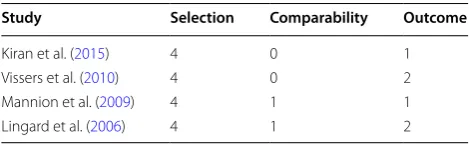
The Newcastle Ottawa Scale provides a system for assessing quality across three domains: selection, comparability, and outcome (Stang 2010). Each domain is scored with a star rat-ing system. A summary score is not provided in an attempt to provide data on the biases inherent in the study design.
Data extraction
After the initial search was performed the studies were screened for eligibility in sequential rounds where their relevance was assessed using at first their titles and abstracts, and finally full review of the paper. Two review-ers (TC and TB), who were both experienced in perform-ing systematic reviews, then independently re-examined each full paper to ensure that they met the inclusion cri-teria. Relevant data was extracted and a quality assess-ment performed independently by both reviewers, resolving any differences through discussion and review.
Due to the nature and heterogeneity of the analyses used in the studies, combined with the heterogeneity of the measurements of expectations and satisfaction, no formal meta-analysis was performed.
Results
Description of studies
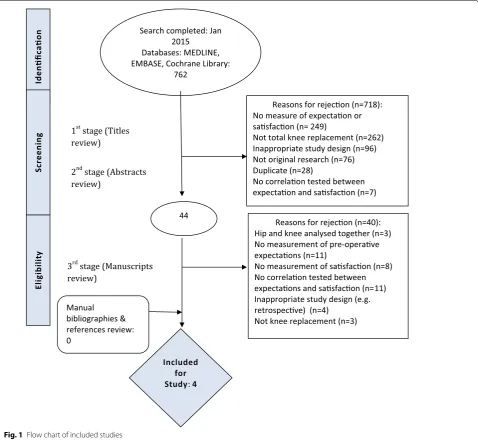
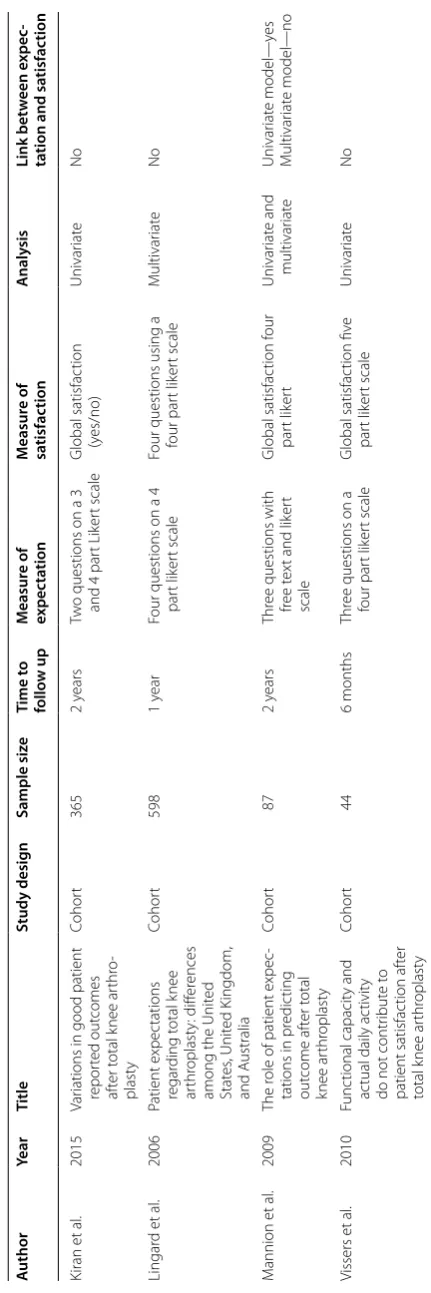
Our search returned 762 studies. Of these some were duplicates from multiple databases that due to a techni-cal limitation had to be removed by hand during the title search. Figure 1 is a flow chart detailing the studies that were excluded. We have included four studies in this review (Table 1).
Quality assessment
Table 2 describes the quality assessment using the New-castle Ottawa scale. All studies were judged to be of simi-lar quality.
Expectations and satisfaction
Of the four studies included in the review the sample size varied from 44 to 598. A different method of meas-uring expectations was used in each study, and a differ-ent method for measuring satisfaction was used in each study (please see Additional File 2 for description of measures used). One study was international in nature and was also the largest by almost double the sample size (Lingard et al. 2006). All other studies were single centre (Kiran et al. 2015; Vissers et al. 2010; Mannion et al. 2009).
Three studies conducted a univariate analysis (Kiran et al. 2015; Vissers et al. 2010), with only one study find-ing an association between pain and function expecta-tions and satisfaction (Mannion et al. 2009).
Two studies conducted a multivariate analysis and nei-ther found a significant association between expectations
and satisfaction (Lingard et al. 2006; Mannion et al.
2009). One study had the largest sample size and did not conduct univariate analysis (Lingard et al. 2006). The second study, that had found an association in the uni-variate model, did not find an association in the multi-variate model; however, they had a sample size of 87, with over 5 covariates in the model, and had included expectation fulfilment in the multivariate model (Man-nion et al. 2009). It is therefore questionable if this study had the necessary power to conduct this analysis, and the logic of including expectation fulfilment (which would be expected to account for the same variation in the final model as pre-operative expectation) is questionable.
Two studies reported positive finding of expectation related to other outcome measures. Kiran found that pre-operative expectation of no pain gave higher (bet-ter) OKS score (p < 0.01) (Kiran et al. 2015), and Lingard found that pre-operative expectation of no pain resulted in better WOMAC pain scores (p = 0.039) and pre-oper-ative expectation of not needing a walking aid resulted in better WOMAC function score (p < 0.0001) (Lingard et al. 2006).
Discussion
Overall, one study out of four found an association between expectation and satisfaction. This could be due to: each study measuring slightly different constructs of “expectation” and “satisfaction”; the effect of expecta-tion on satisfacexpecta-tion may be small, and of dubious clinical relevance.
This study has highlighted several issues surrounding expectation and satisfaction in knee replacements. The first key finding is the multiple measures used by each study to evaluate expectation and satisfaction. There is a great deal of difficulty in measuring these constructs, and multiple theoretical models exist to try and explain some of the complexity. For example the latent state-trait theory suggests that with measurement instruments we measure a persons state, which will depend upon the person (the person’s traits), the situation, and the interac-tion between the person and situainterac-tion (Steyer et al. 1999). This highlights the difficulty in measuring these con-structs consistently and accurately, and may go some way to explain the low numbers of studies examining this key issue. It seems likely that until the orthopaedic commu-nity can reach a consensus on what is important to meas-ure, and how to measure it, progress will be slow.
Page 4 of 7 Barlow et al. SpringerPlus (2016) 5:167
excluded from this review because they did not make any attempt to test for an association (Suda et al. 2010; Clem-ent et al. 2014; Kumar et al. 2015), or they included hips and knees as one cohort (Gonzalez Saenz de Tejada et al.
2014; Brokelman et al. 2008; Gandhi et al. 2009). This is a key finding is itself, as pre-operative expectations would be an ideal target for modification if an association were present. It may be that the difficulty surrounding reliable measurements of these constructs is responsible.
Limitations of this review include the lack of formal meta-analysis, which was not possible due to the hetero-geneity within the papers included. English language arti-cles were specified in the inclusion criteria for full paper
review, but not in the search strategy. Therefore, although the possibility of missing important information from other sources existed, in practice there were no fully pub-lished papers in other languages that would have met the inclusion criteria.
There was some variation in the length of follow up between studies. This has the potential to introduce a form of timing bias as it has been shown that the func-tional status of knees after replacement can improve for around 2 years following surgery (Pynsent et al. 2005). Studies that did not show associations in some domains might well have done so if the length of follow up was extended.
Idenficao
n
Screenin
g
Eligibilit
y
Search completed: Jan 2015
Databases: MEDLINE, EMBASE, Cochrane Library:
762
44
Included for Study:4
Reasons for rejecon (n=718): No measure of expectaon or sasfacon (n= 249)
Not total knee replacement (n=262) Inappropriate study design (n=96) Not original research (n=76) Duplicate (n=28)
No correlaon tested between expectaon and sasfacon (n=7)
Reasons for rejecon (n=40): Hip and knee analysed together (n=3) No measurement of pre-operave expectaons (n=11)
No measurement of sasfacon (n=8) No correlaon tested between expectaons and sasfacon (n=11) Inappropriate study design (e.g. retrospecve) (n=4)
Not knee replacement (n=3) Manual
bibliographies & references review: 0
1ststage (Titles review)
2ndstage (Abstracts review)
3rdstage (Manuscripts review)
[image:5.595.59.538.90.530.2]Table 1 I ncluded studies A uthor Year Title Study desig n Sample siz e Time t o follo w up M easur e of expec ta tion M easur e of sa tisfac tion A naly sis Link bet w een e xpec -ta tion and sa tisfac tion Kiran et al . 2015 Var
iations in good patient repor
ted out comes af ter t otal k nee ar thr o-plast y Cohor t 365 2 years Tw
o questions on a 3 and 4 par
t Lik er t scale Global satisfac tion (y es/no) Univar iat e No Lingar d et al . 2006 Patient expec tations regar ding t otal k nee ar thr oplast y: diff er ences
among the Unit
ed Stat es , Unit ed K ingdom, and A ustralia Cohor t 598 1 year
Four questions on a 4 par
t lik
er
t scale
Four questions using a four par
t lik er t scale M ultivar iat e No M annion et al . 2009 The r
ole of patient expec
-tations in pr
edic ting out come af ter t otal knee ar thr oplast y Cohor t 87 2 years Thr
ee questions with free t
ex
t and lik
er t scale Global satisfac tion f our par t lik er t Univar iat e and multivar iat e Univar iat e model— yes M ultivar iat e model—no Vissers et al . 2010 Func tional capacit y and ac
tual daily ac
tivit
y
do not contr
ibut e t o patient satisfac tion af ter total k nee ar thr oplast y Cohor t 44 6 months Thr
ee questions on a four par
[image:6.595.180.396.84.732.2]Page 6 of 7 Barlow et al. SpringerPlus (2016) 5:167
Systematic reviews are always subject to publication bias and in particular the delay or lack of publication of stud-ies with negative findings (Stern and Simes 1997). We have tried to minimise this by including all archived, published research from each of our searched databases, but the pos-sibility remains that some evidence may remain unpub-lished. This is more likely from older, less well-designed studies, as the resources required performing a high quality modern, observational study would dictate publication irre-spective of the findings. As the concepts and subsequent measurement of expectations and satisfaction are relatively new, it is likely we have included all relevant studies.
Some other studies have been conducted examining the association between expectation in hip and knee and satisfaction. Of these, a study conducted by Gonzalez et al. that was multicentre and included a multivariate analysis demonstrated a significant effect of expectations on satisfaction (Gonzalez Saenz de Tejada et al. 2014), whereas two others, with smaller sample sizes and from single centres, did not (Brokelman et al. 2008; Gandhi et al. 2009). This does tend to suggest that the construct of expectation and satisfaction that is being measured is key and can alter the significance of the result.
A further issue surrounds that of the clinical signifi-cance of our result. Certainly, with regard to satisfac-tion, managing a patient’s pre-operative expectation appears to have little effect on post-operative satisfac-tion. However, this is not the whole picture, as outcome can be measured in a multitude of different ways. Patient Reported Outcome Measures (PROMs) show associa-tions with pre-operative expectaassocia-tions in multiple stud-ies (Kiran et al. 2015; Lingard et al. 2006; Mahomed et al.
2002), and expectations are associated with length of stay and discharge destination (Halawi et al. 2015a, b).
Conclusion
One out of four studies found evidence of an associa-tion between pre-operative expectaassocia-tions and satisfac-tion. While this could be interpreted as either no effect, or a small, clinically insignificant effect, we would caution against a move to abandon management of patient expec-tations for two reasons: expecexpec-tations and satisfaction are difficult constructs to measure, and the papers included here may be measuring different aspects of these
constructs; satisfaction is not the only outcome meas-ure available, and other outcome measmeas-ures are related to pre-operative expectations. One of the major findings of this paper is the lack of large, high quality, studies that have examined this key issue, and the lack of consensus within the literature on how to measure expectation and satisfaction.
Authors’ contributions
TB conceived, designed, conducted the search, extracted data, and wrote the paper. TC extracted data and helped draft the paper. MD designed and helped draft the paper. DG designed and helped draft the paper. All authors read and approved the final manuscript.
Acknowledgements
We would like to thank Arthritis Research U.K. for help with funding this research.
Competing interests
TB received salary from Arthritis Research U.K. while performing this review. DG and TB have received project grant funding from Arthritis Research U.K. The authors declare that they have no competing interests.
Received: 19 November 2015 Accepted: 12 February 2016
References
Adie S, Dao A, Harris IA, Naylor JM, Mittal R (2012) Satisfaction with joint replacement in public versus private hospitals: a cohort study. ANZ J Surg 82(9):616–624
Bandura A (1977) Self-efficacy: toward a unifying theory of behavioral change. Psychol Rev 84(2):191–215
Brokelman R, van Loon C, van Susante J, van Kampen A, Veth R (2008) Patients are more satisfied than they expected after joint arthroplasty. Acta Orthop Belg 74(1):59–63
Callahan CM, Drake BG, Heck DA, Dittus RS (1994) Patient outcomes follow-ing tricompartmental total knee replacement. A meta-analysis. JAMA 271(17):1349–1357
Clement ND, Macdonald D, Patton JT, Burnett R (2014) Post-operative Oxford knee score can be used to indicate whether patient expectations have been achieved after primary total knee arthroplasty. Knee Surg Sports Traumatol Arthrosc. doi:10.1007/s00167-014-2865-0
Dyck BA, Zywiel MG, Mahomed A, Gandhi R, Perruccio AV, Mahomed NN (2014) Associations between patient expectations of joint arthroplasty surgery and pre- and post-operative clinical status. Expert Rev Med Devices 11(4):403–415. doi:10.1586/17434440.2014.916208
Egger M, Schneider M, Davey Smith G (1998) Spurious precision? Meta-analy-sis of observational studies. BMJ 316(7125):140–144
Gandhi R, Davey JR, Mahomed N (2009) Patient Expectations predict greater pain relief with joint arthroplasty. J Arthroplasty 24(5):716–721. doi:10.1016/j.arth.2008.05.016
Gonzalez Saenz de Tejada M, Escobar A, Bilbao A, Herrera-Espineira C, Garcia-Perez L, Aizpuru F, Sarasqueta C (2014) A prospective study of the associa-tion of patient expectaassocia-tions with changes in health-related quality of life outcomes, following total joint replacement. BMC Musculoskelet Disord 15:248. doi:10.1186/1471-2474-15-248
Additional files
Additional file 1. Search strategy.
Additional file 2. Measures of expectation and satisfaction. Table 2 Quality assessment
Study Selection Comparability Outcome
[image:7.595.56.291.102.174.2]Grotle M, Hagen KB, Natvig B, Dahl FA, Kvien TK (2008) Obesity and osteoar-thritis in knee, hip and/or hand: an epidemiological study in the general population with 10 years follow-up. BMC Musculoskelet Disord 9:132. doi:10.1186/1471-2474-9-132
Haanstra TM, Van Den Berg T, Ostelo RW, Poolman RW, Jansma IP, Cuijpers P, de Vet HCW (2012) Systematic review: do patient expectations influence treatment outcomes in total knee and total hip arthroplasty? Health Qual Life Outcomes. doi:10.1186/1477-7525-10-152
Halawi MJ, Vovos TJ, Green CL, Wellman SS, Attarian DE, Bolognesi MP (2015a) Patient expectation is the most important predictor of discharge destina-tion after primary total joint arthroplasty. J Arthroplasty 30(4):539–542. doi:10.1016/j.arth.2014.10.031
Halawi MJ, Vovos TJ, Green CL, Wellman SS, Attarian DE, Bolognesi MP (2015b) Preoperative predictors of extended hospital length of stay following total knee arthroplasty. J Arthroplasty 30(3):361–364. doi:10.1016/j. arth.2014.10.025
Hawker GA, Badley EM, Croxford R, Coyte PC, Glazier RH, Guan J, Harvey BJ, Wil-liams JI, Wright JG (2009) A population-based nested case–control study of the costs of hip and knee replacement surgery. Med Care 47(7):732– 741. doi:10.1097/MLR.0b013e3181934553
Heck DA, Robinson RL, Partridge CM, Lubitz RM, Freund DA (1998) Patient outcomes after knee replacement. Clin Orthop Relat Res 356:93–110 Jokela M, Hintsanen M, Hakulinen C, Batty GD, Nabi H, Singh-Manoux A,
Kivimaki M (2013) Association of personality with the development and persistence of obesity: a meta-analysis based on individual-participant data. Obes Rev 14(4):315–323. doi:10.1111/obr.12007
Judge A, Arden NK, Cooper C, Kassim Javaid M, Carr AJ, Field RE, Dieppe PA (2012) Predictors of outcomes of total knee replacement surgery. Rheu-matology (Oxford) 51(10):1804–1813. doi:10.1093/rheumatology/kes075
Juni P, Reichenbach S, Dieppe P (2006) Osteoarthritis: rational approach to treating the individual. Best Pract Res Clin Rheumatol 20(4):721–740. doi:10.1016/j.berh.2006.05.002
Kiran A, Bottomley N, Biant LC, Javaid MK, Carr AJ, Cooper C, Field RE, Mur-ray DW, Price A, Beard DJ, Arden NK (2015) Variations in good patient reported outcomes after total knee arthroplasty. J Arthroplasty. doi:10.1016/j.arth.2015.02.039
Kumar M, Battepathi P, Bangalore P (2015) Expectation fulfilment and satisfac-tion in total knee arthroplasty patients using the ‘PROFEX’ quessatisfac-tionnaire. Orthop Traumatol Surg Res. doi:10.1016/j.otsr.2014.12.016
Lingard EA, Katz JN, Wright EA, Sledge CB (2004) Predicting the outcome of total knee arthroplasty. J Bone Joint Surg Am 86-A(10):2179–2186 Lingard EA, Sledge CB, Learmonth ID (2006) Patient expectations
regard-ing total knee arthroplasty: differences among the United States, United Kingdom, and Australia. J Bone Joint Surg Am 88(6):1201–1207. doi:10.2106/jbjs.e.00147
Mahomed NN, Liang MH, Cook EF, Daltroy LH, Fortin PR, Fossel AH, Katz JN (2002) The importance of patient expectations in predicting functional outcomes after total joint arthroplasty. J Rheumatol 29(6):1273–1279
Mannion AF, Kampfen S, Munzinger U, Kramers-de Quervain I (2009) The role of patient expectations in predicting outcome after total knee arthro-plasty. Arthritis Res Ther 11(5):R139. doi:10.1186/ar2811
Peat G, Thomas E, Duncan R, Wood L, Hay E, Croft P (2006) Clinical classification criteria for knee osteoarthritis: performance in the general popula-tion and primary care. Ann Rheum Dis 65(10):1363–1367. doi:10.1136/ ard.2006.051482
PRISMA (2012) Preferred reporting items for systematic reviews and meta-analyses. PRISMA. Accessed Feb 2012
Pynsent PB, Adams DJ, Disney SP (2005) The Oxford hip and knee outcome questionnaires for arthroplasty. J Bone Joint Surg Br 87(2):241–248 Razmjou H, Yee A, Ford M, Finkelstein JA (2006) Response shift in outcome
assessment in patients undergoing total knee arthroplasty. J Bone Joint Surg 88(12):2590–2595. doi:10.2106/JBJS.F.00283
Registry NJ (2014) National Joint Registry. Accessed Jan 2015
Santaguida PL, Hawker GA, Hudak PL, Glazier R, Mahomed NN, Kreder HJ, Coyte PC, Wright JG (2008) Patient characteristics affecting the prognosis of total hip and knee joint arthroplasty: a systematic review. Can J Surg 51(6):428–436
Sara G, Nicky B, Mireille T, Paul E, Sylvia R (2009) Uncovering selection bias in case-control studies using Bayesian poststrati ctation. Biostatistics 10(1):17–31
Scott CE, Bugler KE, Clement ND, MacDonald D, Howie CR, Biant LC (2012) Patient expectations of arthroplasty of the hip and knee. J Bone Joint Surg Br 94(7):974–981. doi:10.1302/0301-620x.94b7.28219
Smith BW, Zautra AJ (2008) The effects of anxiety and depression on weekly pain in women with arthritis. Pain 138(2):354–361. doi:10.1016/j. pain.2008.01.008
Stang A (2010) Critical evaluation of the Newcastle-Ottawa scale for the assessment of the quality of nonrandomized studies in meta-analyses. Eur J Epidemiol 25(9):603–605. doi:10.1007/s10654-010-9491-z
Stern JM, Simes RJ (1997) Publication bias: evidence of delayed publication in a cohort study of clinical research projects. BMJ 315(7109):640–645 Steyer R, Schmitt M, Eid M (1999) Latent state-trait theory and research in
personality and individual differences. Eur J Pers 13(13):389–408 Suda AJ, Seeger JB, Bitsch RG, Krueger M, Clarius M (2010) Are patients’
expec-tations of hip and knee arthroplasty fulfilled? A prospective study of 130 patients. Orthopedics. doi:10.3928/01477447-20100104-7
Vissers MM, de Groot IB, Reijman M, Bussmann JB, Stam HJ, Verhaar JA (2010) Functional capacity and actual daily activity do not contribute to patient satisfaction after total knee arthroplasty. BMC Musculoskelet Disord 11:121. doi:10.1186/1471-2474-11-121