Why are You Taking this Stance?
Identifying and Classifying Reasons in Ideological Debates
Kazi Saidul Hasan and Vincent NgHuman Language Technology Research Institute University of Texas at Dallas
Richardson, TX 75083-0688
{saidul,vince}@hlt.utdallas.edu
Abstract
Recent years have seen a surge of interest in stance classification in online debates. Oftentimes, however, it is important to de-termine not only the stance expressed by an author in her debate posts, but also the reasons behind her supporting or oppos-ing the issue under debate. We therefore examine the new task of reason classifi-cation in this paper. Given the close in-terplay between stance classification and reason classification, we design computa-tional models for examining how automat-ically computed stance information can be profitably exploited for reason classifica-tion. Experiments on our reason-annotated corpus of ideological debate posts from four domains demonstrate that sophisti-cated models of stances and reasons can indeed yield more accurate reason and stance classification results than their sim-pler counterparts.
1 Introduction
In recent years, researchers have begun exploring new opinion mining tasks. One such task isdebate stance classification(SC): given a post written for atwo-sidedtopic discussed in an online debate fo-rum, determine which of the two sides (i.e.,foror against) its author is taking (Agrawal et al., 2003; Thomas et al., 2006; Bansal et al., 2008; Soma-sundaran and Wiebe, 2009; Burfoot et al., 2011; Hasan and Ng, 2013b). For example, the author of the post shown in Figure 1 is pro-abortion.
Oftentimes, however, it is important to deter-mine not only the author’s stance expressed in her debate posts, but also the reasons why she supports or opposes the issue under debate. Intuitively, given a debate topic such as “Should abortion be banned?” or “Do you support Obamacare?”, it
[I feel that abortion should remain legal, or rather, parents should have the power to make the decision themselves and not face any legal hindrance of any form.]1Let us take a
look from the social perspective. [If parents cannot afford to provide for the child, or if the family is facing financial constraints, it is understandable that abortion can remain as one of the options.]2
Reason 1:Woman’s right to abort
Reason 2:Unwanted babies are threat to their parents’ fu-ture
Figure 1: A sample post on abortion annotated with reasons.
should not be difficult for us to come up with a set of reasons people typically use to back up their stances. Given a set of reasons associated with each stance in an online debate, the goal of post-level reason classification is to identify those rea-son(s) an author uses to back up her stance in her debate post. A more challenging version of this task issentence-level reason classification, where the goal is to identify not only the reason(s) an au-thor uses in her post, but also the sentence(s) in the post that the author uses to describe each of her reasons. For example, the author of the post shown in Figure 1 mentions two reasons why she supports abortion, namelyit’s a woman’s right to abortandunwanted babies are threat to their par-ents’ future, which are mentioned in the first and third sentences in the post respectively.
Our goal in this paper is to examine post- and sentence-level reason classification (RC) in ideo-logical debates. Many online debaters use emo-tional languages, which may involve sarcasm and insults, to express their points, thereby making RC and SC in ideological debates potentially more challenging than that in other debate settings such as congressional debates and company-internal discussions (Walker et al., 2012).
Besides examining the new task of RC in ide-ological debates, we believe that our work makes three contributions. First, we propose to address post-level RC by means of sentence-level RC by
(1) determining the reason(s) associated with each of its sentences (if any), and then (2) taking the union of the set of reasons associated with all of its sentences to be the set of reasons associated with the post. We hypothesize that this sentence-based approach, which exploits a training set in which each sentence in a post is labeled with its reason, would achieve better performance than a multi-labeltext classification approach to post-level RC, which learns to determine the subset of reasons a post contains directly from a training set in which each post is labeled with the corresponding set of reasons. In other words, we hypothesize that we could achieve better results for post-level RC by learning from sentence-level than frompost-level reason annotations, as sentence-level reason anno-tations can enable a learning algorithm to accu-rately attribute an annotated reason to a particular portion of a post.
Second, we proposestance-supported RC sys-tems, hypothesizing that automatically computed stance information can be profitably exploited for RC. Since we are exploiting automatically com-puted (and thus potentially noisy) stance informa-tion, we hypothesize that the effectiveness of such information would depend in part on the way it is exploited in RC systems. As a result, we introduce a set of stance-supported models for RC, start-ing with simple pipeline models and then mov-ing on to joint models with increasmov-ing sophisti-cation. Note that exploiting stance information by no means guarantees that RC performance will improve, as an incorrect determination of stance could lead to an incorrect identification of rea-sons. Hence, one of our goals is to examine how to model stances and reasons so that RC can benefit from stance information.
Finally, since progress on RC is hindered in part by the lack of an annotated corpus, we make our reason-annotated dataset publicly available.1 To
our knowledge, this will be the first publicly avail-able corpus for sentence- and post-level RC.
2 Corpus and Annotation
We collected debate posts from four popular domains, Abortion (ABO), Gay Rights (GAY), Obama (OBA), and Marijuana (MAR), from an online debate forum2. All debates are two-sided,
1http://www.hlt.utdallas.edu/˜saidul/
stance/
2http://www.createdebate.com/
so each post receives one of twostance labels,for or against, depending on whether the author of the postsupportsoropposesabortion, gay rights, Obama, or the legalization of marijuana respec-tively. A post’s stance label is given by its author.
Note that each post belongs to athread, which is a tree with one or more nodes such that (1) each node corresponds to a debate post, and (2) a post
yi is the parent of another post yj ifyj is a reply toyi. Given a thread, we generatepost sequences, each of which is a path from the root of the thread to one of its leaves. Hence, a post sequence is an ordered set of posts such that each post is a reply to its immediately preceding post in the sequence. Table 2a shows the statistics of the four stance-labeled datasets.
While the debate posts contain the stance labels given by their authors, they are not annotated with reasons. As part of our study of RC, we annotate each post with the reasons it gives for its stance. Our annotation procedure is composed of three steps. First, two human annotators independently examined each post and identified the reasons au-thors present to support their stances (i.e.,forand against) in each domain. Second, they discussed and agreed on the reasons identified for each do-main. Third, they independently annotated the text of each post with reason labels from the post’s do-main. To do this, they labeled each sentence of a post with the set of reasons the author expressed in that sentence. Any sentence that does not belong to any reason class was assigned the NONEclass.
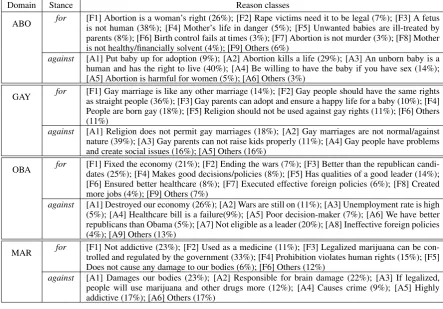
After the annotators completed the aforemen-tioned steps, they were asked to collapse all the reason classes that occur in less than 2% of the sentences annotated with non-NONE classes into the OTHERclass. In other words, all the sentences that were originally annotated with one of these infrequent reason classes will now be labeled as OTHER. Our decision to merge infrequent classes is motivated by two observations. First, from a practical point of view, infrequent reasons do not carry much weight. Second, from a modeling per-spective, it is often not worth increasing model complexity by handling infrequent classes. The resulting set of reason classes for each domain is shown in Table 1.
Domain Stance Reason classes
ABO for [F1] Abortion is a woman’s right (26%); [F2] Rape victims need it to be legal (7%); [F3] A fetusis not human (38%); [F4] Mother’s life in danger (5%); [F5] Unwanted babies are ill-treated by parents (8%); [F6] Birth control fails at times (3%); [F7] Abortion is not murder (3%); [F8] Mother is not healthy/financially solvent (4%); [F9] Others (6%)
against [A1] Put baby up for adoption (9%); [A2] Abortion kills a life (29%); [A3] An unborn baby is a human and has the right to live (40%); [A4] Be willing to have the baby if you have sex (14%); [A5] Abortion is harmful for women (5%); [A6] Others (3%)
GAY for [F1] Gay marriage is like any other marriage (14%); [F2] Gay people should have the same rightsas straight people (36%); [F3] Gay parents can adopt and ensure a happy life for a baby (10%); [F4] People are born gay (18%); [F5] Religion should not be used against gay rights (11%); [F6] Others (11%)
against [A1] Religion does not permit gay marriages (18%); [A2] Gay marriages are not normal/against nature (39%); [A3] Gay parents can not raise kids properly (11%); [A4] Gay people have problems and create social issues (16%); [A5] Others (16%)
OBA for [F1] Fixed the economy (21%); [F2] Ending the wars (7%); [F3] Better than the republican candi-dates (25%); [F4] Makes good decisions/policies (8%); [F5] Has qualities of a good leader (14%); [F6] Ensured better healthcare (8%); [F7] Executed effective foreign policies (6%); [F8] Created more jobs (4%); [F9] Others (7%)
against [A1] Destroyed our economy (26%); [A2] Wars are still on (11%); [A3] Unemployment rate is high (5%); [A4] Healthcare bill is a failure(9%); [A5] Poor decision-maker (7%); [A6] We have better republicans than Obama (5%); [A7] Not eligible as a leader (20%); [A8] Ineffective foreign policies (4%); [A9] Others (13%)
MAR for [F1] Not addictive (23%); [F2] Used as a medicine (11%); [F3] Legalized marijuana can be con-trolled and regulated by the government (33%); [F4] Prohibition violates human rights (15%); [F5] Does not cause any damage to our bodies (6%); [F6] Others (12%)
[image:3.595.75.519.64.373.2]against [A1] Damages our bodies (23%); [A2] Responsible for brain damage (22%); [A3] If legalized, people will use marijuana and other drugs more (12%); [A4] Causes crime (9%); [A5] Highly addictive (17%); [A6] Others (17%)
Table 1: Reason classes and their percentages in the corresponding stance for each domain.
sentences given their rarity, we asked each annota-tor to pick the reason that was highlighted the most in each multi-labeled sentence.
Inter-annotator agreement scores at the sentence level and the post level, expressed in terms of Co-hen’s Kappa (Carletta, 1996), are shown in Ta-ble 2b. Given that the majority of sentences were labeled as NONE, we avoid inflating agreement by notconsidering the sentences labeled with NONE by both annotators when computing Kappa. As we can see, we achieved substantial post-level agree-ment and high sentence-level agreeagree-ment.
The major source of inter-annotator disagree-ment for all four datasets stems from the fact that in many cases, the annotators, while agreeing on the reason class, differ on how long the text span for a reason should be. This hurts sentence-level agreement but not post-level agreement, since the latter only concerns whether a reason was men-tioned in a post, and explains why the sentence-level agreement scores are lower than the corre-sponding post-level scores. Minor sources of dis-agreement arise from the facts that (1) the anno-tators selected different reason labels for some of the multi-labeled sentences, and (2) they tend to disagree in some cases where authors use sarcasm
ABO GAY OBA MAR Stance-labeled posts 1741 1376 985 626 forposts (%) 54.9 63.4 53.9 69.5 Average post sequence length 4.1 4.0 2.6 2.5
(a) Statistics of stance-labeled posts ABO GAY OBA MAR Reason-labeled posts 463 561 447 432 % of sentences w/ reason tags 20.4 29.8 34.4 43.7 Kappa (sentence) 0.66 0.63 0.61 0.67 Kappa (post) 0.82 0.80 0.78 0.83
(b) Statistics of reason-labeled posts
Table 2: Stance and reason annotation statistics.
to present a reason. Each case of disagreement is resolved through discussion among the annotators.
3 Baseline RC System
Our baseline system uses a maximum entropy (MaxEnt) classifier to determine whether a reason is expressed in a post and/or its sentence(s). We create one training instance for each sentence in each post in the training set, using the reason label as its class label. We represent each instance using five types of features, as described below.
[image:3.595.307.516.408.525.2]binary feature indicating the n-gram’s presence or absence in a given sentence.
Dependency-based features. To capture the inter-word relationships that n-grams may not, we employ the dependency-based features previ-ously used for stance classification in Anand et al. (2011). These features have three variants. In the first variant, the pair of arguments involved in each dependency relation extracted by a depen-dency parser is used as a feature. The second vari-ant is the same as the first except that the head (i.e., the first argument in a relation) is replaced by its part-of-speech tag. The features in the third vari-ant, the topic-opinion features, are created by re-placing each sentiment-bearing word in features of the first two types with its corresponding polarity label (i.e., + or−).
Frame-semantic features. While dependency-based features capture the syntactic dependencies, frame-semantic features encode the semantic rep-resentation of the concepts in a sentence. Fol-lowing our previous work on stance classification (Hasan and Ng, 2013c), we employ three types of features computed based on the frame-semantic parse of each sentence in a post obtained from SE-MAFOR (Das et al., 2010). Frame-word interac-tionfeatures encode whether two words appear in different elements of the same frame. Hence, each frame-word interaction feature consists of (1) the name of the framef from which it is created, and (2) an unordered word pair in which the words are taken from two frame elements off. Aframe-pair feature is represented as a word pair corresponding to the names of two frames and encodes whether the target word of the first frame appears within an element of the second frame. Finally,frame n-gramfeatures are a variant of word n-grams. For each word n-gram in the sentence, a frame n-gram feature is created by replacing one or more words in the word n-gram with the name of the frame or the frame element in which the word appears. A detailed description of these features can be found in Hasan and Ng (2013c).
Quotation features. We employ two quotation features. IsQuoteis a binary feature that indicates whether a sentence is a quote or not (i.e., whether it appeared in its parent post in the post sequence). Note that if an instance is a quote from a previ-ous post, it is unlikely that it represents a reason the author is presenting to support her argument. Instead, the author may have quoted this before
stating her counter-argument. FollowsQuoteis a binary feature that indicates whether a sentence follows a sentence for which the IsQuotefeature value is true. Intuitively, a sentence following a quote is likely to present a counter-argument. Positional feature. We split each post into four parts (such that each part contains roughly the same number of sentences) and create one posi-tional feature that encodes which part of the post contains a given sentence. This feature is moti-vated by our observations on the training data that (1) reasons are more likely to appear in the second half of a post and (2) on average more than one-third of the reasons appear in the last quarter of a post.
After training, we can apply the resulting RC system to classify the test instances, which are generated in the same way as the training in-stances. Once the sentences of a test post are clas-sified, we simply assume its post-level reason la-bels to be the set of reason lala-bels assigned by the classifier to its sentences.
4 Stance-Supported RC Systems
In this section, we propose a set of systems for RC. Unlike the baseline RC system, these RC systems are stance-supported, enabling us to ex-plore how different ways of modeling automati-cally computed stances and reasons can improve RC classification. Below we present our systems in increasing order of modeling sophistication.
4.1 Pipeline Systems
We examine two pipeline systems, P1 and P2. Given a set of test posts, both systems first de-termine the stance of each post and then apply a stance-specificreason classifierto each of them.
More specifically, both P1 and P2 employ two stance-specific reason classifiers: one is trained on all the posts labeled asforand the other is trained on all the posts labeled as against. Each stance-specific reason classifier is trained using MaxEnt on the same feature set as that of the Baseline RC system. It computes for a particular stance sthe probabilityP(r|s, t), whereris a reason label and
tis a sentence in a test postp.
P1 and P2 differ only with respect to the SC model used to stance-label each post. In P1, the stancesof a postpis determined by applying top
train-ing instance corresponds to a traintrain-ing post and is represented by all but the quotation and posi-tional features used to train the Baseline RC sys-tem, since these two feature types are sentence-based rather than post-sentence-based. After training, the resulting classifier can be used to stance-label a post independently of the other posts.
In P2, on the other hand, we recast SC as a se-quence labeling task. In other words, we train a SC model that assumes as input a post sequence and outputs a stance sequence, with one stance la-bel for each post in the input post sequence. This choice is motivated by an observation we made previously (Hasan and Ng, 2013a): since each post in a sequence is a reply to the preceding post, we could exploit their dependencies by determining their stance labels together.3
As our sequence learner, we employ a maxi-mum entropy Markov model (MEMM) (McCal-lum et al., 2000). Given an input post sequence
PS = (p1, p2, . . . , pn), the MEMM finds the most probable stance sequenceS = (s1, s2, . . . , sn)by computingP(S|PS), where:
P(S|PS) = n Y
k=1
P(sk|sk−1, pk) (1)
This probability can be computed efficiently via dynamic programming (DP), using a modified ver-sion of the Viterbi algorithm (Viterbi, 1967).
There is a caveat, however. Recall that the post sequences are generated from a thread. Since a test post may appear in more than one sequence, different occurrences of it may be assigned differ-ent stance labels by the MEMM. To determine the final stance label for the post, we average the prob-abilities assigned to theforstance over all its oc-currences; if the average is ≥ 0.5, then its final label isfor; otherwise, its label isagainst.
4.2 System based on Joint Inference
One weakness of the pipeline systems is that errors may propagate from the SC system to the RC sys-tem. If the stance of a post is incorrectly labeled, its reasons will also be incorrectly labeled.
To avoid this problem, we employ joint infer-ence. Specifically, we first train a SC system and
3While we could similarly recast the problem of assigning
reasons to the sentences in a post as a sequence learning task, we did not pursue this idea further because preliminary ex-periments indicated that sequence learning for RC was inef-fective: there is little, if any, dependency between the reason labels in consecutive sentences.
a RC system independently of each other. We em-ploy the Baseline as our RC system, since this is the only RC system that is not stance-specific. For the SC system, we employ P2.
Since the SC system and the RC system are trained independently of each other, their outputs may not be consistent. For instance, an inconsis-tency arises if a post is labeled as forbut one or more of its reasons are associated with the oppos-ing stance. In fact, an inconsistency can arise in the output of the RC system alone: reasons associ-ated with both stances may be assigned by the RC systems to different sentences of a given post.
To enforce consistency, we apply integer lin-ear programming (ILP) (Roth and Yih, 2004). We formulate one ILP program for each debate post. Each ILP program contains two post-stance vari-ables (xfor and xagainst) and |T| ∗ |LR| reason variables (i.e., one indicator variablezt,r for each reason class r and each sentence t), where|T|is the number of sentences in the post and|LR|is the number of reason labels. Our objective is to maxi-mize the linear combination of these variables and their corresponding probabilities assigned by their respective classifiers (see (2) below) subject to two types of constraints, the integrity constraints and the post-reason constraints. The integrity con-straints ensure that each post is assigned exactly one stance and each sentence in a post is assigned exactly one reason class (see the two equality con-straints in (3)). The post-reason concon-straints ensure consistency between the predictions made by the SC and the RC systems. Specifically, (1) if there is at least one reason supporting theforstance, the post must be assigned a for label; and (2) a for post must have at least oneforreason. These con-straints are defined for the against label as well (see the constraints in (4)).
Maximize: X
s∈LS
asxs+|T1|
|T|
X
t=1
X
r∈LR
bt,rzt,r (2)
subject to: X
s∈LS
xs= 1, ∀t X
r∈LR
zt,r= 1,
xs∈ {0, 1}, zt,r ∈ {0, 1}
(3)
∀t xs≥zt,r,
|T|
X
t=1
Note that (1)asand bt,r are two sets of probabil-ities assigned by the SC and RC systems respec-tively; (2) LS and LR denote the set of stance labels and reason labels respectively; and (3) the fraction |T1| ensures that both classifiers are con-tributing equally to the objective function.
4.3 Systems based on Joint Learning
Another way to avoid the error propagation prob-lem in pipeline systems is to perform joint learn-ing. In joint learning, the two tasks, SC and RC, are learned jointly. Below we propose three joint models in increasing level of sophistication.
J1 is a joint model that, given a test postp, finds the stance labelsand the reason label for each of the sentences that together maximize the probabil-ityP(Rp, s|p), whereRp= (r1, r2, . . . , rn)is the sequence of reason labels with ri (1 ≤ i ≤ n) being the reason label assigned toti, thei-th sen-tence inp. Using Chain Rule,
P(Rp, s|p) =P(s|p)P(Rp|s, p)
=P(s|p)Yn i=1
P(ri|s, ti) (5)
Hence, P(Rp, s|p) can be computed by using the stance-specific RC classifier and the SC classi-fier employed in P1.
The second joint model, J2, is the same as J1, except that we recast SC as a sequence la-beling task. As before, we employ MEMM to learn how to predict stance sequences. Given a post sequence PS = (p1, p2, . . . , pn), J2 finds the stance sequence S = (s1, s2, . . . , sn) and rea-sonsR= (R1, R2, . . . , Rn)that jointly maximize
P(R, S|PS). Note thatRi is the sequence of rea-son labels assigned to the sentences in posti.
TheRandSthat jointly maximizeP(R, S|PS) can be found efficiently via DP, using a modified version of the Viterbi algorithm. Unlike in P2, in J2 the decoding process is slightly more compli-cated because we have to take into accountRi. Be-low we show the recursive definitions used to com-pute the entries in the DP table, wherevk(h)is the (k,h)-th entry of the table; P(h|p) is provided by the MaxEnt stance classifier used in P1;P(h|j, p)
is provided by the MEMM stance classifier used in P2; P(rmax
i |h, ti) is provided by the stance-specific reason classifier used in the pipeline sys-tems; andrmax
i is the reason label for sentence ti
that has the highest probability according to the reason classifier.
Base case:
v1(h) =P(h|p)
n Y
i=1
P(rimax|h, ti) (6)
Recursive definition:
vk(h) = maxj vk−1(j)P(h|j, p)
n Y
i=1
P(rmax i |h, ti)
(7)
To motivate our third joint model, J3, we make the following observation. Recall that a post in a post sequence is a reply to its preceding post. An inspection of the training data reveals that in many cases, a reply is a rebuttal to the preced-ing post, where an author attempts to argue why the points or reasons raised in the preceding post are wrong and then provides her reasons for the opposing stance. Motivated by this observation, we hypothesize that the reasons mentioned in the preceding post could be useful for predicting the reasons in the current post. However, none of the models we have presented so far makes use of the reasons predicted for the preceding post.
This motivates the design of J3, which we build on top of J2. Specifically, to incorporate the reason labels predicted for the preceding post in a post se-quence, we augment the feature set of the stance-specific reason classifiers with a set ofreason fea-tures, with one binary feature for each reason. The value of a reason feature is 1 if and only if the cor-responding reason is predicted to be present in the preceding post. Hence, in J3, we can apply the same DP equations we used in J2 except that the set of features used by the reason classifier is aug-mented with the reason features.
5 Evaluation
System
ABO GAY OBA MAR
Stance Sentence PostReason Stance Sentence PostReason Stance Sentence PostReason Stance Sentence PostReason Baseline – 32.7 45.0 – 23.3 40.5 – 19.5 31.5 – 28.7 44.2 P1 62.8 34.5 46.3 63.4 24.5 43.2 61.0 20.3 33.5 67.2 30.5 47.3 P2 65.1 36.1 47.7 64.2 26.6 45.5 63.8 21.1 34.4 68.5 32.9 48.8 ILP 65.2 36.5 48.4 64.6 28.0 46.7 63.6 22.8 35.0 68.8 33.1 48.9 J1 62.5 36.0 47.6 64.0 26.7 45.6 61.2 23.1 35.7 67.8 33.3 49.2 J2 65.9 37.9 50.6 65.3 29.6 48.5 63.5 24.5 37.1 68.7 34.5 50.5
[image:7.595.71.529.61.203.2]J3 66.3 39.5 52.3 65.7 31.4 49.8 64.0 25.1 38.0 69.0 35.1 51.1
Table 3: SC accuracies and RC F-scores for our five-fold cross-validation experiments.
5.1 Experimental Setup
We express SC results in terms of accuracy (i.e., the percentage of test posts labeled with the cor-rect stance) and RC results in terms of F-score micro-averaged over all reason classes except the NONE class. For each RC system, we report its sentence-level RC score and post-level RC score, which are computed over sentences and posts re-spectively. As mentioned at the end of Section 3, the set of post-level reason labels of a given post is automatically obtained by taking the union of the set of reason labels assigned to each of its sen-tences. Hence, a reason classifier will be rewarded as long as it can predict, for any sentence in a test post, a reason label that the annotators assigned to some sentence in the same post.
We obtain these scores via five-fold cross-validation experiments. During fold partition, all posts that are in the same post sequence are as-signed to the same fold. All reason and stance classifiers are domain-specific, meaning that each of them is trained on sentences/posts from ex-actly one domain and is applied to classify sen-tences/posts from the same domain. We use the Stanford maximum entropy classifier4 for
classifi-cation and solve ILP programs usinglpsolve5.
5.2 Results and Discussion
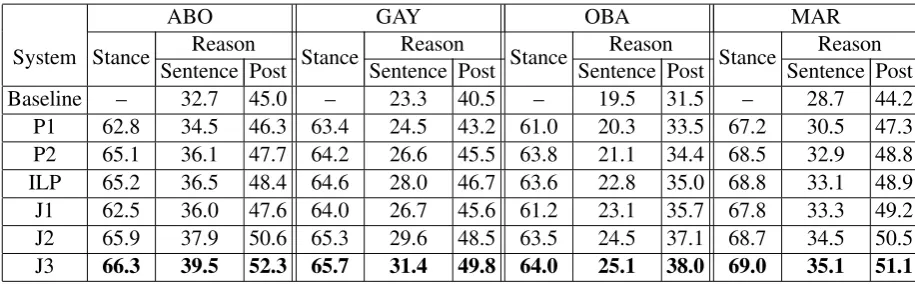
Results are shown in Table 3. Each row corre-sponds to one of our seven RC systems, showing its SC accuracy as well as its sentence- and post-level RC F-scores for each domain.
Let us begin by discussing the RC results.First, P1 and P2 significantly beat the Baseline on all
4http://nlp.stanford.edu/software/
classifier.shtml
5http://sourceforge.net/projects/
lpsolve/
four domains by an average of 1.4 and 3.1 points at the sentence level and by an average of 2.3 and 3.8 points at the post level respectively.6 These
re-sults show that stance information can indeed be profitably used for RC even if it is incorporated into RC systems in a simple manner. Second, improving SC through sequence learning can im-prove RC: the systems in which SC is recast as se-quence labeling (P2 and J2) perform significantly better than the corresponding systems that do not (P1 and J1). Third, ILP significantly beats P2 on two domains (ABO and GAY) and achieves the same level of performance as P2 on the remain-ing domains. These results suggest that joint infer-ence is no worse (and sometimes even better) than pipeline learning as far as exploiting stance infor-mation for RC is concerned. Fourth, the systems trained via joint learning (J1 and J2) beat their cor-responding pipeline counterparts (P1 and P2) on all four domains, significantly so by an average of 2.3 and 2.5 points at the sentence level and by an average of 2.0 and 2.6 points at the post level re-spectively, suggesting that joint learning is indeed a better way to incorporate stance information than pipeline learning. Finally, J3, the joint system that exploits reasons predicted for the previous post, significantly beats J2, the system on which it is built, by 1.6 and 1.8 points at the sentence level and by 1.7 and 1.3 points at the post level for ABO and GAY respectively. It also yields small, statis-tically insignificant, improvements (0.6 points at the sentence level and 0.6–0.9 points at the post level) for the remaining two domains. These re-sults suggest that the reasons predicted for the pre-vious post indeed provide useful information for predicting the current post’s reasons.
Overall, these results are consistent with our
pothesis that the usefulness of stance information depends in part on the way it is exploited, and that RC performance increases as we employ more sophisticated methods for modeling reasons and stances. Our best system, J3, significantly beats the Baseline by an average of 6.7 and 7.5 points at the sentence and post levels respectively.
As mentioned earlier, a secondary goal of this work is to determine whether joint modeling can improve SC as well. For that reason, we com-pare the performances of the best pipeline model (P2) and the best joint model (J3) on each domain. We find that in terms of SC accuracy, J3 is signifi-cantly better than P2 on ABO and GAY, and yields slightly, though insignificantly, better performance on the remaining two domains. In other words, our results suggest that joint modeling of SC and RC has a positive impact on SC performance on all domains, and the impact can sometimes be large enough to yield significantly better results.
5.3 Further Comparison
We hypothesized in the introduction that the sentence-based approach to post-level RC would yield better performance than the multi-label text classification approach. In Section 5.2, we pre-sented results of the sentence-based approach to RC. So, to test this hypothesis, we next evaluate the multi-label text classification approach to RC. Recall that the multi-label text classification ap-proach assumes the following setup. Given a set of training posts where each post is multi-labeled with the set of reasons it contains, the goal is to train a system to determine the set of reasons a test post contains. Hence, unlike in the sentence-based approach, in this approach no sentence-level reason annotations are exploited during training.
We implement this approach by recasting multi-label text classification asnbinary text classifica-tion tasks, wherenis the number of reason classes for a domain. In the binary classification task for predicting reasoni, we train a binary classifierci using the one-versus-all training scheme. Specif-ically, to trainci, we create one training instance for each post p in the training set, labeling it as positive if and only if p contains reason i. Note that ifiis a minority reason, the class distribution of the resulting training set will be highly skewed towards the negatives, which will in turn cause the resulting MaxEnt classifier to be biased towards predicting a test instance as negative.
To address this problem, we adjust the classifi-cation thresholds associated with the binary classi-fiers. Recall that a test instance is classified as pos-itive by a binary classifier if and only if its prob-ability of belonging to the positive class is above the classification threshold used. Hence, adjusting the threshold amounts to adjusting the number of test instances classified as positive, thus address-ing the bias problem mentioned above. Specifi-cally, we adjust the thresholds of the classifiers as follows. We train the binary classifiers to optimize the overall F-score by jointly tuning their classifi-cation thresholds on 25% of the training data re-served for development purposes. Since comput-ing the exact solution to this optimization prob-lem is computationally expensive, we employ a lo-cal search algorithm that changes the value of one threshold at a time to optimize F-score while keep-ing the remainkeep-ing thresholds fixed. Durkeep-ing testkeep-ing, classifierci will classify a test instance as positive if its probability of belonging to the positive class is above the corresponding threshold.
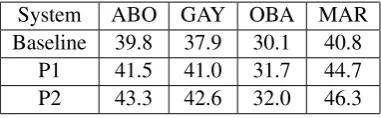
We apply this multi-label text classification ap-proach to obtain post-level RC scores for the Base-line, P1 and P2. Note that since P1 and P2 are pipeline systems, the binary classifiers they use to predict a test post’s reasons depend on the post’s predicted stance. Specifically, if a test post is pre-dicted to have a positive (negative) stance, then only the reason classifiers associated with the pos-itive (negative) stance will be used to predict the reasons it contains. On the other hand, this ap-proach cannot be used in combination with ILP or the joint models to produce post-level RC scores: they all require a reason classifier trained on reason-annotated sentences, which are not avail-able in the multi-label text classification approach. Post-level RC results of the Baseline and the two pipeline systems, P1 and P2, obtained via this multi-label text classification approach are shown in Table 4. These scores are significantly lower than the corresponding scores in Table 3 by 3.2, 2.9, and 3.1 points for the Baseline, P1, and P2 re-spectively, when averaged over the four domains. They confirm our hypothesis that the sentence-based approach to post-level RC is indeed better than its multi-class text classification counterpart.
5.4 Error Analysis
System ABO GAY OBA MAR Baseline 39.8 37.9 30.1 40.8
[image:9.595.86.277.62.121.2]P1 41.5 41.0 31.7 44.7 P2 43.3 42.6 32.0 46.3
Table 4: Post-level RC F-scores obtained via the multi-class text classification approach.
sources of error in this subsection.
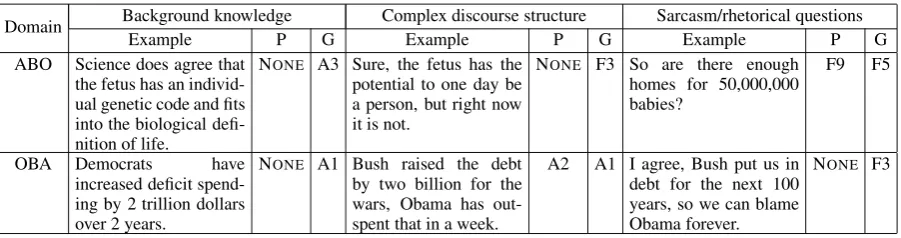
For the four domains, 75–83% of the errors can be attributed to the system’s inability to de-cide whether a sentence describes a reason or not. Specifically, in 51–54% of the erroneous cases, a reason sentence is misclassified as NONE. On the other hand, 23–30% of the cases are concerned with assigning a reason label to a NONEsentence. The remaining 17–25% of the errors concern mis-labeling a reason sentence with the wrong reason. A closer examination of the errors reveals that they resulted primarily from (1) the lack of access to background knowledge, (2) the failure to pro-cess complex discourse structures, and (3) the fail-ure to process sarcastic statements and rhetorical questions. We present two examples for each of these three major sources of error from the ABO and OBA domains in Table 5. In each example, we show their predicted (P) and gold (G) labels. Lack of access to background knowledge. Consider the first example for ABO in Table 5. Our system misclassifies this sentence in part be-cause it lacks the background knowledge that “ge-netic code” is one of the characteristics of life and a fetus having it means a fetus has life (A3). Sim-ilarly, the system cannot determine the reason for the first OBA example without the knowledge that “deficit spending” is a term related to the econ-omy and that increasing it is bad (A1). We believe some of these relations can be extracted from lex-ical knowledge bases such as YAGO2 (Suchanek et al., 2007), Freebase (Bollacker et al., 2008), and BabelNet (Navigli and Ponzetto, 2012).
Failure to process complex discourse struc-tures. Our system misclassifies the second ex-ample for ABO in part because the first part of the sentence (i.e.,Sure, the fetus has the potential to one day be a person) expresses a meaning that is completely inverted by the second part. Such complex discourse structures often lead to classi-fication errors even for sentences whose interpre-tation requires no background knowledge. We be-lieve that this problem can be addressed in part
by a better understanding of the structure of a course, particularly the relation between two dis-course segments, using a disdis-course parser.
Failure to process sarcastic statements and rhetorical questions. Owing to the nature of our dataset (i.e., debate posts), many errors arise from sentences containing sarcasm and/or rhetori-cal questions. This is especially a problem in long post sequences, where authors frequently restate their opponents’ positions, sometimes ironically. A first step towards handling these errors would therefore be to identify sentences containing sar-casm and/or rhetorical questions.
6 Related Work
In this section, we discuss related work in the areas of document-level RC, argument recognition, tex-tual entailment in online debates, argumentation mining, and sentiment analysis.
Domain Background knowledge Complex discourse structure Sarcasm/rhetorical questions
Example P G Example P G Example P G
ABO Science does agree that the fetus has an individ-ual genetic code and fits into the biological defi-nition of life.
NONE A3 Sure, the fetus has the
potential to one day be a person, but right now it is not.
NONE F3 So are there enough
homes for 50,000,000 babies?
F9 F5
OBA Democrats have increased deficit spend-ing by 2 trillion dollars over 2 years.
NONE A1 Bush raised the debt by two billion for the wars, Obama has out-spent that in a week.
A2 A1 I agree, Bush put us in debt for the next 100 years, so we can blame Obama forever.
[image:10.595.75.526.61.180.2]NONE F3
Table 5: Examples of the major sources of error.P and G stand for predicted tag and gold tag respectively.
the post that entail or contradict the title (Cabrio and Villata, 2012). Hence, this task is concerned with identifying text segments that correspond to rationales without a predefined set of rationales, whereas RC is concerned with both identifying text segments and classifying them based on a given set of reasons.
Argumentation mining. The goal of this task is to extract the argumentative structure of a docu-ment. Researchers have proposed approaches to mine the structure of scientific papers (Teufel and Moens, 2000; Teufel, 2001), product reviews (Vil-lalba and Saint-Dizier, 2012; Wyner et al., 2012), newspaper articles (Feng and Hirst, 2011), and le-gal documents (Br¨uninghaus and Ashley, 2005; Wyner et al., 2010; Palau and Moens, 2011; Ash-ley and Walker, 2013). A major difference be-tween this task and RC is that the argument types refer to generic structural cues, textual patterns etc., whereas our reason classes refer to the spe-cific reasons an author may mention to support her stance in a domain. For instance, in the case of a scientific article, the argument types correspond to general background, description of the paper’s or some other papers’ approach, objective, con-trastive and/or comparative comments, etc. (Teufel and Moens, 2000). The argument types for legal documents refer to legal factors which are either pro-plaintiff or pro-defendant (Br¨uninghaus and Ashley, 2005). For instance, for trade secret law cases, factors such as Waiver-of-Confidentiality and Disclosure-in-Public-Forum refer to certain facts strengthening the claim of one of the sides participating in a case.
Sentiment analysis. RC resembles certain tasks in sentiment analysis. One such task is pro and con reason classification in reviews (Kim and Hovy, 2006), where sentences containing opinions as well as reasons justifying the opinions are to be extracted and classified as PRO, CON, or NONE.
Hence, this task focuses on categorizing sentences into coarse-grained, high-level groups (e.g., PRO vs. CON, POSITIVE vs. NEGATIVE), but does not attempt to subcategorize thePROandCONclasses into fine-grained reason classes, unlike RC. Some-what similar to thePROandCONsentence classifi-cation task is the task of determining therelevance of a sentence in a review for polarity classifica-tion. Zaidan et al. (2007) coined the term ratio-naleto refer to any subjective textual content that contains evidence supporting the author’s opinion or stance. These rationales, however, may not al-ways contain reasons. For instance, a sentence that mentions that the author likes a product is a ra-tionale, but it does not contain any reason for her liking it. Methods have been proposed for auto-matically identifying rationales (e.g., Yessenalina et al. (2010), Trivedi and Eisenstein (2013)) and distinguishing subjective from objective materials in a review (e.g., Pang and Lee (2004), Wiebe and Riloff (2005), McDonald et al. (2007), Zhao et al. (2008)). Note that in all these attempts, the end goal is not to classify sentences, but to employ the results of sentence classification to improve a higher-level task, such as sentiment classification.
7 Conclusion
Acknowledgments
We thank the three anonymous reviewers for their detailed and insightful comments on an earlier draft of this paper. This work was supported in part by NSF Grants IIS-1147644 and IIS-1219142. Any opinions, findings, conclusions or recommen-dations expressed in this paper are those of the au-thors and do not necessarily reflect the views or of-ficial policies, either expressed or implied, of NSF.
References
Rakesh Agrawal, Sridhar Rajagopalan, Ramakrishnan Srikant, and Yirong Xu. 2003. Mining newsgroups using networks arising from social behavior. In Pro-ceedings of the 12th International Conference on World Wide Web, pages 529–535.
Pranav Anand, Marilyn Walker, Rob Abbott, Jean E. Fox Tree, Robeson Bowmani, and Michael Minor. 2011. Cats rule and dogs drool!: Classifying stance in online debate. InProceedings of the 2nd Work-shop on Computational Approaches to Subjectivity and Sentiment Analysis, pages 1–9.
Kevin D. Ashley and Vern R. Walker. 2013. From in-formation retrieval (IR) to argument retrieval (AR) for legal cases: Report on a baseline study. In Pro-ceedings of the 26th International Conference on Le-gal Knowledge and Information System, pages 29– 38.
Mohit Bansal, Claire Cardie, and Lillian Lee. 2008. The power of negative thinking: Exploiting label disagreement in the min-cut classification
frame-work. In COLING 2008: Companion volume:
Posters, pages 15–18.
Kurt Bollacker, Colin Evans, Praveen Paritosh, Tim Sturge, and Jamie Taylor. 2008. Freebase: A col-laboratively created graph database for structuring human knowledge. InProceedings of the 2008 ACM SIGMOD International Conference on Management of Data, pages 1247–1250.
Filip Boltuˇzi´c and Jan ˇSnajder. 2014. Back up your stance: Recognizing arguments in online discus-sions. InProceedings of the First Workshop on Ar-gumentation Mining, pages 49–58.
Stefanie Br¨uninghaus and Kevin D. Ashley. 2005. Reasoning with textual cases. InProceedings of the 6th International Conference on Case-Based Rea-soning, pages 137–151.
Clinton Burfoot, Steven Bird, and Timothy Baldwin. 2011. Collective classification of congressional floor-debate transcripts. InProceedings of the 49th Annual Meeting of the Association for Computa-tional Linguistics: Human Language Technologies, pages 1506–1515.
Elena Cabrio and Serena Villata. 2012. Natural lan-guage arguments: A combined approach. In Pro-ceedings of the 20th European Conference on Artifi-cial Intelligence, pages 205–210.
Jean Carletta. 1996. Assessing agreement on classi-fication tasks: The Kappa statistic. Computational Linguistics, 22(2):249–254.
Dipanjan Das, Nathan Schneider, Desai Chen, and
Noah A. Smith. 2010. SEMAFOR 1.0: A
probabilistic frame-semantic parser. Technical re-port, Carnegie Mellon University Technical Report CMU-LTI-10-001.
Vanessa Wei Feng and Graeme Hirst. 2011. Classi-fying arguments by scheme. InProceedings of the 49th Annual Meeting of the Association for Com-putational Linguistics: Human Language Technolo-gies, pages 987–996.
Kazi Saidul Hasan and Vincent Ng. 2013a. Extra-linguistic constraints on stance recognition in ide-ological debates. InProceedings of the 51st Annual Meeting of the Association for Computational Lin-guistics (Volume 2: Short Papers), pages 816–821.
Kazi Saidul Hasan and Vincent Ng. 2013b. Frame se-mantics for stance classification. InProceedings of the Seventeenth Conference on Computational Nat-ural Language Learning, pages 124–132.
Kazi Saidul Hasan and Vincent Ng. 2013c. Stance classification of ideological debates: Data, mod-els, features, and constraints. In Proceedings of the Sixth International Joint Conference on Natural Language Processing, pages 1348–1356.
Soo-Min Kim and Eduard Hovy. 2006. Automatic identification of pro and con reasons in online re-views. InProceedings of the COLING/ACL Main Conference Poster Sessions, pages 483–490.
Andrew McCallum, Dayne Freitag, and Fernando Pereira. 2000. Maximum entropy Markov mod-els for information extraction and segmentation. In
Proceedings of the 17th International Conference on Machine Learning, pages 591–598.
Ryan McDonald, Kerry Hannan, Tyler Neylon, Mike Wells, and Jeff Reynar. 2007. Structured models for fine-to-coarse sentiment analysis. InProceedings of the 45th Annual Meeting of the Association of Com-putational Linguistics, pages 432–439.
Roberto Navigli and Simone Paolo Ponzetto. 2012. BabelNet: The automatic construction, evaluation and application of a wide-coverage multilingual se-mantic network. Artificial Intelligence, 193:217– 250.
Bo Pang and Lillian Lee. 2004. A sentimental educa-tion: Sentiment analysis using subjectivity summa-rization based on minimum cuts. InProceedings of the 42nd Meeting of the Association for Computa-tional Linguistics, pages 271–278.
Isaac Persing and Vincent Ng. 2009. Semi-supervised cause identification from aviation safety reports. In
Proceedings of the Joint Conference of the 47th An-nual Meeting of the ACL and the 4th International Joint Conference on Natural Language Processing of the AFNLP, pages 843–851.
Dan Roth and Wen-tau Yih. 2004. A linear program-ming formulation for global inference in natural lan-guage tasks. InProceedings of the Eighth Confer-ence on Computational Natural Language Learning, pages 1–8.
Swapna Somasundaran and Janyce Wiebe. 2009. Rec-ognizing stances in online debates. In Proceed-ings of the Joint Conference of the 47th Annual Meeting of the ACL and the 4th International Joint Conference on Natural Language Processing of the AFNLP, pages 226–234.
Fabian M. Suchanek, Gjergji Kasneci, and Gerhard Weikum. 2007. YAGO: A core of semantic knowl-edge. In Proceedings of the 16th International World Wide Web Conference, pages 697–706. Simone Teufel and Marc Moens. 2000. What’s yours
and what’s mine: Determining intellectual attribu-tion in scientific text. InProceedings of the 2000 Joint SIGDAT Conference on Empirical Methods in Natural Language Processing and Very Large Cor-pora, pages 9–17.
Simone Teufel. 2001. Task-based evaluation of sum-mary quality: Describing relationships between sci-entific papers. InProceedings of the NAACL Work-shop on Automatic Summarization, pages 12–21. Matt Thomas, Bo Pang, and Lillian Lee. 2006. Get out
the vote: Determining support or opposition from congressional floor-debate transcripts. In Proceed-ings of the 2006 Conference on Empirical Methods in Natural Language Processing, pages 327–335. Rakshit Trivedi and Jacob Eisenstein. 2013.
Dis-course connectors for latent subjectivity in sentiment analysis. InProceedings of the 2013 Conference of the North American Chapter of the Association for Computational Linguistics: Human Language Tech-nologies, pages 808–813.
Maria Paz Garcia Villalba and Patrick Saint-Dizier. 2012. Some facets of argument mining for opinion analysis. InProceedings of the Fourth International Conference on Computational Models of Argument, pages 23–34.
Andrew J. Viterbi. 1967. Error bounds for convolu-tional codes and an asymptotically optimum decod-ing algorithm. IEEE Transactions on Information Theory, 13(2):260–269.
Marilyn Walker, Pranav Anand, Rob Abbott, and Ricky Grant. 2012. Stance classification using dialogic properties of persuasion. InProceedings of the 2012 Conference of the North American Chapter of the Association for Computational Linguistics: Human Language Technologies, pages 592–596.
Janyce Wiebe and Ellen Riloff. 2005. Creating subjec-tive and objecsubjec-tive sentence classifiers from unanno-tated texts. InProceedings of the 6th International Conference on Computational Linguistics and Intel-ligent Text Processing, pages 486–497.
Adam Wyner, Raquel Mochales-Palau, Marie-Francine Moens, and David Milward. 2010. Approaches to text mining arguments from legal cases. In Enrico Francesconi, Simonetta Montemagni, Wim Peters, and Daniela Tiscornia, editors,Semantic Processing of Legal Texts: Where the Language of Law Meets the Law of Language, pages 60–79. Springer-Verlag. Adam Wyner, Jodi Schneider, Katie Atkinson, and Trevor J. M. Bench-Capon. 2012. Semi-automated argumentative analysis of online product reviews. In
Proceedings of the Fourth International Conference on Computational Models of Argument, pages 43– 50.
Ainur Yessenalina, Yejin Choi, and Claire Cardie. 2010. Automatically generating annotator rationales to improve sentiment classification. InProceedings of the ACL 2010 Conference Short Papers, pages 336–341.
Omar Zaidan, Jason Eisner, and Christine Piatko. 2007. Using ”annotator rationales” to improve ma-chine learning for text categorization. In Human Language Technologies 2007: The Conference of the North American Chapter of the Association for Computational Linguistics; Proceedings of the Main Conference, pages 260–267.