Proceedings of the 2019 Conference on Empirical Methods in Natural Language Processing 1222
Attention Optimization for Abstractive Document Summarization
Min Gui1, Junfeng Tian1, Rui Wang1, Zhenglu Yang2
1 Alibaba Group, China
2School of Computer Science, Nankai University, China {guimin.gm, tjf141457, masi.wr}@alibaba-inc.com
Abstract
Attention plays a key role in the improve-ment of sequence-to-sequence-based docu-ment summarization models. To obtain a pow-erful attention helping with reproducing the most salient information and avoiding repeti-tions, we augment the vanilla attention model from both local and global aspects. We pro-pose an attention refinement unit paired with local variance loss to impose supervision on the attention model at each decoding step, and a global variance loss to optimize the atten-tion distribuatten-tions of all decoding steps from the global perspective. The performances on the CNN/Daily Mail dataset verify the effec-tiveness of our methods.
1 Introduction
Abstractive document summarization (Rush et al., 2015;Nallapati et al.,2016;Tan et al.,2017;Chen and Bansal, 2018; Celikyilmaz et al., 2018) at-tempts to produce a condensed representation of the most salient information of the document, as-pects of which may not appear as parts of the original input text. One popular framework used in abstractive summarization is the sequence-to-sequence model introduced by Sutskever et al. (2014). The attention mechanism (Bahdanau et al.,2014) is proposed to enhance the sequence-to-sequence model by allowing salient features to dynamically come to the forefront as needed to make up for the incapability of memorizing the long input source.
However, when it comes to longer documents, basic attention mechanism may lead to distraction and fail to attend to the relatively salient parts. Therefore, some works focus on designing vari-ous attentions to tackle this issue (Tan et al.,2017; Gehrmann et al.,2018). We follow this line of re-search and propose an effective attention refine-ment unit (ARU). Consider the following case. Even with a preliminary idea of which parts of
source document should be focused on (attention), sometimes people may still have trouble in decid-ing which exact part should be emphasized for the next word (the output of the decoder). To make a more correct decision on what to write next, people always adjust the concentrated content by reconsidering the current state of what has been summarized already. Thus, ARU is designed as an update unit based on current decoding state, aiming to retain the attention on salient parts but weaken the attention on irrelevant parts of input.
The de facto standard attention mechanism is a soft attention that assigns attention weights to all input encoder states, while according to previ-ous work (Xu et al.,2015;Shankar et al.,2018), a well-trained hard attention on exact one input state is conducive to more accurate results compared to the soft attention. To maintain good performance of hard attention as well as the advantage of end-to-end trainability of soft attention, we introduce a local variance loss to encourage the model to put most of the attention on just a few parts of input states at each decoding step. Additionally, we propose a global variance loss to directly opti-mize the attention from the global perspective by preventing assigning high weights to the same lo-cations multiple times. The global variance loss is somewhat similar with the coverage mechanism (Tu et al., 2016; See et al., 2017), which is also designed for solving the repetition problem. The coverage mechanism introduces a coverage vec-tor to keep track of previous decisions at each decoding step and adds it into the attention cal-culation. However, when the high attention on certain position is wrongly assigned during pre-vious timesteps, the coverage mechanism hinders the correct assignment of attention in later steps.
Our model surpasses the strong pointer-generator baseline (w/o coverage) (See et al., 2017) on all ROUGE metrics by a large margin. As far as we know, we are the first to introduce explicit loss functions to optimize the attention. More importantly, the idea behind our model is simple but effective. Our proposal could be applied to improve other attention-based models, which we leave these explorations for the future work.
2 Proposed model
2.1 Model Architecture
We adopt the Pointer-Generator Network (PGN) (See et al., 2017) as our baseline model, which augments the standard attention-based seq2seq model with a hybrid pointer network (Vinyals et al., 2015). An input document is firstly fed into a Bi-LSTM encoder, then an uni-directional LSTM is used as the decoder to generate the sum-mary word by word. At each decoding step, the attention distributionat and the context vectorct
are calculated as follows:
eti=vT tanh(Whhi+Wsst+battn) (1)
at=softmax(et) (2)
ct= X
i=1
atihi (3)
where hi andst are the hidden states of the
en-coder and deen-coder, respectively. Then, the token-generation softmax layer reads the context vector ctand current hidden statestas inputs to compute
the vocabulary distribution. To handle OOVs, we inherit the pointer mechanism to copy rare or un-seen words from the input document (refer toSee et al.(2017) for more details).
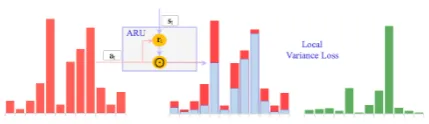
To augment the vanilla attention model, we pro-pose the Attention Refinement Unit (ARU) mod-ule to retain the attention on the salient parts while weakening the attention on the irrelevant parts of input. As illustrated in Figure 1, the attention weight distribution at at timestep t (the first red
histogram) is fed through the ARU module. In the ARU module, current decoding statestand
atten-tion distribuatten-tionatare combined to calculate a
re-finement gatert:
rt=σ(Wsrst+Warat+br) (4)
where σ is the sigmoid activation function, Wr s,
Warandbrare learnable parameters.rtrepresents
[image:2.595.309.524.73.135.2]how much degree of the current attention should
Figure 1: The process of attention optimization (better view in color). The original attention distribution (red bar on the left) is updated by the refinement gatertand
attention on some irrelevant parts are lowered. Then the updated attention distribution (blue bar in the middle) is further supervised by a local variance loss and get a final distribution (green bar on the right).
be updated. Small value of rti indicates that the
content ofi-th position is not much relevant to cur-rent decoding statest, and the attention oni-th
po-sition should be weakened to avoid confusing the model. The attention distribution is updated as fol-lows (the symbolmeans element-wise product):
art =rtat (5)
2.2 Local Variance Loss
As discussed in section 1, the attention model putting most of attention weight on just a few parts of the input tends to achieve good perfor-mance. Mathematically, when only a small num-ber of values are large, the shape of the distribu-tion is sharp and the variance of the attendistribu-tion dis-tribution is large. Drawing on the concept of vari-ance in mathematics, local varivari-ance loss is defined as the reciprocal of its variance expecting the at-tention model to be able to focus on more salient parts. The standard variance calculation is based on the mean of the distribution. However, as pre-vious work (Huang et al.,1979;Jung et al.,2018) mentioned that the median value is more robust to outliers than the mean value, we use the median value to calculate the variance of the attention dis-tribution. Thus, local variance loss can be calcu-lated as:
var(art) = 1
|D|
|D| X
i=1
(arti−aˆrt)2 (6)
LL= 1
T
T X
t
1
var(ar t) +
(7)
2.3 Global Variance Loss
To avoid the model attending to the same parts of the input states repeatedly, we propose another variance loss to adjust the attention distribution globally. Ideally, the same locations should be assigned a relatively high attention weight once at most. Different from the coverage mechanism (See et al.,2017;Tu et al.,2016) tracking attention distributions of previous timesteps, we maintain the sum of attention distributions over all decoder timesteps, denoted asA. Thei-th value ofA repre-sents the accumulated attention that the input state ati-th position has received throughout the whole decoding process. Without repeated high atten-tion being paid to the same locaatten-tion, the difference between the sum of attention weight and maxi-mum attention weight ofi-th input state among all timesteps should be small. Moreover, the whole distribution of the difference over all input posi-tions should have a flat shape. Similar to the def-inition of local variance loss, the global variance loss is formulated as:
gi= X
t
(arti)−max
t (a r
ti) (8)
LG=
1
|D|
|D| X
i=1
(gi−ˆg)2 (9)
wheregirepresents the difference between the
ac-cumulated attention weight and maximum atten-tion weight ati-th position.
2.4 Model Training
The model is firstly pre-trained to minimize the maximum-likelihood loss, which is widely used in sequence generation tasks. We define y∗ =
{y1∗,· · · , yT∗}as the ground-truth output sequence for a given input sequencex, then the loss function is formulated as:
LM LE =−1 T
T X
t=1
log(p(yt∗|x) (10)
After converging, the model is further optimized with local variance loss and global variance loss. The mix of loss functions is:
L=LM LE+λ1LL+λ2LG (11)
whereλ1andλ2are hyper-parameters.
3 Experiments
3.1 Preliminaries
Dataset and Metrics. We conduct our model on the large-scale dataset CNN/Daily Mail (Hermann et al.,2015;Nallapati et al.,2016), which is widely used in the task of abstractive document summa-rization with multi-sentences summaries. We use the scripts provided bySee et al.(2017) to obtain the non-anonymized version of the dataset with-out preprocessing to replace named entities. The dataset contains 287,226 training pairs, 13,368 validation pairs and 11,490 test pairs in total. We use the full-length ROUGE F11and METEOR2as our main evaluation metrics.
Implementation Details. The data preprocess-ing is the same as PGN (See et al., 2017), and we randomly initialize the word embeddings. The hidden states of the encoder and the decoder are both 256-dimensional and the embedding size is also 256. Adagrad with learning rate 0.15 and an accumulator with initial value 0.1 are used to train the model. We conduct experiments on a single Tesla P100 GPU with a batch size of 64 and it takes about 50000 iterations for pre-training and 10000 iterations for fine-tuning. Beam search size is set to 4 and trigram avoidance (Paulus et al., 2018) is used to avoid trigram-level repetition. Tuned on validation set,λ1andλ2in the loss
func-tion (Equafunc-tion. 11) is set to 0.3 and 0.1, respec-tively.
3.2 Automatic Evaluation Result
As shown in Table 1 (the performance of other models is collected from their papers), our model exceeds the PGN baseline by 3.85, 2.1 and 3.37 in terms of R-1, R-2 and R-L respectively and receives over 3.23 point boost on METEOR. FastAbs (Chen and Bansal,2018) regards ROUGE scores as reward signals with reinforcement learn-ing, which brings a great performance gain. DCA (Celikyilmaz et al., 2018) proposes deep com-municating agents with reinforcement setting and achieves the best results on CNN/Daily Mail. Al-though our experimental results have not outper-formed the state-of-the-art models, our model has a much simpler structure with fewer parameters. Besides, these simple methods do yield a boost
1
We use the official package pyrougehttps://pypi. org/project/pyrouge/
2
Models ROUGE-1 ROUGE-2 ROUGE-L METEOR
PREVIOUS WORKS
PGN (See et al.,2017) 36.44 15.66 33.41 16.65
PGN+Coverage (See et al.,2017) 39.53 17.28 36.38 18.72
Intra-att.+RL (Paulus et al.,2018) 39.87 15.82 36.90
-FastAbs+RL (Chen and Bansal,2018) 40.88 17.80 38.54 20.38
DCA+RL (Shi et al.,2018) 41.69 19.47 37.92
-OUR MODELS
PGN (ours) 36.72 15.76 33.40 17.19
PGN+Coverage (ours) 39.75 17.42 36.36 19.73
PGN+ARU 37.41 16.01 34.05 18.03
+Local variance loss 39.45 17.26 35.99 19.02
[image:4.595.87.512.62.240.2]+Global variance loss 40.29 17.76 36.78 19.88
Table 1: Performance on CNN/Daily Mail test dataset.
in performance compared with PGN baseline and may be applied on other models with attention mechanism.
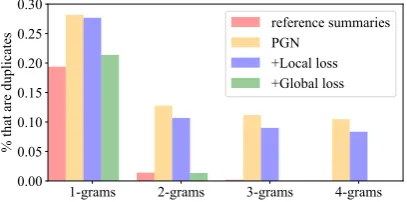
We further evaluate how these optimization ap-proaches work. The results at the bottom of Ta-ble 1 verify the effectiveness of our proposed methods. The ARU module has achieved a gain of 0.97 ROUGE-1, 0.35 ROUGE-2, and 0.64 ROUGE-L points; the local variance loss boosts the model by 3.01 ROUGE-1, 1.6 ROUGE-2, and 2.58 ROUGE-L. As shown in Figure2, the global variance loss helps with eliminating n-gram repe-titions, which verifies its effectiveness.
3.3 Human Evaluation and Case Study
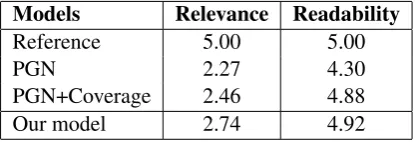
We also conduct human evaluation on the gen-erated summaries. Similar to the previous work (Chen and Bansal, 2018; Nallapati et al., 2017), we randomly select 100 samples from the test set of CNN/Daily Mail dataset and ask 3 human testers to measure relevance and readability of each summary. Relevance is based on how much salient information does the summary contain, and readability is based on how fluent and grammat-ical the summary is. Given an article, different people may have different understandings of the main content of the article, the ideal situation is that more than one reference is paired with the ar-ticles. However, most of summarization datasets contain the pairs of article with a single refer-ence summary due to the cost of annotating multi-references. Since we use the reference summaries as target sequences to train the model and assume that they are the gold standard, we give both arti-cles and reference summaries to the annotator to score the generated summaries. In other words,
Models Relevance Readability
Reference 5.00 5.00
PGN 2.27 4.30
PGN+Coverage 2.46 4.88
Our model 2.74 4.92
Table 2: Human Evaluation: pairwise comparison be-tween our final model and PGN model.
we compare the generated summaries against the reference ones and the original article to obtain the (relative) scores in Table 3. Each perspective is as-sessed with a score from 1 (worst) to 5 (best). The result in Table2 demonstrate that our model per-forms better under both criteria w.r.t. See et al. (2017). Additionally, we show the example of summaries generated by our model and baseline model in Table3. As can be seen from the table, PGN suffers from repetition and fails to obtain the salient information. Though with coverage mech-anism solving saliency and repetition problem, it generates many trivial facts. With ARU, the model successfully concentrates on the salient informa-tion, however, it also suffers from serious repeti-tion problem. Further optimized by the variance loss, our model can avoid repetition and gener-ate summary with salient information. Besides, our generated summary contains fewer trivial facts compared to the PGN+Coverage model.
4 Related Work
[image:4.595.313.521.279.350.2]Article: poundland has been been forced to pull decorative plastic easter eggs from their shelves over fears children may choke - because they look like cadbury mini eggs .trading standards officials in buckinghamshire and surrey raised the alarmover the chinese made decorations , asthey were ‘ likely to contravene food imitation safety rules ’. the eggs have now been withdrawn nationwide ahead of the easter break . scroll down for video . poundland has been been forced to pull decorative plastic easter eggs from their shelves over fears they may choke - because they look like cadbury mini eggs -lrb- pictured is the poundland version -rrb- . the eggs bear a striking similarity to the sugar-coated chocolate treats
with a brown ‘ speckle ’ designed to make it look like a quail ’s egg -lrb- cadbury mini eggs are pictured -rrb- . . . . ‘ parents should also be wary of similar products being offered for sale over the easter period at other stores or online . ’
Reference Summary: Trading standards officials in buckinghamshire and surrey raised alarm. Officers said they were ‘likely to contravene food imitation safety rules’. The eggs bear a striking similarity to the sugar-coated chocolate treats.
PGN: Poundland has been forced to pull decorative plastic easter eggs from their shelves over fears children may choke -because they look like cadbury mini eggs. The eggs have now been withdrawn nationwide ahead of the easter break.The eggs have now been withdrawn nationwide ahead of the easter break.
PGN+Coverage:Trading standards officials in buckinghamshire and surrey raised the alarmover the chinese made decorations , asthey were ‘ likely to contravene food imitation safety rules ’the eggs have now been withdrawn nation-wide ahead of the easter break .the eggs bear a striking similarity to the sugar-coated chocolate treatswith a brown ‘ speckle ’ designed to make it look like a quail ’s egg .
+ ARU:Eggs bear a striking similarity to the sugar-coated chocolate treatswith a brown ‘speckle’ designed to make it look like a quail’s egg.The eggs bear a striking similarity to the sugar-coated chocolate treats with a brown ‘speckle’ designed to make it look like a quail’s egg.
[image:5.595.80.284.356.457.2]+ Variance loss:Trading standards officials in buckinghamshire and surrey raised the alarmover the chinese made decorations, asthey were ‘likely to contravene food imitation safety rules’. The eggs have now been withdrawn nation-wide ahead of the easter break. The eggs bear a striking similarity to the sugar-coated chocolate treatswith a brown ‘speckle’.
Table 3: Theboldwords inarticleare salient parts contained inreference summary. Thebluewords in generated summaries are salient information and theredwords are repetition.
Figure 2: With global variance loss, our model (green bar) can avoid repetitions and achieve comparable per-centage of duplicates with reference summaries.
et al., 2018) select salient sentences from origi-nal document as a summary. In contrast, abstrac-tive summarization (Rush et al., 2015;Nallapati et al., 2016; See et al., 2017; Chen and Bansal, 2018) generates summaries word-by-word after digesting the main content of the document. Out-of-vocabulary(OOV), repetition, and saliency are three conspicuous problems need to be well solved in abstractive document summarization. Some works (Nallapati et al., 2016; See et al., 2017; Paulus et al., 2018) handle the OOV problem by introducing the pointer network. See et al.(2017) introduces a coverage mechanism, which is a vari-ant of the coverage vector (Tu et al., 2016) from Neural Machine Translation, to eliminate repeti-tions. However, there are just a few studies on saliency problem (Tan et al.,2017;Shi et al.,2018; Gehrmann et al.,2018). To obtain more salient
in-formation,Chen et al. (2016) proposes a new at-tention mechanism to distract them in the decod-ing step to better grasp the overall meandecod-ing of in-put documents. We optimize attention using an attention refinement unit under the novel variance loss supervision. As far as we know, we are the first to propose explicit losses to refine the atten-tion model in abstractive document summarizaatten-tion tasks. Recently many models (Paulus et al.,2018; Celikyilmaz et al.,2018;Chen and Bansal,2018; Zhou et al., 2018; Jiang and Bansal, 2018) have emerged taking advantage of reinforcement learn-ing (RL) to solve the discrepancy issue in seq2seq model and have yielded the state-of-the-art perfor-mance.
5 Conclusion
References
Dzmitry Bahdanau, Kyunghyun Cho, and Yoshua Bengio. 2014. Neural machine translation by jointly learning to align and translate. CoRR, abs/1409.0473.
Asli Celikyilmaz, Antoine Bosselut, Xiaodong He, and Yejin Choi. 2018. Deep communicating agents for abstractive summarization. In Proceedings of the 2018 Conference of the North American Chapter of the Association for Computational Linguistics: Hu-man Language Technologies, Volume 1 (Long Pa-pers), pages 1662–1675. Association for Computa-tional Linguistics.
Qian Chen, Xiaodan Zhu, Zhenhua Ling, Si Wei, and Hui Jiang. 2016. Distraction-based neural networks for modeling documents. In Proceedings of the Twenty-Fifth International Joint Conference on Ar-tificial Intelligence, IJCAI’16, pages 2754–2760. AAAI Press.
Yen-Chun Chen and Mohit Bansal. 2018. Fast abstrac-tive summarization with reinforce-selected sentence rewriting. InProceedings of the 56th Annual Meet-ing of the Association for Computational LMeet-inguistics (Volume 1: Long Papers), pages 675–686. Associa-tion for ComputaAssocia-tional Linguistics.
Michael Denkowski and Alon Lavie. 2014. Meteor universal: Language specific translation evaluation for any target language. InProceedings of the Ninth Workshop on Statistical Machine Translation, pages 376–380. Association for Computational Linguis-tics.
Sebastian Gehrmann, Yuntian Deng, and Alexander Rush. 2018. Bottom-up abstractive summarization. In Proceedings of the 2018 Conference on Empiri-cal Methods in Natural Language Processing, pages 4098–4109. Association for Computational Linguis-tics.
Max Grusky, Mor Naaman, and Yoav Artzi. 2018.
Newsroom: A dataset of 1.3 million summaries with diverse extractive strategies. In Proceedings of the 2018 Conference of the North American Chapter of the Association for Computational Linguistics: Human Language Technologies, NAACL-HLT 2018, New Orleans, Louisiana, USA, June 1-6, 2018, Vol-ume 1 (Long Papers), pages 708–719.
Karl Moritz Hermann, Tom´as Kocisk´y, Edward Grefenstette, Lasse Espeholt, Will Kay, Mustafa Su-leyman, and Phil Blunsom. 2015. Teaching ma-chines to read and comprehend. In Advances in Neural Information Processing Systems 28: Annual Conference on Neural Information Processing Sys-tems 2015, December 7-12, 2015, Montreal, Que-bec, Canada, pages 1693–1701.
T. Huang, G. Yang, and G. Tang. 1979. A fast two-dimensional median filtering algorithm. IEEE Transactions on Acoustics, Speech, and Signal Pro-cessing, 27(1):13–18.
Aishwarya Jadhav and Vaibhav Rajan. 2018. Extrac-tive summarization with swap-net: Sentences and words from alternating pointer networks. In Pro-ceedings of the 56th Annual Meeting of the Associa-tion for ComputaAssocia-tional Linguistics (Volume 1: Long Papers), pages 142–151. Association for Computa-tional Linguistics.
Yichen Jiang and Mohit Bansal. 2018. Closed-book training to improve summarization encoder mem-ory. InProceedings of the 2018 Conference on Em-pirical Methods in Natural Language Processing, Brussels, Belgium, October 31 - November 4, 2018, pages 4067–4077.
Yunjae Jung, Donghyeon Cho, Dahun Kim, Sanghyun Woo, and In So Kweon. 2018. Discriminative fea-ture learning for unsupervised video summarization. CoRR, abs/1811.09791.
Chin-Yew Lin. 2004. Rouge: A package for automatic evaluation of summaries. In Text Summarization Branches Out.
Ramesh Nallapati, Feifei Zhai, and Bowen Zhou. 2017.
Summarunner: A recurrent neural network based se-quence model for extractive summarization of doc-uments. In Proceedings of the Thirty-First AAAI Conference on Artificial Intelligence, February 4-9, 2017, San Francisco, California, USA., pages 3075– 3081.
Ramesh Nallapati, Bowen Zhou, Cicero dos Santos, Caglar Gulcehre, and Bing Xiang. 2016. Ab-stractive text summarization using sequence-to-sequence rnns and beyond. InProceedings of The 20th SIGNLL Conference on Computational Natural Language Learning, pages 280–290. Association for Computational Linguistics.
Romain Paulus, Caiming Xiong, and Richard Socher. 2018.A deep reinforced model for abstractive sum-marization. InInternational Conference on Learn-ing Representations.
Alexander M. Rush, Sumit Chopra, and Jason Weston. 2015. A neural attention model for abstractive sen-tence summarization. In Proceedings of the 2015 Conference on Empirical Methods in Natural Lan-guage Processing, pages 379–389. Association for Computational Linguistics.
Abigail See, Peter J. Liu, and Christopher D. Manning. 2017.Get to the point: Summarization with pointer-generator networks. InProceedings of the 55th An-nual Meeting of the Association for Computational Linguistics (Volume 1: Long Papers), pages 1073– 1083. Association for Computational Linguistics.
Jiaxin Shi, Chen Liang, Lei Hou, Juanzi Li, Zhiyuan Liu, and Hanwang Zhang. 2018. Deepchan-nel: Salience estimation by contrastive learning for extractive document summarization. CoRR, abs/1811.02394.
Ilya Sutskever, Oriol Vinyals, and Quoc V. Le. 2014.
Sequence to sequence learning with neural net-works. In Proceedings of the 27th International Conference on Neural Information Processing Sys-tems - Volume 2, NIPS’14, pages 3104–3112, Cam-bridge, MA, USA. MIT Press.
Jiwei Tan, Xiaojun Wan, and Jianguo Xiao. 2017.
Abstractive document summarization with a graph-based attentional neural model. InProceedings of the 55th Annual Meeting of the Association for Com-putational Linguistics (Volume 1: Long Papers), pages 1171–1181. Association for Computational Linguistics.
Zhaopeng Tu, Zhengdong Lu, Yang Liu, Xiaohua Liu, and Hang Li. 2016. Modeling coverage for neural machine translation. InProceedings of the 54th An-nual Meeting of the Association for Computational Linguistics, ACL 2016, August 7-12, 2016, Berlin, Germany, Volume 1: Long Papers.
Oriol Vinyals, Meire Fortunato, and Navdeep Jaitly. 2015. Pointer networks. In Advances in Neural Information Processing Systems 28: Annual Con-ference on Neural Information Processing Systems 2015, December 7-12, 2015, Montreal, Quebec, Canada, pages 2692–2700.
Kelvin Xu, Jimmy Ba, Ryan Kiros, Kyunghyun Cho, Aaron C. Courville, Ruslan Salakhutdinov, Richard S. Zemel, and Yoshua Bengio. 2015. Show, attend and tell: Neural image caption generation with visual attention. InProceedings of the 32nd In-ternational Conference on Machine Learning, ICML 2015, Lille, France, 6-11 July 2015, pages 2048– 2057.