Proceedings of the 2019 Conference on Empirical Methods in Natural Language Processing 4207
Proceedings of the 2019 Conference on Empirical Methods in Natural Language Processing4198
Exploiting Monolingual Data at Scale for Neural Machine Translation
Lijun Wu1,⇤, Yiren Wang2,⇤, Yingce Xia3,†, Tao Qin3, Jianhuang Lai1, Tie-Yan Liu3 1School of Data and Computer Science, Sun Yat-sen University;
2University of Illinois at Urbana-Champaign;
3Microsoft Research Asia;
1
{wulijun3@mail2, stsljh@mail}.sysu.edu.cn; 2[email protected];
3{Yingce.Xia, taoqin, tyliu}@microsoft.com
Abstract
While target-side monolingual data has been proven to be very useful to improve neural ma-chine translation (briefly, NMT) through back translation, source-side monolingual data is not well investigated. In this work, we study how to use both the source-side and target-side monolingual data for NMT, and propose an effective strategy leveraging both of them. First, we generate synthetic bitext by translat-ing monoltranslat-ingual data from the two domains into the other domain using the models pre-trained on genuine bitext. Next, a model is trained on a noised version of the concate-nated synthetic bitext where each source se-quence is randomly corrupted. Finally, the model is fine-tuned on the genuine bitext and a clean version of a subset of the synthetic bi-text without adding any noise. Our approach achieves state-of-the-art results on WMT16, WMT17, WMT18 English$German transla-tions and WMT19 German!French transla-tions, which demonstrate the effectiveness of our method. We also conduct a comprehensive study on how each part in the pipeline works.
1 Introduction
Neural machine translation (briefly, NMT) ( Bah-danau et al.,2014;Gehring et al.,2017;Wu et al.,
2016; Vaswani et al.,2017) is well-known for it-s outit-standing performance (Hassan et al., 2018), which usually relies on large-scale bitext for train-ing. However, high quality bitext is always limit-ed and costly to collect. In contrast, there exists large amount of monolingual data which can be leveraged to augment the training corpus. How to effectively leverage monolingual data is an impor-tant research topic for NMT and there are plenty of works studying this problem (Gulcehre et al.,
⇤The first two authors contributed equally to this work. This work was conducted at Microsoft Research Asia.
†Corresponding author.
2015,2017;Sennrich et al.,2016a;He et al.,2016;
Zhang and Zong,2016;Zhang et al.,2018;Cheng et al.,2016;Wang et al.,2018;Chinea-Rios et al.,
2017;Wu et al.,2018).
Among them, one of the most cited approach is back translation (briefly, BT) (Sennrich et al.,
2016a), which leverages the target-side monolin-gual data. Specifically, a target-to-source transla-tion model (trained on the genuine bitext) is used to translate target-side monolingual sentences in-to the source domain in-to generate a set of synthetic bitext, which is then used together with the gen-uine bitext to train a source-to-target NMT mod-el. While target-side monolingual data is well u-tilized by NMT through BT and its variants ( Sen-nrich et al., 2016a; Edunov et al., 2018; Hassan et al.,2018;He et al.,2016), the investigation on source-side monolingual data is very limited. On-ly few attempts (Zhang and Zong, 2016; Ueffin-g et al., 2007) are made to explore source-side monolingual data, with a common high-level idea that a source-to-target translation model is trained to translate the source-side monolingual data into target domain, the resulted synthetic data is then used for further training. In this work, we study how to leverage both source-side and target-side monolingual data to boost the accuracy of NMT.
We propose a simple yet effective strategy to leverage two-side monolingual data for NMT, which consists of three steps:
(1) Preparation: We pretrain a source-to-target and a target-to-source NMT models on the gen-uine bitext, and use them to generate synthetic bi-text by translating the monolingual data from the source/target domain to the other domain respec-tively.
back-4208
translated from the target domain) are first cor-rupted. We then train an NMT model on this noised dataset together with the genuine bitext. We find that this step benefits from a large amoun-t of monolingual daamoun-ta. The NMT model obamoun-tained from noised training can be further improved in the next finetune step.
(3)Clean training: We randomly generate a subset of the clean synthetic bitext without adding any noise, and leverage them together with the genuine bitext to finetune the output model of step (2). This step only needs a small set of synthetic bitext.
We conduct a comprehensive study of our pro-posed method on WMT English$German
trans-lation and German$French translation and have the following empirical observations:
• Using both source-side and target-side
mono-lingual data is better than using monomono-lingual data from only one domain (see Section5.1).
• Adding noise to large-scale synthetic bitext
improves the accuracy of NMT (see Section
5.2and Section5.3).
• Clean training/tuning of the model obtained from noised training further improves its ac-curacy (see Section5.4).
• Our method achieves state-of-the-art result-s on Engliresult-sh$German newstest 2016, 2017
and 2018 and German!French newstest
2019 (see Section4.2).
2 Related Work
Our work is related to several important research directions of NMT, and we describe the previous relevant works in this section.
2.1 Neural Machine Translation
NMT adopts the sequence-to-sequence frame-work, which consists of an encoder and a decoder in the network architecture. The encoder and de-coder are usually built upon deep neural networks, which can be recurrent neural network ( Sutskev-er et al., 2014), convolutional neural network (Gehring et al., 2017) or simple self-attention based transformer network (Vaswani et al.,2017). The encoder encodes the source sentence into a continuous representation space, and the decoder will decodes the target sentence based on the en-coder representations word-by-word. The objec-tive of the NMT model training is to maximize
the conditional probability of the target sentence given the source sequence. Different model archi-tectures and modifications have been proposed to improve the training efficiency and NMT accuracy (Hassan et al.,2018;Luong et al.,2015;Gu et al.,
2016).
Different from the view of model architecture, in this paper, we study the NMT training from the data aspect. Specifically, we study the effect of both source-side and target-side monolingual data at scale and investigate how to make the best uti-lization of the monolingual data.
2.2 Improving NMT by Monolingual Data
NMT heavily relies on large-scale parallel dataset for training. To augment the limited bilingual data, there are plenty of works attempt to leverage the monolingual data to help the training, which in-cludes the language model fusion (Gulcehre et al.,
2015), back translation (Sennrich et al.,2016a), d-ual learning (He et al., 2016; Wang et al., 2018,
2019) and self learning (Zhang and Zong,2016).
Gulcehre et al. (2017) integrates the hidden s-tates from the target language model into the N-MT decoder to improve the accuracy. Sennrich et al. (2016a) propose the back translation (BT) approach to leverage the target-side monolingual data, which is simple and effective. BT requires training an additional target-to-source NMT mod-el given the bilingual dataset, the modmod-el will be used to back translate the target-side monolingual data. The translation output and the target-side monolingual data then paired as synthetic paral-lel corpus to augment the original bilingual dataset in order to further train the source-to-target NMT model. Dual learning (He et al., 2016) extend-s the BT approach to train NMT extend-syextend-stemextend-s in both translation directions. When jointly training the source-to-target and target-to-source NMT model-s, the two models can provide back translated data for each other direction and perform multi-rounds BT. This strategy is also successfully adopted to build the unsupervised translation system (Lample et al.,2017).
There exists few attempts working on using the source-side monolingual data. Zhang and Zong
(2016) propose self learning approach to generate the synthetic data for the source-side monolingual data, which is a semi-supervised method.Wu et al.
func-4209
tion in a reinforcement learning framework.
2.3 Study of the Back Translation
Since BT is widely acknowledged and effective to improve the NMT model, there has been several works investigating back translation from differ-ent views. Poncelas et al. (2018) study on how using the back translated data as a training cor-pus (separately usage or combined with bilingual data) affects the performance of an NMT model.
Burlot and Yvon(2019) analyze the accuracy im-pact from the quality of the BT data, the alternative uses of BT data to give explanations of why BT works. Cotterell and Kreutzer(2018) provide an interpretation of back translation as approximate inference in a generative model of bitext and give a new algorithm. However, above studies are all based on the small-scale monolingual data, there-fore it remains unclear in the large-scale setting.
Edunov et al. (2018) firstly provide an exten-sive analysis of the back translation at scale. They investigate the different synthetic data generation methods, and also compare the different combina-tion of the synthetic data with bitext. They finally build a strong system with millions of target-side monolingual sentences.
3 Training Strategy
In this section, we give a detailed introduction of our training strategy.
Notations: LetXandY denote two languages,
and letX and Y denote two corresponding lan-guage sentence domains, which are the collec-tion of all sentences. LetB = {(xi, yi)}Ni=1
de-note the bilingual training pairs, wherexi 2 X, yi 2 Y, N is the number of sentence pairs. Let
Mx = {xj}Mj=1x and My = {yj}Mj=1y denote the
collections of monolingual sentences, whereMx
and My are the sizes of the two sets, xj 2 X, yj 2 Y. Our objective is to obtain a translation
modelf : X 7! Y, that can translate sequences from languageXto languageY.
There are three steps of our training strategy:
Step-1: Preparation. We first train two transla-tion modelsfb : X 7! Y andgb :Y 7!X on the
given bilingual dataBby minimizing the negative log-likelihood. After that, we build the following two synthetic datasets through the trained models:
¯
Bs={(x, fb(x))|x2Mx}, ¯
Bt={(gb(y), y)|y2My}, (1)
where B¯s and B¯t can be seen the
forward-translation (i.e., self learning) of source-side monolingual data (Zhang and Zong, 2016) and back-translation of target-side monolingual da-ta (Sennrich et al.,2016a). In practice,fbandgb
will output one translation by either beam search or random sampling according to the model out-put distribution. Random sampling explores more possibility for the unknown generated sentence, which may benefit the data augmentation. In this work, we mainly adopt beam search to generate the sentences, but we will also compare different sequence generation methods in Section5.2.
Step-2: Large-scale noised training. Inspired from the noised back translation (Edunov et al.,
2018) and denoising auto-encoder (Vincent et al.,
2008), we add noise to the source-side data of bothB¯sandB¯tfor training instead of directly
us-ing them to train models. We build two followus-ing noised versions of the two augmented datasets,
¯
Bns ={( (x), y)|(x, y)2B¯s}, ¯
Bnt ={( (x), y)|(x, y)2B¯t},
(2)
where is the operator of adding noise. We follow
Edunov et al.(2018) to design . Specifically, (1) we randomly replace a word in the sentence to be a special token “<UNK>” (representing un-known words) with probability0.1;
(2) we randomly drop the words in each position with probability0.1;
(3) we randomly shuffle (swap) the words in the sentence, with constraint that the words will not be shuffled further than three positions distance.
We then train an NMT model fn for X to Y
translation onB[B¯n
s[B¯tnby minimizing the
neg-ative log-likelihood. Compared withEdunov et al.
(2018), we enlarge the noised data from B¯n t to ¯
Bn
s[B¯nt, instead of using the target-side
4210
other ways to augment/add noise to the training data (Artetxe et al.,2017) and we leave the com-bination with those approaches as future work.
Step-3: Clean data tuning. After obtaining noised training model from step-2, we further fine-tune it on the clean version of the synthetic data without adding noise manually. For the efficiency, we can randomly subsampleB¯sandB¯tto form the
cleanB¯s
sandB¯st dataset. Then we continue tuning fnon the new datasets:
min X
(x,y)2B[B¯s s[B¯st
logP(y|x;f), (3)
wherefis initialized byfn.
There are different ways to obtainB¯s
s and B¯ts,
such as the subset ofB¯sandB¯twe described here.
A more effective way is to train anotherf¯bforX
toY translation and anotherg¯bforY toX
trans-lation, and use them to build new synthetic data for step-3. In this way, more diverse samples are included and we are able to achieve better results. We will provide more discussions in Section4.1
and study in Section5.4.
4 Experiments
We verify the effectiveness of our proposed train-ing strategy in this section. We conduct experi-ments on four different translation tasks. We also make a comprehensive study about the effect of the monolingual data usage in our approach from various aspects.
4.1 Experimental Setup
Datasets We carry out experiments on four d-ifferent translation tasks from WMT19 competi-tion1, including En!De, De!En, De!Fr and
Fr!De, where En, De and Fr are short for
En-glish, German and French.
For En$De translation tasks, the bilingual da-ta consists of two parts: (1) We concatenate “Eu-roparl v9”, “News Commentary v14”, “Common Crawl corpus” and “Document-split Rapid cor-pus”, remove the empty and duplicate lines and eventually get a clean dataset of news domain. (2) We also use the Paracrawl dataset to extend the bilingual corpus. Consider Paracrawl is noisy, we apply a series of filtration rules to this dataset and
1http://www.statmt.org/wmt19/
translation-task.html
remove the low-quality sentences, including sen-tences with too many punctuation marks or in-valid characters, and those with too many or too few words, etc. All the rules are available in thepreprocess.pyin the supplementary doc-ument. These two parts of data are then merged together to get the bilingual dataset. We even-tually get a clean corpus with about 5M clean data and18M Paracrawl data, which are
denot-ed as WMT and WMTPC respectively for ease of reference. The monolingual data we use is from newscrawl released by WMT19. We combine the newscrawl data from year 2016 to 2018 for the
English and German monolingual corpus. After filtering with similar rules applied in Paracrawl (preprocess mono.py in the supplementary document), an additional step is that we further perform language detection (Lui and Baldwin,
2012) on each side monolingual data. Finally, we randomly select about 120M sentences for each
of English and German language. We choose newstest2015 as the validation set and use new-stest2016 to newstest2019 as test sets.
For De$Fr translation data, we follow the same process as that used in En$De. Eventually, the
WMTand ParaCrawl data of De$Fr contains about
2M and4.8M sentence pairs respectively. As for
the French monolingual data, we use all the avail-able newscrawl from previous years due to its s-mall size compared to En and De. After filter-ing, we keep60M monolingual data. We use the validation and test set provided by WMT19 for De$Fr translation.
All datasets are tokenized with Moses (Koehn et al., 2007) toolkit2. The vocabulary is built
based on the Byte-Pair-Encoding (BPE) (Sennrich et al.,2016b) with35K merge operations3for both
En$De and De$Fr datasets. We learn the BPE vocabulary jointly on the source and target lan-guage sentences.
Models We choose the state-of-the-art Trans-former network as our model structure, which con-sists of an encoder with 6layers and a decoder
with6layers. We usetransformer big con-figuration for all experiments: the dimension of word embedding and the inner feed-forward layer is1024and4096respectively. The parameters of
2https://github.com/moses-smt/
mosesdecoder/tree/master
3https://github.com/rsennrich/
4211
source and target word embeddings, as well as the projection layer before softmax are shared. The number of attention heads is16. The dropout is
fixed as 0.2 due to validation performance. We
conduct experiments on the fairseq (Ott et al.,
2019) codebase4.
Training The models are trained by the Adam optimizer (Kingma and Ba,2014) with 1 = 0.9, 2= 0.98. We use the default learning rate
sched-ule used inVaswani et al.(2017) with the initial learning rate5⇥10 4. Label smoothing (Szegedy
et al.,2016) is adopted with value0.1. The batch
size is set to be4096tokens per GPU. We use4
P40 GPUs for training and update the parameter-s every16 minibatches. The pretraining and the
noised training both take about one week, and the finetune process takes about one day training.
To effectively leverage monolingual data, as mentioned in Section 3, we use two differen-t groups of models differen-to generadifferen-te syndifferen-thedifferen-tic dadifferen-ta for noised training and finetuning. For noised train-ing, the models used for translating monolingual data are trained onWMT; for finetuning, the models are trained onWMTPC. The intuition behind using different generation models is that each optimiza-tion stage can benefit from the new/unseen gener-ated synthetic training data. Therefore, we adopt this way in our experiments. As for the data size, in noised training,|B¯s|=|B¯t|= 60M, and during
finetuning,|B¯s
s|=|B¯st|= 20M.
Evaluation To evaluate the model performance, we use beam search generation with beam width
5and without length penalty. The BLEU score
is measured by the de-tokenized case-sensitive SacreBLEU (Post,2018), which is widely adopted in the WMT competitions5.
4.2 Results
We summarize the results of our training strategy for En$De and De$Fr translations in Table1and Table2.
As can be seen from Table 1, the Paracrawl dataset improves the model accuracy by a large margin. Compared with the baseline of using
WMTonly, on average, Paracrawl brings more than
4https://github.com/pytorch/fairseq 5https://github.com/mjpost/sacreBLEU.
SacreBLEU signatures: BLEU+case.mixed+lang.$task +numrefs.1+smooth.exp+test.$SET+tok.13a+version.1.2.12, where $task are en-de, de-en, de-fr and fr-de; $SET are 16, 17, 18, 19.
De!Fr Fr!De
WMT 31.2 26.1
WMTPC 34.2 28.6
[image:5.612.324.512.59.139.2]+Noised Training 36.1 30.8 +Clean Tuning 37.3 33.1
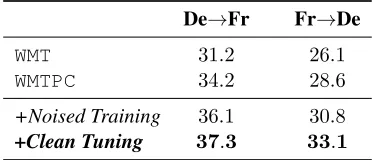
Table 2: De-tokenized case-sensitive SacreBLEU on WMT De$Fr newstest2019. “+” is conducted upon WMTPCdataset.
3.0and4.0BLEU improvements to En!De and De!En tasks respectively, indicating the effec-tiveness of leveraging more data. After large-scale noised training, the accuracy of each task is fur-ther boosted. On average, we improve the BLEU scores of En!De and De!En by 1.6 and 2.2
points, demonstrating the effectiveness of noised training. At last, the output models are tuned on the clean synthetic data. This step further brings
1.7 and 1.5 points gain over the previous step. For En$De translation tasks, we finally achieve
40.9,32.9,49.2and43.8BLEU scores from
new-stest2016 to newstest2019; for De!En, the even-tual BLEU scores of the four test sets end up at
47.5,41.0,49.5and 41.9. Such strong
improve-ments over the baseline reveal the great potential of our proposed strategy.
Prior to this work, the most common way to leverage monolingual data is BT (Sennrich et al.,
2016a). We also compare our strategy to the vanil-la BT, which consists of20M synthetic data and
WMTPC. The results are shown in the last row of Table1. Without finetuning, our noised training strategy surpasses the BT by0.92and0.55points
respectively. This shows that our strategy is more effective than standard BT.
In Table2, we show the results of De$Fr trans-lation tasks. We have similar observation as that for En$De translations. Specifically, the noised
training can improveWMTPCby1.9and2.2points
4212
En!De De!En
Model 2016 2017 2018 2019 Avg 2016 2017 2018 2019 Avg
WMT 34.0 28.0 41.3 37.3 35.15 38.6 34.3 41.1 34.5 37.13 WMTPC 37.1 30.5 45.6 40.3 38.38 41.9 37.5 45.4 40.1 41.23
+Noised Training 39.3 32.0 47.5 41.2 40.00 46.1 39.8 47.7 40.2 43.45 +Clean Tuning 40.9 32.9 49.2 43.8 41.70 47.5 41.0 49.5 41.9 44.98
WMTPC+BT 38.7 31.8 46.0 39.8 39.08 45.8 39.8 47.2 38.6 42.90
Table 1: De-tokenized case-sensitive SacreBLEU on WMT En$De newstest2016, newstest2017, newstest2018, newstest2019 and the average score. “Avg” means the average BLEU score. “+” is conducted uponWMTPCdataset.
Model (En!De) 2016 2017 2018
FAIR (ensemble) 38.0 32.8 46.1
[image:6.612.102.291.376.436.2]MS-Marian (ensemble) 39.6 31.9 48.3 Ours (single) 40.9 32.9 49.2
Table 3: De-tokenized case-sensitive SacreBLEU on WMT En!De newstest2016, newstest2017 and new-stest2018. MS-Marian and FAIR are ensemble results while ours are single-model results.
Model (De!En) 2016 2017 2018
UCAM (ensemble) 45.1 38.7 48.0
RWTH (ensemble) 46.0 39.9 48.4 Ours (single) 47.5 41.0 49.5
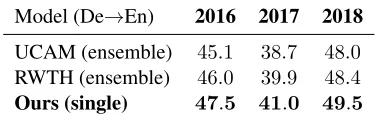
Table 4: De-tokenized case-sensitive SacreBLEU on WMT De!En newstest2016, newstest2017 and new-stest2018. UCAM and RWTH are ensemble results while ours are single-model results.
WMT18 En!De competition, and FAIR’s mod-el (Edunov et al.,2018) which leverages a large amount of monolingual data. Note that results of MS-Marian and FAIR are from ensemble models, while ours are from a single model. We find that our single model successfully surpasses the previ-ous best systems in all test sets. Especially, for newstest2016 and newstest2018, we achieve 1.0
BLEU score improvement over the MS-Marian and set new records for these tasks. We also list the WMT18 top-2 systems for De!En translation in Table4: RWTH (Grac¸a et al.,2018) and UCAM (Stahlberg et al., 2018) systems, which are both ensemble models. Similarly, our single model sur-passes these ensemble systems by a large margin.
5 Analysis
In this section, we provide a comprehensive study on the effect of monolingual data from differen-t aspecdifferen-ts, including dadifferen-ta combinadifferen-tion ways, dadifferen-ta scale and the data generation methods. The ex-periments are conducted on the En!De transla-tion and evaluated on newstest2016, newstest2017 and newstest2018. In this section, without specific clarification, the training data of each setting con-tainsWMTPC.
5.1 Source or Target Monolingual Data
We first investigate the effect about different com-binations of monolingual data. Specifically, we compare three different ways to use monolingual data, including leveraging source-side monolin-gual data only (i.e., B¯s), target-side monolingual
data only (i.e.,B¯t), and the monolingual data from
both two sides (i.e.,B¯sandB¯t).
We keep the number of total synthetic data to be same across the three settings, that is, (i)120M
¯
Bs; (ii)120MB¯t, and (iii) the combination of60M ¯
Bs and 60M B¯t. We conduct this study on the
clean synthetic data without noise, in order to ver-ify which kind of data is more helpful for boosting performances.
The results are shown in Figure 1. From the figure, we can clearly observe that the best configuration is the combination of B¯s and B¯t.
With the same data size, on average, the mod-el trained with combined synthetic dataset out-performs those trained withB¯sonly andB¯t only
by2.6and 3.5points respectively. In particular, on newstest2018, the advantage of the combined dataset is nearly5points compared toB¯t, which
4213 Figure 1: The de-tokenized SacreBLEU scores on En!De newstest2016, newstest2017 and new-stest2018 of the models trained by different synthetic data: (1)B¯s from source-side monolingual data only,
(2)B¯tfrom target-side monolingual data only and (3)
the combination ofB¯sandB¯t.
data is helpful. Another point is that on such large-scale dataset, the B¯t data from back translation
seems to be worse than theB¯sdata generated by
source-side monolingual data, which also supports the point that source-side monolingual is helpful.
5.2 Synthetic Data Generation
We conduct experiments on different generated synthetic data, to verify whether adding noise is essential. We use the same combined dataset (i.e.,
60M B¯sand60M B¯t) as that used in Section5.1
since the effectiveness has been verified. We compare our noised training dataB¯n
s andB¯tn
with another two baselines: 1)B¯sandB¯t without
any transformation; 2)B¯sand the randomly
sam-pled synthetic dataB¯r
t, where each token in the
translation is sampled from the multinomial distri-bution determined by the NMT model. Random sampling is an alternative way to introduce noise, where the resulted synthetic dataset is more di-verse but the translation quality is relatively poor. The data sizes for all settings are120M.
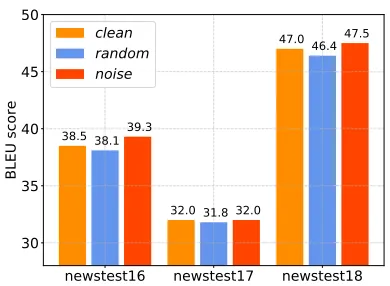
We present the result in Figure 2. Overal-l, noised traininig outperforms the clean training, e.g.,0.8and0.5points advantage on newstest2016 and newstest2018 respectively. Compared with randomly sampled data, our noised data training achieves more than 1.0 BLEU improvement on
newstest2016 and newstest2018, and similar per-formance on newstest2017. The above results sug-gest that our noised training is effective.
Figure 2: The de-tokenized SacreBLEU scores on En!De newstest2016, newstest2017 and new-stest2018 of the models trained by synthetic data gen-erated in different ways: (1) cleanB¯sandB¯tdata, (2)
¯
Br
s and randomly sampledB¯trdata, and (3) noisedB¯ns
andB¯n t data.
5.3 Scale of Monolingual Data
In this section, we give a comparison of different data scales for each kind of synthetic data.
(a) Scale of Target-side (BT) Data We first look into the widely adopted back translation da-taB¯t. We vary the data scale from20M to60M,
which are obtained by random selection from the
120M corpus, and then to120M.
From Figure 3(a), we can observe that model performance is improved when we add 20MB¯t
data. However, adding more clean back translat-ed data starts to hurt the model performances. We suspect the reason is that the data distribution ofB¯t
shifts from the groundtruth distribution. Adding too muchB¯t will enforce the model training to fit
a biased distribution, making the generalization a-bility drop and thus, we observe that the BLEU scores drop. This result implies that we should choose a proper data size when using B¯T only,
such as same size of bitext (e.g.,20M as we used). (b) Scale of Source-side Data We then investi-gate the effect of data scale of source-side mono-lingual data, i.e., B¯s data. We also set the data
sizes as{20M,60M,120M}.
The results are shown in Figure 3(b). We do not observe any improvement over the bilingual system when addingB¯sdata, and with more data
[image:7.612.320.515.62.205.2]4214
[image:8.612.103.517.62.179.2](a) Different scales ofB¯tdata. (b) Different scales ofB¯sdata. (c) Different scales of noisedB¯s+B¯tdata.
Figure 3: The de-tokenized SacreBLEU scores on newstest2016, newstest2017, newstest2018 of the models trained with varied data scales of (a)B¯tdata, (b)B¯sdata, and (c) combinedB¯sandB¯tdata.
is actually hard for the model to boost itself, s-ince there are no other signals to help the learning. The results demonstrate that leveraging source-side monolingual data alone is not a good choice.
(c) Scale of Noised Synthetic Data We final-ly study our noised training on different sizes of noised synthetic data. The experiments are con-ducted on the combination of noised 30M, 60M and 120M B¯n
s and B¯nt with the same number
of source-side and target-side monolingual sen-tences6. We choose the maximum data size as 120M due to GPU memory limitation. The results
are shown in Figure3(c).
We can see that the performances are consis-tently improved as the number of the noised syn-thetic data increases on all test sets. The result a-gain proves that the hybrid usage of source-side and target-side monolingual data is an effective approach which outperforms using the two kinds of data individually.
In summary, first, we verify that source-side monolingual data is helpful and the best way to use it is to combine with target-side monolingual data. Next, we show that adding noise to syn-thetic data outperforms that without noise. Final-ly, we empirically prove that our strategy benefits from more monolingual data, while BT does not, demonstrating our strategy has great potential of utilizing more data.
5.4 Synthetic Tuning
We further study the clean tuning step in our train-ing strategy. Two questions remain to be an-swered: (1) Is it helpful to use two groups of mod-els of building synthetic data for noised training
6For example, same as combined120M data,60M
com-bined data contains30MB¯n
s and30MB¯tndata.
Figure 4: The de-tokenized SacreBLEU scores on En!De newstest2016, newstest2017 and new-stest2018 of the models tuned by different synthetic data and pretrained models: (1) noised training mod-el tuned on the subset ofB¯sandB¯t(WMTin the figure),
(2) noised training model tuned on the synthetic data as introduced in Section4.1, and (3) clean training model tuned on the same synthetic data generated as (2).
and clean training as we discussed before? (2) Is it helpful to use noised training first regarding future BLEU score achieved by the finetune step?
To answer these questions, we conduct another two experiments: (1) At finetuning step, use a sub-sample of synthetic data of noised training step, which isB¯s
s ⇢B¯s,B¯ts⇢B¯t. (2) Training without
noise first and then finetuning using clean data. We present the results in Figure4. Obviously, we can see that tuning on the subset ofB¯sandB¯t
is worse than tuning on another set of synthetic data used in our experiments (e.g.,49.2v.s. 48.0
[image:8.612.321.515.239.383.2]4215
again prove the importance of our noised training and tuning on more diverse dataset is effective.
6 Conclusion
In this work, we exploit the monolingual data at scale for the neural machine translation. Dif-ferent from previous works which usually adop-t back adop-translaadop-tion on adop-targeadop-t-side monolingual da-ta only, we propose an effective training strate-gy to boost the NMT performance by leverag-ing both source-side and target-side monolleverag-ingual data. Our approach contains three steps: syn-thetic data generation, large-scale noised training on synthetic data and clean data training/tuning. We verify our approach on the widely acknowl-edged WMT English$German translation tasks and achieve state-of-the-art results, as well as that for the WMT German$French translations. We also make a comprehensive study on the monolin-gual data utilization.
For future work, we would like to verify our training strategy on more language pairs and oth-er sequence-to-sequence tasks. Furthoth-ermore, we are interested in studying our noised training with other data augmentation approaches.
References
Mikel Artetxe, Gorka Labaka, Eneko Agirre, and Kyunghyun Cho. 2017. Unsupervised neural ma-chine translation.arXiv preprint arXiv:1710.11041.
Dzmitry Bahdanau, Kyunghyun Cho, and Yoshua Ben-gio. 2014. Neural machine translation by jointly learning to align and translate. arXiv preprint arX-iv:1409.0473.
Franck Burlot and Franc¸ois Yvon. 2019. Using mono-lingual data in neural machine translation: a system-atic study.arXiv preprint arXiv:1903.11437.
Yong Cheng, Wei Xu, Zhongjun He, Wei He, Hua Wu, Maosong Sun, and Yang Liu. 2016. Semi-supervised learning for neural machine translation. InProceedings of the 54th Annual Meeting of the Association for Computational Linguistics (Volume 1: Long Papers), volume 1, pages 1965–1974.
Mara Chinea-Rios, Alvaro Peris, and Francisco Casacuberta. 2017. Adapting neural machine trans-lation with parallel synthetic data. InProceedings of the Second Conference on Machine Translation, pages 138–147.
Ryan Cotterell and Julia Kreutzer. 2018. Explain-ing and generalizExplain-ing back-translation through wake-sleep.arXiv preprint arXiv:1806.04402.
Jacob Devlin, Ming-Wei Chang, Kenton Lee, and Kristina Toutanova. 2019. Bert: Pre-training of deep bidirectional transformers for language understand-ing. NAACL.
Sergey Edunov, Myle Ott, Michael Auli, and David Grangier. 2018. Understanding back-translation at scale. In Proceedings of the 2018 Conference on Empirical Methods in Natural Language Process-ing, pages 489–500.
Jonas Gehring, Michael Auli, David Grangier, Denis Yarats, and Yann N Dauphin. 2017. Convolution-al sequence to sequence learning. InProceedings of the 34th International Conference on Machine Learning-Volume 70, pages 1243–1252. JMLR. org.
Miguel Grac¸a, Yunsu Kim, Julian Schamper, Jiahui Geng, and Hermann Ney. 2018. The rwth aachen university english-german and german-english un-supervised neural machine translation systems for wmt 2018. InProceedings of the Third Conference on Machine Translation: Shared Task Papers, pages 377–385.
Jiatao Gu, Zhengdong Lu, Hang Li, and Victor OK Li. 2016. Incorporating copying mechanism in sequence-to-sequence learning. In Proceedings of the 54th Annual Meeting of the Association for Com-putational Linguistics (Volume 1: Long Papers), volume 1, pages 1631–1640.
Caglar Gulcehre, Orhan Firat, Kelvin Xu, Kyunghyun Cho, Loic Barrault, Huei-Chi Lin, Fethi Bougares, Holger Schwenk, and Yoshua Bengio. 2015. On us-ing monolus-ingual corpora in neural machine transla-tion.arXiv preprint arXiv:1503.03535.
Caglar Gulcehre, Orhan Firat, Kelvin Xu, Kyunghyun Cho, and Yoshua Bengio. 2017. On integrating a language model into neural machine translation. Computer Speech & Language, 45:137–148.
Hany Hassan, Anthony Aue, Chang Chen, Vishal Chowdhary, Jonathan Clark, Christian Federman-n, Xuedong Huang, Marcin Junczys-Dowmunt, William Lewis, Mu Li, et al. 2018. Achieving hu-man parity on automatic chinese to english news translation.arXiv preprint arXiv:1803.05567.
Di He, Yingce Xia, Tao Qin, Liwei Wang, Nenghai Yu, Tie-Yan Liu, and Wei-Ying Ma. 2016. Dual learn-ing for machine translation. InAdvances in Neural Information Processing Systems, pages 820–828.
Marcin Junczys-Dowmunt. 2018. Microsoft’s submis-sion to the wmt2018 news translation task: How i learned to stop worrying and love the data. In Pro-ceedings of the Third Conference on Machine Trans-lation: Shared Task Papers, pages 425–430.
4216 Philipp Koehn, Hieu Hoang, Alexandra Birch, Chris
Callison-Burch, Marcello Federico, Nicola Bertol-di, Brooke Cowan, Wade Shen, Christine Moran, Richard Zens, et al. 2007. Moses: Open source toolkit for statistical machine translation. In Pro-ceedings of the 45th annual meeting of the associ-ation for computassoci-ational linguistics companion vol-ume proceedings of the demo and poster sessions, pages 177–180.
Guillaume Lample, Alexis Conneau, Ludovic Denoy-er, and Marc’Aurelio Ranzato. 2017. Unsupervised machine translation using monolingual corpora on-ly.arXiv preprint arXiv:1711.00043.
Marco Lui and Timothy Baldwin. 2012. langid. py: An off-the-shelf language identification tool. In Pro-ceedings of the ACL 2012 system demonstrations, pages 25–30. Association for Computational Lin-guistics.
Minh-Thang Luong, Hieu Pham, and Christopher D Manning. 2015. Effective approaches to attention-based neural machine translation. arXiv preprint arXiv:1508.04025.
Myle Ott, Sergey Edunov, Alexei Baevski, Angela Fan, Sam Gross, Nathan Ng, David Grangier, and Michael Auli. 2019. fairseq: A fast, extensible toolkit for sequence modeling. In Proceedings of NAACL-HLT 2019: Demonstrations.
Alberto Poncelas, Dimitar Shterionov, Andy Way, Gideon Maillette de Buy Wenniger, and Peyman Passban. 2018. Investigating backtranslation in neu-ral machine translation. InProceedings of the 21st Annual Conference of the European Association for Machine Translation: 28-30 May 2018, Universi-tat d’Alacant, Alacant, Spain, pages 249–258. Eu-ropean Association for Machine Translation. Matt Post. 2018. A call for clarity in reporting bleu
scores. InProceedings of the Third Conference on Machine Translation: Research Papers, pages 186– 191.
Rico Sennrich, Barry Haddow, and Alexandra Birch. 2016a. Improving neural machine translation mod-els with monolingual data. InACL.
Rico Sennrich, Barry Haddow, and Alexandra Birch. 2016b. Neural machine translation of rare word-s with word-subword unitword-s. In Proceedings of the 54th Annual Meeting of the Association for Computation-al Linguistics (Volume 1: Long Papers), volume 1, pages 1715–1725.
Felix Stahlberg, Adri`a de Gispert, and Bill Byrne. 2018. The university of cambridges machine trans-lation systems for wmt18. In Proceedings of the Third Conference on Machine Translation: Shared Task Papers, pages 504–512.
Ilya Sutskever, Oriol Vinyals, and Quoc V Le. 2014. Sequence to sequence learning with neural network-s. InAdvances in neural information processing sys-tems, pages 3104–3112.
Christian Szegedy, Vincent Vanhoucke, Sergey Ioffe, Jon Shlens, and Zbigniew Wojna. 2016. Rethink-ing the inception architecture for computer vision. InProceedings of the IEEE conference on computer vision and pattern recognition, pages 2818–2826. Nicola Ueffing, Gholamreza Haffari, and Anoop
Sarkar. 2007. Transductive learning for statistical machine translation. InProceedings of the 45th An-nual Meeting of the Association of Computational Linguistics, pages 25–32.
Ashish Vaswani, Noam Shazeer, Niki Parmar, Jakob Uszkoreit, Llion Jones, Aidan N Gomez, Łukasz Kaiser, and Illia Polosukhin. 2017. Attention is all you need. InAdvances in neural information pro-cessing systems, pages 5998–6008.
Pascal Vincent, Hugo Larochelle, Yoshua Bengio, and Pierre-Antoine Manzagol. 2008. Extracting and composing robust features with denoising autoen-coders. In Proceedings of the 25th international conference on Machine learning, pages 1096–1103. ACM.
Yijun Wang, Yingce Xia, Li Zhao, Jiang Bian, Tao Qin, Guiquan Liu, and Tie-Yan Liu. 2018. Du-al transfer learning for neurDu-al machine translation with marginal distribution regularization. In Thirty-Second AAAI Conference on Artificial Intelligence. Yiren Wang, Yingce Xia, Tianyu He, Fei Tian, Tao Qin,
ChengXiang Zhai, and Tie-Yan Liu. 2019. Multi-agent dual learning. InInternational Conference on Learning Representations.
Lijun Wu, Fei Tian, Tao Qin, Jianhuang Lai, and Tie-Yan Liu. 2018. A study of reinforcement learning for neural machine translation. In Proceedings of the 2018 Conference on Empirical Methods in Nat-ural Language Processing, pages 3612–3621. Lijun Wu, Li Zhao, Tao Qin, Jianhuang Lai, and
Tie-Yan Liu. 2017. Sequence prediction with unlabeled data by reward function learning. InIJCAI, pages 3098–3104.
Yonghui Wu, Mike Schuster, Zhifeng Chen, Quoc V Le, Mohammad Norouzi, Wolfgang Macherey, Maxim Krikun, Yuan Cao, Qin Gao, Klaus Macherey, et al. 2016. Google’s neural machine translation system: Bridging the gap between hu-man and machine translation. arXiv preprint arX-iv:1609.08144.
Jiajun Zhang and Chengqing Zong. 2016. Exploit-ing source-side monolExploit-ingual data in neural machine translation. InProceedings of the 2016 Conference on Empirical Methods in Natural Language Pro-cessing, pages 1535–1545.