Proceedings of the 2019 Conference on Empirical Methods in Natural Language Processing 3521
Bridging the Defined and the Defining: Exploiting Implicit Lexical
Semantic Relations in Definition Modeling
Koki Washio∗†1 Satoshi Sekine†2
∗
Department of Language and Information Sciences, The University of Tokyo †RIKEN Center for Advanced Intelligence Project
{1[email protected], 3[email protected]}.u-tokyo.ac.jp 2[email protected]
Tsuneaki Kato∗3
Abstract
Definition modeling includes acquiring word embeddings from dictionary definitions and generating definitions of words. While the meanings of defining words are important in dictionary definitions, it is crucial to capture the lexical semantic relations between defined words and defining words. However, thus far, the utilization of such relations has not been explored for definition modeling. In this pa-per, we propose definition modeling methods that use lexical semantic relations. To uti-lize implicit semantic relations in definitions, we use unsupervisedly obtained pattern-based word-pair embeddings that represent seman-tic relations of word pairs. Experimental re-sults indicate that our methods improve the performance in learning embeddings from def-initions, as well as definition generation.
1 Introduction
Dictionary definitions are rich resources of seman-tic information for both humans and machines. Recent studies on definition modeling are primar-ily divided into two categories. One is definition generation, in which a definition is generated for a target word from its word representation. Defi-nition generation involves analyzing word embed-dings using generated definitions (Noraset et al.,
2017) and machine explanations of word mean-ings for human readers (Ni and Wang,2017; Ishi-watari et al., 2019). The other is learning word embeddings from definitions to obtain semantic-oriented word representations (Tissier et al.,2017;
Bosc and Vincent,2018).
Although previous methods for encoding or de-coding definitions using recurrent neural networks (RNNs) yielded promising results in definition modeling (Noraset et al.,2017;Bosc and Vincent,
2018), they did not explicitly utilize lexical se-mantic relations between defined words and
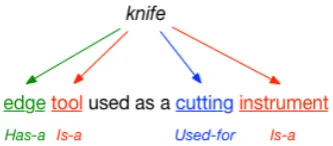
defin-Figure 1: Definition ofknifefrom WordNet (Fellbaum, 1998) and lexical semantic relations between the de-fined word and the defining words.
ing words. Various lexical relations exist in defi-nitions (Amsler,1981), as displayed in Figure1, where the defined wordknifeexhibits anIs-a rela-tion with the defining words,toolandinstrument, Has-a relation with edge, and Used-for relation with cutting. Utilizing structures of definitions about lexical semantic relations facilitates the un-derstanding and generation of definitions.
Based on this observation, we propose defini-tion modeling methods that exploit lexical seman-tic relations between defined and defining words. However, lexical semantic relations in definitions are not explicit. To solve this problem, we use un-supervisedly learned word-pair embeddings that represent semantic relations of word pairs based on co-occurring relational patterns in a corpus (Turney,2005;Washio and Kato,2018b). Exper-imental results show that our definition modeling methods improve previous models, with respect to both definition generation and the acquisition of word embeddings from definitions.
2 Background
2.1 Definition Embedding
[image:1.595.333.500.225.298.2]ex-hibit low similarity ascoffeeis a beverage andcup is a container.
Definition embeddings that are learned from word definitions are useful to capture similarity, while word embeddings based on distributional hypothesis (Mikolov et al.,2013) tend to capture relatedness (Bosc and Vincent,2018).
Bosc and Vincent (2018) proposed a method that learns the long short-term memory (LSTM) (Hochreiter and Schmidhuber,1997) that encodes a word definition into an embedding. Given a defining word sequence D = {w1, . . . , wT}, an
LSTM definition encoder processesD, as follows:
ht = LST M(ht−1,wt) (1)
h = WehT +be (2)
whereLST Mcomputes the hidden state given the previous hidden stateht−1and the input word em-beddingwtalong with the LSTM architecture.hT
is the final hidden state. W∗ and b∗ are weight matrices and bias terms, respectively. The def-inition encoder is trained to reconstruct a bag-of-words representation of the definition from h with a consistency penalty that renders h closer to the corresponding word embedding used in the LSTM. This method is referred to asconsistency penalized autoencoder (CPAE).
2.2 Definition Generation
Definition generation was introduced by Noraset et al. (2017). The goal of definition generation is to predict the probability of the defining word sequence Dgiven the defined word wtrg. In the
aforementioned study, the LSTM conditional lan-guage model was used as a definition decoder to model this probability as follows:
p(D|wtrg) = T
Y
t=1
p(wt|wi<t, wtrg) (3)
p(wt|wi<t, wtrg) =Sof tmax(Wdh0t+bd) (4)
where h0t is a hidden state from the LSTM def-inition decoder. Sof tmax is the softmax func-tion. They conditioned the decoder by providing the embedding of the defined word at the first step of the LSTM. They referred to this model as the Seed (S). Moreover, they extended this model to update the output of the recurrent unit with a gate function depending on the embedding of the de-fined word. This gate function,Gate (G), controls the amount of information from the defined word
that contributes to the definition generation at each step. As additional features, they used morpho-logical information from a character-level convo-lutional neural network (CNN) to process a char-acter sequence of the defined word and the embed-dings of the hypernyms from the WebIsA database (Seitner et al.,2016). These features are calledCH andHE, respectively.
Gadetsky et al.(2018) introduced context-aware definition generation to disambiguate polysemous words with their context and generate the corre-sponding definitions. They extended Equation 3
to consider the context word sequence of the de-fined wordC ={c1, . . . , cm}as follows:
p(D|wtrg, C) = T
Y
t=1
p(wt|wi<t, wtrg, C) (5)
To model this probability, they used an atten-tion mechanism to extract meaningful informaatten-tion fromC and chose relevant dimensions of the em-bedding of the defined word. They referred to this model asInput Attention (I-Attention).
2.3 Word-Pair Embedding
Word-pair embeddings represent relations of word pairs. Although representation of word pairs as the vector offsets of their pretrained word embed-dings is a simple and powerful method (Mikolov et al.,2013), recent studies have shown that neural pattern-based word-pair embeddings are more ef-fective than vector offsets in various tasks such as calculating relational similarity (Washio and Kato,
2018b), natural language inference, and question answering (Joshi et al.,2019).
Neural pattern-based word-pair embedding models (Washio and Kato, 2018a,b; Joshi et al.,
2019) unsupervisedly learn two neural networks: a word-pair encoder and pattern encoder, both of which encode the word-pair and lexico-syntactic pattern respectively into the same embedding space. These networks are trained by predict-ing co-occurrences between word-pairs and pat-terns in a corpus with the negative sampling ob-jective. After the unsupervised learning, the word-pair encoder provides word-word-pair embeddings for any word pair given their word embeddings.
3 Method
defining words in the definition encoder for defi-nition embeddings (Section3.1) and the definition decoder for definition generation (Section3.2). To utilize the implicit semantic relations in defini-tions, we use word-pair embeddings that represent semantic relations of word pairs. We describe how word-pair embeddings are obtained in Section4.1
3.1 For Definition Encoder
To consider lexical semantic relations in acquir-ing embeddacquir-ing from definitions, we feed the word-pair embeddings to the definition encoder. Assum-ing that the pair embeddAssum-ing v(wtrg,wt) represents the relation between the defined wordwtrgand the
t-th defining wordwt, we calculatehtas follows:
ht=LST M ht−1,[wt;v(wtrg,wt)]
(6)
where;denotes vector concatenation. To exclude meaningless relations between the defined word and functional words, we replace v(wtrg,wt) with
the zero vector if wt is a stopword. With
word-pair embeddings as inputs, the definition encoder can recognize the role of information that is pro-vided by the current wordwt, for example, a type
ofwtrg(Is-a), a goal ofwtrg(Used-for), or a
com-ponent ofwtrg(Has-a).
3.2 For Definition Decoder
To provide the definition decoder with information regarding lexical semantic relations, we use an ad-ditional loss function with word-pair embeddings as follows:
Lrel= 1
|K| X
wt∈K
v(wtrg,wt)−(Wrh
0 t+br)
2
(7)
K={wt|wt∈D∧wt6∈S} (8)
whereS is a set of stopwords. As in Section3.1, we ignore the loss whenwtis a stopword. This
ad-ditional loss allows the definition decoder to learn the pattern of what semantic relations occur in def-initions and how they occur. For example, ifwtrg
indicates a type of tools, a defining word that has the Is-a relation to wtrg tends to be followed by
theUsed-forword.
4 Experiments and Results
The experiments conducted to evaluate our meth-ods for definition encoding and decoding are pre-sented in this section. In the Appendix, we de-scribe the details of the hyperparameter settings and optimization methods used in the experiments.
4.1 Obtaining Word-Pair Embedding
To obtain pattern-based word-pair embeddings, we extracted triples (w1, w2, p) ∈ T from the Wikipedia corpus, where(w1, w2)is a word pair composed of nouns, verbs, or adjectives in the the 100K most frequent words of the GloVe 1 ( Pen-nington et al., 2014), and p is the co-occurring shortest dependency path2. We discarded the triples ifp occurred less than five times and sub-sampled the triples based on word-pair probability with a threshold of5·10−7, followingJoshi et al.
(2019).
For the word-pair encoder, we used the neural networks as follows:
h(w1,w2)=M LP([vw1;vw2;vw1 vw2]) (9)
where M LP is a four-layer perceptron with the ReLU activation, vw is a word embedding of w,
andis the element-wise product. Each size of the hidden states ofM LP was 300.
The dependency pathpis a sequence composed of one to three lemmas and dependency relations e1, . . . , en. The sequence of the corresponding
embeddings e1, . . . ,en was encoded using the
bidirectional LSTM with the 300-dimensional hid-den state as the pattern encoder. Then, the 300-dimensional pattern representationvp was
calcu-lated with the final output vectorshf andhb from
the forward and backward LSTM as follows:
vp =Wp[hf;hb] +bp (10)
The word embeddings in the models were ini-tialized by the 300-dimensional GloVe. We used the multivariate negative sampling objective (Joshi et al.,2019) to train the parameters with the dataT for 10 epochs. Adagrad, which has a learning rate of 0.01, was used as the optimizer (Duchi et al.,
2011). After the training was completed, word-pair embeddings are calculated as follows:
v(w1,w2)=
h
(w1, w2)
kh(w1, w2)k
; h(w2, w1) kh(w2, w1)k
(11)
4.2 Definition Embedding
For the evaluation of definition embeddings, we used the modified Word Embedding Benchmarks projects3, following Bosc and Vincent (2018). These benchmarks include SimLex999 (SL999),
1
http://nlp.stanford.edu/data/glove.6B.zip
2
We used spaCy for the dependency parsing.
Development Similarity Relatedness
SV-dev MEN-dev SL999 SL333 SV-test RG SCWS MEN-test MT WS353
GloVe 22.0 73.5 37.1 20.7 22.0 77.0 55.9 74.2 65.0 47.8
Google 39.3 76.0 44.2 29.7 35.8 76.1 66.0 75.6 67.1 63.5
CPAE 47.6 69.4 48.1 33.3 42.4 82.7 63.4 70.1 60.2 66.8
[image:4.595.93.503.63.127.2]Ours 49.9 72.8 48.5 33.8 44.4 81.2 66.7 74.3 67.6 65.4
Table 1: Spearman’s correlation coefficientρ×100on the benchmarks.
Context-agnostic (Noraset et al.,2017)
Model PPL BLEU
S+G+CH+HE 46.8 35.4
w/Lrel 39.5 37.9
Context-aware (Gadetsky et al.,2018)
Model PPL BLEU
S+I-Attention 59.6 12.0
[image:4.595.101.262.166.250.2]w/Lrel 43.8 12.3
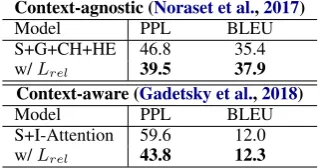
Table 2: Perplexity and equally-weighted BLEU scores for up to 4-grams on the definition generation datasets
SimLex333 (SL333) (Hill et al., 2015), SimVerb (SV) (Gerz et al.,2016), MEN (Bruni et al.,2014), RG (Rubenstein and Goodenough,1965), WS353 (Finkelstein et al., 2002), SCWS (Huang et al.,
2012), and MTurk (Radinsky et al.,2011;Halawi et al., 2012). To evaluate the definition embed-dings, we scored word pairs in the benchmarks us-ing the cosine similarity between the correspond-ing definition embeddcorrespond-ings and calculated Spear-man’s correlation to the ground truth. The defini-tions in WordNet were used to train the definition encoder. The development sets of the SimVerb and MEN were used for the hyperparameter tuning.
We implemented the CPAE (Section2.1) as a baseline and compared it toCPAEwith the word-pair embeddings (Section3.1), which is our pro-posed method. The word embeddings in the def-inition encoder were initialized by the Google Word2Vec vectors4. Google Word2Vec vectors and GloVe were used as the other baselines.
Table 1shows the results of the similarity and relatedness benchmarks. While the baselineCPAE outperformed our model on the two out of five datasets pertaining to word relatedness, our model consistently outperformed the baseline on the sim-ilarity benchmarks. These results indicate that the word-pair embeddings provide the definition en-coder with useful semantic information about the target word.
Hidden States of Definition Encoder
To analyze the functionality of injecting semantic relations between the defined word and the
defin-4https://code.google.com/archive/p/word2vec/
Figure 2: Cosine similarities between the last hidden states of the definition encoders encodingkettle’s def-inition and each hidden states representing theknife’s definition
ing words into the definition encoder, we investi-gate the similarities between hidden states of the definition encoders.
We encoded thekettle’s definition (a metal pot for stewing or boiling) and the knife’s definition (edge tool used as a cutting instrument) with the definition encoders. These two definitions are sim-ilar in their style, composed of the defining words ofIs-a relations (potandtool) andUsed-for rela-tions (stewing,boiling, andcutting.)
Figure 2 displays the cosine similarities be-tween the last hidden state of the encodedkettle’s definition and each hidden state of the encoded knife’s definition. This figure shows that whentool withIs-a relation andcuttingwith Used-for rela-tion toknifewere input to the encoder, our method increased the similarities more than the baseline. This indicates that our method successfully helps the model capture the similarities of definitions in terms of lexical semantic relations.
4.3 Definition Generation
[image:4.595.311.521.167.301.2]S+G+CH+HE w/Lrel
academician a person who specializes in a particular profession
one who is versed in a scholarly or sci-entific field
artist one who is a person who is a person or thing is made
one who creates a picture or representa-tion of a creative work
[image:5.595.79.524.60.149.2]adolescence the state of being pregnant the state of being mature
Table 3: Examples of definitions generated by the baselineS+G+CH +HEand the one withLrel on the development set ofNoraset et al.(2017)
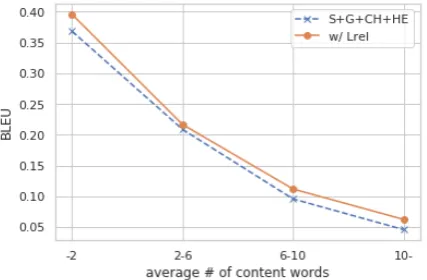
Figure 3: BLEU scores at the average numbers of con-tent words in the reference definitions on the develop-ment set.
2002), following Noraset et al. (2017). We im-plementedS+G+CH+HEfor the context-agnostic dataset and S+I-Attention for the context-aware dataset as baselines, and compared these models to the ones withLrelin Section3.2. The word
em-beddings in the models were initialized by Google Word2Vec vectors, as in Section4.2.
The results in Table 2 show that training with our Lrel improves the performance in both the
context-agnostic and context-aware settings.
Effect to Definition Generation
To analyze the effect ofLrel, we plotted the BLEU
scores at each average number of content words in reference definitions from the development set of
Noraset et al.(2017), as shown in Figure3. This figure shows that when many content words ex-ist in reference definitions, the model with Lrel
is stronger than that withoutLrel. This indicates
that our method allows the model to select correct words when the defined word requires detailed de-scriptions.
Generated Definitions
Table 3 displays examples of generated defini-tions by the baseline S +G+CH +HE and
the one withLrel. The model with the proposed
method successfully generated the definitions for academicianandartist, while the baseline did not. Although the baseline generated the generalized class of the target words, for examples, person andone, it fails to generate details when the tar-get word is distinct from others in the same class. In contrast, the model with the proposed method chose the correct words at both the generalized class and the details.
For adolescence, both models could not gener-ate the correct definitions. Even with our method, the model produced a definition that has an oppo-site meaning to the target word. The generation of opposite definitions is a significant problem in the definition generation from word embeddings (Noraset et al.,2017). Although our method helps the model generate details about the target words, this problem requires other approaches that con-sider antonym relations.
5 Conclusion
In this paper, we proposed definition modeling methods that utilize lexical semantic relations be-tween defined words and defining words. To uti-lize implicit semantic relations in dictionary def-initions, we used pattern-based word-pair embed-dings. The experimental results demonstrated that applying our methods to the definition encoder and the definition decoder improved their per-formance. In our future work, we will extend our methods for phrase-level definition generation (Ishiwatari et al.,2019).
Acknowledgments
[image:5.595.76.290.204.344.2]References
Robert A. Amsler. 1981. A taxonomy for english nouns and verbs. InProceedings of the 19th Annual Meeting of the Association for Computational Lin-guistics, pages 133–138, Stanford, California, USA. Association for Computational Linguistics.
Tom Bosc and Pascal Vincent. 2018. Auto-encoding dictionary definitions into consistent word embed-dings. InProceedings of the 2018 Conference on Empirical Methods in Natural Language Process-ing, pages 1522–1532, Brussels, Belgium. Associ-ation for ComputAssoci-ational Linguistics.
Elia Bruni, Nam-Khanh Tran, and Marco Baroni. 2014. Multimodal distributional semantics. Journal of Ar-tificial Intelligence Research, 49:1–47.
John Duchi, Elad Hazan, and Yoram Singer. 2011. Adaptive subgradient methods for online learning and stochastic optimization. Journal of Machine Learning Research, 12(Jul):2121–2159.
Christiane Fellbaum. 1998. WordNet: An Electronic Lexical Database. MIT Press, Cambridge, Mass.
Lev Finkelstein, Evgeniy Gabrilovich, Yossi Matias, Ehud Rivlin, Zach Solan, Gadi Wolfman, and Ey-tan Ruppin. 2002. Placing search in context: The concept revisited. ACM Transactions on informa-tion systems, 20(1):116–131.
Artyom Gadetsky, Ilya Yakubovskiy, and Dmitry Vetrov. 2018. Conditional generators of words def-initions. In Proceedings of the 56th Annual Meet-ing of the Association for Computational LMeet-inguis- Linguis-tics (Volume 2: Short Papers), pages 266–271, Mel-bourne, Australia. Association for Computational Linguistics.
Daniela Gerz, Ivan Vuli´c, Felix Hill, Roi Reichart, and Anna Korhonen. 2016. SimVerb-3500: A large-scale evaluation set of verb similarity. In Proceed-ings of the 2016 Conference on Empirical Methods in Natural Language Processing, pages 2173–2182, Austin, Texas. Association for Computational Lin-guistics.
Guy Halawi, Gideon Dror, Evgeniy Gabrilovich, and Yehuda Koren. 2012. Large-scale learning of word relatedness with constraints. In Proceedings of the 18th ACM SIGKDD international conference on Knowledge discovery and data mining, pages 1406– 1414. ACM.
Felix Hill, Roi Reichart, and Anna Korhonen. 2015. SimLex-999: Evaluating semantic models with (genuine) similarity estimation. American Journal of Computational Linguistics, 41(4):665–695.
Sepp Hochreiter and J¨urgen Schmidhuber. 1997. Long short-term memory. Neural computation, 9(8):1735–1780.
Eric Huang, Richard Socher, Christopher Manning, and Andrew Ng. 2012. Improving word represen-tations via global context and multiple word proto-types. InProceedings of the 50th Annual Meeting of the Association for Computational Linguistics (Vol-ume 1: Long Papers), pages 873–882, Jeju Island, Korea. Association for Computational Linguistics.
Shonosuke Ishiwatari, Hiroaki Hayashi, Naoki Yoshi-naga, Graham Neubig, Shoetsu Sato, Masashi Toy-oda, and Masaru Kitsuregawa. 2019. Learning to describe phrases with local and global contexts. In Proceedings of the 2019 Conference of the North American Chapter of the Association for Computa-tional Linguistics: Human Language Technologies, Volume 1 (Long Papers). Association for Computa-tional Linguistics.
Mandar Joshi, Eunsol Choi, Omer Levy, Daniel S. Weld, and Luke Zettlemoyer. 2019.pair2vec: Com-positional word-pair embeddings for cross-sentence inference. InProceedings of the 2019 Conference of the North American Chapter of the Association for Computational Linguistics: Human Language Tech-nologies, Volume 1 (Long Papers). Association for Computational Linguistics.
Tomas Mikolov, Ilya Sutskever, Kai Chen, Greg Cor-rado, and Jeffrey Dean. 2013. Distributed represen-tations of words and phrases and their composition-ality. InProceedings of the 26th International Conference on Neural Information Processing Systems -Volume 2, NIPS’13, pages 3111–3119, USA. Curran Associates Inc.
Ke Ni and William Yang Wang. 2017. Learning to ex-plain non-standard english words and phrases. In Proceedings of the Eighth International Joint Con-ference on Natural Language Processing (Volume 2: Short Papers), pages 413–417, Taipei, Taiwan. Asian Federation of Natural Language Processing.
Thanapon Noraset, Chen Liang, Larry Birnbaum, and Doug Downey. 2017. Definition modeling: Learn-ing to define word embeddLearn-ings in natural language. InThe Proceedings of the Thirty-First AAAI Confer-ence on Artificial IntelligConfer-ence.
Kishore Papineni, Salim Roukos, Todd Ward, and Wei-Jing Zhu. 2002. Bleu: a method for automatic eval-uation of machine translation. InProceedings of the 40th Annual Meeting of the Association for Com-putational Linguistics, pages 311–318, Philadelphia, Pennsylvania, USA. Association for Computational Linguistics.
Jeffrey Pennington, Richard Socher, and Christopher Manning. 2014. Glove: Global vectors for word representation. In Proceedings of the 2014 Con-ference on Empirical Methods in Natural Language Processing (EMNLP), pages 1532–1543, Doha, Qatar. Association for Computational Linguistics.
word at a time: computing word relatedness using temporal semantic analysis. In Proceedings of the 20th international conference on World wide web, pages 337–346. ACM.
Herbert Rubenstein and John B Goodenough. 1965. Contextual correlates of synonymy. Communica-tions of the ACM, 8(10):627–633.
Julian Seitner, Christian Bizer, Kai Eckert, Stefano Faralli, Robert Meusel, Heiko Paulheim, and Si-mone Paolo Ponzetto. 2016. A large database of hy-pernymy relations extracted from the web. InLREC.
Julien Tissier, Christophe Gravier, and Amaury Habrard. 2017. Dict2vec : Learning word em-beddings using lexical dictionaries. In Proceed-ings of the 2017 Conference on Empirical Methods in Natural Language Processing, pages 254–263, Copenhagen, Denmark. Association for Computa-tional Linguistics.
Peter D. Turney. 2005. Measuring semantic similarity by latent relational analysis. InProceedings of the 19th International Joint Conference on Artificial In-telligence, pages 1136–1141.
Koki Washio and Tsuneaki Kato. 2018a. Filling miss-ing paths: Modelmiss-ing co-occurrences of word pairs and dependency paths for recognizing lexical se-mantic relations. In Proceedings of the 2018 Con-ference of the North American Chapter of the Asso-ciation for Computational Linguistics: Human Lan-guage Technologies, Volume 1 (Long Papers), pages 1123–1133, New Orleans, Louisiana. Association for Computational Linguistics.