Grammatical Error Correction as Multiclass Classification
with Single Model
∗Zhongye Jia, Peilu Wang and Hai Zhao
†MOE-Microsoft Key Laboratory for Intelligent Computing and Intelligent Systems,
Center for Brain-Like Computing and Machine Intelligence
Department of Computer Science and Engineering, Shanghai Jiao Tong University
800 Dongchuan Road, Shanghai 200240, China
{jia.zhongye,plwang1990}@gmail.com,[email protected]
Abstract
This paper describes our system in the shared task of CoNLL-2013. We illustrate that gram-matical error detection and correction can be transformed into a multiclass classification task and implemented as a single-model sys-tem regardless of various error types with the aid of maximum entropy modeling. Our sys-tem achieves the F1 score of 17.13% on the standard test set.
1
Introduction and Task Description
Grammatical error correction is the task of auto-matically detecting and correcting erroneous word usage and ill-formed grammatical constructions in text (Dahlmeier et al., 2012). This task could be help-ful for hundreds of millions of people around the world that are learning English as a second language. Al-though there have been much of work on grammatical error correction, the current approaches mainly focus on very limited error types and the result is far from satisfactory.
The CoNLL-2013 shared task, compared with the previous Help Our Own (HOO) tasks focusing on only determiner and preposition errors, considers a more comprehensive list of error types, including determiner, preposition, noun number, verb form, and subject-verb agreement errors. The evaluation metric used in CoNLL-2013 is Max-Matching (M2) (Dahlmeier and Ng, 2012) precision, recall and F1 between the system edits and a manually created set of gold-standard ed-its. The corpus used in CoNLL-2013 is NUS Corpus of Learner English (NUCLE) of which the details are described in (Dahlmeier et al., 2013).
In this paper, we describe the system submission from the team 1 of Shanghai Jiao Tong
Univer-∗This work was partially supported by the National
Natu-ral Science Foundation of China (Grant No.60903119, Grant No.61170114, and Grant No.61272248), and the National Basic Research Program of China (Grant No.2009CB320901 and Grant No.2013CB329401).
†Corresponding author
sity (SJT1). Grammatical error detection and correc-tion problem is treated as multiclass classificacorrec-tion task. Unlike previous works (Dahlmeier et al., 2012; Ro-zovskaya et al., 2012; Kochmar et al., 2012) that train a model upon each error type, we use one single model for all error types. Instead of the original error type, a more detailed version of error types is used as class la-bels. A rule based system generates labels from the golden edits utilizing an extended version of Leven-shtein edit distance. We use maximum entropy (ME) model as classifier to obtain the error types and use rules to do the correction. Corrections are made us-ing rules. Finally, the corrections are filtered usus-ing lan-guage model (LM).
2
System Architecture
Our system is a pipeline of grammatical error detection and correction. We treats grammatical error detection as a classification task. First all the tokens are relabeled according to the golden annotation and a sequence of modified version of error types is generated. This re-labeling task is rule based using an extended version of Levenshtein edit distance which will be discussed in the following section. Then with the modified error types as the class labels, a classifier using ME model is trained. The grammatical error correction is also rule based, which is basically the reverse of the rela-beling phase. The modefied version of error types that we used is much more detailed than the original five types so that it enables us to use one rule to do the rection for each modified error type. After all, the cor-rections are filtered by LM, to remove those corcor-rections that seem much worse than the original sentence.
As typical classification task, we have a training step and a test step. The training step consists three phases:
• Error types relabeling.
• Training data refinement.
• ME training.
The test step includes three phases:
• ME classification.
• Error correction according to lebels.
• LM filtering.
2.1 Rebeling by Levenshtein Edit Distance with Inflection
In CoNLL-2013 there are 5 error types but they cannot be used directly as class labels, since they are too gen-eral for error correction. For example, the verb form error includes all verb form inflections such as con-verting a verb to its infinitive form, gerund form, paste tense, paste participle, passive voice and so on. Previ-ous approaches (Dahlmeier et al., 2012; Rozovskaya et al., 2012; Kochmar et al., 2012) manually decompose each error types to more detailed ones. For example, in (Dahlmeier et al., 2012), the determinater error is decomposed into:
• replacement determiner (RD):{a→the}
• missing determiner (MD):{ϵ→a}
• unwanted determiner (UD):{a→ϵ }
For limited error types such as merely determinatives error and preposition error in HOO 2012, manually de-composition may be sufficient. But for CoNLL-2013 with 5 error types including complicated verb inflec-tion, an automatic method to decompose error types is needed. We present an extended version of Levenshtein edit distance to decompose error types into more de-tailed class labels and relabel the input with the labels generated.
The original Levenshtein edit distance has 4 edit types: unchange (U), addition (A), deletion (D) and substitution (S). We extend the “substitution” edit into two types of edits: inflection (I) and the orig-nal substitution (S). To judge whether two words can be inflected from each other, the extended algorithm needs lemmas as input. If the two words have the same lemma, they can be inflected from each other. The extended Levenshtein edit distance with inflec-tion is shown in Algorithm 1. It takes the source to-kenstoksrc, destination tokenstokdstand their lemmas
lemsrc, lemdstas input and returns the editsEand the
parameters of editsP. For example, for the golden edit
{look→have been looking at}, the editsEreturned by DISTANCE will be{A,A,U,A}, and the parameters
Pof edits returned by DISTANCEwill be{have, been, looking, at}.
Then with the output of DISTANCE, the labels can be generated by calculating the edits between original text and golden edits. For those tokens without errors, we directly assign a special label “⊙” to them. The tricky part of the relabeling algorithm is the problem of the edit “addition”, A. A new token can only be added before or after an existing token. Thus for la-bels with addition, we must find some token that the label can be assigned to. That sort of token is defined aspivot. A pivot can be a token that is not changed in
Algorithm 1Levenshtein edit distance with inflection
1: function DISTANCE(toksrc, tokdst, lemsrc,
lemdst)
2: (lsrc, ldst)←(len(toksrc),len(tokdst))
3: D[0. . . lsrc][0. . . ldst]←0
4: B[0. . . lsrc][0. . . ldst]←(0,0)
5: E[0. . . lsrc][0. . . ldst]←ϕ
6: fori←1. . . lsrcdo
7: D[i][0]←i
8: B[i][0]←(i−1,0)
9: E[i][0]← D
10: end for
11: forj←1. . . ldstdo
12: D[0][j]←j
13: B[0][j]←(0, j−1)
14: E[0][j]← A
15: end for
16: fori←1. . . lsrc;j←1. . . ldstdo
17: iftoksrc[i−1] =tokdst[j−1]then
18: D[i][j]←D[i−1][j−1]
19: B[i][j]←(i−1, j−1)
20: E[i][j]← U
21: else
22: m ← min(D[i − 1][j − 1], D[i −
1][j], D[i][j−1])
23: ifm=D[i−1][j−1]then 24: D[i][j]←D[i−1][j−1] + 1
25: B[i][j]←(i−1, j−1)
26: if lemsrc[i−1] = lemdst[j−1] then
27: E[i][j]← S
28: else
29: E[i][j]← I
30: end if
31: else ifm=D[i−1][j]then 32: D[i][j]←D[i−1][j] + 1
33: B[i][j]←(i−1, j)
34: E[i][j]← D
35: else ifm=D[i][j−1]then 36: D[i][j]←D[i][j−1] + 1
37: B[i][j]←(i, j−1)
38: E[i][j]← A
39: end if 40: end if 41: end for
42: (i, j)←(lsrc, ldst)
43: whilei >0∨j >0 do 44: insertE[i][j]into head ofE
45: inserttokdst[j−1]into head ofP
46: (i, j)←B[i][j]
47: end while 48: return(E,P)
49: end function
look-ing at}. In the CoNLL-2013 task, the addition edits are mostly adding articles or determinaters, so when gener-ating the label, adding before the pivot is preferred and only those trailing edits are added after the last pivot. At last, the label is normalized to upper case.
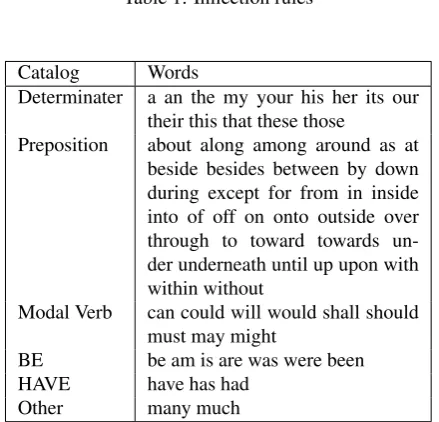
[image:3.595.307.527.189.400.2]The BNF syntax of labels is defined in Figure 1. The the non-terminal ⟨inflection-rules⟩ can be substituted by terminals of inflection rules that are used for cor-recting the error types of noun number, verb form, and subject-verb agreement errors. All the inflection rules are listed in Table 1. The⟨stop-word⟩ can be subsi-tuted by terminals of stop words which contains all ar-ticles, determinnaters and prepositions for error types of determiner and preposition, and a small set of other common stop words. All the stop words are listed in Table 2.
⟨label⟩::= ⟨simple-label⟩ | ⟨compound-label⟩
⟨simple-label⟩::= ⟨pivot⟩ | ⟨add-before⟩ | ⟨add-after⟩
⟨compound-label⟩::= ⟨add-before⟩ ⟨pivot⟩
| ⟨pivot⟩ ⟨add-after⟩
| ⟨add-before⟩ ⟨pivot⟩ ⟨add-after⟩
⟨pivot⟩::= ⟨inflection⟩ | ⟨unchange⟩ | ⟨substitution⟩
| ⟨deletion⟩
⟨add-before⟩::= ⟨stop-word⟩⊕
| ⟨stop-word⟩⊕⟨add-before⟩
[image:3.595.311.523.437.551.2]⟨add-after⟩::= ⊕⟨stop-word⟩
| ⊕⟨stop-word⟩⟨add-after⟩
⟨substitution⟩::= ⟨stop-word⟩
⟨inflection⟩::= ⟨inflection-rules⟩
⟨unchange⟩::= ⊙
⟨deletion⟩::= ⊖
Figure 1: BNF syntax of label
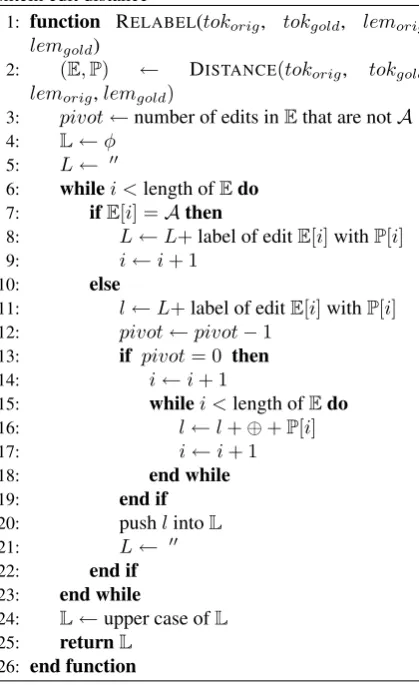
Algorithm 2 is used to generate the label from the extended Levenshtein edits according to the syntax de-fined in Figure 1. It takes the original tokens,tokorig
and golden edit tokens, tokgold in an annotation and
their lemmas,lemorig, lemgoldas input and returns the
generated labelL. For our previous example of edit
{looked→ have been looking at}, theLreturned by RELABELis{HAVE⊕BEEN⊕GERUND⊕AT}. Some other examples of relabeling are demonstrated in Ta-ble 3.
The correction step is done by rules according to the labels. The labels are parsed with a simple LL(1) parser and edits are made according to labels. A bit of extra work has to be taken to handle the upper/lower case problem. For additions and substitutions, the words
added or substituted are normalized to lowercase. For inflections, original case of words are reserved. Then a bunch of regular expressions are applied to correct upper/lower case for sentence head.
Catalog Rules
Noun Number LEMMA, NPLURAL Verb Number VSINGULAR, LEMMA
Verb Tense LEMMA, GERUND, PAST, PART
Table 1: Inflection rules
Catalog Words
Determinater a an the my your his her its our their this that these those
Preposition about along among around as at beside besides between by down during except for from in inside into of off on onto outside over through to toward towards un-der unun-derneath until up upon with within without
Modal Verb can could will would shall should must may might
BE be am is are was were been HAVE have has had
Other many much
Table 2: Stop words
Tokens Edit Label
to {
to reveal→revealing} ⊖
reveal GERUND
a {
a woman→women} ⊖
woman NPLURAL
developing {developing world THE⊕ wold →the developing world} ⊙
a {a→ϵ} ⊖
in {in→on} ON
apple {apple→an apple} AN⊕
Table 3: Examples of relabeling
2.2 Training Corpus Refinement
Algorithm 2 Relabeling using the extended Leven-shtein edit distance
1: function RELABEL(tokorig, tokgold, lemorig,
lemgold)
2: (E,P) ← DISTANCE(tokorig, tokgold,
lemorig,lemgold)
3: pivot←number of edits inEthat are notA
4: L←ϕ
5: L← ′′
6: whilei <length ofEdo 7: ifE[i] =Athen
8: L←L+label of editE[i]withP[i]
9: i←i+ 1
10: else
11: l←L+label of editE[i]withP[i]
12: pivot←pivot−1
13: if pivot= 0 then
14: i←i+ 1
15: whilei <length ofEdo
16: l←l+⊕+P[i]
17: i←i+ 1
18: end while
19: end if 20: pushlintoL
21: L← ′′
22: end if 23: end while
24: L←upper case ofL
25: returnL 26: end function
Inspired by this phenomenon, we propose a method to refine the training corpus which will reduce the error sparsity of the training data and notably improve the recall rate.
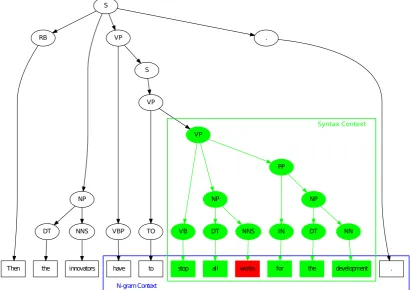
The refined training corpus is composed of contexts containing grammatical errors. To keep the informa-tion which may have effects on the error identificainforma-tion and classification, those contexts are selected based on both syntax tree andn-gram, of which the process is shown in Algorithm 3. For a word with error, itssyntax contextof sizecis those words in the minimal subtree in the syntax tree with no less thancleaf nodes; and its
n-gram contextof sizenisn−1words before and af-ter itself. In the CORPUSREFINEalgorithm, the inputc
gives the size of syntax context andnprovides the size of the n-gram context. These two parameters decide the amount of information that may affect the recogni-tion of errors. To obtain the context, given asentence
containing a grammatical error, we first get a minimum syntax tree whose number of terminal nodes exceed the
c threshold, then check whether the achieved context containing the error word’sn-gram, if not, add then -gram to the context. At last thecontextis returned by CORPUSREFINE.
[image:4.595.74.284.84.427.2]An example illustrating this process is presented in Figure 2. In this example,nandc are both set to 5,
Algorithm 3Training Corpus Refine Algorithm
1: functionCORPUSREFINE(sentence,c,n)
2: context←ϕ
3: ifsentencecontains no errorthen
4: returnϕ
5: end if
6: build the syntax treeTofsentence
7: enode←the node with error inT
8: e←enode
9: whileTruedo
10: pnode←parent node ofeinT
11: cnodes←all the children nodes ofpnode
inT
12: iflen(cnodes)> c then
13: context←cnodes
14: break
15: end if
16: e←pnode
17: end while
18: i←the position ofenodeincontext
19: l←size ofcontext
20: ifi < nthen
21: add (n-i) words beforecontextat the head
ofcontext
22: end if 23: ifl-i<nthen
24: append (l-i) words after context in
context
25: end if
26: returncontext
27: end function
the minimal syntax tree and the context decided by it are colored in green. Since the syntax context in the green frame does not contain the error word’s 5-gram, therefore, the 5-gram context in the blue frame is added to the syntax context and the final achieved context of this sentence is ”have to stop all works for the develop-ment”.
2.3 LM Filter
All corrections are filtered using a large LM. Only those corrections that are not too much worse than the original sentences are accepted. Perplexity (PPL) of the
n-gram is used to judge whether a sentence is good:
P P L= 2−∑w∈n-gramp(w) logp(w),
We use rP P L, the ratio between the PPL before and
after correction, as a metric of information gain.
rP P L=
P P Lcorrected
P P Loriginal
,
Only those corrections with anrP P Llower than a
N-gram Context
Then the innovators have to stop all works for the development .
S
RB
NP
VP .
DT NNS VBP
S
VP
TO
VP
VB NP
PP
DT NNS IN
NP
DT NN
[image:5.595.96.508.83.373.2]Syntax Context
Figure 2: Example of training corpus refinement
3
Features
The single model approach enables us only to optimize one feature set for all error type in the task, which can drastically reduce the computational cost in feature se-lection.
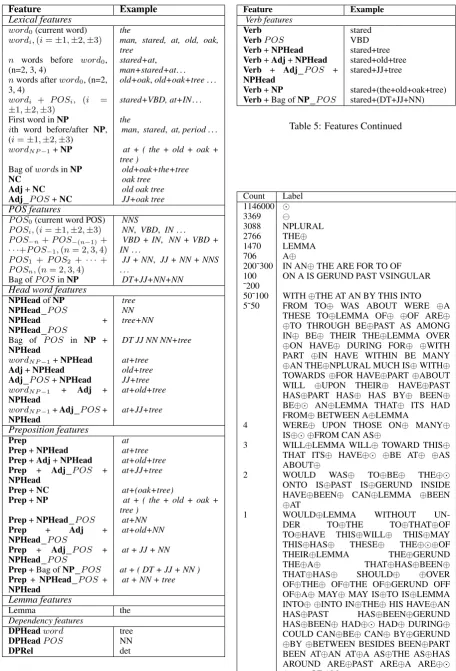
As many previous works have proposed various of features, we first collected features from different pre-vious works including (Dahlmeier et al., 2012; Ro-zovskaya et al., 2012; HAN et al., 2006; RoRo-zovskaya et al., 2011; Tetreault, Joel R and Chodorow, Martin, 2008). Then experiments with different features were built to test these features’ effectiveness and only those have positive contribution to the final performance were preserved. The features we used are presented in Table 4, whereword0is the word that we are
generat-ing features for, andwordandP OSis the word itself and it’s POS tag for various components.NPHead de-notes the head of the minimum Noun Phrase (NP) in syntax tree.wordN P−1represents the word appearing
beforeNPin the sentence. NCstands for noun com-pound and is composed of the last nwords (n ≥ 2) in NP which are tagged as a noun. Verb feature is thewordthat is tagged as a verb whose direct object is theNPcontaining current word. Adjfeature repre-sents the firstwordin theNPwhoseP OSis adjective.
Prepfeature denotes the prepositionwordif it imme-diately precedes theNP.DPHeadis the parent of the
current word in the dependency tree, andDPRelis the dependency relation with parent.
4
Experiments
4.1 Data Sets
The CoNLL-2013 training data consist of 1,397 arti-cles together with gold-standard annotation. The docu-ments are a subset of the NUS Corpus of Learner En-glish (NUCLE) (Dahlmeier et al., 2013). The official test data consists of 50 new essays which are also from NUCLE. The first 25 essays were written in response to one prompt. The remaining 25 essays were written in response to a second prompt. One of the prompts had been used for the training data, while the other prompt is new. More details of the data set are described in (Ng et al., 2013).
We split the the entire training corpus ALLby article. For our training step, we randomly pick 90% articles of ALLand build a training corpus TRAINof 1,258 arti-cles. The rest 10% of ALL with 139 articles are for developing corpus DEV.
Feature Example
Lexical features
word0(current word) the
wordi,(i=±1,±2,±3) man, stared, at, old, oak,
tree
n words before word0,
(n=2, 3, 4)
stared+at, man+stared+at. . .
nwords afterword0, (n=2,
3, 4)
old+oak,old+oak+tree. . .
wordi + P OSi, (i =
±1,±2,±3)
stared+VBD, at+IN. . .
First word inNP the
ith word before/after NP, (i=±1,±2,±3)
man, stared, at, period. . .
wordN P−1+NP at + ( the + old + oak +
tree )
Bag ofwords inNP old+oak+the+tree
NC oak tree
Adj+NC old oak tree
Adj P OS+NC JJ+oak tree
POS features
P OS0(current word POS) NNS
P OSi,(i=±1,±2,±3) NN, VBD, IN. . .
P OS−n+P OS−(n−1)+
· · ·+P OS−1,(n= 2,3,4)
VBD + IN, NN + VBD + IN. . .
P OS1 + P OS2 +· · · +
P OSn,(n= 2,3,4)
JJ + NN, JJ + NN + NNS . . .
Bag ofP OSinNP DT+JJ+NN+NN
Head word features
NPHeadofNP tree
NPHead P OS NN
NPHead +
NPHead P OS
tree+NN
Bag of P OS in NP +
NPHead
DT JJ NN NN+tree
wordN P−1+NPHead at+tree
Adj+NPHead old+tree
Adj P OS+NPHead JJ+tree
wordN P−1 + Adj +
NPHead
at+old+tree
wordN P−1+Adj P OS+
NPHead
at+JJ+tree
Preposition features
Prep at
Prep+NPHead at+tree
Prep+Adj+NPHead at+old+tree
Prep + Adj P OS +
NPHead
at+JJ+tree
Prep+NC at+(oak+tree)
Prep+NP at + ( the + old + oak + tree )
Prep+NPHead P OS at+NN
Prep + Adj +
NPHead P OS
at+old+NN
Prep + Adj P OS +
NPHead P OS
at + JJ + NN
Prep+ Bag ofNP P OS at + ( DT + JJ + NN )
Prep +NPHead P OS +
NPHead
at + NN + tree
Lemma features
Lemma the
Dependency features
DPHeadword tree
DPHeadP OS NN
DPRel det
Table 4: Features for grammatical error recognition. The example sentence is:”That man stared at the old oak tree.” and the current word is ”the” .
Feature Example
Verb features
Verb stared
VerbP OS VBD
Verb+NPHead stared+tree
Verb+Adj+NPHead stared+old+tree
Verb + Adj P OS +
NPHead
stared+JJ+tree
Verb+NP stared+(the+old+oak+tree)
[image:6.595.70.527.59.731.2]Verb+ Bag ofNP P OS stared+(DT+JJ+NN)
Table 5: Features Continued
Count Label 1146000 ⊙
3369 ⊖
3088 NPLURAL
2766 THE⊕
1470 LEMMA
706 A⊕
200˜300 IN AN⊕THE ARE FOR TO OF 100
˜200
ON A IS GERUND PAST VSINGULAR
50˜100 WITH⊕THE AT AN BY THIS INTO 5˜50 FROM TO⊕ WAS ABOUT WERE ⊕A
THESE TO⊕LEMMA OF⊕ ⊕OF ARE⊕
⊕TO THROUGH BE⊕PAST AS AMONG IN⊕ BE⊕ THEIR THE⊕LEMMA OVER
⊕ON HAVE⊕ DURING FOR⊕ ⊕WITH PART ⊕IN HAVE WITHIN BE MANY
⊕AN THE⊕NPLURAL MUCH IS⊕WITH⊕ TOWARDS⊕FOR HAVE⊕PART⊕ABOUT WILL ⊕UPON THEIR⊕ HAVE⊕PAST HAS⊕PART HAS⊕ HAS BY⊕ BEEN⊕ BE⊕⊙ AN⊕LEMMA THAT⊕ ITS HAD FROM⊕BETWEEN A⊕LEMMA
4 WERE⊕ UPON THOSE ON⊕ MANY⊕
IS⊕⊙ ⊕FROM CAN AS⊕
3 WILL⊕LEMMA WILL⊕TOWARD THIS⊕ THAT ITS⊕ HAVE⊕⊙ ⊕BE AT⊕ ⊕AS ABOUT⊕
2 WOULD WAS⊕ TO⊕BE⊕ THE⊕⊙
ONTO IS⊕PAST IS⊕GERUND INSIDE HAVE⊕BEEN⊕ CAN⊕LEMMA ⊕BEEN
⊕AT
1 WOULD⊕LEMMA WITHOUT
UN-DER TO⊕THE TO⊕THAT⊕OF TO⊕HAVE THIS⊕WILL⊕ THIS⊕MAY THIS⊕HAS⊕ THESE⊕ THE⊕⊙⊕OF THEIR⊕LEMMA THE⊕GERUND THE⊕A⊕ THAT⊕HAS⊕BEEN⊕ THAT⊕HAS⊕ SHOULD⊕ ⊕OVER OF⊕THE⊕ OF⊕THE OF⊕GERUND OFF OF⊕A⊕MAY⊕MAY IS⊕TO IS⊕LEMMA INTO⊕ ⊕INTO IN⊕THE⊕HIS HAVE⊕AN HAS⊕PAST HAS⊕BEEN⊕GERUND HAS⊕BEEN⊕HAD⊕⊙HAD⊕DURING⊕ COULD CAN⊕BE⊕CAN⊕BY⊕GERUND
⊕BY⊕BETWEEN BESIDES BEEN⊕PART BEEN AT⊕AN AT⊕A AS⊕THE AS⊕HAS AROUND ARE⊕PAST ARE⊕A ARE⊕⊙ A⊕⊙⊕OF AM⊕
4.2 Resources
We use the following NLP resources in our sys-tem. For relabeling and correction, perl mod-ule Lingua::EN::Inflect1 (Conway, 1998) is used
for determining noun and verb number and Lin-gua::EN::VerbTense2 is used for determining verb
tense. A revised and extended version of maxi-mum entropy model3 is used for ME modeling. For
lemmatization, the Stanford CoreNLP lemma annota-tor (Toutanova et al., 2003; Toutanova and Manning, 2000) is used. The language model is built by the SRILM toolkit (Stolcke and others, 2002). The corpus for building LM is the EuroParl corpus (Koehn, 2005). The English part of the German-English parallel cor-pus is actually used. We use such a corcor-pus to build LM for the following reasons: 1. LM for grammatical error correction should be trained from corpus that it-self is grammatically correct, and the EuroParl corpus has very good quality of writing; 2. the NUCLE cor-pus mainly contains essays on subjects such as environ-ment, economics, society, politics and so on, which are in the same dormain as those of the EuroParl corpus.
4.3 Relabeling the Corpus
There are some complicated edits in the annotations that can not be represented by our rules, for example substitution of non-stopwords such as{human→ peo-ple}or{are not short of→do not lack}. The relabel-ing phase will ignore those ones thus it may not cover all the edits. After all, we get 174 labels after relabel-ing on the entire corpus as shown in Table 6. These labels are generated following the syntax defined in Figure1 and terminals defined in Table 1 and Table 2. Directly applying these labels for correction receives an M2score ofPrecission = 91.43%,Recall = 86.92%
andF1 = 89.12%. If the non-stopwords non-inflection edits are included, of course the labels will cover all the golden annotations and directly applying labels for cor-rection can receive a score up to almostF1 = 100%. But that will get nearly 1,000 labels which is too com-putationally expensive for a classification task. Cut out labels with very low frequency such as those exists only once reduces the training time, but does not give signif-icant performance improvement, since it hurts the cov-erage of error detection. So we use all the labels for training.
4.4 LM Filter Threshold
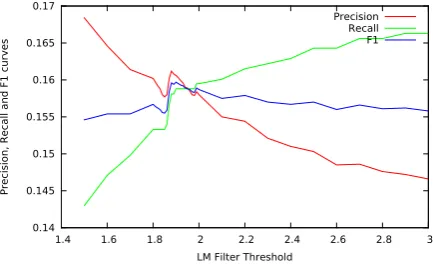
To choose the threshold forrP P L, we run a series of
tests on the DEVset with different thresholds. From our empirical observation on those right corrections and those wrong ones, we find the right ones seldomly
1
http://search.cpan.org/˜dconway/ Lingua-EN-Inflect-1.89/
2
http://search.cpan.org/˜jjnapiork/ Lingua-EN-VerbTense-3.003/
3http://www.nactem.ac.uk/tsuruoka/
maxent/
haverP P L>2, so we test thresholds ranging from 1.5
to 3. The curves are shown in Figure 3.
0.14 0.145 0.15 0.155 0.16 0.165 0.17
1.4 1.6 1.8 2 2.2 2.4 2.6 2.8 3
Precision, R
ecall and F1 curves
LM Filter Threshold
[image:7.595.310.527.103.235.2]Precision Recall F1
Figure 3: Different thresholds of LM filters
With higher threshold, more correction with lower information gain will be obtained. Thus the recall grows higher but the precission grows lower. We can observe a peak of F1 arround 1.8 to 2.0, and the thresh-old chosen for final submission is 1.91.
4.5 Evaluation and Result
The evaluation is done by calculating the M2 precis-sion, recall and F1 score between the system output and golden annotation. All the error types are evalu-ated jointly. Only one run of a team is permitted to be submitted. Table 7 shows our result on our DEVdata set and the official test data set.
Data Set Precission Recall F1 DEV 16.03% 15.88% 15.95% Official 40.04% 10.89% 17.13%
Table 7: Evaluation Results
5
Conclusion
In this paper, we presented the system from team 1 of Shanghai Jiao Tong University that participated in the HOO 2012 shared task. Our system achieves an F1 score of 17.13% on the official test set based on gold-standard edits.
References
DM Conway. 1998. An algorithmic approach to en-glish pluralization. InProceedings of the Second An-nual Perl Conference. C. Salzenberg. San Jose, CA, O’Reilly.
Daniel Dahlmeier, Hwee Tou Ng, and Eric Jun Feng Ng. 2012. NUS at the HOO 2012 Shared Task. In Proceedings of the Seventh Workshop on Building Educational Applications Using NLP, pages 216– 224, Montr´eal, Canada, June. Association for Com-putational Linguistics.
Daniel Dahlmeier, Hwee Tou Ng, and Siew Mei Wu. 2013. Building a Large Annotated Corpus of Learner English: The NUS Corpus of Learner En-glish. InProceedings of the 8th Workshop on Inno-vative Use of NLP for Building Educational Appli-cations, Atlanta, Georgia, USA.
NA-RAE HAN, MARTIN CHODOROW, and CLAU-DIA LEACOCK. 2006. Detecting Errors in En-glish Article Usage by Non-Native Speakers. Nat-ural Language Engineering, 12:115–129, 5.
Ekaterina Kochmar, Øistein Andersen, and Ted Briscoe. 2012. HOO 2012 Error Recognition and Correction Shared Task: Cambridge University Sub-mission Report. InProceedings of the Seventh Work-shop on Building Educational Applications Using NLP, pages 242–250, Montr´eal, Canada, June. As-sociation for Computational Linguistics.
Philipp Koehn. 2005. Europarl: A Parallel Corpus For Statistical Machine Translation. InMT summit, volume 5.
Hwee Tou Ng, Siew Mei Wu, Yuanbin Wu, Christian Hadiwinoto, and Joel Tetreault. 2013. The conll-2013 shared task on grammatical error correction. In Proceedings of the Seventeenth Conference on Com-putational Natural Language Learning.
Alla Rozovskaya, Mark Sammons, Joshua Gioja, and Dan Roth. 2011. University of Illinois System in HOO Text Correction Shared Task. InProceedings of the 13th European Workshop on Natural Lan-guage Generation, pages 263–266. Association for Computational Linguistics.
Alla Rozovskaya, Mark Sammons, and Dan Roth. 2012. The UI System in the HOO 2012 Shared Task on Error Correction. InProceedings of the Seventh Workshop on Building Educational Applications Us-ing NLP, pages 272–280, Montr´eal, Canada, June. Association for Computational Linguistics.
Andreas Stolcke et al. 2002. SRILM-An Extensible Language Modeling Toolkit. InProceedings of the international conference on spoken language pro-cessing, volume 2, pages 901–904.
Tetreault, Joel R and Chodorow, Martin. 2008. The Ups and Downs of Preposition Error Detection in ESL Writing. In Proceedings of the 22nd Inter-national Conference on Computational Linguistics-Volume 1, pages 865–872. Association for Compu-tational Linguistics.
Kristina Toutanova and Christopher D Manning. 2000. Enriching the Knowledge Sources Used in a Max-imum Entropy Part-of-Speech Tagger. In Proceed-ings of the 2000 Joint SIGDAT conference on Em-pirical methods in natural language processing and
very large corpora: held in conjunction with the 38th Annual Meeting of the Association for Compu-tational Linguistics-Volume 13, pages 63–70. Asso-ciation for Computational Linguistics.