Knowledge Distillation for Bilingual Dictionary Induction
Ndapandula Nakashole and Raphael Flauger
Computer Science and Engineering University of California, San Diego
La Jolla, CA 92093
Abstract
Leveraging zero-shot learning to learn mapping functions between vector spaces of different languages is a promising ap-proach to bilingual dictionary induction. However, methods using this approach have not yet achieved high accuracy on the task. In this paper, we propose a bridg-ing approach, where our main contribution is a knowledge distillation training objec-tive. As teachers, rich resource transla-tion paths are exploited in this role. And as learners, translation paths involving low resource languages learn from the teach-ers. Our training objective allows seam-less addition of teacher translation paths for any given low resource pair. Since our approach relies on the quality of monolin-gual word embeddings, we also propose to enhance vector representations of both the source and target language with linguistic information. Our experiments on various languages show large performance gains from our distillation training objective, ob-taining as high as 17% accuracy improve-ments.
1 Introduction
In traditional supervised learning, a classifier is trained on a labeled dataset of the form (X,Y). Each xi ∈ X is a feature vector representing a single training instance andyi ∈Y is the label as-sociated with xi. In zero-shot learning (Mitchell
et al.,2008), at test time we can encounter a test instance xj whose corresponding label was not seen at training time. This setting occurs in do-mains whereYcan take on many values, and ob-taining labeled examples for all possibleY values is expensive. Computer vision is one such
do-main, where there are thousands of objects a sys-tem needs to recognize yet at training time we may only see examples of some of the objects. In zero-shot learning, instead of learning parameters as-sociated with each possible label inY, the learn-ing task is cast as a problem of learnlearn-ing a slearn-ingle mapping function from the vector space of input instances to the vector space of the output labels. The resulting induced function can then be applied to test instances xj whose labels may not have been seen at training time, producing a projected vector, yˆj, in the label space. The nearest neigh-bor of the mapped vector in the label space is then considered to be the label ofxj.
In this paper, we study zero-shot learning in the context of bilingual dictionary induction, which is the problem of mapping words from a source language to equivalent words in a target language. The label space is the full vocabulary of the target language which can be on the order of millions of tokens. First, word embeddings are learned separately for each language, and second, using a given seed dictionary, we train a mapping func-tion to connect the two monolingual vector spaces, thereby facilitating bilingual dictionary induction. The advantage of zero-shot learning is that it can help reduce the amount of labeled data for applica-tions with many possible labels, such as the appli-cation we study in this paper, bilingual dictionary induction. However, the state-of-the-art accuracy on zero-shot bilingual dictionary induction is still low. On the task of English to Italian(en →it), top-1 and top-10 accuracies are around 40% and 60%, respectively (Lazaridou et al., 2015; Dinu et al.,2014).
An important aspect of zero-shot learning for bilingual dictionary induction is that, it relies on availability of a large seed dictionary1. Such large
15000 seed pairs for the(en →it)dataset.
es en nl en sv en
[image:2.595.76.289.58.113.2]pt af da
Figure 1: Trilingual paths for Portuguese(pt) to English(en) via Spanish (es), Afrikaans(af) to
(en)via Dutch (nl), and Danish(da) to(en)via Swedish(sv).
training dictionaries might not be available for all languages. However, for a given language with only a small seed dictionary, there could be a highly related language with a much larger seed dictionary. For example, we might have a small seed dictionary for translating Portuguese to English (pt → en), but a large seed dictio-nary for translating Spanish to English language (es → en). At training time, we can train the (pt → en) mapping function not only using the small seed dictionary, but also make use of the trilingual path going through Spanish,
(pt → es→ en). Sinceptandesare highly re-lated, a small amount of data may be sufficient to learn the projection(pt→es). This is the idea of using a bridge or pivot language in machine trans-lation (Utiyama and Isahara, 2007). Our contri-bution is a knowledge distillation training objec-tive function that encourages the mapping func-tion(pt→ en)to predict the true English target words as well as to match the predictions of the trilingual path(pt→ es→ en)within a margin. This is approach allows seamless Example trilin-gual paths are shown in Figure1.
By setting up our objective function in this way, we are distilling knowledge (Bucilu et al., 2006;
Hinton et al., 2015) from the trilingual paths to train a single mapping function for(pt→ en). In our experiments, we show performance gains for several language pairs, 17% for top-10 precision for(pt→ en). We also show that, for a given lan-guage pair, our objective seamlessly allows us to distill from several related languages. Moreover, we learn weights for each of the distillation paths, thereby automatically learning indicative weights of how useful each distillation path is. Finally, we show that even when we only use unlabeled data to distill knowledge from trilingual paths, we still obtain performance gains over a model trained on a small seed dictionary.
Since our approach relies on the quality of monolingual word embeddings, we also propose
to enhance vector representations of both the source and target language with linguistic infor-mation. In particular, we augment word vec-tors with additional dimensions capturing corpus statistics of part-of-speech tags of words. Second, we model sub-word information in the vector rep-resentations of words.
2 Related Work
Cross Vector Space Mapping with Seed Dictio-naries.Our work is most related to models that do zero-shot learning for bilingual dictionary induc-tion, using maps between vector spaces with seed dictionaries as training data. Examples include the models of (Mikolov et al.,2013;Dinu et al.,2014;
Lazaridou et al.,2015;Vulic and Korhonen,2016). Like these approaches, we first learn word embed-dings for each language, then use a seed dictionary to train a mapping function between the two vec-tor spaces. In a departure from these prior meth-ods, we propose to distill knowledge from trilin-gual paths of nearby languages for languages with small seed dictionaries using a distillation train-ing objective. Additionally, we model ltrain-inguistic information in the vector space of the source and target languages. Another line of research in this vein is the work of (Vulic and Korhonen, 2016), who analyze how properties of the seed dictio-nary affect bilingual dictiodictio-nary induction across different dimensions (i.e., lexicon source, lexicon size, translation method, translation pair reliabil-ity). However, methodologically, their approach is based on prior work (Mikolov et al., 2013; Dinu et al.,2014).
Bilingual word embeddings. There is a rich body of work on bilingual embeddings. Bilin-gual word embedding learning methods produce a shared bilingual word embedding space where words from two languages are represented in the new space so that similar words, which may be in different languages, have similar representations. Such bilingual word embeddings have been used in a number of tasks including semantic word sim-ilarity (Faruqui and Dyer, 2014; Ammar et al.,
2016) learning bilingual word lexicons (Mikolov et al.,2013;Gouws et al.,2015;Vulic and Korho-nen,2016), parsing (Guo et al.,2015;T¨ackstr¨om et al., 2012), information retrieval (Vulic and Moens, 2015), and cross-lingual document clas-sification (Klementiev et al.,2012;Koˇcisk`y et al.,
Some bilingual word embedding methods such as (Blunsom and Hermann, 2014; Gouws et al.,
2015) require sentence or word aligned data, which our approach does not require. We com-pare our approach to the bilingual embeddings produced by the recent method of (Ammar et al.,
2016). Like our approach, this work does not re-quire availability of parallel corpora but only a seed dictionary.
On the aspect of enriching word embeddings with linguistic knowledge for the purpose of ma-chine translation, Sennrich and Barry (Sennrich and Haddow,2016) introduce linguistic features in sequence to sequence neural machine translation. Like our work, they also represent such features in the embedding layer. In addition to part-of-speech tags and morphological features, they also use syntactic dependency labels which are not ap-plicable to our model since we work at the word level while their model is at the sentence level.
Knowledge Distillation. Knowledge distilla-tion was introduced for model compression to learn small models from larger models (Bucilu et al., 2006; Hinton et al., 2015). For exam-ple, from a large neural network model a smaller model can be distilled such that it generalizes in the same way as the large model (Romero et al.,
2014). Knowledge distillation was also used by (Hu et al.,2016) to distill knowledge from logical rules in the tasks of named entity recognition and sentiment analysis, thereby enforcing constraints on the trained model. Our approach is different from this prior work on knowledge distillation in that we distill knowledge from mapping functions of related languages into mapping functions of languages with only small seed dictionaries.
Domain adaptation, for which there is a long history, is also related to our work (Ben-David et al., 2007; Daum´e III, 2007; Pan et al., 2010;
Long and Wang, 2015). (Daum´e III, 2007) pro-posed feature augmentation, suggesting that a model should have features that are general across domains, as well as features that are domain-specific. Thus the model learns from all do-mains while preserving domain-specific informa-tion. These kinds of models have to be retrained when a new domain is added. Our work however only has to train mapping functions that involve a new language, all others can be distilled without retraining them.
3 Embedding Linguistic Information
Since our approach relies on the quality of mono-lingual word embeddings, we would like to work with high quality word embeddings. We therefore, first seek to enhance the vector representations of words in the source and target languages so that they can capture useful linguistic information. The intuition is that such information can help narrow down the words in the target language that are con-sidered valid translations for a given source lan-guage word. To that end, we model both part of speech (POS) tag distributions of words and sub-word information in the vector representations.
3.1 Part of Speech Distributions
The idea behind modeling POS tags is that words should have the same part of speech tag in dif-ferent languages. For example, if we are trans-lating the nounKatzefrom German to English, in English we expect the singular noun cat and not the plural cats. While this information may be monolithically represented in word vectors gen-erated by embedding methods such as Skip-gram and CBOW, here we seek to explicitly model POS tags. Since each word can have multiple POS tags, we model a word’s part of speech information as a distribution over all the possible POS tags that it can take on. We learn POS tag statistics by first tagging a large corpus of each language, we then use tag counts to generate distributions. For exam-ple, if the English word,barkappears tagged as a verb 30 times in our corpus, and tagged as a noun 10 times, we generate a vector which puts 2/3 in the verb direction, and 1/3 in the noun direction, and 0 in the directions of all other POS tags. While these statistics can be noisy, we hope they can still provide useful signals. We use the universal POS tags, there are 12 tags in the universal POS tags (Petrov et al.,2011).
For a given word w, we compute a vector rep-resentation wi ∈ Rd using a word embedding method. For now, let’s assume we use the Skip-gram model. In the next section, we describe an enhanced word embedding method. We compute a POS corpus statistics vector vi ∈ R12 for the word using the12 universal POS tags. With this new information, the representation for wordiis given by
3.2 Word Internal Structure
Morphology carries information that is useful for capturing the identity of a word. It represents in-formation such as tense. When doing cross-lingual zero-shot projection of a word in a source lan-guage, we wish to translate to words that have the same linguistic properties. For example, the Ger-man word gewinnen should be translated to the present tensewin, not the past tensewonwhich in German isgewonnen. We approximate morphol-ogy by incorporating sub-word information into the vector representations. There are several ways of doing this, one approach is to work on the level of characters. We go for the middle-ground, in which a word is represented as a combination of a vector for the word itself with vectors of sub-word units that comprise it. In particular, for a given a word we learn a vector representation for the word itself, and also for eachn-gram of>= 3and<6
in the word (Bojanowski et al.,2017). Each word is thus represented by the sum of the vector rep-resentations of itsn-grams, including the word it-self. This representation is then used to replacewi in equation1.
4 Training Objective
A common objective function used in prior work (Mikolov et al.,2013;Dinu et al.,2014) for learn-ing cross vector space mapplearn-ing functions is the regularized least squares error:
ˆ
W= arg min
W∈Rs×t||XW−Y||F +λ||W|| (2) where matrixWˆ is the learned mapping function, X and Y represent the matrices containing the vectors for the source language words and vectors for the target language words, respectively. In-stead of the least squares loss shown in equation
2, we use a ranking loss, as in (Lazaridou et al.,
2015), which aims to rank correct training data pairs (xi, yi) higher than incorrect pairs (xi, yj) with a margin of at least γ. The margin γ is a hyper-parameter which is application specific, and the incorrect labels, yj can be selected randomly such thatj 6= ior in a more application specific manner2.
2In our experiments, we explored several application
spe-cific approaches for choosing negative examples, including one that picks negative examples among words whose part of speech class is different from the positive example. However, these approaches did produce significant improvement, and we resorted back to randomly selected negative examples.
Given a seed dictionary training data of the form
Dtr ={xi, yi}m
i=1, the margin-based ranking loss
is defined as:
Jsingle=
m
X
i=1
k
X
j6=i
max0, γ+d(yi,yˆi)−d(yj,yˆi)
(3) whereyˆi =Wxiis the prediction,kis the number of incorrect examples per training instance, and
d(x, y) = (x−y)2is the distance measure.
For a given correct pair and incorrect pair, sub-stitutingyˆi=Wxi. The loss is given by:
max0, γ+(yi−yˆi)2−(yj−yˆi)2
:j 6=i. (4)
To evaluate the derivative analytically, we can write:
max 0, γ+ (yi−yˆi)2−(yj−yˆi)2
=θ γ+ (yi−yˆi)2−(yj−yˆi)2×
γ + (yi−yˆi)2−(yj−yˆi)2 (5) whereθ(x)denotes the Heavisideθ-function. The derivative with respect to the elements of the ma-trixW is then approximated by, after neglecting a term that would only contribute if the difference
(yj −yˆi)2−(yi−yˆi)2 were exactlyγ
∂
∂Wab(θ γ+ (yi−yˆi)
2−(y
j −yˆi)2×
γ+ (yi−yˆi)2−(yj −yˆi)2
'2θ γ+ (yi−yˆi)2−(yj −yˆi)2×
xi b(yj a−yi a) (6)
5 Model Distillation
In zero-shot learning for bilingual dictionary in-duction a large seed dictionary is used to train a mapping function. Such large training dictionar-ies might not be available for all languages. How-ever, for a given language with only a small seed dictionary, there could be a highly related lan-guage with a much larger seed dictionary. We propose a method for leveraging mapping tions of nearby languages to train mapping func-tions for languages where large seed dictionaries may not be available. Our method is related to no-tion of having a bridge or pivot language as done in sentence level translation (Utiyama and Isahara,
5.1 Trilingual Paths for distillation
Let us consider the problem of translating from a given source language to English. As a running example, we use Portuguese(pt)as the source lan-guage. We wish to learn a mapping function from word vectors in Portuguese to word vectors in En-glish. We can set up a learning task, using a train-ing datasetD={xi, yi}mi=1and the loss defined in
Equation3. This gives us the projection function in the form of a matrix: W(pt→en). We can thus
translate Portuguese words to English as follows:
ˆ
yi(en)←-(pt)=W(pt→en)x(ipt) (7)
If the seed dictionary for Portuguese to English is small,W(pt→en) might generalize poorly, pro-ducing many wrong translations when using Equa-tion7. Suppose, a related language, for example, Spanish has a lot of training data available, and we have independently trained its mapping func-tion, which can make predictions from Spanish to English as follows:
ˆ
yi(en)←-(es)=W(es→en)x(ies) (8)
SinceW(es→en)is trained with a lot of data, we
expect it to generalize better and make more accu-rate predictions thanW(pt→en). One insight here is that since the languagesesandptare highly re-lated, we need much less data to train an accurate mapping matrixW(pt→es)than we to need to learn an accurateW(pt→en). Therefore we train a
map-ping function from Portuguese to Spanish, which makes predictions as follows.
ˆ
yi(es)←-(pt)=W(pt→es)x(ipt) (9)
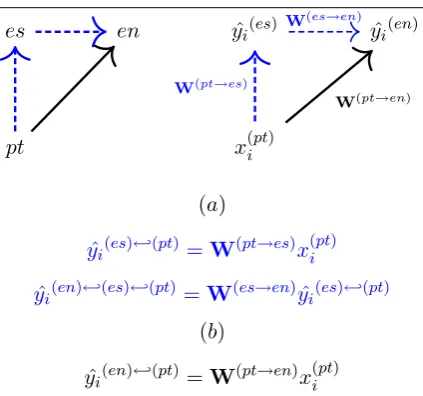
We now have a second path that goes from Por-tuguese to English much like Equation7 but this path goes via Spanish as follows:
ˆ
yi(es)←-(pt)=W(pt→es)x(ipt)
ˆ
yi(en)←-(es)←-(pt)=W(es→en)yˆi(es)←-(pt) (10)
Figure 2 illustrates the two paths from Por-tuguese to English. Our main insight is to use knowledge distillation, to improve the accu-racy of the mapping matrix W(pt→en) through
ˆ
yi(en)←-(es)←-(pt). This distillation is done by mod-ifying our learning objective.
es en yˆi(es) yˆi(en)
pt x(ipt)
W(es→en)
W(pt→es)
W(pt→en)
(a)
ˆ
yi(es)←-(pt)=W(pt→es)x(ipt)
ˆ
yi(en)←-(es)←-(pt)=W(es→en)yˆi(es)←-(pt) (b)
ˆ
[image:5.595.310.522.66.264.2]yi(en)←-(pt)=W(pt→en)x(ipt)
Figure 2: Translating with both a trilingual path (dotted lines, and equation (a)) , and a bilingual path (solid line, and equation (b))
5.2 Distillation Objective
For a given Portuguese word x(ipt), Equation 7
makes the predictionyˆi(en)←-(pt)and Equation10 makes the trilingual prediction yˆi(en)←-(es)←-(pt) which involves three languages. We would like to improve predictions made by Equation 7 by im-proving the mapping matrix W(en→pt).
There-fore when training using the Portuguese to English training data, we want our objective to both min-imize the loss defined in Equation3and simulta-neously to letW(en→pt)mimic predictions made
through the pathyˆi(en)←-(es)←-(pt)as “soft targets” within a margin. The distillation objective is as follows:
Jd= m
X
i=1
max0,
ˆ
yi(en)←-(pt)−yˆi(en)←-(es)←-(pt)2−φ
,(11)
whereφis the margin. We combineJsingleandJd through a weighted average of the two different objective functions. Notice that Jd can be com-puted without having labeled training data. In our experiments, we show that even in this case of un-labeled data, which gets rid ofJsingle since it re-quires labeled data,Jdoutperforms models trained using onlyJsinglewhen the training data is small.
5.3 Multiple Trilingual Paths
for example distill through German, French, and other languages. We can modify the distillation loss as follows:
Jd−multi= m
P
i=1
n
P
j=1ψjmax
0,
ˆ
yi(en)←-(pt)−yˆi(en)←-(j)←-(pt)2−φ
, (12)
wherejlabels the distillation language. With the objectiveJd−multi combined withJsingle, we are training a mapping function which mimics the be-havior of many trilingual paths, as “soft targets” within a margin ψ. We keep φ the same in our experiments across all trilingual paths. The ψi are weights that reflect how much we penalize our model if it diverges from the predictions of a par-ticular trilingual path. Intuitively, if a language is similar to our source language, (pt) in this case, its correspondingψvalue should be high. For ex-ample, if Spanish is considered more related to Portuguese than any other language in the trilin-gual paths in Equation 12, than we expect ∀i 6= 1, ψ1 > φi. This is assuming that the second parts of the trilingual paths have similar accuracies, ie. W(es→en), W(fr→en), and W(...→en) have
sim-ilar projection accuracies. The most simsim-ilar lan-guage is expected to be the easiest to project into from Portuguese. For example we might expect W(pt→es) to be more accurate thanW(pt→de), if
we have similar amounts of training data for learn-ing both of these. We next present how we learn theψivalues for the multiple paths.
5.4 Weighted Trilingual Paths
Going back to the example, we first learn the weights using the Portuguese to English training set,D={xpti , yen
i }mi=1, and then input the weights
into the model before training with Jd−multi and
Jsingle. Suppose we want to compute ψ1 which corresponds to Spanish in Equation 12. For a given Portuguese word xpti ∈ D, whose English translation isyen
i , we can compute:
ψdot
1i = (yeni )Tyˆi(en)←-(es)←-(pt) (13) We also experimented with a bilinear term:
ψbilinear
1i = (yien)THyˆi(en)←-(es)←-(pt) (14) We found a better performing approach to be:
V =yˆi(en)←-(pt)−yˆi(en)←-(es)←-(pt)
2
ψ1euclidi = exp(V1). (15)
P@1 P@5 P@10
Italian (en→it)
THIS 51.0 66.6 72.4
THIS w/pos 51.6 68.5 73.4
Ridge 29.7 44.2 49.1
Lazaridou et. al 40.2 54.2 60.4 MultiCluster 2.40 7.30 11.0
[image:6.595.318.512.61.187.2]MultiCCA 0 0.1 0.3
Table 1: Translation accuracy on the English to Italian dataset of (Dinu et al.,2014).
6 Experimental Evaluation
In this section, we study the following questions:
• What is the effect of modeling linguistic in-formation in the vector representations of the source and target languages on accuracy of bilingual dictionary induction?
• Can our knowledge distillation objective from trilingual paths involving related lan-guages improve accuracy of mapping func-tions of languages with small seed dictionar-ies?
6.1 Data and Experimental Setup
In most of our experiments, we use the train-ing data that was used to train the multi-ltrain-ingual embeddings in (Ammar et al., 2016). We indi-cate when this is not the training data used. This data was obtained automatically by using Google Translate. For test data, we use manual transla-tions either from prior work or from searching the Web, including genealogical word lists3.
For word vector representations, we use Wikipedia to train 300 dimensional vectors for all languages we evaluate on. Based on a validation set, we set the margin γ in Equation 3 through Equation6to beγ = 0.4,φin Equations11,12, and15to beφ= 0.01. We estimate model param-eters using stochastic gradient descent.
6.2 Methods Under Comparison
In our experiments, we compare performance of the following methods.
• The methodTHISrefers to our model which uses a max-margin loss function as defined 3For example:
in Equation 3. It uses sub-word informa-tion in the vector representainforma-tions of words. One variation of our method is,THIS w/pos, which includes POS tag statistics as addi-tional dimensions. The distilled variations of our method explicitly indicate the languages involved, for example(pt→es→en). • The method Ridge is used in a number of
prior work (Mikolov et al.,2013;Dinu et al.,
2014;Vulic and Korhonen,2016). These ap-proaches use an L2-regularized least-squares error objective as shown in Equation2.
• The methodLazaridou et al. was proposed by (Lazaridou et al., 2015). It uses a max-margin ranking function and introduces a way of picking negative examples in comput-ing the loss.
• The methods MultiCluster and MultiCCA
refer to the multilingual word embeddings introduced by (Ammar et al., 2016). They extend canonical correlation analysis (CCA) based methods (Haghighi et al., 2008;
Faruqui and Dyer, 2014) to a multi-lingual setting where they treat English as the com-mon vector space. For these methods, we use their pre-trained word embeddings.
6.3 Linguistic Information Evaluation
To address the first of our evaluation questions, we performed experiments on the dataset introduced by (Dinu et al., 2014), where the state-of-the art is the work of (Lazaridou et al., 2015). This is an Italian to English dataset, which consists of5K
translation pairs as training data, and1.5Kpairs as test data. In both (Dinu et al.,2014) and ( Lazari-dou et al.,2015), the embeddings were trained on Wikipedia and additional corpora, we only train on Wikipedia.
The results for this experiment are shown in Ta-ble1. Our method, THIS, performs well above the previous state of the art (Lazaridou et al., 2015). For top-1 precision, as can been seen in Table1, we obtained an 11% gain. From Table1, we can also see that the POS statistics are only marginally helpful. The word embeddings generated with MultiCluster and MultiCCA perform poorly, with MultiCluster doing better than MultiCCA.
We additionally carried out experiments on 8 other language pairs, further showing our method outperforming prior work. The results are shown
de es fr it nl sv
↓ ↓ ↓ ↓ ↓ ↓
[image:7.595.309.524.61.121.2]en en en en en en Train 400k* 400k* 100k* 5k 1,392 110k* Test 1,180 1,109 810 2,148 296 471
Table 2: Training and test sets for various lan-guage pairs. The training datasets marked with (*) are from (Ammar et al., 2016) obtained through Google Translate. Italian to English is from (Dinu et al.,2014). The Dutch to English training dataset is introduced in this paper. With the exception of Italian to English, all test datasets are introduced in this paper.
de es fr it nl sv
↓ ↓ ↓ ↓ ↓ ↓
en en en en en en
P@10
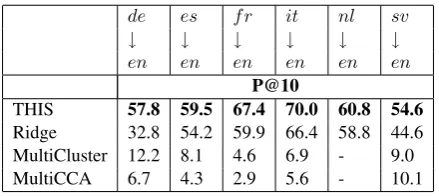
THIS 57.8 59.5 67.4 70.0 60.8 54.6 Ridge 32.8 54.2 59.9 66.4 58.8 44.6 MultiCluster 12.2 8.1 4.6 6.9 - 9.0 MultiCCA 6.7 4.3 2.9 5.6 - 10.1
Table 3: Top-10 precision for eight languages translated to English. The high accuracy on Ital-ian can be explained by the fact that, unlike other language pairs, for Italian we do not use Google Translate training data, but the data of (Dinu et al.,
2014), as shown in Table2.
in Table 3, and the corresponding data is shown in Table 2. For these language pairs, we do not show results for our method, THIS w/pos, since POS taggers are not available for some of the lan-guages. We also do not show (Lazaridou et al.,
2015), as they did not do experiments on these data sets, and we did not have an implementation of their approach. Additionally, (Ammar et al.,2016) did not have trained embeddings for Dutch (nl).
6.4 Trilingual Paths for Distillation
To address our second evaluation question, we car-ried out experiments with languages for which we only had small seed dictionaries. The training and test datasets for this setup are shown in Table 4. We gathered these datasets by searching for man-ually created datasets. In the cases were we could not find any, we used Google Translate, which, however produces some noisy translations. This is partly due to the fact that the translations are done out of context.
[image:7.595.306.526.252.350.2]pt pt pt pt da da af af
↓ ↓ ↓ ↓ ↓ ↓ ↓ ↓
en es fr de en sv en nl
Train 573 701 1,808 465 3,000 1,980 3,744 2,000
[image:8.595.73.292.61.114.2]Test 296 0 0 0 262 0 459 0
Table 4: Training and test datasets used in the trilingual path distillation experiments. We evalu-ated sub-parts of trilingual paths such aspt→es, andpt→ frusing cross validation hence the test sets for those languages are zero.
P@10
Portuguese (pt→en)
1 THIS(pt→en) 65.2 2 (pt→en)+(pt→es→en)[unlabeled data] 74.0 3 (pt→en)+(pt→es→en) 82.1
4 (pt→en)+(pt→ dees
fr
→en)[Weighted] 81.8
5 (pt→en)+(pt→ dees
fr
→en)[Unweighted] 78.4
[image:8.595.313.520.73.220.2]6 Ridge 60.8
Table 5: Trilingual path distillation results for Por-tuguese to English.
Portuguese-English language pair. The results are shown in Table5. First, we see that if we distill through the Spanish trilingual path(pt → es → en), without using any labeled data frompt→en, we already obtain a 9% gain in accuracy, line 2 in Table5. If, in addition to distilling through Span-ish, we use the available training data pt → en, 573 translation pairs, line 3 in Table 5, we ob-tain a 17% gain in accuracy. We see however that adding the distillation paths via French, and Ger-man did not improve perforGer-mance, line 4 in Ta-ble5. This can be attributed to the fact that with multiple distillation paths, the model has to opti-mize a more difficult function. On the other hand, we see that our trilingual weighting mechanism is effective. Without path weights, top-10 accu-racy is78.4%vs81.8%with weights, lines 4 and 5 in Table 5. The learned weights for the three languages involved in the trilingual paths for Por-tuguese are shown in Figure3. Spanish is the high-est weighted, followed by French, and German has the lowest weight. By definition, the learned weights add up to 1. In Figure4, we show accu-racy while varying the size of the seed dictionary. We can see that, given the small size of the training data, distillation provides a strong advantage.
T
ri
li
ngua
l P
at
h w
ei
ght
0.25 0.288 0.325 0.363 0.4
Distillation Language near Portuguese
[image:8.595.72.290.210.350.2]DE FR ES
Figure 3: Learned weights for languages involved in trilingual paths for translating Portuguese to En-glish. Spanish is the highest weighted and German is the lowest.
P
re
ci
si
on a
t t
op-10
10 25 40 55 70 85 100
Seed dictionary size
50 100 200 300 400 573
No distillation
Distill with unlabeled data Distill + labeled data
Figure 4: Varying the size of the seed dictionary for(pt→en).
Finally, we applied our distillation method to Afrikaans and Danish. Afrikaans distills from Dutch, and Danish distills from Swedish. As shown in Table6, in both cases, we obtained per-formance gains. However, in both of these cases, performance gains are modest. Unlike Portuguese to English, the seed dictionaries involved in train-ing these language pairs were obtained automat-ically using Google Translate and contain noisy translations.
7 Conclusion
We have presented a knowledge distillation train-ing objective that leverages triltrain-ingual paths of re-lated languages to improve mapping functions of languages with small seed dictionaries. The model produces substantial gains in accuracy for several language pairs.
[image:8.595.312.523.296.449.2]P@10
Afrikaans (af→en)
THIS(af→en) 46.4
(af→en)+(af→nl→en)[unlabeled data] 49.9
(af→en)+(af→nl→en) 51.0
Ridge 38.6
Danish (da→en)
THIS(da→en) 44.4
(da→en)+(da→sv→en) [unlabeled data] 45.2
(da→en)+(da→sv→en) 47.2
Ridge 37.1
Table 6: Trilingual path distillation results for Afrikaans and Danish.
to advances in methods for extracting general pur-pose knowledge (Mitchell et al.,2015;Nakashole et al., 2013; Wijaya et al., 2014), the use of se-mantic knowledge has been explored for several natural language tasks (Nakashole and Mitchell,
2015; Yang and Mitchell, 2017). However, for bilingual dictionary induction, and more generally, machine translation, the role of semantic knowl-edge has not been fully explored. We consider this to be a promising line of future work. Second, although we focus on bilingual dictionary induc-tion, our knowledge distillation training objective that enables seamless use of paths of rich resource languages as teachers of low resource languages is general and can be applied to problems such as multilingual tagging and parsing.
References
Waleed Ammar, George Mulcaire, Yulia Tsvetkov, Guillaume Lample, Chris Dyer, and Noah A. Smith. 2016. Massively multilingual word embeddings. CoRR, abs/1602.01925.
Shai Ben-David, John Blitzer, Koby Crammer, Fer-nando Pereira, et al. 2007. Analysis of represen-tations for domain adaptation. Advances in neural information processing systems, 19:137.
Phil Blunsom and Karl Moritz Hermann. 2014. Mul-tilingual distributed representations without word alignment.
Piotr Bojanowski, Edouard Grave, Armand Joulin, and Tomas Mikolov. 2017. Enriching word vectors with subword information. TACL.
Cristian Bucilu, Rich Caruana, and Alexandru Niculescu-Mizil. 2006. Model compression. In Proceedings of the 12th ACM SIGKDD interna-tional conference on Knowledge discovery and data mining, pages 535–541. ACM.
Hal Daum´e III. 2007. Frustratingly easy domain adap-tation.ACL 2007, page 256.
Georgiana Dinu, Angeliki Lazaridou, and Marco Ba-roni. 2014. Improving zero-shot learning by mitigating the hubness problem. arXiv preprint arXiv:1412.6568.
Manaal Faruqui and Chris Dyer. 2014. Improving vec-tor space word representations using multilingual correlation. InEACL, pages 462–471.
Stephan Gouws, Yoshua Bengio, and Greg Corrado. 2015. Bilbowa: Fast bilingual distributed represen-tations without word alignments. InIICML, pages 748–756.
Jiang Guo, Wanxiang Che, David Yarowsky, Haifeng Wang, and Ting Liu. 2015. Cross-lingual depen-dency parsing based on distributed representations. InACL, pages 1234–1244.
Aria Haghighi, Percy Liang, Taylor Berg-Kirkpatrick, and Dan Klein. 2008. Learning bilingual lexicons from monolingual corpora. InACL, pages 771–779. Geoffrey Hinton, Oriol Vinyals, and Jeff Dean. 2015. Distilling the knowledge in a neural network. arXiv preprint arXiv:1503.02531.
Zhiting Hu, Xuezhe Ma, Zhengzhong Liu, Eduard Hovy, and Eric Xing. 2016. Harnessing deep neu-ral networks with logic rules.
Alexandre Klementiev, Ivan Titov, and Binod Bhat-tarai. 2012. Inducing crosslingual distributed repre-sentations of words. InCOLING, pages 1459–1474. Tom´aˇs Koˇcisk`y, Karl Moritz Hermann, and Phil Blun-som. 2014. Learning bilingual word representa-tions by marginalizing alignments. arXiv preprint arXiv:1405.0947.
Angeliki Lazaridou, Georgiana Dinu, and Marco Ba-roni. 2015. Hubness and pollution: Delving into cross-space mapping for zero-shot learning. InACL, pages 270–280.
Mingsheng Long and Jianmin Wang. 2015. Learn-ing multiple tasks with deep relationship networks. arXiv preprint arXiv:1506.02117.
Tomas Mikolov, Quoc V. Le, and Ilya Sutskever. 2013. Exploiting similarities among languages for ma-chine translation. CoRR, abs/1309.4168.
[image:9.595.73.290.61.202.2]learning. InProceedings of the Twenty-Ninth AAAI Conference on Artificial Intelligence, (AAAI), pages 2302–2310.
Tom M Mitchell, Svetlana V Shinkareva, Andrew Carl-son, Kai-Min Chang, Vicente L Malave, Robert A Mason, and Marcel Adam Just. 2008. Predicting human brain activity associated with the meanings of nouns.science, 320(5880):1191–1195.
Ndapandula Nakashole and Tom M. Mitchell. 2015. A knowledge-intensive model for prepositional phrase attachment. In Proceedings of the 53rd Annual Meeting of the Association for Computational Lin-guistics, (ACL), pages 365–375.
Ndapandula Nakashole, Gerhard Weikum, and Fabian Suchanek. 2013. Discovering semantic relations from the web and organizing them with patty. ACM SIGMOD Record, 42(2):29–34.
Sinno Jialin Pan, Xiaochuan Ni, Jian-Tao Sun, Qiang Yang, and Zheng Chen. 2010. Cross-domain senti-ment classification via spectral feature alignsenti-ment. In Proceedings of the 19th international conference on World wide web, pages 751–760. ACM.
Slav Petrov, Dipanjan Das, and Ryan McDonald. 2011. A universal part-of-speech tagset. arXiv preprint arXiv:1104.2086.
Adriana Romero, Nicolas Ballas, Samira Ebrahimi Ka-hou, Antoine Chassang, Carlo Gatta, and Yoshua Bengio. 2014. Fitnets: Hints for thin deep nets. arXiv preprint arXiv:1412.6550.
Rico Sennrich and Barry Haddow. 2016. Linguistic input features improve neural machine translation. InProceedings of the First Conference on Machine Translation, pages 83–91, Berlin, Germany. Associ-ation for ComputAssoci-ational Linguistics.
Oscar T¨ackstr¨om, Ryan T. McDonald, and Jakob Uszkoreit. 2012. Cross-lingual word clusters for di-rect transfer of linguistic structure. InNAACL, pages 477–487.
Masao Utiyama and Hitoshi Isahara. 2007. A compari-son of pivot methods for phrase-based statistical ma-chine translation. InHLT-NAACL, pages 484–491. Ivan Vulic and Anna Korhonen. 2016. On the role
of seed lexicons in learning bilingual word embed-dings. ACL.
Ivan Vulic and Marie-Francine Moens. 2015. Bilin-gual word embeddings from non-parallel document-aligned data applied to bilingual lexicon induction. InACL, pages 719–725.
Derry Tanti Wijaya, Ndapandula Nakashole, and Tom M Mitchell. 2014. Ctps: Contextual temporal profiles for time scoping facts using state change de-tection. In Proceedings of the 2014 Conference on Empirical Methods in Natural Language Processing (EMNLP).