Abstract—Most of electrical power utilities in the world are required to ensure that electrical energy requirement from the customer is served smoothly in accordance to the respective policy of the country. Despite serving the power demands of the country, the power utility has also to ensure that the electrical power is generated within minimal cost. Thus, the total demand must be appropriately shared among the generating units with an objective to minimize the total generation cost for the system in order to satisfy the economic operation of the system. Economic dispatch is a procedure to determine the electrical power to be generated by the committed generating units in a power system so that the total generation cost of the system is minimized, while satisfying the load demand simultaneously. This paper presents the economic power dispatch problems solved using Ant Colony Optimization (ACO) technique. ACO is a meta-heuristic approach for solving hard combinatorial optimization problems. In this study, the proposed technique was tested using the standard IEEE 26-Bus RTS and the results revealed that the proposed technique has the merit in achieving optimal solution for addressing the problems. Comparative studies with other optimization technique namely the artificial immune system (AIS) were also conducted in order to highlight the strength of the proposed technique.
Keywords – Ant Colony Optimization, economic dispatch, meta-heuristic, power systems, optimization.
I. INTRODUCTION
The main role of electrical power utility is to ensure that electrical energy requirement from the customer is served. However in doing so, the power utility has also to ensure that the electrical power is generated with minimum cost. Hence, for economic operation of the system, the total demand must be appropriately shared among the generating units with an objective to minimize the total generation cost for the system. Economic Dispatch is a procedure to determine the electrical power to be generated by the
1
Ismail Musirin is with currently the Faculty of Electrical Engineering, Universiti Teknologi MARA Malaysia. He can be reached at: [email protected].
3
Mohd. Rozley Kalil is currently with the Politeknik Ungku Omar, Ipoh Malaysia. He can be reached at [email protected].
4
Mohamad Khayat Idris is with the Faculty of Electrical Engineering, Universiti Teknologi MARA Malaysia. He can be reached at: [email protected].
5
Titik Khawa Abdul Rahman is currently with the Academic Affairs Department, Universiti Teknologi MARA Malaysia. She can be reached at: [email protected].
6
Mohd. Rafi Adzman is currently with the Faculty of Electrical System, Universiti Malaysia Perlis (UniMAP). He can be reached at [email protected].
committed generating units in a power system so that the total generation cost of the system is minimized, while satisfying the load demand simultaneously. To address this
problem, optimization is a priori in solving the cost minimization problems. Power system optimization is an important field in the operation, planning and control of power systems. Many modern heuristic techniques to the solution of complex power system optimization problems have been proposed, each differing in their method of representation, implementation and solution procedure [1]. Economic power dispatch is one of the fundamental problems in power system operation and planning [2]. It is defined as the process of allocating generation levels to the generating units so that the system load is supplied entirely and most economically [3]. It concerned on the minimization of an objective function, usually the total cost of generation, while satisfying both the equality and inequality constraints [4]. Depending on load variations, the output of generators has to be changed to meet the balance between loads and generation power to make the system efficient. Recently, a new global optimization techniques known as Ant Colony Optimization (ACO) has become a candidate for many optimization applications. The ACO has solved several combinatorial optimization traveling salesman (ATSP), quadratic assignment problem (QAP), optimal design and scheduling problem of thermal units [5]. ACO has been used to address various optimization problems as reported by [6-12]. This paper presents the application of Ant Colony Optimization (ACO) in solving economic power dispatch problems. The objective function is cost minimization considering loss of transmission implemented on a 6 generating unit system. Comparison was implemented using AIS.
II. ECONOMICDISPATCHPROBLEMFORMULATION
Economic Dispatch problem can be solved by minimizing the cost of generation in the system. The solution gives the optimal generation output of the online generating units that satisfy the system’s power balance equation under various system and operational constraints. The Economic Dispatch problem can be formulated mathematically as follows
A. Objective Function
å
= Ngi
Fi(Pi) cost
minimize (1)
where cost is the operating cost of power system. Ng is the
number of units. Fi(Pi) is the cost function and Pi is the
power output of the unit i. Fi(Pi) is usually approximated by
a quadratic function of its power output Pi as:
Ant Colony Optimization (ACO) Technique in
Economic Power Dispatch Problems
1
Ismail Musirin, MemberIEEE, 2Nur Hazima Faezaa Ismail, 3Mohd. Rozely Kalil, 4
c P b P a ) Pi (
Fi 2 i i
i
i + +
= (2) where ai , bi and ciare the cost coefficients of unit i. Wire
drawing effects occurs when each steam admission valve in a turbine starts to open, and at the same time a rippling effect on the unit curve is produced. To model the effects of “valve-points”, a recurring rectified sinusoid contribution is added to the cost function. The result is:
)] P P ( h sin[ g c P b P a ) Pi (
Fi min
i i i i i
i 2 i
i + + +
-=
(3) where gi and hi are the valve-points coefficients. Pimin is the
lower generation limit of unit i. Ignoring valve point effects, some inaccuracy would be introduced into the resulting dispatch [3].
B. Constraint Equations
1: Unit Operation Constraints are given by:
g i
i
i
P
P
i
1,2,...,
N
P
min£
£
max=
(4)
where Pimin and Pimax are the lower and upper generation
limit of unit i.
2: Power Balance equation:
å
=
+
=
g
N i
D L i
P
P
P
1(5)
where PD is the demand and PL is transmission loss. The
transmission loss can be calculated bye the B-coefficients method or power flows analysis.
B-coefficients used in the power system is:
00
0
B
B
P
BP
P
P
T TL
=
+
+
(6)where P is a – dimensional column vector of the power output of the units.
3: Line flow constraints:
max
i i
Lf
Lf
£
i=1,2,…..NL (7)where Lfi is the MW line flow, Lfimax is the allowable
maximum flow of line i (line capacity), and NL is the number of transmission lines subject to line capacity constraints.
4: System stability constraints:
max ij j i
-

£


i,j=1,2,…..ND (8)where ∂i, ∂j are voltage angle of bus i and j. ∂ijmaxis the
allowable maximum voltage angle.
C. Solution Coding:
Let Xi = (x1,x2,….,xNg) be a vector denoting the ith
individual of the ant colony, where Ng is the number of units and Xi is the generated output of unit i. At initialization phrase, Xi is selected randomly from the
selected region S.
D. Objective Function and Feasible Region:
In order to minimize the objective function of ED the constraints have to be obeyed. Penalty function was used to transform those constraints which have difficulties to deal with in the feasible region including power balance, etc. The feasible region S is determined by the unit operation constraints.
E. Parameter Setting:
The parameter used here are N =5, τ0 = 1.0, γ1 =λ2=1,
ρ=0.6, q0=0.6.
III. ANTCOLONYOPTIMIZATIONTECHNIQUE
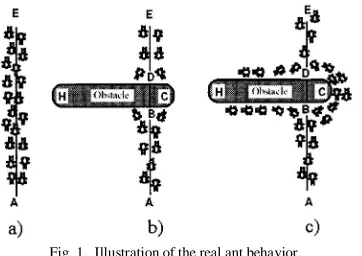
Ant Colony Optimization (ACO) was first developed by Dorigo et al. [5]. It is proposed as a viable new approach to stochastic combinatorial optimization. The idea is based on the following observation. A colony of ants is able to succeed in a task to find the shortest path between the nest and the food source. It was found that ants deposit a chemical substance trail, called pheromone on the ground when they move. This pheromone can be observed by other ants and motivates them to follow the path with a high probability. The following example shows how over time, the shortest paths are found through this self-reinforcing process.
In Fig. 1a, suppose that ants move between food source A and nest E on a straight line. Then, as shown in Fig. 1b, suddenly an obstacle appears and the path was cut off. At position B, ants have to decide whether to turn right or left. Under this situation, they may choose to turn right (BCD) or left (BHD). For all that, due to path BCD is shorter than
BHD, the first ant following path BCD will reach D before the first ant following path BHD. So, a higher level of pheromone intensity on the right will give information to the followers as a higher probability to turn right, which is shown in Fig. 1c. For a while, the shorter path will collect larger amount of pheromone trail than the longer path. Therefore, more ants will be increasingly guided to move on the shorter path. The result is that, very soon all ants will choose the shortest path in their movement.
Fig. 1. Illustration of the real ant behavior.
IV. ANT COLONY OPTIMIZATION (ACO)ALGORITHM ACO algorithm is inspired by the behaviour of real ant colonies used to solve combinatorial optimization problem [3]. The real ants lay down in some quantity an aromatic substance, known as pheromone, in their way to food. The pheromone quantity depends on the length of the path and the quality of the discovered food source. An ant chooses an exact path in connection with the intensity of the pheromone.
The pheromone trail evaporates over time if no more pheromone is laid down. Other ants are attracted to follow the pheromone trail. Therefore, the path will be marked again and it will attract more ants to use the same path. The pheromone trail on paths leading to rich food sources close to the nest be more frequented and will therefore grow faster. In this way, the best solution has more intensive pheromone and higher probability to be chosen. The described behaviour of real ant colonies can be used to solve combinatorial optimization problems by simulation: artificial ants searching the solution space by transiting from nodes to nodes. The artificial ants move usually associated with their previous action, stored in the memory with a specific data structure. The pheromone consistencies of all paths are updated only after the ant finished its tour from the first node to the last node. Every artificial ant has a constant amount of pheromone stored in it when the ant proceeds from the first node. The pheromone that stored in will be distributed average on the path after artificial ants finished its tour. The amount of pheromone will be high if artificial ants finished its tour with a good path. The pheromone of the routes progressively decreases by evaporation in order to avoid artificial ants stuck in local optima [8].
The overall steps of the ACO can be represented in the flow chart in Fig. 2. In this study, there is some modifications performed on the ACO algorithm in order to make it suitable for the application in power system. The following sections explain the ACO algorithms in detail.
Step 1: Initialization
In the beginning, the ACO parameters have to be specified during initialization process. The main difficulty with the ACO program is that; an appropriate choice of ACO control parameters is necessary before applying the ACO program. The choice of parameters has been obtained by trial and error. In order to get better result in the development of the ACO’s program; the parameters must be selected carefully.
No
No
Yes
Yes
Fig. 2. Flow chart for ACO
On the other hand, every parameter requires to be set for limiting the search range in order to avoid large computation time. During initialization; the following parameters need to be initialized for the purpose of ACO implementation.
n : no. of nodes
m : no. of ants
tmax : maximum iteration
dmax : maximum distance for every ants tour
β : parameter, which determines the relative importance of pheromone versus distance (β > 0)
ρ : heuristically defined coefficient (0 < ρ< 1)
α : pheromone decay parameter (0 < α < 1)
q0 : parameter of the algorithm (0 < q0 < 1)
τo : initial pheromone level
The maximum distance for every ants tour (dmax) can be
calculated by using this formula:
dmax = ú
û ù ê
ë é
å
-=
1
1
n i
i
d (9)
( )
u rdi= -max (10)
where:
r : current node
u : unvisited node
[image:3.612.97.278.49.177.2]In order to determine dmax, every node in the list is required
to be set as the first node. The node in the list can only be selected once for every tour of ant. Each ant will select the next node which has higher distance from the current node. This process will repeat until the end node in the list.
Step 2: Generate First Node
The first node will be selected by generating random number based on the uniform distribution, ranging from 1 to n.
Step 3: State Transition Rule
At each construction step, ant k applies a state transition rule in order to decide which node to be visited next. The ant k, whichis currently positioned at current node (r)will move to the next node (s) by applying the state transition rule given by:-
[ ]
[
]
{
ïî ï í ì £ = ) exp ( , ) (exp }, ) , ( . ) , ( maxarg () 0
loration biased otherwise S loitation q q if u r u r J
s u kr
b
e t h
(11) where:
q : random number uniformly distributed in [0 to 1]
q
0
: parameter of the algorithm (0 < q0 < 1)
S : random variable selected according to the probability distribution given in eq. (12)
The probability for an ant k at current node (r) to choose the next node (s) is calculated using the probability equation given by:- ï î ï í ì =
å
otherwise J s if u r u r s r s r s rPk u Jkr kr
, 0 , ] ) , ( )].[ , ( [ ] ) , ( )].[ , ( [ ) , ( () ) ( e h t h t e b b (12) where:
τ : pheromone
Jk(r) : set of nodes that remain to be visited by ant k
positioned on node (to make the solution feasible)
β : parameter, which determines the relative importance of pheromone versus distance (β > 0)
η : 1/d, is the inverse of the distance d(r,s)
In equation (11) and (12) the pheromone on path τ(r,s) is multiplied by the heuristic value η(r,s) in order to determine the selection of paths which are shorter and have a greater amount of pheromones. The parameter q0 determines the
relative importance of the exploitation versus exploration condition: an ant at node r (current node) has to choose a node s (next node) to move. This is determined by the value of qrandomly where (0 < q< 1). If (q < q0 ) the best path
will be determined based on equation (11), (i.e. in the exploitation mode). On the other hand, if (q ≥ q0 ) the best
path will be determined based on equation (12), (i.e. in the exploration mode). The process to determine the next node (s)starts by calculating the probability of choosing the next node using equation (12). After the calculation of probability, the value of q is then generated randomly. If (q < q0), node 4 was selected as next node (s) which has the
highest probability (i.e. in the exploitation mode). On the other hand, if (q ≥ q0 ), the next node (s) will be selected
randomly from the list of unvisited nodes (i.e. in the exploration mode).
Step 4: Local Updating Rule
Local updating rule is a process used to change the amount of pheromone to the visited paths during the construction of solution. The amount of pheromones can be updated based on the following equation:-
τ(r,s) ‹— (1 – ρ) τ(r,s)+ ρ.Δ τ(r,s) (13) where:
r = heuristically defined coefficient (0 < ρ < 1) Δ τ(r,s) = τo
to = initial pheromone trail
This local updating rule will shuffle the tours, so that the early nodes in one ant’s tour may be explored later in other ants’ tours. The amount of pheromone on visited paths will be reduced so that the visited paths become less desirable and therefore will be chosen with lower probability by the other ants in the remaining steps of an iteration of the algorithm. When the new τ value is lower, the probabilities to select the same nodes also become lower.
Step 5: Fitness Evaluation
Fitness evaluation is performed after all ants have completed their tours. In this step, the control variable (x) is computed using the following equation:-
max max
x d
d
x= ´ (14)
where:
d : distance for every ants tour
xmax : maximum x
dmax : maximum distan ce for every ants tour
The values of variable x will be assigned for the fitness in the ACO algorithm.
Step 6: Global Updating Rule
Global updating rule is a process used to update the amount of pheromones generated by the ant which has constructed the shortest tour from the beginning of the tour. There will be only one ant is allowed to update the amount of pheromone which determines the best fitness. The amount of pheromones is updated after all ants have completed their tours by applying equation (15).
τ(r,s) ‹— (1–α) τ(r,s)+ α.Δ τ(r,s) (15) where:
( )
( )
( )
î í
ì -
-= D otherwise tour best global s r if L s r gb , 0 , , , e
α : pheromone decay parameter (0 < α < 1)
Lg b
: length of the globally best tour from the beginning of the tour
Step 7: End Condition
The algorithm stops the iteration when a maximum number of iterations (tmax) have been performed. Every tour
that was visited by ants should be evaluated. If a better path is discovered in the process, it will be kept for the next reference. The best path selected between all iterations engages the optimal scheduling solution. As a consequence, ants never converge to common path. This is observed experimentally, and it is a desirable property. If ants explore different paths then there is a higher probability that one of them will find an improving solution. There are cases where solutions converge to same tour which would make the use the no. of ants (m) pointless.
V. RESULTSANDDISCUSSION
The results tabulated in Table I are obtained when the ACO parameter are set to the following values at the initialization process:
n = 10, m = 5,
t
max= 5,d
max= 49, b = 2, a= 0.1, qo=0.6,r = 0.6 and to= 1.
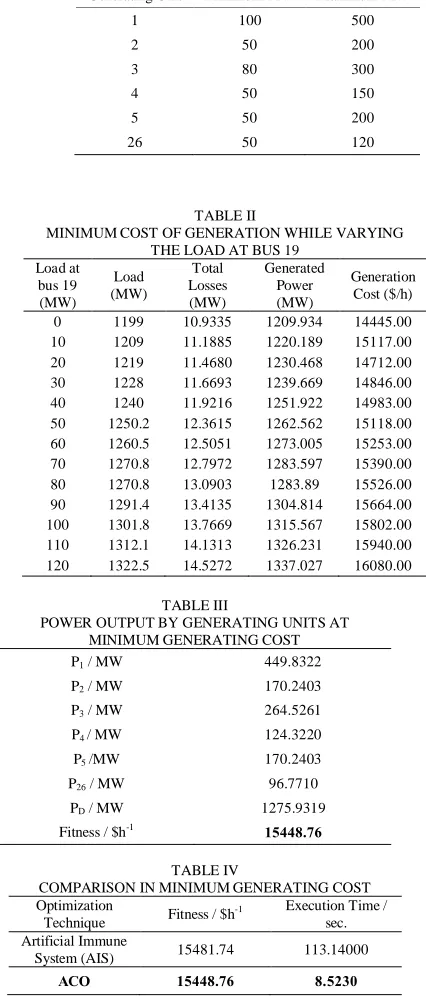
The developed technique was employed to determine the economic dispatch for the IEEE 26-Bus RTS that has 6 generating units. The test was performed with bus 19 subjected to the load variation. The generator’s operating costs in $/h, with Pi in MW are as follows [5]:
C1 = 240 + 7.0P1 + 0.0070P1 2 C2 = 200 + 10.0P2 + 0.0095P2 2 C3 = 220 + 8.5P3 + 0.0090P3
2 C4 = 200 + 11.0P4 + 0.0090P4 2 C5 = 220 + 10.5P5 + 0.0080P52 C26 = 190 + 12.0P26 + 0.0075P262
The total cost of generation is given by,
CT = C1 + C2 + C3 + C4 + C5 + C26
In this study, CT is taken as the fitness which was minimized during the optimization process. On the other hand, Table II tabulates the minimum generation cost obtained by ACO while varying the load (Pload) at a selected bus (i.e. bus 19) until it reaches the stability limit. The total loss increased accordingly as the load is increased. The constrains need to be considered are: Vm
³
0.95 p.u and Vm£
1.06 p.u. and Tloss£
20. The developed ACO hassuccessfully the generated power by each generating unit to minimize the total cost in the system. The minimization of total generation cost has also taken account the systems’ limits and constraints. Table II shows the minimum generation cost obtained by ACO while varying the load (Pload) at a selected bus (i.e. bus 19) until it reaches the stability limit. The total loss increased accordingly as the load is increased.
Table III tabulates the output power by all the generating units in the system with the optimized cost of $15448.76 as highlighted in the table. In order to achieve this minimal cost, the amount of generating unit for each generator is given in the table.
To realize the effectiveness of the proposed ACO technique, comparative studies were performed by reevaluating the process using AIS; with results given in Table IV. It is obvious that ACO outperformed AIS in terms of cost minimization, implemented with much faster execution time.
VI. CONCLUSION
[image:5.612.351.528.53.175.2]Ant colony optimization has been proposed for solving economic dispatch problems with cost minimization as the objective function. In this study, the developed ACO engine is capable to implement the power to be generated by each generating unit at the minimum cost and meet the demand requirement. The results obtained are also compared with
TABLE II
MINIMUM COST OF GENERATION WHILE VARYING THE LOAD AT BUS 19
Load at bus 19
(MW) Load (MW)
Total Losses (MW)
Generated Power (MW)
Generation Cost ($/h) 0 1199 10.9335 1209.934 14445.00 10 1209 11.1885 1220.189 15117.00 20 1219 11.4680 1230.468 14712.00 30 1228 11.6693 1239.669 14846.00 40 1240 11.9216 1251.922 14983.00 50 1250.2 12.3615 1262.562 15118.00 60 1260.5 12.5051 1273.005 15253.00 70 1270.8 12.7972 1283.597 15390.00 80 1270.8 13.0903 1283.89 15526.00 90 1291.4 13.4135 1304.814 15664.00 100 1301.8 13.7669 1315.567 15802.00 110 1312.1 14.1313 1326.231 15940.00 120 1322.5 14.5272 1337.027 16080.00
TABLE I
GENERATING LIMIT OF GENERATING UNITS Generating Unit Minimum MW Maximum MW
1 100 500
2 50 200
3 80 300
4 50 150
5 50 200
26 50 120
TABLE III
POWER OUTPUT BY GENERATING UNITS AT MINIMUM GENERATING COST
P1 / MW 449.8322
P2 / MW 170.2403
P3 / MW 264.5261
P4 / MW 124.3220
P5 /MW 170.2403
P26 / MW 96.7710
PD / MW 1275.9319
Fitness / $h-1 15448.76
TABLE IV
COMPARISON IN MINIMUM GENERATING COST Optimization
Technique Fitness / $h
-1 Execution Time /
sec. Artificial Immune
System (AIS) 15481.74 113.14000
[image:5.612.318.531.77.575.2]AIS to investigate its computation capability. The comparison shows that ACO is versatile, robust and efficient. Further work is required to develop techniques for searching the neighborhood, and present more efficacious sufficient conditions for convergence.
VII. REFERENCES
[1] K. S. Swarup, “Ant Colony Optimization for Economic Generator Scheduling and Load Dispatch, Proceedings of the 6th
WSEAS Int. Conf. on EVOLUTIOANARY COMPUTING, Lisbon, Portugal, June 16-18, 2005, pp. 167-175.
[2] Yun-He Hou, Yao-Wu, Li-Juan Lu and Xin-Yin Xiong, “Generalized Ant Colony Optimization for Economic Dispatch of Power Systems,” IEEE Trans. Power Apparatus and Systems, pp 225-229.
[3] Yoshimi, M.; Swarup, K.S.; Izui, Y.;”Optimal Economic Power
Dispatch Using Genetic Algorithm” Proceedings of the Second International Forum on Applications of Neural Networks to Power Systems, ANNPS '93, 19-22 April 1993, pp. 157 – 162.
[4] Chowdhury, B.H.; Rahman, S.; “A Review of Recent Advances in
Economic Dispatch”, IEEE Transactions on Power Systems, Volume 5, Issue 4, Nov. 1990 pp. 1248 – 1259.
[5] D. Nualhong, S. Chusanapiputt, S. Phomvuttisarn, T. Saengsuwan and S. Jantarang, “Diversity Control Approach To Ant Colony Optimization for Unit Commitment Problem”, 2004 IEEE Region 10 Conference,
TENCON 2004, 21-24 Nov. 2004, Vol. C, pp. 488- 491.
[6] Linda Slimani and Tarek Bouktir, “Economic Power Dispatch of Power System with Pollution Control using Multiobjective Ant Colony Optimization”, International Journal of Computational Intelligence
Research (IJCIR) 2007, Vol. 3, No. 2, pp. 145-153.
[7] Wen Yu and Wu Tie-Jun, “Dynamic Window Search of Ant Colony Optimization for Complex Multi-Stage Decision Problems”, IEEE International Conference on Systems, Man and Cybernetics, 2003. 5-8 Oct. 2003 , Volume 5, pp. 4091 – 4097.
[8] Ying-Tung Hsiao, Cheng-Long Chuang and Cheng- Chih Chien, “Ant Colony Optimization for Best Path Planning,” International Symposium on Communications and Information Technologies 2004 (ISCIT 2004), Sapporo, Japan, 26-29 October 2004, pp. 109-113. [9] Dedek Lukman and Trevor R. Blackburn, “Loss Minimization in Load
Flow Simulation in Power System”, 4th IEEE International Conference
on Power Electronics and Drive Systems, 2001
22-25 Oct. 2001, Vol.: 1, pp. 84- 88.
[10] C. J. Bridenbaugh, D.A. DiMascio and R. D’Aquila, “Voltage Control Improvement Throught Capacitor and Transformer Tap Optimization,” IEEE Transactions on Power Systems, Vol. 7, No. 1, February 1992, Pp. 222-227.
[11] Li Ling; Liao Zhiwei; Huang Shaoxian; Wang Gang,”A Distributed Model for Power System Restoration Based on Ant Colony Optimization Algorithm”, IEEE/PES Asia and PacificTransmission and
Distribution Conference and Exhibition, 2005, pp. 1 – 5.
[12] Lee, K.Y.; Vlachogiannis, J.G. “Optimization of Power Systems
based on Ant Colony System Algorithms: An Overview”, 13th
International Conference on Intelligent Systems Application to Power Systems, 2005. Volume , Issue , 6-10 Nov. 2005 pp. 22 – 35.
VIII. BIOGRAPHIES
Dr. Ismail Musirin obtained Diploma of Electrical Power Engineering in 1987, Bachelor of Electrical Engineering (Hons) in 1990; both from Universiti Teknologi Malaysia, MSc in Pulsed Power Technology in 1992 from University of Strathclyde, United Kingdom and PhD in Electrical Engineering in 2005 from Universiti Teknologi MARA, Malaysia. He has published 2 books and more than 70 technical papers in the international and national, conferences and journals.
His research interest includes power system stability, optimization techniques, distributed generator and artificial intelligence. He is also a member of IEEE and ARTIST. He has reviewed numerous IEEE, IET and WSEAS journal and conference papers.
Nur Hazima Faezaa Ismail obtainedBachelor of Engineering (Electrical) (Hons) from Universiti Teknologi MARA Malaysia in 2004. Shee is currently undergoing Aviation Engineering Programme at the Malaysian Airline System (MAS), Malaysia. Her research interest include ant colony optimization technique, loss minimization and voltage stability studies.
Mohd Rozely Kalil obtained Diploma in Electrical Engineering (Power) from Universiti Teknologi Malaysia in 1994 and Bachelor in Electrical Engineering (Hons) from Universiti Teknologi MARA, Malaysia in 2000. He is currently pursuing research towards his MSc at Universiti Teknologi MARA. He has published several technical papers in the international conferences and journal. His research interest includes power system optimization, ant colony optimization (ACO) technique, Evolutionary Programming (EP), voltage stability studies, reactive power planning and loss minimization.
Muhammad Khayat Idris received Bachelor of Electrical Engineering from University of Technology Malaysia in 1977 and MSc in Electrical Power Engineering from University of Strathclyde in 1983. He is an Assoc. Prof. at the Faculty of Electrical Engineering, Universiti Teknologi MARA, Shah Alam and currently attached as the Deputy Director at the UiTM Development Division, Puncak Alam Campus. He has published numerous research papers in power system for the national and international publications. His research interest includes voltage stability, transmission network improvement, protection systems, and building services besides posing practical experiences.
Dr. Titik Khawa Abdul Rahman received BSc E.E. (Hons) and PhD in 1988 from Loughborough University of Technology, United Kingdom and University of Malaya, Malaysia in 1996 respectively. She is an Associate Professor at the Faculty of Electrical Engineering and currently Tthe Head of Quality Academic Assurance, Academic Affair Division of Universiti Teknologi MARA Malaysia. She has written more 80 technical papers and also supervising post-graduate students. Her research interest includes voltage profile studies, artificial neural network, Evolutionary Computation, Artifical Immune System (AIS), Economic Dispatch and Loss Minimization.