A Log-Linear Model for Unsupervised Text Normalization
Yi Yang
School of Interactive Computing Georgia Institute of Technology
Jacob Eisenstein
School of Interactive Computing Georgia Institute of Technology
Abstract
We present a unified unsupervised statistical model for text normalization. The relation-ship between standard and non-standard to-kens is characterized by a log-linear model, permitting arbitrary features. The weights of these features are trained in a maximum-likelihood framework, employing a novel se-quential Monte Carlo training algorithm to overcome the large label space, which would be impractical for traditional dynamic pro-gramming solutions. This model is im-plemented in a normalization system called UNLOL, which achieves the best known re-sults on two normalization datasets, outper-forming more complex systems. We use the output ofUNLOL to automatically normalize a large corpus of social media text, revealing a set of coherent orthographic styles that under-lie online language variation.
1 Introduction
Social media language can differ substantially from other written text. Many of the attempts to character-ize and overcome this variation have focused on nor-malization: transforming social media language into text that better matches standard datasets (Sproat et al., 2001; Liu et al., 2011). Because there is lit-tle available training data, and because social me-dia language changes rapidly (Eisenstein, 2013b), fully supervised training is generally not considered appropriate for this task. However, due to the ex-tremely high-dimensional output space — arbitrary sequences of words across the vocabulary — it is
a very challenging problem for unsupervised learn-ing. Perhaps it is for these reasons that the most suc-cessful systems are pipeline architectures that cob-ble together a diverse array of techniques and re-sources, including statistical language models, de-pendency parsers, string edit distances, off-the-shelf spellcheckers, and curated slang dictionaries (Liu et al., 2011; Han and Baldwin, 2011; Han et al., 2013). We propose a different approach, performing nor-malization in a maximum-likelihood framework. There are two main sources of information to be exploited: local context, and surface similarity be-tween the observed strings and normalization can-didates. We treat the local context using standard language modeling techniques; we treat string simi-larity with a log-linear model that includes features for both surface similarity and word-word pairs.
Because labeled examples of normalized text are not available, this model cannot be trained in the standard supervised fashion. Nor can we apply dynamic programming techniques for unsu-pervised training of locally-normalized conditional models (Berg-Kirkpatrick et al., 2010), as their com-plexity is quadratic in the size of label space; in normalization, the label space is the vocabulary it-self, with at least104 elements. Instead, we present a new training approach using Monte Carlo tech-niques to compute an approximate gradient on the feature weights. This training method may be appli-cable in other unsupervised learning problems with a large label space.
This model is implemented in a normalization system calledUNLOL (unsupervisednormalization in aLOg-Linear model). It is a lightweight
bilistic approach, relying only on a language model for the target domain; it can be adapted to new corpora text or new domains easily and quickly. Our evaluations show thatUNLOL outperforms the state-of-the-art on standard normalization datasets. In addition, we demonstrate the linguistic insights that can be obtained from normalization, using
UNLOL to identify classes of orthographic transfor-mations that form coherent linguistic styles.
2 Background
The text normalization task was introduced by Sproat et al. (2001), and attained popularity in the context of SMS messages (Choudhury et al., 2007b). It has become still more salient in the era of widespread social media, particularly Twitter. Han and Baldwin (2011) formally define a normalization task for Twitter, focusing on normalizations between single tokens, and excluding multi-word tokens like
lol (laugh out loud). The normalization task has been criticized by Eisenstein (2013b), who argues that it strips away important social meanings. In recent work, normalization has been shown to yield improvements for part-of-speech tagging (Han et al., 2013), parsing (Zhang et al., 2013), and machine translation (Hassan and Menezes, 2013). As we will show in Section 7, accurate automated normalization can also improve our understanding of the nature of social media language.
Supervised methods Early work on normaliza-tion focused on labeled SMS datasets, using ap-proaches such as noisy-channel modeling (Choud-hury et al., 2007a) and machine translation (Aw et al., 2006), as well as hybrid combinations of spelling correction and speech recognition (Kobus et al., 2008; Beaufort et al., 2010). This work sought to balance language models (favoring words that fit in context) with transformation models (fa-voring words that are similar to the observed text). Our approach can also be seen as a noisy channel model, but unlike this prior work, no labeled data is required.
Unsupervised methods Cook and Stevenson (2009) manually identify several word formation types within a noisy channel framework. They parametrize each formation type with a small
num-ber of scalar values, so that all legal transformations of a given type are equally likely. The scalar pa-rameters are then estimated using expectation max-imization. This work stands apart from most of the other unsupervised models, which are pipelines.
Contractor et al. (2010) use string edit distance to identify closely-related candidate orthographic forms and then decode the message using a language model. Gouws et al. (2011) refine this approach by mining an “exception dictionary” of strongly-associated word pairs such as you/u. Like Con-tractor et al. (2010), we apply string edit distance, and like Gouws et al. (2011), we capture strongly related word pairs. However, rather than applying these properties as filtering steps in a pipeline, we add them as features in a unified log-linear model.
Recent approaches have sought to improve accu-racy by bringing more external resources and com-plex architectures to bear. Han and Baldwin (2011) begin with a set of string similarity metrics, and then apply dependency parsing to identify contextually-similar words. Liu et al. (2011) extract noisy train-ing pairs from the search snippets that result from carefully designed queries to Google, and then train a conditional random field (Lafferty et al., 2001) to estimate a character-based translation model. They later extend this work by adding a model of vi-sual priming, an off-the-shelf spell-checker, and lo-cal context (Liu et al., 2012a). Hassan and Menezes (2013) use a random walk framework to capture contextual similarity, which they then interpolate with an edit distance metric. Rather than seek-ing additional external resources or designseek-ing more complex metrics of context and similarity, we pro-pose a unified statistical model, which learns feature weights in a maximum-likelihood framework.
3 Approach
Our approach is motivated by the following criteria:
• Low-resource. Other unsupervised ap-proaches take advantage of resources such as slang dictionaries and spell checkers (Han and Baldwin, 2011; Liu et al., 2011). Resources that characterize the current state of internet language risk becoming outdated; in this paper we investigate whether high-quality normaliza-tion is possible without any such resources.
• Featurized. The relationship between any pair of words can be characterized in a number of different ways, ranging from simple character-level rules (e.g.,going/goin) to larger substi-tutions (e.g.,someone/sum1), and even to pat-terns that are lexically restricted (e.g., you/u,
to/2). For these reasons, we seek a model that permits many overlapping features to describe candidate word pairs. These features may in-clude simple string edit distance metrics, as well as lexical features that memorize specific pairs of standard and nonstandard words.
• Context-driven. Learning potentially arbitrary word-to-word transformations without supervi-sion would be impossible without the strong additional cue of local context. For example, in the phrase
give me suttin to believe in,
even a reader who has never before seen the wordsuttin may recognize it as a phonetic transcription ofsomething. The relatively high string edit distance is overcome by the strong contextual preference for the word something
over orthographically closer alternatives such as button or suiting. We can apply an arbi-trary target language model, leveraging large amounts of unlabeled data and catering to the desired linguistic characteristics of the normal-ized content.
• Holistic. While several prior approaches — such as normalization dictionaries — operate at the token level, our approach reasons over the scope of the entire message. The necessity for such holistic, joint inference and learning can be seen by changing the example above to:
gimme suttin 2 beleive innnn.
None of these tokens are standard (except 2, which appears in a nonstandard sense here), so without joint inference, it would not be possi-ble to use context to help normalizesuttin. Only by jointly reasoning over the entire mes-sage can we obtain the correct normalization.
These desiderata point towards a featurized se-quence model, which must be trained without la-beled examples. While there is prior work on train-ing sequence models without supervision (Smith and Eisner, 2005; Berg-Kirkpatrick et al., 2010), there is an additional complication not faced by models for tasks such as part-of-speech tagging and named entity recognition: the potential label space of standard words is large, on the order of at least 104. Naive application of Viterbi decod-ing — which is a component of traindecod-ing for both Contrastive Estimation (Smith and Eisner, 2005) and the locally-normalized sequence labeling model of Berg-Kirkpatrick et al. (2010) — will be stymied by Viterbi’s quadratic complexity in the dimension of the label space. While various pruning heuris-tics may be applied, we instead look to Sequen-tial Monte Carlo (SMC), a randomized algorithm which approximates the necessary feature expecta-tions through weighted samples.
4 Model
Given a set of source-language sentences S =
{s1,s2, . . .} (e.g., Tweets), our goal is to
trans-duce them into target-language sentences T =
{t1,t2, . . .}(standard English). We are given a
tar-get language model P(t), which can be estimated from some large set of unlabeled target-language sentences. We denote the vocabularies of source lan-guage and target lanlan-guage asνSandνT respectively.
We define a log-linear model that scores source and target strings, with the form
P(s|t;θ)∝expθTf(s,t). (1)
`θ(s)for a source-language sentencesas follows:
`θ(s) = logP(s) = log
X
t
P(s|t;θ)P(t)
We would like to maximize this objective by mak-ing gradient-based updates.
∂`θ(s)
∂θ =
1 P(s)
X
t
P(t) ∂
∂θP(s|t;θ)
=X
t
P(t|s) f(s,t)−X s0
P(s0|t)f(s0,t)
!
=Et|s[f(s,t)−Es0|t[f(s0,t)]]
(2)
We are left with a difference in expected feature counts, as is typical in log-linear models. However, unlike the supervised case, hereboth terms are ex-pectations: the outer expectation is over all target se-quences (given the observed source sequence), and the nested expectation is over all source sequences, given the target sequence. As the space of possible target sequencestgrows exponentially in the length of the source sequence, it will not be practical to compute this expectation directly.
Dynamic programming is the typical solution for computing feature expectations, and can be applied to sequence models when the feature function de-composes locally. There are two reasons this will not work in our case. First, while the forward-backward algorithm would enable us to compute Et|s, it would not give us the nested expectation
Et|s[Es0|t]; this is the classic challenge in training
globally-normalized log-linear models without la-beled data (Smith and Eisner, 2005). Second, both forward-backward and the Viterbi algorithm have time complexity that is quadratic in the dimension of the label space, at least104or105. As we will show, Sequential Monte Carlo (SMC) algorithms have a number of advantages in this setting: they permit the efficient computation of both the outer and inner expectations, they are trivially parallelizable, and the number of samples provides an intuitive tuning tradeoff between accuracy and speed.
4.1 Sequential Monte Carlo approximation
Sequential Monte Carlo algorithms are a class of sampling-based algorithms in which latent
vari-ables are sampled sequentially (Cappe et al., 2007). They are particularly well-suited to sequence mod-els, though they can be applied more broadly. SMC algorithms maintain a set of weighted hypotheses; the weights correspond to probabilities, and in our case, the hypotheses correspond to target language word sequences. Specifically, we approximate the conditional probability,
P(t1:n|s1:n)≈ K
X
k=1
ωnkδtk
1:n(t1:n),
whereωnkis the normalized weight of samplekat wordn(ω˜nkis the unnormalized weight), andδtk
1:nis
a delta function centered attk1:n.
At each step, and for each hypothesis k, a new target word is sampled from aproposal distribution, and the weight of the hypothesis is then updated. We maintain feature counts for each hypothesis, and ap-proximate the expectation by taking a weighted av-erage using the hypothesis weights. The proposal distribution will be described in detail later.
We make a Markov assumption, so that the emis-sion probabilityP(s|t)decomposes across the ele-ments of the sentenceP(s|t) =QN
n P(sn|tn). This
means that the feature functionsf(s,t)must decom-pose on eachhsn, tnipair. We can then rewrite (1)
as
P(s|t;θ) =
N
Y
n
exp θTf(sn, tn)
Z(tn)
(3)
Z(tn) =
X
s
expθTf(s, tn)
. (4)
In addition, we assume that the target language modelP(t)can be written as an N-gram language model, P(t) = Q
nP(tn|tn−1, . . . tn−k+1). With
these assumptions, we can view normalization as a finite state-space model in which the target lan-guage model defines the prior distribution of the pro-cess and Equation 3 defines the likelihood function. We are able to compute the the posterior probabil-ityP(t|s) usingsequential importance sampling, a member of the SMC family.
The crucial idea in sequential importance sam-pling is to update the hypotheses tk
1:n and their
Assuming the proposal distribution has the form Q(tk1:n|s1:n), the importance weights are given by
ωnk∝ P(t k
1:n|s1:n) Q(tk
1:n|s1:n)
(5)
In order to update the hypotheses recursively, we rewriteP(t1:n|s1:n)as:
P(t1:n|s1:n) =
P(sn|t1:n,s1:n−1)P(t1:n|s1:n−1)
P(sn|s1:n−1)
=P(sn|tn)P(tn|t1:n−1,s1:n−1)P(t1:n−1|s1:n−1) P(sn|s1:n−1)
∝P(sn|tn)P(tn|tn−1)P(t1:n−1|s1:n−1),
assuming a bigram language model. We further as-sume the proposal distributionQcan be factored as:
Q(t1:n|s1:n) =Q(tn|t1:n−1,s1:n)Q(t1:n−1|s1:n−1)
=Q(tn|tn−1, sn)Q(t1:n−1|s1:n−1).
(6)
Then the unnormalized importance weights sim-plify to a recurrence:
˜
ωnk=P(sn|t
k
n)P(tkn|tkn−1)P(tk1:n−1|s1:n−1)
Q(tn|tn−1, sn)Q(tk1:n−1|s1:n−1)
(7)
=ωnk−1
P(sn|tkn)P(tkn|tkn−1)
Q(tn|tn−1, sn)
(8)
Therefore, we can approximate the posterior dis-tributionP(tn|s1:n) ≈ PKk=1ωnkδtk
n(tn), and
com-pute the outer expectation as follows:
Et|s[f(s,t)] =
K
X
k=1
ωNk N
X
n=1
f(sn, tkn) (9)
We compute the nested expectation using a non-sequential Monte Carlo approximation, assuming we can draws`,k ∼P(s|tkn).
Es|tk[f(s,tk)] =
1 L
N
X
n=1
L
X
`=1
f(s`,kn , tkn)
This gives the overall gradient computation:
Et|s[f(s,t)−Es0|t[f(s0,t)]] = 1
PK
k=1ω˜
k N
K
X
k=1 ˜ ωNk
× N
X
n=1
f(sn, tkn)−
1 L
L
X
`=1
f(s`,kn , tkn)
!
(10)
where we sample tkn and update ωkn while mov-ing from left-to-right, and sample s`,kn at each n.
Note that although the sequential importance sam-pler moves left-to-right like a filter, we use only the final weightsωN to compute the expectation. Thus,
the resulting expectation is based on the distribu-tion P(s1:N|t1:N), so that no backwards
“smooth-ing” pass (Godsill et al., 2004) is needed to elim-inate bias. Other applications of sequential Monte Carlo make use of resampling (Cappe et al., 2007) to avoid degeneration of the hypothesis weights, but we found this to be unnecessary due to the short length of Twitter messages.
4.2 Proposal distribution
The major computational challenge for dynamic programming approaches to normalization is the large label space, equal to the size of the target vo-cabulary. It may appear that all we have gained by applying sequential Monte Carlo is to convert a computational problem into a statistical one: a naive sampling approach will have little hope of finding the small probability region of the high-dimensional label space. However, sequential im-portance sampling allows us to address this issue through the proposal distribution, from which we sample the candidate wordstn. Careful design of the
proposal distribution can guide sampling towards the high-probability space. In the asymptotic limit of an infinite number of samples, any non-pathological proposal distribution will ultimately arrive at the de-sired estimate, but a good proposal distribution can greatly reduce the number of samples needed.
Doucet et al. (2001) note that the optimal pro-posal — which minimizes the variance of the im-portance weights conditional ont1:n−1 ands1:n —
has the following form:
Q(tkn|sn, tkn−1) =
P(sn|tkn)P(tkn|tkn−1)
P
t0P(sn|t0)P(t0|tkn−1)
Sampling from this proposal requires computing the normalized distributionP(sn|tkn); similarly, the
update of the hypothesis weights (Equation 8) re-quires the calculation ofQin its normalized form. In each case, the total cost is the product of the vocabu-lary sizes,O(#|νT|#|νS|), which is not tractable as
the vocabularies become large.
In low-dimensional settings, a convenient so-lution is to set the proposal distribution equal to the transition distribution, Q(tkn|sn, tkn−1) =
P(tkn|tnk−1, . . . , tkn−k+1). This choice is called the
“bootstrap filter,” and it has the advantage that the weights ω(k) are exactly identical to the product of emission likelihoods Q
nP(sn|tkn). The
com-plexity of computing the hypothesis weights is thus
O(#|νS|). However, because this proposal ignores
the emission likelihood, the bootstrap filter has very little hope of finding a high-probability sample in high-entropy contexts.
We strike a middle ground between efficiency and accuracy, using a proposal distribution that is closely related to the overall likelihood, yet is tractable to sample and compute:
Q(tkn|sn, tkn−1)
def
=
P(sn|tkn)Z(tnk)P(tkn|tkn−1)
P
t0P(sn|t0)Z(t0)P(t0|tkn−1)
= exp θ
Tf(s n, tn)
P(tkn|tkn−1)
P
t0exp θTf(sn, t0)
P(t0|tkn−1)
(12)
Here, we simply replace the likelihood distribu-tion in (11) by its unnormalized version.
To update the unnormalized hypothesis weights ˜
ωnk, we have
˜
ωkn=ωkn−1
P
t0exp θTf(sn, t0)
P(t0|tkn−1)
Z(tk n)
(13)
The numerator requires summing over all ele-ments in νT and the denominator Z(tkn) requires
summing over all elements inνS, for a total cost of
O(#|νT|+ #|νS|).
4.3 Decoding
Given an input source sentences, the decoding prob-lem is to find a target sentence t that maximizes P(t|s) ∝ P(s|t)P(t) =QN
n P(sn|tn)P(tn|tn−1).
Feature name Description
word-word pair A set of binary features for each source/target word pairhs, ti string similarity A set of binary features
in-dicating whether s is one of the top N string similar non-standard words of t, for N ∈ {5,10,25,50,100,250,500,1000}
Table 1: The feature set for our log-linear model
As with learning, we cannot apply the usual dy-namic programming algorithm (Viterbi), because of its quadratic cost in the size of the target lan-guage vocabulary. This must be multiplied by the cost of computing the normalized probability P(sn|tn), resulting in a prohibitive time complexity
ofO(#|νS|#|νT|2N).
We consider two approximate decoding algo-rithms. The first is to simply apply the proposal dis-tribution, with linear complexity in the size of the two vocabularies. However, this decoder is not iden-tical to P(t|s), because of the extra factor ofZ(t) in the numerator. Alternatively, we can apply the proposal distribution for selecting target word can-didates, then apply the Viterbi algorithm only within these candidates. The total cost is O(#|νS|T2N),
whereTis the number of target word candidates we consider; this will asymptotically approachP(t|s) asT →#|νT|. Our evaluations use the more
expen-sive proposal+Viterbi decoding, but accuracy with the more efficient proposal-based decoding is very similar.
4.4 Features
5 Implementation and data
The model and inference described in the pre-vious section are implemented in a software system for normalizing text on twitter, called
UNLOL: unsupervised normalization in a LO
g-Linear model. The final system can process roughly 10,000 Tweets per hour. We now describe some im-plementation details.
5.1 Normalization candidates
Most tokens in tweets do not require normalization. The question of how to identify which words are to be normalized is still an open problem. Follow-ing Han and Baldwin (2011), we build a dictionary of words which are permissible in the target domain, and make no attempt to normalize source strings that match these words. As with other comparable approaches, we are therefore unable to normalize strings likeillintoI’ll. Our set of “in-vocabulary” (IV) words is based on the GNU aspell dictionary (v0.60.6), containing 97,070 words. From this dic-tionary, we follow Liu et al. (2012a) and remove all the words with a count of less than 20 in the Edin-burgh Twitter corpus (Petrovi´c et al., 2010) — re-sulting in a total of 52,449 target words. All sin-gle characters exceptaandiare excluded, andrt
is treated as in-vocabulary. For all in-vocabulary words, we defineP(sn|tn) = δ(sn, tn), taking the
value of zero whensn 6= tn. This effectively
pre-vents our model from attempting to normalize these words.
In addition to words that are in the target vocabu-lary, there are many other strings that should not be normalized, such as names and multiword shorten-ings (e.g. going to/gonna).1 We follow prior work and assume that the set of normalization candidates is known in advance during test set decoding (Han et al., 2013). However, the unlabeled training data has no such information. Thus, during training we at-tempt to normalize all tokens that (1) are not in our lexicon of IV words, and (2) are composed of letters, numbers and the apostrophe. This set includes con-tractions like "gonna" and "gotta", which would not appear in the test set, but are nonetheless normalized
1Whether multiword shortenings should be normalized is
ar-guable, but they are outside the scope of current normalization datasets (Han and Baldwin, 2011).
during training. For each OOV token, we conduct a pre-normalization step by reducing any repetitions of more than two letters in the nonstandard words to exactly two letters (e.g.,cooool→cool).
5.2 Language modeling
The Kneser-Ney smoothed trigram target language model is estimated with the SRILM toolkit Stolcke (2002), using Tweets from the Edinburgh Twitter corpus that contain no OOV words besides hash-tags and username mentions (following (Han et al., 2013)). We use this language model for both training and decoding. We occasionally find training con-texts in which the trigramhtn, tn−1, tn−2i is
unob-served in the language model data; features resulting from such trigrams are not considered when comput-ing the weight gradients.
5.3 Parameters
The Monte Carlo approximations require two pa-rameters: the number of samples for sequential Monte Carlo (K), and the number of samples for the non-sequential sampler of the nested expectation (L, from Equation 10). The theory of Monte Carlo ap-proximation states that the quality of the approxima-tion should only improve as the number of samples increases; we obtained good results withK = 10 andL = 1, and found relatively little improvement by increasing these values. The number of hypothe-ses considered by the decoder is set to T = 10; again, the performance should only improve withT, as we more closely approximate full Viterbi decod-ing.
6 Experiments
Method Dataset Precision Recall F-measure (Liu et al. 2011)
LMML11
68.88 68.88 68.88
(Liu et al. 2012) 69.81 69.81 69.81
UNLOL 73.04 73.04 73.04
(Han and Baldwin, 2011)
LexNorm 1.1
75.30 75.30 75.30
(Liu et al. 2012) 84.13 78.38 81.15
(Hassan et al. 2013) 85.37 56.4 69.93
UNLOL 82.09 82.09 82.09
[image:8.612.143.470.56.198.2]UNLOL LexNorm 1.2 82.06 82.06 82.06
Table 2: Empirical results
In this corpus, we can decode with a trigram lan-guage model.
Close analysis of LexNorm1.1 revealed some in-consistencies in annotation (for example, y’all
and 2 are sometimes normalized to you and to, but are left unnormalized in other cases). In ad-dition, several annotations disagree with existing resources on internet language and dialectal En-glish. For example, smh is normalized to some-how in LexNorm1.1, but internetslang.com
andurbandictionary.comassert that it stands forshake my head, and this is evident from examples such assmh at this girl. Similarly,finna
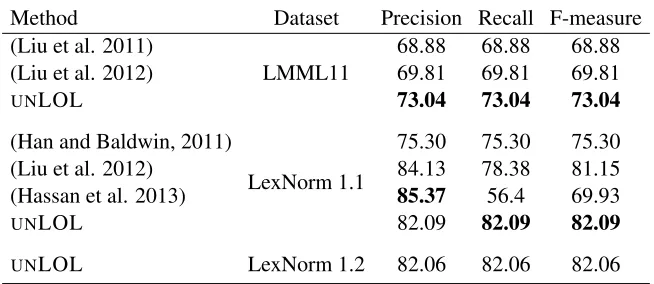
is normalized to finally in LexNorm1.1, but from the literature on African American English (Green, 2002), it corresponds tofixing to(e.g.,i’m finna go home). To address these issues, we have pro-duced a new version of this dataset, which we call LexNorm1.2 (after consulting with the creators of LexNorm1.1). LexNorm1.2 differs from version 1.1 in the annotations for 172 of the 2140 OOV words. We evaluate on LexNorm1.1 to compare with prior work, but we also present results on LexNorm1.2 in the hope that it will become standard in future work on normalization in English. The dataset is available athttp://www.cc.gatech.edu/ ~jeisenst/lexnorm.v1.2.tgz.
To obtain unlabeled training data, we randomly sample 50 tweets from the Edinburgh Twitter cor-pus Petrovi´c et al. (2010) for each OOV word. Some OOV words appear less than 50 times in the cor-pus, so we obtained more training tweets for them through the Twitter search API.
Metrics Prior work on these datasets has assumed perfect detection of words requiring normalization, and has focused on finding the correct normalization for these words (Han and Baldwin, 2011; Han et al., 2013). Recall has been defined as the proportion of words requiring normalization which are normalized correctly; precision is defined as the proportion of normalizations which are correct.
Results We run our training algorithm for two it-erations (pass the training data twice). The results are presented in Table 2. Our system, UNLOL, achieves the highest published F-measure on both datasets. Performance on LexNorm1.2 is very simi-lar to LexNorm1.1, despite the fact that roughly 8% of the examples were relabeled.
In the normalization task that we consider, the to-kens to be normalized are specified in advance. This is the same task specification as in the prior work against which we compare. At test time, our system attempts normalizes all such tokens; every error is thus both a false positive and false negative, so pre-cision equals to recall for this task; this is also true for Han and Baldwin (2011) and Liu et al. (2011).
It is possible to trade recall for precision by re-fusing to normalize words when the system‘s confi-dence falls below a threshold. A good setting of this threshold can improve the F-measure, but we did not report these results because we have no development set for parameter tuning.
mem-0 100000 200000 300000 400000
number of features
79 80 81 82 83
F-measure
λ=1e−04
λ=5e−05
λ=1e−05
λ=5e−06 λ=1e
−06 λ=0e+00
λ Dataset F-measure # of features
10−4
LexNorm 1.1
79.05 9,281
5×10⁻⁵ 80.32 11,794
10−5 81.00 42,466
5×10⁻⁶ 82.52 74,744
10−6 82.35 241,820
0 82.26 369,366
[image:9.612.86.526.68.221.2]5×10⁻⁶ LexNorm 1.2 82.23 74,607
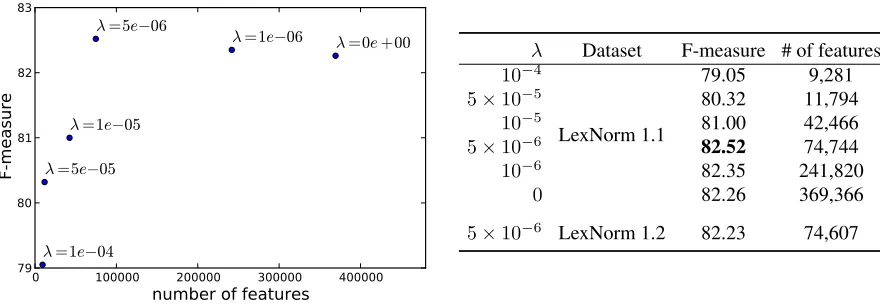
Figure 1: Effect of L1 regularization on the F-measure and the number of features with non-zero weights
ory limitations in the experiments producing the re-sults in Table 2, this issue can be addressed through the application of L1 regularization, which produces sparse weight vectors by adding a penalty ofλ||θ||1
to the log-likelihood. We perform online optimiza-tion of the L1-regularized log-likelihood by apply-ing the truncated gradient method (Langford et al., 2009). We use an exponential decreasing learning rateηk = η0αk/N, wherekis the iteration counter
andN is the size of training data. We setη0 = 1and
α= 0.5. Experiments were run until 300,000 train-ing instances were observed, with a final learntrain-ing rate of less than1/32. As shown in Figure 1, a small amount of regularization can dramatically decrease the number of active features without harming per-formance.
7 Analysis
We apply our normalization system to investi-gate the orthographic processes underlying language variation in social media. Using a dataset of 400,000 English language tweets, sampled from the month of August in each year from 2009 to 2012, we ap-plyUNLOL to automatically normalize each token.
We then treat these normalizations as labeled train-ing data, and examine the Levenshtein alignment be-tween the source and target tokens. This alignment gives approximate character-level transduction rules to explain each OOV token. We then examine which rules are used by each author, constructing a matrix
of authors and rules.2
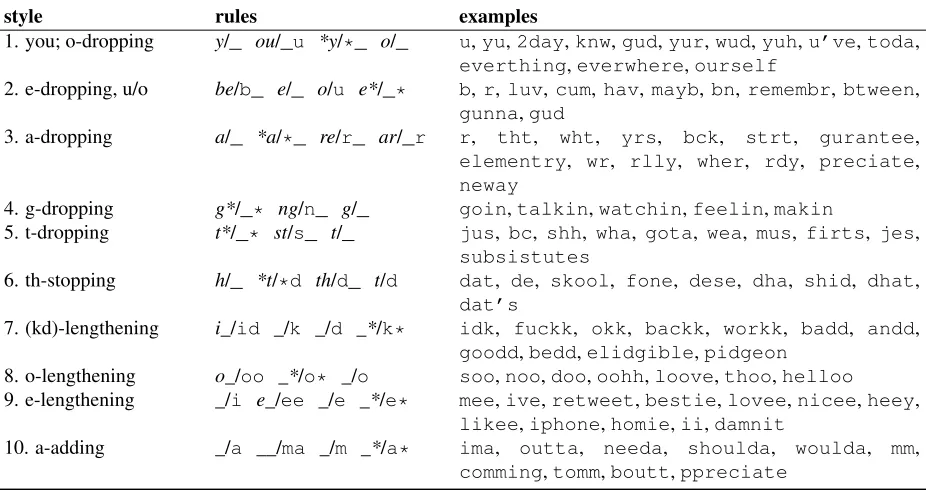
Factorization of the author-rule matrix reveals sets of rules that tend to be used together; we might call these rulesets “orthographic styles.” We apply non-negative matrix factorization (Lee and Seung, 2001), which characterizes each author by a vector of k style loadings, and simultaneously constructs kstyle dictionaries, which each put weight on dif-ferent orthographic rules. Because the loadings are constrained to be non-negative, the factorization can be seen as sparsely assigning varying amounts of each style to each author. We choose the factoriza-tion that minimizes the Frobenius norm of the recon-struction error, using the NIMFA software package (http://nimfa.biolab.si/).
The resulting styles are shown in Table 3, for k = 10; other values ofk give similar overall re-sults with more or less detail. The styles incor-porate a number of linguistic phenomena, includ-ing: expressive lengthening (styles 7-9; see Brody and Diakopoulos, 2011); g- and t-dropping (style 5, see Eisenstein 2013a) ; th-stopping (style 6); and the dropping of several word-final vowels (styles 1-3). Some of these styles, such as t-dropping and th-stopping, have direct analogues in spoken language varieties (Tagliamonte and Temple, 2005; Green, 2002), while others, like expressive length-ening, seem more unique to social media. The re-lationships between these orthographic styles and social variables such as geography and
demograph-2
style rules examples
1. you; o-dropping y/_ ou/_u *y/*_ o/_ u,yu,2day,knw,gud,yur,wud,yuh,u’ve,toda,
everthing,everwhere,ourself
2. e-dropping, u/o be/b_ e/_ o/u e*/_* b,r,luv,cum,hav, mayb,bn, remembr,btween,
gunna,gud
3. a-dropping a/_ *a/*_ re/r_ ar/_r r, tht, wht, yrs, bck, strt, gurantee,
elementry, wr, rlly, wher, rdy, preciate,
neway
4. g-dropping g*/_* ng/n_ g/_ goin,talkin,watchin,feelin,makin
5. t-dropping t*/_* st/s_ t/_ jus, bc, shh, wha, gota, wea, mus, firts, jes,
subsistutes
6. th-stopping h/_ *t/*d th/d_ t/d dat, de, skool, fone, dese, dha, shid, dhat, dat’s
7. (kd)-lengthening i_/id _/k _/d _*/k* idk, fuckk, okk, backk, workk, badd, andd,
goodd,bedd,elidgible,pidgeon
8. o-lengthening o_/oo _*/o* _/o soo,noo,doo,oohh,loove,thoo,helloo
9. e-lengthening _/i e_/ee _/e _*/e* mee,ive,retweet,bestie,lovee,nicee,heey,
likee,iphone,homie,ii,damnit
10. a-adding _/a __/ma _/m _*/a* ima, outta, needa, shoulda, woulda, mm,
[image:10.612.76.539.56.301.2]comming,tomm,boutt,ppreciate
Table 3: Orthographic styles induced from automatically normalized Twitter text
ics must be left to future research, but they offer a promising generalization of prior work that has fo-cused almost exclusively on exclusively on lexical variation (Argamon et al., 2007; Eisenstein et al., 2010; Eisenstein et al., 2011), with a few exceptions for character-level features (Brody and Diakopoulos, 2011; Burger et al., 2011).
Note that style 10 is largely the result of mis-taken normalizations. The tokensima,outta, and
needaall refer to multi-word expressions in stan-dard English, and are thus outside the scope of the normalization task as defined by Han et al. (2013).
UNLOL has produced incorrect single-token nor-malizations for these terms:i/ima,out/outta, and
need/needa. But while these normalizations are wrong, the resulting style nonetheless captures a co-herent orthographic phenomenon.
8 Conclusion
We have presented a unified, unsupervised statistical model for normalizing social media text, attaining the best reported performance on the two standard normalization datasets. The power of our approach comes from flexible modeling of word-to-word re-lationships through features, while exploiting con-textual regularity to train the corresponding feature
weights without labeled data. The primary techni-cal challenge was overcoming the large label space of the normalization task; we accomplish this us-ing sequential Monte Carlo. Future work may con-sider whether sequential Monte Carlo can offer sim-ilar advantages in other unsupervised NLP tasks. An additional benefit of our joint statistical approach is that it may be combined with other downstream lan-guage processing tasks, such as part-of-speech tag-ging (Gimpel et al., 2011) and named entity resolu-tion (Liu et al., 2012b).
Acknowledgments
We thank the reviewers for thoughtful comments on our submission. This work also benefitted from discussions with Timothy Baldwin, Paul Cook, Frank Dellaert, Arnoud Doucet, Micha Elsner, and Sharon Goldwater. It was supported by NSF SOCS-1111142.
References
S. Argamon, M. Koppel, J. Pennebaker, and J. Schler. 2007. Mining the blogosphere: age, gender, and the varieties of self-expression. First Monday, 12(9). AiTi Aw, Min Zhang, Juan Xiao, and Jian Su. 2006. A
Richard Beaufort, Sophie Roekhaut, Louise-Amélie Cougnon, and Cédrick Fairon. 2010. A hybrid rule/model-based finite-state framework for normaliz-ing sms messages. InProceedings of ACL, pages 770– 779.
Taylor Berg-Kirkpatrick, Alexandre Bouchard-Côté, John DeNero, and Dan Klein. 2010. Painless un-supervised learning with features. InProceedings of
NAACL, pages 582–590.
Samuel Brody and Nicholas Diakopoulos. 2011. Cooooooooooooooollllllllllllll!!!!!!!!!!!!!!: using word lengthening to detect sentiment in microblogs.
InProceedings of EMNLP.
John D. Burger, John C. Henderson, George Kim, and Guido Zarrella. 2011. Discriminating gender on twit-ter. InProceedings of EMNLP.
Olivier Cappe, Simon J. Godsill, and Eric Moulines. 2007. An overview of existing methods and recent ad-vances in sequential monte carlo. Proceedings of the IEEE, 95(5):899–924, May.
M. Choudhury, R. Saraf, V. Jain, A. Mukherjee, S. Sarkar, and A. Basu. 2007a. Investigation and model-ing of the structure of textmodel-ing language.
Interna-tional Journal on Document Analysis and Recognition,
10(3):157–174.
Monojit Choudhury, Rahul Saraf, Vijit Jain, Animesh Mukherjee, Sudeshna Sarkar, and Anupam Basu. 2007b. Investigation and modeling of the structure of texting language. International Journal of Document
Analysis and Recognition (IJDAR), 10(3-4):157–174.
Danish Contractor, Tanveer A. Faruquie, and L. Venkata Subramaniam. 2010. Unsupervised cleansing of noisy text. InProceedings of COLING, pages 189–196. Paul Cook and Suzanne Stevenson. 2009. An
unsu-pervised model for text message normalization. In
Proceedings of the Workshop on Computational
Ap-proaches to Linguistic Creativity, CALC ’09, pages
71–78, Stroudsburg, PA, USA. Association for Com-putational Linguistics.
A. Doucet, N.J. Gordon, and V. Krishnamurthy. 2001. Particle filters for state estimation of jump markov lin-ear systems. Trans. Sig. Proc., 49(3):613–624, March. Jacob Eisenstein, Brendan O’Connor, Noah A. Smith, and Eric P. Xing. 2010. A latent variable model for ge-ographic lexical variation. InProceedings of EMNLP. Jacob Eisenstein, Noah A. Smith, and Eric P. Xing. 2011. Discovering sociolinguistic associations with structured sparsity. InProceedings of ACL.
Jacob Eisenstein. 2013a. Phonological factors in social media writing. InProceedings of the NAACL
Work-shop on Language Analysis in Social Media.
Jacob Eisenstein. 2013b. What to do about bad language on the internet. InProceedings of NAACL, pages 359– 369.
Kevin Gimpel, Nathan Schneider, Brendan O’Connor, Dipanjan Das, Daniel Mills, Jacob Eisenstein, Michael Heilman, Dani Yogatama, Jeffrey Flanigan, and Noah A. Smith. 2011. Part-of-speech tagging for twitter: annotation, features, and experiments. In
Pro-ceedings of ACL.
Simon J. Godsill, Arnaud Doucet, and Mike West. 2004. Monte carlo smoothing for non-linear time series. In
Journal of the American Statistical Association, pages
156–168.
Stephan Gouws, Dirk Hovy, and Donald Metzler. 2011. Unsupervised mining of lexical variants from noisy text. InProceedings of the First Workshop on
Unsu-pervised Learning in NLP, EMNLP ’11.
Lisa J. Green. 2002. African American English: A
Linguistic Introduction. Cambridge University Press,
September.
Bo Han and Timothy Baldwin. 2011. Lexical normalisa-tion of short text messages: makn sens a #twitter. In
Proceedings of ACL, pages 368–378.
Bo Han, Paul Cook, and Timothy Baldwin. 2013. Lex-ical normalization for social media text. ACM
Trans-actions on Intelligent Systems and Technology, 4(1):5.
Hany Hassan and Arul Menezes. 2013. Social text nor-malization using contextual graph random walks. In
Proceedings of ACL.
Catherine Kobus, François Yvon, and Géraldine Damnati. 2008. Normalizing sms: are two metaphors better than one? In Proceedings of COLING, pages 441–448.
John D. Lafferty, Andrew McCallum, and Fernando C. N. Pereira. 2001. Conditional random fields: Probabilis-tic models for segmenting and labeling sequence data.
InProceedings of ICML, pages 282–289.
John Langford, Lihong Li, and Tong Zhang. 2009. Sparse online learning via truncated gradient. The
Journal of Machine Learning Research, 10:777–801.
D. D. Lee and H. S. Seung. 2001. Algorithms for Non-Negative Matrix Factorization. InAdvances in Neural
Information Processing Systems (NIPS), volume 13,
pages 556–562.
Fei Liu, Fuliang Weng, Bingqing Wang, and Yang Liu. 2011. Insertion, deletion, or substitution?: normaliz-ing text messages without pre-categorization nor su-pervision. InProceedings of ACL, pages 71–76. Fei Liu, Fuliang Weng, and Xiao Jiang. 2012a. A
broad-coverage normalization system for social media lan-guage. InProceedings of ACL, pages 1035–1044.
Xiaohua Liu, Ming Zhou, Xiangyang Zhou, Zhongyang Fu, and Furu Wei. 2012b. Joint inference of named entity recognition and normalization for tweets. In
Saša Petrovi´c, Miles Osborne, and Victor Lavrenko. 2010. The edinburgh twitter corpus. InProceedings of the NAACL HLT Workshop on Computational
Lin-guistics in a World of Social Media, pages 25–26.
Noah A. Smith and Jason Eisner. 2005. Contrastive estimation: training log-linear models on unlabeled data. In Proceedings of the 43rd Annual Meeting on
Association for Computational Linguistics, ACL ’05,
pages 354–362, Stroudsburg, PA, USA. Association for Computational Linguistics.
R. Sproat, A.W. Black, S. Chen, S. Kumar, M. Os-tendorf, and C. Richards. 2001. Normalization of non-standard words. Computer Speech & Language, 15(3):287–333.
Andreas Stolcke. 2002. SRILM - an extensible language modeling toolkit. In Proceedings of ICSLP, pages 901–904.
Sali Tagliamonte and Rosalind Temple. 2005. New perspectives on an ol’ variable: (t,d) in british en-glish. Language Variation and Change, 17:281–302, September.